“The hip-hop scene in the UK is quite straight,” says Kwesi Darko with a shrug. We’re drinking cider in The Unicorn on Camden Road. Tucked away behind the pub is New Rose Studios, where the 27-year-old Camden local, better known to production aficionados and beat fiends as Blue Daisy, spends most of his time locked away in a studio working on his forthcoming second album The Mask & The Aura.
Rudimental are four impossibly upbeat boys from Hackney who are the new kings of the all-night party anthem. Last year’s debut album ‘Home’ was packed with more bangers than a family-size toad in the hole, and it rightfully earned them three BRIT Award nominations: Best Group, Best Album and Best Single (for ‘Feel the Love’).
“Hey, you’re on the telly right now!” shouts a guy sneaking a crafty cigarette in the shelter of his own doorway. Every candidate who’s ever worked a campaign trail must have wished they could be in two places at once and, thanks to the magic of television, John Bickley is. On a bitterly cold Sunday morning, UKIP’s candidate in the Wythenshawe and Sale by-election is simultaneously haranguing his Labour opponent Mike Kane for “betraying the working class” on the BBC’s Sunday Politics and out knocking on doors in the Brooklands area of the constituency. “I was just laughing at you giving it to that Labour guy,” the man with the cigarette grins. “You really let him have it!”
Wythenshawe, in the south of Manchester, is staunch Labour country and although the more affluent Sale has a Conservative-controlled council, the Wythenshawe and Sale constituency is considered a safe seat. In 2010, Paul Goggins was returned for a fourth consecutive time with a majority of over 7,000; his unfortunate death on 7 January triggered this by-election. After finishing second in Eastleigh, South Shields and Middlesbrough, UKIP believe they can repeat the trick here and in doing so strike fear into Labour in what should be their heartland.
Last week, Peter Hain vocalised this fear in an interview with The Independent. “UKIP is hoovering up the anti-politics vote,” he said. “It goes beyond Europe and even beyond immigration. Some of it is plain bigotry. A lot of it is deep, deep antagonism to the political class, of which all the major parties are part. Under New Labour – and it has still not been wiped away – there has been a big disillusionment with us as a party among white working class traditional Labour supporters.”
A morning spent canvassing with Bickley proves Hain right. Granted, at the first few doors Bickley gets the expected responses: “I’m voting, but not for you. Get out.” Or “We’re Labour here.” Then the yet more disheartening: “Oh, there’s an election? How do you vote?”
However, as Bickley works his way around the streets, more and more people start to promise him their support. A 73-year-old pensioner is keen to talk to Bickley. She says she feels disillusioned with Labour and even more so with the coalition government. “It’s disgusting what they’ve done to the pensioners. They’ve taken money off us.” She brings up immigration straight away: “What are they letting all these foreigners come in the country for? This is what I can’t understand. People want jobs and they can’t get them because of the Polish and what have you.”
A handful of people tell Bickley they’ve given up on politics as a whole, but just as many present him with the opportunity to win them over for the same reason. He’s “not like the others”. Bickley has a smart response whenever people bring up Labour, as they inevitably do: that his family were Labour voters, but that he feels let down by them. This strikes a chord with a woman in her mid-forties. “I’ve always been Labour but I’ll vote UKIP this time,” she says. “My parents were Labour, and my husband’s parents. Just the last twelve months we feel totally let down with everything that’s happened.” As Bickley leaves, she shouts: “Good luck to you!”
Before long, two or three houses in a row start telling Bickley he has their support, and he’s tallying up as many yeses as nos. While privately he admits that he still expects Labour to win – particularly due to the short timeframe the election has been run over and the prevalence of postal votes, which Labour have been encouraging people to return early – it’s difficult to come away without a sense that UKIP are proving attractive.
“I think you’re picking up a flavour there of people’s frustration,” Bickley says when we duck back into the car to warm our frozen fingers. “They perceive the political class as ignoring them and favouring non-British citizens.”
It’s striking how rarely Bickley, or indeed any of the other UKIP activists on the campaign trail directly bring up withdrawing from the European Union. While the party may have formed back in 1993 as a single-issue party, their ambitions are now much broader. They campaign primarily on jobs – which are then linked back to immigration – and foreign aid, which they believe should be suspended in order to divert that money to help people affected by flooding in the South West.
There’s a sense that UKIP are attempting to be all things to all people. While they can campaign on tax cuts or social conservatism in the south, here they want to present themselves as a working class party to fill the void left by Labour. Bickley says this is why they’re taking votes from both sides. “These voters will never vote Tory,” he says. “Maybe 30 years ago they briefly lent Thatcher their vote, but I don’t think that will happen again. They’re looking around, and they’re starting to listen to what UKIP has to say.”
In the hotel bar at the Britannia Airport Hotel, UKIP supporters who have come from across the country to attempt to sway the undecided gather for pints of Tetley’s. It’s fair to describe them as enthusiastic amateurs, rather than cadres of slickly professional politicians – and that’s a badge they’d wear with pride. One thing mentioned time and again is a disillusionment with being represented by career politicians with no life experience outside of Westminster. James Hadfield-Hyde, who nominated Bickley and is out supporting his campaign, once presented a Granada television programme as ‘Lord Lust’. That’s certainly a life outside politics.
Tony Hooke, a county councillor from Hampshire, describes joining UKIP as an act of “rebellion”: “People are sick and tired of the way the Conservatives, Labour and the Liberals are fighting over the same middle ground. You could interchange any of the party leaders and they’d be at home in their new parties.”
Melanie Hurst, the Chairperson of UKIP’s Tynedale branch, adds that their mere presence has already invigorated local politics. “Where I live locally we’ve seen real improvements since we set up our UKIP branch. We’ve seen our MP out knocking on doors in villages that he’s never set foot in before in his life.”
Nigel Farage wants more. The party seem hopeful that a strong showing in May’s European elections could set them up to take a scalp in next year’s general election. Judging by the palpable anger against the political class on the streets of Wythenshawe, you wouldn’t want to bet against them pulling it off.
It’s easy to poke holes in UKIP’s belief that withdraw from Europe would be a panacea for all of Britain’s ills. For a start, this week the Financial Times dampened their mass immigration argument by pointing out that the number of European migrants in the UK is almost exactly balanced by the number of British people living in the EU. (2.2m people have gone in either direction, with over 1m Brits now living in Spain alone.) Furthermore, their uncomfortableness with same-sex marriage seems out of step with the country at large and it’s not clear that their proposed flat rate of tax adds up. But it almost doesn’t matter if their policies are thin and their budgets uncosted, as long as they can tap into the wellspring of anger at how remote Westminster appears when viewed from the rest of the country.
At first glance, there might appear to be little in common between Nigel Farage and Russell Brand, but in fact what’s powering UKIP at the moment is the same sense of dissatisfaction that Brand tapped into in his much discussedNewsnight interview. Farage would almost certainly have nodded along with Brand’s description of the “weariness and exhaustion from the lies, treachery, deceit of the political class” and his description of a “disenfranchised, disillusioned, despondent underclass that are not being represented by that political system.” The difference is, Brand isn’t on the doorsteps of Wythenshawe preaching about social justice. UKIP are, here to offer up Europe as a scapegoat.
There’s an alternative narrative to be told – one that talks about the value of European integration and the worth of foreign aid – but for the people out in the cold in Wythenshawe who are disillusioned with the mainstream political class as a whole, right now UKIP are the only game in town.
“Panorama of the City of Interzone. Opening bars of East St. Louis Toodleoo … at times loud and clear then faint and intermittent like music down a windy street…. The room seems to shake and vibrate with motion…”
That was how William S Burroughs introduced the world to the ‘Interzone’ in his heroin-and-hashish-soaked 1959 novel ‘Naked Lunch’. Those few bars of Duke Ellington were just the beginning. Rarely has a writer had as much of an impact on rock’n’roll as Burroughs, who was born 100 years ago today on 5 February 1914.
Kurt Cobain was such a big fan that he played discordant guitar on a spoken-word performance called ‘The “Priest” They Called Him’. The Beatles put him on the Sgt. Pepper’s sleeve. Jagger and Richards used his ‘cut-up’ technique of rearranging words from their notes to help them write lyrics for ‘Exile On Main St.’s ‘Casino Boogie’.
While Burroughs lived all over the world, including in London and in Tangier, in north Morocco, the city that inspired ‘Interzone’, he is perhaps most associated with the New York scene that he inhabited with fellow poets and writers like Allen Ginsberg and Jack Kerouac. In later life, these writers became icons to the city’s burgeoning punk rock scene, particularly songwriters like Lou Reed, Patti Smith and Richard Hell.
Sonic Youth’s Thurston Moore moved to New York as a teenager to become a part of this scene. I spoke to him about his memories of the author as an old man:
What was your first impression of Burroughs?
I used to live near him in New York City. I first moved to New York in ’77 and he was living in ‘The Bunker’ in the Bowery, which was a sort of mythological place that John Giorno, the poet, resided in. Burroughs lived downstairs from him, underneath the street. I would see Burroughs walking around sometimes in the Bowery. You saw all those cats walking around at that time: Allen Ginsberg lived down the street from me with Peter Orlovsky. I would see them holding hands on the subway, which was fascinating. It was more of a small town in New York City in those days. Everybody knew each other. You would see all the people who were celebrated in that scene, such as those guys, and then the punk rock people like Tom Verlaine and Richard Hell and Patti Smith. Everybody lived in sort of the same area. There was this little village, and the area was starting to draw attention to itself because of CBGB.
Was he going to the shows?
When I first saw William Burroughs he was sitting in the audience at CBGB when Patti Smith was playing. It was really interesting, because usually that club was just crammed full of kids my age, 19 or 20 years old. I remember going to see Patti Smith there, late 76 or early 77, and she was pretty much at her apex at that point. I remember the place being really crowded, and in the day CBGB had tables and chairs and they served hamburgers and there were dogs walking around. I don’t think it was really set up to deal with the capacity crowds that started coming in there. They got rid of the tables and chairs after a while, but they still had them then. I remember it being jam-packed and sitting tightly up against this little round wooden table, and all of a sudden people who worked there came into the middle of the room and just started yelling, pulling people out of the chairs and pushing people away. They slammed down a table right in the middle of the room and threw some chairs around it. Everybody was really upset while this was going on. Then they escorted William Burroughs and a couple of his friends in and sat them down very diplomatically at this table. I remember sitting there thinking: ‘Oh my God, it’s like William Burroughs’. He was this old, grey eminence in a tie and a fedora. He sat there and looked around at us. He didn’t seem to feel very guilty about taking up all this space. Then Patti came out in leather trousers and absolutely decimated the place. I remember that was probably the most fabulous Patti Smith performance I ever saw. She was on fire, knowing that William Burroughs was sat right in the middle of the room watching this concert.
There was another club downtown called The Mudd Club. I started going there and you’d never know what was going to happen. There were no flyers or anything. Sometimes it would be a band or some performance art or a poet or whatever. One of the first times I walked in there they set up a folding card table onstage and William Burroughs did a reading. He did it a few times during those first few years of The Mudd Club, 78-79. That was fabulous. It was a very neighbourhood thing, and he was really acerbic. Cutting and biting.
Around that time they had the Nova Convention, which was one of the first celebrations of William S Burroughs. John Giorno instigated it. There were things that happened all over the city but there was a main concert which I got tickets for. There was a cavalcade of people announced for it: Patti Smith, Frank Zappa, Keith Richards, Brion Gysin and all the literary people. Everybody was there, except Keith Richards never showed up. Much to the audience’s dismay, because I think he sold a lot of tickets! We were all excited to see what that was all about because it was purported that Keith Richards wrote the lyrics to ‘Satisfaction’ after reading William Burroughs. It was a great event, and that was the first real gracing of William Burroughs as a cultural icon. That was a wonderful thing.
Did you meet him?
I didn’t meet him until he moved away. He relocated to Lawrence, Kansas and Sonic Youth was on a little miniature tour opening up for REM. REM were playing huge arenas and Sonic Youth would come out and the audience would sit there confounded. That happened all through the tour. It happened that we were in Kansas and James Grauerholz, who was his assistant/confidante/lover was a Sonic Youth fan. He was also possibly an REM fan, and Michael Stipe certainly moved in literary circles. He was a huge Patti Smith fanatic, as we both were, although she had disappeared from the scene at that point. She had married Fred Smith and to all intents and purposes she had vanished from the culture as an active presence. So we got this invite from Grauerholz for REM and Sonic Youth to visit Burroughs. So we went and that’s where we met him. I always remember walking into his little house in Lawrence, Kansas, which was one of these houses that Sears Roebuck had sold during the Fifties as Do-It-Yourself build-your-own house deals. It was quite interesting. He was extremely welcoming. He was elderly. He had magazines and books everywhere about knives and guns. That was a little off-putting. I didn’t know what to think of that because that was the last thing I was interested in. I tried to engage him in conversation: ‘So you’re obviously really into knives and guns?’ I asked him if he had a collection and I think he said yes. I asked him if he had a Beretta and he said: ‘Ah, that’s a ladies’ pocket-purse gun. I like guns that shoot and knives that cut.’ He was pretty sweet. I remember Michael Stipe had a hat on and he was going to toss it down. William thought he was going to toss it on the bed so he said: ‘No, no, no, don’t throw it on the bed!’ He really believed in these superstitions. I always remember that, even though of course Michael said: ‘I was never going to throw it on the bed. That was not my intention.’ Anyway, we had a nice visit with him. We visited his Wilhelm Reich orgone machine in the back yard. I sat in it and it was full of cobwebs.
Sonic Youth went back independently a few years later. It was right after Kurt Cobain had died. They’d done that recording together. I always remember William talking to me about it. He had this look in his eye like: ‘Why would anybody take their own life?’ He couldn’t make sense of it. Why would you do that? Why would you disturb your energy and your cosmic soul like that? You don’t do that. You protect it. You have to fight for it. You can do whatever you like, you can take heroin your entire life, you can be an alcoholic or you can be a creep, but you don’t eradicate yourself. You don’t kill yourself purposefully. He had this look on his face that was very childlike. He was questioning why anyone’s psychology would take them there? I said, ‘I don’t know, but I think some people get overwhelmed by their own bio-chemical, depressive feelings. They feel like they can’t take it. They get really lost. It’s nothing we can intellectualise.’ That was interesting. We talked. My daughter was in her first year, I remember. She was starting to make some noise in the house while he was talking. She was in my arms and she was whining. He put his hand up towards her face. I thought: ‘Uh oh! I need to stand tall here’ but basically he just did this little hand movement and she immediately quieted up. It was like this magician’s hand movement. He was a father. His son died tragically while he was still alive. I think William dealt with a lot of personal horrors of intimacy, with his wife, his son and his own personal and sexual feelings.
How much impact did his work have?
He was very radical to me as a writer. I first read about him in rock’n’roll publications, especially Creem Magazine in the early Seventies when Lester Bangs was the editor. He would talk about William Burroughs in conjunction with Lou Reed or the Velvet Underground, and certainly Patti Smith would reference William Burroughs. Right around 73 or 74 I started reading him. I read it as prose poetry. There’d be these repetitive lines that would be added to rat-a-tat-tat. He had this American gangster kind of language. It was very curious and intriguing, and it was very musical, what he wrote. It was somewhat like reading Kerouac. He had a complete knowledge of literature but also a disregard for regulations.
Did he influence your own songwriting?
I think he influenced me. I think that describing things that were horrific, but transforming them into romantic notions, I think it was that. I think I was probably more inspired by people he had inspired. Certainly writers like Patti Smith, Lou Reed, Tom Verlaine and Richard Hell. Even John Lydon was influenced by him. Characters like Johnny Yen. I think certainly Iggy Pop was very inspired by Burroughs. Those songs on ‘Lust For Life’ and ‘The Idiot’. Then journalists like Richard Meltzer and Lester Bangs.
At the Nova Convention he read this poem that he introduced by saying it had been inspired by a trip to London. He had this whole connection to the London underground of radical poetry, people like Jeff Nuttall. Then he was also publishing pieces for men’s magazines like Mayfair. He was living on Drury Lane and being part of the scene around the Indica Bookstore that Barry Miles had. He was a big part of the London scene, hanging out with Ian Sommerville, Iain Sinclair and all those guys. London was a big part of his history. For me now living in London it’s something I really relate to, Burroughs’ time here, as an American in London. I remember at this reading he said: ‘There’s a rock’n’roll group in London called the Sex Pistols who have a song called ‘God Save The Queen’. I’ve written my own song. It’s called ‘Bugger The Queen’. It was a really anti-authority, anti-royalty and anti-privilege piece of writing. It was wonderful, because a lot of people in New York, a lot of Americans, don’t really have much consciousness about royalty at all. It’s this funny thing that happens in the rest of the world that happens in Walt Disney films. It has no effect in any cultural way. The whole audience was chanting the phrase ‘Bugger The Queen’ every time he said it. ‘Bugger The Queen!’ I’ve always wanted to record that song, but I don’t want to get thrown out of the country now I live in England.
I think the idea of writing under the influence of genuine vision, and to be locked away with your typewriter and just let it roll like that, will always make him an influence on new artists. I think his influence continues, and certainly with this centennial this year it seems that lots of people are interested in representing different aspects of William Burroughs’ life, here in London, New York and Boulder, Colorado. That’s where NaropaUniversity is, where he taught and where I lecture every summer. This year I’ll be doing a course a which focuses on Burroughs’ relationship to rock music. There’s a real relationship there. There are bands who named themselves after his writing. Soft Machine. Matching Mole, which comes from the French for Soft Machine. Even punk bands like Dead Fingers Talk. Iggy Pop singing songs like ‘Here comes Johnny Yen again’. Even the phrase ‘heavy metal’ comes from his ‘heavy metal kids’, which is something Lester Bangs brought into the lexicon of rock’n’roll. I talk about all that, and any music that is trying to exhibit ‘Burroughsian’ ideas. We look at what that means. It comes out of the fall-out of ‘hippy’ and utopian desires and all this kind of thing. There’s a kind of anger and it takes the piss out of this dream of utopia. It’s somewhat naïve to the powers of the establishment, which is where people like McClaren and the Pistols and The Clash started to come in. For any of us coming in at that point that was what we had to do if you had any interest in defining yourself. He was really central to that, and Allen Ginsberg as well.
He interviewed Jimmy Page for Crawdaddy magazine. Page was into mysticism and Aleister Crowley’s writing. Burroughs was certainly interested in metaphysics and outer space. He was very interested in life beyond the human realm. He was very interested in Scientology as well. He researched all this stuff. I don’t think he was a cultist, because I think he probably took that line that he wouldn’t want to belong to any group that would have him as a member.
Did you use his ‘cut-up’ technique?
The cut-up process was definitely something I used, and I do that not only with literary language but with music as well. You’re working traditionally with verses and choruses and bridges, but something I’ve always been interested in is what happens if you take things and move them around. In a way, that was always the modus operandi of Sonic Youth. There was always talk of Sonic Youth being this experimental band in terms of guitars or other things, but actually the most experimental thing about the band was song structure. How we took traditional song structure and would try techniques with it. One of those techniques was certainly that cut-up technique. I would certainly do that with lyrics. I would take pieces from different notebooks and I would cut them up to create new meanings, or a new unity. I always liked that. I think it was really successful. I thought it was really interesting when I read an interview with Jagger talking about doing that on ‘Exile on Main Street’. He found it to be a successful strategy for lyric writing.
An abridged version of this interview appeared in NME, 8 February 2014 under the headline ‘The beat goes on’.
“We’re climbing down off of Mount Olympus to speak with you,” says Debbie Harry with a laugh, accepting Blondie’s Godlike Genius Award with all the graciousness and wicked humour you’d expect from a genuine pop culture icon. “No, it’s great you know. It’s out of proportion, but it’s nice to be recognised. It’s outstanding, really.”
It’s certainly no less than they deserve. This year Blondie celebrate their 40th anniversary as a band, having formed as an underground punk band in New York in 1974 before grasping widespread attention with the release of their classic 1978 record ‘Parallel Lines’. On their four decade journey from Greenwich Village and the Bowery they’ve become muses for Andy Warhol, made disco classics like ‘Call Me’ with Giorgio Moroder and even helped New York’s burgeoning hip hop scene reach a wider audience with the Fab Five Freddy-referencing ‘Rapture’.
All of which more than prepares them to assume their rightful place in the NME pantheon. “It’s an outstanding list,” says Debbie of the other Godlike Genius recipients. “I also find it particularly interesting that there aren’t many Americans who’ve been given this award before, so that’s flattering.”
“Yeah, I mean, the Beach Boys aren’t even on there, so there you go!” adds guitarist Chris Stein. “We’ve always had a special relationship with the UK. I love The Cure and listen to their stuff all the time. And The Clash is The Clash, you know? What more can you say about them?”
“There are a lot of ‘rock’ bands on the list so far,” says Debbie, who considers their inclusion even more of a compliment given how musically varied their own output has been. “We’ve always done different things that we like and that reflect what we’re influenced by. We are a metropolitan New York City band whose influences come to bear in the music that we make. Now we have so much more ‘world’ influence on us through the internet, and I think those sounds have become something distinctively part of Blondie.”
So just like The Cure, The Clash and all the rest, we’re giving Blondie the finger. In the best possible way, of course. Where are they gonna put it? “Awards tend to just get strewn about. My Rock’n’Roll Hall of Fame thing is just up on a shelf with a bunch of toys, smoking rabbits and my Andy Warhol skull. Somehow I’m in possession of the actual skull that he used for his paintings,” laughs Chris.
“That’s appropriate, I think,” says Debbie. “I have mine on a shelf with a couple of little Warhol dollar signs.”
As for the Awards Show night itself, the band feel like they’re in finely-tuned form ahead of their performance. “I think this is the best version of Blondie that we’ve had of all time,” says Debbie. “All the guys are really great players and that means when I walk out there I feel really excited about playing. I look forward to playing new songs, having a good time and working with the audience. I think in our earlier days we were often distracted by other problems or struggles that we were having, but now we’ve sort of got through a lot of the difficulties that young bands often go through establishing their business. We’re just glad to be playing music, really.”
Having survived so long in the entertainment business, they’ll have a few pearls of advice to dish out to the NME Newcomers. “My main advice is always that enthusiasm is not enough,” says Chris. “One has to practice also. You have to work on your skills. Enthusiasm helps but it’s just part of the equation. The model has changed since we were starting out. When we started there was nobody in rock and pop who was in their 50s or 60s. The only people who were that age were the old blues guys, who were also my heroes. In fact, when I was a teenager all my heroes were 60 years old anyway. People like Bukka White and Muddy Waters.”
That’s not to say that Blondie are ready for the Rock’n’Roll Old People’s Home just yet. This year they have a new album called ‘Ghosts Of Download’ coming out alongside a reworked greatest hits package dubbed ‘Blondie 4(0) Ever’. Chris is also putting out a book of his photography alongside an accompanying exhibition. These Godlike Geniuses have no plans to hang up their halos. “I know we’d like to keep recording and making music,” says Debbie. “Whether we can actually drag our withered old bones out onto the road to promote it in the future is another story, but right now I feel pretty good about doing shows.”
As you’d expect, the veterans of New York’s CBGB and Studio 54 are looking forward to the NME Awards party as much as the performance. “I always look forward to meeting people who I’ve never met before,” says Debbie. “But then again I really wish that people like Joe Strummer could be there. There’s a bittersweet aspect to that.”
“I still always get star-struck,” adds Chris. “I’m just as much of a fan as the next guy.”
“It should be a nice, chaotic night,” says Debbie. “I imagine there’ll be a lot of poking fun at people. It’ll be good to hang out, to see old friends, to be honoured so nicely and to play music. What could be better?”
Say you’re searching Spotify for Lauryn Hill so that you can jam out to The Miseducation of… in the privacy of your own bedroom when you stumble across a song called “Lauryn Hill Is Like Awesome And Great”. You’re curious, so you stick it on. Matt Farley just earned $0.005.
Or maybe you’re bored and decide to stick in “Kurt Vonnegut” to see what comes up. Or “David Beckham” or “Ryan Gosling”. Or you’re really in need of a very specific apology song like “I’m Sorry I Forgot Our Anniversary”. Every time your curiosity gets the better of you, Matt Farley gets $0.005. More if you download it off iTunes.
Sure, the margins are so low that it would take an insane number of plays to add up to a substantial amount of money. It would take millions of plays and downloads, and that would require thousands of songs, on a ludicrous breadth of topics. It would take a superhuman amount of effort to make that numbers game work in your favour.
But last year, Matt Farley earned $23,500 (about £14k) from his music. He managed that because in the last six years Farley has written, recorded and released over 14,000 songs. He puts them out under a variety of assumed band names, so it’s not immediately apparent quite how prolific he is. He sells them and streams them on every available site, and all those $0.005s add up. Not to a fortune, admittedly, but enough that he can justify spending half his working week knocking out songs from his home in Danvers, just outside Boston in Massachusetts. I wanted to talk to Matt because although he might dream of being recognised as part of the “best pop/rock duo since Hall & Oates”, his absolute dedication to DIY music is probably the best thing since Lil B created 150 MySpace pages.
It’s good to start the year as you mean to go on, and Superfood saw in 2014 onstage surrounded by mates, covered head-to-toe in champagne. “We were playing the Club NME party with Wolf Alice and Swim Deep,” explains singer Dom Ganderton. “We decided we should cover Robbie Williams’ ‘Millennium’ at about one in the morning. Aussie and Cav came on and there was so much champagne everywhere the stagehands were going crazy. I had my phone in my hand trying to read the lyrics of the second verse. I must have looked like such a plonker.”
The revolution in Egypt that would eventually see Hosni Mubarak run out of Presidential office and lead to the country’s first democratic elections began three years ago, on the 25th of January 2011. That day an MC named Sadat, then aged 24, was among the hundreds of thousands protesting on the streets of Cairo, looking for change. When he got home that night, Sadat couldn’t sleep.
“I started writing, and the next day I went to Figo’s house to write and compose the song,” he explains with the help of a translator, sat in a back room at the Rinse FM studios in east London. “It was about corruption and killing and everything that I had witnessed.”
Sadat, along with his collaborator DJ Figo and a handful of others, was already at the forefront of an underground dance music scene which many people call “electro chaabi” (which roughly translates as “electro folk”) but which he’d rather you call “mahraganat” (“festivals”), because he thinks of it as something new, and not just an electro version of the music that’s gone before.
‘It’s got lust and love and danger and jealousy on it. It feels “red”.’ Sadly, Katy B is not talking about the Big Red pizza bus where we’re sat in Deptford. She’s describing her second album ‘Little Red’, the follow-up to her rave-igniting, Mercury Prize-nominated 2011 debut ‘On a Mission’. After digging in to a rocket-loaded Giardiniera pizza, the south London R&B icon opens up about dating, dancing and her past life as Peckham’s answer to Vinnie Jones.
“How, unless you drink as I do, can you hope to understand the beauty of an old woman from Tarasco who plays dominoes at seven o’clock in the morning?”
Malcolm Lowry the author of Under The Volcano, a strange and beautiful novel from which that quote is taken, was a dipsomaniac, which is a lot like being an alcoholic except you don’t have to go to meetings. Something about his tale of a Mescal-soaked Englishman living out his final days in the Mexican heat must have appealed to The Family Rain who stole the title for their debut record, which is out next month.
The Family Rain are a rock’n’roll band in the old fashioned sense . They’re called ‘The Family’ because they’re three brothers and ‘Rain’ after Sister Rosetta Tharpe’s timeless blues number “Didn’t It Rain”. The oldest brother, Ollie, plays guitar riffs that strut and stumble like Keith Richards leaving a nightclub. Tim beats the living shit out of the drums while his identical twin Will plays bass and wails like Jack White in a custody hearing.
“It’s like any normal city. My friend has just opened a club which is playing dubstep – real dubstep, not EDM – but on top of that there’s hipsters, super mainstream people, midget boxing, strip clubs, crackheads who like rock and nu-metal, places where you can get shrooms and just get lost…”
Welcome to Manila, capital of the Philippines and home to your tour guide: 23-year-old producer Idris Vicuña, better known as Eyedress. Where does he fit into all that? Nowhere exactly. Well, okay, maybe the shrooms part. “I’ve definitely ventured a lot of times,” he laughs. “All the stuff I’ve done here inspires me to make music. I’ve entered the black hole, I’ve entered the light and I’ve entered the psychedelic side. It’s fun out here.”
For the most part, Idris prefers to invent his own world. Born in the Philippines but raised in Arizona from the age of 5, he first really discovered music when his parents moved him to California at 13 and he started playing bass in a crusty skater band with distinct “Crass vibes.” When he moved back to Manila, in 2005, he formed a new band called Bee Eyes with his friend Julius Valledor. It was Julius who introduced him to making hip-hop beats. “It was just trial and error,” Idris explains. “I was just making whatever sounded good. And then eventually I started to think what it would be like if I sang over the beat.”
That solo production project, now called Eyedress, drew the attention of labels worldwide. Julius was still involved too, directing the Drive-meets-Enter The Void video for ‘Nature Trips’, the slice of blessed-out witch house which would become Eyedress’ calling card. “Before I took music seriously, I was trying to be a filmmaker,” explains Idris. “I guess through that I developed my eye and with my limitations, meaning lack of money, I developed my own way of seeing the world. I see people out in the Philippines trying to do films with huge budgets but they make the shittiest stuff. That inspired me to make use of what I had. My music videos were things that me and all my friends could do together because we were always frustrated with the stuff we were being fed out here so we thought we’d try and give it a shot.”
Musically, Idris draws from artists like J Dilla and the acts on Flying Lotus’ Brainfeeder label as well as UK producers like Joker and Darkstar. He also cites Frank Ocean and Odd Future as being big influences, adding: “Tyler is a huge inspiration because he started out rapping over his own beats and making his own videos for it, so for me that inspired me.” Although his music is made and recorded out of his bedroom in Manila, he doesn’t think is sound is particularly Filipino. “There’s some really cool old music,” he says. “And I guess the fact that it comes from the Philippines makes it Filipino but all inspirations aren’t from here, I’m not gonna lie about that. It’s not awesome out here for music, man. There are only a few cool people here that inspire me. Aside from that, a lot of musicians are years behind because they don’t really know much about music out here. Music here is made by privileged people. Lower class people aren’t really heard. Bands here tend to be either really ballin’ or really doing it on the cheap, so we just tried to put the best of both worlds.”
He says his debut album is pretty much done, and is due to be released this April. It should feature about half-a-dozen songs he sings on with the same number of collaborations with female vocalist Skint Eastwood – although he says people still get mixed up trying to tell them apart. “They think she sings ‘Nature Trips’ and I’m kind of embarrassed because I sing that! I was trying to be like Nite Jewel.”
When international artists do come calling, he’s right there. Bee Eyes have supported Mac DeMarco at their Asian dates, and as Eyedress he’s supported both Grimes and How To Dress Well. The latter show which Idris’ enjoyed with true rock star decadence. “I was really fucked up at the time!” he laughs. “So that was fun. I was on a molly, I was drunk as hell, but it was good because I felt like I was a like a rapper or some shit. I’m a singer, but when I’m performing live I try to just be punk. No-one ‘wilds out’ here. Everyone just stands there with their arms crossed. I’m out here trying to do my thing even if no one cares!” This February, Eyedress heads to these shores to play an NME Awards Show at London’s Sebright Arms. Time for people to wild out.
Originally published in NME, 11 January 2014
NME Radar Artist Of The Week, 7 December 2013:
“It’s really sad because the government doesn’t really do anything,” sighs 23-year-old Filipino songwriter and producer Idris Vicuña over a Skype connection from Manila, well north of the areas affected by the recent typhoon which ravaged the country. He shakes his Beatles mop top as he describes how his countries problems extended well beyond the recent catastrophe. “There’s a bigger problem out here than the typhoon. If you see the way our cities are built and look at our traffic, you’ll see that everything’s poorly planned. The only thing to do is to encourage everyone to work together and be loving towards each other.”
As Eyedress, he’s doing just that with his music. Born in the Philippines, Idris moved to the United States when he was five, living first in Arizona and then in California as a teenage, where he discovered music mainly through skate videos. After moving back to Manila in 2005, Idris continued to make music, both in indie band Bee Eyes and his own solo electronica project Eyedress. It’s with this blessed-out witch house that he caught the attention of Abeano, the indie label that broke the likes of Vampire Weekend and Iceage.
What proved really unforgettable is his homemade video for ‘Nature Trips’, blending lo-fi aesthetics with lashings of ultra-violence. “Before I took music seriously,” Idris explains, “I was trying to be a filmmaker. I had lots of limitations, particularly in terms of money, but I developed my own way of seeing the world. My music videos were things that me and all my friends could do together because we were always frustrated with the stuff we were being fed out here.”
His debut EP, out now, sees Idris teaming up with Skint Eastwood, who provides feminine vocals to counterpoint his own, although not everyone can always tell: “People get it mixed up,” Idris laughs. “They think she sings ‘Nature Trips’ and I’m kind of embarrassed because I sing that! I was trying to be like Nite Jewel.” He’s ended up sounding like nobody except himself. Keep your eyes on what Eyedress does next.
“She’s super-cute. I want you to put that in there in case she reads this!” Chance The Rapper laughs as he remembers one of the most surreal moments he had in 2013, a year that wasn’t short on surreal moments. He was playing a show in LA in November when Madonna came to check him out and hang out backstage. “It was cool,” he says, gathering his composure. “Madonna’s like Michael Jackson and Prince. She’s in that category. Meeting her was exactly how you’d imagine it would be. She’s flirty too, and sexy A F. Do you guys say ‘A F’? It means ‘as fuck’. She was sexy as fuck.”
Madonna isn’t the only person who’s ear Chance caught last year. He turned 20 on April 16th 2013 and then, two weeks later, Chancellor Bennett dropped his second mixtape, ‘Acid Rap’, as a free download. A wildly inventive mix of soul, acid jazz and his idiosyncratic rhymes, it wasn’t long before it had been downloaded 300,000 times. It even ended up making the Billboard charts because so many people were buying bootlegs of it by mistake. The success of ‘Acid Rap’ opened the door for him to travel the world, touring America and coming to Europe twice. He did the whole thing as a fully independent artist, typically just travelling as a trio with DJ Oreo and Pat, his manager, who everybody obviously calls Pat The Manager.
The excitement caused by ‘Acid Rap’ tells us a lot about where hip-hop is heading in 2014, and what Chance’s place in it is. Everyone’s been looking for people to challenge rap’s entrenched norms, and last year it was Kendrick Lamar who made the leap from an acclaimed mixtape to seriously challenging for a place among the pantheon of great rappers. Chance has the potential to go even further. He’s different. Chance has Kendrick’s knack for turning a finely-tuned phrase, but he also has Eminem’s delivery and Kanye’s ear for production – oh, and he’s funny as hell too.
When ‘Acid Rap’ dropped it passed the acid test: people wanted in to the world that Chance was creating. From that moment on, his life changed forever. What followed was eight months of solid touring, and now, back at his parents’ house in Chicago, he finally has a minute to sit and reflect on what’s happened. “I’ve seen some dope shit,” he tells me. “Before this year I hadn’t really been anywhere other than a few States in America. Americans don’t travel that much. I mean, some people do. White people do, but not everybody. This year I went to Europe twice, once with Eminem and once with Macklemore. I’ve seen a lot of shit, but I’m burning my body up. I had this belief that I had this unlimited amount of energy, but that shit ain’t true. I need a break!”
Chance’s New Year’s resolutions are to take things a little easier. He’s moving into a new place in LA with his mates – except in Chance’s world, those mates include last year’s Mercury Prize winner James Blake. “I’ve never lived anywhere else other than this house, the one I grew up in in Chicago,” he explains. “I’m leaving home finally, so it will probably be like being on vacation for the first couple of months. Then I’ll start figuring out what kind of music I’ll be making.”
Blake and Chance have become friends, collaborators and co-conspirators since first meeting at SXSW last year, and their plan for 2014 is simply to start working together and see who else the wind blows in: “We’re probably going to make a bunch of shit every day,” Chance explains. “I don’t know what we’re going to do with it. We might give some shit to other artists. We’re getting a compound, so we figure we might invite people round to the crib and make some music in the house, then kick them out and bring in some new people.”
Right now, though, there’s something more important to Chance than locking himself in a studio to finish an album, and that’s living his life. He spent so long touring ‘Acid Rap’ that it left him philosophical about the way art has swallowed up his young life whole. “This kid told me that: ‘Art is the articulation of existence’,” he says thoughtfully, then pauses as waits for this to sink in. “It’s like a regurgitation of what the world is and what living is. Art is like… did you ever see a slug move? And it leaves that filmy shit behind? That’s what art is. Even when you’re surrounded by art, and all these people are coming to my concerts to see me rap, you’ve got to remember that existence is the most beautiful thing. I want to go and see some concerts. I want to go surfboarding. Real life is awesome. I’m eventually going to go back to making my art and doing all that shit, but I want to just exist for a second. I want to clear my head.”
It’s no surprise that Chance feels the need to take some time out at the start of the year. What do you do next after all your dreams have come true? “It’s been very overwhelming,” he says. “I grew up trying to convince my parents that I was a rapper, or trying to convince my friends that I was a rapper, and no matter how talent shows I played, it was never too real. Now, every time I sell out a show or I’m in a magazine that people can hold and touch, it gets more real to everyone else. I don’t really know what my endgame is anymore.”
Chance’s options remain wide open to him because he still hasn’t signed any sort of record deal. This must make him easily the most famous unsigned artist on the planet, but it also means he doesn’t have the buffer of having a record label around him for support. “When I started touring it was just me, Pat The Manager and DJ Oreo going from country to country and city to city,” he explains. “Now it’s 18 people and all of them are on salary. It’s becoming more and more of a tangible thing. Everybody wants a picture for their friend, or wants to get their friend into the show, or their homie that makes music wants to get my email. It’s not the end of the world.”
Every so often his thoughts return to taking time off: “I’m having hella fun, I just know that I’ve got to get away. I need like two months to just sit down on the beach and throw rocks into the water… and fuck some bitches! And do some drugs! Or not do some drugs! Just do whatever the fuck I want. I feel like now everybody’s making me do something everyday, and I need some space so I can make a way hotter next project.”
The multi-million dollar question, at this point, is whether his life would become instantly easier if he signed a deal or if that would mean signing away his individuality. When I ask him whether he thinks his problems would go away if he signed, he doesn’t miss a beat: “I think about it all the time, man.” He pauses, still not sure of the answer. “I can think of a million different things that would have been easier if I had that money. Do you know how many of my friends have signed? Like… everybody. Everybody I know has some sort of deal, whether it’s a record deal, a publishing deal or a distribution deal. Motherfuckers got money. I ain’t got no money. All the money I make comes straight from rapping, plus a little merch money.”
On the other hand, he doesn’t believe he’d be even close to where he’s got himself today if he were tied to a conventional deal. “Do you think any label would have let me go on a headlining tour across the nation, playing 2,000-capacity rooms, without dropping an album or even releasing the name of an album?” he asks. “I was supposed to sign last year, in December. I had a deal on the table that I was so ready to go for. I was playing them ‘Acid Rap’ and they were talking about putting it out as an EP, but the truth is nobody would have heard it! They would have been telling me to do featured appearances with other artists, making me work on this and that and definitely not letting me tour! I’d have been in the studio every day until the album was done.”
The point is, Chance is reinventing being a rapper just like ‘Acid Rap’ reinvented the art of the mixtape. “Everything that I’m doing hasn’t been done before! Everything we do, we’re the architects of it. We’re the new architects. We’re what motherfuckers are going to start modeling their shit after, but it hasn’t been done before. That’s what makes it so scary.”
He’s got a lot of options ahead of him. He could release a major label debut of ‘pop smashs’. He could release a record of weird experimental acid jazz on an indie. As he puts it: “I’ve been anti-label for so long, but I could sign in 2014! Or I might not sign in 2014! I might quit making music in 2014 and go to college! Who fucking knows?.”
If he chooses right, he’s gonna be a seriously big deal in 2014. Chance The Rapper is gonna be big A F.
Most people wouldn’t choose to record a new album in a country where extremist militants last year attempted to outlaw music itself, but Damon Albarn isn’t most people. The Blur frontman rounded up a motley crew including Brian Eno and members of Metronomy, Django Django and Yeah Yeah Yeahs to travel to Bamako, in conflict-torn Mali in West Africa. There they convened with a group of African musicians at a youth club where they recorded a fascinating and funky new record named after the club itself: ‘Maison Des Jeunes’.
It’s part of the Africa Express project, but while they’ve visited Ethiopia and toured the UK by train in previous years, producing a whole albumwas a new challenge. Even as an Africa Express veteran, Yeah Yeah Yeahs’ Nick Zinner was blown away by this year’s adventure: “I’ve never been a part of anything like this at all. It was non-stop music: writing and recording all the time. It was one of the most inspiring experiences of my life.”
Zinner plays on one of the album’s standout tracks ‘Soubour’, joining the group Songhoy Blues for their first ever studio session. The band formed last year in opposition to the ban on music which the jihadist rebels who controlled the north of the country were trying to enforce. “The band are originally from Timbuktu,” Zinner explains, “but they fled because of the absurd law.”
It took Zinner some time to adjust to his new studio surroundings. “They literally had one amp,” he explains. “Then one acoustic guitar and a bunch of microphones, but these guys came in and just immediately started playing and jamming. It’s an amazing song with a phenomenal guitar riff so I loved it immediately from the first time I heard them play.”
Albarn adds backing vocals to the track, but Zinner says the singer is happy to let all of the participating musicians do their own thing. “He’s incredibly open and encouraging and inspiring,” he says, “Ultimately it’s his undertaking but he wants everyone to be equally involved.”
He says he was more star struck by having Brian Eno join the trip: “It’s so mind-blowing that he’s right there, but so cool because he’s such a lovely guy. In the back of your head you’re like: ‘Fuck! It’s Brian Eno!’”
So can we expect the next Yeah Yeah Yeahs record to be full of Malian rhythms and songs of resistance against those who seek to banmusic? Maybe. “We recorded some incredible music,” says Zinner. “I don’t know specifically what will come from it, but with so many rhythms and songs around and resonating with me then it’s going to come out in some way.”
People say that port gives you monstrous hangovers. People would be wise not to say that to Tim Stanley-Clarke. “Bullshit!” is the port expert’s robust assessment. “And I speak from years of first-hand research.”
Stanley-Clarke, who works for the Symington Family, owners of various famous port producers including Dow’s, Graham’s and Warre’s, is on a mission to see Port restored from its current position languishing as a night cap – the real reason he thinks it gets the blame for hangovers is that it tends to arrive at the tail end of a night of drinking – to a wine to be enjoyed over a long and sumptuous dinner.
Fortunately, we met at Hawksmoor where they do that sort of thing rather well. While the Graham’s Fine White Port, served with scallops, is too sweet for our taste, the Graham’s 20 year Tawny Port makes Stanley-Clarke’s case. It’s rich with a long, smooth finish and not entirely unreasonable at £35 a bottle. It holds its own paired with Hawksmoor’s Tamworth Belly Ribs, which is so soft and tender you lament for every time you have to eat pork cooked any other way.
The real star of the night though is Graham’s Quinta dos Malvedos 2001 Vintage Port, which comes exclusively from the company’s famed flagship vineyard and is blessed with a rich blackberry taste, a long finish and a £24 pricetag. And the best part? No hangover.
“Where’s the doorman? He was supposed to be here by now.” It’s a Wednesday night in Nottingham, and a student house has been cleared of all its valuables and breakables. In the kitchen, a makeshift stage has been arranged. In the living room, Palma Violets and Childhood crack open tinnies and down rum. Sophie, a 21-year-old student at Nottingham Uni, whose house we’re all in, has spotted the one thing that’s missing: someone to stop the floods of Palma Violets fans from pouring into the house. “We’ve locked the garden gate,” she says, “but people are just climbing over. There’s nails on top, but it’s not stopping them.”
A year on since they first appeared on the cover of NME, caught in the midst of an riotous live show at Studio 180, their London base, Palma Violets are taking their Rattlesnake Rodeo tour right into their fans’ front rooms. If they’re not careful, it might be the only places they can play. They’ve become outlaws. “We’ve had a slight issue because O2 Academies have blacklisted us,” explains Pete. “We’ve still got two more shows at their venues to go.”
Ben from Childhood explains: “This security dude comes up to my after our show to tell us our gear was in the wrong place. Different venues sometimes want it in different places. He started having a go at me and I said I’d move it, but then he said something underneath his breath and all his mates were laughing at me. I asked him to repeat it and he said: “Is this the first gig you’ve ever played in your life?” It was so rude. Chilli comes in like: “You motherfucker!””
Chilli picks up the tale: “I was about to hit him with a bottle. The thing is: the whole tour is like a gang. We’re all friends. One guy starts on one of us and he starts on all of us. I hate those venues anyway. To be honest, that’s why we’re here at this house party. Those venues are so sterile and horrible. We’ve always played pub to pub. This is a taste of big venues, and I don’t really like it. I’m glad we’re experiencing it, and I have to say the kids have been fucking brilliant. Whatever’s gone on behind the scenes, the gigs have been just mental.”
The fact that this is the band’s biggest headline tour to date is precisely why they’ve arranged their own intimate, announced-on-the-day free shows to punctuate the tour. They’ve just played one in Sheffield, while at Middlesbrough’s Westgarth Social Club they literally brought the roof down.
“It fell in, but we still a great show,” explains Chilli. “There were kids breaking in through our dressing room, there were guys coming in through the windows…”
Will cracks open a beer: “Yeah, Westgarth kind of got out of hand.”
“It was delicious,” grins Chilli. “I love that kind of stuff.”
They’ve played shows all over the planet these past twelve months, from Australia to Mexico, but when asked for his highlight Chilli points to their recent respite from touring, when they ensconced themselves away to start writing the follow up to ‘180’.
“They can book you shows forever,” he says, “But we have a real love for writing songs. There’s nothing more exciting than putting in the hard work and getting something out of it.”
The band took themselves out of London to write, to a remote secret bunker somewhere in the Welsh mountains, but this has only resulted in a rediscovered love for the city. “There’s a lot of songs on the first album about the countryside, like ‘Last Of The Summer Wine’ and ‘All The Garden Birds’,” says Chilli. “Now we’re writing about London because we’re not there. When we get off the road we’re going to go back in and start recording demos. Hopefully a bridging single soon, we’ve got a good one, and no idea when the album will be but sooner rather than later.”
“At first writing in Wales was very chilled out,” adds Will. “There were a lot of magic mushrooms growing around the place. We’ve got one new one ‘Scandal’ which is a bit darker than the first album. We’re still such a new band that we’re still finding our sound. Other bands release their first album after they’ve been together for four years and they already own their sound. With us we’re still trying things out. If it works live, that’s the rule of thumb. It has to work live.”
Tonight, in the tiny, packed kitchen, they tear through a short set which includes the likes of ‘Step Up For The Cool Cats’, ‘Best Of Friends’ and ‘Rattlesnake Highway’ and is masterfully timed to wrap up just before the police van inevitably arrives. There’s sweat dripping off every body crammed into the room before the opening song is even done, and fans at the back hang off the windows to get a better view. It’s chaotic and intense, but the band are in their absolute element. They can stand the heat, and they could be in your kitchen next.
A man named Rizan Sa’id is alone on the stage of a converted underground car park in Hackney, his face impassive as he begins to play a fast-paced reworking of an old Arabic folk tune on a Yamaha keyboard and a big Korg synthesiser. It’s 10:30pm on the closing Sunday of the inaugural London Electronic Arts Festival, which goes some way to explaining the odd industrial surroundings – although they’re no doubt stranger to Rizan, who’s more used to playing this distinctly Middle Eastern music at Syrian weddings.
A powerful, disembodied voice fills the room. His song builds and builds before the singer himself emerges from backstage. He’s wearing an ankle-length khaki thawb, a distinctive keffiyeh headscarf known as a shemagh, and a pair of dark Antonio Miro shades which he never, ever removes on account of an eye injury sustained aged five. The crowd, already driven into the beginnings of a frenzy by the music, set about losing their shit at the appearance of Omar Souleyman. The trace of a smile plays across his lips. “Thank you”, he says, as the song finishes, one of only a handful of things he’ll say in English. Later, with the aid of an interpreter, he tells me he always likes to appear on stage already singing. “It’s good because in a way it surprises the audience,” he says. “I like surprises.”
It’s lucky Omar likes surprises, because he never expected to find himself playing festivals all over the globe, or to release a Four Tet-produced album on Domino Records, where he counts Arctic Monkeys, Franz Ferdinand and Animal Collective among his label mates. Omar, now 45, has lived for his entire life in Tel Amir, a small town on the outskirts of Ras Al Ayn, near Syria’s border with Turkey. He has been singing for his own entertainment since the age of 7, but he spent his teenage years working odd jobs in agriculture or construction to make ends meet. “I’d take any sort of labour,” he tells me over black coffee the morning after his show, “If it would help me eke out a living.”
Sometimes though, when he got lucky, people would let him sing at their weddings. “They used to allow me to sing for five or ten minutes,” he explains. “I took it as a form of practice, to help me refine my style.” By 1994, when Omar was 26, he was starting to find himself in demand as a wedding singer. The demand grew and grew. Nowadays, people ask him to sing for two or three hours.
He recorded all of his wedding performances, sometimes playing back-to-back events in a single day, and then distributed the tapes. This vast library of live material brought him fame across Syria and throughout neighbouring countries like Saudi Arabia, Jordan, Kuwait and the United Arab Emirates. Eventually his tapes came to the attention of Seattle label Sublime Frequencies, who began to release his music in the West. Omar found himself with a new fan base that he’d never expected, and with it his music took on a new significance. “When I perform now in Europe and North America I bring a message of love and a message of friendship,” he explains, “And it’s also a message which introduces Arabic music to Western audiences. I’m really very proud of this.”
When he did make the journey west, he took it in his stride. “I’m self-confident, in a way, because I worked for this. I worked really hard for this,” he says. “Even though initially I wasn’t expecting to perform in Europe or America, by the time I came here I was very self-confident about myself.” The same goes for recording his new record in New York with Kieran Hebden, better known as Four Tet. “It was quite smooth,” says Omar. “We’ve recorded in different studios before, so working with Kieran was no problem.”
Omar sings, as he speaks, in Arabic, but his music and the poetry of his lyrics resonate with audiences even if they don’t understand a word. Songs like ‘Wenu Wenu’, the title track of his new album, are built around repeated phrases. In English, the chorus translates as: “Where is he? Where is he? The one I loved – where is he?”, which is a diacope, a rhetorical flourish that Shakespeare loved, which is why his characters are always saying things like: “Romeo, Romeo, wherefore art thou Romeo?” or “My horse, my horse, my kingdom for a horse”. “There’s always a language barrier,” says Omar, “but my lyrics are very simple. I’ve noticed that when I sing ‘Wenu Wenu’, Western audiences will sing it with me.”
Many of the cultural differences between the Middle East and East London hipsters aren’t as wide as you might assume. While there’s no drinking at Syrian weddings – because of the presence of parents and grandparents – Omar does drink himself socially. Just never before a show. “Sometimes those who drink excessively may pass out when they’re onstage,” he points out. “This is a grave mistake for any artist who is appreciated by the people.” I hope Pete Doherty is taking notes.
Today, off duty, Omar has switched his headscarf and robe for a simple white baseball cap and a brown bomber jacket. “I wear my traditional clothes all the time back home,” he explains, “but here I don’t want to be very distinct from everybody else except for when I’m onstage. While I’m walking in the street I don’t want to be the focus of everybody’s attention,” He laughs. “It would be as if I’m going to do a show in the street.”
After he leaves London, Omar will be pulling his shemagh back on and heading home. Despite the brutal civil war currently devastating Syria, he says the situation in his own relatively remote village has stabilised. “There are no problems,” he says. “It’s isolated and I can go back whenever I want. As a singer I keep a distance from all these disputes.”
He’ll be on the road again before too long. “My ambition is to take part in the biggest music festivals in the world,” he says. The message of love that he brings to everyone: men, women, Syrians, Westerners, even hipsters, is too important not to spread. Omar’s music lets us hear something from Syria above the sound of bombs dropping on the news. He lets us hear humanity. “If you look at the general situation in the world,” he says, “A few radicals have inserted these bad ideas about the East in the West. This is something I completely disagree with. I’m trying to correct it with my music. I’m working against hate. Whenever I sing to Western audiences I really enjoy the way we interact: singing, clapping and dancing. I really love them.”
“Brown girl, brown girl, turn your shit down” raps MIA midway through her much-delayed new record ‘Matangi’, “Let you into Super Bowl, you try to steal Madonna’s crown”. It’s a reminder, if you needed one, of what happened a year and a half ago when she overshadowed Madge’s main event by giving the finger to 114 million Americans innocently tuned in to watch two teams of 300-pound bull elephants beat the living hell out of one another in the name of the name of God, advertising and the American Dream. The NFL, playing the shocked ingénue, are still trying to lay a $1.5million fine on MIA for her tiny act of digital rebellion.
The first time I meet the world’s preeminent pop agitator, whose friends call her Maya, she’s in a photo studio in Hackney, east London. She is wearing a jumper covered in raised middle fingers. There’s another on her beanie. In front of NME’s photographer she looks straight down the lens and sticks both her middle fingers up. I think she might be trying to tell us something.
The $1.5million question is whether she even really wants Madonna’s crown. Every time the stage seems set for her to cash in her chips, smile for the cameras and ascend to the throne she’ll be dragged away by a devilish current that will see her broadcasting shock-tactic videos like Romain Gavras’ film for ‘Born Free’, full of ginger children being rounded up and shot. Or else she’ll decide to hole up with Wikileaks’ Julian Assange to exchange outlaw conspiracy theories about governments committing murder in cold-blood and spying on their own people. These have a habit of turning out to be true.
“Everyone on a daily tells me I could be Madonna if I shut up,” she says with a grin. She does an impression of a cigar-chomping pop impresario telling her he can make her a star: “When I get offstage promoters and big people in the industry come back and they always go: ‘Oh, Maya: You could be Madonna! Or you could be Johnny Rotten! We don’t know! It’s a thin line!’”
She flashes her teeth.
“I’m like: ‘I’m Matangi, bitches! I’m both.’”
Up on the roof of the studio after the photo shoot, the 38-year old – whose well-worn passport reads Mathangi Maya Arulpragasam – has changed into an oversized t-shirt bearing a kitsch Hindu print. She stands 5’5’’ in flat shoes but her presence is immediate. Maybe it’s that she’s talking sixteen-to-the-dozen. She riffs like Wikipedia incarnate, following ideas down rabbit holes like a kid with a short attention span who’s just discovered hyper-links. She laughs a lot. It’s a conspiratorial laugh, as if you’ve just caught her doing something she shouldn’t be and she’s trusting you not to call the police. Right now she’s curled over a laptop, pulling up Google Images to illustrate how she stumbled across the ideas that would inform ‘Matangi’, her fourth record. The one the record label didn’t get. The one they delayed and delayed because Maya hadn’t delivered what they expected.
They wanted something on-trend. Dubsteppy. She gave them Matangi, Hindu goddess of music and learning. When Maya started researching the deity she shares a name with, give or take a ‘h’, she soon realised she’d found her kind of Tantric goddess. “Matangi is a bit wild and crazy,” she explains. She reads straight from Wikipedia: “‘Matangi represents the power of the spoken word as an expression of thoughts and the mind.’ I feel like what I’m doing is not even new. It already exists. Some dude or woman 5000 years ago already came up with this story about the things that are important to me. It wasn’t enough to make music just to ‘get back in the game.’ I wanted to tell this story.”
Maya reels off a whole list of coincidences and parallels between herself and Matangi. The goddess represents Hinduism’s “64 arts”, which are called ‘Kala’, the same as Maya’s mum’s name and her second album. Her mantra is ‘Aim’, MIA backwards. Fittingly and inevitably, when she meditates Matangi places her hands together with – you guessed it – both her middle fingers raised. I ask Maya outright about the Super Bowl incident and its her turn to play naïve. She suggests she was referencing the meditation pose she’s just demonstrated, but the look in her eye says she knew the exact location of the fuse she was lighting.
Not every link Matangi threw up was a positive one. Maya wanted to know more about her “gem studded throne” so she plugged the phrase into Google Images. The very first result shows Sri Lankan president Mahinda Rajapaksa being presented with a replica. “I tried to get away from politics on this record,” says Maya. “And I definitely tried to get away from evil Rajapaksa, but he’s the first thing that comes up! He killed my people. It could have been anything, but the first result is him being presented with this throne by fake monks who basically killed all these people for totalitarianism.”
Stop. Go back. Having spent years carving out a role for herself as pop’s politically-active social conscience and lining up alongside radicals like Julian Assange, why is she trying to get away from politics? Mostly it sounds like a fear of repeating herself. “You could never culturally make a record like ‘Arular’ or ‘Kala’ again,” she says. “I feel shit when I go and talk about: ‘Here’s a fucking slum in Africa’. I talked about these places and said: ‘Hey, there’s positivity and we still like partying even though we’re getting fucked up by all these other things.’ But if you trace those third world problems to the root it’s a dude in a suit in a boring office. Why am I gonna talk about him for?”
There’s a line on ‘Matangi’ where Maya raps: “We started from the bottom but Drake gets all the credit.” She nods when I recite it: “He does, doesn’t he? If his is the bottom, mine is the abyss.” To understand where MIA started from, and why she hates Rajapaksa so much, you have to stare into the abyss of the Sri Lankan civil war.
Maya was born in Hounslow, west London in July 1975. When she was just six months old her father, Arul, decided to move the family back to Sri Lanka to join the fight for an independent Tamil state in the north of the country. He had heard too many tales of his fellow Tamil Hindus being oppressed and killed by the Buddhist Sinhalese-majority government. Arul, who adopted the nom de guerre Arular, has been called a terrorist and linked by press reports to the Tamil Tigers, but was in fact a founding member of another group, the Eelam Revolutionary Organization of Students (EROS). He wasn’t around much when she was young, and even when he was she had been told he was her uncle so that she would not accidentally give away his location to government troops. Maya hasn’t seen him since 2011, and can’t say with any confidence which continent he might be on.
Life in Sri Lanka was hard. Maya remembers being six years old and still waiting for her two front teeth to appear. “My dad yanked my baby tooth out on a bus,” she explains. “Maybe he was a bit aggressive and it wasn’t ready to come out. They didn’t grow for three years, that’s why they’re massive. They took me to a dentist, but in Sri Lanka they use a grain of rice still in the shell to cut the gum. I would just have to sit there while a woman cut my gums open.”
The situation for the Tamil population has only worsened during Maya’s lifetime. In 2009, up to 40,000 mostly Tamil civilians were massacred while inside what Rajapaksa’s government called, with classic Orwellian misdirection, ‘No Fire Zones’. This month, that same government will host the UK’s Foreign Secretary William Hague for a cosy meeting about the future of the Commonwealth. Maya is often characterised as being overly keen to get on her soapbox about Sri Lanka, but wouldn’t any of us do the same?
She’s had to wait patiently for the world to catch up with her fury. Having been accused of “glamourising terrorism” by former producer and boyfriend Diplo, she says she felt vindicated by Callum Macrae’s documentary No Fire Zone which investigates Rajapaksa’s systematic human rights abuses and was broadcast on Channel 4 last year. “I actually want to screen that film to Diplo,” she says. “I’d like to project it onto his house. This is part of the reason why I can’t really talk about politics on this record in a very direct way because it just blew my mind how shit it was and how obvious it is these days. It’s so in your face it’s embarrassing.”
As for her friendship with Assange, she calls him “one of the smartest people I know” and sees a kindred link between Wikileaks and Matangi. “Matangi fights for truth. It was just nice to know him because I guess he fights for the same shit.”
Many of Assange’s other high-profile supporters have turned against him following his failure to face rape allegations in Sweden. “It’s difficult, isn’t it?” Maya says. “That’s kind of how they get you these days. It’s your character. They don’t actually assassinate you like they used to in the Seventies. It’s not necessary these days.”
She reveals that Assange played a small part in the creation of ‘Matangi’. He “named the first song ‘Karmageddon’”, she explains, and also helped in the creation of ‘AtTENTion’ by downloading “every possible English word in the library of the internet that had the word ‘tent’ in it. He got me like 5000 words and I had to write a song. I only used about 40.”
Maya’s mum Kala moved her three children first to Chennai in India and then back to London in 1986, where they were housed as refugees in Phipps Bridge Estate in South London. Maya grew into a predictably tearaway teenager who would steal high-end fashion from London’s most expensive department stores, something she delighted in telling Versace when she was invited to collaborate with them. “It was the only thing I could steal,” she says with relish. “You couldn’t nick it at normal high street stores because the security was insane. Every teenage person thinks about nicking it at the high street stores. I would go to the top, top, top store which is Harvey Nichols, because their security was so lax. I used to just go in there and pretend I was lost then walk out with Versace jeans. I was the best-dressed poor person in the world.”
She talked her way into Central St Martins where she studied fine art, film, and video. On the day she graduated in 2000 she got a phone call to say that her cousin Janna had gone missing in action in Sri Lanka. Her search for him inspired the name ‘M.I.A.’ She met Elastica’s Justine Frischmann, an early fan of her art, and she promptly asked Maya to design the cover for their second album ‘The Menace’ and direct the video for ‘Mad Dog God Dam’. The pair become flatmates. While on tour as Elastica’s photographer, Maya is encouraged by Frischmann – and Peaches – to work with a Roland MC-505, which she uses to write her first single, ‘Galang’, in 2002.
Her debut album ‘Arular’ is nominated for the Mercury Prize in 2005, but it’s 2008’s ‘Paper Planes’, from the follow-up ‘Kala’, which makes her a bona fide worldwide star and earns her an Oscar nomination following its inclusion in Slumdog Millionaire. Many were expecting a crossover pop album when she delivered follow-up ‘/\/\/\Y/\’ in 2010. An industrial-sounding concept album about who controls the internet, it was met with utter bafflement. Maya shrugs when I ask if she was disappointed. “‘Maya’ is a confusing concept,” she says. “It’s an illusion. It’s about exactly what I said it was about: truth and lies. The fact that it had a confused reception is good. It was meant to. It wasn’t about money. It wasn’t about me capitalising on my mainstream credibility. It was more important to be consistent with making a body of work.”
She wrestled with the opportunity that fame presented her: “I used to put myself through shit, going: ‘Why can’t I just be normal? Why can’t I just do it? Why can’t I sell out? Why can’t I record that song and record that hook about partying in Las Vegas? I wished I could do it but I couldn’t. Now I’m happy I can’t. I’m untouchable in the sense that I will always find something else to do. I’ll find inspiration. That’s more important to me.”
At the time, Maya herself was more concerned with her home life. She was separating from her billionaire fiancé Benjamin Bronfman, the father of her son Ikhyd, who she had lived with in palatial one-percenter luxury in LA. “In a way it helped because I was going through the break-up,” she says. “All my day-to-day problems were dealing with that and with my child, so I wasn’t paying attention to the press.”
Maya has been living back in the UK since 2011, and had to fight a protracted legal battle to ensure she could return here from the USA with her son. “I’m really proud of the fact that I had to go to court to come to England, and I want English people to know that,” she says. “It was worth fighting for.”
The next time I meet MIA we’re backstage at Mexico City’s Corona Capital festival in mid October. She’s smothered in a green parka and wearing “Thai bride shoes” that she picked up earlier in the day at one of the city’s many flea markets. Tonight is just one of just a handful of dates she has scheduled worldwide ahead of the release of ‘Matangi’. Don’t expect a full-scale world tour.
“I try to limit it. I have a child, you know. I was already tour-shy. Now when I do shows it’s very controlled. I have a life. I enjoy playing live, but I get so into it that it takes me a few days to come out. To give that energy every night is really hard, especially when you make high-energy music. It’s a lot to fucking give.”
She looks surprised when I remind her ‘Matangi’ is about to finally be released. “Oh my God, yeah” she murmurs. “It’s been two years in the making and I’m never going to listen to it again.”
Why not?
“‘Cause I always do that. I never listen to my records. Once I’ve made it, then I never listen to it. When you’re making it you listen to it all the time. But when I’ve made it and its done and I hand it in, then I don’t listen to it. You listen to it all the time in the car. Whichever car you’re in. You have to listen to it in your headphones, on the laptop, in your mate’s car, in your mum’s car, at the local shopping centre… but once it’s out there then it’s other people’s. It’s not yours.”
How does she feel now, about to hand this music over to the world? She looks deep in thought. “I don’t know how I feel,” she says finally. “Until a few days ago nobody who had worked on the record had heard the other songs. They didn’t have a copy of it. Nobody had played it. Everyone was just in a state of weird limbo. Now they’ve heard it everyone’s like: ‘Oh, it’s really cool. It’s incredible. You should be really happy. Blah, blah, blah.’ But they say that all the time!”
I laugh and tell her she’s being ungracious.
“I know, I know. I just like making instant albums. The time this one took wasn’t nice.”
Suddenly her mood brightens and she breaks into a toothy smile. “I’m definitely going to make a mixtape. If the albums are like planets, then the mixtapes are like little moons. I think the full length ‘Matangi’ mixtape is going to be good. I love doing that. It takes me 48 hours. I go in the studio. I just do it. I don’t care about anyone else. I don’t call anyone. I don’t ask anyone for anything. I don’t have to sit and communicate to a producer. I just make it and put it out and it’s done. I’m looking forward to that.”
So are you under contract for your next record?
“I am, but only under M.I.A…” she says coyly.
On the last day of 2010, in between releasing ‘/\/\/\Y/\’ and ‘Matangi’, Maya released the free download ‘Vicki Leekx’ mixtape which spawned one of her biggest hits to date, ‘Bad Girls’, which reappears on ‘Matangi’. Would she do something like that again?
“Maybe I’ll become Matangi and just do it. Matangi’s concept of music was before it was monetised. It’s very difficult to exist within the monetised parameters of music. I could do a Brian Eno-style Matangi record that would just be sounds: ‘Boing, ping, bong’. Get into the ambient frequencies. I’m sure Interscope aren’t going to want that record. I’m sure they’d much rather have MIA records than Matangi records. Anyone that wants to sign Matangi on a small indie label, I’m here, available, free.”
At least she wouldn’t have to deal with her label that way – but isn’t all that confrontation just posturing for the cameras? When she threatened to leak ‘Matangi’ because the label hadn’t given it a release date, was it just a publicity stunt? “No way! That’s bullshit!” she glares. She really was just frustrated by the label’s delays, she insists. “I can make a record in a day. In fact, that’s how I thrive. When someone says: you’ve got 24 hours: make a record, I can do it, but one thing I can’t take is having a long drawn-out process.”
MIA’s show that night lives up to her ‘high energy’ promise, closer to an old-school rave than the rehearsed inanity of a polished pop concert. “I’m called Matangi,” Maya announces, assuming the persona of her truth-spitting namesake before a performance that doesn’t let the sweat-soaked audience catch its breath for a moment. It’s an exhilarating, idiosyncratic set that showcases how, unlike the constant attention-seeking reinventions of Madonna, the MIA back catalogue stands as a coherent art performance. She’s carved out a unique place for herself: a refugee who has taken over the apparatus of mainstream pop to smuggle Eastern philosophy and radical thought into the cultural ether.
Steve Loveridge, who studied with Maya at St Martins and who has been working on a documentary about her life, calls her a “complicated person to work with and a hard task master”. Earlier this year he quit the film, saying he’d “rather die” than finish it. Now it’s back on, although Maya can’t help joking that they’re still looking for the right way to finish the story. “I’m ducking and diving from Steve,” she says. “I’m scared he’s going to have me killed just to create a good ending!”
On the flight back to London I’m still trying to find the perfect way to describe Maya. She’s Johnny Rotten stealing Madonna’s crown. She’s an art-school-educated refugee who overlaps the personal and political more than any other contemporary musician. When I land my phone buzzes. An email I’ve been waiting for. It’s Julian Assange. He sends a suggestion from inside the bunker: “She’s the world’s loudest and finest rapping and dancing megaphone for the truth.”
Absence makes the heart grow fonder. We haven’t seen Mac DeMarco on these shores since he played The Garage back in May, and he and his band haven’t seen each other for a month while Mac’s been holed up alone writing and recording his new album ‘Salad Days’, due in April next year. Maybe that explains the communal feelings of love and togetherness filling the Scala. Maybe that explains the tender moment when Mac and bassist Pierce McGarry, still playing their instruments, get down on their knees during ‘Baby’s Wearin Blue Jeans’, and share a sloppy kiss, Mac’s thin, porny moustache mingling with Pierce’s full ginger beard. Actually, maybe nothing can explain that.
How did you end up playing David Bowie’s ‘Space Oddity’ on the International Space Station?
I recorded a Christmas Carol up there and my son said: “That’s ok, but people really want to hear ‘Space Oddity’.”
Were you keen?
It’s an odd, late-Sixties druggy tune about an astronaut dying in space. Why would I record that? He said: “Dad, you’re not doing it for you. You’re doing it for everybody else.” I said if he rewrote the words so that the astronaut lives, I’d record it.
Was Bowie happy for you to do it?
I called Bowie’s legal team and told them I was phoning from outer space. I thought it might help. We got permission and Bowie heard it and said he loved it, which was great.
Were you aware how many people were watching it?
It went crazy! I was watching from orbit, but then I had to fly the shuttle home. When I landed, after thundering through the atmosphere and thumping back to earth, the first thing anyone said was: “Hey Chris, I saw your music video!”
“There’s even some evil mothers, well they’re gonna tell you that everything is just dirt. You know that women never really faint, and that villains always blink their eyes, that children are the only ones who blush and that life is just to die. But anyone who ever had a heart…”
The first time I ever met my best friend I was wearing a black t-shirt with white letters on it that said: “Lou Reed: American Poet”. He took one look at it and said: “I want them to play ‘Metal Machine Music’ at my funeral.” You’ve gotta become best friends with someone who’d say a thing like that.
‘Metal Machine Music’ is pure, high-grade Lou Reed. An hour of screaming feedback loops and ear-fucking distortion, it’s one of those records that seems like anybody could have made it when in fact nobody on earth but Lou Reed would have actually seen it through, and even then he had to be ripped to the eyeballs on Octagell, the strongest form of pharmaceutical speed. He’s reported to have once said: “Anybody who gets to side four is dumber than I am” but that didn’t stop Lester Bangs calling it “the greatest record ever made in the history of the human eardrum.” In 2002 the Berlin-based avant-garde sax player Ulrich Krieger transcribed the original score into sheet music so that he could perform it live, aided by Lou himself and the group Zeitkratzer. They even put out a live recording. Ho ho ho. Lou liked that one.
You won’t hear ‘Metal Machine Music’ on the radio today. You will hear ‘Sunday Morning’, ‘Venus In Furs’ and ‘I’m Waiting For The Man’. Those alone, all taken from the Velvet Underground’s debut record, guarantee Lou’s place in the pantheon of rock’n’roll. He owes something to Andy Warhol and John Cale for giving him his stage, but Lou had the tunes. When Cale first met him, at a party, Lou was in a band called the Primitives and he immediately started bitching and grouching because they weren’t letting him play his song ‘Heroin’.
Lou bitched and grouched a lot. It’s poor form to speak ill of the dead, I know, but Lou was famously a bastard. “Lou isn’t my friend though, because he wouldn’t share his drugs with me,” Nico told NME’s Nick Kent in 1974, which would be a funny line if she hadn’t followed it with: “Also I had to leave his house because he was beating his girlfriend.” So let’s not pretend that Lou was always a nice guy, but he was a poet and a genius and that’s something else.
For more evidence of his genius, throw on ‘Candy Says’, ‘Sweet Jane’ and ‘Rock & Roll’. Every word of ‘I’ll Be Your Mirror’. The grisly short story that he wrote and had Cale recite on ‘The Gift’. Don’t forget the atonal guitar solos from ‘I Heard Her Call My Name’. Then of course there’s still ‘Perfect Day’, ‘Satellite Of Love’ and ‘Walk On The Wild Side’.
Despite his truculent reputation, Lou was also an expert band leader. When I saw him play his epic, underrated novel-as-album ‘Berlin’ in full in Hammersmith in 2007, he was maybe the least gifted musician on stage. He seemed content to stand at the eye of the storm and conduct great performances out of the likes of guitarist Steve Hunter. He showed a lack of ego, at the service of the music, that’s not often associated with him.
If you don’t know Lou and the Velvet Underground inside out already then today would be a good day to get your hands on all his records and to play them loud. Same goes, really, if you’ve already heard them a hundred times or more. Lou Reed spent his life strutting and fretting on the stage, telling a tale full of sound and fury. I hope they play ‘Metal Machine Music’ at his funeral. Goodbye Lou, you magnificent bastard.
Noel Gallagher, in an interview with Russell Brand for the New Statesman, says he wouldn’t vote if there was an election tomorrow. “I’m not sure I would vote,” he said. “I didn’t feel last time that there was anything left to vote for. Doesn’t seem that anything has changed, ergo…?”
It’s a similarly disenfranchised view to the one espoused by many of the new bands we gathered together for NME’s recent ‘Young Britannia’ cover.
Leon Hendrix recalls exactly where he was when he heard his brother had died in September 1970: he was in a Seattle correctional facility serving time for desertion from the army. “My dad called me up in prison and the Chaplain called me over the loudspeaker,” says Leon. “Everybody knew before I did because they heard it on the radio. It was usually like a madhouse in there, but everybody in the whole place went silent. ”
Five years older than Leon, Jimi looked out for his little brother. Their mother died while they were children, leaving them in the care of their alcoholic father. “Jimi was kind of introverted and quiet because my Dad was always yelling at us,” says Leon. “But he would protect me from that. Sometimes he’d even take a whipping for me.”
After becoming fascinated by an old ukulele the brothers found while clearing out a neighbours’ garage, Jimi eventually managed to get a guitar he could call his own. “It was beat up so bad,” says Leon, “and it wasn’t even electric. But he made it electric. He bought a pick-up from the Sears Roebuck catalogue, drilled some holes in it, used duct tape, the wires were just hanging down: but he made a fucking electric guitar out of a box guitar using scrap shit. He played the hell out of that guitar.”
Jimi’s virtuoso talents took him from Seattle to New York and then to London, where he founded the Experience. Leon, meanwhile, had landed himself in trouble with the law and been drafted into the army. Jimi had unwittingly made life in the forces difficult: “He played ‘Star Spangled Banner’ and they thought it was treason or some shit. They treated me like a piece of shit. I made a lot of friends in there, so many that they disrupted the general. He said to me: ‘There’s only one general in this fucking army, and it ain’t you!’”
When Jimi visited town, Leon went AWOL for a year to join him on tour. “We’d get a limo and I’d be fucking Jimi’s residual bitches,” he says. “Once they got to Jimi they didn’t want to let go, so there was always hangers-on. But, you know, they’re part of rock ‘n’ roll.” It’s rare to hear even the most testosterone-driven artists talk about female fans like that any more, but Leon points out this was a different time: “This was the Sixties, dude! Free pussy and a lot of marijuana and acid. If you smiled at a girl you were gonna fuck. It was part of the culture!”
By the time the tour got to Seattle, Leon had “straight forgotten” he was even in the army. “I’d been getting loaded a lot: smoking weed, drinking and taking acid,” he says. “Then all these Military Policemen grabbed me and I went, ‘What?’ and they said, ‘You went AWOL!’ I said, ‘Oh, shit. That’s right.’”
Leon was sent to prison for deserting the army, and it was while he was there in September 1970 that he received the tragic phonecall from his father that informed him his brother had died. “He’d wanted to come do a benefit concert for the prison in Seattle,” says Leon sombrely. “Next thing I know, Jimi was dead.”
Later in life, at the age of 50, Leon decided to pick up a guitar himself. He now tours the world playing his own music, and remains locked in various legal battles with an adopted sister over Jimi’s estate. He tells his story in the new Slash-narrated documentary ‘Jimi Hendrix: The Guitar Hero’ and in his own book, ‘Jimi Hendrix: A Brother’s Story’. Both give a new insight into one of rock’n’roll’s greatest enigmas. “He was such an introvert, off stage,” remembers Leon. “But on stage, he had this elaborate dress sense, an awesome character, and the way he played the guitar – you put that all together and you get Jimi Hendrix. And nobody has come close to that yet.”
This is a video that’s been doing the rounds on Twitter this week. It’s called “F The Tories Freestyle” (rude word censorship, songwriter’s own) and features a man rapping about the many, many problems with Britain today. Over cloying strings borrowed from a Coldplay song, MC NxtGen – a guy from Loughborough in his mid-twenties known as Sean Donnelly to his mother – sprays bars about people being “brainwashed by Britain’s Got Talent” and calls David Cameron “a prick”.
As a writer, sometimes you’ll be trying to keep your head down and mind your own business when an incredible story will come along and slap you in the face, demanding to be told. That’s how I felt when I first heard the tale of National Wake: a punk band from apartheid-era South Africa comprised of guitarists Ivan Kadey and Steve Moni and a rhythm section of Gary and Punka Khoza, Shangaan-speaking brothers from the township of Soweto. Every move they made and every show they played – often in segregated whites-only clubs – was a challenge to their country’s openly racist laws. It was an honour to speak to the band’s remaining members for a feature in this week’s NME. It’s a hell of a story.
Sadly, of course, the story of bands being persecuted is not a unique one or something we can confine to history. Repressive governments all over the planet still fear and loathe any musicians who has the iron-clad cojones to speak out against them. Pussy Riot’s imprisonment in Russia for taking over the pulpit in a Moscow church to recite a “punk prayer” in opposition to Vladimir Putin is just one of the more high profile recent cases.
From Trainspotting’s Renton watching Iggy Pop singing “Scotland takes drugs in psychic defence” to Filth’s Detective Bruce Robertson meditating on the definitive Deep Purple lineup, you can always count on an Irvine Welsh novel to have a generous overdose of rock’n’roll. With a film version of Filth out now, starring James McAvoy as the racist, sexist and psychopathic Robertson, Welsh tells us how music shaped the man.
When you wrote Filth, what were you trying to tell us about Robertson by making him a big metal fan?
In Scotland, anybody of Robbo’s generation who doesn’t live in Edinburgh or Glasgow tends to be into metal. It’s almost a version of country and western for white people from small towns in Britain. It’s the default setting for a certain generation so he has that sort of encyclopaedic knowledge of that kind of music. Not just that, but cheesy power ballads as well, like Michael Bolton and Billy Joel. Those are his musical influences. The secret is that he’s a closet Marvin Gaye fan but his racism would never allow him to admit that.
Do you share his taste?
No, not at all. What I do is when I create a character is to make a playlist for them. I’ve got a system that’s called: ‘What they play, where they stay and who they lay.’ It’s about their musical tastes, where they grew up, their family background and then their romantic and sex life. You kind of build up a CV of the characters. One of the ways of getting into a character is through music, because you start to experience the same sort of emotional mindset as the characters. You always kinda pride yourself on having a good music taste and you like to think that’s about aesthetics, but what’s quite depressing is that I think it’s more about what you’re immersed in. You’re really lucky if you meet people who help you get immersed in the good stuff. It’s so easy to meet people who get you immersed in crap. So Robbo [Bruce Robertson] is from a small town just outside Edinburgh, so he was immersed in the kind of stuff that at first is very difficult to listen to. I had to listen to it day in, day out to get into his character.
Do you listen to the playlist while you write?
Yeah, I’d be blasting it while I was doing some writing and getting into character. Sometimes you need to make it really quiet while you put the story and the book together, but then when you do another draft and you go back to having the music blasting out again.
The film’s soundtrack uses a lot of great old soul tunes by people like The Shirelles and Billy Ocean. Are you a fan of that stuff?
Yeah. That’s Robbo’s inner self, his soul coming out. Obviously we got Clint Mansell to do the soundtrack as well. I’d worked with Clint on a short movie before, and we’d become pals. I put him in touch with Jon to see if he wanted to get involved in this and they hit it off. His work is brilliant, he’s amazing.
The film has a particularly trippy scene involving David Soul appearing to sing ‘Silver Lady’. How did that come about?
I met David a while back. ‘Silver Lady’ and ‘Don’t Give Up On Us Baby’ are two of my karaoke classics. I put Jon in touch with David and they got on like a house on fire. They went off on the piss together. David was keen to get involved and he did it with such panache.
How are you at karaoke?
Terrible. Which means its brilliant. You either have to be a fantastic singer or a terrible singer for karaoke to work. If you’re just mediocre it doesn’t work at all. I’m a terrible singer. I’m completely tone deaf. So it works brilliantly.
It is dangerous to be right in matters where the established authorities are wrong. Voltaire said that. It is dangerous to be a politically radical multi-racial punk band when the law itself is openly racist. National Wake were that band. In apartheid South Africa at the tail end of the Seventies, guitarists Ivan Kadey and Steve Moni and a rhythm section of Gary and Punka Khoza, Shangaan-speaking brothers from the township of Soweto, represented a visceral challenge to the segregated status quo. The government, it’s safe to say, were not fans.
In 1979, when the band joined the Riot Rock tour around the Cape, the message the promoters received from the authorities was stark: “Application for a Group Areas Permit to allow a mixed band has not been favourably considered.” Looking back now, Kadey still can’t believe the organisers had been stupid enough to ask permission. “Of course they’re going to refuse! You’ve got to expect it,” he says. “You just have to do these things and hope they don’t care about it until much later. The promoters said we couldn’t play and I said: ‘Screw that! We’re on the bill, we’re going to play.’” They did, but the promoters soon pulled the plug. Being stopped from playing music because of the colour of your skin throws Macca and Springsteen’s over-running Hyde Park show into some sort of perspective.
By that point, National Wake were getting used to living outside the law. The band lived and rehearsed together in a rented house in a ‘whites-only’ area, where it was illegal for Gary and Punka to stay. “It wasn’t just Gary and Punka,” adds Kadey. “There was a group of musicians and various girlfriends and guys who’d stay over for the night. It was really a hotbed of illegal dwelling. It was like an outpost of Soweto in the middle of Johannesburg.”
The constant atmosphere of oppression just served to fuel the band. “It was an intense existence, like being at war,” says Kadey. “There was a total edge to our existence as a band and as a group. The police were well aware of us. There were many stories of contact with police, both hilarious and frightening. Somehow we managed to walk that line.”
“Punka was arrested several times,” adds Moni. “They would come around and look for marijuana seeds or ‘subversive literature’. They were also looking for evidence that there were mixed race couples living together, anything. Whatever they could find that smelt of illegality they were onto.”
Behind their teeming headquarters, in a jungle-like garden overgrown with vegetation, an old summer house had been converted into a makeshift rehearsal room. It was there that the band brewed their music: a mixture of rebel punk, roots reggae and African music. It is music of its time in the best possible sense: a permanent record of the band’s journey and their cultural struggle against apartheid. Listening to the music from throughout their short, precarious existence, you can hear the early optimism that a better world could be found being squeezed out by the choke hold of police interference. “There was a constant sense of living dangerously,” says Kadey. “That gets into the heart of the music. It’s urgent.”
They were not the only multi-racial musicians playing together in South Africa at the time – there were folk bands like Juluka, whose white frontman Johnny Clegg sang in Zulu, and mixed jazz groups – but those bands weren’t pushing the aggressively countercultural message that National Wake were. Songs like ‘International News’ spoke directly about the media blackout surrounding the townships and the war over the Angolan border. Indeed, Kadey is keen to correct one misconception perpetuated by the ‘Searching for Sugarman’ documentary: “It’s a marvellous movie, and we all dug Rodriguez, but the filmmakers say that he “was protest music” in South Africa. That’s pure bullshit. There was a ferment of protest singers and bands and music in South Africa. National Wake was right at the belly of the beast.”
The political heart of the band had been there ever since Kadey began jamming with Mike Lebesi, who played congas and bongos. Steve Moni joined the band later, in 1980, after original lead guitarist Paul Giraud left. Moni had previously been in The Safari Suits, another of the bands on that ill-fated Riot Rock tour. When Kadey asked him to join he didn’t hesitate: “National Wake were not a band in the normal sense. They were really pushing the envelope on a lot of different levels: the music they made, the way they lived, where they lived, where they played. It was much more than a band.”
The group played as many shows as they possibly could – rock bars in white-only or ‘grey’ areas on one night, then hitting the township nightclub circuit the next. “We were playing in uncharted places, in defiance of the then Group Areas Act which defined where people could live, play and move about,” remembers Moni. “I was finishing work at nights on a late shift, then heading off in a van after midnight to play some township and getting back at three or four in the morning.”
Typically they would be forced to play segregated venues because they were the only ones that existed, but the band didn’t let that stop them. “Certain venues would be whites only and certain venues would be blacks only. We crossed those lines,” says Kadey. “Sometimes they wouldn’t let us play because we were a mixed group and they were terrified of losing their liquor licence. The consumption of booze was completely controlled by the government and there was no way that blacks and whites were going to drink liquor together because [in the eyes of the government] that might lead to, you know, God knows what.”
The band recorded and released just one record, 1981’s self-titled debut, which sold something like 700 copies before being withdrawn under government pressure. “When the album came out we were getting even more attention,” says Kadey. “The amount of visits from the police became regular. I’m talking about three times a day.”
Eventually this pressure grew too much and the band cracked apart. “Life was becoming pretty weird,” says Kadey. “On top of that, the album was stifled and there wasn’t really anywhere for us to go.” Despite the record’s subdued sales, the band’s music continued to be passed around Johannesburg throughout the Eighties in the form of underground cassettes, and their story was recounted in various fanzines.
Tragically both Punka and Gary would die in their late forties, before they could witness Keith Jones’ 2012 documentary ‘Punk In Africa’ reignite an interest in their band’s music. For the first time, bootleg and original recordings from throughout the band’s brief life have been collected together for a new compilation, ‘Walk In Africa 1979-1981’.
In the end, it was major forces of history like the collapse of the Soviet Union and the impact of American divestment that led to the 1990 lifting of the ban on the ANC, Nelson Mandela’s political party, and the abolition of apartheid. However, after hearing from fans and the musicians he inspired, Ivan Kadey knows protest music had a part to play. “In terms of people being able to express their defiance I think it was one of the elements that gave people courage,” he says. As long as their outlaw band played, another world seemed possible. “In those hours when we were performing, it was a different South Africa.”
At a time when Britain and America’s major festivals are becoming ever more homogenised, corporatised and sanitised, it’s good to know that there’s still somewhere on earth where a festival can be truly unique. It’s a long way from the English countryside – but if you have the opportunity to join the party at Malawi’s Lake of Stars you’d be a fool not to snatch it with both hands.
Russia’s six-and-a-half million square miles make it comfortably the largest country on Earth, but when was the last time you heard any of their music? Yeah, aside from t.A.T.u.’s ‘All The Things She Said’?
The only time the country ever hits the music press is when Vladimir Putin is either throwing a strop and locking up Pussy Riot or trying to enact his oppressive laws against ‘homosexual propaganda’. It’s not just Putin, either. When I was in the country this summer there was an incredible piece in The Moscow Times about a regional lawmaker who blamed homosexuals for the country’s problems and suggested: “the Cossack community should be allowed to physically punish gay people by flogging them in public with a leather whip.” In different hands, that could have been a hell of a party.
Despite a regime that lapses into such self-parody, Russian music is remarkably resurgent. I visited Moscow for the inaugural Subbotnik Festival and although the bill was mostly British the Muscovite hipsters were eager to talk up local bands and party in places like Red October Island and the painfully cool Solyanka. The latter’s art director Sasha Rozet told me that as well as bringing over DJs like Kode9 they also run: “house nights, Italo-disco nights and a gay night which is probably the most successful night in the club.” He shrugged when I incredulously asked if they’d had Putin angrily knocking at the door, and points out that earlier in the year they put on a Marc Almond show without incident.
So what’s everyone listening to, other than old Soft Cell hits? Denis Boyarinov, who runs a music site at colta.ru, recommends synthpoppers Tesla Boy as one of the “most successful indie bands in Moscow right now” and Pompeya who make “chilled music for the beach”. Check out the gorgeous ‘Y.A.H.T.B.M.F’ below:
The editor of listings magazine and all-round hipster bible Afisha, Alexander Gorbachev, tips Mujuice: “He is very, very talented. He’s a very good electronic musician who has played Sonar several times. He sings in Russian and I think it’s very ‘Russian’ in terms of melody. It’s
danceable and it’s clever.” Here’s ‘Get Well Soon’:
It’s impossible to throw a copy of ‘Unknown Pleasures’ in Moscow without hitting a Joy Division-inspired post-punk band. Motorama and Kino are established masters of the form, while in a similar vein the producers of local station Follow Me Radio called Trud, who were the only Russian band at Primavera this year, “the best group ever”. They also recommend checking out the Wavves-influenced rock of Glintshake, and my personal favourite, the strange and beguiling Curd Lake:
Pablo Padovani has friends in highly psychedelic places. A year ago, the Parisian multi-instrumentalist met Melody Prochet at a gig in Paris and was soon on the road as part of Melody’s Echo Chamber. Now, he’s returning to his solo project Moodoïd with an EP mixed by Tame Impala’s Kevin Parker.
If you’ve been hearing a lot about Chance The Rapper’s brilliant mixtape ‘Acid Rap’ (maybe you read his NME Radar profile?) then you might reasonably have decided to see if you could buy it from Amazon, the internet’s favourite consumer-industrial complex.
A quick search will reveal that you can: on import, currently retailing at a hefty £17.33. But there’s something fishy going on. You see, ‘Acid Rap’ is a free mixtape. You can download it direct from Chance’s website chanceraps.com now. If you didn’t know this, or if you assumed that by handing over some money for it you were helping to support an exciting artist at the beginning of his career, you’d be sadly mistaken. The CDs being sold on Amazon are bootlegs burned from the free mixtape by a mysterious company called Mtc. Chance isn’t seeing a single penny of that £17.33.
As an A&R scout during the hedonistic heyday of Britpop, John Niven’s first signing was a lounge singer who covered ‘Wonderwall’ and came within a hair’s breadth of beating Michael Jackson to the Christmas number one spot. Later he would prove his dedication to rock’n’roll by heroically declining to sign Coldplay. His 2008 novel Kill Your Friends, based on his time in the industry, is wickedly funny and dark as sin. His most recent book, Straight White Male, is about a writer coming to terms with his own mortality – but still manages to be filthier than a private Twitter message from Azealia Banks.
What made you leap from a record label to novel writing?
“I always knew I wanted to be a writer, but it seemed as if you were doomed to fail. I got a job in the music industry after university and was soon earning very good money, plus an expense account, and was being flown around the world. It’s hard to walk away from that, but in the end I thought: ‘Fuck it’. I’d burned all my bridges by that point. I wasn’t a very good A&R man.”
You passed over both Coldplay and Muse, right?
“That makes it sound like I had them sitting in my office and eventually told them to get fucked. It was just when those demos were doing the rounds I wasn’t keen. I’m still not really a massive fan of either band, but I guess if my job was to predict the public’s interest in them then I failed.”
How much was the bad behaviour in Kill Your Friends exaggerated?
“My friend Christian Tattersfield, who’s CEO of Warner Brothers UK now, said after he read it that people would think I was exaggerating but actually I’d underplayed it. It was a lunatic time. We were selling millions of records. Something like Portishead’s album sold a million plus at £15 a time. Now you’re lucky to get a fraction of that at £5 or £6. The volumes were huge and the profit margins were huge. If you take guys in their 20s and give them that kind of money it’s going to lead to some fairly excessive behaviour. Which it did.”
Any favourite tales of excess?
“Oh, they’re all in the book! I remember going to present the Orbital album at a marketing meeting having not been to bed to three days. When you’re older you think ‘Jesus!’, but when you’re in your 20s you’re testing your limits. As you get older it takes two or three days to get over a major bender.”
The protagonist of your new book, Kennedy Marr, is more sympathetic than Kill Your Friends’ Steven Stelfox.
“I’d hope so! You’d have to go a long way to be less sympathetic than Steven Stelfox.”
Did you set out to give this novel more of a heart?
“I wanted to make people cry as well as laugh. There’s an inherent sadness in the story. If you’ve lived your life in a certain way, by your early 40s there’s a fair old line of regrets queuing up.”
The book is very frank about Kennedy’s mortal terror of death.
“I can only echo his view from the book. When people say ‘What’s the point in being scared of death?’ or ‘We’ve all got to go sometimes’ I think: ‘Are you out of your fucking mind? Have you not thought this through?’ He also talks about the great hatred that those who write and create have for death, and how fiercely they run to embrace its opposites: laughter, life and love. If you’re engaged in creating things the idea of death is absolutely appalling.”
Speaking of death, is the record industry on its last legs?
“I don’t think it’s dying at all. The way people consume it and the way people get paid is changing, but I don’t think the music industry is dead by a long chalk. Years ago Nathan McGough, the Happy Mondays manager, was asked if he thought video games like Sonic The Hedgehog would destroy music. He said: “Music is about as primeval as fire-lighting and fucking.” It’s not going anywhere.”
Jagwar Ma know you should never make plans with a raver too early after a big Friday night. At this year’s Glastonbury, they weren’t too surprised or disappointed to see the John Peel tent nearly empty when they started setting up for their show early on Saturday afternoon. They knew people had hangovers to nurse. They assumed it would be a quiet one. They were wrong. “At some point the whole tent filled up with what they told us was 8,000 people,” says keyboardist and beatmaker Jono Ma. “That was life-changing for me, playing to a crowd like that.”
“It was a Sword in the Stone moment,” adds frontman Gabriel Winterfield. “Nothing went wrong. Little things always go wrong at a gig, but this was seamless.”
Lured in by the ecstatic groove the band showcased on their debut record ‘Howlin’, released earlier in June, the Glastonbury crowds were rewarded for dragging themselves out of their tents with one of the weekend’s biggest parties. Jono and Gabriel were joined by bassist Jack Freeman as they turned their early afternoon set into an all-out rave that pushed psychedelic guitar and old school house piano into a massive wall of sound.
What the gathered masses didn’t know is that the show almost didn’t happen at all. In the months leading up to the festival, Jono had been laid out by a mysterious and debilitating chronic illness. He lost 20% of his body weight. As he watched the crowds dance, those memories rushed through his mind. “A couple of weeks earlier I was in a bed. I wasn’t sure whether I was ever going to be able to play live music again.”
Watching the Glastonbury crowd lose their shit was the culmination of a journey that started in the suburbs of Sydney. Jono and his brother Dave grew up with a father whose hobby was training racing dogs, living in what Jono calls a “shitty fibre house in a shitty suburb, with six or seven greyhounds at any given time”. They escaped into music and art, with Dave eventually finding his way to England where he was essentially known as an extra member of Foals for a while, creating all the band’s early artwork and most of their music videos into the ‘Holy Fire’ era.
Gabriel, meanwhile, had music in his blood. His dad was a professional session musician who also played live in a jazz duo; one of Gabriel’s earliest memories is of standing at the side of the stage watching him play. Gabriel first got started platying guitar at the age of four. By the time he was 12, he had gotten heavily into Nirvana and Hendrix and had decided that if he was going to play guitar, he’d have to try out singing, too.
Growing up, the pair would regularly see each other playing around Sydney’s small venues circuit. Jono was in an electronic techno band called Lost Valentinos, who were reviewed in NME (“A skittering shitstorm of punk fury, disco beats and psychedelic excursions,” apparently) but whose major claim to fame was probably being forced to add the ‘Lost’ to their name in 2007 after they were hassled by Bobby Womack and his group the Valentinos. Gabriel learned his trade in Ghostwood, a band with shades of the Jesus and Mary Chain. Traces of both sounds can be heard in the music they make now, particularly live. “I’ve got that muscle memory from playing those shows, for sure,” says Gabriel. “I guess you carry those experiences with you.”
When their individual bands went on hiatus they both continued to write and record. In 2011, Jono worked with his brothers’ mates Foals on the early sessions for ‘Holy Fire’, taking the band to record in the wilds of the Australian outback and pushing them to experiment with new synths and instruments. Meanwhile, Gabriel was writing sixties-influenced songs that he eventually hoped to record. When the time came, Jono was the natural choice for a producer. Jono had other ideas. “When he came in I played Gabriel a track I had,” he says. “It was [2012 debut single] ‘Come Save Me’ without the vocals, and Gabriel had an idea for what they should be. We just recorded it and put them on, and then that became our first track and the beginning of the band. It’s grown organically since then.”
What started as an inadvertent collaboration has been tagged as a sort of “baggy revival”, hearkening back to the 80s ‘Madchester’ scene. Jono argues that relationship has been overstated, even as he accepts they share DNA: “It’s funny, I heard that during the recording of ‘Screamadelica’, Primal Scream were really into Phil Spector. Shaun Ryder was really into Sly and the Family Stone, and the Stone Roses were obviously really into Hendrix. They’re three of our favourite artists. Then you have the whole Chicago house and Detroit techno acid house scene, which influenced Madchester and us as well. We have common ancestry.”
The pair kept writing in Sydney, but when it came to recording the album proper they decided they would benefit from distance and isolation. They found it in a remote studio in La Briche, France, which Jono had helped to kit out with friend. “It meant we could go and live there and just focus on making music, which is what we did,” says Jono. “That’s where the record really evolved and we defined ourselves as an act.”
The band were aided at various points by Warpaint drummer Stella Mozgawa, who’s an old family friend of Jono’s, and by the producer and mixer Ewan Pearson, who took them to Berlin’s 24-hour techno sex club, Berghain, to introduce them to the European brand of endurance clubbing.
Back in April, a couple of months before ‘Howling’ would be released, Jagwar Ma supported The xx on their Australian tour. Once they got back from the trip, however, things started to get heavy for Jono. He started feeling unwell, but assumed it would clear up. After six weeks, he was only getting worse, and the band were forced to cancel a string of live dates when Jono was advised not to fly. Meanwhile, his doctors were baffled. They prescribed him one lot of medication, and then when that had no effect, they prescribed him others. “Nothing was working,” he explains. “It was really frightening. And even though I’d made the record, I thought I might not be able to be a touring musician ever again. That was really fucking scary.”
Making ‘Howlin’ had opened up a world for Jono that suddenly threatened to shrink back to the size of a hospital bed. “There was a moment where it looked like I was going to have done all the work and not get the reward of seeing people having a really good time to it at the end,” he says. He claims his doctors still don’t know what helped him recover, and personally credits the thought of missing out on Glastonbury as the Lourdes-like touch that got him back on his feet to dance a joyous victory rave. They’ve seized each day since. That’s another thing Jagwar Ma know. “You know what they say,” Gabriel says. “If life gives you lemons, have some fuckin’ tequila.”
“In all honesty, I can’t remember the first time I took acid,” says Chancellor Bennett, known to the 50,000 people who downloaded his mixtape in a single day as Chance The Rapper, “but I do remember when I started taking acid way too much!”
The laidback 20-year-old was tripping two or three times a week when he recorded the unsurprisingly titled ‘Acid Rap’, but he didn’t set out to make a ‘drug record’. “I didn’t do it to show people what it’s like to rap on acid,” he explains. “I did it because of how altered my mind was and how deeply I could analyse situations.”
Mick Farren died as he lived: onstage, in a spotlight, leading a band of Deviants.
The former NME writer was 69 when he collapsed at the Borderline on a Saturday night at the end of last month. He left behind a righteous body of work that included a dozen or so records with his band the Deviants and a mountain of countercultural writing that includes a startlingly prescient NME column from 1976: ‘The Titanic Sails At Dawn’.
In it, Farren set his coruscating sights on the “dazzlingly lit, wonderfully appointed Titanic that is big-time, rock-pop, tax-exile, jet-set show business.” Punctuated by his own capitalised exhortations from the ‘editor’, he predicted that this floating mausoleum, represented by the likes of The Stones, The Who and Rod Stewart, would soon be wrecked against the coming iceberg of punk. Yet 37 years on, how much has changed? Has anything?
At the time he quoted readers’ letters that rejected The Stones because who’d want to see “five middle aged millionaires poncing around” or pay “three quid to be bent, mutilated, crushed or seated behind a pillar or PA stack, all in the name of modern, seventies style super rock”? He lived to see five elderly millionaires carve Hyde Park into extortionately priced plots, and charge £95 for the cheapest.
(SO HISTORY PROVED HIM WRONG?)
No, he predicted all that too. He saw the danger in bands and promoters turning rock into a “safe, establishment form of entertainment”. When he asked whether rock and roll had “become another mindless consumer product that plays footsie with jet set and royalty” he was foreshadowing the day when Prince Harry would be at the side of the Pyramid Stage bopping along to ‘Paint It Black’.
Punk arrived, as he knew it would, but this Titanic proved unsinkable. He lifted his title from Dylan’s ‘Desolation Row’, and the iconoclastic spirit of the piece is captured in the next few lines: “The Titanic sails at dawn / And everybody’s shouting / ‘Which side are you on?’” Farren wanted us to pick sides. He wanted punk’s safety pins to puncture the inflated egos of heritage rock once and for all. In the end, we got both. The only thing that will stop The Stones’ circus is the same mortal fate that took Farren.
(OKAY, OKAY, SO WHAT’S THE POINT THEN?)
The point is that even if mainstream rock and roll has become toothless, primetime entertainment, that doesn’t have to be the only option. Farren believed above all that rock and roll could stay dangerous. Even then, and as a Sixties mover and shaker himself, he was resisting the atavistic urge to simply ape the sounds and styles of that most tediously retrodden of decades. He had seen the golden era from the inside, and knew that it existed in the “tiny margin of a still affluent economy, a margin that doesn’t exist today”.
(THAT SOUNDS FAMILIAR…)
It should. Even in the Seventies Farren was arguing that the real question was “not whether to compromise or not, but how much, and in what way”. Those are words to live by for a generation of musicians who have seen their income from record sales all but extinguished by the dawn of the internet era.
Farren wasn’t just a musician and a writer, he was also a militant political radical. He believed that rock music and writing could be a vehicle for real social change. He argued that rock’s salvation would only arrive when a new generation produced their own ideas to push out the old farts and their tired ways of doing things.
Farren concluded his column with the words: “Putting the Beatles back together isn’t going to be the salvation of rock’n’roll. Four kids playing to their contemporaries in a dirty cellar club might.”
As Simon Pegg and director Edgar Wright can tell you, you know you’re doing something right with your film soundtracks when disco legend Nile Rodgers tweets to say how much he loves the ‘White Lines’ zombie scene in Shaun Of The Dead.
Their new film, The World’s End, is the third in a loose trilogy that provides the final statement on the theme of perpetual adolescence that ShaunOf The Dead and Hot Fuzz both mined for hilarious gold. “We said that we’d call it the Three Flavours Cornetto trilogy as a tribute to Krzysztof Kieślowski,” explains Wright. While the Polish director’s films were based on the colours of the French flag and the political ideals of liberty, equality and fraternity, the three flavours of Cornetto represent the British filmmakers’ genre-hopping pastiches. That’s red for the gore-splattered Shaun Of The Dead, blue for police spoof Hot Fuzz and green in The World’s End for an apocalyptic end-of-the-world pastiche that pays homage to classic British sci-fi like John Wyndham’s ‘The Day Of The Triffids’.
What we do know is that when Pegg, Wright and co-star Nick Frost sat down to write a film about a group of mates who return to their teenage haunts for the pub crawl to end all pub crawls, they knew immediately that they needed a soundtrack packed with tunes by Blur, The Stone Roses and a host of other bands with the power to catapult their characters and much of the audience back to their adolescence.
“We decided really early on that all the music you’ll hear in the film would come from between about ’88 and ’92,” explains Pegg. “Apart from one track by The Doors, we’ve stuck by that. We started rummaging around our record collections and looking at old NMEs to see what was around.”
“It’s true,” adds Wright. “I looked through the NME singles of the year lists from ’88 to ’94 then cherry-picked the best stuff to make a playlist that we listened to while writing the film. It’s a very NME-centric compilation album – I mean there’s Primal Scream, Blur, Happy Mondays, Stone Roses, James, The Charlatans, Teenage Fanclub, Pulp, Inspiral Carpets, Silver Bullets, then Kylie Minogue, The Sundays and Suede all on there. That’s just the beginning. Music powers the film along in quite a few places. It revolves around the songs.”
In the film, Pegg’s character’s dream of reliving a failed pub crawl from their youth is an extension of the fact that his character is trapped in a cultural time-warp, as Wright explains: “Part of the idea with Simon’s character, who always wants to keep the party going forever, is that he basically had this amazing night in1990 and never wanted it to end. He’s sort of living by these hedonistic anthems, especially from the ‘second summer of love’. I like the idea that these songs that have never really gone away. They’ve become real anthems, and Simon’s character uses these songs as like his Bible. He lives by these songs and the soundtrack is crucial. When you see the song list at the end of the credits you’ll think: “Fucking hell, they’ve spent a lot of money on the soundtrack!””
While many of the biggest bands from that era, like Blur and The Stone Roses, are now a fixture on radio stations and on the live circuit, Pegg and Wright knew that relatively obscure songs would help catapult people right back to a very specific moment in time.
“‘Here’s Where The Story Ends’ by The Sundays’ takes me back to being a student,” says Pegg. “‘I’m Free’ by the Soup Dragons is anchored in that time, and while something like Primal Scream’s ‘Loaded’ has become an absolute proper classic, it still has its roots in that period of music which was very formative for me. It’s that age where you start to go to gigs a lot and start to discover music that’s not necessarily on national radio. Soul II Soul’s ‘Back to Life’ really reminds me of that era, as do band like Inspiral Carpets. More obscure stuff that isn’t in the film like Carter The Unstoppable Sex Machine came out of that sort of odd baggy time when dance and indie were starting to mix together.”
Wright adds that when they came to put the film together, a lot of the music fitted the film’s air of nostalgia perfectly. “A lot of them are deadly on point in terms of the theme of the movie. We’ve got ‘So Young’ by Suede, ‘I’m Free’ by Soup Dragons, ‘There’s No Other Way’ by Blur and ‘Do You Remember The First Time?’ by Pulp all in there. All those songs are either about youth or about looking back, and even the Kylie Minogue song we use is completely on point because it’s ‘Step Back In Time’. We created this massive 300 song playlist that we used to listen to whenever we wrote the script, and there were certain songs like ‘Join Our Club’ by Saint Etienne that just worked perfectly. It was fun to be very specific about the time frame and say: “This is the time when they were at college and this is the mixtape they would’ve had then.””
In a world where YouTube and Spotify playlists have become the norm, the film pays tribute to the noble art of the cassette mixtape. As Wright explains: “There’s a prologue in the film: three minutes at the start that say: ‘In 1990…’ and then you flash forward to the present day. You see the characters as teenagers, and then as adults. Both in the prologue and throughout the movie Simon’s character has a mixtape which Paddy Considine’s character made for him back in 1990. That starts the soundtrack of the film and then it sort of takes over.”
The idea of a man clinging to a friend’s mixtape was inspired by a real incident from Wright’s own life: “It actually happened to me. I went down to a wedding with a friend of mine from school in his car, and he was playing this AC/DC song on audio cassette and I said, “Oh my God, I haven’t heard this in ages. Didn’t I put this on tape for you?” and he goes, “Yeah this is it! This is the tape!” That exact dialogue is in the movie, but it really happened! In my friend’s defence, he had got it out as a joke, he didn’t just have it in the car. In our movie, Simon’s character has never let the tape leave the car.”
Like the characters in The World’s End, we’re rapidly running out of time. Before we let Pegg and Wright go to save the world again, there’s just time to ask the ultimate question. If you really were locked in a pub with the four horsemen of the apocalypse on the horizon, what would you stick on the jukebox?
“Jeez, that’s a massive question!” replies Pegg. “Well, The Beatles obviously. Probably the whole of ‘Revolver’. I just love them, I mean, if I was going to listen to music at the end of the world then it would have to be significant music, and you can’t get much more significant than the Beatles.”
Wright, on the other hand, would go out in a blaze of rock’n’roll glory: “I think you’d have to go out on a hedonistic note. I think if you were gonna start drinking and having sex with lots of people, probably ‘Screamadelica’ is your option. Go out with a bang, you know? Those song are party anthems for a reason.”
It’s 8pm on the Saturday night at Glastonbury and as Primal Scream walk off the Pyramid Stage after almost an hour as leaders of this musical kingdom thousands of voices ring out “Come together as one” in unison. In the wings, Ronnie Wood, Alex Turner, Jarvis Cocker, Jamie Hince and Kate Moss drink in the sound with smiles on their faces. Haim, whose harmonies backed the band at the end of the set, say they have “goosebumps”. Bobby Gillespie, a live wire in an electric pink suit, is the last man to leave the stage. When he finally makes it back to his dressing room, he calls the singing a “cosmic echo”.
And yet what he’s just pulled off on the most famous stage in world music is something far more impressive, more radical and more rock’n’roll than anything most bands even attempt. The Russian anarchist Emma Goldman once said that if she couldn’t dance, she didn’t want to be a part of the revolution, but by mixing good-time party hits like ‘Loaded’, ‘Rocks’ and ‘Movin’ On Up’ with a healthy selection from their furiously political new record ‘More Light’, Primal Scream have put anger and danger back on the dancefloor.
In 2013, we’ve grown strangely uneasy with the idea of our rock’n’roll stars as political agitators. Call it the ‘Bono effect’, but ordinarily we don’t like the idea of being preached at when we’re trying to get our rocks off. But ever since Woody Guthrie daubed “This Machine Kills Fascists” on his guitar, standing up for the voiceless and disenfranchised has been an essential part of what makes rock’n’roll what it is, and nobody knows that quite like Bobby Gillespie.
On the eve of Glastonbury, a few days after Bobby’s 51st birthday, we meet for a drink in London. He greets me with a lupine grin, like a wolf with a juicy secret. He looks good for his age, especially given the prodigious amount of Class As he’s been consuming for the better past of the last three decades. Now sober, we order two black coffees. An hour-and-a-half later, his is still almost untouched. He’s barely paused for breath in a passionate, informed and eloquent soliloquy on the state of the nation, the lack of dissent in popular culture and why he injected ‘More Light’ with more fight than a bagful of hungry terriers.
NME: Millions of people will be watching Glastonbury on primetime TV and it’s a become a social fixture. It might have started as a hippy, alternative festival, but it’s now the mainstream, isn’t it?
Bobby: “Yeah, but you could say that about all of music. We touch on those themes in ‘2013’. There’s no underground anymore. There’s a lack of dissent in culture, all across the arts and in society as a whole. We’re living in extremely right-wing, irrational, intolerant times and we’re being governed by an extremist right-wing government. There’s no protest from the arts. People don’t really see a way that things can change. There’s a great quote of JG Ballard’s where he said that there was no need to write science fiction novels anymore, because we’re living in one. Reality is stranger than fiction, and I agree with that.”
Does that give you an opportunity to seize that platform and use it as a way to disseminate a message of protest?
“Anything we’ve got to say we say in our music. We’re going to play songs like ‘2013’ and ‘River Of Pain’, which is a seven minute song about domestic violence from the point-of-view of the child. We’ll play older Primal Scream songs as well because it’s a festival and you want people to have a good time. You want to mix the art with the rock’n’roll. That’s what we’re about. We love art and we love rock’n’roll and we mix it, and sometimes it works and sometimes maybe it doesn’t work, but when it does work it’s fucking great.”
There’s a real sense of class war on the record, in lines like: “Thatcher’s children make their millions.”
“Yeah. “Thatcher’s children, make their millions. Hey. remember Robespierre!” I think that’s kind of a funny line, but really all those guys: bankers, politicians, prime ministers, Boris – they’re all around 42 or 43. They’re Thatcher’s boys. She gave birth to that ideology of free market capitalism and they’re taking full advantage of it. So yeah, I think it is class war. It’s not fashionable to use it anymore, but that’s what it is. There are distinct classes in the country and the gulf is getting wider. The people at the top have got way more of the money than they had 30-40 years ago. That’s a fact. There’s just so much greed.”
I tend to associate the phrase ‘class war’ with popular uprising, but what we’re seeing with the austerity cuts is a class war being waged by the upper classes against the most vulnerable people in society.
“I’ve always associated ‘class war’ with Marx. He was talking about the industrial revolution and how capitalist bosses were basically waging a war against the poor to make themselves rich. They were going to fucking hammer you. The problem with talking in terms of class is that people get alienated. They think: “Oh, if you’re working class you hate the middle class”. It’s not that at all, it’s just that the exploited class is always gonna be the working class. To me, it’s about the rest of society, whether they’re middle class, working class or underclass, against the cunts at the top who run the show. It’s about corporations and the governments who run countries on the behalf of those corporations. When Cameron and fucking Blair say Britain needs to be open for business, that means deregulating the workplace. It’s about stripping away people’s rights to create a precariat. There’s a class of people who live a precarious existence, without insurance or job security or any of the things that the unions fought for. It’s become a science-fiction situation where civil liberties are being taken away.”
America’s PRISM surveillance program for monitoring the public’s phonecalls and internet use is straight out of science fiction.
“It’s pure sci-fi, but I don’t know why anyone is so surprised. We’re living in a ‘science fiction reality’ so that’s what ‘More Light’ is about.
Every news headline this year seems to repeat of the same story about the abuse of government power. Take the Stephen Lawrence story, where police were trying to smear his grieving family.
“It’s incredible. I heard a top cop on BBC radio this morning saying we can’t change the laws about undercover policeman because the reason we have them, this is classic, is to infiltrate terrorists and organised crime groups. What? Every story we hear about them, they’re at anti-nuclear or anti-racist demos, or, in this case, a family whose son was murdered in a racial attack that the police didn’t bother investigating. Just ordinary people. It’s you and me. It’s a pretext. It’s like Bradley Manning. He’s seen as a terrorist, but to me he’s a real American. He was showing the world the real face of the USA. This is what we really do. We’re not about freedom, democracy and helping people rebuild their lives in their countries, we’re torturing, raping, looting and exploiting, the whole fucking shebang. It’s a brave guy that does that. He’s a brave guy. They tell us we need a bigger budget for MI6 to fight ‘The War On Terror’, but Britain, America and France helped create this worldwide Muslim fundamental movement to break down secular, nationalists or socialist indigenous movements in the Middle East. Israel and America helped create Hamas as an alternative to cause a schism among Palestinians, and now Hamas has become really powerful and they won’t deal with them! It’s the same as America in Afghanistan. They funded the mujahedeen against the Russians, we paid and armed them.”
We’re about to do the same fucking thing in Syria.
“It’s the same thing! It’s amazing. We’re arming Al Qaeda! It’s amazing. The rebels don’t want democracy, they want a caliphate. They’re medieval psychopaths who hate women. Anyway, the point is I’m just in a rock band but I’m trying to be conscious of this authoritarian shit. Facism, if and when it does come back, will be in a softer and more insidious way. It’s not going to be the jackboot and the rifle. You’re being watched at all times. Your rights are being taken away from you. We’re heading back to the beginnings of the 19th Century and slum conditions. More kids are in poverty now. Battered women’s refuges don’t exist anymore. Everything is an attack on the poor. It’s a class war. You look at the government’s cuts, and they’re aimed at hurting people, the poorest people in society. I don’t know. I’m just in a rock’n’roll band! I just want to get my rocks off!”
You say you’re “just in a rock’n’roll band” but political engagement is part of what people look for from artists. It’s important to hear you referencing people like Marx, Engels and Guy Debord on this record. Why do you think we haven’t heard more anger from younger bands?
“Well I’m a bit older and I come from a political family. I wouldn’t necessarily expect a younger person to read the same books that I do… well, actually they probably should be reading the same books that I do! We’ve always been on the left and always taken an outsider view. We haven’t voiced it in song so much before but that’s only because we didn’t know how to. I think I’ve become a better songwriter.”
Why did you decide to invite Haim to join you for your Glastonbury set?
“We did ‘Later with Jools Holland’ and the girls were on it. We really got on with them and thought they were cool. Our songs have those big choruses and they can really sing in harmony. They say sisters and brothers sing the closest harmonies. If I sing with my sons it’s bang on. It’ll be cool. It’ll be a pop moment.”
What does it mean to play ahead of the Rolling Stones?
“I’m focusing on playing with Primal Scream, but it’s a great slot. Saturday night before the Rolling Stones on the Pyramid Stage. There should be a lot of people there and we’re going to give them a good time, and have a good time ourselves. I’ve just got to work out what I’m going to wear!”
When you recorded ‘Movin’ On Up’ you brought in the producer Jimmy Miller, who worked with the Stones on their greatest albums: ‘Beggars Banquet’, ‘Let It Bleed’, ‘Sticky Fingers’ and ‘Exile On Main St.’ What did he bring to that record?
“We’d recorded ‘Movin’ On Up’ with somebody else but it needed more production. We came up with this idea: ‘Let’s fucking get Jimmy Miller! It’s fucking obvious.’ At that point I don’t think he had a great reputation in the music business. He was seen as somebody who had had his time, but he rose to the occasion and sorted it out. We’d recorded a lot of gospel vocals but he edited it and left just the best stuff in. He mixed that and ‘Damaged’ and they sounded incredible.”
Did you pick his brains for Stones stories?
“Aye, I asked him a couple of things. I asked him about Brian Jones. He told me that Brian’s last session was ‘No Expectations’, which is just too much. He told me the night that they got the news that Brian had died they were trying to cut ‘I Don’t Know Why’ by Stevie Wonder. Someone came in and said that Brian was dead and they all stopped for half an hour, forty-five minutes and nobody said anything. Then they started up again. He said Mick and Keith used to ask him to send Brian home. Jimmy said: “Listen, it’s your band, you do it!” Instead they’d just unplug him so he’d be playing but he wouldn’t be plugged into the mixing desk because he was so out of it. He told us about all that stuff, which I found fascinating. We tried to get him to work on the sessions that became ‘Give Out But Don’t Give Up’ but we were all a bit of a mess at that point.”
Those sessions were famously difficult, in part because of the band’s drug use. Is it right that you’re clean and sober now?
[Bobby picks up a glass of water and puts it to his face, looking at me through it]: “It’s a bit distorted! It’s just my choice. It’s not a big deal. I just had to change my life and I did it and that’s it. It’s simple.”
So you don’t have any regrets about drugs?
“Well, that’s a different question. I don’t wanna really talk about that stuff, but I think I stole for good reasons. In the end I wasn’t making myself happy and I made my life very difficult, so everything’s a lot better now and I made a good record so that’s the fucking result of getting clean. You know that’s all I need to say right now. I don’t care what anybody else does, I don’t expect anybody else to be or live like me but this is the best thing for me. Right now, I’m happy. Pretty happy. Reasonably happy.”
The next time I talk to Bobby he’s just come offstage after an incendiary Glastonbury set that showed flashes of antagonism – he doesn’t think the crowd were dancing enough, so he accuses them of being “dosed with valium” – but ends triumphantly. Introducing ‘Loaded’, he’d roared: “Take acid! Take speed! Take ecstasy!” and after the show he tells me with a grin: “It wasn’t a very druggy crowd, I can tell you that. Two years ago when we played ‘Screamadelica’ on the Other Stage everyone was fucked!” Mick Jagger must know exactly what he means, because during the Stones set later in the evening he changes the words to 1968’s ‘Factory Girl’ to ‘Glastonbury Girl’ and sings: “Waiting for a girl she took all my ecstasy / now she’s off with Primal Scream.” The thing about Primal Scream is that the mysterious Glastonbury girl won’t just be singing, dancing and getting her rocks off. She’ll be discovering that music can be about anger, intelligence and finding a world that isn’t as heartless, venal or corrupt as the one we find ourselves in. It’s isn’t only rock’n’roll, it’s life.
“One of the great laws of war is ‘Never invade Russia’,” as the probably apocryphal Field Marshal Montgomery line goes. It stands as pretty solid advice. Still, that didn’t deter Arctic Monkeys, Hurts, Foals, Jessie Ware and Savages from launching a British invasion of their own this summer, braving 30°C temperatures for the inaugural Subbotnik festival in Gorky Park, in the centre of Moscow.
The coolest woman in the world just quit her day-job. A statement on Pixies’ official Facebook page earlier today announced:
We are sad to say that Kim Deal has decided to leave the Pixies. We are very proud to have worked with her on and off over the last 25 years. Despite her decision to move on, we will always consider her a member of the Pixies, and her place will always be here for her. We wish her all the best.
Black Francis, Joey Santiago and David Lovering
It’s exactly two decades since Pixies broke up first time around. Back then, Francis announced the split in a radio interview, then called Joey Santiago and only informed Deal and David Lovering via fax. This time around, that statement makes it sound like the remaining three members may continue to work under the Pixies name.
If you found yourself scanning radio frequencies in Tripoli, capital of the still war-torn Libya, you might not expect to hit upon the latest slice of garage-psych from Temples or Savages’ ferocious manifesto ‘Shut Up’.
But if you were listening this week, you could well have done. The British Council’s weekly radio show, The Selector, broadcasts UK music to 39 countries scattered across the planet, with Libya just being the most recent addition to their roster.
Back in London, presenter Goldierocks lays out their philosophy: “We play everything from hip-hop through to thrash metal, jazz, blues, electronica… just whatever’s new and fresh and we feel represents the underground culture of the UK.”
Peace have a problem. It’s a little over an hour until they’re due onstage at Primavera and they can’t find their guitarist, Doug. He was last seen swimming naked in a rooftop hotel pool with a mysterious man named Joe as the sun came up over Barcelona. “Last night was eventful,” explains singer Harry Koisser. “It’s our first festival appearance of the summer, so if Doug shows up that’ll be a good sign. It’s not looking good. The meeting time was about an hour ago and he isn’t here. I don’t even have his number anymore. You get four chances to be in my phonebook, and he’s lost four phones. I’m not putting another number in for Doug Castle. He’s had his chance.”
I’ve come to Spain to find out what makes seeing music live at summer festivals such a trip, and it’s clear Peace have an intimate understanding of the ancient, tribal significance of people coming together to party under the full moon.
“Festivals were the first time I went on a weekend bender without parents and with just the lads,” says Harry. “We just watched some bands and had a good time. That’s why it’s weird that this year we’re playing them and it feels like we’re on the other side of a one-way mirror. I hope that people who come and see us are having the same sort of experience that we had. I discovered a lot of bands at festivals. Reading, especially. The first time I went to Reading was when I was 16, and everyone I had to beg my parents for a ticket for my birthday. I went, and the person I was meeting was called Hezzy, and when I found him he was in his underpants in an upside-down shopping trolley with three litres of Strongbow on his back. I was like: “Fair. I can dig.” I had a blast. I don’t know if it was just a thing about being from the Midlands, but a group of about 50 people would all go. You’d know people all over the shop, and people would introduce you to new bands all the time. It’s cool to think that people might come to see us from a group of people looking to have a fantastic time.”
Unsurprisingly, going to festivals as a band hasn’t changed their attitude to having a fantastic time, even if their group of friends has grown steadily more surreal. “We fucking got wasted last night,” Harry continues. “And then Harry Styles came to my party. He gave me a cheeky congratulations on my engagement. Fair play. Last night was a total… I got carried home by our manager. Apparently there were police and shit. I got way too into the festival spirit way too early. Total knockout. This morning was one of the hardest mornings of my life.”
Life backstage at a major international festival is both less glamorous and more fun than you might imagine. It is less glamorous because instead of hot tubs, gourmet chefs and monkey bartenders all you get is a series of stark grey portacabins and toilets only marginally more sanitary than the shitholes outside. It’s more fun because the beer is literally on tap, and it’s free and they let you pour it yourself. Although the security do get restless if you try to squirt it straight into your mouth.
Eventually, Peace’s guitar tech turns up with Doug in tow, full of stories about the enigmatic Joe: “He was a beautiful man. He wears lipstick. He’s got a lovely hairdo. Great personality, great legs, and we went for a little swim… from seven to ten this morning.” He pauses, and thinks for a minute. “If I see him today it’ll be so, so awkward. The last time I saw him I was naked.” Still, he has a pretty unanswerable defence for his adventures: “This hotel is full of bands,” he points out. “The question is: why am I the only one swimming naked at 10am?”
If the backstage area isn’t quite as glamorous as you’d hope, the rooftop of the 4-star Zero hotel opposite the site more than makes up for it. From up here you can look down over the Parc del Fòrum site, from the main stage and the Ferris Wheel to the smaller stages out by the sea. With a bit of a following wind you could probably get a decent distance on a punted TV set. Tame Impala are in relaxed mood, though, despite the fact that this festival trip has taken them further than probably any other band. They’ve come from all over the world, with Kevin Parker flying in from Australia and drummer Julien Barbagallo driving from France. “And we’re just doing this one festival,” points out Kevin. “We literally came all this way just to do Primavera, which shows how good we think it’s going to be!”
Julien chips in: “Where I come from in France, Primavera is the highlight of the year festival-wise. Every year it’s the best lineup that’s near France, so everyone comes here.”
With so many people coming from so far away and planning on having the best weekend of their year, can the bands actually feel the difference when everyone’s really up for it? “Ah no, we can totally tell the difference,” says Kevin. “We never lie when we tell the audience they’re the best crowd of the tour or something. I would never just say that. Each gig is it’s own kind of episode. The funny thing is, it’s super psychological. Even within the band. Sometimes we’ll get offstage and someone will say: “Man, that crowd didn’t give a shit.” Then someone else will say: “No man, they were totally transfixed.” That seems to be the keyword. It just proves that it’s completely subjective. The crowd could have been dead, or it could have been transfixed, and transfixed is like the best possible thing because they’re so into it they can’t even move. How you interpret it depends on how you’re feeling.”
Sitting by the pool across at the equally luxurious Princess hotel are festival headliners Phoenix. If anyone knows what a surreal trip music can take you on, it’s the men who stunned Coachella by bringing out R Kelly halfway through their set. The whole experience was made even more strange by the fact that he turned up so late they didn’t even meet the guy until they were already onstage.
“It’s true!” says guitarist Laurent Brancowitz with a wide, playful grin. “We prepared everything, but from a distance. We didn’t meet beforehand. We were onstage and we still didn’t know when he was going to turn up. As time went by I thought he wasn’t going to get there, so when he arrived with his cigar, his mobile phone and his diamond-encrusted microphone… I felt happy! We were almost as surprised as the crowd. We felt very lucky because we are part of the small community of people who worship R Kelly. We talked to Thomas from Daft Punk about it and he’s part of this community as well. Some people realise that he’s a genius, he’s just hiding it in a very unique way.”
Laurent’s own musical journey has been particularly odd, taking him from playing in garage band Darlin’ with the members of Daft Punk to headlining festivals alongside bands he once slept outside just to catch a glimpse of: “One of the first festivals I went to was an NME one, a long time ago in the ‘90s,” he says “Blur and Ride, the shoegaze band, played. I went to London with my backpack and a few friends and we slept in the streets. It was at The Marquee. We were very poor, and really cold, I remember. Now we are playing a festival along with Blur! It’s bizarre.”
Maybe it’s this sense of the magic of the occasion that makes the band appreciate festival shows so much. “There is something in the air, you know?” says Laurent. “It’s like the Olympic Games or something. At these events people know that it will only happen for one night or two nights, and then it’s gone. Not every festival gives you that feeling, but the Grand Chelem do, the Grand Slam: Glastonbury, those kind of festivals. Everybody is taking a small part in the history of entertainment. We love also to play under the full moon. There’s something pagan about it that connects us to our ancestors. We are very excited, so we come up with stupid ideas. We asked one of our favourite artists, Richard Prince, to design fake dollars bills for us.” He reaches into his bag and pulls out a stack of notes. “This is what he came up with. It’s really crazy. We’re going to fire 40,000 of those into the crowd. They’re going to be blown into the air during the song ‘Bankrupt!’. This guy is so big we never thought he would say yes, but he did. I think he liked the fact that we have a captive audience. This is the dream we had as kids. You can use the power that being in a band gives you to get a lot of hookers, or you can use it to contact Richard Prince. You have the choice!”
It’s all well and good to prepare for a headline slot from the comfort of a 4-star hotel, but to really find the beating heart of a festival you have to get down and dirty with a hardcore touring band, and there’s nobody more down and dirty than Mac DeMarco and his band. I head down to the Pitchfork stage to see them play the funniest and coolest set of the weekend, then try to head backstage to hang out. A particularly muscle-bound security guard with a crew-cut is having none of it, and I’m firmly turned away.
Not to be denied, I find a friend with a VIP pass who’s leaving the site and cut the wristband off his arm. Then I head offsite to buy some sellotape and stick the band onto my wrist. The perfect crime.
Backstage at the Pitchfork Stage is a series of dressing rooms which look to be swimming pool changing rooms in normal life. The clean white tiles and panelled doors give the impression of hanging out in a bathroom stall, which seems somehow fitting given the massive amount of recreational narcotics being consumed in there. I find Mac and his band and start drinking heavily until some guy comes in and takes our bottle of vodka, which pisses everyone off until someone points out, quite reasonably, that we’re in the wrong dressing room and it was probably his bottle all along. Nevermind, just outside there’s a bar with a pricelist which includes this listing for beer: “Cerveza – €0”. The Promised Land.
Mac is buzzing about having made his Primavera debut. “This place is crazy,” he says. “It’s like we’re being told: “You get to play in front of the ocean, and there’s a bajillion people, and it’s outside and it’s beautiful. Welcome!” It’s so sick. It’s crazy. It’s a little bit overwhelming sometimes. It’s hard before you have to play because it feels so overwhelming and you’re thinking about the fact that you have to play later, and then as soon as you’re done it’s like: “Fuck yeah! I can do whatever I want!””
I can see the crew-cut guard from earlier eyeballing me. He knows I’m a fraud, but I’m inside now and he knows in his heart I’ve already penetrated his inner sanctum. I eyeball him back, and down a free beer that tastes like victory. “People are coming here to party,” Mac continues. “I didn’t realise it goes to like four in the morning, which is fucking crazy. I’m just glad they didn’t slot us in at like 3:30 in the morning. I just wouldn’t be able to stay sober. It would be a very funky show. I think they know to put the dance-y, feel-good-in-the-middle-of-the-night stuff in the middle of the night. It’s very groovy.”
We head out into the night to see My Bloody Valentine over on the mainstage. Mac’s ginger-bearded bassist Pierce McGarry is alternating between playing chicken with the security cars that rumble past and, perhaps relatedly, worrying that the drip-drip-drip he can feel in his pants is his own piss. ‘Loved up’ would be a generous description of the general mood. ‘Wasted’ would be a more accurate one.
It’s approaching dawn when a man dressed in a tuxedo, wielding a novelty oversized wand and calling himself The Magician finally gives into the unstoppable psychic energy of the summer and plays ‘Get Lucky’. “Come on dude, they’re playing Daft Punk,” shouts Pierce as he leads Mac and the rest of the band towards the dancefloor. It seems so fitting, in its way, because like the thousands of other people still awake on this spit of land jutting into the Mediterranean, we’re up all night and it’s impossible not to feel lucky. It doesn’t quite feel like real life though, maybe just a backstage we’re going through.
Originally published in NME, 8 June 2013.
Kevin EG Perry is a writer for The Independent, The Guardian, GQ, NME, Empire, Wallpaper*, Vice, Lonely Planet Traveller and other reputable publications



 Rudimental are four impossibly upbeat boys from Hackney who are the new kings of the all-night party anthem. Last year’s debut album ‘Home’ was packed with more bangers than a family-size toad in the hole, and it rightfully earned them three BRIT Award nominations: Best Group, Best Album and Best Single (for ‘Feel the Love’).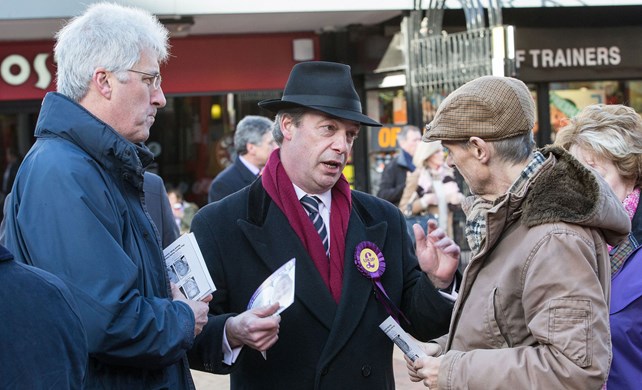

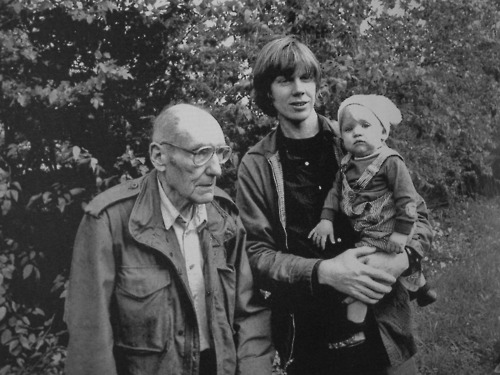
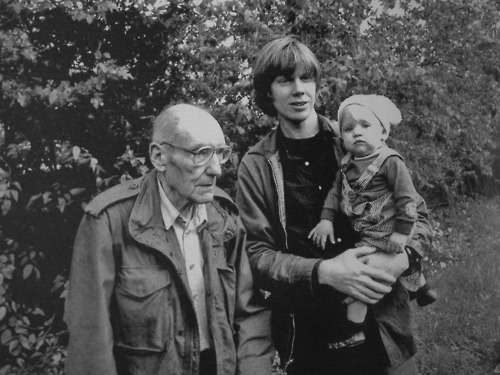
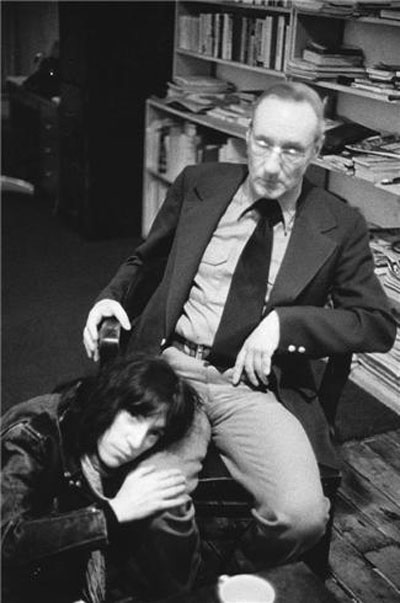
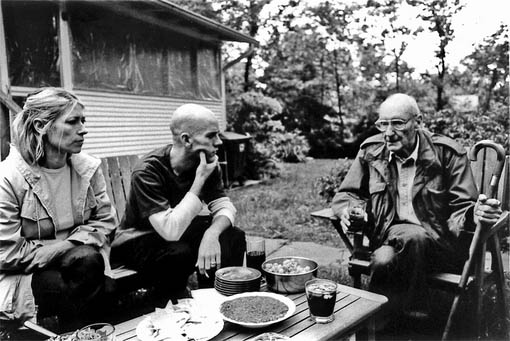
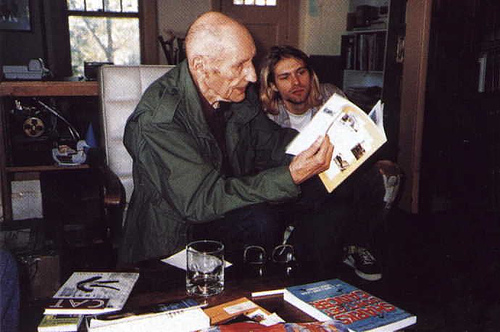
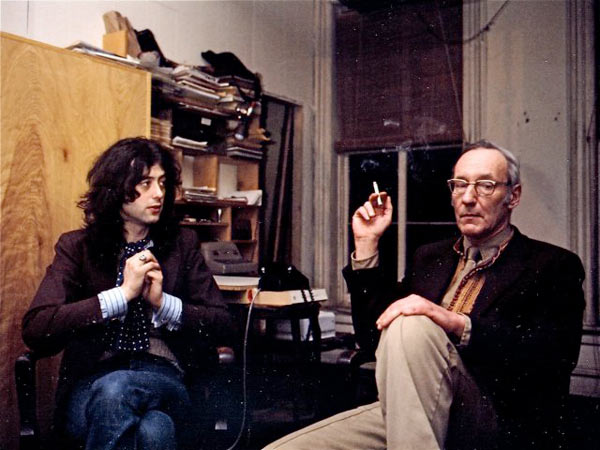

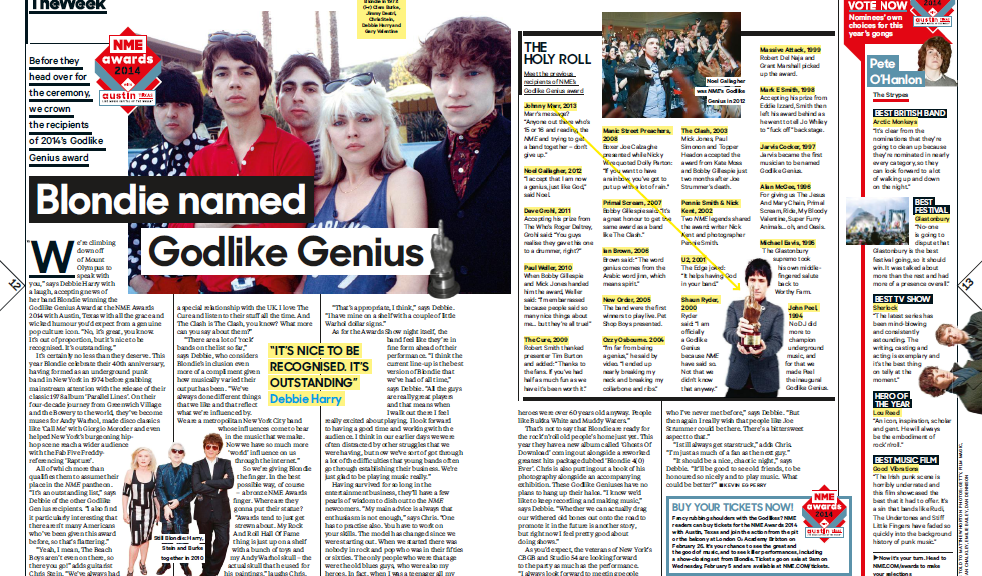
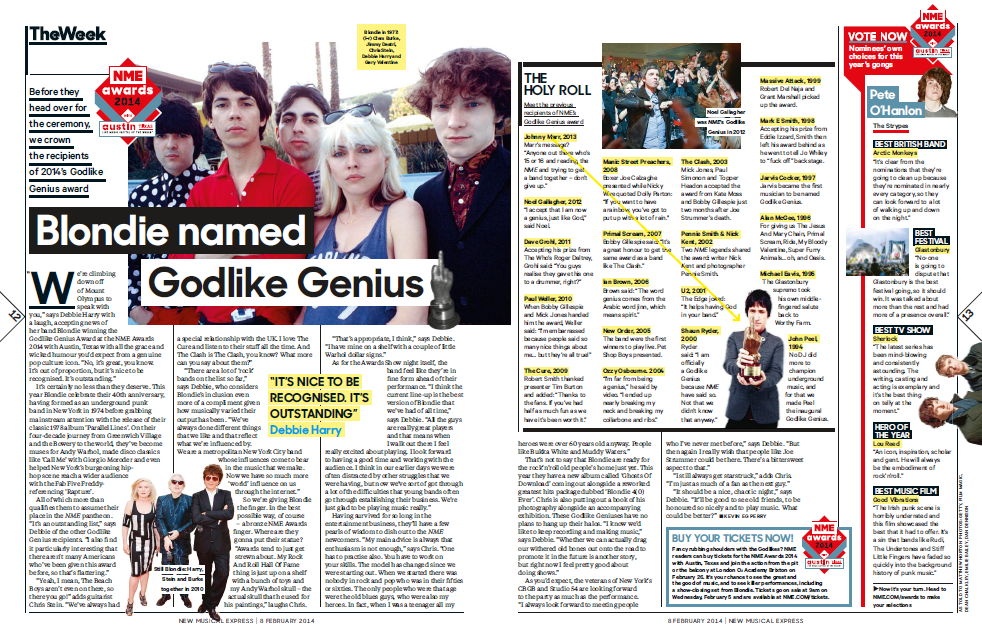


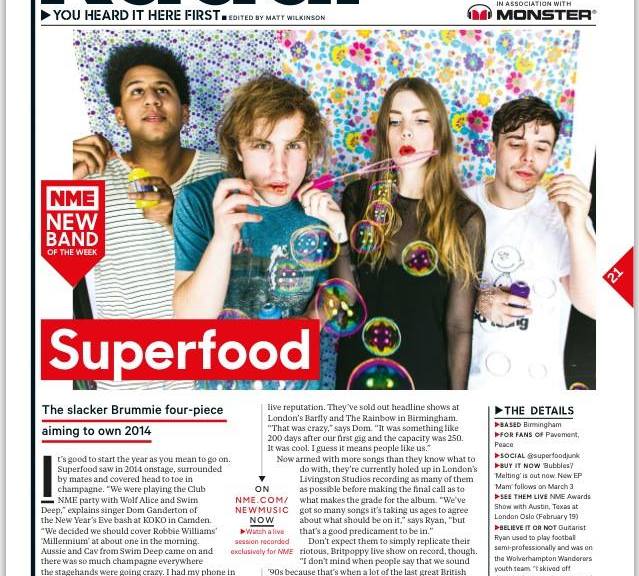



 ‘It’s got lust and love and danger and jealousy on it. It feels “red”.’ Sadly, Katy B is not talking about the Big Red pizza bus where we’re sat in Deptford. She’s describing her second album ‘Little Red’, the follow-up to her rave-igniting, Mercury Prize-nominated 2011 debut ‘On a Mission’. After digging in to a rocket-loaded Giardiniera pizza, the south London R&B icon opens up about dating, dancing and her past life as Peckham’s answer to Vinnie Jones.

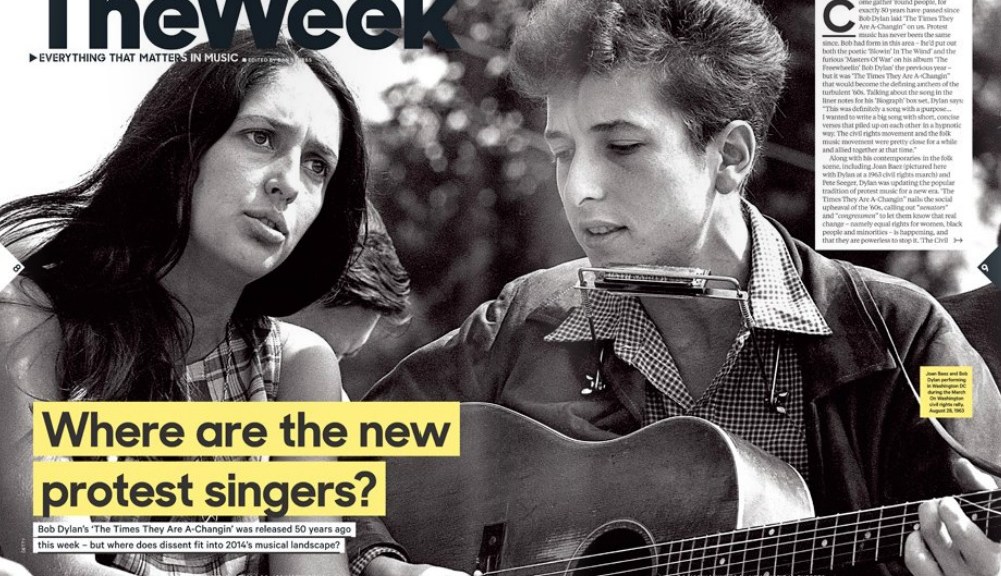


 NME Radar Artist Of The Week, 7 December 2013: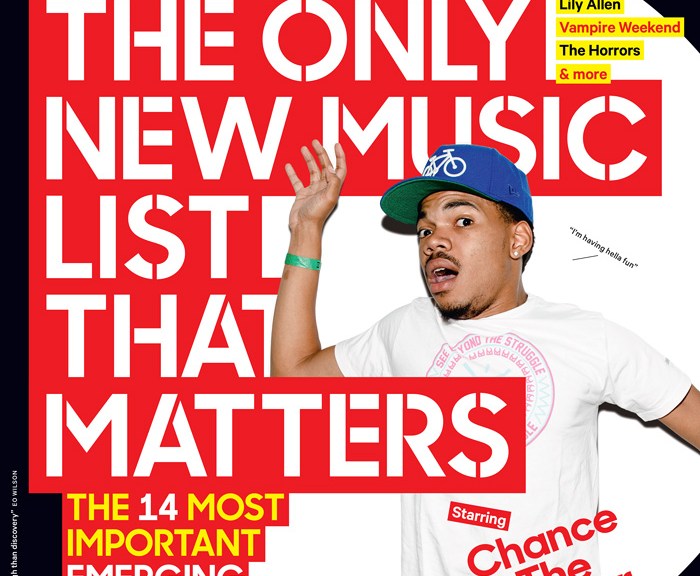





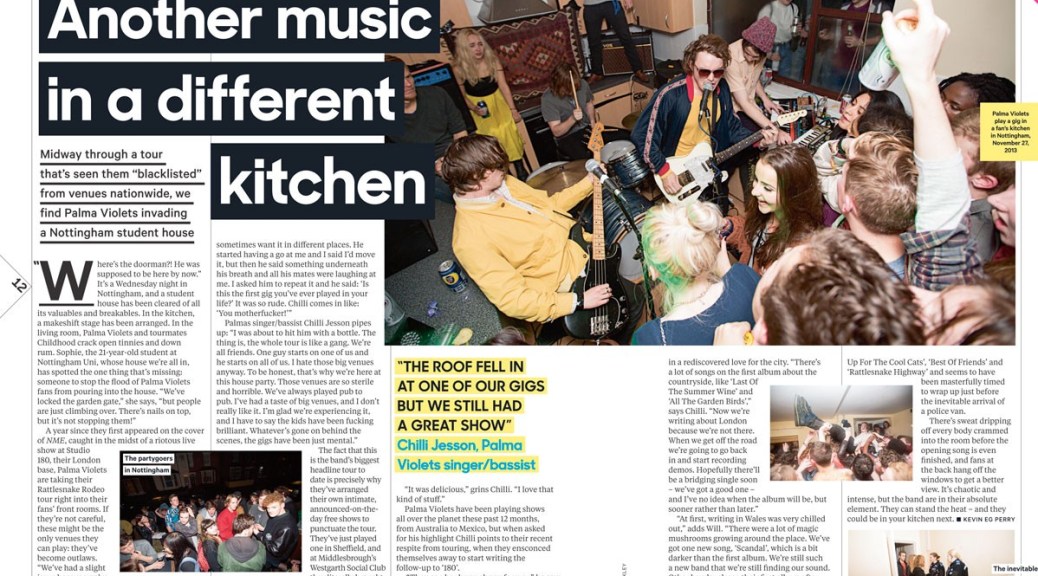


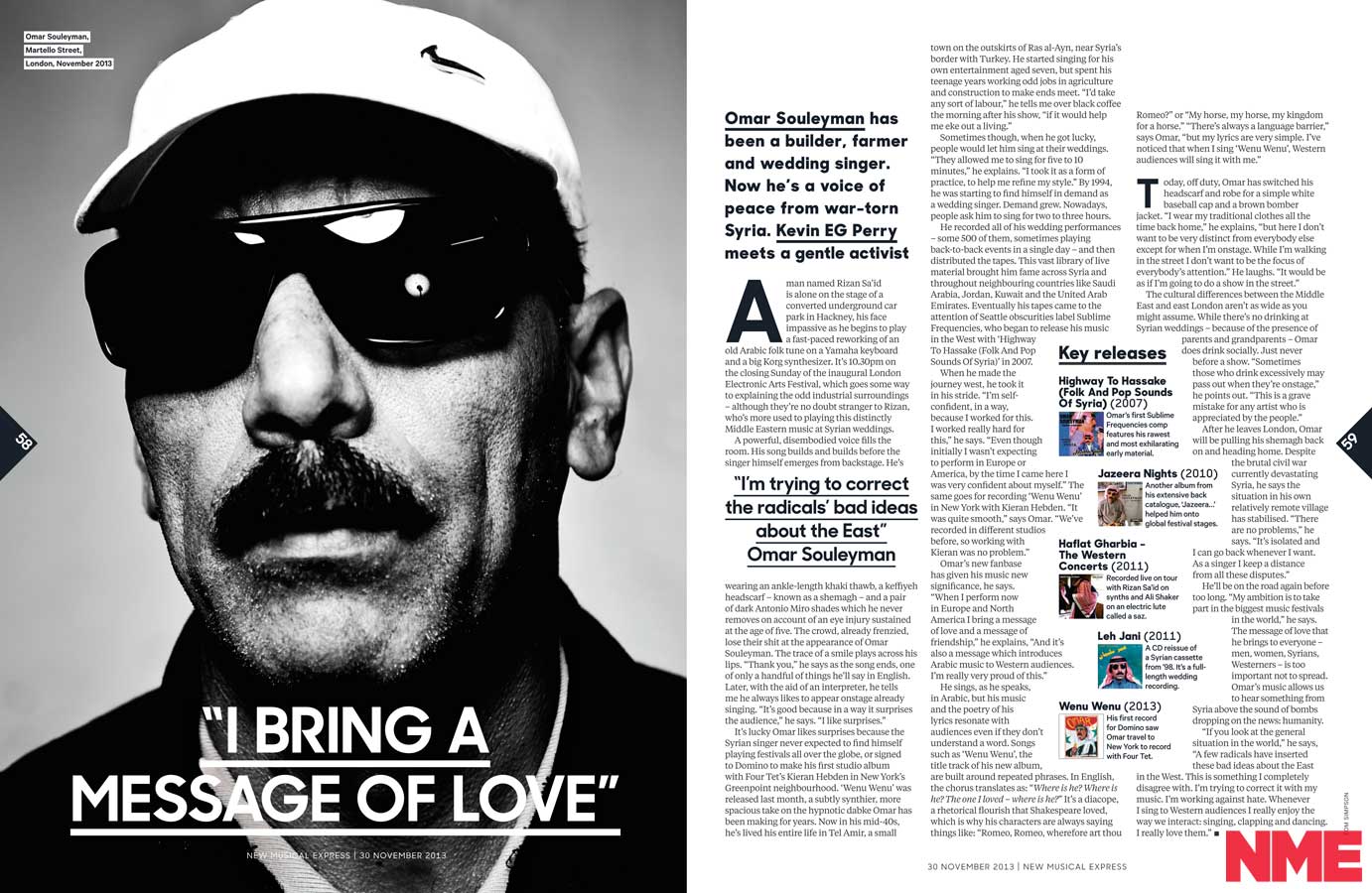
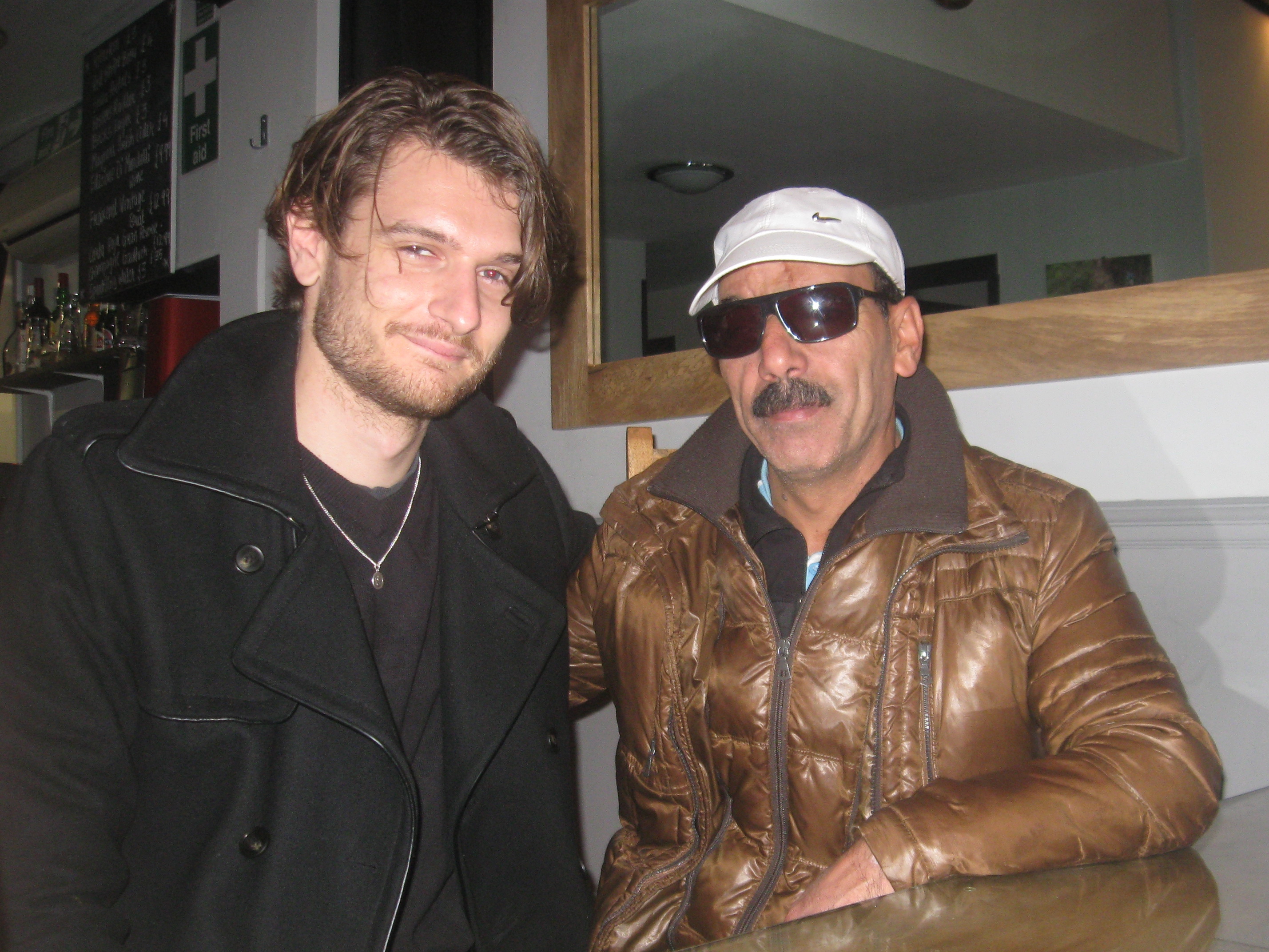
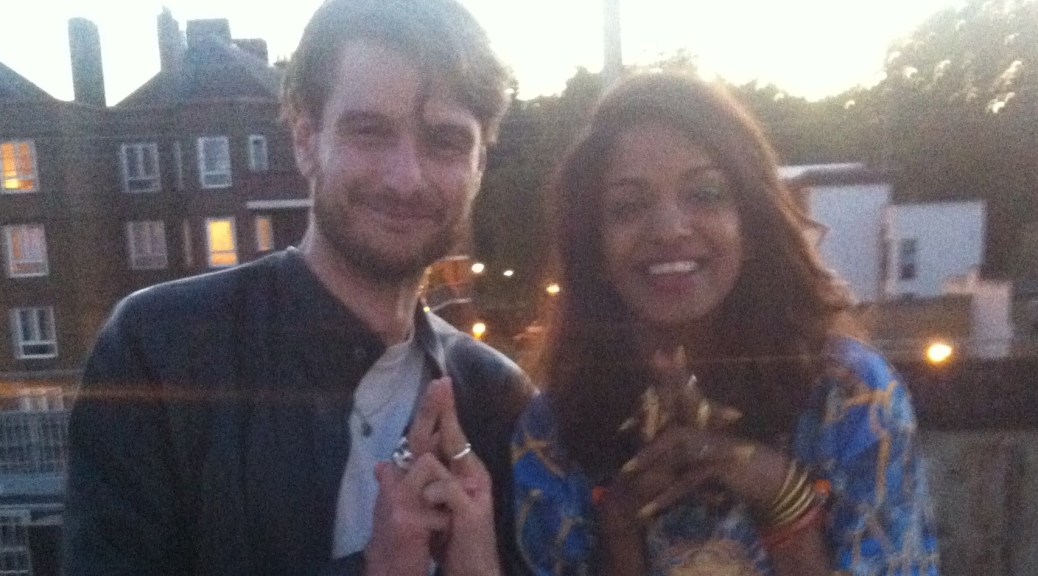


 Up on the roof of the studio after the photo shoot, the 38-year old – whose well-worn passport reads Mathangi Maya Arulpragasam – has changed into an oversized t-shirt bearing a kitsch Hindu print. She stands 5’5’’ in flat shoes but her presence is immediate. Maybe it’s that she’s talking sixteen-to-the-dozen. She riffs like Wikipedia incarnate, following ideas down rabbit holes like a kid with a short attention span who’s just discovered hyper-links. She laughs a lot. It’s a conspiratorial laugh, as if you’ve just caught her doing something she shouldn’t be and she’s trusting you not to call the police. Right now she’s curled over a laptop, pulling up Google Images to illustrate how she stumbled across the ideas that would inform ‘Matangi’, her fourth record. The one the record label didn’t get. The one they delayed and delayed because Maya hadn’t delivered what they expected.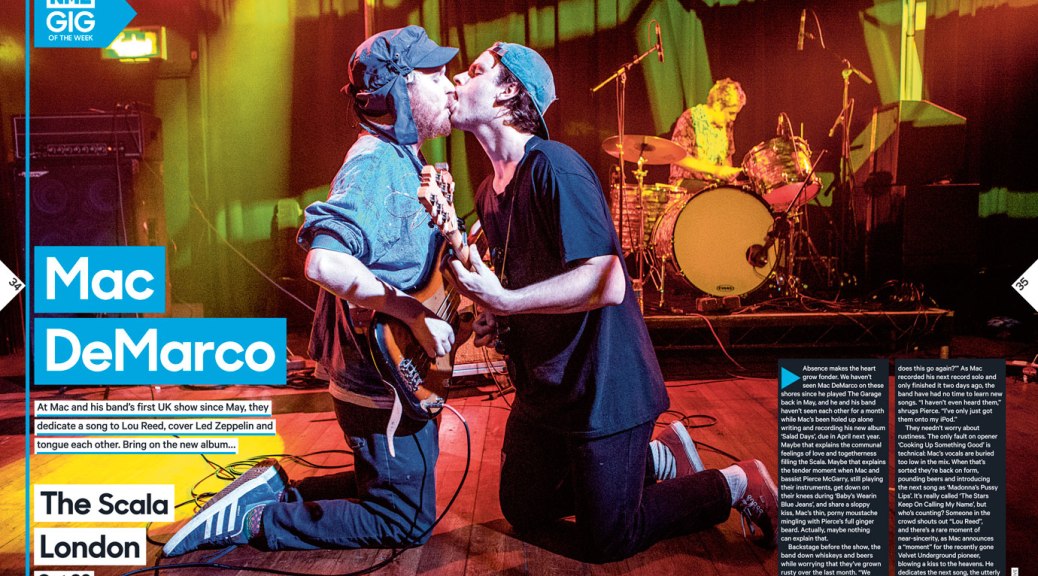


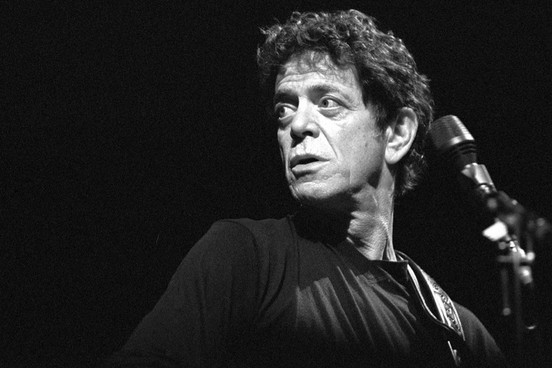
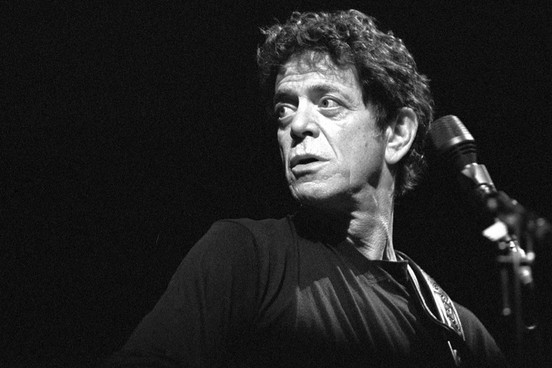
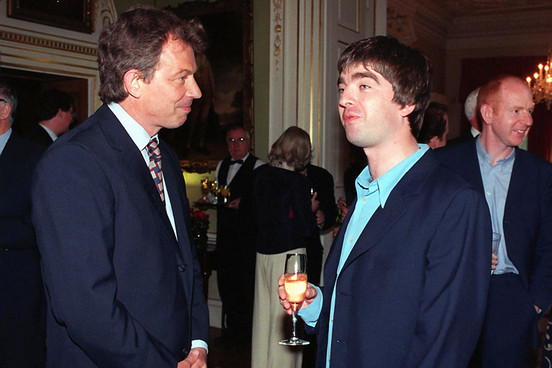
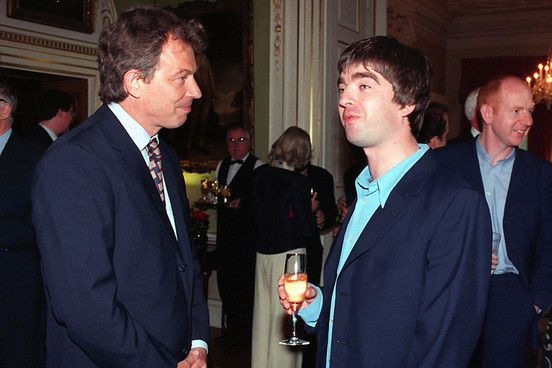
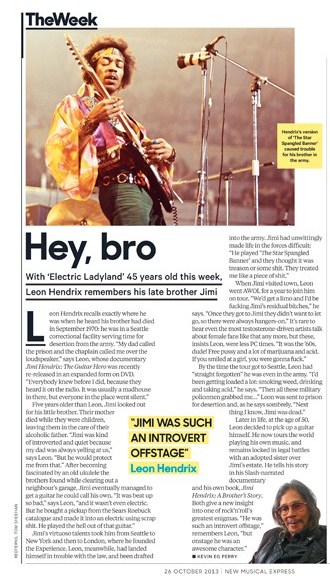


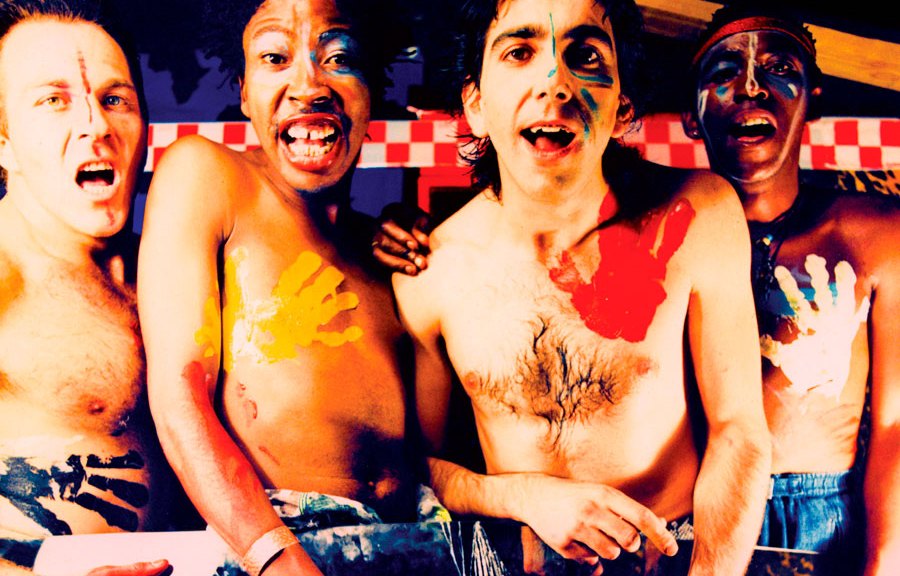


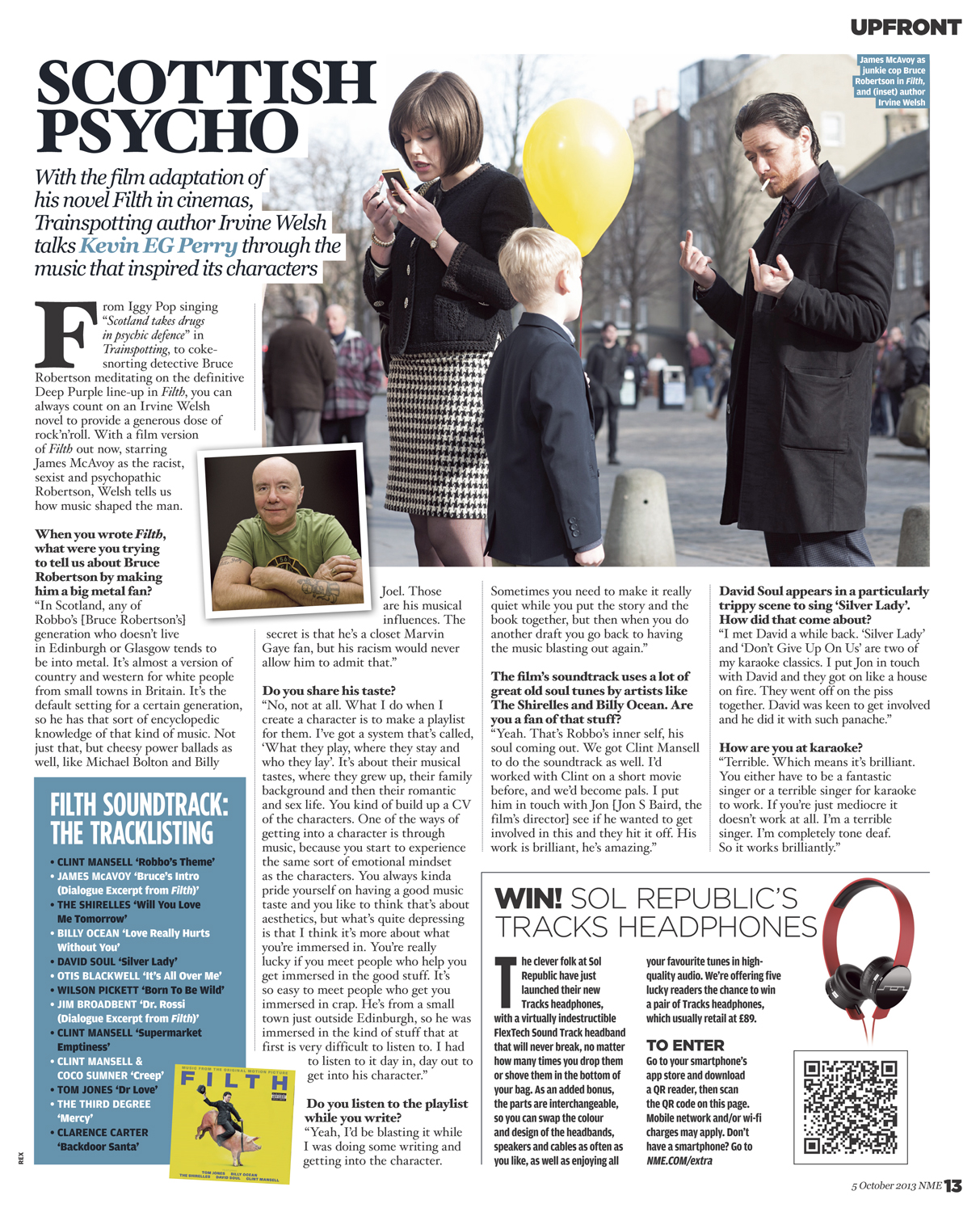


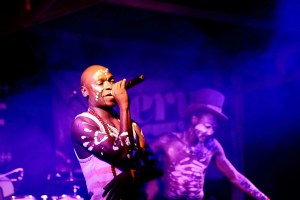




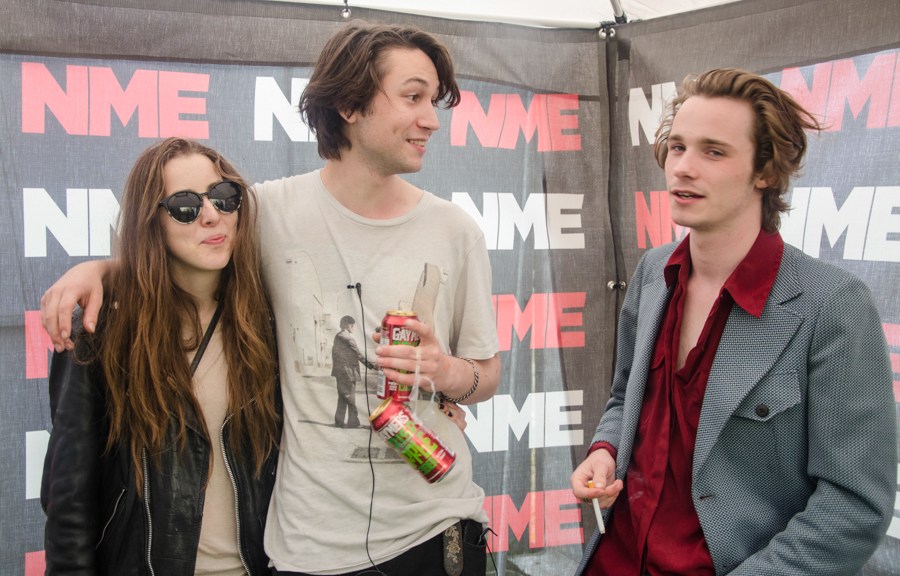


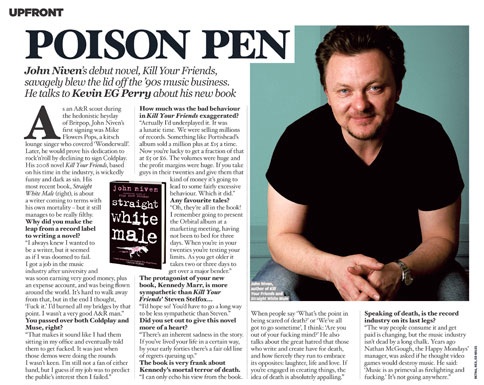

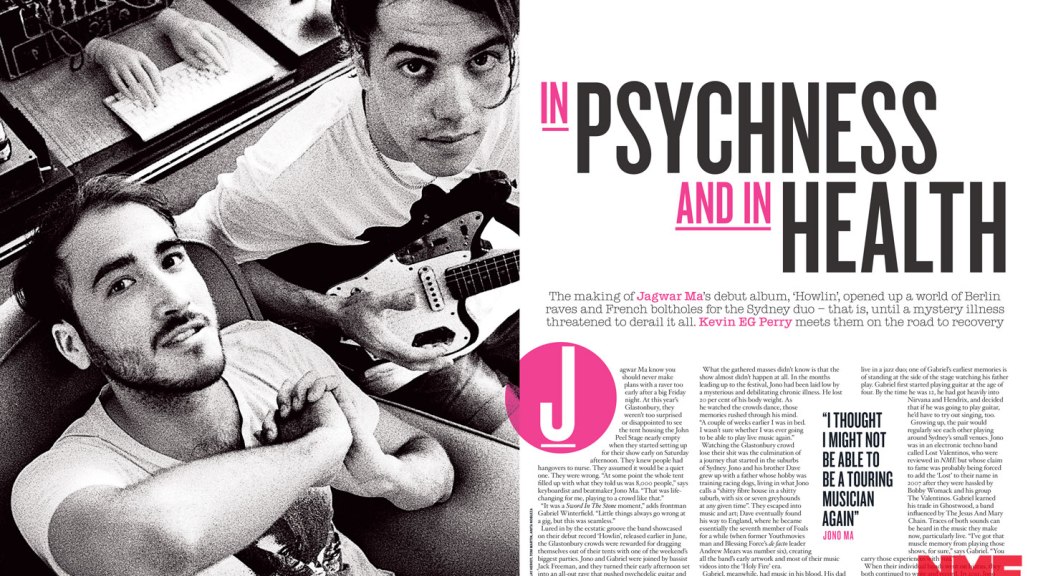
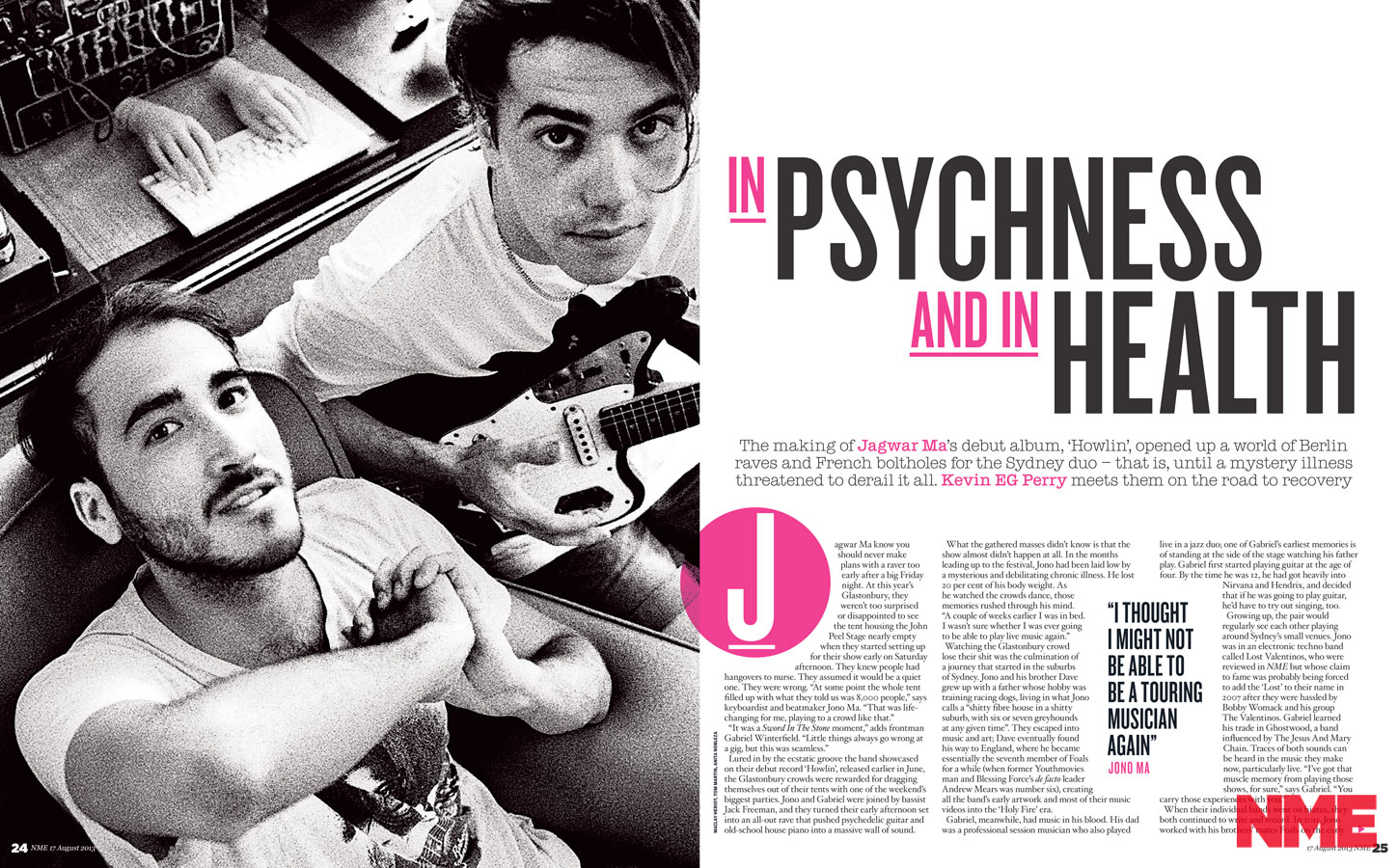
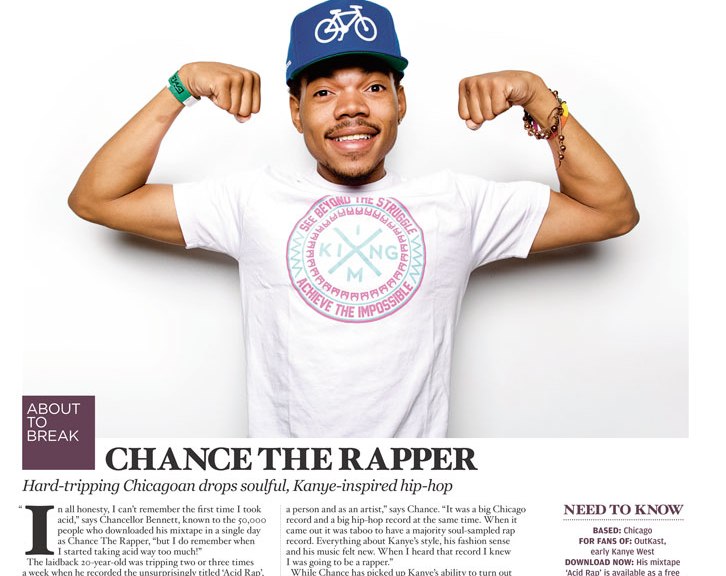
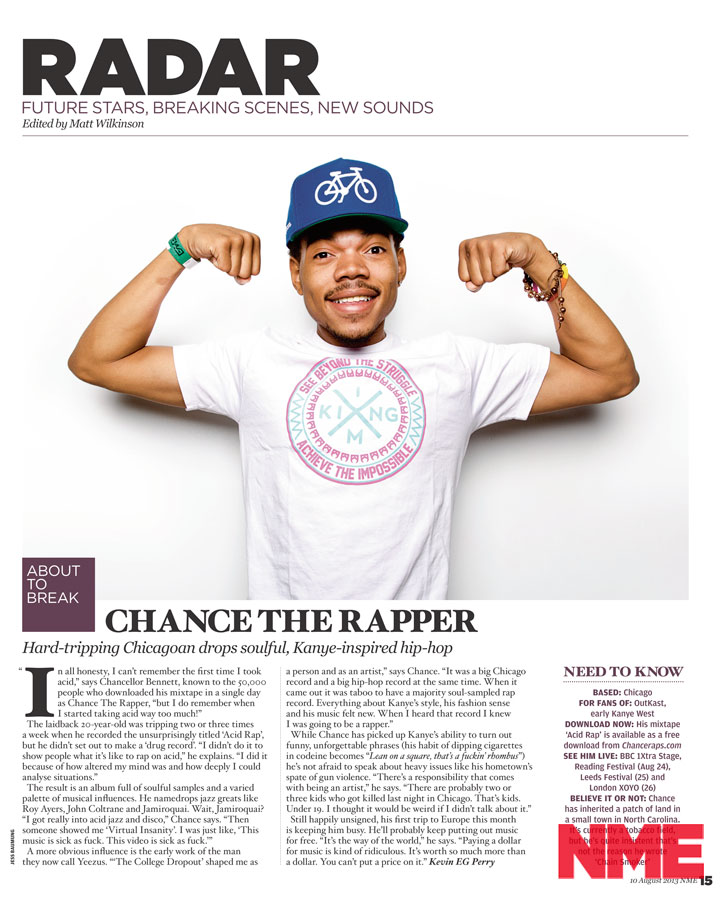 “In all honesty, I can’t remember the first time I took acid,” says Chancellor Bennett, known to the 50,000 people who downloaded his mixtape in a single day as Chance The Rapper, “but I do remember when I started taking acid way too much!”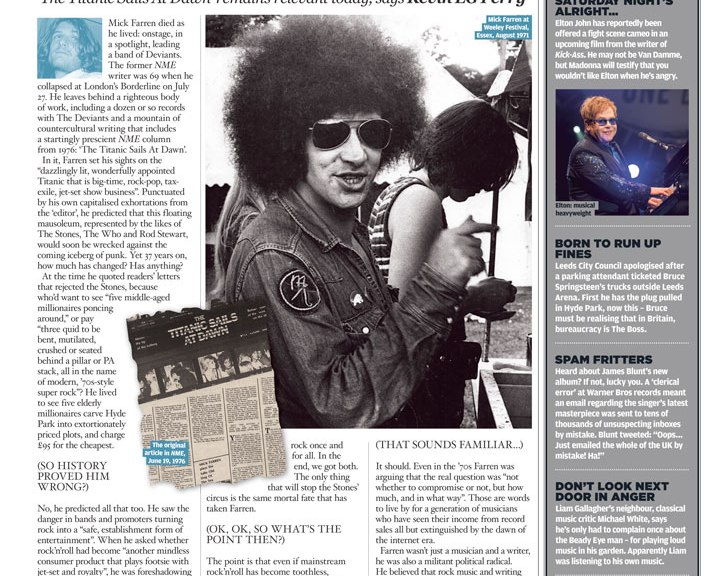


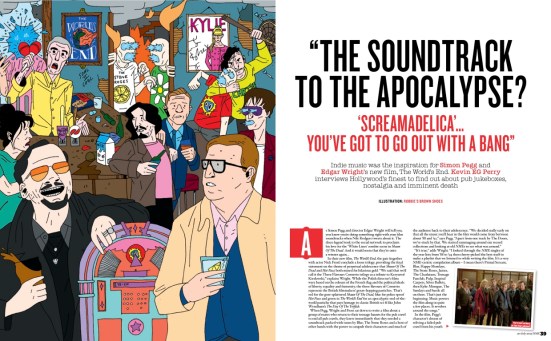


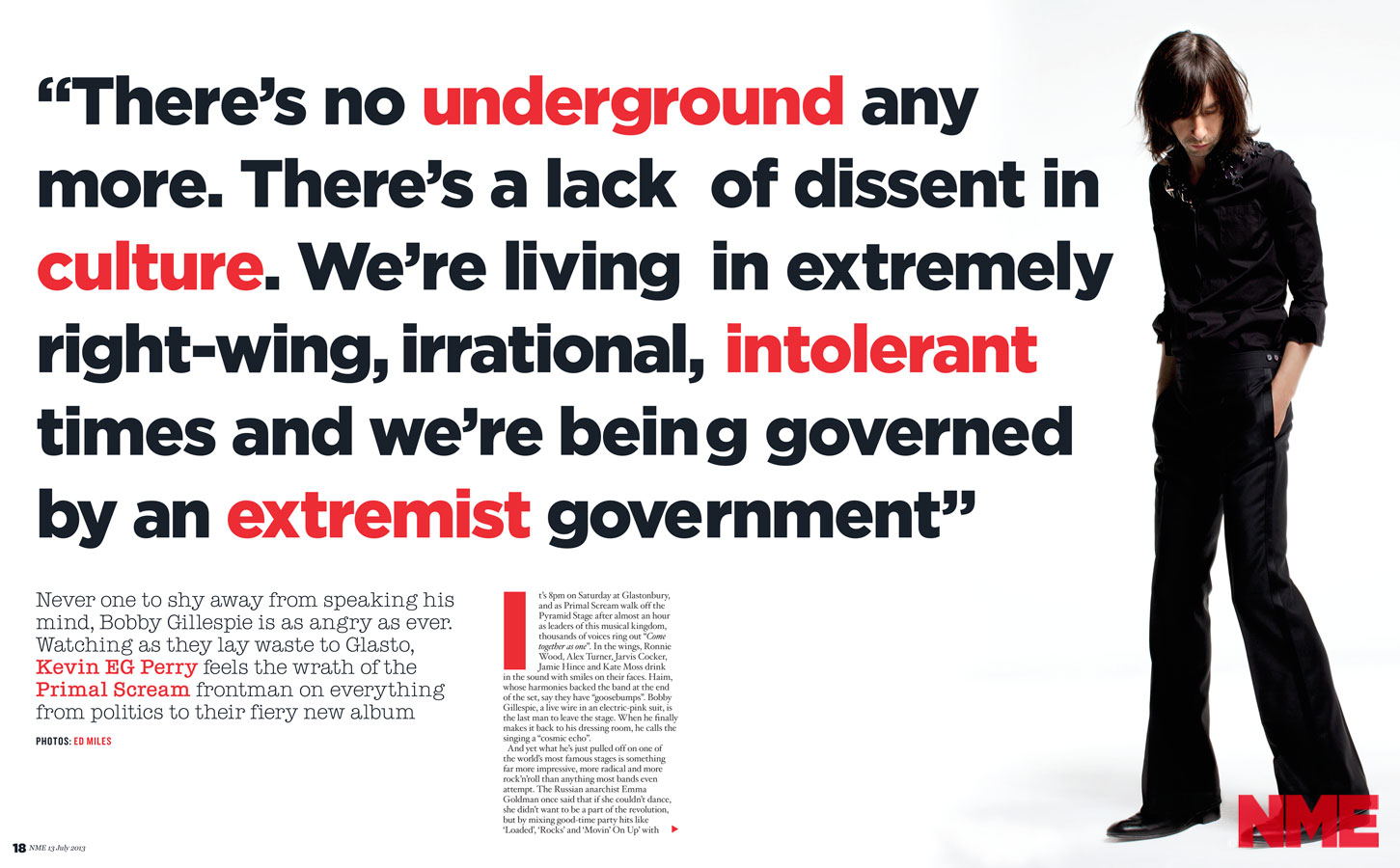
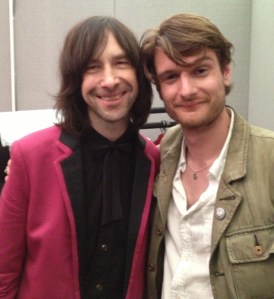 NME: Millions of people will be watching Glastonbury on primetime TV and it’s a become a social fixture. It might have started as a hippy, alternative festival, but it’s now the mainstream, isn’t it?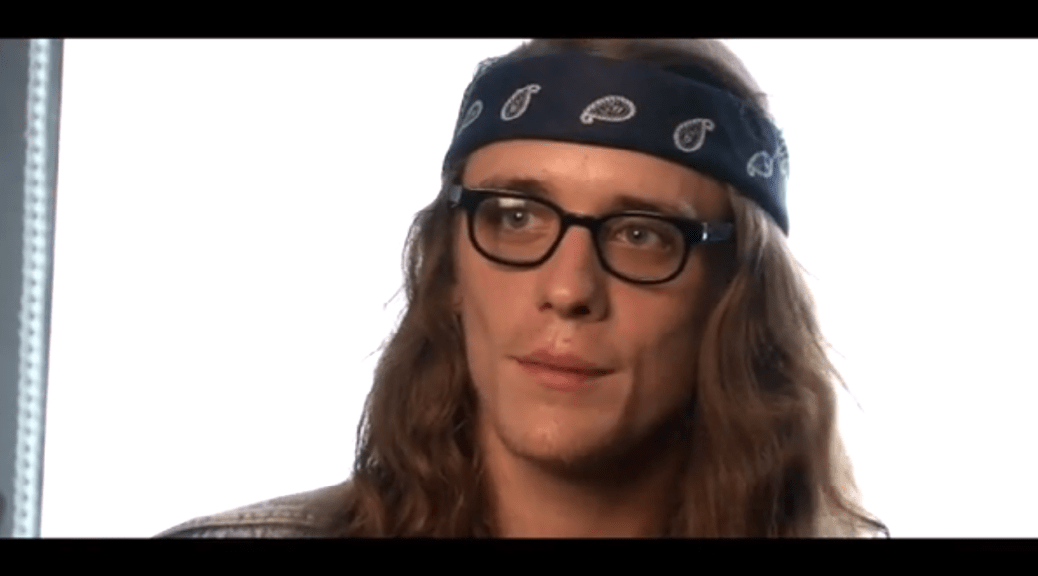


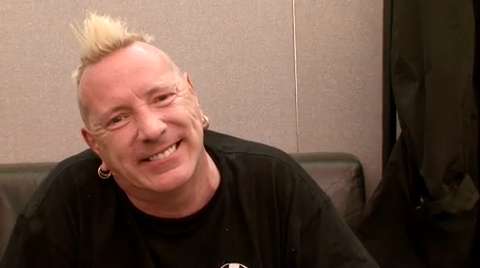
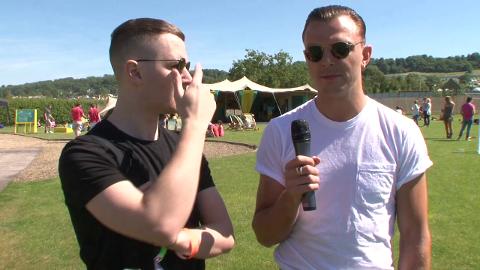
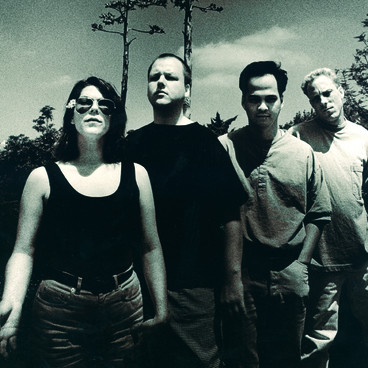



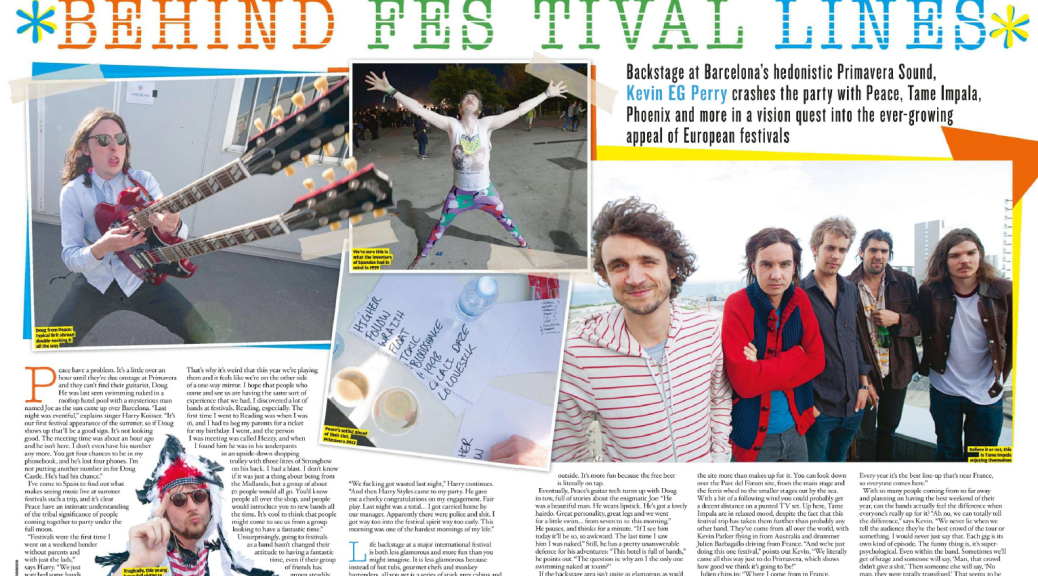
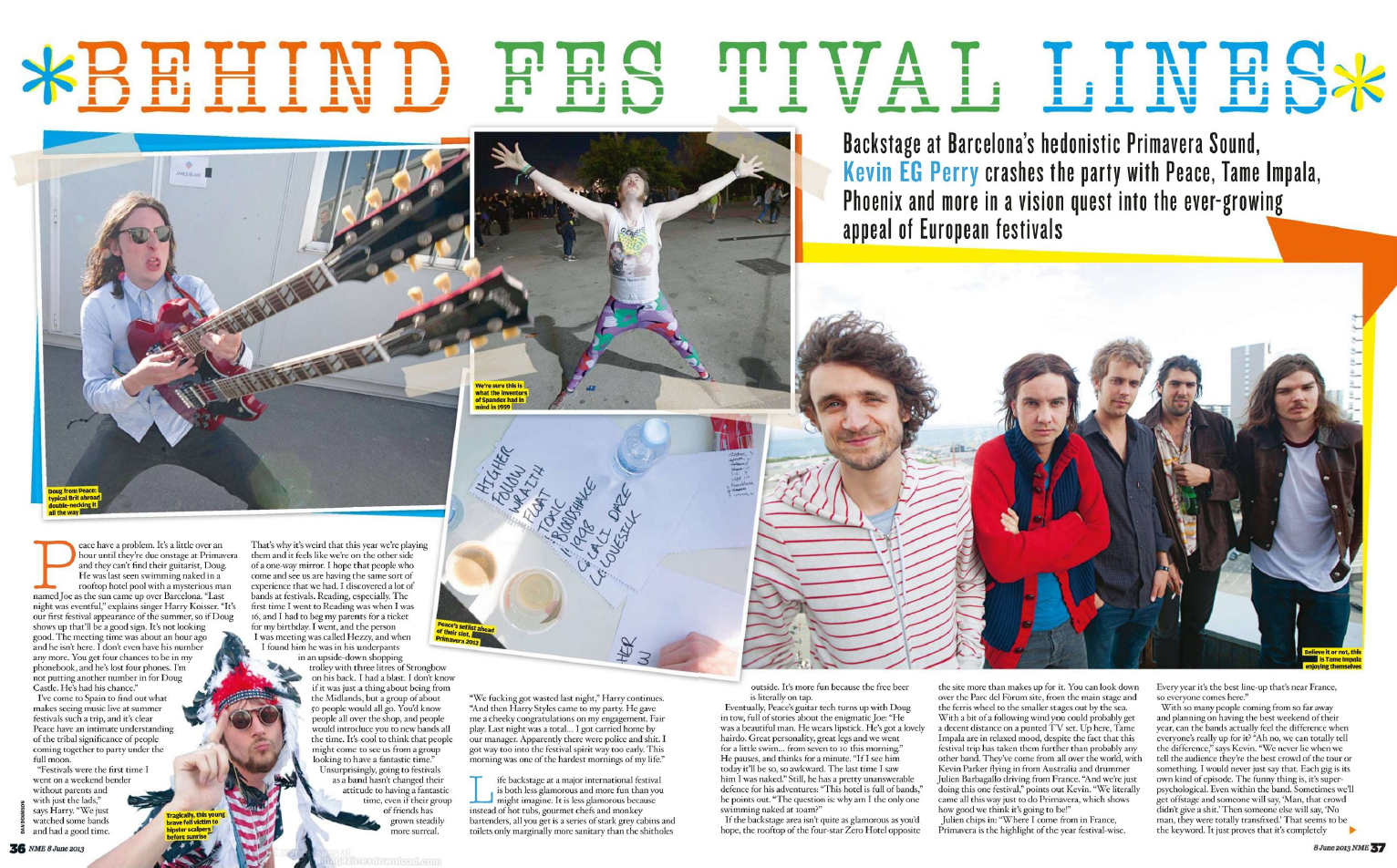
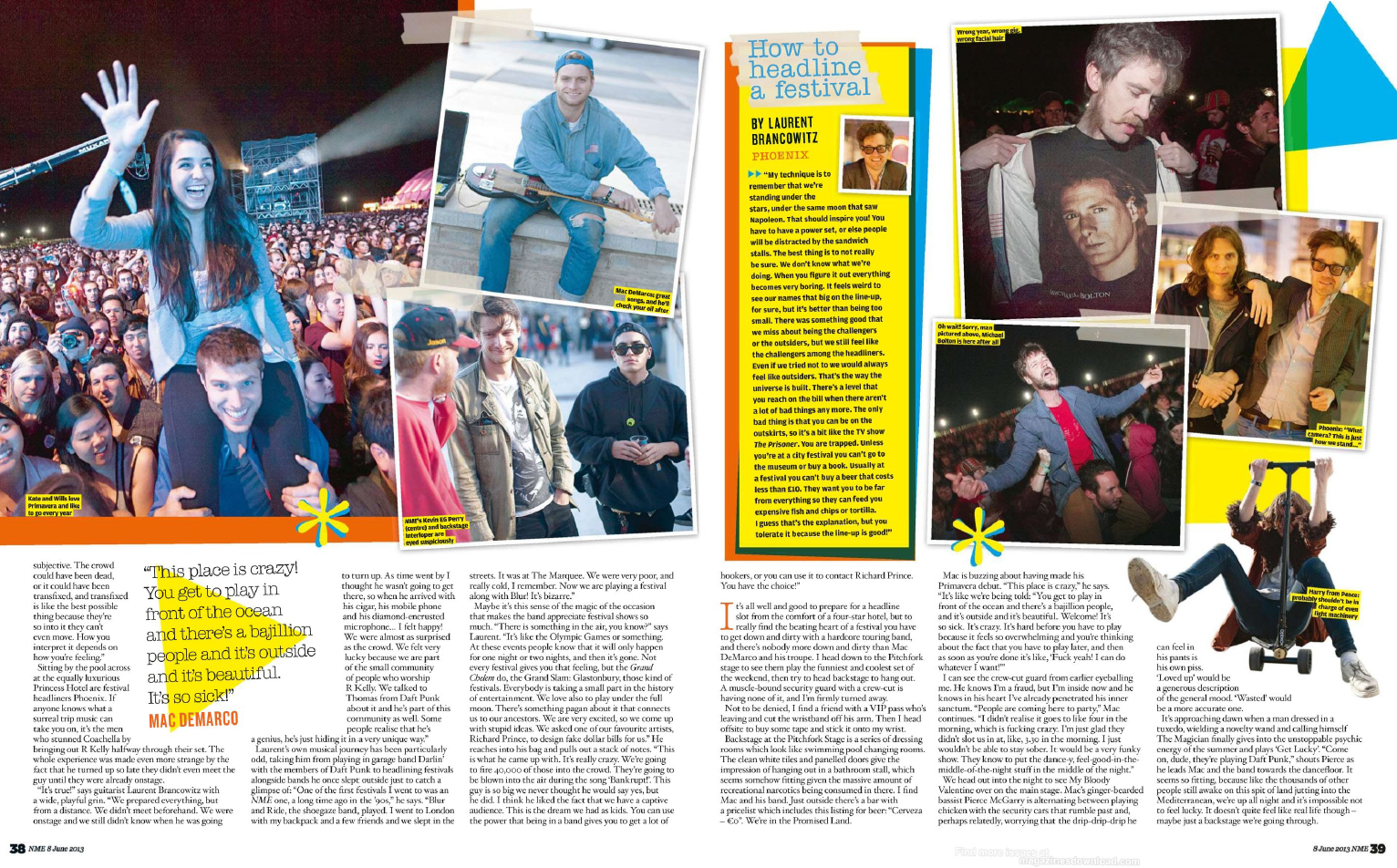
 Kevin EG Perry: Collected Works