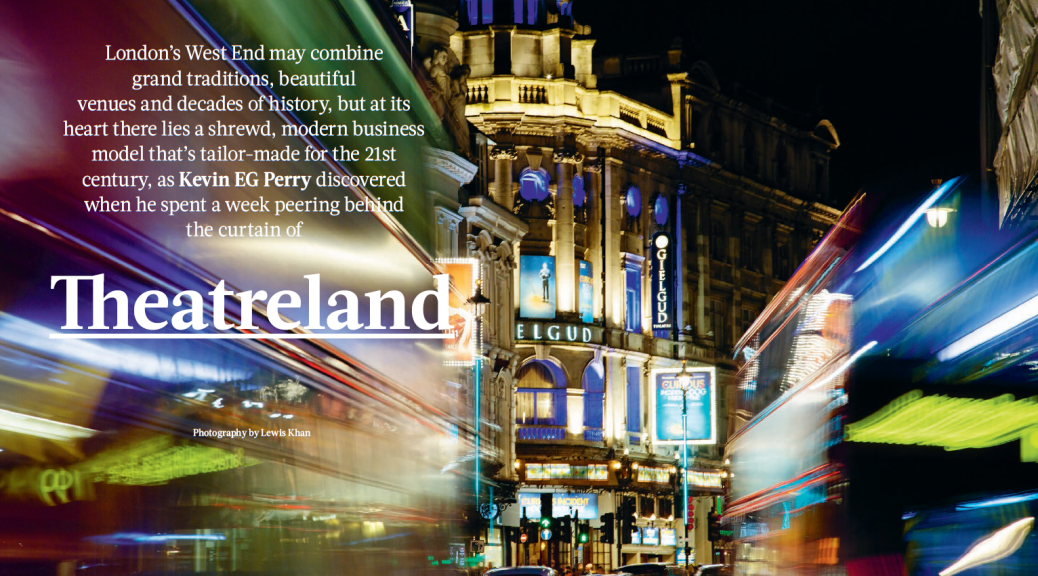
Theatreland

Theatreland.png

It’s a cold, miserable Tuesday in London’s West End, but the crowd clustered around the red carpet outside the Shaftesbury Theatre doesn’t seem to notice. Tonight is the opening of Motown: The Musical and a flashbulb chorus greets stars including Mary Wilson, Smokey Robinson and Motown founder, Berry Gordy.

“I’ve had, and Motown has had, a love affair with the UK for many years,” says Gordy, as explanation for why he brought his musical over from Broadway, where the Tony-nominated show enjoyed a run of nearly 800 performances, but that’s not the only reason he’s here.

The West End is as synonymous with London as the drizzle in the air and it’s also seriously big business. Last year, almost 15 million people bought a ticket for a West End performance. The 47 venues that are members of the Society of London Theatre (SOLT) grossed over £630m (€790m) in 2015 and SOLT estimates that 41,000 jobs depend on the industry, which contributes over £2bn to the economy.

West End theatres may combine grand traditions, beautiful venues and decades of history but at work is a shrewd, modern business model that has moved with the times – and it’s one that everybody wants a piece of.

Paul Ibell, author of Theatreland, a history of the past five centuries of London theatre, argues that West End shows have remained popular – even during both world wars – because they offer us entertainment, education and escape. “Noël Coward’s play Blithe Spirit, which opened in 1941, was a hit partly because the theme – a comedy about ghosts – enabled audiences to laugh at death at a time when they were experiencing it all the time in their own lives,” he says. “Much the same applied to the Depression between the wars, so it’s perhaps not surprising that at a time of economic and political upset, people flock to see shows like The Lion King, Mamma Mia! or The Phantom of the Opera. As a result, the West End has sailed through the recession, despite predictions of disaster.”

However, despite the thriving scene, launching a new show remains a risky business. Last year, 278 new productions opened in the West End, but some only remained open for a few weeks. While Agatha Christie’s The Mousetrap has famously run continuously since opening at St Martin’s Theatre in March 1974, others are not so lucky. Harry Hill’s X Factor parody, I Can’t Sing, closed in 2014 after just six weeks, losing its backers much of their £6m (€7.5m) investment.

What makes predicting the success of a new venture so difficult is also one of the West End’s greatest strengths: its variety. On any given night, you’ll find a mix of high-camp musicals, serious psychological dramas and, in the case of Stomp, lots of people clattering about with bins.

Beautiful is one recent success and this biography in musical form of the singer-songwriter Carole King, recently celebrated a year at the Aldwych Theatre. “It’s weird. Either a show runs for decades or it seems to close within three months,” says Cassidy Janson, who plays King. “There are big, big shows which close, so it’s a relief when you make it to a year.”

Alan Morrissey, who stars opposite Janson in Beautiful, agrees: “Particularly with new musicals, it’s really hard to survive in the West End. The majority don’t last a year, but these days six months is a great run.”

For Morrissey, as for many of those who perform in the West End, acting here is the realisation of a childhood dream. “Doing this job, London is totally the best place to be,” he says. “You’ve got New York, obviously, but Broadway has its own challenges. I love being a British actor and I love the quality of work we get over here.”

He says his most important motivation is remembering how inspired he was the first time he travelled down from Stockport as a child. “My first West End show blew me away and it’s someone’s first one tonight. That’s a beautiful pressure that we give ourselves as a show.”

Those looking for an illustration of the breadth of West End audience’s palates should look no further than The Curious Incident of the Dog in the Night-Time. Having started life at the National Theatre, adapted by acclaimed playwright Simon Stephens from Mark Haddon’s book, it’s told from the perspective of a teenage boy with Asperger’s syndrome. It’s a remarkable play that has become a West End hit at the Gielgud Theatre.

Bunny Christie, who designed Curious Incident’s wildly inventive, set, argues that West End shows don’t have to fall into pre-existing moulds. “I think it’s a mistake to think, ‘Oh, that’s not very commercial’ or ‘That’s not very West End’,” she says.

Christie is passionate about theatre’s ability to ask more of its audience than a television or iPad screen can. “If you imagine a film of Curious Incident, chances are it would be quite a straightforward narrative with lots of locations,” she says. “Of course, we can’t do that in theatre. What’s fantastic is that we ask people to use their imaginations and fill in the bits that we miss. It feels more sophisticated, in a weird way, because it’s about using our creativity. It’s a lovely thing that we all do as children really naturally and then  kind of forget about later in life.”

There’s certainly something childlike about the awe and wonder of seeing a great performance, but following the premiere of Motown: The Musical, the producers, cast and crew make the short journey to a very grown-up opening-night party at 100 Wardour Street in Soho. It’s attended by the likes of former Friends star Matthew Perry, who’s in town with his playwriting debut, The End of Longing, at the Playhouse Theatre. While the live band couldn’t go wrong with a string of Motown hits, including Superstition, You Can’t Hurry Love and My Girl, the cast are avoiding the stream of free cocktails.

“If you’re a lead in a West End show, you get membership to the Ivy Club and the Groucho, but it’s one of those things where, when you finally get it, you can’t really enjoy it,” laughs Janson. “You don’t go out and get hammered at the weekend.”

Performing eight high-intensity shows a week doesn’t exactly lend itself to the sort of bacchanalian debauchery the likes of Peter O’Toole and Oliver Reed once enjoyed. Working from 5.30pm until 10pm six nights a week would wreak havoc on anyone’s social life.

Away from the private-members bars, where performers might enjoy a mocktail, there’s at least one pub that can count on a regular theatre crowd: the Nell of Old Drury, on Catherine Street. It’s named after Nell Gwynn, the actress and mistress of King Charles II, who was recently the subject of an eponymous play at the Apollo Theatre. The pub, once known as the Lamb, has attracted thespians since 1663, when the Theatre Royal was built opposite and is connected to it by an underground tunnel, by which Charles is said to have visited his lover. “If you say you’re going to the Nell,” says Janson, “everyone knows where it is.”

“We cross paths with actors from other shows all the time,” adds Morrissey. “You meet at the same places, but there’s no rivalry. Everyone’s in it together.” That goes for all involved – playwrights, actors, crew, wardrobe, make-up.

“You’re working with the best of the best. It feels lucky to be here.”

No wonder, then, that shows and fans in their millions continue to be drawn to the West End, regardless of modern distractions, wider economic gloom or grey London skies.

“The West End feels more successful than ever,” says Christie. “There’s just something about sitting together in a theatre with people around you laughing or gasping that works. I think we really miss that, because many of our lives are quite solitary or insular. Going to the theatre is a communal experience and, as human beings, we like that.”

Originally published in Easyjet Traveller, May 2016.

Mash It Up!

soulwaxSoulwax, it’s fair to say, don’t like labels. “There’s this misconception about us that we invented the mash-up,” said Stephen Dewaele, when I got a brief audience backstage before a gig at London’s Brixton Academy. “It’s weird, because with everything we do, that becomes the anchor to hang it on. Even if it’s an hour of ballads the press will call it a mash-up. We’re like: ‘Have you not listened to it?’ It’s weird that people need that label.”

You can see the temptation. Soulwax, which is primarily made up of brothers Stephen and David Dewaele, are still best known for blasting Dolly Parton and 99 Luftballons at ravers with their 2002 mash-up album, As Heard on Radio Soulwax Pt.2. The incongruous mishmash of styles – called “bastard pop” by some – sold half a million copies, was named the best pop album of the year by the New York Times and became a near-eternal student party staple.

But Soulwax’s career has been as varied as their mashups, taking in everything from Beethoven to Belgian film scores. Indeed, when they released their debut album 20 years ago this month, it was a piece of mid-1990s post-grunge. Leave The Story Untold received only limited notice, and there was little expectation that its creators would become arguably the most influential Belgian musicians since Jacques Brel stubbed out his final cigarette.

By the time another grunge album came and went in 1998, the Dewaele brothers had started DJ-ing themselves, having realised that the techno clubs of Belgium weren’t playing any of the music they’d grown up listening to. When they first DJ-ed together by chance in 1997, they played Michael Jackson’s Billie Jean and New Order’s Blue Monday in quick succession. It shouldn’t have been much of a surprise that the Dewaele brothers had a certain something behind the decks. Their father Jackie Dewaele, better known as DJ Zaki, was one of Belgian radio’s biggest stars in the 1960s. But they had no intention of following him until, under the guise of 2manydjs, they started putting together a show for alternative music station Studio Brussel.

They made 12 unofficial compilations for Studio Brussel, the first of which was turned into the official album that went global fast (it was the only one they could clear all the rights for). Mash-ups weren’t new, but the genre had been largely dormant – and no one had ever quite thought that American country singer Dolly Parton and Norwegian electronic duo Röyksopp would make such perfect musical bedfellows.

“We don’t have a problem being called ‘mashup pioneers’ or whatever,” says Stephen, “but it’s something we only did for eight or nine months of our lives, and for the rest we’ve been remixing, producing, playing Soulwax, DJ-ing as 2manydjs, making Radio Soulwax. A lot of it has nothing to do with mash-ups, but that word is always in there!”

After As Heard on Radio Soulwax Pt.2, the brothers performed a typical volte-face, creating electronic rock album Any Minute Now in 2004, and then remixing their own work for the dancefloor on 2005’s Nite Versions.

With their own hits such as E Talking gaining traction, they started doing official and unofficial remixes for other bands, from Gorillaz to Daft Punk and their friends LCD Soundsystem.

Their stock in trade was a distinctive, populist take on club culture, and their persona has always been at once idiosyncratic and carelessly matter-of-fact. In 2007, they released a compilation of their remixes that at the time had the longest title ever: Most of the Remixes we’ve made for other people over the years except for the one for Einstürzende Neubauten because we lost it and a few we didn’t think sounded good enough or just didn’t fit in length-wise, but including some that are hard to find because either people forgot about them or simply because they haven’t been released yet, a few we really love, one we think is just ok, some we did for free, some we did for money, some for ourselves without permission and some for friends as swaps but never on time and always at our studio in Ghent.

That studio was rebuilt and retooled over three years at the beginning of the 2010s, and is now home to an Aladdin’s cave of decades-old analogue gear alongside state-of-the-art digital equipment. Indeed, they’ve become something of connoisseurs of audio installations. In July 2013, they teamed up with LCD Soundsystem’s James Murphy to build every audiophile’s dream nightclub: Despacio, a custom-built 50,000-watt system that only plays vinyl. They’ve spent the intervening years taking the system on tour.

Meanwhile, they’ve still found time to get back to the studio themselves to make genre-bending music. Their most recent project is the soundtrack for the Belgian film Belgica, which follows two brothers who run a nightclub. Each of the 16 bands who appear on the soundtrack are fictional, with the music – which ranges from Kraut-techno to psychobilly and hardcore – written and recorded by the brothers themselves.

The Dewaele brothers are almost impossible to pigeonhole. At times it seems like they’re basically the world masters at creating mixtapes of the music they love. As Stephen says: “We’ve been called many things: ‘electropioneers’, ‘a punk funk band’, ‘an electronic rock band’, many, many things. It’s nice to survive those names. We just keep doing music we like.” After two decades, that simple approach seems to have worked out quite well.

Published by Brussels Airlines’ b inspired, May 2016.

How a War Reporter’s Memoir Was Turned Into a Big Budget Tina Fey Comedy

kim-barker-interview-tina-fey-whiskey-tango-foxtrotTyrannical despots, vast quantities of narcotics, women seen as second-class citizens: it’s hard to imagine how reporting on the war in Afghanistan could have prepared Kim Barker for Hollywood. But since her 2011 memoir The Taliban Shuffle was adapted by Tina Fey for her new film Whiskey Tango Foxtrot, Barker has been getting a taste of the Hollywood lifestyle.

Barker’s book is a frank, funny account of her time as a foreign correspondent in Afghanistan and Pakistan for the Chicago Tribune, and is a world away from traditionally macho blood-and-thunder frontline stories. Barker was always an unconventional war reporter, already in her thirties when the 9/11 attacks first inspired her to head overseas. She eventually worked her way up to the position of south Asia bureau chief, reporting on the resurgence of the Taliban and painting a nuanced portrait of life in the two countries that took her from maternal health clinics to interviewing notorious warlord Pacha Khan Zadran. The book contrasts these scenes with the adrenaline-lust of journalists working in war zones and the manic lives they lead there. She describes wild parties at the “Fun House” where she lived and at the notorious L’Atmosphere bar.

These debauched nights are exuberantly recreated in Whiskey Tango Foxtrot. The film wears a thin veil of fiction: Fey’s character is a TV news anchor; her surname is “Baker” rather than “Barker”; Barker’s friendship with documentary maker Sean Langan inevitably becomes a romance with a Scottish photographer played by Martin Freeman. But the absurd theatre of war it portrays is drawn directly from Barker’s real-life journalistic experiences. As it becomes increasingly hard to get editors interested in Afghan stories, we see reporters go to ever more life-endangering lengths in search of an attention-grabbing scoop. It’s a comedy with something serious to say about America’s lack of interest in how its own wars are fought.

Here, Barker tells us how a prophetic New York Times review hooked Fey, what it’s like watching a movie about your life and what donkey porn can tell us about democracy.

Continue reading at Vice.

Into The Deep

SAMSUNG CSCInhale. Take in as much air as you can and hold it until I tell you to stop. This is a story about how deep a single breath can take you.
The idea that we as humans don’t yet fully understand where our limits lie is an enticing one, and one that binds freedivers together. For his recent book One Breath, Adam Skolnick interviewed most of the world’s best. “I learned that humans have these capabilities that we’re not tapping into,” he tells me. “That’s what freedivers love to do: tap into this reservoir of human ability that most people don’t even approach.”

At some point during my first freediving lesson I found myself sinking through clear water with weights attached to my neck and hips, like a corpse dumped by mobsters. I was trying not to think about the phrase ‘he sleeps with the fishes’. I was trying not to think about anything at all. The first thing you have to learn is not to panic.

When you’ve been holding your breath for a while soon enough a thought will cross your mind: ‘I wonder how long that’s been?’ Just after that your muscles will start to tense up. There are sensors called chemoreceptors in your heart and skull and they’ve clocked there’s too much carbon dioxide building up in your system. Your body’s natural alarm is screaming at you to breathe. Ignore it. This is just your internal ‘20% battery remaining’ warning. Despite how it feels you still have oxygen left, so tell yourself to relax.

The other thing I was trying not to think about is how dangerous freediving can be even for those at the very top of the sport. Last August, one of the world’s best freedivers Natalia Molchanova died off the coast of Formentera in the Mediterranean. She lost touch with her group and never resurfaced. It wasn’t the first freediving tragedy. In November 2013, another diver named Nick Mevoli died while competing in the Vertical Blue competition in the Bahamas when fluid filled his lungs. These are not good things to dwell on while ten foot underwater

Okay, take a breath now. Did you notice what you just did? You exhaled for a long time before breathing in. This is your body flushing out the carbon dioxide. It’s a natural reaction, but it’s also bad news because what you need is to get oxygen into your system. Freedivers learn to perform just a short exhale, then a smooth inhale when they surface. This is important, because if you’re spending a long time underwater it’s often when you come back up that you can blackout or have what freedivers refer to, with a certain dark humour, as a ‘samba’. The medical term for this is an LMC (loss of motor control) and it’s marked by violent convulsions of your head, arms and legs. You know, like dancing a samba.

Because of the dangers of blacking out or drowning, you should always freedive with a buddy. Fortunately for me my buddy is Liv Philip, the British women’s freedive champion six times over and a woman capable of diving 65 metres (213ft) on a single breath.

Philip teaches freediving at a pool in Richmond, and she tells me that the sport is now attracting a broad swathe of people with different motivations, from triathletes who want to improve their ability in the water to high-flying city types just looking for a way to switch off. That’s one of the things about freediving: for an extreme sport, it’s remarkably zen. Becoming a serious freediver requires the ability to lower your heart rate and clear your mind of distractions.

“There’s a lot in the media at the moment about mindfulness and we get quite a few people coming at it from that angle,” explains Philip. “It’s about not trying to do something, but just being in the moment.”

As well as being responsible for attaching those weights to me, Philip also takes me through the basics of freedive breathing. She teaches me to prepare for a dive by fully exhaling for eight seconds, inhaling for four, and then repeating the process three times over. The difference is notable. My first time under the water I barely last sixty seconds, using her methods I can stay down for more than two minutes. Try it for yourself, it will be easier than last time.

The speed at which it’s possible to tap into potential you didn’t realise you had is a big draw for new freedivers, especially when you realise it’s actually possible to dive deeper than most scuba divers. Beyond around 60 metres, breathing in air is lethal. Freedivers can go deeper.

How much deeper nobody really knows. Records are being broken all the time. In the 1950s, scientists believed that the deepest a human could dive was about 30 metres (100 ft). After that, it was assumed the pressure would crush your ribcage and kill you.

The reason the pressure doesn’t kill you is thanks to an evolutionary trait known as the ‘mammalian dive reflex’. You have more in common with your average sea otter than you might think. As soon as you enter cold water, your body naturally lowers your heart rate and moves blood from your extremities into your core to protect your vital organs. This is why you’ll find you’re able to hold your breath much longer underwater than you could on land.

Freedivers never listened to the scientists anyway, and have gone on to beat their predicted maximum depth many times over. Some, like “the deepest man on earth” Herbert Nitsch, use a watersled to dive and a balloon to surface, allowing him to reach a staggering 831 feet in June 2012. Others, like Aleix Segura, inhale pure oxygen from cans before they go underwater. He smashed the Guinness World Record for the longest underwater breath-hold this February with a time of 24 minutes 3 seconds.

However, most purist freedivers eschew the use of oxygen canisters or watersleds. One of the appeals of the sport is that it can be done without any equipment at all.

William Trubridge is the current world record holder for the deepest dive without equipment or fins, having reached a depth of 101 metres (331 ft) in December 2010.  “It’s an idyllic sport because it’s a pure expression of human potential,” he tells me when I ask what spurs him to keep breaking records. “We’re exploring our own depths and the depths of the planet. Being a part of that process is exciting. There aren’t too many frontiers left on our planet, so if you’re part of that discovery of human limits it’s actually a really privileged place to be.”

For all the dangers, it’s that plunge into the unknown that keeps pushing freedivers deeper.

Now breathe.

WHAT EXTREME DEPTHS DO TO YOUR BODY

Heart
As soon as you so much as put your face into cold water, receptors on your skin instigate the mammalian dive reflex, the same reflex found in otters and dolphins. The first effect is to lower your heart rate, which means less oxygen is required in your bloodstream.

Fingers and toes
As you continue to dive, capillaries in your extremities start to close, stopping blood circulation to the furthest reaches of your body. This starts in your fingers and toes, then hands and feet, and eventually even arms and legs. It will give you cramp, but it also leaves more oxygen for where it’s most needed: your heart and brain.

Chest
Eventually, you will experience something known as ‘blood shift’. The blood from your extremities is now rushing into your core to support your lungs and prevent your chest from collapsing under the increased pressure.

Lungs
For the first few metres of your dive, you’ll have had to paddle down because your air-filled lungs will be buoyant, and trying to pull you towards the surface. At the 10 metre mark (33ft) the pressure on your body doubles and the contracting air shrinks your lungs to half their normal size. At 12 metres (40ft), you hit ‘negative buoyancy’ and will be able to fall without paddling.

Brain
Remarkably, your brain appears to survive this process unscathed. Freedivers below 30 metres (100ft) have recorded heart rates as low as 14 beats per minute, which is roughly a third of that of a person in a coma yet, thanks to the mammalian dive reflex, they’ve remained conscious and kept swimming.

Originally published by Shortlist, 21 April 2016.

Call of the Wild

AndyFord1

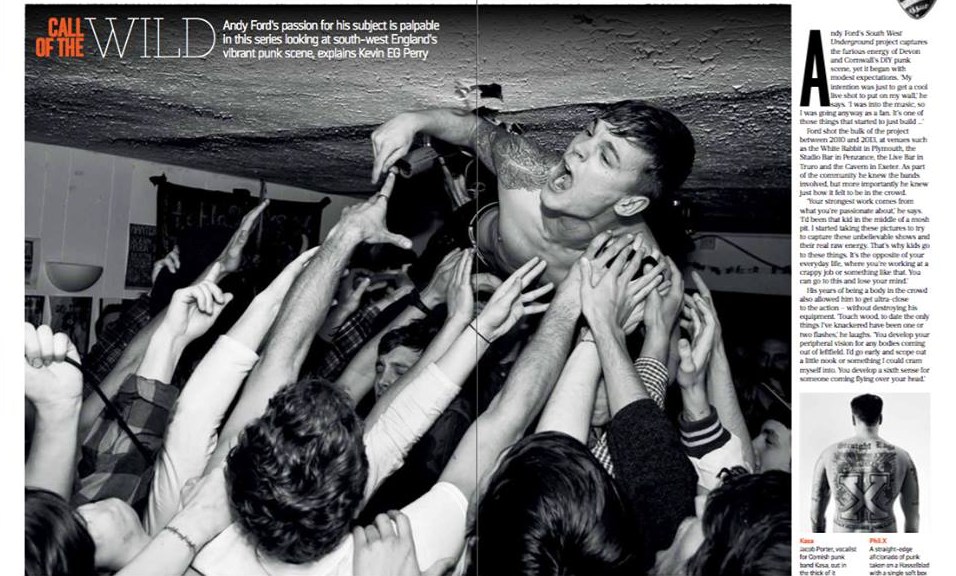
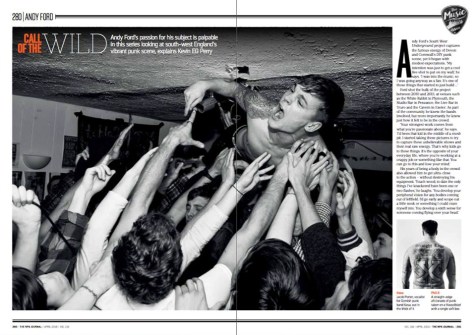
Andy Ford’s South West Underground project captures the furious energy of Devon and Cornwall’s thriving DIY punk scene, yet he began it with modest expectations.

“My intention was just to get a cool live shot to put on my wall,” says Ford. “I was into the music, so I was going anyway as a fan. It’s one of those things that started to just build and build.”

Ford shot the bulk of the project between 2010 and 2013, at venues like the White Rabbit in Plymouth, the Studio Bar in Penzance, the Live Bar in Truro and the Cavern in Exeter. As a fan and a part of the community, he knew the bands involved, but more importantly he also knew exactly how it felt to be a member of the crowd.

“I think in photography your strongest work always comes from what you’re passionate about,” he says. “I’d been that kid in the middle of a mosh pit. What I wanted when I first started taking these pictures was to try and capture these unbelievable shows and their real raw energy. That’s why kids go to these things. It’s the total opposite of your everyday life, where you’re working at a crappy job or something like that. You can go to this and lose your mind.”

It was also his experience of being a body in the crowd that allowed him to get so close to the action without destroying his equipment. “Touch wood, to date the only things I’ve knackered have been one or two flashes,” he laughs. “You definitely develop your peripheral vision for any bodies coming out of leftfield. I’d go early and scope out a little nook or something I could cram myself into. You develop a sixth sense for someone coming flying over your head.”

AndyFord2Inspired by Glen Friedman’s classic punk rock photography to display his work in black and white, it was only when he began studying at Plymouth College of Art that he began to think of his project as a way of documenting a subculture. “I was looking at a lot of documentary work, and photo books of Teddy Boys and Mods,” he says. “I started to think about my photos from a more cultural perspective, and realised that this DIY movement was an interesting subculture and a reaction against Simon Cowell and the mainstream of 2010.”

This realisation changed Ford’s approach, and encouraged him to shoot the portraits which form his Duct Tape Empire series. “After looking at a lot of documentary work I realised that this, as a culture, was an interesting thing. In twenty years time it could be as interesting as portraits of Skinheads are today. Also, I realised that when you look at all these energetic, violent live shots you might assume certain things about the people in them, yet they’re often vegan or straight-edge, or are parents to kids. The portraits were a way to counter people’s preconceptions.”

Having been a part of the scene himself, Ford is well placed to understand both the quiet home life of his subjects and the cathartic release of the live shows he photographs. “There’s definitely something to do with testosterone and hormones running wild in young guys,” he points out. “That’s the same whether you’ve had a few drinks and are going crazy, or you’re straight-edge. Either way there’s a need for a release.”

Fortunately, his years of experience as a fan have left him able to read a crowd in the way a buffalo understands a herd. “I’d compare it to coming to a big city like London,” he explains. “When you first arrive at Victoria station it just looks like absolute chaos. When you’ve been here for a while you learn how it works. That’s how it feels in a mosh pit. From the outside it looks like pure chaos, but when you’re in it there are all sorts of ethics and a mutual understanding of what it is. It’s a release, but people aren’t trying to hurt one another. It’s a mad modern dance. There’s a tribal edge to it, with a weird unwritten set of rules.”

What stands out about South West Underground, and about Ford’s music photography in general, is his understanding that the crowd are just as important as the band onstage. “I shot this stuff on a really wide lens, so I could be right in the thick of it and still get the context,” he explains. “When you go to an amazing live show, there’s an intensity where it’s on the verge of absolute chaos. I was always trying to find those perfect shots where everything came together. It’s about the crowd, and the energy. The one thing a music photograph shouldn’t be is boring.”

Published in The Royal Photographic Society Journal, April 2016.


The real face of UK migrants

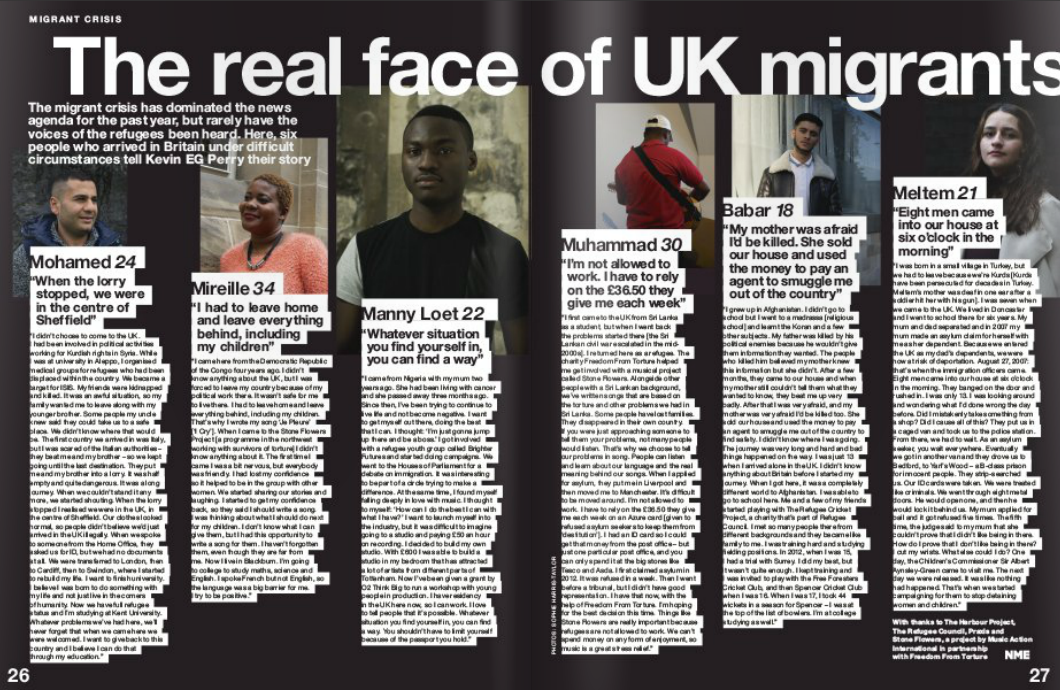
migrantsThe migrant crisis has dominated the news agenda for the past year, but rarely have the voices of refugees and migrants themselves been heard. Here, six people who arrived in Britain under difficult circumstances tell their stories

Mohamed, 24

“When the lorry stopped, we were in the middle of Sheffield”

“I didn’t choose to come to the UK. I had been involved in political activities working for Kurdish rights in Syria. While I was at university in Aleppo, I organised medical groups for refugees who had been displaced within the country. We became a target for ISIS. My friends were kidnapped and killed. It was an awful situation, so my family wanted me to leave along with my younger brother. Some people my uncle knew said they could take us to a safe place. We didn’t know where that would be. The first country we arrived in was Italy. I was scared of the Italian authorities. They beat me and my brother. That’s why we decided to stay with those people until the last destination. They put me and my brother into a lorry. Just the two of us. It was half empty, and quite dangerous. It was a long journey. When we couldn’t stand anymore we started shouting and screaming. When the lorry stopped I realised we were in the UK. We were in the centre of Sheffield. Our clothes looked normal, so people didn’t believe we’d just arrived in the UK illegally. When we spoke to someone from the Home Office they asked us for ID. I said: ‘We’ve just come now!’ We had no documents at all. We were transferred to London, then to Cardiff, then to Swindon. It was there that I started to rebuild my life. I want to finish university. I believe I was born to study. I believe I was born to be, not an important person, but to do something with my life and not just to live in the corners of humanity. Now we have full refugee status and I’m studying at Kent University. Whatever problems we’ve had here, we’ll never forget that when we came here we were welcomed. I want to give back to this country, and I believe I can do that through my education.”

Mireille, 34

“I had to leave home and leave everything behind, including my children”

“I came here from the Democratic Republic of Congo four years ago. I didn’t know anything about the UK, but I was forced to leave my country because of my political work there. It wasn’t safe for me to live there. I had to leave home and leave everything behind, including my children. That’s why I wrote my song ‘Je Pleure’ (‘I Cry’). When I came to the Stone Flowers project I didn’t know anything about it. It was my therapist who introduced me to it. She said I should go and see if I liked it. The first time I came I was a bit nervous, but everybody was friendly. I had lost my confidence so it helped to be in the group with other women. We started sharing our stories and laughing. I started to get my confidence back, so they said: ‘You should write a song.’ I wrote my first song, which was called ‘Soleil’. It was just a poem, but the group turned it into a song and it was so beautiful. It made me feel I could do more. I continued writing and started spending more time with the group, which had been hard for me because I’d been alone and cut myself off from people. I was thinking about what I should do next for my children. I don’t know what I can give them, but I had this opportunity to write a song for them. I haven’t forgotten them, even though they are far from me. Now I live in Blackburn. I’m going to college to study maths, science and English. My therapist encouraged me to go to college because I spoke French but not English, so language was a big barrier for me. I try to be positive.”

Manny Loet, 22

“Whatever situation you find yourself in, you can find a way”

“I came from Nigeria with my mum two years ago. She had been living with cancer, and then she passed away three months ago. Since then I’ve been trying to continue to live life and not become negative. I want to get myself out there, doing the best that I can. I thought: ‘I’m just gonna jump up there and be a boss.’ I got involved with a Refugee Youth Group and Brighter Futures and started doing campaigns. We went to the Houses of Parliament to do a debate on immigration. It was interesting to be a part of that circle trying to make a difference. At the same time, I found myself falling deeply in love with music. I thought to myself: ‘How can I do the best I can with what I have?’ I want to launch myself into the industry, but it was difficult to imagine going to a studio and paying £50 an hour on recording. I decided to build my own studio. With £600 I was able to build a studio in my bedroom that has attracted a lot of artists from different parts of Tottenham. Now I’ve been given a grant by O2 Think Big to run a workshop with young people in production. I’ve written a song called ‘Let Me Go’ which is about a lady who’s in an abusive relationship. I put it on for some friends of mine and they got really excited because it inspires people to get out of bad situations. I have residency in the UK here now, so I can work. I love to tell people that it’s possible. Whatever situation you find yourself in, you can find a way. You shouldn’t have to limit yourself because of what passport you hold.”

Muhammad, 30

“I’m not allowed to work. I have to rely on the £36.50 they give me each week”

“I first came to the UK from Sri Lanka as a student but when I went back to Sri Lanka that’s when the problems started back home [The Sri Lankan civil war escalated between 2005-2009]. I returned here as a refugee. The charity Freedom From Torture helped me get involved with the Stone Flowers musical project. Together with the other people from a Sri Lankan background we’ve written songs that are based on the torture and other problems we had in Sri Lanka. Some people have lost families. They disappeared in their own country, and nobody can find where they are. If you were just approaching someone to tell them your problems, not many people would listen. That’s why we choose to tell our problems in song. People can listen and learn about our language and the real meaning behind our songs. When I applied for asylum they put me in Liverpool and then moved me to Manchester. It’s difficult to be moved around. I’m not allowed to work. I have to rely on the £36.50 they give me each week. I had an ID card so I could get that money from the post office – only one particular post office. Now I have an Azure card. You can’t take any money out. You can only spend it at the big stores like Tesco and Asda, not the small ones. I first claimed asylum in 2012. It was refused in a week. Then I went before a tribunal, but I didn’t have good representation. I have that now, with the help of Freedom From Torture. I’m hoping for the best decision this time. Things like Stone Flowers are really important because as refugees we’re not allowed to work. We can’t spend money on any form of enjoyment, so music is a great stress relief.”

Babar, 18

“My mother was afraid I’d be killed. She sold our house and used the money to pay an agent to smuggle me out of the country”

“I grew up in Afghanistan until I was about 12. I didn’t go to school but I went to a Madrassa and learnt the Koran and a few other subjects. My father was killed by his political enemies because he wouldn’t give them information they wanted. The people who killed him believed my mother knew this information but she didn’t. After a few months they came to our house and when my mother still couldn’t tell them what they wanted to know they beat me up very badly. After that I was very afraid and my mother was very afraid I’d be killed too. She sold our house and used the money to pay an agent to smuggle me out of the country to find safety. I didn’t know where I was going. The journey was very long and hard and bad things happened on the way. I was just 13 when I arrived alone in the UK. I didn’t know anything about Britain before I started my journey. When I got here, it was a completely different world to Afghanistan. I was able to go to school here. Me and a few of my friends started playing with The Refugee Cricket Project, which is a charity that’s part of Refugee Council. I met so many people there from different backgrounds and they became like family to me. I was training hard and studying fielding positions. In 2012, when I was 15, I had a trial with Surrey. I did my best, but it wasn’t quite enough. I kept training and I was invited to play with the Free Foresters Cricket Club, and then Spencer Cricket Club when I was 16. When I was 17, I took 44 wickets in a season for Spencer. I was at the top of the list for bowlers, and I’m at college studying as well.”

Meltem, 21

“Eight men came into our house at six o’clock in the morning”

“I was born in a small village in Turkey, but we had to leave because we’re Kurds [Kurds have been persecuted for decades in Turkey, including the banning of their political parties and language. Meltem’s mother was left deaf in one ear after a soldier hit her so hard with his gun her ear drum popped.] I was seven-and-a-half when we came to the UK. We lived in Doncaster and I went to school there for six years. My mum and dad separated, and in 2007 my mum made an asylum claim for herself with me as her dependent [However, if this claim was rejected they could be deported]. August 27th: that’s when the immigration officers came. Eight men. They took us. They came into our house at six o’clock in the morning. They banged on the door and rushed in. I was only 13. I was looking around and wondering what I’d done wrong the day before. Did I mistakenly take something from a shop? Did I cause all of this? Next they put us in a caged van and took us to the police station. From there, we had to wait. As an asylum seeker, you wait everywhere. Eventually we got in another van and they drove us to Bedford, where Yarl’s Wood is. They strip-searched us. Our ID cards were taken. We were treated like criminals. We went through eight metal doors. He would open one, and then he would lock it behind us. Yarl’s Wood is a B-class prison for innocent people. My mum applied for bail and it got refused five times. The fifth time, the judge said to my mum that she couldn’t prove that I didn’t like being in there. How do I prove that I don’t like being in there? I cut my wrists. I did it as proof. They need everything to be documented, right? What else could I do? One day, the Children’s Commissioner, Sir Aynsley-Green, came to visit me. The next day we were released. It was like nothing had happened. That’s when we started campaigning for them to stop detaining women and children.”

With thanks to The Harbour Project, the Refugee Council, Praxis and Stone Flowers, a project by Music Action International in partnership with Freedom from Torture.

Originally published in NME, 1 April 2016.

Einstein: right again

Black Hole Blues.jpgEinstein predicted gravitational waves in 1916, but it took us a century to find them. Astrophysicist Janna Levin’s new book explains how.

What are gravitational waves?

Gravitational waves are motions in the shape of spacetime. Just as mallets create waves in the shape of a drum, black hole collisions create waves in the shape of spacetime. By recording the ringing of spacetime, we can reconstruct the motion and size and shape of the mallets.

How was LIGO able to detect them?

LIGO suspends mirrors so that they’re free to bob on the passing gravitational wave. By measuring the distance between mirrors, the machine records changes in the shape of spacetime of less than one ten-thousandth of the width of a proton over 4 km’s.

What was the atmosphere like at LIGO when they were found?

People were incredulous – then ecstatic.

What are the implications of Einstein being proved right?

Not exactly a surprise. More important are the astronomical discoveries this new era will make possible. We have already heard the first gravitational wave sounds, observed the first black hole pair, and discovered black holes a few times bigger than expected. Who knows what’s next.

Published in Shortlist, 17 March 2016.

No, really: is there life on Mars?

ExoMars2016As Bowie tributes go, it’s extravagant: this Monday, the European Space Agency will launch the Trace Gas Orbiter on a seven-month mission to answer his enduring question: is there life on Mars? Or, as the ESA rather more scientifically puts it, “to search for evidence of methane and other trace atmospheric gases that could be signatures of active biological or geological processes.” It’s a triumph for scientists who’ve overcome 11 years of technological, political and financial problems since the mission was first approved back in 2005. So much for a god-awful small affair.


Published in Shortlist, 10 March 2016.

Sage against the machine

bobby-gillespie-independentIf you only listen to one album named after a book by the radical French psychiatrist Félix Guattari this year, make it Primal Scream’s Chaosmosis.

Bobby Gillespie, the band’s indefatigable leader, may once have been known as one of rock’n’roll’s great hedonists but these days, at 53 and almost eight years sober, he’s never happier than when discussing critical theory.

When I meet him for lunch in north-west London, he tells me he actually lifted the portmanteau from the Italian Marxist theorist Franco “Bifo” Berardi’s 2015 book Heroes, which references Guattari’s work, who uses it to explain how we each absorb the mass of disconnected information the contemporary world throws at us.

Continue reading at The Independent.

Brothers In Arms

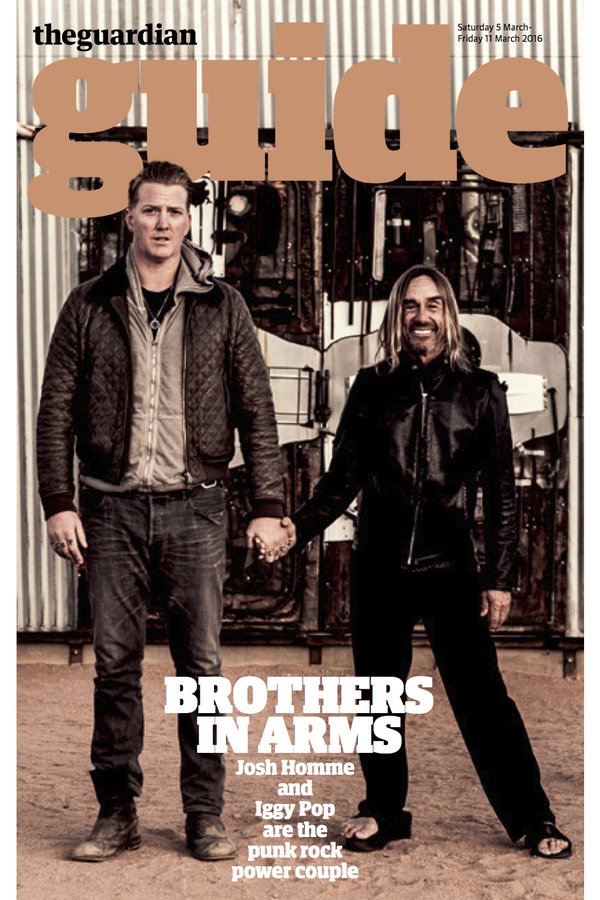
Who would have guessed, when David Bowie, Lou Reed and Iggy Pop were reinventing rock’n’roll in their own image, that it would be the guy rolling around in broken glass bare chested who’d be the last one standing?

Yet here he is, stalking into a New York hotel suite, fresh from practising serene Chinese exercise Qigong: grizzled beard, bleached hair, skin of melted leather. Iggy has scoliosis, one leg an inch-and-a-half shorter than the other and stands only 5ft 6in, but he’s still twice as commanding as the next guy. Even when the next guy is the towering Queens Of The Stone Age frontman (and drummer for Eagles Of Death Metal) Josh Homme, here recast as adoring fanboy.

Iggy-Pop-KEGP-Josh-Homme

Now 68, Iggy realised he might only have one last shot at making a “real album” as great as those incendiary first three Stooges efforts, or his pair of peerless Bowie-produced Berlin records. He sent word to Homme, who in turn recruited Arctic Monkeys drummer Matt Helders and regular QOTSA sideman Dean Fertita. Together, they went to the desert and came back with Post Pop Depression, an eerie, sinuous record mixing sex and death with gallows humour; Iggy’s baritone underscored by Homme’s desert blues.

iggy-homme-guide-cover

What did they learn? “I’ve taken lessons about longevity from him, especially knowing that I can do whatever I want now and still bounce back,” says Helders. Well, maybe – but could anyone without Iggy’s lizard DNA live as he’s done and survive?

Yet there’s always been more to Iggy than the self-destructive caricature. He’s a punk with a poet’s heart, Walt Whitman in leather trousers. He sits down with Homme in New York to discuss the new album that could be his swansong.

Continue reading at The Guardian

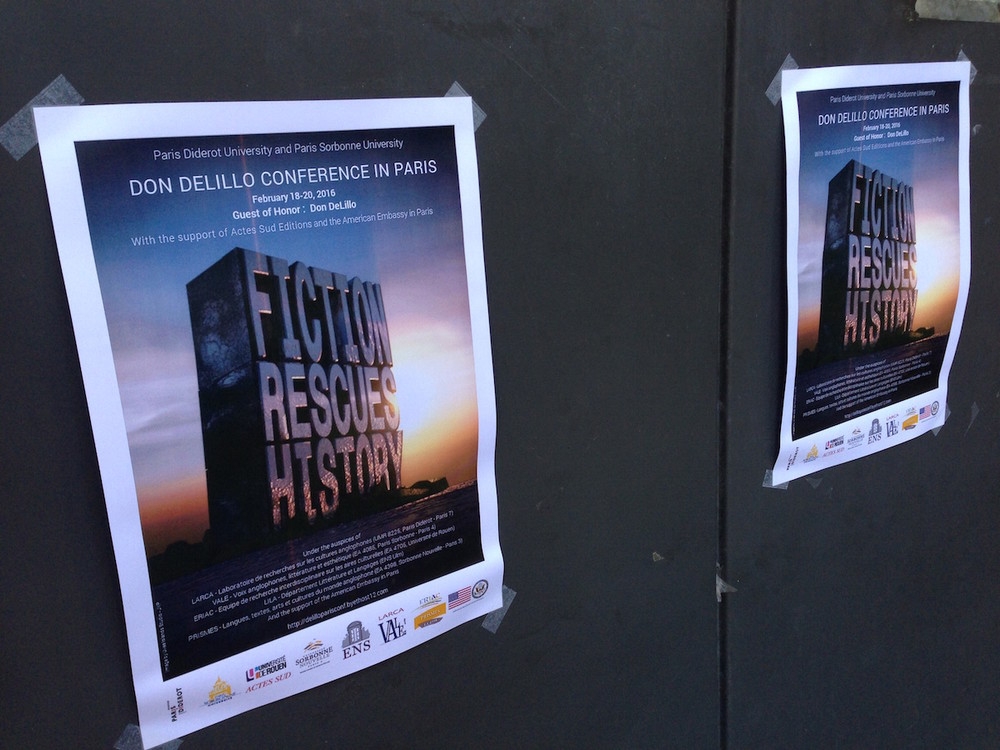
Don DeLillo talked about raising the dead at a Don DeLillo Conference in Paris

we-listened-to-don-delillo-talk-about-his-new-book-at-a-don-delillo-conference-body-image-1456757963-size_1000It’s the opening day of the Don DeLillo Conference at the Diderot University in Paris and the guest of honour stands at the back of the Buffon lecture hall. He wears a leather jacket, burgundy sweater, black jeans. He is 79 years old. I ask him: “Is it strange to attend a conference dedicated to yourself?”

DeLillo says: “Very strange. The truth is I’m not sure why I’m here.”

I mumble something excruciating like “Well, I’m glad you are” like we’re on an awkward first date. I don’t tell him that I spent a not insignificant amount of my own money to get the first Eurostar from London this morning just to see him, or that I think it’s his clarity of thought and heart which makes him the world’s greatest living novelist. It’s a brief encounter but hey, we’ll always have Paris.

Continue reading at Vice.

FIFA on the campaign trail: Jérôme Champagne says expanding the World Cup to 40 teams is ‘pure fantasy’

Jerome-ChampagneFifa presidential candidate Jérôme Champagne has dismissed electoral rival Gianni Infantino’s promise to expand the World Cup to 40 teams as “demagoguery” and “pure fantasy.”

With just two weeks to go until the Fifa Extraordinary Congress on February 26, where Sepp Blatter’s successor will be elected, Champagne has claimed that expanding the World Cup as Infantino has proposed would be unnecessarily expensive and time-consuming.

Speaking from his office in Zurich, Champagne said: “It sounds very appealing, but the reality is that the World Cup of 32 teams is already too costly and too complicated to organise. [Expanding] would reduce our ability to improve stadiums and public transportation. Secondly, a World Cup of 40 would need ten groups of four or eight groups of five. If you’re coming from a club background, you’d say that the calendar is already too full. We have to protect the leagues and the clubs and the players.”

Continue reading at The Independent.


Talking to the Algerian metal bands accused of satanism

213Fest-by-Aida-Gispsy (4)Being accused of worshipping Satan is bad enough when your sixth form art teacher takes exception to your Mayhem-inspired pentagram mural, but it’s rather more serious when the people pointing the finger are conservative Islamists with a national TV channel. That’s the position metal fans in Algeria found themselves in last August when they flipped on local network El Bilad to see an hour-long special casting those about to rock as enemies of the state.


“The media always paints a bad picture of us, showing Satanism and diabolic rituals,” says YoRi, singer and guitarist with Algerian progressive death metallers Predothia: “That can force the scene underground. This time, however, they chose not to go into hiding. Slogans like ‘Save Algerian metal’ and ‘I’m a metalhead and Muslim’ spread across Facebook, propelled by the popular Algerian Metal Community page, which boasts just under thirty thousand fans.

Turning their defiance up even louder, in November the north-eastern city of Constantine hosted 213Fest: Reach For A New Horizon, a two-day festival celebrating the best of Algerian metal. Organised as part of Constantine’s celebration of its status as Capital of Arab Culture 2015, it was perhaps the clearest sign yet that metal in Algeria is beginning to find some sort of mainstream acceptance.

The festival was organised by Harrag Melodica and Hichem Kikai, who help run the Algerian Metal Community page and originally met at a gig by the Tunisian band Myrath.

“The first edition of the festival went really well,” says Melodica. “Our aim was to put together a programme with excellent Algerian bands, and then to put on a production fit for head-banging. We received congratulations from all those present, and there were positive articles in the national press.”

Foued Moukid played the festival with his band Arkan. “It was great,” he says. “The organisation was very professional, and what about Algerian metal heads? They’re crazy! They don’t stop head-banging from the first note until the end of the show! Imagine you’re a metal fan but you don’t have the chance to attend concerts regularly. After months of frustration, you make sure you have a blast. That’s what a metal concert in Algeria looks like. Guys and girls who head-bang and enjoy the moment. During the festival we even got a wall of death!”

Moukid was born in Morocco before living and playing in Algeria in the 90s. Arkan are now based in Paris. “For me, the festival was particularly special because the last show I had played in Algeria was in 2003,” he says. “I’d been waiting to play there with Arkan for a long time. We knew that we have a lot of fans in Algeria, and they came from faraway to see us!”

The 90s metal scene in which Moukid and others cut their teeth was particularly significant in north Africa. At the tail end of 1991, around the time that on the other side of the world Metallica were releasing The Black Album and helping metal to a commercial peak, civil war was breaking out in Algeria. The ten years that followed, from December 1991 to February 2002, became known as the ‘black decade’, a period of terrorism and fratricidal war which claimed some 200,000 lives and displaced more than a million people. Yet somehow the chaos of war, and the lack of government interference, allowed the country’s burgeoning metal scene the space to grow. “In the 90s the government was focused on terrorism, and the Algerian metal scene prospered,” says Moukid. “Lots of bands played in the biggest cities of Algeria.”

“We also had a legacy of big brothers passing on tapes or vinyl of ands like Motorhead, Iron Maiden, Scorpions and Accept,” adds Melodica. “One day, young people began to buy instruments and put into practice what they’d heard. That’s how the first Algerian heavy metal bands were born, like Rascass, Neanderthalia and Litham.”

Litham, who formed in 1996, released their debut record ‘Dhal Ennar’ in 1999. It’s referred to as ‘the first metal album from Algeria’, and the band are still cited as a major influence by many of today’s emerging metal bands. Mustapha, drummer with melodic death metal band Traxxx, says: “The metal scene in Algeria started in the 90s with the legendary Litham. Sure, there were other bands but Litham were the most famous at this point in time.”

These days, many Algerian bands have become proponents of ‘Oriental’ or ‘Eastern’ metal, a sound which mixes heavy guitars with darbuka drums. Arkan’s Facebook page describes their sound as: “A concentrate of violence, twenty minutes of pure Death Metal mixed with Chahbi and other Eastern moods.”

That is, when they can find a place to play. While Traxxx were one of 213Fest’s success stories, Mustapha points out that outside of the festival it can be hard to find a venue. “The biggest problem for the scene is having a place to do it,” he says, “Because all the theatre and concert halls are handled by the government, and as you know the government don’t give a fuck about any underground movement, music or otherwise.”

The success of 213Fest suggests that Algeria’s metallers may at last shake off the Satan-worshipping tag given to them by a fear-mongering media. Melodica says the organisers steer clear of religion (“Faith is something very personal, we avoid mixtures.”) but his belief in metal is unbreakable. “The road to reach maturity is still long, but metal in Algeria is growing seriously,” he says. “A new generation of musicians like Acyl, Traxxx, Numidas, Fingerprint, Vomit Gore, Lelahell and Jugulator are getting their music out there on Facebook, Soundcloud and YouTube and I’m confident about the future artistically. It’s a very promising time.”

Savages: the angriest band in showbiz

savagesSavages have a reputation for being about as funny as breaking your spine while trying to turn off an episode of The Big Bang Theory, but singer Jehnny Beth is laughing her arse off.


We’re sitting in a café in London, and I’ve only asked why T.I.W.Y.G., a recent single from the usually morose post-punk outfit’s second record, ends with a laugh track.

“What can I say?” she asks, composing herself. “We thought it would be surprising.”

Surprising is putting it mildly. Since the release of ferocious 2013 debut Silence Yourself, Savages have carved themselves a niche as Britain’s most confrontational band. To see them live is to witness raw power, with Fay Milton beating the drums of hell, while guitarist Gemma Thompson and bassist Ayse Hassan whip up a storm to back Beth’s snarl. Their return this month with album Adore Life sees them square up to the world again.

Continue reading at Shortlist.

Rosie Lowe

RosieLoweSometimes you have to unlearn the rules. While growing up near Totnes in Devon, Rosie Lowe started learning piano and violin at the age of five. Later she picked up guitar as well, and did her musical apprenticeship in a jazz band. Yet it was only when she cast her instruments aside that she started writing from the heart.


“After I moved up to study at Goldsmiths I abandoned the piano and the guitar,” she remembers. “I got a computer with some Logic software and just started recording everything with my voice. I sang what was going on in my head: the drums, the bass and everything. It was the first time I was creating something that felt really ‘me’.”

Just like her music, her lyrics too come straight from her subconscious. Perhaps that’s why she can deal with topics as weighty as feminism and therapy with such a light touch. “I never know what I’m about to write about until I’ve written it,” she says. “I can’t really remember writing my songs. When it’s something I’m really feeling, I write it quickly – usually just over a couple of hours. When I’m on a vibe, I’m on it.”

Her debut record, ‘Control’, is full of these heartfelt moments, but she has no worries about letting people into her world. “This record is so personal to me, and I’ve lived with the music for so long,” she says. “I don’t want it to just be mine anymore, I want it to be other people’s too.”

Originally published in Mixmag, February 2016.

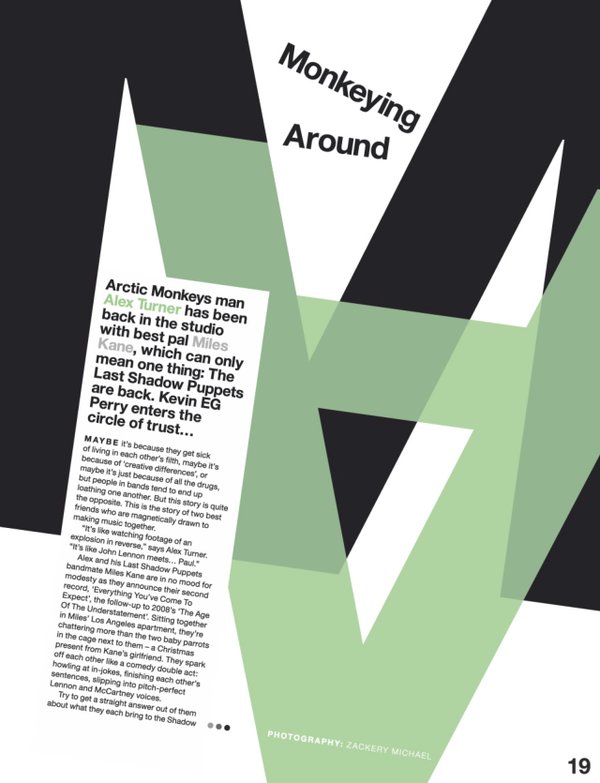
Monkeying Around

last-shadow-puppets-nme
last-shadow1Maybe it’s because they get sick of living in each other’s filth, maybe it’s because of ‘creative differences’, or maybe it’s just because of all the drugs, but people in bands tend to end up loathing one another. But this story is quite the opposite. This is the story of two best friends who are magnetically drawn to making music together.

“It’s like watching footage of an explosion in reverse,” says Alex Turner. “It’s like John Lennon meets… Paul.”

So much for the age of the understatement. Alex and his Last Shadow Puppets bandmate Miles Kane are in no mood for modesty as they announce their second record, ‘Everything You’ve Come To Expect’, the follow-up to 2008’s ‘The Age Of The Understatement’.

Sitting together in Miles’ Los Angeles apartment, they’re chattering more than the two baby parrots in the cage next to them – a Christmas present from Kane’s girlfriend. They spark off each other like a comedy double act: howling at in-jokes, finishing each other’s sentences, slipping into pitch-perfect Lennon and McCartney voices.

Continue reading NME cover story, 22 January 2016. 

Where The Magic Happens: Baaba Maal Interviewed

kegp-baaba-maalBaaba Maal has a bed big enough to sleep six people in either direction. We’re at his house in Podor, his hometown at the northernmost point of Senegal, and he’s giving me the tour. If they made MTV Cribs in West Africa this is the part where he’d sweep in and say something faintly embarassing like: ‘This is where the magic happens’, but instead he just laughs and tells me it’s actually only a guest room, and the oversized bed is “just to be a little bit exotic.”
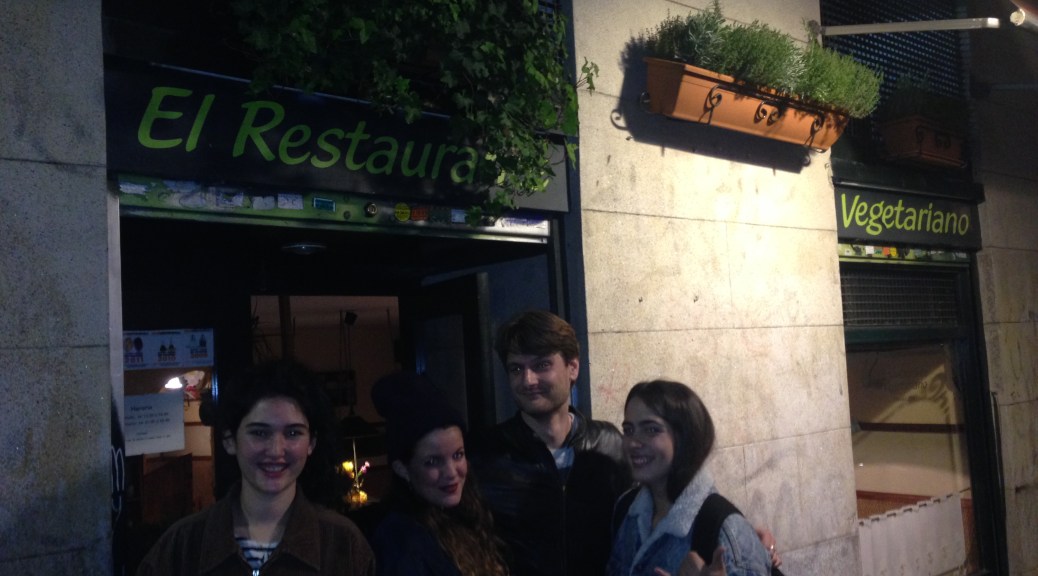
We’re here for Blues Du Fleuve, Baaba’s annual celebration of music drawn from the four countries connected by the Senegal river: Guinea, Mali, Mauritania and Senegal itself. The festival opens with Baaba arriving on a multicoloured fishing boat regatta, oar symbolically aloft, and sees performances from the likes of Orchestra Baobab, Petit Yero and the spellbinding Mauritanian singer Noura Mint Seymali. Baaba makes a cameo appearance during Noura’s set, treating us to a coming together of two of Africa’s finest voices.

This time two years ago, Baaba’s guests here included Johan Hugo Karlberg, of The Very Best, and Mumford & Sons guitarist Winston Marshall. After the festival, they stayed behind to work on songs for what would become Baaba’s new record The Traveller, his eleventh album and first since 2009. It turns out this guest room with the big bed, converted into an impromptu recording studio, really was where the magic happened.

Continue reading at The Quietus.

Senegal on song – travel feature for The Guardian.

Senegal on song

kegp-baaba-maal

Maal’s festival has run since 2006 and usually takes place in Podor, the northernmost town in Senegal, although in previous years it’s visited the capital Dakar and crossed the border to Boghé in Mauritania. Podor will always be its spiritual home, though, for two reasons: it’s Maal’s hometown, and it’s in a prime spot on the Senegal river – the Fleuve which gives the festival its name – which forms the border between Senegal and Mauritania, after passing through Guinea and Mali.

Continue reading at The Guardian.

Hinds: ‘Pop is about perfection. We’re the opposite’

Hinds-KEGPIn the past year, Hinds have emerged as the indie gang that everyone wants to join. They’ve played shows with The Strokes, The Libertines and Mac DeMarco, become the first Spanish band to appear on one of Glastonbury’s main stages and have incited so many stage invasions that it’s a wonder they bother with barriers at all. It’s easy to see why fans will risk a bouncers’ ire to get onstage with them: Hinds’ rickety rock’n’roll songs are charming because of their total lack of artifice and their shows fizz with the highwire sense that they could collapse at any moment.

Bowling down the streets of their hometown, Madrid, Hinds can barely make it a block without bumping into a friend, fan or fellow musician. They duck into their favourite hangout, Bar Sidi in downtown Malasaña, where the only thing exciting the balding clientele is the Real Madrid match on the telly.

“I think the owners like us because we’re the youngest people who ever come in here,” says Carlotta Cosials, one half of Hinds’ songwriting duo and a fast-talking flurry of curls. Every time the band try to leave, another round of Mahous appears unbidden on the bar, gratis. They like this place because it’s close to Plaza del Dos de Mayo, where they drink cervezas outside in summer, but it’s uncool enough that they get respite from Madrid’s competitive garage rock scene from which Hinds have become the city’s breakout stars.

Continue reading at The Guardian.

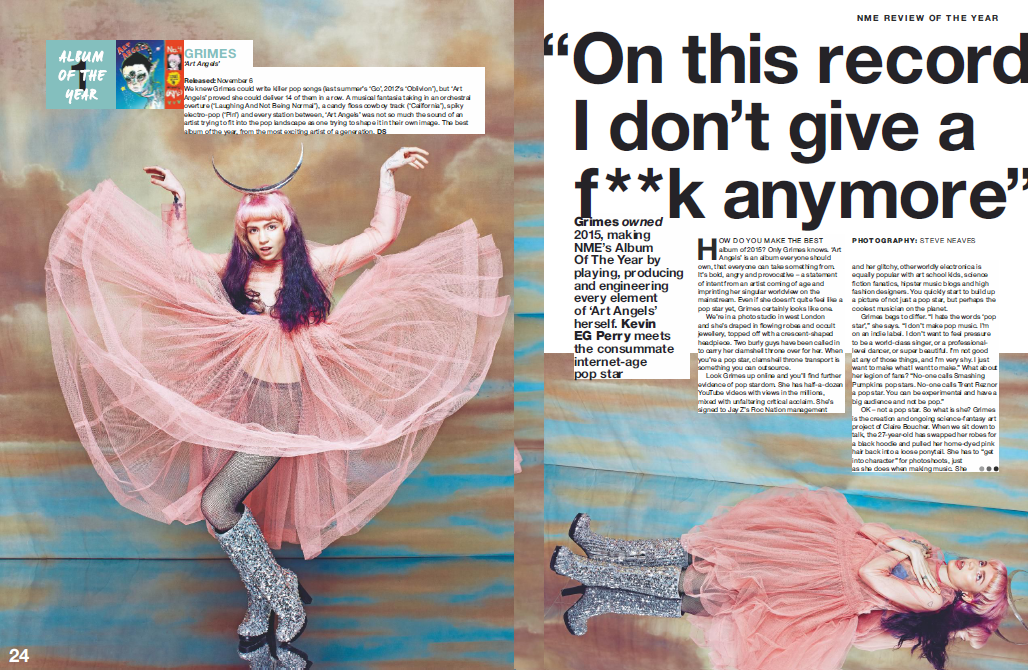
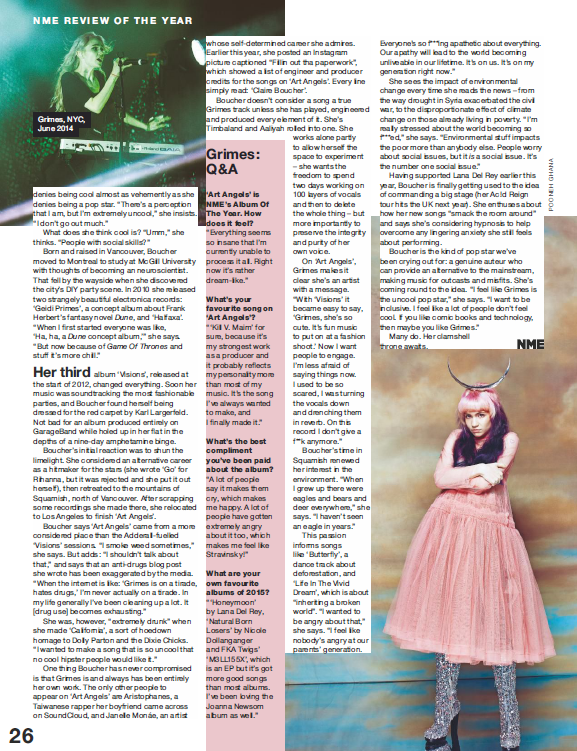
Grimes: “On this record I don’t give a fuck anymore”

grimes-nme-covergrimes1How do you make the best album of 2015? Only Grimes knows. ‘Art Angels’ is an album everyone should own, that everyone can take something from. It’s bold, angry and provocative – a statement of intent from an artist coming of age and imprinting her singular worldview on the mainstream. Even if she doesn’t quite feel like a pop star yet, Grimes certainly looks like one.

We’re in a photo studio in west London and she’s draped in flowing robes and occult jewellery, topped off with a crescent-shaped headpiece. Two burly guys have been called in to carry her clamshell throne over for her. When you’re a pop star, clamshell throne transport is something you can outsource.

Look Grimes up online and you’ll find further evidence of pop stardom. She has half-a-dozen YouTube videos with views in the millions, mixed with unfaltering critical acclaim. She’s signed to Jay Z’s Roc Nation management and her glitchy, otherworldly electronica is equally popular with art school kids, science fiction fanatics, hipster music blogs and high fashion designers. You quickly start to build up a picture of not just a pop star, but perhaps the coolest musician on the planet.

Grimes begs to differ. “I hate the words ‘pop star’,” she says. “I don’t make pop music. I’m on an indie label. I don’t want to feel pressure to be a world-class singer, or a professional-level dancer, or super beautiful. I’m not good at any of those things, and I’m very shy. I just want to make what I want to make.” What about her legion of fans? “No-one calls Smashing Pumpkins pop stars. No-one calls Trent Reznor a pop star. You can be experimental and have a big audience and not be pop.”

kegp-grimesOK – not a pop star. So what is she? Grimes is the creation and ongoing science-fantasy art project of Claire Boucher. When we sit down to talk, the 27-year-old has swapped her robes for a black hoodie and pulled her home-dyed pink hair back into a loose ponytail. She has to “get into character” for photoshoots, just as she does when making music. She denies being cool almost as vehemently as she denies being a pop star. “There’s a perception that I am, but I’m extremely uncool,” she insists. “I don’t go out much.”

What does she think cool is? “Umm,” she thinks. “People with social skills?”

Born and raised in Vancouver, Boucher moved to Montreal to study at McGill University with thoughts of becoming an neuroscientist. That fell by the wayside when she discovered the city’s DIY party scene. In 2010 she released two strangely beautiful electronica records: ‘Geidi Primes’, a concept album about Frank Herbert’s fantasy novel Dune, and ‘Halfaxa’. “When I first started everyone was like, ‘Ha, ha, a Dune concept album,’” she says. “But now because of Game Of Thrones and stuff it’s more chill.”

grimes2Her third album ‘Visions’, released at the start of 2012, changed everything. Soon her music was soundtracking the most fashionable parties, and Boucher found herself being dressed for the red carpet by Karl Largerfeld. Not bad for an album produced entirely on GarageBand while holed up in her flat in the depths of a nine-day amphetamine binge.

Boucher’s initial reaction was to shun the limelight. She considered an alternative career as a hitmaker for the stars (she wrote ‘Go’ for Rihanna, but it was rejected and she put it out herself), then retreated to the mountains of Squamish, north of Vancouver. After scrapping some recordings she made there, she relocated to Los Angeles to finish ‘Art Angels’.

Boucher says ‘Art Angels’ came from a more considered place than the Adderall-fuelled ‘Visions’ sessions. “I smoke weed sometimes,” she says. But adds: “I shouldn’t talk about that,” and says that an anti-drugs blog post she wrote has been exaggerated by the media. “When the internet is like: ‘Grimes is on a tirade, hates drugs,’ I’m never actually on a tirade. In my life generally I’ve been cleaning up a lot. It [drug use] becomes exhausting.”

She was, however, “extremely drunk” when she made ‘California’, a sort of hoedown homage to Dolly Parton and the Dixie Chicks. “I wanted to make a song that is so uncool that no cool hipster people would like it.”

One thing Boucher has never compromised is that Grimes is and always has been entirely her own work. The only other people to appear on ‘Art Angels’ are Aristophanes, a Taiwanese rapper her boyfriend came across on SoundCloud, and Janelle Monáe, an artist whose self-determined career she admires. Earlier this year, she posted an Instagram picture captioned “Fillin out tha paperwork”, which showed a list of engineer and producer credits for the songs on ‘Art Angels’. Every line simply read: ‘Claire Boucher’.

Boucher doesn’t consider a song a true Grimes track unless she has played, engineered and produced every element of it. She’s Timbaland and Aaliyah rolled into one. She works alone partly to allow herself the space to experiment – she wants the freedom to spend two days working on 100 layers of vocals and then to delete the whole thing – but more importantly to preserve the integrity and purity of her own voice.

On ‘Art Angels’, Grimes makes it clear she’s an artist with a message. “With ‘Visions’ it became easy to say, ‘Grimes, she’s so cute. It’s fun music to put on at a fashion shoot.’ Now I want people to engage. I’m less afraid of saying things now. I used to be so scared, I was turning the vocals down and drenching them in reverb. On this record I don’t give a f**k anymore.”

Boucher’s time in Squamish renewed her interest in the environment. “When I grew up there were eagles and bears and deer everywhere,” she says. “I haven’t seen an eagle in years.”

This passion informs songs like ‘Butterfly’, a dance track about deforestation, and ‘Life In The Vivid Dream’, which is about “inheriting a broken world”. “I wanted to be angry about that,” she says. “I feel like nobody’s angry at our parents’ generation. Everyone’s so f***ing apathetic about everything. Our apathy will lead to the world becoming unliveable in our lifetime. It’s on us. It’s on my generation right now.”

She sees the impact of environmental change every time she reads the news – from the way drought in Syria exacerbated the civil war, to the disproportionate effect of climate change on those already living in poverty. “I’m really stressed about the world becoming so f***ed,” she says. “Environmental stuff impacts the poor more than anybody else. People worry about social issues, but it is a social issue. It’s the number one social issue.”

Having supported Lana Del Rey earlier this year, Boucher is finally getting used to the idea of commanding a big stage (her Ac!d Reign tour hits the UK next year). She enthuses about how her new songs “smack the room around” and says she’s considering hypnosis to help overcome any lingering anxiety she still feels about performing.

Boucher is the kind of pop star we’ve been crying out for: a genuine auteur who can provide an alternative to the mainstream, making music for outcasts and misfits. She’s coming round to the idea. “I feel like Grimes is the uncool pop star,” she says. “I want to be inclusive. I feel like a lot of people don’t feel cool. If you like comic books and technology, then maybe you like Grimes.”

Many do. Her clamshell throne awaits.

Cover story for NME, 4 December 2015.

The Battle To Be Top Christmas Toy

easyjet-traveller-battle-christmas-toy

easyjet-traveller-battle-christmas-toy-1A long time ago, in a galaxy not far away, a battle began between toy makers to win big on Christmas day. Today, using high-tech methods and Jedi marketing mind tricks, the industry is as far removed from an elf whittling away in Santa’s workshop as can be… But whose year will it be?

Picture the scene. It’s Christmas morning 2014 and parents across the world are being woken, bleary-eyed in the far-too-early hours, by their excited, expectant children, all with but one thing on their minds. What’s wrapped up underneath the tree – and soon to be ripped open – will have a greater bearing on the outcome of the day than whether Mum has decided to follow the year’s hot-chef advice of pre-brining her turkey or which box set Dad will fall asleep in front of. For a fairly large proportion of little girls in the UK, that item is a doll called My Friend Cayla.

Earmarked as the year’s hottest toy by retailers such as Hamleys, Cayla talks. Of course, talking dolls are nothing new – Edison first invented one back in 1890 – but Cayla’s wi-fi internet connection means that she can check Wikipedia in the blink of a plastic eye and answer pretty much anything you throw at her. Think of her as Siri with brushable hair. Cayla proved so successful that this year her maker, Surrey-based Vivid Imaginations, is expanding the range to include My Friend Freddy Teddy for younger children and a robot called i-Que that’s aimed at boys, both of which employ the same sort of cutting-edge technology.

It’s fair to say that the days when children would be satisfied with a puzzle or a painted wooden figure are long gone – and the stakes for toy makers are immeasurably higher, as a result. In fact, you could say that, as we go about obliviously eating, drinking and indulging, a turf war is being played out every year for supremacy beneath our Christmas trees. And every toy company on Earth wants to come out on top.

According to trade group Toy Industries of Europe, Europeans spend over €16.5bn on toys each year and over half of those sales are in November and December in the run-up to Christmas.

Now, companies pour their resources into spotting trends years in advance and into harnessing new technology. Yet, predicting and producing the year’s must-have toy remains a Jedi mind trick made even tougher by the fact that new products have to win over not one, but two of the most fickle, critical and discerning audiences on the planet: children and their parents.

Probably the safest bet is to ride in the wake of a wildly popular film franchise. Scan a list of the predicted top sellers for 2015 and you’ll see Minions, Disney’s Frozen and, inevitably, Star Wars featuring highly.

But what if you’ve an entirely new idea? Then you need to start thinking smart. To this end, companies like Vivid employ in-house research and development teams; they also look for help from external sources. Eric Rossi, Vivid’s European Managing Director, says Cayla was actually created by someone outside the company. “We have to be humble,” he says. “The idea for Cayla came from an inventor. We work closely with the inventor community and when we like an idea, we’ll enter into an agreement. Then we help with development and apply our marketing expertise. You can have a good product, but if it doesn’t connect with an audience then your job isn’t done.”

If there’s one toy that’s never had trouble connecting with an audience, it’s Thunderbirds’ Tracy Island. It’s been one of the toys most associated with Christmas in the British popular imagination ever since 1991, when short supply led to the BBC reporting on fights breaking out between parents in shops and a flourishing black market in secondhand sales. After more toy sets were produced to meet demand the following Christmas, it went on to be that year’s top seller. By then, Blue Peter presenter Anthea Turner had staked her claim for immortality by showing those who’d missed out how to build their own out of shoeboxes and sticky-backed plastic.

In 2000, a revamped Tracy Island play set again became the Christmas bestseller, so perhaps it’s no surprise that with new CGI series Thunderbirds Are Go on TV at the moment, a new iteration of the toy is enjoying yet another lease of life. Now also manufactured by Vivid, this year’s much-expanded version, complete with more sounds, bells and whistles, was named at the top of Hamleys list of predicted top sellers this Christmas.

Jamie Anderson, son of Thunderbirds creator Gerry Anderson and Managing Director of Anderson Entertainment, believes that Tracy Island has a timeless appeal. “The show itself was put together by people who were fascinated by stuff like space, aeronautical engineering, gadgets and where the future might take us,” he says. “With Tracy Island, we all know that making secret bases, even if it’s just a fort between a couple of chairs under a duvet, is the kind of thing kids love.”

It’s a testament to the invention and ingenuity of Gerry Anderson and special-effects designer Derek Meddings that their creations still inspire children 50 years after Thunderbirds first aired – and also to the legacy of Keith Shackleton, who was the man who masterminded the toy side of the company.

“I don’t think it’s unfair to suggest that Dad’s production company, Century 21, basically invented merchandising to the degree that we know it now,” says Anderson. “In the 1960s, Century 21 was putting together a magazine that had a circulation of a million copies a week – which now seems bizarre for a kid’s comic or any magazine. They also had a toy division, a publishing division and even a music division featuring Penelope and Parker singing stupid songs. By the end of the 1960s, it was established that you could make a huge amount of money on the merchandising side. Some of the same people went on to work on the Star Wars toys in the 1970s. They kind of changed the world in that way.”

Which brings us right back to this Christmas. The fact that Tracy Island is competing for shelf space with toys from the new Star Wars film is, in fact, a battle between teacher and student – a plot fit for a space opera.

“It will be very interesting to see how well Thunderbirds does after the Star Wars release [on 18 December],” says toy designer Stefan Knox. “It’ll be the same boys playing with those toys. In the past few months, they’ve all been playing Thunderbirds in the playground. I bet by January, when Star Wars is out and it has a slick machine like Disney behind it, they’ll all be playing Star Wars. What do retailers do then? Do they fill their shelves with all Star Wars toys – or 50% Star Wars and 50% Thunderbirds and other boys’ toys? If you don’t have the deep pockets of Hasbro to afford the Star Wars licence, then that really makes it difficult for other toy companies.”

Knox worked with both Hasbro and Vivid before leaving to form his own design company, Bang Creations, in 2000. On his desk in his design studio in Haslemere, Surrey, he carefully unwraps a few mementos of his time working on the last range of Star Wars toys. Along with Luke Skywalker and Darth Vader, his prized possession is a Boba Fett figurine, which was doomed long before it made it to mass production. “It’s too expensive,” he says, pointing to the grappling hook hanging from the prototype’s backpack. “The amount of detail you need just costs too much.”

This is one of the key challenges facing toy designers in 2015: they have to create products interesting enough to distract a child’s attention away from their phones or iPads, but simple enough to produce cheaply on a mass scale. “The word ‘toy’ implants in people’s minds that it’s just a bit of fun and that it’s easy,” says Knox. “Actually, it’s a really difficult product to design. You’ve got to capture two markets: kids and parents. Then you’ve got the fact that it’s the most safety-cushioned industry in the world and it’s the most litigious. Then you have to plan ahead to realise that your product, which costs $5 [€4.50]to make, will end up selling for £25 [€34.65] at retail. How do you make something for $5 that is so magical it looks like it’s worth £25?”

For maverick inventors and independent designers, figuring out how to fit their toys into existing worlds can make or break whether one of the bigger companies will help them take it to market. This year, Disney are marketing a Millennium Falcon drone – a good example of taking a new piece of technology and fitting it into a world of toys that children (and their parents) are already interested in.

“If you’re a toy inventor, the wise thing to do would be to look at a company’s portfolio,” says Knox. “For example, Hasbro has the Star Wars licence. If you’ve got an idea that could be moulded into the Star Wars property, spend your money on that and try and get it in. Starting a new brand needs a lot of marketing and you’re then competing against the films and the licences in this world. It’s a very hard sell.”

Star Wars is such a powerful force in the toy market that it even had a little-heralded impact on the survival of one of the world’s most successful toy companies. Back in the late 1990s, LEGO was floundering and dicing with bankruptcy. While it was struggling to modernise, it did have one big-selling product line keeping it afloat: Star Wars, its first outside licence. As the company rebuilt in the 2000s, they went on to licence a whole host of other franchises, including Harry Potter and Pirates of the Caribbean, but it’s Star Wars that has remained the biggest seller, even as the brand diversified into computer games. The LEGO Movie has also helped the Danish company to a stunning recovery and annual global sales approaching 28.6DKK (€3.83) billion.

Warren Elsmore, a professional LEGO builder and the man behind London’s Brick 2015 exhibition, believes that its recent success is down to finding a way to integrate modern interactivity with its physical toys. “They’ve kept their finger on the pulse of what people want,” he says. “The video games are huge sellers, but I think what’s really nice, especially with their new game, LEGO Dimensions, is that they’re melding the two together. There’s something visceral about playing with something with your hands.”

While LEGO has been successful in bringing together physical toys and computer games, one new technology that still isn’t quite up to scratch is 3D printing. Elsmore says that printers aren’t yet accurate enough to print bricks with the precision that LEGO requires. “LEGO bricks are made to the tolerance of one-fiftieth of a millimetre, 10 times finer than a human hair,” he says. “That’s way beyond what most 3D printers can cope with at the moment. It’s something that can be used in design, but it won’t take over from moulding LEGO bricks any time soon.”

Meanwhile, as battles rage between companies competing to create the newest tech and bid for the biggest film franchises, other toy companies still exist in a rather more sedate world, where they know their tried-and-tested formula works. Germany’s Playmobil, for instance, is targeted at younger children and pulls in an annual revenue of over €552m, without plastering any famous faces or brands on their boxes.

“Most of our toys are classics that we’ve been making since the beginning, like knights, firefighters and police. There’s no need to license things,” says Uwe Reuter, head of Playmobil’s product-development department. He says they get their inspiration for new toys from a more traditional source: “We receive 150 letters per month from children commenting on our products. They send us sketches and ideas. That’s what tells us which direction we should take.”

Come 25 December, when children across Europe dive underneath their Christmas trees to find out what Father Christmas has brought them, they’ll be holding in their hands the end result of a design, development and marketing process years in the making. Whether it’s brand-new technology or a timeless classic, it’s their parents who’ll be crossing their fingers behind their backs and asking: “Are these the toys you were looking for?”

Cover story for Easyjet Traveller, December 2015.

The Beastie Boys Story Is Now A Play With A Puppet Rick Rubin – But Does It Work On The Stage?

beastie-boys-joe-twiggFor the next three weeks at the Camden People’s Theatre in north London, you’ll find a show with a little story to tell about three bad brothers you know so well.
‘Licensed To Ill’ is an unofficial musical paying tribute to the 5 Borough’s finest: Ad-Rock, MCA and Mike D, better known as the Beastie Boys. It’s a show as inventive, colourful and playful as the music the band themselves made, condensing the lives of the three members into 90 minutes of gags, puppets and rap montages.

Continue reading at NME.

Jamie Hewlett’s First Art Exhibition Is a Tribute to 70s Sexploitation, Tarot and Trees

jamie-hewlett-double-honeyHaving created both Gorillaz and Tank Girl during almost 30 years as a graphic artist, Jamie Hewlett has finally been tempted into a gallery for his debut art show. He was inspired, like so many before him, by Googling “tramp sex”.
“I was talking to someone in my studio about online pornography,” explains Hewlett. “I said to him, jokingly, “Whatever you tap in, it will be there”. He didn’t believe me. I said, “Ok, let’s think of something… tramp sex”. Sure enough, he tapped it in and there was a website about that. I didn’t really want to see that, and I’m not sure many people do, but my point was that it’s all there. Nothing is left to the imagination at all. I don’t like that. I prefer the power of suggestion.”

So “The Suggestionists” – his first gallery exhibition – was born. The show brings together three different styles of Hewlett’s work. Fans of his cartoons will immediately recognise the “Tarot” pictures, inspired by magical-realist Chilean film director Alejandro Jodorowsky’s reconstruction of the original Tarot de Marseille. Hewlett’s wife Emma de Caunes stars as “Honey” in his tribute to 70s sexploitation movie posters and “Pines”, a series of drawings he did in the south of France, provides a bucolic counterpoint.

“They’re very different in style and medium, yet they’re connected by the idea of the power of suggestion,” says Hewlett. “Having taken so long to do an exhibition, I wanted to show three different sides of what I do.” Here, he talks us through some of the images from the collection…

Continue reading at Vice.

Bruce Robinson & I

kegp-bruce-robinson“Why is it that all the writers one admires are always arseholed?”

Bruce Robinson and I are already a bottle of wine each in when he asks this, which sort of proves his point. Since writing Withnail and I, Robinson has had plenty of admirers – not least Johnny Depp, who painted the oil portrait of Keith Richards smoking a joint hanging above us on Robinson’s living room wall. The canvas is made – and hopefully you can see the subtle motif here – entirely from Rizla papers.

There are, as Robinson points out, “no books in booze”, although that never stopped him looking. “I’ve been so drunk working I’ve typed with my nose,” he says. “But the point is, if you’re typing something worth reading, no one knows you typed it with your nose.”

When it works, it works. As well as Withnail, Robinson is best known for writing the BAFTA-winning, Oscar-nominated The Killing Fields in 1984, and for writing and directing – at Depp’s insistence – The Rum Diary in 2011. What’s less well known is that he’s spent much of the last 15 years on the trail of the true identity of Jack the Ripper – and he reckons he’s finally got his man.

Continue reading at Vice.


John Lydon: The Art of the Frontman

johnlydon

“I still get nervous. When I first started I thought it was just me. I’d watch other bands and think: “What confidence these singers have got!” Gradually you learn it’s normal. What you don’t learn is how to deal with it. I read books by actors on stage fright. I learned that nerves are an important gift. That’s what you need to get your adrenaline.”

“Laurence Olivier was one of the fellas I studied. People used to say: “Johnny Rotten, where did you get that image from?” I said: “Him as Henry V!” I wasn’t joking. It wasn’t based on the characters he portrayed as Henry V or Richard III, but how he dealt with stage fright. Alec Guinness was another one. It didn’t quite solve the nerves, but it taught me that they’re useful once you’re on stage.”

Continue reading at Shortlist.

Why Millions of Men Lose Friends in Their Twenties

losing-friendsMen often think of themselves as lone wolves. Lone wolf being ambitious in the office. Lone wolf on Tinder. Lone wolf playing Fallout 4 alone in a flat, eating lasagne out of the microwave carton. As we get older and life inevitably starts flinging shit at us, we might start to wonder whether there’s a reason most wolves hunt in packs.

While we’re typically sociable beasts during school and university, when the pressures of work start beating down, faces that were once familiar to us can start falling away, making us realise just how alone in the world we truly are.

This month, a YouGov poll carried out by The Movember Foundation found that 12 percent of men over the age of 18 don’t have a close friend they would discuss a serious life problem with. That’s two and a half million men across Britain. Over a quarter of men said they got in touch with their mates less than once a month, and 9 percent said they don’t remember the last time they made contact with their friends.

This can develop into a serious problem in later life. Research by the World Health Organisation has shown that a lack of close friends has a significant impact on men’s health in the long term, leaving us at risk of depression, anxiety and suicide.

Sarah Coghlan, head of Movember UK, tells me: “Many men we’ve spoken to don’t actually realise how shallow their relationships have become until they face a significant challenge, such as bereavement, breakdown of a relationship, fatherhood or loss of employment – and yet that is of course when good friends are needed most.”

So what happens to our friendships as we get older? Here, six men at different stages of their lives discuss their relationships with their friends.

Continue reading at Vice.

Could Hyperloop come to the UK?

hyperloopDon’t like flying? How does being fired the length of the country at over 700mph in something not entirely dissimilar to Futurama’s vacuum tubes sound? Incredibly, this could soon be a reality. Hyperloop Transportation Technologies (HTT) have announced that they’ll start work on building a $6bn track in California this month which should be open by 2019 – and they want to bring it to Britain.

HOW DOES IT WORK?
The Hyperloop concept, dreamed up by Telsa and SpaceX entrepreneur Elon Musk in 2013, involves individual ‘pods’ running in sealed tubes. The air in the tubes is kept at very low pressure, while a cushion of high-pressure air supports the pods. This does away with the need for conventional rails or magnetic levitation. The pods are then fired along the tubes by linear induction motors in a system that Musk himself has described as “a cross between a Concorde and a railgun and an air hockey table.”

JUST HOW FAST CAN IT GO?
When HTT get their first track up-and-running in California they’ll be sending passengers down it at 160mph, slightly slower than Eurostar speeds. However, they’ll be testing empty carriages at up to 780mph. The aim is that eventually they’ll be able to move people at those speeds too.

COULD IT REALLY COME TO BRITAIN?
HTT have said that the UK is a candidate for the first ever construction of a full length Hyperloop, connecting London to Glasgow in as little as 30 minutes. While they’re confident their technology works, the bigger problem for HTT will be actually constructing the tubes. Given the speeds the pods will be travelling at, Hyperloop tubes need to be as flat and straight as possible. HTT have said they’d build the tubes on raised legs, and CEO Dirk Ahlborn argues they could be built over existing railways to reduce the cost of buying new land. Ahlborn tells Shortlist that he believes Hyperloop could end up replacing the government’s current High Speed 2 project.

“Our system produces more energy than we’re using, thanks to solar panels, wind and kinetic energy,” he says. “High Speed Rail doesn’t make sense economically. Once you have a system that generates income versus one that doesn’t recover your initial investment, I think every government will be switching over to the better system. For High Speed Rail projects that are starting now, there’s a huge possibility that they’re not going to be finished.”

Published in Shortlist, 12 November 2015.

The Sound and the Fury

drengeA live show by grunge siblings Drenge is an all-out assault on the senses, but don’t just take our word for it. “We met Kanye West when we did Later… With Jools Holland and he told us he liked the aggression in our music,” says drummer and younger brother Rory Loveless. “He was talking about wanting to put more aggression into his own music. Yeezus was out by then, but I’d be interested to hear what his next album sounds like. Maybe there’s a sprinkling of Drenge inspiration in there. Drengespiration.”

Continue reading at Shortlist.

Living the Highlife: the global party scene taking world music into the future

Going-with-the-Flo-Highli-009If a DJ can play Chicago house next to Detroit techno or German electro without anyone missing a beat, then why shouldn’t they also drop some Angolan kuduro, Brazilian baile funk or South African kwaito into the mix? That’s the philosophy behind the crossover dance scene spearheaded by Highlife, a club with more passport stamps than David Attenborough’s cameraman. Five years since its first night at Glasgow’s Stereo, the club’s mix of UK funky, Afrofuturism and Middle Eastern beats has built a mini empire that extends to a compilation series and Rinse FM radio show.

Continue reading at The Guardian.

Fear And Loathing Goes Graphic

Fear-&-Loathing-29When Tom Wolfe called Hunter S Thompson the “greatest American comic writer of the 20th century”, there’s no way he could have seen this coming. It’s been 44 years since Fear And Loathing In Las Vegas was first blasted into ink, and it’s now been reimagined as a graphic novel by Canadian artist Troy Little.

Thompson’s drug-twisted Vegas odyssey lends itself to the comic format. “Things can be much more plastic and malleable in this medium then in real life, which suits the story” says Little.

The comic’s been critically praised, but the jury’s out on whether Thompson himself would‘ve warmed to it. He fired director Alex Cox from the Fear And Loathing film for trying to animate a particularly righteous passage known as ‘the wave speech’. “Write your own story,” Thompson barked, “just don’t fuck with mine and make it into a cartoon.”

Little was well aware of that exchange. “I can see his concern about having his work ‘Mickey Moused’,” he says. “I was careful to stick to the source material. That said, I fully expect nothing less than a savage haunting foisted upon me.”

Originally published in Shortlist, 5 November 2015.

Songhoy Blues on fighting Mali’s musical oppression

songhoy-bluesLike money, oil and funny cat gifs, music is such a basic part of our shared culture that it’s hard to imagine what society would feel like without it.

Yet in Mali in 2012, music was banned outright in the north of the country. Following a presidential coup, Islamist extremists took control of some regions and swiftly set about implementing an extreme version of Sharia law that outlawed all forms of music. They destroyed radio stations, burned instruments and tortured musicians. Yet as they were spreading their darkness, the jihadists could have had no idea that they would end up inspiring one of the most visceral bands to emerge this year: Songhoy Blues.

Today, Johanna Schwartz’s remarkable documentary ‘They Will Have To Kill Us First’ is released in the UK. The film follows the stories of Songhoy Blues as well as fellow musicians Kharia Arby, Fadimata “Disco” Walet Oumar and Moussa Sidi as they fight to keep their music alive and perform the first public concert in Timbuktu since music was banned.

Oumar Toure, one of Songhoy Blues’ guitarists, tells me he believes the Islamist mujahedeen feel threatened by music. “The mujahedeen hate the influence that Western music has,” he explains. “The philosophy behind it, the entertainment and leisure it promotes. For them the only way to control the city is to control the media and to put their propaganda on the radio.”

Oumar points out that it was only after the band members were forced to flee to the Malian capital Bamako, in the south of the country, that they even thought about starting to make music together. “The band started after the meetings we had during the occupation of the northern in 2012,” he says. “In those meetings we were asking what we can do for the north and the idea came about to create a band to express ourselves and what is going on here.”

His bandmate, Garba Toure, adds that it remains too dangerous to return to their homes in the north, although they’d like to. “”To return whilst there are still weapons and attacks that are increasing day by day and there is no stability?” he asks rhetorically. “Right now, it’d be difficult to return.”

However, he adds that their dream is to see music return to all the places where the extremists have banned it. “Of course!” he says. “Music is one of Mali’s greatest cultural resources and without it we can’t celebrate weddings, baptisms, birthdays, every day life, like we want to. Conflict needs music for resolution, that’s why we play.”

For Oumar, it’s through continuing to perform and by refusing to be silenced that Songhoy Blues can help music return to their hometowns. “Our music denounces the justification which various groups use when hurting people,” he says. “The rebels have their Kalashnikovs. For us, our guitars are our Kalashnikovs. It’s how we can fight back.”

The Magic Gang hang Tuff with Sly & Robbie

sly-robbie-kegp

There’s something in the air at Tuff Gong Studios, and it’s not just what the engineer’s smoking. There are awards everywhere, from a Grammy in the control room to the certificate outside proclaiming Bob Marley’s place in the High Times Cannabis Hall of Fame, but more than all that there’s just something special about standing in the room where deathless songs like ‘Could You Be Loved’, ‘Buffalo Soldier’ and ‘Redemption Song’ were recorded.

Located at 220 Marcus Garvey Drive in Kingston, Marley’s former studio is a cottage industry, home to one of Jamaica’s biggest live recording rooms, a vinyl pressing plant and even a run-down record shop. For the next couple of days, it’s also home to Brighton four-piece The Magic Gang, who’ve been flown out to record here by Converse Rubber Tracks.

The band – guitarists Kris Smith and Jack Kaye, bassist Gus Taylor and drummer Paeris Giles – quickly make themselves at home, but they’re clearly appreciative of the sun-kissed opportunity they’ve been gifted.

“When we first sent our music to Converse Rubber Tracks we said we wanted to record at Tuff Gong because the thought of coming here was just unimaginable,” says Jack. “We didn’t expect to ever be able to come to Jamaica and work in such an amazing place. We chose it as a pipe dream – and then obviously it worked out, which is incredible.”

“It’s the place we would least expect to come as a band,” adds Gus. “I’d love to come back to Jamaica for a holiday, but I can’t imagine that we’d tour here. It’s half-way across the world, and such a different vibe. We could have gone to record in America or Abbey Road but it wouldn’t have been the same.”

Everyone at Tuff Gong seems to have a story to tell, not least Chow, the studio’s main engineer. He first met Bob Marley in London in 1975, and the singer was so impressed by the Malaysian’s technical know-how that he invited him to move to Kingston to help him build a studio, first at his house at 56 Hope Road and then here, at the former site of Federal Studios. Chow has been living here ever since. He kicks back and watches ‘Titanic’ in a side room while The Magic Gang record, but he’s always on hand with a spotlight and a screwdriver to fix any equipment that goes haywire – and to remind the band of what hallowed ground they’re treading.

“He said about the Fender twin amp that Jack was using: ‘I think Bob played through this, it’s been here since then’,” says Paeris. “That’s just amazing. Chow is a living legend.”

magicgangThe band have barely got their instruments set up when a couple more living legends walk through the door. Converse Rubber Tracks have invited Sly & Robbie, the most famous rhythm section in reggae history, to help produce their session. Given that the pair have previously worked with everyone from Jimmy Cliff and Peter Tosh to Bob Dylan and Chaka Demus & Pliers, they’re not bad people to have behind the mixing desk. “Don’t worry,” mutters Kris after their superfluous introduction. “We know who you are.”

There’s clearly a few starstruck nerves at first, but before long Robbie is sat behind the mixing desk singing along with the band’s three-part harmonies and Sly is humming their basslines.

“When they first walked in I literally didn’t know what to say,” admits Kris later. “I was thinking: ‘That looks like Sly Dunbar… that is Sly Dunbar… and there’s Robbie.’ I couldn’t really say anything. I was speechless. This has been the most surreal experience of my life.”

Sly & Robbie may have the easy-going air of men who’ve been playing reggae for 40 years but some estimates say they’ve recorded or played on over 200,000 tracks. You don’t build up a library like that without a fierce work ethic beneath the laidback disposition. “They worked us hard,” says Kris. “One of us was flat during a group vocal and Robbie came in and stood next to us while we were singing. He rooted out the culprit.”

“It was terrifying,” laughs Jack “But I’m sure that experience is going to better us.”

robbieRobbie takes a hands-on approach with the band, and knows instinctively how to coax the best performances out of them. At one point, after listening to Kris record a guitar part, he simply instructs him to play it again as if he’s playing a gig. The performance is instantly improved.

“It was just business as usual,” says Kris. “They were cracking on with it in the same way that we were. I get the impression that they were able to tell that we’re sincere and hard-working. Jamaica’s a very musical country, and everyone’s very passionate about it. I think that if you come across in your truest way that’s always well received, regardless of where you come from or what you’re doing.”

While the two tracks that The Magic Gang record here – ‘Happy Birthday’ and ‘Wanna Get To Know Ya’ – are intricate indie pop songs, a long way from reggae, there’s a musical affinity that Sly & Robbie pick up on. Sly tells Gus that his bassline reminds him of a Motown tune, and asks him why the band chose Tuff Gong. “I think you made the right choice anyway,” he laughs. This studio holds a lot of memories for him too – it was in this room that he first recorded as a drummer, back when it was called Federal Studios. “When I was 14, this is where I made my first recording on The Upsetters’ ‘Night Doctor’,” he says. “It’s a special place to cut a record.”

“I love the way Sly and Robbie work,” Gus says later. “They pick up on things that we wouldn’t necessarily pick up on.  They’re not meticulous in the sense of musical perfection, but they’re meticulous in terms of the vibe of the song, and the performance. Rather than making a sonically perfect piece of music, it’s totally about the feel of the song. The songs we’ve recorded with them do sound like they were recorded at Tuff Gong. You can just hear it within the drums. On ‘Wanna Get To Know Ya’ we used proper room mics and it just sounds like that room.”

Outside of the studio, the band soak up the Jamaican atmosphere. Kris roots out classic reggae seven inches at Rockers International, one of the few record shops still standing on the famed Orange Street, and Paeris goes to check out the Weddy Weddy Wednesday party at Stone Love, one of the original Jamaican soundsystems that’s been running since 1972. The resident MC calls it the “University of dancehall, an institute of higher learning.” The same could go for the whole island. No matter which back street you turn in Kingston there always seems to be music coming from somewhere, as if you’ve been cast in a remake of ‘The Harder They Come’ and all the music is diegetic. As a country it has resisted the cultural homogenisation that’s spread across so much of the globe: Jamaica remains unmistakeably Jamaican.

“I was expecting it to be much more Westernised, more into celebrity culture and materialism,” says Gus as the band prepare to fly back to Britain with their freshly cut recordings in tow. “It’s still totally how you imagine it was 20 years ago. Everyone’s still doing their thing, and no-one’s compromised their way of doing things.”

the-magic-gang“I’ve never met so many characters in so little time,” adds Jack. “The thing I found most overwhelming was how welcoming everyone was. We’re this new band that no-one had obviously seen or heard of before, just coming in and working in their space, but they made us feel totally welcome.”

Better than any souvenir they could bring home from their time in Jamaica is the knowledge that they’ve got two fresh tunes, indelibly stamped with that Tuff Gong air, and that they’ve made a couple of new fans in high places in Sly & Robbie. Back in the control room, Robbie cracked a wide grin at the idea of giving them any advice. “They’ve just got to keep doing what they’re doing and do everything with attitude,” he said. “They’re on the right track. They’re making magic music.”

Originally published by NME, 9 October 2015.

How Iceland Went From Bust To Boom

Iceland-Easyjet-TravellerIceland-Easyjet-Traveller-1It was only a matter of time before Iceland went bust. For decades, the people on this volcanic island in the middle of the Atlantic had made their money from fishing and aluminium smelting. Then, in the 2000s, they started making money from international finance. Lots of money. By 2007, Iceland’s three biggest banks were worth $140bn, 10 times the size of the country’s economy. The banks pulled this off by promising unrealistically high rates of return to foreign clients and buying up companies, real estate and even football clubs around the world. There was no way they could keep paying their bills and so, on 6 October 2008, the whole house of cards came crashing down overnight. Billions were wiped out in the flicker of a computer screen as the global financial crisis took hold.

Not that you’d notice walking around Reykjavik today, where an army of cranes pluck the city into new shapes. On Laugavegur, the main drag, tourists pose with Vikings and trolls, while restaurants lure in hipsters with gourmet hot dogs slathered in pulled pork. At night, the bars throng with Icelanders taking great pleasure in introducing their visitors to Brennivín, the powerful local schnapps. Clinking glasses punctuate spirited chatter.

And the reason for the cheery scenes? Instead of licking their wounds, this country of 329,000 people took it upon themselves to find a fix, creating a blueprint for how to plot a 21st-century economic recovery in the process.

Iceland-Easyjet-Traveller-2Magnús Sveinn Helgason is a great example. As a financial journalist and member of Iceland’s Althing Special Investigative Commission on the Collapse of the Financial System, Helgason has had a front-row seat for the whole ride. Nowadays, he gives ‘Walk The Crash’ tours of Reykjavík, where he helps visitors understand how the banks went down and how the country got back up again.

“I started the tour because every other tourist I meet is interested in hearing about either the collapse or the recovery,” he says. “They want to hear about the fall of our corporate Vikings, the marauding financiers who went around the world, not robbing monasteries, but buying up department stores.”

Tourism has played a huge part in this success story. In fact, last year, it became Iceland’s biggest industry – overtaking fishing – and you can see the results in the place we’re staying. Slap-bang in the business district, the Fosshotel Reykjavik is the city’s biggest hotel, with 320 rooms. Since opening in the summer, its been operating at near full capacity.

So, what caused the boom? Helgason attributes it – perhaps counterintuitively – to the impact of the crash and to the island’s volcanic eruptions in April 2010. “You had the currency collapsing, making it cheaper to visit, then you had the Eyjafjallajökull eruptions,” he says. “For the country, this was massive, free, international advertising.”

While Helgason’s tour is the most direct example of Icelanders turning their economic disaster into a tourism opportunity, the country abounds with specialists who’ve used their knowledge to offer visitors something they won’t find anywhere else. Take Hreinn Elías, who cofounded Arctic Surfers in 2010 and was thus perfectly positioned to benefit from the tourism swell. “Iceland is a unique location for surfers,” he says. “We have world-class waves and scenic locations, but it’s not enough to just know the spots. Here, you have to be on the move to find the best surf. That’s what people come to us for.”

Established destinations, like the Blue Lagoon, have also benefitted from this upswing in attention. Founder and CEO, Grimur Saemundsen, who’s currently building a luxury hotel at the lagoon, to open in 2017, says: “The last five years have been an adventure for us. It’s undisputed that the growth in tourism since 2010 has played a major role in reestablishing the economy of Iceland. We’re now the biggest sector in the economy and the biggest employer. The banking crash created a vacuum that the tourism industry stepped into.”

Iceland-Easyjet-Traveller-3While the island’s unique geography is part of its draw, the country also has a busy cultural calendar. Here, its small size is a definite advantage. Halla Helgadóttir, who runs Iceland’s design week in March, says that designers from a variety of disciplines come here to share ideas; while Stella Soffía Jóhannesdóttir, of the Reykjavik International Literary Festival, tells an anecdote that illustrates just how intimate their events are. “When David Sedaris spoke here, he said he was used to audiences of 3,000. Here, he spoke to 100 people,” she says. “That makes our festival an opportunity to meet your favourite authors in very unusual circumstances.”
Mingling among the tourists heading to Iceland since the crash have been some of Hollywood’s top directors. Prior to 2006, only three foreign films had been shot in the country. Since then, it’s provided locations for almost 20, including Christopher Nolan’s Batman Begins and Interstellar, Ridley Scott’s Prometheus and several seasons of Game of Thrones.

“More than 14% of visitors come here because they saw Iceland in a foreign film or TV show,” says Iceland’s film commissioner, Einar Tómasson. “With things like Game of Thrones filming here every year, I think people see the great landscapes and think, ‘Let’s go there. It’s so different’. One of our strengths is that our locations are so diverse. Within two hours, you have glaciers, lagoons, waterfalls, rivers, lakes, green valleys, black deserts and lava sculptures. It’s all packed together.”

As well as the locations, film studios also come in search of technical expertise. Daði Einarsson opened a division of visual-effects studio Framestore in Iceland shortly before the crash in 2008 and was able to buy the company out to form independent studio RVX in 2012. They’ve since provided effects for films including 2 Guns and this year’s mountaineering epic, Everest.

Einarsson says that, in the years following the crash, Icelandic companies benefited from a surge of talented workers returning to the labour market. “There had been a huge brain drain into the banking sector from basically everything else,” he says. “Nobody could compete with it in terms of wages or the sexiness of the industry at that time. Obviously, the crash was a catastrophe in many ways, but on the other side, it’s caused an influx of talent back into the workforce to do new things. After a year or so, there were a bunch of new entrepreneurs and start-ups. In some ways, we tried to create our way out of trouble.”

Iceland-Easyjet-Traveller-4One of those new start-ups was Plain Vanilla, an app company that created QuizUp, the fastest-growing iPhone game ever. Thor Fridriksson founded the company in 2010 and agrees with Einarsson that the crash created the incentive for people like him to follow their dreams. “If the crash hadn’t happened, and I was coming back from Oxford with student debt on my back, and had the option to go into a well-paid job at a bank, I probably would’ve done that,” he says. “It wasn’t on offer, so I did something else. The worst thing for entrepreneurism is if there’s too much luxury. It’s almost always born out of some sort of need.”

It’s not just in entertainment and arts that Iceland’s entrepreneurs have flourished. The country already generates all of its electricity from renewable sources, like hydropower and geothermal power, so it’s no surprise it’s also leading the way in carbon-capture innovation.

In 2012, Carbon Recycling International started producing liquid fuel at the first commercial carbon-dioxide recycling plant in the world, located in Reykjanes. This technology could have a huge impact on climate change and may even one day be used to help astronauts make the fuel they need to return from Mars. The company’s director of business development, Benedikt Stefánsson, argues that it was the crash that helped them secure the support they needed. “Before the crash, nobody bothered to think about making our own fuel, because it was easier and cheaper to buy oil,” he says. “Afterwards, people realised that maybe we should start thinking long term about investing in this sector.”

Iceland’s entrepreneurial spirit led them into even more unlikely arenas. Out near Keflavik Airport sits a unique factory belonging to Algalif. Each week, it harvests 45kg of algae in 12,000 litres of water, from which they can extract 1.6kg of astaxanthin, a substance which is used as a food additive for salmon (it makes them pinker) and as a dietary supplement for humans (it’s an antioxidant – their pinkness remains unchanged). This may seem like a niche business until you consider the returns. “The retail price of astaxanthin is between $150,000 and $250,000 per kilogram,” points out COO Orri Björnsson as he shows me around the algae-filled pipes. “It’s more expensive than cocaine.”

Iceland-Easyjet-Traveller-5What lessons can other countries learn from Iceland’s phoenix-like rise? Economist Ásgeir Jónsson believes it’s about toeing the line. “When the IMF came to Iceland, we did everything they asked us to do,” he says, when we meet in his book-lined office at the University of Iceland, where he’s an associate professor of economics. Iceland didn’t owe money either: “The Icelandic government had almost no debt when it got into the crisis. We kept the debts private. That’s what the IMF said: ‘No socialisation of losses’. Sovereign debt is not the same as private debt.”

For struggling economies, Nobel prize-winning economist Paul Krugman strongly recommends ‘doing an Iceland’. For Krugman, that entails allowing your banks to collapse, devaluing your currency (if you have your own), introducing capital controls on money leaving the economy and trying to avoid paying back foreign debts. Though, of course, not all nations have the same circumstances.

However, back on the ‘Walk The Crash’ tour, through the quiet streets of Reykjavik, Magnus Sveinn Helgason is arguing that Krugman has missed the most critical element in Iceland’s recovery. It’s the thing that binds together everyone from Arctic surfers and location directors to app designers and algae farmers. “The basis of Iceland’s prosperity has always been our human, social and cultural capital. That was not destroyed in the crash,” says Helgason. “You could have destroyed that if you had ripped apart the social contract and imposed brutal austerity measures. Icelanders got through because we really did feel that we were all in it together. That’s what other countries should learn from this recovery: the importance of society. If you’re in it together, you can get through it together.”

Cover feature for Easyjet Traveller, October 2015. 

Arcade Fire: ‘The major record labels are completely clueless’

arcade-fire-independent-on-sundaywin-butler-kegpIt’s late in the evening after the premiere of The Reflektor Tapes at the Toronto International Film Festival, and Arcade Fire are throwing a party at Rhum Corner, a local Haitian bar. Win Butler, unmissable at 6ft 5in in a widebrimmed hat, works the room, thanking those who worked on the film and hugging friends. Beside him, his wife and co-bandleader Régine Chassagne dances to the insistent rhythm coming over the soundsystem. “This is rara music,” she shouts over the beat. “You hear it all the time in Haiti.”

The Reflektor Tapes is an oblique, impressionistic documentary about the making of Arcade Fire’s fourth album and, like this bar, it’s full of visions of Haiti. Fittingly for a film about a record Butler called a “mash up of Studio 54 and Haitian voodoo,” director Khalil Joseph eschews a straightforward making-of narrative, and instead offers glimpses of what the band saw when visiting the island shortly after winning the Grammy for Album of the Year for The Suburbs in 2011. Butler and Chassange had first travelled to Haiti in 2008 and had been involved in charity work there since long before the devastating earthquake of January 2010.

The visits were something of a homecoming for Chassagne, whose parents fled the country in the 1960s when President François “Papa Doc” Duvalier’s Tonton Macoute death squads were murdering his political enemies. Understandably, they were never keen to return themselves.

“I never knew my [paternal] grandfather, because he was taken away, and my mother’s extended family were massacred as well,” says Chassagne. “My mother had a very traumatic experience, so for her it was never an option to go back. After she passed away, I decided to go in 2008 because I wanted to see it for myself. It was only when I got there that I began to understand my own tics. Everything made so much sense.”

Chassagne and Butler, the couple at the heart of Arcade Fire, met while studying at Montreal’s McGill University in 2001. They wrote a song on the first night they spent together (“Headlights Look Like Diamonds”), married in 2003, and released the first Arcade Fire album Funeral the following year. It included a song called “Haïti”, which Butler encouraged his wife to write after becoming fascinated with the stories he’d hear around her uncle and aunt’s dinner table while celebrating Haitian Christmas. “It was always something that she was sort of scared to talk about,” says Butler. “I remember writing that song with Regine and really pushing her to talk about this stuff.”

Despite Chassagne’s family background, Reflektor was accused in publications, including The Atlantic, of cultural appropriation. In The Reflektor Tapes, Chassagne discusses the fact that her immediate family are all darker skinned than she is, suggesting that these same criticisms wouldn’t have been levelled if she didn’t appear to be “white”. In Toronto, she argues, this shouldn’t matter anyway. “It’s interesting because I see this criticism more from people who are not Haitian, or who couldn’t even pinpoint which part of the songs have a Haitian influence,” she says. “I think it’s silly to put barriers between musical genres. Every kind of music is a combination of different influences. Music is a language that everybody talks. It brings people together, and that’s the point.”

Even if The Reflektor Tapes marks a full stop to the band’s work around their last album, they say it won’t be the last time they’re influenced by Haitian musicians. “You can’t unhear the Beatles,” reasons Butler. “It’s not like we ever had any interest in making this our ‘Haitian’ record. If I didn’t talk about it, I don’t know that people would have necessarily picked up on it, except there’s congas on there.”

As well as capturing the band’s travels in Haiti, and recording sessions in Jamaica and Montreal, The Reflektor Tapes teases out the band’s intellectual journey since 2011, notably Butler’s fascination with Søren Kierkegaard’s essay “The Present Age”. The film offers the quotation: “The present age is one of understanding, of reflection, devoid of passion, an age which flies into enthusiasm for a moment only to decline back into indolence.”

While that line sounds as if it could have been written while Kierkegaard was casting his eye down his Twitter feed, it dates from 1846. In the past Arcade Fire have been cast as anti-technology because of Facebook-baiting lyrics like “We’re so connected, but are we even friends?” on Reflektor’s title track. However, Butler says that idea is false and agrees that our click-short attention spans can’t be blamed on the internet or smart phones. “I don’t give a shit about iPhones,” he says. “When I was a kid it was: ‘TV is going to rot your brain’. Every era has something to take its place.”

Butler and Chassagne laid their technology-friendly credentials bare in March when they became two of the few rock musicians involved in the launch of Jay Z’s Tidal streaming service. The event ended up being roundly mocked for presenting millionaire artists as charity cases asking for the public’s support, and with double the monthly subscription price of main competitor Spotify, the app has so far failed to take off.

Butler says he doesn’t regret their involvement, but he accepts the launch gave an unfortunate impression. “None of the artists knew anything about the PR,” he says. “It was a poorly managed launch, but conceptually the thing that we liked about Tidal was that it’s HD streaming quality.”

He lays the blame for Tidal’s struggle squarely at the door of major labels. “They dictated that Tidal has to cost $20,” he says. “The major label music industry has completely ruined every aspect of their business. At every step of the way they’ve had the tools offered to them to create an industry that works, and they’ve completely blown it. That’s why we never had any interest in signing a contract with one of these companies because they’re clearly completely clueless.”

Having kept the band resolutely independent, tied only to tiny indie label Merge, Butler defends their involvement with Tidal as a way of seeking solutions that the music industry have missed. “It seems silly, for fear of being embarrassed, to not at least sit at the table with Jay Z, Kanye and Daft Punk and talk about art and music and how it’s going to be distributed,” he says.

In a little over a decade, Arcade Fire have grown from indie eccentrics into one of the biggest bands in the world – and Butler shows no false modesty in his belief that they’ve earned their place, literally, at music’s top table. “I think that we’ve ended up there because we work really hard and our records are really great,” he says, matter-of-factly. “All I care about is the work. I don’t care if people recognise me when I leave this building. I’d really prefer if they didn’t, but I really do care about the work. David Bowie came to our first show in New York, which blew my mind, but now I see him as … not a contemporary, but like a professor. I see our band as trying to carry on that same spirit of what Bowie was doing, or Bruce Springsteen, or Radiohead, or any of these bands that were bold enough that I heard them in suburban Houston.”

At one point in The Reflektor Tapes, Butler’s brother and bandmate Will says the band would be happy for their music to be remembered anonymously. Butler agrees with the sentiment. More important than any personal recognition, he says, is the idea that their own songs can become part of that chain of musical influence.

It was, fittingly, in Haiti that Butler and Chassagne saw that in action when, several years after that first 2008 trip, a group of teenagers dragged them to watch their band practice in Jacmel, southern Haiti. “Their apartment looked like mine when I was 19,” remembers Butler. “There was a drum kit in the corner and a bass. These kids from rural Haiti were playing, and it was Arcade Fire inspired. I mean, the name of the band is Fire Flame. It was the craziest thing. One of the kids got into Neil Young because he got on some bad internet connection in Haiti and found Arcade Fire and followed a link and then learned Neil Young songs on an acoustic guitar.”

A grin as wide as the brim of his hat breaks across his face. “That is cool,” he says. “To me, that’s the point of the whole thing.”

Originally published in The Independent, 20 September 2015.

“Whoever wins, we’re fucked”: On The Punk Rock Frontline of Anti-Government Protests in Guatemala

el-suchi-by-charlie-quezadaSomething huge is happening where I am in Guatemala right now, and it’s good news if you’re in the vuvuzela business. Before the weekend some 70,000 protestors were making an earth-shaking racket in Constitution Square in the capital of Guatemala City, calling on their President, Otto Pérez Molina, to resign so that he can be arrested on corruption charges. It was just the latest in a series of demonstrations that have been going on every Saturday since April.

The president will be gone by the end of the year anyway, as there are elections planned for September 6 and Molina can’t run again. But that’s not enough for the protesters, who call themselves, simply, ‘The Movement’. They want him arrested to prove that the country can take corruption seriously. The problem is that Guatemala’s political class are so crooked they need servants to help them screw their clothes on every morning. The demonstrators are calling for a total overhaul of the system. One of their chants is: “En estas condiciones no queremos elecciones” – “In these conditions, we don’t want elections.”

kegp-el-suchiWhen I was in the square last Saturday I bore witness to quite a surreal scene, as a band turned up to play an impromptu guerrilla gig right at the centre of the protests, dragging their kit into the midst of the demonstration on a wooden donkey cart. They were handing out hymn sheets as they set up, which named them as El Suchi. The protests have drawn a broad cross-section of Guatemalan society, but everyone from businessmen to elderly street-traders seemed to be united by the anger and frustration that was channelled in this band’s performance – which, as contemporary protest music bylaws decree, sounds a bit like Rage Against The Machine.

When they finished their set, I grabbed frontman Daniel Garcia to thank him for drowning out the vuvuzela and to ask him how he and his band came to contribute the righteous soundtrack to Guatemala’s uprising:

Continue reading at Vice.

The Libertines: ‘Play the dodgy pub at the end of the street. You could get a blowjob.’

Libertines Pete Carl KEGP

‘We used to squat around here,’ says Pete Doherty, gesturing out of the window. ‘Albion Towers. There, the place opposite the Scala.’ ‘That was my little belfry,’ adds Carl Barât. ‘There’s a tiny little room at the top.’ We’re in the St Pancras Renaissance Hotel. It’s the perfect place for The Libertines to complete the circle: a London gothic fantasy. The Sir John Betjeman suite bears the stamp of its current occupants: the table is covered in empty cocktail glasses, one of which serves as a mausoleum for a steady stream of dead Marlboro Lights.

Barât picks up a book of the late poet laureate’s and reads from ‘A Child Ill’: ‘Oh little body, do not die…’ as we wait for our drinks; they’re called Ring of Roses, a potent concoction of vodka, champagne and elderflower. The summer evening is falling outside: all the scene needs is Chatterton dead on the couch. You can never accuse The Libertines of not staying in character.

A lot has happened since Doherty and Barât, along with drummer Gary Powell and bassist John Hassall, first stuck a needle in the arm of British rock ’n’ roll. Among music’s millionaire rappers and business-class casuals, the Libs wore their wit and mercurial intelligence on their sleeve. The press loved them: in 2002 the NME put them on the cover before they’d had a record out. Their vision of an English ‘Albion’ was a composite of Pete & Dud, ‘Steptoe and Son’ and ‘Oliver!’, with a distinctive London seediness and swagger. At their heart was the singular relationship between Doherty and Barât: loving, co-dependent, doomed. If Britpop had looked to the ’60s, the Libs were the Romantic poets, more Keats than Kinks.

And like the Romantics, they carried the shadow of their own destruction. They were – initially in the best possible way, subsequently in the very worst possible way – a shambles. Within two years of the release of their acclaimed debut, ‘Up the Bracket’, they had disintegrated in a mess of drugs, amateur burglary and prison. Doherty was appointed artist-in-residence to the tabloid media. A reunion looked unlikely.

But now they’re back, with a third album, ‘Anthems for Doomed Youth’. Recorded at Karma Sound Studios in Thailand, close to where Doherty recently completed rehab, the record represents a chance at redemption. After a triumphant set at Glastonbury, they’re headlining Reading Festival and Leeds Festival, and their return is a breath of smoky air to 2015’s clean-living music scene. Maybe we need their uncompromising devotion to the spirit of rock ’n’ roll more than ever. As new single ‘Gunga Din’ snarls: ‘It feels like nothing’s changed/Oh, fuck it, here I go again…’

Does this city inspire you?
Carl: ‘It’s endlessly a source of inspiration. It’s home, isn’t it?’
Pete: ‘My girlfriend has never lived in London, so all the time, when I take her out, I’m telling her stories and reliving things. It must get a little bit annoying for her after a while – “You worked there as well?”’

Was there a moment when the band’s relationship clicked again after the initial awkwardness of getting back together?
Carl: ‘By the time we were in Thailand there was no awkwardness. We were just really eager to get on with [recording the album]. I guess it all clicked when we pressed record and started playing “Gunga Din”…’
Pete: ‘Yeah, that’s true. Just playing together in a room like that.’

Have you noticed changes in each other?
Pete: ‘I never really used to take much notice before, but now we’re being asked to analyse the changes and the differences, just to placate the naysayers. I’m scared to share a microphone with him now because people say it’s a gimmick. Sometimes I do rush over [to the mic], but that’s only because after you’ve had a few drinks and smoked a certain amount you get that really nice smell on your breath. You know, like when your lover has got that winey, smoky taste. Not that Carl’s my lover… I’d rather toss off a frog.’
Carl: ‘That’s why he moved to France.’

Speaking of the two of you as lovers, have you read any Libertines fan fiction?
Pete: ‘Don’t mention that! He gets really annoyed.’
Carl: ‘I wouldn’t even know where to look for it.’
Pete: ‘He’s lying. Someone pointed us in the direction of it. It’s fucking weird, man, isn’t it? A lot of effort has gone into it. There’ll be a poetic stream of consciousness and then suddenly, BANG! My cock will appear in Carl’s ear. I think it must be written by someone close to us, because apart from the actual sex side of things, which obviously isn’t true, some of it’s quite close to life.’

You seem to be getting on better now. Are you older and wiser?
Carl: ‘I think we just understand things a bit better. We called down the thunder, and by fuck did we get it: like a piledriver that squashed the four of us. Now we’re realising a bit what things mean. How little time there is.’
Pete: ‘Maybe it’s the opposite. Maybe we really understood what things meant then, but things are different now in all our worlds. Carl’s got two little children who he loves. They call him daddy, because, well, that’s what he is. He’s a different person. There’s something in his eyes that wasn’t there before. Something fast approaching happiness.’

Now you’re back together, I see you’re still finishing each other’s…
Carl: ‘…Sandwiches.’

Exactly. How did you deal with being in the tabloids all the time?
Pete: ‘To be honest I’ve always been more of a TLS reader myself. I never really bothered. Sometimes you can’t avoid it, when it’s in your face when you’re buying milk.’
Carl: ‘I’m more interested in the crossword.’
Pete: ‘Or you find yourself in the fucking dock because someone’s taken a picture of you from a funny angle that makes it look like you’re doing something you’re not. The tabloids can fucking kiss it, man. As soon as I get 12 Number Ones I’ll buy them out and have a huge bonfire. All the fucking journalists will be tied up, gagged and bound in flammable gaffer tape. All the people saying “Pete Doherty’s put on weight”: they’ll see! I’ll lose a stone as the sweat pours from me while their carcasses go up in flames. The squeals of their last breaths…’
Carl: ‘It’s been a long day.’

You’re headlining Reading Festival. Will that feel like a homecoming?
Carl: ‘Reading is always a homecoming. It’s where I first stood in the mud and didn’t understand why someone was shouldering me to the ground. I got up with a bloody nose and realised that it was fun. It was abrasive love, and that’s what people do in front of a band that they love.’

Is there a pressure on you returning to the fans after ten years?
Carl: ‘A lot of them weren’t there then. You see a lot of 15-year-olds in the front row. We’ve just got to do what we do. If what we do is true but it isn’t good enough, then that’s a whole different issue.’
Pete: ‘Pressure really only exists when you have two opposing forces. If all the forces are pushing in the same direction then you just let the energy flow, and utilise it. There’s no one out there now to prove anything to.’

Does it feel more permanent now?
Carl: ‘We’re forever in the moment. There never has been any permanency to our state of mind.’

What advice would you give to a young band just starting out?
Pete: ‘You should start that question “Is there any advice…”’

Is there any advice…?
Pete: ‘No.’
Carl: ‘Nothing apart from “Keep the faith!” It’s the hardest thing in the world, and the easiest.’
Pete: ‘Just don’t listen to the naysayers who say that it’s a crap idea to put on this certain event at this certain place. Just do it. Play the really dodgy pub at the end of the street. You could meet a songwriting partner. You could get a blowjob. I don’t know.’
Carl: ‘You could get both, if you read the fan fiction.’

Do you still get nerves before big shows?
Pete: ‘That ain’t even the word, mate. “Nerves” ain’t even the word. Heebie-jeebies.’
Carl: ‘Fucking fear. Terror.’

It hasn’t changed with age?
Pete: ‘The day we just skip on [stage], we’ll knock it on the head.’
Carl: ‘That is the metaphor of “The Elves and the Shoemaker”. At the end, they’re given clothes and they all go away happy.’
Pete: ‘That’s what we’re looking for. The day the demons go away.’
Carl: ‘Then we won’t need to play songs any more.’

So that’s The Libertines in 2015: the same but different, as vital as ever. How long they will hold it together this time is anyone’s guess. ‘Gunga Din’ also contains a warning: ‘The road is long/If you stay strong/You’re a better man than I.’ What makes The Libertines unique also makes them uniquely fragile. The Ring of Roses cocktails arrive. ‘Chew the elderflower,’ advises Doherty. Then: ‘How old are you?’ ‘Twenty-nine,’ I reply.

He leans in conspiratorially. ‘Got any drugs?’

Originally published in Time Out, 25 August 2015.

Read in Russian at Time Out Moscow.

We Spoke To The Guy Who’s Turned The Rolling Stones’ Story Into A Dickensian Novel

2015Rollingstones_book_5_press_040815Have you ever pictured The Rolling Stones as the heroes of their own picaresque novel – the rogueish heroes battling their way through a corrupt and venal society as sketched by Dickens, Thackeray or Henry Fielding? Probably not, to be honest, yet you have to admit the idea of Jagger and Richards cocking a snoot at authority and living on their wits does make a certain amount of sense. It made so much sense to Simon Goddard, author of Ziggyology and Mozipedia, that he’s reimagined the story of the band in Rollaresque, a new novel, complete with sketch illustrations by Mr Chadwick. I spoke to Goddard to find out why he wanted to retell the ‘rakish progress’ of The Rolling Stones…

Lusts

2015Lust_press_030815It was while trawling round Paris in search of the ghosts of Oscar Wilde and Ernest Hemingway that Andy Stone and his younger brother James were inspired to start a band. “We met some cool people and ended up going to loads of parties,” says Andy. “We realised it’s not just about visiting these old haunts, it’s about finding the equivalent scene now.”

They did seek inspiration from decadent French poet Rimbaud though, even if they couldn’t actually understand him. “James bought me Rimbaud’s Illuminations for my birthday, but he bought the French edition by mistake,” explains Andy. “We wrote a song based on what we envisioned the book might be about. One of the good things about being brothers is that it doesn’t matter so much when one of us does something fucking weird, it can still spark something off.”

Continue reading at NME.

Sea Dance’s Founders are Harnessing the Power of Rave to Prevent Another Balkan War

dusan-kovacevicIn England, all we really ask of a festival is that it gives us somewhere to get fucked, dance like twats with our mates and enjoy a few days escape from confronting the essential futility of all human endeavour.

In the countries of the former Yugoslavia, however, festivals can mean something rather more revolutionary. Here in the Balkans nobody has forgotten that just 16 years ago NATO planes were dropping bombs over Belgrade. Saturday July 11 this year marked the 20th anniversary of the Srebrenica massacre in Bosnia and Herzegovina, the most horrific act of genocide in Europe since the end of World War II. At the memorial this year, Serbian prime minister Aleksandar Vucic, who once claimed that for every Serb that was killed in the war they would kill 100 Muslims, was pelted with stones by an angry crowd. Deep wounds don’t heal easy.

Which is what makes it so remarkable that the following weekend, on a beach in Montenegro, the Bosnian band Dubioza Kolektiv could stand on stage and ask: ‘Who’s Serb?’, ‘Who’s Croat?’ and ‘Who’s Bosnian?’ and get nothing but cheers from an audience drawn from all over the region who wanted nothing more from each other than to drink, dance and maybe have a cheeky snog sometime late during Gramatik’s set.

Continue reading at Vice.

Kevin EG Perry is a writer for The Independent, The Guardian, GQ, NME, Empire, Wallpaper*, Vice, Lonely Planet Traveller and other reputable publications