Category Archives: Other

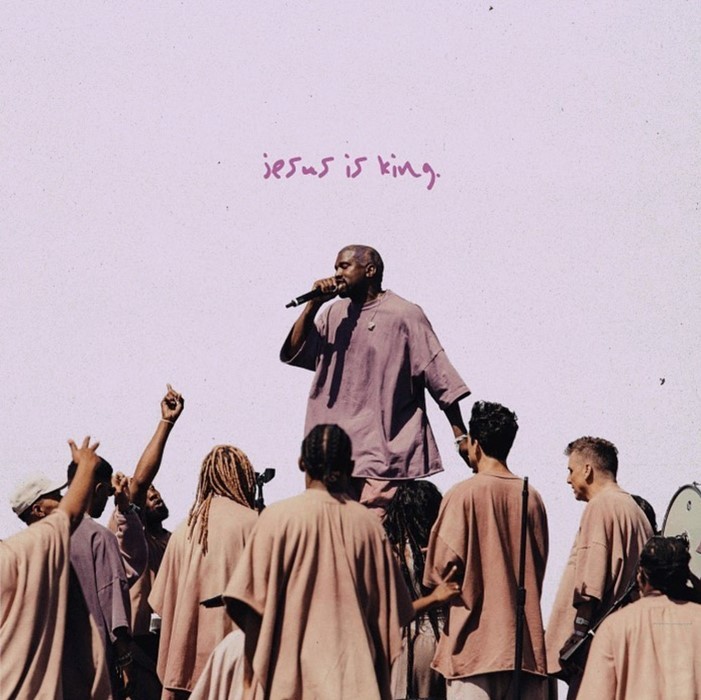
A report from the LA premiere of ​‘Jesus is King’

kanye-jesusLast night in Los Angeles, Ye’s faithful flock descended on the Forum to hear his repeatedly-delayed ninth album two days ahead of its (apparent) release. As they approached the venue they could see the record’s title JESUS IS KING in white lettering bathed in blue light, projected on the side of the building. Down in the parking lot, it was hell on earth.

The show was supposed to start at 8pm, but at that point thousands were still stranded outside trying to collect tickets. At 8:35pm, Kanye took the mic and asked for patience. ​Over half the people are not in the building yet,” he announced. ​Can you give us 15 more minutes?” The crowd, chanting: ​Yeezy!”, didn’t seem to mind at all, especially after he confirmed that the new record really is on its way this time. ​Two days ​til the album drop,” he confirmed. ​It’s coming.”

Continue reading at The Face.

Jerry Lorenzo: ​“There’s something about living in LA that is luxury”

FOG7Jerry Lorenzo may have been a late starter in the world of fashion but he’s sure as hell made up for lost time. At the start of the decade, Lorenzo was still working in sports management and struggling to find suitable clothes for one of his clients, LA Dodgers baseball star Matt Kemp. It was then that Lorenzo took matters into his own hands and decided to design them himself. His early work was such a hit that in 2013 he founded his clothing label, Fear of God. Since then he’s worked extensively with Kanye West, designed tour merch for Justin Bieber, Jay Z and Kendrick Lamar and created his own Nike shoes. It’s been a meteoric rise, but until now one thing Lorenzo never had was a shop to call his own.

Continue reading at The Face.

Big­gie Thinking

THEFACE_ACOGGIN_THINKBIG_1The Noto­ri­ous B.I.G. was not a man who was shy about his love of tak­ing tokes of the mar­i­jua­na smoke. Nei­ther is the late rapper’s son, CJ Wal­lace. That makes a move into the cannabis indus­try seem like a nat­ur­al step for the 22-year-old actor – but equal­ly, he knows he has to do right by the name of his father.

I was think­ing: how do we do it, oth­er than just putting Big­gie on bongs and Big­gie on blunts?” he tells me. ​“Oth­er than that, how do we real­ly do it?”

We’re gen­tly bak­ing in the sun out­side Wallace’s busi­ness part­ner Willie Mack’s home in the Los Feliz neigh­bour­hood of Los Ange­les. The pair met in May last year, after Wal­lace had wrapped shoot­ing the third sea­son of hor­ror spin­off series Scream. He was on the hunt for some­one who could help him use the Noto­ri­ous B.I.G. name for some­thing more than a cheap brand­ing exer­cise. Mack, with a long back­ground in cannabis mar­ket­ing, was the man for the job.

Continue reading at The Face.

City Guide: Austin, Texas

austin-abta.pngIt’s hard to go more than a few feet in Austin without spotting a sign or bumper sticker imploring you to ‘Keep Austin Weird’. It may be the capital of Texas, but this thriving and diverse city of nearly one million people has dedicated itself to providing an artistic and cultural alternative to the state’s mainstream. Walking around town you’ll spot statues of local heroes such as Willie Nelson and Stevie Ray Vaughan, while cult musician Daniel Johnston’s mural of Jeremiah the innocent frog – always asking: ‘Hi, How Are You?’ – has become a local icon. It’s also an easy destination to reach from the UK, with airlines including British Airways, Norwegian and American Airlines all offering direct flights from London, as well as many more options connecting through nearby Dallas-Fort Worth.

Continue reading at ABTA Magazine.

The Small Town Gang Murder Broadcast Live On Snapchat

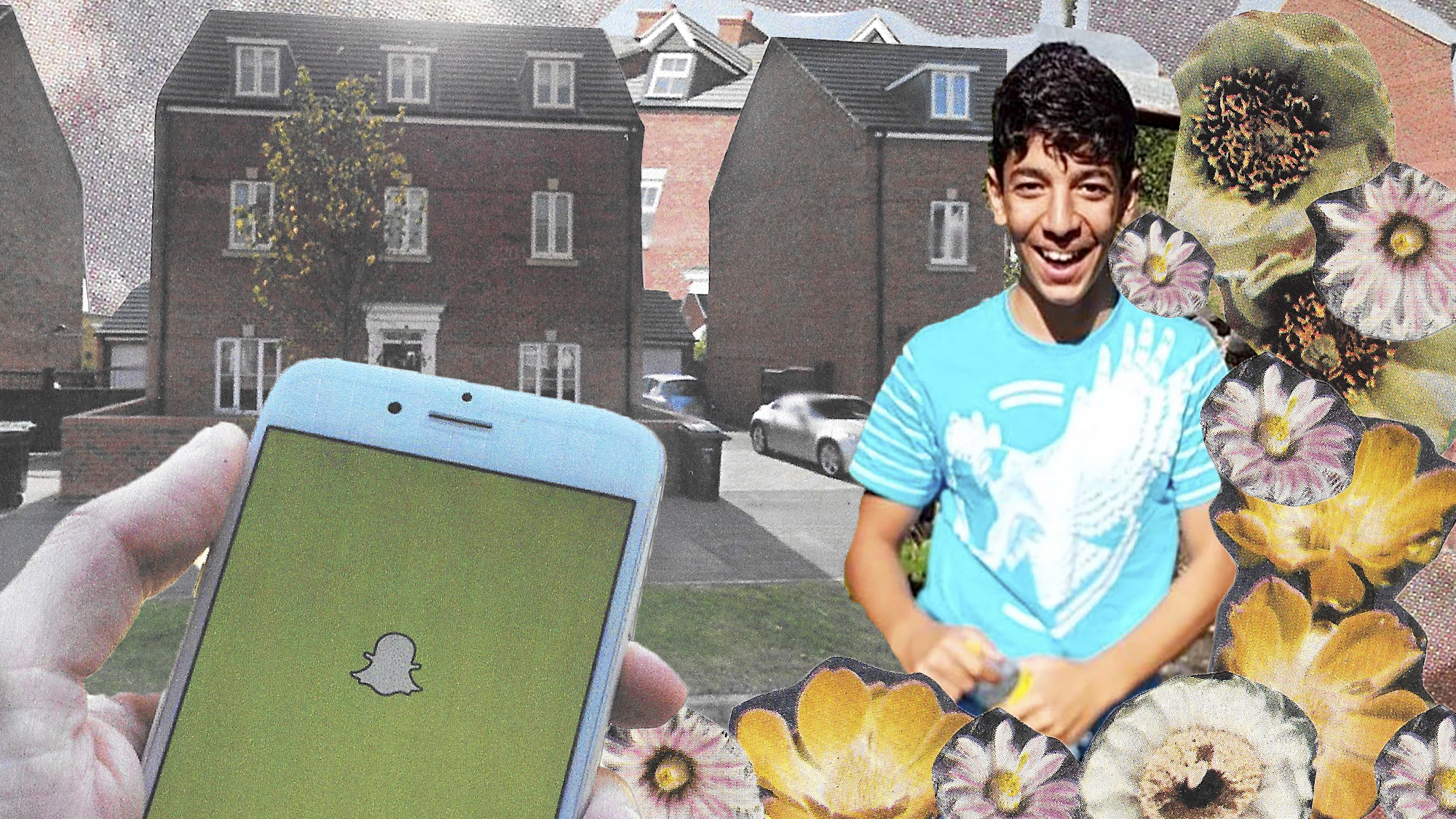
1562660222071-blacktomIt was late on Sunday the 16th of September, 2018 when 16-year-old Cemeren Yilmaz lay dying on a patch of grass between Ashmead Road and Westrope Way. He was already bleeding from a deep stab wound inflicted by one member of Bedford’s Black Tom gang when two more 15-year-old gang members, Ramon Djauna and Caleb Brown, arrived on the scene. They were carrying a hammer. One of them struck Cemeren on the head with it, a blow that caused a compressed fracture of his skull, lacerating his brain and damaging it irreparably.

Cemeren groaned: “I think I’m going to die.”

We know he said this because Djauna was standing over him, filming the attack on his phone at the time. Cemeren begged him for mercy. Instead, Djauna posted the video to Snapchat.

Continue reading at Vice.

Mac DeMarco meets his idol Haruomi Hosono

Mac-KEGP-Hosono

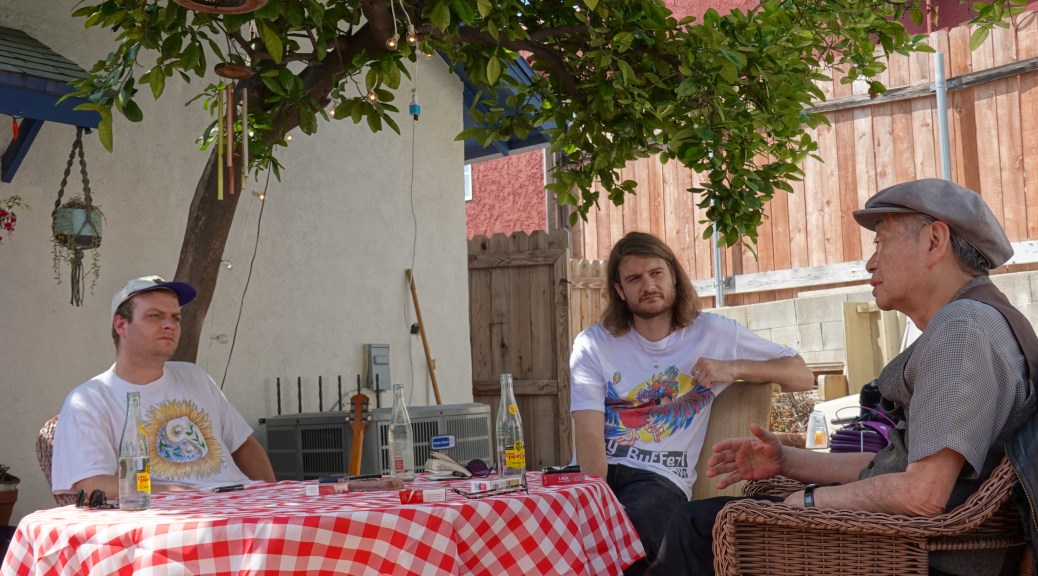
Since he moved to Los Angeles, Mac DeMarco has had plenty of musicians over to visit the home studio in his backyard. Today’s guest, however, is a special one. Haruomi Hosono has arrived, trailed by a Japanese film crew, who are shooting a documentary about the legendary musician’s hugely influential career and recent cultural resurgence. DeMarco is an avowed Hosono superfan, so while he’s usually as laid back as they come, today even he betrays a few nerves as he plays Hosono some of his recent recordings. He mentions that he was even more nervous last night, when DeMarco joined Hosono onstage at The Mayan Theater to perform the Japanese artist’s 1975 track “Honey Moon” together.

Haruomi Hosono’s music is impossible to pigeon-hole. The 71-year-old experimentalist started out playing with Tokyo psychedelic rockers Apryl Fool before he became the bassist for California Sound-indebted four-piece Happy End, but it’s his work with Yellow Magic Orchestra, the pioneering electronic group that he formed in 1978 with Ryuichi Sakamoto and Yukihiro Takahashi, that he’s most known for. To a certain type of musician, however, Hosono will be equally recognised for his mind-bogglingly eclectic solo career, which has experienced something of a revival in the west as of late. A number of his albums were recently reissued by Light in the Attic, and Vampire Weekend sampled his ambient track “Talking” on their single “2021”. DeMarco has been covering his songs, too, and in a recent interview with CBC Radio, he said that since hearing Hosono’s music ten years ago, “I’ve just been trying to rip him off. He’s been my favourite thing to dive in to or listen to or try and emulate for a long time… There’s a wealth in terms of what I’d like to achieve.”

So today, beneath the shade of a pomelo tree, the pair are sitting down to discuss Hosono’s work, his studio clothing etiquette, and all the times he’s been as starstruck as DeMarco is right now.

Continue reading at Dazed.

The History Boy

Studarus_190425_AndrewBird_0355_1107_1627_90

The Largo at the Coronet is a 130-seat theatre in Los Angeles which first opened in 1947, making it something of an ancient landmark in Hollywood terms.

In its opening year the venue hosted the world premiere of the English language version of Bertolt Brecht’s Galileo Galilei, and ever since it has held a reputation for staging challenging and provocative new work by musicians and comedians alike. The place has become something of a second home for Andrew Bird so it’s here that he’s come to debut his twelfth solo album, which he’s given the waggishly self-aggrandising title My Finest Work Yet.

As he proceeds to play the album in full to an audience that includes the likes of Carrie Brownstein it’s clear there’s a measure of truth to that swaggering name. My Finest Work Yet is a lush and melodic collection of songs which showcase Bird’s playful lyricism and virtuoso whistling, but they’re also shot through with nuanced political thought. This is picked up on by the show’s host, the actor John C. Reilly, who is a friend and fan of Bird’s. During a short Q&A Reilly finds himself imploring Bird to elaborate on some of his mythical and historical references. “What exactly,” he asks, “was going on in Catalonia in 1936?”

A month later I’m sat in Andrew Bird’s kitchen at his chic, minimalist home in the leafy LA neighbourhood of Los Feliz. I’ve come to find out more about why, at the age of 45, he’s made his first overtly political album. Before that, he’s making us coffee. He whistles while he works. Of course he does.

Continue reading at The Line of Best Fit.

Super natural

big-bear-lake-atlas

High above the north shore of Big Bear Lake, Amber Woodyard, a local guide, stands on one of her favourite trails. The air is fresh, clean and cool, scented by the pine forest that sweeps downhill toward the still, blue water. The view is breathtaking: in the distance, she points out the contours of Mount San Gorgonio, known locally as Old Greyback, the highest peak in Southern California. In the foreground the heavily forested hillsides look much the same as they would have done to this land’s early explorers. But the most remarkable thing about the view is not so much what we can see as what we can’t: a freeway. Take a look in any direction, and from here, it’s hard to believe that the bad-tempered, traffic-clogged arteries of Los Angeles are even on the same planet, never mind less than 100km away. I can’t hear a thing.

“The wilderness is what attracts people here,” says Woodyard, as her dog, Carly, scampers around her well-worn hiking boots. “It’s just so beautiful, and yet so close to LA. Where else in the world can you wake up by the beach and be up in the mountains in the afternoon?”

Continue reading at Atlas by Etihad.

Little Steven on Springsteen, The Sopranos and his Summer of Sorcery

Little-Steven-KEGP.jpg

New Jersey produced the two greatest Bosses in American culture and they both chose the same right-hand man. Steven Van Zandt was best known as a member of Bruce Springsteen’s E Street Band until he was cast, despite having no prior acting experience, as Tony Soprano’s consigliere Silvio Dante. With his unrufflable demeanour, face like a Greek tragedy mask and a mean way with a Michael Corleone impression, Van Zandt had been Sopranos creator David Chase’s original choice to play Tony himself.

I don’t know about you but if the two main entries on my CV were “E Street Band” and “The Sopranos” I’d probably take the rest of my life off. Not so for Van Zandt. In the early 80s he formed his own band, Little Steven & The Disciples of Soul, who this month return with new album Summer of Sorcery. Politically outspoken in his music for years (see 1985 anti-apartheid protest anthem “Sun City”), he’s now a more recent vocal opponent of Brexit, saying in 2018 that he hopes for a second referendum and that “the citizens of the UK realise this is a huge mistake”.

When we meet for coffee at the Sunset Marquis in West Hollywood Van Zandt arrives wearing a purple bandana and Technicolor scarf, his neck festooned with Mardi Gras beads, and proceeds to hold court on why he didn’t end up playing Tony Soprano, how he saved “Born to Run” and what it’s like getting married when your priest is Little Richard.

Continue reading at Vice.

Grimes is ready to play the villain

grimes-crackFive days before her 31st birthday, Claire Boucher is sat on a pink suede banquette in the Terrace Room of the Sunset Tower Hotel facing out towards a glistening swimming pool. Beyond it is the humdrum brilliance of another sun-bleached day in Los Angeles. If she looks like she’s just rolled out of bed it’s because she has. She’s decided to postpone her birthday celebrations until summer, but whether you acknowledge them or not, birthdays have a special way of making you reflect on the year just gone.

Boucher has had a lot to reckon with. She’s been better known as Grimes since she started making music under that name in 2007, but in the past twelve months the power to define her creation seems to her to have slipped from her grasp. “Without me doing anything, just by random association with other people, I’ve watched my career and my reputation get totally fucking smashed,” she says. “I worked my whole fucking life for this and now everyone thinks I’m so stupid. I was just sitting there incredulous watching my life’s work go down the drain.”

It was in May last year, a couple of months after she turned 30, that Boucher and her boyfriend decided to make their relationship public by appearing together at the Met Gala in New York. This decision was complicated by the fact that her boyfriend is Elon Musk, the billionaire CEO of Tesla and SpaceX who, depending on your perspective, is either humanity’s last hope to colonise Mars and save the species or a union-busting, megalomaniacal James Bond villain in waiting. They made a striking pair: him in a white blazer and an inverted notched priest collar, her in a Musk-designed white marbled high-cut corset paired with a metal collar which looked, online commenters were quick to point out, not entirely unlike the Tesla logo.

Some Grimes fans weren’t sure what to make of Boucher’s newly-public relationship. She had first emerged from the Montreal warehouse scene as a fiercely independent artist, putting out a pair of hypnotic electronica albums in 2010 on DIY label Arbutus Records: Geidi Primes, a concept album about Frank Herbert’s fantasy novel Dune, and Halfaxa. Her mainstream breakthrough came with third record Visions in 2012, which was met with such critical acclaim that two years later Pitchfork named Visions track Oblivion as the best song of the decade so far. Eclectic 2015 follow-up Art Angels proved, according to this magazine, that it’s “okay to like what you like, even if you’re a Dolly Parton fan who’s into J-pop and medieval Mongolia.”

Alongside her artistic output, Boucher has consistently proved herself unafraid to speak out on the political issues that are important to her. In 2016 she recreated a 1964 Lyndon B. Johnson advert in support of Hillary Clinton, stating that in the coming election: “The stakes are too high for you to stay home.” The following year, after President Trump announced a travel ban on seven predominantly Muslim countries, she tweeted that she would match donations up to $10,000 for the Council on American-Islam Relations. Last year she joined protesters in British Columbia against Kinder Morgan’s Trans Mountain pipeline expansion.

It was in this context that Boucher and Musk’s relationship was swiftly and mercilessly dissected in the press. Many publications were quick to link Musk to Boucher’s decision to remove the phrase “anti-imperialist” from her Twitter bio. In an article headlined ‘The Trouble With Elon Musk And Grimes’, the New Yorker painted their pairing as nothing less than the final collapse of indie culture. “What if ideological distinctions still mattered and were not so easily swept away by a levelling torrent of information and capital?” asked staff writer Naomi Fry. “What if anything still meant something?”

Boucher, it’s fair to say, does not agree with this characterisation. “Seriously, fuck the New Yorker,” she says, growing agitated. She stops fiddling with the pale pink scrunchie around her right wrist and makes direct eye contact. “Fuck the New York Times. Fuck Vice. You guys think you have journalistic integrity? What the fuck? Now I can’t read the Guardian because they’ve written things about me which are completely false. We really do live in a post-truth society. I know it sounds right-wing of me, but the majority of things that have been written about me in the past year were not true.”

In this case the truth, according to Boucher, is that she’d removed the phrase on a whim long before even meeting Musk. “I change my Twitter bio every week,” she says. “I took ‘anti-imperialist’ out literally three or four months before I met Elon. I changed it from ‘anti-imperialist’ to ‘baby wolverine’. That means I love colonialism now? Seriously, what the fuck?”

With their relationship out in the open, Boucher found herself being asked by fans on social media to defend Musk’s business practices. In May she tweeted that reports Musk had prevented his workers unionising were “fake news”. She later deleted that post, and in July wrote that she had “literally tried to instigate union vote so y’all wud lay off”. A couple of days earlier, she had argued that Musk’s donations to the Republican party were simply “the price of doing business in america” for an aerospace company. She added that Musk: “donates way more money, like absurdly more, to environmental causes.” When this became a news story in its own right, she clarified: “there is no world in which i’m ok w republican donations.. was just trying to explain wut happened.”

While some Grimes fans saw these statements as evidence of Musk’s nefarious influence turning Boucher towards greed, avarice and unfettered capitalism, she argues that in truth her politics could never be easily defined. “I didn’t realise everyone thought I was such a by-the-books socialist,” she says. “My politics are literally insane. I’ll probably go down for it in the end.”

When I ask her what she means by “literally insane,” she elaborates: “My Instagram bio was: ‘I pledge allegiance to the robot overlords’ for, like, two years. I thought people understood that I ultimately probably believe in an AI dictatorship. I mean, I don’t think humanity is going to survive anyway. We’re fucked. I think AI is the natural evolution. It’s just like we killed the fucking neanderthals, and now they’re going to kill us. I don’t think democracy really works. These are the kinds of things I think. I actually, for the short term, am a bit of a socialist, but not economically. I’m into free markets. What can I say? I think capitalism can solve some things.”

As 2018 wore on, things got progressively weirder. On August 7th, Elon Musk tweeted that he was taking Tesla private at a share price of $420. Azealia Banks, who said she was at Musk’s home waiting to collaborate with Boucher at the time, would later claim that Musk was high when he sent the tweet, and that he’d come up with the figure $420 because Boucher had recently taught him the significance of the number 420 in weed culture.

Over the next month, Banks posted a string of text messages supposedly sent by Boucher on her Instagram story that made reference to Musk’s “fake made up accent” and “giant dick” while also saying “the Russians want Elon dead”. The whole surreal mess is now the subject of a class action lawsuit by Tesla investors so it’s understandable that Boucher doesn’t want to comment directly, but it’s hard not to assume she has the alleged texts in mind when she tells me: “There have been quotes ascribed to me that I did not say. I can’t go into detail, but I didn’t type that. I’ve never seen that. That’s not me. It sucks when you want to do good in the world and you’re forced to do bad in the world because people are putting things in your mouth that are negative and shitty.”

It’s a difficult realisation for anyone who finds themselves in the public eye that they’re no longer in control of their own narrative, but it seems like a particularly cruel irony for Boucher after she worked so hard for so long to make sure she had complete artistic control over every aspect of Grimes. She self-produced every song on every Grimes album, drew her own artwork and directed her own videos, creating a distinct aesthetic universe that may have been influenced by Japanese manga and gothic dystopias but became something all of her own. She has never relied on anybody else. “For most artists if you’re not cool for 20 minutes then you can’t get in a room with a good producer and your career is fucking over,” she says. “I never want to be in that situation. I want to be in a situation like I am now where my reputation is at an all-time low and I can still make sick-ass fucking music, because I don’t rely on anybody.”

If her reputation is truly, as she believes, “at an all time low” then where does she go from here? The answer, to Boucher, is simple. “If I’m stuck being a villain, I want to pursue villainy artistically,” she says. “If there’s nothing left to lose, that’s actually a really fun idea to me. I think it has freed me artistically. The best part of the movie is the Joker. Everyone loves the villain. Everyone fucking loves Thanos. Let’s make some Thanos art.”

All of which goes some way to explain why the next Grimes album will be, in Boucher’s words, “an evil album about how great climate change is.”

The record will be called Miss Anthropocene, named after a character that Boucher has created for herself to portray. Miss Anthropocene is climate change brought to life as an anthropomorphic supervillain. Her name, which casts her as a beauty queen, is a pun on ‘misanthrope’ and ‘anthropocene’, which for the uninitiated is a proposed scientific name for the geological epoch we’re currently living through – the time period during which human activity has become the dominant influence on climate and the environment.

“The way I figure it is that climate change sucks and no-one wants to read about it because the only time you hear about it is when you’re getting guilted,” explains Boucher. “I wanted to make climate change fun. Miss Anthropocene has got a Voldemort kind of vibe. She’s naked all the time and she’s made out of ivory and oil. It’s going to be super tight.”

The album itself is, as yet, unfinished. It may not even be her next release. “I just made a bunch of music this month and I’ll probably drop that as an EP first, honestly,” she says. “Just so I can clear my mind to then go back and finish the goddamn album.”

Her most recent single, November’s K-pop-meets-nu-metal banger We Appreciate Power, will probably be on the record. The song would fit thematically, because it deals with the possibility that an AI dictatorship might be vindictive and she wants “every song to be about a different way the world could end.” The only thing holding her back from confirming it’ll be on the record is that she shares production credits on the track with fellow singer-songwriter and frequent collaborator Hana and producer and guitarist Chris Greatti. “I’ve never had any other producers on my records,” she says, “but I should probably just let that go.”

Before meeting Boucher I’d been sent three other new tracks which may or may not appear on either the new record or the EP, each wildly different from the last in style and composition. The first is So Heavy I Fell Through The Earth, a slow-moving, chaotic tune made using the Google NSynth that will appeal to fans of her second record, Halfaxa. The second, Shall I Compare Thee, sounds like it’s been lifted from an anime soundtrack and is one of the more recent tracks that Boucher says she made in “like two hours” and could end up on the EP. The last, My Name Is Dark, is an overwhelming nu-metal monster in the lineage of Kill V. Maim and Medieval Warfare, which also serves to introduce another new character for Boucher to play with. “Dark is going to be my main alter-ego,” she says. “It’s visually the best thing I’ve ever come up with. Everyone is very tired of me making metal and screamo and stuff, so that can just be Dark.”

Not for the first time, I find myself disagreeing with Boucher’s perceived critics. Where has she got the idea that “everyone” is very tired of her making metal and screamo?

“People are always like: ‘When are you going to make another…’”

Which people?

“On Twitter. Fans. Honestly, my parents. I came out making beautiful, ethereal chill synth music and I do still really like that, I just don’t like being pigeon-holed so I had to react against it for a minute. Now I’m back to it. I honestly think Shall I Compare Thee is kind of Visions-y.”

She pauses to take a sip of her coffee, and it occurs to me that the more I listen to Boucher the more I realise she is talking to me above a background roar that only she can hear. The deafening cacophony of voices on the internet pulling apart every aspect of her music, her politics and her relationship is always there whether she engages with it or not. She tells me she quit social media for six months, and now uses it only sparingly, “because there’s just no point in knowing. It’s like in high school when I had major problems. People have always hated me.”

She is turning 31 now, a long way from high school, and she has learned how to take in hate and convert it like fuel into defiant power. “That’s why I’m making this pro-climate change album,” she says. “I’ll just be a villain now, and that’s cool. I’ll find a way to make that useful to society.”

Originally published in Crack Magazine, April 2019.


Mamajuana, the ‘Dominican Viagra’, Has Big Turtle Dick Energy

1551958727611-dominican-republic-national-drink-turtle5

Pity the sea turtle, for it has been cursed with a surplus of big dick energy. It’s not unusual for green turtles to have 12-inch penises, and no less an authority than Scientific American once described the creatures as “horrifically well endowed.” Why is this not a blessing? Well, for one thing, wherever there’s an oversized phallic animal part you can be sure someone, somewhere, will decide to lop it off and sell it as a miracle cure to “make you strong.” Just look what happens to rhino horns.

Sure enough, in the Dominican Republic, there was a time when sea turtle penis was seen as a valuable ingredient in the country’s unique national drink, mamajuana. Also known as “The Baby Maker” or “El Para Palo” (translation: “Stand the Stick”), the tonic’s supposed aphrodisiac qualities made it a favourite of the legendary 1950s Dominican playboy Porfirio Rubirosa—a man who, according to Truman Capote, had at least one thing in common with the sea turtles.

Continue reading at Vice.

A Death at Uni: The British Student Who Died During an Initiation Ritual

1544701241421-ed-farmer

It was 5:45 in the early hours of Tuesday the 13th of December, 2016 when Newcastle University student Ed Farmer’s unconscious body was delivered to the city’s Royal Victoria Infirmary.

His clothes were soaking wet, part of his head had been shaved and his blood alcohol level was running at 400 milligrams of alcohol in every 100 millilitres of blood, over five times the legal drink drive limit. Doctors gave him a 1 to 2 percent chance of survival, but even that slim hope proved optimistic.

When he died the next day, Ed Farmer’s official cause of death was recorded as “a hypoxic brain injury, because his brain was deprived of oxygen due to cardio respiratory arrest”. What that means is that the excessive consumption of alcohol had led to fluid filling his lungs and starving his brain of oxygen. He was 20 years old.

Continue reading at Vice.

Scene Report: Carlos Capslock In São Paulo

Capslock 1 - Credit Felipe GabrielSão Paulo is the largest city in the western hemisphere, a vast and sprawling concrete jungle whose metropolitan area is home to some 21 million souls and more high-rises than anywhere else on earth. Yet as you walk the crowded streets it’s easy to spot buildings that have been left empty or abandoned, often half-hidden behind sheets that flap in the breeze, the architectural equivalent of Miss Havisham’s wedding dress. The best estimate is that there are more than 200,000 vacant buildings in the city.

For the DJ and cultural activist Paulo Tessuto, these spaces represent opportunities to party. Formerly a member of the diverse VoodooHop art collective which formed in 2009 to transform abandoned spaces for music and art projects, Tessuto went on to start his own spin-off DIY night, Carlos Capslock, dedicated purely to electronic music. “We started as a monthly night at Trackers, the first squat location we had in São Paulo,” remembers Tessuto. “After we had our third birthday party there, I started to search for new locations. We would just walk the streets, looking out for abandoned buildings that could become venues for parties.”

Continue reading at The Quietus.

The new wave

atlas-sri-lanka-cover

Lucky Pathiniya Durage remembers the exact moment he first saw someone surfing. He was nine years old, and he was with his aunty going to the vegetable market in the tiny fishing village of Midigama, on the south-west curve of the teardrop-shaped island nation of Sri Lanka. The market looked out to sea at a spot where a mellow left hand wave breaks over a deep reef. As Lucky watched, he saw a man on a board riding the wave towards the shore. At that moment, something inside him changed forever. Thirty-three years later, sat in the warm sun outside the Lion’s Rest Hotel, his eyes light up at the memory. “I just had this feeling inside me,” he says. “I knew I wanted to do this.”

_ZNrZggA

Of course, in those days there was no surfing scene in Sri Lanka. This was long before surf schools, yoga retreats or the Lion’s Rest Hotel started appearing along this palm-fringed paradise coast. Lucky would learn later that the man he’d seen surfing – who turned out, predictably, to be an Australian – had been staying at a local home, sleeping on the floor.

IogIeYoQ

That simplicity didn’t deter Sri Lanka’s early surf pioneers. By the following year, Europeans, Australians and Japanese visitors were all coming to surf Coconut Point, near Lucky’s village. He would watch them intently, still determined to surf himself. Soon he resolved that there was nothing else for it. He would take matters into his own hands. “My friend and I decided we should try to make our own surfboard,” he remembers. “We decided to cut it out of a big tree. It took nearly two months to get it right. When we first went in with it, the foreigners were looking at us like, ‘What are they doing? Crazy boys!’”

The board was a long way from perfect. Lucky and his friend would get splinters in their stomachs until they learned to tie sponge to the surface with fishing line. After growing weary of constantly having to chase after the board when it got away from them they made themselves a leash using an old saline drip from the local hospital. All of it was worth it to get Lucky closer to his dream. “I was always in the ocean, always,” he says. “I knew where all the reefs were, and where the shallows were.”

That knowledge came in handy. One day he tried to warn an Italian couple not to go into the sea in a dangerous spot. Unable to understand his broken English, they went in anyway and soon the woman was being dragged under by a powerful current. Lucky chased after her through the shallow water he knew so well and pulled her to safety. He was still only 10 years old. It was around then people started calling him ‘Lucky’.

Nowadays, Lucky has achieved his dream of making his living from surfing. He is one of the few local Sri Lankans to be a qualified International Surfing Association instructor. “I’m always smiling,” he says. “Doing this makes me very happy. I see a lot of teachers who get angry with their students, but I don’t like that. I want to encourage them and give them confidence.”

As well as his own surf school, Lucky also offers lessons in conjunction with the Lion’s Rest Hotel – which looks out over Coconut Point, the same spot where he first started teaching himself to surf three decades ago. As we sit outside on the terrace we can hear the gentle, rhythmic sound of waves crashing on the beach. In front of the hotel, cows chew the cud as they stand about idly on the cricket pitch while colourful tuk tuks buzz down narrow sandy alleyways. To hear Lucky tell it, there’s no better place on earth to surf. “Sri Lanka has warm water,” he points out, astutely. “Europe is very cold, so you have to wear a wetsuit. Also, there are many surf breaks here so they don’t get too busy. And the King Coconut is native here. Did you ever drink a fresh coconut on the beach just after you finished surfing? That’s a very good feeling.”

It’s not just locals like Lucky who’ve fallen head over heels off a wave for Sri Lanka’s idyllic conditions. People come to experience them from all over the world. South African Jelaine Hermitte is an instructor who’s spent the last two years working here on the southern coast. She argues that it’s the perfect spot for people who want to learn to surf. “The waves are very friendly here and quite soft, which is perfect for beginners,” she says, drip-drying herself just a few feet from Weligama Beach. “You don’t get super powerful waves here like you do in Indonesia, for example, so it’s a great place to learn and build up your confidence. The whole place has a typical laidback island vibe: surfing, shorts and T-shirts, huts, coconuts, turtles and warm waves. What more could you ask for?”

Indeed, part of the attraction of Sri Lanka is that unlike many surf destinations there’s a lot happening on dry land as well. There is plenty of charm to stumble across on your journey – as befits the country which the ancient Persians referred to as ‘Serendip’, from which we get the word ‘serendipity’.

Whether it’s spotting elephants in Udawalawe National Park or waking up early to experience the buzz of Mirissa Fish Market, where tuna, hammerhead sharks and even manta rays line the docks, the wild variety of the natural world is always close at hand. Alternatively, you can spend time rejuvenating your body with an holistic massage conducted within in the ocean itself by Franco Rebagliati, the experienced surfer and masseuse who runs You Are The Sea. For many who come to Sri Lanka, the most natural companion to surfing is yoga. After all, assuming cobra pose will prepare you for perfectly for lying on a surfboard, while warrior pose isn’t a million miles from how you need to stand to successfully ride a wave.

A few minutes drive by tuk tuk from Lion’s Rest is Camp Poe, which offers simple safari tent lodging, meditative murals, a secluded pool and daily yoga and surf lessons. Sitting near the still blue water, yoga instructor Jessyca Eve Canizales explains why Sri Lanka stands out among the many yoga destinations she’s visited. “I think the melting pot of cultures here is really interesting,” she says. “The food is really remarkable, especially for a vegan or vegetarian lifestyle because it’s all tropical fruit and vegetables. People really appreciate you being here. It’s such a smiley place and I feel it’s safe for my children. I find there’s a reverence for the philosophy of buddhism here, a code of living, which extends beyond people’s specific religious beliefs. It’s a warm and textured place to be.”

For my own first ever surf lesson, I head 30 miles east of Weligama Beach to meet Steve Taylor of Tropicsurf. An Australian from Melbourne who like Lucky has been surfing since he was 10, he was attracted to living and working in Sri Lanka in part because his mother is from the island. He is based out of the Anantara Peace Haven resort in Tangalle, a five-star hotel sat on a rocky outcrop which offers the chance to stay in beautifully secluded villas that come complete with private pools.

Steve, however, has something more challenging in mind than a dip in an infinity pool. It doesn’t take him long to size me up. “Can you swim?” he asks seriously soon after we meet. “You have to be able to swim. My only rules are no life jackets…” his stony demeanour cracks into a cheeky grin “…and no budgie smugglers.”

We set off to find the perfect spot in an air-conditioned van, our surf boards following behind strapped to the roof of a tuk tuk. We pass down unassuming lanes past shacks with grass roofs until we find a deserted beach. The only thing keeping us company is a solitary cow on the beach who enjoys licking the saltwater off our boards. As far as the eye can see, we have the ocean to ourselves. “Surfing is about freedom,” Steve says. “You’re getting out amongst nature, and best of all nobody can get on their damn phones while they’re surfing!”

Lying on the beach, Steve guides me through the basics of how I’m going to stand myself up: arms out like chicken wings, leg crooked like a lizard, then popping up to standing. Before I know it, I’m out at sea, riding my first wave. An hour later, back on the shore, Steve has a serendipitous surprise for me. He cracks open a King Coconut as my reward and hands it to me to drink. Lucky was right. It’s a very good feeling.

Published in Atlas by Etihad, November 2018.

The Baby-Faced Far Right Terrorist Who Planned to Murder an MP

1531153999394-jack-renshaw

When the annals of great chat-up lines are written, it’s unlikely former BNP Youth spokesman Jack Renshaw will feature highly. On the evening of the 1st of July, 2017, he approached a girl in a nightclub in Warrington and told her: “I’m a terrorist.”

He was telling the truth. Earlier that night, at the Friar Penketh Wetherspoons on Barbauld Street, he had spoken of his plan to use a machete to murder his local MP, Labour’s Rosie Cooper. He would later testify in court that he had been “drunk and ranting” and that he’d “have probably talked to anyone that was there”.

He may well have been drunk, but he was deadly serious. At some point during the previous month he’d spent £54 on a 19-inch machete, which he intended to use as the murder weapon. Even before that, in May, his search history showed that he’d googled the phrase: “cutting the jugular artery”.

Renshaw said he believed that murdering Cooper would “send the state a message” – that message being: “If you beat a dog long enough, it bites” – and called his actions “white jihad”. Asked in court why he chose Cooper as his stand-in for the British state, he said simply: “She happened to be my local MP.”

Rosie Cooper was not his only intended victim. Renshaw also planned to take hostages after killing the MP so that he could lure Detective Constable Victoria Henderson to the scene. He had a vendetta against Henderson because she was investigating him for allegedly grooming children for sex, as well as several racial hatred offences. He told the jury that, unlike Cooper, the murder of Henderson “was personal”.

After killing the two women, he planned to reveal a fake bomb vest. He imagined the day would end with his suicide by police. He hoped to die a martyr to the far-right cause.

Continue reading at Vice.

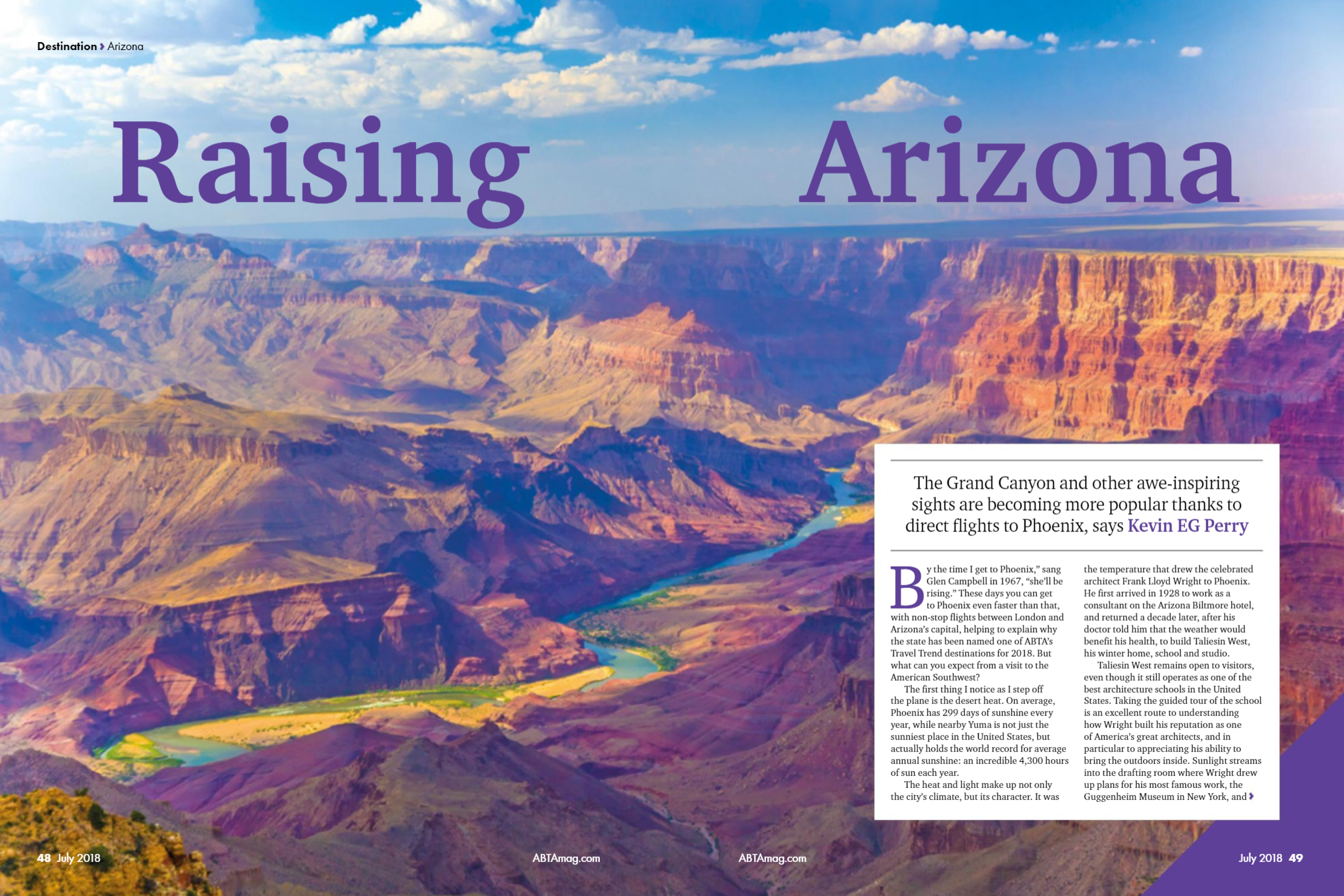
Raising Arizona

abta-arizona-july-2018

abta-cover-july-2018The first thing I notice as I step off the plane is the desert heat. On average, Phoenix has 299 days of sunshine every year, while nearby Yuma is not just the sunniest place in the United States, but actually holds the world record for average annual sunshine: an incredible 4,300 hours of sun each year.
The heat and light make up not only the city’s climate, but its character. It was the temperature that drew the celebrated architect Frank Lloyd Wright to Phoenix. He first arrived in 1928 to work as a consultant on the Arizona Biltmore hotel, and returned a decade later, after his doctor told him that the weather would benefit his health, to build Taliesin West, his winter home, school and studio.

Taliesin West remains open to visitors, even though it still operates as one of the best architecture schools in the United States. Taking the guided tour of the school is an excellent route to understanding how Wright built his reputation as one of America’s great architects, and in particular to appreciating his ability to bring the outdoors inside. Sunlight streams into the drafting room where Wright drew up plans for his most famous work, the Guggenheim Museum in New York, and where students continue to work and learn from his example.

If they need further inspiration, the Phoenix Art Museum is a good place to start: the gallery sprawls over 26,500 square metres, and houses work dating from the Renaissance right up to the modern day. Highlights include a portrait of George Washington by Gilbert Stuart, modernist work by Georgia O’Keeffe and Anish Kapoor’s acclaimed sculpture Upside Down, Inside Out.

Even the greatest artwork struggles to compete with the majesty of the natural landscapes that lie on the doorstep, however. As I head out into the desert, I feel as if I have arrived in the Wild West of my childhood fantasies: giant saguaro cactuses dot the land, instantly familiar from cowboy films.

Saguaro grows an average of a foot per decade, so those that climb to 20 or 30 feet will have been standing on that same spot for around 250 years. It is easy to picture yourself as one of the early pioneers – although it is worth bearing in mind that widescreen depictions may not have been wholly accurate. In John Ford’s Three Godfathers, John Wayne finds himself stranded in the Arizona desert and hacks open a barrelhead cactus in order to drink the watery pulp. In reality, it would be so full of acids you would be likely to become very ill, so don’t forget your water bottle.

Of course, no visit to Arizona would be complete without paying a visit to the Grand Canyon. Entry to the national park – a three-and-a-half hour drive north of Phoenix – costs £24 per vehicle, a tiny price to pay for the majesty that awaits.

It is hard to describe the experience of standing on the cusp of The Abyss, the name given to one of the canyon’s many look-out points. What is remarkable is not just the size and scale of the canyon, but also the swathe of history it illuminates. It has been six million years since the Colorado River first found its way to the Gulf of California and began working its way down through the dirt and rock. The river now runs more than 1,500 metres below the Grand Canyon’s rim.

There are two very different ways of experiencing the Grand Canyon. One is to hike down into it. The most popular route, the Bright Angel Trail, descends 1,370 metres to the Colorado River, which means you have got to climb all the way back up. The other, rather more leisurely way to get inside the canyon is by helicopter. Maverick Helicopters depart from the airport near the small town of Tusayan, on the south side of the park, and 40-minute flights start from £140.

From the vantage point the flights provide, it is possible to see as far as the Painted Desert and to follow the river before diving through the Dragon Corridor, the widest and deepest part of the canyon. The most heart-stopping moment, however, is early on, when you are flying 15 metres above the Ponderosa pine treeline, and then suddenly there is nothing beneath you except the rushing waters almost a mile below.

But to visit Arizona and only see Phoenix and the Grand Canyon is to barely scratch the state’s surface. To the east of the National Park is the incredibly photogenic Horseshoe Bend, where the curve of the river has carved out a spectacular landmark. Nearby is Antelope Canyon, a narrow and now dry slot canyon, which creates an otherworldly landscape for visitors. Inside the canyon, photographers jostle for position, no surprise considering the world’s most expensive photograph was taken here: Peter Lik sold Phantom, an image of dust in the canyon appearing to take the form of a ghost, for $6.5m in November 2014.

Improbably, Arizona is also home to a burgeoning wine scene. Despite the heat, vineyards have sprouted up in the Verde Valley, near Sedona, and the food and wine being produced here is almost as spectacular as the red rock formations that loom over the town.

With all this and so much more to explore, and with direct flights already taking off from London, it looks like it’s time to get to Phoenix.

Cover story for ABTA Magazine, July 2018.

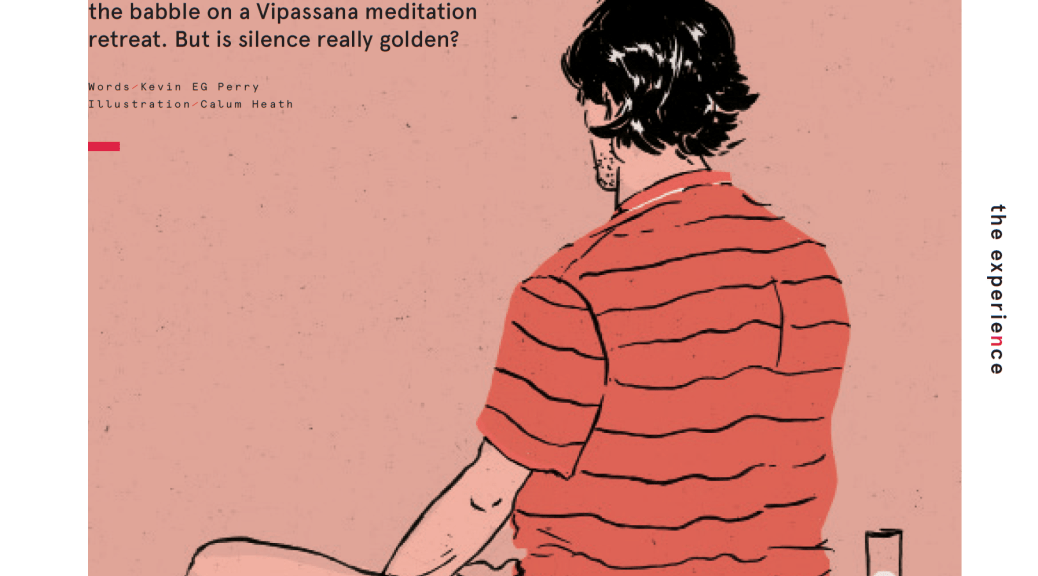
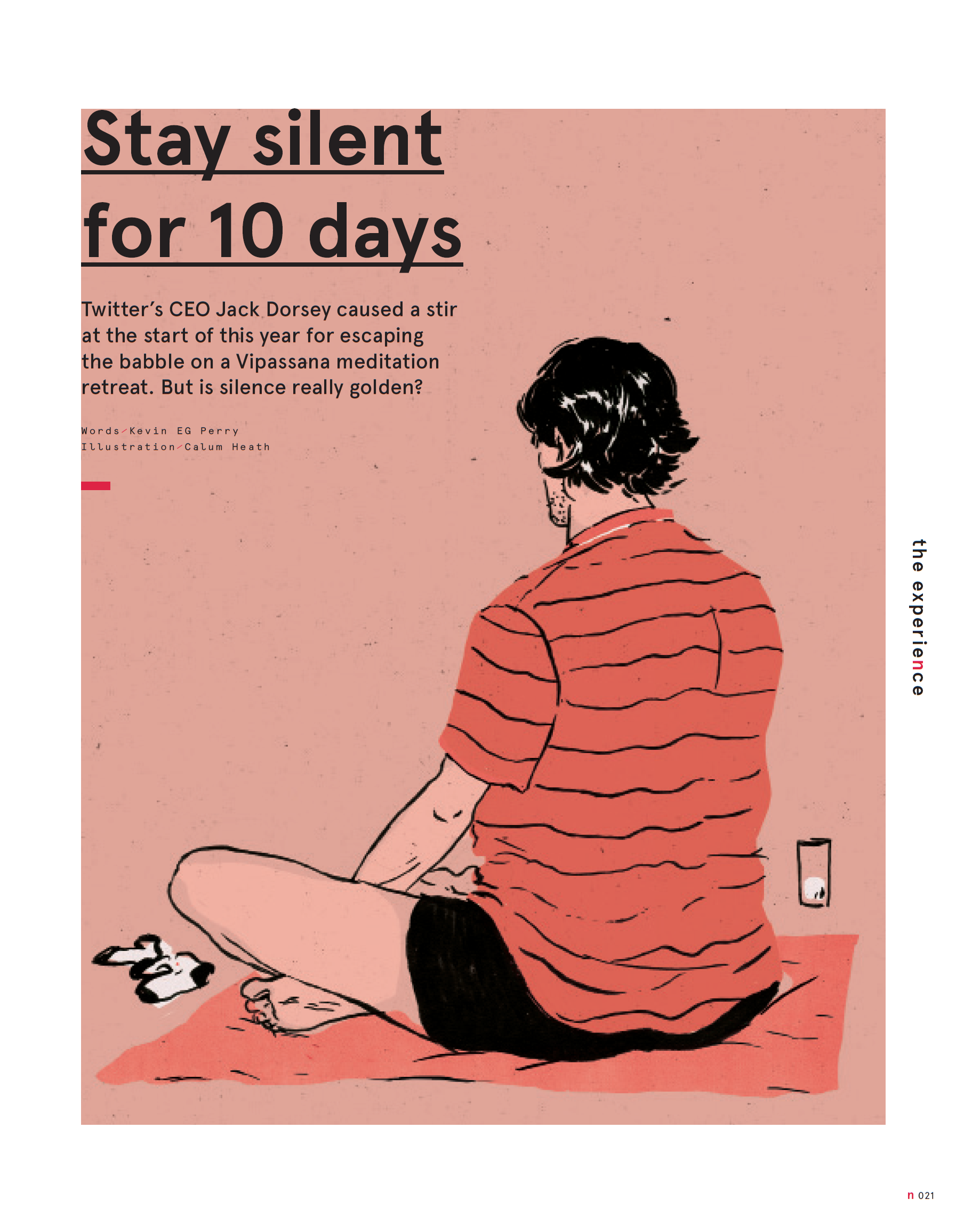
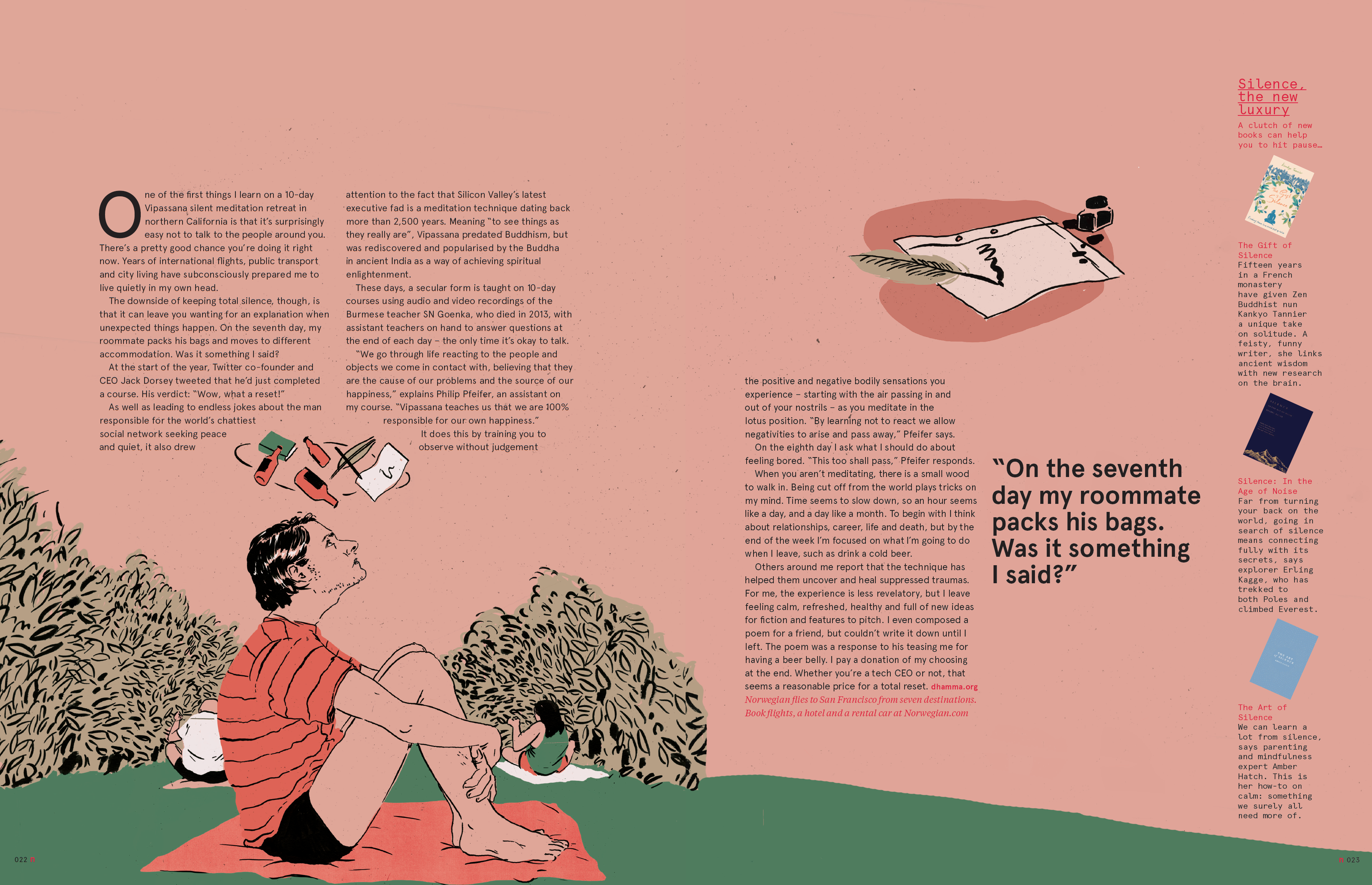
I Spent 10 Days at a Silent Retreat and Would Really Like My Phone Back Now Please

Silent-MeditationImagine a world without sex, drugs, and rock’n’roll. Then remove cigarettes and alcohol from the equation. For good measure, why not banish meat too. And then to top it all off, let’s pretend that neither speaking nor reading exist on our plane. This is the reality of a Vipassana silent retreat, and in this world there’s only one thing to do: meditate.

Allegedly the same meditation technique that Gotama the Buddha harnessed in order to achieve spiritual enlightenment and reach nirvana, the practise of Vipassana stretches back about 2500 years into the past and its spread is global, even if its teacher is no longer with us here on Earth. Burmese Vipassana master S.N. Goenka passed away in 2013, but his wisdom now lives on in the audio and video recordings that participants on a retreat are privy to.

Continue reading at Vice.

A Young Photographer Takes on Thailand’s Monarchy

MtHS6Thai army soldiers entered an art gallery in downtown Bangkok one June day in 2017 and forcibly removed several pieces by the photographer Harit Srikhao. The 22-year-old’s work had clearly touched a nerve with Thai authorities, although he’s still not exactly sure why he was targeted by the dangerously overzealous critics.

“I’ve been offered a lot of explanations, official and unofficial alike, but none of them make sense,” he says. “It just goes to show the lack of freedom of thought in my country, and how ridiculously the government use their power to bully citizens. Most importantly, it is an affirmation that art is indeed a very, very powerful weapon.”

Srikhao wields this weapon with a hallucinogenic flourish. From his base in Pathum Tani, a northern suburb of Bangkok, he creates work that offers a savage satirical perspective on his country’s political landscape. His pictures depict a fantastical world in which traditional hierarchies are upended, the sanctity of the Thai monarchy is punctured and government propaganda images are rendered absurd. He alters his own photos by cutting and pasting by hand in hopes of revealing a deeper truth: “I use hand collage instead of Photoshop because I want to perform surgery on the pictures.” He explains, “I want to show the traces of how reality has been made oblique.”

Continue reading at Playboy.

Sex, Death and Social Media at the Annual Porn Awards

evil-angel-august-amesSometime after the talking-head segment on how to make an award-winning anal scene, but before the stage invasion that led Lil Wayne to declare he’d “died and gone to heaven”, this year the AVN Awards – known as the “Oscars of porn” – spent a few minutes facing the reality and finality of death.
The ceremony, which was held on Saturday night at the Hard Rock Casino in Las Vegas, is not usually an arena which grapples with mortality. This time was different. When Greg Lansky, the creator of adult studios Tushy, Vixen and Blacked Studios, collected his Director of the Year award, he said only a quick thank you before inviting the producer Kevin Moore to speak in his place. Moore’s wife, the porn star August Ames, took her own life on the 5th of December last year at the age of 23.

Continue reading at Vice.

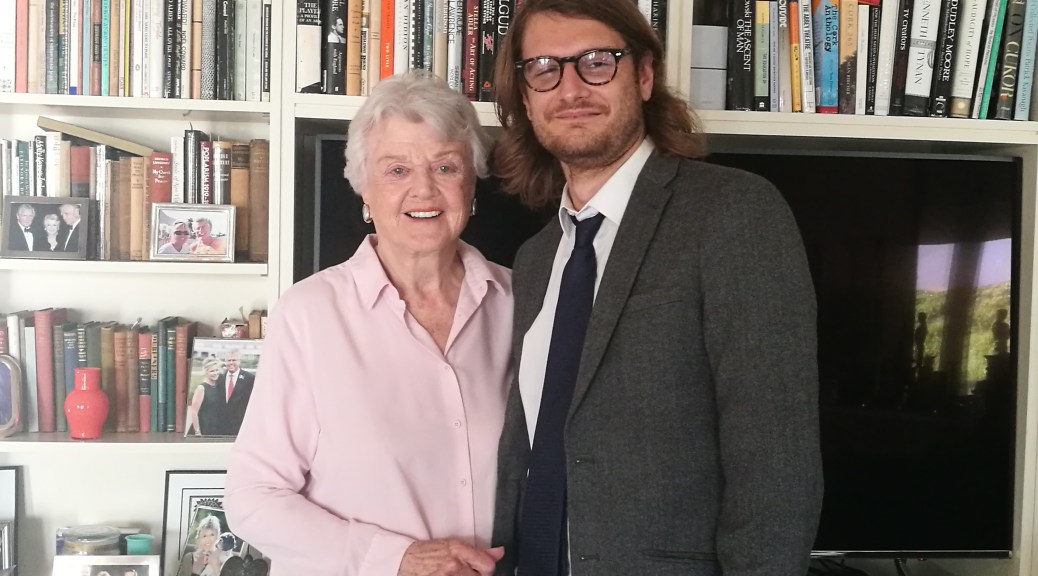
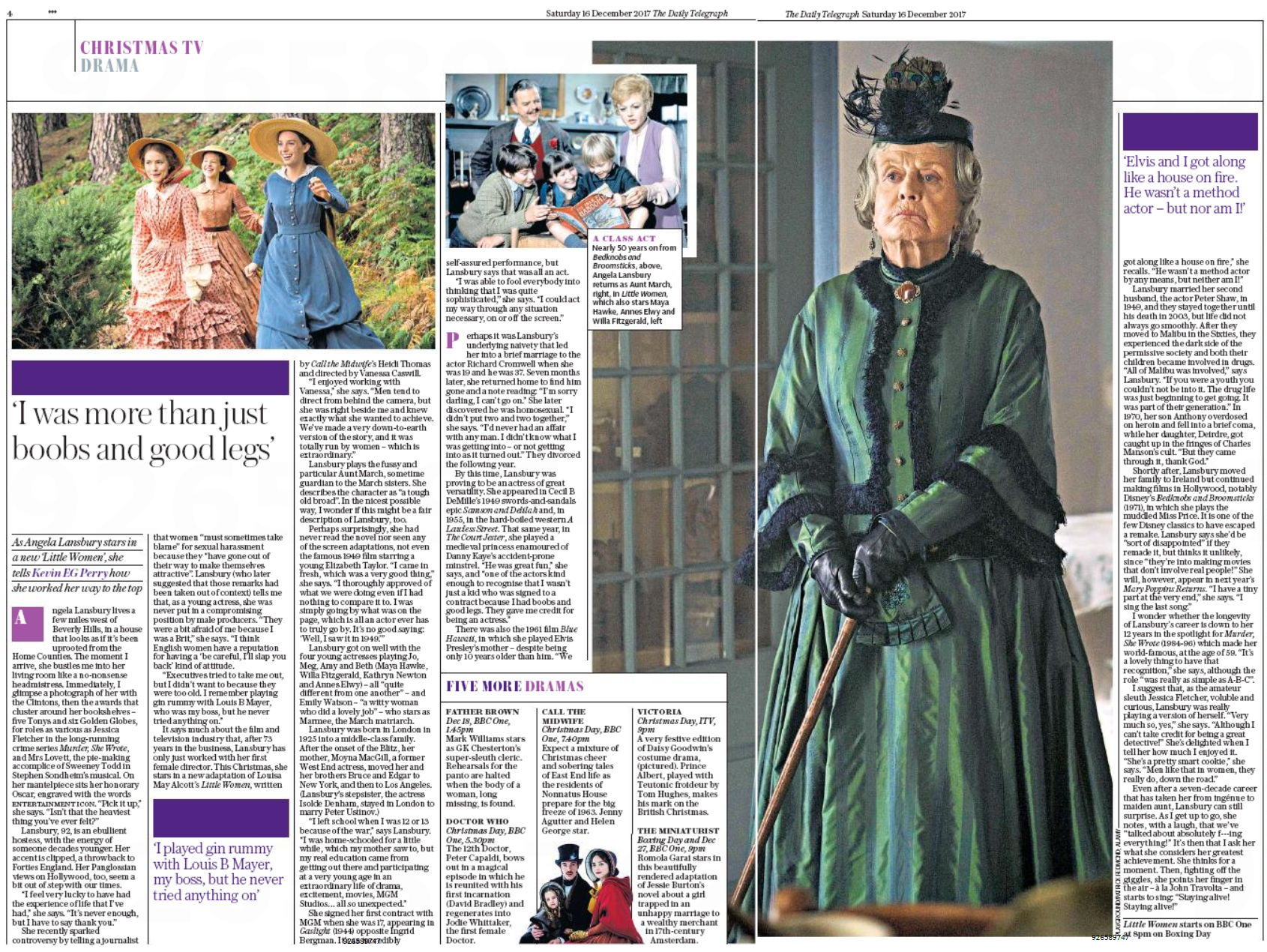
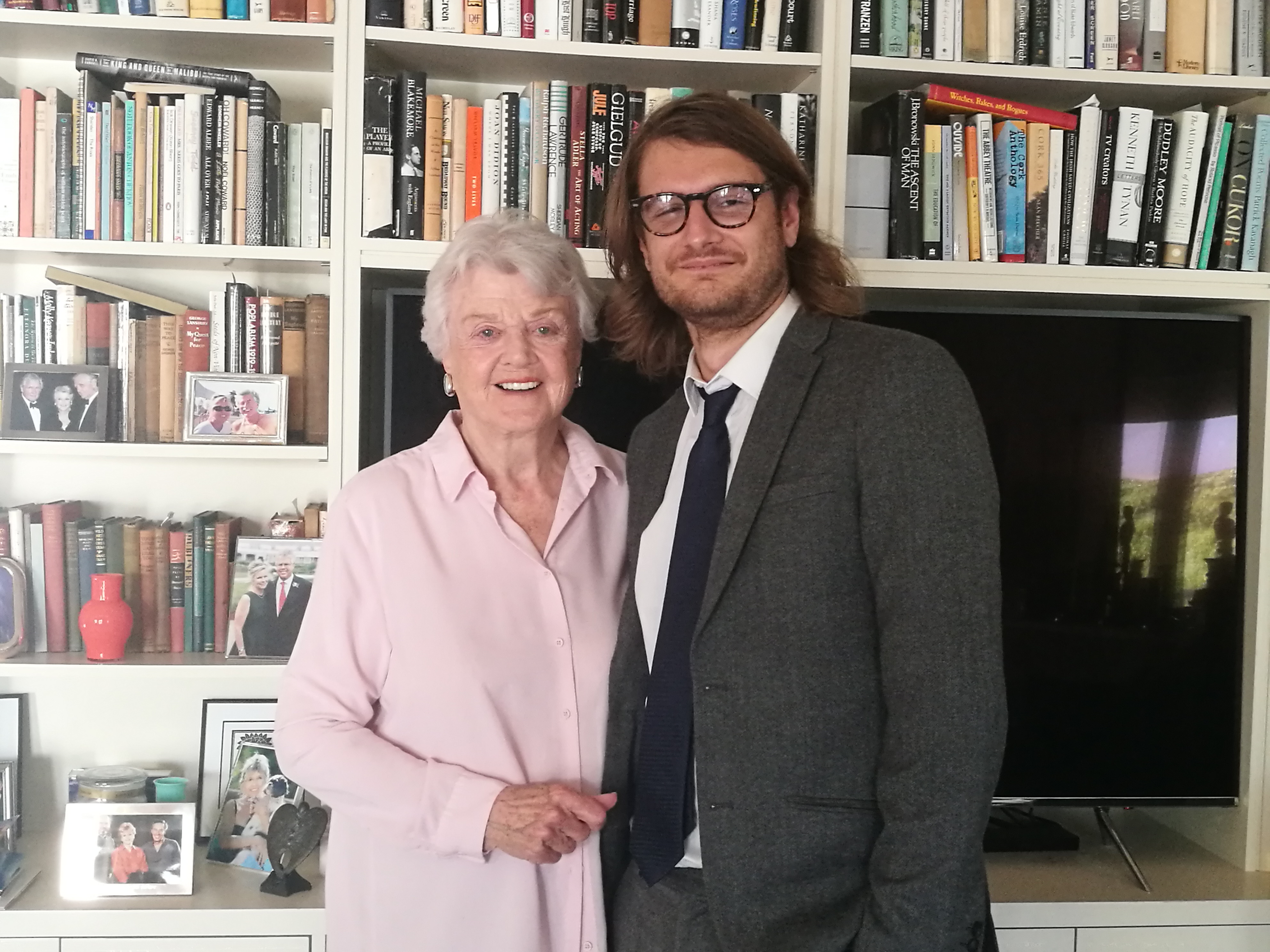
Angela Lansbury: ‘I was more than just boobs and good legs’

angela-lansbury-telegraphcofAngela Lansbury lives a few miles west of Beverly Hills, in a house that looks as if it’s been uprooted from the Home Counties. The moment I arrive, she bustles me into her living room like a no-nonsense headmistress. Immediately, I glance a photograph of her with the Clintons, then the awards that cluster around her bookshelves – five Tonys and six Golden Globes, for roles as various as Jessica Fletcher in the long-running crime series Murder, She Wrote and Mrs Lovett, the pie-making accomplice of Sweeney Todd in Stephen Sondheim’s musical. On her mantelpiece sits her honorary Oscar, engraved with the words ENTERTAINMENT ICON. “Pick it up,” she says. “Isn’t that the heaviest thing you’ve ever felt?”
Continue reading at The Telegraph.

Remembering The Hawley Arms, the Pub That Became Indie’s 2000s Hub

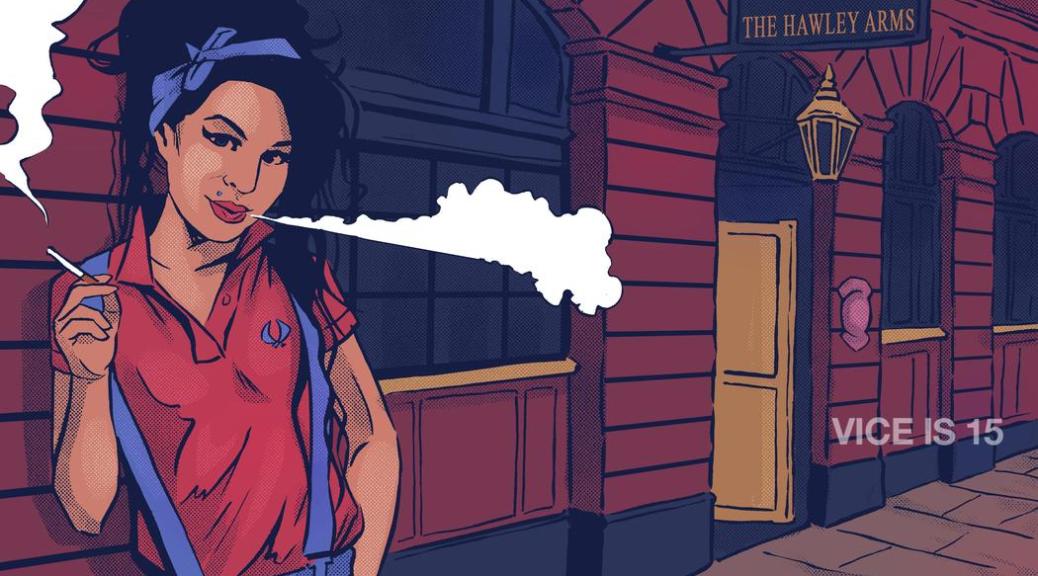
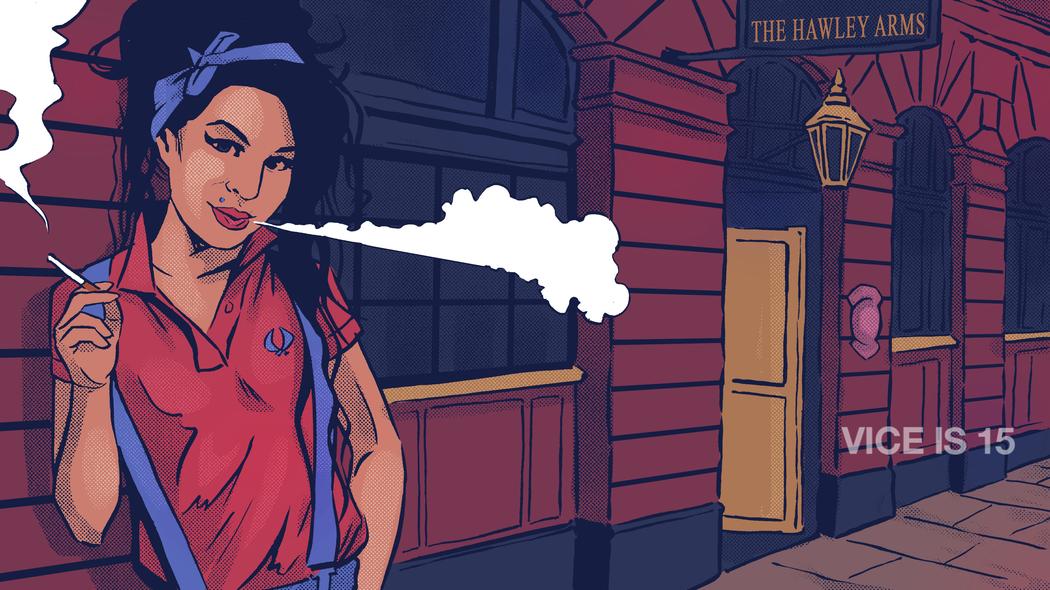
hawley-armsLate on 9 February 2008, a Saturday night, I left a gig at Koko and made my way up Camden High Street in north London toward my house. I didn’t get very far before I was stopped by a policeman who told me that Camden was “on fire”, which struck me as unusual. Going the long way round, I found myself stood on a bridge over Regent’s Canal watching the most famous pub in British indie music burn.

Continue reading at Vice.

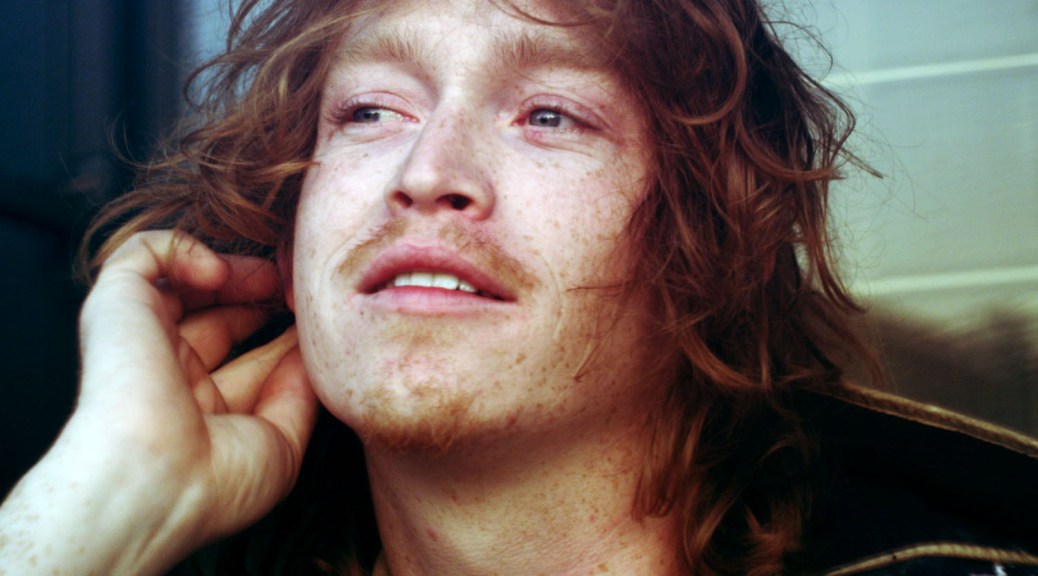
Philip Glass: ‘I wanted to compose, not recover from last night’

philip-glassOn a bright, clear afternoon in Hollywood, Philip Glass is considering why it might be that, aged 80, he has outlasted his younger friends and collaborators, David Bowie and Lou Reed. He traces it back to the excesses of the Seventies, an era whose hedonism he deliberately observed from the sidelines.

“I didn’t have the money to corrode my body as some of my friends did,” he says wryly. “When I was a young man I was afraid of that lifestyle and I stayed away from it. I hate to put it so crudely, but I gained an extra 20 years of life.”

Continue reading at The Telegraph.

Can Desert Daze Be America’s Answer to Glastonbury?

1509096289369-Desert-Daze-Zane-Roessell_01It’s a hot, dusty Sunday afternoon in the Joshua Tree desert. I’m in a tent trying to hold my body in something I’ve just been told is called a warrior pose while Wolves In The Throne Room’s “Prayer of Transformation” gives way to Sleep’s “Holy Mountain”. This is black metal yoga at Desert Daze festival, and it’s surprisingly meditative. “Yoga teachers tend to focus on things that are light and positive,” explains Alissa Nelson, our black metal yogi, “That can be great, but when people are in a certain place that doesn’t resonate. Black metal can be dark and gory, but it plays on that dark aspect that’s in all of us.”
Black metal yoga is just one of a whole roster of strange events being held in the festival’s Mystic Bazaar. Next up is something promisingly called “plant activation meditation”, then a little later it’s the ominously titled ‘defense against the dark arts’. Elsewhere, an entire venue has been given over to a five-hour ‘deep drone cycle’. Make of that what you will, but only 50 miles from the site of Coachella it’s impressive to see a wholly different conception of what a music festival is and what it might be for. Along with the chance to see the likes of Iggy Pop, Spiritualized and Courtney Barnett & Kurt Vile, Desert Daze also offers probably the closest thing an American rock festival has to the hippy spiritualism of Glastonbury’s healing fields.

Continue reading at Vice.

Why One of the World’s Biggest Rockstars Got Away with Child Abuse

1508152918893-watkins

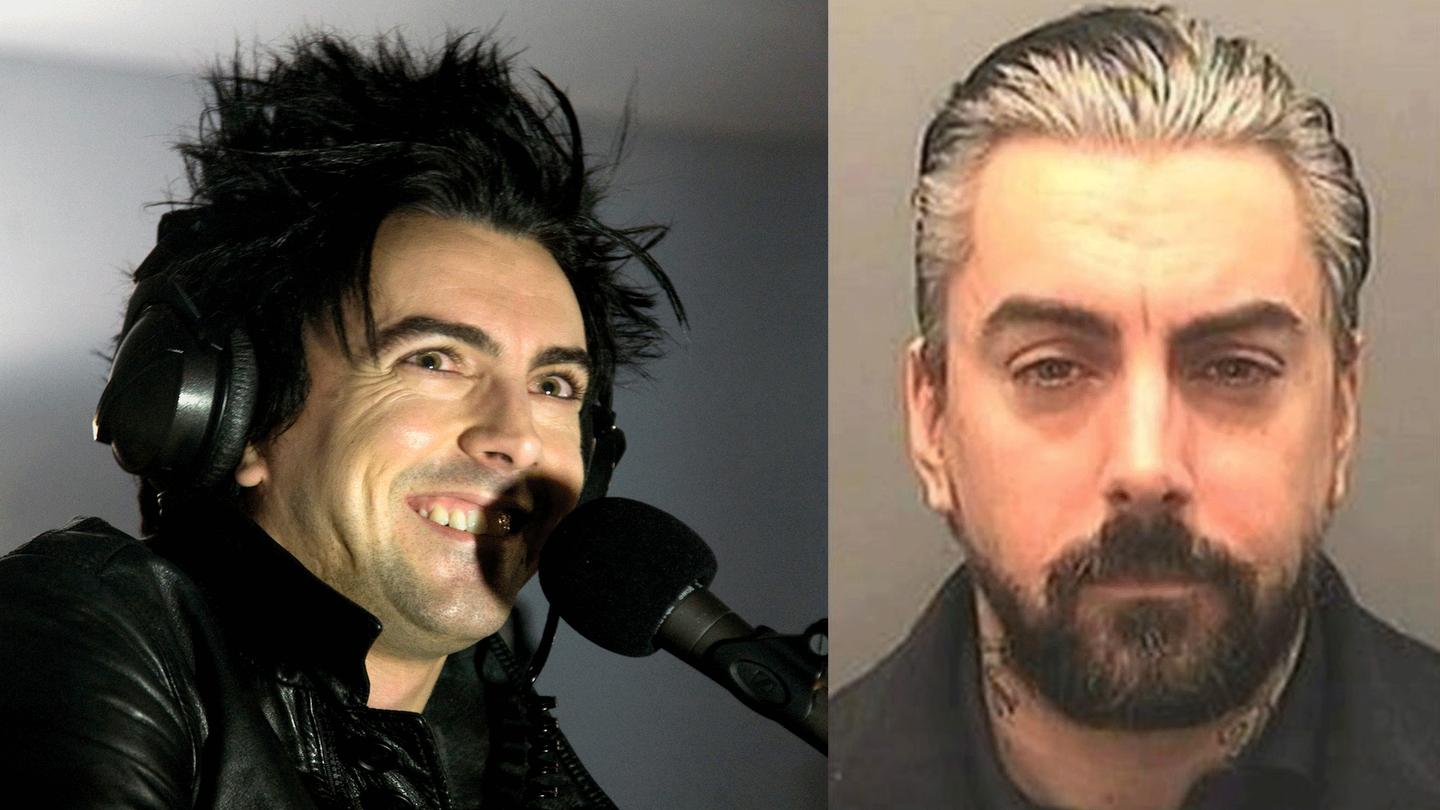
When Ian Watkins was sentenced for his child sex crimes in December of 2013, they were described by the presiding judge as having “plumbed new depths of depravity”.

Among other offences, the former Lostprophets singer admitted he had attempted to rape an 11-month-old baby boy with the help of the child’s mother, and conspired with a second mother to rape her infant daughter. Watkins had also slept with and urinated on a 16-year-old fan of his band, among a string of other similar offences. The judge specifically commented on “the delight that Watkins evidently has when engaging in the most terrible offences involving tiny children”.

Continue reading at Vice.

Hey, Adam Granduciel: What’s Your Secret?

twod

The problem with talking to musicians about music is that you can end up talking about anything but. Interviews become about about rock star beefs or who they’re dating, when all you really want to know is: “Why do your songs make my heart swell up until it feels like it’s going to burst?” I mean, is there a secret chord or something?

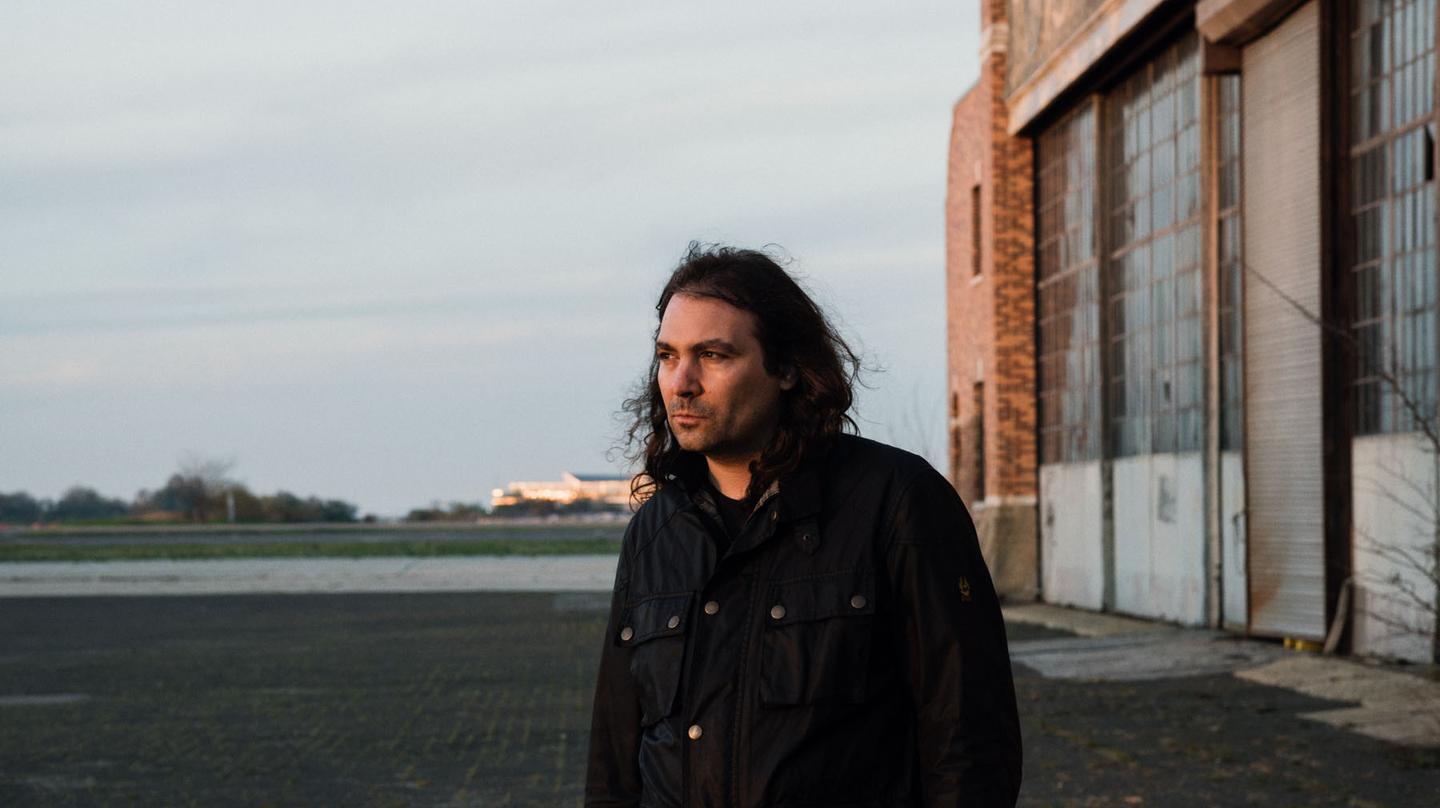
Adam Granduciel, who records as The War On Drugs, has had at least one weird rock star beef (with noted asshole Mark Kozelek) and is dating a genuine celebrity (Krysten Ritter, latterly of Breaking Bad, currently of some iteration of the interminable Marvel universe) but if we’re going to find out he writes music to make the heart swell then we’re going to have to find out how his desire to become an painter led to him crisscrossing America, how he learned to live with his anxiety and, in the end, what he hears when he’s listening for that special moment. But before all that, the first thing you should know about him is that he’s the sort of guy who’s so obsessed with the way sound is recorded that he collects studio T-shirts.

Continue reading at Vice.

The Website You Need to Check Before You Take Ecstasy

pillreportsBrands run the world. By the time the average American child is three years old, they’ll be able to recognise 100 brand logos. Likewise, when the average British teenager starts double-dropping pingers on a weekend they’ll soon learn their Mitsubishis from their Teslas, their Skypes from their Spongebobs, their Anonymous masks from their puckering Donald Trumps.
Brands can be useful when they tell us something about a product’s origin and quality, and the same goes for drugs. While it’s true that ecstasy manufacturers frequently use similar or identical stamps to brand wildly different products, reviews of certain batches of the drug doing the rounds in a given place at a certain time can help to identify potentially dodgy pills. That can mean more than the difference between a great night and throwing up in the smoking area. Sometimes it can mean life or death.

That’s where PillReports.net comes in.

Continue reading at Vice.

The Great Merlini

the-great-merlini

merlini-kegp

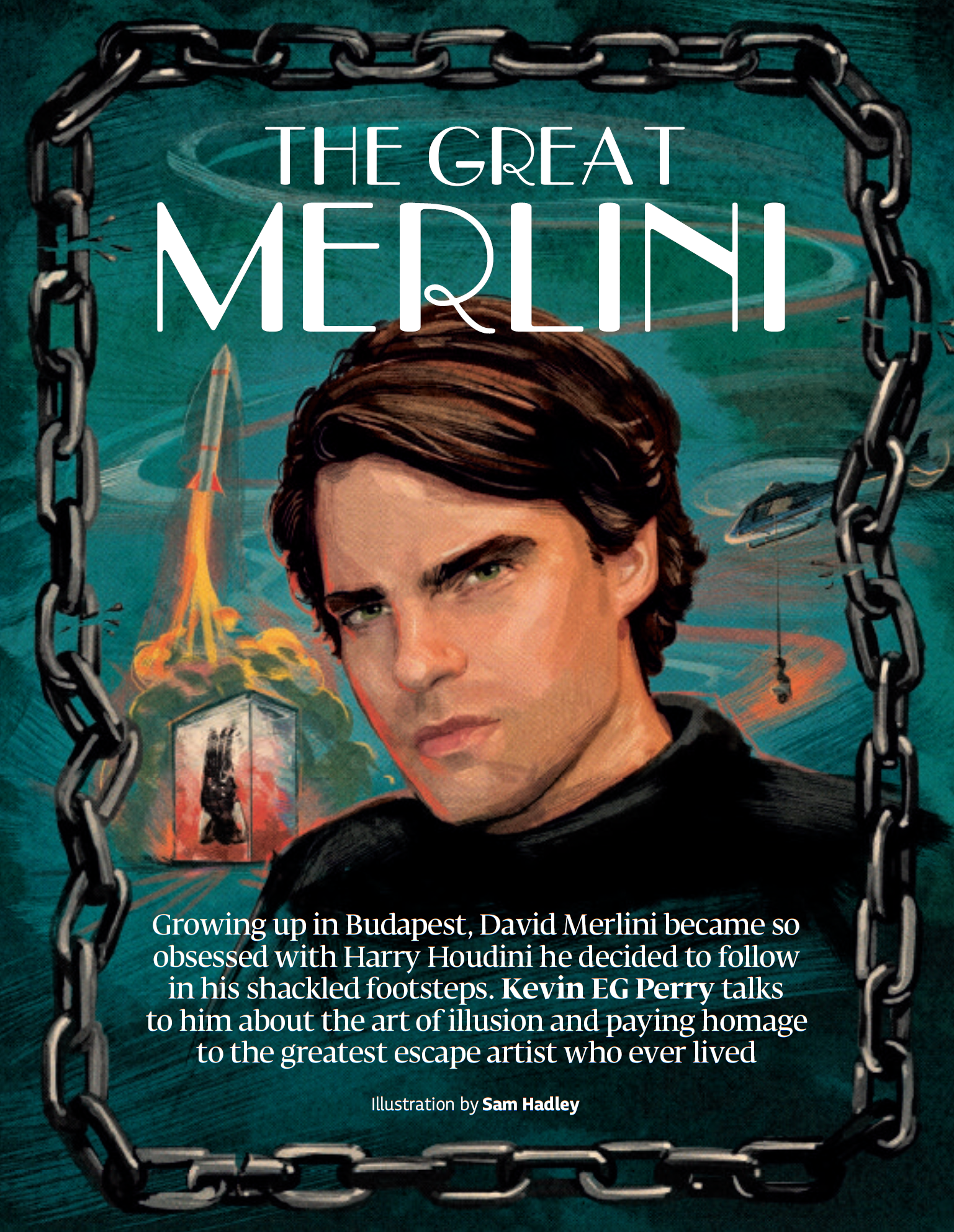
Early in his career, David Merlini learned that one of the benefits of being an escape artist is not having to worry when you’re stopped by the police. It was the mid-90s, and he had just bought his first car, a silver Maserati. Not bad for a 17-year-old in Budapest. There was just one minor problem: he didn’t have a driving licence. So he came up with a ruse. Whenever he got pulled over, he’d say that his license was in the boot. When they popped it open it would be full of chains and padlocks.

“What are you doing with all these?” they’d demand.

“I’m an escape artist.”

“Is that right? Could you escape from my handcuffs?”

They’d snap on their police-issue cuffs and moments later Merlini would hand the bracelets back to them. By this point, they’d have invariably forgotten all about needing to see his licence. As if by magic.

Yet there is no trickery in this story. They were real policeman with real handcuffs, and Merlini really wrestled free of them. Even Merlini’s name is real, and appears on the driving licence he’s rather belatedly acquired.

Teller, the shorter half of Penn & Teller, once told Esquire magazine that: “Sometimes magic is just someone spending more time on something than anyone else might reasonably expect.” Merlini knows that to be true. He has spent his whole life learning to escape.

Merlini was born in Budapest on 31 October 1978 to an Italian father and a Hungarian mother. They knew something was different about their son by the time he reached the age of four. He showed no interest in Matchbox cars, Lego or football. The only toys he wanted to play with were padlocks and handcuffs. His only passion was for magic. Not long after, his father moved the family to Turin in northern Italy. Coincidentally, the city is home to the biggest society of European magicians: The Circolo Amici della Magia di Torino. A chance meeting with one of its founders led to Merlini joining the club when he was just 13, after an examination period of six months. He was the youngest member ever admitted.

It was in their library of magic that Merlini made a discovery that changed his life. He began to read about the life of Harry Houdini, the greatest escape artist of all. Here was a man who had shared Merlini’s love for combining magic with padlocks and handcuffs. What’s more, both men had been born in Budapest – one district away from each other – but left Hungary as young children. Houdini had died at the age of 52 on 31 October 1926. Exactly 52 years later, Merlini had been born. “Then and there it was decided,” says Merlini. “I will stage again all of his illusions, all of his escapes, but with a modern key. I will modernise these amazing escapes that he performed.”

He didn’t waste any time. Merlini made his first public appearance at the age of 14, in the theatre tent of Budapest’s Sziget festival. Just two years later, he was upside down over the main stage at the same festival escaping from a straitjacket while suspended by his feet from a burning rope. It was a variation on a trick Houdini himself had performed outside newspaper offices to guarantee himself press coverage, and it had a similar effect for Merlini. “In 1995 in Hungary it was something that had never been seen before,” he remembers. “There was massive media attention, which fuelled my passion. I made a statement that every year I would present a new stunt, something amazing. The year after I was locked in a steel box and lowered into the Danube river.”

Quickly succeeding in his goal to recreate Houdini’s escapes, Merlini then raised the stakes even higher. “Escape artists all do the same gigs. They get chained, they escape,” he explains. “I always wanted to create something of my own.”

The first show he devised himself was performed in Budapest’s Hero’s Square in 2001. Merlini was strapped in a regulation straitjacket and then welded into a steel and reinforced glass container filled with water. The water was then frozen, and 33 hours later the one ton ice block was melted with chainsaws and flame-throwers. Merlini then staggered out and escaped from the straitjacket. After that, the stunts got bigger every year. One year he was embedded in a block of concrete and lowered into the Danube. The next he was launched inside the largest non-governmental non-military rocket every commissioned by an individual. “After I was launched in the rocket, I said: ‘What else can I do?’” he laughs.

His answer to that was to be named Best Escape Artist at the World Magic Awards in Los Angeles in 2007. He picked up the award after performing a variation on his ice block escape where he was instantly frozen with liquid nitrogen. Two years later, on the starting grid before a Formula 1 race in Bahrain, he broke the world record for the longest breath-hold underwater with a staggering time of 21 minutes and 29 seconds.

The trick with Merlini is that there is no trick. “A magician creates an illusion by, for example, using the dice to roll a certain number, and maybe the dice is prepped, and the trick is possible because of an apparatus,” he says. “On the other hand, the escape artist is the apparatus itself. The secret behind my escapes is how to hold your breath, how to open locks underwater, how to resist very uncomfortable and harsh conditions. It wouldn’t be right to say it’s trickery, because the trick is the man itself.”

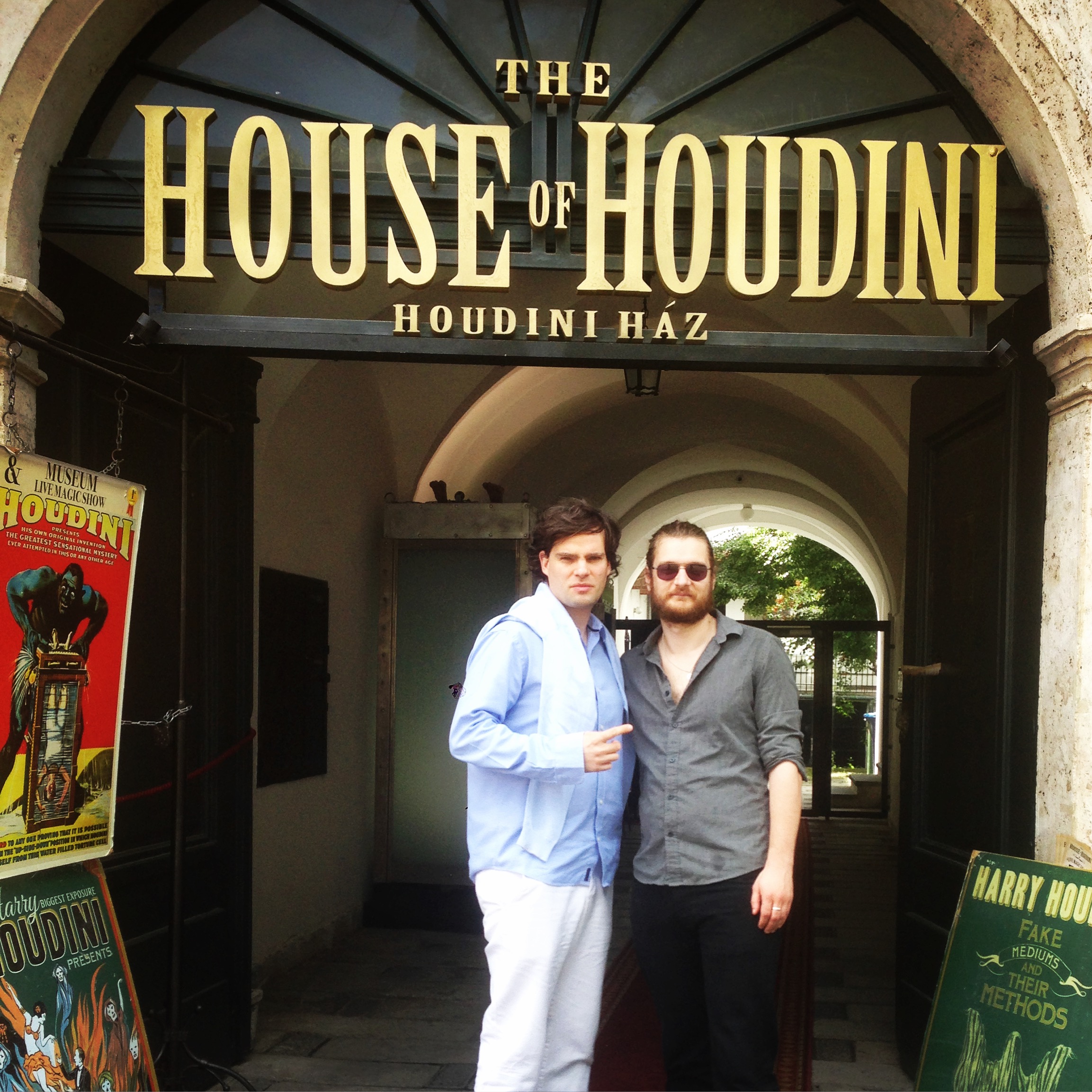
Having performed all over the world, Merlini returned to Budapest to open The House of Houdini last year. An apartment in Buda Castle has been transformed into a shrine to Merlini’s hero. Handcuffs and lock-picks that once belonged to the great escape artist, as well as his old family bible inscribed with his birth name Erik Weisz, sit side by side with props from a recent Houdini television series starring Adrien Brody, for which Merlini taught him the basics of escapology. There are also regular magic shows, every half an hour, literally providing a stage for a new generation of young Hungarian illusionists.

Before it opened, there was nothing to mark Houdini in the city of his birth. Merlini couldn’t allow that to continue. “Houdini is still an icon,” he says. “The museum is here because I hope he will still be an icon in 100 years, because that’s what he deserves. He had the class and the straight-forward style all mixed in one. He was unique. We have amazing magicians again today who are very successful, but I doubt if in 100 years there will be many names still up for future generations.”

Merlini and Houdini capture the imagination because in escaping from the ties that bound them, they represent something essential in the human condition. The French philosopher Jean-Jacques Rousseau once wrote that: “Man is born free, but is everywhere in chains.” Houdini and those who’ve followed him show us that we can throw them off. “We all have our manacles and our chains,” says Merlini. “It’s just a question of how we can escape from them.”

Published by Brussels Airlines’ b inspired, July 2017.

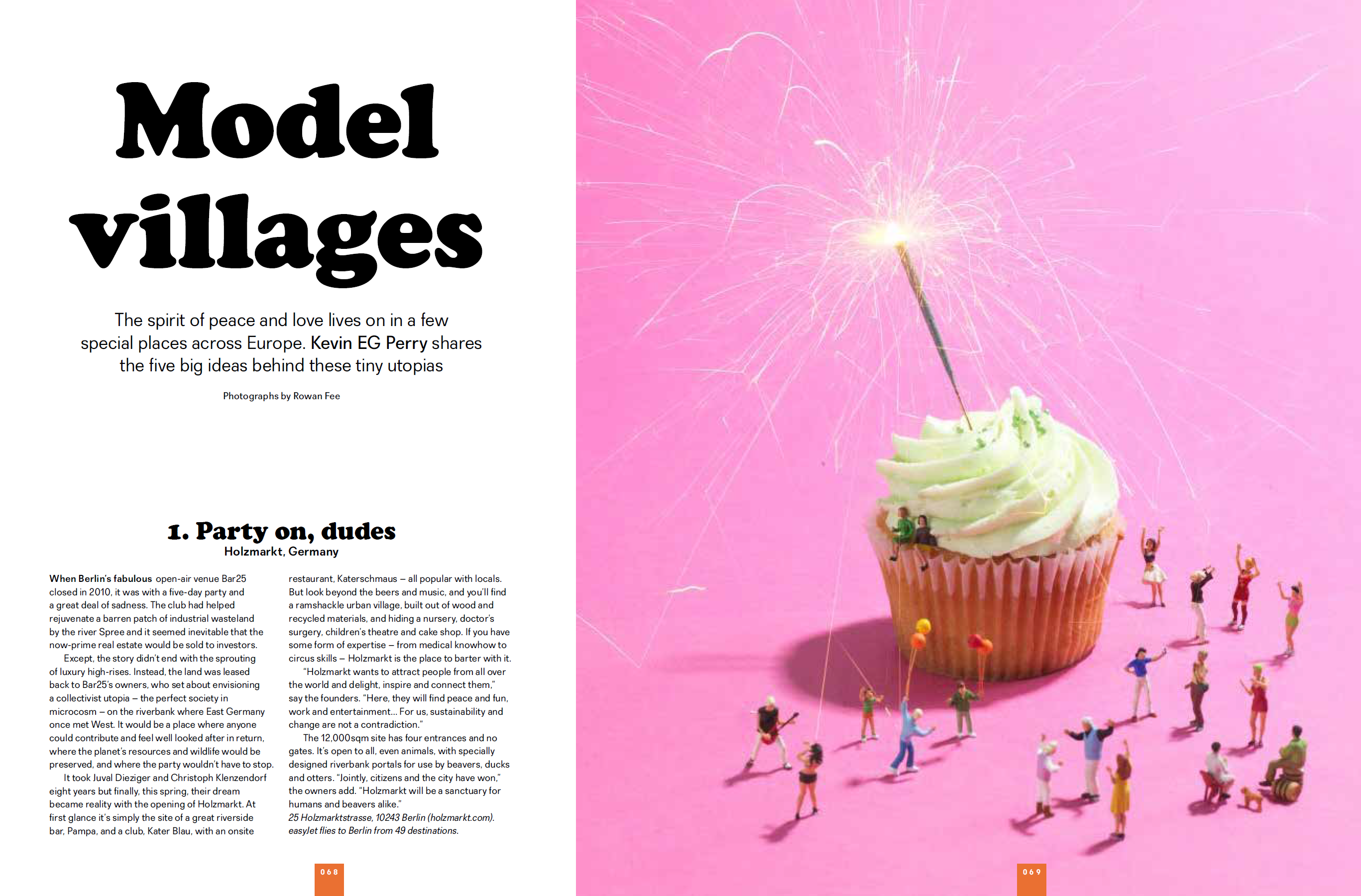
Model villages

model-villages

1. Party on, dudes
Holzmarkt, Germany

When Berlin’s fabulous open-air venue Bar25 closed in 2010, it was with a five-day party and a great deal of sadness. The club had helped rejuvenate a barren patch of industrial wasteland by the river Spree and it seemed inevitable that the now-prime real estate would be sold to investors.

Except, the story didn’t end with the sprouting of luxury high-rises. Instead, the land was leased back to Bar25’s owners, who set about envisioning a collectivist utopia – the perfect society in microcosm – on the riverbank where East Germany once met West. It would be a place where anyone could contribute and feel well looked after in return, where the planet’s resources and wildlife would be preserved, and where the party wouldn’t have to stop.

It took Juval Dieziger and Christoph Klenzendorf eight years but finally, this spring, their dream became reality with the opening of Holzmarkt. At first glance it’s simply the site of a great riverside bar, Pampa, and a club, Kater Blau, with an onsite restaurant, Katerschmaus – all popular with locals. But look beyond the beers and music, and you’ll find a ramshackle urban village, built out of wood and recycled materials, and hiding a nursery, doctor’s surgery, children’s theatre and cake shop. If you have some form of expertise – from medical knowhow to circus skills – Holzmarkt is the place to barter with it.

“Holzmarkt wants to attract people from all over the world and delight, inspire and connect them,” say the founders. “Here, they will find peace and fun, work and entertainment… For us, sustainability and change are not a contradiction.” The 12,000sqm site has four entrances and no gates. It’s open to all, even animals, with specially designed riverbank portals for use by beavers, ducks and otters. “Jointly, citizens and the city have won,” the owners add. “Holzmarkt will be a sanctuary for humans and beavers alike.”

2. Embrace woolly ideas
Lammas, Wales

“It’s totally possible to live a first-world lifestyle without it costing the Earth,” says Tao Wimbush, one of the founders of the Lammas Ecovillage in Pembrokeshire. His statement’s true in both senses – since 2009, Wimbush’s comfortable existence has been as cheap as it is sustainable.

Lammas is ‘off-grid’, meaning members of this pioneering community create their own power and rely on their skills to solve problems. Not that there are many within this lush enclave on the UK’s western edge. Happy cows chew the cud, the soil bursts with fresh produce and beautiful houses spring up without the help of any big development companies.

“In the village, we’ve all got computers, internet, washing machines, stereos…” Wimbush points out. The difference is that residents know exactly how much of the community’s solar and hydroelectrically generated power each appliance needs. “I’ve got two teenagers and they know that when they turn on their hairdryer it’s going to take 900 watts of power, so they check it’s available before they turn the hairdryer on. If it’s not, they can reroute power by turning off other appliances.”

Eating organic isn’t an optional luxury, it’s a necessity and houses are literally packed with natural materials. “We insulate our homes with sheep’s wool. It came straight off the sheep’s back and into a cavity in our timber-framed house,” says Wimbush. “We’ve proved that it’s totally possible to build affordable, healthy, high-performance houses with local, naturally available materials. The house I’m living in cost £14,000 [€16,000] and is more effectively insulated than the average suburban home.” It goes to show: it’s better to keep a sheep than be one.

3. Put your art into it
Christiania, Copenhagen

Pothole repairs are an issue that all towns face, but a workaday chore? Not in the ‘free town’ of Christiania. The autonomous neighbourhood in Copenhagen is famous Europe-wide, not least for its relaxed approach to cannabis, but also for its louche and lovely aesthetics. Here, potholes are as likely to be filled with marble mosaics or glazed tiles as asphalt.

“Beauty is just as important as function,” says Britta Lillesøe, an actress and the chairwoman of the Christiania Cultural Association. “Christiania is a town for people expressing themselves artistically in everyday life.”

Ever since it was founded as a squat in 1971, Christiania has attracted those who don’t feel they fit in anywhere else. “We accept and tolerate deviant ideas and behaviour, because we know that by judging others we judge ourselves,” says Lillesøe. “Being different is a way to be yourself.” However, those differences have a way of binding people together – forming what she calls an ‘urban tribe’. “Individualism and collectivism come together in the tribal spirit, which is beyond the political,” she says. “It honours tradition and yet despises worn-out ways. We are a bridge between the prehistoric and the future, between the shamanistic vision and the age of Aquarius.” Couldn’t have put it better myself.

4. Don’t stop till you get enough

Marinaleda, Spain

In 1979, 2,500 labourers in Andalusia found they had no land, no prospects and nothing left to lose. All around them they saw fields that weren’t being farmed and they decided to act.

It took 12 years of relentless protests, including whole-village hunger strikes, occupations of the farmland they were demanding and a march to the Andalusian capital, Seville, but by the turn of the 90s, the battle had been won and the land around the village of Marinaleda was handed over.

“Eventually, the local government decided it was more trouble than it was worth, bought the land from a duke and gave it to the people,” says journalist Dan Hancox, whose book The Village Against the World details the labourers’ struggles. During the almost three decades since, the people of Marinaleda have created their own narrative. “They have their own TV channel and radio station, which might sound ridiculous for a village of 2,500 people, but that’s what makes it fascinating,” says Hancox. “They party together at their own feria [festival] in July, which always has a revolutionary theme – one year it was Che Guevara. The village even has its own colour scheme: green for their rural utopian ideal, red for the workers’ struggle and white for peace.”

Che would surely approve.

5. Make love not war
Metelkova, Slovenia

The army barracks in the centre of Slovenia’s capital, Ljubljana, have not historically been the sort of place you’d want to spend a night on the tiles. Built by the Austro-Hungarian Empire in the late 19th century, they have at various times been home to soldiers from Fascist Italy, Nazi Germany and the authoritarian Socialist Federal Republic of Yugoslavia, none of whom were renowned for being much fun at the disco – which explains the glorious irony that since 1993 the barracks have been transformed into Metelkova, a home for artists and one of the most successful urban squats in the world. Moreover, the alternative city-state was home to Ljubljana’s first gay and lesbian clubs – Klub Tiffany and Klub Monokel respectively – and has since been used as a base for a whole variety of campaigns against racism and other forms of abuse. Even the mayor of Ljubljana, Zoran Janković, has been won over by the squat.

“Metelkova is a centre of urban culture,” he said in 2015. “It’s a place for critical reflection, civic engagement – and with its activities, it is establishing Ljubljana as an area where ideas of all generations can freely flow.”

If former Nazi army bases can become beacons of hope and togetherness, surely anywhere can.

Originally published in Easyjet Traveller, July 2017.

Killers at 14: The Story of the UK’s Youngest Double Murderers

1497820371683-markhamIt was midnight on Monday the 11th of April, 2016. Fourteen-year-old Lucas Markham had set out for his girlfriend Kim Edwards’ house on Dawson Avenue in the small market town of Spalding, Lincolnshire. In his backpack, rolled inside a black T-shirt, were four kitchen knives. When he arrived at the back of the house, he clambered onto the roof of a shed and knocked three times on her bedroom window. He waited, but before long he realised that Kim, who was also 14, was fast asleep. Lucas walked back home alone.


The following night he returned. Again, he knocked on the glass. Again, she didn’t hear him.

The next night, Wednesday, Kim heard him knocking.

Continue reading at Vice.

The British Teenager Who Tried to Bomb a Tube Train

1496158759548-1tubeIt was 9:30AM on an uncomfortably hot Friday morning, and in the gallery of Court 10 at the Old Bailey Antonitza Smith sat alone. Below her, flanked by guards and wearing the navy-blue suit she had delivered to him at Belmarsh Prison, was her only son, Damon. The 20-year-old’s curly hair had been cut short. They were both waiting to learn the sentence that the judge, Richard Marks QC, would hand down that morning.
Three-and-a-half weeks earlier, on the 3rd of May, 2017, Damon had been found guilty of leaving a homemade bomb packed with ball bearings on a Jubilee Line train. Marks knew that whatever decision he made would come under renewed focus after the deaths of 22 people in the shocking and senseless suicide bombing in Manchester just four days before. A few minutes after starting proceedings, he announced there would be a short break and cleared the room.

Outside the court, Antonitza steeled herself for another unbearable stretch of minutes spent worrying about her son. His lawyers had already told her that it would be “a miracle” if he got anything less than ten years. “He needs help, not prison,” she told me.

Continue reading at Vice.

Helal Al Baarini: “I’m a refugee, but I’m also a footballer”

1490011785107-SHHelalAlBaarini011Helal al Baarini is 21 years old and a native of Homs, Syria. He fled to Jordan in 2012 and came to England in February 2016.


I’m a refugee, but I’m also a footballer. I play for Bilston Town at the moment – a team near where I live in Birmingham. I’m a midfielder and I can play on either wing or behind the striker. Some of my teammates call me ‘Coutinho’, because I have the same style as him – I can score goals but I focus mainly on creating chances, and I get a lot of assists.

It’s been my dream to play in England ever since I was a little boy – I think the Premier League is the strongest league in the world. I support Liverpool but I’d love to play professionally for any club here. I’d play for whoever gave me a chance.

I’m originally from Homs. My brother and I fled the war in Syria in 2012 – my parents wanted us to leave our family and get away from the violence and the fighting. At the time I was playing for Al-Karamah SC, one of the top clubs in the country and one of the oldest sports clubs in Asia. I first joined Al-Karamah when I was 7 years old, and ended up playing for their Under-17 team. Before I left Syria, I was even named best player in the Under-17 league. Life was good before the war started. It was hard for us to leave the country, but the war had destroyed everything we loved, everything that was familiar to us. It was dangerous to even just walk down the street.

Continue reading at Vice.

Meeting the editor of Guatemala’s free feminist newspaper

IMG_1143

Guatemala is one of the most dangerous places in the world to be a woman. According to a 2012 report by the Small Arms Survey, the small Central American country has the third highest rate of femicide – women being killed just for being women – in the world, behind El Salvador and Jamaica. During the Guatemalan Civil War, which lasted from 1960 to 1996, rape was used as a weapon of war against women. Perpetrators of gender-based violence in Guatemala often quite literally get away with murder, bolstered by a “machismo” culture that treats women as objects. Amnesty International has called on the state to do more to protect women.

This cultural backdrop makes it even more remarkable that for the last 19 years, Guatemala has also been home to a proudly feminist free newspaper called La Cuerda (The Cord). First published on 8 March 1998, International Women’s Day, it has been distributed monthly across the country ever since and has given a voice to women who would otherwise have been ignored.

In Antigua, in the south of the country, I met one of the newspaper’s four founders, Ana Cofiño, at her home to ask her about the challenges they’ve faced and her hopes for planting the seeds of Guatemalan feminism:

How did La Cuerda first get started?

“Before we started La Cuerda there was another daily journal, and we asked the editor to give us a page when the moon was full. Every full moon we had a page. It was four of us, friends, and we had meetings where we would decide what we would write about. After that finished, my colleagues and I shared the dream of having our own paper. “A room of our own”, as Virginia Woolf put it. We were writing for other magazines, but we wanted to have a paper that belonged to us. If you just put one article in a big magazine it gets lost. We wanted to start a magazine which said: ‘We are feminists and this is our position’. What we tried to do from the beginning with this newspaper was to open society to what women were thinking, doing and feeling. We wanted women to know each other, because war breaks everything. Our social fabric had been broken during the war.”

Where did your idea of feminism come from?

“We should define what we mean by feminism. Feminism is a philosophical theory. It’s also an economic proposal. It’s a way of living. It’s not like machismo. It’s not stupid actions. It’s an accumulation of knowledge and political changes done by feminism. That’s what we inherited. It’s theory written by feminists, and the story of women. That’s one part of it. We also became feminists because it’s easy to see how unfair it is. If you have any consciousness and intelligence then you can see that the situation is not fair at all.”

So you arrived at it independently, rather than from reading foreign academia?

“I think many women of my generation found feminism through their mothers or in school. If you studied in a public school you had more opportunities to be critical. Many women of my class from my generation were educated by nuns. I studied in a nun’s school. That’s what’s behind us as Guatemalan feminists, in many ways. Sometimes if they tell you something, and they impose it on you, and in your heart and in your skin and in your flesh you know that’s not true, you fight against it. You become a rebel. You don’t need to pick up a gun to be a rebel. You’re a rebel because you know what they are doing to you is not fair. I think that kind of spirit is something that comes in your blood. You don’t resign yourself to be what they tell you to be because it’ s not fair. Fairness is also a matter of feeling. It’s not only what’s written.”

What sort of things were you publishing in La Cuerda at the beginning?

“We wanted to give a voice to women who didn’t have a voice. We collected stories about what happened to women in the war, and we supported processes by which women revealed all the sexual violations which had happened during the war, because that didn’t come out in the official reports. We were also collecting new types of images of women, not just women as Barbies. We were trying to change mentalities. We had very high aspirations, but that’s what we wanted: to change mentalities and teach people to be critical. From the beginning, La Cuerda was not just a paper or the digital version, it is an organisation that has a political goal. At the same time as doing the paper we were talking, and making alliances in some cases, with women’s organisations in different parts of the country. If you want to change the world and the society in which you live, you can’t do it alone.”

What do you see as the goal of the newspaper?

“We want people to see things, discuss things and think about the problems of our society from another perspective, because that’s the fundamental feature of a feminist paper. You have all these instruments, all these tools to see society, like the concept of patriarchy. They can give you a radically different perspective. We’re trying to construct a political platform for society. I know we’re crazy, I know it’s a dream. We’ve been talking to other women, other feminists, for seven or eight years now trying to coin the terms that describe what we want. Not what there is. What there is already has names. What we want is different. You can’t imagine it. Sometimes we laugh so much and say: ‘A world without machismo? How would that be?’ For us, that means no guns. No armies. In this country, the military, and the owners of the country, we’ve been saying for years and years that we should disarm.”

Do you think there’s a big difference between what feminism means in Guatemala and what it means in Britain or America?

“There are a lot of different points of view on this! People talk about ‘white feminism’, and now in Latin America many women are talking about ‘colonial feminism’. There are different emphases. There’s a feminism that has been working with the United Nations, with human rights, which is called ‘institutional’. There is more radical feminism, there is lesbian feminism, so I think every reality and every society has its own features. It’s different talking from the first world, like England, to here because you have your own democracy and parties and the way things function. People are not dying like they are here. One of the main things that we discovered when we started this process is that Guatemalan feminism had to be conscious and marked, and to fight against racism. When we talk about women’s rights, we have to talk about indigenous women’s rights.”

What lessons have you learned from publishing La Cuerda that you would want to pass on to young feminists?

“I would tell them to confront power. When we’re educated, in schools and in our homes, we just learn that everything is as it is. They don’t tell you that it is a matter of power. Another thing that we’ve learned is that we need our history. We didn’t know about women. We didn’t know the names of the women who came before us. In the official stories that you study at school, it’s all about ‘Great Men’ – war and power and scientists, but never women. It was a beautiful adventure to go back in time to find what women had done before. For example, now there is a story of women in journalism in Guatemala and we are part of that, already. That’s very important. When you study history, newspapers are a good reflection of what is being said.”

Originally published by Shevolution.

The unbearable loneliness of pick-up artist bootcamp

trump-1“You know, I’m automatically attracted to beautiful – I just start kissing them. It’s like a magnet. Just kiss. I don’t even wait. And when you’re a star, they let you do it. You can do anything. Grab ’em by the pussy. You can do anything.”
It was back in 2005 that those grimy nuggets of “locker room talk” bubbled out of Donald Trump’s puckered lips on the Access Hollywood bus. That same year, Neil Strauss published The Game, a how-to guide for wannabe ‘pick-up artists’ that would go on to sell 2.5 million copies. It recommended tactics like “negging”, insulting a woman to reduce her self-esteem, and “caveman-ing”, which it defined as “to directly and aggressively escalate physical contact”.

It seems clear that the culture The Game was a part of helped carry Trump to the Presidency 12 years later. We now live in a world where grotesque machismo is so commonplace that his chief strategist Steve Bannon reportedly calls his White House rivals “cucks”. Bannon rose to prominence as chair of Breitbart News, which stoked the misogyny of Gamergate in 2014 and fuelled the rise of the Alt-Right. Many of its readers are the same young men who learned all they know about women from Reddit’s The Red Pill forum, which teaches that feminism is a lie and what women really want is to be dominated and manipulated by powerful men. Pick-up artist (PUA) philosophy has taken over the asylum.

So when I was invited to cover a three-day PUA ‘bootcamp’ run by a company called Love Systems, I was intrigued. If I wanted to understand what made these guys the way they are, this seemed like a good place to start.

Continue reading at Shortlist.

Idris Elba: ‘I’d get pelted with eggs for being black’

idris-elba-telegraphBefore he was the eponymous tortured detective in Luther, before he was a regal Nelson Mandela in Long Walk to Freedom, before he was even The Wealth of Nations-toting drug kingpin Stringer Bell in The Wire, Idris Elba was a schoolboy on a bus in east London being pelted with eggs by racists.

“My school, Trinity, was just off the Barking Road, which would take all the National Front supporters to the football at West Ham,” he remembers, leaning forward on a sofa in a production office, in London’s Holborn, that smells of expensive candles and industriousness.

Continue reading at The Telegraph.

The Haunting Case of the ‘Killer Cabbie’

killer-cabbieWhen Detective Sergeant Steve Fulcher heard that taxi driver Christopher Halliwell – the lead suspect in the disappearance of Sian O’Callaghan five days earlier – had refused to tell officers anything during his arrest, he made a decision that, in a cop show, would be described as “not doing things by the book”. In the real world, Fulcher’s actions were later described by the Independent Police Complaints Commission (IPCC) as a “catastrophic” breach of the Police and Criminal Evidence Act.

While officers were driving Halliwell from the scene of his arrest, in an Asda carpark, to Gablecross police station in Swindon, Fulcher called them and told them to instead take the suspect to Barbury Castle, an Iron Age hill fort. Fulcher met Halliwell on the wind-swept hilltop at 12:11PM on Thursday the 24th of March, 2011. He led him 50 yards away from the officers and their police cars to talk. Their conversation was recorded by the only other person there, a civilian note-taker:

Fulcher: “Are you going to tell me where Sian is?”
Halliwell: “I don’t know anything.”
Fulcher: “Are you going to show me where Sian is? What’s going to happen, if you tell us where Sian is – that whatever you will be portrayed – you would have done the right thing.”
Halliwell: “I want to go to the station.”
Fulcher: “Are you prepared to tell me where Sian is?”
Halliwell: “You think I did it.”
Fulcher: “I know you did it.”
Halliwell: “Can I go to the station?”
Fulcher: “You can go to the station. What will happen is that you will be vilified. If you tell me where Sian is you would have done the right thing.”
Halliwell: “I want to speak to a solicitor.”
Fulcher: “You are being given an opportunity to tell me where Sian is. In one hour’s time you will be in the press.”
Halliwell: “I want to speak to a solicitor.”
Fulcher: “You will speak to a solicitor. I’m giving you an opportunity to tell me where Sian is. By the end of this cycle you will be vilified. Tell me where Sian is.”

Long minutes of silence passed. Finally, Halliwell said: “Have you got a car? We’ll go.”

Continue reading at Vice.

Kong: Skull Island: “My own personal Heart of Darkness”

kong-skull-island-imax-posterKualoa Ranch is a 4000-acre private nature reserve in Hawaii, most recognisable as Jurassic Park. Back in December 2015, I flew over to witness its transformation into Skull Island, a place where King Kong meets Apocalypse Now. Tom Hiddleston and director Jordan Vogt-Roberts were on hand to explain:
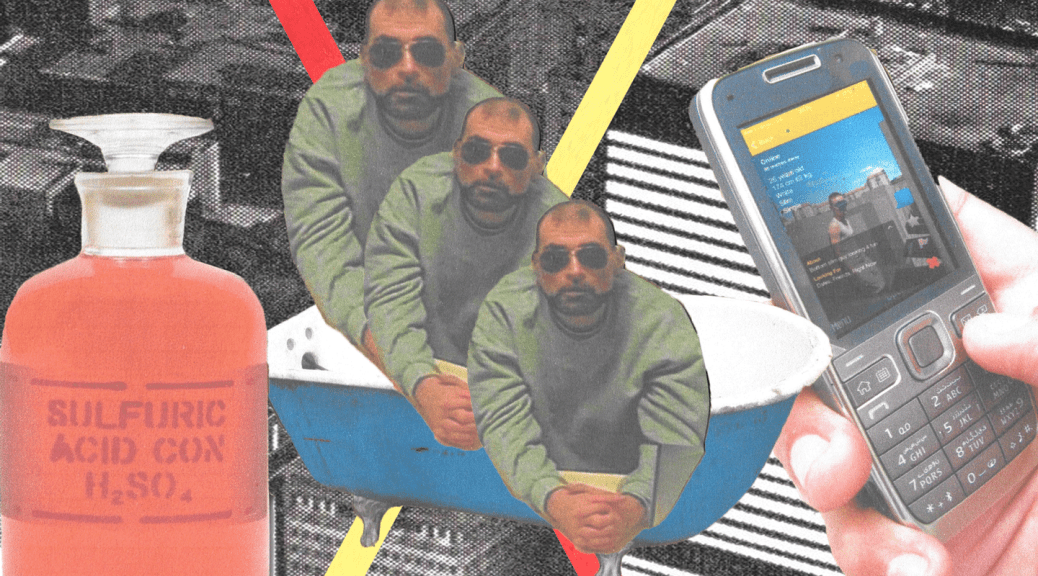
You decided to call two of your characters Conrad and Marlow…

Hiddleston: “The idea of Conrad and Marlow really came from Jordan. That was such a great inspiration as a spine. I think there’s something intrinsically exciting and cinematic about putting a group of disparate characters in the same place on a boat and sending them down a river. I think ‘Heart of Darkness’ has inspired so many stories like that.”

Vogt-Roberts: “This is my own personal ‘Heart of Darkness’! ‘Apocalypse Now’ is a huge reference point. The initial talking points for this movie in my mind were: ‘Man, you know what I’ve never seen? A monster movie with the aesthetic of ‘Apocalypse Now’. With Hendrix playing, with The Stones playing, with The Doors playing… thinking about the imagery and the chaos of ‘Apocalypse Now’, what was going through everyone’s mind.”

Are we going to get those things on the soundtrack?

Vogt-Roberts: “Yes! I want to see Kong punching a helicopter while Jimi Hendrix plays. But our movie… ‘Apocalypse Now’ is one of the best films of all time, and while there’s a loose inspiration there we’re ultimately making a very big and accessible movie. ‘Apocalypse Now’ is almost Malick-esque in the way that it has to wash over you, and I don’t quite think that’s opening on 3,000 screens these days. There are aesthetic inspirations, and inspirations in terms of the madness that this place takes on and the journey that going up the river has for these people, but, you know, it’s an easy talking point on the movie when you look at a lot of these things. We’re going for something bigger than that, more adventurous than that.”

What sort of hero is Hiddleston’s Conrad?

Vogt-Roberts: “There’s a bit of Steve McQueen in there. Tom’s so great, and charming, and textured. We initially were talking about making him American. One of the big things that came out was instantly separating him from Packard and the rest of his men. In the context of a movie that takes place in the shadow of Vietnam – those are generally very uniquely American stories – a lot of the conversations about Tom it became clear that it was a way to make the movie feel bigger, more worldly and to give him a different perspective on what was going on at that time. There actually were a lot of British soldiers in Vietnam, which is something which is downplayed pretty significantly. It’s viewed as a uniquely American war, which it wasn’t quite. There were a lot of avenues that led us there, a lot of it was just really trying to create clear and concise sides.”

Hiddleston: “Indiana Jones of course came up, as an icon and a silhouette, in a way. He’s somebody who has an intellectual passion and becomes an adventurer. We always wanted Conrad to be that. We knew we couldn’t make him like Martin Sheen in ‘Apocalypse Now’ because that’s a very heavy character – another iconic performance – but this needed more wit. It’s an adventure film. It will be spectacular – I know that already having been on this for nine weeks. I’ve seen it. It needs to be fun. Having made a couple of films on this scale, the ones that are the most successful have a balance of weight and drama and also of wit.”

The Life and Crimes of ‘Cannibal Cop Killer’ Stefano Brizzi

brizziWhen the smell of rotting human flesh became too much for the residents of Block E to take, the caretaker on The Peabody Estate first tried to mask it with bubblegum-scented air spray. When that didn’t work, somebody eventually decided to call the police.
That was on Thursday the 7th of April last year. Almost a week earlier, on the night of Friday the 1st, a man who would later be identified in court only as “CD” found himself lost on the estate while looking for a chemsex party he’d been invited to by someone named “Domination London” on “gay fetish app” Recon. The Peabody Estate, which originally opened in 1876, lies a few minutes south of the Thames, between London Bridge and the Tate Modern. Its desirable location means a one-bed studio apartment there will set you back £1,300 a month in rent, but its various blocks can be difficult to navigate for the uninitiated.

Eventually, CD found the right door and rang the buzzer. There was no answer, so he rang it again. And again.

Eventually a man’s voice answered. It said: “Hello, sorry, we are having kind of a situation here.”

CD didn’t know what the voice meant by “a situation”, so he asked what was going on. The voice explained that somebody was feeling ill, but said not to worry because they were taking care of it. CD asked if there was anything he could do to help, and the voice said no, everything was under control, but the party was cancelled. The voice, CD would later testify, “sounded concerned, a little bit upset. He did not sound too worried.” As he walked away, CD thought to himself that perhaps somebody was throwing up on the carpet.

The voice on the other end of the intercom belonged to a 49-year-old Italian named Stefano Brizzi. He later told police why he hadn’t let CD in; he’d invited a few men to join his party, he explained, “but they didn’t arrive, and when one did arrive I was right in the middle of strangling Gordon.”

Continue reading at Vice.

How Blur’s ‘Blur’ Brought Them Back from the Brink

blur-gettyThe other day I found myself watching Central Intelligence, a 2016 goofball action romp starring Dwayne ‘The Rock’ Johnson as a unicorn-loving super-spy who saves the world by teaming up—for reasons which are still not altogether clear to me—with his old schoolmate, an accountant played by Kevin Hart. Look, I know it’s not going to win any Oscars but I was on a plane at the time. Nobody wants to strap in to 12 Years A Slave at 35,000 feet. Anyway, there’s a scene where the pair jump out of a skyscraper together through a plate glass window in a hail of bullets. I’m sure you know the type, whether or not you’ve had the pleasure of Central Intelligence. As the glass shatters and they burst into the air, the voice you hear isn’t The Rock’s or Kevin Hart’s, but the sheer, uncut exhilaration of Damon Albarn screaming: “WOOOO-HOOOOO!” It’s a dumb moment in a dumb film, but hearing “Song 2” in a Hollywood blockbuster almost exactly 20 years after it first came out was a weird and timely reminder of what a transformative impact that song, and the self-titled album it appears on, had on Blur’s relationship with America and their whole career.
Continue reading at Vice.

Inside the Criminal Trend of Stealing Laughing Gas from Hospitals

nosYou can get a lot of things for free on the NHS, but a five foot cylinder of nitrous oxide isn’t supposed to be one them. Mind you, that hasn’t stopped plenty of people figuring out that stealing NOS cylinders from hospitals in order to sell the gas in balloons at parties, festivals and raves can be a highly lucrative venture. With punters happy to spend £2 to £5 on each balloon, even a smaller 3ft cylinder can be converted into about £700 of pure profit.

Continue reading at Vice.

The Jazz Funeral Of Lady Liberty

Inauguration Day in The Big Easy… Dancing to reclaim the streets in Trump’s America… Rallying cries in front of City Hall… Six-foot vagina in the nightclub… Hope in the dark…

jazz-funeral-lady-liberty

“New Orleans is a glorious mutation.” — Anthony Bourdain, quoted on the marquee of The Joy Theater, Canal Street.

In the beginning, the coffin holds hopes and dreams. It’s half past ten on the morning of Donald Trump’s inauguration. New Orleans is hot and sticky and only getting hotter. In front of the arched gateway of Louis Armstrong Park, the open casket is filling up with notes from mourners putting their fears for the next four years into words:

“I am scared my future as a woman is over.”

“Equal rights are not extra rights.”

“RIP: Free Appropriate Public Education”

Watching over the couple of hundred protesters is an eight-foot papier-mâché Statue of Liberty, a tear streaked down her cheek. A group of older women pose in front of it, chanting: “Upbeat and defiant.” At eleven o’clock, the marching band strike up a mournful tune and Lady Liberty is lowered into her resting place.

The parade sets off down North Rampart Street and soon the music becomes celebratory, like Live And Let Die told me a New Orleans funeral should be. (“Whose funeral is it?” “Yours.”) Umbrellas and parasols punch the air. Just as in a film, people run out of their houses to join in.

Cops on motorbikes clear the route, blocking the traffic on busy Canal Street to allow the procession to pass down the main road past the front of the Ritz Carlton. People are still joining the parade, whether for the politics or just the marching brass, but not everyone is impressed. In front of the Marriott, a big man in an even bigger blue t-shirt turns to his buddy: “Like the dude isn’t going to give his inauguration speech because of a few protesters!”

A little further down the road I meet Jeff Saunders, a volunteer with The Next Right Thing, the group who organised the funeral. He explains why the big blue man was missing the point:

“Most of the people I’ve talked to in the crowd are talking about getting more involved in local politics. There’s no negativity at all. People are feeling energised.”


The procession stops for a while on the Moon Walk, the riverside promenade created in the 1970s by Mayor Moon Landrieu. Just before one in the afternoon there’s an announcement to the waiting crowd that they’re “not gonna throw her in the drink”. Instead, the flowers from her casket are distributed to be thrown symbolically into the river. They drift away on the brown murk.

Lowering Lady Liberty into the Mississippi wouldn’t have been quite in keeping with the mood of the day. Americans are a naturally optimistic people, and they’re big on symbolism. Another announcement is made:

“We’re going to keep marching. The band will start playing ‘Didn’t She Ramble’, because she did, didn’t she? She had a good run. As we walk towards Frenchmen Street her arm will go back up and her torch will be lit. She will rise again!”


Going down Decatur Street, just in front of the statue of Joan of Arc, the parade meets its first vocal Trump supporter. He’s the archetype, the Platonic ideal of a Trump fan in a coordinated colour scheme: White ‘Trump’ t-shirt, red ‘Make America Great Again’ hat. White arms, red face. Tiny stars and stripes waving above his head. He chants: “Trump not hate! Trump not hate!” The funeral procession responds only by vigorously dancing at him.

Later on, another man shouts: “Let’s hear it for Donald!” but these were the only two individuals I heard protesting the protesters all day. This is not all that surprising. While Louisiana backed Trump, giving him 1,178,638 million votes, only 24,292 of those came from New Orleans. By contrast, Hillary pulled in 134,000 votes from the city. One New Orleans voting precinct didn’t receive any Trump votes at all.


Political puns have made me cringe ever since ‘Bliar’, but grudging respect to the lady with the ‘Hair Twitler’ sign for wringing three puns out of two words.


The funeral procession comes to a halt at Washington Square Park around two o’clock, but this is not the end for Lady Liberty. “She’s still alive, we just need to fight for her!” someone shouts.

It’s not even the end for the day. Statue and coffin are taken across town to Duncan Plaza, in front of City Hall, where the day’s main protest rally begins at three. On the way, teenage drug dealers mingle with the couple of thousand protesters heading into the park. Their sales pitch suggests they’ve either misunderstood the purpose of the rally or are mocking the anti-capitalists:

“I got those Donald Trump bags. Smoke this shit and it’ll get you rich.”

On stage in Duncan Plaza, beneath a banner reading ‘Power To The People’, fifteen different speakers explain in turn how the issues closest to them will be affected by Trump entering the White House. Housing. Health. Mass Incarceration. Immigration. The environment. The list goes on and on. The repeated message is one of solidarity: “We are here to inaugurate our own unity.”


Worst sign of the day: “1984 — Orwell Rising From His Tomb — 2017.” Poor old George. Fight Franco and try to warn people about the rise of surveillance fascism and they still treat your name like a zombie dictator’s.


The rally becomes another march, many times the size of the funeral procession. As it passes the Sheraton, the windows crowd with hotel workers on their phones filming the crowd’s chants: “No Trump. No KKK. No fascist USA.” I see Lady Liberty pass by in her coffin again. Sure enough, her flame is now glowing orange again.


After seven, walking alone down Frenchmen Street, I pass a man with a soundsystem hooked up to the back of his bike. He’s playing a rap tune on a loop that just repeats the line: ‘Fuck Donald Trump.’ I ask him what it is. He says: “It’s called ‘Fuck Donald Trump’.” Someone else passes and high-fives him.


Sun down, yellow moon. They’re throwing an ‘Anti-Inaugural Dance Party’ at Poor Boys Bar on St Bernard Avenue. On Facebook they quote the writer Michael Ventura, who wrote during the Reagan era:

“It can be a beautiful thing to dance all night during evil times.”

When I first walk in, I notice a woman sat at the bar with a Guy Fawkes mask in front of her. Earlier in the day, someone with a Guy Fawkes avatar responded to my tweet about Lady Liberty’s jazz funeral:


I mention this to her. “People are anti-government from all sides,” she says. These days, everyone wants to burn down parliament.


There’s a stall in the corner of Poor Boys being manned by a woman in a six-foot vagina costume. She is Amy Irvin, founder of the New Orleans Abortion Fund. I’d seen her earlier at the jazz funeral too. “It’s protest, but it’s a satirical protest,” she says. “This is very New Orleans, it’s very us. Trump’s policies threaten all of us, and this is a way for folks who are supporters of these issues to come together.”

I ask her about the work she does at the NOAF and she explains, with memorised statistics and figures, exactly how limited abortion access is in Louisiana. I nod and scribble notes, trying to ignore the fact that her face is poking out from between cushioned labia.


Outside, there’s another stall where a woman is giving away free trigger locks. These are padlocks that you place around your gun to stop your kids picking them up and accidentally shooting themselves. I tell her it’s mad she lives in a country where these things are needed. She doesn’t smile.


On the final stall I meet the fabulous Nathalie Nia Faulk, the spokesperson for the New Orleans LGBT Community Center. After she tells me about the work the Center does, I ask her about Trump. She’s not concerned.

“We’ve been in this fight already. We’ve been organising. Nothing’s changed. I’m not scared. Trump doesn’t worry me. We’ve been doing this already, and now we’re going to do it better and we’re going to do it stronger.”

After the jazz funeral, the rally, the march and the party, I tell her it seems to me that today isn’t just about Trump. When I was a teenager and marched against the Iraq war, I might have been naïve to believe we’d actually stop the war but I don’t think I was the only one who thought that’s why we were doing it. This is different. Nobody actually thinks they’re going to impeach Trump today. Rather these marches are about the protesters themselves turning to one another and saying: ‘Look, I know we’ve been complacent but we’re in for a fight now and I’m here for it.’

Nathalie nods enthusiastically, and says:

“Isn’t that glorious, though? People are actually getting involved. At some point, people were saying: ‘I don’t vote, that doesn’t fit me.’ Half of our generation were like that. At some point we all have to come together, and I think these demonstrations are that place, right? If you vote, that’s cool, if you don’t vote, that’s cool, but we all know that this is not okay, so what are we gonna do about it?”

I expected fear and despondency on Inauguration Day. Instead there was jazz, and dancing, and a lot of people telling each other it’s going to be alright. ‘Trump’s in the White House?’ says New Orleans. ‘We’re on the streets.’

Laissez les bon temps rouler.

Published on Medium.

Dominant

maggie-siff

In the Showtime drama Billions, about a US Attorney going after a corrupt hedge fund manager, the very first shot of the pilot episode shows Paul Giamatti bound and gagged on the floor. A dominatrix appears, putting out a cigarette on his chest and then helpfully alleviating the burn by pissing on him. By the end of the episode, we’ve learned that this woman is his wife.

It’s a hell of a way to make a first impression. For Maggie Siff, who plays the psychiatrist-turned-dominatrix, it presented both a challenge and an opportunity. “The sex stuff I was nervous about,” she says. “I’m not really an exhibitionist, yet I thought it was a really interesting component of their marriage. It felt smart. It made me want to know about that marriage, who those people were to each other and how they arrived there.”

It also makes her – in a show full of macho characters – quite literally the boss?

“And in a very literal sense it makes her the boss, yes,” she laughs. “She’s comfortable in that role.”

Siff and I are having breakfast in a hotel in Lower Manhattan, and over fruit and coffee she’s lamenting how rare it is to be offered such a powerful and complex female role. As an actress she’s become accustomed to being presented with barely-sketched stereotypes. “There’s the bitchy wife, the bitchy ex-wife, the sardonic best friend… there’s a lot of those tropes,” she says. “There’s just a disproportionate number of male writers, and directors, and producers, so the stories that are getting told are slanted that way. You get so used to that as a woman.”

It’s a particularly challenging situation for young actresses who are so keen to find work when they’re starting out that they find themselves playing roles they may inwardly cringe at. Siff, who grew up in the Bronx before studying English at Bryn Mawr, a women’s liberal arts college in Pennsylvania, and theatre at NYU’s Tisch School of the arts, remembers this time of her life well. “When you start out as a scrappy theatre artist just trying to pay back your student loans, you go through several years where you’re panning for gold,” she says. “I wasn’t picky at all. Your standard for what is acceptable goes down because you have to do things just to survive.”

After years working in regional theatre her television break came in her early 30s when she was cast to play department store heiress Rachel Menken in Mad Men. It was a role close to her heart. “Somehow I just knew that part was mine, no matter how many times I went back to audition for it,” she says “I just had this feeling like I knew who that person was. She reminded me of my grandmother, who grew up in the Lower East Side as a Jewish woman. I just thought: ‘Nobody else knows this character as much as I do.’ That’s a very unusual feeling, but it does happen rarely.”

Just as Mad Men was taking off, Siff won her next major part in biker drama Sons of Anarchy. It turned into a six-year job, filming for six months a year in California. She spent her summers there and her winters back in New York with her first love, theatre.

“I never think about quitting acting, but sometimes I do think: ‘When can I just go back to theatre?’” she says, pointing out that on the stage there’s less of a struggle to find great female roles. “It’s nice to go back to jobs where it’s purely an artistic exercise and not a commercial enterprise. I feel like that’s really where you get into the trouble spots. I’d also like to do more teaching, or things where the love that I have for the craft doesn’t have to be constantly slimed by the sexism that is really hard to avoid.”

Finding good roles is a perennial problem for actresses, and one that exacerbates off-screen problems of gender inequality too. When there are fewer great female roles to go around – and fewer female roles in general – it places actresses in a difficult bargaining position which in turn leads to the pay gap that’s recently been such a heated topic of debate in Hollywood. So – I ask Siff – what’s the solution?

“I don’t know, I’m trying to figure it out!” she laughs. “I go round and round because as a working actor you have to figure out how much power you actually have and how to use it. I’m not Scarlett Johansson, I’m not a box office draw in mainstream movies, so I feel like all I can do is be very selective about the kind of jobs that I choose to take. It’s about the kind of stories that I’m choosing to tell.”

The challenge for actresses continues even after they’ve won roles. Often, Siff says, they find themselves having to battle for how their character’s stories will develop. “You have to cross your fingers, especially when you sign on to do television, that the creators and directors are going to stay true to the course of what is promised from the outset,” she says. “Within creative projects you have to fight for the character continuing to have an interesting voice, and also fight for things like how many women are in the writers’ room. I do all that. I try to talk to people about that and make people conscious of it.”

One of the things which drew her to Billions was the chance to play a woman who’s on an equal footing with a cast of powerful men which includes Paul Giamatti as a US Attorney and Damian Lewis’ charismatic hedge fund manager. Siff’s character, Wendy Rhoades, is caught between the two as the wife of Giamatti’s character and a colleague of Lewis’.

“In the pilot the thing that was apparent to me was that she was this strong, unusually smart woman,” says Siff. “She’s really her own woman, and that’s really what attracted me. In terms of the story, yes she is married to somebody, she is somebody’s wife – as a woman you get used to being somebody’s wife, or somebody’s girlfriend, or somebody’s paramour or whatever – but she’s also in the workplace. What she does is of interest to people. She holds power in a similar way to which men do, and that’s interesting.”

Alongside her television work, Siff has also turned to independent films with the hope of telling more nuanced stories about women. This includes 2016’s A Woman, a Part, written and directed by the avant-garde filmmaker Elisabeth Subrin. “She approached me about it and told me what the story was and I thought: ‘Oh, that sounds interesting,’” says Siff, “and familiar.”

The film follows a successful television actress who has a nervous breakdown and returns to New York from Los Angeles to try and reclaim her old friendships and her theatre roots. For Siff, her only concern was that the film might be a little too close to the bone. “It was terrifying because it felt too close,” she says. “I thought: ‘Are people going to think this is me?’ It’s not me, but it’s a story that I’m really interested in telling and when else am I going to get the opportunity to tell this story? Elisabeth calls herself a feminist filmmaker and 50% of the crew were women, so the whole ethos behind the making of the film really had that at its heart.”

One positive change that Siff has observed has been the move of so much talent and money from film to television, where she argues there are more opportunities for actresses, particularly older women. “Films is a shrinking industry, and I think the energy of that has gone over to television,” she says. “The gift of that is there’s this ever-expanding opportunity for women, and for people of colour. You don’t need to get an audience of 16 million people for it to be a hit, so it’s more artisanal. Look at Orange Is The New Black, which has Blair Brown, an amazing theatre actress who’s 70 years old. She has this great arc on that show right now. I look at people like her and think that things are changing.”

In the decade Siff has spent working in television since she was first cast opposite Jon Hamm in Mad Men, she’s seen first-hand how women’s roles have slowly grown more powerful. Where once she had to contend with Don Draper storming out of a board room because he wouldn’t be spoken back to by a woman, now she’s crunching a stiletto’d heel onto Paul Giamatti’s chest. Even so, she points out there’s still some way to go before we see more strong female-led stories on our screens.

“The thing I find myself grappling with is how many macho shows I’ve been on,” she says. “You get to be a certain age, and as a 40 year-old woman you look back on your career and think: ‘How much of it has been spent shining a light on a man?’, you know?”

Originally published by The Fall.

The Artist

the-fall-sam-rockwellkegp-sam-rockwell

Sam Rockwell wants to dance. He’s having his photograph taken in a 120-year-old warehouse in Brooklyn but it’s a warm day and he’s starting to feel lethargy creep through his bones. “What music have we got?” he asks. “We need to wake up. Have you got any James Brown?”

Somebody fiddles with an iPhone and soon the godfather of soul is echoing off the exposed brickwork. This is Rockwell’s jam. He starts rolling his shoulders and then his feet follow, moonwalking him across the dusty floor. If you’ve seen a Sam Rockwell film in the past 20 years you’ve probably noticed the way he moves. He danced his way from his indie breakthrough in 1997’s Lawn Dogs to blockbusters such as Iron Man 2. He danced to wind-up Nicholas Cage in Matchstick Men and to impress George Clooney in Confessions of a Dangerous Mind. Even when his character was sick and depressed in Moon he still managed to throw some shapes to Walking on Sunshine.

Like a lot of teenage boys, he started dancing to impress a girl. Her name was Michaela, and he met her at a school dance. Until then he’d been a shy kid who smoked a lot of weed, but that changed when his friends Leroy and Charles started taking him to parties. “I tried to get over my shyness by dancing, and that’s what happened,” he says. He runs a hand through his beard and smiles at the memory. “I’ve been dancing ever since.”

Acting was the family business. When Sam Rockwell was born on 5 November 1968 in Daly City, just south of San Francisco, both his parents Pete and Penny were actors. “It was in the blood,” he says.

After his parents separated, when he was five, their lives took different paths on opposite coasts. His father, raising his only son in San Francisco, took a series of blue collar jobs to support them. He was a postman, a taxi driver, a union organiser and finally a printer. Years later, when he started acting again, it was in small roles in his son’s films like Frost/Nixon and Better Living Through Chemistry. His mother lived in New York and entrenched herself in the city’s bohemian theatre scene. Her son would visit during the summers and his first appearance on the stage, aged 10, was playing Humphrey Bogart opposite his mother in a skit that riffed on Casablanca at a small theatre in the East Village.

Back west, Rockwell attended the San Francisco School of the Arts where he joined an improv group called Batwing Lubricant along with Margaret Cho, who would become a stand-up, and Aisha Tyler, who Rockwell dated for a while and who now voices Lana Kane in Archer. There’s video online of them all making their first tentative steps into performance and even a moment where they must sit and tell the camera what they want from life. A voice echoes over the tannoy: “Sam, what do you want to be?” Rockwell – 18 years old, a long earring dangling from his left ear – shrugs. “I want to go out and, I don’t know, seek adventure,” he replies.

Thirty years later, he winces at his wide-eyed younger self. “Oh my God, so terrible,” he mutters, but he concedes he got what he wished for. “Oh absolutely, there’s been a lot of adventures.”

The adventures began with a move to New York to enrol at the William Esper Studio in Manhattan, met he Terry Knickerbocker, the acting coach he still works with to this day. It was there that Rockwell really began to approach acting as an art and to think seriously about his craft. “That was when I got it,” says. “When I studied Meisner that’s when it kicked in.”

The Meisner technique is an approach which focuses on getting actors out of their own heads so they can react instinctively to the scene. It’s something Rockwell still applies to his roles, and so that I can understand his process he guides me through a simple Meisner exercise.

“You’re wearing a grey shirt,” he says.

“I’m wearing a grey shirt,” I reply.

“You’re wearing a grey shirt?”

I’m wearing a grey shirt.”

Through this repetition we’re quickly responding simply to tone of voice, inflections and emphasis. “It’s a very naked exercise,” he explains. “You have to just be. Everything percolates to the surface. It’s peculiar. It’s about listening to your subtext and staying in tune with what your vibe is. It’s great training for life.”

Armed with a newfound confidence in his ability to act and live in the moment, Rockwell began to win small parts in films like Last Exit To Brooklyn and Teenage Mutant Ninja Turtles. He illegally sublet a room on Thompson Street in Manhattan from some other actors, paying them $484 a month, and supported himself working as a waiter, or delivering burritos by bicycle, and briefly as an assistant to a private investigator. In 1992 he became one of the founder members of the Labyrinth Theater Company. He was part of a scene of up-and-coming actors that included Mark Ruffalo, Liev Schreiber, Ethan Hawke and, most influentially, Phillip Seymour Hoffman.

“Phil directed me in a play and I learned a lot from him,” says Rockwell. “In the theatre, it has to cost you something. You have to get up there and lose a little piece of yourself every night. He demanded a lot of us, but you knew that he could walk the walk.”

Although they were the same age, Rockwell considered Hoffman a mentor. He took the actor’s death in February 2014 hard. “We all miss Phil,” he says. “Phil was the guy. It was really a big hit for me.”

I apologise for making him talk about something that’s clearly still so raw, but he waves his hand. “That’s alright. That’s real,” he says. “What are you going to do? You’ve got to keep living, and doing it the way Phil used to do it. He didn’t phone it in, that’s for sure.”

Rockwell got his break with stand-out roles in 1996’s Box of Moonlight and 1997’s Lawn Dogs which led to a part in his first major production, The Green Mile, in 1999. “It took me 10 years before I started to make a living,” he says. “It can be tough. Even when you’re successful it’s always precarious. Everybody has goals. Hopefully they’re more artistic goals rather than being famous or being big on Twitter or whatever the hell else.”

Immediately after The Green Mile Rockwell was cast in Galaxy Quest, but he was initially hesitant to take a role in a comedy. “I was reluctant because I really wanted to do what Sean Penn or Daniel Day Lewis were doing,” he says. “Then I realised: Sean Penn did Fast Times at Ridgemont High. It was an amazing movie, and it meant I met Alan Rickman and Sigourney Weaver.”

Those contacts paid off when he was cast as the villain in the 2000 remake of Charlie’s Angels. With the script going through constant rewrites, Rickman was one of the actors Rockwell asked help him punch up the role. Another was Kevin Spacey: “I had this cheesy line, and he said: ‘Why don’t you put the gun to your head when you say it?’ That really helped. Liev Schreiber came up with a funny line, and Mitch Glazer, Bill Murray’s writer, helped too.”

This is a theme Rockwell returns to when talking about building his characters. He’ll soak up as many influences as he can. He’s not afraid to ask for help. As he puts it: “Sometimes it takes a village, you know?”

Rockwell will also totally immerse himself in his subject, as he did before playing former The Gong Show host Chuck Barris in 2002’s Confessions of a Dangerous Mind. “I hung out with Chuck all the time,” he says. “I had him tape my lines and I learned a Baltimore accent.”

It was a perfect lead role for Rockwell, a chance for his irreverent energy to shine where another actor might have turned in a mechanical impersonation. However, it nearly didn’t happen. Rockwell was director George Clooney’s first choice but studio boss Harvey Weinstein wanted somebody else.

“I was at the Chateau Marmont and bumped into Ben Stiller,” recalls Rockwell. “He was a little shy around me. He said: ‘You’re going in tomorrow, right?’ I said: ‘For what?’ ‘For the movie, for George, for Confessions.’ I said: ‘Yeah, how’d you know?’ He went: ‘I went in today.’ So I found out the night before my screen-test that Ben Stiller was up for it too. I freaked out. I couldn’t sleep.”

Rockwell dealt with his nerves the same way he’s done since that school dance all those years earlier. “George had a boom box and we put some James Brown on,” he remembers. “I started dancing to try and shake out the nerves. George filmed it, we started improvising and he kept it in the screen test. I’ve always danced to relax.”

Rockwell won the part, although only after Clooney embedded his golf club in an office wall arguing with Weinstein. Clooney’s passion was well-founded: Rockwell shone, and his dancing stayed in the picture.

Rockwell could now take his pick of roles. Having grown up on a diet of movies like Taxi Driver, Badlands and Midnight Cowboy, his taste led him towards darker independent films like Choke and Moon. The latter, featuring his bravura performance as a pair of lunar-mining clones, came about after director Duncan Jones offered him the role of a child molester in a film he was trying to get made called Mute. Rockwell turned the part down but the two fell into conversation about their favourite science-fiction films.

“We talked about the working-class aspect of Alien and Outland,” Rockwell remembers. “In Alien, Harry Dean Stanton rolling cigarettes in a Hawaiian shirt grounds you, so when the monster shows up you sort of believe it. Duncan took that conversation and had Nathan Parker write this script about these clones. Then we infused a little humour into it, because it’s such a dark story.”

To build his cloned characters, Rockwell decided the film needed a touch of De Niro. He often incorporates his favourite films into his own performances. Taxi Driver is very prevalent in Moon,” he says. “And also very much in Seven Psychopaths, where there’s a conscious nod to Travis Bickle.”

When we see Sam Rockwell on screen, his performances look as effortless as his dancing. What we can’t see is the work that has gone in to crafting every moment. For Rockwell, work starts with his coach Terry Knickerbocker and then he’ll look for great performances to incorporate. Moon, for example, blends not just Taxi Driver but also Dustin Hoffman in Midnight Cowboy and Jeremy Irons’ dual role in Dead Ringers. Then he’ll immerse himself in the knowledge and skills his character needs, whether riding with police for his upcoming role as a cop in Three Billboards Outside Ebbing, Missouri or learning to speak the Sioux language Lakota for this year’s Sitting Bull drama Woman Walks Ahead. What ends up on screen is his unique take on everything he’s absorbed, brought to life with his own sense of adventure.

In 2014 Rockwell played a cowboy stuntman on stage in Sam Shepard’s Fool For Love and had to lasso a chair every night. He thinks of this when I ask him to place his finger on what it is that makes him so good at what he does.

“I would hope it’s a little bit of talent, but mostly hard work,” he says. “I think it’s true that if you do something over and over again then practise makes perfect. There were some days with the lasso where I’d be lassoing like shit. I’d take a break, come back to it, clear my mind. If you put in that time, an hour a day, it does pay off. It’s got to pay off.”

Cover feature for The Fall, January 2017.

2016 Was The Year The Tabloids Won The War On Drugs

tabloid-drugsWe live in a “post-truth” world now, don’t we? You know it, Donald Trump knows it, even the lexicographers charged with keeping dictionaries hip know it. But while we might know it, many of us still don’t fully understand it. How can such a large chunk of the voting population just not give a fuck about the facts?

One lucky set of people who’ve at least had a little more time to comprehend this concept are those who follow British law. Drug legislators were “post-truth” before it was cool, very much leading the way when it came to ignoring experts and just reacting to whatever the red tops were making a fuss about. And this year was a big win for the tabloids: when the Psychoactive Substances Act came into force on the 26th of May, making it illegal to sell hitherto “legal highs” or nitrous oxide, it was a direct result of the moral panic they’d started themselves.

Continue reading at Vice.

I Tried Every Legal High Left On The Market

i-tried-every-legal-high-left-on-the-marketA lot of us have had a rough time in 2016, but spare a thought this Christmas for the families of the poor men and women of the once proud legal highs industry. There’ll be no presents under the tree for their kids this year, not since the Roflcopter factories were shuttered and all the Meow Meow labs closed down. Things just haven’t been the same since the 26th of May this year, when the Psychoactive Substances Act came into effect, banning the sale of legal highs in the UK.

When the law was introduced, some police chiefs said it would be impossible to enforce. And at first glance it looks like they were right. Go online and you’ll still find products being sold that look very similar to all of the formerly legal party powders that are now illegal to sell in the UK. However, my first thought is that, to be sold, they must be legal, meaning they also must not have any kind of “psychoactive effect” on the human brain, because otherwise they’d be blocked under the act.

There was only one way to find out: buy a load of them and review them one by one. So I set off for Camden, spiritual home of the British head shop, to find out what had managed to slip through the ban.

“We don’t sell that stuff any more – all banned now,” one shopkeeper on the high street told me. “Stop taking that shit!” shouted another, which was a bit rich considering his shop was 90 percent bongs. I think they thought I was a narc, and you can’t blame them for being wary given that police raided those same shops as the ban was coming in.

The last place still promising you “a one stop shop for all your party needs” this side of the dark web is the online ICE head shop, which will still deliver a range of “research chemicals” straight to your door. I ordered the lot.

Continue reading at Vice.

“I got the girl and won all the fights. What more can you ask for?”

kegp-roger-mooreBecause of you I grew up wanting to drink martinis in exotic locations. Was being James Bond as much fun as it looked?

I’ve been lucky all my life. From the time I started making movies and television I played heroes. Never had to say too much, got the girl, won all the fights, got to keep the clothes. What more can you ask for?

Not a lot. What is being a man all about, in your book?

It occurs to me that the first three letters of ‘manners’ is ‘man’, and manners maketh the man. It’s about how you’re brought up. Don’t be afraid of people thinking you’re too nice. If people mock you, well, as my friend Tony Curtis would say: ‘Fuck ’em, feed ’em fish.’ That’s a great philosophy in life.

What’s the best piece of advice you ever got?

My first week in theatre when I came out of the army, the director said to me: ‘You’re not very good. Smile when you come on.’ So I smiled, and I’ve spent my life smiling.

You’ve said your favourite of your Bonds is The Spy Who Loved Me. Why?

Obviously the song: ‘Nobody Does It Better’. I mean, modesty forbids me…

It was your idea to drop the fish out of the window of the Lotus after you drive out of the sea, wasn’t it?

That’s right. Cubby [Broccoli, Bond producer] said: ‘Roger, you’re in a car that’s underwater and watertight. How does the fish get in there?’ I said: ‘It’s a movie, Cubby.’ It stayed in, and it gets a big laugh.

You’re always self-deprecating about your acting but there’s a great scene in that film where you tell Anya you killed her boyfriend. You quickly turn from charming to ice cold.

It’s funny you say that, the director Lewis Gilbert always mentioned that scene. Maybe it was lit right! It’s easier to joke about yourself than to go on about having to work hard as an actor. Bullshit. Get up, say the line, don’t bump into the furniture. In the 70s there was an article criticising Laurence Olivier and Marlon Brando for thinking of themselves as ‘great artists’. It finished by saying the only actors who made the profession acceptable, through their self-deprecating humour, were David Niven and Roger Moore. The next morning there was a letter from Niven with the article attached. Across the top he’d written: ‘It pays to be a cunt!’

You got all the best lines as Bond: ‘Sheer magnetism’, ‘Keeping the British end up, sir’. Which was your favourite?

In The Man With The Golden Gun when I’m – when Bond – is asking the gunsmith where something or other is. I line up a rifle right at his balls and say: ‘Speak now, or forever hold your piece.’

What’s the key to delivering a one-liner?

Timing. A great example of that is Jack Benny. The villain says: ‘Your money or your life!… Well?’ ‘I’m thinking it over!’

Forget ‘shaken, not stirred’, how do you make a perfect vodka martini?

I prefer gin. The way to make a proper gin martini is you take a martini glass and rim it with the zest of a lemon. As much zest as you can get. Then put it in the deep freeze. Take a teaspoon full of Vermouth, Noilly Prat, put it in a glass, shake it around and then throw it away. Into that glass you put two jiggers of gin. Take that, put that in the deep freeze. When the time comes, take the glasses out and pour the liquid into the martini glass. There should be a slight film on it, like oil. Put it to your lips and drink it, with three olives on the side.

That sounds quite time consuming, frankly.

If a drink’s worth having it’s worth doing properly. If you’re going to have vodka, by the way, have Grey Goose.

Are you on commission?

No. Jesus, I wish I were. With gin, I like Gordon’s.

You’re a British icon – the spy with the Union Jack parachute – but since Brexit we seem to be a country struggling to figure out who we are. How do you see Britain’s place in the world?

I hope we continue to be important contributors to alleviating the effects of poverty. I don’t like the newspaper campaigns taking the government to task for the amount of money it gives other countries.

Should we be taking in more refugees?

I drive around England quite a lot. We have an awful lot of space, we really do. It’s because we’re a fortunate society that people want to come here. If they’re coming here for non-economic reasons then that’s all the more reason to take them. If they’re coming for economic reasons and have something to contribute then I don’t blame the poor bastards for getting out. They’re doing exactly what the British did 400 years ago.

You recently turned 89 – what’s the secret of your longevity?

Good doctors.

How would you like to be remembered?

‘He never left a bill unpaid.’

Originally published in Shortlist, 10 November 2016.

I visited the Black Mirror set to ask Charlie Brooker if the future is fucked

playtest1.png

George Orwell once wrote: “If you want a vision of the future, imagine a boot stamping on a human face – forever.”

Now we know that’s a GIF, endlessly looping.

I’ve heard about another guy cursed with visions of the future so I’ve come to a haunted house to find him. It looks like the one you probably had nightmares about as a kid: gothic architecture, vines creeping up the walls and floorboards that creak like escaping ghouls. Bad news, friend. That nightmare haunted house is real and it’s in Henley-on-Thames.

In the dimly lit hall is one of those eerily realistic paintings of the house itself that you keep peering at, half expecting to see yourself trapped in a window. Beneath it stands the man I’m looking for, supervising as one of his stories is brought to life. “I suppose you’re like a guide,” he says of his role here. “Like someone who’s seen these fabulous visions, and then the people from the village are asking: ‘What did you see beyond the mist?’ And you’re telling them.” Charlie Brooker pauses for a beat. “That’s the cuntiest way I could think of to describe it.”

charlie-brookerIn its five years on our screens Charlie Brooker’s Black Mirror has given us a string of dead-on predictions. They range from the expected – people filming their entire lives in 2011 episode The Entire History of You two years before Google Glass – to the rather less expected. “Who would have thought,” asks Brooker, “That the [prime minister] pig-fucking episode would be the most accurate one?”

After two series and a Christmas special for Channel 4, Brooker and fellow producer Annabel Jones will premiere the third series of Black Mirror exclusively on Netflix tomorrow. It’s a move that granted the pair an increased budget, which Brooker says has all been put to good use. “There’s more things you can do with it,” he says. “We have episodes set in California, and a bit of CGI. The scale of it is different. The fact that the actors are clothed and have shoes. That it was written on a golden typewriter…”

Our supposed soothsayer is taking the absolute piss. What they’ve actually been spending the money on is stars like Bryce Dallas Howard and Kelly MacDonald and directors like Atonement’s Joe Wright and 10 Cloverfield Lane’s Dan Trachtenberg. In fact, Trachtenberg is hard at work right now upstairs in this haunted house. We can hear the echoing screams of Wyatt Russell – son of Kurt, last seen in Richard Linklater’s Everybody Wants Some – being dragged around unsure of what’s real and what’s not.

When the scene is over, Trachtenberg explains how Brooker has managed to become so attuned at bringing our fears to life. “You can see the show in his personality,” he points out. “He’s observational, and he’s always finding the irony in things. He’s a concerned guy but his worries are often very funny. They’re not funny to him! He’s really worried, but the way he expresses them are funny for us.”

playtest2

Trachtenberg is directing an episode called Playtest, which sees Russell’s character thrown into a terrifyingly immersive computer game. It’s one of six new episodes and, as Brooker explains on-set, he’s relished the freedom the new format has afforded him:

Now that you’re off conventional TV, were you tempted to indulge yourself in sprawling episodes? 

Brooker: “We could make it eight hours long! If I could come up with a story where someone is stuck in a short time-loop we could keep them there for eight hours.”

Like those LPs with a circular groove at the end?

“Exactly. You could do that with ‘White Bear’. You could loop that episode again and again and again and just change the date that he crosses off. I’ll have to do that sometime… a little art installation for someone…”

Have Netflix been hands on?

“They’re very supportive and they’ve been very involved in that they’ve got an opinion on everything. I would say 99% of the time I agree with what they say, but they don’t impose things or give you instructions, it’s more suggestions. Most of the time what they’re saying is irritatingly well thought out and cogent and clever. You can’t go: ‘Bloody execs coming in and tinkering with my art!'”

Having six episodes this time must’ve given you more scope to explore different genres?

“Yeah, you kind of have to. Over six you need a wider variance in tone, otherwise it just becomes predictable. We’re not always necessarily going to have bleak endings, which is historically what we have had.”

So are we in for happy endings?

“Well, this is Black Mirror so… we don’t want people getting up and showing shoes at the screen because…”

Because you’ve made them happy and they’re furious?

“…because they smiled. Well, hopefully they will smile, occasionally, through the anguish. It’s a weird one. What people think the show is slightly depends on which episodes they’ve seen, obviously. If you’ve watched ‘Entire History Of You’ it feels like its commentary on personal relationships and technology, if you’re looking at ’15 Million Merits’ it’s more a satirical, cheerful dystopia. That’s a sarcastic version of now.”

Was that episode autobiographical?

“It turned out that way. We did jokingly refer to it as ‘The Screenwipe Story’, just in that the guy is railing against stuff and then ends up on TV. The original ending was slightly different, and I thought it was quite neat. Because he was constantly having to look at how many merits they were generating, in the original ending he ended up looking at how many ratings his show was generating. It was difficult to shoehorn that in, although it’s implied. It’s all allegorical. I was thinking of weird old Plays for Today that used to be on in the 80s, which probably happened by accident and wouldn’t be on today anywhere. There was this thing called ‘The Year of the Sex Olympics’, which was by Nigel Kneale, who did ‘Quatermass’. It’s not what it sounds like!”

That’s on Channel 5 now, I think.

“It probably is! It’s from 1968 and it’s got Leonard Rossiter in it and Brian Cox, not the physicist the actor, obviously. It predicts reality TV with quite a bizarre degree of accuracy. I watched it with my wife and we were going: ‘This is… now?’ There’s a bit of it which sort of predicts TV execs looking at Twitter, in a weird way. The entire population is kept dull by watching shows called things like the Tittedy Bum Dance Hour, and The Sex Olympics, and Fat People Falling Down, and that sort of thing… or is that our world? I’m getting mixed up. Anyway, to gauge how the shows are going down the producers have a panel of viewers who are sitting there constantly with a camera on their face, there’s about nine people on this panel, and they look at their facial expressions and go: ‘Oh no, they’re not liking it!’ That’s people looking at Twitter! Then they basically invent Big Brother in it. They say: ‘What we need is a show that’s completely unscripted. We’ll just get some people and put them in a house.’ It’s a bit like Survivor because they say: ‘Let’s put them on an unihabitated island and just have cameras on them 24 hours a day.’ They do that within the show. Obviously, there are all sorts of elements that seem quite clunky or old and creaky by today’s standards, but it was really ahead if its time. At the time I saw it I was thinking that you don’t really get those weird, one-off Plays for Today anymore where it’s just set in a giant onion because someone’s had the notion of doing that. You don’t get that sort of weirdness happening so much anymore, certainly not for one episode. So it was a very deliberate attempt to make something set in a bizarre universe that doesn’t really make sense and is just sort of ‘allegory land’. It felt like a statement of intent to do that early on. Some of these new episodes are set in quite odd environments.”

Does having a bit more budget help with that?

“Generally you can although often restrictions are quite good. You still have to approach it practically. We don’t have $50 million, but there’s definitely more you can do. There’s an episode called ‘Hated In The Nation’, which is a 90 minuter… roughly, we haven’t seen the first cut yet. It might be six minutes! It won’t be six minutes… That’s got a relatively large cast and lots of locations, and is on a scale that we probably couldn’t have done before. It’s got a pain-in-the-arse driverless car in it. It’s about two female police officers, not Cagney and Lacey or Rosemary and Thyme. They’re played by Kelly Macdonald and Faye Marsay.”

Is that your crime procedural episode?

“Kind of. It’s might start off like that. It’s closer to Scandi-noir than it is to… Rosemary and Thyme, for instance. It’s Scandi-noir meets Black Mirror, set in Britain. It becomes apparent quite quickly that it’s a bit odd. All the new episodes are atypical, but that one in particular is very different to anything we’ve done before because doing a police procedural is different. It’s sort of plot-driven rather than character-driven. You’re not focusing so much on a protagonist, which I guess is where the ‘procedure’ comes in.”

Is it strange for you to be on set like this and just oversee the director?

“I’m not always on set, but when I am I often tend to be chipping in on a logic point. Sometimes I’ll notice something and think: ‘Oh shit, I should change that line.’ Sometimes I’ll watch something and think: ‘That’s not how I interpreted it’ so you’ll go and have a conversation with the director. Generally if I’m here and there’s an issue it’s to do with logic. ‘We can’t do that, because this is a world where no-one has a phone!’ or that sort of thing. In this episode there was a debate about the level of reality that was going on. It was to do with whether an object would break. Could that object break? We worked out that it couldn’t, then we decided that actually, given the wider logic, it could. I can’t really explain it better than that! It’s ‘Inception’ levels of… hang on, that wouldn’t happen because that person isn’t really there. It’s that sort of thing, which is always the case. It was the case on ‘White Bear’, and the Christmas special was a nightmare in terms of the fucking levels of reality going on in that. It was imperative in that episode that you could see the blocking when you jumped in to someone’s head to see their point of view. It quite quickly became a mindfuck. There are scenes where people are walking around as blurred out silhouettes, and to do that we had to get all the extras to wear replicas of the clothes they’d worn in the other scene but in chroma key blue.”

Chroma key blue replicas of everything they’re wearing?

“Yeah. There’s a guy in a turban so he had to get a blue one. They were all wearing blue masks and gloves. Then we also had to have John Hamm for the reverse, so we had a blue John Hamm wandering around. It was quite a headache, and that tends to happen a lot.”

I’m sure someone will be swiftly along on Twitter to point out any logic errors

“They quite often do. Sometimes they identify a plot hole and they genuinely have and you think: ‘Oh, shit’ but sometimes they’re identifing something that you knew but went: ‘Oh, fuck it. Most people won’t notice or care and if they do it won’t matter.’ That happened with ‘The National Anthem’ a lot. There are a few little plot holes, which I think are addressed within it, but that are kind of implausible. Broadly it works, but that’s probably the most divisive episode we’ve done, I’d say. That’s why we’re going to do a sequel where he has to make a pig cum. No, we’re not going to do that.”

Do you write with an audience in mind, particularly now that the show has become an international success?

“No, I don’t really know who they’re aimed at. Sometimes you sort of think… well, the cliche is that you aim it at yourself, because you can’t really second guess who’s going to watch it. I don’t know that people are different around the world. I always concentrate more when I’m watching a show with subtitles, so I think lots of foreign TV is brilliant. That’s just because you can’t get distracted and go on Twitter when you’re reading this book that just happens to have people and furniture behind it.”

How do you think this series will be received?

“I can’t work it out. It’s the same but different. You don’t want it to be ‘the same’ because that’s the same, but you don’t want it to be too different. I’m probably not the best judge of how different it is. We’ve got more playful episodes than we’ve done before, and we’ve got heavier episodes than we’ve done before as well. We haven’t seen the final cut yet, so God knows what they’ll be like!”

As a writer, do you feel like you’ve already seen the episodes?

“You see them when you’re writing them, weirdly. I always think of writing as a bit like programming, which is a really unromantic way of looking at it, but it’s similar, I think, not that I’ve ever programmed anything, in that I’ll sometimes notice bugs later and think: ‘Oh fuck!’ Quite often I’ll slightly overwrite it and then when I go back and edit it and start hacking away at the stage directions I’ll realise I forgot to mention something and I’ve broken the logic of something completely. When I’m writing things, when you get on a roll with it, you tend to be seeing it so you’re sort of describing what’s happening, in some way. Getting to that state is the tricky bit. I tend to write very quickly once I know what I’m doing, and generally speaking… one of them this time round was a real pig to do. I kept rewriting and rewriting it, but otherwise they’ve come out relatively easily. I tend to now plans things a bit more than I used to, because it saves you time in the long run. I’ll write up the treatment firstwhere I broadly outline what’s going to happen, kind of the bullet point version of it. Then I’ll plot it out and write the scenes. It always massively changes, but if you didn’t have that road map to start with you’d go mental. I tend to go nocturnal when I’m writing. I tend to write at night… standing up, now, which is probably the biggest change!”

Didn’t Donald Rumsfeld have a standing desk?

“I don’t have a standing desk, I just got a cheap thing off Amazon which is like a stand that you put a laptop on because I wasn’t sure if I wanted to commit to the whole standing desk thing. What’s good about it is you just waste less time. You don’t sit there and think: ‘I’ve got to write a scene with a helicopter in it’ and then go on Wikipedia and look up helicopters, and then before you know it you’re watching episodes of Airwolf on YouTube.”

So you’re tricking yourself into writing quickly because you want to sit down?

“Yeah, you’re slightly uncomfortable the whole time but nowhere near as uncomfortable as you’d think. You’re writing, and then you go and sit down for a little rest.”

Do you have to unplug the internet?

“I tried that for a while. Standing up is better. It’s when you’re sat there slouching that you end up going on the internet constantly. I tried it before. I had a bit of software called Freedom that cuts off your internet connection. I discovered that it would work but a bit, but what’s terrifying about it is how often you would forget. You’d go to check your email and it would say: ‘Connection Error’ and you’d think: ‘What? Oh yeah, of course, I switched the internet off’ and then later you’d go back to it again, like a lab rat. You’d keep going back looking for that little dopamine hit. So I was using it for a bit, and it just cuts off your internet connection, so then I’d just start using my phone. I’d be sitting there staring at my phone, so that didn’t work either. I was talking to the novelist Ned Beauman, who might be doing something with us for the second season. He locks his phone in a kitchen safe, which is a perspex box with a timer on it. He locks it in there for hours and then goes off and works, so he can’t get to it. I haven’t tried that because I worry there’ll be an emergency.”

Ned’s also an advocate of wearing ear plugs to help you work.

“That’s a bit much. I’ll play music, but I can’t listen to anything with lyrics. I suppose it’s a similar thing to going nocturnal. There’s just fewer distractions. During the day you slightly feel like you should be outside, or you feel that time is ticking away, whereas at night you should either be asleep or doing that. I plot things out using Scrivener. I’m evangelical about using Scrivener to start with, and then I somehow segue into using Final Draft at some point in the process. I don’t do any of those things like having a system… I scarcely know what the first, second and third acts are, but I guess when you look back you go: ‘Oh, that’s adhered to that structure.’ I can’t keep all that stuff in my head about the hero’s quest or whatever. I think it’s masturbation, basically, or it’s interesting but it’s like music theory. Being told why a song is catchy isn’t the same. You kind of intrinsically know when something has gelled. Where we are in the cycle at the moment is that after we’ve done the last few days of shooting I’m about to start getting back into the writing process.”

Have you written the next six episodes yet?

“No.”

Not at all?

“I know what some of them are. I know what quite a few of them are. It’s partly balancing. There was one that I wanted to do in this series but there was a similarity with something we’d done in the second season. Now I think enough water has gone under the bridge that we can do it. There’s quite a few ideas that have got the same sort of technological underpinning, so I know I can’t do all of those unless I come up with something like the Christmas special which is a portmanteau. That was a clearing house for lots of ideas I’d had that weren’t long enough to sustain a full episode, but I realised they could fit together. I’ve got a clear idea of what quite a few of them are. As for the others, they often start from a germ of an idea that it would be good if there was something a bit like this… but I don’t know quite what it is. Here’s a thing I’ve noticed, and then extrapolate from that. That’s slightly terrifying, because if it doesn’t happen we’re fucked!”

You’re not tempted to bring in other writers?

“Well, I said about Ned. For this run of six, two of them were written with other writers. There’s a guy called Will Bridges, who’s been writing on one of the episodes, and Mike Schur and Rashida Jones writing on one of the other ones. We’ve done that, and we’ll do that again for the second batch. It’s a difficult one for people to come in and slot into, because it’s probably a more idiosyncratic show than I realised when I first set it up. They are all different, and you could have almost anything happen in it, and it does have technology, but it doesn’t tend to be… I find it hard to articulate what a Black Mirror story is, but I know it when I think of it. The thing that lets me know I’ve hit on a good idea is when I start getting worried that someone else is going to do it. We’ve been quite lucky that that hasn’t quite happened yet. I start getting a real panic that I’ll see a trailer for a film with the same premise. It’s all a very different muscle to doing comedy stuff. It’s a completely different mode of thinking.”

Have the episodes you’ve made before measured up to how you first imagined them?

“Generally they’re better. It’s weird because they’re often really similar, but better because along the way you work out all sorts of ways of doing things. Sometimes things happen which are not what you envisioned at all, but which turn out to work and be a better idea. Generally speaking, bits that don’t work are things that didn’t work on the page, I always find. It’s pretty close. We’re involved in every aspect, including the edit, dubbing, all the designs… I get very nerdy about the typeface used on the phones, and all that sort of stuff. We don’t tend to do too much of that stuff that you get in Hollywood movies, which is getting better, but it always used to be that if the hero received an email there’d be a giant animation of an envelope spinning around. We don’t tend to do those kind of histrionic computers. We want our technology to feel real, or basically magic. In that respect, because I’m chipping in at every stage, it’s close to what I envisioned. That’s really what you’re being asked about: is this what you pictured? It’s amazing what difference things can make. Even at the stage of the audio mix you can alter something which massively affects a scene, for better or worse. Continuing to be involved in that stage does make a difference. That’s the thing I always forget about how long the gestation period is. From the inception of the idea through pre-production, production, post-production there’s a constant barrage of questions and decisions. Then people watch it and go: ‘Huh!’ It’s very different to doing topical comedy shows. That’s very intense for a very short period of time, and then its done and nobody is ever going to watch it again. Who’s still watching 2013 Wipe now? No-one. It’s a very different discipline.”

Does that make a difference to how much pressure you feel?

“It’s the same amount of pressure compressed into less time. The pressure is about the same. When you’re doing topical stuff… the weirdest one was when I was doing the live thing. That was immense pressure in an afternoon. Terrifying, and then it would be over in three or five minutes, my chunk. Then there’d be another fifty minutes on air. It was always a bit surreal when it finished. I was done for the week. I didn’t know what to do with myself. With this, it’s a constant low-level pressure. It’s enjoyable. It’s problem solving, a lot of the time.”

Has Black Mirror become your main job now?

“Certainly at the moment. We’ve postponed doing Weekly Wipe and stuff like that because you can’t really do it at the same time. We’ve postponed that for a bit. I’m doing the end of year show. It’s all-consuming, which means you can’t consume anything else…”

Is this what you feel happiest doing?

“I’m not happy doing anything. What is happiness? No… um… yeah, I think so. It’s a constant challenge.”

[Someone comes to announce that catering has arrived…]

“Shall we go and get some soup? He said, hungrily. We’ve set up a soup kitchen outside. I’d say it’s… It’s fucking cold. Jesus. Who broke the bloody weather?… I’ve got to stop swearing. I swear all the time… In terms of what I’m happiest doing, I like variety. Which is stupid, because generally all the things I’ve ever done have either been short runs or… Dead Set was one story, but it was a short one. Black Mirror is a different story each episode. Topical shows again are different every week. It’s bloody stupid, really, because it’s difficult! It means you don’t get many recurring characters… Philomena Cunk, I guess would be one. It seems to be the way I’m wired, for whatever reason.”

Even TV Go Home had that variety.

“Yeah. I started doing that specifically because I wanted to do something with comic strips. I did a website where I put comic strips up. But comic strips take so long to do, and are such a pain in the arse, and I wasn’t the world’s greatest cartoonist, so I thought that I should be doing something that I could just regularly update. So I started doing that because it was easy and bitty. I set myself the goal of doing it once a fortnight. At the time it was probably the most disciplined I’d ever been. It became quite popular, and that was what got me the job on The Guardian and things like that.”

What made you decide to do spoof TV listings?

“It wasn’t really my idea. It’s a thing that’s been done in novelty comedy books since year dot. I’d forgotten but rediscovered recently that when I was about 16 I was doing stuff for a comic called Oink and I’d written a Radio Times parody for that. So I’d been doing it for yonks. That was the prototype, I suppose. At the time I started doing TV Go Home it felt like TV was in a slightly transitional period. There were things that overtook the listings, like Touch The Truck. Also, if you think about… it was pre-I’m A Celebrity. When you’ve got Matt Willis from Busted eating a kangaroo anus on TV, what’s the point of writing a satirical listing? You can’t really outdo that.”

Does Donald Trump make you feel the same way about political satire? Where can you go?

“Hes terrifying, because he’s shameless. Literally shameless, in that you cannot shame him. He’ll just come out with a blizzard of lies. There’s that old saying that the bigger the lie, the more people will believe it. What he does is comes out with a constant confetti of little lies so he never really gets called out, because there’s always another one… as soon as you start to go: ‘Hang on a minute, that didn’t happen you fucking liar!’ he’s come out with another ten lies. What do you do when it’s someone who just lies all the time? You’ve got no idea what he really believes, or really represents. He’s a terrifying, weird, comb-overed blank. He’s kind of like the nightmare vision of a President. He’s the guy from the fucking Deadzone, but you can also see that he’s appealing because he’s none-of-the-above. He’s the anti-candidate, but he’s the worst possible person to step into that role. Maybe it’s all a situationist art prank, I don’t know. I feel like I won’t sleep soundly until after November, even though the election is nothing to do with me. It may be happening overseas, but you kinda feel like… I don’t really want to have to start digging a bunker.”

How do you feel about Hillary Clinton?

“I don’t know much about her, but I know she’s not particuarly popular. It’s almost a perfect storm. There are few people I can imagine would do a worse job than Trump, so I would be inclined to look at it in that reductive way. I don’t know too much about her, but I understand that she’s not well liked in the States, to put it mildy. It’s not exactly a popularity contest. I keep telling myself that sanity and pragmitism will prevail, and people will go: ‘I hate Hillary, but at least she’s not him.’ I read PJ O’Rourke say he’ll vote for Hillary, because he thinks she’s wrong on every issue, but she’s wrong within normal parameters. I feel like I won’t be able to watch the news on the night of the election, because I’ll worry too much about it. I’m nothing if not a worrier. The Black Mirror version of that reality is that you wake up and Trump’s won, so maybe it’s good for business.”

How do you rate Nathan Barley, looking back now?

“I think, apart from anything else, the fucking cast we had on it… Benedict Cumberbatch is in it, Ben Whishaw… And it was weirdly prescient. It was slightly informed by my experiences writing in the video games world in the 90s. I wanted to transition from that to writing for newspapers but I didn’t know how to do it.”

“Dutch wine”?

“Dutch wine. That was what I felt like. I wouldn’t know how to begin writing for a Sunday newspaper because I don’t have that whole… It’s like everyone else knows something I don’t. Dan Ashcroft’s desperation was informed by that lack of a sense of direction. We predicted a lot of things by accident. In Nathan Barley he’s got that phone he carries around with him all the time, the Wasp T12. I remember at the time we thought it should have all sorts of different functions. It’s sort of got apps, but they’re physical. He could open it up and it had DJ decks, and it could project things. If we’d thought of apps you could use on a screen we could have made a fortune. It basically is an iPhone isn’t it. At the time it came out I remember people going: ‘Oh, this is a bit two-years-ago. The dot com bubble has burst. That moment’s passed. Now it looks like an alternate reality where everyone has slightly older technology.”

Do you find yourself reading and watching a lot of near-future satire? Have you read things like Super Sad True Love Story?

“No. I try not to read things or watch things, generally. Don’t get me wrong, I’ll watch and read things that are not in the same ballpark, but for instance I haven’t seen the film Her because loads of people have said to me: ‘That’s quite Black Mirror, you should watch that.’ I don’t want to watch it because I’ll be too angsty. If it’s brilliant I’ll get twisted up. If I think it’s rubbish I’ll get twisted up. If I think it’s just okay I probably won’t like that either. I kind of can’t. Although I did watch Ex Machina, which I enjoyed. I tend to avoid sci-fi near-future things if I can, partly because I’ll see something and go: ‘We’re trying to do something like that!'”

Do you worry it would end up in your writing?

“Not so much. We’ve done episodes that are ostensibly in a similar world to other things. There have been stories before about nightmarish Orwellian futures, so I don’t worry too much about overlap. Her came out around the same time as our episode Be Right Back, but they’ll have been in production for ages. People always gleefully tweet me these things, and horrible news stories as well. ‘Someone was killed by an iPhone falling on their head, that’s a bit Black Mirror isn’t it?’ I’m the first to be informed of all of that shit. Increasingly it’s product launches. People tweet me saying: ‘Apple have launched a thing that’s just like the home-controlling egg from the Christmas special!’ or the Samsung contact lenses. I think a lot of our stuff is quite out there, so I don’t think anything like that will happen this time…”

You say that now…

“I say that now. That’s true. Who’d have thought the pig fucking episode would be the most accurate one? I didn’t know anything about that. It’s the one thing people always ask me. I didn’t. I’d never heard that rumour. When that story broke I was quite weirded out. I was quite worried, for a short period, that maybe reality is a simulation designed to confuse me. It was so weird. It was such a weird thing. The day before someone had sent me a link to an article that was: ‘Look at all these things Black Mirror predicted’ and it said in the article: ‘Obviously not the prime minister one…’ I genuinely thought it was too weird a coincidence. It was too specific. If I’d known about it I wouldn’t have bothered writing a thing about it, I’d have just run around yelling it at people.”

What do you think really happened with Cameron? Did they just want to make him deny it?

“It was a weird old story, wasn’t it? There was supposed to be one source. You would think, that if the logic follows that he always felt he was born to rule even at Bullingdon, then you’d think he would have the wherewithal to think: ‘Maybe I shouldn’t fuck a pig’s head in front of everyone.’ I could imagine some tomfoolery, but actually putting your knob in a pig’s mouth? I find that hard to believe. I would image it’s an embroidered version of something. God knows. It seemed to be motivated as a revenge story. I felt quite sorry for him, although it was funny. In The National Anthem the Prime Minister is the most sympathetic person in it. It was too funny for people not to enjoy. It was like a carnival on social media. It was eerie how it did play out on the news as it did in our episode, in that they pussyfooted around it and how they would even manage to describe it. That really did play out exactly as it did in the episode, which is bizarre because they must have been having the same conversations in the newsrooms. ‘Everyone on the internet is talking about, how do we describe it? It’s breakfast, we can’t have people choking on their bacon.’ I don’t know. I’m hoping that doesn’t happen again. I don’t want to predict more things. It would be quite bleak.”

Do you ever get those tweets about things being a bit Black Mirror and think: ‘God that is quite a good idea’?

“Occasionally, but it’s easy to lose sight of the fact that originally the point of the series wasn’t to be technological. I’ve discovered that if we sit there trying to think of stories on the basis that: ‘Oh, Google are doing a thing…’ it’s hard to come up with. It tends to be more broad ‘What if?’ ideas that lend themselves to some sort of technological element. Really, we use technology in this show in the same way that The Twilight Zone would use magic or the supernatural, it’s a means by which magical things happen. Which is sort of how it happens in real life. When the show first came out there was a period when I’d have believed anything. The first time you use Uber it’s like magic. What I just do this and the car appears? That’s amazing. I did a show a couple of years ago for the BBC called How TV Ruined Your Life. As part of that, one of the things we did was went out and vox-popped people. One episode was on progress. We went and showed people a promotional video we’d mocked up for a mobile phone that let you call through time so that you could ring yourself in the future so you could remind yourself of something. We showed it to people and a surprising number took that at face value, because you’re so accustomed to believing miracles. The Time Phone allowed you to call through time and it also had a laser so you could boil a cup of tea in seconds. People went: ‘That’s clever, when’s it out?’ because why wouldn’t it be? In fact, you could ring yourself in the future. I could imagine a service that you call and record a voice message and then it’s timed to call you back in the future: ‘Hey Charlie, remember that you’re living in a dystopian nightmare?’ So the ideas for Black Mirror either tend to be a funny ‘What if?’ about a situation or things like The National Anthem that take a ridiculous scenario and treats it seriously. All the thematic layers were secondary. You realise that if you commit to it then there’s all sorts of other things you can be saying. When people talk to me about Black Mirror ideas they’re often coming at it from a worthy, issues point of view, whereas I usually start with a popcorny idea, a hooky premise, that means people will say: ‘I’ve just watched this mental thing where a man fucked a pig.’ Well, hopefully not that, that’s a spoiler. Hopefully we’re adhering to that. It’s weird when you look at the episodes across the series. You go: we’ve got a poignant one, we’ve got a lighter one… now we need an absolutely devastating one.”

‘What’s the worst thing you can possibly imagine?’

“Yeah, often it’s that kind of thing. Here’s a set-up, now what’s the worst thing that could happen now? What’s the worst thing that could possibly happen to anyone? We’ve had a couple of examples of that. In White Christmas, what happens to Raph Spall’s character is pretty much the worst thing that could happen to anyone. Living for eternity experiencing Christmas Day in a house that isn’t there, on your own, with the body of a child whose death you were responsible for, while Wizzard’s ‘I Wish It Could Be Christmas Every Day’ plays on an eternal loop and every time you smash the radio it gets louder.”

“LOL!”

“Yeah, it always makes me laugh. Whenever we come up with an endpoint like that I always fucking piss myself. That’s when you know it’s perfect. That would be horrendous! Let’s have a good laugh about it!”