Category Archives: Other

Still Kicking Out The Jams: MC5’s Michael Davis

MC5“Right now… right now… I think it’s time to… KICK OUT THE JAMS MOTHERFUCKER!” begins one of the most incendiary tracks of all time, from the debut of MC5, a Detroit band who, whilst not widely feted in their time, are now recognised for their unique inventiveness and influence, especially within the American Punk movement.

Originally the band were together for just eight years, from 1964 until 1972, when they caved in under the pressure of their individual drug habits. Bassist Michael Davis was the first to leave the band, but I’m surprised when he tells me the scene of his departure. “I missed a gig at the LSE, and they kicked me out. We were really excited about playing there, we’d heard about the Stones playing the LSE, and it was only the third time we’d ever visited Britain. But I got busted at the airport with works in my bag, and I had to get a later flight to London. By the time I got there I’d missed the gig and the other guys kicked me out.”

Original members Rob Tyner and Fred Smith both died in the 90s, and Davis and Kramer had an unusual reunion in prison. Davis tells me “I was serving time for drug offences, and Wayne sent me this letter, saying that he was facing similar charges, and asking for my advice. I told him to say that he was serious about rehabilitation, and he was then sent to the same prison as me.”

However, it wasn’t until 2003 that Davis would play live with Kramer and Thompson again. “The reunion actually came about because of Levi’s. They were launching a new range of clothes inspired by that era, by the punk attitude, and apparently their marketing people told them that the band that best represented that music was the MC5. Can you believe that? So put out a line of t-shirts featuring old MC5 artwork, and they invited the three of us to play together again. There’s a British link again here, because our first gig was at the 100 Club. We really enjoyed it, so we toured after that, under the name DKT.”

The MC5 were famed for their overtly political lyrics, and their campaigning stance. I ask Davis whether he still thinks that music can change the world. “Absolutely, I think it’s the most nonviolent thing you can do, to be creative, and to play music together with other people. That’s why I set up a charity, musicisrevolution, to get more money for schools to have live music classes, to give more kids the chance to play instruments together.”

One of MC5’s most famous political moments came when they played for over eight hours at the infamous 1968 Democratic Convention in Chicago, but at the time no-one could have guessed at the carnage which was to follow. “I don’t know if I was in a Marijuana world or something, but when we were loading up the van, it just felt like going to play any other show. We just thought, we’re going to play for a load of political campaigners, and the Democratic convention just happens to be on at the same time – that’s why we’re meeting there, y’know? We weren’t prepared for what happened. We were playing to this field full of people, and we just saw the back of the crowd start to go crazy as the police closed in, and everyone start to surge forward. That wasn’t even the worst riot of the day. It was later in the evening that the police really started kicking the shit out of people.”

Originally published in the LSE’s The Beaver, 28 November 2006.

A farewell to arms

“How can we control the arms trade? How can we stir up enough public interest? Well, if emotive pictures of destruction and child soldiers were going to work, they would have worked by now. What we need to do if we want to control the arms trade is thoroughly destroy all of their arguments.” Mark Thomas fires his opening salvo with the precision and intensity of one of the guns he is working to control. Throughout the interview, Thomas rattles off figures and statistics with unnerving accuracy. But then, he should be good at this by now. Mark Thomas has been Britain’s foremost campaigning comedian since The Mark Thomas Comedy Product was first broadcast, eschewing tired sketches or “celebrity guests” in favour of creating a platform from which to attack social injustice and political negligence.

He has campaigned for greater corporate responsibility, against the dam in somewhere, and for the removal of third world debt, but in his new book As Used On The Famous Nelson Mandela, and on his current UK stand-up tour, he has his sights set firmly on the arms trade. “All the old lines that get wheeled out, “If we didn’t do it, someone else would”, “It’s good for British jobs”, “It’s good for the economy”, they’re all wrong, and we need to prove that they’re wrong to a wider audience. I mean, the arms industry is one of the most protected industries in Britain, these are companies that sponsor conflict, that sell weapons to the sorts of regimes and the sorts of individuals that sane people wouldn’t even invite round to their house for a cup of tea, and I really think they’re a cancer, a cancer in our society and a cancer at the very heart of our government. So really, my aim is to get people to engage with the arguments.”

Thomas’ campaigns have seen him doing extensive undercover journalism, posing as a pr specialist for aiding repressive regimes deal with amnesty, to setting up gun smuggling rackets in order to expose the loopholes in the current arms system. In light of his experiences, I ask him what he thinks of the LSE UGM’s recent decision to boycott donations from arms companies. His answer is less straight forward than perhaps one would expect. “Well, I would say that it does depend on the details of the companies, it not as easy as saying all companies ever involved in the manufacture of arms should be boycotted. Just to give an example, Land Rover have been involved in various arms deals over the years, but if they wanted to fund research, let’s say to develop a truck that could transport groups of people over large areas of difficult terrain, aiding the movement of refugees. You shouldn’t say, ‘They’ve been involved in arms in the past, we shouldn’t work with them’.” However, when I cite BAE Systems by name, his answer is slightly different. “I do think there is a very real ethical issue, with anyone, especially any university, accepting money from a company that has time and time again proven itself to act unethically. I mean, this is a company which has bribed, which has hidden information from investigation, which specialises in the most secretive of deals, which supports repressive regimes and that has the Labour government in its pocket, so I would definitely support a refusal to be funded by BAE’s money.”

It is a mark of Thomas’ nous as a campaigner that he does not see the world in a simple world-in-opposites reality. There is such a thing, for example, as a “good” arms company.

“The thing is, I do know some moral people who work within the arms industry and the arms trade, and people within the industry who support tougher laws and international treaties. These people will tell you that there are “good” arms companies and “bad” arms companies, and that you can distinguish between the two. Now, its fairly easy to see what a “bad” arms company is, I mean, even people within the arms trade will say that someone gunrunning to Zimbabwe is a “bad” arms company. The confusion comes when you try to work out exactly what a “good” arms company is. But it’s not as black as white as some activists seem to think.”

For Thomas, one of the failings of the arms control movement up to this point has been a lack of education, a simple ignorance of the facts. “I mean, some activists just haven’t done their homework. For example, you tell them that the Labour government has done good things, and they’re shocked. The Labour Government has brought in extra controls on the proliferation of torture equipment. That’s fucking brilliant! I mean, yes, it should go further, it should apply to all small arms, but it is a step in the right direction, it’s better than nothing. I always say that if the last Conservative government got 0/10 for arms control, then Labour is getting maybe 2 and a half/10, but that’s still something.”

The idea of a “good” arms company, I suggest, is perhaps a bitter pill for many activists to swallow. “Well, look at Liberia. The people of Liberia really deserve peace and safety. I mean, considering the things they’ve been through, the horrible atrocities, child soldiers and human rights violations of the worst kind, they really deserve some safety now. If that means that there has to be an armed police force, then arms are playing a positive role. It shouldn’t be assumed that all arms are bad.”

In this context then, support for stricter arms control does not need to infer a support for pacifism, and indeed Thomas refuses to sign up to what he refers to as “The Gandhian Perspective”. “There’s no point in adopting a pacifist strategy if the people attacking you are dropping Napalm on you from thousands of feet in the air. Non-violent resistance only works by eliciting shame in your attacker, but burning to death with your human dignity intact is still burning to death. Everyone has a right to life. That is the single most important human right. Article 2. It’s only natural that along with that right you have a right to defend your life. That’s just stunningly obvious. You have to be able to defend your own life against an aggressor.”

Thomas avoids being pigeon-holed into a neat category, and perhaps the same could be said for his career as a performer. He has worked in stand up, radio, television and written articles for publications such as The New Statesman, but As Used On The Famous Nelson Mandela is his first book. I ask him if he found the experience of writing it. “In a way it was daunting, and in a way it wasn’t. A lot of comics have written books, the likes of Alexi Sayle and Jo Brand, and I think the reason for this is that all comics are egoists. We all think we can do anything, and the sort of thing that people would regard as a challenge, the sort of thing to be approached with care and precision, we think is a piece of piss. But I’ve been working on issues in and around the arms trade for years, and basically I really saw the book as storytelling, a chance to fill in the gaps. When you do a television show you get about 24 minutes, once you’ve taken out ad breaks and the opening sequence and that sort of thing. If you want to really engage the audience in an issue, and present them with all the facts, that isn’t really long enough.”

One area his career has never taken him is into the realm of conventional politics. I ask him whether he has ever been tempted to become an MP, and also about his friend Tess Kingham, who is mentioned on several occasions in his book. Kingham was a Labour MP between 1997 and 2001, but she retired after a single term citing disillusionment with the political process. “Tess is an incredibly passionate person, she’s a friend, and she didn’t fuck about when she was an MP. I mean, before she became an MP she used to go out and do body counts, and collect other data on human rights violations. But her experience as an MP meant that she resigned because basically she felt her position had become untenable. She felt as if she had become part of the problem, rather than part of the solution. I think that’s what puts me off conventional politics, but also that I’m not disciplined enough to be an MP. I mean, I don’t think I could follow a party line! My skill is in offending people.” Indeed, his uncompromising style has hardly endeared him to the targets of his campaigns, but I ask him whether his humour is useful in the often dangerous situations he finds himself in, or whether the comedy only comes out later. “A bit of both, I guess. I do find myself in situations where I come away thinking, that was a bit scary, or that was a bit weird, or that was a bit horrible. I think anyone after an experience like that tries to rationalise their actions a little bit, tries to understand why they did what they did and said what they said, and I suppose humour comes in there.”

One story that Thomas details in As Used On The Famous Nelson Mandela is his uncovering of an illegal deal by Dheeraj Hinduja and Anders Spare to supply military trucks to the Sudan. Thomas worked on the story for BBC2’s newsnight, but the show was never aired following pressure from the Hinduja’s lawyers, a decision by the BBC which obviously disappointed Thomas. “I think that the moment they decided to pull the program will live on as a moment of ignomy, really. It was a shame to see a broadcaster politically cowed, and I think that it made the corporation seem very timid. The BBC has a special role to play. It’s remit is public broadcasting, and I think it has a duty to stand head and shoulders above other news broadcasters, and really hold people to account. That’s really what democracy is all about, holding people to account, and I think they failed on this occasion.”

However, his work was not without reward. “A lot of very positive things did come out of it. The committee report came out of it, the show I’m touring at the moment actually features it substantially – we’ve actually printed off copies of the final report and we distribute it at the end of it show, and of course the deal did fall through. Although a Chinese company did eventually come in and fill the order anyway, at least my actions did have some effect and proved that forcing the issue can produce results.”

Thomas’ campaigns over the years have brought many successes, but, as with any campaigner, the extent to which he knows how much personal influence he has had is unclear. “I think with anything in life you sometimes know the influence your actions have had, and sometimes you don’t. There’s a famous story about Kissinger advising Nixon not to nuke Vietnam with the words “Beware the hammer blow of the peace movement”, so while they may not have ended the war immediately, perhaps without even knowing it the peace protestors prevented nuclear bombs being dropped. To give another example, there was a strike in Colombia, and the military was called in to sort things out – it was getting very nasty, so solidarity protests were called outside the Colombian embassy in London. Now at these protests you’d get 10 people, maybe 20, maybe even 30 if you were really really lucky. However, when the Colombian government called off the military and began to negotiate, one of their non-negotiable demands was that they “call off the pickets in London”. So even relatively minor actions can have a major impact.”

But some important tangible changes have occurred. “But as for my proudest moment, I think getting real changes in the law. The thing I did with furniture disclose tax was a lot of fun, and getting the law changed. Finland also introduced a new law to restrict arm sales after one of my programs, and we’ve got Nestle to change their packaging and that sort of thing.”

“The next big aim is an international arms trade treaty, but really the aim before that is just to get as many people as possible engaged in the debate. It may seem complex, but, for example back in 1992 I was talking about reducing world debt, and people were incredulous. If you told them the facts they simply wouldn’t believe them. If you told them that some of the debt had been created by the Americans funding a nuclear power plant in the Philippines at the foot of an active volcano and in an earthquake zone, people wouldn’t believe it, but its true – a fucking active volcano. But now, some 14 years later, the removal of world debt is a large and popular debate, which shows that the public can get behind quite complicated arguments and movements. The same can happen with arms treaties.”

Thomas’ message, like his body of work, is a rallying shout, a call to arms if you will, for each of us to get informed and get engaged with the debates that will shape the world for years to come.

Originally published in the LSE’s The Beaver, 24 October 2006.

Satire For Art’s Sake

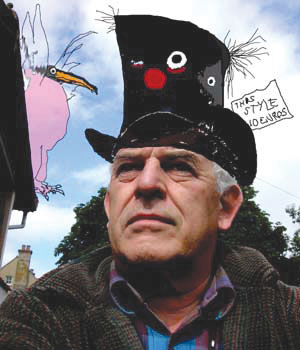
RalphSteadman“Hunter used to call Blair a ‘simpering little whore’, and I think we saw that yesterday” says Ralph Steadman, speaking the day after Tony Blair’s speech at the Labour Party Conference, and quoting his long time collaborator Hunter S. Thompson “Blair has dragged the socialist party of Britain to somewhere I never imagined it would be, and I don’t think the party did either.”

Perhaps the same could be said for Steadman himself, dragged out of his ordinary surroundings by his unstoppable talent. His career has taken him places that he could barely even of conceived of as a schoolboy growing up in North Wales. Born in 1936, Steadman’s artwork took him from the confines of the London College of Printing and Graphic Arts to working for the foremost satirical and cultural publications of the era, including Punch, Private Eye and Rolling Stone.

Described by Will Self as “Britain’s foremost post-war satirist” Steadman has forged a niche for himself with his instantly recognisable artwork that unflinchingly mocks and undermines the major political players of the day. However, as Self explains, he has not always achieved the intended offence; “Ralph eventually had to give up drawing politician’s faces after he discovered that no matter how disgusting, corrupt and venal he made them look, they’d still ring him up trying to buy the original prints.”

Self continues to work with Steadman on his regular Psychogeography column for The Independent, and speaks fondly about having Steadman as an illustrator. “After he gave up drawing their faces, he would just draw their legs. I used to get reams and reams of faxed politicians legs sent to whichever hotel I was staying at while I was writing the accompanying articles, which would utterly bewilder the hotel staff who received the faxes. I ended up just screaming at them ‘Have you got the legs??” Self states unequivocally that “Receiving a brand new Ralph Steadman print every week has been one of the greatest honours of my life.”

Steadman is currently in town to promote his latest work, a memoir of his late friend Hunter Thompson, entitled “The Joke’s Over”. Specifically the book focuses on the time the two spent working together covering such events as the Kentucky Derby, the Americas Cup and the Honolulu Marathon. Thompson wanted him to capture in his drawing ‘absolute evil’, the face of the decadent America that Thompson was pursuing. Steadman says he failed, and was only able to draw certain shades, certain types of evil.

He describes writing this memoir as a cathartic experience, which helped him to deal with the loss of a companion of was not only a great friend but also a constant inspiration. “I think we sparked off each other”, he says. Steadman now possesses a number of items of Thompson memorabilia, such as a distinctive hat, pair of aviator glasses and a cigarette holder. During the promotion of the work, he has begun donning these items to recreate the character of his lost friend, something he says he only feels comfortable doing now that he is dead. “When I used to go to Hunter’s house in Colorado, there were lots of people trying to be Hunter when they were with him. I could never do that.”

Steadman was always an outsider, and cursed with a naivety which at some times it seems Thompson took advantage of. He shows me a fax from Thompson, which begins with pleasantries but is soon down to brass tacks; “What I really need is $50,000 dollars. Keep your advice and send money.” Thompson was notoriously unwilling to share the credit he received for his work. Indeed, Steadman says that Thompson always regretted one of their deals when they did end up splitting the royalties. “For “The Curse of Lono” we agreed to split it 50-50, but afterwards he was never happy. He would say to me ‘Ralph, couldn’t we change that deal? Make it 51-49 in my favour?’ but I always said No.”

However, despite their differences of opinion, and of character, Steadman played an integral role in the forging of Gonzo journalism, Thompson’s great literary legacy, and Steadman delights in explaining the phenomenon. “What is Gonzo? Well, there are two concrete events in his life which I would point to and say “That’s pure Gonzo” The first would be, quite late in his life, when he had had a hip replacement and surgery to his spine, and he insisted on smoking inside the oxygen tent. The second would be his habit of turning off his lights and driving very fast down the wrong side of the road. We could see the other cars coming, but they couldn’t see us. We’d go past like ghosts, and they wouldn’t be sure whether they’d seen anything or not. The police had no idea. There was nothing to report. How could they know that some maniac was speeding down the wrong side of the road in pitch darkness?”

Thompson revelled in danger, and claimed that he wanted to drive fast enough that the “thrill of speed exceeded the fear of death”. Bearing this in mind, I wonder whether Steadman was surprised by Thompson’s suicide? “I say in my book ‘I have always known that at last I would take this road, but yesterday I did not know that it would be today.’ I always knew that he’d do it someday, but I wasn’t ready for it when he did. I understand his reasons for it. He was sick. He hated not being able to do what he loved, he hated not being able to do what he’d always done, and he hated the idea of going to an old people’s home. He used to say, “Ralph, the thing I worry about is being in an old people’s home, being strapped into a chair and some woman coming along and playing with my balls – and not being able to do anything about it.” Arthritis and illness had crept up on Thompson in later life, a man who had always been larger than life. Steadman mimics Thompson’s peculiar ambling gait, so ably reproduced by Johnny Depp in Fear and Loathing in Las Vegas. “Well he had one leg shorter than the other due to an American Football injury, so he always ended up with one foot just off the floor” Steadman explains “He would walk into a room and everyone would look at him. They had to; he was right in their faces.” He talks about Thompson fondly, but without deifying him, as so often happens after the death of a public figure. “He was a bastard” Steadman smiles, “but he was a lovable bastard.”

Speaking of bastards, Steadman is back to ranting about Blair. “He’s claims to have achieved everything he dreamt of coming to office – presumably that means bombing the shit out of Baghdad.” As I leave, Steadman is approached by a fan who asks him to doodle on the cover of the day’s Guardian. He willingly obliges, and sets about defacing the grinning image of Tony Blair with devil horns and other demented features. I suggest that he’s getting closer to absolute evil. He laughs, “I think you’re right”.

Originally published in the LSE’s The Beaver, 3 October 2006.

Wolfmother

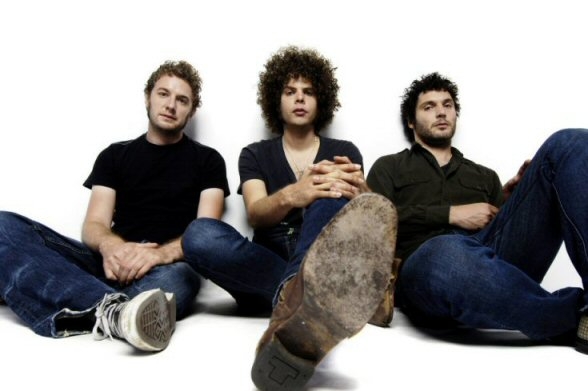
Wolfmother are a band in demand. My interview with them before their sold-out show at the London Scala tonight is delayed and then cut short as their late arrival means cramming my demented inquisition in alongside my better paid but clearly inferior peers at the NME and several representatives of the international press. Whilst bassist Chris Ross has seemingly baulked at the gruelling schedule of interviews, playing truant at today’s proceedings, the band should be no strangers to attention. They are already superstars in their native Australia, where their debut album has garnered massive success which has been reflected by critical praise. Influential Australian radio station JJJ awarded them their ‘album of the year’ award and the band also had an unprecedented six songs voted on to their annual top 100 list.

When drummer Myles Heskett and Andrew Stockdale, the band’s impressively afroed lead singer and guitarist, finally arrive they are both laid back and happy to chat away, although this could be to do with the fact that they both seem very very stoned. Indeed, some critics have attempted to pigeonhole their sound as ‘stoner’ rock, but they tell me that they’re ‘not that absorbed’. To my ears, they are ‘everything-but-the-average’ rock, drawing influences from countless genres. They say ‘We want to take elements of stoner and mix it in with elements of punk, or take the finger plucking from country and mix it with straight out rock. We take things from hip-hop or anywhere else. I wouldn’t want to designate one scene.’ Myles cites Kyuss, and his subsequent discovery of Pink Floyd as key influences, whilst Andrew seems to naturally draw influences from anywhere he can find them, saying that even at school he could socialise with any scene, and listened to anything and everything from Black Flag to the Blues Explosion. This openness to eclecticism has made for an album with some unusual highlights. ‘I don’t see why people freak out over panflute solos,’ says Andrew, ‘I think for our next album we’re gonna get an entire flute orchestra together.’ Their debut LP was recorded in Los Angeles with Dave Sardy, a big name producer who’s worked with the likes of Oasis, The Dandy Warhols and Marilyn Manson. Andrew tells me that their openness to his ideas helped the band to progress, and to move on from the level they had already achieved after the years of jamming and rehearsing which had led up to the EP they self-released and which brought them so much attention. They are coming towards the end of this tour, and feel triumphant that their work has brought fresh recognition.

It’s been a far cry from the nightmare gig that followed their last visit to London. As Myles recounts the tale, Andrew seems physically pained, wincing “I feel like we shouldn’t even talk about it, I don’t wanna go there” Apparently a hectic departure from London, en route to New York, involved a very stoned Andrew and Wolfmother’s tour manager breaking into his old flat in order to retrieve his passport, then flying half way around the world to a photo shoot which involved sitting in the snow for several hours. By the time they played their New York showcase Andrew had lost his voice and Myles was suffering with flu and finding that his rented drumkit disintegrated mid-show. As their PR shuffles them off to sound check, I hope that the Scala will be kinder to them. By the time I next see them, striding onto the Stage to an exultant roar, they are changed men. Gone is the laid back, not a care in the world attitude, and in its place is classic showmanship. The show is pure foot-to-the-floor rock. Part Zeppelin riffs, part Sabbath howl and part Floyd psychedelia, they unite a diverse audience of hairy head-banging AC/DC fans, huge sweaty skinheads apparently on loan from Millwall riots and skinny girls with blonde pigtails, awakening an initially lethargic Tuesday night crowd. They roar through a crowd pleasing set, with Apple Tree, Another Dimension and Mind’s Eye particular standouts. Be sure to catch them at the Koko for their final British date next month, because as they exit stage right, world domination surely awaits.

Originally published in the LSE’s The Beaver, 14 March 2006.

The Naked Poet

‘If Tony Blair was in front of me, I’d fucking lamp him.’ Benjamin Zephaniah is back, and he’s angrier than ever. His new album ‘Naked’ is his first since ‘Belly of De Beast’ a decade ago, and he begins our interview by explaining that he never gets himself tied into a record or book deal, so you know that if he’s got material out then it’s because there’s something he needs to say, not because he’s fulfilling a contract. However, he tells me that there could be another record not too far away, simply because there’s so much going on in the world that he feels the need to speak out about. He may be best known as a poet, but his albums allow him to combine music with the performance poetry that comes naturally to someone who favours the oral tradition over dull textbooks. ‘Naked’ sees him at his very best, ‘undressed’ and ‘looking at the truth’.

Despite his righteous anger, I get the feeling that Benjamin Zephaniah is something of a reluctant radical. He’s as laid back and easy going as they come, and happily tells me that he’d much rather be ‘writing comedy and having lots of sex’. Unfortunately for the Tony Blairs of this world though, he’s the sort of person who couldn’t live with himself being apathetic.

On the title track of his new album he says ‘I hate dis government as much as I hated the one before it and I have reason to believe that I will hate the one to come’. It’s a powerfully delivered statement, but I ask him if he ever feels depressed about the lack of difference his message, and those of people like him, has made. ‘Yes, in a word. One of the most frustrating things is that there are no alternatives.’ He tells me about his experiences in South Africa after the fall of Apartheid, where he experienced the rare phenomenon of people actually being excited to vote for someone, rather than voting for the lesser of two evils. The end of Apartheid in South Africa was an issue that was close to Zephaniah’s heart. In the early 80s he recorded a protest song for Nelson Mandela with the Wailers, becoming the first artist to record with them after Bob Marley’s death. He tells me that the issue of South Africa brought them together, and the song was heard by Mandela, who asked to meet him when he was released from Robben Island. Zephaniah cannot help but remark at the way Mandela’s image has transformed in the West ‘You have to remember that at the time, the ANC were Al Qaeda, and Nelson Mandela was Osama Bin Laden, except that he’d been caught!’

Africa remains a central theme in Zephaniah’s writing. On ‘Rong Radio Station’ he says ‘I waz trying to convince myself that I could ease my conscience, If I gave a few pence or a few cents to a starving baby in Africa, Because African babies need me so, Because African babies needed my favours, Because Africa is full of dictators, and oh yeah, Globalisation will bring salvation. I’ve been listening to the rong radio station’ I tell him that while I agree that giving money to charity may not be the long term way to solve inequality, it must have an important role to play for the people suffering right now. Anyone who received the Kenyan Society’s recent urgent email regarding the drought that has hit the Horn of Africa will know that it has been estimated that eleven million people there will require food aid, but is the urge to give them our loose coins any more than middle class guilt? Zephaniah thinks that charitable giving is short changing African nations ‘If you have a stab wound, you don’t try and cover it up with a plaster do you? I’m not saying that people who give to charity are bad people, I’m saying that they should get political. Too often people give to charity and think that that counts as being political, because they’re scared of being revolutionary or radical.’ He compares the difference to that of not being a racist, and of being actively anti-racist. ‘If you’re walking down the street and you see a guy getting beaten up by a racist, do you walk on and say ‘That’s bad, I wouldn’t do that’ or do you actually get involved and do something to stop it? It may not be directly confronting the racist, but just anything to actively stop it happening. The same applies to charities. There’s more to stopping inequality than putting money in a tin.’

Issues of inequality are never far from Zephaniah’s mind, which is hardly surprising given his personal journey from spending time detained at Her Majesty’s Expense to being invited to the palace to meet HRH in person and collect his OBE, an ‘honour’ which he famously declined. He wrote at the time ‘Me? I thought, OBE me? Up yours, I thought. No way Mr Blair, no way Mrs Queen’ He rejected it on several grounds, not least the fact that an Order of the British Empire would be an unwieldy honour for someone who is ‘profoundly anti-empire’. Today he stands by his decision, describing those who accept one as ‘getting into bed with government and monarchy’ He says ‘I mean, I got a letter from Tony Blair inviting me to Downing Street. If Tony Blair was in front of me, I’d fucking lamp him. I’m a vegan, and when I was offered the OBE it was like someone who knew that offering me a steak, I’d fucking hit them, y’kno?’

He tells me that the years he spent in prison were formative for him. He says ‘Prison gave me time to think. Screws always have this thing where they’ll be like, ‘I’ll give you a year, you’ll be back’ When they said that to me, I said, ‘I’m not saying I won’t be back, but if I am it’ll be political.’ I realised that stealing off of the working class guy wasn’t achieving anything, but political activism could.’

Honours that he has been happy to receive are the honorary doctorates that have been bestowed on him by various Universities scattered across Britain. He counts ten proudly displayed on his wall, and tells me that for someone who left school at thirteen, being told your work is influential is an especially great honour, and one with some unexpected privileges. ‘After the first one I went to give a talk to some school kids and they introduced me as Dr Benjamin Zephaniah. I said, ‘Oh No, You don’t have to do that’ but the kids seemed impressed. I told them that I had had it put on my drivers licence so that every time I get stopped, the policeman has to call me ‘doctor.’

Freedom of speech has always been a key issue in Zephaniah’s writing, but he says that he thinks the recent uproar over cartoons published in a Danish paper highlights the ‘responsibility that comes with the right’ to free speech. Furthermore he tells me that he believes portraying the prophet as a suicide bomber perpetuated the negative stereotype that all suicide bombers are Muslim. He tells me that when he was in Palestine there was a suicide bomber who was a Christian, but ‘the media reported that he was a ‘Palestinian suicide bomber’, and never mentioned the fact that he was a Christian. It just fits in with this blinkered view that all suicide bombers must be Islamic.’

Musically speaking, ‘Naked’ is Zephaniah’s most diverse album. Every track stands out as an experiment in a different genre. He switches effortlessly from drum’n’bass to hip-hop and from garage to reggae dub. He tells me that whilst previous albums have been mostly reggae orientated, like ‘Belly of De Beast’ which was produced by the legendary Mad Professor, the new album ‘experiments with any genre of music that will enhance the words’. This openness to experiment has seen the involvement of a couple of talented collaborators. Preceding the release of the album is a remix EP by Rodney P, a friend of Zephaniah’s who ‘demanded’ that he got involved after he first played him the album. The album itself, unlike so many of the cheap and mundane CDs on the market, is physically a work of art. It is presented as a mini book of poetry, something Zephaniah says was intentional to ensure that the poems could stand alone from the music, and features the artwork of genius graffiti artist Banksy, whose work has become notorious worldwide and is ‘displayed’ everywhere from Palestine to LA and in several places close to the LSE campus. Zephaniah praises the alternative viewpoint that Banksy’s art provides. ‘He’s subversive and gives you another way of looking at the issues, which complements my poems.’

You sense that whilst he is very much a performance poet, he is at heart a wordsmith. I ask him how he sees himself. ‘I describe myself as a ‘Griot’. It’s a West African term which has no exact translation in English. Probably ‘Troubadour’ or ‘Bard’ would be closest. It’s someone who travels from village to village. Maybe they’ll tell a story in one village, sing in the next and perform a poem in another. Sometimes they aim just to entertain, but sometimes their aim is to get people off their asses and ready to storm the government.’ At a time like this, we need Griots like Benjamin Zephaniah more than ever.

Originally published in the LSE’s The Beaver, 7 March 2006.

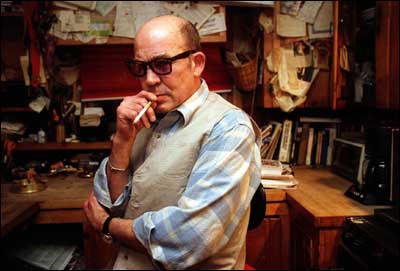
Hunter S Thompson (July 18, 1937 – February 20, 2005)

A lot can change in a year. Twelve months ago Pope John Paul II was still happily popeing around, part-time horse impersonator and full-time home wrecker Camilla Parker Bowles was preparing herself to marry into our glorious monarchy and I was living in a hut in the vast, desert-like stretch of land that surrounds the remote Indian town of Lucknow. The only means I had of keeping tabs on Prince Charlie’s equestrian pursuits or surveying the spread-betting on the date and time of JP’s demise was scalpeled from The Hindustan Times, a decent and upstanding publication with many fine English-language articles and an unintentionally hilarious section in which desperate parents seek spouses for their children. However, this is certainly not the time or place or page in which to discuss the merits or otherwise of arranged marriages, as it was on this date, exactly a year ago, that The Hindustan Times was to bring me news of the death of Dr. Hunter S. Thompson. He had, the Times informed me, put a gun into his own mouth and ended a life that had brought him literary notoriety as well as a reputation for personal excess, no holds barred journalism and fire-and-brimstone prose.

The front page of the paper carried the quotation “The best fiction is far more true than any kind of journalism” It was wrongly attributed to Thompson, the words in fact first being written by William Faulkner, but they were often cited by Thompson and influenced the genre of writing which he carved out alone. He called it ‘Gonzo’, a form of journalism where the writer not only brings their own experiences and opinions into the writing, but also becomes the protagonist. Hunter Thompson didn’t simply report the story, he was the story.

This is a man whose ashes, six months later, were loaded into huge flares and fired, along with enough fireworks to celebrate every Guy Fawke’s night for the rest of the decade, out of a cannon topping a 150-foot tower shaped like a fist with two thumbs and clutching a peyote button, an hallucinogenic cactus native to the south-west of the United States of America.

It’s an horrifically pathetic cliché to say something along the lines of “if you looked up crazy in the dictionary, his picture would be there” but his picture and biography actually appeared in text books about manic compulsives. He was a maverick, a dangerous lunatic and in my opinion at least, the best thing to happen to the written word since cavemen first took up pointy sticks and carved crude approximations of their grunts into the earth.

He first rose to infamy in 1966 when he established himself as a journalist who was not constrained by ordinary boundaries by riding with the Hell’s Angels in San Francisco, imbibing gallons of alcohol, guzzling prescription drugs and LSD and eventually getting his face pounded into the asphalt. Then writing a book about it. Whilst shocking and controversial at the time it was published, in contrast with his later work it is in fact remarkably conventional journalism.

The success of Hell’s Angels secured him work with a number of American magazines where he began to hone his trademark style. The most high profile of these was Rolling Stone, who serialised his most famous work, Fear and Loathing in Las Vegas in 1971. Starting life when Sports Illustrated gave him the chance to travel to Las Vegas to cover the Mint 400 motorcycle race, Thompson hit the road with Chicano lawyer Oscar Zeta Acosta and a veritable pharmacy of illegal narcotics alongside him in a huge red convertible. The “mean gibberish” he sent back transformed from race coverage into a “Savage Journey to the Heart of the American Dream” and was predictably refused out of hand by Sports Illustrated. Rolling Stone proved to be more accommodating and the book went on to critical and commercial success.

‘Fear and Loathing’, like all Thompson’s ‘Gonzo’ work, blurs the lines between fiction and journalism, but as Thompson himself said “only a goddam lunatic would write a thing like this and claim it was true.” As such, identities are always thinly but necessarily masked. Thompson becomes Raoul Duke, an alter ego he used on several occasions, often in the third person, and Acosta is referred to as Doctor Gonzo, or simply “my attorney”, and transformed from a Mexican into a 300-pound Samoan.

The book itself starts at a ferocious pace which never slackens. Like a drunk on a powerful motorbike, Thompson twists the throttle without let up, and as his passengers all we can do is cling on for dear life and hope that this unstoppable force manages to keep tyres to tarmac. Ostensibly about Thompson’s attempt to cover the race, and later the district attorney’s drug conference, the themes the book explores capture the zeitgeist of an era. It deals with the death of the dream of a non-violent revolution, which the sixties had seemed to promise, and sees the American Dream itself being killed off by war in Vietnam and the election of the crooked Richard Nixon. However, the book is much more than a period piece, it is a book about the human condition, in particular our desire to anesthetise ourselves as insulation from ugly realities.

By second half of the book the narrative has broken free from its shackles and has set about destroying itself, like a scorpion doused in alcohol, insane and stinging itself to death. Part two’s ninth chapter opens with an editor’s note informing the reader that the author is no longer in a fit state to lash the prose together, and there follows simply a transcript of Thompson’s recorded conversations. The narrative re-appears in time to close the book, emerging blinking into the cold light of day in fittingly hung-over, but unrepentant, style. Alongside the vivid imagery of the prose, Ralph Steadman’s hectic illustrations, which originally accompanied the articles, have become inseparable from the novel.

He followed what he called “my Vegas book” with Fear and Loathing on the Campaign Trail in 1972. Unlike most of the jaded hacks covering the race for the presidency, Thompson actually had experience of running for office. Two years earlier he had been a candidate for Sheriff of Pitkin County, Aspen in Colorado. He ran under his own “Freak Power” banner and proposed renaming Aspen “Fat City”, a ploy designed to discourage the developers who sought to turn the town into a money-spinning ski resort, and also, somewhat predictably, proposed the decriminalization of the possession and sale of recreational drugs. In order to subvert his image as a hippy he promptly shaved his head and during public debates referred to the crew-cut-sporting Republican candidate as “my long haired opponent”. He lost the election, but only by a handful of votes.

Even in his later years he continued to publish and stood out amongst the pantheon of global social commentators. On 12 September 2001 he memorably wrote ‘The towers are gone now, reduced to bloody rubble, along with all hopes for Peace in Our Time, in the United States or any other country.’

A common criticism of his work as a serious body of literature has been his own, and by extension his protagonists’, vast narcotics consumption and many critics have used this as an excuse to dismiss the uncomfortable truths that Thompson frequently voiced. However, unlike comparable authors, notably William Burroughs, Thompson never baffles the reader or slips too far into his drug induced stupor that he becomes incoherent. While drugs undoubtedly inform the text, it is his intellect which drives it.

The biggest criticism of Thompson, however, and it is a major one, is that by his success and his genius in writing about truth and what it means to be alive, he has inspired hundreds of fucked up morons with drug habits to think that they can write, and it is for that reason that papers like The Beaver have to endure contributions like this one.

On that note it only remains for me to drain this bottle of Wild Turkey and cram these pages into the mojo wire. Only his own words can come close to being big enough to serve as an epitaph. “Too weird to live, too rare to die.”

Res Ipsa Loquitur. Mahalo.

Originally published in the LSE’s The Beaver, 21 February 2006.