All posts by Kevin EG Perry

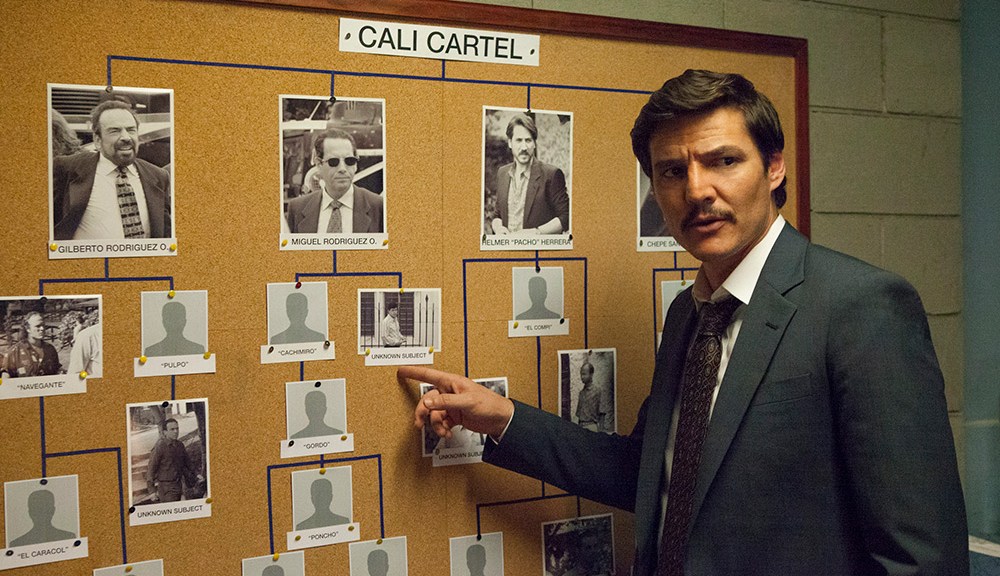
Pedro Pascal on Narcos beyond Escobar

2017_Narcos_Netflix_210717Narcos is the hit Netflix series that since 2015 has been telling the story of the rise (Season One) and fall (Season Two) of Colombian cocaine kingpin and hippo enthusiast Pablo Escobar. Anyone who knows their druglords will have realised that tale could only have one ending. Sure enough, Season Two ended with (historical spoiler alert) Escobar shot through the head on a Medellin rooftop.

But the story of the cocaine trade obviously didn’t end there. If it had, how would Be Here Now have gotten made? In fact, the Cali cartel rose to take over Escobar’s business, and that means the mission isn’t over for DEA agent Javier Pena. Pedro Pascal, who plays Pena, argues that the change of focus means the series is just getting interesting.

“When people say there can’t be a Narcos without Escobar I’m like: ‘Are you kidding? What world do you live in?’,” he says. “The show isn’t called Escobar. Cocaine sales go up after he’s dead. That alone tells you what we’re up against in Season Three. It’s an empire that’s now seemingly impossible to take down because it isn’t one target in the way that Escobar was. You won’t know what to expect. Even if you Google the shit out of it, you still won’t be able to predict exactly how it goes down.”

Continue reading at NME.

Burning Man 2017: Dancing in the dark in Trump’s America

Burning Man 2017 Preparations

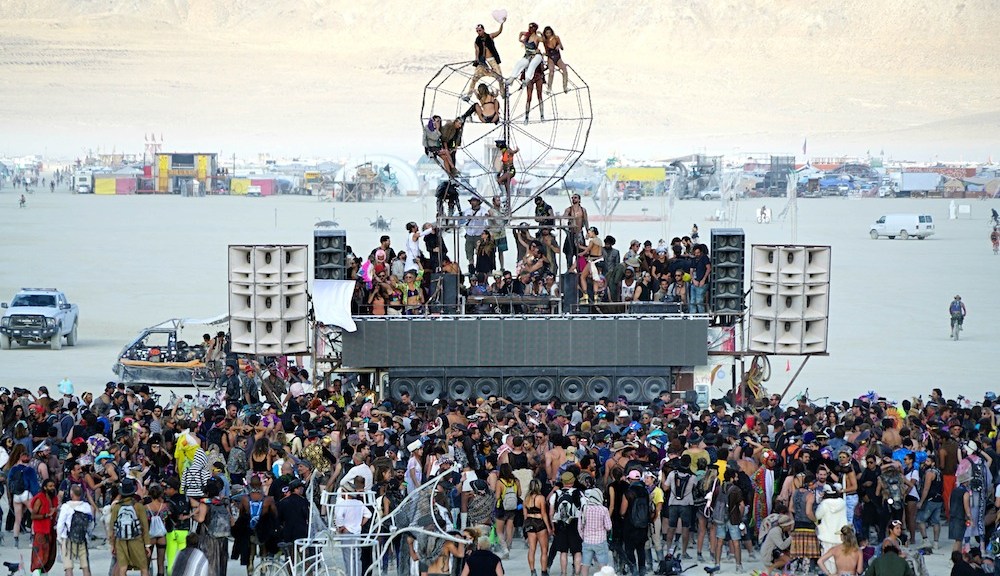
On the Wednesday before Burning Man 2017, President Donald Trump surfed into Reno, Nevada on a wave of outrage following a speech in Phoenix the previous night where he’d sided with white supremacists and claimed that protesters who sought to pull down Confederate statues were “trying to take away our culture.”

The casinos and motels of Reno were already filling with those of us on our way to the desert for the most logistically challenging of world festivals, stocking up on bicycle locks, water bottles and leopard-print thongs, so the standing joke as Trump arrived in town was that the President must also be on his way to Black Rock City. “He’d probably turn up in the desert still wearing his suit,” smirked a taxi driver in midtown, before changing his tune. “He would definitely go though. He’s not afraid of anything. You’ve got to give him some credit for that.”

Continue reading at NME.

Great Escape: Baja California

lonely-planet-october-2017

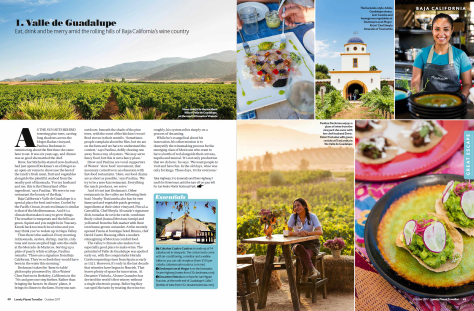
baja-1-valle-de-gaudelupe1. Valle de Guadalupe
Eat, drink and be merry amid the rolling hills of Baja California’s wine country

As the sun sets behind towering pine trees, casting long shadows across the Mogor-Badan vineyard, Paulina Deckman is reminiscing about the first time she came here to eat. It was six years ago, and dinner was so good she married the chef.

Drew, her Michelin-starred now-husband, had just opened Deckman’s en el Mogor as an open-air venue to showcase the best of the ranch’s fresh meat, fruit and vegetables alongside the plentiful seafood from the nearby port of Ensenada. ‘For my husband and me, this is the Disneyland of the ingredient,’ says Paulina. ‘We serve in our restaurant the bounty of the Baja.’

Baja California’s Valle de Guadalupe is a special place for food and wine. Cooled by the Pacific Ocean, its microclimate is similar to that of the Mediterranean. And it’s a climate that makes it easy to grow things. The weather is temperate and the hills are green. Squint and you might be in Tuscany. Knock back too much local wine and you may think you’ve woken up in Napa Valley.

Then there’s the seafood. Every morning in Ensenada, oysters, shrimp, marlin, crab, tuna and more are piled high onto the stalls at the Mercado de Mariscos. Serving up a plate of pearly white scallops, Paulina remarks: ‘These are a signature from Baja California. They’re so fresh they would have been in the water this morning.’

Deckman’s takes the ‘farm-to-table’ philosophy pioneered by Alice Waters’ Chez Panisse in Berkeley, California in the ’70s and goes one step further. Rather than bringing the farm to its diners’ plates, it brings its diners to the farm. Everyone eats outdoors, beneath the shade of the pine trees, with the scent of the kitchen’s woodfired stoves in their nostrils. ‘Sometimes people complain about the flies, but we are on the farm and we have to understand the context,’ says Paulina, deftly shooing one away from a tray of oysters. ‘We may serve fancy food, but this is not a fancy place.’

Drew and Paulina are vocal supporters of Waters’ ‘slow food’ movement, that necessary corrective to an obsession with fast-food restaurants. ‘Here, our food chains are as short as possible,’ says Paulina. ‘We try to be a zero-km restaurant. Everything the ranch produces, we serve.’

And it’s not just Deckman’s. Other restaurants in the valley are following their lead. Nearby TrasLomita also has its own farmyard and vegetable patch growing ingredients at their sister vineyard, Finca La Carrodilla. Chef Sheyla Alvarado’s signature dish, tostadas de ceviche verde, combines finely cubed jícama (Mexican turnip) and yellowtail from the fish market with their own home-grown coriander. At the recently opened Fauna at boutique hotel Bruma, chef David Castro Hussong offers a modern reimagining of Mexican comfort food.

The valley’s climate also makes it an especially good place to make wine. The potential of Valle de Guadalupe was spotted early on, with the conquistador Hernán Cortés requesting vines from Spain as early as 1521. However, it’s only in the last decade that wineries have begun to flourish. That leaves plenty of space for innovation. At Decantos Vínícola, Alonso Granados has devised the world’s first winery without a single electronic pump. Believing they can spoil the taste by treating the wine too roughly, his system relies simply on a process of decanting.

While he’s evangelical about his innovation, his other mission is to demystify the winemaking process for the emerging class of Mexicans who want to have a bottle of red alongside their cerveza, tequila and mezcal. ‘It’s not only production that we do here,’ he says. ‘We want people to visit and have fun. In the old days, wine was only for kings. These days, it’s for everyone.’

Take Highway 3 to Ensenada and then Highway 1 south for three hours until the turn off on your left for San Pedro Mártir National Park
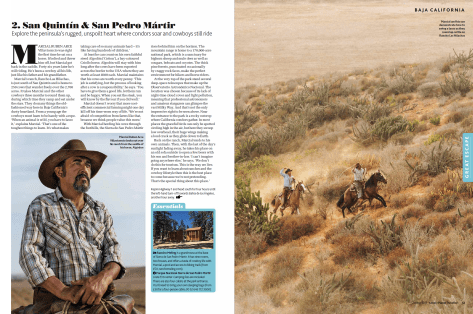
baja-2-san-quintin2. San Quintín & San Pedro Mártir
Explore the peninsula’s rugged, unspoilt heart where condors soar and cowboys still ride

Marcial Ruben Arce Villavicencio was eight the first time he sat on a horse. It bolted and threw him off, but Marcial got back in the saddle. Forty-six years later he’s still riding. He’s been a cowboy all his life, just like his father and his grandfather.

Marcial’s ranch, Rancho Las Hilachas, is just south of San Quintín and is home to 250 cows that wander freely over the 2,700 acres. It takes Marcial and the other cowboys three months to round them up, during which time they camp and eat under the stars. They do many things the old-fashioned way here in Baja California’s dusty heartland. From a young age the cowboys must learn to be handy with a rope. ‘When an animal is wild, you have to lasso it,’ explains Marcial. ‘That’s one of the toughest things to learn. It’s what makes taking care of so many animals hard – it’s like having hundreds of children.’

At least he can count on his own faithful steed Algodón (‘Cotton’), a bay-coloured Criollo horse. Algodón will stay with him long after the cows have been exported across the border to the USA where they are worth at least £600 each. Marcial maintains that his cows are worth every penny. ‘This job is satisfying, but the process of looking after a cow is a responsibility,’ he says. ‘You have to give them a good life, let them run and be happy. When you eat the steak, you will know by the flavour if you did well.’

Marcial doesn’t worry that more costefficient commercial farming might one day kill off his time-worn way of life. ‘We’re not afraid of competition from farms like that, because we think people value this more.’

With Marcial herding his cows through the foothills, the Sierra de San Pedro Mártir rises behind him on the horizon. The mountain range is home to a 170,000-acre national park, which is a sanctuary for bighorn sheep and mule deer as well as cougars, bobcats and coyotes. The thick pine forests, punctuated occasionally by craggy rock faces, make the perfect environment for hikers and horse riders.

At the very top of the park stand several deep-space telescopes that make up the Observatorio Astronómico Nacional. The location was chosen because of its lack of night-time cloud cover and light pollution, meaning that professional astronomers and amateur stargazers can glimpse the vast Milky Way. And that’s not the only impressive sight to be seen above. Near the entrance to the park is a rocky outcrop where California condors gather. In most places the graceful birds can only be spotted circling high in the air, but here they swoop low overhead, their huge wings making a loud crack as they glide down to Earth.

Back on the ranch, Marcial tends to his own animals. Then, with the last of the day’s sunlight fading away, he takes his place on an old sofa outside to open a few beers with his son and brother-in-law. ‘I can’t imagine going anywhere else,’ he says. ‘We don’t do this for tourism. This is the way we live. If you want to learn about ranches and the cowboy lifestyle then this is the best place to come because we’re not pretending. That’s the special thing about this place.’

Rejoin Highway 1 and head south for four hours until the left-hand turn-off towards Bahía de los Ángeles, another hour away.
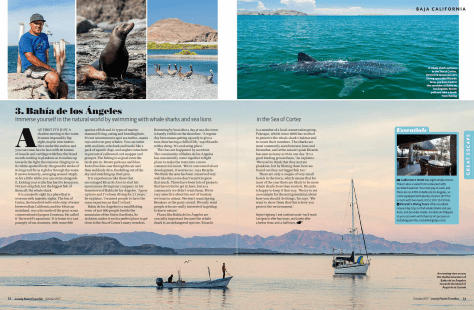
baja-3-bahia3. Bahía de los Ángeles
Immerse yourself in the natural world by swimming with whale sharks and sea lions

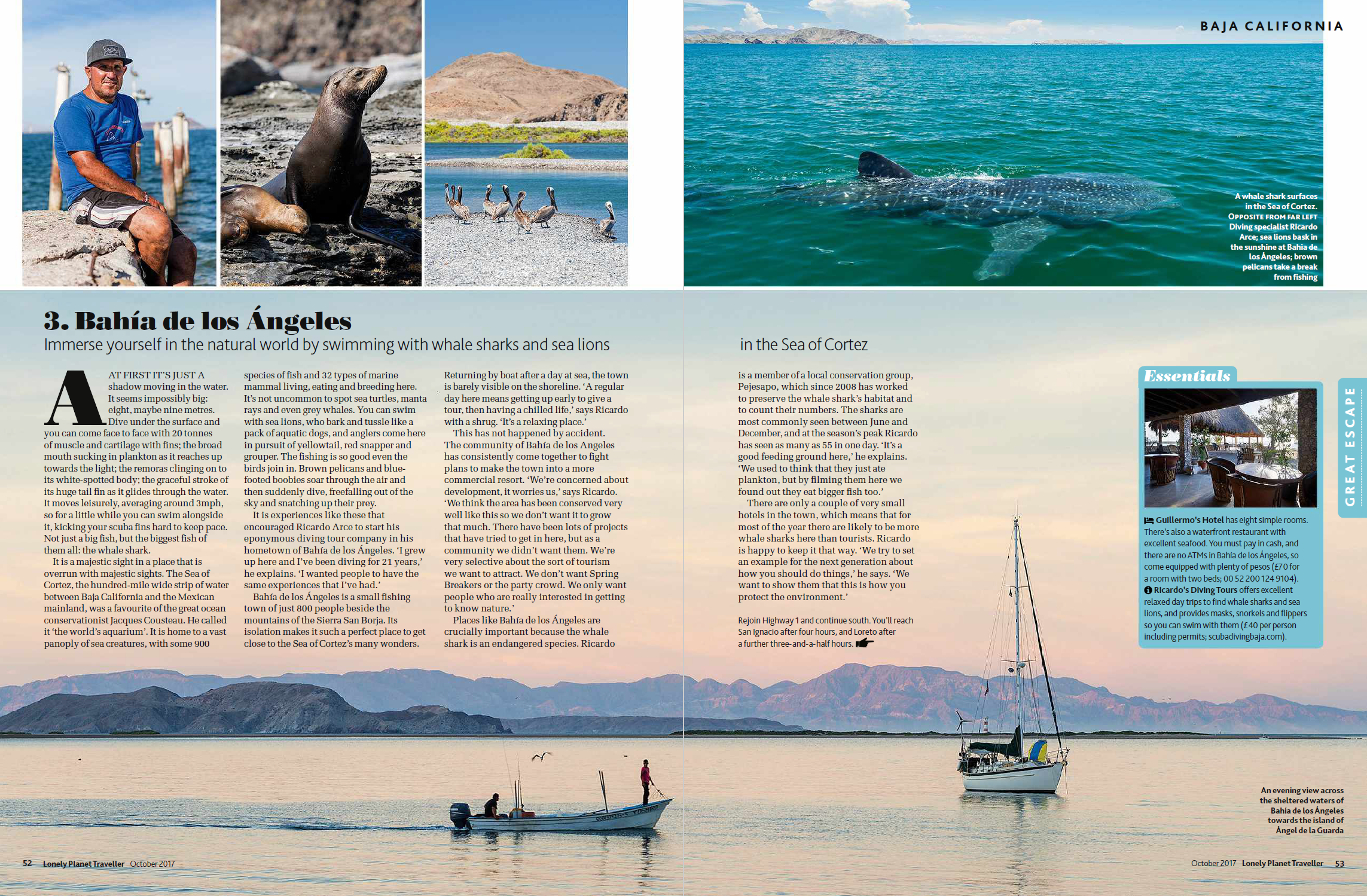
At first it’s just a shadow moving in the water. It seems impossibly big: eight, maybe nine metres. Dive under the surface and you can come face to face with 20 tonnes of muscle and cartilage with fins; the broad mouth sucking in plankton as it reaches up towards the light; the remoras clinging on to its white-spotted body; the graceful stroke of its huge tail fin as it glides through the water. It moves leisurely, averaging around 3mph, so for a little while you can swim alongside it, kicking your scuba fins hard to keep pace. Not just a big fish, but the biggest fish of them all: the whale shark.

It is a majestic sight in a place that is overrun with majestic sights. The Sea of Cortez, the hundred-mile wide strip of water between Baja California and the Mexican mainland, was a favourite of the great ocean conservationist Jacques Cousteau. He called it ‘the world’s aquarium’. It is home to a vast panoply of sea creatures, with some 900 species of fish and 32 types of marine mammal living, eating and breeding here. It’s not uncommon to spot sea turtles, manta rays and even grey whales. You can swim with sea lions, who bark and tussle like a pack of aquatic dogs, and anglers come here in pursuit of yellowtail, red snapper and grouper. The fishing is so good even the birds join in. Brown pelicans and bluefooted boobies soar through the air and then suddenly dive, freefalling out of the sky and snatching up their prey.

It is experiences like these that encouraged Ricardo Arce to start his eponymous diving tour company in his hometown of Bahía de los Ángeles. ‘I grew up here and I’ve been diving for 21 years,’ he explains. ‘I wanted people to have the same experiences that I’ve had.’

Bahía de los Ángeles is a small fishing town of just 800 people beside the mountains of the Sierra San Borja. Its isolation makes it such a perfect place to get close to the Sea of Cortez’s many wonders. Returning by boat after a day at sea, the town is barely visible on the shoreline. ‘A regular day here means getting up early to give a tour, then having a chilled life,’ says Ricardo with a shrug. ‘It’s a relaxing place.’

This has not happened by accident. The community of Bahía de los Angeles has consistently come together to fight plans to make the town into a more commercial resort. ‘We’re concerned about development, it worries us,’ says Ricardo. ‘We think the area has been conserved very well like this so we don’t want it to grow that much. There have been lots of projects that have tried to get in here, but as a community we didn’t want them. We’re very selective about the sort of tourism we want to attract. We don’t want Spring Breakers or the party crowd. We only want people who are really interested in getting to know nature.’

Places like Bahía de los Ángeles are crucially important because the whale shark is an endangered species. Ricardo is a member of a local conservation group, Pejesapo, which since 2008 has worked to preserve the whale shark’s habitat and to count their numbers. The sharks are most commonly seen between June and December, and at the season’s peak Ricardo has seen as many as 55 in one day. ‘It’s a good feeding ground here,’ he explains. ‘We used to think that they just ate plankton, but by filming them here we found out they eat bigger fish too.’

There are only a couple of very small hotels in the town, which means that for most of the year there are likely to be more whale sharks here than tourists. Ricardo is happy to keep it that way. ‘We try to set an example for the next generation about how you should do things,’ he says. ‘We want to show them that this is how you protect the environment.’

Rejoin Highway 1 and continue south. You’ll reach San Ignacio after four hours, and Loreto after a further three-and-a-half hours.
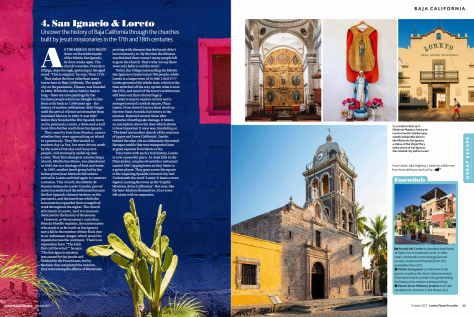
baja-4-san-ignacio4. San Ignacio & Loreto
Uncover the history of Baja California through the churches built by Jesuit missionaries in the 17th and 18th centuries

As the midday sun beats down on the white façade of the Misión San Ignacio, its door creaks open. The church’s warden, Francisco Zúñiga, steps through, gesturing to the aged wood. ‘This is original,’ he says, ‘from 1728.’

That makes the door older than many towns here in Baja California. The largest city on the peninsula, Tijuana, was founded in 1889. While the native history here is long – there are cave paintings by the Cochimí people which are thought to date from as far back as 7,500 years ago – the history of modern settlements didn’t begin until the arrival of Jesuit missionaries from mainland Mexico in 1683. It was 1697 before they founded the first Spanish town on the peninsula, Loreto, a three-and-a-half hour drive further south from San Ignacio.

They came by boat from Sinaloa, unsure whether they were approaching an island or a peninsula. They first landed at modern-day La Paz, but were driven north by the native Pericúes and Guaycura people, and eventually ended up near Loreto. Their first attempt at constructing a church, Misión San Bruno, was abandoned in 1685 due to a shortage of food and water.

In 1697, another Jesuit group led by the Italian priest Juan María de Salvatierra arrived in Loreto and tried again to construct a mission. This church, the Misión de Nuestra Señora de Loreto Conchó, proved more successful and the settlement became the first Spanish-claimed territory on the peninsula, and the base from which the missionaries expanded their evangelical work throughout the region. The church still stands in Loreto, next to a museum dedicated to the history of the Jesuits.

However, as the museum’s custodian Hernán Murillo explains, the missionaries who made it as far north as San Ignacio saw a fall in the number of their flock due to an unforeseen danger, which would be repeated across the continent. ‘There’s an expression here: “The bells that call the wind,”’ he says. ‘The San Ignacio mission was started by the Jesuits and finished by the Franciscans, but by the time they completed the mission, they were seeing the effects of Westerners arriving with diseases that the locals didn’t have immunity to. By the time the Mission was finished there weren’t many people left to go to the church. That’s why we say there were only bells to call the wind.’

Today, the village surrounding the Misión San Ignacio is home to just 700 people, while Loreto is a larger town of 15,000. Until 1777 Loreto governed the whole state, which at the time stretched all the way up into what is now the USA, and much of the town’s architecture still bears out that colonial legacy.

Loreto is easy to explore on foot and is arranged around a central square, Plaza Juárez. From there it’s just a short stroll up the tree-lined Avenida Salvatierra to the mission. Restored several times after centuries of earthquake damage, it retains an inscription above the door which attests to how important it once was, translating as: ‘The head and mother church of the missions of upper and lower California’. Inside, behind the altar, sits an elaborately decorated Baroque retablo that was transported here at great expense from Mexico City.

For a town with such a rich history, Loreto is now a peaceful place. As dusk falls in the Plaza Juárez, couples sit outside a restaurant named 1697 sipping beers as they listen to a guitar player. They gaze across the square to the imposing Spanish Colonial city hall. Underneath the word ‘Loreto’ it bears a stone legend, naming the town as the ‘Capital Histórica de las Californias’. But now, like the beer drinkers themselves, it is a town left alone with its memories.

From Loreto, take Highway 1 south for a little over four hours until you reach La Paz.

baja-5-la-paz5. La Paz
Swim, kayak or paddle board your way around white-sand beaches and rocky coastlines

The sun is dipping low in the sky over Balandra Beach, 17 miles north of La Paz, but the groups of friends and families who’ve come to while away a Sunday afternoon by the sea are determined to eke out every last moment of the day’s heat. As the tide comes in, two men lift their plastic picnic table up out of ankle-deep water and carry it to shore, a half-drunk bottle of rum still balanced on it precariously.

Further up the beach, a group of teenage acrobats from Tijuana are taking it in turns to throw each other, pirouetting high into the air, until inevitably – perhaps the result of too many cervezas – they miss their catch. The fallen gymnast just laughs it off, rolling over in the soft, white sand. American pop music pumps from an unseen stereo. Kayaks of green and orange return to the bay, easy to spot against the turquoise sea. As sunset approaches the sky becomes a miraculous shade of red. Even the clouds appear to have been dyed pink, like candyfloss. Families take it in turns to traipse to the far end of the bay to take the obligatory selfies in front of Balandra’s signature mushroom rock.

As they clamber back up the dusty brown slopes dotted with cardón cactuses to where they’ve left their cars, it is easy to see why people are drawn here from across Mexico, attracted by the white sand and the warm azure water. A cracked tile sign near some government-built sunshades declares that they were ‘Hecho con Solidaridad’ – ‘Made with solidarity.’ It’s a beach that welcomes all with open arms.

By contrast, out at sea lie some more exclusive beaches. Espíritu Santo, a 31-square-mile island in the Sea of Cortez ringed by mangroves and volcanic rock formations, was declared a Unesco Biosphere Reserve in 1995 and the number of visitors there are carefully limited. It is officially uninhabited, although at certain times of the year it is possible to stay overnight on the island at Camp Cecil, a series of safari tents set up with real beds and furniture on the long stretch of La Bonanza Beach. Live-in chefs Giovanni and Ivan serve up excellent Baja Med fare, and can organise everything from kayaking and snorkelling to bird watching and nature hikes.

Espíritu Santo is an hour by motorboat from La Paz, and it’s common to see schools of dolphins playing in the boat’s wake. For the more adventurous, it’s also possible to reach the island by kayak or stand up paddle board. The next day in La Paz, on the long stretch of beach in front of the city’s Malecón, paddle board instructor Sergio García of Harker Board Co. is giving enthusiastic lessons to the uninitiated. A former professional basketball player from Chihuahua, he moved to La Paz seven years ago, drawn like many others by the relaxed beach lifestyle.

‘I first visited La Paz when I was 16,’ he says, keeping a watchful eye on his students out in the bay. ‘I knew it was a beautiful place, so I always thought I’d like to come back and make my life here. It’s a small town growing up quickly. You have a good quality of life here, better than in the other states of Mexico. It’s a really peaceful place, tranquil and calm.’

García learned to paddle board when he moved here, and now the sport has taken over his life. ‘In my free time I paddle board as well!’ he says with a laugh. ‘La Paz is a perfect place for stand up paddle boarding because you have warm water all the time. Sometimes there is wind and sometimes you have waves, so it’s good for beginners and for experts. Here, let me show you…’

He tosses his board into the water and clambers in, then with long strokes paddles swiftly out into the bay. Like life itself in this place where the desert meets the sea, he makes it look easy.

Photographs by Justin Foulkes.

Published in Lonely Planet Traveller, October 2017.
Hey, Adam Granduciel: What’s Your Secret?

twod

The problem with talking to musicians about music is that you can end up talking about anything but. Interviews become about about rock star beefs or who they’re dating, when all you really want to know is: “Why do your songs make my heart swell up until it feels like it’s going to burst?” I mean, is there a secret chord or something?

Adam Granduciel, who records as The War On Drugs, has had at least one weird rock star beef (with noted asshole Mark Kozelek) and is dating a genuine celebrity (Krysten Ritter, latterly of Breaking Bad, currently of some iteration of the interminable Marvel universe) but if we’re going to find out he writes music to make the heart swell then we’re going to have to find out how his desire to become an painter led to him crisscrossing America, how he learned to live with his anxiety and, in the end, what he hears when he’s listening for that special moment. But before all that, the first thing you should know about him is that he’s the sort of guy who’s so obsessed with the way sound is recorded that he collects studio T-shirts.

Continue reading at Vice.

The Website You Need to Check Before You Take Ecstasy

pillreportsBrands run the world. By the time the average American child is three years old, they’ll be able to recognise 100 brand logos. Likewise, when the average British teenager starts double-dropping pingers on a weekend they’ll soon learn their Mitsubishis from their Teslas, their Skypes from their Spongebobs, their Anonymous masks from their puckering Donald Trumps.
Brands can be useful when they tell us something about a product’s origin and quality, and the same goes for drugs. While it’s true that ecstasy manufacturers frequently use similar or identical stamps to brand wildly different products, reviews of certain batches of the drug doing the rounds in a given place at a certain time can help to identify potentially dodgy pills. That can mean more than the difference between a great night and throwing up in the smoking area. Sometimes it can mean life or death.

That’s where PillReports.net comes in.

Continue reading at Vice.

Open’er 2017: Prophets of Rage reign in the rain as they make Polish debut

ProphetsOfRageProphets of Rage played their first ever show in Poland last night at Open’er 2017, with Chuck D telling the audience they want to: “Make Poland rage again.”
The supergroup, made up of Rage Against The Machine’s Tom Morello, Brad Wilk and Tim Commerford, Public Enemy’s Chuck D and DJ Lord, and Cypress Hill’s B-Real, didn’t allow the gathering rain clouds to dampen their righteous ire.

They opened with their version of Public Enemy’s ‘Prophets of Rage’, the track from 1988’s ‘It Takes a Nation of Millions to Hold Us Back’ from which they take their name. The rest of the set was dominated by Rage Against The Machine’s greatest hits, although they also found time to play a handful of Cypress Hill tracks and an instrumental version of Audioslave’s ‘Like A Stone’, dedicated to Chris Cornell.

Before playing the song, guitarist Tom Morello announced: “Not that long ago a good friend of ours and a musical comrade passed away. Please give an enormous ovation for Chris Cornell. We loved him very much too. We’d like to sing a song in his memory. If you know the words, sing along. If you don’t, say a prayer for peace.”

Morello’s guitar bore the legend ‘Arm The Homeless’ on the front, and ‘Fuck Trump’ on the reverse. Before playing final song ‘Killing In The Name’, B-Real thanked the crowd and said: “We came together to talk about and against injustice and fuckery. We hope we connected with you today to make a change in the world. Dangerous times call for dangerous songs. Here’s a dangerous fucking song.”

Continue reading at NME.

The Great Merlini

the-great-merlini

merlini-kegp

Early in his career, David Merlini learned that one of the benefits of being an escape artist is not having to worry when you’re stopped by the police. It was the mid-90s, and he had just bought his first car, a silver Maserati. Not bad for a 17-year-old in Budapest. There was just one minor problem: he didn’t have a driving licence. So he came up with a ruse. Whenever he got pulled over, he’d say that his license was in the boot. When they popped it open it would be full of chains and padlocks.

“What are you doing with all these?” they’d demand.

“I’m an escape artist.”

“Is that right? Could you escape from my handcuffs?”

They’d snap on their police-issue cuffs and moments later Merlini would hand the bracelets back to them. By this point, they’d have invariably forgotten all about needing to see his licence. As if by magic.

Yet there is no trickery in this story. They were real policeman with real handcuffs, and Merlini really wrestled free of them. Even Merlini’s name is real, and appears on the driving licence he’s rather belatedly acquired.

Teller, the shorter half of Penn & Teller, once told Esquire magazine that: “Sometimes magic is just someone spending more time on something than anyone else might reasonably expect.” Merlini knows that to be true. He has spent his whole life learning to escape.

Merlini was born in Budapest on 31 October 1978 to an Italian father and a Hungarian mother. They knew something was different about their son by the time he reached the age of four. He showed no interest in Matchbox cars, Lego or football. The only toys he wanted to play with were padlocks and handcuffs. His only passion was for magic. Not long after, his father moved the family to Turin in northern Italy. Coincidentally, the city is home to the biggest society of European magicians: The Circolo Amici della Magia di Torino. A chance meeting with one of its founders led to Merlini joining the club when he was just 13, after an examination period of six months. He was the youngest member ever admitted.

It was in their library of magic that Merlini made a discovery that changed his life. He began to read about the life of Harry Houdini, the greatest escape artist of all. Here was a man who had shared Merlini’s love for combining magic with padlocks and handcuffs. What’s more, both men had been born in Budapest – one district away from each other – but left Hungary as young children. Houdini had died at the age of 52 on 31 October 1926. Exactly 52 years later, Merlini had been born. “Then and there it was decided,” says Merlini. “I will stage again all of his illusions, all of his escapes, but with a modern key. I will modernise these amazing escapes that he performed.”

He didn’t waste any time. Merlini made his first public appearance at the age of 14, in the theatre tent of Budapest’s Sziget festival. Just two years later, he was upside down over the main stage at the same festival escaping from a straitjacket while suspended by his feet from a burning rope. It was a variation on a trick Houdini himself had performed outside newspaper offices to guarantee himself press coverage, and it had a similar effect for Merlini. “In 1995 in Hungary it was something that had never been seen before,” he remembers. “There was massive media attention, which fuelled my passion. I made a statement that every year I would present a new stunt, something amazing. The year after I was locked in a steel box and lowered into the Danube river.”

Quickly succeeding in his goal to recreate Houdini’s escapes, Merlini then raised the stakes even higher. “Escape artists all do the same gigs. They get chained, they escape,” he explains. “I always wanted to create something of my own.”

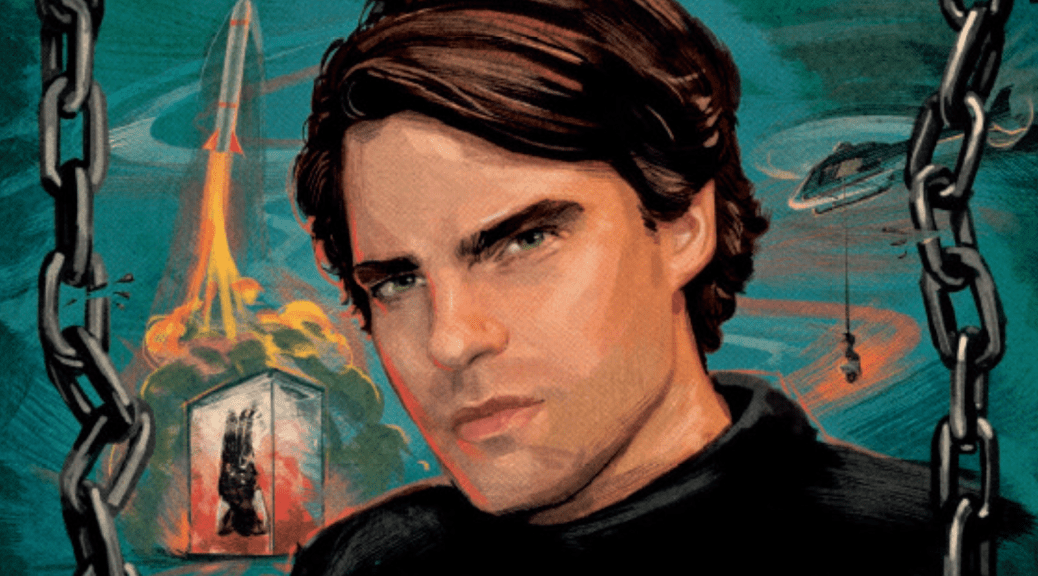
The first show he devised himself was performed in Budapest’s Hero’s Square in 2001. Merlini was strapped in a regulation straitjacket and then welded into a steel and reinforced glass container filled with water. The water was then frozen, and 33 hours later the one ton ice block was melted with chainsaws and flame-throwers. Merlini then staggered out and escaped from the straitjacket. After that, the stunts got bigger every year. One year he was embedded in a block of concrete and lowered into the Danube. The next he was launched inside the largest non-governmental non-military rocket every commissioned by an individual. “After I was launched in the rocket, I said: ‘What else can I do?’” he laughs.

His answer to that was to be named Best Escape Artist at the World Magic Awards in Los Angeles in 2007. He picked up the award after performing a variation on his ice block escape where he was instantly frozen with liquid nitrogen. Two years later, on the starting grid before a Formula 1 race in Bahrain, he broke the world record for the longest breath-hold underwater with a staggering time of 21 minutes and 29 seconds.

The trick with Merlini is that there is no trick. “A magician creates an illusion by, for example, using the dice to roll a certain number, and maybe the dice is prepped, and the trick is possible because of an apparatus,” he says. “On the other hand, the escape artist is the apparatus itself. The secret behind my escapes is how to hold your breath, how to open locks underwater, how to resist very uncomfortable and harsh conditions. It wouldn’t be right to say it’s trickery, because the trick is the man itself.”

Having performed all over the world, Merlini returned to Budapest to open The House of Houdini last year. An apartment in Buda Castle has been transformed into a shrine to Merlini’s hero. Handcuffs and lock-picks that once belonged to the great escape artist, as well as his old family bible inscribed with his birth name Erik Weisz, sit side by side with props from a recent Houdini television series starring Adrien Brody, for which Merlini taught him the basics of escapology. There are also regular magic shows, every half an hour, literally providing a stage for a new generation of young Hungarian illusionists.

Before it opened, there was nothing to mark Houdini in the city of his birth. Merlini couldn’t allow that to continue. “Houdini is still an icon,” he says. “The museum is here because I hope he will still be an icon in 100 years, because that’s what he deserves. He had the class and the straight-forward style all mixed in one. He was unique. We have amazing magicians again today who are very successful, but I doubt if in 100 years there will be many names still up for future generations.”

Merlini and Houdini capture the imagination because in escaping from the ties that bound them, they represent something essential in the human condition. The French philosopher Jean-Jacques Rousseau once wrote that: “Man is born free, but is everywhere in chains.” Houdini and those who’ve followed him show us that we can throw them off. “We all have our manacles and our chains,” says Merlini. “It’s just a question of how we can escape from them.”

Published by Brussels Airlines’ b inspired, July 2017.

Model villages

model-villages

1. Party on, dudes
Holzmarkt, Germany

When Berlin’s fabulous open-air venue Bar25 closed in 2010, it was with a five-day party and a great deal of sadness. The club had helped rejuvenate a barren patch of industrial wasteland by the river Spree and it seemed inevitable that the now-prime real estate would be sold to investors.

Except, the story didn’t end with the sprouting of luxury high-rises. Instead, the land was leased back to Bar25’s owners, who set about envisioning a collectivist utopia – the perfect society in microcosm – on the riverbank where East Germany once met West. It would be a place where anyone could contribute and feel well looked after in return, where the planet’s resources and wildlife would be preserved, and where the party wouldn’t have to stop.

It took Juval Dieziger and Christoph Klenzendorf eight years but finally, this spring, their dream became reality with the opening of Holzmarkt. At first glance it’s simply the site of a great riverside bar, Pampa, and a club, Kater Blau, with an onsite restaurant, Katerschmaus – all popular with locals. But look beyond the beers and music, and you’ll find a ramshackle urban village, built out of wood and recycled materials, and hiding a nursery, doctor’s surgery, children’s theatre and cake shop. If you have some form of expertise – from medical knowhow to circus skills – Holzmarkt is the place to barter with it.

“Holzmarkt wants to attract people from all over the world and delight, inspire and connect them,” say the founders. “Here, they will find peace and fun, work and entertainment… For us, sustainability and change are not a contradiction.” The 12,000sqm site has four entrances and no gates. It’s open to all, even animals, with specially designed riverbank portals for use by beavers, ducks and otters. “Jointly, citizens and the city have won,” the owners add. “Holzmarkt will be a sanctuary for humans and beavers alike.”

2. Embrace woolly ideas
Lammas, Wales

“It’s totally possible to live a first-world lifestyle without it costing the Earth,” says Tao Wimbush, one of the founders of the Lammas Ecovillage in Pembrokeshire. His statement’s true in both senses – since 2009, Wimbush’s comfortable existence has been as cheap as it is sustainable.

Lammas is ‘off-grid’, meaning members of this pioneering community create their own power and rely on their skills to solve problems. Not that there are many within this lush enclave on the UK’s western edge. Happy cows chew the cud, the soil bursts with fresh produce and beautiful houses spring up without the help of any big development companies.

“In the village, we’ve all got computers, internet, washing machines, stereos…” Wimbush points out. The difference is that residents know exactly how much of the community’s solar and hydroelectrically generated power each appliance needs. “I’ve got two teenagers and they know that when they turn on their hairdryer it’s going to take 900 watts of power, so they check it’s available before they turn the hairdryer on. If it’s not, they can reroute power by turning off other appliances.”

Eating organic isn’t an optional luxury, it’s a necessity and houses are literally packed with natural materials. “We insulate our homes with sheep’s wool. It came straight off the sheep’s back and into a cavity in our timber-framed house,” says Wimbush. “We’ve proved that it’s totally possible to build affordable, healthy, high-performance houses with local, naturally available materials. The house I’m living in cost £14,000 [€16,000] and is more effectively insulated than the average suburban home.” It goes to show: it’s better to keep a sheep than be one.

3. Put your art into it
Christiania, Copenhagen

Pothole repairs are an issue that all towns face, but a workaday chore? Not in the ‘free town’ of Christiania. The autonomous neighbourhood in Copenhagen is famous Europe-wide, not least for its relaxed approach to cannabis, but also for its louche and lovely aesthetics. Here, potholes are as likely to be filled with marble mosaics or glazed tiles as asphalt.

“Beauty is just as important as function,” says Britta Lillesøe, an actress and the chairwoman of the Christiania Cultural Association. “Christiania is a town for people expressing themselves artistically in everyday life.”

Ever since it was founded as a squat in 1971, Christiania has attracted those who don’t feel they fit in anywhere else. “We accept and tolerate deviant ideas and behaviour, because we know that by judging others we judge ourselves,” says Lillesøe. “Being different is a way to be yourself.” However, those differences have a way of binding people together – forming what she calls an ‘urban tribe’. “Individualism and collectivism come together in the tribal spirit, which is beyond the political,” she says. “It honours tradition and yet despises worn-out ways. We are a bridge between the prehistoric and the future, between the shamanistic vision and the age of Aquarius.” Couldn’t have put it better myself.

4. Don’t stop till you get enough

Marinaleda, Spain

In 1979, 2,500 labourers in Andalusia found they had no land, no prospects and nothing left to lose. All around them they saw fields that weren’t being farmed and they decided to act.

It took 12 years of relentless protests, including whole-village hunger strikes, occupations of the farmland they were demanding and a march to the Andalusian capital, Seville, but by the turn of the 90s, the battle had been won and the land around the village of Marinaleda was handed over.

“Eventually, the local government decided it was more trouble than it was worth, bought the land from a duke and gave it to the people,” says journalist Dan Hancox, whose book The Village Against the World details the labourers’ struggles. During the almost three decades since, the people of Marinaleda have created their own narrative. “They have their own TV channel and radio station, which might sound ridiculous for a village of 2,500 people, but that’s what makes it fascinating,” says Hancox. “They party together at their own feria [festival] in July, which always has a revolutionary theme – one year it was Che Guevara. The village even has its own colour scheme: green for their rural utopian ideal, red for the workers’ struggle and white for peace.”

Che would surely approve.

5. Make love not war
Metelkova, Slovenia

The army barracks in the centre of Slovenia’s capital, Ljubljana, have not historically been the sort of place you’d want to spend a night on the tiles. Built by the Austro-Hungarian Empire in the late 19th century, they have at various times been home to soldiers from Fascist Italy, Nazi Germany and the authoritarian Socialist Federal Republic of Yugoslavia, none of whom were renowned for being much fun at the disco – which explains the glorious irony that since 1993 the barracks have been transformed into Metelkova, a home for artists and one of the most successful urban squats in the world. Moreover, the alternative city-state was home to Ljubljana’s first gay and lesbian clubs – Klub Tiffany and Klub Monokel respectively – and has since been used as a base for a whole variety of campaigns against racism and other forms of abuse. Even the mayor of Ljubljana, Zoran Janković, has been won over by the squat.

“Metelkova is a centre of urban culture,” he said in 2015. “It’s a place for critical reflection, civic engagement – and with its activities, it is establishing Ljubljana as an area where ideas of all generations can freely flow.”

If former Nazi army bases can become beacons of hope and togetherness, surely anywhere can.

Originally published in Easyjet Traveller, July 2017.

Glastonbury 2017: Johnny Depp – “When was the last time an actor assassinated a President?”

Johnny Depp appeared at Glastonbury Festival tonight, and used his appearance to joke that “maybe it’s time” that an actor once more assassinated the President of the United States.

Addressing the audience at the Cineramageddon stage, before a screening of his 2004 film The Libertine, Depp was told by the audience that as it’s Glastonbury he could say whatever he wants.

“Oh thank you,” he replied. “Fuckin’ A. I’m moving here then! Jesus Christ. Can we bring Trump here?”

Responding to a chorus of boos from the crowd, he continued: “No, no, no, you’ve misunderstood completely. I think he needs help… and there are a lot of wonderful dark places he could go. A lot of Doc Martens… It’s just a question… I’m not insinuating anything, but… by the way, this is going to be in the press, and it will be horrible… but I like that you’re all a part of it. When was the last time an actor assassinated a President?”

As the crowd cheered his reference to the 1865 assassination of Abraham Lincoln by the actor John Wilkes Booth, Depp added: “I want to clarify, I’m not an actor. I lie for a living. However, it’s been a while! And maybe it’s time!”

Earlier, Depp had expressed his appreciation for Julien Temple’s new Cineramageddon stage, saying: “Look what this thing is! It’s incredible what he’s invented here. It’s a beautiful sort of madness.”

He introduced the film, in which he plays John Wilmot, the second Earl of Rochester, by saying: “I made this film to try to bring to England a poet that they missed because he was written off as a jokester, or just a kind of wit, but he was actually very deep.”

Published by NME.

Killers at 14: The Story of the UK’s Youngest Double Murderers

1497820371683-markhamIt was midnight on Monday the 11th of April, 2016. Fourteen-year-old Lucas Markham had set out for his girlfriend Kim Edwards’ house on Dawson Avenue in the small market town of Spalding, Lincolnshire. In his backpack, rolled inside a black T-shirt, were four kitchen knives. When he arrived at the back of the house, he clambered onto the roof of a shed and knocked three times on her bedroom window. He waited, but before long he realised that Kim, who was also 14, was fast asleep. Lucas walked back home alone.


The following night he returned. Again, he knocked on the glass. Again, she didn’t hear him.

The next night, Wednesday, Kim heard him knocking.

Continue reading at Vice.

The British Teenager Who Tried to Bomb a Tube Train

1496158759548-1tubeIt was 9:30AM on an uncomfortably hot Friday morning, and in the gallery of Court 10 at the Old Bailey Antonitza Smith sat alone. Below her, flanked by guards and wearing the navy-blue suit she had delivered to him at Belmarsh Prison, was her only son, Damon. The 20-year-old’s curly hair had been cut short. They were both waiting to learn the sentence that the judge, Richard Marks QC, would hand down that morning.

Three-and-a-half weeks earlier, on the 3rd of May, 2017, Damon had been found guilty of leaving a homemade bomb packed with ball bearings on a Jubilee Line train. Marks knew that whatever decision he made would come under renewed focus after the deaths of 22 people in the shocking and senseless suicide bombing in Manchester just four days before. A few minutes after starting proceedings, he announced there would be a short break and cleared the room.

Outside the court, Antonitza steeled herself for another unbearable stretch of minutes spent worrying about her son. His lawyers had already told her that it would be “a miracle” if he got anything less than ten years. “He needs help, not prison,” she told me.

Continue reading at Vice.

Helal Al Baarini: “I’m a refugee, but I’m also a footballer”

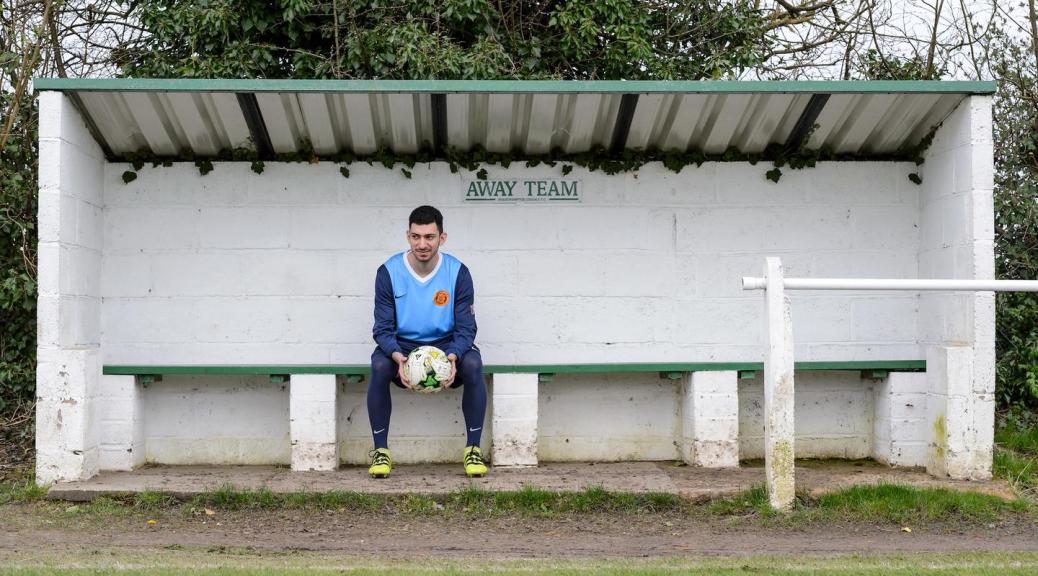
1490011785107-SHHelalAlBaarini011Helal al Baarini is 21 years old and a native of Homs, Syria. He fled to Jordan in 2012 and came to England in February 2016.

I’m a refugee, but I’m also a footballer. I play for Bilston Town at the moment – a team near where I live in Birmingham. I’m a midfielder and I can play on either wing or behind the striker. Some of my teammates call me ‘Coutinho’, because I have the same style as him – I can score goals but I focus mainly on creating chances, and I get a lot of assists.

It’s been my dream to play in England ever since I was a little boy – I think the Premier League is the strongest league in the world. I support Liverpool but I’d love to play professionally for any club here. I’d play for whoever gave me a chance.

I’m originally from Homs. My brother and I fled the war in Syria in 2012 – my parents wanted us to leave our family and get away from the violence and the fighting. At the time I was playing for Al-Karamah SC, one of the top clubs in the country and one of the oldest sports clubs in Asia. I first joined Al-Karamah when I was 7 years old, and ended up playing for their Under-17 team. Before I left Syria, I was even named best player in the Under-17 league. Life was good before the war started. It was hard for us to leave the country, but the war had destroyed everything we loved, everything that was familiar to us. It was dangerous to even just walk down the street.

Continue reading at Vice.

Celebrate Towel Day with Disaster Area: The loudest band in the Galaxy

douglas-adamsDouglas Adams was many things: a novel writer, a radio-maker, a sane man in an increasingly insane universe, but most of all he was a hoopy frood who really knew where his towel was.


For the uninitiated, Adams described in the Hitchhiker’s Guide To The Galaxy why a towel is: “about the most massively useful thing an interstellar hitchhiker can have.” As a result, every year since his death in 2001 fans have remembered him by celebrating Towel Day on May 25th. Which is today. I can’t think why people would still be quoting lines like:

“It is a well-known fact that those people who must want to rule people are, ipso facto, those least suited to do it… anyone who is capable of getting themselves made President should on no account be allowed to do the job.”

But perhaps you can.

Continue reading at NME.

Roger Moore: Keeping The British End Up

Not long ago I found one of my school notebooks from 1995, when I would have been 9 years old. I’d obviously been asked to fill in responses to a sort of pop quiz questionnaire. I’d written, in my neat childish hand: “If I could be any famous real person I would be Roger Moore, because in some of my favourite movies Roger Moore plays the lead role.”

No prizes for guessing that I meant James Bond. In fact, a few lines later I go on to summarise the plot of Ian Fleming’s short story ‘A View To A Kill’, which I’m not sure I should have been reading at 9. I described the violent tale about assassins in Versailles as “the best story book I have ever read.”

I’m telling you this so you understand that when I say Roger Moore was my childhood hero, I really mean it. His was the life I wanted: full of glamorous locations, bottomless cocktails and always ready with a pun and a raised eyebrow. I’m not sure I fully understood what he meant by “Keeping the British end up, sir” at the end of The Spy Who Loved Me, or why Q’s Moonraker line: “I think he’s attempting re-entry, sir” was so funny, but I howled at them anyway. I probably thought he was talking about kissing.

I finally got to meet my hero last year, shortly before what was to be his final appearance on stage at the Royal Festival Hall in November. I bought a three-piece suit for the occasion, because there was no way I could go to meet James Bond wearing a t-shirt.

The first thing I said to him was: “Thank you.” I told him how much his films had meant to me, and how excited they had made me to go out and explore the world. “You’re welcome!” he said, with a grin. “I’ve been lucky all my life. From the time I started making movies and television I played heroes. Never had to say too much, got the girl, won all the fights, got to keep the clothes. What more can you ask for?”

He was, exactly as you’d imagine, endlessly charming company. He was self-deprecating about his own acting ability, but he taught me how to make the perfect Martini (with gin, not vodka) and how to deliver the perfect one-liner. He said his own favourite was from The Man With The Golden Gun: “When I’m, when Bond, is asking the gunsmith about Scaramanga. He’s got a rifle that I’m lining up. I’m asking him where’s something something. I’m pointing the gun right at his balls and I said: ‘Speak now, or forever hold your piece.’ Which I love. I love that line.”

Roger Moore has always been tied up with my idea of what it means to be British. How could it not be, when he was the man who skied over the cliff edge only to be saved by a Union Jack parachute? After Brexit, and with the Conservative government going back on its promise to take in refugees from Syria, I wanted to know what he thought Britain’s role in the world should be.

“I hope we continue to be important contributors to alleviating the effects of poverty,” he said. “I don’t like the newspaper campaigns that take the government to task for the amount of money it gives to other countries. Yes, some of it gets abused, but it’s important.”

When I asked him whether as a country we should take in more refugees, he replied: “I drive around England quite a lot. We have an awful lot of space, we really do. It’s because we’re a fortunate society that people want to come here. If they’re coming for non-economic reason then that’s all the more reason we should take them. If they’re coming for economic reasons, if they have something to contribute, then I don’t blame the poor bastards for getting out! They’re doing exactly what the British did 400 years ago.”

As much as we might picture Roger Moore living the good life on the Riviera, or turning up as Bond somewhere exotic wearing a safari suit, he dedicated his own life to campaigning against war and poverty for UNICEF. “I went to El Savador on my first UNICEF field trip, and learnt first-hand about what life was like in a favela,” he told me. “You see a very different world to the world that Bond saw,”

For me, Roger Moore embodied an idea of Britishness totally at odds with the insular worldview and false nostalgia of Brexit. He hated the idea that we should cut our overseas aid budgets, or build walls to keep out refugees. He spoke about a Britain that goes out into the world and makes it a better place for everyone. For that, he’ll always be my hero.

Originally published by NME.

Register to vote – and take a +1

polling-station-politics-election-GettyImages-51071763-041917

Today is the last day to register to vote in the upcoming Most Important General Election Of Your Lifetimeᵀᴹ.

You may think this need not bother you. We know that you, dear, sweet, devastatingly good-looking and politically-engaged NME reader that you are, have already registered to vote. Of course you have. You went along to https://www.gov.uk/register-to-vote and spent a few minutes making sure you can make your voice heard on the 8th June. Well done you.

But don’t recline smugly on your laurels just yet, there’s still something that you could do today that might, at the risk of mildly overstating things, Change The Future Of The Country Forever. It’s time to text a mate and remind them to register. This is, after all, not just about individuals but about whole generations. We know that in the 2015 election, only 43% of people aged 18-24 and 54% of people aged 25-34 cast their vote, compared to a massive 78% of over-65s voted.

Continue reading at NME

Meeting the editor of Guatemala’s free feminist newspaper

IMG_1143

Guatemala is one of the most dangerous places in the world to be a woman. According to a 2012 report by the Small Arms Survey, the small Central American country has the third highest rate of femicide – women being killed just for being women – in the world, behind El Salvador and Jamaica. During the Guatemalan Civil War, which lasted from 1960 to 1996, rape was used as a weapon of war against women. Perpetrators of gender-based violence in Guatemala often quite literally get away with murder, bolstered by a “machismo” culture that treats women as objects. Amnesty International has called on the state to do more to protect women.

This cultural backdrop makes it even more remarkable that for the last 19 years, Guatemala has also been home to a proudly feminist free newspaper called La Cuerda (The Cord). First published on 8 March 1998, International Women’s Day, it has been distributed monthly across the country ever since and has given a voice to women who would otherwise have been ignored.

In Antigua, in the south of the country, I met one of the newspaper’s four founders, Ana Cofiño, at her home to ask her about the challenges they’ve faced and her hopes for planting the seeds of Guatemalan feminism:

How did La Cuerda first get started?

“Before we started La Cuerda there was another daily journal, and we asked the editor to give us a page when the moon was full. Every full moon we had a page. It was four of us, friends, and we had meetings where we would decide what we would write about. After that finished, my colleagues and I shared the dream of having our own paper. “A room of our own”, as Virginia Woolf put it. We were writing for other magazines, but we wanted to have a paper that belonged to us. If you just put one article in a big magazine it gets lost. We wanted to start a magazine which said: ‘We are feminists and this is our position’. What we tried to do from the beginning with this newspaper was to open society to what women were thinking, doing and feeling. We wanted women to know each other, because war breaks everything. Our social fabric had been broken during the war.”

Where did your idea of feminism come from?

“We should define what we mean by feminism. Feminism is a philosophical theory. It’s also an economic proposal. It’s a way of living. It’s not like machismo. It’s not stupid actions. It’s an accumulation of knowledge and political changes done by feminism. That’s what we inherited. It’s theory written by feminists, and the story of women. That’s one part of it. We also became feminists because it’s easy to see how unfair it is. If you have any consciousness and intelligence then you can see that the situation is not fair at all.”

So you arrived at it independently, rather than from reading foreign academia?

“I think many women of my generation found feminism through their mothers or in school. If you studied in a public school you had more opportunities to be critical. Many women of my class from my generation were educated by nuns. I studied in a nun’s school. That’s what’s behind us as Guatemalan feminists, in many ways. Sometimes if they tell you something, and they impose it on you, and in your heart and in your skin and in your flesh you know that’s not true, you fight against it. You become a rebel. You don’t need to pick up a gun to be a rebel. You’re a rebel because you know what they are doing to you is not fair. I think that kind of spirit is something that comes in your blood. You don’t resign yourself to be what they tell you to be because it’ s not fair. Fairness is also a matter of feeling. It’s not only what’s written.”

What sort of things were you publishing in La Cuerda at the beginning?

“We wanted to give a voice to women who didn’t have a voice. We collected stories about what happened to women in the war, and we supported processes by which women revealed all the sexual violations which had happened during the war, because that didn’t come out in the official reports. We were also collecting new types of images of women, not just women as Barbies. We were trying to change mentalities. We had very high aspirations, but that’s what we wanted: to change mentalities and teach people to be critical. From the beginning, La Cuerda was not just a paper or the digital version, it is an organisation that has a political goal. At the same time as doing the paper we were talking, and making alliances in some cases, with women’s organisations in different parts of the country. If you want to change the world and the society in which you live, you can’t do it alone.”

What do you see as the goal of the newspaper?

“We want people to see things, discuss things and think about the problems of our society from another perspective, because that’s the fundamental feature of a feminist paper. You have all these instruments, all these tools to see society, like the concept of patriarchy. They can give you a radically different perspective. We’re trying to construct a political platform for society. I know we’re crazy, I know it’s a dream. We’ve been talking to other women, other feminists, for seven or eight years now trying to coin the terms that describe what we want. Not what there is. What there is already has names. What we want is different. You can’t imagine it. Sometimes we laugh so much and say: ‘A world without machismo? How would that be?’ For us, that means no guns. No armies. In this country, the military, and the owners of the country, we’ve been saying for years and years that we should disarm.”

Do you think there’s a big difference between what feminism means in Guatemala and what it means in Britain or America?

“There are a lot of different points of view on this! People talk about ‘white feminism’, and now in Latin America many women are talking about ‘colonial feminism’. There are different emphases. There’s a feminism that has been working with the United Nations, with human rights, which is called ‘institutional’. There is more radical feminism, there is lesbian feminism, so I think every reality and every society has its own features. It’s different talking from the first world, like England, to here because you have your own democracy and parties and the way things function. People are not dying like they are here. One of the main things that we discovered when we started this process is that Guatemalan feminism had to be conscious and marked, and to fight against racism. When we talk about women’s rights, we have to talk about indigenous women’s rights.”

What lessons have you learned from publishing La Cuerda that you would want to pass on to young feminists?

“I would tell them to confront power. When we’re educated, in schools and in our homes, we just learn that everything is as it is. They don’t tell you that it is a matter of power. Another thing that we’ve learned is that we need our history. We didn’t know about women. We didn’t know the names of the women who came before us. In the official stories that you study at school, it’s all about ‘Great Men’ – war and power and scientists, but never women. It was a beautiful adventure to go back in time to find what women had done before. For example, now there is a story of women in journalism in Guatemala and we are part of that, already. That’s very important. When you study history, newspapers are a good reflection of what is being said.”

Originally published by Shevolution.

Manana: the festival helping contemporary Cuban music go global

AriwoIn an age where anything from Daft Punk to Debussy can be summoned at the touch of a screen, it’s hard to imagine that, like bills or milk bottles, new music-hungry Cubans get the latest tunes delivered by hand. In lieu of fast, reliable internet, dealers distribute El Paquete Semanal (“The Weekly Package”), a terabyte of choice music and movies, via USB stick.

This presents a challenge for musicians seeking the latest trends. “I didn’t send an email until I was 27,” remembers Hammadi Valdes, a Latin Grammy-winning percussionist who grew up in the capital, Havana. “That’s a big barrier. For the development of new music, the internet is crucial.”

Continue reading at The Guardian.

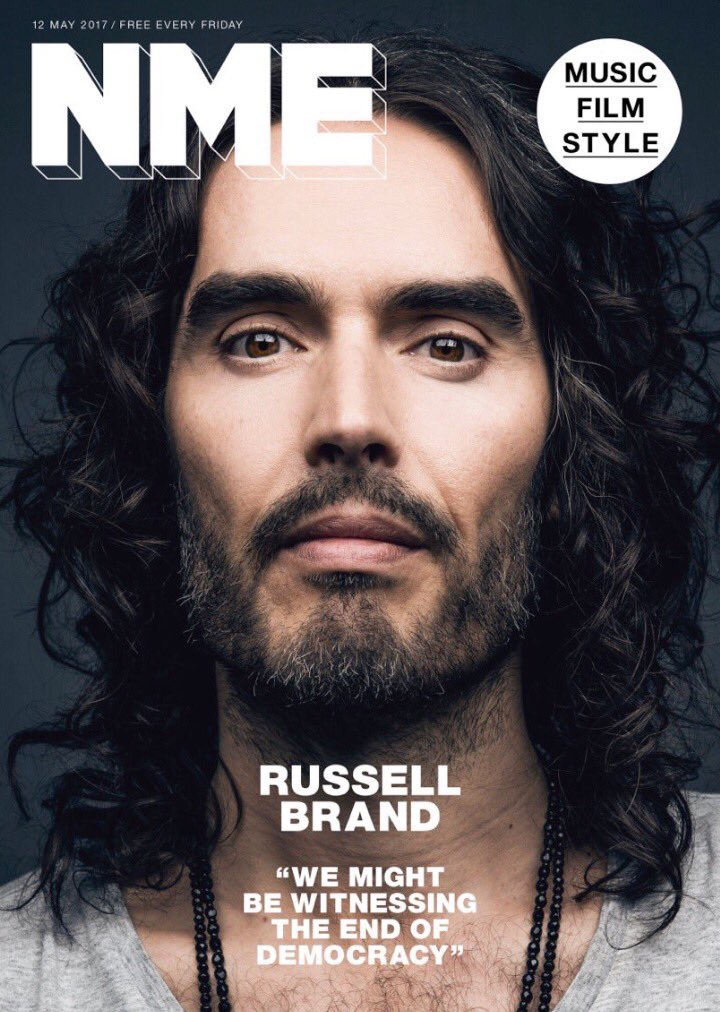
Russell Brand: “We might be witnessing the end of democracy”

russell-brand-nme

Russell-Brand-KEGP

Russell Brand has been many things in his 41 years: stand-up comedian, heroin addict, movie star, Andrew-Sachs-offending national disgrace, reality TV host and three-time winner of The Sun’s ‘Shagger of the Year’, to name but six. And just when it looked like he was set to spend the rest of his days fopping around Hollywood as the token English eccentric, he recast himself as a real-life revolutionary.

In October 2013, Brand used a Newsnight interview to call for “a socialist egalitarian system based on the massive redistribution of wealth, heavy taxation of corporations and massive responsibility for energy companies and any companies exploiting the environment”. It was a far cry from making knob gags on a Big Brother spin-off, but it struck a chord with a public who at the time could only tell the difference between the three major political parties by looking at what colour tie their leader had on. Brand threw himself into activism, writing a book called Revolution, launching his YouTube channel The Trews and getting involved in the successful campaign to save the New Era housing estate in Hackney from redevelopment.

The media, however, largely focused on just one aspect of the original interview: the fact he’d told Jeremy Paxman that he didn’t think people should vote. Then, on the eve of the 2015 election, Brand changed his mind and urged people to vote for Labour’s Ed Miliband – who promptly lost resoundingly, and resigned.

In the wake of the election, Brand retreated from public view. He enrolled in a degree while the tabloids mocked his decision to move to a £3.3m house near Henley-on-Thames with his fiancée Laura Gallacher, who last year gave birth to a daughter they gave the deliberately un-celebrified name Mabel. Having licked his wounds, Brand is resurrecting himself with a stand-up tour, Re:Birth, and a new show on Radio X. We meet him in the luxurious gardens of Danesfield House, a fancy hotel near his home that’s so decidedly un-insurrectionist that George Clooney had his wedding after-party here. He’s watching his “recalcitrant hound”, a German Shepherd named Bear, lollop through the gardens. The dog, he says, has “self-control issues… I don’t know where he’s picked that up from.”

While he can’t resist that knowing joke at his own expense, Brand in person now cuts a calm, sage figure. Wearing a Trews T-shirt and gym gear, hair tied up in a bun, beard flecked with grey, he’s more Zen yoga enthusiast than marauding sex pirate. He may be less vocal with his righteous ire, but he still believes, despite mounting evidence to the contrary, that society need not be so venal. He even recently filmed himself registering to vote for the first time, meaning Britain’s most notorious non-voter could be about to cast his first ballot. Which raises the question…

Continue reading at NME.

Cover story for NME, 12 May 2017.

The unbearable loneliness of pick-up artist bootcamp

trump-1“You know, I’m automatically attracted to beautiful – I just start kissing them. It’s like a magnet. Just kiss. I don’t even wait. And when you’re a star, they let you do it. You can do anything. Grab ’em by the pussy. You can do anything.”

It was back in 2005 that those grimy nuggets of “locker room talk” bubbled out of Donald Trump’s puckered lips on the Access Hollywood bus. That same year, Neil Strauss published The Game, a how-to guide for wannabe ‘pick-up artists’ that would go on to sell 2.5 million copies. It recommended tactics like “negging”, insulting a woman to reduce her self-esteem, and “caveman-ing”, which it defined as “to directly and aggressively escalate physical contact”.

It seems clear that the culture The Game was a part of helped carry Trump to the Presidency 12 years later. We now live in a world where grotesque machismo is so commonplace that his chief strategist Steve Bannon reportedly calls his White House rivals “cucks”. Bannon rose to prominence as chair of Breitbart News, which stoked the misogyny of Gamergate in 2014 and fuelled the rise of the Alt-Right. Many of its readers are the same young men who learned all they know about women from Reddit’s The Red Pill forum, which teaches that feminism is a lie and what women really want is to be dominated and manipulated by powerful men. Pick-up artist (PUA) philosophy has taken over the asylum.

So when I was invited to cover a three-day PUA ‘bootcamp’ run by a company called Love Systems, I was intrigued. If I wanted to understand what made these guys the way they are, this seemed like a good place to start.

Continue reading at Shortlist.

How to run for Parliament (while doing your A Levels)

EliAldridge18-year-old Eli Aldridge has been selected as a Labour candidate for the General Election on 8 June – a day after his A Level exams start. The aspiring MP for Westmorland & Lonsdale explains how you too could get started on the road to Westminster


When did you first get involved in politics?

“In the aftermath of the 2015 election, my disappointment about the result spurred me to think about how I could make a difference. The Labour Party seemed the obvious choice for me.”

Continue reading at NME.

Nothing But Thieves on new single ‘Amsterdam’, tour plans and taking advice from Muse’s Matt Bellamy

nothing-but-thieves.png

Nothing But Thieves announced themselves to the world in emphatic style when their 2015 self-titled debut sold over 250k copies, racking up over 174 million track streams along the way. This September 8 they return with their second album, Broken Machine, of which new single ‘Amsterdam’ is the first taste. When we gave frontman Conor Mason a ring  to ask him what we should expect, we found him in Ukraine where the band are currently filming the  ‘Amsterdam’ video:

Continue reading at NME.

93% of students say they’re registered to vote – but will it bring change?

The Labour Leader Addresses Party Conference

The election this June is a weird one for any number of reasons. Conducted beneath the cloud of Brexit, it’s also notable for likely being the last one we’ll be able to squeeze in before global Armageddon. Enjoy it while you can!

Another weird thing about it is simply that it’s happening in June. The last three general elections have all been held in early May, and it’s possible this subtle shift in the date could have a big impact on how young people vote – or more specifically, where they vote. Holding the election after many students have finished exams could mean that more vote in their home constituencies, and 68% of those surveyed said this was their plan. It’s hard to call exactly how this might impact the result. It may mean that there’s a reduced impact from concentrated blocks of students voting in university seats. At the same time, some students may be going home to cast potentially powerful votes in marginal constituencies.

Continue reading at NME.

Theresa May’s ‘strong and stable’ catchphrase is just a bad meme

BRITAIN-POLITICS-VOTE-CONSERVATIVE

People who work in advertising love going viral. They love it even more than cocaine and stealing money from the tiny fists of children. They can’t get enough of it, yet it remains mysterious. Advertisers spend hours upon hours reading tea leaves or consulting tarot cards to try to divine the specific rubric which makes some ideas meme-worthy while others wilt and die without a retweet to their name.

In this election, Theresa May’s “strong and stable leadership” catchphrase has already taken on the qualities of a meme. Thanks to her adherence to the three Rs of repetition, repetition, repetition, the slogan has become one of the few things even the most casual of election observers will have picked up.

Continue reading at NME.

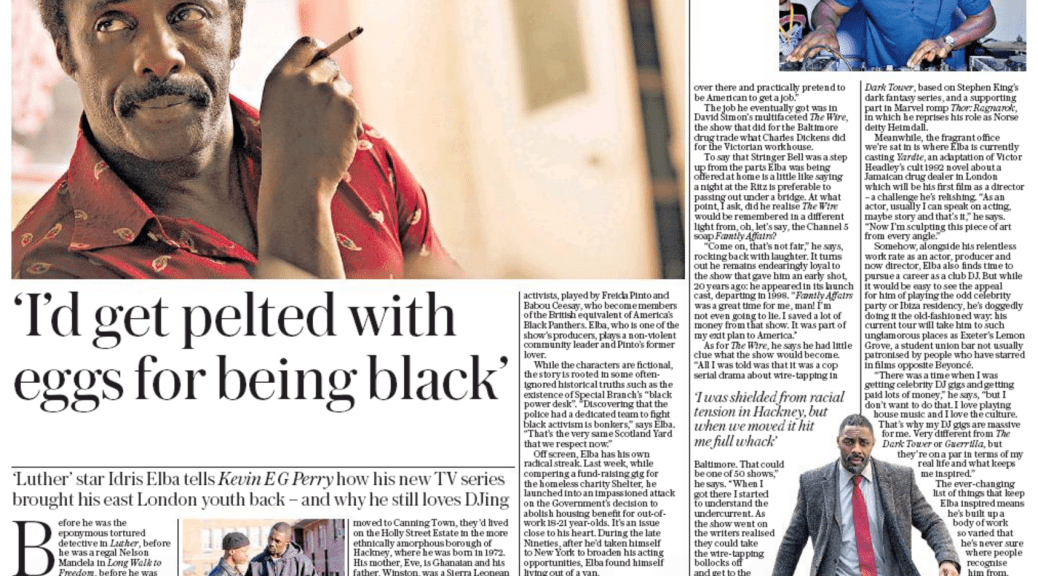
Idris Elba: ‘I’d get pelted with eggs for being black’

idris-elba-telegraphBefore he was the eponymous tortured detective in Luther, before he was a regal Nelson Mandela in Long Walk to Freedom, before he was even The Wealth of Nations-toting drug kingpin Stringer Bell in The Wire, Idris Elba was a schoolboy on a bus in east London being pelted with eggs by racists.

“My school, Trinity, was just off the Barking Road, which would take all the National Front supporters to the football at West Ham,” he remembers, leaning forward on a sofa in a production office, in London’s Holborn, that smells of expensive candles and industriousness.

Continue reading at The Telegraph.

From Charlotte Church to David Byrne: the musicians making covers bands cool

charlotte-churchIt was past one o’clock on the Monday morning of last year’s Glastonbury, around the time thoughts usually turn to proper beds, showers, and drinking anything other than warm cider. But the sweat-slicked crowd squeezed into the Rabbit Hole didn’t want any of that. They wanted to hear En Vogue’s Don’t Let Go collide with King Crimson’s 21st Century Schizoid Man. They wanted Destiny’s Child’s Bootylicious segueing into Rage Against the Machine’s Killing in the Name. They wanted, as their full-throated chant put it: “Charlotte! Charlotte! Charlotte fucking Church!” The former child soprano’s Late Night Pop Dungeon is a riotous set that sees her cover an eclectic mix of disco hits, rock anthems and cult pop curios and is responsible for the most Church-based excitement since Martin Luther nailed the ninety-five theses to a door in 1517.

Continue reading at The Guardian.

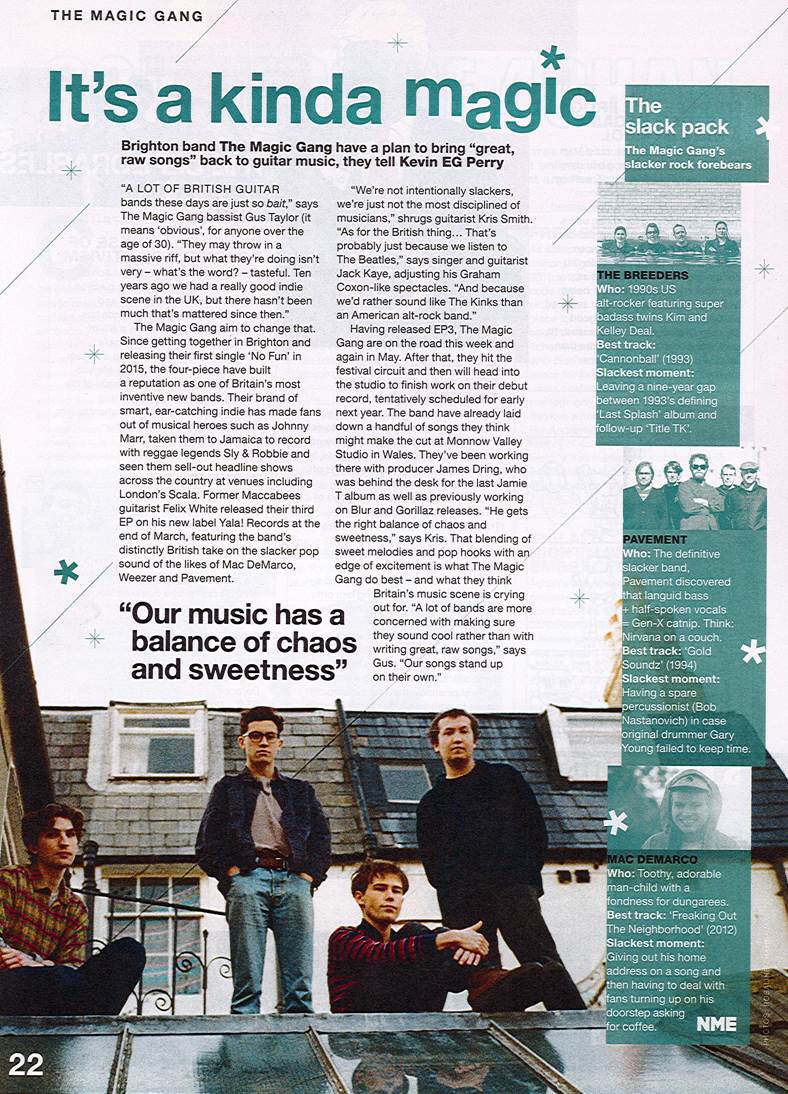
It’s A Kinda Magic

the-magic-gangA lot of British guitar bands these days are just so bait,” says The Magic Gang bassist Gus Taylor (it means ‘obvious’, for anyone over the age of 30). “They may throw in a massive riff, but what they’re doing isn’t very – what’s the word? – tasteful. Ten years ago we had a really good indie scene in the UK, but there hasn’t been much that’s mattered since then.”
The Magic Gang aim to change that. Since getting together in Brighton and releasing their first single ‘No Fun’ in 2015, the four-piece have built a reputation as one of Britain’s most inventive new bands. Their brand of smart, ear-catching indie has made fans out of musical heroes such as Johnny Marr, taken them to Jamaica to record with reggae legends Sly & Robbie and seen them sell-out headline shows across the country at venues including London’s Scala. Former Maccabees guitarist Felix White released their third EP on his new label Yala! Records at the end of March, featuring the band’s distinctly British take on the slacker pop sound of the likes of Mac DeMarco, Weezer and Pavement.

Continue reading at NME.

Pa’l Norte 2017: Señor Brightside

KILLERS_03_Mexico_Jenn_Five

We’re backstage at Pa’l Norte festival in Monterrey, northern Mexico, about half an hour before The Killers are due onstage for their headline set, and Brandon Flowers is trying to convince guitarist Dave Keuning that now is perhaps not the ideal time to start experimenting with mixology.

“No,” sighs the singer, “don’t mix vodka and tequila.”

You can’t blame him for getting into the Mexican national spirit. Brandon himself has been in town for a few days, acclimatising to the late March heat and sampling the very best of the local cuisine. A couple of nights earlier he’d been spotted at Tacos Primo, a great local joint that serves the best tacos I’ve ever eaten. Each taco costs just 15 Pesos each (about 64p) for bistec or carnitas, and the secret to their superlative taste seems to be frying the tortillas in the steak fat.

“I think the tortilla is a really important part,” concurs Brandon. “We were watching their process at Primo. You could put anything in a good tortilla and it would be really great.”

Brandon’s a man of the world, so I want to know how he ranks them against his personal lifetime of taco-eating? “They were up there with the best tacos I’ve ever had,” he confirms, although he points me towards another couple of contenders: “When we’re in Guadalajara we have a place on the street that we go, Tacos Jorge. At home in Vegas, it’s got to be Tacos El Gordo, ‘fat taco’.”

There you have it. Never let it be said that NME doesn’t ask the meatiest questions. I also take the opportunity to grill the band on the progress of their fifth album. “It’s sounding good,” offers drummer Ronnie Vannucci Jr of their new songs. “We have a problem with taking two steps forward and one step back, so that makes it take longer. We keep asking ourselves: ‘What does a fourpiece band do? How do you keep it fresh?’ It’s a constant exercise in experimentation.”

The band confirm that the record will be out this year, and that they’ll have new material to play by the time they headline Hyde Park on July 8. There’s no new stuff tonight, so the 85,000 people packed into Monterrey’s Parque Fundidora have to settle for just being reminded how many indie dancefloor fillers the band have written over the years. Which is a lot, even if you just listen to their debut. Watching thousands of Mexicans scream along to ‘Somebody Told Me’, ‘Smile Like You Mean It’, ‘Jenny Was A Friend Of Mine’, ‘All These Things That I’ve Done’ and ‘Mr Brightside’ in 2017, you’re tempted to conclude that ‘Hot Fuss’ has aged better than any of its early-00s peers. After the show, like so many rock stars, Brandon Flowers only has one thing on his mind. “We’re going again tonight,” he says. “Straight from the stage to Tacos Primo.”

There is, of course, more to Monterrey than just criminally good tacos. A bustling industrial city with a population a little over one million, it’s also home to a decent live music scene. Café Iguana in Barrio Antiguo is a great indie club with at least four live rooms, including one in an old-fashioned theatre where the end of an indie band’s set was signalled by the thick red curtains immediately drawing shut across the stage. You don’t get that at Birthdays. The best cocktails in town are at Río Mississippi 105-B, who do frankly obscene things with mezcal.

Then there’s Pa’l Norte itself, a sprawling festival which runs its two main stages with ruthless efficiency. Located side-by-side, the moment a band on the first stage finishes the next band starts up on the second stage. Never a moment wasted, although when you’re supposed to pop for a wee or to the bar is anyone’s guess. In what might be a stroke of genius, there’s also a third, smaller stage just to the right of the two main ones. Known as the Sorpresa (‘Surprise’) stage, the line-up is unannounced and the secret sets last just 5 or 10 minutes, making them perfect for one-hit wonders. Wondering why there’s a five-minute gap between Kaskade finishing and Jason Derulo starting? Surprise! Here’s Las Ketchup singing their 2002 novelty single ‘The Ketchup Song’. Got 10 minutes before The Offspring come on? Surprise! Here’s Redfoo playing the only two LMFAO songs you’ve heard of, and another one you haven’t, and taking his trousers off and wiggling his dick in his tiny pants, and making you wonder whether anyone else could make a 10-minute set feel 40 minutes too long.

Speaking of sexually inappropriate men with bad hair, it wouldn’t be 2017 without Donald Trump. MIA performed her weekend-stealing high-energy set in front of a huge metal wall dividing the stage in two. If you somehow missed the significance of that, just 200km south of the border, she spelled it out by getting her DJ to play Edwin Starr’s ‘War’ and singing along: “Wall, what is it good for? Absolutely nothing.” Having stuck her middle finger up at Trump, she decides to “pull up on the politics” and play what she calls “the most romantic song I’ve ever written.” It’s ‘Teqkilla’ – like I said, in Mexico everyone gets into the local spirit eventually.

Published by NME.

The Haunting Case of the ‘Killer Cabbie’

killer-cabbieWhen Detective Sergeant Steve Fulcher heard that taxi driver Christopher Halliwell – the lead suspect in the disappearance of Sian O’Callaghan five days earlier – had refused to tell officers anything during his arrest, he made a decision that, in a cop show, would be described as “not doing things by the book”. In the real world, Fulcher’s actions were later described by the Independent Police Complaints Commission (IPCC) as a “catastrophic” breach of the Police and Criminal Evidence Act.

While officers were driving Halliwell from the scene of his arrest, in an Asda carpark, to Gablecross police station in Swindon, Fulcher called them and told them to instead take the suspect to Barbury Castle, an Iron Age hill fort. Fulcher met Halliwell on the wind-swept hilltop at 12:11PM on Thursday the 24th of March, 2011. He led him 50 yards away from the officers and their police cars to talk. Their conversation was recorded by the only other person there, a civilian note-taker:

Fulcher: “Are you going to tell me where Sian is?”
Halliwell: “I don’t know anything.”
Fulcher: “Are you going to show me where Sian is? What’s going to happen, if you tell us where Sian is – that whatever you will be portrayed – you would have done the right thing.”
Halliwell: “I want to go to the station.”
Fulcher: “Are you prepared to tell me where Sian is?”
Halliwell: “You think I did it.”
Fulcher: “I know you did it.”
Halliwell: “Can I go to the station?”
Fulcher: “You can go to the station. What will happen is that you will be vilified. If you tell me where Sian is you would have done the right thing.”
Halliwell: “I want to speak to a solicitor.”
Fulcher: “You are being given an opportunity to tell me where Sian is. In one hour’s time you will be in the press.”
Halliwell: “I want to speak to a solicitor.”
Fulcher: “You will speak to a solicitor. I’m giving you an opportunity to tell me where Sian is. By the end of this cycle you will be vilified. Tell me where Sian is.”

Long minutes of silence passed. Finally, Halliwell said: “Have you got a car? We’ll go.”

Continue reading at Vice.

Kong: Skull Island: “My own personal Heart of Darkness”

kong-skull-island-imax-posterKualoa Ranch is a 4000-acre private nature reserve in Hawaii, most recognisable as Jurassic Park. Back in December 2015, I flew over to witness its transformation into Skull Island, a place where King Kong meets Apocalypse Now. Tom Hiddleston and director Jordan Vogt-Roberts were on hand to explain:

You decided to call two of your characters Conrad and Marlow…

Hiddleston: “The idea of Conrad and Marlow really came from Jordan. That was such a great inspiration as a spine. I think there’s something intrinsically exciting and cinematic about putting a group of disparate characters in the same place on a boat and sending them down a river. I think ‘Heart of Darkness’ has inspired so many stories like that.”

Vogt-Roberts: “This is my own personal ‘Heart of Darkness’! ‘Apocalypse Now’ is a huge reference point. The initial talking points for this movie in my mind were: ‘Man, you know what I’ve never seen? A monster movie with the aesthetic of ‘Apocalypse Now’. With Hendrix playing, with The Stones playing, with The Doors playing… thinking about the imagery and the chaos of ‘Apocalypse Now’, what was going through everyone’s mind.”

Are we going to get those things on the soundtrack?

Vogt-Roberts: “Yes! I want to see Kong punching a helicopter while Jimi Hendrix plays. But our movie… ‘Apocalypse Now’ is one of the best films of all time, and while there’s a loose inspiration there we’re ultimately making a very big and accessible movie. ‘Apocalypse Now’ is almost Malick-esque in the way that it has to wash over you, and I don’t quite think that’s opening on 3,000 screens these days. There are aesthetic inspirations, and inspirations in terms of the madness that this place takes on and the journey that going up the river has for these people, but, you know, it’s an easy talking point on the movie when you look at a lot of these things. We’re going for something bigger than that, more adventurous than that.”

What sort of hero is Hiddleston’s Conrad?

Vogt-Roberts: “There’s a bit of Steve McQueen in there. Tom’s so great, and charming, and textured. We initially were talking about making him American. One of the big things that came out was instantly separating him from Packard and the rest of his men. In the context of a movie that takes place in the shadow of Vietnam – those are generally very uniquely American stories – a lot of the conversations about Tom it became clear that it was a way to make the movie feel bigger, more worldly and to give him a different perspective on what was going on at that time. There actually were a lot of British soldiers in Vietnam, which is something which is downplayed pretty significantly. It’s viewed as a uniquely American war, which it wasn’t quite. There were a lot of avenues that led us there, a lot of it was just really trying to create clear and concise sides.”

Hiddleston: “Indiana Jones of course came up, as an icon and a silhouette, in a way. He’s somebody who has an intellectual passion and becomes an adventurer. We always wanted Conrad to be that. We knew we couldn’t make him like Martin Sheen in ‘Apocalypse Now’ because that’s a very heavy character – another iconic performance – but this needed more wit. It’s an adventure film. It will be spectacular – I know that already having been on this for nine weeks. I’ve seen it. It needs to be fun. Having made a couple of films on this scale, the ones that are the most successful have a balance of weight and drama and also of wit.”

“It’s simple: We need to help”

choose-love

It’s two days before the NME Awards and, in a rehearsal room in London’s King’s Cross, a group of musicians are gathering to prepare a very special performance. What unites them is a belief that we’re in a time of crisis and we all need to do what we can to raise our voices.

Almost six years ago, a ferocious civil war broke out in Syria. With much of the country now controlled by so-called ISIS, there’s still no end in sight. Just like the victims of wars in Afghanistan and Iraq, millions of ordinary Syrians were left with little choice but to flee for their lives. They packed a few belongings into plastic bags and set off with their children in tow. Most ended up in neighbouring countries Turkey, Lebanon and Jordan, but some kept going and made the precarious journey to Europe. Many of those who hoped to come to Britain ended up at a camp in Calais, France, which at its peak was a makeshift home for 15,000 refugees.

For a time, the crisis made headlines, but before long our collective gaze drifted to Brexit, Trump and Bake Off. While we looked away, a million new refugees from Syria, Iraq and Afghanistan arrived in Europe last year. The camps in Calais and elsewhere were closed down, leaving many people homeless on the streets of Paris. In Britain, we’ve given refuge to just a few thousand. In the last few weeks, the Government announced that a scheme which promised to rehome 3,000 unaccompanied children in the UK will be scrapped after letting in just 350. That decision alone makes the idea of Britain as a compassionate country sound like cheap fiction – and it’s why the charity movement Help Refugees is currently in the process of suing the Home Office.

Continue reading NME cover feature, 24 February 2017.

The Life and Crimes of ‘Cannibal Cop Killer’ Stefano Brizzi

brizziWhen the smell of rotting human flesh became too much for the residents of Block E to take, the caretaker on The Peabody Estate first tried to mask it with bubblegum-scented air spray. When that didn’t work, somebody eventually decided to call the police.

That was on Thursday the 7th of April last year. Almost a week earlier, on the night of Friday the 1st, a man who would later be identified in court only as “CD” found himself lost on the estate while looking for a chemsex party he’d been invited to by someone named “Domination London” on “gay fetish app” Recon. The Peabody Estate, which originally opened in 1876, lies a few minutes south of the Thames, between London Bridge and the Tate Modern. Its desirable location means a one-bed studio apartment there will set you back £1,300 a month in rent, but its various blocks can be difficult to navigate for the uninitiated.

Eventually, CD found the right door and rang the buzzer. There was no answer, so he rang it again. And again.

Eventually a man’s voice answered. It said: “Hello, sorry, we are having kind of a situation here.”

CD didn’t know what the voice meant by “a situation”, so he asked what was going on. The voice explained that somebody was feeling ill, but said not to worry because they were taking care of it. CD asked if there was anything he could do to help, and the voice said no, everything was under control, but the party was cancelled. The voice, CD would later testify, “sounded concerned, a little bit upset. He did not sound too worried.” As he walked away, CD thought to himself that perhaps somebody was throwing up on the carpet.

The voice on the other end of the intercom belonged to a 49-year-old Italian named Stefano Brizzi. He later told police why he hadn’t let CD in; he’d invited a few men to join his party, he explained, “but they didn’t arrive, and when one did arrive I was right in the middle of strangling Gordon.”

Continue reading at Vice.

Kevin EG Perry is a writer for The Independent, The Guardian, GQ, NME, Empire, Wallpaper*, Vice, Lonely Planet Traveller and other reputable publications