Flying Lotus: 30 Years of Warp

MIXMAG_Flying-Lotus

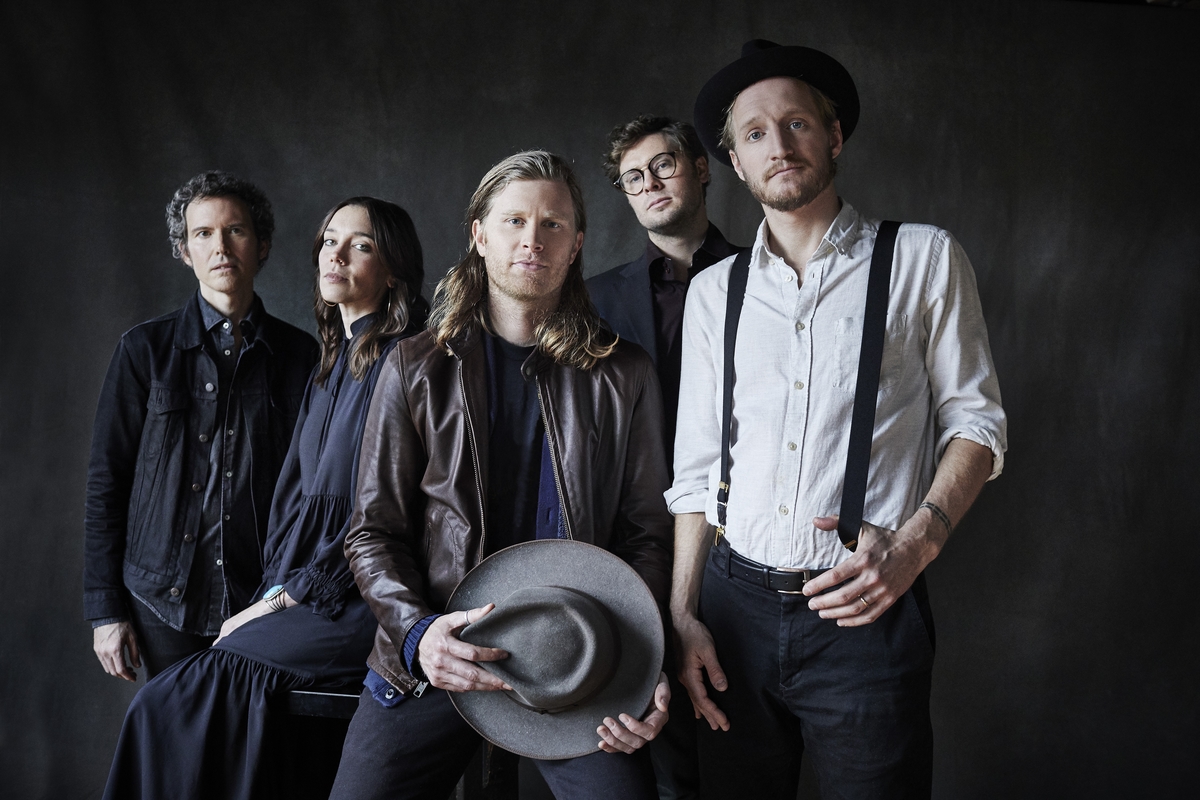
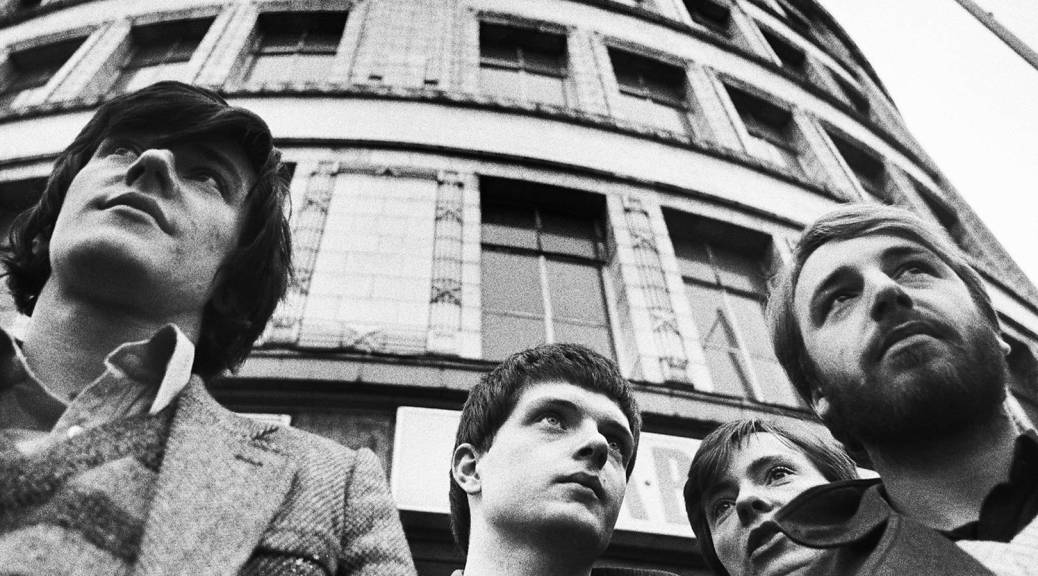
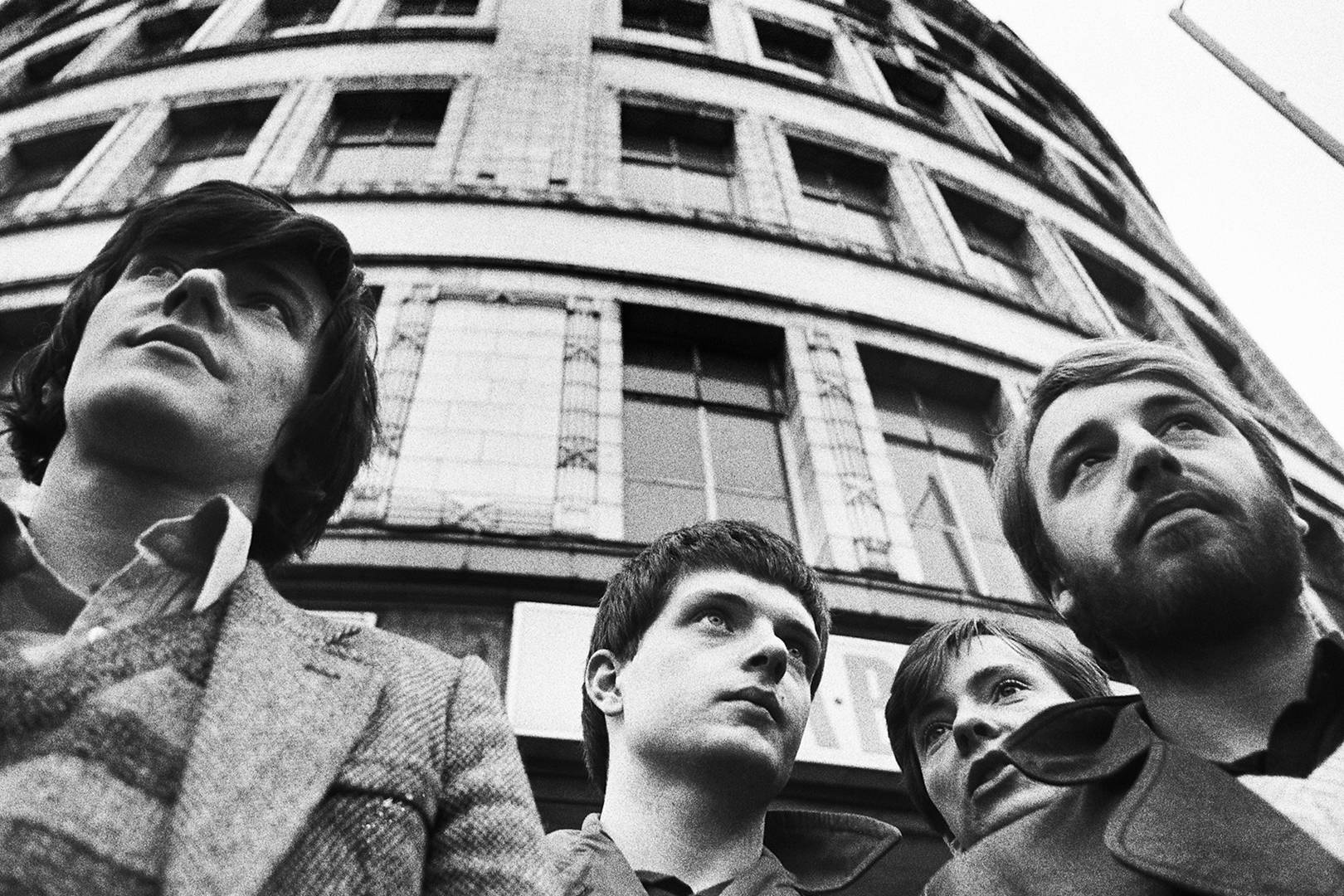
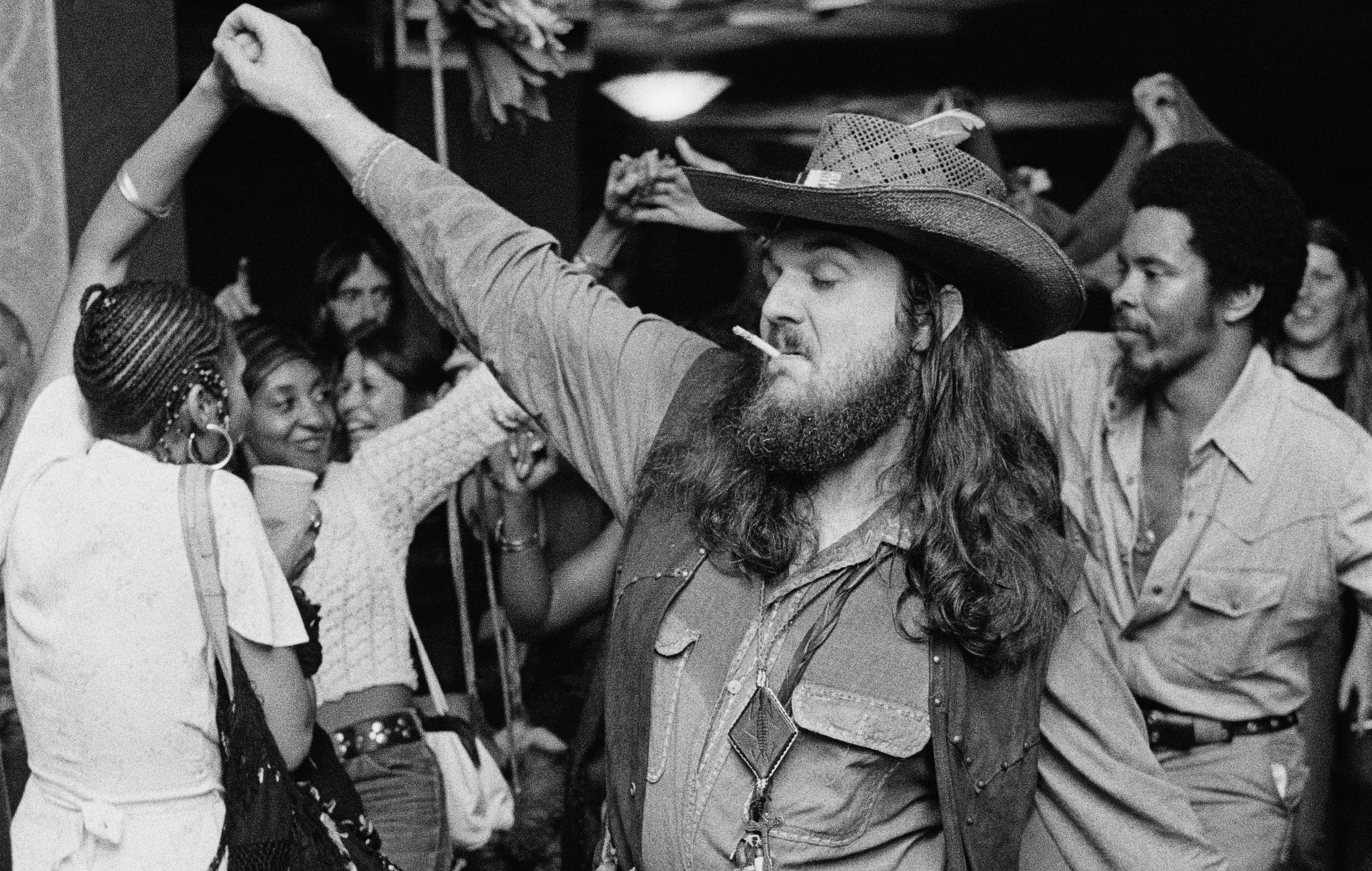
Flying Lotus was born to be on Warp. Real name Steven Ellison, the great-nephew of jazz greats John and Alice Coltrane has been making surreal, wildly experimental beats since he bought his first Roland MC-505 Groovebox at the age of 15. He released one album (‘1983’, named for the year of his birth) on indie label Plug Research in 2006 before fulfilling his destiny to sign with Warp the following year. Since then he’s put out five albums with the label, starting with the textured soundscapes of 2008’s ‘Los Angeles’ (named for the place of his birth). Follow-ups ‘Cosmogramma’ (2010), ‘Until The Quiet Comes’ (2012), ‘You’re Dead’ (2014) and ‘Flamagra’ (2019) have established him as one of the world’s most inventive beatmakers, able to integrate elements of prog, jazz, hip hop, r’n’b and club music into one dizzying whole. In 2016 he made his feature film debut, directing the body horror comedy Kuso, while in his live performances he’s pioneered the use of 3D visuals, creating shows which are, like his music, truly psychedelic and constantly evolving.

Cover story for Mixmag, January 2020. Continue reading.


Grimes review – a suitably surreal invasion of the Miami Art Basel

Grimes-Art-BaselThe art world has descended on Miami for Art Basel, the annual fair dedicated to proving that old idiom about a fool and his money. The most talked-about piece so far is by the Italian artist Maurizio Cattelan, who has found at least two buyers for a work consisting of a banana duct-taped to a wall. Arrested Development’s Lucille Bluth once blithely asked: “I mean, it’s one banana, Michael. How much could it cost?” The answer, it turns out, is $120,000.

Continue reading at The Guardian.

NME’s Greatest Albums of The Decade: The 2010s

Best-of-Decade-Web-Header

  1. Arctic Monkeys – ‘AM’

It all started with those drums. We don’t just mean the languid stomp of opener ‘Do I Wanna Know?’ or the showy solo at the start of ‘R U Mine?’. No – we mean the way that as soon as you heard ‘AM’ erupt out of your speakers for the first time it was clear that from now on the Arctic Monkeys were moving to a different beat.

They were thieves, of course, but they were good at it. The band cheerfully admitted to nicking a few ideas from the likes of Dr Dre, Outkast and Aaliyah, but what was really remarkable was the sheer range and scope of their rampant looting. They stole from hip hop, glam, Motown, rock’n’roll, R&B and even doo-wop with equal ease and evident delight. They picked Phil Spector’s pockets and mugged John Lennon. They lifted that “Mad sounds/In your ears” bit from a song by their early producer Alan Smyth. For the finale, they just straight-out plagiarised a John Cooper Clarke poem. Somebody should have called the police.

This disparate collection of pilfered genres and stolen sounds came together seamlessly with Turner’s too-clever-by-half lyrics about love, lust and the grey area in-between. It’s still hard to get over the elegantly sketched scene in the car in ‘Arabella’, which ends with the phenomenal line: “The horizon tries but it’s just not as kind on the eyes.” The man can chirpse. He had us at: “I’m sorry to interrupt/It’s just I’m constantly on the cusp/Of trying to kiss you.” But ‘AM’ was about so much more than just chat-up lines. What about the lovely, melancholy double meaning of: “Leave me listening to the Stones/2000 Light Years From Home”? The writing is sharply-observed, sometimes self-lacerating and often laugh-out-loud funny. There were a lot of great albums released in the 2010s but only one of them features prominent lyrical references to both Mean Streets and Thunderbirds. 

What it all amounted to was as good a portrait of what it was like to be staying out too late and getting into trouble in the 2010s as anyone wrote in any medium, with the added bonus that it was also really fun to dance to. That meant it connected with people. It sold more copies than One Direction’s ‘Up All Night’. It became the soundtrack for countless nights out, hook-ups and comedowns in every town and city of this country. It was the album of the decade.

Read the full list at NME.

Noah Baumbach: Modern Lover

Noah-Baumbach-Website-1430-x-804-696x391There are certain telltale signs which let you know you’re in a Noah Baumbach movie: everyone around you is some sort of creative artist, probably a writer, actor, director or dancer. They are all obsessed with living in New York. Distant fathers greet their offspring with the words: “There’s my son.” Nobody can ever find a parking spot. Everybody has just been or is about to be featured in either The New York Times or The New Yorker, the only publications which exist within the Baumbach Cinematic Universe (BCU).

Yet even though he has a tendency to set his films within a particular milieu, Baumbach is at his best when he manages to hone in on that which we can all relate to. Over the course of his almost quarter century career (Noah’s arc, you might say), spread across the 10 narrative features he’s written and directed (plus one, 1997’s Highball, which he disowned) he has done this time and again.

In his 2005 breakout hit The Squid and the Whale, he transformed the pain of his own parents’ divorce into a story that was at once touching, heartfelt and hilarious, and was rewarded with an Oscar nomination for Best Original Screenplay (losing out to unsettling crime drama Crash, which also won Best Picture).

In his collaborations with partner Greta Gerwig, including 2012’s widely-acclaimed Frances Ha and their criminally-underrated 2015 follow-up Mistress America, he captured the melancholy rush of youth flying by in a way that connected even if you weren’t a part of their specific social group. It’s not as if the BCU isn’t rooted in reality. Shortly after Baumbach and Gerwig first made their relationship public, they were featured together in a joint profile in (where else?) The New Yorker.

Continue reading at NME.

Lost in the Dust

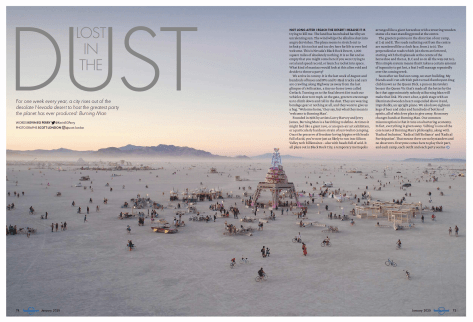
burning-man-lonely-planetNot long after I reach the desert I realise it is trying to kill me. The land has been baked hard by an unrelenting sun. The wind whips the alkaline dust into angry dervishes. The playa seems to stretch out to infinity. It is too hot and too dry here for life to ever feel welcome. This is Nevada’s Black Rock Desert, 1,000 square miles of absolutely nothing. It is so flat and so empty that you might come here if you were trying to set a land speed record, or launch a rocket into space. What kind of maniacs would look at this alien void and decide to throw a party?

We arrive in convoy. It is the last week of August and hundreds of buses and RVs and U-Haul trucks and cars are crawling along Highway 34 away from the last glimpse of civilisation, a tiny no-horse town called Gerlach. Turning on to the final desert dirt track our vehicles slow to 10mph. At the gate, greeters encourage us to climb down and roll in the dust. They are wearing bondage gear or nothing at all, and they want to give us a hug. “Welcome home,” they say, but what they mean is welcome to Burning Man.

Founded in 1986 by artists Larry Harvey and Jerry James, Burning Man is a hard thing to define. At times it might feel like a giant rave, or an open-air art exhibition, or a particularly hardcore strain of survivalist camping. Once the preserve of freedom-loving hippies with a head full of acid, you’re now just as likely to run into Silicon Valley tech billionaires – also with a head full of acid. It all plays out in Black Rock City, a temporary metropolis arranged like a giant horseshoe with a towering wooden statue of a man standing proud at the centre.

The greeters point us in the direction of our camp, which is at 7:45 and E. The roads radiating out from the centre are numbered like a clock face, from 2 to 10. The perpendicular roads which join them are lettered, starting with the Esplanade at the centre of the horseshoe and then A, B, C so on all the way out to L. This simple system means that it takes a certain amount of ingenuity to get lost, a feat I will manage repeatedly over the coming week.

Soon after we find our camp we start building. My friends and I run a British pub-turned-flamboyant drag club known as the Queen Dick, a pun on Eastenders boozer the Queen Vic that’s made all the better by the fact that approximately nobody at Burning Man will make that link. We erect a bar, a pink stage with an illuminated wooden heart suspended above it and, improbably, an upright piano. We also have eighteen kegs of beer and cider and hundreds of bottles of spirits, all of which we plan to give away. No money changes hands at Burning Man. One of the most common misconceptions is that it runs on a bartering economy. In fact, everything is given away. ‘Gifting’ is one of the core tenets of Burning Man’s philosophy, along with ‘Radical Inclusion’, ‘Radical Self Reliance’ and ‘Radical Participation’. That means there are no bystanders and no observers. Everyone comes here to play their part, and each camp, each outfit and each party seems more outlandish than the last. Burning Man is what happens when 70,000 people ask: ‘Is this too much?’ and nobody ever tells them: ‘Yes, that’s too much.’

On the first night after the pub is built I take my bike and cycle out into the deep playa. I watch as the sun sets over the city, purple hues filling the sky over a distant mountain range, the bleached light of day fading into the black of night. The horizon glows with countless neon lights, but these are unreliable landmarks. As well as the camps there are hundreds of slow-moving vehicles, known as art cars, and they move across the playa with no obvious logic. Pyramids and towering sheep, fire-breathing dragons and even a scale replica of the Golden Gate bridge are never to be found where you left them. Each of them throbs to the beat of their own soundsystem, and some of Burning Man’s most infamous nightspots – with names like Mayan Warrior and Robot Heart – are mobile. At one point, feeling disorientated, I hitch my bike to the side of a ship gliding past and climb up on deck. I grip the rigging and gaze out awestruck. Sometimes in life you need something to hold on to, even if that’s a giant neon pirate ship in the desert. Now the real game begins. Where on Earth did I leave the pub?

As I try to cycle back in the vague direction of 7:45 and E I pass revelers wearing outfits just as elaborate and creative as the art cars. There are BDSM punks and stilt-walkers in ballgowns, Mad Max warriors and models in bikinis. One night I see a couple dressed in khakis and fleece jumpers with cameras slung around their necks. I spend the rest of the week debating whether this strange vision was simply people wearing their ordinary clothes or arch conceptualists who’ve managed to put together the one costume that’s truly transgressive.

Just as I’m starting to become exhausted from cycling over the uneven playa I spot a rest stop. A little warren of sofas in the middle of the desert. It’s as if Burning Man has anticipated my exact desire, which of course it has. Throughout the week this happens time and again. Feeling hungry? Here’s a camp passing out quesadillas. Growing weary? This place will give you a coffee, although they may insist on spanking you to earn it. Struggling in the heat of the day? There’s a lounge full of people misting you with cool water. In need of a strong cocktail? Well, take your pick. This phenomenon comes with its own maxim: ‘The playa provides.’ Slowly, moment by moment and place by place, the desert is starting to feel a little less inhospitable.

Eventually I stagger back into the welcoming bosom of the Queen Dick. My friends are dancing on the bar and pouring shots into the mouths of a crowd of people I’ve never seen before. It feels good to be home. Night becomes day and day becomes night. Each morning in the pub I swap breathless tales about the things I’ve seen and found and am rewarded with stories of things I hadn’t even imagined. Everyone comes to Burning Man for different reasons. Everyone’s Burning Man is different.

There is only one universal communal experience, and the clue’s in the name. On the penultimate night we leave our bikes behind and walk to the man. All 70,000 of us gather together, at the centre of our new community, to watch him burn. We sit in a vast ring, whooping and cheering when he goes up in flames and then lingering a while as the heat prickles our faces. The next day we begin to dismantle the pub. When we’re finished we sweep the ground meticulously, making sure not even a scrap of plastic is left behind. Litter is taken very seriously at Burning Man. It’s known as MOOP (‘Matter Out Of Place’) and creating it is an unforgivable faux pas. By the time we all leave, the desert will look as blank and foreboding as it did when we first arrived.

Belatedly, I am coming to understand the significance of the desert. It is easy to become distracted by Burning Man’s dizzying lights and sounds, the chaos and the hedonism, but beneath it all is this grand blank slate. Every dancefloor, every piece of art, everything you see and touch has been built by someone expressly for you to enjoy. Everything has a purpose. On this sprawling canvas we come together to build whatever we like, wear whatever we like, be whoever we like. For this brief and wondrous grain of time, it’s home.

Published in Lonely Planet Traveller, January 2020.

That Fiji Feeling

fiji-lonely-planet.png

I regret to inform you that we have all been wildly misinformed about pineapple. I’d been going through life fishing rings of the stuff out of tin cans onto gammon and indulging my controversial affection for it on pizza, so I cavalierly assumed I had a pretty good idea of what it tastes like. I was wrong. I realise my mistake the moment I casually bite into a slice of freshly-picked pineapple and it explodes in my mouth: sweet and rich. It’s like hearing Beethoven’s Fifth when you’d been expecting a drunk banging on a bin. It’s as if happiness itself had a taste.

At the moment of my epiphany I’m standing in the kitchen of Sala Lacabuka’s home, in the tiny village of Vacalea. With a population somewhere around 80, it sits on a hilltop towards the eastern end of Kadavu, Fiji’s fourth largest island. The house was built by hand by her husband Seimisi and is painted a slightly deeper shade of blue than the vast sky above. When Sala started preparing dinner – tuna, spinach, eggplant and the tropical root vegetable, taro – Seimisi picked a baby pineapple from one of the plants outside and sliced it up to serve as a snack. We eat greedily, while above our heads shiny DVDs hang from the ceiling, catching the fading light. Sala’s incongruous choice of decoration is a complete box set of Scrubs.

Outside the window every child in the village – from toddler to teenager – is engaged in an energetic game of pani, a local game roughly equivalent to dodgeball. Behind them the sunset is beginning to turn the horizon candy-floss pink. Earlier, approaching the village by boat, thick green vegetation had made the whole place appear uninhabited, and there are no cars or roads on this side of the island. At 411km2, Kadavu is just slightly bigger than the Isle of Wight – but home to an awful lot more palm trees swaying over white sandy beaches. The sea is turquoise and clear. Pineapples grow freely. If you were ever shipwrecked on Kadavu, you probably wouldn’t be in any particular hurry to be rescued. For their part, the islanders don’t seem to be in any particular hurry about anything. Sala’s catchphrase is: ‘Take your time, no rush.’

I’d come to Fiji to find out why people here are so happy. A 2017 Gallup poll found that 92% of people who live in Fiji describe themselves as ‘happy’ or ‘very happy’, the highest proportion anywhere in the world. This statistic comes as no surprise to Seimisi, who as well as growing most of the food we’ll eat tonight also farms kava, the root crop used to make a mildly sedating drink which is Fiji’s main form of social lubrication. As we sit down to dinner, joined by their children Lusiana and Samuela, Seimisi points to the bountiful natural harvest spread out on the table in front of us as one of the reasons why Fijians are so content.

‘No money, no worries,’ he says. ‘In your country, you need to have money. Here you can pull up cassava and taro from the ground and get fish from the sea. In the evening you can drink kava. You may have no money, but you have no worries either.’

Be hospitable

The plentiful food also helps to facilitate Fiji’s culture of generosity and hospitality. Sala, who works as a manager at the nearby Matava Resort, invites guests to come and stay in her village. She’s just as welcoming to her own neighbours. ‘We keep our door open,’ she says, and she means this literally. The front door has been propped open all day. ‘We’re eating now, and whoever walks past we’ll say: ‘Come, have dinner!’ Anyone can just walk in if they feel like coming in. If they’re starving they’ll just come straight away and we’ll serve them food. Families don’t cook just the right portion. We cook extra so that we can invite anyone to come and have a meal with us.’

This sense of tight-knit community is strengthened by the islanders’ rich folklore and collective mythology. Over the dinner table Lusiana cuts off her parents to eagerly regale us with the story of Dakuwaqa, the fearsome Fijian shark god who was only defeated in battle by an octopus who lived in the shallow waters around Kadavu. ‘When they fought, the octopus wrapped his arms around the shark and used two of them to block the shark’s nostrils,’ explains Lusiana. ‘The shark surrendered and promised he would never bite or eat any Kadavu people.’ Local fishermen claim Dakuwaqa has protected them from shark attacks ever since.

After dinner I settle down for bed on a foam mattress in Sala’s living room and am quickly lulled to sleep by the quiet of the village. A chorus of cockerels breaks the silence a little before 6am, but another couple of hours pass before Sala appears in the kitchen to start shaping dough to bake into fresh buns. ‘In island life this is how we do breakfast,’ she says with a shrug. ‘There’s no rush.’

Most of the men who live in Vacalea are farmers, like Seimisi. For those women who don’t work in tourism like Sala there are more traditional forms of employment, such as weaving grass mats from pandanus leaves. A couple of doors down from Sala’s house I meet Kelera Raivasi, who learned to weave this way when she was just six years old. ‘All through Fijian history people have been weaving like this,’ she says. ‘The skill is passed from grandmother to mother to daughter.’

She sits on the mat as she works, happy to chat away as the weaving has long since become second nature. Her eyes light up when she hears that I plan to visit Bouma National Park on Taveuni, another island 200 miles to the north-east. Slightly larger than Kadavu, it is known as Fiji’s ‘Garden Isle’ because of the incredible diversity of its flora and fauna. By chance Kelera’s in-laws live there, and she’s spotted an opportunity to display that characteristic Fijian generosity. ‘The head man of that village is called Iosefo, he’s my husband’s father,’ she explains as she fetches two sulus, the Fijian sarong. ‘Can I give you these to take to him and his wife? He looks after the waterfalls. They’re beautiful.’

Cherish nature

Bouma National Park lives up to Kelera’s billing. A three-hour hike through the teeming rainforest reveals three waterfalls, each forming its own perfect pool. After the long climb I can’t resist the chance to dive in, washing the sweat from by body in the cool, fresh water. From vantage points near the top of the trail the island appears entirely untamed, a sea of green from which coconut palm trees grow like church spires. As I walk downhill, hibiscus, gardenia and heliconia flowers provide bright splashes of colour while frogs and purple shore crabs cross my path. In a small village near the entrance to the park I meet Chief Iosefo Raupuga, who welcomes me to his simple home and happily accepts Kelera’s sulus. As we talk, he points out that this pristine natural environment can’t be taken for granted. His community had to fight for it.

He explains that in the 1980s, a Korean logging company did a deal with the most powerful chief on the island to turn Taveuni’s trees into timber. They even went so far as to construct a sawmill. However, the chief still needed to get the assent of the various village chiefs, which at that time included Iosefo’s father. They all refused, the deal fell through and the barely-used sawmill fell into disrepair. In a poetic twist, the mill itself is now part of the forest, overgrown and tied up with vines. A tall, unfelled palm towers over the forgotten doorway.

‘They turned down a lot of money,’ says Iosefo. ‘They decided the island was more important. They were thinking of future generations, and I think they made a wise choice. Now we’re reaping the benefits of it. Money comes into the village from the tourists who visit the waterfalls every day.’

Like everyone I meet, Iosefo quickly agrees with the portrayal of Fijians as happy people. ‘We’re happy because we live as a community,’ he says. ‘We live as neighbours among these beautiful surroundings and we can always go and talk to the other villagers, our brothers and sisters.’

Live and let live

This sense of togetherness is another clue towards understanding Fijian happiness. Importantly, it even extends across what other countries would called ‘religious and cultural divides’. While around 64% of the population identifies – like Sala and Seimisi – as Christian, the sizable Indo-Fijian population helps explain why 28% of the population are Hindu.

Many of those Indo-Fijians live on nearby Vanua Levu, which at 12 times the size of Taveuni is significantly larger than the two previous islands I’ve visited and has much to explore. On the south coast near Savusavu I stroll along a white sandy beach and swim surrounded by tiny but curious fish. The island’s biggest town, Labasa, is home to almost 30,000 people – a heaving metropolis by Fijian standards built around one main street, with a bustling market and a busy bus station. Just outside of town is one of Fiji’s most significant Hindu religious sites: Naag Mandir, literally ‘Snake Temple’. The red and yellow building contrasts sharply against the rolling hills and is built around a three metre tall rock which resembles, from certain angles, a cobra. Some Hindus believe that this island is the place referred to in their scriptures as Ramanaka Dweep, where Lord Krishna sent a snake god.

When I visit, the rock is garlanded in red, yellow and white flowers. Although the priest’s chanting echoes around the room, there is a sense of stillness. Families from as far afield as Australia and New Zealand kneel, pray and give offerings of apples, bananas, coconuts and milk. The air is thick with the smell of burning camphor.

After the families leave the priest introduces himself as Anil Maharaj, and explains why people travel such distances to pray here. ‘They come to have their desires fulfilled,’ he explains. ‘Their problems are solved and their sicknesses are healed.’ He adds that religious tensions in Fiji are non-existent. ‘There are never any problems here,’ he says. ‘It’s a beautiful country. People are very happy.’

In Fiji that happiness springs from many wells. It’s easiest to see in the natural beauty of those untouched beaches and waterfalls, but it rises too from the strength of the communities that protect them. It’s there in the spirit of hospitality, the giving of gifts for no reason, and sometimes it’s in places you might not expect it – like that first bite of really fresh pineapple.

Published in Lonely Planet Traveller, January 2020.

Vampire Weekend’s Chris Baio and Fort Romeau on reinventing krautrock with new band CYM

PRESS-PHOTO-C.Y.M.-credit-Joey-Greene-1-1220x775Hidden away in Eagle Rock, a trendy neighbourhood in east Los Angeles, there’s a studio that once belonged to legendary Beastie Boys producer Mario C. These days, its home to Vampire Weekend bassist Chris Baio, and he’s already putting it to good use. Not content with merely being part of one of the albums of the year (VW’s ‘Father of the Bride’) or pursuing his solo career as Baio, he’s now teamed up with house music producer Mike Greene – who you may know as Fort Romeau – to form yet another band, CYM. Their experimental three-track debut EP is a wildly imaginative take on krautrock, and they say they’re just getting started. We visited the studio to get the lowdown:
Continue reading at NME.

Jason Schwartzman: ‘My uncle Francis Ford Coppola thinks Marvel films are despicable, but I’d be happy to act in one’

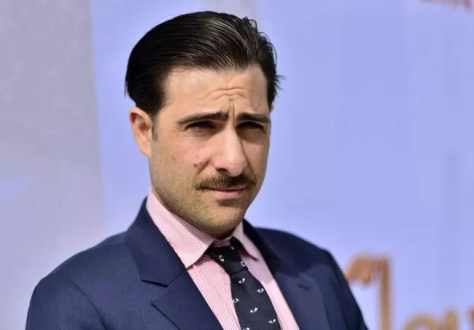
jason-schwartzmanJason Schwartzman is a sharp and witty presence onscreen, yet somehow our interview begins with pure old-fashioned slapstick. In a hotel room at the Four Seasons in Beverly Hills, he is attempting to turn off the television but only succeeds in pushing the volume louder and louder. “GAME TIME,” an announcer booms. “No, it’s not game time,” Schwartzman mutters back, still scrabbling around the set to silence the racket. The remote control has vanished, as remote controls are wont to do. Eventually, he gives up and yanks out the plug. “Pulled the power!” he grins triumphantly. “It’ll probably be a pain in the ass to set that up again, but I had to kill it somehow.”

Now that the recalcitrant device has been dealt with he takes a seat, dapper in a navy blue suit and tie with a pale pink shirt. His hair is slicked back above a neat moustache, as if he might be about to audition to play Clark Gable. A bundle of nervous energy, he still looks younger than his 39 years, but less boyish than he did in his floppy-haired youth. “I’m not cute like you,” Seth Rogen’s character lamented to Schwartzman in Funny People a decade ago, “I don’t look like Jackson Browne.”

Continue reading at The Independent.

Vienna’s hot spots

heurigerWhen the sun is shining in Vienna, there are few better places to be than the gardens of the Prater. Home to a sprawling amusement park – notable for the Ferris wheel where Orson Welles delivered his nihilistic monologue in The Third Man – it also contains one of the city’s most famous beer gardens. The Schweizerhaus has existed in this location in one form or another since 1766, and its reputation rests on doing two simple things very well: perfectly-soft, meaty pork knuckles the size of rugby balls, and glass tankards filled with beer so frothy that it’s impossible to drink them without getting bubbles on your nose.
‘Every year I always go to the Schweizerhaus with my friends,’ says Johann Diglas, whose family have run coffeehouses in Vienna since 1875. ‘We have a few beers and then summer has officially begun.’ We are sat in the hedge-lined garden of Café Diglas in Schottenstift, where Johann is sipping a white wine spritzer. ‘It’s half wine and half soda water. It’s very traditional for Austria,’ he says. Locals will tell you that the drink was invented in the country as an easy way to create bubbly wine. I discover, too, that drinking outdoors is intimately intertwined with Viennese culture. ‘Since the 1800s, people in Austria have felt that the coffeehouse is like their living room. Gardens like this one are the living rooms of summer.’

That concept, with all its welcoming ambience, is played out all over the city. At Heuer Am Karlsplatz, which shares a building with the Kunsthalle Wien art gallery, I have beer and burrata on a smart outdoor patio which has proven so popular they’ve had to set up wooden picnic tables and chairs in the adjoining park to cope with the overflow. At Glacis Beisl, a restaurant specialising in Wiener schnitzel, they serve their craft lagers in wine glasses – a world away from the foaming beers at the Schweizerhaus – but it’s their spacious courtyard that’s the real draw. I also spend an evening among the hundreds of Viennese who visit the Ottakringer brewery’s outdoor events during the summer, listening to Austrian cover bands play classic rock while drinking beers under the very silos they’re made in.

Looking for a view over the city, I head to the Dachboden bar on the roof of the 25Hours Hotel. It’s a fashionable hangout, with a disassembled drum-kit suspended over the bar, an extensive cocktail list and great views over the baroque MuseumsQuartier. However, for me, the best views in town are to be had from the bar on the roof of the Hotel Lamée. Here I sip a spritzer of my own while looking across at the majesty of St Peter’s Church – just 400 metres away – the most striking landmark on a skyline dotted with spires.

A short walk brings me to the Donaukanal, which borders Vienna’s city centre and was once an arm of the Danube before being converted into a regulated canal. The last 15 years have seen a rejuvenation of the area, particularly since the opening of Strandbar Herrmann in June 2005 demonstrated the appeal of water-side drinking.

Hermann remains one of the best, with deckchairs set up on a patch of sand and a young, hip crowd whiling away their day drinking bottles of beer and nodding their heads to reggae. Wandering further down the canal, I find Blumenwiese, which serves frozen daiquiris and puts an altogether more upmarket spin on the beach bar idea. By this point I’m ready to cool off with a swim, but the canal water doesn’t look too inviting. This is where Badeschiff Wien comes in: two barges that are permanently moored in the canal and house both a bar and a shimmering blue swimming pool.

Refreshed after my dip, I hop on a D Tram and head 20 minutes out of the city centre to my last stop, Heuriger Schübel-Auer. Will it, I wonder, be worth the journey? A ‘Heuriger’ is a type of traditional wine tavern located close to a vineyard; Schübel-Auer’s is just two blocks away. Before the city expanded, it was surrounded by fields, and stepping into the courtyard, I feel transported back in time to a rural idyll. It’s no surprise when you consider that the place has been owned and run by the same family since 1711, and that the table I sit down at is shaded by the branches of a 150-year-old chestnut tree. Wrought-iron lamp posts complete the atmosphere, although their powers aren’t needed in the dappled sunlight. The signature drink here is a DIY version of a white wine spritzer: one of their own bottles of wine served with an accompanying soda siphon. I mix my drink and put my feet up. As living rooms go, this will take some beating.

For Lonely Planet Traveller.

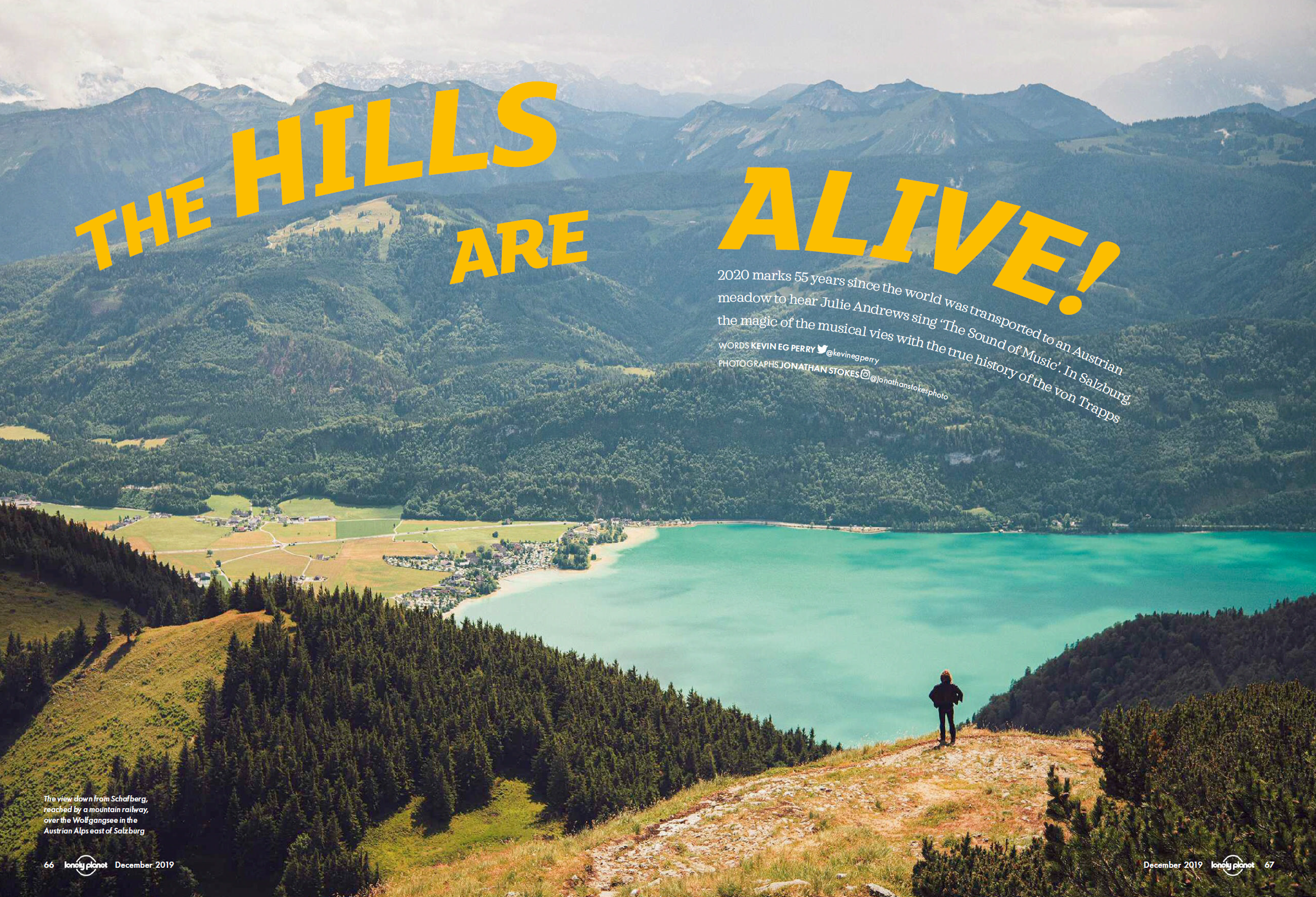
The Hills Are Alive!

the-hills-are-alive.png

It’s only an hour until stage time in Salzburg but right now the star of the show is wedged sideways between the green folds of the scenery, looking a little lifeless. Tonight’s performance is Rodgers and Hammerstein’s The Sound of Music, performed here in the same city where the musical is set, and where the real Von Trapp family singers once lived. Maria, the singing nun-turned-fairy stepmother made famous by Julie Andrews, is sandwiched between the scenery because, when the time comes, the meadows will spring into motion at exactly the same moment she does. Here at the Marionette Theater, the hills really are alive.

The Maria waiting patiently amid the folded fields is just one of five puppet Marias who play their part in this show, each with a different hand-stitched costume that’s been painstakingly minaturised. Another Maria, wearing a dark blue dress with a white apron, is shyly dancing on her strings towards the edge of the stage where the theatre’s creative director Barbara Heuberger is perched. ‘Oh God!’ gasps Barbara, still moved by the grace of the puppet even after 20 years working here. ‘That smashes me. It’s just a dead piece of wood, but it can express something so powerful.’

The Marionette Theater only started performing The Sound of Music in 2007, at Barbara’s suggestion, but the theatre itself has been here for over a hundred years. It opened on 27 February 1913 with a performance of Mozart’s comic opera Bastien und Bastienne, and has been bewitching children and adults alike ever since. In 1964, while shooting the film version of The Sound of Music, director Robert Wise found himself so enamoured with the puppets that he became determined to include them in his movie. Theatre boss Hermann Aicher declined to get involved because he was about to tour America, but Wise was undeterred and hired his own puppeters to produce the famous ‘The Lonely Goatherd’ sequence. ‘I think that’s the biggest mistake in the history of this theatre,’ says Barbara with a laugh. ‘But we’re the reason why there are puppets in the film.’

For Barbara, it made perfect sense for the theatre to repay the compliment by staging The Sound of Music as their first musical after a century of operas. She understands, too, why 300,000 visitors come to Salzburg every year in search of its magic. ‘It’s got wonderful music, and it’s a story with heart,’ she says. ‘Maria is the great mother, the mother for everyone. She came to the rescue of this poor captain, and even if the real Maria wasn’t actually like that with the children it doesn’t really matter.’

How Do You Solve A Problem Like Maria?

The fact that the true story of the Von Trapps did not play out exactly as it does in the musical can come as a surprise to some of those hundreds of thousands of fans who make the pilgrimage here from around the world. The actual home of the Von Trapps, Villa Trapp, is not quite as grand as the version which appeared on screen but is nonetheless a beautiful stately home that dates from 1863. It is now a hotel, with a photograph of the seven singing Von Trapp children lined up above the sweeping central staircase, a beautifully restored parlour full of antique furniture and a breakfast room where guests eat together around a single large dining table, just as the family would have done. It’s run by the husband and wife team of Christopher Unterkofler and Marianne Dorfer, who have dedicated themselves to preserving the real story of the Von Trapp family.

‘It’s true that the captain went into town to ask for a house teacher,’ explains Christopher, an ebullient former journalist who hasn’t lost his knack for telling a good story. We’re stood in the sun on Villa Trapp’s well-kept lawn, part of a 3.5 hectare estate which remains one of the largest in Salzburg. ‘Maria was a teacher at Nonnberg Abbey, not a nun. She intended to become one but the Mother Superior was unhappy with her temper. Maria’s nickname was ‘The General’, so you can imagine what she was like. In reality, the characters were vice-versa. The captain was the charming Julie Andrews-type, and she was more stern, like Christopher Plummer. On the other hand, you have to be fair, she did take on a family with seven kids and she had to rule somehow.’

While Maria’s temperament may have been romanticised, much of the story really did happen as it appears in The Sound of Music. The children did form a successful singing troupe, Captain Von Trapp did use individual whistle calls to summon each of them, and they really did flee from the Nazis because Von Trapp refused to serve in their navy – although in reality they made their escape by train to Italy, rather than hiking over the mountains to Switzerland.

It’s also true that Maria and Captain Von Trapp married in the convent church at Nonnberg Abbey, where she had once dreamed of becoming a nun. Visible from around Salzburg with its distinctive red onion dome, the nunnery is still active to this day. I climb an ancient set of stone stairs to reach the church, which contains beautifully preserved Romanesque wall paintings that date from 1150. The most spectacular view, however, is from outside the priory gates. Looking south, jagged mountain-tops seem to fade gradually into the blue of the sky as if some long forgotten Romantic artist had sat down and painted an exquisite backdrop for the whole city.

My Favourite Things

Whatever the truth about the mortal Von Trapp family, it’s the timeless pull of Robert Wise’s film that has been drawing people to Salzburg ever since it was released in 1965. Wandering down from the Abbey through the narrow cobbled streets of the city it’s easy to spot familiar sights from the film: the vast Baroque cathedral, and the Rock Riding School hall where the climactic concert takes place. In the fruit and vegetable market in Universitätsplatz I stop to eat a juicy tomato, like the ones Julie Andrews juggles with. Wherever I go there seems to be music echoing from around every corner, whether it’s a choir in the cathedral or an a capella group rehearsing in a beer hall. The sound bounces off the cobbles, mingling with the gentle clip-clop of horses pulling carriages and the splashing of water in the fountains.

A little further out is Schloss Leopoldskron, the grand house whose lakeside location was used for the scene where Julie Andrews and the children fall noisily into the water. Today the park beside the lake is quiet and tranquil, even though it’s a bright and warm Saturday afternoon. A group of men sit around on the bank of the lake with a hookah, their fishing lines dangling in the water, hoping for carp. Swans glide serenely over the placid surface. The house itself looks chocolate-box perfect on the far shore, with Hohensalzburg Fortress hovering over its shoulder. Just as in the film, the castle is a constant landmark, always in view somewhere above and beyond the workaday city.

One of the most famous Salzburg locations in The Sound of Music is the Mirabell Gardens, where Julie Andrews and the children perform their choreographed song-and-dance routine of ‘Do-Re-Mi’. Tour guide and dedicated Sound of Music superfan Trudy Rollo has no qualms about launching into her own rendition as we climb the steps towards the rose hill, and I find myself joining in. It’s as if everyone else in the gardens has been secretly waiting for this moment. Soon others have gathered around us, hesitantly singing and then breaking into applause at this impromptu moment of joyful abandon and reverance for the music that has drawn so many of them here.

Trudy is not surprised that The Sound of Music is still winning new fans half a century after it was released, or that they’re drawn to Salzburg. ‘It’s a good family film,’ she explains. ‘There’s no rampant sex scenes or major violence. Good wins over evil. Every time I watch that opening scene on a big screen, with Julie doing her twirl on up on the mountain, I still think: ‘Wow!’ It’s just so beautiful.’

Climb Ev’ry Mountain

The exact same thought comes into my own head while I look out at the rolling green hills surrounding the Posch’n Hütte, a wooden mountain cabin high up in Salzkammergut, the Austrian lake district. Taking a hike over the nearest ridge I watch as clouds roll into the valley below. Although just a short drive from Salzburg, the cabin feels like it inhabits another time. Even the air tastes sweeter. This is splendid isolation, cut off from the modern world without phone signal or wifi.

In nearby St. Wolfgang there’s a steam-powered cog railway up the Schafberg mountain which had a brief cameo in The Sound of Music, taking Maria and the children to the meadow where she teaches them to sing with ‘Do-Re-Mi’. As the track curves up the hillside at an incredible gradient the little engine chugs along, pushing – not pulling – the carriages through thick forests which eventually break to allow spectacular views over Lake Wolfgang. Within minutes we’re up above the clouds, looking out at grazing cows seemingly unphased by the altitude.

‘It’s wonderful here,’ says Martin Bahr, a train driver on the SchafbergBahn who grew up dreaming of working on these steam engines. ‘We have the lake and the mountains. I can go swimming, I can go out on a boat. I think it’s one of the most beautiful places in the world.’

Martin knows about the train’s brief appearance in The Sound of Music, but he’s more concerned with the noise a steam train makes all by itself. ‘For many people,’ he says. ‘It’s music.’

At the summit of Schafberg, a short climb from the train station, is a hotel serving good coffee and apple strudel. Directly behind the building is a terrifyingly sheer drop, a fact mitigated only by its breathtaking views. As I look down at the rough-hewn peaks reflected in shimmering lakes and the church spires jutting up from little towns I can’t help but think of those famous aerial shots which open The Sound of Music. Rather than taking the train back down, it feels better to walk down through the soft green grass of the meadows, listening to the music of the passing trains, the clanking of cow bells and – with apologies to Rodgers and Hammerstein – to sing:

“Stone-cobbled streets
And trains powered by steam
Nuns in old churches and strudel with cream
Beautiful puppets that dance on their strings
These are a few of my favourite things…”

Published in Lonely Planet Traveller, December 2019.

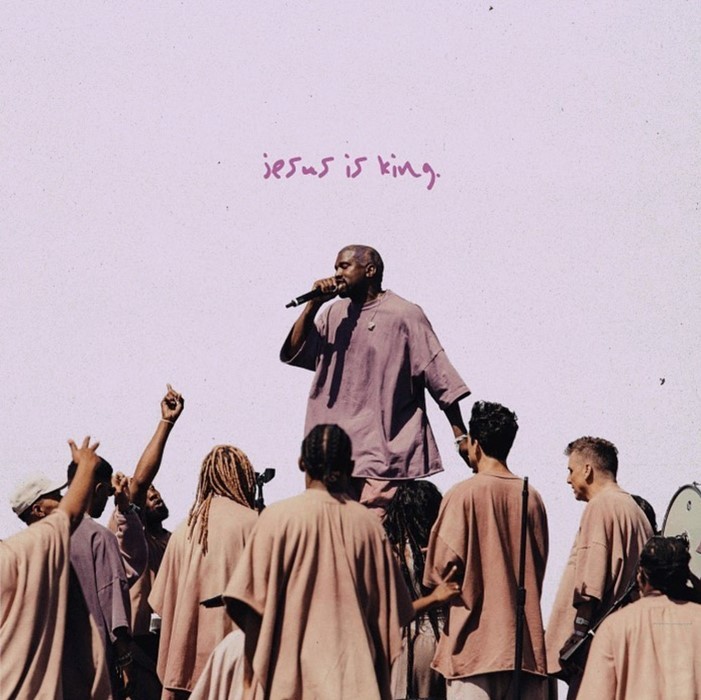
A report from the LA premiere of ​‘Jesus is King’

kanye-jesusLast night in Los Angeles, Ye’s faithful flock descended on the Forum to hear his repeatedly-delayed ninth album two days ahead of its (apparent) release. As they approached the venue they could see the record’s title JESUS IS KING in white lettering bathed in blue light, projected on the side of the building. Down in the parking lot, it was hell on earth.

The show was supposed to start at 8pm, but at that point thousands were still stranded outside trying to collect tickets. At 8:35pm, Kanye took the mic and asked for patience. ​Over half the people are not in the building yet,” he announced. ​Can you give us 15 more minutes?” The crowd, chanting: ​Yeezy!”, didn’t seem to mind at all, especially after he confirmed that the new record really is on its way this time. ​Two days ​til the album drop,” he confirmed. ​It’s coming.”

Continue reading at The Face.

Cigarettes After Sex: “It kills the magic if someone asks, ‘What’s our song gonna be?'”

20190715_CigarettesAfterSex_EbruYildiz_178-e1571393854807
Greg Gonzalez writes songs like intimate diary entries: explicit, erotic and nakedly autobiographical. That was all well and good when he started out in 2008, before anyone was really listening, but in 2016, his band Cigarettes After Sex became an overnight internet sensation eight years in the making.

It was in January of that year that his song “Nothing’s Gonna Hurt You Baby”, which had been released to little fanfare four years earlier, went belatedly and unexpectedly viral.

It has now been played 95 million times on YouTube alone, helping the band’s 2017 self-titled debut album find an audience eager for its gauzy, hypnagogic melancholy and X-rated lyrics. The question is, does this success mean that now every potential romantic partner expects to be memorialised in song?

Continue reading at The i.

“We make movies come to life”: behind the mask of Hollywood Boulevard’s superheroes and villains

Spongebob Squarepants.jpg

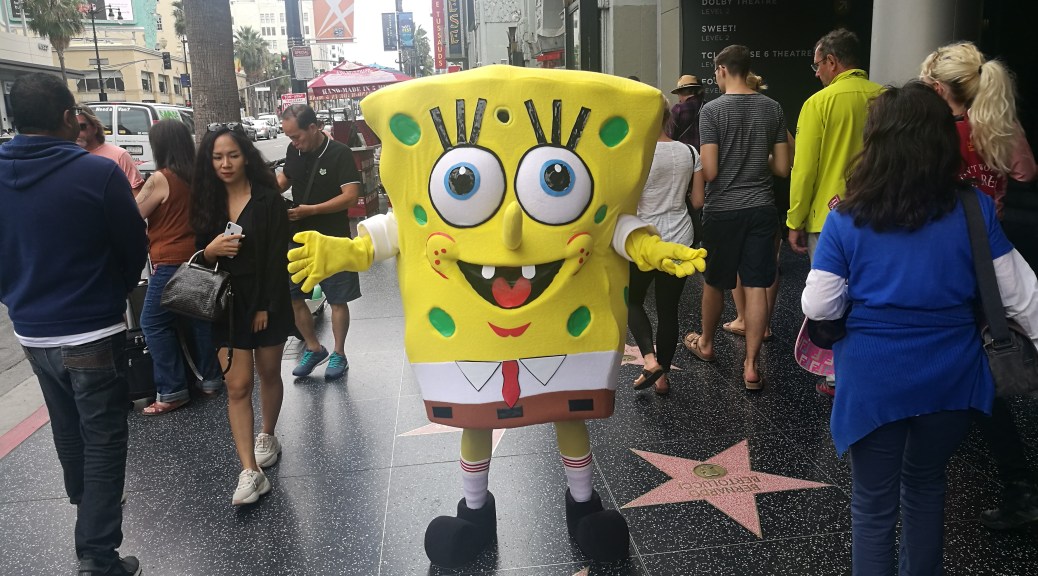
For the last 17 years, Bernard Golden has been living with a secret identity. By night he may be an unassuming security guard at Netflix’s office in Los Angeles but by day crowds of shy children and laughing adults gather around him on Hollywood Boulevard to pose for photos and exchange a few high-pitched words. All it takes is for Bernard to pull on his bright yellow costume and he’s transformed. He is no longer Bernard Golden. He’s SpongeBob SquarePants.

Continue reading at Lonely Planet.

Jerry Lorenzo: ​“There’s something about living in LA that is luxury”

FOG7Jerry Lorenzo may have been a late starter in the world of fashion but he’s sure as hell made up for lost time. At the start of the decade, Lorenzo was still working in sports management and struggling to find suitable clothes for one of his clients, LA Dodgers baseball star Matt Kemp. It was then that Lorenzo took matters into his own hands and decided to design them himself. His early work was such a hit that in 2013 he founded his clothing label, Fear of God. Since then he’s worked extensively with Kanye West, designed tour merch for Justin Bieber, Jay Z and Kendrick Lamar and created his own Nike shoes. It’s been a meteoric rise, but until now one thing Lorenzo never had was a shop to call his own.
Continue reading at The Face.

How this LA bar earned its own star on the Hollywood Walk of Fame

6 Musso Martini Photo Credit Tina Whatcott-Echeverria

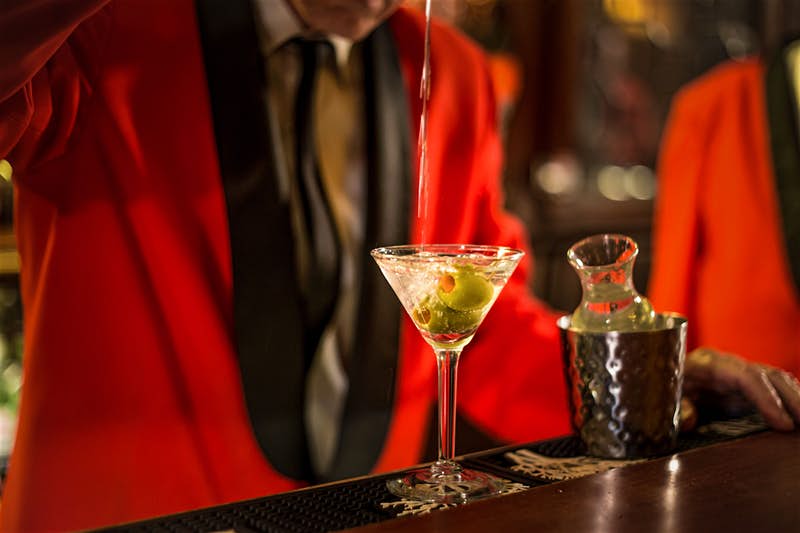
It takes a certain quality to make it in Hollywood, but sticking it out for an entire century requires something else altogether. On Friday, Musso & Frank Grill became the first restaurant in Hollywood to reach that milestone, celebrating 100 years of serving up their famed martinis.

Opened on 27 September 1919 by the eponymous Frank Toulet and Joseph Musso, Musso & Frank Grill was originally known as Francois until they adopted the current name in 1923. In those days the offices of the Screen Writers Guild were just across the street, and the restaurant and bar quickly proved popular with the city’s literary heavyweights. Regulars included John Fante, Dorothy Parker, Raymond Chandler and William Faulkner. The latter was said to have had a habit of mixing his own mint juleps behind the bar, something you probably shouldn’t try today.

Continue reading at Lonely Planet.

Big­gie Thinking

THEFACE_ACOGGIN_THINKBIG_1The Noto­ri­ous B.I.G. was not a man who was shy about his love of tak­ing tokes of the mar­i­jua­na smoke. Nei­ther is the late rapper’s son, CJ Wal­lace. That makes a move into the cannabis indus­try seem like a nat­ur­al step for the 22-year-old actor – but equal­ly, he knows he has to do right by the name of his father.

I was think­ing: how do we do it, oth­er than just putting Big­gie on bongs and Big­gie on blunts?” he tells me. ​“Oth­er than that, how do we real­ly do it?”

We’re gen­tly bak­ing in the sun out­side Wallace’s busi­ness part­ner Willie Mack’s home in the Los Feliz neigh­bour­hood of Los Ange­les. The pair met in May last year, after Wal­lace had wrapped shoot­ing the third sea­son of hor­ror spin­off series Scream. He was on the hunt for some­one who could help him use the Noto­ri­ous B.I.G. name for some­thing more than a cheap brand­ing exer­cise. Mack, with a long back­ground in cannabis mar­ket­ing, was the man for the job.

Continue reading at The Face.

The Lumineers: ‘Addiction is complex — there are so many shades of grey’

lumineers.jpgToronto is in the grip of film festival fever, and while The Lumineers may be one of the most successful bands in the world – their 2012 breakthrough track “Ho Hey” has been streamed almost 500 million times on Spotify alone – that doesn’t make them immune to the excitement.


In the lobby of the Hotel InterContinental, frontman Wesley Schultz has spotted Wagner Moura on an escalator. “That’s the guy from Narcos, dude!” he nods to drummer Jeremiah Fraites. “We love your show!” shouts Fraites. Moura gives the pair a cautious thumbs-up.

The bandmates could almost pass for film stars themselves. The long-haired Schultz looks not unlike a young Kurt Russell, while Fraites, in his pork pie hat, is a dead ringer for Woody Harrelson.

In fact, they’re in town for the premiere of III – either a short film or a long music video, depending which way you look at it, which dramatises their third album, a concept record of the same name which is released today.

Continue reading at The i.

City Guide: Austin, Texas

austin-abta.pngIt’s hard to go more than a few feet in Austin without spotting a sign or bumper sticker imploring you to ‘Keep Austin Weird’. It may be the capital of Texas, but this thriving and diverse city of nearly one million people has dedicated itself to providing an artistic and cultural alternative to the state’s mainstream. Walking around town you’ll spot statues of local heroes such as Willie Nelson and Stevie Ray Vaughan, while cult musician Daniel Johnston’s mural of Jeremiah the innocent frog – always asking: ‘Hi, How Are You?’ – has become a local icon. It’s also an easy destination to reach from the UK, with airlines including British Airways, Norwegian and American Airlines all offering direct flights from London, as well as many more options connecting through nearby Dallas-Fort Worth.
Continue reading at ABTA Magazine.

Black Sabbath made Birmingham the Home of Metal. Shouldn’t the city repay the favour?

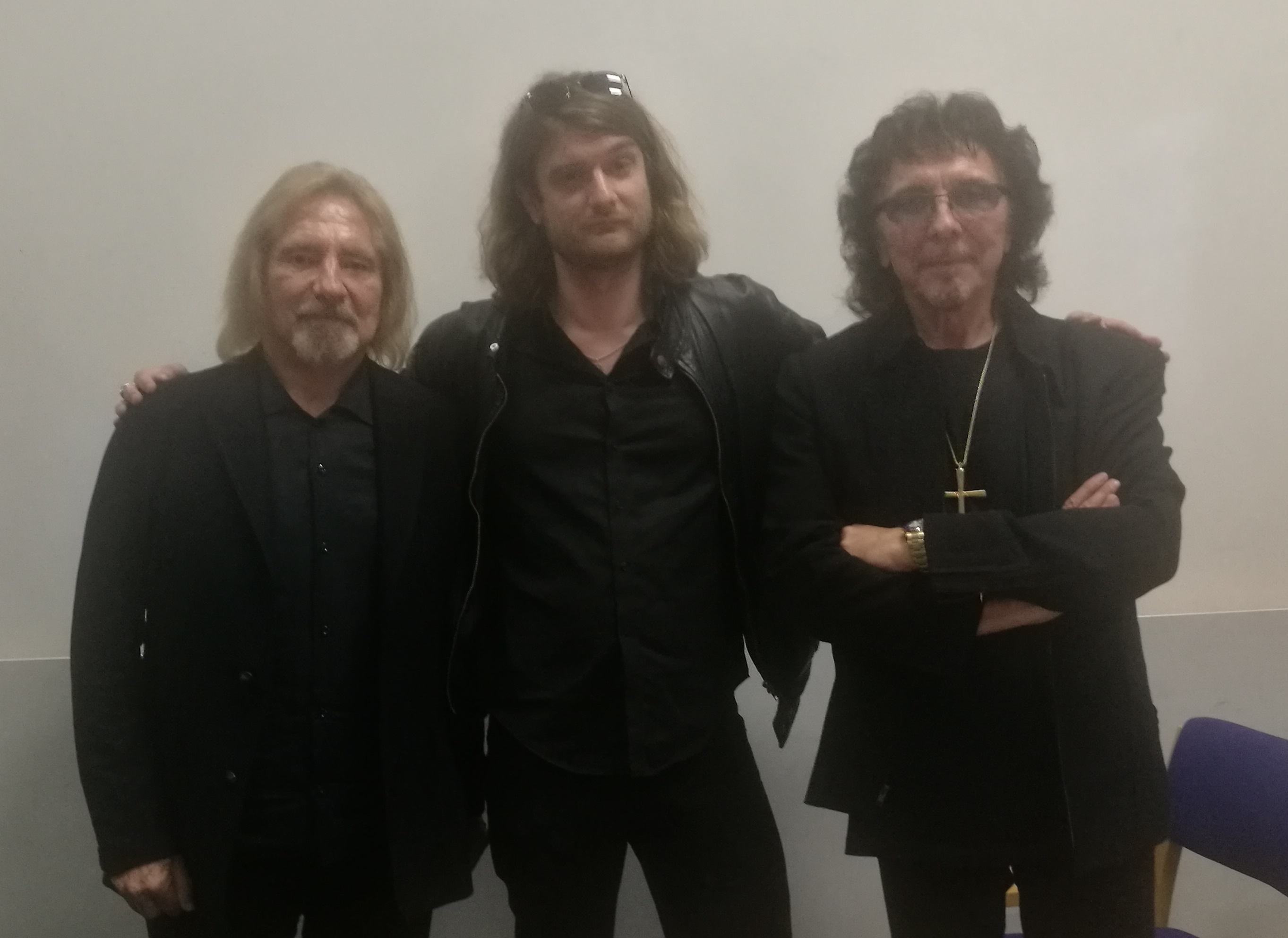
Earlier this summer, guitarist Tony Iommi and bassist and lyricist Geezer Butler returned to Birmingham for the opening of an exhaustive exhibition about Black Sabbath, the band they formed in the city 50 years ago. Birmingham Museum & Art Gallery is currently home to a vast collection of both the band’s own memorabilia and a staggering array of fan tributes. Asked if there was anything not present in the collection that they expected to see, Butler couldn’t resist a quip: “Ozzy?”
Continue reading at NME.

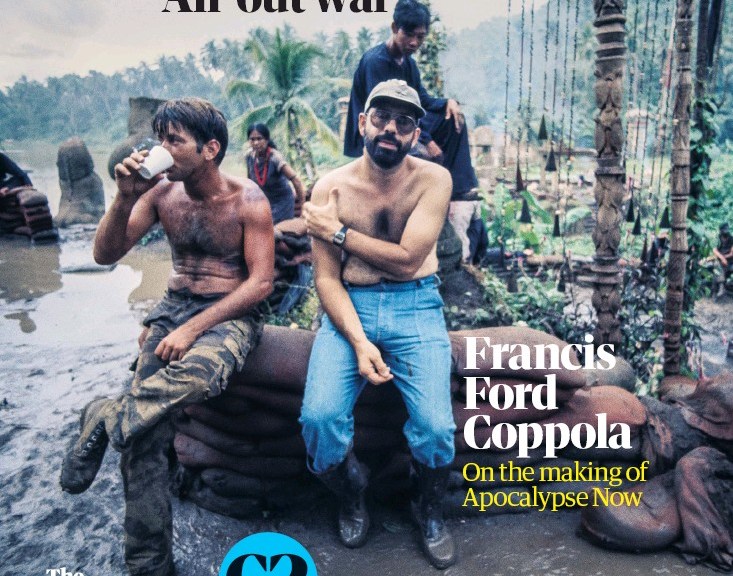
All-out war: Francis Ford Coppola on the making of Apocalypse Now

francis-ford-coppolaFounded in 1887 by a Finnish sea captain named Gustave Niebaum, Inglenook is a sprawling 1,680-acre winery known as “the Queen of the Napa Valley”. The estate contains 280 acres of vineyards, a Queen Anne-style Victorian mansion and a magnificent stone-and-iron chateau, all of which combine to create a refined northern Californian ambience that is about as far away as it’s possible to imagine from being in the shit in Vietnam.
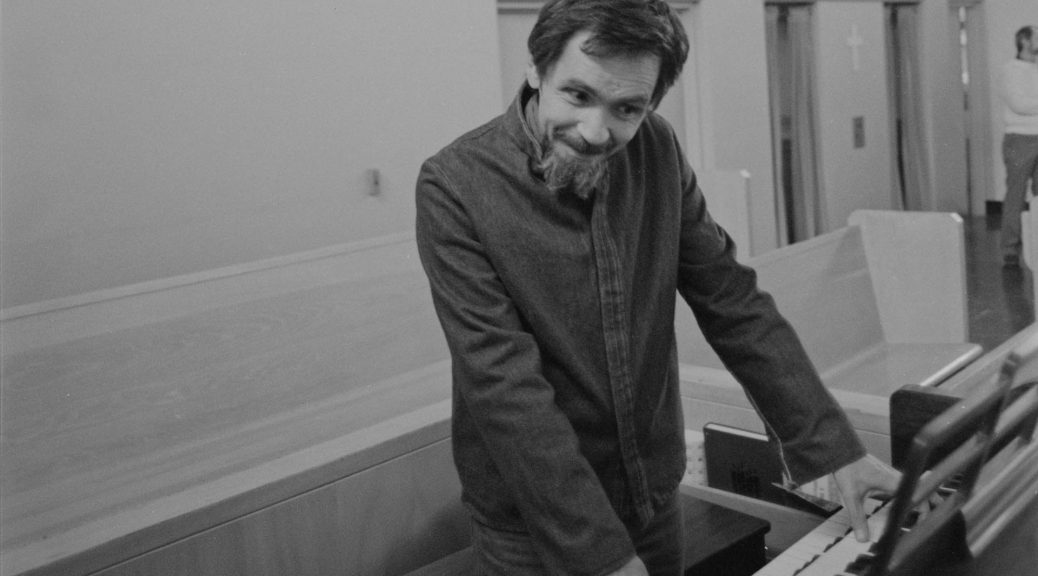
Yet arguably the greatest war film of them all owes much to Inglenook. Bought in 1975 by Francis Ford Coppola, using his spoils from The Godfather, he promptly risked the property, staking it to raise money for what would become one of the most arduous and challenging productions in the history of film. It is also here, in the estate’s old carriage house, that Coppola has spent the past two years restoring and refining a new – and he says definitive – version of that film: Apocalypse Now: Final Cut.

Continue reading at The Guardian.

Charles Manson: how the notorious cult leader tried – and failed – to launch a music career

Charles Manson hovers like a spectre in the background of Quentin Tarantino’s excellent new retro-romp Once Upon A Time In Hollywood, just as he’s haunted American popular culture ever since he orchestrated a series of gruesome murders in Los Angeles in August 1969.

The way his crimes came to represent the poisoning of the hippy ideal has given him an outsized reputation, making him appear far more powerful and terrifying than he really was. The truth is that Manson was a cruel and manipulative piece of shit, and like many pieces of shit before and since, what he really wanted in life was to be a rock ’n’ roll star.

Continue reading at NME.

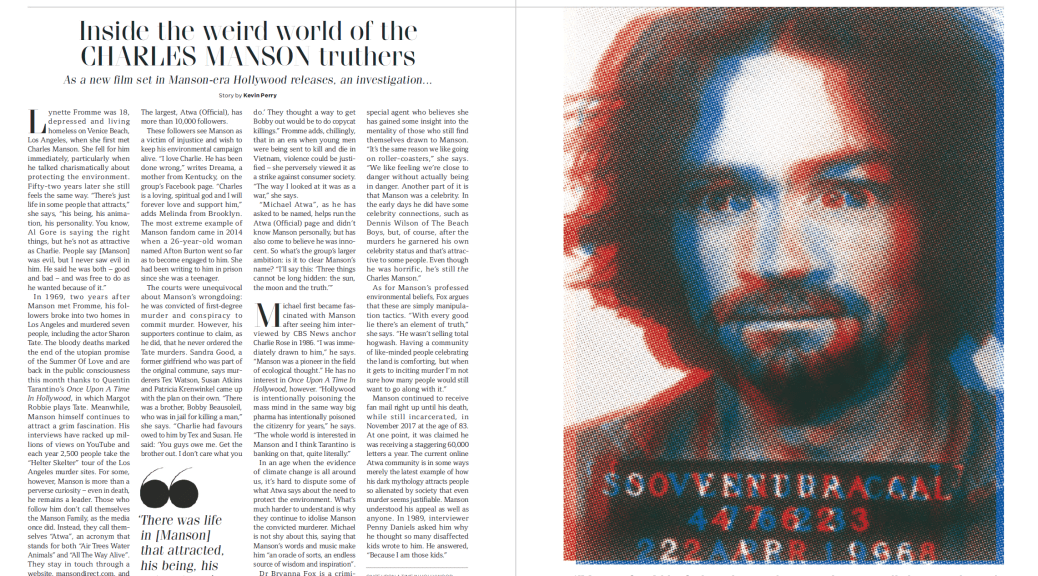
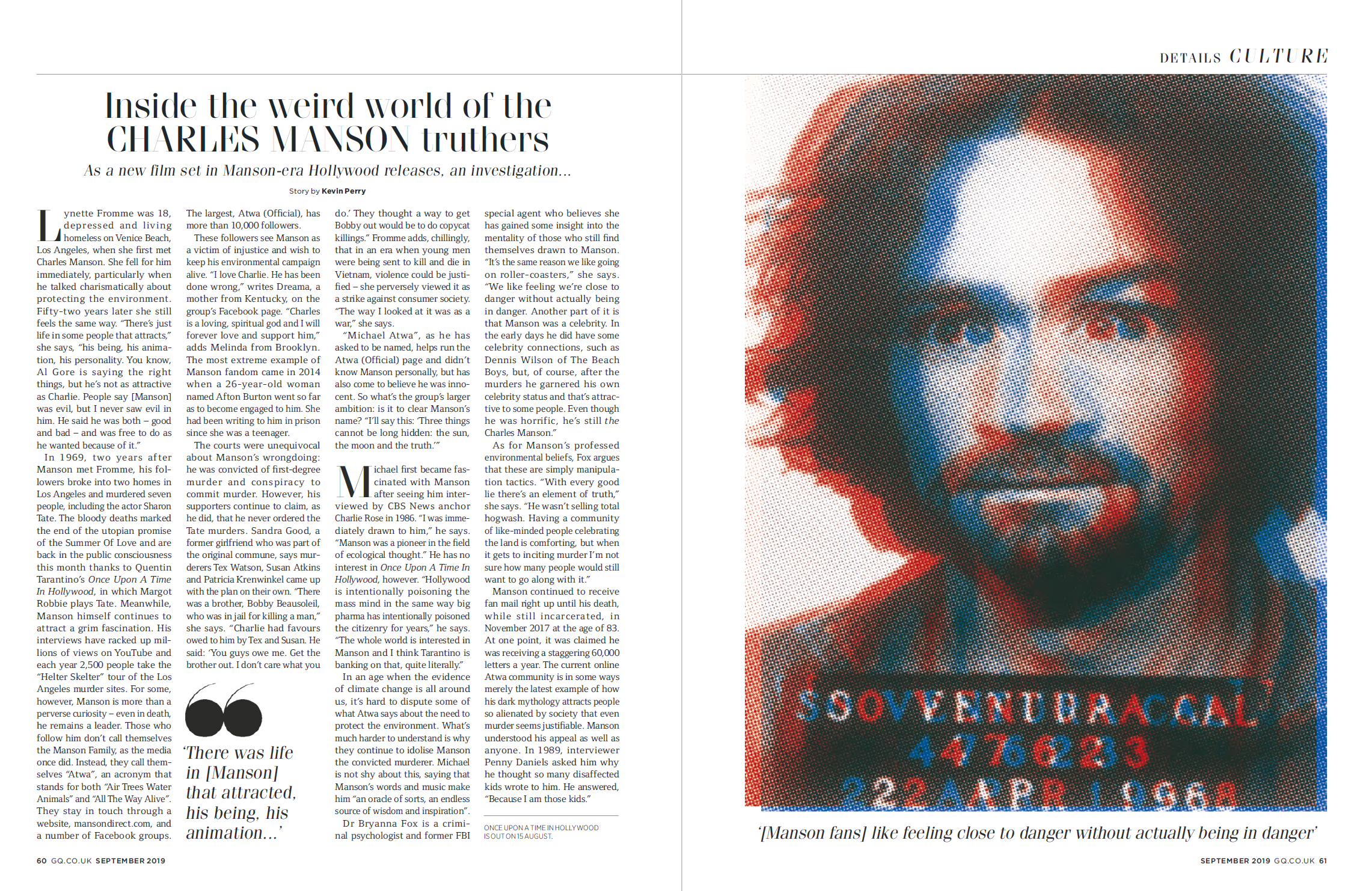
Inside the weird world of the Charles Manson truthers

Manson-truthers-GQLynette Fromme was 18, depressed and living homeless on Venice Beach, Los Angeles, when she first met Charles Manson. She fell for him immediately, particularly when he talked charismatically about protecting the environment. Fifty-two years later she still feels the same way. “There’s just life in some people that attracts,” she says, “his being, his animation, his personality. You know, Al Gore is saying the right things, but he’s not as attractive as Charlie. People say [Manson] was evil, but I never saw evil in him. He said he was both – good and bad – and was free to do as he wanted because of it.”

Published in British GQ, September 2019. Continue reading.

Oliver Stone on dropping acid during ‘Nam, his failed Bob Marley biopic and the psychedelic allure of Jim Morrison

There’s been a spate of big, campy music biopics in the last few years, including films about Queen (Bohemian Rhapsody), Elton John (Rocketman), Mötley Crüe (The Dirt) and even one about that band of freakish Doctor Moreau rejects whose screams haunt my nightmares (Cats).

Back in 1991, however, music biopics could be altogether darker and druggier affairs. Oliver Stone’s The Doors portrayed frontman Jim Morrison as a death-obsessed shaman who wandered the Sunset Strip spouting lines like: “What’s a band for? Let’s plan a murder or start a religion” or “I don’t remember being born, it must have happened during one of my blackouts”. It also featured a memorable desert acid trip sequence that would be lovingly satirised in Wayne’s World 2 (“I have to ask, didn’t you think it was a trifle unnecessary to see the crack in the Indian’s bottom?”).

Now that music films are back in vogue, the film has been given a shiny new 4K polish and is being re-released today. To mark the occasion, we headed to Oliver Stone’s Hollywood office to see if he’d let us touch one of his three (three!) Oscars (Best Adapted Screenplay for 1979’s Midnight Express, Best Director for both 1987’s Platoon and 1990’s Born on the Fourth of July). When that failed, we settled for talking to him about how Val Kilmer managed to rack up a $20,000 massage bill on the set of The Doors, the best place to score acid in Sydney in 1968, and why Madonna’s lack of acting chops led him to walk away from Evita.

Continue reading at NME.

My gonzo night at Hunter S Thompson’s cabin

sdr

It is 4.30 on a Thursday morning and I am writing these words on the big red IBM Selectric III that once belonged to Hunter S Thompson. Owl Farm, Thompson’s “fortified compound” in Woody Creek, Colorado, is dark and silent outside. Even the peacocks he raised are sleeping. The only sound anywhere is the warm hum of this electric typewriter and the mechanical rhythm of its key strikes, as clear and certain as gunfire.

In April, Thompson’s widow, Anita, began renting out the writer’s cabin to help support the Hunter S Thompson scholarship for veterans at Columbia University, where both she and Hunter studied. It sits beside the main Thompson home on a 17-hectare estate marked with hoof prints and elk droppings that gradually rises towards a mountain range. A short walk uphill is the spot where Thompson’s ashes were fired into the sky from a 153ft tower in the shape of a “Gonzo fist”, a logo he first adopted during his unsuccessful 1970 campaign to be sheriff of nearby Aspen. Johnny Depp, who played Thompson in Fear and Loathing in Las Vegas, picked up the $3m tab for that elaborate sendoff, which took place shortly after Thompson killed himself in 2005.

Continue reading at The Guardian.

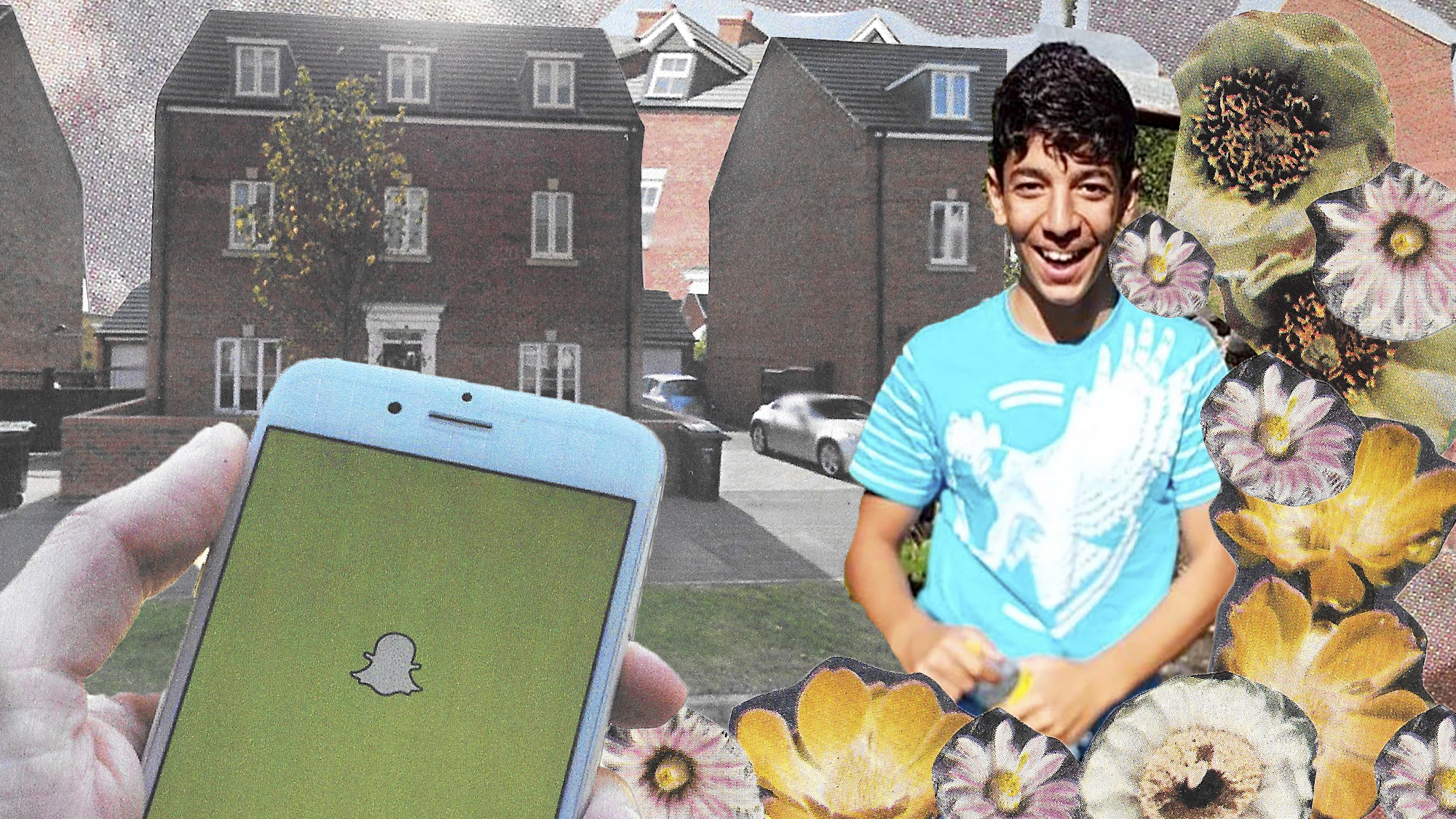
The Small Town Gang Murder Broadcast Live On Snapchat

1562660222071-blacktomIt was late on Sunday the 16th of September, 2018 when 16-year-old Cemeren Yilmaz lay dying on a patch of grass between Ashmead Road and Westrope Way. He was already bleeding from a deep stab wound inflicted by one member of Bedford’s Black Tom gang when two more 15-year-old gang members, Ramon Djauna and Caleb Brown, arrived on the scene. They were carrying a hammer. One of them struck Cemeren on the head with it, a blow that caused a compressed fracture of his skull, lacerating his brain and damaging it irreparably.


Cemeren groaned: “I think I’m going to die.”

We know he said this because Djauna was standing over him, filming the attack on his phone at the time. Cemeren begged him for mercy. Instead, Djauna posted the video to Snapchat.

Continue reading at Vice.

Can Above & Beyond’s yoga class and meditation album cure my post-Glastonbury malaise?

The week after Glastonbury is always tough. After a year as glorious as this one, even the drive home was more than I could bear. I got The Fear as soon as we got to a service station. Did we really have to come back to concrete civilisation? Couldn’t we just live in the fields? Where had all my serotonin gone? Why are there so many different types of crisps? Nothing made sense anymore.

I was lying flat across the backseat of the car in a cocoon of blankets and self-loathing when the email came through. I could hear my editors discussing it up front. Humongous, Grammy-bothering dance act Above & Beyond are apparently about to release a new album designed specifically for yoga and meditation, and they’re running a post-Glastonbury yoga session in a yard in Victoria. One of my editors jerked his thumb towards the back seat. “Kev’ll do it,” he said. I didn’t hate the idea. Maybe it’ll be just what I need to return my broken body to some state of normalcy. What they don’t tell me is that it starts at 8am. Bastards.

I’m late, obviously. The organisers have saved me a spot right in front of the DJ decks, but it’s hard to be inconspicuous when you’re wearing space cat leggings. I try to sneak straight into a surreptitious downward dog but before I know it a serene figure in white has appeared next to me. “That was quite the entrance,” she breathes. I’m far too fragile for all this.

Still, my Columbo-like powers of deduction are functioning enough that I gather this ethereal presence must be Elena Brower. One of the world’s leading yogi (not the bear), the story goes that she met the guys from Above & Beyond at Burning Man (where else?) in 2014. She led a yoga session in front of the Robot Heart soundsystem in the deep playa while Above & Beyond DJed (The set has now been streamed over two million times on Soundcloud). It was, by all accounts, such a profound and powerful experience for everyone involved that they ran it again five or six times at various other festivals and parties and eventually  decided to collaborate on a new album, ‘Flow State’.

The record itself is a continuous ambient instrumental mix, but there’s also a second version featuring a lengthy spoken word piece by Elena. The threat of a ‘spoken word yoga album’ is usually the sort of thing that makes me delete an email faster than you can think of a rhyme for Jeremy Hunt, but right now listening to Elena I realise I’d sell the stronger of my two kidneys for a recording of her. It’s not just that she’s gracefully guiding us through the yoga, making even pretzeling myself into an excruciating pigeon position seem elegant, it’s that she’s keeping up such a steady stream of wisdom about gratitude and safety and self-reliance that I catch myself smiling up at the clear blue sky. The music swells euphorically, not in a I’ve-just-dropped-a-pinger-in-Block-9 way, more like a striding-off-into-a-new-dawn way. It feels vast and cinematic. I’m Renton with the bag full of cash at the end of ‘Trainspotting’. I think it’s all going to be OK. I think it’s going to be fine.

Once Elena is done restoring me to the status of functioning human, I sit down with her and Above & Beyond’s Paavo Siljamäki and Tony McGuinness to find out how they ended up creating this instant dose of Serenity Now.

“We’re obviously DJs who spend most of our time playing dark nightclubs,” explains Paavo. “I think where this fits in is that I feel like if I look after my own mental fitness better, and look after my body better, if I’m in better shape mentally and physically, then I can get more out of the parties. It enables a lot more fun in life.”

We’re living in a hyper-accelerated age, where the danger of pushing yourself too hard and too fast is all too real. That fear is the tragic backstory to this project, which was born in the wake of the recent suicides of Avicii and Bill Hamel, a member of Fatum, who released music through Above & Beyond’s label Anjunabeats.

“I’ve been burning out,” says Paavo. “I’ve been struggling with depression. For me, this has been a therapeutic thing. I’ve needed to stop stuff, and I’ve needed space to really work through things. Music is such an awesome thing because I can make music if I’m feeling happy or sad or tired or energetic. That’s very much where a lot of this album has come from, from a very painful and dark place, but doing it has been a release and now that’s it’s out there maybe it’s going to resonate with people who are struggling. All the shocking things that have happened in the last few years have made me realise that we need to get people talking about this. There’s no shame in it.”

To reinforce the message he wanted to convey with this music, Paavo approached Elena to record her voice-over. “Her message is so on point with what we’re trying to do,” he explains.

So what exactly is Elena’s message? “The very first line [of the spoken word recording] is I think the most important,” she says. “‘There is a place within you that is always at rest and always at peace.’ Then we walk through the process of forgetting and remembering several times over the course of the talk, so that by the end there’s no question: You are here listening to this so that you can remember that space inside of you, provide yourself with a sense of safety and presence and hold your own hand. By doing so, you’re going to be able to do that for other people. That is a service that we can all give to the communities in which we live.”

Speaking of communities, I’ve got about 200,000 mates who I think would be into this. “We’ve got to bring this to Glastonbury, for sure,” says Paavo. “I think Glastonbury would be the place,” adds Tony. “Even more than Burning Man.”

Elena, are you in? “I’d love that!” Let’s make it happen. Glastonbury. 2020. Elena Brower and Above & Beyond, I wanna be your downward dog.

Originally published by NME.

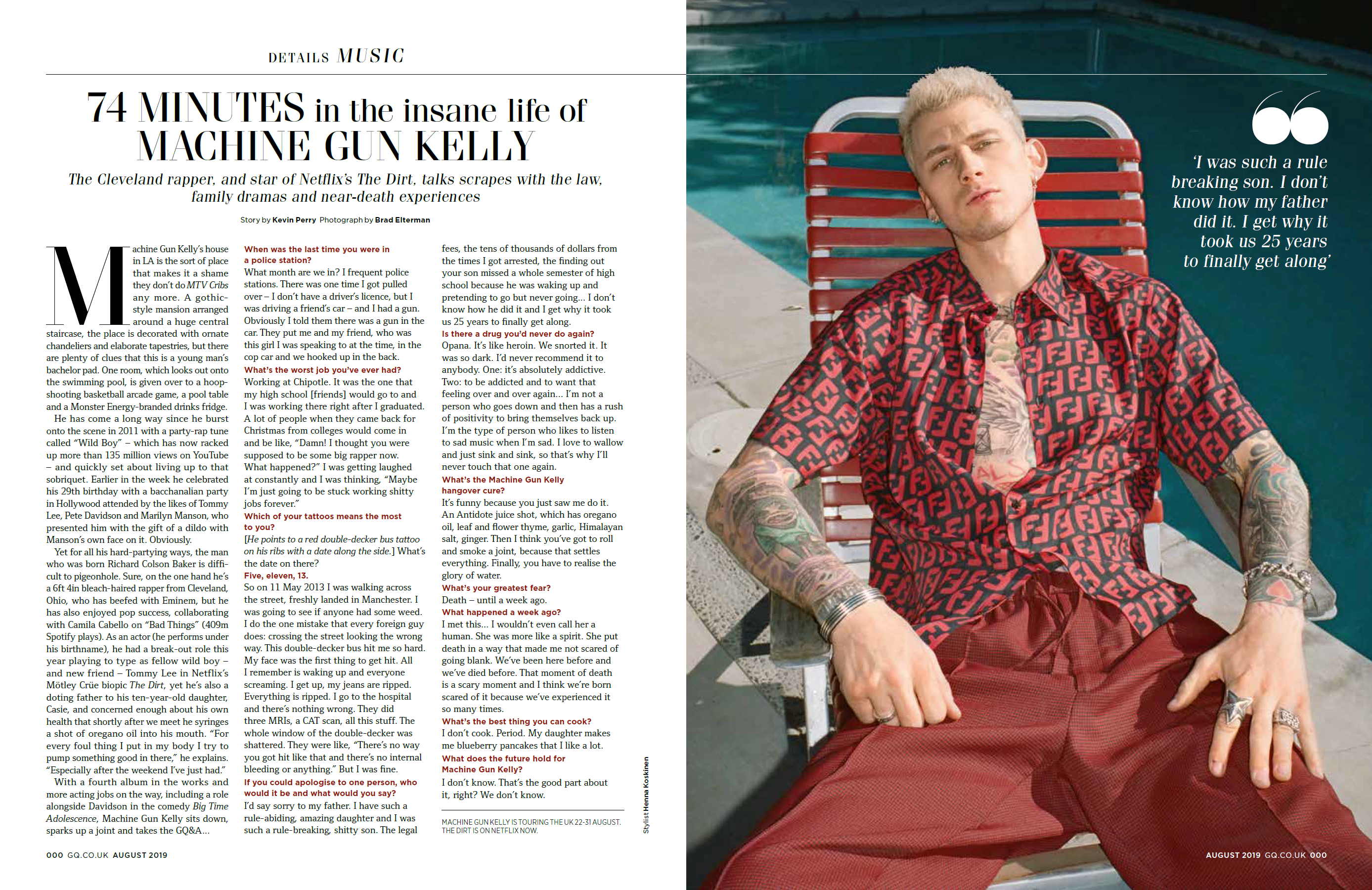
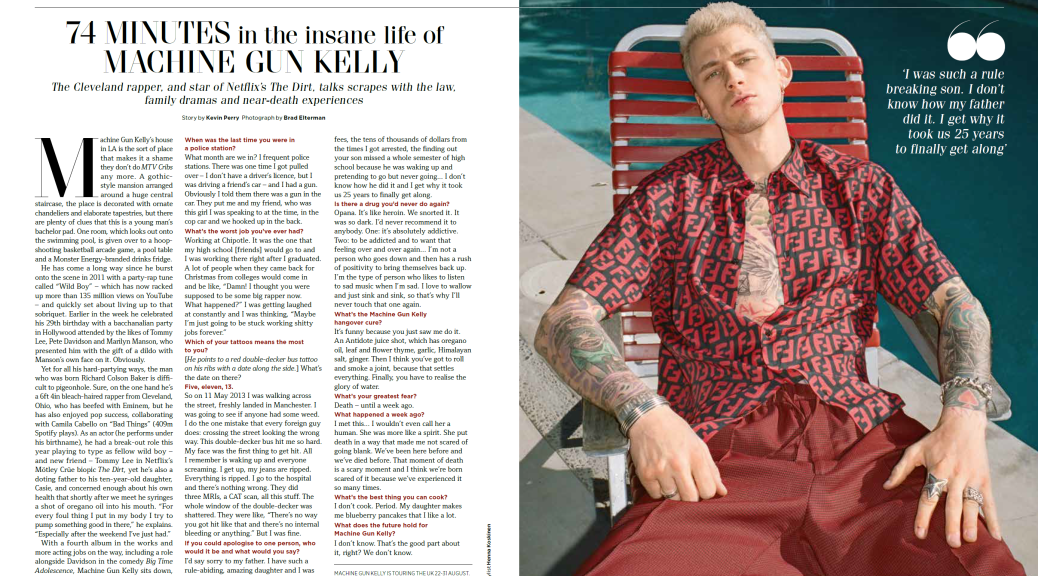
74 minutes in the insane life of Machine Gun Kelly

machine-gun-kelly-gq

20190719-Hype-Cover-02_b.jpgMachine Gun Kelly’s house in LA is the sort of place that makes it a shame they don’t do MTV Cribs any more. A gothic-style mansion arranged around a huge central staircase, the place is decorated with ornate chandeliers and elaborate tapestries, but there are plenty of clues that this is a young man’s bachelor pad. One room, which looks out onto the swimming pool, is given over to a hoop-shooting basketball arcade game, a pool table and a Monster Energy-branded drinks fridge.
He has come a long way since he burst onto the scene in 2011 with a party-rap tune called “Wild Boy” – which has now racked up more than 135 million views on YouTube – and quickly set about living up to that sobriquet. Earlier in the week he celebrated his 29th birthday with a bacchanalian party in Hollywood attended by the likes of Tommy Lee, Pete Davidson and Marilyn Manson, who presented him with the gift of a dildo with Manson’s own face on it. Obviously.

Yet for all his hard-partying ways, Machine Gun Kelly is difficult to pigeonhole. Sure, on the one hand he’s a 6ft 4in bleach-haired rapper from Cleveland, Ohio, who has beefed with Eminem, but he has also enjoyed pop success, collaborating with Camila Cabello on “Bad Things” (409m Spotify plays). As an actor (he performs under his real name, Colson Baker), he had a break-out role this year playing to type as fellow wild boy – and new friend – Tommy Lee in Netflix’s Mötley Crüe biopic The Dirt, yet he’s also a doting father to his ten-year-old daughter, Casie, and concerned enough about his own health that shortly after we meet he syringes a shot of oregano oil into his mouth. “For every foul thing I put in my body I try to pump something good in there,” he explains. “Especially after the weekend I’ve just had.”

With a fourth album, Hotel Diablo, out now and more acting jobs on the way, including a role alongside Davidson in the comedy Big Time Adolescence, Machine Gun Kelly sits down, sparks up a joint and takes the GQ&A…

Published in British GQ, August 2019. Continue reading at GQ Hype.

Glastonbury 2019: Running away to join the circus

KEVIN-EG-PERRY-ANDY-HUGHES-NME-GLASTO19-6667

Glastonbury has a way of getting under your skin. By the time Sunday rolls around, you start dreaming of ways you could keep living the festival life forever. If you’re anything like me, there comes a point where you start to think: ‘Could I… could I run away and join the circus?’

Luckily, Glastonbury is exactly the sort of place which encourages these sort of insane dreams. With Monday’s threat of a return to reality hurtling towards me at breakneck speed, I decided to pull on my trusty space cat leggings and head down to the the festival’s circus field. There’s a whole tent there dedicated to teaching a range of useful everyday life skills like hula-hooping, poi, juggling, contact balls, devil sticks and plate-spinning. That’s where I meet Ben the Juggler. Not the most inventive name, but you get the idea. “I wanted to be called Willy Drop’em,” Ben tells me sadly, “But somebody had already taken the name.”

He points out the circus tent proper on the other side of the field, which boasts a line-up of some of the planet’s most in-demand acts. You can see everything in there from high-wire acts and acrobats to card tricks and contortionists. “There’s some world class acts in the circus tent,” says Ben. “And we’re the beginning of the next world class acts.” I can only assume he’s talking about me. I’m pretty good at juggling deadlines. How much harder can balls or clubs be?

KEVIN-EG-PERRY-ANDY-HUGHES-NME-GLASTO19-6574

Pretty hard, as it turns out, although Ben makes it look as straight-forward as necking a pear cider. He’s been a professional juggler for 30 years, teaching in the south-west of England, and has come to Glastonbury in 15 of the last 20 years. “I always do the festival this way,” he tells me. “We get a lot of people coming here who can already juggle a little bit, so instead of just doing 1-2-3 we can open people’s minds to things that they never thought were possible to do themselves. That’s the cool thing about all this stuff, you do it for yourself. It gives you a little spring in your step knowing that you have a superhuman power with a hula-hoop. When people first learn to do something like spin a plate they get a look of joy on their face. It’s a leap of faith. You do it for yourself when you never knew you could. People feel good about themselves, that’s the thing.”

I like the sound of that, but when Ben starts showing me his moves with the juggling clubs I quickly lose confidence. “With clubs, it’s about knowing where the spin is,” he explains as they start flying around his body. “When I throw the clubs from one hand to another it spins around my shoulder height, and that way I know it will come down easily in my other hand.” He makes it sound so simple, but it looks close to magic. Soon he’s throwing them under his leg and balancing one of the clubs on his trilby mid-juggle. Showing off, in other words.

“Juggling, out of all these things, does take a bit longer to learn,” Ben concedes. “Hula-hooping you’re only concentrating on one thing, plate spinning you’re only concentrating on one thing, whereas with juggling you’ve got to get both sides going. People say it’s good for the grey matter, although there’s not much evidence for that for me.”

KEVIN-EG-PERRY-ANDY-HUGHES-NME-GLASTO19-6556

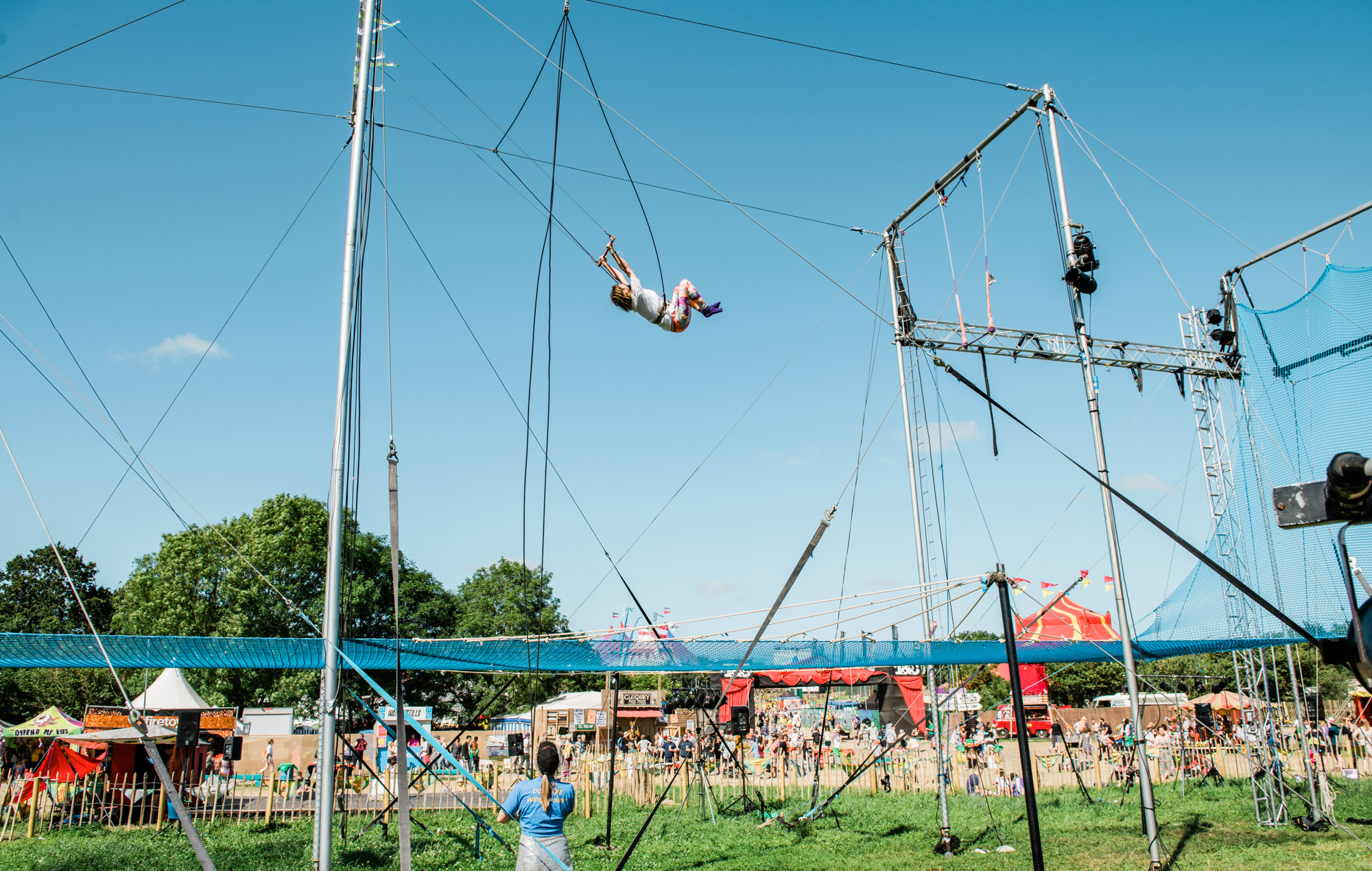
Ben’s being self-deprecating there. He’s inspired me to further pursue my circus dreams, but sadly I’m a truly terrible juggler. I’m not much better at hula-hooping either, and I can’t seem to spin a plate without sticking my tongue out. There’s no way I’m giving up that easily though. My eyes have been drawn to the grand centre-piece of the circus field: the flying trapeze. It’s time for me to go big or go home, and I don’t want to go home.

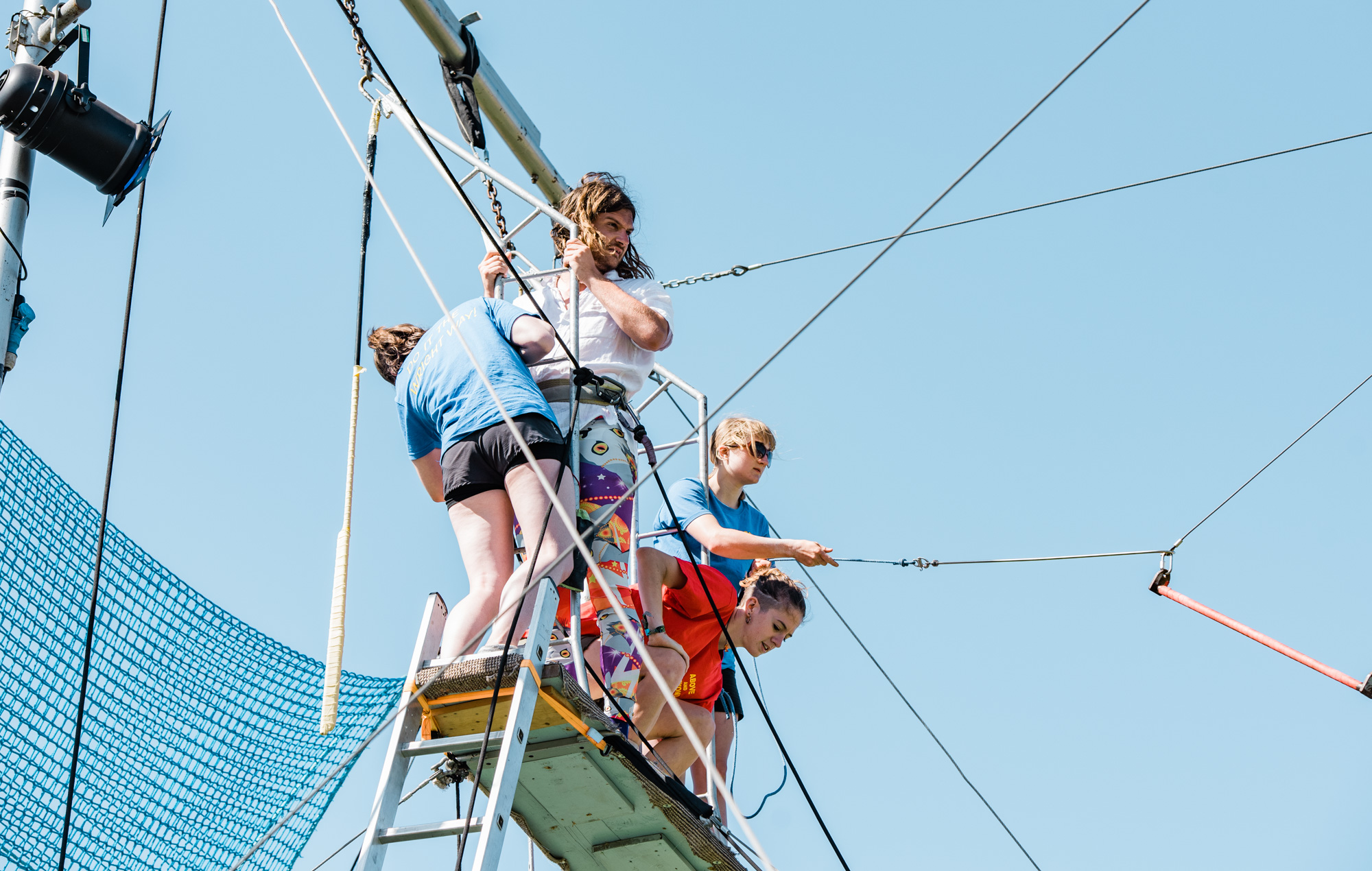
Every afternoon of the festival, Above and Beyond runs two-and-a-half hours worth of free aerial trapeze workshops. The company is run by 71 year-old Glastonbury veteran Mike Wright, who’s produced performances for the Brit Awards, Euro 96 and Simply Red. Hard to resist calling that a high-flying career.

Just as my training is about to begin, I get a text from a friend that Nick Cave has just come out with Kylie over on the Pyramid Stage. Annoying. Still, that’s the problem with Glastonbury. You can’t be everywhere at once, and I can’t quit on my new dream already. The instruction is, frankly, minimal. It basically consists of being told not to let go of the fly bar, which I probably could have figured out for myself. Just as I’m thinking that, one of the people ahead of me slips straight off the bar as soon as they leave the platform and crashes clumsily into the safety net. I don’t want to be that guy. If I can hang on long enough, the plan is that I’m going to perform a move called a knee hang, generally considered to be the most basic and accessible of flying trapeze tricks. Still, I’ve got to start my circus career somewhere, and upside down 25ft in the air seems as good a place as any.

KEVIN-EG-PERRY-ANDY-HUGHES-NME-GLASTO19-1392

As I climb the long, unsteady ladder to the platform, I can hear faint strains of ‘Can’t Get You Out Of My Head’ drifting across the fields. The view from the top is magnificent. On one side, I can just about make out Kylie on the big screens beside the Pyramid Stage. To the other, I can see down towards the madness of Block 9 and Shangri-La in the south-east corner, where in the early hours of this morning I was still rhythmically twitching to some sort of aggressive dance music. The foggy memories come roaring back into horrible clarity. Was that really only a few hours ago? Is it wise to launch myself off this platform in this sort of state? It’s nice up here. Will this be the end of me?

KEVIN-EG-PERRY-ANDY-HUGHES-NME-GLASTO19-6672

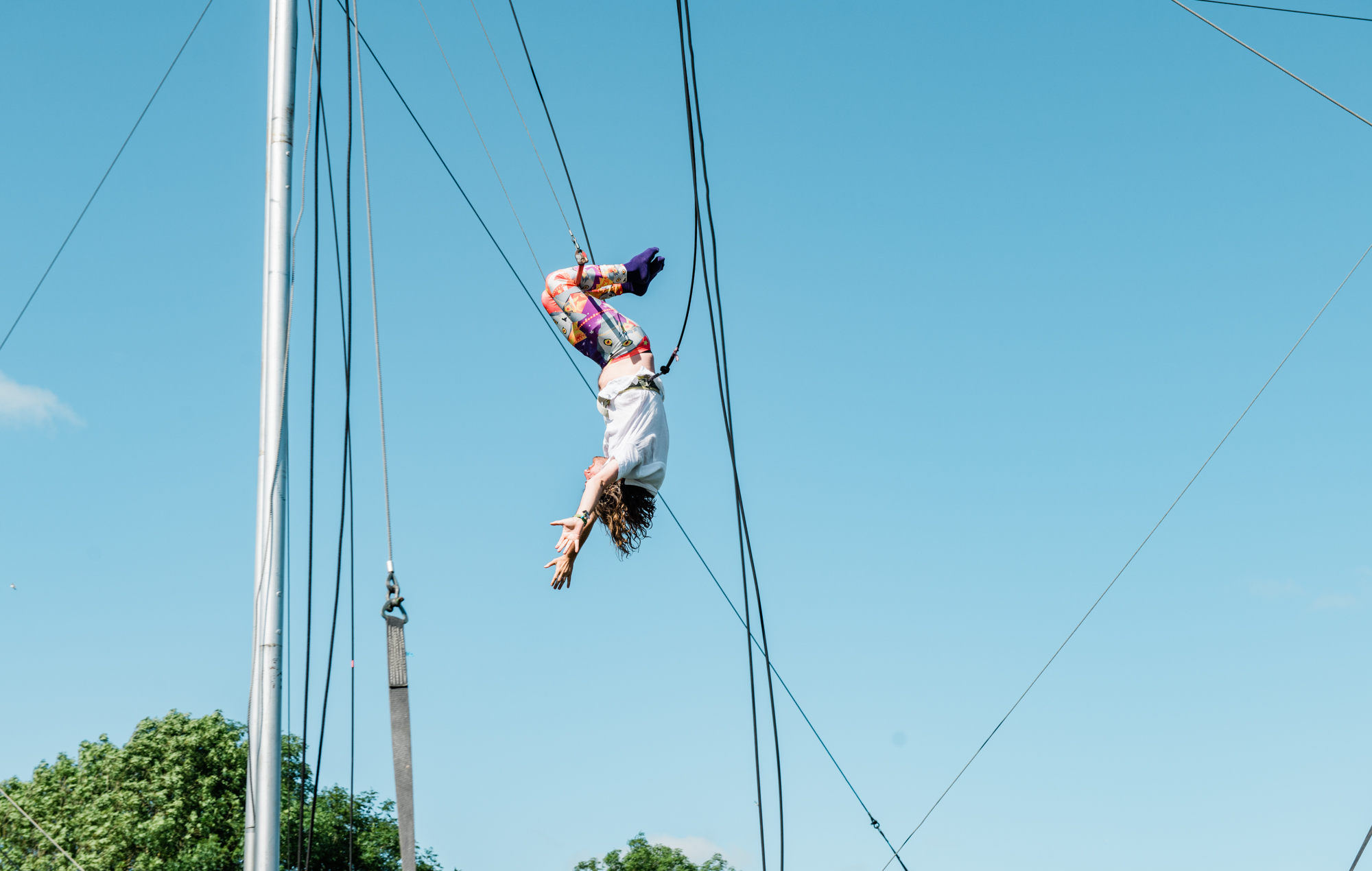
I grasp the fly bar in both hands. I hear the instructor’s voice say: “Ready?” and then: “Hup!” I jump up and the bar carries me forward, out into the clear blue sky. At the height of the first swing I somehow, impossibly, manage to curl myself up and hook my legs over the bar. As it swings back I let go and hang in the air upside down. I’m flying, Jack!

KEVIN-EG-PERRY-ANDY-HUGHES-NME-GLASTO19-6656

After a couple more swings I pull myself back the right way around and drop into the net. Okay, I know what you’re thinking, I might need to learn how to do more than just one knee hang before I can run away to join the circus. Yet as I dismount from the net I can feel that look of joy Ben the Juggler told me about spreading across my face. I saw a lot of great bands at Glastonbury this year, hugged a lot of friends, and did a lot of dancing, but what’s really special about this festival are the opportunities to do something totally new. Like learning to fly.

Originally published by NME.

Glastonbury 2019: Jeff Goldblum brings out Sharon Van Etten and announces new album

GettyImages-1159217185

Jeff Goldblum won over the crowd at his debut Glastonbury performance with a mix of easy charm and jazz classics. He also took the opportunity to announce the release of his second album with the Mildred Snitzer Orchestra, which will be released before the end of the year. It will feature a version of Irving Berlin’s ‘Let’s Face The Music And Dance’ featuring guest vocals from Sharon Van Etten, who joined him onstage today to perform their slow and sultry take on the classic tune from 1936. “Sharon Van Etten, can you please come and join us on stage,” Goldblum asked before she appeared. “The great Sharon Van Etten. We’re going to do a tune that – can I say? – we recorded for a new record on Decca Records.”

Continue reading at NME.

Glastonbury 2019: Liam Gallagher rolls back the years

LIAM-ANDYHUGHES-2

Liam Gallagher was put on this earth for moments like this. His set on the Pyramid Stage on Saturday night after a glorious day of sunshiiiine was so full of ‘Glastonbury moments’ that it’ll be hard for any act this weekend to better him.

He came out of the blocks like Usain Bolt running for a bus. He started the show with a pre-recorded chant of “Championes, championes”, presumably a reference to his beloved Manchester City as well as to his own rejuvenated fortunes in recent years. His stage set featured a banner reading: ‘MCFC Spezial’ as well as his usual ‘Rock ‘N’ Roll’ sign. As the chant faded out, Oasis’ classic opening music blared out over the field as Liam strutted on stage. And nobody struts quite like Liam.

Continue reading at NME.

Mac DeMarco meets his idol Haruomi Hosono

Mac-KEGP-Hosono

Since he moved to Los Angeles, Mac DeMarco has had plenty of musicians over to visit the home studio in his backyard. Today’s guest, however, is a special one. Haruomi Hosono has arrived, trailed by a Japanese film crew, who are shooting a documentary about the legendary musician’s hugely influential career and recent cultural resurgence. DeMarco is an avowed Hosono superfan, so while he’s usually as laid back as they come, today even he betrays a few nerves as he plays Hosono some of his recent recordings. He mentions that he was even more nervous last night, when DeMarco joined Hosono onstage at The Mayan Theater to perform the Japanese artist’s 1975 track “Honey Moon” together.

Haruomi Hosono’s music is impossible to pigeon-hole. The 71-year-old experimentalist started out playing with Tokyo psychedelic rockers Apryl Fool before he became the bassist for California Sound-indebted four-piece Happy End, but it’s his work with Yellow Magic Orchestra, the pioneering electronic group that he formed in 1978 with Ryuichi Sakamoto and Yukihiro Takahashi, that he’s most known for. To a certain type of musician, however, Hosono will be equally recognised for his mind-bogglingly eclectic solo career, which has experienced something of a revival in the west as of late. A number of his albums were recently reissued by Light in the Attic, and Vampire Weekend sampled his ambient track “Talking” on their single “2021”. DeMarco has been covering his songs, too, and in a recent interview with CBC Radio, he said that since hearing Hosono’s music ten years ago, “I’ve just been trying to rip him off. He’s been my favourite thing to dive in to or listen to or try and emulate for a long time… There’s a wealth in terms of what I’d like to achieve.”

So today, beneath the shade of a pomelo tree, the pair are sitting down to discuss Hosono’s work, his studio clothing etiquette, and all the times he’s been as starstruck as DeMarco is right now.

Continue reading at Dazed.

GQ at Glastonbury: “I was there when…”

gq-glastonburyWhen Leonard Cohen did not go all the way to Glastonbury to fool us, 2008
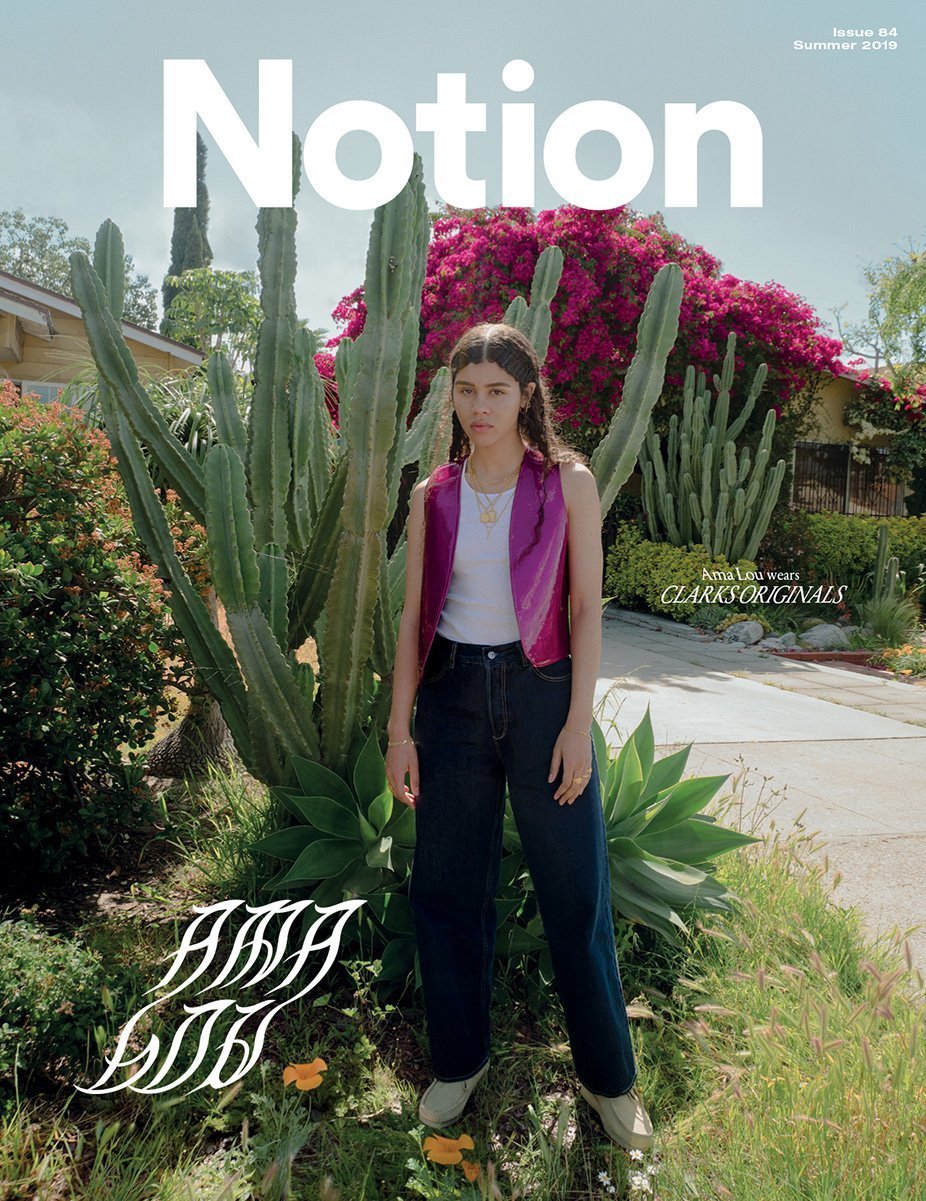
There’s a popular misconception that Leonard Cohen’s music is a bit of a downer and it was this falsehood I found myself battling as I corralled a group of friends into joining me for his 2008 set on the Pyramid Stage. They thanked me later. Cohen’s performance was as uplifting and joyful as any I’ve ever witnessed, in the muddy fields of Pilton or anywhere else. The man himself, suavely suited and with a sly grin half-hidden under a fedora, seemed to be enjoying himself too. “I told the truth,” he sang during an unforgettable “Hallelujah”. “I did not come all the way to Glastonbury to fool you.”

Read more at British GQ.

Joy Division’s Unknown Pleasures: an oral history

joy-division-gq-14jun19_bIt’s been 40 years since Joy Division released their debut record Unknown Pleasures, an album that has done more than any other to teach us what the radio waves from pulsar stars look like.

Its now-iconic cover art, found by guitarist Bernard Sumner in The Cambridge Encyclopaedia Of Astronomy before being modified by graphic designer Peter Saville, has gone on to appear on everything from bed sheets and baby grows to trainers and skateboards.

While the Unknown Pleasures artwork has been subsumed into popular culture, the music itself has steadfastly resisted commercialisation. When the record was first released on 15 June 1979 on Factory Records it sounded quite unlike anything that had come before it. That was a result of the unlikely cast who ushered it into existence. Sumner and bassist Peter Hook had formed a band called Warsaw in 1976, later changing their name to avoid confusion with the punk band Warsaw Pakt. In Ian Curtis they had stumbled across a singular lyricist and frontman. Drummer Stephen Morris completed the band, but the sound of Unknown Pleasures would also be heavily shaped by maverick producer Martin Hannett.

Acclaimed from the moment it was released, the album’s critical reputation has only grown in the last four decades. NME, Q and Pitchfork all named it one of the greatest albums of the Seventies, while Rolling Stone called it one of the best debut albums of all time. The diverse list of artists to have cited it as an inspiration includes U2, Moby and The Killers.

Here, Sumner, Morris and Saville recall the creation of a classic.

Continue reading at British GQ.

Mass Hysteria: Ghostbusters reunite to celebrate 35th anniversary and set out 2020 vision

ghostbusters-fan-fest
Last Saturday marked the 35th anniversary of the release of Ghostbusters, the most popular and commercially successful movie ever to feature a scene in which one of the lead characters receives a blowjob from a ghost. (Contrary to scurrilous rumour there is absolutely no evidence that Dan Aykroyd getting head from the dead was the origin of the popular theme lyric: “Bustin’ makes me feel good.” The only connection is the one you’re making now, in your own mind, and neither I nor the filmmakers can be held responsible for what goes on in there.)

I’m sure you all celebrated the occasion in your own way, perhaps by eating some Stay Puft marshmallows or a big Twinkie, but I decided to strap on my proton pack and head over to the Sony Pictures lot in Los Angeles to join original Ghostbusters Dan Aykroyd and Ernie Hudson at the Ghostbusters Fan Fest. I have to confess, there was a part of me that felt a little cynical about the whole endeavour. The idea of hosting a sort of ComicCon in miniature based solely on Ghostbusters could have been little more than an exercise in flogging merch and fleecing the very fans who hold the series so dear. I couldn’t help but think of Bill Murray’s line as Peter Venkman in the original 1984 film: “The franchise rights alone will make us rich beyond our wildest dreams!”

Yet as soon as I arrive I realised how wrong I’d been. Most of the costumes – and there were a lot of costumes – on display were homemade, whether it be jumpsuits or the impressively intricate proton packs everyone seemed to have designed for themselves. As if by magic, I felt myself being transported back to my brother’s birthday when we were kids, the one when we used foam-firing proton guns and a ghost trap made out of a shoebox to hunt and eventually capture Casper the Friendly Ghost, in what many critics claim to be “the most ambitious crossover event in history.”

The idea of children wielding proton guns turns out to be central to the plot of the eagerly awaited Ghostbusters 3. Jason Reitman, the director of Juno and Up In The Air, took part in one of the day’s most eagerly awaited panel discussions and revealed all sorts about what we can expect from next year’s film. He told the crowd: “We wanted to make a love letter to the original movie. I did not expect to be making a new Ghostbusters movie. I thought I was going to be this indie dude who made Sundance movies. And then this character came to me. She was a 12 year old girl. I didn’t know who she was or why she popped into my head, but I saw her with a proton pack in her hand. And I wrote this story. This story began to form over many years actually. It started with a girl and all of a sudden it was a family. And eventually I knew this was a movie that I needed to make.”

He confirmed that the 12-year-old girl in question will be played by Mckenna Grace, who recently played the young Carol Danvers in Captain Marvel. Her family will be fleshed out by Stranger Things star (and Calpurnia frontman) Finn Wolfhard, who of course already has some experience in a Ghostbusters uniform, and Gone Girl’s Carrie Coon as their mother. Reitman also promised that the film would blend horror in with the comedy, joking: “I want to scare children.” He’d earlier mentioned that Steven Spielberg had recently told him that he considered the library ghost from the original film as being one of the “Top 10 scares of all time.”

The big question hanging over the film, however, has been the extent to which the cast of the original two films will return. Reitman made a show of attempting to keep his lips sealed, but he did lay a pretty strong hint at their involvement by confirming that Bill Murray, Dan Aykroyd, Ernie Hudson and Sigourney Weaver have all read the script for the film.

The sweetest moment of the day though was when Reitman turned to his father Ivan – director of the original two Ghostbusters films – to sincerely express his “gratitude for telling this story that’s brought people together from all over the world.” Just like that, all my cynicism exploded like a 100-foot tall Marshmallow mascot in the streets of New York. Roll on 2020, I’m excited beyond the capacity for rational thought.

Originally published by NME.

The History Boy

Studarus_190425_AndrewBird_0355_1107_1627_90

The Largo at the Coronet is a 130-seat theatre in Los Angeles which first opened in 1947, making it something of an ancient landmark in Hollywood terms.

In its opening year the venue hosted the world premiere of the English language version of Bertolt Brecht’s Galileo Galilei, and ever since it has held a reputation for staging challenging and provocative new work by musicians and comedians alike. The place has become something of a second home for Andrew Bird so it’s here that he’s come to debut his twelfth solo album, which he’s given the waggishly self-aggrandising title My Finest Work Yet.

As he proceeds to play the album in full to an audience that includes the likes of Carrie Brownstein it’s clear there’s a measure of truth to that swaggering name. My Finest Work Yet is a lush and melodic collection of songs which showcase Bird’s playful lyricism and virtuoso whistling, but they’re also shot through with nuanced political thought. This is picked up on by the show’s host, the actor John C. Reilly, who is a friend and fan of Bird’s. During a short Q&A Reilly finds himself imploring Bird to elaborate on some of his mythical and historical references. “What exactly,” he asks, “was going on in Catalonia in 1936?”

A month later I’m sat in Andrew Bird’s kitchen at his chic, minimalist home in the leafy LA neighbourhood of Los Feliz. I’ve come to find out more about why, at the age of 45, he’s made his first overtly political album. Before that, he’s making us coffee. He whistles while he works. Of course he does.

Continue reading at The Line of Best Fit.

Dr. John, 1941-2019 – A guide for the confusementalised

GettyImages-182302024.jpgGod damn, I wish I’d been in New Orleans last night. That must have been a hell of a good party. Missing someone though.
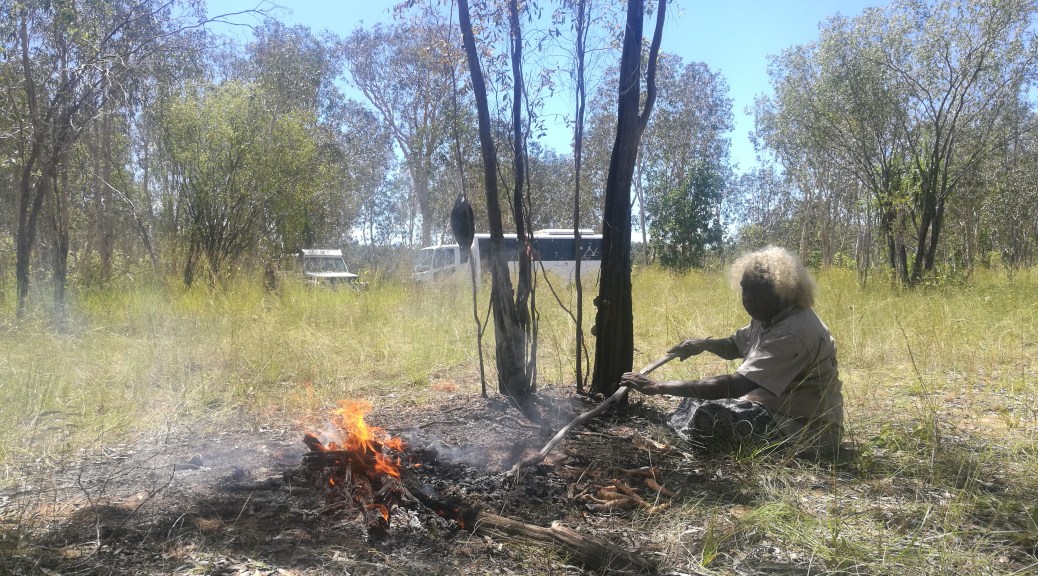
Not me, obviously. Well, not just me. It was missing Dr. John, who died from a heart attack on Thursday just as the sun was coming up. On Friday night, the streets outside Kermit’s in the Treme were thronged with what looked like thousands of people, gathered to play and sing his music loud and raw as part of the great New Orleans tradition of the Second Line parade. Disappointingly for me I’m gleaning this only from YouTube clips. Although, watching those Second Line videos did make me wonder whether Dr. John will be given the full jazz funeral treatment in due course? He must do, right? I need to see coverage of that exactly like Princess Diana’s, ideally with the same presenters. I want to see professional Royal observers forced to try and interpret not just the pomp and ceremony but also Dr John’s intoxicating blend of voodoo ritual and pure rock’n’roll. Live on two different channels so I can pick the best commentators.

Continue reading at NME.

The truth about Australia’s bush tucker

davWhether or not you’ve sat through an episode of I’m a Celebrity… Get Me Out Of Here!, you’re probably familiar with the concept of a ‘bush tucker trial’. Since the TV reality show set in the Australian jungle first appeared on screens, the phrase has become synonymous with celebrities being challenged to eat a variety of unsavoury-looking insects and animal parts.

This deliberately unappetising portrayal of bush tucker does the name a disservice, because insects and other food foraged from the bush can be genuinely nutritious and surprisingly delicious. There are Aboriginal communities in Australia who have been living off diets pretty much unchanged for the last 60,000 years, and many experts believe that in the future, as competition for food increases across the planet, insects and bugs may be seen as an increasingly desirable source of protein.

Continue reading at Lonely Planet.

Life Is Just A Party: Celebrating Prince’s purple reign

Prince-purple-reign

In 1979, Earth, Wind and Fire’s manager Bob Cavallo travelled to Anaheim, California to see a young artist who’d approached him about the possibility of working together. Cavallo had with him his wife and 12 year-old daughter, so he was somewhat taken aback when the performer came onstage wearing a trenchcoat and pantyhose. Every time he span around the coat would lift and open, revealing the G-string he was wearing underneath. After the show, Cavallo made his way backstage. “Well, young man,” he began. “I thought your show was great and your band is great, but I don’t think it’s right for you to go onstage in your underwear.” Prince looked back at him. “Okay,” he said. “Next time, I’ll take it off.”

Cavallo, naturally, signed Prince on the spot and would go on to manage him for the next decade. As well as shepherding the wildly ambitious 1984 film Purple Rain into existence, in 1987 Cavallo also helped Prince build his 65,000 square-foot, $10 million home base Paisley Park in Chanhassen, just outside Minneapolis. Prince had gotten the idea when shooting pick-ups for Purple Rain at Earth, Wind and Fire’s own studio, The Complex. “Whenever he wanted something, he just pretty much told me I was doing it,” remembers Cavallo, sat inside Paisley Park’s own soundstage as part of Celebration 2019, a gathering of thousands of the world’s purplest Prince fans at their own, personal Mecca to mark the third anniversary of their hero’s death.

Continue reading at NME.

Super natural

big-bear-lake-atlas

High above the north shore of Big Bear Lake, Amber Woodyard, a local guide, stands on one of her favourite trails. The air is fresh, clean and cool, scented by the pine forest that sweeps downhill toward the still, blue water. The view is breathtaking: in the distance, she points out the contours of Mount San Gorgonio, known locally as Old Greyback, the highest peak in Southern California. In the foreground the heavily forested hillsides look much the same as they would have done to this land’s early explorers. But the most remarkable thing about the view is not so much what we can see as what we can’t: a freeway. Take a look in any direction, and from here, it’s hard to believe that the bad-tempered, traffic-clogged arteries of Los Angeles are even on the same planet, never mind less than 100km away. I can’t hear a thing.

“The wilderness is what attracts people here,” says Woodyard, as her dog, Carly, scampers around her well-worn hiking boots. “It’s just so beautiful, and yet so close to LA. Where else in the world can you wake up by the beach and be up in the mountains in the afternoon?”

Continue reading at Atlas by Etihad.

Kevin EG Perry is a writer for The Independent, The Guardian, GQ, NME, Empire, Wallpaper*, Vice, Lonely Planet Traveller and other reputable publications