Category Archives: Other

Wealthy American Women Can’t Resist Cuba’s Young, Salsa Dancing Male Hustlers

old-ladies-cuban-boyfriendsThe deaf prostitute took my hand in hers and traced “20” on my palm with her finger. When I look back on all my nights out, it’s a moment more depressing than even a wet Tuesday in Torquay could muster. I’d bumped into her down on the corner in front of Havana’s faded Hotel Nacional, former stomping ground of Sinatra, Hemingway and Brando and host to the infamous Mafia conference in 1946 that Coppola recreated inGodfather II. All I’d done was ask her for directions. I shook my head and tried to mime: “Sorry for wasting your time”.

It wouldn’t have been the first time a foreigner in Cuba was assumed to be in the market for transactional sex, and now that the USA and Cuba are friends again there’ll be a whole lot more of it. Thanks to the travel ban currently in place, only around 60,000 Americans visit Cuba each year. Jay-Z and Beyonce caused a minor diplomatic incident when they went this summer, and they’re the closest things the Yanks have to infallible royalty. The US figure is dwarfed by the 150,000 Brits and more than a million Canadians who are drawn there by the promise of sun, rum and hot, steamy salsa dancing.

Continue reading at Vice.

11 Outstanding Cocktail Bars In London

NOLAThere are enough great pubs in London to keep the ghosts of Oliver Reed and Peter O’Toole busy for weeks, not to mention plenty of heaving nightclubs willing to sell you an overpriced spirit and mixer. However, finding a really top-class cocktail in the city requires a little insider knowledge. The best places are tucked away, safe in the knowledge that only the truly discerning drinker will seek them out. And since we know you, dear reader, are one of those discerning drinkers, I’m going to give you a tour of the best cocktail bars in the city.

Continue reading at Playboy.

Inside Britain’s Secret Courts

inside-britains-secret-courts-101-body-image-1415711479The Investigatory Powers Tribunals (IPT) are the most secretive court cases in Britain. They are the only place you can go and complain if you think you’re being illegally spied on by MI5, MI6 or GCHQ, or even by the police or local government. The only time they’ve actually found against the authorities was when Poole Borou​gh Council spied on a family to see if they were lying about which school catchment area they lived in. Of course before you can make a complaint you have to somehow know that you’re being secretly spied on, which is pretty tricky. Even if you do, the IPT most likely won’t grant you access to the evidence against you, give you the right to cross-examine anyone, let you appeal or even tell you what their reasoning was when they hand down their verdict. Sometimes they won’t even tell you whether you’ve won or not. Needless to say, they almost always meet behind closed doors.

That was until this year, when the IPT bowed to legal pressure and agreed to open its doors for a few select public hearings. Which is how I found myself, a couple of weeks ago, at the Rolls Building in Holborn, central London at 4:30PM on a dreary Wednesday afternoon.

Continue reading at Vice.

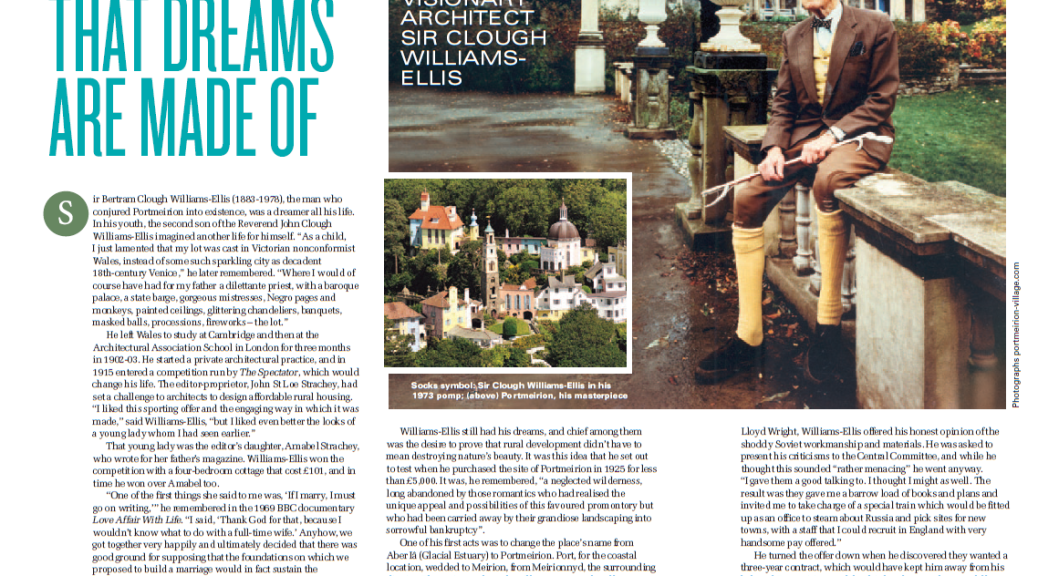
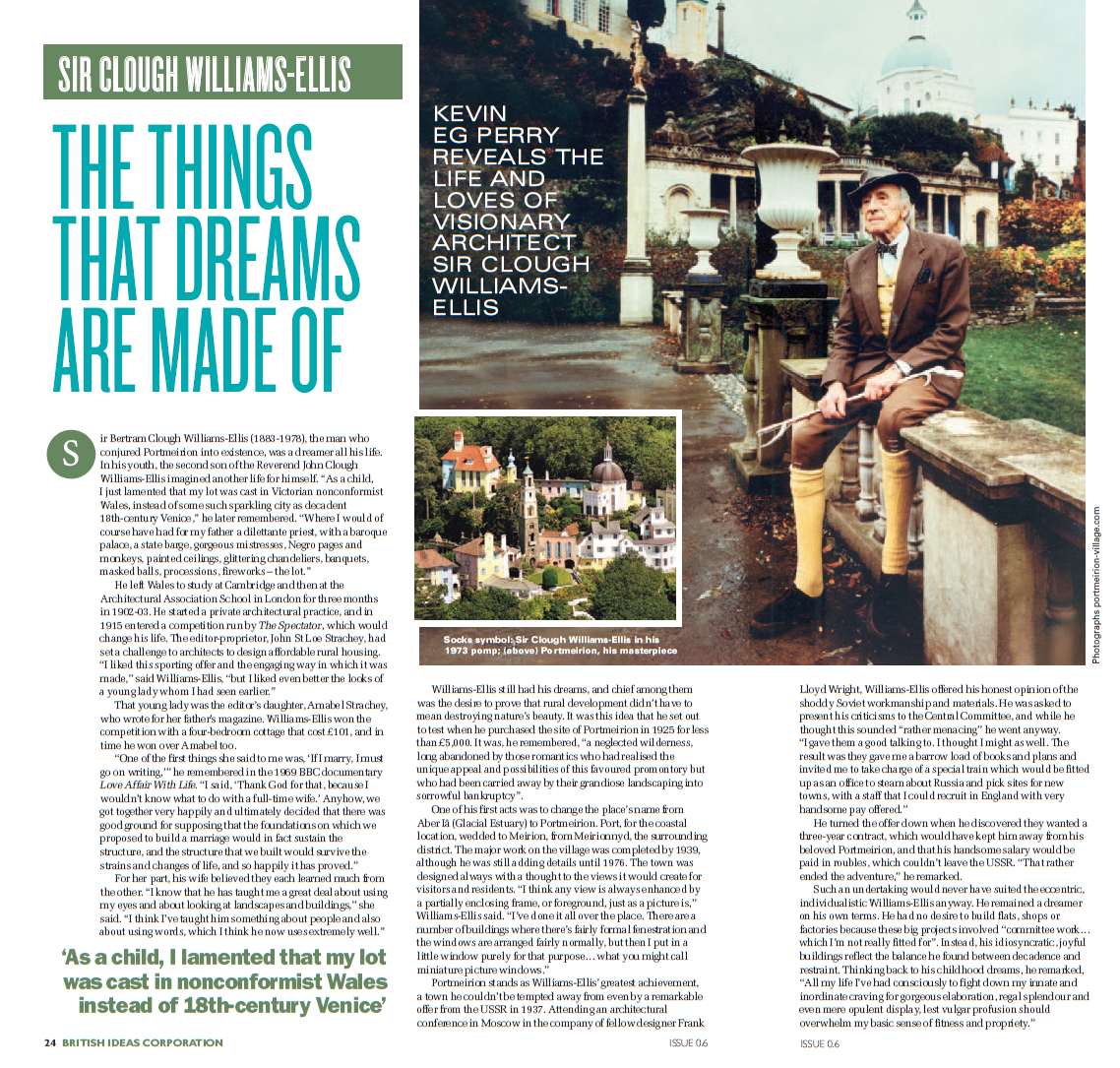
Clough Williams-Ellis: The Things That Dreams Are Made Of

cloughwilliamsellisClough Williams-Ellis, the man who conjured Portmeirion into existence, was a dreamer all his life. In his youth the second son of the Reverend John Clough Williams-Ellis imagined another life for himself. “As a child I just lamented that my lot was cast in Victorian non-conformist Wales instead in some such sparkling city as decadent 18th Century Venice,” he later remembered.

Full piece in British Ideas Corporation, Festival No. 6 Special

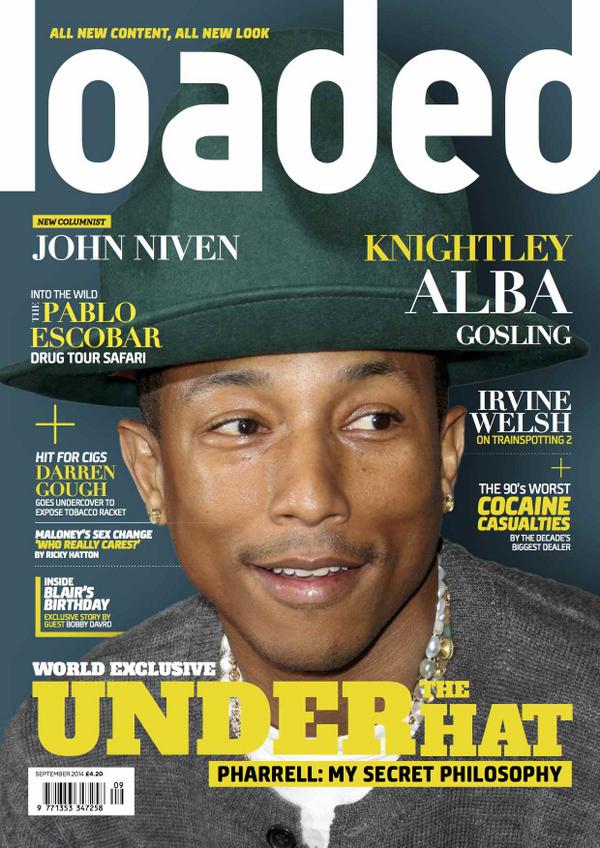
Under The Hat: Pharrell’s Secret Philosophy

HE’S not just a pretty (expensive) hat. Pharrell Williams believes he’s tuned into how we’ll be curing diseases in the future. You see, music isn’t a matter of life and death to him – it’s much more important than that. On a flying visit to London the most successful and ubiquitous producer of his generation took the time to explain his philosophy to Loaded. “I believe in the medicinal property of music,” he tells us. “I believe in maximising the therapeutic and holistic properties of music and what it can do for you.”

Replacing medicine with melodies might sound far-fetched, but as well as having three million-selling UK singles in the last year alone, Pharrell is also a scholar of world musical traditions. “The Tibetans have singing bowls that they tune chakras with,” he points out, referring to the Buddhist belief that upturned bells of different pitches can affect the body’s seven energy points. “In the Western world there are certain songs that come on and make people feel better. When people are feeling melancholy and down and they need something to relate to they can play a blues record and it can help purge them and get those feelings out. There are such incredible degrees of music, frequency-wise, that I believe science will prove that we’ll be able to use exact musical notes to cure certain things.”

It isn’t hard to see how Pharrell’s unreserved faith in the power of music has made him the man he is in 2014. He’s on a run of singles which make him the envy of every other songwriter and producer on the planet – and he’s done it a full decade after he last dominated pop music. At 41, Pharrell Williams is having the year of his life.

loaded-pharrell

I FIRST spoke to Pharrell back in April 2013, at the start of his annus mirabilis. I was in California attending Coachella in the company of Daft Punk, who were at the festival to premiere the video for their omnipresent global hit ‘Get Lucky’ on the big screens. In typical Daft Punk fashion the stunt was completely unannounced, so when the video first burst into life showing Pharrell fronting a fantasy band with Nile Rodgers on guitar and the robots on bass and drums, half the festival sprinted across the field thinking they were about to catch an impromptu live set. In truth, Daft Punk’s Thomas Bangalter and Guy-Manuel de Homem-Christo were down the front of the VIP area, unrecognizable without their helmets, watching amongst the crowd with wide grins splayed across their faces.

The next day, Daft Punk hosted a party at the house they were renting in Palm Springs: Bing Crosby’s former villa, where JFK and Marilyn Monroe are said to have consummated their affair. As the piña coladas flowed, Bangalter explained to me why they’d chosen Pharrell to front the band he described as being their “dream scenario in a dream environment”. “We’re fans of hip-hop and Pharrell as a performer, as a singer, as a rapper and as a human being is someone who we consider to be extremely special,” he said. “It felt like a perfect match for creating this one-time band with Nile and the robots. It was exciting on a musical level and a symbolic level. Most of all, his talent as singer and a performer made him the perfect candidate for us.”

Nile Rodgers, the legendary Chic guitarist and producer of hits for the likes of David Bowie, Madonna and Mick Jagger is arguably the man whose career Pharrell has most modeled his own on. He was similarly full of praise for his new collaborator. “Sometimes you meet a person and you have an idea of who they are but then you meet them and they go beyond it,” Rodgers told me. “I love Pharrell. As a person, as an artist, as a human being, he went way beyond any preconceived notion I had of him, which was already pretty cool! He had done a record that really paid homage to me, with Justin Timberlake. I remember meeting him at the Grammys and he walked up on me and just bowed down and said: “Hey man, I’m sorry but I couldn’t help it.” I said: “Dude, don’t worry! If you don’t think I stole ‘Good Times’ from somebody else you’re crazy!” ‘Good Times’ was not a completely original idea by any stretch of the imagination! When we finally got the chance to work together and we got to talk I thought to myself: “I love this dude!” He’s unbelievably cool.”

Pharrell himself didn’t make it to Daft Punk’s pool party. He was at home in Miami, where his exhausted-sounding manager told me he was producing two different artists simultaneously. When I called him from California he was unusually taciturn. It tells you something about Pharrell’s sweetness of character that despite the fact Bangalter and de Homem-Christo were splashing around in their trunks in front of me, Pharrell was still earnestly referring to them as “the robots”. “I’m very excited for the robots, man,” he said, speaking about the anticipation for their record ‘Random Access Memories’. “They deserve it. Those guys are super-rare. This is all a part of their masterful calculation. I’m thankful to just be a digit in their equation. I’m such a small part. I was just happy to be there and be a part of it. I’m just as much a voyeur of their process as you are.”

When I told him about Nile Rodgers’ tribute to him, Pharrell was effusive in returning the praise. “I was pleasantly surprised that Daft Punk got him to work on the album because I had been working on music previously that was imitating him. It was the coolest thing. His playing is exquisite. He’s just a genius.”

With Pharrell and Rodgers together at last, ‘Get Lucky’ was unstoppable. It hit the top ten in over 32 countries, and for a while it seemed impossible to go to a nightclub anywhere on earth without hearing it. I personally saw people getting down to it on dancefloors everywhere from Lilongwe in Malawi to Bogota, Colombia. It picked up Grammys for both Record of the Year and Best Pop Duo/Group Performance, and at the ceremony in January this year Pharrell, Rodgers and Daft Punk were joined by Stevie Wonder to perform their hit. In sales terms it shifted 9.3 million copies, making it one of 2013’s biggest singles. But not the biggest. That would be Robin Thicke’s Pharrell-produced ‘Blurred Lines’, which sold 14.8 million copies. Solo hit ‘Happy’ sold another 10 million. By the end of 2013, Pharrell was only really competing against himself. The internet was supposed to have divided us all into specific camps, atomizing popular music and ending the era of this kind of ubiquitous super-hit. To understand how Pharrell bucked that trend, we have to go right back to the beginning.

PHARRELL Williams was born on 5th April 1973 in the east coast city of Virginia Beach, a seven hour drive south of New York City. The eldest of three sons born to Southern handyman Pharaoh Williams and his wife Carolyn, a teacher. “My mum thought her sons could do no wrong. She lived for us,” he told the Evening Standard in 2012. “There was plenty of discipline, but we knew we were loved. My dad is a nice guy, Southern, old-fashioned. He restores cars now. My mum has just gotten her doctorate in education.”

At age 12 Pharrell met his future production partner Chad Hugo at a summer band camp where he was playing keyboards and drums while Hugo played saxophone. The pair soon became just as interested in production as in playing their instruments. “I was a teenager and we were desperately making music, Chad and I,” he remembered later. “We loved taking Depeche Mode and A Tribe Called Quest tracks and recreating them, taking them apart and figuring out how those things worked. It was kind of cool because that’s what we’d do every day after school.”

Outside of music, Pharrell was always the kid with his head in the stars. From a young age he was bewitched by the astrophysicist Carl Sagan’s groundbreaking documentary series ‘Cosmos’. “I can only aspire to be someone that people learn as much from as they’ve learned from Carl Sagan,” he would say later. “Carl Sagan is to me what Tribe Called Quest was to us for music.”

Eventually he had Chad formed an R&B band called The Neptunes with Shay Haley, who would stay with them after they became N.E.R.D, and schoolmate Mike Etheridge. It was after a high school talent show performance that the young band came to the attention of the producer Teddy Riley, who Pharrell says “pretty much changed my life.” “His studio was like a five minute from my high school,” he said later. “He sent a scout over and they saw us and the rest was history.”

Riley, a member of R&B group Blackstreet as well as a Grammy-winning producer for the likes of Michael Jackson and Usher, took Pharrell and Chad Hugo under his wing. However, it took a while for the young, excitable Pharrell to get a hang of the discipline of record production. He made a nuisance of himself until one of Riley’s engineers took him to one side for a quiet talking to. “Teddy had layers of people around him in his compound,” remembered Pharrell, speaking to the Canadian interviewer Nardwuar. “Some of the engineers were cool and some were not so nice. They meant business. They didn’t want kids running round the studio getting in the way, and quite honestly that’s probably what we did. My studio etiquette when I first came to the studio was so wrong. Teddy would play a chord and I’d shout: ‘Hey, why don’t you change it to this chord?’ The engineer would just look at me and give me the dirtiest look. I’ll never forget, a guy called Jean Marie gave me the best lesson in the world. He sat me down and said: ‘Look, Teddy’s the boss. When he’s working, you don’t say anything. You’re lucky to be in the room. You sit quiet and you listen to everything that he’s doing. You absorb everything that you can. When you have the opportunity to ask him a question, you ask him a question, but you don’t just jump out. You’ve got to have better studio etiquette than this. I believe in you, and I see what Teddy sees in you and Chad, but you have to calm down.’ Chad was quiet. Chad wouldn’t say anything, but I was like the young, hot-headed, fiery Aries. I’d be going: ‘Change that chord! Change the snare!’ They were like: ‘Pipe down!’”

Pharrell’s first ever writing credit came in 1992, when he was just 19. He wrote a verse for Riley to perform on Wreckx-N-Effect’s hit ‘Rump Shaker’. “I remember being a kid in high school and I was definitely unfocused,” he said later. “I had another year to go, and when that record came out it was an amazing feeling. I was from Virginia Beach, Virginia, where there wasn’t really a music industry at all.” Later that same year he made his debut vocal appearance on a record, chanting “S-W-V” towards the end of a remix of girl group SWV’s track ‘Right Here’.

Success didn’t come overnight, but Pharrell kept his head down and worked under the tutelage of Riley, bouncing ideas off his partner Hugo. The pair dusted off their old band’s name, The Neptunes, and started using it for their own production work. When Riley’s group Blackstreet released their debut self-titled record in 1994, The Neptunes were credited as co-producers on album track ‘Tonight’s The Night’. Over the next couple of years, the duo produced a handful of other singles as they searched for a sound they could call their own. They found it in 1998, working on a track called ‘Superthug’ for the rapper Noreaga. The single hit number 36 on the Billboard charts, but more importantly for Pharrell and Chad Hugo it introduced the world to ‘The Neptunes sound’. In 1999, a mutual friend introduced the pair to a 20-year-old aspiring singer named Kelis Rogers. They never looked back.

KELIS and Pharrell hit it off immediately. The Neptunes had been invited to produce a track for Ol’ Dirty Bastard, a founding member of the Wu-Tang Clan, and they came up with the possibly lunatic idea of pairing the fearsome rapper’s rasp with the debutant singer’s sultry hook. The result was magic. ‘Got Your Money’ sounded like nothing else before or since, and the single announced Kelis as a major new talent.

They followed that up with an album ‘Kaleidoscope’ which included ‘Caught Out There’, featuring Kelis’ unforgettable shouted “I hate you so much right now” refrain. It peaked at number four, giving The Neptunes their first hit here in the UK. Meanwhile, things were getting complicated outside the studio for Pharrell and Kelis, who had become involved. “We never dated,” she clarified in a 2012 interview with Complex magazine. “We have the same relationship now that we did then, with the exception of the sexual part. I used to care too much. I began to feel that all men cheat. [I felt] all cynical and gross.”

The impact Kelis had on Pharrell’s life extended to his wardrobe. In a recent Vogue interview, he credited his interest in fashion to meeting her at this point in his life. “I’d just signed this girl called Kelis, and back then all I wore was Ralph Lauren’s Polo, because that was the thing,” he said. “And Kelis turned to me and said, ‘You’ve got to get out of this box.’ She introduced me to Prada and Gucci. It was thanks to Kelis I discovered a life outside of monograms.”

Follow-up single ‘Good Stuff’ (featuring Pusha T back when he was still calling himself Terrar) further refined their sound. Bigger artists were beginning to seek them out, and by the following year Jay-Z helped The Neptunes score their first US number one single with ‘I Just Wanna Love U (Give It 2 Me)’. It’s a mark of the respect they were now held in that Hova shouts them out on the track, promising to “Get you bling like the Neptune sound”, yet at the same time Pharrell was still so little known that despite singing the song’s chorus he was uncredited on the album sleeve and doesn’t even appear in the music video.

The time was coming for Pharrell to step out of the shadow of the production desk and into the limelight. 2001 saw the release of N.E.R.D’s debut album ‘In Search Of…’, named by the still space-obsessed Pharrell in honour of a supernatural TV show hosted by Leonard Nimoy. Originally released only in the UK, where Kelis’ Neptunes-produced records had fared better than in the States, the album was by Pharrell’s modern standards only a modest hit. Singles ‘Lapdance’ and ‘Rock Star’ edged into the Top 20, but they did serve to establish Pharrell as a frontman in his own right. Meanwhile their production work was producing bigger and bigger hits. The same month ‘In Search Of…’ hit the shelves, they had their first worldwide number one with Britney Spears’ ‘I’m A Slave 4 U’. Britney had hand-picked The Neptunes to work with after becoming obsessed with their work with Jay-Z.

Despite the phenomenal pace and quality of their output, Pharrell was still finding time to have fun. It was around this time that the lifelong non-smoker had his first serious experience with marijuana, which he had asking a friend to bake into brownies so he could try it without toking. He ate two, got the munchies and then ate four more. That’s when things got really trippy. “It was like straight-up, ‘Big Lebowski’ running from the bowling pins weird shit,” he remembered later. “I went to use the bathroom and passed out on the toilet.”

Maybe Pharrell should count himself lucky he didn’t take to heavy drug use. In 2002 the Neptunes were on a run of hit singles that remains pretty much unparalleled in modern times – well, at least until Pharrell did it again in 2013. In 2002 the duo were behind the desk for Nelly’s ‘Hot In Herre’, N’Sync’s ‘Girlfriend’, Beyoncé’s ‘Work It Out’, Busta Rhymes’ ‘Pass The Courvoisier, Part II’ and Britney’s ‘Boys’ to name but five. When Justin Timberlake wanted to go solo at the end of the year it was Pharrell he called. The Neptunes produced the bulk of his album ‘Justified’, including a trio of massive singles in ‘Señorita’, ‘Like I Love You’ and ‘Rock Your Body’. The following year, 2003, they were behind Snoop Dogg’s ‘Beautiful’, Kelis’ ‘Milkshake’ and Jay-Z’s ‘Change Clothes’. June also saw Pharrell release his first single as a solo artist with ‘Frontin’’, which featured Jay-Z and hit the top 10 on both sides of the Atlantic.

In 2004, N.E.R.D. released their second album, ‘Fly or Die’. As if to emphasise the point that everything was going Pharrell’s way, lead single ‘She Wants To Move’ starred Mis-Teeq singer Alesha Dixon who he’d apparently spotted in a magazine photoshoot and ended up dating. In September, Pharrell and Snoop released ‘Drop It Like It’s Hot’ which remained his biggest hit until 2013 and went on to be named the most popular rap song of the decade by Billboard. He wasn’t just making pop music anymore. By this point, Pharrell was pop music.

STAYING humble is pretty hard after a run like the one Pharrell was on. With the 2005 launch of his clothing line, Billionaire Boys Club, Pharrell was becoming a brand. When news emerged that he would release a debut solo record ‘In My Mind’ at the end of the year, expectations couldn’t have been higher. Alarm bells started to ring when he announced the record would be delayed because it still needed more work, and then disappeared for a full six months. When it was finally released in July 2006, it was met not with a bang but a critical whimper.

Looking back, Pharrell believes the album’s relative failure was due to an uncharacteristic failure to be true to himself. “‘In My Mind’ was just purpose-oriented toward, like, competing and being like my peers—the Jays and the Puffs of the world, who make great music,” he told GQ earlier this year. “But their purposes and their intentions are just completely different than what I have discovered in myself that I wanted to achieve in [second album G I R L].”

“I felt like I had amassed this big body of work, most—not all—but most of which was just about self-aggrandizement, and I wasn’t proud of it,” he added. “So I couldn’t be proud of the money that I had; I couldn’t be proud of all the stuff that I had. I was thankful, but what did it mean? What did I do? And at this point, where I came from, I’m just throwing it in that kid’s face, instead of saying, “Look at all the fish I have, and look how much we’re going to eat.” It should’ve been—at least a part of it—teaching them how to fish.”

After his single with Kanye West, the unfortunately named ‘Number One’ entered the American Billboard charts at a lowly 57, Pharrell began to take his eyes off music for a while. He kept busy, of course. There was still Billionaire Boys Club to run alongside his other clothing line, Ice Cream, and he also designed sunglasses for Louis Vuitton and “bulletproof”-inspired jackets for Moncler. He invested in an eco-friendly textile company, Bionic Yarn. He started his own YouTube channel called ‘i am OTHER’. In 2007 he dropped a cool $12.525 million on the 9,000 square foot penthouse apartment of Miami’s beachfront Bristol Tower. 40 floors up, the three-level apartment has its own pool – and Pharrell promptly decorated it like a Sixth Form common room, with huge Family Guy paintings and a Ms. Pac Man machine.

Perhaps the biggest change in Pharrell’s life occurred when girlfriend Helen Lasichanh – usually billed as a model/designer but in reality too secretive to be either – gave birth to their son Rocket in 2008. Fatherhood gave the once confirmed bachelor a new perspective on both life and the music he’d been making. “He’s changed my world,” he said, looking back. When one interviewer asked him how he’d changed, Pharrell replied with genuine humility: “My son teaches me. It’s crazy, he teaches me. This is one of those times in your life when you’re like, ‘Think about that one interview when someone asked you a serious question, and it just hit me…’ When you asked me about my son and my answer to you was, ‘He teaches me?’ Like, that was bizarre to me.”

N.E.R.D. released two more albums, 2008’s ‘Seeing Sounds’ and 2010’s ‘Nothing’ but they were met with little fanfare. Inspired by his young son, Pharrell produced the soundtrack to animated kids romp ‘Despicable Me’, which was at least received better reviews than either N.E.R.D album. After years as an innovator at music’s bleeding edge, Pharrell seemed destined to slide into family-friendly mediocrity.

In 2012, when Miley Cyrus began work on her fourth album, the one that she was hoping would reinvent her and cast off her squeaky-clean Disneyfied, Hannah Montana image for good, she wanted Pharrell to produce. Incredible as it seems now, her management team actually counseled her against it. He hadn’t had a hit in years. As far as they were concerned, he was all washed up.

MILEY got her way, as she usually does. She had seen how Pharrell’s production had helped Justin and Britney cast off their Disney pasts, but perhaps she also sensed that the time was right for a Pharrell renaissance. “Everything he did with, like, Justin and Britney made Pharrell a legend,” Miley would say. “But that wasn’t really his time.”

At the same time he was working with Miley on the album that would become ‘Bangerz’, Pharrell’s name was again beginning to appear in all the right places. 2012’s critical darling Frank Ocean fended off the overbearing approaches of Kanye West, but he was happy to work with the Neptunes man on ‘Channel Orange’ single ‘Sweet Life’. “To me he’s a singer/songwriter,” said Pharrell of the former Odd Future member. “But his album itself is incredible. He’s super talented. To me he’s like the Black James Taylor. He’s lyrical – he’s got a great perspective and super sick melodies. I haven’t seen anybody bob and weave through chords with such catchy melodies in a long time – that’s why I liked working with him.” Meanwhile the year’s breakthrough rap success story was Kendrick Lamar – and sure enough Pharrell was behind the desk for album track ‘good kid’.

It was late 2012 when Daft Punk invited Pharrell to Paris to hear the tracks that Nile Rodgers had already laid down for ‘Random Access Memories’. He’d been fans of, and friends with, “the robots” for 10 years by this point – ever since he first heard ‘One More Time’ while both acts were signed to Virgin Records. “It was just the emotion of that track,” he told me. “It’s great, emotional music.”

He described going into Daft Punk’s Parisian workshop as “magic”. Rather than discussing any of their previous work, he told me that they immediately started playing him Rodgers’ riffs to see what he’d come up with. “They just played me music and asked me to write to it,” he says. “It was an interesting back and forth. It was pretty cool.”

It’s tempting to think that Pharrell had himself in mind when he wrote the now famous opening line “Like the legend of the phoenix / All ends with beginnings”. After his meteoric rise and quiet fall back to earth, Pharrell’s star was very much back in the ascendancy again. Before July 2013, only 135 songs had sold more than a million copies in the entire history of the British charts. That month, Pharrell added two more when ‘Get Lucky’ and ‘Blurred Lines’ passed the milestone within weeks of each other.

He still wasn’t done. He had written a song called ‘Happy’ for CeeLo Green, but Green’s record label turned it down as the singer was due to release a Christmas album. Pharrell recorded it himself, released it on the soundtrack to ‘Despicable Me 2’, sold yet another million singles in the UK and scored himself an Oscar nomination to boot. “I’m still amazed with what people have done with ‘Happy’,” he said later. “At the end of the day I know that people like what I’m doing. But everything with that song has been done by the fans. When I hear it all the time on the radio and see it on TV it’s changed me because I realise all I can do is release a song and then what happens after that isn’t up to me.”

In a music industry we’re constantly being told is floundering, Forbes estimates that Pharrell earned $22 million between June 2013 and June 2014 and predicts that he’ll increase those earnings next year thanks to a meatier touring schedule. To commercial success add critical acclaim. In January 2014, Pharrell won four Grammys – more than he’d won in his entire career up to that point. This included the coveted Producer of the Year title – a full decade after he first won with The Neptunes. You wouldn’t have wanted to be the guy who had told Miley that Pharrell was a has-been that night.

GRAMMY wins are one thing, but all anyone was really talking about the next morning was Pharrell’s hat. The Vivienne Westwood buffalo hat he wore to the awards, last seen on Sex Pistols impresario Malcom McLaren circa 1982 became a meme overnight and showcased Pharrell’s idiosyncratic knack for using high fashion to make bold statements. His decision to wear it on the red carpet saw an immediate upsurge in interest that for a while knocked out Vivienne Westwood’s website completely. For a few months it became his signature style before, with impeccable timing, he realised the look had been done to death and auctioned the hat off to raise money for the children’s charity he set up with his mother. He denied his intention had ever been to stand out for the sake of it. “I don’t know that the aim should be to stand out,” he said. “I think the aim, well for me specifically, the aim would be to just express myself and be who I am and your clothing should be a byproduct of that.”

Pharrell must have realised that the cultural landscape of 2014 was vastly different to the one he first emerged onto a decade ago. While an awards ceremony hat being immediately transformed into a thousand Twitter memes was one thing, the furore that had grown around the allegedly sexually predatory ‘Blurred Lines’ and it’s accompanying video, starring three topless models Emily Ratajkowski, Jessi M’Bengue and Elle Evans, seemed briefly to threaten his nice guy reputation.

In an interview with Channel 4 News in May 2014, interviewer Krishnan Guru-Murthy seemed to get under his skin with his line of questioning about ‘Blurred Lines’. “Did I touch the women sexually in the video?” he responded rhetorically. “Let me ask you something, in a high fashion magazine when women have their boobs out is there something sexual there too? If you ask the director who created it – who was a woman – she was inspired by high fashion magazines where women do have their boobs out. I love women, I love them inside and out. That song was meant for women to hear and go, ‘You know, I’m a good woman and sometimes I do have bad thoughts.”

Pharrell, who at the end of last year finally married Helen Lasichanh, the mother of his son Rocket, in a ceremony in Miami, denied that his second solo album ‘G I R L’ was in any way a response to charges of chauvinism. “‘G I R L’ is the album that I’ve always dreamt of making and I was set free and reminded by the executives of Columbia when they gave me the opportunity to do the record,” he said. “They kind of just said ‘Go and make the record that you want to make and we’ll support you’. Certain people were offended by ‘Blurred Lines’, well really the video and some of the lyrics. I mean, it says ‘You don’t need no papers,’ meaning there’s no paperwork on your life and that man is not your maker. Anyway, we all come from women and that seemed like the perfect segue and the perfect way to tee up the importance of making ‘G I R L’. So, no, I had my own reasoning. I’ve always wanted to make this record, you know. I didn’t know it would be called ‘G I R L’ but I always wanted to make a record that wasn’t about me, to be honest and that’s why I’m so elated that I was able to pull it off. ‘G I R L’ is something that I needed to say for a long time.”

With ‘G I R L’ proving more successful than his first solo album or his recent N.E.R.D. records – it’s even spawned a Comme des Garçons fragrance he’s “super proud” of – Pharrell now finds himself on his biggest ever solo tour. He recently collaborated with one of his longtime heroes Spike Lee on a live web broadcast of one performance, while this September he’ll bring the tour to the UK for a date in Manchester before finishing off with two shows at London’s O2 Arena in October. For a man who started off seeing himself as a producer rather than a performer, “the man beside the man” as he often puts it, a major tour without even his N.E.R.D. bandmates is a new challenge. “I think it’s a different part of the process,” he said recently. “I think for me most of the magic is the alchemy of it all. You know, being in a studio at the moment when it’s almost done and you feel it, you see what it’s like at the end of the rainbow or whatever.  When you go out to perform it you’re re-living that sort of magical moment that you felt in the studio and you’re kind of forgetting where you are. So although I’m in front of the fans and I get to hug the girls and tell them thank you so much for being so supportive, I’m also partially still back in the studio when it was all happening, in my head.”

LISTENING back to the string of hits from the last two decades that bear Pharrell’s fingerprints – from ODB and Kelis, Jay-Z and Snoop, Justin and Britney through to Daft Punk and Robin Thicke – it becomes difficult to imagine how contemporary pop would sound without him. It certainly becomes easier to see why he believes music can heal the sick. The one thing that runs through all of Pharrell’s music like a red cord is an exuberant, seductive belief that music can make us better, fitter and, in the end, well, happy. We don’t have to look to the future to experience music as medicine – we’re already dosed to the eyeballs on it.

“We know that music on a broader level can help people who would otherwise feel isolated or vulnerable and make them feel better,” says Pharrell, summing up his philosophy. “This is a thing I believe. I’m always walking around saying the same thing over and over again.”

Cover story for Loaded, September 2014.

Reviewed: The UK’s Five Weirdest Euro Election Videos

I-mEnglish-Yes, the build-up to today’s European elections has been dominated entirely by a one-man publicity machine. But that doesn’t mean that there aren’t other groups of narcissists out there who aren’t at least as deserving of your attention. So, before you go to cast your vote for UKIP, let’s review some party political broadcasts from other groups – groups who also refuse to adhere to the staid PR conventions of Westminster’s “Big Three”, like using decent microphones and not putting giant CGI monsters in your videos.

Continue reading at Vice.

King Of The Swingers

timeoutarcticmonkeys

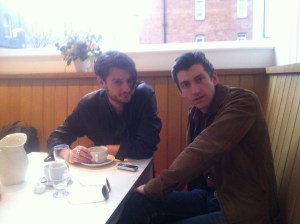
Alex TurnerI’m sat in a coffee shop just off Shoreditch High Street when Alex Turner walks in, removing a pair of Ray Bans as he steps through the door. Everyone here is far too cool to stare, but there are turned heads and lingering looks as he makes his way to my table. He doesn’t swagger or strut. He’s wearing a brown suede jacket and skinny jeans, but what sets him apart are the details: the dark quiff that could have been sculpted by the King himself and the insouciance that can only really come from having headlined Glastonbury twice by the age of 27.

Right now he’s enjoying a rare month off. After we order coffee he tells me he’s been back at his place in east London, and that he spent the previous evening dusting off his CD collection. ‘I pulled out “The Songs of Leonard Cohen” and it still had a sticker on it. £14.99!’

Money well spent, I suggest. ‘Totally,’ he agrees. ‘Fucking “Suzanne”: what a song! I don’t have an Instagram account, but if I did I’d have grammed it, saying exactly that: “Money well spent.”’

It must be nice for him to be home, enjoying the simple pleasures of rummaging through old albums? ‘I’m not even sure where home is,’ Turner sighs. ‘Probably Terminal 5. There is a strange sense of calm about arriving back at Heathrow.’

He’s spent a lot of time in the air these last eight years. The Arctic Monkeys’ record-breaking debut ‘Whatever People Say I Am, That’s What I’m Not’ launched Turner, drummer Matt Helders and guitarist Jamie Cook into the stratosphere almost overnight in 2006, with fourth member Nick O’Malley joining to replace original bassist Andy Nicholson soon after. Since then the gang of schoolmates have established themselves as Britain’s biggest contemporary rock ’n’ roll band. Last year’s heavy, sultry and tremendous ‘AM’ (their fifth album) topped the charts in nine countries and set them up for a pair of huge shows in Finsbury Park this week.

Some of the fans flocking to see them will be teenagers too young to remember the band as Yorkshire urchins, trackie bottoms tucked into their socks. There are others, however, who remember it all too well: critics who’ve accused the Arctics’ frontman of now pretending to be something he’s not. At the outset Turner wrote songs about drinking and dancing and falling out of taxis, and described those nights just the way you and your mates would, if only you were blessed with a sharper turn of phrase. Now Turner spends much of the year in LA, dates a model and dresses like a screen idol – somewhere between James Dean and Marlon Brando in ‘The Wild One’. Has he been blinded by the bright lights of Stateside success? Whatever people say about Alex Turner, who is he now?

Not a man who takes himself entirely seriously, it turns out. ‘I wish I could be that guy,’ he says, when I ask him about his International Rock Star persona. He tells me he’s happiest when he’s writing, plucking new songs out of the ether. What’s the hardest part of his job? ‘Probably the same thing,’ he deadpans, in that muttering, sub-Elvis drawl he’s cultivated. He’s taking the piss out of himself. He’s too self-aware, probably too Northern, to believe his own smooth rhetoric. ‘I wish I could be the guy who says those sort of lines,’ he says. ‘I catch myself too quick.’This February, at The BRIT Awards, that self-awareness landed him in the eye of a tabloid storm. Collecting the first of the band’s two awards, for Best British Album and Best British Group, Turner made a now notorious speech about how ‘rock ’n’ roll seems like it’s faded away sometimes, but it will never die’.

He was accused of arrogance (as if that’s such a sin in a rock star) but Turner maintains that the celebration of his genre needed voicing. ‘I was trying to present an option in an entertaining way,’ he says. ‘In a room like that, where we were the only guitar band, it’s easy to start feeling like an emissary for rock ’n’ roll. If that’s what people were talking about after the Brits rather than a nipple slipping out, that’s a good thing. In a way, maybe it is a nipple slipping out.’

Raised on a diet of Britpop, Turner can’t have imagined being in Britain’s biggest rock band and having to make that sort of clarion call. I ask him if he ever feels like the Arctics are an Oasis without a Blur to lock horns with. He laughs. ‘It would be really arrogant to say that there’s just us. There are others but there are very few bands on the radio. It doesn’t have to be that way. I think that’s where that speech was coming from.’

Turner is the sort of man who chooses his words carefully, occasionally retrieving a comb from a pocket so that he can attend to his quiff and buy a few more seconds of thought. Award shows don’t come naturally. ‘As perverse as this may sound, I don’t really enjoy being the centre of attention,’ he says. ‘It’s all right during a show, because I’d argue it’s the song or the performance that’s the centre of attention. It’s not like me opening my birthday presents in front of everybody. I’m not a big fan of that. I think making a speech falls into that category. It’s like getting a trophy for a race that you didn’t really know you were running. There’s a twisted side to it. I can come off as ungrateful, but fuck it. That’s just the truth.’

That subtle sleight-of-hand to keep a part of himself out of the limelight may also explain the bequiffed, leather-clad character he’s created, although he’s quick to dismiss the idea that the band are keeping it any less ‘real’ than when they started out. ‘Tracksuits are as much of a uniform as a gold sparkly jacket,’ he says. ‘We made a decision to keep dressing like that at the start. It’s as contrived as anything else. It’s a sort of theatre.’

So don’t expect him to dig out a pair of shorts for Finsbury Park (‘Unless I’m within splashing distance of water I won’t be caught dead in them, as a rule’). He’s happy that audiences seem more excited to hear tunes from ‘AM’ than old stuff (‘Still got it!’), but he’s self-effacing about what’s made this record such a success. ‘I think the production is what makes people move. The words are just me blabbing on, the usual shit.’

Our time’s up but Turner’s in no hurry. We sit and chat about books, and as befits the sharpest lyric writer of his generation he’s the sort of reader who can quote his favourite novels. He’s a fan of Conrad and Hemingway, but above all Nabokov. He recites a line about internalised anger from ‘Despair’: ‘I continued to stir my tea long after it had done all it could with the milk.’

After an hour or so, it’s time for a smoke. As we leave the coffee shop the manager stops us. He’s noticed the turned heads. ‘Excuse me,’ he asks me, ‘are you the singer in a band?’ Alex Turner laughs out loud. He doesn’t need his ego massaging. He’s a bona fide rock ’n’ roll star.

Cover story for Time Out, 20 May 2014.

Chuck Palahniuk: All Of Creation Just Winks Out

chuckThere’s this guy who paints houses for a living. He has a pick-up truck and a pug dog, who he loves very much. The guy has to change his health insurance so he goes for a check-up, and afterwards they ask him to come in to talk about his results with a counsellor, which is never good news. So he goes in and he’s sat across the desk from this well-dressed, middle-aged woman with a folder of results. She says: “I’m sorry to tell you this, but you’ve tested positive for HIV.”

She says: “Do you know how serious this is?”

She starts to weep with the stress of having to tell him this news, but he’s lost in thought. He’s thinking how every night before he goes to sleep he jerks off into a Kleenex and drops it off the side of the bed, and every morning his dog has shredded and eaten most of it. He’s thinking that he’s killed the one thing in the world that he loves, and that loves him.

She’s going on and on about how they need to do viral load tests and what treatment might be best, and eventually he has to stop her and he says: “Can you just shut up? I’ve just got one question that I need answering.”

“I need you to tell me if I could have transmitted the AIDS virus to my pug dog?”

The woman’s face freezes into a lip-trembling mask of horror. This woman who has dedicated her life to social work and helping others. He can’t see her move but he can hear her wooden chair creaking. She’s leaning as far back as she can trying to get away from him, until it finally dawns on him and he says:

“Oh! You think I fucked my dog!”

So he tells the story about the tissues, and she is so relieved to know that she hasn’t devoted her life to counselling the sort of person who fuck pug dogs that she bursts out laughing. They’re able to laugh and to move past the impossible moment. She explains that the ‘H’ in HIV stands for ‘Human’, and they’re able to talk about what they need to talk about.

Telling that story is the reason Chuck Palahniuk isn’t allowed to speak at Barnes & Noble anymore. When he came to London, at the tail end of last year, it was one of many stories that he told onstage at Madame JoJo’s. I’d been asked to compère the night, which meant that as well as having to finally nail the pronunciation of his surname (it’s Paula-nick) I also got to sit beside Chuck and witness the effect his stories have on an audience. The way the atmosphere seemed to decompress as the audience inhaled as one and the room lost cabin pressure. Then the nervous snorts that punctuated the story and finally the lurch of redemptive laughter as we, like the man and his counsellor, moved past the impossible moment.

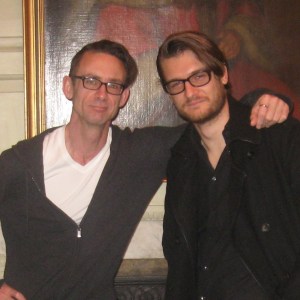
A few days later I met Chuck again at a genteel little guest house just off Soho Square. It was the sort of place that has oil paintings on the walls and marble busts in all the alcoves. We found a quiet place to talk in a small library with book-lined walls and a real fire burning in the hearth. In person, he speaks softly and thoughtfully. It was not the sort of atmosphere in which you would expect to be haunted by a story about fearing you’ve given your pug AIDS, yet here we were.

Chuck told me that he was sent the story, which is apparently true, by the house painter himself after he had read Palahniuk’s short story ‘Guts’. Although it was his debut 1996 novel Fight Club that made his name, ‘Guts’ burnished his reputation when ambulance-loads of people started passing out whenever he read it in public. The fact that the house painter felt comfortable sending his story to Chuck illustrates something important about his art. “It’s partly about creating the opportunity and the freedom for other people to make that same admission,” he says. “When I go up and read ‘Guts’ I humiliate and debase myself in a public way. It gives the audience this superiority that gives them the freedom to risk that kind of debasement in order to admit something about themselves.”

You can read ‘Guts’ in full here, and I urge you to do so if you haven’t. Hurry back, I’ll hold my breath. The first time I ever read that story, I was talking to a good-looking girl at a party about how much Fight Club had blown apart my young world and she told me I had to read this short story by the same writer. In fact, she said, I should read it aloud to the whole party. This is a good example of why you shouldn’t try to impress good-looking girls at parties. Chuck gets a hoot out of this when I tell him. “You had no idea where it was going?” he asks. “What a laugh that was.”

For those who need reminding, it’s a series of three escalating stories about the things that young men will do to make stroking their own penises feel more intense, each with more horrendous consequences than the last. To make matters even worse, Chuck says that like the pug dog tale each of these stories are essentially true.

“I’d been carrying around two parts of ‘Guts’ since my college days,” he says. He knitted them together, tinkering with details – like standardising all their ages to 13 – but the stories themselves were obtained with good old-fashioned journalistic initiative. “The carrot story took a lot of drinking. I had to get my friend so drunk. The candle story came from another friend who had been in the military and had been discharged and now was going to college. He phoned me and asked me to pick up all of his homework for several classes. It took a lot of over-the-phone manipulation. I eventually said: ‘I will not pick up your homework until you tell me what happened’. I had to threaten him to get that story.”

So Chuck carried those two stories around with him, looking for a third to complete the set. “I knew I needed a third act, and I needed a bridge verse as well. I thought of it like a song, with three verses and a bridge. For the bridge verse, I used that passage about how most of the last peak of teen suicide was really kids choking to death. I love to read forensic science textbooks. I started to notice that medical examiner procedural textbooks started to include a new chapter in the 1990s about how to identify auto-erotic asphyxiations where the crime scene has been manipulated by loving friends and family. I wanted to include that information as a sort of big voice observation, before we land in the ultimate anecdote. That’s how the story went together: like a song, with three verses and a bridge.”

He found his third verse when he was hanging out at a sexual compulsive support group, doing research for his 2001 novel Choke. “I asked this very thin man how he stayed in such good shape, and he explained that he couldn’t eat meat. I asked why, if it was an allergy, and he said no, he just had a reduced large intestine. It took a lot of talking before he eventually told me that he’d had a radical bowel resectioning, and why. I kind of embroidered it a little. There’s no way you could survive losing that much intestine. He did not bite through it, but he did have a prolapsed bowel from doing that and he did have to somehow wrench it out of the machinery to save his life. He told me the whole thing face-to-face, but it was a very gentle unpacking.”

At Madame JoJo’s, Chuck read a new short story, ‘Zombie’, which you can read in full here. Again, speaking as someone with your best interests at heart I advise you to go and do so immediately. Chuck thinks it’s a new standard bearer for his work: “It’s nice, every few years, to bring out something that’s really strong, that becomes the signature scandalous thing. For so long it was Fight Club. Then it became something else. Then ‘Guts’ carried the weight for a long time. I think this year’s story, ‘Zombie’, will be another perennial story.”

What floored me when I heard Chuck read ‘Zombie’ was the fact that while it starts out with typically Palahniukian helpings of dark humour, cynicism and nihilism, ultimately the story rejects those ideas in favour of an essential optimism: the existential meaning that can be provided by our sense of community.

“For me, it’s a big breakthrough,” he agrees. “I see my generation as snarky because it was our default identity in the face of the earnestness of the hippies at Woodstock. All of that was a sincere attempt to save the world. Our reaction to that was punk and new wave and with them cynicism, irony and sarcasm. We needed to be to be the reverse of the preceding generation. I want another option. I’m not going to live forever, so why not risk the ultimate transgression for my generation: to be sentimental and to be vulnerable. I think the breakthrough in the story is where the character says: “I don’t even know what a happy ending is.” I think my generation doesn’t believe in happy endings. The first step to resolving that is to admit that we have no idea what a happy ending would be anymore. By making the admission, we’re opening the vulnerability to maybe make it happen.”

Admitting we don’t know what a happy ending looks like, now that our old belief systems are gone, is the first step to finding one. ‘Zombie’ seems to echo that old Gramsci line: “The challenge of modernity is to live without illusions without becoming disillusioned.”

Likewise, Fight Club was about finding a device, almost a game, by which to deal with existential angst. It’s about bravery in the face of the void, as Philip Larkin wrote in ‘Aubade’: “Courage is no good, it means not scaring others. Being brave lets no one off the grave.”

“Beyond just being stoic about it, I liked the idea of being playful about it,” says Chuck. “I think so many discoveries come through the joy of play. Fight Club was about finding a game that would allow the impossible thing to be explored. I was so confronted by violence that I thought if there was a consensual, structured way that I could explore violence, experience violence, inflict violence, then I could develop a greater understanding and mastery and I wouldn’t have that fear. Fear of death is why I started going to those terminal illness support groups and volunteering in hospices, so that I would see at least what the physical process was and how other people dealt with it. As a young adult in my mid-twenties I would at least be taking some action, and have some experience of the thing, so that it wouldn’t be preying on me all the time. It looks like such an impossible thing to die. I think I wrote that into the character of Madison when I wrote Doomed. When she looks at her Grandmother’s hand she sees age spots and wrinkles and thinks: ‘How am I ever going to accomplish that?’ I look at my own hands now and see liver spots that my grandmother had. I remember being a child and thinking ‘Wow! How did those happen?’ It seems so miraculous to find them on my own hand now.”

We’ve reached a terminal point, so let’s go back to the beginning.

Chuck Palahniuk was born on 21 February 1962 in a city called Pasco in Washington State. His family history is bloodier than fiction. His grandfather killed his grandmother, and then himself. Chuck’s father, who was three years old, was at home at the time. “His earliest memories were of being in the house and hiding while his father was trying to find him and kill him.”

Chuck’s father worked on the railroad, an itinerant lifestyle which he and his brother swore they’d never repeat. Now his brother works in Angola, with a family in South Africa, while Chuck spends a third of his time on the road. “We’ve both ended up with my father’s life,” he says with a wry smile.

He says he didn’t learn how to read or write until he was eight or nine, in the third grade. “I think I was the last child in my class. I was filled with terror that I was going to be left behind. When I finally was able to read and write I was filled with such joy that I think that’s why I attached so much to it.”

Chuck talks passionately about how raising a child helps you to understand your own upbringing and to question all your assumptions about the world. “A child is a constantly quizzing thing,” he says. However, he’s talking about the experiences of his friends. Chuck is gay, a subject he doesn’t usually talk about in interviews, but in the context of raising a child I ask whether he’s considered surrogacy or adoption.

“No!” he says immediately. “I devour biographies and writers make really terrible parents. Kurt Vonnegut, Norman Mailer, William Burroughs – oh my God! They were all self-involved and self-obsessed and all of their children suffered.”

Does he recognise that in himself?

“Yeah, I’m completely selfish. I’m just glad that my partner is really good at letting me be obsessed with what I’m obsessed about. I’m really blessed. We’ve been together for twenty years, since before I started to write, so he’s kind of seen me through one persona into a completely different persona. When we met I was working at Freightliner, he was working stocking aircraft for an airline. We both had these very blue-collar lives, and now our lives are completely different.”

Chuck was in his thirties before he started attending creative writing workshops. He learned to write standing on a bar. His teacher, Tom Spanbauer, would arrange public readings in sports bars. “People were involved in sports on televisions or playing pool or pinball or videogames,” says Chuck. “I remember seeing friends of mine trying to read heartfelt memoir that was so subtle and emotionally sensitive that they would be weeping and no-one would give a shit. When it came my turn to stand on the bar and read I made sure that the thing that I read drew the attention of the entire bar, and it worked.”

In Spanbauer’s workshops he studied short-story writers like Mark Richard and his “extraordinary” collection The Ice At The Bottom Of The World, Thom Jones’ “amazing” The Pugilist At Rest and Denis Johnson’s collection Jesus’ Son. Chuck also adored Kurt Vonnegut, and learned from his work the beauty of the repeated chorus, as in Slaughterhouse Five‘s ‘So it goes’. Palahniuk loves them because of “that wonderful way that they keep the past always present, and they provide a standard transition that allows you to move past the impossible moment. I love those cultural ways which we have of getting past that moment where nothing can be said.”

His writing routine is still informed by his early experiences of reading stories aloud in a noisy bar, and he’s wary of the internet, a place where stories grow stale. “I almost never go to the internet for anything, except for maybe to check the spelling of a name, because if it’s on the internet then it’s not fresh. It’s not something original. It really takes talking to people to draw out these fantastic, unrealised new things. I write longhand. I tend to do what they used to call brain-mapping, where you have an idea and you gather everything you can in relation to that idea. I’ll compile notebooks full of handwritten notes exploring every facet of the thing I want to ultimately write about. Then at some point it will start to crystallise and I’ll sit down at a keyboard. When I talk about writing Fight Club in six weeks, or next year’s novel Beautiful You which I wrote in six weeks, I’m really talking about the keyboarding part. The writing took a year or more, but the keyboarding took six weeks.”

Chuck’s way of dealing with the writer’s terror of the blank page is to physically put himself in the places where stories happen. “I want to be in the world,” he says. “I want to be interacting with people and I want to produce something that can compete with the real world. I want to write in largely the same circumstances in which my work will be consumed, in places like bars or airports or hospitals, where people are surrounded by stress and distraction. If I can produce the work in those circumstances I think it’s more likely that people can consume the work there.”

He says the best piece of advice he’s received about writing was from Joy Williams’ essay ‘Uncanny Singing That Comes from Certain Husks’, where she writes: “A writer isn’t supposed to make friends.” Chuck grins as he recites those words. “I just so love that. The idea that you don’t write something in order to be liked. It transcends that. That has nothing to do with genuine writing. It moves me to think about that. “You don’t write to make friends.””

Just as you don’t write to make friends, he argues that when he’s first pitching a story to an editor, it’s less important that they like it and more important that they simply can’t forget it. “Eventually they will recognise some value in it,” he explains. “I think my short stories especially have a depth to them that very few people get. Very few people recognise the fantastic sadness at the end of ‘Guts’. I’m glad that they don’t. It’s nice that they come out of it with a lot of laughs, but occasionally I get a letter from someone saying that when the father has reduced his son to the idiot family dog, that’s heartbreaking, that’s the saddest thing I’ve ever read, and the fact that somebody recognises that makes it all worthwhile. Even if just one person gets it. It’s so gratifying.”

Iris Murdoch said that “every book is the wreck of a perfect idea,” and I want to know whether Chuck still struggles with sealing an unforgettable idea or an ear-catching bar tale in the wax of prose. He says: “That’s the way it used to be. I used to be in love with the idea but now I realise that what I’m in love with is just the tiniest seed of the idea. The idea is going to grow and evolve and bring me to something I could never comprehend in the first place. I can’t be the person who came up with the idea and be the person who has the answer at the end. I’m going to have to grow and evolve through the whole process as well. So I accept that struggle, and that there are going to be unpleasant parts in that struggle where I’m just stymied, but that eventually we all work through those. It’s like my Eiffel Tower story… do you mind if I tell that?”

Not at all.

“Years ago I was in Paris and my publisher threw me this dinner party. Everyone at this party was smoking. I had arrived the day before, so I was jetlagged, and my schedule was just dense with obligations. I was so tired and I knew the day after and the day after and the day after were going to be an ordeal. The last thing I wanted to do was stay up late at this dinner party listening to people speak French, which I don’t speak, and breathing their cigarette smoke. I was so angry because they were just ignoring me. They were talking about whatever they were talking about and it was getting later and later, so I finally begged a couple, who were very drunk, to take me back to my hotel. They were so drunk that they would get lost. They would sit through green lights and run red lights. I was terrified that I would be killed in a car accident. We seemed to be aimlessly driving through Paris, in one direction and then back in the same direction. Just criss-crossing Paris aimlessly. Finally, they pulled up on a kerb near the Eiffel Tower. They parked on the kerb, they left the engine running, they threw the doors open, they jumped out and then screamed: “Chuck, run!” They abandoned the car and started running across the plaza towards the Eiffel Tower. These policemen started to approach us, and I didn’t know what to do so I chased after them. I was just running. They were screaming back at me: “Run, run, we’ve got to run!” I thought maybe they had drugs, and we were about to be arrested for possession. The police were chasing us. As we got underneath the Eiffel Tower they stopped and started screaming: “Look up! Look up!” The Eiffel Tower was all lit up. It was blazing with lights. When you’re under the centre – I didn’t know this – and you look up, it’s this tapering, blazingly bright tunnel that flares in on all sides. We were standing under the very centre looking up at this tunnel that seems to stretch into infinity. As I’m looking up into this tunnel, out of breath and drenched in sweat, my heart is pounding… everything vanishes. All of creation just winks out. There is nothing. Not a sound. Not a light. All I can hear is this collective gasp of breath. The few people who were there at that moment all inhaled at the same moment. I became disorientated in this total darkness and my knees buckled. I had to grasp the pavement because I had such vertigo in that moment of complete nothingness.”

“It turned out that for the whole dinner party what they had been debating was what experience I had to have while I was in Paris? What was the most striking thing that they had to show me? They all decided that I needed to be underneath the Eiffel Tower at midnight when they shut off the lights. They flip all the lights off with a single switch and the whole thing goes to darkness. The entire evening, including the meander through Paris, had been a delaying tactic, so that I would arrive out-of-breath underneath the centre of the Eiffel Tower at exactly the right moment. The whole thing had been a conspiracy to bring me to an ecstasy that I couldn’t conceive of. I had been so filled with rage, and so sure that they hated me and I hated them, and this was such a reversal that it really was an ecstasy. It was a weeping euphoria. Since then it has changed how I feel about writing. That it may be gruesome and torturous in this moment, but the next moment might be an ecstasy greater than anything I could have imagined. The book might not be exactly that seed that you fell in love with, but what it ends up as might be something so beyond who you were when you came up with that idea that it might be this deliverance to something extraordinary. It’s changed how I feel about life too. Maybe life itself, with all of its moments of irritation and suffering might be a conspiracy to bring us to an ecstasy that now we can’t even conceive of.”

Originally published by The Quietus.

Chet Faker

ChetFaker

Who knew an earworm could change your life? Three years ago, Nick Murphy stumbled home from DJing in a bar and sat down in front of Ableton to make a beat. “I’d obviously had too much to drink,” he grins. “When I was writing it I thought it was going to be an original, but I had ‘No Diggity’ in my head. I totally get the words wrong. Nobody’s pulled me up on that yet…”

The next day he stuck his reworked, and reworded, cover on YouTube for his friends to hear. Within two months it was the top track on Hype Machine. Emails and offers started to flood in, which meant he could focus on music – although his day job at a bookshop had been pretty good for a voracious reader. “I just read all day and spoke to weirdos,” he says. “You should have seen the place, it was like ‘Black Books’.”

He’s spent the last two years writing “about 80” tracks, culled to 12 for debut record ‘Built On Glass’. He adheres to Hemingway’s maxim that you have to write ninety-one pages of shit to get one page of masterpiece. “That’s it,” he laughs. “I got plenty of shit.”

‘Built On Glass’ is his own chance to write something that connects with people. “The big lesson is that no-one gives a shit,” he says. “but if you write a song that’s good enough people are happy to listen to your problems. It’s no longer whining, it’s art!”

Originally published in Mixmag, May 2014.

Campaigning In A Galaxy Far, Far Away…

donottiptoeWhen was the last time you went online? Within the last hour? The last five minutes? Are you, in fact, checking your emails on your phone with one hand while you flip through this magazine? Are you half-wondering what you might tweet about it?

In 2014, the internet is where most of us live. That goes for the whole planet. Once in a small café in Koraput, a rural town in Orissa, in the east of India, a teenage boy asked me ‘what’s your name?’ Within moments he was showing me my own Facebook profile on his smartphone screen. That’s in a place that never got landlines.

When we lived in towns, we marched on the streets to get our voices heard. Now it’s easier than ever to mobilise mass protests online, particularly thanks to campaigning sites like Avaaz and Upworthy, but it’s also easier than ever for those in power to ignore them.

Continue reading at Do Not Tiptoe.

Drug Traffickers Build the Best Theme Parks

1When Colombian National Police finally put a bullet through Pablo Escobar’s head in December 1993, he was running what was probably the most successful cocaine cartel of all time, worth some $25 billion (£15 billion). You can do pretty much anything you want with that kind of money, and Escobar did, building houses for the poor, getting himself elected to Colombia’s Congress and running much of the northeastern city of Medellín as his own personal fiefdom.

In 1978 he bought up a vast tract of land outside the city and set about building Hacienda Nápoles, the sort of sprawling complex that you’d expect the world’s richest drug dealer to inhabit, complete with its own array of wild animals. When he died, the land was ignored for a decade and fell into disrepair. The house was looted by locals who were convinced he’d stashed money or drugs in the walls, and the hippos turned feral.

airstripEventually, some bright spark hit upon the idea of reopening the estate as an adventure park. They kept the name, gave it a Jurassic Park-style makeover and reopened it to the public, creating the ultimate family-friendly tourist destination: a still pretty run-down complex with some dinosaur figurines, some hippos and the enduring, unavoidable legacy of a man whose cartel were responsible for anywhere between 3,000 to 60,000 deaths.

Continue reading at Vice.

Route 94

Route 94 - 002 - RINSE 8399copy

Barely out of his teens, Rowan Jones is already an old pro. Having first started making beats on a downloaded demo of FruityLoops at just 13, by 17 he was playing dubstep as Dream at places like Cable, Ministry of Sound and Fabric.

“I’ve been DJing in clubs since before I was old enough to be in clubs,” he admits. “I’ve never been out as a punter. I was either making tunes or I was locked in the green room, doing things I shouldn’t be doing.”

At the grand old age of 18 he realised he’d “kind of hit a wall”. Route 94 was born when he sent ‘Window’, a house track he’d been working on, to New York Transit Authority. “I didn’t think much of it,” he says. “But then he put it in a FACT mix. People started going mad for it and it dawned on me: ‘Shit, I’m actually quite good at this’.”

The deep house of ‘My Love’ shows the direction he’s heading under the tutelage of new manager Artwork. “Because I’m so young having people like him and Skream around is amazing,” he says. “I can take a leaf out of their books.”

This summer he’ll play “every festival”, but for now he’s home in Richmond with his mum, a music fanatic who plays everyone from Michael Jackson to Roy Davis Jr. “I love working in my bedroom,” he says. “I know people pay thousands of pounds for massive studios, but it’s pointless if you just make shit tunes.”

Originally published in Mixmag, April 2014.

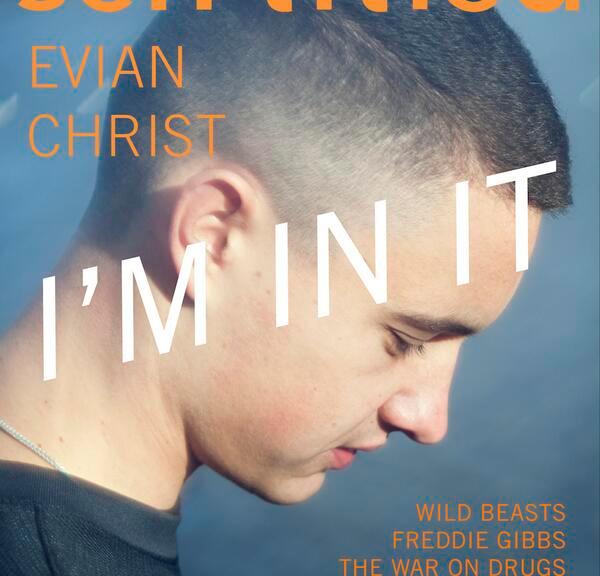
I’m In It

evianchristevianchristipadEllesmere Port is an industrial town in the north west of England, 13 miles south of Liverpool. There’s not a lot going on around here. It used to be that young people would go and get jobs at the oil refinery or the chemical plant. Some of them got jobs in the car factories that secrete the Vauxhall Astras that flow along the town’s major arteries as if in convoy. But times are changing. Nowadays kids leaving school are more likely to end up working in the big retail park that’s grown up on the other side of town, shifting Ellesmere Port’s centre of gravity geographically as well as economically. The kids that can get out move to the cities and forget all about Ellesmere Port, telling their new friends they’re from the nearby well-heeled city of Chester instead.

Josh Leary is different.

Continue reading at self-titled magazine.

Graham Johnson gets the scoop

Graham-JohnsonIn an anonymous but well-fortified lean-to somewhere down a back alley in South London, Graham Johnson is deep in conversation with a man he describes as a “local warlord”. Johnson is a usually a talkative Scouser, but at the moment he’s letting the physically imposing figure who greeted me with a finger-crushing handshake hold court. Johnson explained earlier that the guy’s business is “protection, in the nicest possible way.” He rarely grants this sort of audience. He’s a busy man. Wholesale drug dealers and fraudsters pay him insurance money, and in return they can operate safe in the knowledge that they’re protected against theft by other gangs. Above the gangster’s desk are pinned remembrance cards from the funerals of a host of London underworld figures, and under the watchful eyes of Ronnie Biggs he’s currently telling a wildly entertaining story about the time he extorted compensation money for a drug dealer who’d be dobbed in to the police by a family member. He’d made sure the snitch paid the dealer’s family £20,000 “plus a Big Mac” for him. The deal almost went south when they forget to bring him his Big Mac. In short, Guy Ritchie would cast this guy without a second’s hesitation.

For Johnson, this is just another day at the coal face. One of Britain’s finest investigative journalists, his career relies on the fact that he’s trusted by newspaper editors and criminals alike. He needs underworld figures to be able to open up to him, and more often than not they do. “People like to talk,” Johnson tells me later. “Most of them don’t want to be criminals. Crime is all about capitalism. All the criminals we met today, and 99% of the ones you’ll ever meet, all consider themselves just another part of the economy. There’s the Canary Wharf economy, and there’s organised crime. These guys all consider themselves to be at the extreme end of capitalism. They don’t think they’re any different to the rogue traders in Canary Wharf.”

Now 45, Johnson started his career at local paper Falmouth Packet before moving to the South West News Service. Since then he’s spent 20 years writing for tabloids, starting with the News of the World. He moved to the Sunday Mirror in 1997 and spent six years as the paper’s Investigations Editor before leaving in 2005. He’s been freelance since. Nowadays his work usually appears in The Sun, on Panorama or in documentaries for Vice like ‘Fraud’, ‘The Debt Collector’ and ‘How To Get Away With Stealing’. He’s also written a shelf-load of fiction and non-fiction books, including ‘Powder Wars’, ‘Druglord’ and ‘Hack’.

In 20 years he’s only had one contract taken out on him, which seems like pretty good going, and a testament to his conciliatory skills. “It was for £100,000,” remembers Johnson. “I’d written a series of articles and a couple of books [including ‘Druglord’] about a villain called John Haase. He ended up going back to prison for 22 years, and he put the contract out on me. My reporting put him away, end of story, and smashed his little firm to bits. But that’s quite rare. Usually I try to do things by negotiation and compromise.” It was for his reporting on Haase that Johnson was described in Parliament as an “investigative reporter supreme”.

Having been in the thick of the tabloid scrum for the last two decades, Johnson couldn’t be less surprised by their current travails. He knows firsthand how poisonous their working environment has been to any noble concept of what journalism could be. “I think Leveson is great,” he says. “Newspapers were a cartel. Instead of selling drugs they sold stupid stories. In the race to get ever stupider stories, they started to do evil things. It was a corrupt corporate culture based on bullying, and that only has a finite life. You know it’s going to go tits up. Me and [his partner] Emma were both sacked by Rebekah Brooks. We knew they were all gangsters because we used to work for them.”

He looks back with regret at what his time at the News of the World made of him. “Being binned by the News of the World was the greatest thing that ever happened to me, because otherwise I would be in the dock now. I may still end up in the dock. I’ve done some terrible things. I was a member of the tabloid einsatzgruppen. I was a member of a Nazi Death Squad, and when I came to your village everyone there was getting metaphorically wiped out: men, women and children, by my little firm. I didn’t care because I had no conscience.”

After moving to the Sunday Mirror, Johnson was again forced to watch as a once-proud investigative paper was thoroughly declawed. “Working on newspapers, you come to learn why tabloids are so great. You learn what you need in the mix. You need some showbiz stories, you need some crime stories, you need some human interest stories and some politics. You need your John Pilger and all that.” Then at the Sunday Mirror we dealt with editors who started to say: ‘We don’t want any of that. All we want is celebrity stories. We’re going to bet the farm on Big Brother’, and they did. Sales went down. The editors would say: ‘Listen, this is not because we’ve made bad editorial decisions.’ This is not because we put a lottery winner on the front of the paper. This is because B&Q is open on a Sunday, so people are going to B&Q instead of buying the paper. Then when the internet came along, it was: ‘Oh, we’ll blame it on the internet.’ They got more and more desperate and it got deeper and deeper.’”

Johnson blames privately-educated editors for losing touch with their own readers. “They’re out of touch and then they all feed off each other. Tina Weaver used to go to the Labour Party conference. I was there for 10 years and she never mentioned the Labour Party. She never mentioned socialism. She never mentioned pay and conditions. And this is from The Mirror, the ‘left-leaning’ tabloid. I knew the whole Labour thing was a fraud from the inside. Once a year, to make it look like it wasn’t a fraud, Tina Weaver would get in a Merc and get chauffer driven to the party conference to meet other privately educated leaders. It was all a fraud.”

You can’t have legions of privately educated people running a newspaper,” he continues. You need a good mix. That’s your readers. But listen, I’ve got nothing against privately educated people. Like it says in this book, if you’ve got the money then you should spend lavishly on it…” At this point he reaches into a wide pocket on the front of his rain jacket where I’d seen his stash his notepad along with a well-worn book with its cover missing. He throws the book down on the table. It is Marcus Aurelius’ ‘Meditations’.

In 2005, Johnson had a nervous breakdown and left the Sunday Mirror. It took him two years to return properly to journalism, and in that time he sought solace and direction in studying philosophy. “I got into the stoics and the ‘Meditations’,” he says. “That’s why I always have a copy of that. You need it, honestly. When you’re a crime reporter you need it because all day you’re surrounded by people telling stories like the warlord we met earlier. He’s not evil, but he’s capable of evil things. You meet a lot worse than him, so you need to get your head together. I use that. I always carry that. I read it in my downtime. I had a nervous breakdown because I just told so many lies. When you’re in the tabloids you’re just telling lies to everyone. You’re telling lies to your readers, your contacts, everyone.”

Now that he’s out of the newsroom and working to his own rhythms, Johnson can see that the tabloid environment pushed him towards that inevitable breakdown. “When I started out on the NCTJ I was a pretty bad reporter,” he says. “Well, I was a good reporter, but I played fast and loose with the code. I didn’t really care about the journalism. It was just about stories and ambition. I was corrupt. All I wanted to be was a Fleet Street hotshot. I went to work at the News of the World, and that’s great if you’re corrupt, because they’re corrupt as well.”

Today, Johnson is an advocate for a different kind of journalism. The kind that’s disappearing from newsrooms. “After I left the News Of The World I decided to be the best reporter I could, and play it straight. Now I consider myself a reasonably good reporter. I don’t break the law. I don’t fabricate any stories at all, yet we get big world exclusives week-in, week-out. We deliver. We don’t use Google and all that crap. We don’t get stories off the internet. It’s just banging doors and running round. Half the fucking reporters at the Mirror won’t come out of the office. On top of their office is a bank, underneath is bank: they think they work in a bank. They think getting stories is like trading in credit default swaps or something. They think you don’t have to leave the office to do it. They’ve lost all connection with their readership. That’s why traditional newspapers have been going down for many years. The phone-hacking thing has just demoralised their confidence further, but the truth is you can’t get stories off Twitter, or fucking Facebook, or however people do it. You’ve got to go out and get stories.”

We Made Tons of Weird Friends at the UKIP Party Conference

UKIP-VICE-CIAN-2

The UKIP press officer said he hadn’t heard of VICE, and he wanted us to leave. Our photographer Cian Oba-Smith was trying to check his bags into the cloakroom when the guy – a former journalist himself – popped up behind us and told the attendant to immediately return them. “These boys are going now,” he breathed. He didn’t like the way Cian had been taking photos of the UKIP gift shop and the raffle on the way in, but who could resist shooting a pewter bulldog with the Union Jack on his back and the EU flag between his teeth? Maybe the two of us looked pretty out of place at a conference that was, with a couple of exceptions, a sea of white hair and skin, but eventually we managed to talk him into letting us stay – provided we behaved.

Continue reading at Vice.

Quirky Dickheads Ruined William Burroughs’ 100th Birthday Party

typewriting

This year would have been William Burroughs’ 100th birthday. He died in 1997 at the age of 83, which was still pretty good going for a man who spent the majority of his adult life treating his body like a pin cushion. While he wasn’t travelling the world, trying new drugs or accidentally shooting his wife dead in a failed William Tell trick, he wrote books that are now sold next to Jack Kerouac’s and Allen Ginsberg’s, and read by every teenager who’s outgrown Salinger and wants to look like a maverick on public transport.

Perhaps his most well-known is 1959’s Naked Lunch, a chronicle of heroin visions that’s partly set in the dreamlike “Interzone”, an imagined city based on his experiences of living in Tangiers’ lawless international zone after World War II. Parties in the Interzone tend to be pretty chastening affairs, where madmen “go about with a water pistol shooting jism up career women”.

When I heard that something called Guerrilla Zoo was going to recreate one of these near the O2 Arena to celebrate Burroughs’ birthday, I thought it would be impossible, owing to stuff like laws and common decency. But I didn’t want to write them off without seeing it for myself first, so I got a ticket and went along.

Continue reading at Vice.


“I’d go to church high with a knife in my pocket” – Blue Daisy has got a weird kind of salvation

bluedaisy

“The hip-hop scene in the UK is quite straight,” says Kwesi Darko with a shrug. We’re drinking cider in The Unicorn on Camden Road. Tucked away behind the pub is New Rose Studios, where the 27-year-old Camden local, better known to production aficionados and beat fiends as Blue Daisy, spends most of his time locked away in a studio working on his forthcoming second album The Mask & The Aura.

Continue reading at Vice.

This guy made $23,000 by releasing 14,000 songs on iTunes and Spotify

paparazzilongfor1a

Say you’re searching Spotify for Lauryn Hill so that you can jam out to The Miseducation of… in the privacy of your own bedroom when you stumble across a song called “Lauryn Hill Is Like Awesome And Great”. You’re curious, so you stick it on. Matt Farley just earned $0.005.

Or maybe you’re bored and decide to stick in “Kurt Vonnegut” to see what comes up. Or “David Beckham” or “Ryan Gosling”. Or you’re really in need of a very specific apology song like “I’m Sorry I Forgot Our Anniversary”. Every time your curiosity gets the better of you, Matt Farley gets $0.005. More if you download it off iTunes.

Sure, the margins are so low that it would take an insane number of plays to add up to a substantial amount of money. It would take millions of plays and downloads, and that would require thousands of songs, on a ludicrous breadth of topics. It would take a superhuman amount of effort to make that numbers game work in your favour.

But last year, Matt Farley earned $23,500 (about £14k) from his music. He managed that because in the last six years Farley has written, recorded and released over 14,000 songs. He puts them out under a variety of assumed band names, so it’s not immediately apparent quite how prolific he is. He sells them and streams them on every available site, and all those $0.005s add up. Not to a fortune, admittedly, but enough that he can justify spending half his working week knocking out songs from his home in Danvers, just outside Boston in Massachusetts. I wanted to talk to Matt because although he might dream of being recognised as part of the “best pop/rock duo since Hall & Oates”, his absolute dedication to DIY music is probably the best thing since Lil B created 150 MySpace pages.

Continue reading at Vice.

Mahraganat lets Egyptians say the unsayable

figosadatinterview

The revolution in Egypt that would eventually see Hosni Mubarak run out of Presidential office and lead to the country’s first democratic elections began three years ago, on the 25th of January 2011. That day an MC named Sadat, then aged 24, was among the hundreds of thousands protesting on the streets of Cairo, looking for change. When he got home that night, Sadat couldn’t sleep.

“I started writing, and the next day I went to Figo’s house to write and compose the song,” he explains with the help of a translator, sat in a back room at the Rinse FM studios in east London. “It was about corruption and killing and everything that I had witnessed.”

Sadat, along with his collaborator DJ Figo and a handful of others, was already at the forefront of an underground dance music scene which many people call “electro chaabi” (which roughly translates as “electro folk”) but which he’d rather you call “mahraganat” (“festivals”), because he thinks of it as something new, and not just an electro version of the music that’s gone before.

Continue reading at Vice.

Pizza with Katy B

katyb‘It’s got lust and love and danger and jealousy on it. It feels “red”.’ Sadly, Katy B is not talking about the Big Red pizza bus where we’re sat in Deptford. She’s describing her second album ‘Little Red’, the follow-up to her rave-igniting, Mercury Prize-nominated 2011 debut ‘On a Mission’. After digging in to a rocket-loaded Giardiniera pizza, the south London R&B icon opens up about dating, dancing and her past life as Peckham’s answer to Vinnie Jones. 

Continue reading at Time Out.

Hanging out with The Family Rain in Bath

thefamilyrain

“How, unless you drink as I do, can you hope to understand the beauty of an old woman from Tarasco who plays dominoes at seven o’clock in the morning?”

Malcolm Lowry the author of Under The Volcano, a strange and beautiful novel from which that quote is taken, was a dipsomaniac, which is a lot like being an alcoholic except you don’t have to go to meetings. Something about his tale of a Mescal-soaked Englishman living out his final days in the Mexican heat must have appealed to The Family Rain who stole the title for their debut record, which is out next month.

The Family Rain are a rock’n’roll band in the old fashioned sense . They’re called ‘The Family’ because they’re three brothers and ‘Rain’ after Sister Rosetta Tharpe’s timeless blues number “Didn’t It Rain”. The oldest brother, Ollie, plays guitar riffs that strut and stumble like Keith Richards leaving a nightclub. Tim beats the living shit out of the drums while his identical twin Will plays bass and wails like Jack White in a custody hearing.

Continue reading at Vice.

Why Is MC NxtGen’s Anti-Tory Song So Lame?

nxtgen

This is a video that’s been doing the rounds on Twitter this week. It’s called “F The Tories Freestyle” (rude word censorship, songwriter’s own) and features a man rapping about the many, many problems with Britain today. Over cloying strings borrowed from a Coldplay song, MC NxtGen – a guy from Loughborough in his mid-twenties known as Sean Donnelly to his mother – sprays bars about people being “brainwashed by Britain’s Got Talent” and calls David Cameron “a prick”.

Continue reading at Vice.


(This Is) The Dream Of Jimmy and Ben: 10 years of The Postal Service

PostalService

On February 19th 2003, a band called The Postal Service released an album called Give Up. It was the product of a curious union between vocalist Ben Gibbard of Death Cab for Cutie and the producer Jimmy Tamborello, known as Dntel. The pair had been exchanging CD-Rs through the post and working on their glitchy, introspective electro-pop independently in their bedrooms. Their record label, Sub Pop, were supportive but realistically expected it to shift maybe 20,000 copies.

By September 1st 2010, Give Up had sold 1,012,135 copies in the US alone, making it only the second Sub Pop release after Nirvana’s Bleach to go platinum. Something about this sweet, ethereal record struck a chord that surprised even those who made it. They thought they were putting together something niche, a labour of love, but Give Up was the album for its time and place. It brought electronic music in from the clubs and made it something quiet and personal: a romantic, digitised sound for a digitised world in need of romance.

I’ve found myself coming back to Give Up more often than almost any other record in the last decade. It’s been the soundtrack to countless flights, train-journeys, tube-rides and evenings spent lit by the glow of a computer. As the album nears its tenth anniversary, and with it likely that the duo will mark the occasion by reforming at least for a handful of festival dates, I wanted to track down some of the people involved in the record to see if they could help me to better understand this beautiful freak.

“I agree with you, there’s something mysterious about the record as a whole,” says Jen Wood, who dueted with Gibbard on ‘Nothing Better’. “I think that a lot of the songs have a dream-like theme and there is a dark, romantic cloud that looms around inside every song. I think the lyrics are so poetic that it leaves you in an imaginative state… it just allows you to be transported to a different place in your mind.”

That place is hard to pin down from the beguilingly rootless music, but in reality the story of Give Up starts in L.A. in 1993, a decade before its release, at a small college radio station called KXLU. Here, Jimmy Tamborello was working as the Music Director while playing bass in a band called Strictly Ballroom with Chris Gunst. Through KXLU they met Tony Kiewel and Jeff Antebi, who later managed Danger Mouse, and the pair of them teamed up to release Strictly Ballroom’s album. Looking back now, Kiewel says: “Strictly Ballroom didn’t really get out of California much but they were a fairly influential part of the local music scene while they were around. Suffice to say, there’s an odd crew of folks who were all really close and involved in this little scene who all went on to do relatively interesting stuff.”

The interesting stuff Tamborello was working on was an album of music that he would release under the name Dntel in 2001, Life is Full of Possibilities. “Jimmy had been quietly churning out tons of music from his bedroom for years,” says Kiewel, “but that album was a whole new venture for him.” It featured a host of guest vocals, including his old bandmate Gunst, but the track that Kiewel calls “a special bit of alchemy” was his first collaboration with Gibbard: ‘(This Is) The Dream of Evan and Chan’.

The track was a product of chance, one of those possibilities that life is indeed full of. Kiewel and Tamborello both shared a house with Pedro Benito, whose band The Jealous Sound landed a tour with Death Cab for Cutie. It was through Benito that Tamborello was introduced to Gibbard and given the opportunity to invite him to sing on his album.

Following Death Cab’s tour, Gibbard ended up back in Seattle where Kiewel was now working in A&R for Sub Pop. One evening, when Tamborello and Benito came to visit them, Gibbard and Tamborello fell into reminiscing about their collaboration. “Those guys started talking about how much fun making that one song was and how great it would be to bust out an EP,” says Kiewel. “I suggested that if they were going to make an EP they might as well make an album and said if they did I was pretty sure Sub Pop would be into putting it out.”

It was his job to sell the idea to the label: “When I pitched the project to the A&R group at Sub Pop I brought in ‘The Dream of Evan and Chan’ and played it and basically explained that they wanted to make a whole album like that. There wasn’t a single voice of dissention. Everyone was totally into the idea. Plus the guys said they didn’t need much of a recording budget. That record literally cost a couple thousand to make and most of that was spent on FedEx and hard drives. They made pretty much the whole thing in their bedrooms.”

Gibbard invited Death Cab’s Chris Walla to get involved and also asked singer-songwriter Jen Wood to add her vocals into the mix. “It all was a little out of the blue,” she remembers. “I had no idea that Ben was working on this project. I just got an email asking if I’d wanna sing on his new project. Ben then mailed me a CD of rough mixes. I remember playing it for the first time and being so stunned. It was nothing like Death Cab. It was a cool surprise! I cranked up the volume to the max and literally started jumping and dancing around in my room. Obviously, then, my answer was ‘Yes! I will sing on these songs!’ At the time, I didn’t know anyone who was making a record via mailing CDs back and forth. It was a new idea to me. I remember just thinking how rad it was that they were doing that, such a creative and yet kind of endearing way of making music together. There’s something special about receiving packages of music back and forth between two friends. It creates a sentimental kind of feeling.”

The critic Robert Christgau called ‘Nothing Better’ “the album’s centerpiece” and argued that Gibbard needs his female principle “too much to mince metaphors”. The song owes a debt to The Human League’s ‘Don’t You Want Me?’, but Wood says that, for her at least, it wasn’t a conscious homage. “Honestly, I don’t recall Ben ever telling me that about the song. Not at first at least. When I was recording my vocals, I had no idea that that was an influence. I basically was just thrilled to do something totally brand new. I was already getting bored with playing acoustic guitar and the Postal Service songs allowed me to embody something fresh and energizing.”

While Wood recorded her parts in Seattle, Jenny Lewis added her vocals in L.A. “They’re all very different people,” remembers Kiewel, “but they’re all incredibly grounded, ridiculously sweet and frustratingly talented.” In total, he says the whole recording process probably only took three months. “Every couple of weeks Jimmy would send up two CD-Rs to my office with two or three songs and Ben would pop over and pick them up. Then he’d track some vocals and guitars on top and bring the CD-R’s back in a few days to a week. It just went like clockwork.”

Squirreled away in his studio, Tamborello was busily absorbing sounds from across the globe. Looking back, the producer says: “There were a lot of Morr Music influences, the German label. People like Lali Puna. It was light-hearted, but I guess it was kind of indietronica. When we started making the record I figured it would be a little more experimental but we ended up just having more fun and making straight-forward pop songs.”

Kiewel had total confidence in the album as the release approached: “Around the time they finished we were experiencing a bit of a renaissance at Sub Pop. The Shins and David Cross were selling really well and the Hot Hot Heat debut was about to take off. I just remember thinking, ‘Wait ‘til people get a load of this Postal Service album!’ So, I was really confident about the project at pretty much every step. I also knew I was totally biased. I loved the people involved on a personal level and this music was tailor-made to hit all my pop sweet spots.”

It turned out he wasn’t the only one it seemed tailor-made for. “I always thought there was a better than average chance it would do a lot better than we’d predicted, but I knew for sure when they went on tour immediately following the release of the album and show after show started to sell out. Second shows were being added everywhere. The year that followed was really bizarre. The record continued to find fans all on its own. We were giving away ‘Such Great Heights’ on our website and we were seeing over a hundred thousand downloads a week, sometimes a lot more.”

For his part, Tamborello was completely caught off guard. “Yeah! It was pretty surprising,” he tells me. “It was slightly gradual, the way it got big, so there wasn’t a big moment of shock. When we made it it was really one of the most casual recording situations I’ve been in. We were just really having fun and doing exactly what we wanted to do, and when it was done I couldn’t really figure out who it was made for.”

In August 2003, the band received a cease and desist letter from the U.S. Postal Service citing their trademark of their name. The resulting publicity, which saw the dispute appear on the cover of the New York Times, didn’t hurt the record one bit. Indeed, in a novel settlement the band agreed to let their music be used in adverts for the Postal Service and played a show at their National Executive Conference. In return, the postmen started selling Give Up on their website. Meanwhile, ‘Such Great Heights’ was becoming a radio hit across California, although it wasn’t given such a warm welcome elsewhere: “At least one music director told me that it was ‘too gay’,” says Kiewel, “and I suspect that pretty much summed up the macho bullshit attitude we were up against from most places east and north of California.”

Regardless of the ‘macho bullshit’ the album took on a life of its own, almost despite the efforts of the band members who were keen to get back to their day-jobs. “The plan was for The Postal Service to record a new album after that next Death Cab album but between the busy Death Cab schedule and a short stretch of writers block on Jimmy’s part early on, that record has still never come to pass,” says Kiewel. No matter, the music was out there now. Napoleon Dynamitedirectors Jared and Jerusha Hess directed a video for ‘We Will Become Silhouettes’ and ‘Such Great Heights’ found an even wider audience after it appeared in the trailer for Garden State – apparently suggested by the video editor who happened to be another alumni of KXLU.

Nearly ten years after Gibbard and Tamborello first collaborated on ‘(This Is) The Dream of Evan and Chan’, Give Up continues to sell over 500 copies every week. Jen Wood still feels “super shocked and super thrilled” by the album’s success: “Ben and Jimmy were making these songs purely because they enjoyed it and it was fun for both of them. I think I didn’t realise that it was going so big-time until it was in full-force. I remember being on tour at the time with a Seattle band, Aveo, and every single venue we played at across the US was playing the Postal Service in the bar. It was insane! I remember feeling totally baffled yet so happy that everyone was listening to the Postal Service. Then, when it was being covered and used in movies and commercials, it really hit me that it was taking over! The icing on the cake was when I got a call from Tony Kiewel telling me had a gold record for me! In my mind I was thinking ‘Holy crap! This is crazy!’”

There’s now a platinum record to go with that gold one but in truth the unexpected commercial success and pop cultural appearances make no difference at all to the blissful forty-five minutes when Give Up holds you in its reverie. “I think it has to do with its effortlessness and the incredible talent of the people who made it,” says Kiewel. “That album was never meant to be anything other than a labour of love. They had no expectations and no ambitions as a band. They wanted to make something for the sheer joy of it that paid respect to some of their favorite 80s influences. That they transcended that one modest goal is a testament to their rare abilities.”

Originally published by Drowned in Sound.

A Liquid Lunch: In Bed With Shane MacGowan

Shane & IShane MacGowan is unwell. In a hotel room in London Bridge, the Pogues frontman is sat up in bed fully dressed, eating soup with his fingers. He runs them around the nearly empty bowl on the tray beside him, licks them delicately and then wipes his hand on the bed sheets. The television is on, chattering about the news, but nobody’s watching. There’s a pack of Gauloises on the bedstand and another pack of Bensons lying on the bed. Shane’s partner Victoria Mary Clarke welcomes me in. “Do you want a glass of this?” she says, proffering a bottle of red wine. “It’s very good. It costs £50.”

She pours me a glass and tops up herself and Shane. He apologises for the drag of having to conduct the interview from his bed. He’s had gastroenteritis. “I’ve been ill. Nothing to do with the food. I just overdid it. The food was great. The whole thing was great. Too great. Now I’m paying the price.”

So now he’s laid up in his sick bed like Cúchulainn, the mythical Irish warrior who, when his enemies finally came for him, was said to have tied himself to a standing stone so as to be able to die on his feet. When Shane wrote his song ‘The Sick Bed Of Cúchulainn’, he transposed one of the stories of the indefatigable hero onto a tale about a fighter with Frank Ryan’s anti-fascist Irish nationalists. The opening track of The Pogues’ flawless 1985 album Rum, Sodomy & The Lash, it’s archetypal MacGowan songwriting: an exuberant celebration of boozing delivered with a punk snarl yet somehow timeless, as if the song had been passed down through the ages.

But it hadn’t. Shane had to write it. In his memoir of his life in The Pogues, Here Comes Everybody, accordion player James Fearnley says of another track from that album, ‘Sally MacLennane’: “the melodies were so seamlessly Irish I was surprised to find out that the song wasn’t traditional.”

Shane shrugs when I tell him this. “Well, there are similar Irish and Scottish folk songs. There’s only eight notes, or sixteen if you want to count it the proper way. I like story songs. Most really good songs, I’m not necessarily saying mine, but if you think of rock & roll, or blues, go as far back as you want, they all have a story. They’re all about a revolution, or a battle, or a love affair, or whatever. I came from a really musical family. Everybody played music and told stories and made up songs. All the neighbours did as well.”

Shane MacGowan was born to an Irish family living in Kent on Christmas Day 1957. Lord knows what people listened to at Christmas before he wrote ‘Fairytale Of New York’, but presumably there was music of some description. When he was a young child his family moved back to Tipperary, but they were in England again by the time he went to school. He won a literature scholarship to go to Westminster School, but was expelled after being caught in possession of dope, acid and pills.

As a young man in London he was in a succession of “Irish ballad groups and rock bands”, and felt the first trembles of punk: “Things were building up to punk for years. There were people like the Stooges, the MC5 and the Dolls. The Pistols have to take the credit, but one of the regular support gigs they got when they were starting out was with the 101ers. Joe Strummer really liked them. At that point Mick Jones and Tony James were in a band called London SS. There’s a joke behind that, because Mick had got a university degree while living up on the 90th floor of a godforsaken tower block in Harrow Road. With that degree he’d got the job of opening letter bombs for the Department of Health and Social Security: the DSS.”

Shane lets out a wheezing snicker, which sounds something like how Muttley would laugh if he’d given Dick Dastardly the slip and gone out for a night on the tiles with Tom Waits instead.

“They were also into the leather and coy Fascist bling and coy Communist bling, all at the same time. I saw a guy wearing this homemade shirt one night and then the next day they had a copy of it in Sex for fucking £50. It had Marx and some Nazi or Ivan The Terrible on it, and it was covered in hammers and sickles and swastikas. It was great. The main thing was making your own stuff, which the hippies did to a certain extent with tie-dye and all that shit. You could make your own fashion, you know what I mean? Then, so that people wouldn’t feel left out if they couldn’t make their own clothes, or destroy their own clothes and then put them back together with safety pins, you could buy one for £50 from the Sex shop – or you could nick one! I used to let people nick my shirts, as advertising.”

It must have been an exhilarating time to be a part of the music scene in London?

“The scene that formed round the Pistols was something that record labels just couldn’t understand at all. They were all people like Dave Dee of Dave Dee, Dozy, Beaky, Mick and Tich. Do you know them?”

I have to confess to not being au fait with the oeuvre of Dave Dee, Dozy, Beaky, Mick and Tich.

“They were a completely over-the-top, grotesque, outrageous Sixties band. In the Sixties everyone knew ‘The Legend Of Xanadu’ by Dave Dee, Dozy, Beaky, Mick and Tich. He used to crack a whip. The fact that people in those days in the state they were in could actually say their name… Dave Dee was the guy who later got sacked from one of the record labels for not signing up The Sex Pistols. Yes, they were crass and outrageous. Yes, The Sex Pistols pissed older people off, but so did Dave Dee, Dozy, Beaky, Mick and Tich!”

Shane snickers again and streaks another soupy hand down the bed sheets. Victoria, who has been watching him do this since I arrived, finally snaps: “Shane, there is a napkin!”

He glances around guiltily and wipes his hand on a napkin from the tray, then deposits it into his soup bowl.

The Pogues released their first record ‘Red Roses For Me’ in 1984, a mix of Shane’s gutter hymns and traditional Irish songs with one, ‘The Auld Triangle’, written by Dominic and Brendan Behan. Behan also features on one of the album’s most famous tracks, ‘Streams Of Whiskey’, appearing to Shane in a dream. How important was the great poet’s influence on him as a young writer?

“It’s interesting. Behan recorded loads of talk-books in which he bursts into song. I think they’re great. I also think he was a great writer of stories. He used to experience things when he was pissed but he couldn’t discipline himself to write it down or type it out. Even if he had his things in the pub with him, he’d only have a pint of stout because he’d drink slowly while he was doing it. He couldn’t get wrecked and then go home and write a bloody story. It’s not the same with me. It’s strange… Later on, he could write stories when he was pissed because people recorded him. He’d go off in all directions. It’s fascinating, really fascinating.”

The streams of whiskey helped the streams of consciousness along?

“Yeah, and bursting into song. All that. That’s the thing about Irish writing. It developed from story-telling. Story-telling is a huge thing in Ireland, or used to be. All the playwrights, all the novelists, all the poets… well they’re all poets. It’s all poetry, really, the same way that Shakespeare is poetry in play-form.”

There’s a strong tradition of public performance.

“Yes, exactly yes. Music and poetry are meant to be performed. I mean you can get a really good poem, but if somebody reads it out without really thinking about what it means then it’s a total waste of everybody’s time.”

Does he still enjoy getting up in front of an audience?

“I’m phasing it down,” he says, then nods at Victoria: “She’s seen thousands of Pogues, Popes, whatever you want to call it, gigs with me in them. She reckons the first of the nights in Paris that we were filming for the DVD was really great and the second night was even better.”

“I was really surprised,” she says. “You never know what to expect. It might have been terrible. Ha!”

“When the Parisians go nuts they really go nuts. The audience gives you so much.” He grins at Victoria: “But I’m always great, anyway.”

Victoria smiles back: “You’re not always great. Sometimes you’re shit.”

“Not any more!” He snickers. “Occasionally… no, I’m never shit! Sometimes I’m as boring as the rest of them, but in Paris they were great as well. The audience was great. We were great.”

The Pogues’ Christmas tours have become a semi-regular fixture, and I don’t doubt that the royalty cheques for ‘Fairytale Of New York’ are a pleasant gift each year, but I ask whether Shane ever fears that song overshadows the rest of the band’s work?

He shrugs. He doesn’t seem to mind if it does or not. “Well, yes, it was a Christmas hit and Kirsty is on it and it was a special moment. It took two years for that thing to go from the original bet with Elvis Costello, who was no longer producing it when we eventually did it with Kirsty. Originally it was going to be Cait O’Riordan doing it. Cait did it well, but I think Kirsty was a really important element. She had the right attitude, and she produced herself. She separately double-tracked her own voice.”

How was working with Elvis Costello on Rum, Sodomy & The Lash? Shane pauses and there’s an audible intake of breath from Victoria before he answers: “I preferred working with Kirsty!” His laugh sounds like a death rattle. “A lot! And I preferred working with Cait but he [Costello] went off and fucking married her and made her leave the bloody band. I was furious.”

Shane’s own departure from the band, precipitated by his failure to even turn up for the opening dates of their 1988 American tour, finally came when he found himself sacked at a Japanese festival in 1991.

He would go on to marshall a new band, The Popes, for a few years, but before that he recorded and released a duet with Nick Cave, ‘What A Wonderful World’, in 1992. He’s recorded with Cave on several occasions since. How did that friendship come about?

“I was always into Nick Cave, and I always hoped he was into me. It turned out he was. There’s a lot of similarities, I think, between our songs. We’re very different people. We have a lot of similarities, but he’s more studious I suppose.”

Victoria picks up on Shane’s understatement: “It’s strange because Nick is very intolerant of people. He really doesn’t like people. Shane is the only person I’ve ever seen him tolerate. The thing about Shane is he’s late for everything. He’s messy, he spills drinks. He’s quite the opposite of Nick, but Nick doesn’t mind. It’s strange, because he’d criticise anyone else for that. He just forgives Shane anything. Nick’s very disciplined. He gets up at 6am and sits in his little shed and writes. He loves to work more than anything.”

Shane laughs: “And I love to work less than anything.”

This seems to be one of the central facts of Shane’s mythology: that unlike Cave’s meticulous and painstaking craft, there was a time when Shane would simply load up on drink and drugs and the poetry would flow out of him. Was that really how he experienced it? Was the writing automatic?

“Yeah, a lot of the time, yeah. Lots of people do that. You chug away at the same old riff until it’s hypnotic. Maybe you get it wrong, and then you have a new riff, or at least a different riff. You get a title. A title is a really good start. Then musically a riff. I don’t feel like it’s me writing it.”

I don’t know if he’s being disingenuous. His songwriting is rich with classical and literary allusions and layers of meaning. Was there really no graft involved in constructing them?

Shane pulls a face at this: “Well that’s not graft, do you know what I mean? Literature is just stories. One of the greatest works of literature is Finnegans Wake by James Joyce. The inspiration for that came from ‘Finnegan’s Wake’ which is a great story-song. Nobody knows who wrote it, it’s so old. Well, it’s not that old. It’s 200 years old maybe. People just used to pass it down, as often happened at wakes. That’s what wakes are for. People would start off being very nice about the person, then there’d be more and more slanging and then they’d have a huge row and all the rest of it. If that didn’t wake them up then they must be dead, yeah? It was all because there were so many premature burials in those days.”

He goes to take another swig of wine, then pauses with his glass poised at his lips as he remembers something more about Joyce: “In his later years Joyce was nearly blind and he was using a typewriter that he was constantly having to hock and get out again. There were two or three bum letters on it so he didn’t know exactly what was going to come out. He had bad eyesight, a bad back, all the rest of it. In those days a doctor would write you a prescription for everything, and he was a boozer from an early age.”

Were Behan and Joyce your biggest influences?

“The whole folk tradition, it doesn’t have to be Irish. I might be in a cab with a Greek guy, it might be in Greece, it might be in London, and if he’s singing this great song, great tune, beautiful song and I’m asking him: ‘Can you give me a rough idea of what it’s about?’ He’ll say: ‘It’s about a guy murdering his girlfriend.’ In Irish and English songs there’s often no reason given why the guy kills his girlfriend, then the girlfriend’s ghost warns him that he’s going to get caught. They’re going to find her body and he’s going to get hung. She’s not angry with him, because she loves him and just wants to warn him.”

I guess that’s a recurring theme in folk songs.

“It’s a recurring theme in life, really.” He lets out a long laugh: “Sex, birds, life, death, sex, birds, life, death.”

There’s plenty of death in Shane’s writing. When he first played the band ‘A Pair Of Brown Eyes’, guitarist Spider Stacy’s initial response was: “You sick fuck! Labelled parts one to three? What sort of a twisted, fucked-up sort of mind comes up with lyrics like that?”

“Mine,” said Shane.

“That song’s about a guy who’s pissed off because he’s broken up with his girlfriend,” Shane explains now. “There’s also this older guy whinging away in the corner. There’s people singing songs and it gives you the titles of them. There’s a bit where Johnny Cash sings ‘A Thing Called Love’ on the jukebox, and ‘My Elusive Dreams’ is by Ray Lynam and Philomena Begley. That particular song is kind of autobiographical. It’s set in The Scottish Stores which is an Irish bar near Camden, do you know it?”

It’s now The Flying Scotsman, the rundown strip pub with blacked-out windows by King’s Cross Station.

“There’ll always be someone, you’d be sitting there feeling miserable and some old geezer says: ‘Why do you look so bloody miserable? Listen to what happened to me!’ and he tells him about whatever war it was. Of course, there was a war going on at the time in Ireland, as usual.”

Having had his premature death predicated for years, Shane has now reached the 30th anniversary of The Pogues. What is he proudest of?

“Getting this far without fucking being… well, I have been in the nuthouse. I’ve been locked up a few times, but without any serious… I have been beaten up several times. Then I’ve beaten other people up. I’ve had some ludicrous accidents, but…”

He looks at Victoria. “You’re alive,” she says.

Shane seizes on this: “Yes! That’s my greatest achievement: still being alive!”

“You’ve come very, very close to death,” she replies. “I found you not breathing once.”

“A couple of times you’ve started my heart.”

Victoria turns to me: “He jumped out of a moving car onto a motorway.”

Shane reacts with practised exasperation. He’s fought this corner before: “The woman was only driving at twenty miles an hour and she couldn’t see! She wasn’t wearing her glasses!”

Victoria ignores his protestations: “And he got hit by a taxi that was going quite fast.”

Shane nods: “Twice. Once I got hit by a taxi that was going pretty fast, but it glanced off me. If it had been a few inches in the other direction he’d have hit me head on and I’d be dead. I was knocked 18 feet across the road. On another occasion it happened when I was working at the Hudson Bay Warehouse. I wasn’t even drunk, just hungover from the night before. I was doing overtime on a Sunday. At lunch hour most people used to go across the road to the pub. I was just wandering across, and this Renault hit me much faster than the taxi. Again he glanced me but it knocked me across the road. I was really lucky. I didn’t even realise I had a lacerated arm. With the taxi I had a smashed up leg on one side.”

Shane ruminates on this for a moment. “You know, some people are lucky, and some people aren’t. I’m a lucky guy, as a general rule.”

Do you have any regrets?

“There are things that I wish had gone the other way, but there are no regrets. I savagely get rid of them. I won’t dwell on regrets. If it means going out and having a skin full then I’ll go out and have a skin full.”

He pauses and grins: “Then I’ll have something else to regret.”

Everyone laughs, and Shane turns the conversation back to writing. He asks about my work, then tells me proudly about Victoria’s books, which she believes are channeled from angels. I ask him if he’s religious?

“If you mean by ‘religious’, do I believe that things have happened to me which aren’t supposed to be possible? Then yes. I’m not going to say that I didn’t see what I’ve seen. I’ve seen ghosts. I’ve seen loads of ghosts. Whether it was Ireland or England I was always brought up in fairly haunted areas, particularly in Ireland. Well, the whole of Ireland is haunted.”

“I don’t see things,” Victoria points out.

“But you hear them.”

“I don’t hear them,” she says, “but the words come automatically.”

“I actually see people dictating to me behind me through… they call it the third eye, but the Japs reckon you’ve got at least eight, apart from the two here. I’ve seen ghosts behind me in period costume dictating songs on a couple of occasions. ‘A Rainy Night In Soho’ was automatic writing. I had no idea what it was about. I had a vague idea by the time I got to the fourth verse but until then I hadn’t got a clue what was going on.”

I’m not sure that I believe in angels or ghosts in period costumes, but I do believe that anything that helps a person write a song as fierce and pure and righteous as ‘A Rainy Night In Soho’ is a good thing. I tell Shane that the line that always floors me is when he starts the final verse with: “Now the song is nearly over…”

“That just came out, you know what I mean? I know it sounds very clever-clever, but it wasn’t me being clever-clever.”

It seems self-aware, but it really captures that feeling of melancholy.

“Yes, yes. It’s meant to be melancholy. It is melancholy.”

It’s hard to imagine writing something that beautiful while being completely out of it, I say, but maybe that’s your gift.

Shane takes another swig of wine. His eyes twinkle with a wild kind of joy: “I do have a gift for getting out of it.”

Originally published by The Quietus.

‘A Blank Page Gives Me Freedom’

Orhan Pamuk

Orhan Pamuk arrives in Bloomsbury carrying Japanese paintbrushes. It’s a crisp autumn afternoon and the 2006 Nobel Literature Laureate has spent the morning shopping for art supplies. “The painter in me has been resurrected,” he says with a playful smile as we settle down to drink strong black tea at his publisher’s office.

Pamuk was born in Istanbul on 7 June 1952. Growing up on the fault line between Europe and the East, the child who would become the most widely-read Turkish writer in history dreamed not of prose, but of painting. His family supported his art and architecture studies and were surprised when, at the age of 23, something changed. “Suddenly a screw was loose in my head and I began to write novels,” he says. “I could never explain why that happened, but it’s an essential fact of my life. My mind is still busy with it. I wrote My Name Is Red to try and understand the joys of painting and Istanbul to try and understand why I did what I did. The Museum Of Innocence also addresses the dead painter in me. The dead painter in me helps the writer in me. They are getting closer. Perhaps I will try to combine pictures with text more often in my books in the future.”

What happened to Pamuk to make his life skip a groove? In The Silent House, the novel which he wrote in 1983 but is now being published for the first time in English, there is a character who “read so many books that he went crazy.” This is an autobiographical nod. He is the boy who read so many books that he went crazy. “Not one particular book, but Tolstoy, Dostoevsky, Thomas Mann, Borges, Calvino… these writers and their novels made me. Reading novels changed my life. I’ve said that I mysteriously moved from painting to novels but at that time I was reading so much that it’s really no mystery. Discovering these writers, as Borges once said about reading Dostoevsky for the first time, is like the experience of seeing the sea for the first time in your life. Discovering these writers, all of them, was like seeing the sea for the first time. You’re stuck there. You want to be something like that. You want to belong to that.”

So he put down his paintbrushes and began to write. Actually, the truth is he had already started experimenting with language. At 19 he had some of his poems published in one of Turkey’s leading literary magazines, but he quickly realised he wasn’t born to write poetry. “My little poetic success helped me to move from painting to literature, and gave me some self confidence, but frankly I didn’t believe that I was a poet. Turkey and the Ottoman Empire have a long tradition of poetry. The poet can pose as someone who is possessed by God. He is not a calculating spirit but is frank and honest under the command of a higher being. The poet has a certain status in the culture, while writing novels is a lesser thing. You are a long-distance runner. This distinction still exists. A poet is a saint, a novelist is a clerk.”

Pamuk explores this idea in his novel Snow, which features a poet who hears voices. “This is related to Coleridge’s experiences of writing Kubla Khan,” he explains, “where poetry comes under the influence of God, and also opium perhaps, and then disappears. Poetry is something that you are not doing, but you are possessed by some outer force. It is moving your hand while you watch with amazement.”

Unexpectedly, I’m reminded of Shane MacGowan. I tell Pamuk that The Pogues frontman recently told me in an interview for this website that he believes some of his songs came from a ghost standing behind him and writing for him.

“That is sweet,” Pamuk replies, “It’s a rhetorical thing that makes you relax. To a point I agree with it. All novels have those kind of poetical pages, which later you have to edit and manage, but there are also pages where this kind of poetry doesn’t help. I like surrealistic writing, or what they call automatic writing, but not always. It has to be balanced with a calculating, managing, orchestrating sensibility. I argued in My Name Is Red that Western Civilisation puts artistic creativity on a pedestal. That’s a nice thing. We respect artists. But most of art, I tell you as a novelist, is really craft. I turn around sentences again and again. Yes, there is some artistic element, but lots of craft. Now the poor craftsmen of medieval time are discredited, but all the Picassos and Turners and Coleridges of history were also craftsmen.”

Pamuk spent seven years in the mid-Seventies learning and honing his craft, reading and writing during the days before wrapping up “in two sweaters and an overcoat” to go to the film screenings at the European consulates. There he discovered yet more great storytellers: Orson Welles, Roman Polanski and Wim Wenders. Under all of these influences he published his first novel, Cevdet Bey And His Sons, in 1982 at the age of 30.

The Silent House was his second novel to be published, but the third he had written. He was forced to abandon an “outspoken political novel” he had been working on when there was a military coup in Turkey in 1980. He didn’t think the next book he wrote was political at all, but 29 years on The Silent House seems remarkably prescient about the tensions between the West and the Muslim world which have surfaced over the last three decades.

“It does foresee the future in a sense,” Pamuk agrees. “The character Hasan is an angry and resentful 18-year-old high school student who flunks his classes and goes around with right-wing militants. He collects money from shop owners, terrorizing them. His language of anti-Western resentment is something that everybody knew about in Turkey but nobody cared. That resentment grew and grew. Now it is on the agenda. You can call it ‘political Islam’ or ‘Islamic fundamentalism’, but it’s not necessarily Islam. It could be Hindi or Japanese anti-Western sentiment. The voice of Hasan is based on the confessions of Turkish right-wingers who were arrested after the military coup of 1980. The army not only rounded-up left-wing militants but also some of the right-wingers who had killed people. They were forthcoming in their confessions about what they did but also about their daily lives and political fantasies.”

Has the political landscape changed significantly in the last 29 years?

“Istanbul had changed. My city grew from one million to 14 million. Swallowed by this development was all the Mediterranean flora of fig trees and olive trees, little shantytowns and factories, Ottomans ruins, railroads and hills. The whole landscape has changed, swallowed by high-rises, bigger factories and working-class districts. On the other hand, the problems of modernising Turkey and the ambitions of modernisation, the contradicting resistance and anger, the anti-Western resentment: they’re the same. One more thing changed: the country grew richer, Istanbul is not as frustrated anymore. In the novel, even the upper classes are frustrated. They feel all sorts of inferiority, troubled by their self-image: those angry and resentful voices on the street are fading away because the country is getting richer.”

You’ve said recently that you think the European Union is turning away from Turkey. How concerned are you by that?

“I was eager for Turkey to join the EU, but I understand that the EU has bigger problems now. Enlargement has slowed down as everyone is busy with the Euro problem, which is more than a European problem, it’s a global problem. I’m a bit disappointed about Turkey’s entry, but I’m not crying about it.”

Are you concerned though that Europe’s resistance to admitting Turkey was a product of religious divisions?

“Yes. Europe has every right to ask if Turkey is getting religious or parochial, but also we outsiders who believe in Europe have the right to say that if Europe defines itself not by liberté, égalité, fraternité, but by Christianity or ethnicity then it is going to end up just like Turkey too. If your definition of Europe is based on religion then yes, Turkey has no part in it, but if it’s something else, like liberté, égalité, fraternité, then once Turkey satisfies these criteria it should have a place.”

As he’s mentioned, parts of The Silent House are drawn from his memories of being a young man in Istanbul, and I ask him if there was a certain nostalgic melancholy that came from revisiting the work during the process of translation: “No. I’m happy that the whole nation got rid of this frustrating sense that nothing was happening, and stopped killing each other. Don’t forget that the book describes an Istanbul of the late 1970s and early 1980s where left wing militants and right wing militants were seriously shooting each other. If you read the wrong newspaper in the wrong neighbourhood you could get shot. So I’m not nostalgic about that period, but I may be nostalgic about the old streets of Istanbul. This is not about that. This is about the intensity of living in a country where the expectation of unhappiness is so intense.”

If you could speak to yourself in 1983, would you give yourself any advice?

“I would say to myself: don’t make the ending that tragic. I would definitely say that. I may be wrong, but I would make the picture broader and the book longer, adding more characters, but the rest I’m happy with. I’m happy that I did not give too much prominence to inner monologue or stream-of-consciousness, as other people did at that time. It’s balanced. I’d argue that there’s no such thing as inner monologue. It’s really inner dialogue. We don’t talk just to ourselves, we talk to some real or imaginary person or maybe something that somebody said 20 years ago, but there is another text to think against and other beings. It’s a literary concept, but actually inner monologue, I argue, is inner dialogue. You always answer someone in your mind.”

This statement strikes me as startlingly lucid, the sort of keen observation which makes Pamuk such an enthralling and humane writer. There are many reasons to love his books. He is wise and kind and treats his characters with empathy, but perhaps more than anything what brings me back to his novels is the elegiac ocean of melancholy which dwells within them. In his 2003 memoir Istanbul: Memories Of A City, he dedicates a chapter to Turkish melancholy: hüzün.

“I asked myself what feeling does Istanbul evoke in me? The obvious answer, not just in me but in everyone in Turkish poetry and music, is hüzün. Istanbul was my autobiography until the age of 23. It ends in 1974. The young generation of Turkish readers said: ‘No, our Istanbul is not black and white and melancholy. It’s a happy, colourful place.’ They were right, and today they would be even more right. The economic boom made the city, at least its historical and touristy parts, a very colourful and happy place. However, that historical and touristy Istanbul is not the only Istanbul. There remain 13 million people who are living in the peripheries in the working class districts. Go to those places in winter and again you will find the melancholy I mention in Istanbul.”

Are you still trying to capture that in your work?

“My Istanbul book, The Museum Of Innocence and The Innocence Of Objects have the same sentiment. That this city was provincial, that it generated sadness and inwardness not in individuals but in the whole community, but as I say it is changing now.”

But can economic changes really do anything about the underlying melancholy?

“Hüzün also has communal ethical and moral dimensions that can be compared to what an American scholar said about Japanese culture: ‘the nobility of failure’. Hüzün advises you: don’t venture too much, you’re not going to succeed. Be modest. Don’t be individualistic or capitalistic but belong to the community. I respect some of these sentiments, but it is also sometimes important to have the creativity of the solitary artist. Hüzün advises too much to respect the elders or establishment. That melancholy has a negative medieval side to it. A terror of being yourself. It tells you to belong to the community, just don’t be distinct. Be like others. Some of these ideas may work in pre-modernity,” he laughs, “but I don’t like them.”

Is hüzün related to the existential terror of death?

“No, belonging to a community doesn’t avoid the idea of death, really,” he laughs again. “Fear of death, all the anxieties about that… maybe that fear is not around in me. Maybe it will come to me, but I don’t think of it too much. In my youth, say, reading Albert Camus: “The greatest philosophical question is whether to commit suicide or not.” I loved these questions as a teenager, but not as someone worrying about the other world or what will happen to me. Maybe that will come. Now in my mind I’m not as busy with teenage metaphysics. Maybe my paintings are a bit, but I’ve changed. Now I think of death as a very natural ending. I hope it happens naturally, but my mind is not busy with death. I am busy with the novels that I will write. Yes, of course I should have characters whose minds are busy with it, but I have acknowledged death. Maybe because of the likes of Camus or Dostoevsky and that sort of existential thinking in my early twenties. It is not news for me. I’m not worried about it, but perhaps I will begin worrying as it gets closer.”

In 2006 Pamuk had just started teaching at Columbia University in New York and was working on his next novel, The Museum Of Innocence. One morning, at seven am, he received a phone call to tell him he had won the Nobel Prize. “My automatic reaction was to say: “This will not change my life!” The words came out of me in a hurry, in a panic. That is the cliché about the prize. As a writer, it didn’t change me. I continued the novel I was in the middle of. I was lucky, because I didn’t have to say: ‘Oh, what am I going to do now? What is my next project?’ I was deeply buried in a project that I could continue. However, it did change my life in many ways. It made me more of a diplomat of Turkey, with more political responsibilities and pressures. Everyone is watching, so you cannot be playful or silly or irresponsible. I am doing my best to keep the irresponsible, playful child in me alive. This is the one who helps me write my books and find new ideas. That is what I have to protect above the formality or snobbishness the prize may give you.”

Do you think of yourself as the voice of a generation?

“I’d prefer that to be ‘voice of a nation’. Inevitably, you represent both your nation and generation. From the visitors to the Museum of Innocence, I know that they tell me they had the same things in Spain, and Italy, and Iran. That immediately places you in your generation, but of course we all write to address something beyond our generation. The problem about being a famous Nobel Prize winner, particularly as there are not many other high-profile Turkish intellectuals, is that the burden of both explaining the country to the world and addressing political issues is sometimes too much.”

That next novel, The Museum of Innocence, became one of Pamuk’s greatest projects and helped to resurrect the painter within him. “The Museum of Innocence is a novel about love that doesn’t put love on a pedestal. It treats it as a more human thing, something like a car accident that happens to all of us. We all behave the same. All the negotiations with the lover: anger, resentment, impatience and so on. In the story, the upper class spoiled man collects the things that his beloved touches, and after the sad ending he wants to exhibit these objects and even tells us how to make the museum. Four years after I published the book in Turkey I created the museum, and opened it this April in Istanbul. Both the novel and the museum were conceived together. It’s not that I had a successful selling novel and then wanted to illustrate it. They are telling the same story. When I opened it the welcome from the Turkish media was very sweet, which was surprising but I was very happy. We have a good number of visitors. In 2011 I did not write as much in the last six months as I had been for the last 38 years. I quit writing fiction and gave all of my energy to the eleven or twelve artists, carpenters, friends and assistants who were working together. That was a really great time. The painter in me was so happy, but so was the writer in me. Now that period is over I’ve returned to my old self. Empty page. Discipline. Working all the time. Which I like.”

Have do you feel when you face the blank page?

“No problem. I never have what Americans call ‘writer’s block’. Perhaps it’s because I plan ahead, and if I do feel blocked I can move to another chapter. Perhaps it’s because I’m optimistic. If I know what I’m going to write, and I always prepare that the night before, then a blank page gives me not anxiety but freedom. The freedom of creativity and being alive.”

Thomas Mann said that writers are people for whom writing is more difficult than other people. Do you agree?

“Writing is always difficult, but you have your rewards too. You are writing something that nobody else has done. Even a little detail, if no-one else has done it then you’re happy. It’s your invention. There is that kind of happiness. Writing is difficult, but it’s also rewarding. If you’re happy with what you do then you smile all night. Sometimes you can’t. Then I’m sulking and my daughter says to me: “You didn’t write well today, is that it?””

Do you enjoy holding court in public?

“I didn’t. I’m not a good party person, especially when I was a teenager. I was not good at parties. That is represented in The Silent House, there is lots of nervousness and inner dialogue going on. I learned to do it because of the success of my books, learning to introduce and read from them. Contrary to my youthful days I now enjoy listening to other people talk. In my youth, just like the characters Hasan and Metin, I tried to prove myself. That has changed, and I’m not complaining!”

I asked that because I was wondering if you consider yourself a natural storyteller?

“No, I don’t. I’m a modern novelist and a modern novelist should perhaps occasionally, like Albert Camus in L’Etranger, be a natural storyteller, but most of it is planning, making decisions even before you start to write. I’m also a photographer. You don’t mind, right?”

While he was speaking Pamuk has taken his digital camera out of his jacket pocket, and has crooked his arm over his shoulder so that he can photograph himself with me in the back of the shot. The phrase ‘MySpace pose’ flashes across my mind. I tell him I don’t mind as long as he takes one for me as well. He does.

From the look on Pamuk’s face I get the impression that the “irresponsible, playful child” within him is at work, so I ask him to tell me a joke. He thinks for a moment, then says: “This comes from life, and it’s about a subject that I deal with in my books: sibling rivalry. I used to exchange letters with my brother full of this rivalry. Eventually I wrote to him: ‘Look, the two of us have wasted a lot of energy on resentment. Now that we’re going to university, we should forget this competition between us. He wrote back: ‘Yes, you’re right… but I observed it first.’”

He smiles at the memory. “I like these oxymoronic jokes and self-contradictory observations. It is like the guys, and I come across a lot of them in Turkey, who say that they are ‘probably the most modest person in the world.’ They are proud of their modesty, and say: ‘I’m very, very modest. Perhaps you didn’t notice it. There’s nobody more modest than I am.’”

What are you proudest of?

“I’m happy that I did not waste much time in life. I’m happy that I did not spend too much time hanging out with the boys, that I locked myself up. I was partly like Metin, my character who wants upper-class mobility or some success and wants to try and prove his intellect. Perhaps I did that, but only through writing books, not through other venues like business. I’m proud of the fact that although this or that happened I never left writing. I continued to write and from the age of 23 I’ve never stopped. Through hard times, political and personal problems, I wrote my novels. The experience of writing a novel is the experience of looking at the world through other’s windows, from other points of view. This teaches you a sort of humility if you do it for almost 40 years. I’m proud of that humility, if I have it. I hope I have it.”

I can’t resist telling him that being proud of his humility sounds like one of his oxymoronic jokes.

He laughs. “Yes, another joke! Another contradiction!”

Have your writing habits changed since you started at 23?

“No, I still handwrite with a fountain pen into squared notebooks.”

Why squared?

He shrugs. “I don’t know. I’m used to it. It’s just easier. The comfort of it. Probably I am working more now. I’m more careful not to waste time. I plan out more, because if you don’t plan then you’ll waste a lot of time, but the rest is the same thing. Sitting at the table in the morning, and if you know what you’re going to do that day then you’re the happiest person alive.”

His playful smile is back. “I’m still like that.”

Originally published by The Quietus.

Richard Milward: The Interpretation of Dreams

Author-Richard-Milward-003_1349704636_crop_550x366There is no such thing as an aspiring writer: you’re either writing or you’re not. Richard Milward sat down at home in Middlesbrough with a pencil and paper aged 12, immediately after devouringTrainspotting in the Britpop-soundtracked summer of 1996, and hasn’t had a month off since. He’d already produced half-a-dozen novels before one of them, a tale of acid-gobbling teenage mums titled Apples, was published in 2007. His second, Ten Storey Love Song, followed in 2009. Written as a single pill-fuelled paragraph, the unbroken text mimics the novel’s tower-block setting, where lives intertwine and interrupt each other at will.

His new book, Kimberly’s Capital Punishment, is a sprawling epic which pushes the formal inventiveness still further: there are multiple endings, the dialogue of inseparable mates Shaun and Sean is rendered as parallel columns and the words from a memorised menu form the shape of a stag’s head on the page. That’s just the start of it, but Milward’s experimentation is always in service of his narrative. Here, he discusses death, drugs and the strange rituals of writing.

Continue reading at The Quietus.

Dntel: “Sometimes a song kind of turns 3D.”

dntelJimmy Tamborello is a bedroom producer. At least he was until a couple of years ago, when he finally moved his studio out into its own room at his home in LA. Still, the man better known as Dntel didn’t do too badly out of that bedchamber. It was, as they used to perpetually say on MTV Cribs, “where the magic happened.”

A pioneer of glitch and the sort of understated electronica that’s become increasingly popular over the last decade, his 2001 album Life Is Full Of Possibilities still sounds fresh and vital today. There are plenty of exquisite moments on that record, but the track which was to prove most fruitful was his collaboration with Death Cab For Cutie singer Ben Gibbard, ‘(This Is) The Dream of Evan and Chan’. The pair liked the track so much that they decided to make an album together as The Postal Service. The result, Give Up, was released on Sub Pop in 2003 and went on to become the label’s biggest-selling album since Nirvana’s Bleach.

Tamborello returned to the name Dntel for 2007’s Dumb Luck, which featured collaborations with Conor Oberst and Jenny Lewis among others, but when he started work on new album Aimlessness he initially decided he wanted to move away from vocalists altogether. “I made most of this album instrumentally and at one point planned on it all being instrumental,” he says, “but then in the last couple of months we decided to add little bits of vocals. Nite Jewel is friends with my girlfriend, so that’s kind of how that collaboration happened! She’s someone that I hadn’t worked with before and I really like her voice. I thought it could work for a song. I gave her almost the whole album as instrumentals and had her tell me what she wanted to sing on.”

The track she plumped for, ‘Santa Ana Winds’, is one of the highlights of a gorgeous, understated ramble through sweet electronic soundscapes. “I tend to turn on instrumental electronic music more than other music these days,” Tamborello explains. “I have this thing of just liking music on in the house that’s not super-aggressive and forcing you to pay attention all the time. Stuff that elevates the mood but you can choose how much to pay attention to it. You can take different things from it.”

Given that he’s inspired by the sort of music fills people’s lives almost without them realising, does he consider how people will be listening to his songs when he makes them? “I don’t think about it too much,” he says. “I rarely know what sort of song I’m making while I’m making it, so to think about the audience for it too would be really hard. I was making a lot of these songs as I was preparing to go on tour, so I pictured them being in clubs. I guess I started making these big dance hits, but then when they get finished they’re not that at all! A lot of the electronic music I like is club music, so I want to be like that but it doesn’t come out that way.”

Listening to his intricate production work, and considering the five year gap since Dumb Luck, it seems easy to imagine that Tamborello has a painstaking perfectionist streak. I ask if it feels like starting over from his beginnings each time he makes a new record, and he pauses for a while before saying: “It’s a little bit like starting from scratch. I never mean for it to take so long between albums.” He sighs. “I really like the idea of putting out a lot of albums and taking chances and not really worrying about what people think. Just building up the albums, but I haven’t really done that because each one has taken me so long.”

For this record, though, there was a conscious attempt to go back to his roots: “I was looking back at my older music from before Life Is Full Of Possibilities, at what I was doing in the 90s which was more electronic and melancholy. I tried to recapture some of that energy and that mood, which is also there on Life Is Full Of Possibilities. I felt like ‘Dumb Luck’ was going in a direction that, by the time it was done, was barely to my tastes. I like the album, but if I put it up against other records that are like it I probably wouldn’t like those other records! I needed to re-figure out where I was going.”

The direction he’s found himself heading in can perhaps best be summed up by the instrumental ‘Bright Night’, which marks something like the centre point of the album and which he describes as perhaps his favourite moment on the record. “It’s a real visual song for me,” he says, “It makes me picture things in my head.”

It’s that alchemy, the way Tamborello’s music can draw pictures using the most minimal of palettes, that makes a Dntel record so rewarding. He just wishes he knew how he does it: “It’s not always visual but I like sounds that feel physical, like they have a texture or shape to them. I never really know how to get that. It just kind of happens accidentally. Sometimes a song comes out sounding kind of flat, which can be okay too, but sometimes they kind of turn 3D.”

Originally published by Drowned In Sound.

(Dirty) Business at London 2012

Adidas: “We’re not in the welfare business”

Official Olympics sponsor Adidas recently reported that they are unable to provide evidence that they pay their Indonesian workers any more than 34p an hour, and confirmed that in at least one supplier factory they are failing to pay even that amount. However, it would seem that chief executive Herbert Hainer has missed a memo. Speaking to the Independent while in London for the Olympics, he flat-out denied paying workers that rate, before adding: “We are not in the welfare business. Our job is to make a profit.”

Olympics Boss admits selling out to McDonalds and Coca-Cola

The president of the International Olympic Committee, Jacques Rogge, has admitted in an interview with the Financial Times that it “was not an easy decision” to allow McDonald’s and Coca-Cola to sponsor the Games until 2020. While he acknowledged that consuming their unhealthy products would not be a good step towards becoming an Olympian, he confessed that financial concerns won out. As the FT reported: “The growing financial demands of the Olympics were making it harder for the movement to hold on to its long-cherished values, which include taking care of one’s health.”

Dow Chemical slump

Dow Chemical Co. have announced that their 2012 second-quarter net income has fallen by 34 percent. Its share price also took a hit, falling 3.7 percent. The company are blaming weaker demand and the ongoing economic crisis, but they’ve have also been contending with one of the world’s worst ongoing PR failures: their handling of the Bhopal tragedy. In December 1984, a United Carbide India pesticide plant in central India began leaking poisonous gases and other toxic chemicals, eventually killing 20,000 people, poisoning 500,000 more and causing decades of disease. Union Carbide was bought by Dow Chemicals in 2000, but they have refused to assume any liability for the tragedy. The Indian Olympic Association have tried to pressure the London Olympic Games Committee to drop Dow as a sponsor as their stance clearly conflicts with the ethical standards of the Olympics.

Rio Tinto tarnish Olympic medals

Global mining giant Rio Tinto have the prestigious and lucrative job of providing all of the official Olympic medals at London 2012. However, they’re also guilty of human rights violations across the globe. At the end of last year, 780 unionised mine workers in Quebec were locked out for opposing plans to replace retiring workers with contractors who would earn 50% less in wages, with no pension and no union. Rio Tinto executives were also found guilty of bribery and stealing commercial secrets in China and sentenced to lengthy jail terms, while at the Kelian Gold Mine in Indonesia they’ve been accused of forcible evictions, contamination of local waterways and other human rights violations. Hardly medal-worthy behaviour.

Would Atos allow athletes to claim support?

Atos, the private company behind the controversial computerised test which judges whether benefit claimants are unable to work have drawn the ire of disability activists by sponsoring the London 2012 Paralympics. The company is paid £100m a year under a contract from the Department for Work and Pensions and tests around 11,000 incapacity benefit claimants every week. However, MPs and disability campaigners alike have highlighted their “flawed” approach which has already left thousands of genuinely disabled people unable to claim essential benefits. Tanni Grey-Thompson, who won 11 Paralympic gold medals as a wheelchair athlete, has said that disability benefit cuts will affect the development of top athletes while Tom Greatrex, Labour MP for Rutherglen and Hamilton West pointed out: “It is a cruel irony that the company causing so much distress to thousands of disabled people across the country is now sponsoring the Paralympics.”

(Dirty) Business appeared in today’s one-off newspaper London Late : The Big Money Games.

London Late is a spoof newspaper that critiques and pokes fun at some of the more controversial sponsors of the Olympic Games, including BP, Adidas, Rio Tinto, G4S and Dow Chemicals.

The paper has been produced by five organisations – the London Mining Network, the anti-poverty charity War on Want, the Bhopal Medical Appeal, the oil campaign group Platform and the UK Tar Sands Network.

The paper was distributed today in central London, but if you missed out then you can download it in .pdf format or read it online below:

Open’er 2012: Penderecki’s violin revolution in Poland

Penderecki greenwood live2 P. Tarasewicz  Alter Art“If you love music, this is the place to come,” said Mikolaj Ziolkowski, the chief organiser of Heineken Open’er. We were sat backstage in a tent on the disused military airport in Gdynia, northern Poland, where his festival takes place. “Our audience prepare for the festival,” he continued. “They listen to the music and care about who’s playing. There are not too many drunk people, as you can see. It’s not a holiday, it’s a music festival.”

I smiled and nodded, but inside I was thinking: “I’m not sure this will play well in Britain.” Do people who go to festivals want to be told to take things more seriously? I’ve been to British festivals and we’re just inefficient machines for converting gallons of booze and fistfuls of drugs into piss and shouting.

At Open’er, they only serve Heineken. Aside from a couple of stalls offering Desperados as an alternative beer, it’s the only alcohol on site. As a branding exercise it seems utterly self-defeating. After four days of nothing but Heineken you don’t want to taste another drop. It’s hard to get raving, stumbling drunk without hard liquor, but naturally we in the British Music Press Corps gave it a damn good try. Must be all that Olympic spirit. Inspire a generation.

Still, Mikolaj had a point. Open’er’s unusually attentive 65,000-strong audience and thoughtfully curated line-up combined to produce some jaw-dropping moments. They served up everything from Björk firing up her overhead Tesla coil to an epic six-hour production of Tony Kushner’s ‘Angels In America’ in the theatre tent. They also provided one of the most brilliant, unique and aggressively weird things I’ve ever seen on a festival stage: the hour-long orchestra performance of work by both legendary radical Polish composer Krzysztof Penderecki and Radiohead’s Jonny Greenwood, his devoted acolyte.

We had landed in Poland early on the Wednesday at Gdansk’s airport, which is named in honour of Lech Walesa. The baggage handlers all seemed to wear approximations of his walrus moustache, hairy personal tributes to the shipyard union leader who in 1990 became the first Polish President elected by popular vote and oversaw the country’s transition out of communism. I had a hunch that meeting Penderecki would help me to understand how music and culture had interacted with the country’s historical realities, but first there were bands to be seen.

We arrived on site in time to witness The Kills in indomitable form. Every eyeball on site seemed to be trained on Alison Mosshart, her hair dip-dyed like a tequila sunrise, as she elegantly stalked the stage. The band were backed by four extra drummers, wearing red bandanas, and their contribution made tracks like ‘Heart Is A Beating Drum’, ‘Fuck The People’ and ‘Monkey 23’ sound imposingly huge. They’re not shy about their influences, with ‘DNA’ sounding uncannily like The Rolling Stones’s ‘We Love You’, but nobody cares. When everyone else leaves the stage to let Mosshart and Jamie Hince tiptoe through ‘The Last Goodbye’ the crowd is rapt. The only bum note is Hince’s Polish, which needs a polish. “Cheers!” he shouts at one point, “What do they say in Poland?… Cheers!”

Björk’s Polish is better, and she thanked the crowd regularly: “Dziekuje!” She’s played here before, in 2007, and seemed to be welcomed back as a returning hero and kindred artistic spirit. She was very much in Biophilia mode, with exactly half of her 16-song set drawn from that most recent record. The Tesla coil suspended above her sparked into action for ‘Thunderbolt’, while both ‘Crystalline’ and closer ‘Declare Independence’ turned into onstage raves as she was joined in losing the plot by her army of backing singers.

New Order opened by saying sorry. “This is our first time in Poland,” Bernard Sumner announced. “We can only apologise for not coming here in the last 30 years. It wasn’t our fault.” No matter, they still manage to somehow sound ahead of their time despite Sumner’s ragged vocals. Tracks like ‘Regret’ still sound transcendent, and ‘Transmission’ and ‘Love Will Tear Us Apart’ aren’t a bad couple of songs to keep up your sleeve for the encore.

We arrived the next day to discover that things start late at Open’er. At least we had plenty of time to explore the site. I ate some perogies, which were delicious but so greasy I worried my lips had turned translucent. I visited the fashion tent, where a catwalk jutted out of a hillside bunker. Young Polish designers displayed punk knitwear in garish colours and t-shirts emblazoned with slogans like “Fuck My Polish Life”. Mainly the airport’s old runway was lined with the sort of international hippy tat stalls that you find at every festival in Europe, but the Muzeum, a modern art gallery, is more unusual. Housed in another bunker, it had short art films playing on a loop inside wooden containers. “My ambition is to do art on a high level,” Mikolaj had told me, explaining why Open’er avoids workaday fancy dress festivities. “Usually at other festivals it’s just street theatre as decoration.”

When 5pm rolled around the first bands came on and I went to check out one of the locals. Iza Lach is a much-hyped young singer who’s just been signed by the artist formerly known as Snoop Dogg. There wasn’t much evidence of his rap influence, or indeed his new reggae incarnation, in her spikily confident keyboard-led set.

By the time I left the tent 45 minutes later a thick fog had descended which made it impossible to even see the main stage from the press area. With stage lights streaming through the fog as people wandered back and forth the whole scene could have been lifted straight out of ‘Close Encounters Of The Third Kind’. Through the mist drifted the sound of Kapela Ze Wsi Warszawa (The Warsaw Village Band) playing extended versions of traditional Polish folk songs.

Open’er does a pretty great job of balancing intriguing Polish acts with high-end headliners. Justice topped the bill on Thursday night and ruthlessly got every soul moving, while the following night Franz Ferdinand’s dazzlingly tight set was followed by the reformed Cardigans. Everyone fell for the wonderful Nina Persson just as hard as we had done for Mosshart. Away from the main stage, Public Enemy and Janelle Monáe delivered very different but equally energy-packed and rapturously-received sets on consecutive nights. The Mars Voltaand The xx closed the final night, both confidently justifying the fact that they played higher up the bill than you’d see them in the UK.

As a booking philosophy, Mikolaj had explained with a laugh that: “Our ambition is to be an interesting festival. We don’t book bands who are very popular but not very interesting.” He’s achieved that goal this year, although out of politeness I didn’t bring up the inevitable Mumford & Sons performance. The Polish summer proved to be just as changeable as the British, and in four days we got everything from sweltering heat to thick fog. The only time the heavens really opened was for a spectacular thunderstorm which delayed the Mumfords. Maybe God was trying to send Mikolaj a message.

By contrast, that remarkable Penderecki // Greenwood performance was fittingly cloaked in mysterious fog. I had to get up close just to see the full string orchestra assembled onstage. The show had been performed just twice before, at the Congress of Culture in Wroclaw, and at the Barbican in London. As Mikolaj explained: “It crosses borders. It’s been performed for classical music fans but it’s never been performed for regular people. It’s never been at a festival. It was an experiment, but it worked! I know that 99% of people won’t be listening to his CD in their cars, but they came with open minds. People who come to this festival should know that this kind of music exists and it’s very important. Penderecki is a big star in Poland, so for him to come here means a lot. He was very enthusiastic to do it.”

The format is that first Penderecki’s startling 1960 composition ‘Threnody for the Victims of Hiroshima’ is performed, followed by Jonny Greenwood’s ‘Popcorn Superhet Receiver’, which was heavily inspired by it. Then we hear Penderecki’s ‘Polymorphia’ and Greenwood’s ‘48 Responses to Polymorphia’, which includes echoes of Bach and Messiaen.

It’s strange and unfamiliar music to hear in a festival setting. Many of the audience will have heard Penderecki’s work before, though, even if only in films. He’s appeared on soundtracks including The Shining and a couple of David Lynch movies, while parts of ‘Polymorphia’ feature in The Exorcist. ‘Popcorn Superhet Receiver’, meanwhile, formed the basis of Greenwood’s famous There Will Be Blood score.

Penderecki’s avant garde work came about through his early experiments with electronic music, and he asks the orchestra to do things with their instruments that they’d never usually do. String instruments are transformed into percussion, which lends their whole performance an unusual physicality that complements the often jarring and unbearably tense music. Greenwood goes even further in ‘48 Responses’, and towards the end the violinists swap their bows for pacay tree branches that look like toy swords. At the finale they shake their branches over their heads, creating a sound like massed armies of rattlesnakes. For the entire performance, which lasted over an hour, the audience were flawlessly attentive, something I have to confess to Mikolaj would surely never have happened at a UK festival of comparable size.

Penderecki conducted his own pieces, while Marek Mos conducted Greenwood’s, who wasn’t actually there. He didn’t need to be. This was Penderecki’s rock star moment. At the end of ‘Polymorphia’ he walked offstage and than returned to yet more whooped applause. He lifted both arms above his head and punched the sky.

“It’s not easy music,” Penderecki admitted when I tracked him down backstage, “but it is music that these young people have never heard before. Those two pieces, ‘Threnody’ and ‘Polymorphia’, I wrote 52 years ago. I was young and enthusiastic. Actually at that time, only young people liked my music. Now it’s finding a new generation.”

I asked him what made ‘Threnody’ so radical, and he replied: “It’s unusual because of this new way of using string instruments, playing behind the bridge or on the tail-piece, different types of vibrato, and so on and so forth. Also, of course, treating the instrument as a percussion instrument. I remember, 50 years ago many orchestras went on strike and refused to play this music, but I believed that I was right. Of course, the string instrument is not built for such music but it can produce a sound that it had not done before. I was happy to be a radical.”

If ‘Threnody’ was radical, then the strange genesis of ‘Polymorphia’ is something else entirely. As Penderecki explained: “I was interested to know the reaction of people to my music. My friend was a psychiatrist, so we played ‘Threnody’ for the sick people, and recorded electroencephalograms. I used the results of this in ‘Polymorphia’. It doesn’t look like a piece of music.”

He opened his book of sheet music to show me. Black lines zigzagged across the page like the medical charts of a particularly unstable patient. Which is precisely what they are. Penderecki chuckled to himself. “You can imagine that 52 years ago, for musicians who had only studied music in a conservatory, looking at this score and the music that I asked them to play was a shock! Even now if somebody wants to play ‘Polymorphia’ or ‘Threnody’ I ask for one specific rehearsal for an explanation of the symbols I have used. Otherwise, you can’t play it.”

Penderecki’s musical experiments seem all the more remarkable when placed in the context of a Poland still living under communism. I asked the composer how his country has changed in his lifetime. He replied: “It’s a different country now to the one that I remember. I grew up under communism. You can compare it maybe to the situation in Cambodia… I’m exaggerating perhaps, but it was a very poor country in Europe and that’s completely changed now. The economy is very good. It is the only country without a crisis. People are working. Everything is possible. There is freedom. When I grew up, sacred music and avant garde music was forbidden because it was the music of the bourgeois. We were very lucky to have the Warsaw Autumn festival, which was the only place where this music was played. Then I started, with other composers, to fight for freedom in art. Poland was a unique country in the socialist bloc where avant garde music was possible. It was not in Russia, not in Czechoslovakia, not in other countries, only in Poland.”

His fight was not just an artistic one but a fight for political freedom. “I wrote a lot of sacred music,” he continued. “At that time it was forbidden but because it was a success in the West they started to play my music in Poland as well. It could not be performed when I wrote it. We had to find private choirs to practice the music. It was 10 years before I saw it in Poland. We did it, really. Artists, not only me, of course, but my colleagues, people like Wajda for movies and Tadeusz Kantor for the theatre. We changed Poland.”

The country Penderecki helped shape is one that embraces the musically adventurous, and there’s no better place to experience that than at Open’er. The crowd are also wilder than Mikolaj made out. On the final night after leaving the site we in the British Music Press Corps ended up in the nearby town of Sopot. Hundreds of Polish teenagers leaving the festival were celebrating their last night, and their freedom from Heineken, by sitting on the beach and mixing litre bottles of vodka and apple juice. I could see many, many drunk people. We were treated to the sight of one of my fellow journalists stripping stark naked and wading out into the water. He splashed around like a wet seal as the sun came up, but even that wasn’t quite as weird or unforgettable as what a 78-year-old Polish composer had just done with a string orchestra, an awed crowd and a head full of twisted, revolutionary ideas.

Originally published by Drowned In Sound.

Clash Of The Titans

There’s a monkey who watches the news in the Guggenheim in Bilbao. An artist named Francesc Torres put him there. He’s sat on a rotating high chair, and as it turns his simian gaze takes in first the television playing CNN, then glacially slow footage of the Russian Revolution, Hitler’s rise to power, Roosevelt, Churchill and Stalin at the Yalta Conference, the creation of the state of Israel, decolonization as represented by Algeria’s war of independence and Gorbachev taking control of the Soviet Union. Finally he sees an etching by Goya, in which fortune punishes those who have risen to greatness with downfall. History stutters past as the baffled chimp watches on. I think I know how he must feel, and I don’t even own a rotating high chair. That monkey doesn’t know how lucky he is.

I’ve come to Bilbao to weigh up whether either Radiohead or The Cure can lay claim to being the foremost proponents of live “alternative rock” in 2012 or whether fortune is grasping their ankles and precipitating their downfall.

Continue reading at The Quietus.

I Dreamed Of Being An Olympic Dancer

I am not a dancer. Not even for fun. I’ve been seen to twitch in darkened rooms to pounding basslines but that was just a trick of the strobe light. Mine is a largely sedentary life, aside from the odd unavoidable flight of stairs.

I’ve hiked to the top deck of the bus on occasion. I climb in and out of bed several times each day. I can only imagine that any more strenuous exercise would feel roughly like a hangover, and knowing how much they take it out of me I’ve done all I can to avoid it.

Continue reading at The Quietus.

Garbage’s Shirley Manson: “Women have forgotten what a struggle it was”

shirley-manson

“To take seven years off and see all the bands who came up after us, I think there were times when I did sit at home and think: ‘I don’t understand why I never felt I was good enough because I could smoke 99.9% of this bunch.’”

Shirley Manson remains very much a shrinking violet.

Shirley and I are sat in some sort of ersatz library at The Langham, a grand, swanky hotel opposite BBC Broadcasting House in central London and thus a prime location for anyone wishing to launch an assault on the nation’s airwaves. Shirley is “fantastic” because she’s just drunk half a bottle of wine over lunch and apparently ate three or four contemporary pop acts for breakfast. She seems to be rather enjoying being back in the saddle of this record-promoting lark. She’s brilliant company, with a glint in her eye and her tongue in her cheek. The seven year gap since the last record doesn’t seem to have mellowed her.

“Don’t be fooled!” she laughs wickedly, “I’ve completely mellowed! I’m a pussycat!”

The rest of Garbage: Duke Erikson, Steve Marker and Butch Vig are nowhere to be seen. It seems hard to believe now but there was a time when it was the trio of male producers, most notably Butch “That bloke who produced Nevermind” Vig who were perceived as running the show, with their red-headed front-woman cast as the eye-candy who should be grateful to have been plucked from the relative obscurity of goth-pop combo Goodbye Mr. Mackenzie. Hence Shirley’s aforementioned feelings of inadequacy:

“I spent my entire career feeling that I was coming from a position of lack. When you’re a young woman who gets into business with a renowned and revered producer, the way the world views that can be complicated and diminishing for a less experienced, younger, unproven talent. I constantly felt, because I would read it everyday in the press, that I wasn’t worthy of such a relationship. Even though I am a bolshie, feisty person it did eventually wear me down, if the truth be told.”

While she’s now more confident in herself than ever, she’s not even close to forgetting the struggle she went through as a woman to be taken seriously as an artist. When I bring up feminism, she raises her concern that the types of roles women are allowed to play in mainstream music have become increasing circumscribed: “I feel that in the Nineties when we first came out there were a lot of different types of women being heard in the mainstream. In the last ten years all it has been is women singing pretty ditties and showing their titties. There’s not been really many records that have been played on mainstream radio of any depth, or have indeed even been penned by women. That disturbs me a little. Plenty of pop music. Plenty of catchy, all-singing, all-dancing girls out there, but there’s not really many agitators or provocateurs or women in disagreement with what’s going on.”

There’s the odd exception, of course. Shirley’s a big fan of one particular filthy-mouthed New Yorker: “Azealia Banks blows me away. Fucking unbelievable. When I heard ‘212’ it was like hearing ‘Why D’ya Do It?’ by Marianne Faithfull for the first time. It blew me away, and I was jealous because that’s something I can’t do. She does it brilliantly and I’m so grateful that there’s somebody like her out there. But she’s the 1%. Azealia is a phenomenal, fantastic, welcomed force right now, but her challenge will be to have a career that lasts more than two years.”

With the music industry still softly imploding around all of us it’s a tough time for anyone to be thinking about career longevity, but her concerns come from a hard won sense of having climbed a mountain and found few compatriots at the top: “It’s tough for anyone to be in the music industry, but I think what has happened in the last decade is that a lot of women have forgotten what a struggle it was for previous generations to even get a foot in the door in the music scene and so have forgotten how tenuous their holding is. As a result I haven’t seen much effort into trying to redefine the way women have historically been viewed as solely visual treats and playthings. Make no mistake, there is still an incredible struggle for women to be treated as equal around the world and in the music industry. I’ve always felt a responsibility to conduct myself a certain way. Before I broke into the music scene there weren’t that many empowered women getting played on the radio. There are still very few women who have managed to navigate a career of any length or are considered of any worth and that bothers me.”

Seventeen years separate Garbage’s debut self-titled record and the spanking new aggression of Not Your Kind Of People. She thinks she’s better at her job now than she was back then: “I can’t speak for everyone else in the band but I definitely found it easier to make this record than the earlier ones. We’ve maybe stopped giving a shit about everything aside from making music together as a band and trying to ensure that we engineer our own happiness. That sounds really trite, but actually it’s harder than one might think.”

So why reform now? “Why not?”, she shoots back, without missing a beat. “There’s a lot of different reasons. A lot of things have happened to us. A lot of things have happened to those we love. A lot of time has changed. A lot of time has passed, but we’ve got to the point where we’re gasping to communicate and gasping for contact.”

Needless to say, plenty has changed since Garbage were last treading the boards of publicity. Not least the advent of the age of social media. Shirley is relishing it. The band’s twitter account is staffed by: “Mostly me. Not always, but mostly. At first I railed against it and thought it was awful. Now I see it as remarkably effective tool to inform our following.” There are also new connections to be made: “There’s something really exciting for me to get a glimpse into our fans’ lives. I find it fascinating, and thrilling and sometimes touching. When you realise someone’s spent their entire wage to buy a ticket to your show and travel there and buy the T-shirt… that makes me want to burst into tears, quite frankly. I’ve railed against it, but now I realise that what once was is gone. The mysteriousness and the allure of rock’n’roll as we knew it when we were growing up is gone, but that doesn’t mean that other great things can’t move into its place.”

In some ways, she says, the things she’s proudest of herself for are the things she didn’t do. She was never lured by the carrot of a pop solo career. She “didn’t take my clothes off for a million dollars.” She’s still every inch her own woman, but knows now that the temptations of fame and fortune are “hard things to resist. It looks easier on paper.”

The greatest joy of having Garbage back together again is being back on stage. That’s where she’s happiest: “I didn’t have a flutter of nerves even on day one. I feel more comfortable onstage than I do anywhere else in the world in my life. I feel completely uninhibited. I just don’t feel self-conscious, in any way, shape or form, and yet in my day-to-day life even now I feel self-conscious.”

That sounds like the mirror image of stage fright, I venture.

“Exactly. I don’t know why that is and I’m sure it’s not healthy. I don’t feel that the audience is judging me in a negative way, at all. I feel that they’ve come because they love our music, and I’m just a vessel for that. I don’t feel that I’m being scrutinised and judged and criticised, whereas in the rest of my life I do. I feel that people are constantly looking at me and judging me and making assumptions about me. It’s nothing to do with being famous. My whole life I’ve felt that way….”

She pauses as she realises we’re drifting into the realm of therapy. She laughs at herself loudly and then pouts at me: “Can you explain it, doctor? Can you cure me?”

I’m not sure what to say to that, so I tell I can’t: “But then I wouldn’t want to.”

“Good answer,” she smiles. “Smooth.”

I appear to be accidentally trying it on with Shirley Manson. I’m saved from further embarrassing myself because she’s due any minute over at Broadcasting House. As we get up to leave I tell her that I hope the album does well.

“I’m sure it won’t,” she grins, not giving a fuck. “But that’s life.”

Originally published by Drowned In Sound.

“It’s not a throwback… we’re trying to do something new with what we love”

war-on-drugsThe War On Drugs were about halfway through their set in the sweaty confines of Corsica Studios last year when band leader Adam Granduciel announced that they were about to play ‘Brothers’, arguably the centrepiece of their stunning last record Slave Ambient. “We usually invite someone from the audience up to play guitar on this one, but I don’t think there’s room,” he continued, glancing around the tiny stage. “Ah, fuck it! Who wants to play guitar?” The guy who cheered loudest was invited up, but his tentative strumming made it quickly apparent that he wasn’t as confident as he first sounded. There was just a trace of consternation in Granduciel’s voice when he told him: “Erm… this is a big show for us, dude.”

Moments later the singer turned back to face the audience. “Hey, that’s what rock’n’roll is all about,” he announced. “It doesn’t matter whether he can play or not. He said he wanted to play and now he’s up here. Fuck it.” No matter. As the band launched into the song the new guy’s tentative strumming became just a drop in their squalling ocean of sound.

Months later, when I remind Granduciel of that moment he recalls it instantly, and with a chuckle: “I think that might have been the last time we’re going to do that! It’s funny because it’s such an easy song to play that normally we’d been lucky. People who wanted to come up and play with the band in front of a lot of people would be pretty confident in their playing ability. We’d never had an issue, but on that night I remember the guy… well, he was left-handed to start with, and we obviously didn’t have any left-handed guitars. The whole thing was pretty amusing. I still give the guy credit for getting up there! He’d definitely had a couple of drinks but he didn’t let not having a left-handed guitar stop him! For me, it’s one of those things that takes the energy of the room to a different place. It changes the mood in a good way, whether or not the person coming up is capable, it’s more about the fact that they wanted to be up there… it’s more about just having a good time. At the end of the day, it’s just rock music!”

The War On Drugs bring their rock music back to the UK this week, and the widely-acknowledged brilliance of Slave Ambient means they’re playing bigger rooms than ever. As well as the pleasure of playing to larger audiences, for someone as obsessive about the way his music sounds as Granduciel there’s also a sonic reward: “When you start playing bigger rooms the music just sounds better. The show at Corsica Studios was awesome but it’s definitely not the best environment for a lot of the War On Drugs music. Also, as a band we really like to play for a while, so hopefully the more people who come and the more our catalogue expands will mean that we can play big rooms and just keep going for two-and-a-half hours! It’s a blessing to play these gorgeous rooms, and to hear our music there is a really big pay-off.”

It’s a pay-off Granduciel’s earned after spending years carefully honing and shaping his music. In 2003 he moved to Philadelphia where he met and started making music with Kurt Vile, who played in an early incarnation of The War On Drugs. To support himself, Granduciel was working for a property management company. His job was to clear out apartments when people, mostly college students, moved on and left detritus in their wake. It was the sort of job that allowed him to concentrate his energy on his music. “There was a lot to do, but there was a lot of down time as well,” he remembers. “In the main office there was a computer on the third floor and I would come in in the morning and work for an hour and then disappear up to the third floor to work on the album art for the first record. I’d come down at like five in the afternoon and they’d be like: “You were here today?” and I’d make up some excuse about what I’d been working on up there. That’s the time when you really find out for yourself the extent to which you’re committed to something. I was working all the time to pay the rent, and also to buy musical equipment and records. I’d work all day and then come home and jam all night. I was playing shows, recording, manipulating sounds, partying and fucking around. We’d go on tour and then get back and have to go to work the next day. It was all because we just loved what we were doing. We put a lot of time into it, and really focused on just being better musicians. I still spend all my time working on new music and just fucking around with sounds. I think it taught me a certain working method that I feel comfortable with and get great results from. It would have been easier to not work as hard as I did all the time, but I feel like it was worth it.”

You can hear the results of that work in the densely-layered music on Slave Ambient, which Granduciel spent weeks and months fine-tuning. He’s been making music this way for so long that things like lyric-writing have become almost instinctive: “A lot of the stuff that I’m really proud of on the record was stuff that just came out in the moment while I was working on the song. Lines that would just pop into my head when I was writing it or recording a vocal. A lot of times I’d go into the studio with just the music and take a couple of hours to improvise and take notes. I got some real gems out of just zoning in to what I was hearing in the music. In ‘I Was There’ there’s a line: “I was there to catch a man, I thought I had him by the hand, I only had him by the glove,” which just came out at the spur of the moment and I still can’t believe I got something like that.”

He raves about seeing his heroes play live, people like Neil Young and Bob Dylan, but he thinks it’s reductive for critics to peg his band as “throwback Americana”. It’s not a throwback, he says, because: “we’re trying to do something new with what we love.”

When the band had a little time off from touring recently, Granduciel predictably couldn’t be kept out of the studio for long. He read Thomas McGuane’s short story collection Gallatin Canyon and cooked his signature chicken soup, but mostly he just recorded and recorded. “I was writing a lot,” he says. “I booked some studio time and went in with the band. It’s nice to have some new stuff to listen to and to put into the set. By the time it comes to record ‘for real’, when we put together the next record, it’ll be nice to have stuff that we’ve been playing live as a band for a while.”

He’s taking his band across Europe this month, and recently he celebrated his birthday with a show at the Melkweg in Amsterdam. He describes it as coming “full circle”, having spent countless hours listening to Spacemen 3’s classic live album Performance, recorded at the Dutch venue in 1988. He’s enjoying the challenge of living up to the music he loves: “In terms of making the records I try to make them as interesting and as much of a work of art as possible, but then live we take those big ideas and turn it into music for a full-fledged rock band.”

Granduciel is a man doing what he loves, on his own terms, which might be what makes his records and his shows so utterly and purely exhilarating. “From the moment I started playing I knew it was something I really, really loved. I never hunted down a record deal. I was really just enjoying what I was doing and it fell into place. I was aware of having to make sure that I was ready for it. I just focused on writing and recording and amazingly it got around to the people who wanted to put it out.” Listening to him talk, I keep thinking back to what he said to that audience in the sweaty confines of Corsica Studios. Hey, this is what rock’n’roll is all about. “Since I was young,” he tells me matter-of-factly, “I’ve always known that all I wanted to do was play guitar my whole life.”

Originally published by Drowned In Sound.

A Culture In-Between

baloji“The energy in Kinshasa is something else,” says Baloji before pausing, searching for the right way to describe the industrious and frenetic Congolese capital. The sound of the city throbs out of every bar of his second solo album, Kinshasa Succursale, which blends the expressive rap style that made his name in Belgium with the unmistakeable Congolese rhythm of collaborators like Konono No. 1. “Maybe it sounds strange, but I want to say that it is unique. It’s a city that was made for 500,000 people, and now there are 12 million living there. Nothing is really built for that. Everybody has to work hard and to address themselves to their situation, but they do it with elegance. It’s clichéd to say that African people always laugh, or African people are always friendly, but it’s true. There is a spirit there of people saying: ‘Let’s be creative, let’s find a way to make things work.'”

Continue reading at The Quietus.

It is hard for thee to kick against the pricks

Up those stone steps I climbed. Into its great shadowed vault I stepped. Tall candles flickered at the far end of the aisle. It was quiet inside, reverential, and something in the air made it hard to catch my breath. I checked my watch: still time before Mass. Time to kill. A painted sign said: For confession, ring bell.

I considered it. I glanced around the Brompton Oratory and wondered whether Nick Cave had rung it. Like Thomas, I had my doubts. Cave would have no need. His confession is made in song.

I made my way forward slowly, trying to tread carefully but sure the click of my heels was disturbing the handful of worshippers knelt in their pews. Above me, the apostles gazed down unmoved, as they did on Cave in the song that bears the church’s name: “The reading is from Luke 24/ Where Christ returns to his loved ones/ I look at the stone apostles/ Think that it’s alright for some.”

The apostles fail utterly to comfort him in his time of sorrow and longing. The word “stone” recurs: the steps, the apostles, his own wish to be made of it and so be spared pain. “Very often people are driven towards a spiritual life through the failings of their personal life,” he told James McNair in 1997. “In the Brompton Oratory I was thinking about a particular girl that had left me, and found that the church wasn’t a lot of help.”

Cave came here for the “event”, the Catholic Mass in Latin. I had come here for the same service, in search of inspiration. I’d just spent several days holed up in a room with a record player, a word processor and a Bible feverishly trying to keep track of every time Nick Cave alludes in song to God, or heaven, or hell, or forgiveness, or redemption. This had been a mistake. Cave’s writing is so drenched in biblical imagery I couldn’t see straight – not just a mote but a beam in my eye.

Likewise, every time I opened my Bible I suspected Cave had been slipping murder ballads into its pages. This is the Song of Deborah, from Judges 5:26, which tells the story of Jael: “She put her hand to the nail, and her right hand to the workmen’s hammer; and with the hammer she smote Sisera, she smote off his head, when she had pierced and stricken through his temples. At her feet he bowed, he fell, he lay down: at her feet he bowed, he fell: where he bowed, there he fell down dead.”

Shouldn’t that have taken place in O’Malley’s Bar? The lines were blurring. I needed space, and what better place than church? As Cave said in that same interview: “I like the order and ritual of a church service, the way it facilitates some kind of spiritual meditation.” I took a pew and tried to sketch out what I’d learned.

Cave was just a boy when he was introduced to the words of the Lord. He was a choirboy in Wangaratta and would have learned what many forget, that the Bible rings with music. Many of the psalms begin with the instruction: “To the choirmaster: with stringed instruments,” surely a Bad Seeds reference; and even more are dotted with the word “Selah”, a kind of musical punctuation calling on the reader, or listener, to reflect.

Cave says he started reading the Bible of his own volition at around the age of 22, which would have been in 1979. His father had died in a car accident in 1978. By the time of the first Bad Seeds record in 1984 his absorption of Old Testament vernacular was already apparent. And why not? How could any songwriter fail to be moved by the seduction of the Song of Solomon, or by the raw power of the instruments that brought the walls of Jericho tumbling down? There was much wailing and gnashing of teeth, and while he dug his ‘Well of Misery’ Cave lamented that “the same God that abandon’d her/ Has in turn abandon’d me.”

The next record, 1985’s The Firstborn is Dead, could have been named to appease Herod. It’s worth noting at this point that the simplistic notion that Cave’s discography can be split into chronological Old and New Testament periods is wrong. Cave called this idea “tosh” in an interview with Mojo’s Phil Sutcliffe in 2004, and described how the story of Jesus hooked him early on: “I was taken away by the life of Christ. Because he seemed, in the Bible, he seems very different to this Christ character who was being pushed at me when I was in the choir – a figure that was deeply human, fallible, and something one could almost aspire to, as opposed to the gods in other religions who seemed to be beyond us as humans.”

Cave identified with the rebel Jesus, and cast him as a sort of wild, tormented proto-punk rock star. In ‘Tupelo’, the beast slouches not towards Bethlehem, but the birthplace of Elvis, to be born: “Where no bird can fly no fish can swim…Until The King is born!”

In the late eighties, Cave began writing And the Ass Saw the Angel, which was published in 1989. He drew from the Southern Gothic aesthetic of William Faulkner and Flannery O’Connor, but more than anywhere else he drew from the Old Testament. Of course, even the titular allusion is to Numbers 22:25, in which Balaam does not see the angel, for he is blind to God’s will, but his animal does: “And when the ass saw the angel of the LORD, she thrust herself unto the wall, and crushed Balaam’s foot against the wall: and he smote her again.” Balaam’s failure to witness God’s rehabilitative intervention only leads him to struggle more, heaping on more pain and misery.

This period of immersion in the Old Testament produced 1986’s Kicking Against the Pricks, which draws its title from a warning to Saul, in Acts 26:14, that he should not rebel against the Lord: “And when we were all fallen to the earth, I heard a voice speaking unto me, and saying in the Hebrew tongue, Saul, Saul, why persecutest thou me? It is hard for thee to kick against the pricks.” Cave’s reappropriation of the phrase layers it in new meanings, not least in alluding to Samuel Beckett’s More Pricks Than Kicks and in aiming a righteous broadside at the band’s perceived critics.

The language of the Bible was thoroughly used, abused, subverted and perverted later that same year on Your Funeral… My Trial. In ‘Hard On for Love’ we get a girl swaggering in looking “like she walked straight outta the book of Leviticus,” and soon our protagonist is “coming at her like Lazarus from above.” The whole of the venerable old Psalm 23 gets thoroughly filthified: “The Lord is my shepherd I shall not want/ But he leadeth me like a lamb to the lips/ Of the mouth of the valley of the shadow of death/ I am his rod and his staff/ I am his sceptre and shaft/ And she is heaven and hell/ At whose gates I ain’t been delivered/ I’m gonna give the gates a shove/ Hard on for love.” It’s perhaps the least pious and most viscerally alive song ever to take the name of the Lord in vain.

Buried within And the Ass Saw the Angel, once you scrape off the filth and muck, is evidence of Cave tossing aside Old Testament fireworks in search of redemptive truths. The novel’s protagonist Euchrid Eucrow tells us: “God has matured. He is not the impulsive, bowelless being of the Testaments – the vehement glorymonger, with His bag of cheap carny tricks and his booming voice – the fiery huckster with his burning bushes and his wonder wands. Nowadays God knows what He wants and He knows who He wants.”

God, it seems, wanted Cave. As he told Debbie Kruger when he was interviewed for Songwriters Speak in 2005: “I’ve always been more interested in the New Testament. Apart from very early on. The Old Testament to me really has been nothing more than an extraordinary kind of storybook with wonderful tales. But the New Testament spoke in a very different way to me.”

The New Testament spoke to Cave in such a way that he began retelling it in song. There’s ‘Mercy’, from 1988’s Tender Prey, the story of John the Baptist repeatedly prophesying his own death; or ‘The Good Son’ from 1990’s album of the same name, which narrates the tale of the brother of the prodigal son, and his murderous feelings towards his father and brother. Needless to say, Cave could still summon up a vengeful God. When he sang: “He’s a ghost, he’s a god, he’s a man, he’s a guru/ You’re one microscopic cog in his catastrophic plan/ Designed and directed by his red right hand” in 1994, he was talking not about Satan, of course, but invoking the demon Belial’s description of God in Milton’s Paradise Lost.

Arguably Cave wrote his most famous religious lyric when he strayed furthest from vengeance. The very first line of the first song on 1997’s The Boatman’s Call was a change of scenery, but the cast remained the same: “I don’t believe in an interventionist God/ But I know, darling, that you do…” Cave himself was changing: he wrote that song while in rehab after returning from church, although it was a visit he’d made as much to get out of the clinic for a few hours as for any spiritual calling.

The same record contains both ‘Brompton Oratory’ and the contemplative ‘(Are You) The One That I’ve Been Waiting For?’. Matthew 7:7-8 is alluded to in the description of Jesus as “a man who spoke wonders/ though I’ve never met him/ he said, ‘he who seeks finds and who knocks will be let in.’”

In the stone reality of Brompton Oratory, a small bell rang to announce the beginning of Mass. Three priests appeared to perform the service. I could not follow the Latin, but the readings were in English. Not from Luke, but from the “Book of the Apocalypse”, which it took me a moment to realise referred to Revelation. As I listened to the man in robes prophesy the end-times, I thought of what Cave said when challenged about the reality of his beliefs: “In some respects – the existence of a benign God is an impossible notion,” he told Barney Hoskyns in 2004. “But for me that lives quite comfortably in the part of my mind that is about imagination and magic and absurdity and everything that there is no argument for. It’s pointless for me to argue the existence of God, because I’ll lose. In the end I just have to go, ‘Well, it’s just something I feel, it’s just this feeling I have.’”

There is a sense in which Nick Cave is mounting a defence of God. At a time when He rarely finds Himself spoken of aside from being used to justify bloody wars, homophobia, unenlightened creationism or another lunatic’s fury, Cave’s work stands as an alternative both to religious extremism and to the equally tiresome new atheism of Richard Dawkins. These opposing groups have succeeded in making the Bible something of a taboo text among certain readers and writers, but Cave learns from it both as a great work of literature, from which he has stolen countless starbursts of writing, but also as a majestic study of the human condition. Cave is a true believer.

He may not believe in an interventionist God, but he believes in love, and he believes in beauty. His belief in beauty, particularly the redemptive power of art, seems to drive his work. In an interview with Ginny Dougary of The Times in 1999, he even went so far as to say that he felt he’d been “protected in certain ways by God” from an early grave in order that he could keep creating his art.

It is tempting, knowing Cave’s biography, to read his faith in God, the ultimate patriarch, as a direct response to his father’s death when Cave was 19. He inherited a love of literature from his father, and also that faith in beauty. The exchange which he recounts in the opening verse of ‘Nature Boy’ is true, and occurred when Cave was 14 and watching the news coverage of the attempted assassination of presidential candidate George Wallace by Arthur Bremer, the man whose actions went on to inspire Scorsese’s Taxi Driver: “I was just a boy when I sat down/ To watch the news on TV/ I saw some ordinary slaughter/ I saw some routine atrocity/ My father said, don’t look away/ You got to be strong, you got to be bold, now/ He said, that in the end it is beauty/ That is going to save the world, now.” His father told him then that the beauty of the world outweighs the pain and violence, and it’s a belief that Cave seems to have clung to even when penning his most manically violent stories.

He also inherited a scholar’s eye. When he was asked to write an introduction for the Gospel according to Mark, he picked out Mark’s writing style for particularly close analysis: “‘Straightway’ and ‘immediately’ link one event to another, everyone ‘runs’, ‘shouts’, is ‘amazed’, inflaming Christ’s mission with a dazzling urgency.

Mark’s Gospel is a clatter of bones, so raw, nervy and lean on information that the narrative aches with the melancholy of absence. Scenes of deep tragedy are treated with such a matter of factness and raw economy they become almost palpable in their unprotected sorrowfulness.”

Throughout Cave’s life and work, certain melodies repeat: themes of sin, addiction, betrayal, loss, faith, creativity, love and redemption run through his work like red cords. For all of Cave’s faith, his work, from the violent to the elegiac, rarely inhabits a state of grace. He is constantly searching and questioning, and whenever he looks for a guide the Bible seems as good a place as any to start.

When the service ended the priests shuffled off and the spell was broken. I turned towards the huge wooden doors but the majority of the congregation turned to their left, into the transept, to kneel and pray. I followed them, still looking for some final clue, and found only a prayer whose words were dedicated to St Philip Neri, but whose voice seemed to be unmistakably in the tone of Nick Cave. Selah:

“Steer this little ship of thine… keep us off all the rocks of evil desires, that… we may safely come to the port of eternal bliss.”

Originally published in Read Write [Hand]: A Multi-Disciplinary Nick Cave Reader.

Searching for rock & roll in Abu Dhabi

AbuDhabi

“God said to Abraham, “Kill me a son”
Abe say, “Man, you must be puttin’ me on”
God say, “No.” Abe say, “What?”
God say, “You can do what you want Abe, but
Next time you see me comin’ you better run”
Well Abe said, “Where do you want this killin’ done?”
God said, “Out on Highway 61””

I stepped off the plane into the dry heat of the desert morning a little over twelve hours earlier than planned. My trip to Abu Dhabi, at the invitation and expense of the Aloft hotel chain, had been moved forward at the last moment when the Islamic authorities sighted the new moon and declared Eid al-Adha for the following Saturday. The religious holiday, which commemorates the willingness of Abraham to sacrifice his son at God’s command – Christian and Qur’anic traditions differ over whether that son was Isaac or Ishmael – necessitates that the preceding night the sale of alcohol is prohibited. This is to ensure that believers approach Abe’s obedience in a spirit of sober contemplation. Aloft had been planning to host ‘Turning Up The Spotlight’, their Battle of the Bands competition, on the Friday. However, after apparently being caught unawares by the annual holiday they obviously realised that a spirit of sober contemplation would be wholly unsuited to a Battle of the Bands and scrambled to rearrange the show for Thursday evening.

Hence the earlier flights, for myself and for the eclectic batch of judges: Charlatans guitarist Mark Collins, Grammy award-winning producers Kevin Bacon and Jonathan Quarmby, Facebook competition winner Karen Newby, and Radio One’s Huw Stephens. That, at least, was the plan. The change of date meant that Huw Stephens who, with scant regard for the timing of Islamic religious festivals, hosts a weekly radio show on a Thursday, was unable to make it. This meant some immediate changes for me. “We’d like you to step in as a judge”, one of the organisers told me shortly after I arrived at the Aloft Abu Dhabi, “Don’t worry, it won’t be anything like X Factor.”

Later that evening, after the stifling heat of the day had given way to the pleasant warmth of the night, I joined the rest of the judges by the hotel’s rooftop pool. The stage behind the pool didn’t have a lot of space in front of it to begin with, but now most of that space had been taken up by another stage with a long desk and a row of chairs. It looked unmistakably like the set of X Factor.

The three bands: Nikotin, Beat Antenna and Tim Hassall, were all milling around, and it was already obvious that they were taking things seriously. For them, the prize was a golden ticket to come and play a show in London at the opening of Aloft’s newest outpost. In between sound-checking they spoke about life in the United Arab Emirates. They had all earlier made the two hour drive down the coast from Dubai, where much of UAE’s cultural innovation happens. Indeed, the organisers admitted that the bands had been chosen for the show after they’d found it impossible to find suitable bands playing original music in Abu Dhabi.

Like the overwhelming majority of the UAE’s population, all of the musicians are essentially expats. Only 1 in 6 people living in the UAE are local Emirati, the rest are transient workers drawn here by the almost non-existent tax system but subject to strict immigration controls: lose your job, and you lose your visa and face deportation. Even people born here, like the musicians in Nikotin, do not automatically receive citizenship. Another result of making visas dependent on employment is that it’s a tough country in which to play music for a living. Writing ‘struggling artist’ on your visa application won’t impress anybody.

Beat Antenna, who are all from England, told me a little about the lifestyle here: “It’s a weird place to live, because you feel like you’re constantly on holiday. You go from hotel to hotel, your car is valeted, and there’s an Americanised feel, but the culture is completely different – as you see from Friday being a ‘dry day’. There’s a culture grind between the Westernised elements and the local culture, where you have the call to prayer five times a day.”

The attitude to alcohol is a good example of this uncomfortable juxtaposition of cultures. Drinking is theoretically frowned upon and is subject to heavy taxation and strict restrictions on where it can be sold. The only bars are in hotels, and although a pint of beer can cost you £8 the local workforce who pay so little income tax are happy to take the hit. The hotel dance-floors are packed with drunk people dancing to pop music. They could be anywhere in the world.

At that moment, however, the price of alcohol was of no concern to me. At the Aloft, judges drank for free. Before long we were ushered into our seats at the long X Factor desk while an enthusiastic radio DJ from Dubai burbled excitedly. He told us he worked for a station called Radio One, which made me think wistfully of Huw Stephens and how I wished he was there to play the role of indie Simon Cowell instead of me.

The first band up were Nikotin, a metal band whose prior claims to fame included opening shows for Nickelback and Maxïmo Park. Although their nationalities split them between India, Pakistan, Iran and Canada their sound was an MTV-friendly take on heavy rock. At the end of the set, when we judges were immediately asked for our verdict – the attempts to distance the night from X Factor seemed to fall at every hurdle – several picked out their track ‘Overloaded’ as possessing the sort of instantly memorable riff which Metallica fans in bedrooms all over the world search for.

The second act, Beat Antenna, were unashamedly ‘lad rock’ – their sound ran the gamut from Hard Fi, on ‘Coming Around’, to Oasis, on ‘Love Never Lands’ – and they had recently supported Beady Eye. Their singer Neil Harrison accurately summed up the weirdness of this particular gig set-up when he told the crowd: “If you guys don’t come further forward, we’re gonna feel like we’re in a job interview, and that’s not good.” One of the judges described them as “muscular guys playing muscular rock”, but the more introspective ‘Cloud Suits’ was maybe their strongest track.

The final act, Tim Hassall, told us early on that he wrote a couple of his songs when he was “down in Louisiana”, a much mythologised place he seems to permanently inhabit in his music. There were lots of lyrical references to “Lafayette” and old friends going “down to the Bayou”. His duet with singer Gayathri Krishnan on ‘Christmas Eve’ stood out, even after judge Mark Collins picked him up for making the “classic rock and roll mistake” of declaring how happy he is to be “back in Dubai” while stood onstage in Abu Dhabi.

After the show we were bundled backstage to pick a winner, where we all spoke about how international the bands sounded, and how little life in the UAE seemed to be reflected in their music. We eventually settled on Nikotin, and soon the band were popping champagne corks and raving about the promise of their first visit to London.

abu-dhabi

The next day I met Nikotin’s singer Cruize, and asked him about how he felt about the local music scene. “It’s quite restrictive,” he told me, “Because of local rules and regulations you have to be over 21 to play in a bar, because they’ll be drinks. It’s restrictive for young musicians who want to get out there, because they have no place to play, other than all-ages shows. This country is all about making money, so promoters really don’t go for all-ages gigs because they don’t get bar sales. That’s a restriction which causes trouble for bands in this part of the region. We do have a few promoters who try and promote local bands, although most people play covers. There is a music scene growing though.”

There don’t seem to be any purpose-built gig venues in the entire country: it’s either hotel bars or stadiums. Cruize said: “We don’t have any actual ‘venues’. Most of the places we play are in hotels, because they have bars with alcohol licenses so they can do this. They’re supposed to be opening a new Hard Rock Café, which I guess will be open to bands. Other than that, there are very few places where most of the local music scene play.”

Even if going to watch a local band remains a niche pastime, people will flock to see big names. Cruize added: “Abu Dhabi have been bringing huge acts down to the Yass Arena, which is where Metallica played recently. I think there were about 45,000 people there on a week day. Abu Dhabi have the F1 track so there’s going to be a series of big shows: Britney Spears, The Cult, Incubus and Paul McCartney. You can’t miss them.”

One of the things to remember about the UAE is that it’s still so young: it only recently turned 40. Bands like Nikotin are among the first generations that have lived their whole lives there. “Most of us were born and grew up in Dubai,” Cruize told me. “We’ve had the Dubai experience. Growing up, the music scene has been underplayed. Being a Muslim country, really heavy music is not really approved of but slowly it seems to be coming out in Dubai because Dubai is opening up. That’s something that we welcome.”

‘The Dubai experience’ is a hard thing to pin down, but the journalist and author Jim Krane gets close to it in his book ‘City of Gold’. Towards the end of it he writes: “Given everything I’ve written about this fascinating place, one must understand that Dubai is not a genuine city. Yet. It’s still an unfinished collection of buildings where the atmosphere is transitory, like an airport or a hotel. The population consists of flows of people rather than permanent residents. Life is superficial.”

The same goes for Abu Dhabi, a place where it often feels like life is taking place within a bar room scene from Lost in Translation. Before I left I visited one of the city’s landmarks, the Emirates Palace Hotel. Inside this sprawling Xanadu, which contains a vending machine which sells gold bars along with various luxury goods shops, there is an exhibition about Saadiyat Island, Abu Dhabi’s planned quarter of museums and art galleries. Designed as the new centrepiece of the city’s cultural life, it will have branches of the Guggenheim and the Louvre. Just as with the promoters looking to fill stadiums, there is an attitude that when it comes to culture the UAE can afford to buy in the best of what the world has to offer. The local arts scene feels neglected by comparison.

Several weeks later, back in London, I got the news that Nikotin were not granted visas in time to make the gig. After the show goes on without them, I get an email from Cruize: “It was tragic that we couldn’t make it due to the delay in getting our visas in time for the show. A lot of our fans in the UK were quite excited to hear that we were making our debut appearance in the UK, but alas we could not make it,” he wrote, before adding: “Winning the Abu Dhabi leg of the Aloft competition, on the other hand, did bring in a lot of interest and renewed exposure to the band.”

I hope winning the competition helps Nikotin get themselves heard, but I fear that they, just like Beat Antenna and Tim Hassall and every other musician in the UAE, are trying to climb a ladder which is missing all of its middle rungs. Hotel bars are as high as they can climb in a country willing to sacrifice its own homegrown potential for glamorous imports. There’s plenty of money in Abu Dhabi, but there are some things it can’t buy.

Originally published by Drowned In Sound.

Afghan Wig Out

They had bigger things to worry about than mud, dodgy sound systems or the state of the portaloos. On Saturday 1st October Afghanistan hosted its first rock festival since 1975 at an outdoor venue in downtown Kabul. The location had been kept secret until the last moment for security reasons, leading organisers to dub Sound Central the world’s first “stealth” music festival.

In the event, it went off without a hitch. District Unknown, who have built a fearsome reputation on their notoriety as the first ever all-Afghan metal band, were joined on the bill by a mix of home-grown talent and a handful of visitors. Kazakh emo band Eklektika played alongside Afghan indie bands like Kabul Dreams and the bluesier Morcha. Opportunities like this don’t come along very often: for young Afghan pop-rockers White Page, who covered Green Day, Linkin Park, and System of a Down during their set, it was just their third ever show.

Until recently, a festival like this one would have been simply unimaginable. Under the Taliban, music was banned, or rather musical instruments and recordings of them were. The closest you could get was a little unaccompanied chanting, and even then the Taliban tended to favour traditional poetry over ‘American Idiot’.

Daniel J Gerstle, one of the festival organisers, told Mojo that even after the fall of the Taliban music continued to be an illicit pleasure for many Afghan bands: “These guys and their peers have been listening to, then covering, and now writing songs inspired by everything from The Rolling Stones to Slayer for years. They kept their ‘secret’ between themselves and their closest friends through the war. It’s only now after pop singers like Farhad Darya and Europe-based rockers like Mirwais Sahab have rebuilt the traditional music industry, that these bands are coming out of the basement to offer rock and metal alternative music culture to the public.”

Many of the bands write about the horrors their country has experienced in recent times – District Unknown have a song about an airstrike mistakenly hitting a wedding – but, as Gerstle points out, part of the festival’s success has been restoring a little bit of local pride: “It’s great to give Afghan youth a glimpse of what a peaceful Kabul could one day be like, and show them that they don’t always have to look elsewhere for fun and great music.”

Originally published in the December 2011 issue of Mojo.

Mark E Smith: We Only Have This Excerpt

MES

“It’s a shopper’s paradise, isn’t it?” says Mark E Smith as he surveys ‘Smoak’, the inexplicably Texan-themed bar in Manchester’s Malmaison hotel. It’s a Saturday afternoon a month or so before Christmas, and both the hotel bar and the adjacent lobby are crawling with families laden with expensive-looking carrier bags. We collect our beers, chosen at random from a long list of imports, and Smith spots a quiet corner on the other side of the lobby: “We’ll go over there.”

He moves in a shuffling gait, and already seems older than his 54 years, but his wit and his work rate never seem to slow. In the 35 years since he and a handful of mates formed The Fall in an apartment in Prestwich he has released 29 albums under that name. Although his bandmates have long since become the subject of regular rotation, over the years Smith has crafted for himself a complex, literate authorial voice which is as unmistakable as his own Salford anti-vocals. The new record, ‘Ersatz G.B.’, is out in time for the Christmas shoppers, at his own insistence.

Is he happy with it? “Yeah!” he grins as we get settled on a sofa, “but I wouldn’t mind a copy! Have you got one?” He lets out a cackle. Smith laughs long, and hard and often. It’s an expressive laugh, and depending on the subject it ranges from a chesty death rattle to whooping back in his seat. His tongue emerges regularly. It looks like a gila monster, and in his long career it seems to have gotten him in and out of trouble in roughly equal measure.

Where did the title ‘Ersatz G.B.’come from?

“Well, it’s one of them word things. I came up with the title before I started writing half the songs. That’s what they like, the record companies. They like the title first, because I was insisting on it being out by Christmas.”

What’s the thinking behind it?

“Well… what do you think the thinking is behind it?”

I tell him it sounds like a state of the nation address. That Great Britain isn’t what it seems to be, or perhaps what it used to be. Smith, however, has never been one for nostalgia.

“There’s always that rose-coloured glasses shit, but people forget how crap it was in the Seventies. All you’ve got to do is to look to your right to know what the title means. Ha ha ha ha” To our right, a woman with a toddler in a pushchair has taken a seat. The handles of the pushchair are heavy with shopping bags. “What surprised me was that a lot of people didn’t know what ‘ersatz’ was.”

That British people now read less and have smaller vocabularies would seem to validate the point.

“I think that’s probably right, yeah. I don’t think they appreciate what they’ve got, but you’ve got to be careful because you end up sounding like a grumpy old man. It was like this when I was fucking 12. I used to read all the fucking time, but I was the only one at the fucking school who did. I went to a grammar school but I was the only one who actually read anything. It’s not because of computers or anything. People have always been pig ignorant! Ha! There’s nowt you can do about it! Ha Ha Ha! Cheers!”

It’s Smith’s turn to ask the questions, so we talk for a while about The Quietus and about how much I’m getting paid to do this interview, and then about our shared love of Hunter S Thompson and conversely about the lad’s mag journalism he unsurprisingly abhors:

“I’ve never been into cars or looking at birds. I don’t understand that. It’s funny because when my book came out, I went to this writing convention in Wales. It’s like where all these writers congregate. Very famous.”

The Hay festival?

“Yeah. So that fella was there. The Top Gear fella. Jeremy whodyamob. Jeremy whatisface from Top Gear.”

Oh, Clarkson.

“I dunno, I know nothing about cars at all. Even my dad was like that. My dad had a Lada. Ha ha ha. What happened was, I was doing this thing about my book, and there was about 500 people there. But for this geezer there was thousands. You couldn’t get out of the place. There was about a million cars on this camping site. It’s almost like you’re drowning in people who look like him!” Smith points at a balding, middle-aged man reading a newspaper on the other side of the lobby. “Fucking thousands of them! I had this fucking co-writer with me, the ghost-writer. The fucking idiot is shaking hands with the fuckers because he thinks they’ve all come to see me, or ‘im. So I fucking bottled him! Ha ha ha ha. I bottled him in the car park! He was shaking hands with fucking every fucker you’d see! I just wanted to get out, it was that frustrating. It was horrible.”

It’s a pretty damning indictment of people’s reading habits that Jeremy Clarkson is the most popular man at the Hay Festival.

“I know, yeah, but there weren’t like young girls there. It was people like him.” He points again. “It was quite frightening! Thousands and thousands of thousands of them, and they must be parents so you can’t really blame the kids who aren’t reading. A lot of fellas my age, they won’t fucking grow up.”

Who were your literary influences?

“When I was about your age I used to like Burroughs and stuff like that.”

You can hear echoes of Burroughs’ fragmented narratives in some of Smith’s most glorious lyrics, like this, from 1982’s ‘The Classical’: “You won’t find anything more ridiculous than this new profile razor unit, made with the highest British attention to the wrong detail, become obsolete units surrounded by hail”. Like Burroughs, Smith gets his hands dirty operating down in the bowels of language.

“Yeah, I think his influence is apparent. I used to read a lot of Nietzsche. Still do!” A sly laugh, before he deadpans: “He’s not very popular.”

Are you attracted to the idea of the übermensch?

“No, I think that’s all bullshit. Arthur Machen, you know, the horror writer. HP Lovecraft, who I still read, sadly. I could go on forever really. All the Pan Horror classics.”

What about Ballard? I’ve thought I heard his influence a few times?

He turns the question around: “Do you like him?”

Yeah, I do. How about you?

“Well, I don’t know. I like that one where the world’s underwater. He did ‘Crash’, though, I didn’t like that one. I prefer Clarke. Arthur C Clarke, people don’t like him but I do. He’s very underrated, I think.”

What about playwrights? There seems to be an obvious parallel between the use of repetition in Samuel Beckett’s work and in the music of The Fall.

“It’s funny you should mention that, because we’re playing the Royal Exchange tomorrow and I saw ‘Waiting for Godot’ there. We’re the first rock group to play there. Personally I don’t know how much he had an influence. Do you like Beckett?”

I do, yeah.

“All me mates do. They really love him. I can’t see it myself. Although, I did see a version of it where it was set in the Weimar Republic and it was really good. The big bully boy was a Nazi. I like Shakespeare a lot, though. Macbeth, in particular. I think Shakespeare’s very, very underrated. Henry V. Every American film you can see they’ve just nicked bits from it. Do you like film?”

I do. Have you seen ‘Naked’ by Mike Leigh?

“Yeah! I’ve got it. It’s good, isn’t it?”

Johnny driving down from Manchester to London and being stuck outside all night.

“I can relate to that, ha ha ha! Seriously, I can relate to that!”

I mention it because in your book you talked about travelling being overrated because: “Where you’re living is in your head.” Johnny says something similar in the film, about never really being outside “because you’re always inside your head.”

We talk a bit more about travel, and touring, and he says:

“I’m in two minds about travelling. The good thing about it is it keeps the group on their fucking toes. They have to be tired for two or three days. A lot of groups nowadays they just think they’re in their little shuttle-bus. The wife’s not very pleased and the group aren’t very pleased, but I just think it’s just good to keep them on the fucking go all the time, even if it’s for useless things. I’ve always been like that. What you get then is ‘Why did we travel for two days just to be onstage for fifty minutes?’ and I say: ‘Because you fucking do.’ If you don’t like it you can fuck off. You’re very lucky to have a job.”

By this point our glasses are empty, so Smith hands me £20 and sends me over to brave the bar. “Do you want to get another one? Could you please? I’ve got something on my feet,” he says. He’s been rubbing them underneath his shoes and it’s clear they’re causing him some pain.

When I get back he says:

“What the fuck is that buffalo doing there?”

He’s been inspecting the bar’s mock saloon decor and faux animal skulls. I tell him it’s not what I expected when I heard I’d be meeting him in a Manchester bar.

“It’s not like people come here expecting a buffalo is it? Ha ha ha. Sorry!”

I ask him about what the music scene was like in Salford in the middle Seventies, and he talks about rebelling against the hippies but taking a lot of acid. “It was proper acid. In my experience, hippies didn’t take acid, they just smoked dope. The bikers sort of controlled it in North Manchester, for a while. If you want a confession, I took acid before I smoked. Before I smoked cigarettes or had a drink. You can’t say that now. I particularly object to ecstasy. It’s a horrible drug, sub par to acid.”

But ecstasy became such a big part of the Manchester scene.

“That’s why I moved to Scotland. It’s true. I’d rather drink whisky, thank you very much. I don’t relate to other groups. I never have. I don’t relate to a lot of musicians to be quite frank. I don’t relate to anything from Manchester and I never saw us as anything like that.”

I take it you won’t be off to see The Stone Roses reform at Heaton Park then?

“Oh no, it was bad enough when Oasis played. I’ve got this really mad mate from Liverpool, and he lives just the other side of Heaton Park. He knocked on me fucking door when Oasis played: ‘What you gonna fucking do? You’ve got some influence in the fucking music industry! Can you fucking tell them to fucking shut up? Every fucking day!’ I said, ‘I can’t do anything about it! I can’t tell ‘em to stop sound checking!’ He said: ‘You fucking know ‘em! Otherwise I’m gonna get my fucking crossbow out!’ I said: ‘DO NOT do that.’ He only likes metal groups. But it’s reformation, innit? ‘Reformation!’ That’s what the song’s about. But you must know this, Kevin: the reason they reform is that the tax bill’s coming. I don’t relate to ‘em at all, really. I don’t see myself as in any way having anything in common with them. I mean, Mike Joyce rang up the other day and I mean, I can get on with some guys, the Gorillaz and all, but I can’t really relate to musicians. How about you, do you play an instrument?”

I don’t, no. I’m a writer.

He laughs and pats me on the shoulder. “Good lad! Correct! So am I. That’s what it’s got on me passport.”

We talk a bit more about writing, and agree that although Tom Wolfe and Hunter Thompson were grouped together as New Journalism, Thompson was out on his own in terms of talent.

“Oh, definitely. Though I had a French friend who used to be a good pal of Thompson’s, and I used to say: ‘Could he do it without the drugs?’ I don’t think Thompson could.”

Was taking drugs a big part of your writing process?

Smith laughs long and hard at this question. “Was the Pope Catholic? Are you mad? Why, have you got any?”

I wish I did.

“I wish you did and all.”

But was it something you felt you had to do to write, like you’re saying about Thompson?

“In life, there’s sex, drugs and rock’n’roll. I’ve never been into either three of them, to be honest. I’d rather read a good book. I’d rather get pissed and have a cigarette.”

I take the hint, and we go outside for a cigarette.

Back inside and with fresh drinks, I ask whether they had to turn around the album quickly to meet his self-imposed Christmas deadline?

“No, it was quite a long process, for me, really. Started about April, so about three or four months. The main thing was to get it out before Christmas. Which is sacrilege in the music business because you can’t bring out things then because there’s a Christmas rush. ‘Best Hits of Robbie Williams’ or whatever, so the factories are all clogged up with crap.”

But you wanted to make sure you were in people’s Christmas stockings?

“Yeah. Definitely. I don’t wanna wait behind ‘The Best of Barry Manilow’, you know what I mean? That’s what The Fall used to be about.”

Getting a record out every year?
“Yeah. As I’m sure you’ve found out most groups are very content to sit on their fucking arses. With Cherry Red we want to bring out a single or two and a fucking LP before Christmas. As opposed to the last record companies we’ve had. It’s more economical for record companies nowadays to bring out ‘The Best of the fucking Three Welsh Dwarves’ or whoever. So I’m pleased that it’s out. I’ve got back to my bloody roots really: ‘Our cassette will be in your shops next week’. People just look at you: ‘We need six months to do it. We need six weeks to develop the marketing.’ All this shit. ‘We need six weeks to do the marketing, six weeks to do the interneting.’ Can’t you just get the fucking thing out?”

You’d think the internet would speed all this up, but the big record companies still seem just as slow.

“If not more.”

Do you use the internet yourself?

“No, not a lot.”

But you own a computer?

“Yes.”

So the possibility’s there.

“My wife is really good at it, so she does it, but sometimes I’m just like: ‘Turn that fucking thing off!’ We’ve got the lot: iPad and that. We’ve got a lot of young friends, so we’ve got the fucking lot. I mean we buy it off ‘em but they give it us, so it’s all there, but it’s what I’ve always said: it’s the tongue of Satan.”

Why’s it the tongue of Satan?

“I don’t know! Somebody said that to me!”

It’s a good phrase anyway.

“I do realise you work for an internet magazine which I think is good. I’ve read the stuff and I think it’s fucking excellent, but what I’m saying is I can’t go over and…” He does a comic mime of a man trying to type. “I can just about turn Channel fucking 26 on, you know what I mean? I’m allergic to machinery and machinery is allergic to me. Nothing’s changed. I’ve got four mobile phones and they all just break. Watches explode. Think I’m kidding, don’t ya?”

Not at all. Do you reads the papers regularly?

“I do, yeah.”

Which paper?

“Well they’re very few and far between where I live. It’s not like London. It’s North Manchester, innit. People don’t bother.”

That’s interesting.

“It fucking is interesting, isn’t it? They’re all trying to work out that…” He mimes typing again, “which is maybe what Blair’s plot was. If people spend so much time on their computers, they’re not reading Marx, are they? They’re not reading anything else either… This beer’s great, isn’t it?”

It’s not bad. Speaking of Blair, do you vote?

“Sometimes, yeah.”

Who did you vote for at the last election?

“Council. The anti-Zionist Jewish something for the restoration of payments in North Manchester. Oh, you mean in the main election? I did the one but last one. The last one I just defaced the card. What a bunch of tossers the Lib Dems turned out to be, eh? You wouldn’t have thought that would you?”

I asked about newspapers because I wanted to know whether you use them in your writing: re-appropriation of texts, Burroughsian cut-up and that sort of thing.

“I like crap, me. The local advertiser and all that. The rubbish that’s written in there is quite fascinating. Free newspapers, the Metro and all that shit. What kind of person writes that? You look at it and think ‘whoever told this cunt he could write?’ It’s gotta be said, hasn’t it? I have wrote letters to the paper, under pseudonyms: ‘As an Australian living in Manchester I am appalled at the standard of writing by your main editor.’ Manchester Evening News. It’s gotta be said, hasn’t it? They have me on page three about how I kill squirrels in me backyard. It’s the Manchester Evening News, you cunts. It used to be a respected newspaper, didn’t it?”

We move on to whiskies, and when I return from the bar he’s spotted “the fucking referee from the bleeding game, Burnley vs. Leeds” checking in. I tell him I saw the comedian Jimmy Carr here just before he arrived. It’s obviously a celebrity hangout.

“Nah! No, ‘cause they’ve all moved up to Salford with the BBC, haven’t they? I know who you mean, that fucking dick. The unfunniest man in the world. None of them are funny, are they? None of them are as funny as Thompson.”

Absolutely not. Has Manchester changed a lot?

“It changes every fucking ten minutes.”

I start to ask about class, but Smith is momentarily distracted: “That fella keeps making gestures to me. I’m gonna hit ‘im in a minute. Is he security or something? Probably a United fan, bet you any money.”

I ask again about changes in class terms.

“I don’t know really, the working class doesn’t exist. I mean, look at this lot.” He indicates the shoppers milling around. “What are you gonna do? ‘Don’t get upset about it,’ that’s what my working class friends say. Leave ‘em to it. Can you see a fucking recession going on here? I fucking can’t. They don’t know what a fucking recession is. No fucking idea. There’s a recession in Greece. People can’t afford to eat. They fucking can round here.”

What do you make of the Occupy movement?

“What made me laugh about the Wall Street one is that it started off a thousand and then 800 of them went home. I said to the wife, they’ve gone home to their mam and dad’s haven’t they? It’s like the hippies. It’s got a bit cold. New York police have stopped treating you with the respect you used to get off them. I fucking hate New York coppers. I was arrested, I was in jail there. Only for a day or two. In New York, in America, it’s like, how much have you got? They don’t go: ‘In the van, mate.’ They go, ‘Who’s your fucking dad?’ You get my drift? They don’t go: ‘Get in the back of the fucking van you’re fucking busted’, if you go: ‘Oh, I’m John Von Dyke the fucking third’, it’s: ‘Oh, sorry sir!’ Ha ha ha. ‘I’m Al Capone’s fucking nephew.’ ‘Release him now.’ ‘My dad’s in the mafia’ Ha ha ha. If you’ve just taken a bad trip, or you’re black, fucking smack in the back of a van. The black fella’s going: ‘You’ll get used to it!’”

What were you arrested for?

“Fucking nothing! Smoking in a hotel room. The police were saying to me: ‘Do you know Freddie Mercury or David Bowie?’ and I said, ‘No, and I don’t fucking want to!’ ‘Do you know New Order?’ ‘Unfortunately, but I don’t fucking like them.”

He flicks a wrist at my whisky glass. “Do you wanna finish that off then, kid? Do you wanna go somewhere else?”

We get in a taxi and drive to Gulliver’s, on Oldham Street. It’s much more like the sort of pub where I would have expected to find Smith, and it couldn’t be more different from the Malmaison. He tells me: “It’s a hard case bar, so you don’t start laughing too much or anything.” From the Hotel Amnesia, to the Hotel Aggro.

He asks me about where I grew up, and then we talk about relationships, about how ‘Perverted by Language’, the book of short stories inspired by his music was “just crap… using my title and writing a load of gibberish”, and about how he prefers Bernard Manning to Stewart Lee. It’s starting to get late, and Smith is growing increasingly truculent and irascible. We’re both a bit drunk by now, and he says a few cruel and ugly things which are maybe intended as a bit of idle provocation. I don’t want to leave on that note, so I try to steer the conversation back towards writing. Did he ever want to write a novel himself?

“No way,” he snaps.

“Fair enough,” I say, “Your songs tell your stories. That’s what makes your music great. That’s what people like me love about The Fall.”

He winds down and looks away from me, at the empty bottle in front of him. “Cheers, Kev,” he says softly. He rubs the sides of his feet and we’re both quiet for a while until, still speaking softly, but in the unmistakeable voice of Mark E Smith, he says: “I think I’m becoming very, very tired, Kevin.”

Originally published by The Quietus.

Now available in Point Close All Quotes: A Quietus Anthology.

Protest And Occupation: Billy Bragg on the future of the Left

Billy_Bragg_Boxing_1319550145_crop_550x660On Saturday (Oct 15) I was one of thousands of people packed into a tight knot outside St Paul’s Cathedral. The heavy-looking wall of policemen made it abundantly clear we’d get no closer to the London Stock Exchange, but that didn’t seem to matter all that much. We’d settle for occupying the home of the old God rather than the new. It was difficult to ignore the sense that anger shared across generations at how corrupt, how selfish and how venal the banks have been is now coming to a head in a long fine flash. A sense of relief, too, that there is international momentum. The occupation which has remained on the steps of the Cathedral since then is just one of hundreds which have sprung up across the world like franchises of the protest on Wall Street. And why not start franchises? After all we are all children raised by multinationals, and this is a protest for a globalised age.

Billy Bragg was there too, but as a supporter, not a leader. “That’s not my role,” he’d told me over coffee a few days earlier. “What I can’t do, despite having been asked by some people, is go down there with my guitar and become Che Guevara. My role is to try and reflect what’s going on. Write about it. Old geezers like me, with our perspective, hopefully we can help to inform. Connect it with what happened in the Thirties, with Woody Guthrie, stuff like that, but they don’t need me there. They’re doing fine. They need me to help spread the word, through the internet and through writing songs. That’s my role, and it’s important that songwriters remember that. Some of the young bands say to me, when I ask them why they don’t talk about this sort of thing in interviews: ‘Oh, I don’t know enough about politics.’ How the fucking hell do you think I learned about it? I left school when I was 16! I didn’t know shit about socialism until the miners’ strike, but you know enough to write the songs.”

Continue reading at The Quietus.

Stella Feehily

Stella-FeehilyI’m supposed to be interviewing Stella Feehily about her new play, Bang Bang Bang, which explores the lives of human rights researchers in the Democratic Republic of Congo, but so far she’s asking most of the questions. We’re sat in the rehearsal room of Out of Joint’s north London offices, and having discovered that I visited the country with an NGO several years ago she is now gently interrogating me in her subtle Irish brogue.  The role of interviewer is clearly one the playwright is comfortable playing. Her densely researched script grew out of hours of conversations with aid workers, journalists, photojournalists, human rights defenders and government advisors. She set out to tell their story: “I just wanted to make people aware that when they see that person on the news, saying those three lines, that they are actually juggling so many other things. They haven’t just appeared there in Africa.”

Continue reading at Exeunt.

Björk: From the beginning to Biophilia

bjork4

Part 1: Beginnings

I was watching Björk play the Other Stage at Glastonbury in 2007 when the dreadlocked man in front of me took a live snake out of his backpack. “Jesus!” I said, “Is that a live snake?” The serpent danced slowly in his hands, flicking out its tongue inquisitively as Björk’s rhythms filled the air. The man looked back at me with a distant smile: “He loves the vibrations.”

Well, don’t we all? Over the last two decades Björk’s vibrations have established her as pop music’s preeminent innovator, a fearless and restless proponent of the avant-garde whose discography defies the staid categorisation of genre. When I meet her on a summer afternoon in West London her enthusiasm for her work is infectious and the ebullient conversation as eclectic as you’d expect. We talk about education, about feminism and Lady Gaga’s outfits, about why she’s like ‘carrot soup and tequila’ and Coldplay are like ‘chips and sausages’, about political activism and aluminium mining and even about the lack of punk spirit in proprietary software, a topic she acknowledges she probably shouldn’t talk about.

Fittingly for someone who can make even reptiles shimmy, she also talks about the passion for nature which informed her latest wildly ambitious project, which shares its name with the hypothesis that humans have an innate affinity with the natural world: Biophilia.

It’s an idea she relates to. We’re in Little Venice, where she has kept a house since the time of Debut, and she tells me that the canals here are her surrogate for the sea: “Yeah, when I came here in ’93 I looked first for places by the Thames, but I didn’t really find anything I liked. Maybe it was a bit industrial, too. I guess I settled for the canals, I just like walking…”

This is a nicer place to walk than down by the river. “Yeah, I have a routine where I will go for walks and I can work on my melodies. I actually use the canals, but then I discovered because I go to the swimming pool in Westbourne Grove that I can walk through – there’s all these tunnels underneath the motorway. They’re quite good for working on my melodies actually. They’ve got a really nice echo. I sort of have to go somewhere where no one is, or they’ll arrest me and put me away.” She giggles. “In Iceland, even though you’re in the capital you can always walk for five minutes and you’re on your own. That’s kinda how I’ve worked on my melodies since I was a kid.”

The evidence for this is there in her songs: she says they’re all 83 BPM because that’s the speed she walks at. “Yeah, it’s pretty pathetic!” she laughs, “I’m actually trying to push one of the songs on the album now above 100 BPM but it’s proving hard!”

When Björk says she’s been working on melodies since she was a kid, she means it. She first became a star in Iceland at the age of 11 after one of her music teachers sent a recording of her singing a cover of ‘I Love to Love’ by Tina Charles to RÚV, at the time Iceland’s only radio station. When the recording was broadcast Björk was offered her first contract by local label Fálkinn, and with the help of her stepfather released a self-titled album in 1977. Björk has since said that she felt strange receiving praise for songs she had only sung, not written, although she did contribute one track which showcased her precocious talent and her maverick aspirations: an instrumental piece for flute named after Icelandic painter Jóhannes Kjarval.

She didn’t remain that cherubic child for long. As a teenager she shaved her eyebrows and joined a series of punk bands: she drummed for an all-girl group called Spit & Snot, was flautist for the proggier Exodus and then joined Tappi Tikarrass, whose name translates as ‘Cork the Bitch’s Ass’. Her next band, KUKL, recorded a couple of albums for Crass Records before spawning The Sugarcubes, whose 1988 single ‘Birthday’ and subsequent album Life’s Too Good gave Björk her first real taste of global acclaim.

After three albums The Sugarcubes split in 1992 and Björk moved to London to establish herself as a solo artist. She made it look effortless. The album she recorded with producer Nellee Hooper of Soul II Soul, Debut, won her ‘Best Newcomer’ and ‘Best International Female’ at the Brits in 1994, while her music videos were already beginning to make her an icon: the Michel Gondry-directed video for ‘Human Behavior’ was nominated for a Grammy.

For 1995’s follow-up Post she worked with an assortment of producers drawn from jungle and trip hop, including Tricky and Graham Massey of 808 State, to create an album she described as “musically promiscuous”. 1997’s Homogenic reacted against this, setting out to explore her Icelandic identity against a backdrop of explosive, distorted beats. Her next album Vespertine was another about turn. When it was released in 2001 she told Simon Reynolds that she wanted it to be “a love affair to the home, about creating paradise under the kitchen table. It’s about creating peaks without outside stimulants… The kind of peaks you reach reading a book.”

Looking back at her career, Björk acknowledges that the clearest pattern is her stubborn refusal to repeat herself. She offers by way of explanation the fact that she adores a challenge, which often manifests itself in her choosing to take on genres she ordinarily dislikes. She wasn’t sure about a cappella music, she says, so she made Medúlla. She wasn’t excited by protest music, so she made Volta . “I guess with each project I have some sort of personal taboo I have to break,” she continues. “I don’t know why. It’s some sort of a kick I get out of it. I mean, obviously I’m also embracing a lot of things that I like, like nature, electronic music, vocals, choirs…”

For Biophilia, which will be simultaneously released as a series of musical and educational games built into an app for iPad and iPhone, part of the challenge was to take the idea of generative music, music created by a system, and use it to actually write great music: “I guess I’ve been going to galleries and museums – not often, but once in a while – and I’ve always thought it was such a strange brand of music. A lot of it is such a good idea, an amazing concept, and you walk through it and it’s interactive in space – but would you be able to then go home and listen to that song on your stereo, without knowing that, and it still be a good song? Or hear it on the radio? In most cases, that’s not the case. I don’t blame it; because of course it’s still good. Certain music is good in films, certain music is good in porn movies, certain music is good in clubs… that’s the good thing about music, it’s everywhere. I guess my challenge with this project was to do generative music but that it was still ‘songs’. I gave it my best shot that if in ten years somebody listens to the CD, or whatever format is going on then, and they don’t know anything about it… it would be just like my other CDs. It wouldn’t be that you needed the apps to get it. So in that way I wanted to unite those two worlds, you know?”

Part 2: Biophilia

Björk‘s new project Biophilia does not want for ambition. It has been billed as the first ‘app album’: Each of its ten tracks are being released alongside a corresponding app version for iPad and iPhone. These apps can be bought and accessed through the central Biophilia app, which appears as a galaxy waiting to be explored and navigated, with the songs as stars in its constellation. Zeroing in on a star enables you to hear the song as Björk recorded it, or to play a game which will involve you manipulating the music in some thematically-appropriate way. For example, on ‘Virus’ you play the part of a cell defending itself from viral attack, while on ‘Thunderbolt’ you draw Tesla coil charges which alter the bass lines you hear.

I’d been playing with the apps before we met and while they all seemed intuitive at the time, my notebook ended up covered in a bewildering cobweb of ideas: something about ‘continental drift’, something else about ‘seduction’, something about ‘DNA’, something else about ‘piano keys’. I look at Björk helplessly. Can she put it into words? “In a way, every app is a visualisation of the song. You are inside the song,” she explains eagerly. “I think when you listen to music on headphones and you close your eyes it’s very… internal. I wanted it to be that you could see the sounds, you know?”

Her career has already given us a series of beautiful and intensely original music videos, so I ask whether that experience of working with directors helped to inform her design work with the app developers? One immediate obvious difference is that she’s not onscreen for the apps: “With all the video directors I’ve worked with in the past I’ve always had just a couple of clues about each song: ‘This one is about walking on roofs’ or ‘This one is confrontational’ or ‘No, it’s not pink’. I’ll have a few clues about each song, and then I will try and work with them and try and bridge that gap between the image and the sound. But I mean I think this is even better, for me. For me it was never really about the way I look.”

I have to stop her there. This is a woman who wore a swan to the Oscars, whose dress at the Olympics in 2004 unwrapped itself to reveal a 10,000 square foot map of the world, and who, more immediately, is currently sat opposite me beneath a copper dome of hair that blossoms around her ears in the shape of a bell. She’s one of the most iconic pop stars in the world. It must, I suggest, have been a little bit about the way she looked. She laughs. “Yeah, of course it is, but it’s really about the core, and the core of it to me is the song. I guess I learned after being in bands for fifteen years before I did my solo stuff, and we were punks and we were like: ‘Oh, it doesn’t matter how things look it’s all about how they sound’ and then somebody would just take a picture of us and put us in the papers and you would be upset – not that it was ugly, nothing to do with vanity – just that it didn’t fit the music. So I guess I had fifteen years of kinda…” she shrugs indifferently, “and then once every few years I would meet somebody who totally got it. So I learned, almost like I was a pupil. So for fifteen years I learned that if you match the right image to the right sound it makes my life a lot easier! But I think it has changed as I get older and become more idiosyncratic with the music – like, I used to collaborate more but now in the studio I make all the decisions!”

You’re an auteur now? “Yeah, yeah, yeah! I’m bossy! I’m a bossy-boots!” She laughs. “Well to be honest it’s mostly me and the engineer so there’s no one to boss around anyway, but I’ve kinda managed to develop more so I know more what I want there, so by the time I work with the visual people, or the app people, or the photographers, it’s like I’m back in a band. It’s like ‘Oh!’ You all sit in a circle and say: ‘How about crystals?’ ‘How about this?’ So it’s more like being in a band. So I enjoy the process, in that way.”

What struck me when I played with the apps was how immersed you become in the music and in the myriad ways that your actions could affect it. In an age where music seems to have been devalued by its sheer ubiquity, these apps demand your full attention. Was that the aim? “Hmm… that’s a good question.” She pauses to think, and when Björk is thinking she does this thing where she rotates her jaw as if chewing distractedly. “To be honest, I wasn’t focused on that but maybe unconsciously! I can’t promise you totally… my focus was kinda more on the fact that we had the touch-screen. We were performing on it on the Voltatour from 2006 to 2008 and all I could see was opportunities. The thing I was more conscious about was how I was unsatisfied with my music education in school. I mean obviously there were a lot of amazing things. I was there for ten years and I loved it, don’t get me wrong, but I felt it wasn’t tactile enough. It was more ‘booksy’ or, I don’t know what you say in English? Like ‘academic’?”

‘Didactic’, I suggest? “Yeah! So because I had such strong feelings about musicology, and about how I see rhythms.” She laughs. “Well, I said it there, didn’t I? How I see rhythms, and how I see different chords and different scales and different speeds, and what I feel like at the beginning of a song, when I go inside and when I come out the other end. I wanted to include that somehow, and I kept thinking: ‘For kids’. I guess because I spent three years on trying to get it as true to how I feel about music as possible, I could say ‘yes’ to your question and say I wanted other people to be able to see it too. But to be honest I wasn’t so much thinking of that because two years into the project I didn’t know that it would come out on touch-screens because they hadn’t even made iPads! I was mostly writing it for our touch-screens, we had Laniers. I was making programs: ‘The structure of this song is crystals, so it’s this shape. Let’s write a program that’s like that.’ Then I’d sing about it and put the emotion in there as well, so for me it was trying to connect things which very often are not connected and I feel they should be, you know?”

She’s overflowing with excitement about the project now: “In my mind I was trying to simplify something but I guess it comes across as being the most complicated project I’ve ever done! I think it is in print, but I think once you sit down and play with the apps it’s something like… ‘Oh! You go three times round the galaxy and then you tap on something and then lightning comes at you’… it’s very hard to describe in print, because basically then you’re making it didactic again, when you write about it! Basically this project, to cut a really long story short, is about making things that I feel have been too didactic into a 3D tactile experience. You know, you take up the spoon and you get to turn it in circles.” She picks up an empty coffee mug and whisks a tea spoon inside it. “The other idea is to do with electronic music, because I love electronic music. I’ve been doing it for a very long time, but it had its limitations and one of the criticisms I’ve heard for twenty years from people who prefer indie music or classical music or jazz or whatever is that they’ll be like: ‘Yes, but it has no soul’ and I’ve been doing that debate for twenty years now!” She laughs. “It’s like, well, it’s because nobody put it there!”

So this album is not just about bringing together music, technology and nature, it’s also about putting the soul into electronic music? “Yeah, and with the touch screens now you’re not stuck with a grid. That’s why the songs are like they are. The grid is water. The grid is a pendulum. The grid is DNA multiplying. It’s not 4/4. It’s not TCK-CH, TCK-CH, TCK-CH, TCK-CH. It’s basically liberating you from the grid, but it’s still electronic music.”

Björk’s quest to give electronic music a soul reminds me of a contrary attempt by Coldplay to use a machine to help their drummer sound less like a machine. In a recent New Yorker article by Burkhard Bilger about a study into time perception by neuroscientist David Eagleman, Coldplay’s Will Champion describes how the band had been using a click track when playing live to keep time but then, having found that playing to it made them sound too rigid, the band decided not to do away with it but to speed it up and slow it down in places to artificially recreate the mood of a live gig. Coldplay now use elaborate “tempo maps” for their live shows and, as Champion told the magazine: “It re-creates the excitement of a track that’s not so rigid.”

As I describe how uncomfortable the idea of Coldplay’s tempo map makes me, Björk is nodding furiously: “Yeah, yeah, yeah, yeah.” It seems strange to me, I tell her, that a machine is actually helping them to sound human. “It’s a really interesting point, because obviously I’ve been doing gigs since Debut and I’ve tried to solve this riddle ten times! It’s like the tenth time I’ve tried to solve this same riddle, in a way, but I just get better tools now! I mean, I personally would not have gone about it that way, because I feel you should let the tools be good at what they are good at. It’s not that the tools are pretending to be human or that the humans are pretending to be tools. Then again, I’m a very different musician to Coldplay. I like extremes. I think they probably like the middle a bit better than I do.”

Björk: queen of the understatement. She smiles. “I’m not saying that as a bad thing, you know? I quite enjoy a fierce techno beat with a pipe organ, do you know what I mean? I like that contrast, you know? Some people don’t. It’s kinda like having carrot soup and tequila, not just chips and sausages.” She laughs. “So I quite enjoy that. I mean the way I’ve done it in the past, what I’ve found really helpful, is if you solve this riddle in a few different ways in each concert, and then you never have songs back-to-back that are solved the same way. That puts the musicians on their toes. Say for example, on the Post tour: I had an accordion player who could play like Beethoven, he was a virtuoso accordion player and he played all the string arrangements but he was playing on a grid… so you had something very human, that no machine could do, and then you had something that only a machine could do. The next song, it would be electronic samples, very techno or whatever, played by a drummer not on a grid. He would be playing that and then I would be singing on top of that, you know?”

So varying the use of click-tracks or grids is your way of keeping things fresh? “Yeah. On one song the accordion player would just press ‘play’ on a computer and you’ll have a beat that doesn’t vary in speed. It’s just like a grid. Then you have a virtuoso musician do something that only a human can do. The next song would be a totally different approach, where again you would have electronic sounds that are very electronic – they’re not pretending to be acoustic – but they’d be played by a drummer so they wouldn’t be on a grid, or on a clock, and then you have musicians playing along with that. Then the next song would be just me and a keyboard, and then the next song would be everything on a grid. In that way, things can be dynamic. It keeps people on their toes. I’ve been in bands where nothing is on a grid and that can also, funnily enough, become stagnated. It brings different things out in people if you do that, but I think life is like that, anyway, and nature is like that. You can have something very grid-like such as your calendar, or your heartbeat, but you have to work around it. Aging, for example. It’s not dynamic. You’re not 10, and then you’re 50, and then 5. It’s a grid that you have to work around. You might as well just let it be very ‘griddy’ and then bring something that’s the opposite and… spunk it up!” She collapses into a fit of giggles. “I don’t know what word to use!”

Another example of throwing opposites together is the fact that the electronic sounds the Biophilia apps make are based on a series of acoustic instruments, many of which she had built specifically for this project: “Basically, I kept thinking of the kids. So, I wanted them to have a touch-screen, to have access to an algorithm from nature, to be able to play it with one finger and then for it to be connected with either a pipe-organ, or gamaleste, or pendulum, or sharpsichord. It’s sort of like ‘Where is the electric?’ and ‘Where is the acoustic?’ You make the machine do what the machine is best at doing, which is those algorithms that nobody could do live without it and then you can make impulsive decisions depending on your feelings at the time, or your emotions, and react to that – but then that’s plugged with acoustic sounds. I kept thinking about how kids sometimes get too stuck into computer games and I wanted it to not just be this virtual world where everything’s perfect. I wanted to be connected with things which are more like the skin or oxygen. So basically the pipe-organ is like wind, and the gamaleste is like bronze and the pendulum is like gravity. I just think that age between five and seven is magical. You can learn new languages, you can learn to read and write, you’re just a sponge. So whatever you grasp on the world in those years usually stays with you for the rest of your life.”

Was it important then that there was a element of composition built into the app, as well as creating a new way to present your own music? “Very much so, but I understood that it would just be an introduction. I call it ‘semi-educational’ because if you wanted to take the ‘semi-’ off you’d have to do a lot of work and a proper program. But it’s sort of an introduction, the 101 of musicology, but obviously this is my point of view: how I see musicology, so the songs will sound a little bit like my songs. Hopefully it will inspire people to go off and do their own songs.”

Part 3: Bootlegs

As intriguing as Björk’s Biophilia project is, there’s something about it that makes me feel slightly uneasy. I think it’s to do with the number of times the names ‘iPad’ and ‘iPhone’ appear on my press release and particularly with the fact that the Biophilia apps will not be made available on any other format. For someone as fiercely independent as Björk, who has spent her entire career on indie labels, this seems out of character. I hate to think of Björk as a corporate shill, but as we all know deep down in the depths of our iSouls, Apple have now unquestionably become The Man.

So this is what I ask her: ‘You’ve talked about the iPad feeling like a return to a punk ethos, where anyone can use it to make their own music. At the same time, iPads are expensive and elitist gadgets. Do you think there is a discord between the technology and the spirit of what you’re trying to do?’

“Yeah, for sure, there’s definitely another polarity there, a conflict,” she replies. “The only solution for me was to somehow be some sort of a ‘Kofi Annan’ and try and make these two worlds speak to each other.”

She pauses and coyly drums her fingers on the table.

“I’m not supposed to say this, probably, but I’m trusting that the pirates out there won’t tie their hands behind their back.”

‘So you’d quite like to see Biophilia end up on other operating systems?’

“Yeah. I mean, I’ve been in Africa in the last few years, and Indonesia. There are people there who have cardboard houses but they have mobile phones. Everybody’s texting. It’s just a question of time before touch screens are cheap. That’s why we really made sure when we wrote all the programs that they will transfer to other systems. I mean, I don’t totally understand technologically what it is that makes that possible.”

Björk, as she mentioned, should probably not have said that. It seemed to me at the time that she was being disarmingly honest, and also perhaps a little knowingly provocative, so I quoted her in the news story we ran when the interview took place in July. The story was quickly picked up by Wired, then Pitchfork and NME and then pretty much every other music magazine with a net connection. Unfortunately but inevitably the time-worn journalistic credo of “simplify and exaggerate” kicked in a little more with each new article, with the result that by the time her thoughts had made it to, say, Billboard, they had become simply a reductive instruction: ‘Björk: Hack My Apps!’

In the interests of clarity then, here’s the message that appeared on Björk’s Facebook page the following day: “been doing scrillions of interviews , most has gone well except, i noticed a misunderstanding online when asked in an interview if i thought hackers would get into the app box i answered something along the lines that that was to be expected . that you could trust that they wouldnt have their hands tied behind their backs . i have seen this then juxtaposed against other things i said later to make it look like i am encouraging them. this is not how i feel.”

Interestingly, that message itself disappeared a day after it was posted without explanation. It’s understandable, of course, that she does not want to see a project she’s invested so much time and energy in being bootlegged. This is without mentioning the huge amount of her own money that she’s poured into Biophilia, of which more later. Ultimately it’s likely that the point is moot anyway: transferring an iPhone app to another operating system presents significantly more technological hurdles than pirating an MP3.

The subtext here is the broader question of how musicians are going to get paid for the work they do, now that we have apparently decided, as a society, that we’re cool with getting our music for free, either through streaming services like Spotify or through illegal means. The result is that making a great album is no longer enough: musicians are having to find new ways to persuade us to actually part with our cash. There have been missteps. Indeed, Björk herself started to get a reputation for unnecessarily repackaging and reissuing her music around the time of 2006’s Surrounded box set, and she’s currently selling something called Biophilia: The Ultimate Edition from her website which will set you back a cool £500. There doesn’t seem to be room for egalitarianism in the brave new world that the internet has created, but at least with the apps she has created something original and of real value.

However, I get the impression from talking to Björk that her work on Biophilia is not born out of a desire to sell a gimmick, but out of a genuine desire to create something innovative despite the baffled state of the music industry. Unfortunately for her, and for her fans, being in the technological vanguard tends to come with an accompanying high startup cost. Hence her involvement with Apple and the grim shop-front reality that as influential as Björk is, she couldn’t have even dreamed of getting something like this off the ground without being certain that she could count on the support of the iTunes Store. What her comments really tell us is that Björk is still struggling with the same dilemma being faced by countless contemporary artists across a whole range of mediums: do you want your art to be enjoyed by as many people as possible, or do you want to earn a living?

For Björk, it was her work with cutting-edge app developers which really recalled her punk days: “I guess when I was talking about ‘punk’ I was more talking about the way the app team worked together. By then we had no money, we’d run out of budget. It’s like two years since we ran out of budget. The app team said ‘We wanna do this so much that we’ll do it for free, but then we’ll split the profit 50/50. That’s kinda how we used to do things, the indie companies back in the punk days. Everyone makes the posters and glues them up and hand-makes the covers and then if there’s profit you just split it 50/50. That’s kinda what I meant by ‘punk’.”

The flexibility offered by the apps opens up the possibility of releasing further songs into the Biophilia universe: “I’m hoping I can do that. I’m at least thinking ‘double album’. We’ve got ten songs, maybe I can keep adding another ten. I don’t know, I’m just going to improvise. The good thing about the internet, or should be, is that it’s more spontaneous. I feel like if we’re making a new model it should be more flexible. But I mean, I wrote almost all of the songs on this album on touch-screens. That was a really new thing to me. The first time I’m not writing songs by walking outside and singing, because I had it in my lap and could faff about and improvise. A couple of songs were written on Nintendo games controllers. The chords we made on the touch-screens I would put on so that we could control the chords and the speeds and the time-signatures like a computer game. Both because I was trying to think of something that kids know, and also after programming with a mouse for ten years… it’s not really helpful for making quick decisions. I haven’t even tried it because I know it’s not a turn-on for me, to be singing like ‘dner-dner-d-ner-ner’ and then going on the mouse,” she mimes clicking and dragging, “clicking and opening up new boxes. It’s just not… it’s good for… is it the left-side of your brain? The more sort-of essay-writing side… but if you’re writing a song it needs to be more tactile. So far, with computers or electronic stuff, this is the most… you can grab it…” she mimes moulding clay, “or act really quickly and be more impulsive, so that’s kinda why we’ve be doing stuff with that.”


Björk believes children will respond instinctively to this tactile world: “I’ve wanted to do a music school since I was a kid, and so I was thinking well maybe it wasn’t that literal. I always imagined myself on some farm in Iceland, an elderly lady, and all the kids with recorders or whatever coming for a few weeks. I was always thinking about those few years, between five and seven, when it was more of an introduction to music, and for this to be an inspiring and enabling thing. For me to see the touch-screens and realise how everybody’s downloading the ocarina, so that this could mean that a kid in India could learn the difference between scales or time signatures, and not by reading this thick book but just through feeling, just by playing with it for a bit. I saw my own daughter, who’s eight now, playing with an app called ‘The Elements’ which is basically the element table. There’s also another one called ‘Solar System’. The teams that made those two apps actually did a couple of things for me. But with ‘Solar System’, she’d just been playing and scrolling with the solar system, and I think she gets more what the solar system is from that than I did from five years of lessons! I think these things are meant to be known more like that. They’re not like Latin or something, where you have to spend years and years over details and grammar. It’s more of a feeling.”

So you want to teach the world to sing? “I don’t know. I think everybody, once in their lifetime, wants to have a go at sharing what helped you… I was laughing about it with my friends. ‘Oh my God, what am I doing?’ This project is about the universe and everything! It’s vast! But I think it’s something I’ve noticed with people my age, because obviously I take care of my kids, but now I’m just about getting to that age where I’m starting to take care of my parents as well. It’s sort of a debate. ‘When will I start having the Christmas parties?’ It’s not yet kicked in, but give it five years. It’s a really strange feeling, because I’ve always thought of myself as the one who attends the Christmas parties. It’s interesting that age, about 50 or something, that you are in the middle, so you take care of both sides.”

The album also seems to reflect an almost spiritual awe that comes from contemplating the intricacies of our universe, recalling the work of the cosmologist Carl Sagan. Is she becoming more spiritual as she gets older? “I think so! I never thought I would… When I was a teenager, or in my twenties, I thought stuff like that was really pretentious, but now if I can teach you something…” She laughs. “Now that I’m not twenty any more, I think it’s natural for each individual, at least once in their life, to want to put out their version of how they see the world and how it could function. For me, obviously, I’m obsessed with music, so my musicology… nature is my religion, in a way, and I see sound as celebration of that. It’s a bit…” She pauses as she searches for the right phrase, “a bit ‘over-the-top’ to say that!” She smiles indulgently, “But I do! I do. I think everybody has their own private religion. I guess what bothers me is when millions have the same one. It just can’t be true. It’s just…” she screws her face up incredulously, “…what?”

Part 4: Business

One of the things you realise pretty quickly around Björk is that for all her colourful flamboyance, her eccentricity and her sometimes child-like awe and wonder, she is not naïve. She is fiercely intelligent and hard-working and despite spending the better part of her life trapped inside the distorted mirror ball of her own celebrity, her engagement with the world around her is honest and clear-sighted. In particular, the passion for nature which she espouses so readily on Biophilia would be easy to dismiss as abstract whimsy if it were not for the fact that she has proved herself unafraid to engage wholeheartedly with grassroots environmental activism and to take on big business without ever displaying a pop star’s sense of entitlement.

She described her radicalisation in a 2008 op-ed for The Times, in which she wrote about how she’d been forced to stop living “happily in the land of music-making” when she realised that “politicians seem bent on ruining Iceland’s natural environment”.

As activist groups like Saving Iceland have identified, Iceland’s bankrupt government is currently scrambling to cash in their few remaining chips by granting permission for huge tracts of land to be torn up for aluminium plants while simultaneously signing a secretive and ludicrous contract to sell off Icelandic energy producer HS Orka to Canada’s Magma Energy Corp in a deal which grants the corporation exclusive access to some of the country’s largest geothermal reserves for the next 130 years.

Björk first got involved in the protests in 2004, when she played at the Hætta concert in Reykjavík which had been organised in opposition to a new Alcoa aluminium smelter. She then founded an organisation called Náttúra and has taken up campaigning in a way that was new to her: “It was another thing I thought I’d never get into, funnily enough,” she laughs. “I’m breaking all my own taboos!”

Although Náttúra faces a huge struggle to protect Iceland’s landscape, there are echoes of similar battles being fought across the world. We talk about the Dongria Kondh tribe in Orissa, India, where I used to live, who recently won a historic battle against Vedanta Resources to save their forest lands and stop their sacred Niyamgiri mountain being turned into an open-pit bauxite mine. “It’s great,” she says, “I’ve been following this since about a year ago.”

She says she never intended to become involved in this sort of activism: “I always felt music was better if it wasn’t political, but I live on an island which I guess is about the same size as England – without Wales and Scotland – but it’s only got 350,000 people. It’s the biggest untouched area in Europe. You can imagine how we felt: not just me, but the majority of Icelanders, when we found out that behind the scenes for 20 years the right-wing rednecks had been planning to harness all of its energy. I mean, already we’re over the pollution mark that the Kyoto agreement set, so that would just be gone! I just had to do something about it.”


She says that at first she had been complacent: “We had two huge aluminium smelters and they were going to build a third one. I thought ‘that’s not going to happen’. There was a lot of protest, everybody went bonkers, people came from all over the world… and it still got built!”

After that, she could no longer content herself with just turning up for benefit concerts: “That was 2005-6, and after that I was just like…” She mimes rolling up her sleeves. “It’s about my children or my grandchildren. I had believed it would be stopped. There were a lot of people in government who were against it, but it still didn’t get stopped. I wouldn’t be able to live with myself, when I’m old and looking at my grandchildren, unless I at least gave it a whack.”

With the lack of alternative employment opportunities being cited as the critical factor, Björk decided to get creative: “In the autumn of 2008 I spent four months on it full time. It sounds maybe odd, but it seemed to me and my friends that the best way to do it was to go to the rural areas and ask ‘Why aren’t you thinking of starting other companies?’ We figured out very quickly that legally it was impossible for these people to start start-up companies. If you had a village of 500 or 1,000 people, and 20 people are unemployed, then if they could start three little companies they’d be fine. Basically they wanted to build an aluminium smelter there and then the people who were unemployed from ten villages would all come and get jobs. But if instead you could start one company that would grow their own vegetables… I mean, it doesn’t all have to be hippy, green things… you could start a data centre or an online company!”

“We basically went and wrote out lists of 500 companies that were possible to inspire people and so we basically ended up with 150 people who were cherry-picked, and we had a brain-storming weekend, and then we had a lot of really influential people in Iceland but also a lot of people who started start-up companies which nobody thought would work: like gaming companies that hire now 2,000 people but were set up by two guys who are half my age. So these kind of people. We wrote a manifesto, not a thick one but just a functional manifesto and took it to the Prime Minister and said ‘These are laws that you can change now and they’d make things easier for little start-up companies.’ It was silly things. For example, fish is under a monopoly, so you can’t have fish markets in the villages. Which is insane when they’re catching these fish right there. You can’t have sushi restaurants. It was a collection of stuff like this, you know? So that did something, not much, and then was the privatisation of access to Iceland’s energy sources. After the bank crash, it was sneaked through, so then started a year-long fight to try to raise awareness. We did a petition online, I don’t know if you saw it?”

I tell her I did see the petition, which called for a referendum to decide whether the country’s natural resources should be publicly owned. Then I tell her I also saw the remarkable series of open letters that went back and forth between her and Magma Energy CEO Ross Beaty last year, in which he at one point offered to sell her a 25% stake in the Icelandic energy company HS Orka. She eloquently rebuffed him, writing back: “you totally miss my point. i feel this company should not be privatized , it should be given back to the people. therefore i am not interested in shares.”

When I mention the letters she laughs loudly and scowls in pantomime disapproval.

“He is so cocky! So cocky! So anyway, to cut a long story short we got 47,000 people to sign a petition to give to the government to not privatise access to our energy resources. That’s like 25% of voters! But like what you were saying about India, it’s a cobweb. For three years, half of my time went into this and then in January I realised that if I didn’t go full time on my project it would never, never happen. So in January 2011 I organised the karaoke marathon and then I took the next plane out and said; ‘Now I have to focus on my project.’ I think with my project I can be proactive, do you know what I mean?”


After hosting a three-day karaoke marathon in January this year to attract attention to her calls for a referendum, Björk decided that making her own music was the best way to get people talking and engage them with environmental issues.

“That was actually one of the driving points, emotionally, for Biophilia. Instead of standing on a chair and criticising and going ‘Ner-ner-ner-ner-ner’ why didn’t I come up with solutions? I ended up being… touch-screens… internet… ok… solutions. After the bank crash and seeing all the people who lost their houses and lost their pensions because of what 20 crazy venture-capitalists did, my problems were superficial. After trying to encourage people who’ve got nothing, to tell them: ‘Come on!’” She claps emphatically. “‘You could start your own fishing company! You could grow mussels! Harness the tide! You can do it!’ Then when you come back to your home, to your studio… you cannot be lazy. It’s like karma. If you’re saying to other people that it’s no big deal, then you have to give it a go yourself. You have to practise what you preach, you know?”

It wasn’t just witnessing other people in trouble that spurred her on, she had her own problems as well: “There are so many things that used to work that don’t work anymore. Not only with the music industry, but I lost my voice… I got nodules on my voice and had to learn a totally new technique. I didn’t know if I could sing again. So on so many different levels it seemed like all the old systems were off the table, and it was a case of: ‘Let’s just do simple stuff that works’. It’s an interesting irony that this project maybe comes across as being pretentious and complicated, but for me, how I experienced it for three years was very DIY. We’d run out of budget. It was as if all these old systems, these palaces, had tumbled down and it’s like: ‘Ok. Here’s a spoon. Here’s a cup.’” She picks them up off the table and mimes a pestle and mortar: a picture of single-minded determination.

You felt like you could rip it up and start again?

“Yeah. That’s how it felt to me to do it really.”


Having spoken about the failings of the music industry in general, and about running out of budget herself, I’m intrigued as to how she manages to fund a project as singular and ambitious as Biophilia. The live show alone is reported to be a vastly expensive undertaking. Is she actually making any money?

“Well I’ve always felt that because I’ve got money from my albums that I should use them to make the next project. It’s been one of the reasons that every project has been so different, because I felt that somebody was rewarding me for being brave! If I stopped being brave it would stop! If I started being stingy, the project would be stingy. So far in my career, I’ve usually used the money from each project to pay for the next one. So for this project, I could pay for the making of the album, that is the music. I got the Polar Music Prize, from Sweden, a year ago, and that’s quite a generous prize, so I paid for the instruments with that, but I couldn’t pay for the apps.”

The Polar Music Prize is worth one million Swedish kronor, just under £100,000, which paid for the unique instruments she showcased at her summer residency at the Manchester International Festival.

“The concert in Manchester, we just about made it on zero. I mean, that’s success, as far as I’m concerned. I’ve got a house in England, I’ve got a house in New York, I’ve got a house in Iceland, I don’t need anything more, you know? I’m fine. Once I stop making music… once I stop making money from music, I’ll sell one house! So after I stop making money from music… I can make albums for a few years, at least the next ten years, from selling the houses I’ve got! I’m not trying to be rich; it’s more that I want to solve riddles. For example, with the music industry: it tumbled ten years ago, and I felt that I wasn’t doing anything about it, really. Probably I was having it too good or something! But now I can say ‘I postponed it too long’. Also maybe because I come from this punk background where there was only 80,000 people in the village I was brought up in – the capital, you know? – and there was a big company there already that sold Abba and Beethoven or whatever, put out the commercial Icelandic musicians. We didn’t want to be part of that. We knew that it’s no big deal putting out an album. I think a lot of musicians think it’s this kinda thing where you have to send your music to all the big labels. It’s more of a psychological, confidence thing: ‘If I’m good enough, they will like my demo.’ But I mean I did it all for ten years. I’ve done it: making the album in somebody’s bedroom, making the poster yourself.”

Do you think that’s what you’d be doing if you were just starting out now?

“I think so. I think because I had that background, I knew when the music industry started tumbling that it wasn’t a big deal. I knew it from experience. I haven’t always been able to just hand out my demo and get a response. I’ve done it myself. Taking buses around Reykjavik and putting the posters up myself. Now, with the internet, that’s exactly what you do. What I’m trying to say… in a really complicated way, I’m sorry!… is that I felt that if somebody would know what could be possible it would be somebody of my generation. I’ve had it quite good for a decade, so that I can take this kind of risk, you know? But I think it was also very driven by the stuff I was doing in Iceland.”

Part 5: Boundlessness

Björk was never going to be happy with an ordinary, workaday world tour for Biophilia. Instead, she plans to spend the next three years visiting just eight international cities for a series of six-week residencies. She will spend around a month and a half in each location, and her venues will be carefully chosen with science museums more likely to be selected than arenas. She plans to perform twice a week to relatively intimate audiences of fewer than 2,000 people, while the rest of the time the venues will host a series of music-education workshops in collaboration with local schools. At long last, her dream of becoming a music teacher will become a reality, albeit in a fittingly fantastical way.

A conventional tour is unthinkable in part because of how absurdly unwieldy her instruments are. While the high-tech touch screens that her band played on the Volta tour have directly influenced her composition of Biophilia, the machines she will use to play it are the sort of objects which will strike fear into the hearts of roadies everywhere. There is the vast barrel harp known as the Sharpsichord and then there are a further four 10-foot pendulum-harps whose strings are plucked by gravity’s pull. There is a pipe organ controlled by midi files and a celeste which has been re-fitted with bronze gamelan bars to create a hybrid called a Gamaleste. In order to play the bassline on ‘Thunderbolt’ she will have a twin Tesla coil system suspended over the stage. You know, because a single Tesla coil is just never enough, is it?

While she’s already told me how important Iceland is to her, it’s clear Björk relishes the opportunity to travel. Likewise her music has incorporated influences and collaborators from the far reaches of the globe, from Inuit throat singer Tagaq to Malian kora player Toumani Diabaté, and she recently released a series of Biophilia remixes by Syrian maverick Omar Souleyman. As I’ve traveled and worked in the Democratic Republic of Congo, I’m particularly interested in how she managed to stumble across Congolese dance pioneers Konono Nº1 before inviting them to play on Volta?

“I can’t remember… I guess somebody sent me a link to them – I guess that’s how you find out about new music these days!”

Does she spend a lot of time on the internet? The subject matter of Biophiliasuggests she has the sort of mind that could spend weeks falling down Wikipedia’s rabbit holes.

She laughs: “Yeah! Yeah, I do a little bit! I still haven’t gotten into Twitter and Facebook and all that. I’m trying, with this project, because it has that educational streak so I feel I want to talk about it. In a way it’s not about me. It’s the frustrated music teacher in me that’s gagging to find a platform! I mean obviously I do emails and use it to find music, but I also go to CD shops, so it’s a bit of both.”


Going back to Konono Nº1, she adds:

“I wanted to go to Congo, when I worked with them, but it was exactly when… when was it, it must have been 2005? It was like the week before that this big war had kicked off, and I asked the people who put Konono Nº1 out, who are Belgian, and they said that even they couldn’t go there at the time. So I couldn’t go, although of course I wanted to. I ended up going to Mali and working with Toumani Diabaté. In the end I met Konono Nº1 in Belgium. They were fun! We had a language barrier, but it was all translated. I would have liked to have worked more with them but their schedule and mine was tricky. My original dream was to persuade Timbaland to come with me to Congo. Not just for a short week or something but for a few months, and somehow combine his beats… because he’d been asking me for ten years to work together and I never understood exactly how I was going to enter that world. But I think between me and Timbaland, I would have been the anthropologist! That would have been my role.”

Björk is well cast as a pith-helmeted musical anthropologist, and having recorded in the past with not just the aforementioned musicians but also the likes of Thom Yorke, Antony Hegarty, Mike Patton and Rahzel I ask whether she’s seeking out future collaborations?

“Yeah, for sure,” she replies, “I’m not that greedy though, because to be honest I’ve been doing them for so long that I understand that it’s not just about ‘shopping’, you know? In the end of the day, if you have good chemistry then you have good chemistry. The chemistry is kinda more important than the two individuals. Usually, if you’re lucky, at any given point you might have chemistry with maybe one or two musicians. For example, I became good friends with Antony before we even sang together. It takes a while. I don’t know if you heard what I did with Dirty Projectors? That was one of the most exciting things I’ve done recently.”


As she said earlier, the songs are the core for her. I wonder whether she sees a triumph of style over content in the contemporary pop charts. Is Björk interested in or by Lady Gaga?

Her reply is cautious: “I definitely like some of the outfits she’s worn. I definitely admire her for her courage – it was getting really boring! It was like everybody was just really conservative, and nobody was taking any risks. I love theatrical stuff. I think all of us have a theatrical side and a not-so-theatrical side. The music? It’s not my thing. I mean, I don’t judge it. One thing good about music is that you can have all sorts of music. You can have… easy-listening new age music…which actually is even bigger than Gaga! Classical music. You can have billions…”

There’s room for everything.

“There is room for everything. Something that is quite common though, and I’ve noticed it even though things have changed a lot, is that there always seems to be room for a lot of male singers, and they don’t get asked to duel. You have Jay-Z and Kanye West being best mates. There’s always room for many male characters.”

Whereas women tend to be pitted against one another?

“Yeah, still it’s like ‘Christina vs. Britney’. Why? I don’t want to be put in a position where I have to attack her. I thought it was really weird and unfair when M.I.A. and Joanna Newsom were asked about Gaga and then because they didn’t like her music, it was immediately big news online and they had to shoot each other down. It’s like the three new, most happening female pop girls, the same kind of age, and they had to shoot each other down! Guys are never asked to do that. It’s just ‘the more, the merrier’, you know?”


I ask her whether she thinks of herself as a feminist and she draws a deep breath:

“In the same way as religion… I am very spiritual, but I don’t belong to any… ‘party’. The same with feminism. I get really scared and worried and run the other way the minute it becomes a dogma, or a doctrine. My mum’s generation, the hippies, were quite radical when it came to those things and I felt that for my generation the best thing we could do for women was just to go and get things done instead of pointing your finger forever. I think it’s better for me to focus my energy on just getting things done. Especially as you get older, because there seems to be this kind of invisible line that you’re just supposed to go home and stop doing things, which is odd. My idols have often been authors, because we have so many in Iceland.”

Who do you idolise?

“So many! In Iceland we are the nation that writes most books, reads most books and buys most books per person in the world. Our heroes are always authors and they always did their best work between 50 and 60. You’d do your angry, hardcore, ‘pose-y’ poetry book when you’re 21, when you’re an arrogant youth and you beat people up and all this kind of stuff! People will say: ‘Let’s see… when she’s 40 or 50, then she’ll do her mature work…’”

Björk, despite not appearing to abide by what she would call the ‘grid-like’ nature of aging, is now 45. The eclectic, ecstatic music she has made her life has at times been angry, hardcore and even ‘pose-y’. Is Biophilia her mature work?

“I don’t know! I definitely feel like I personally broke through some old, stagnated habits on this project which might enable me, for the next ten years or so, to do better music.”

For a moment she is lost in thought, rotating her jaw. She is still as driven as she always has been, still as exacting in the demands she places on herself as she scampers ceaselessly into uncharted territory: pop music’s most fearless explorer. She smiles ruminatively:

“I still feel I’m just as far away from what I want to do… but, you know? That’s just the way it is, right?”

Originally published by Drowned In Sound.

Sex & Trainers In Berlin

“Berlin. I’m a foreigner here, and yet it’s all so familiar,” thought Marion, the trapeze artist, as she lay across her bed under the angel’s watchful gaze in Wings of Desire. I knew how she felt.

Perhaps it’s the Wim Wenders films or the industrial influence this city has exerted on anglophone pop ever since it was the divided, decadent home of Bowie, Iggy Pop and Brian Eno in the 70s, but when I arrived in Berlin the city felt immediately familiar.

Continue reading at The Quietus.

Out Of The Darkness

In 2009, Tasmanian musician Julien Poulson walked into a karaoke bar in Phnom Penh and heard a lone female voice singing Peggy Lee’s ‘Johnny Guitar’. This struck him as odd. Ordinarily the bars in Cambodia’s capital only allow singers to perform in groups of around a dozen, and youth and vacant stares seem to be favoured over musical talent. “They kinda look like the zombies in Michael Jackson’s ‘Thriller’,” he says. As he listened to her he realised why she sang alone. A voice as naturally gifted as this is a rare find.

Continue reading at The Quietus.

Drowned in decadence at the Mercury Prize 2011

Mercury

I arrived at the Grosvenor House Hotel just in time to be reminded that I should refer to tonight’s Mercury Prize as the ‘Barclaycard Mercury Prize’, which of course I’m only too happy to do. I would have thought that Barclays might like to lay low for a while, what with it having emerged earlier in the day that they’re being sued by the US government for “routinely breaching their own mortgage-lending rules” and bullying supposedly independent appraisers so that they “feared for their livelihoods, and therefore cherry picked data” to support home loans which should never have been granted. But hey, if the Mercury Prize wants to be associated with the “liar loans” lawsuits then so be it: the Barclaycard Mercury Prize it is.

Speaking of reckless gambling, I rang my man Rupert Adams at the bookies, William Hill, shortly before proceedings began and he assured me that PJ Harvey remained the firm favourite at 6/4 on, but that King Creosote and Jon Hopkins had enjoyed a late flurry of bets. “Over the weekend we have seen significant gambles on King Creosote and Jon Hopkins, who our punters think could be the dark horse this year,” he said, which I took under advisement given that last year Mr Adams told The Guardian that Paul Weller had been at the centre of the “biggest turnaround in music betting for 40 years” just hours before he lost to long-term favourites The xx.

I collected my press credentials and entered the Art Deco opulence of Grosvenor House’s Great Room, complete with extravagantly ostentatious chandeliers. The room was originally built as an ice rink, so it had been designed with a broad balcony running around the outside of the open central space. This is as far as I got, as heavily-built men in ill-fitting suits stepped in to bar my way downstairs. Below me, on what used to be ice, eighty tables full of music industry suits and Barclays bankers chilled out in places which reportedly cost £2,000 a head. Meanwhile I was swiftly escorted towards the press enclosure, where the only bar sold bottles of beer for £8 and a bottle of wine for over £30. Not being a banker, I reached for the bottle of whiskey I’d secreted about my person but was soon distracted by the distant sound of a man mumbling mournfully into a wind tunnel. Further investigation revealed that it was Jools Holland saying something about a music prize. The time had come.

Tinie Tempah and Anna Calvi were first up, but I was distracted by bumping into Metronomy. Bassist Gbenga Adelekan, looking as dapper as ever, said the band were feeling relaxed but slightly weirded out by the fact that they’d been asked to leave the venue earlier so that they could re-enter on the red carpet for the benefit of the cameras. Never trust anything you see on TV. I drew an ill-advised parallel with the practice of war-reporters setting up cameras inside buildings so that they could be filmed kicking down doors from the inside, which Gbenga kindly and patiently ignored.

I wished Joseph Mount luck, and mentioned that like him I had spent my own adolescence on the English Riviera. “Oh, I’m sorry,” he smiled. I thanked him for making Torbay seem like a tropical paradise, both in song and in music videos. He said that he occasionally gets complaints from people who think he’s misrepresenting it, which seems to be missing the point somewhat. If there’s a lesson here, it’s that musicians should never read the comments under their own YouTube videos; a world of mad opinions and bad spelling awaits.

On stage, Gwilym Simcock played ‘These Are The Good Days’, starting off by using the piano keys in the time-honoured manner but then progressing to reaching inside and playing the strings, which was a pretty neat trick. PJ Harvey was next up, and played ‘The Words That Maketh Murder’ dressed in a flowing white robe and matching headdress. Aside from the outfit, the performance was pretty low-key but this only served to underscore the strength of the source material. King Creosote and Jon Hopkins gave a similarly understated but beguiling performance, and after those two performances Metronomy’s chest lights alone seemed frighteningly futuristic, never mind the gorgeous pop of ‘The Bay’.

In an interval break I got chatting to a man from Barclays. “I don’t know much about music,” he said, which I’m not sure would have disqualified him from being on the judging panel. “I liked that King Creosote though, that was nice, and Metronomy were charming.” He’s looking forward to dinner, and to Elbow, in that order, which probably tells you most of what you need to know about the sort of night this is. He’s surprised when I tell him that the journalists don’t get served dinner, and seems a little confused as to why we’d have bothered coming.

Katy B’s performance was full of confidence and swagger, James Blake’s wasn’t. Adele had a bad voice, a doctor’s rather than a critical opinion, so we got a video. Everything Everything were followed by Elbow as the night’s music lurched to a close.

The whiskey was gone. PJ Harvey was declared the winner, and the consensus seemed to be that it was a safe choice only because she has made a truly great album. A swiftly erected dance floor lay depressingly empty. It was time to go home. It was hard not to feel like I’d spent a night at a carefully choreographed advertising function, which of course I had. This isn’t necessarily a negative, the likes of Ghostpoet and King Creosote and Jon Hopkins will have benefitted hugely and deservingly from their time in the spotlight. However, something about making exciting and talented artists perform for suited and seated bankers and label bosses makes the experience of the awards show vaguely uncomfortable. This is supposed to be a celebration of great art, but the art is elsewhere. The muse has been left weeping gently at home, and as I walk home I’m reminded of Nick Cave’s letter to MTV when he withdrew from their award show in 1996 and bridled against the very concept of making musicians compete for a prize: “My muse is not a horse and I am in no horse race and if indeed she was, still I would not harness her to this tumbrel – this bloody cart of severed heads and glittering prizes. My muse may spook! May bolt! May abandon me completely!”

Originally published by Drowned In Sound.

Stephen Malkmus: “Part of the wallpaper in a capitalist system”

malkmus-kevinegperry“I don’t feel like there’s much to be gained by admitting that you’re part of the wallpaper in a capitalist system that you help propagate.” Stephen Malkmus is lying on a sofa in the book-lined lobby of a self-consciously upmarket hotel in Soho. The erstwhile Pavement ringleader is talking about class, about the role of musicians and music fans and about the futility of rebellion, but he’s doing it with characteristic nonchalance. He never quite seems to be taking himself entirely seriously, and as he reclines I realise I’m being offered an irresistible visual metaphor: Stephen Malkmus is so laidback he’s horizontal.

“You can say there is a sort of dilettantism… a sense of saying ‘no’ to this system, just by being a really obsessive music fan, yerkno? Maybe you’re not buying into a lot of what the system and the culture is trying to make you buy into. I say we do that, but that’s still saying it’s ok to be in the system. You’re just on the edge of it; you’re not really outside of it.”

He stretches out on the sofa. He is very tall, or from this angle, very long. His fingers point and weave expressively as he talks and his hands are perpetually in motion, a sort of slow-motion version of hyperactivity. “Not to be, like, a French philosopher or something, but we’ve been co-opted into the bourgeois culture, totally, whatever. We’re like a rough edge. My idea is that the only way that I could be truly avant-garde, or somehow outside the consumption system, is through humour.”

Anybody who is familiar with his song-writing will know that Malkmus possesses a finely tuned sense of the absurd, whether he’s skewering bourgeois culture or the endlessly ridiculous world of rock & roll. Back in 1992, promoting the first Pavement album Slanted and Enchanted, he told Simon Reynolds: “When we play live, we do feel the whole ritual is absurd. Music isn’t life and death for us, and it’s hard for me to believe that art can be like that.”

Of course, despite, or because of, their apparent indifference, Pavement became the sort of band that are talked about in life and death terms. Robert Christgau called them the “finest rockband of the ‘90s”. Chuck Klosterman noted that for fans they were “the apotheosis of indie aesthetics”. Their reunion tour last year, their only performances together in a decade, seemed to sell out almost before it was announced.

It was a tour which finally laid Pavement to rest – a sort of worldwide victory lap. Malkmus confirms that they are now officially over, although he does hesitate slightly before laying the word ‘forever’ on the tomb of perfect sound. “Well, basically we could do a fat guys reunion tour or something in ten more years again, but it’s done as a creative venture. I don’t wanna rule out some kind of fun, or some major charity. If someone wants to offer us a million dollars to play a charity I’m sure everyone would find time to do that.”

With Pavement firmly quarantined in the past, Malkmus is releasing his fifth album with the Jicks, Mirror Traffic, although he points out that his ‘solo’ career isn’t all too different from his song-writing with Pavement. He’s no more or less of an auteur now than he ever was. “In Pavement I had full authoritarian control, for better or worse. It’s no different, really. I write the tunes, the band plays them, and if they don’t play ‘em well, we drop ‘em.” His laconic drawl renders tunes as toons. “It’s still the same thing. They almost always say they like them, or they give me the benefit of the doubt to carry through. If they’re not good, we sorta all agree. They don’t have to say ‘That song’s bad’, they just sorta die on the vine.”

For Mirror Traffic, Malkmus had his old friend Beck in the producer’s chair, fresh from his work on Thurston Moore’s Demolished Thoughts. He says Beck was “a pleasure to work with” although this might have something to do with the fact that it doesn’t sound like Malkmus ceded too much creative control: “He’s in the right zone for people like us. There’s no point in trying to, at this age, change someone like me. I think he heard our demos and he realised what we needed was kind of a performance. A good performance and quick, but not overcooked. There’s so many different ways you could work with somebody. I could come there with no songs…”

I mention that I spoke to Charlotte Gainsbourg when IRM was released and she said that Beck, nominally the producer, had written the whole thing. “Yeah, I think he did. He might not have even known he was going to have to do that…” He laughs. “She’s a different breed to the likes of me or Thurston. We got our toons. We play ‘em. He tries to get the right ambience. He’s very Californian. He doesn’t really say many negative things about anything. That’s pretty nice. If he does he sort of couches it in L.A. speak.”

There’s a parallel here, because Malkmus has only worked with a ‘name’ producer once before, when Nigel Godrich was brought in for the fifth, and as it turned out, final, Pavement album, Terror Twilight. “Yeah. I would give production props to this dude Bryce Goggin who worked on early Pavement albums, and I’ve done different levels of mixing and production with different people who didn’t have enough of a name or the power to call themselves ‘producers’. But yeah, this is where someone else had their name on the line, as it were, as a producer, and I took advantage of that in both cases and did a little bit less and just focused on… on um… doing less…” He laughs again, still lazy after all these years. “No! Focusing on lyrics and playing, yerkno?”

How did working with Beck compare with working with Nigel Godrich? “Well, Nigel at that time was much more of a taskmaster… more British… and coming through the ranks of the producer side. More interested in you hitting the right notes. He definitely added more ‘Nigel’, and now that I went back and listened to the record there’s more ‘Nigel’ on there. He was infatuated with delay pedals and, like, echoplex sounds. I let him, like, do it all over that because I was a little worn out on Pavement, I didn’t put up a fight. There should have been less of that on the album and it probably would have been better.”

He is sat upright now, and warming to his subject. It’s obvious that this is a topic he’s given considerable thought to. “But the good things Nigel did were incredible. He’s a brilliant engineer and some things he added I could never… I mean the sound he gets is unbelievable. I don’t know how he does it, but he definitely is a fucking genius at getting sound. Now Beck also gets a good sound too. His engineer works with Nigel – Darryl, the guy that worked with us, so they know some of those tricks. They’re in the same ballpark without the ‘Nigel’ overload. The difference obviously with Beck is that he’s coming more from an artist’s perspective and he’s a little more sympathetic to what I might want to do. He doesn’t care so much about things being in tune. He doesn’t notice, or it doesn’t bug him. He just kinda hears the whole thing as a fan.”

So Beck is less of a perfectionist than Godrich? “Beck’s a perfectionist definitely sonically, but maybe not tune or tempo. Where Nigel just couldn’t help it, back then. He’d be like ‘That’s out of time’. Once you’ve been down that road with Travis or with Natalie Imbruglia, where things have to be right, it’s hard to say ‘I don’t want that’. I bet he’s changed though, now. I bet he doesn’t care as much about that.”

It’s tempting to wonder whether Malkmus himself, now 45 and naming people like Nick Lowe and Bert Jansch as influences for his new record, is feeling mellow? “I can be. I wouldn’t mind being. Not enough to be played in a coffee shop, unfortunately. I would like to be one of those, like, Sufjan Stevens-type people that is soft and the girls love it, but I haven’t mellowed that much.”

There’s a pause, and then he shrugs. “Not that sensitive, I guess. Not a sensitive boy.” I tell him he’s going to have to be a lot more earnest if he wants that coffee shop airplay. “I’m earnest in my unearnestness. I’m not a ‘let’s talk about our feelings’-type person. I talk about feelings but there’s an undercurrent of darkness in the relationships. I just look for that because I like reading stories by John Updike or Richard Yates. I was always attracted to that. There are a lot of unreliable narrators in these songs. It’s not really me, it’s just a person – it’s like some projection of a dark person. Unreliable narrators are more interesting to me. Some of it is just humour, some feeling. Some unreal, some real. There’s no real answer.”

Updike and Yates are two authors with a clear stamp on his unabashedly literate lyrics, but Malkmus is a writer who has always been more concerned with cadence than literal interpretation. In terms of literary influence he offhandedly remarks that Dostoevsky and F. Scott Fitzgerald are equivalent to The Beatles and The Stones but says he’s more likely to read poetry than novels when writing, particularly post-Beat American poets like Jack Spicer and Lew Welch. “Poetry is something I try to keep in my mind. What would they do? But regardless I know I’m not doing poetry so I’m aware that music is really about that year, so I’ll throw in stuff that’s topical.”

Stephen Malkmus, it seems, still doesn’t see music as life and death. He shrugs, “When music comes out it’s like advertising or a magazine to me. It’s not some big work of art, yerkno?”

I look at him and try to decipher his deadpan delivery. Does he really think music is just ephemera? “I definitely do. I know what turns out to be classic could be… I mean, obviously, some things are more ephemeral than others. It’s like movies which are just total pop because they look really bad thirty years later. You don’t wanna ignore your times or the temporality of it. It’s not some ‘uber-text’. There are some talented poets like Charles Olson who are trying to write for all time, for eternity or something. I like him… even when I don’t understand him… but I wouldn’t try to do that in a pop CD that’s like gonna be in Mojo magazine or something.”

The speed with which he dismisses the ‘pop CD’ makes me wonder whether he thinks Pavement were taken too seriously. He rubs his chin and delivers an answer which suggests that perhaps he’s a little more invested in his work than he’d like to let on: “It’s paradoxical,” he says, “Sometimes you wanna be taken more seriously. You wanna be taken seriously and say that you’re not!”

He laughs. “It’s like Bob Dylan. He’s like [affects Dylanesque whine] ‘You don’t understand, man’, but, yerkno, he’s loving it! Deep in his heart he’s loving the attention. You can see it. He wouldn’t be doing it if he wasn’t getting attention. It’s more important to be loved than ignored. It never got to a point with Pavement where it was so annoying as it did for Bob Dylan, where people are looking through his garbage. Then I would probably be bummed out by it.”

There’s always been a sense, though, that Malkmus has wanted to take a step away from the ritual of rock & roll. “Absolutely,” he agrees, although he knows enough rock iconography to point out my skull ring. “I like your Keith Richards ring,” he says. “He’s one of my favourite guitar players actually. People might not expect that, but he is.”

If making music is just magazines and advertising, what keeps him going? I ask him what his favourite part of the job is: “Probably somewhere in making an album when you’re first listening and you realise you’ve done something that you and your twenty friends think is special, at least. That’s all you can rely on!” he laughs. “It’s in that record producing thing because that’s more final. Shows are really fun, but they’re so temporal. You do it and it was amazing but then it’s gone and there’s no… it could be a sort of a payoff but also you can work so hard on that show and it could be so amazing, more amazing than the album, but you just… no one will ever know, so it’s like this wasted energy. So it’s kinda sad. That’s frustrating and good and just so temporal. So it’s more in that recording time. Also, it’s fun getting positive feedback from people, like: ‘Hey man, I like what you did. We’re friends by proxy because I like your shit and you’d probably like my shit. That’s the most rewarding.” He pauses, then deadpans: “And then the big fat cheque from the music placement in the Guinness ad, that is, like, totally what I’m there for.”

He smiles. “That’s never happened, so I don’t know.” Oh well, I tell him, everybody has to have a dream. Maybe if you knuckle down and fly right you’ll end up in Guinness adverts and get played in coffee shops. “Well, that’s right,” he says. “If I really wanted it I’d probably already have it. I tend to believe that, within reason. That you can get what you really want.”

I get the impression that Malkmus has an uneasy relationship with his success, so it seems worth asking whether he really did ‘want it’? “Not really… on my own terms,” he replies, with just a trace of melancholy. “If I could have done as much work as I did and be Arcade Fire I think I would like it. It’s gotta be fun to be just travelling at that level. Being the headliner, blowing people away and stuff. That must be fun, and I never really did that.”

I think I visibly cringe when he says this. Oh come on, man! Don’t tell me you, Stephen Malkmus, want to be Arcade Fire! For a start, surely the Pavement reunion tour was pretty damn huge? “It was, but it didn’t feel… the moments were of the past, a bit. Maybe sometimes when Pavement was going it felt a little like that, but unfortunately on the rock & roll treadmill once you start doing festivals you’re constantly reminded where your status is…”

I laugh at this, and it turns out that Malkmus has a thing about that classic rock hang-up, the festival hierarchy ego battle: “I was looking at this advert in a magazine for this festival, it looked like a cool festival. It’s one where Björk’s headlining.” Bestival? “Yeah. We’re not playing it this year, but we might next year. I started scanning and I was like ‘we’re gonna be right THERE’,” he jabs the air with his index finger. ‘There’s Graham Coxon, we’re gonna be right… probably two above where his name is, or something, judging by the names… regardless of how good or well-received our album is. That’s where we’re gonna be.’ It’s like, that’s where you stand. It’s pretty funny. Those festival charts are the most incredible class systems. I was thinking about it because there’s this one festival in there that has like James Blunt headlining…” I think he means Guilfest? “Yeah, it’s like… not an elite festival. It’s obviously low money, for the bands. Probably cheap for the punters too, which is good, but it’s definitely like ‘well this festival is in this class, and this one is this way’. There’s enough of them that it’s not like you have just three classes. There are millions of ‘em.”

Stephen Malkmus shakes his head and shrugs in mock amazement. He’s back here on tour in November, and then look out for him on the festival circuit. Spare a thought for where he lands up. He’ll be there somewhere. Right there. Probably two names above Graham Coxon. Not yet a senile genius. No need to reinvent the wheel. Not mellow enough for coffee shops. The rough edge of bourgeois culture. Still finding the whole thing faintly absurd. Still slanted. Still enchanted.

Originally published by Drowned In Sound.