All posts by Kevin EG Perry

Josh T Pearson: Beard Science

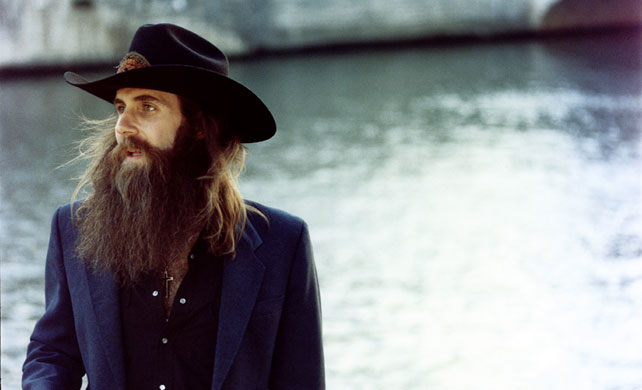
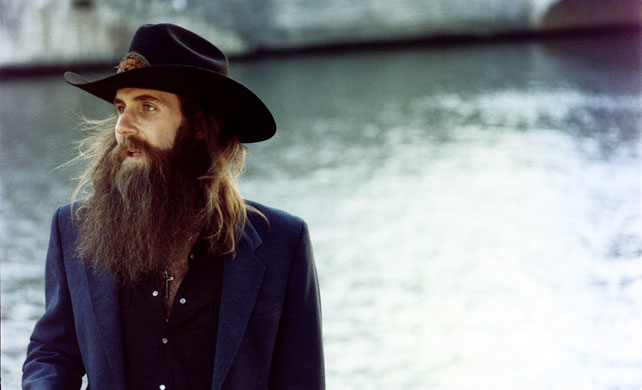
jtpbeard“GQ! It’s about time! Where y’all been? I’m a handsome man!” Josh T Pearson cracks a broad smile behind his thatched beard as he welcomes GQ.com into his dressing room backstage at London’s Barbican. “Step into my office!” he says as he ushers us in with long limbs, before admitting he’s still adjusting to playing venues of this size. “It’s not stadium rock but for ten-minute long heartbreak songs the Barbican is a good lookin’ room. I’m glad that it’s touching people, but it probably means you got your heart broke somewhere along the way in a real devastatin’ manner.” The Texan songwriter first surfaced back in 2001 when his band, Lift to Experience, released an ambitious debut concept double-album about the coming apocalypse called The Texas-Jerusalem Crossroads, after which he promptly vanished off the face of the earth. The decade that followed saw him drift around the world, make a tentative return to live performance and go through a painful divorce. His heartbreak was captured on record on Last of the Country Gentlemen, which was recently named album of the year by Rough Trade. The devastating beauty of his live performance is matched only by the awfulness of the jokes he tells between each song, as a device for surfacing from the intensity of his despair. Here he talks about struggling with poetry, discovering opera and what it means to be a gentleman.

GQ.com: Which lyric are you most proud of writing?
Josh T Pearson: I like “Sweetheart, I Ain’t Your Christ”. It’s silly and simple, but I sure like that one. I’m proud of that work. I tend to write in clumps. I’ll sit and play guitar for a couple of hours until I have a batch of melodies to go along with. Then I go and write down, say, four pages of stuff and then try fit in everything I want to. That’s the real hard part, where you’re getting the s*** kicked out of ‘ya. It’s never easy. Just looking at yourself in the mirror and wondering if you’ve ever written a single line that didn’t completely suck bollocks. It’s just locking yourself in the ring and getting beat up. The first fifteen minutes are excruciating. Then you sort of pass the baton between the music and the words. It’s hard. There’s that story about the poet and the novelist, where they meet after working all day to discuss what they did today. The novelist says: “In the first half of the day I wrote about 14 pages and in the second half I cut seven of those pages out.” The poet says: “Well, in the first half I added a comma and in the second half I cut it out.”

Can you recommend a good book?
The House of Breath by William Goyen. He’s a Texan guy. I’ll let what it’s about surprise you, but it really sounds like breath. It’s an old one, before Hemingway but in that same simple sentence style. He was in the military and then he started writing later and came up with some really great stuff. There’s a real sensuality in the book, and I’m surprised by what he got away with.

Is there a literary influence on your song-writing?
I’m a big fan of Walt Whitman as far as a great American poet goes. Milton as an English poet. I like both of those because you can just open the books to anywhere and start reading them out loud. It’s like jazz. I grew up reading the Bible, the King James version, night after night. That was a big influence as far as the metre of it. Iambic stress-pause-stress. “Blessed is the man that walks not in the counsel of the ungodly, nor standeth in the way of sinners, nor sits in the seat of the scornful. But his delight is in the law of the Lord; and in his law does he meditate day and night. And he shall be like a tree planted by the water…” Just the rhythm of it. But the King James Version, and the Geneva Bible before that influenced all of Western literature including the language of Shakespeare. The Geneva Bible that Shakespeare grew up with is 70% the same as the King James Bible. There’s a lot of colour there to pull from. It’s great source material. The greatest story ever told!

What music do you love that would surprise people?
I like opera. About ten years ago I stopped listening to a lot of the stuff I had been, and started reading about opera. I love the stories. There’s one book I’ve been reading called, Ticket to the Opera by Phil Goulding and a new one called A Night at the Opera: An Irreverent Guide. It’s a British one by Sir Denis Forman. There’s so many operas, so it depends what you’re after, but I’d recommend somewhere between Wagner and Verdi. I prefer Verdi’s melodies but Wagner’s drama. It’s an expensive hobby, though. I saw one in Paris called The Dead City by Korngold. He was a Jewish guy who got overlooked because of the war and it’s more like film music than older opera.

What have been your best fan experiences?
The other night some bloke comes up and really means it. He says: “I’ve just split up with my girl of seven years, and this got me through it.” That’s great. That’s the reason you do it, and put it out there. I had the benefit of writing for the last ten years without fear because I didn’t think they’d make it to record. I played these songs live on a little tour of Ireland and these guys came up and said some specifically touching things that made me reconsider my aesthetic of keeping it to myself. So I then went back to the task of finishing it as an album, as a whole, as one love letter.

Which band would you recommend seeing live?
The greatest live rock’n’roll band are the Dirty Three. I’ve seen thousands of bands and never seen anything like it. They used to come through Texas quite a bit and they were just epiphanal moments. They’re poets, each one of them.

What question are you bored of answering?
Nothing, really. We have a good team who seem to get good interviewers in. We don’t get college kids who are just here because their editor told them to be. I sniff that out, and say “I’m sorry, but you can Google any of this stuff.” I don’t want to waste their time and mine. That sort of stuff is not for the weak at heart, and I definitely have a weak heart.

What’s your favourite record?
As far as records go, beginning to end, there’s three great ones: Pet Sounds by The Beach Boys, Loveless by My Bloody Valentine and In the Aeroplane Over the Sea by Neutral Milk Hotel. In the Aeroplane Over the Sea needs more praise than it’s been given. I like albums that are long pieces and those three are good starting places for any young man trying to do something creative that hasn’t been done before. I made the mistake young of thinking that music was art and spent so much time trying to finish one perfect piece. It’s just rock’n’roll. It’s not opera.

What’s your favourite film?
I saw Sorrentino’s Il Divo the other day.  I got a little confused at the end but it was really great. Reminded you why you liked film to begin with. I don’t know about my favourite. I’m old now. I like s*** that blows up. Hollywood crap. Probably my favourite film is Once Upon A Time In The West. That spaghetti western music and that drama is my favourite period, with all that untamed American land.

What does it mean to be a gentleman?
Mark Twain says a gentleman is someone who can play the banjo, and doesn’t. [laughs] I’d say honesty, and that the man tries his best. That would be the two. Honesty and the intent, with all that’s within you, to live peaceably with all men.

What’s your favourite joke?
That would be my Willie Nelson joke. I tell it onstage: What’s the worst thing to hear when you’re giving Willie Nelson a blowjob? “I’m not even really Willie Nelson.”

HOW TO COMPETE AT THE WORLD BEARD CHAMPIONSHIPS

“The first thing I’ve got to say about beards, is that they grow on you” says Josh T Pearsonwith a grin. The proudly hirsute songwriter released one of the albums of the year in Last of the Country Gentlemen, but he’s also a two-time competitor at the World Beard and Moustache Championships. The internationally-recognised event takes place every two years, with the next scheduled for Stuttgart in November 2013. It includes prizes for moustaches including the Dali, Imperial and Hungarian, and beards including the Chinese, Musketeer and Alaskan Whaler. GQ.com sought Pearson’s advice on what it takes to make it in the hairiest of situations:

A good beard takes time.
“My beard is ten years old this month. I’ve had many beards before. I’d grow them for a year and shave them. I’m a handsome man underneath this beard, but I’m an even more handsome man with it. I trim it to keep it at this length. I don’t want to look crazy! Not a lot of girls like ’em, but the ones that do… they’re pretty cool.”

Growing a beard can be a competitive business.
“I went to two World Beard Championships. The first one was 2005 in Berlin. I went in good fun but I did compete. The Germans are really serious about it. The second one I went to was in Brighton in 2007, the year that Nick Cave was judging moustaches.”

Everybody can compete.
“There were 21 categories, from full-beard freestyle to the handlebar moustache category. Length, size, shape, there’s a category for everyone. It was a good lookin’ room. I thought it would be fun to be in a room with a hundred bearded men, and it was! Just to get a picture with all those bearded beauties in one room is worth the flight.”

Beware: the judges don’t always appreciate innovation.
“I competed in “full-beard freestyle” in Berlin. You can make it into anything you want to, so I got some putty and shaped the beard into a tornado. A funnel cloud. Then the extra step was to put little train-set miniatures into it: a telegraph pole and a little person. The greatest thing was a little trailer poking out, because in the South the cliché is that hurricane alleys always seem to go through trailer parks. I was too avant-garde for the conservative German judges. They’re really serious about their beards. The guy who won had a tear in his eye. It’s a big deal for these old Bavarian dudes. My “growing on you” joke isn’t so funny to them.”

Originally published by British GQ.


Searching for rock & roll in Abu Dhabi

AbuDhabi

“God said to Abraham, “Kill me a son”
Abe say, “Man, you must be puttin’ me on”
God say, “No.” Abe say, “What?”
God say, “You can do what you want Abe, but
Next time you see me comin’ you better run”
Well Abe said, “Where do you want this killin’ done?”
God said, “Out on Highway 61””

I stepped off the plane into the dry heat of the desert morning a little over twelve hours earlier than planned. My trip to Abu Dhabi, at the invitation and expense of the Aloft hotel chain, had been moved forward at the last moment when the Islamic authorities sighted the new moon and declared Eid al-Adha for the following Saturday. The religious holiday, which commemorates the willingness of Abraham to sacrifice his son at God’s command – Christian and Qur’anic traditions differ over whether that son was Isaac or Ishmael – necessitates that the preceding night the sale of alcohol is prohibited. This is to ensure that believers approach Abe’s obedience in a spirit of sober contemplation. Aloft had been planning to host ‘Turning Up The Spotlight’, their Battle of the Bands competition, on the Friday. However, after apparently being caught unawares by the annual holiday they obviously realised that a spirit of sober contemplation would be wholly unsuited to a Battle of the Bands and scrambled to rearrange the show for Thursday evening.

Hence the earlier flights, for myself and for the eclectic batch of judges: Charlatans guitarist Mark Collins, Grammy award-winning producers Kevin Bacon and Jonathan Quarmby, Facebook competition winner Karen Newby, and Radio One’s Huw Stephens. That, at least, was the plan. The change of date meant that Huw Stephens who, with scant regard for the timing of Islamic religious festivals, hosts a weekly radio show on a Thursday, was unable to make it. This meant some immediate changes for me. “We’d like you to step in as a judge”, one of the organisers told me shortly after I arrived at the Aloft Abu Dhabi, “Don’t worry, it won’t be anything like X Factor.”

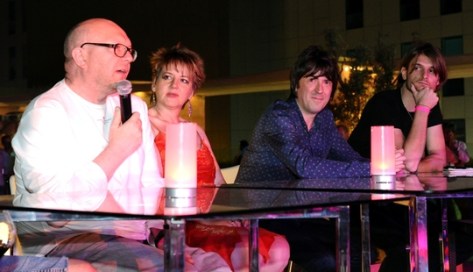
Later that evening, after the stifling heat of the day had given way to the pleasant warmth of the night, I joined the rest of the judges by the hotel’s rooftop pool. The stage behind the pool didn’t have a lot of space in front of it to begin with, but now most of that space had been taken up by another stage with a long desk and a row of chairs. It looked unmistakably like the set of X Factor.

The three bands: Nikotin, Beat Antenna and Tim Hassall, were all milling around, and it was already obvious that they were taking things seriously. For them, the prize was a golden ticket to come and play a show in London at the opening of Aloft’s newest outpost. In between sound-checking they spoke about life in the United Arab Emirates. They had all earlier made the two hour drive down the coast from Dubai, where much of UAE’s cultural innovation happens. Indeed, the organisers admitted that the bands had been chosen for the show after they’d found it impossible to find suitable bands playing original music in Abu Dhabi.

Like the overwhelming majority of the UAE’s population, all of the musicians are essentially expats. Only 1 in 6 people living in the UAE are local Emirati, the rest are transient workers drawn here by the almost non-existent tax system but subject to strict immigration controls: lose your job, and you lose your visa and face deportation. Even people born here, like the musicians in Nikotin, do not automatically receive citizenship. Another result of making visas dependent on employment is that it’s a tough country in which to play music for a living. Writing ‘struggling artist’ on your visa application won’t impress anybody.

Beat Antenna, who are all from England, told me a little about the lifestyle here: “It’s a weird place to live, because you feel like you’re constantly on holiday. You go from hotel to hotel, your car is valeted, and there’s an Americanised feel, but the culture is completely different – as you see from Friday being a ‘dry day’. There’s a culture grind between the Westernised elements and the local culture, where you have the call to prayer five times a day.”

The attitude to alcohol is a good example of this uncomfortable juxtaposition of cultures. Drinking is theoretically frowned upon and is subject to heavy taxation and strict restrictions on where it can be sold. The only bars are in hotels, and although a pint of beer can cost you £8 the local workforce who pay so little income tax are happy to take the hit. The hotel dance-floors are packed with drunk people dancing to pop music. They could be anywhere in the world.

At that moment, however, the price of alcohol was of no concern to me. At the Aloft, judges drank for free. Before long we were ushered into our seats at the long X Factor desk while an enthusiastic radio DJ from Dubai burbled excitedly. He told us he worked for a station called Radio One, which made me think wistfully of Huw Stephens and how I wished he was there to play the role of indie Simon Cowell instead of me.

The first band up were Nikotin, a metal band whose prior claims to fame included opening shows for Nickelback and Maxïmo Park. Although their nationalities split them between India, Pakistan, Iran and Canada their sound was an MTV-friendly take on heavy rock. At the end of the set, when we judges were immediately asked for our verdict – the attempts to distance the night from X Factor seemed to fall at every hurdle – several picked out their track ‘Overloaded’ as possessing the sort of instantly memorable riff which Metallica fans in bedrooms all over the world search for.

The second act, Beat Antenna, were unashamedly ‘lad rock’ – their sound ran the gamut from Hard Fi, on ‘Coming Around’, to Oasis, on ‘Love Never Lands’ – and they had recently supported Beady Eye. Their singer Neil Harrison accurately summed up the weirdness of this particular gig set-up when he told the crowd: “If you guys don’t come further forward, we’re gonna feel like we’re in a job interview, and that’s not good.” One of the judges described them as “muscular guys playing muscular rock”, but the more introspective ‘Cloud Suits’ was maybe their strongest track.

The final act, Tim Hassall, told us early on that he wrote a couple of his songs when he was “down in Louisiana”, a much mythologised place he seems to permanently inhabit in his music. There were lots of lyrical references to “Lafayette” and old friends going “down to the Bayou”. His duet with singer Gayathri Krishnan on ‘Christmas Eve’ stood out, even after judge Mark Collins picked him up for making the “classic rock and roll mistake” of declaring how happy he is to be “back in Dubai” while stood onstage in Abu Dhabi.

After the show we were bundled backstage to pick a winner, where we all spoke about how international the bands sounded, and how little life in the UAE seemed to be reflected in their music. We eventually settled on Nikotin, and soon the band were popping champagne corks and raving about the promise of their first visit to London.

abu-dhabi

The next day I met Nikotin’s singer Cruize, and asked him about how he felt about the local music scene. “It’s quite restrictive,” he told me, “Because of local rules and regulations you have to be over 21 to play in a bar, because they’ll be drinks. It’s restrictive for young musicians who want to get out there, because they have no place to play, other than all-ages shows. This country is all about making money, so promoters really don’t go for all-ages gigs because they don’t get bar sales. That’s a restriction which causes trouble for bands in this part of the region. We do have a few promoters who try and promote local bands, although most people play covers. There is a music scene growing though.”

There don’t seem to be any purpose-built gig venues in the entire country: it’s either hotel bars or stadiums. Cruize said: “We don’t have any actual ‘venues’. Most of the places we play are in hotels, because they have bars with alcohol licenses so they can do this. They’re supposed to be opening a new Hard Rock Café, which I guess will be open to bands. Other than that, there are very few places where most of the local music scene play.”

Even if going to watch a local band remains a niche pastime, people will flock to see big names. Cruize added: “Abu Dhabi have been bringing huge acts down to the Yass Arena, which is where Metallica played recently. I think there were about 45,000 people there on a week day. Abu Dhabi have the F1 track so there’s going to be a series of big shows: Britney Spears, The Cult, Incubus and Paul McCartney. You can’t miss them.”

One of the things to remember about the UAE is that it’s still so young: it only recently turned 40. Bands like Nikotin are among the first generations that have lived their whole lives there. “Most of us were born and grew up in Dubai,” Cruize told me. “We’ve had the Dubai experience. Growing up, the music scene has been underplayed. Being a Muslim country, really heavy music is not really approved of but slowly it seems to be coming out in Dubai because Dubai is opening up. That’s something that we welcome.”

‘The Dubai experience’ is a hard thing to pin down, but the journalist and author Jim Krane gets close to it in his book ‘City of Gold’. Towards the end of it he writes: “Given everything I’ve written about this fascinating place, one must understand that Dubai is not a genuine city. Yet. It’s still an unfinished collection of buildings where the atmosphere is transitory, like an airport or a hotel. The population consists of flows of people rather than permanent residents. Life is superficial.”

The same goes for Abu Dhabi, a place where it often feels like life is taking place within a bar room scene from Lost in Translation. Before I left I visited one of the city’s landmarks, the Emirates Palace Hotel. Inside this sprawling Xanadu, which contains a vending machine which sells gold bars along with various luxury goods shops, there is an exhibition about Saadiyat Island, Abu Dhabi’s planned quarter of museums and art galleries. Designed as the new centrepiece of the city’s cultural life, it will have branches of the Guggenheim and the Louvre. Just as with the promoters looking to fill stadiums, there is an attitude that when it comes to culture the UAE can afford to buy in the best of what the world has to offer. The local arts scene feels neglected by comparison.

Several weeks later, back in London, I got the news that Nikotin were not granted visas in time to make the gig. After the show goes on without them, I get an email from Cruize: “It was tragic that we couldn’t make it due to the delay in getting our visas in time for the show. A lot of our fans in the UK were quite excited to hear that we were making our debut appearance in the UK, but alas we could not make it,” he wrote, before adding: “Winning the Abu Dhabi leg of the Aloft competition, on the other hand, did bring in a lot of interest and renewed exposure to the band.”

I hope winning the competition helps Nikotin get themselves heard, but I fear that they, just like Beat Antenna and Tim Hassall and every other musician in the UAE, are trying to climb a ladder which is missing all of its middle rungs. Hotel bars are as high as they can climb in a country willing to sacrifice its own homegrown potential for glamorous imports. There’s plenty of money in Abu Dhabi, but there are some things it can’t buy.

Originally published by Drowned In Sound.

Gary Numan

gnuman_7dec11_pr_642“I kind of get a lot of credit for something which maybe doesn’t really deserve as much…” says Gary Numan of his reputation as the “Godfather of electronic music”. However, given that everyone from Trent Reznor and Basement Jaxx to Prince and Kanye West have cited him as an influence, GQ.com admires his modesty. Looking much younger than his 53 years beneath a shock of jet black hair, the self-effacing synth pioneer has this year released his 16th studio album, Dead Son Rising, appeared on the new Battles album and is currently preparing for ATP’s “Nightmare Before Christmas” festival and a UK tour. Over drinks in a musty London pub, Numan tells GQ.com about fantasy, technology and taking his style cues from ghosts.

GQ.com: How important is technology to the way you make music?
Gary Numan: I’m completely tied to it – that’s the way my brain works. I’ve got Asperger’s syndrome and I’m not a very good people person, so I’ve always been more comfortable around machinery. Not in a weird way – I don’t want to marry my car or anything stupid like that! Also it’s easy to be innovative if you’re an electronic musician, because you’re given tools that enables you to something new almost by default.  In 1978 when we first started doing electronic music people were saying “Oh, it’s so new!” or “How inventive!” and I was thinking: “It’s not really, I’m just playing it with a synth.” All of those songs were actually written on a guitar.

What about the impact technology has had on the music industry?
I see quite a lot of people doom-mongering about music, but I think it’s the most amazing time to be in a band. It’s almost become a free-for-all. There was a very entrenched way that it had to be done: you had to do a demo, get a record deal and get with the right label. It’s not like that anymore. Bands are becoming their own labels, their own cottage industries and they now own their own stuff. I never got the point of record companies owning everything. I had to pay to make my own album, for them to own it -what a bizarre situation that was! Some of the big record companies are still desperately trying to hold onto it. They now want a percentage of your merchandise, a percentage of your tour income – they can go fuck themselves! I’m not having any of that!

Who were your main musical influences?
Ultravox were the blueprint for what I wanted to do but I stumbled across them by accident. When I went to record my first album, which should have been a punk album, there was a synthesiser in the control room. I’d never seen one before but they let me have a go on it and I loved it to bits. I went back to the label with an electro-punk album which they were really unhappy with! I thought I was the first one to make this sort of music, but then I went out and discovered that Ultravox were on their third album [Systems of Romance]! So much for being at the forefront of it…

Can you recommend a good book?
Considering that I use a lot of technology to make my music, I quite like having an idea source that has a non-technology base. I would recommend Steven Erikson’s science fantasy books about the Malazan Empire. He co-created this world with Ian Esslemont and it’s absolutely epic in its scope. You’re dropped into the middle of the story with all these weird religions and cultures interacting in a way that is never explained. Each book is massive –  I read them every night and they’re amazing!

What was the first band you really loved?
When I was 11 I became a massive fan of The Monkees. We had a so-called “band” of kids on my street and we’d go along to people’s houses and mime to Monkees records. We’d jokingly call it a “show”: put an album on, dance and mime away, get some pocket money and then f*** off…

Was that how you got started as a performer?
It’s all very well doing it at your friend’s houses, but later on when I was in my punk band I was terrified. For days before any gig in a little Mickey Mouse pub in front of a dozen people you just couldn’t talk to me. My Dad took me to one side and asked me how I was ever going to be able to enjoy it. That’s when I started coming up with images and alter-egos.  When I had my first bit of success I was very into the make-up and the clothes. That was my way of dealing with it, by creating a persona. It was a front that was cold, and arrogant and seemed to be untouched by anything.

Did anyone in particular influence your style?
I do remember being in a club and a man walked by me who from behind had this almost-Nazi look. All black, with a sand-brown belt which would normally have a pistol attached to it. It just looked really striking. I wasn’t really inspired by other celebrities. I’d been brought up as a David Bowie fan, so the use of image seemed natural to me. Bowie’s a lovely looking man, and I never thought I could compete with that!

What inspired the double-breasted suit on the cover of The Pleasure Principle?
It’s a complete rip-off of a Rene Magritte painting of the same name! It’s the same suit, same pose, same table, but where he had a rock, I had a little glowing pyramid and because I’ve got an ego I put my face on it! [laughs] Part of the reason the painting resonated with me so much was because of something that happened when I was about 16. A friend and I were getting off the tube and were one of the last people coming off the platform at Piccadilly Circus. The man in front had a long grey coat on and a grey hat, like a fedora. He looked like he was from the Forties. We got to the top of one particular escalator and he went round to the left. My friend and I were just chatting to each other, following the flow of people and not really looking where we were going. We followed this man round only to find that there was no left and it was a brick wall! Presumably at one point there’d been a tunnel there but it had been filled in decades ago. We’d seen a ghost or whatever you want to call it. Freaked us out completely. That stayed with me and in the early years that man appeared in a lot of my images. On the Replicas cover I’m looking out of a window and he’s standing outside.  On the covers of Dance and I, Assassin I’m completely dressed as him. Quite a lot of my style, especially when I got into double-breasted suits, was based on this man I’d seen. It had a massive effect on my life.

How did you feel when you first heard the Numan sampling Sugababes track “Freak Like Me”?
It was a triple whammy for me. I was on holiday in Mexico, so I was having quite a cool time anyway, and I got a phone call telling me that Sugababes had gone to number one and then another telling me that we’d gone to number one in the Kerrang chart with a new song called “Rip”. Two number ones, in different genres, while I was in the swimming pool in Mexico! One of the best days of my life.

How do you feel about playing your old songs live?
It’s a tricky one. I’m not a big fan of retro and nostalgia. Like any kind of artist you’re always passionate about what you’re doing now, and what you’re doing next. The songs that you’re writing reflect what you want to be singing about. At the same time, you do have a sort of duty to play the older stuff for people who bought it and remember it and still want to hear it.

Where’s the strangest place you’ve heard your music?
I was making the demos for “Cars” and The Pleasure Principle just as “Are ‘Friends’ Electric?” was going to number one. I came out of the demo studio, at the back of the Strand, and as I was walking along the street I heard “Are ‘Friends’ Electric?” coming out of a flat window. That was the first time I ever heard my music being played by someone else. It was a silhouette of a woman with her curtains drawn doing the ironing. I thought: “If she only knew I was stood outside her window looking at her!” [laughs] How stalkerish would that be?

How does it feel to be cited as an influence by bands like Nine Inch Nails?
When I get compliments from people like that I’m blown away, because I don’t see myself that way. Every time I’m in the studio, I’m struggling. I don’t go in there and think “I’m a legend! I’ve influenced all these people!” The fact that I wrote a big song thirty years ago means absolutely nothing today. That pressure to reinvent yourself keeps you grounded.

Originally published by British GQ.

Afghan Wig Out

They had bigger things to worry about than mud, dodgy sound systems or the state of the portaloos. On Saturday 1st October Afghanistan hosted its first rock festival since 1975 at an outdoor venue in downtown Kabul. The location had been kept secret until the last moment for security reasons, leading organisers to dub Sound Central the world’s first “stealth” music festival.

In the event, it went off without a hitch. District Unknown, who have built a fearsome reputation on their notoriety as the first ever all-Afghan metal band, were joined on the bill by a mix of home-grown talent and a handful of visitors. Kazakh emo band Eklektika played alongside Afghan indie bands like Kabul Dreams and the bluesier Morcha. Opportunities like this don’t come along very often: for young Afghan pop-rockers White Page, who covered Green Day, Linkin Park, and System of a Down during their set, it was just their third ever show.

Until recently, a festival like this one would have been simply unimaginable. Under the Taliban, music was banned, or rather musical instruments and recordings of them were. The closest you could get was a little unaccompanied chanting, and even then the Taliban tended to favour traditional poetry over ‘American Idiot’.

Daniel J Gerstle, one of the festival organisers, told Mojo that even after the fall of the Taliban music continued to be an illicit pleasure for many Afghan bands: “These guys and their peers have been listening to, then covering, and now writing songs inspired by everything from The Rolling Stones to Slayer for years. They kept their ‘secret’ between themselves and their closest friends through the war. It’s only now after pop singers like Farhad Darya and Europe-based rockers like Mirwais Sahab have rebuilt the traditional music industry, that these bands are coming out of the basement to offer rock and metal alternative music culture to the public.”

Many of the bands write about the horrors their country has experienced in recent times – District Unknown have a song about an airstrike mistakenly hitting a wedding – but, as Gerstle points out, part of the festival’s success has been restoring a little bit of local pride: “It’s great to give Afghan youth a glimpse of what a peaceful Kabul could one day be like, and show them that they don’t always have to look elsewhere for fun and great music.”

Originally published in the December 2011 issue of Mojo.

One Direction

OneDirectionInside a shopping centre in West London, a heavily built bodyguard leads GQ.com through a crowd of screaming teenage girls. The squeal is high-pitched and deafening but the five young men at the centre of this vortex of noise are unfazed. Since finishing third on last year’s X Factor, One Direction’s Liam Payne, Louis Tomlinson, Niall Horan, Zayn Malik, and Harry Styles have gone on to release “What Makes You Beautiful”, the fastest selling single of 2011, as well as their debut album Up All Night. Stepping inside the circle of security, minders and press officers who make up their day-to-day coterie the first thing we notice is how tired everybody looks. Everybody, that is, except for the boy-band themselves, who are a wide-eyed bundle of hyperactivity. Here the band talk about fans bearing vegetables, creative merchandise and whether they’ll write a “diary of naughtiness”.

Did you have a good time at GQ Men Of The Year?
Louis: One of the best nights we’ve had this year, wasn’t it?
Niall: Just being in the same room as Bono was great. Stephen Fry’s speech was incredible as well.
Harry: Bill Nighy looked sick.
Liam: When Johnny Depp popped out I couldn’t believe it.

You already have your own action figures – what other merchandise do you aspire to?
Liam: Can we get waxworks at Madame Tussauds? We’ve never thought about that.
Harry: We’re doing Transformers. Louis transforms into a car. Like a Porsche or something…
Louis: We’re doing women’s lingerie as well.

JLS have their own range of condoms. Do you fancy creating your own line?
Louis: We’re not going to go down that road…
Harry: Though we are all for safe sex.
Louis: We’re all about femidoms. That’s the future. That’s an exclusive right there!
Zayn: Why should we have to carry them? [laughs]

What’s the most important item on your rider?
Harry: People put stuff in our room, but we don’t go there and tell them what we need. Basically, if you can get a cup of tea or a bottle of water it’s fine.
Liam: We get sweets just because we’re kids.

We noticed fans keep bringing you carrots…
Louis: In week one of the X Factor, just to be a little bit quirky, I decided to say that I like girls who eat carrots. Ever since I’ve had lots and lots and lots of carrots.
Zayn: That’s why he’s very tanned.
Louis: And why I’m also very good at seeing in the dark.

What’s the strangest gift you’ve got from a fan?
Louis: Sanitary towels stuck to the window of the car.
Zayn: They’d put their Twitter names on it.

Is that a good tactic to get One Direction to follow you on Twitter?
Louis: We didn’t actually follow them because it was taken away so quickly.
Niall: For some reason I didn’t want to touch them…

It does seem a bit… unsanitary.
Louis: I like what you did there!
[One Direction give GQ.com a impromptu round of applause. We feel like Oscar Wilde.]
Liam: Save that in the memory bank.

Can you recommend a good book?
Niall: One Direction: Dare to Dream.
Louis: James Corden’s new autobiography [May I Have Your Attention Please?].
Liam: Russell Brand’s My Booky Wook.
Zayn: This is going to make me sound like a geek, but I read a book called On A Wing and A Prayer. I think it was about World War I.
Niall: Michael Buble’s Onstage, Offstage.
Liam: The script of An Inspector Calls. That’s the only one I’ve ever read.
Harry: You’ve only ever read one book in your life?
Liam: Yes.
Niall: Me too. It was called: How To Kill A Mocking Bird.
Liam: Wasn’t it just called To Kill A Mocking Bird?
Harry: It’s confusing because you’re 200 pages in and the bird still hasn’t died.

What music do you love that would surprise people?
Liam: Bing Crosby.
Louis: Bombay Bicycle Club.
Liam: Two Door Cinema Club. Daniel O’Donnell. I’m just coming up with random words now. Two Milk Bottles and an Egg!

We understand that you all own monogrammed full-size babygro-style “onesies”?
Louis: These boys have stopped wearing them but I have loads of onesies at home. I know they don’t necessarily look sick but they’re so comfy.
Zayn: They’re good for when you’re chilled out at home. You can’t always look tip-top.
Liam: I bet you sit in one at home.

Do you get chatted up a lot on tour?
Liam: Honestly, because we’re taken from the venue to the hotel and whatever else you don’t really see much in between. We don’t really go out, but this tour will be different because we’re all 18 now…
Niall: Supermarket sweep!

So this tour will be a bit more Mötley Crüe?
[cue blank expressions from One Direction so GQ.com explains who Mötley Crüe are, with particular reference to their candid rock confessional The Dirt]
Niall: I can’t wait for that! Can we do one?
Liam: A diary of naughtiness?
Harry: Ours would be more like The Virgin Diaries.
Liam: Porn… without the illustrations.
Louis: Just porn!
Liam: This interview’s gone horribly wrong.

[One Direction’s PR intervenes and starts wrapping up the interview…]

Harry: We’re all adults here. We’ve all seen our share of…
Liam: No, you haven’t! You’re still 17! Shut up!
Louis: I find the whole porn thing quite…
Liam: Derogatory?
Niall: Objectifying?
Harry: I think it’s derogatory.
Liam: It can be a bad influence on youngsters…
Louis: …but sometimes it’s great.
Harry: Sometimes it’s amazing!
Liam: You’re 17, shut up! Louis, you brought this up! We’ve brought this upon ourselves.
Harry: This is going to be a great read.

Originally published at GQ.

Mark E Smith: We Only Have This Excerpt

MES

“It’s a shopper’s paradise, isn’t it?” says Mark E Smith as he surveys ‘Smoak’, the inexplicably Texan-themed bar in Manchester’s Malmaison hotel. It’s a Saturday afternoon a month or so before Christmas, and both the hotel bar and the adjacent lobby are crawling with families laden with expensive-looking carrier bags. We collect our beers, chosen at random from a long list of imports, and Smith spots a quiet corner on the other side of the lobby: “We’ll go over there.”

He moves in a shuffling gait, and already seems older than his 54 years, but his wit and his work rate never seem to slow. In the 35 years since he and a handful of mates formed The Fall in an apartment in Prestwich he has released 29 albums under that name. Although his bandmates have long since become the subject of regular rotation, over the years Smith has crafted for himself a complex, literate authorial voice which is as unmistakable as his own Salford anti-vocals. The new record, ‘Ersatz G.B.’, is out in time for the Christmas shoppers, at his own insistence.

Is he happy with it? “Yeah!” he grins as we get settled on a sofa, “but I wouldn’t mind a copy! Have you got one?” He lets out a cackle. Smith laughs long, and hard and often. It’s an expressive laugh, and depending on the subject it ranges from a chesty death rattle to whooping back in his seat. His tongue emerges regularly. It looks like a gila monster, and in his long career it seems to have gotten him in and out of trouble in roughly equal measure.

Where did the title ‘Ersatz G.B.’come from?

“Well, it’s one of them word things. I came up with the title before I started writing half the songs. That’s what they like, the record companies. They like the title first, because I was insisting on it being out by Christmas.”

What’s the thinking behind it?

“Well… what do you think the thinking is behind it?”

I tell him it sounds like a state of the nation address. That Great Britain isn’t what it seems to be, or perhaps what it used to be. Smith, however, has never been one for nostalgia.

“There’s always that rose-coloured glasses shit, but people forget how crap it was in the Seventies. All you’ve got to do is to look to your right to know what the title means. Ha ha ha ha” To our right, a woman with a toddler in a pushchair has taken a seat. The handles of the pushchair are heavy with shopping bags. “What surprised me was that a lot of people didn’t know what ‘ersatz’ was.”

That British people now read less and have smaller vocabularies would seem to validate the point.

“I think that’s probably right, yeah. I don’t think they appreciate what they’ve got, but you’ve got to be careful because you end up sounding like a grumpy old man. It was like this when I was fucking 12. I used to read all the fucking time, but I was the only one at the fucking school who did. I went to a grammar school but I was the only one who actually read anything. It’s not because of computers or anything. People have always been pig ignorant! Ha! There’s nowt you can do about it! Ha Ha Ha! Cheers!”

It’s Smith’s turn to ask the questions, so we talk for a while about The Quietus and about how much I’m getting paid to do this interview, and then about our shared love of Hunter S Thompson and conversely about the lad’s mag journalism he unsurprisingly abhors:

“I’ve never been into cars or looking at birds. I don’t understand that. It’s funny because when my book came out, I went to this writing convention in Wales. It’s like where all these writers congregate. Very famous.”

The Hay festival?

“Yeah. So that fella was there. The Top Gear fella. Jeremy whodyamob. Jeremy whatisface from Top Gear.”

Oh, Clarkson.

“I dunno, I know nothing about cars at all. Even my dad was like that. My dad had a Lada. Ha ha ha. What happened was, I was doing this thing about my book, and there was about 500 people there. But for this geezer there was thousands. You couldn’t get out of the place. There was about a million cars on this camping site. It’s almost like you’re drowning in people who look like him!” Smith points at a balding, middle-aged man reading a newspaper on the other side of the lobby. “Fucking thousands of them! I had this fucking co-writer with me, the ghost-writer. The fucking idiot is shaking hands with the fuckers because he thinks they’ve all come to see me, or ‘im. So I fucking bottled him! Ha ha ha ha. I bottled him in the car park! He was shaking hands with fucking every fucker you’d see! I just wanted to get out, it was that frustrating. It was horrible.”

It’s a pretty damning indictment of people’s reading habits that Jeremy Clarkson is the most popular man at the Hay Festival.

“I know, yeah, but there weren’t like young girls there. It was people like him.” He points again. “It was quite frightening! Thousands and thousands of thousands of them, and they must be parents so you can’t really blame the kids who aren’t reading. A lot of fellas my age, they won’t fucking grow up.”

Who were your literary influences?

“When I was about your age I used to like Burroughs and stuff like that.”

You can hear echoes of Burroughs’ fragmented narratives in some of Smith’s most glorious lyrics, like this, from 1982’s ‘The Classical’: “You won’t find anything more ridiculous than this new profile razor unit, made with the highest British attention to the wrong detail, become obsolete units surrounded by hail”. Like Burroughs, Smith gets his hands dirty operating down in the bowels of language.

“Yeah, I think his influence is apparent. I used to read a lot of Nietzsche. Still do!” A sly laugh, before he deadpans: “He’s not very popular.”

Are you attracted to the idea of the übermensch?

“No, I think that’s all bullshit. Arthur Machen, you know, the horror writer. HP Lovecraft, who I still read, sadly. I could go on forever really. All the Pan Horror classics.”

What about Ballard? I’ve thought I heard his influence a few times?

He turns the question around: “Do you like him?”

Yeah, I do. How about you?

“Well, I don’t know. I like that one where the world’s underwater. He did ‘Crash’, though, I didn’t like that one. I prefer Clarke. Arthur C Clarke, people don’t like him but I do. He’s very underrated, I think.”

What about playwrights? There seems to be an obvious parallel between the use of repetition in Samuel Beckett’s work and in the music of The Fall.

“It’s funny you should mention that, because we’re playing the Royal Exchange tomorrow and I saw ‘Waiting for Godot’ there. We’re the first rock group to play there. Personally I don’t know how much he had an influence. Do you like Beckett?”

I do, yeah.

“All me mates do. They really love him. I can’t see it myself. Although, I did see a version of it where it was set in the Weimar Republic and it was really good. The big bully boy was a Nazi. I like Shakespeare a lot, though. Macbeth, in particular. I think Shakespeare’s very, very underrated. Henry V. Every American film you can see they’ve just nicked bits from it. Do you like film?”

I do. Have you seen ‘Naked’ by Mike Leigh?

“Yeah! I’ve got it. It’s good, isn’t it?”

Johnny driving down from Manchester to London and being stuck outside all night.

“I can relate to that, ha ha ha! Seriously, I can relate to that!”

I mention it because in your book you talked about travelling being overrated because: “Where you’re living is in your head.” Johnny says something similar in the film, about never really being outside “because you’re always inside your head.”

We talk a bit more about travel, and touring, and he says:

“I’m in two minds about travelling. The good thing about it is it keeps the group on their fucking toes. They have to be tired for two or three days. A lot of groups nowadays they just think they’re in their little shuttle-bus. The wife’s not very pleased and the group aren’t very pleased, but I just think it’s just good to keep them on the fucking go all the time, even if it’s for useless things. I’ve always been like that. What you get then is ‘Why did we travel for two days just to be onstage for fifty minutes?’ and I say: ‘Because you fucking do.’ If you don’t like it you can fuck off. You’re very lucky to have a job.”

By this point our glasses are empty, so Smith hands me £20 and sends me over to brave the bar. “Do you want to get another one? Could you please? I’ve got something on my feet,” he says. He’s been rubbing them underneath his shoes and it’s clear they’re causing him some pain.

When I get back he says:

“What the fuck is that buffalo doing there?”

He’s been inspecting the bar’s mock saloon decor and faux animal skulls. I tell him it’s not what I expected when I heard I’d be meeting him in a Manchester bar.

“It’s not like people come here expecting a buffalo is it? Ha ha ha. Sorry!”

I ask him about what the music scene was like in Salford in the middle Seventies, and he talks about rebelling against the hippies but taking a lot of acid. “It was proper acid. In my experience, hippies didn’t take acid, they just smoked dope. The bikers sort of controlled it in North Manchester, for a while. If you want a confession, I took acid before I smoked. Before I smoked cigarettes or had a drink. You can’t say that now. I particularly object to ecstasy. It’s a horrible drug, sub par to acid.”

But ecstasy became such a big part of the Manchester scene.

“That’s why I moved to Scotland. It’s true. I’d rather drink whisky, thank you very much. I don’t relate to other groups. I never have. I don’t relate to a lot of musicians to be quite frank. I don’t relate to anything from Manchester and I never saw us as anything like that.”

I take it you won’t be off to see The Stone Roses reform at Heaton Park then?

“Oh no, it was bad enough when Oasis played. I’ve got this really mad mate from Liverpool, and he lives just the other side of Heaton Park. He knocked on me fucking door when Oasis played: ‘What you gonna fucking do? You’ve got some influence in the fucking music industry! Can you fucking tell them to fucking shut up? Every fucking day!’ I said, ‘I can’t do anything about it! I can’t tell ‘em to stop sound checking!’ He said: ‘You fucking know ‘em! Otherwise I’m gonna get my fucking crossbow out!’ I said: ‘DO NOT do that.’ He only likes metal groups. But it’s reformation, innit? ‘Reformation!’ That’s what the song’s about. But you must know this, Kevin: the reason they reform is that the tax bill’s coming. I don’t relate to ‘em at all, really. I don’t see myself as in any way having anything in common with them. I mean, Mike Joyce rang up the other day and I mean, I can get on with some guys, the Gorillaz and all, but I can’t really relate to musicians. How about you, do you play an instrument?”

I don’t, no. I’m a writer.

He laughs and pats me on the shoulder. “Good lad! Correct! So am I. That’s what it’s got on me passport.”

We talk a bit more about writing, and agree that although Tom Wolfe and Hunter Thompson were grouped together as New Journalism, Thompson was out on his own in terms of talent.

“Oh, definitely. Though I had a French friend who used to be a good pal of Thompson’s, and I used to say: ‘Could he do it without the drugs?’ I don’t think Thompson could.”

Was taking drugs a big part of your writing process?

Smith laughs long and hard at this question. “Was the Pope Catholic? Are you mad? Why, have you got any?”

I wish I did.

“I wish you did and all.”

But was it something you felt you had to do to write, like you’re saying about Thompson?

“In life, there’s sex, drugs and rock’n’roll. I’ve never been into either three of them, to be honest. I’d rather read a good book. I’d rather get pissed and have a cigarette.”

I take the hint, and we go outside for a cigarette.

Back inside and with fresh drinks, I ask whether they had to turn around the album quickly to meet his self-imposed Christmas deadline?

“No, it was quite a long process, for me, really. Started about April, so about three or four months. The main thing was to get it out before Christmas. Which is sacrilege in the music business because you can’t bring out things then because there’s a Christmas rush. ‘Best Hits of Robbie Williams’ or whatever, so the factories are all clogged up with crap.”

But you wanted to make sure you were in people’s Christmas stockings?

“Yeah. Definitely. I don’t wanna wait behind ‘The Best of Barry Manilow’, you know what I mean? That’s what The Fall used to be about.”

Getting a record out every year?
“Yeah. As I’m sure you’ve found out most groups are very content to sit on their fucking arses. With Cherry Red we want to bring out a single or two and a fucking LP before Christmas. As opposed to the last record companies we’ve had. It’s more economical for record companies nowadays to bring out ‘The Best of the fucking Three Welsh Dwarves’ or whoever. So I’m pleased that it’s out. I’ve got back to my bloody roots really: ‘Our cassette will be in your shops next week’. People just look at you: ‘We need six months to do it. We need six weeks to develop the marketing.’ All this shit. ‘We need six weeks to do the marketing, six weeks to do the interneting.’ Can’t you just get the fucking thing out?”

You’d think the internet would speed all this up, but the big record companies still seem just as slow.

“If not more.”

Do you use the internet yourself?

“No, not a lot.”

But you own a computer?

“Yes.”

So the possibility’s there.

“My wife is really good at it, so she does it, but sometimes I’m just like: ‘Turn that fucking thing off!’ We’ve got the lot: iPad and that. We’ve got a lot of young friends, so we’ve got the fucking lot. I mean we buy it off ‘em but they give it us, so it’s all there, but it’s what I’ve always said: it’s the tongue of Satan.”

Why’s it the tongue of Satan?

“I don’t know! Somebody said that to me!”

It’s a good phrase anyway.

“I do realise you work for an internet magazine which I think is good. I’ve read the stuff and I think it’s fucking excellent, but what I’m saying is I can’t go over and…” He does a comic mime of a man trying to type. “I can just about turn Channel fucking 26 on, you know what I mean? I’m allergic to machinery and machinery is allergic to me. Nothing’s changed. I’ve got four mobile phones and they all just break. Watches explode. Think I’m kidding, don’t ya?”

Not at all. Do you reads the papers regularly?

“I do, yeah.”

Which paper?

“Well they’re very few and far between where I live. It’s not like London. It’s North Manchester, innit. People don’t bother.”

That’s interesting.

“It fucking is interesting, isn’t it? They’re all trying to work out that…” He mimes typing again, “which is maybe what Blair’s plot was. If people spend so much time on their computers, they’re not reading Marx, are they? They’re not reading anything else either… This beer’s great, isn’t it?”

It’s not bad. Speaking of Blair, do you vote?

“Sometimes, yeah.”

Who did you vote for at the last election?

“Council. The anti-Zionist Jewish something for the restoration of payments in North Manchester. Oh, you mean in the main election? I did the one but last one. The last one I just defaced the card. What a bunch of tossers the Lib Dems turned out to be, eh? You wouldn’t have thought that would you?”

I asked about newspapers because I wanted to know whether you use them in your writing: re-appropriation of texts, Burroughsian cut-up and that sort of thing.

“I like crap, me. The local advertiser and all that. The rubbish that’s written in there is quite fascinating. Free newspapers, the Metro and all that shit. What kind of person writes that? You look at it and think ‘whoever told this cunt he could write?’ It’s gotta be said, hasn’t it? I have wrote letters to the paper, under pseudonyms: ‘As an Australian living in Manchester I am appalled at the standard of writing by your main editor.’ Manchester Evening News. It’s gotta be said, hasn’t it? They have me on page three about how I kill squirrels in me backyard. It’s the Manchester Evening News, you cunts. It used to be a respected newspaper, didn’t it?”

We move on to whiskies, and when I return from the bar he’s spotted “the fucking referee from the bleeding game, Burnley vs. Leeds” checking in. I tell him I saw the comedian Jimmy Carr here just before he arrived. It’s obviously a celebrity hangout.

“Nah! No, ‘cause they’ve all moved up to Salford with the BBC, haven’t they? I know who you mean, that fucking dick. The unfunniest man in the world. None of them are funny, are they? None of them are as funny as Thompson.”

Absolutely not. Has Manchester changed a lot?

“It changes every fucking ten minutes.”

I start to ask about class, but Smith is momentarily distracted: “That fella keeps making gestures to me. I’m gonna hit ‘im in a minute. Is he security or something? Probably a United fan, bet you any money.”

I ask again about changes in class terms.

“I don’t know really, the working class doesn’t exist. I mean, look at this lot.” He indicates the shoppers milling around. “What are you gonna do? ‘Don’t get upset about it,’ that’s what my working class friends say. Leave ‘em to it. Can you see a fucking recession going on here? I fucking can’t. They don’t know what a fucking recession is. No fucking idea. There’s a recession in Greece. People can’t afford to eat. They fucking can round here.”

What do you make of the Occupy movement?

“What made me laugh about the Wall Street one is that it started off a thousand and then 800 of them went home. I said to the wife, they’ve gone home to their mam and dad’s haven’t they? It’s like the hippies. It’s got a bit cold. New York police have stopped treating you with the respect you used to get off them. I fucking hate New York coppers. I was arrested, I was in jail there. Only for a day or two. In New York, in America, it’s like, how much have you got? They don’t go: ‘In the van, mate.’ They go, ‘Who’s your fucking dad?’ You get my drift? They don’t go: ‘Get in the back of the fucking van you’re fucking busted’, if you go: ‘Oh, I’m John Von Dyke the fucking third’, it’s: ‘Oh, sorry sir!’ Ha ha ha. ‘I’m Al Capone’s fucking nephew.’ ‘Release him now.’ ‘My dad’s in the mafia’ Ha ha ha. If you’ve just taken a bad trip, or you’re black, fucking smack in the back of a van. The black fella’s going: ‘You’ll get used to it!’”

What were you arrested for?

“Fucking nothing! Smoking in a hotel room. The police were saying to me: ‘Do you know Freddie Mercury or David Bowie?’ and I said, ‘No, and I don’t fucking want to!’ ‘Do you know New Order?’ ‘Unfortunately, but I don’t fucking like them.”

He flicks a wrist at my whisky glass. “Do you wanna finish that off then, kid? Do you wanna go somewhere else?”

We get in a taxi and drive to Gulliver’s, on Oldham Street. It’s much more like the sort of pub where I would have expected to find Smith, and it couldn’t be more different from the Malmaison. He tells me: “It’s a hard case bar, so you don’t start laughing too much or anything.” From the Hotel Amnesia, to the Hotel Aggro.

He asks me about where I grew up, and then we talk about relationships, about how ‘Perverted by Language’, the book of short stories inspired by his music was “just crap… using my title and writing a load of gibberish”, and about how he prefers Bernard Manning to Stewart Lee. It’s starting to get late, and Smith is growing increasingly truculent and irascible. We’re both a bit drunk by now, and he says a few cruel and ugly things which are maybe intended as a bit of idle provocation. I don’t want to leave on that note, so I try to steer the conversation back towards writing. Did he ever want to write a novel himself?

“No way,” he snaps.

“Fair enough,” I say, “Your songs tell your stories. That’s what makes your music great. That’s what people like me love about The Fall.”

He winds down and looks away from me, at the empty bottle in front of him. “Cheers, Kev,” he says softly. He rubs the sides of his feet and we’re both quiet for a while until, still speaking softly, but in the unmistakeable voice of Mark E Smith, he says: “I think I’m becoming very, very tired, Kevin.”

Originally published by The Quietus.

Now available in Point Close All Quotes: A Quietus Anthology.

Azealia Banks

azealiabanks_GQ_22Nov11_640“I’ve been reading a lot of the stuff that people have been saying and I just think, ‘You guys – this was just my first try! You might hate me tomorrow…'” Sitting in a west London hotel room wearing a white towelling robe, sparkly Union Jack mini-dress, long brown socks and a pair of electric pink boots, Azealia Banks looks every inch the star. The 20-year-old Harlem rapper is hip-hop’s most talked-about new sensation and has been at the centre of an intense industry buzz ever since the release of her first recording, “Seventeen”, three years ago. But after releasing one of the biggest and filthiest singles of the year in the form of “212” and topping NME‘s recent Cool List, 2012 looks set to finally be her year. Curling up beneath her dressing gown, here she explains to GQ.com why Nicki Minaj is just a Lil’ Kim tribute act, what made her fall in love with British bands and why you can’t beat a bit of Supergrass.

GQ.com: Your outfit is very Geri Halliwell…
Azealia Banks: I’ve got a Spice Girls thing going on! I just bought this as a gag in Camden Market. My style is if it’s clean and together, put it on and go. I’m always up so late trying to pull whatever I can out of my brain, check my e-mails and keep up on my Twitter and my Tumblr.

What was the first song that you were obsessed with?
Probably “No, No, No” by Destiny’s Child. Oh my God, you could not tell me that I was not going to grow up and be in that group when I saw that. I remember thinking “Who are these girls? Why is her hair pink?” Also do you remember when Aalilyah came out with “Back & Forth”? She was a tomboy. That was my s***.

Can you recommend a good book?
I can, but I feel like I’m just stealing ideas from Jay-Z. I read his book Decoded and in the back he recommends The Seat Of The Soul by Gary Zukav. It’s basically about soul versus personality and multi-sensory personality versus the five-sensory personality – the people whose souls operate with spiritual guidance against people who can only see the earth, the beginning and the end. You really find out a lot about yourself when you read that book.

What should every man have in his wardrobe?
I definitely like it when men dress like men. Proper clothes. No offence to any man who’s into fashion, but I feel like I’m very into masculinity. I just like loose pants and big shoes – one thing I hate is seeing a guy in a pair of Toms. I’m not really a fan of men in fancy materials. I like guys who buy stuff that they can just put in the washing machine and put on, who aren’t so shiny, you know?

What do you think of the Nicki Minaj comparisons?
It’s not something that I particularly like, but it’s something that I understand. It’s just people making sense of things. If you listen to BOB. for the first time, you might think, “He sounds like André 3000”. If you eat sorbet for the first time, you might think, “Oh, this is like ice cream but there’s no milk in it.”

Who is the best-dressed man in hip-hop?
I really like Jay-Z’s style, because it’s real. I feel like he’s the king of making music and detaching himself from it. He says, “Here’s my music. Take it or leave it. I’m me regardless.” That’s why people are so intrigued.

You went to La Guardia High School of Performing Arts…
I didn’t finish school. I just walked away from it because I had the little rap thing going on. So for the last few years I’ve just been learning about life. I’ve been making mistakes and learning from my mistakes: got dropped from a label, got my heart broken, lost my apartment. I’m lucky that I learned my lessons this early, because sometimes people don’t learn their lessons until they’re like 28-30, you know? “212” makes fun of everything and my reactions to it. I think that’s a lot of the reason why people relate to it so much, because everybody wants to say, “F*** you!” I think by virtue of English culture being so polite, I feel like there’s definitely a part of every English person that just wants to be like, “Aargh!” That’s why it’s picking up so much over here.

What’s your favourite record of all time?
“Alright” by Supergrass. That’s a good-ass song.

What does your family think of your lyrics?
My mom is pretty crass. She does go, “Azealia, does every song have to be about sex?” I’m like, “Maybe?” [laughs filthily] But no, every song won’t be. But some will.

What music do you put on when you get home?
I’m obsessed with Interpol. It’s funny, I feel like I kind of willed [producer] Paul Epworth [into working with] me, because I grew up listening to all of that stuff he worked on, like Bloc Party and the Futureheads. When I was 14, that’s what I was bumping.

How did you get into British music?
The internet and copies of NME. We’d go downtown and get copies of it just to cut out pictures of the Strokes. When you’re 14 you don’t give care about labels .You’re just think “Who are these guys? I guess they’re the cool new s*** so I’m going to go and pirate some of their music and then be able to talk about it with people.” I was just like a culture vulture. I still am.

What do you think of Tyler the Creator and Odd Future?
You see, when I listen to Tyler’s music I just get the feeling that I’m listening to someone who has also been told no or been rejected for whatever reason. It’s that same kind of “Who the f*** are you? You didn’t do s*** for me! You don’t feed me, you don’t clothe me, you don’t pay for where I live, so why do you have an opinion?” Just take it or leave it.

Do you think of yourself as a feminist?
No, I’m not a feminist, but at the same time I’ve kind of gotten over that inferiority towards men that I’ve grown up with. Not having a dad growing up you feel a little inferior and a little vulnerable. I realised the power of being a woman. We don’t really have physical man power. I’m sure there are some girls who are totally into sports, but that’s how men compete with each other: they play sports, they have the best car and they have the prettiest girl. With men their power is very much external. Women compete on a completely different level. There’s definitely a lot more psychological warfare that goes on between women. Women meet each other and they will say, “Hey!” [looks GQ.com up and down] Automatically sizing each other up, whereas men are more like[bored drawl], “Hey, you like nachos? Want to get some nachos?” Women are way more conniving – I don’t want to say evil – but way more internal and we keep a lot more stuff secret. It’s not a feminism thing, it’s just me realising where I am, what I can get and what I can do to get it.

Do you feel like women have to compete more against other women?
As much as you wish it weren’t that way, if you want to be where you want to be then hey, maybe you’ve got to knock the next bitch down to get it. At the end of the day, it’s about you. You’re born alone and you’re going to die alone – you’ve got to make sure that when you’re alive you live the way you want to live. I don’t necessarily feel like you have to knock the next bitch down. It’s not that brutal. At the same time, it’s kinda like when you’re the new alternative person, you enjoy being that one person and having that spot.

Did you feel like Nicki Minaj was taking your “spot”?
Not that she was taking my spot, but there were just way too many coincidences. It could just be that we were both inspired by Lil’ Kim. She did her thing with it, but I was kind of going to do a little bit of that same thing, with the characters, the pink and the Barbies. I wrote a song called “Barbie S***”. I was thinking “I’m going be black Barbie, that’s going to be my thing.” Then all of a sudden she [released it]! I was like, “F***! Did she have someone on my MySpace page? Is someone watching my Twitter? This is way too coincidental!” At the same time, maybe that just means those ideas aren’t the most original ideas. I mean, no offence to Nicki Minaj, but her career has essentially been a Lil’ Kim tribute. It has. That’s not a bad thing, at all. She took it and went somewhere else. It’s still very, very, very reminiscent of Lil’ Kim, but she took it and did something with it. My job is to find something else completely. That’s being done. It’s been done, and it’s being done again. What would I be adding to the world by doing it too?

We can’t imagine Nicki Minaj doing an Interpol cover like you did…
Well, you never know, she could now!

Originally published by British GQ.

Protest And Occupation: Billy Bragg on the future of the Left

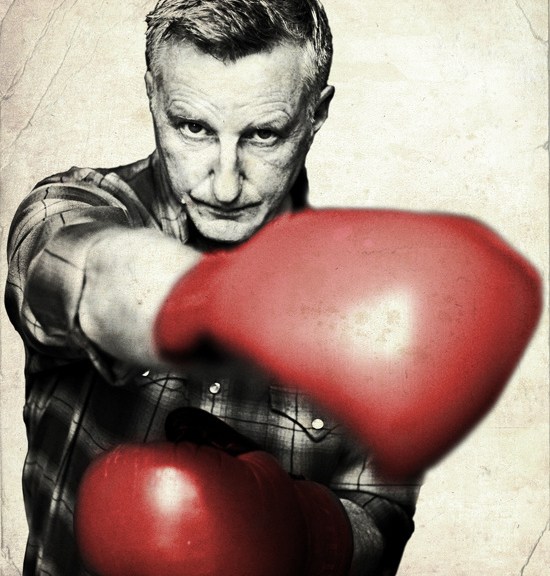
Billy_Bragg_Boxing_1319550145_crop_550x660On Saturday (Oct 15) I was one of thousands of people packed into a tight knot outside St Paul’s Cathedral. The heavy-looking wall of policemen made it abundantly clear we’d get no closer to the London Stock Exchange, but that didn’t seem to matter all that much. We’d settle for occupying the home of the old God rather than the new. It was difficult to ignore the sense that anger shared across generations at how corrupt, how selfish and how venal the banks have been is now coming to a head in a long fine flash. A sense of relief, too, that there is international momentum. The occupation which has remained on the steps of the Cathedral since then is just one of hundreds which have sprung up across the world like franchises of the protest on Wall Street. And why not start franchises? After all we are all children raised by multinationals, and this is a protest for a globalised age.

Billy Bragg was there too, but as a supporter, not a leader. “That’s not my role,” he’d told me over coffee a few days earlier. “What I can’t do, despite having been asked by some people, is go down there with my guitar and become Che Guevara. My role is to try and reflect what’s going on. Write about it. Old geezers like me, with our perspective, hopefully we can help to inform. Connect it with what happened in the Thirties, with Woody Guthrie, stuff like that, but they don’t need me there. They’re doing fine. They need me to help spread the word, through the internet and through writing songs. That’s my role, and it’s important that songwriters remember that. Some of the young bands say to me, when I ask them why they don’t talk about this sort of thing in interviews: ‘Oh, I don’t know enough about politics.’ How the fucking hell do you think I learned about it? I left school when I was 16! I didn’t know shit about socialism until the miners’ strike, but you know enough to write the songs.”

Continue reading at The Quietus.

Stella Feehily

Stella-FeehilyI’m supposed to be interviewing Stella Feehily about her new play, Bang Bang Bang, which explores the lives of human rights researchers in the Democratic Republic of Congo, but so far she’s asking most of the questions. We’re sat in the rehearsal room of Out of Joint’s north London offices, and having discovered that I visited the country with an NGO several years ago she is now gently interrogating me in her subtle Irish brogue.  The role of interviewer is clearly one the playwright is comfortable playing. Her densely researched script grew out of hours of conversations with aid workers, journalists, photojournalists, human rights defenders and government advisors. She set out to tell their story: “I just wanted to make people aware that when they see that person on the news, saying those three lines, that they are actually juggling so many other things. They haven’t just appeared there in Africa.”

Continue reading at Exeunt.

Björk: From the beginning to Biophilia

bjork4

Part 1: Beginnings

I was watching Björk play the Other Stage at Glastonbury in 2007 when the dreadlocked man in front of me took a live snake out of his backpack. “Jesus!” I said, “Is that a live snake?” The serpent danced slowly in his hands, flicking out its tongue inquisitively as Björk’s rhythms filled the air. The man looked back at me with a distant smile: “He loves the vibrations.”

Well, don’t we all? Over the last two decades Björk’s vibrations have established her as pop music’s preeminent innovator, a fearless and restless proponent of the avant-garde whose discography defies the staid categorisation of genre. When I meet her on a summer afternoon in West London her enthusiasm for her work is infectious and the ebullient conversation as eclectic as you’d expect. We talk about education, about feminism and Lady Gaga’s outfits, about why she’s like ‘carrot soup and tequila’ and Coldplay are like ‘chips and sausages’, about political activism and aluminium mining and even about the lack of punk spirit in proprietary software, a topic she acknowledges she probably shouldn’t talk about.

Fittingly for someone who can make even reptiles shimmy, she also talks about the passion for nature which informed her latest wildly ambitious project, which shares its name with the hypothesis that humans have an innate affinity with the natural world: Biophilia.

It’s an idea she relates to. We’re in Little Venice, where she has kept a house since the time of Debut, and she tells me that the canals here are her surrogate for the sea: “Yeah, when I came here in ’93 I looked first for places by the Thames, but I didn’t really find anything I liked. Maybe it was a bit industrial, too. I guess I settled for the canals, I just like walking…”

This is a nicer place to walk than down by the river. “Yeah, I have a routine where I will go for walks and I can work on my melodies. I actually use the canals, but then I discovered because I go to the swimming pool in Westbourne Grove that I can walk through – there’s all these tunnels underneath the motorway. They’re quite good for working on my melodies actually. They’ve got a really nice echo. I sort of have to go somewhere where no one is, or they’ll arrest me and put me away.” She giggles. “In Iceland, even though you’re in the capital you can always walk for five minutes and you’re on your own. That’s kinda how I’ve worked on my melodies since I was a kid.”

The evidence for this is there in her songs: she says they’re all 83 BPM because that’s the speed she walks at. “Yeah, it’s pretty pathetic!” she laughs, “I’m actually trying to push one of the songs on the album now above 100 BPM but it’s proving hard!”

When Björk says she’s been working on melodies since she was a kid, she means it. She first became a star in Iceland at the age of 11 after one of her music teachers sent a recording of her singing a cover of ‘I Love to Love’ by Tina Charles to RÚV, at the time Iceland’s only radio station. When the recording was broadcast Björk was offered her first contract by local label Fálkinn, and with the help of her stepfather released a self-titled album in 1977. Björk has since said that she felt strange receiving praise for songs she had only sung, not written, although she did contribute one track which showcased her precocious talent and her maverick aspirations: an instrumental piece for flute named after Icelandic painter Jóhannes Kjarval.

She didn’t remain that cherubic child for long. As a teenager she shaved her eyebrows and joined a series of punk bands: she drummed for an all-girl group called Spit & Snot, was flautist for the proggier Exodus and then joined Tappi Tikarrass, whose name translates as ‘Cork the Bitch’s Ass’. Her next band, KUKL, recorded a couple of albums for Crass Records before spawning The Sugarcubes, whose 1988 single ‘Birthday’ and subsequent album Life’s Too Good gave Björk her first real taste of global acclaim.

After three albums The Sugarcubes split in 1992 and Björk moved to London to establish herself as a solo artist. She made it look effortless. The album she recorded with producer Nellee Hooper of Soul II Soul, Debut, won her ‘Best Newcomer’ and ‘Best International Female’ at the Brits in 1994, while her music videos were already beginning to make her an icon: the Michel Gondry-directed video for ‘Human Behavior’ was nominated for a Grammy.

For 1995’s follow-up Post she worked with an assortment of producers drawn from jungle and trip hop, including Tricky and Graham Massey of 808 State, to create an album she described as “musically promiscuous”. 1997’s Homogenic reacted against this, setting out to explore her Icelandic identity against a backdrop of explosive, distorted beats. Her next album Vespertine was another about turn. When it was released in 2001 she told Simon Reynolds that she wanted it to be “a love affair to the home, about creating paradise under the kitchen table. It’s about creating peaks without outside stimulants… The kind of peaks you reach reading a book.”

Looking back at her career, Björk acknowledges that the clearest pattern is her stubborn refusal to repeat herself. She offers by way of explanation the fact that she adores a challenge, which often manifests itself in her choosing to take on genres she ordinarily dislikes. She wasn’t sure about a cappella music, she says, so she made Medúlla. She wasn’t excited by protest music, so she made Volta . “I guess with each project I have some sort of personal taboo I have to break,” she continues. “I don’t know why. It’s some sort of a kick I get out of it. I mean, obviously I’m also embracing a lot of things that I like, like nature, electronic music, vocals, choirs…”

For Biophilia, which will be simultaneously released as a series of musical and educational games built into an app for iPad and iPhone, part of the challenge was to take the idea of generative music, music created by a system, and use it to actually write great music: “I guess I’ve been going to galleries and museums – not often, but once in a while – and I’ve always thought it was such a strange brand of music. A lot of it is such a good idea, an amazing concept, and you walk through it and it’s interactive in space – but would you be able to then go home and listen to that song on your stereo, without knowing that, and it still be a good song? Or hear it on the radio? In most cases, that’s not the case. I don’t blame it; because of course it’s still good. Certain music is good in films, certain music is good in porn movies, certain music is good in clubs… that’s the good thing about music, it’s everywhere. I guess my challenge with this project was to do generative music but that it was still ‘songs’. I gave it my best shot that if in ten years somebody listens to the CD, or whatever format is going on then, and they don’t know anything about it… it would be just like my other CDs. It wouldn’t be that you needed the apps to get it. So in that way I wanted to unite those two worlds, you know?”

Part 2: Biophilia

Björk‘s new project Biophilia does not want for ambition. It has been billed as the first ‘app album’: Each of its ten tracks are being released alongside a corresponding app version for iPad and iPhone. These apps can be bought and accessed through the central Biophilia app, which appears as a galaxy waiting to be explored and navigated, with the songs as stars in its constellation. Zeroing in on a star enables you to hear the song as Björk recorded it, or to play a game which will involve you manipulating the music in some thematically-appropriate way. For example, on ‘Virus’ you play the part of a cell defending itself from viral attack, while on ‘Thunderbolt’ you draw Tesla coil charges which alter the bass lines you hear.

I’d been playing with the apps before we met and while they all seemed intuitive at the time, my notebook ended up covered in a bewildering cobweb of ideas: something about ‘continental drift’, something else about ‘seduction’, something about ‘DNA’, something else about ‘piano keys’. I look at Björk helplessly. Can she put it into words? “In a way, every app is a visualisation of the song. You are inside the song,” she explains eagerly. “I think when you listen to music on headphones and you close your eyes it’s very… internal. I wanted it to be that you could see the sounds, you know?”

Her career has already given us a series of beautiful and intensely original music videos, so I ask whether that experience of working with directors helped to inform her design work with the app developers? One immediate obvious difference is that she’s not onscreen for the apps: “With all the video directors I’ve worked with in the past I’ve always had just a couple of clues about each song: ‘This one is about walking on roofs’ or ‘This one is confrontational’ or ‘No, it’s not pink’. I’ll have a few clues about each song, and then I will try and work with them and try and bridge that gap between the image and the sound. But I mean I think this is even better, for me. For me it was never really about the way I look.”

I have to stop her there. This is a woman who wore a swan to the Oscars, whose dress at the Olympics in 2004 unwrapped itself to reveal a 10,000 square foot map of the world, and who, more immediately, is currently sat opposite me beneath a copper dome of hair that blossoms around her ears in the shape of a bell. She’s one of the most iconic pop stars in the world. It must, I suggest, have been a little bit about the way she looked. She laughs. “Yeah, of course it is, but it’s really about the core, and the core of it to me is the song. I guess I learned after being in bands for fifteen years before I did my solo stuff, and we were punks and we were like: ‘Oh, it doesn’t matter how things look it’s all about how they sound’ and then somebody would just take a picture of us and put us in the papers and you would be upset – not that it was ugly, nothing to do with vanity – just that it didn’t fit the music. So I guess I had fifteen years of kinda…” she shrugs indifferently, “and then once every few years I would meet somebody who totally got it. So I learned, almost like I was a pupil. So for fifteen years I learned that if you match the right image to the right sound it makes my life a lot easier! But I think it has changed as I get older and become more idiosyncratic with the music – like, I used to collaborate more but now in the studio I make all the decisions!”

You’re an auteur now? “Yeah, yeah, yeah! I’m bossy! I’m a bossy-boots!” She laughs. “Well to be honest it’s mostly me and the engineer so there’s no one to boss around anyway, but I’ve kinda managed to develop more so I know more what I want there, so by the time I work with the visual people, or the app people, or the photographers, it’s like I’m back in a band. It’s like ‘Oh!’ You all sit in a circle and say: ‘How about crystals?’ ‘How about this?’ So it’s more like being in a band. So I enjoy the process, in that way.”

What struck me when I played with the apps was how immersed you become in the music and in the myriad ways that your actions could affect it. In an age where music seems to have been devalued by its sheer ubiquity, these apps demand your full attention. Was that the aim? “Hmm… that’s a good question.” She pauses to think, and when Björk is thinking she does this thing where she rotates her jaw as if chewing distractedly. “To be honest, I wasn’t focused on that but maybe unconsciously! I can’t promise you totally… my focus was kinda more on the fact that we had the touch-screen. We were performing on it on the Voltatour from 2006 to 2008 and all I could see was opportunities. The thing I was more conscious about was how I was unsatisfied with my music education in school. I mean obviously there were a lot of amazing things. I was there for ten years and I loved it, don’t get me wrong, but I felt it wasn’t tactile enough. It was more ‘booksy’ or, I don’t know what you say in English? Like ‘academic’?”

‘Didactic’, I suggest? “Yeah! So because I had such strong feelings about musicology, and about how I see rhythms.” She laughs. “Well, I said it there, didn’t I? How I see rhythms, and how I see different chords and different scales and different speeds, and what I feel like at the beginning of a song, when I go inside and when I come out the other end. I wanted to include that somehow, and I kept thinking: ‘For kids’. I guess because I spent three years on trying to get it as true to how I feel about music as possible, I could say ‘yes’ to your question and say I wanted other people to be able to see it too. But to be honest I wasn’t so much thinking of that because two years into the project I didn’t know that it would come out on touch-screens because they hadn’t even made iPads! I was mostly writing it for our touch-screens, we had Laniers. I was making programs: ‘The structure of this song is crystals, so it’s this shape. Let’s write a program that’s like that.’ Then I’d sing about it and put the emotion in there as well, so for me it was trying to connect things which very often are not connected and I feel they should be, you know?”

She’s overflowing with excitement about the project now: “In my mind I was trying to simplify something but I guess it comes across as being the most complicated project I’ve ever done! I think it is in print, but I think once you sit down and play with the apps it’s something like… ‘Oh! You go three times round the galaxy and then you tap on something and then lightning comes at you’… it’s very hard to describe in print, because basically then you’re making it didactic again, when you write about it! Basically this project, to cut a really long story short, is about making things that I feel have been too didactic into a 3D tactile experience. You know, you take up the spoon and you get to turn it in circles.” She picks up an empty coffee mug and whisks a tea spoon inside it. “The other idea is to do with electronic music, because I love electronic music. I’ve been doing it for a very long time, but it had its limitations and one of the criticisms I’ve heard for twenty years from people who prefer indie music or classical music or jazz or whatever is that they’ll be like: ‘Yes, but it has no soul’ and I’ve been doing that debate for twenty years now!” She laughs. “It’s like, well, it’s because nobody put it there!”

So this album is not just about bringing together music, technology and nature, it’s also about putting the soul into electronic music? “Yeah, and with the touch screens now you’re not stuck with a grid. That’s why the songs are like they are. The grid is water. The grid is a pendulum. The grid is DNA multiplying. It’s not 4/4. It’s not TCK-CH, TCK-CH, TCK-CH, TCK-CH. It’s basically liberating you from the grid, but it’s still electronic music.”

Björk’s quest to give electronic music a soul reminds me of a contrary attempt by Coldplay to use a machine to help their drummer sound less like a machine. In a recent New Yorker article by Burkhard Bilger about a study into time perception by neuroscientist David Eagleman, Coldplay’s Will Champion describes how the band had been using a click track when playing live to keep time but then, having found that playing to it made them sound too rigid, the band decided not to do away with it but to speed it up and slow it down in places to artificially recreate the mood of a live gig. Coldplay now use elaborate “tempo maps” for their live shows and, as Champion told the magazine: “It re-creates the excitement of a track that’s not so rigid.”

As I describe how uncomfortable the idea of Coldplay’s tempo map makes me, Björk is nodding furiously: “Yeah, yeah, yeah, yeah.” It seems strange to me, I tell her, that a machine is actually helping them to sound human. “It’s a really interesting point, because obviously I’ve been doing gigs since Debut and I’ve tried to solve this riddle ten times! It’s like the tenth time I’ve tried to solve this same riddle, in a way, but I just get better tools now! I mean, I personally would not have gone about it that way, because I feel you should let the tools be good at what they are good at. It’s not that the tools are pretending to be human or that the humans are pretending to be tools. Then again, I’m a very different musician to Coldplay. I like extremes. I think they probably like the middle a bit better than I do.”

Björk: queen of the understatement. She smiles. “I’m not saying that as a bad thing, you know? I quite enjoy a fierce techno beat with a pipe organ, do you know what I mean? I like that contrast, you know? Some people don’t. It’s kinda like having carrot soup and tequila, not just chips and sausages.” She laughs. “So I quite enjoy that. I mean the way I’ve done it in the past, what I’ve found really helpful, is if you solve this riddle in a few different ways in each concert, and then you never have songs back-to-back that are solved the same way. That puts the musicians on their toes. Say for example, on the Post tour: I had an accordion player who could play like Beethoven, he was a virtuoso accordion player and he played all the string arrangements but he was playing on a grid… so you had something very human, that no machine could do, and then you had something that only a machine could do. The next song, it would be electronic samples, very techno or whatever, played by a drummer not on a grid. He would be playing that and then I would be singing on top of that, you know?”

So varying the use of click-tracks or grids is your way of keeping things fresh? “Yeah. On one song the accordion player would just press ‘play’ on a computer and you’ll have a beat that doesn’t vary in speed. It’s just like a grid. Then you have a virtuoso musician do something that only a human can do. The next song would be a totally different approach, where again you would have electronic sounds that are very electronic – they’re not pretending to be acoustic – but they’d be played by a drummer so they wouldn’t be on a grid, or on a clock, and then you have musicians playing along with that. Then the next song would be just me and a keyboard, and then the next song would be everything on a grid. In that way, things can be dynamic. It keeps people on their toes. I’ve been in bands where nothing is on a grid and that can also, funnily enough, become stagnated. It brings different things out in people if you do that, but I think life is like that, anyway, and nature is like that. You can have something very grid-like such as your calendar, or your heartbeat, but you have to work around it. Aging, for example. It’s not dynamic. You’re not 10, and then you’re 50, and then 5. It’s a grid that you have to work around. You might as well just let it be very ‘griddy’ and then bring something that’s the opposite and… spunk it up!” She collapses into a fit of giggles. “I don’t know what word to use!”

Another example of throwing opposites together is the fact that the electronic sounds the Biophilia apps make are based on a series of acoustic instruments, many of which she had built specifically for this project: “Basically, I kept thinking of the kids. So, I wanted them to have a touch-screen, to have access to an algorithm from nature, to be able to play it with one finger and then for it to be connected with either a pipe-organ, or gamaleste, or pendulum, or sharpsichord. It’s sort of like ‘Where is the electric?’ and ‘Where is the acoustic?’ You make the machine do what the machine is best at doing, which is those algorithms that nobody could do live without it and then you can make impulsive decisions depending on your feelings at the time, or your emotions, and react to that – but then that’s plugged with acoustic sounds. I kept thinking about how kids sometimes get too stuck into computer games and I wanted it to not just be this virtual world where everything’s perfect. I wanted to be connected with things which are more like the skin or oxygen. So basically the pipe-organ is like wind, and the gamaleste is like bronze and the pendulum is like gravity. I just think that age between five and seven is magical. You can learn new languages, you can learn to read and write, you’re just a sponge. So whatever you grasp on the world in those years usually stays with you for the rest of your life.”

Was it important then that there was a element of composition built into the app, as well as creating a new way to present your own music? “Very much so, but I understood that it would just be an introduction. I call it ‘semi-educational’ because if you wanted to take the ‘semi-’ off you’d have to do a lot of work and a proper program. But it’s sort of an introduction, the 101 of musicology, but obviously this is my point of view: how I see musicology, so the songs will sound a little bit like my songs. Hopefully it will inspire people to go off and do their own songs.”

Part 3: Bootlegs

As intriguing as Björk’s Biophilia project is, there’s something about it that makes me feel slightly uneasy. I think it’s to do with the number of times the names ‘iPad’ and ‘iPhone’ appear on my press release and particularly with the fact that the Biophilia apps will not be made available on any other format. For someone as fiercely independent as Björk, who has spent her entire career on indie labels, this seems out of character. I hate to think of Björk as a corporate shill, but as we all know deep down in the depths of our iSouls, Apple have now unquestionably become The Man.

So this is what I ask her: ‘You’ve talked about the iPad feeling like a return to a punk ethos, where anyone can use it to make their own music. At the same time, iPads are expensive and elitist gadgets. Do you think there is a discord between the technology and the spirit of what you’re trying to do?’

“Yeah, for sure, there’s definitely another polarity there, a conflict,” she replies. “The only solution for me was to somehow be some sort of a ‘Kofi Annan’ and try and make these two worlds speak to each other.”

She pauses and coyly drums her fingers on the table.

“I’m not supposed to say this, probably, but I’m trusting that the pirates out there won’t tie their hands behind their back.”

‘So you’d quite like to see Biophilia end up on other operating systems?’

“Yeah. I mean, I’ve been in Africa in the last few years, and Indonesia. There are people there who have cardboard houses but they have mobile phones. Everybody’s texting. It’s just a question of time before touch screens are cheap. That’s why we really made sure when we wrote all the programs that they will transfer to other systems. I mean, I don’t totally understand technologically what it is that makes that possible.”

Björk, as she mentioned, should probably not have said that. It seemed to me at the time that she was being disarmingly honest, and also perhaps a little knowingly provocative, so I quoted her in the news story we ran when the interview took place in July. The story was quickly picked up by Wired, then Pitchfork and NME and then pretty much every other music magazine with a net connection. Unfortunately but inevitably the time-worn journalistic credo of “simplify and exaggerate” kicked in a little more with each new article, with the result that by the time her thoughts had made it to, say, Billboard, they had become simply a reductive instruction: ‘Björk: Hack My Apps!’

In the interests of clarity then, here’s the message that appeared on Björk’s Facebook page the following day: “been doing scrillions of interviews , most has gone well except, i noticed a misunderstanding online when asked in an interview if i thought hackers would get into the app box i answered something along the lines that that was to be expected . that you could trust that they wouldnt have their hands tied behind their backs . i have seen this then juxtaposed against other things i said later to make it look like i am encouraging them. this is not how i feel.”

Interestingly, that message itself disappeared a day after it was posted without explanation. It’s understandable, of course, that she does not want to see a project she’s invested so much time and energy in being bootlegged. This is without mentioning the huge amount of her own money that she’s poured into Biophilia, of which more later. Ultimately it’s likely that the point is moot anyway: transferring an iPhone app to another operating system presents significantly more technological hurdles than pirating an MP3.

The subtext here is the broader question of how musicians are going to get paid for the work they do, now that we have apparently decided, as a society, that we’re cool with getting our music for free, either through streaming services like Spotify or through illegal means. The result is that making a great album is no longer enough: musicians are having to find new ways to persuade us to actually part with our cash. There have been missteps. Indeed, Björk herself started to get a reputation for unnecessarily repackaging and reissuing her music around the time of 2006’s Surrounded box set, and she’s currently selling something called Biophilia: The Ultimate Edition from her website which will set you back a cool £500. There doesn’t seem to be room for egalitarianism in the brave new world that the internet has created, but at least with the apps she has created something original and of real value.

However, I get the impression from talking to Björk that her work on Biophilia is not born out of a desire to sell a gimmick, but out of a genuine desire to create something innovative despite the baffled state of the music industry. Unfortunately for her, and for her fans, being in the technological vanguard tends to come with an accompanying high startup cost. Hence her involvement with Apple and the grim shop-front reality that as influential as Björk is, she couldn’t have even dreamed of getting something like this off the ground without being certain that she could count on the support of the iTunes Store. What her comments really tell us is that Björk is still struggling with the same dilemma being faced by countless contemporary artists across a whole range of mediums: do you want your art to be enjoyed by as many people as possible, or do you want to earn a living?

For Björk, it was her work with cutting-edge app developers which really recalled her punk days: “I guess when I was talking about ‘punk’ I was more talking about the way the app team worked together. By then we had no money, we’d run out of budget. It’s like two years since we ran out of budget. The app team said ‘We wanna do this so much that we’ll do it for free, but then we’ll split the profit 50/50. That’s kinda how we used to do things, the indie companies back in the punk days. Everyone makes the posters and glues them up and hand-makes the covers and then if there’s profit you just split it 50/50. That’s kinda what I meant by ‘punk’.”

The flexibility offered by the apps opens up the possibility of releasing further songs into the Biophilia universe: “I’m hoping I can do that. I’m at least thinking ‘double album’. We’ve got ten songs, maybe I can keep adding another ten. I don’t know, I’m just going to improvise. The good thing about the internet, or should be, is that it’s more spontaneous. I feel like if we’re making a new model it should be more flexible. But I mean, I wrote almost all of the songs on this album on touch-screens. That was a really new thing to me. The first time I’m not writing songs by walking outside and singing, because I had it in my lap and could faff about and improvise. A couple of songs were written on Nintendo games controllers. The chords we made on the touch-screens I would put on so that we could control the chords and the speeds and the time-signatures like a computer game. Both because I was trying to think of something that kids know, and also after programming with a mouse for ten years… it’s not really helpful for making quick decisions. I haven’t even tried it because I know it’s not a turn-on for me, to be singing like ‘dner-dner-d-ner-ner’ and then going on the mouse,” she mimes clicking and dragging, “clicking and opening up new boxes. It’s just not… it’s good for… is it the left-side of your brain? The more sort-of essay-writing side… but if you’re writing a song it needs to be more tactile. So far, with computers or electronic stuff, this is the most… you can grab it…” she mimes moulding clay, “or act really quickly and be more impulsive, so that’s kinda why we’ve be doing stuff with that.”


Björk believes children will respond instinctively to this tactile world: “I’ve wanted to do a music school since I was a kid, and so I was thinking well maybe it wasn’t that literal. I always imagined myself on some farm in Iceland, an elderly lady, and all the kids with recorders or whatever coming for a few weeks. I was always thinking about those few years, between five and seven, when it was more of an introduction to music, and for this to be an inspiring and enabling thing. For me to see the touch-screens and realise how everybody’s downloading the ocarina, so that this could mean that a kid in India could learn the difference between scales or time signatures, and not by reading this thick book but just through feeling, just by playing with it for a bit. I saw my own daughter, who’s eight now, playing with an app called ‘The Elements’ which is basically the element table. There’s also another one called ‘Solar System’. The teams that made those two apps actually did a couple of things for me. But with ‘Solar System’, she’d just been playing and scrolling with the solar system, and I think she gets more what the solar system is from that than I did from five years of lessons! I think these things are meant to be known more like that. They’re not like Latin or something, where you have to spend years and years over details and grammar. It’s more of a feeling.”

So you want to teach the world to sing? “I don’t know. I think everybody, once in their lifetime, wants to have a go at sharing what helped you… I was laughing about it with my friends. ‘Oh my God, what am I doing?’ This project is about the universe and everything! It’s vast! But I think it’s something I’ve noticed with people my age, because obviously I take care of my kids, but now I’m just about getting to that age where I’m starting to take care of my parents as well. It’s sort of a debate. ‘When will I start having the Christmas parties?’ It’s not yet kicked in, but give it five years. It’s a really strange feeling, because I’ve always thought of myself as the one who attends the Christmas parties. It’s interesting that age, about 50 or something, that you are in the middle, so you take care of both sides.”

The album also seems to reflect an almost spiritual awe that comes from contemplating the intricacies of our universe, recalling the work of the cosmologist Carl Sagan. Is she becoming more spiritual as she gets older? “I think so! I never thought I would… When I was a teenager, or in my twenties, I thought stuff like that was really pretentious, but now if I can teach you something…” She laughs. “Now that I’m not twenty any more, I think it’s natural for each individual, at least once in their life, to want to put out their version of how they see the world and how it could function. For me, obviously, I’m obsessed with music, so my musicology… nature is my religion, in a way, and I see sound as celebration of that. It’s a bit…” She pauses as she searches for the right phrase, “a bit ‘over-the-top’ to say that!” She smiles indulgently, “But I do! I do. I think everybody has their own private religion. I guess what bothers me is when millions have the same one. It just can’t be true. It’s just…” she screws her face up incredulously, “…what?”

Part 4: Business

One of the things you realise pretty quickly around Björk is that for all her colourful flamboyance, her eccentricity and her sometimes child-like awe and wonder, she is not naïve. She is fiercely intelligent and hard-working and despite spending the better part of her life trapped inside the distorted mirror ball of her own celebrity, her engagement with the world around her is honest and clear-sighted. In particular, the passion for nature which she espouses so readily on Biophilia would be easy to dismiss as abstract whimsy if it were not for the fact that she has proved herself unafraid to engage wholeheartedly with grassroots environmental activism and to take on big business without ever displaying a pop star’s sense of entitlement.

She described her radicalisation in a 2008 op-ed for The Times, in which she wrote about how she’d been forced to stop living “happily in the land of music-making” when she realised that “politicians seem bent on ruining Iceland’s natural environment”.

As activist groups like Saving Iceland have identified, Iceland’s bankrupt government is currently scrambling to cash in their few remaining chips by granting permission for huge tracts of land to be torn up for aluminium plants while simultaneously signing a secretive and ludicrous contract to sell off Icelandic energy producer HS Orka to Canada’s Magma Energy Corp in a deal which grants the corporation exclusive access to some of the country’s largest geothermal reserves for the next 130 years.

Björk first got involved in the protests in 2004, when she played at the Hætta concert in Reykjavík which had been organised in opposition to a new Alcoa aluminium smelter. She then founded an organisation called Náttúra and has taken up campaigning in a way that was new to her: “It was another thing I thought I’d never get into, funnily enough,” she laughs. “I’m breaking all my own taboos!”

Although Náttúra faces a huge struggle to protect Iceland’s landscape, there are echoes of similar battles being fought across the world. We talk about the Dongria Kondh tribe in Orissa, India, where I used to live, who recently won a historic battle against Vedanta Resources to save their forest lands and stop their sacred Niyamgiri mountain being turned into an open-pit bauxite mine. “It’s great,” she says, “I’ve been following this since about a year ago.”

She says she never intended to become involved in this sort of activism: “I always felt music was better if it wasn’t political, but I live on an island which I guess is about the same size as England – without Wales and Scotland – but it’s only got 350,000 people. It’s the biggest untouched area in Europe. You can imagine how we felt: not just me, but the majority of Icelanders, when we found out that behind the scenes for 20 years the right-wing rednecks had been planning to harness all of its energy. I mean, already we’re over the pollution mark that the Kyoto agreement set, so that would just be gone! I just had to do something about it.”


She says that at first she had been complacent: “We had two huge aluminium smelters and they were going to build a third one. I thought ‘that’s not going to happen’. There was a lot of protest, everybody went bonkers, people came from all over the world… and it still got built!”

After that, she could no longer content herself with just turning up for benefit concerts: “That was 2005-6, and after that I was just like…” She mimes rolling up her sleeves. “It’s about my children or my grandchildren. I had believed it would be stopped. There were a lot of people in government who were against it, but it still didn’t get stopped. I wouldn’t be able to live with myself, when I’m old and looking at my grandchildren, unless I at least gave it a whack.”

With the lack of alternative employment opportunities being cited as the critical factor, Björk decided to get creative: “In the autumn of 2008 I spent four months on it full time. It sounds maybe odd, but it seemed to me and my friends that the best way to do it was to go to the rural areas and ask ‘Why aren’t you thinking of starting other companies?’ We figured out very quickly that legally it was impossible for these people to start start-up companies. If you had a village of 500 or 1,000 people, and 20 people are unemployed, then if they could start three little companies they’d be fine. Basically they wanted to build an aluminium smelter there and then the people who were unemployed from ten villages would all come and get jobs. But if instead you could start one company that would grow their own vegetables… I mean, it doesn’t all have to be hippy, green things… you could start a data centre or an online company!”

“We basically went and wrote out lists of 500 companies that were possible to inspire people and so we basically ended up with 150 people who were cherry-picked, and we had a brain-storming weekend, and then we had a lot of really influential people in Iceland but also a lot of people who started start-up companies which nobody thought would work: like gaming companies that hire now 2,000 people but were set up by two guys who are half my age. So these kind of people. We wrote a manifesto, not a thick one but just a functional manifesto and took it to the Prime Minister and said ‘These are laws that you can change now and they’d make things easier for little start-up companies.’ It was silly things. For example, fish is under a monopoly, so you can’t have fish markets in the villages. Which is insane when they’re catching these fish right there. You can’t have sushi restaurants. It was a collection of stuff like this, you know? So that did something, not much, and then was the privatisation of access to Iceland’s energy sources. After the bank crash, it was sneaked through, so then started a year-long fight to try to raise awareness. We did a petition online, I don’t know if you saw it?”

I tell her I did see the petition, which called for a referendum to decide whether the country’s natural resources should be publicly owned. Then I tell her I also saw the remarkable series of open letters that went back and forth between her and Magma Energy CEO Ross Beaty last year, in which he at one point offered to sell her a 25% stake in the Icelandic energy company HS Orka. She eloquently rebuffed him, writing back: “you totally miss my point. i feel this company should not be privatized , it should be given back to the people. therefore i am not interested in shares.”

When I mention the letters she laughs loudly and scowls in pantomime disapproval.

“He is so cocky! So cocky! So anyway, to cut a long story short we got 47,000 people to sign a petition to give to the government to not privatise access to our energy resources. That’s like 25% of voters! But like what you were saying about India, it’s a cobweb. For three years, half of my time went into this and then in January I realised that if I didn’t go full time on my project it would never, never happen. So in January 2011 I organised the karaoke marathon and then I took the next plane out and said; ‘Now I have to focus on my project.’ I think with my project I can be proactive, do you know what I mean?”


After hosting a three-day karaoke marathon in January this year to attract attention to her calls for a referendum, Björk decided that making her own music was the best way to get people talking and engage them with environmental issues.

“That was actually one of the driving points, emotionally, for Biophilia. Instead of standing on a chair and criticising and going ‘Ner-ner-ner-ner-ner’ why didn’t I come up with solutions? I ended up being… touch-screens… internet… ok… solutions. After the bank crash and seeing all the people who lost their houses and lost their pensions because of what 20 crazy venture-capitalists did, my problems were superficial. After trying to encourage people who’ve got nothing, to tell them: ‘Come on!’” She claps emphatically. “‘You could start your own fishing company! You could grow mussels! Harness the tide! You can do it!’ Then when you come back to your home, to your studio… you cannot be lazy. It’s like karma. If you’re saying to other people that it’s no big deal, then you have to give it a go yourself. You have to practise what you preach, you know?”

It wasn’t just witnessing other people in trouble that spurred her on, she had her own problems as well: “There are so many things that used to work that don’t work anymore. Not only with the music industry, but I lost my voice… I got nodules on my voice and had to learn a totally new technique. I didn’t know if I could sing again. So on so many different levels it seemed like all the old systems were off the table, and it was a case of: ‘Let’s just do simple stuff that works’. It’s an interesting irony that this project maybe comes across as being pretentious and complicated, but for me, how I experienced it for three years was very DIY. We’d run out of budget. It was as if all these old systems, these palaces, had tumbled down and it’s like: ‘Ok. Here’s a spoon. Here’s a cup.’” She picks them up off the table and mimes a pestle and mortar: a picture of single-minded determination.

You felt like you could rip it up and start again?

“Yeah. That’s how it felt to me to do it really.”


Having spoken about the failings of the music industry in general, and about running out of budget herself, I’m intrigued as to how she manages to fund a project as singular and ambitious as Biophilia. The live show alone is reported to be a vastly expensive undertaking. Is she actually making any money?

“Well I’ve always felt that because I’ve got money from my albums that I should use them to make the next project. It’s been one of the reasons that every project has been so different, because I felt that somebody was rewarding me for being brave! If I stopped being brave it would stop! If I started being stingy, the project would be stingy. So far in my career, I’ve usually used the money from each project to pay for the next one. So for this project, I could pay for the making of the album, that is the music. I got the Polar Music Prize, from Sweden, a year ago, and that’s quite a generous prize, so I paid for the instruments with that, but I couldn’t pay for the apps.”

The Polar Music Prize is worth one million Swedish kronor, just under £100,000, which paid for the unique instruments she showcased at her summer residency at the Manchester International Festival.

“The concert in Manchester, we just about made it on zero. I mean, that’s success, as far as I’m concerned. I’ve got a house in England, I’ve got a house in New York, I’ve got a house in Iceland, I don’t need anything more, you know? I’m fine. Once I stop making music… once I stop making money from music, I’ll sell one house! So after I stop making money from music… I can make albums for a few years, at least the next ten years, from selling the houses I’ve got! I’m not trying to be rich; it’s more that I want to solve riddles. For example, with the music industry: it tumbled ten years ago, and I felt that I wasn’t doing anything about it, really. Probably I was having it too good or something! But now I can say ‘I postponed it too long’. Also maybe because I come from this punk background where there was only 80,000 people in the village I was brought up in – the capital, you know? – and there was a big company there already that sold Abba and Beethoven or whatever, put out the commercial Icelandic musicians. We didn’t want to be part of that. We knew that it’s no big deal putting out an album. I think a lot of musicians think it’s this kinda thing where you have to send your music to all the big labels. It’s more of a psychological, confidence thing: ‘If I’m good enough, they will like my demo.’ But I mean I did it all for ten years. I’ve done it: making the album in somebody’s bedroom, making the poster yourself.”

Do you think that’s what you’d be doing if you were just starting out now?

“I think so. I think because I had that background, I knew when the music industry started tumbling that it wasn’t a big deal. I knew it from experience. I haven’t always been able to just hand out my demo and get a response. I’ve done it myself. Taking buses around Reykjavik and putting the posters up myself. Now, with the internet, that’s exactly what you do. What I’m trying to say… in a really complicated way, I’m sorry!… is that I felt that if somebody would know what could be possible it would be somebody of my generation. I’ve had it quite good for a decade, so that I can take this kind of risk, you know? But I think it was also very driven by the stuff I was doing in Iceland.”

Part 5: Boundlessness

Björk was never going to be happy with an ordinary, workaday world tour for Biophilia. Instead, she plans to spend the next three years visiting just eight international cities for a series of six-week residencies. She will spend around a month and a half in each location, and her venues will be carefully chosen with science museums more likely to be selected than arenas. She plans to perform twice a week to relatively intimate audiences of fewer than 2,000 people, while the rest of the time the venues will host a series of music-education workshops in collaboration with local schools. At long last, her dream of becoming a music teacher will become a reality, albeit in a fittingly fantastical way.

A conventional tour is unthinkable in part because of how absurdly unwieldy her instruments are. While the high-tech touch screens that her band played on the Volta tour have directly influenced her composition of Biophilia, the machines she will use to play it are the sort of objects which will strike fear into the hearts of roadies everywhere. There is the vast barrel harp known as the Sharpsichord and then there are a further four 10-foot pendulum-harps whose strings are plucked by gravity’s pull. There is a pipe organ controlled by midi files and a celeste which has been re-fitted with bronze gamelan bars to create a hybrid called a Gamaleste. In order to play the bassline on ‘Thunderbolt’ she will have a twin Tesla coil system suspended over the stage. You know, because a single Tesla coil is just never enough, is it?

While she’s already told me how important Iceland is to her, it’s clear Björk relishes the opportunity to travel. Likewise her music has incorporated influences and collaborators from the far reaches of the globe, from Inuit throat singer Tagaq to Malian kora player Toumani Diabaté, and she recently released a series of Biophilia remixes by Syrian maverick Omar Souleyman. As I’ve traveled and worked in the Democratic Republic of Congo, I’m particularly interested in how she managed to stumble across Congolese dance pioneers Konono Nº1 before inviting them to play on Volta?

“I can’t remember… I guess somebody sent me a link to them – I guess that’s how you find out about new music these days!”

Does she spend a lot of time on the internet? The subject matter of Biophiliasuggests she has the sort of mind that could spend weeks falling down Wikipedia’s rabbit holes.

She laughs: “Yeah! Yeah, I do a little bit! I still haven’t gotten into Twitter and Facebook and all that. I’m trying, with this project, because it has that educational streak so I feel I want to talk about it. In a way it’s not about me. It’s the frustrated music teacher in me that’s gagging to find a platform! I mean obviously I do emails and use it to find music, but I also go to CD shops, so it’s a bit of both.”


Going back to Konono Nº1, she adds:

“I wanted to go to Congo, when I worked with them, but it was exactly when… when was it, it must have been 2005? It was like the week before that this big war had kicked off, and I asked the people who put Konono Nº1 out, who are Belgian, and they said that even they couldn’t go there at the time. So I couldn’t go, although of course I wanted to. I ended up going to Mali and working with Toumani Diabaté. In the end I met Konono Nº1 in Belgium. They were fun! We had a language barrier, but it was all translated. I would have liked to have worked more with them but their schedule and mine was tricky. My original dream was to persuade Timbaland to come with me to Congo. Not just for a short week or something but for a few months, and somehow combine his beats… because he’d been asking me for ten years to work together and I never understood exactly how I was going to enter that world. But I think between me and Timbaland, I would have been the anthropologist! That would have been my role.”

Björk is well cast as a pith-helmeted musical anthropologist, and having recorded in the past with not just the aforementioned musicians but also the likes of Thom Yorke, Antony Hegarty, Mike Patton and Rahzel I ask whether she’s seeking out future collaborations?

“Yeah, for sure,” she replies, “I’m not that greedy though, because to be honest I’ve been doing them for so long that I understand that it’s not just about ‘shopping’, you know? In the end of the day, if you have good chemistry then you have good chemistry. The chemistry is kinda more important than the two individuals. Usually, if you’re lucky, at any given point you might have chemistry with maybe one or two musicians. For example, I became good friends with Antony before we even sang together. It takes a while. I don’t know if you heard what I did with Dirty Projectors? That was one of the most exciting things I’ve done recently.”


As she said earlier, the songs are the core for her. I wonder whether she sees a triumph of style over content in the contemporary pop charts. Is Björk interested in or by Lady Gaga?

Her reply is cautious: “I definitely like some of the outfits she’s worn. I definitely admire her for her courage – it was getting really boring! It was like everybody was just really conservative, and nobody was taking any risks. I love theatrical stuff. I think all of us have a theatrical side and a not-so-theatrical side. The music? It’s not my thing. I mean, I don’t judge it. One thing good about music is that you can have all sorts of music. You can have… easy-listening new age music…which actually is even bigger than Gaga! Classical music. You can have billions…”

There’s room for everything.

“There is room for everything. Something that is quite common though, and I’ve noticed it even though things have changed a lot, is that there always seems to be room for a lot of male singers, and they don’t get asked to duel. You have Jay-Z and Kanye West being best mates. There’s always room for many male characters.”

Whereas women tend to be pitted against one another?

“Yeah, still it’s like ‘Christina vs. Britney’. Why? I don’t want to be put in a position where I have to attack her. I thought it was really weird and unfair when M.I.A. and Joanna Newsom were asked about Gaga and then because they didn’t like her music, it was immediately big news online and they had to shoot each other down. It’s like the three new, most happening female pop girls, the same kind of age, and they had to shoot each other down! Guys are never asked to do that. It’s just ‘the more, the merrier’, you know?”


I ask her whether she thinks of herself as a feminist and she draws a deep breath:

“In the same way as religion… I am very spiritual, but I don’t belong to any… ‘party’. The same with feminism. I get really scared and worried and run the other way the minute it becomes a dogma, or a doctrine. My mum’s generation, the hippies, were quite radical when it came to those things and I felt that for my generation the best thing we could do for women was just to go and get things done instead of pointing your finger forever. I think it’s better for me to focus my energy on just getting things done. Especially as you get older, because there seems to be this kind of invisible line that you’re just supposed to go home and stop doing things, which is odd. My idols have often been authors, because we have so many in Iceland.”

Who do you idolise?

“So many! In Iceland we are the nation that writes most books, reads most books and buys most books per person in the world. Our heroes are always authors and they always did their best work between 50 and 60. You’d do your angry, hardcore, ‘pose-y’ poetry book when you’re 21, when you’re an arrogant youth and you beat people up and all this kind of stuff! People will say: ‘Let’s see… when she’s 40 or 50, then she’ll do her mature work…’”

Björk, despite not appearing to abide by what she would call the ‘grid-like’ nature of aging, is now 45. The eclectic, ecstatic music she has made her life has at times been angry, hardcore and even ‘pose-y’. Is Biophilia her mature work?

“I don’t know! I definitely feel like I personally broke through some old, stagnated habits on this project which might enable me, for the next ten years or so, to do better music.”

For a moment she is lost in thought, rotating her jaw. She is still as driven as she always has been, still as exacting in the demands she places on herself as she scampers ceaselessly into uncharted territory: pop music’s most fearless explorer. She smiles ruminatively:

“I still feel I’m just as far away from what I want to do… but, you know? That’s just the way it is, right?”

Originally published by Drowned In Sound.

Sex & Trainers In Berlin

“Berlin. I’m a foreigner here, and yet it’s all so familiar,” thought Marion, the trapeze artist, as she lay across her bed under the angel’s watchful gaze in Wings of Desire. I knew how she felt.

Perhaps it’s the Wim Wenders films or the industrial influence this city has exerted on anglophone pop ever since it was the divided, decadent home of Bowie, Iggy Pop and Brian Eno in the 70s, but when I arrived in Berlin the city felt immediately familiar.

Continue reading at The Quietus.

Out Of The Darkness

In 2009, Tasmanian musician Julien Poulson walked into a karaoke bar in Phnom Penh and heard a lone female voice singing Peggy Lee’s ‘Johnny Guitar’. This struck him as odd. Ordinarily the bars in Cambodia’s capital only allow singers to perform in groups of around a dozen, and youth and vacant stares seem to be favoured over musical talent. “They kinda look like the zombies in Michael Jackson’s ‘Thriller’,” he says. As he listened to her he realised why she sang alone. A voice as naturally gifted as this is a rare find.

Continue reading at The Quietus.

Drowned in decadence at the Mercury Prize 2011

Mercury

I arrived at the Grosvenor House Hotel just in time to be reminded that I should refer to tonight’s Mercury Prize as the ‘Barclaycard Mercury Prize’, which of course I’m only too happy to do. I would have thought that Barclays might like to lay low for a while, what with it having emerged earlier in the day that they’re being sued by the US government for “routinely breaching their own mortgage-lending rules” and bullying supposedly independent appraisers so that they “feared for their livelihoods, and therefore cherry picked data” to support home loans which should never have been granted. But hey, if the Mercury Prize wants to be associated with the “liar loans” lawsuits then so be it: the Barclaycard Mercury Prize it is.

Speaking of reckless gambling, I rang my man Rupert Adams at the bookies, William Hill, shortly before proceedings began and he assured me that PJ Harvey remained the firm favourite at 6/4 on, but that King Creosote and Jon Hopkins had enjoyed a late flurry of bets. “Over the weekend we have seen significant gambles on King Creosote and Jon Hopkins, who our punters think could be the dark horse this year,” he said, which I took under advisement given that last year Mr Adams told The Guardian that Paul Weller had been at the centre of the “biggest turnaround in music betting for 40 years” just hours before he lost to long-term favourites The xx.

I collected my press credentials and entered the Art Deco opulence of Grosvenor House’s Great Room, complete with extravagantly ostentatious chandeliers. The room was originally built as an ice rink, so it had been designed with a broad balcony running around the outside of the open central space. This is as far as I got, as heavily-built men in ill-fitting suits stepped in to bar my way downstairs. Below me, on what used to be ice, eighty tables full of music industry suits and Barclays bankers chilled out in places which reportedly cost £2,000 a head. Meanwhile I was swiftly escorted towards the press enclosure, where the only bar sold bottles of beer for £8 and a bottle of wine for over £30. Not being a banker, I reached for the bottle of whiskey I’d secreted about my person but was soon distracted by the distant sound of a man mumbling mournfully into a wind tunnel. Further investigation revealed that it was Jools Holland saying something about a music prize. The time had come.

Tinie Tempah and Anna Calvi were first up, but I was distracted by bumping into Metronomy. Bassist Gbenga Adelekan, looking as dapper as ever, said the band were feeling relaxed but slightly weirded out by the fact that they’d been asked to leave the venue earlier so that they could re-enter on the red carpet for the benefit of the cameras. Never trust anything you see on TV. I drew an ill-advised parallel with the practice of war-reporters setting up cameras inside buildings so that they could be filmed kicking down doors from the inside, which Gbenga kindly and patiently ignored.

I wished Joseph Mount luck, and mentioned that like him I had spent my own adolescence on the English Riviera. “Oh, I’m sorry,” he smiled. I thanked him for making Torbay seem like a tropical paradise, both in song and in music videos. He said that he occasionally gets complaints from people who think he’s misrepresenting it, which seems to be missing the point somewhat. If there’s a lesson here, it’s that musicians should never read the comments under their own YouTube videos; a world of mad opinions and bad spelling awaits.

On stage, Gwilym Simcock played ‘These Are The Good Days’, starting off by using the piano keys in the time-honoured manner but then progressing to reaching inside and playing the strings, which was a pretty neat trick. PJ Harvey was next up, and played ‘The Words That Maketh Murder’ dressed in a flowing white robe and matching headdress. Aside from the outfit, the performance was pretty low-key but this only served to underscore the strength of the source material. King Creosote and Jon Hopkins gave a similarly understated but beguiling performance, and after those two performances Metronomy’s chest lights alone seemed frighteningly futuristic, never mind the gorgeous pop of ‘The Bay’.

In an interval break I got chatting to a man from Barclays. “I don’t know much about music,” he said, which I’m not sure would have disqualified him from being on the judging panel. “I liked that King Creosote though, that was nice, and Metronomy were charming.” He’s looking forward to dinner, and to Elbow, in that order, which probably tells you most of what you need to know about the sort of night this is. He’s surprised when I tell him that the journalists don’t get served dinner, and seems a little confused as to why we’d have bothered coming.

Katy B’s performance was full of confidence and swagger, James Blake’s wasn’t. Adele had a bad voice, a doctor’s rather than a critical opinion, so we got a video. Everything Everything were followed by Elbow as the night’s music lurched to a close.

The whiskey was gone. PJ Harvey was declared the winner, and the consensus seemed to be that it was a safe choice only because she has made a truly great album. A swiftly erected dance floor lay depressingly empty. It was time to go home. It was hard not to feel like I’d spent a night at a carefully choreographed advertising function, which of course I had. This isn’t necessarily a negative, the likes of Ghostpoet and King Creosote and Jon Hopkins will have benefitted hugely and deservingly from their time in the spotlight. However, something about making exciting and talented artists perform for suited and seated bankers and label bosses makes the experience of the awards show vaguely uncomfortable. This is supposed to be a celebration of great art, but the art is elsewhere. The muse has been left weeping gently at home, and as I walk home I’m reminded of Nick Cave’s letter to MTV when he withdrew from their award show in 1996 and bridled against the very concept of making musicians compete for a prize: “My muse is not a horse and I am in no horse race and if indeed she was, still I would not harness her to this tumbrel – this bloody cart of severed heads and glittering prizes. My muse may spook! May bolt! May abandon me completely!”

Originally published by Drowned In Sound.

Stephen Malkmus: “Part of the wallpaper in a capitalist system”

malkmus-kevinegperry“I don’t feel like there’s much to be gained by admitting that you’re part of the wallpaper in a capitalist system that you help propagate.” Stephen Malkmus is lying on a sofa in the book-lined lobby of a self-consciously upmarket hotel in Soho. The erstwhile Pavement ringleader is talking about class, about the role of musicians and music fans and about the futility of rebellion, but he’s doing it with characteristic nonchalance. He never quite seems to be taking himself entirely seriously, and as he reclines I realise I’m being offered an irresistible visual metaphor: Stephen Malkmus is so laidback he’s horizontal.

“You can say there is a sort of dilettantism… a sense of saying ‘no’ to this system, just by being a really obsessive music fan, yerkno? Maybe you’re not buying into a lot of what the system and the culture is trying to make you buy into. I say we do that, but that’s still saying it’s ok to be in the system. You’re just on the edge of it; you’re not really outside of it.”

He stretches out on the sofa. He is very tall, or from this angle, very long. His fingers point and weave expressively as he talks and his hands are perpetually in motion, a sort of slow-motion version of hyperactivity. “Not to be, like, a French philosopher or something, but we’ve been co-opted into the bourgeois culture, totally, whatever. We’re like a rough edge. My idea is that the only way that I could be truly avant-garde, or somehow outside the consumption system, is through humour.”

Anybody who is familiar with his song-writing will know that Malkmus possesses a finely tuned sense of the absurd, whether he’s skewering bourgeois culture or the endlessly ridiculous world of rock & roll. Back in 1992, promoting the first Pavement album Slanted and Enchanted, he told Simon Reynolds: “When we play live, we do feel the whole ritual is absurd. Music isn’t life and death for us, and it’s hard for me to believe that art can be like that.”

Of course, despite, or because of, their apparent indifference, Pavement became the sort of band that are talked about in life and death terms. Robert Christgau called them the “finest rockband of the ‘90s”. Chuck Klosterman noted that for fans they were “the apotheosis of indie aesthetics”. Their reunion tour last year, their only performances together in a decade, seemed to sell out almost before it was announced.

It was a tour which finally laid Pavement to rest – a sort of worldwide victory lap. Malkmus confirms that they are now officially over, although he does hesitate slightly before laying the word ‘forever’ on the tomb of perfect sound. “Well, basically we could do a fat guys reunion tour or something in ten more years again, but it’s done as a creative venture. I don’t wanna rule out some kind of fun, or some major charity. If someone wants to offer us a million dollars to play a charity I’m sure everyone would find time to do that.”

With Pavement firmly quarantined in the past, Malkmus is releasing his fifth album with the Jicks, Mirror Traffic, although he points out that his ‘solo’ career isn’t all too different from his song-writing with Pavement. He’s no more or less of an auteur now than he ever was. “In Pavement I had full authoritarian control, for better or worse. It’s no different, really. I write the tunes, the band plays them, and if they don’t play ‘em well, we drop ‘em.” His laconic drawl renders tunes as toons. “It’s still the same thing. They almost always say they like them, or they give me the benefit of the doubt to carry through. If they’re not good, we sorta all agree. They don’t have to say ‘That song’s bad’, they just sorta die on the vine.”

For Mirror Traffic, Malkmus had his old friend Beck in the producer’s chair, fresh from his work on Thurston Moore’s Demolished Thoughts. He says Beck was “a pleasure to work with” although this might have something to do with the fact that it doesn’t sound like Malkmus ceded too much creative control: “He’s in the right zone for people like us. There’s no point in trying to, at this age, change someone like me. I think he heard our demos and he realised what we needed was kind of a performance. A good performance and quick, but not overcooked. There’s so many different ways you could work with somebody. I could come there with no songs…”

I mention that I spoke to Charlotte Gainsbourg when IRM was released and she said that Beck, nominally the producer, had written the whole thing. “Yeah, I think he did. He might not have even known he was going to have to do that…” He laughs. “She’s a different breed to the likes of me or Thurston. We got our toons. We play ‘em. He tries to get the right ambience. He’s very Californian. He doesn’t really say many negative things about anything. That’s pretty nice. If he does he sort of couches it in L.A. speak.”

There’s a parallel here, because Malkmus has only worked with a ‘name’ producer once before, when Nigel Godrich was brought in for the fifth, and as it turned out, final, Pavement album, Terror Twilight. “Yeah. I would give production props to this dude Bryce Goggin who worked on early Pavement albums, and I’ve done different levels of mixing and production with different people who didn’t have enough of a name or the power to call themselves ‘producers’. But yeah, this is where someone else had their name on the line, as it were, as a producer, and I took advantage of that in both cases and did a little bit less and just focused on… on um… doing less…” He laughs again, still lazy after all these years. “No! Focusing on lyrics and playing, yerkno?”

How did working with Beck compare with working with Nigel Godrich? “Well, Nigel at that time was much more of a taskmaster… more British… and coming through the ranks of the producer side. More interested in you hitting the right notes. He definitely added more ‘Nigel’, and now that I went back and listened to the record there’s more ‘Nigel’ on there. He was infatuated with delay pedals and, like, echoplex sounds. I let him, like, do it all over that because I was a little worn out on Pavement, I didn’t put up a fight. There should have been less of that on the album and it probably would have been better.”

He is sat upright now, and warming to his subject. It’s obvious that this is a topic he’s given considerable thought to. “But the good things Nigel did were incredible. He’s a brilliant engineer and some things he added I could never… I mean the sound he gets is unbelievable. I don’t know how he does it, but he definitely is a fucking genius at getting sound. Now Beck also gets a good sound too. His engineer works with Nigel – Darryl, the guy that worked with us, so they know some of those tricks. They’re in the same ballpark without the ‘Nigel’ overload. The difference obviously with Beck is that he’s coming more from an artist’s perspective and he’s a little more sympathetic to what I might want to do. He doesn’t care so much about things being in tune. He doesn’t notice, or it doesn’t bug him. He just kinda hears the whole thing as a fan.”

So Beck is less of a perfectionist than Godrich? “Beck’s a perfectionist definitely sonically, but maybe not tune or tempo. Where Nigel just couldn’t help it, back then. He’d be like ‘That’s out of time’. Once you’ve been down that road with Travis or with Natalie Imbruglia, where things have to be right, it’s hard to say ‘I don’t want that’. I bet he’s changed though, now. I bet he doesn’t care as much about that.”

It’s tempting to wonder whether Malkmus himself, now 45 and naming people like Nick Lowe and Bert Jansch as influences for his new record, is feeling mellow? “I can be. I wouldn’t mind being. Not enough to be played in a coffee shop, unfortunately. I would like to be one of those, like, Sufjan Stevens-type people that is soft and the girls love it, but I haven’t mellowed that much.”

There’s a pause, and then he shrugs. “Not that sensitive, I guess. Not a sensitive boy.” I tell him he’s going to have to be a lot more earnest if he wants that coffee shop airplay. “I’m earnest in my unearnestness. I’m not a ‘let’s talk about our feelings’-type person. I talk about feelings but there’s an undercurrent of darkness in the relationships. I just look for that because I like reading stories by John Updike or Richard Yates. I was always attracted to that. There are a lot of unreliable narrators in these songs. It’s not really me, it’s just a person – it’s like some projection of a dark person. Unreliable narrators are more interesting to me. Some of it is just humour, some feeling. Some unreal, some real. There’s no real answer.”

Updike and Yates are two authors with a clear stamp on his unabashedly literate lyrics, but Malkmus is a writer who has always been more concerned with cadence than literal interpretation. In terms of literary influence he offhandedly remarks that Dostoevsky and F. Scott Fitzgerald are equivalent to The Beatles and The Stones but says he’s more likely to read poetry than novels when writing, particularly post-Beat American poets like Jack Spicer and Lew Welch. “Poetry is something I try to keep in my mind. What would they do? But regardless I know I’m not doing poetry so I’m aware that music is really about that year, so I’ll throw in stuff that’s topical.”

Stephen Malkmus, it seems, still doesn’t see music as life and death. He shrugs, “When music comes out it’s like advertising or a magazine to me. It’s not some big work of art, yerkno?”

I look at him and try to decipher his deadpan delivery. Does he really think music is just ephemera? “I definitely do. I know what turns out to be classic could be… I mean, obviously, some things are more ephemeral than others. It’s like movies which are just total pop because they look really bad thirty years later. You don’t wanna ignore your times or the temporality of it. It’s not some ‘uber-text’. There are some talented poets like Charles Olson who are trying to write for all time, for eternity or something. I like him… even when I don’t understand him… but I wouldn’t try to do that in a pop CD that’s like gonna be in Mojo magazine or something.”

The speed with which he dismisses the ‘pop CD’ makes me wonder whether he thinks Pavement were taken too seriously. He rubs his chin and delivers an answer which suggests that perhaps he’s a little more invested in his work than he’d like to let on: “It’s paradoxical,” he says, “Sometimes you wanna be taken more seriously. You wanna be taken seriously and say that you’re not!”

He laughs. “It’s like Bob Dylan. He’s like [affects Dylanesque whine] ‘You don’t understand, man’, but, yerkno, he’s loving it! Deep in his heart he’s loving the attention. You can see it. He wouldn’t be doing it if he wasn’t getting attention. It’s more important to be loved than ignored. It never got to a point with Pavement where it was so annoying as it did for Bob Dylan, where people are looking through his garbage. Then I would probably be bummed out by it.”

There’s always been a sense, though, that Malkmus has wanted to take a step away from the ritual of rock & roll. “Absolutely,” he agrees, although he knows enough rock iconography to point out my skull ring. “I like your Keith Richards ring,” he says. “He’s one of my favourite guitar players actually. People might not expect that, but he is.”

If making music is just magazines and advertising, what keeps him going? I ask him what his favourite part of the job is: “Probably somewhere in making an album when you’re first listening and you realise you’ve done something that you and your twenty friends think is special, at least. That’s all you can rely on!” he laughs. “It’s in that record producing thing because that’s more final. Shows are really fun, but they’re so temporal. You do it and it was amazing but then it’s gone and there’s no… it could be a sort of a payoff but also you can work so hard on that show and it could be so amazing, more amazing than the album, but you just… no one will ever know, so it’s like this wasted energy. So it’s kinda sad. That’s frustrating and good and just so temporal. So it’s more in that recording time. Also, it’s fun getting positive feedback from people, like: ‘Hey man, I like what you did. We’re friends by proxy because I like your shit and you’d probably like my shit. That’s the most rewarding.” He pauses, then deadpans: “And then the big fat cheque from the music placement in the Guinness ad, that is, like, totally what I’m there for.”

He smiles. “That’s never happened, so I don’t know.” Oh well, I tell him, everybody has to have a dream. Maybe if you knuckle down and fly right you’ll end up in Guinness adverts and get played in coffee shops. “Well, that’s right,” he says. “If I really wanted it I’d probably already have it. I tend to believe that, within reason. That you can get what you really want.”

I get the impression that Malkmus has an uneasy relationship with his success, so it seems worth asking whether he really did ‘want it’? “Not really… on my own terms,” he replies, with just a trace of melancholy. “If I could have done as much work as I did and be Arcade Fire I think I would like it. It’s gotta be fun to be just travelling at that level. Being the headliner, blowing people away and stuff. That must be fun, and I never really did that.”

I think I visibly cringe when he says this. Oh come on, man! Don’t tell me you, Stephen Malkmus, want to be Arcade Fire! For a start, surely the Pavement reunion tour was pretty damn huge? “It was, but it didn’t feel… the moments were of the past, a bit. Maybe sometimes when Pavement was going it felt a little like that, but unfortunately on the rock & roll treadmill once you start doing festivals you’re constantly reminded where your status is…”

I laugh at this, and it turns out that Malkmus has a thing about that classic rock hang-up, the festival hierarchy ego battle: “I was looking at this advert in a magazine for this festival, it looked like a cool festival. It’s one where Björk’s headlining.” Bestival? “Yeah. We’re not playing it this year, but we might next year. I started scanning and I was like ‘we’re gonna be right THERE’,” he jabs the air with his index finger. ‘There’s Graham Coxon, we’re gonna be right… probably two above where his name is, or something, judging by the names… regardless of how good or well-received our album is. That’s where we’re gonna be.’ It’s like, that’s where you stand. It’s pretty funny. Those festival charts are the most incredible class systems. I was thinking about it because there’s this one festival in there that has like James Blunt headlining…” I think he means Guilfest? “Yeah, it’s like… not an elite festival. It’s obviously low money, for the bands. Probably cheap for the punters too, which is good, but it’s definitely like ‘well this festival is in this class, and this one is this way’. There’s enough of them that it’s not like you have just three classes. There are millions of ‘em.”

Stephen Malkmus shakes his head and shrugs in mock amazement. He’s back here on tour in November, and then look out for him on the festival circuit. Spare a thought for where he lands up. He’ll be there somewhere. Right there. Probably two names above Graham Coxon. Not yet a senile genius. No need to reinvent the wheel. Not mellow enough for coffee shops. The rough edge of bourgeois culture. Still finding the whole thing faintly absurd. Still slanted. Still enchanted.

Originally published by Drowned In Sound.

This Festival Kills Fascists

HutzSzigetThe men sat in the front row of EasyJet flight 5443 from Gatwick to Budapest were wearing sunglasses and sheepish expressions. A fellow passenger caught their eye. “Are you guys in a band?” she smiled. “Yeah,” sighed Maxim Reality as he glanced across at Liam Howlett and Keith Flint, a man who doesn’t find it easy to look inconspicuous. “We’re The Prodigy.”

A look of recognition flickered across her face and the band shrugged, just a little self-consciously. Like the fine men and women of the British Music Press Corps scattered about the plane behind them, they were on their way to Sziget, a weeklong Hungarian festival which bursts into life every August on an island in the Danube nestled between the once distinct cities of Buda and Pest.

Continue reading at The Quietus.

Rice Dream

India is not a good place to live if you don’t like eating rice. It is utterly ubiquitous, the staple of every meal from rice and daal for lunch and dinner, to rice puddings and rice sweets for dessert. I regularly get bemused looks from colleagues when I confess that I’ve cooked myself pasta or potato as an alternative. The idea of going even a day without rice is anathema to most rural Indians, and my fondness for sandwiches is regarded as a bizarre British eccentricity.

Continue reading at the Fairtrade Foundation.

Anxiety Attack: Jeffrey Lewis

JLExcerpts from an unpublished Jeffrey Lewis interview…

Part of what makes me such a big fan of your records is going through things like anxiety attacks and then listening to your records and feeling like someone else knows what I’m going through. Are you very aware when you write that you’re trying to say that to people? It’s something I struggle to talk about.

“I’m often surprised that people… I mean, I’m not surprised that people relate… I figured that somebody out there would relate to this stuff, but I feel like… obviously, people say the most personal things are the most universal things, or somebody said that, maybe Lenny Bruce or somebody? A lot of songs I’m really surprised that people… ah… I guess I’m not surprised that people relate, I’m surprised that people relate where… like you’re here, obviously, a very hip, together, young guy, you’re looking good in a Keith Richards shirt, you know? You should have the world laid out before you… you’re a swinging young man in London. Why would this guy relate to a song about an anxiety attack? Or… some stuff that I have that’s very New York City-oriented… I’m talking about certain trains, certain streets, certain people, but I can play it in Russia and people are into it. It makes me wonder how much other bands… well, er… I don’t know… I’m exposed to a lot of different bands in doing this because I play shows and every night we’re playing with other bands, we’re at festivals and seeing other bands, and I don’t know what other bands find important to talk about. For me, if there’s something that feels a little bit uncomfortable or something that it’s difficult to have a regular conversation about, or a casual conversation about, unless it’s somebody that’s a very close friend… and yet you can make a song out of it and play it in front of a hundred people or a thousand people or ten people, or whatever the case may be… and it makes sense in a social context in that way, whereas just one-on-one if you were to sit down next to somebody at a bar there’s no social construct for it.”

It’s weird to even talk about it now.

“Yeah, it’s very odd, right? Us sitting here and talking about our anxiety attacks… there’s no social… there isn’t really a roadmap for how you and I, who don’t know each other, are going to talk about something that’s intensely personal to both of us and yet when we’re in a room together and there’s a song as a bridge between us then we can share that space and relate to that. Except that it doesn’t always work, and I don’t really know why. I have a lot of songs where I’m like: ‘OK, I’m talking about stuff that’s personal’ and nobody cares, or people don’t like it, or I don’t like it, or, just, it’s not a good song. I started writing songs because I thought: ‘OK, this is not very hard, all I have to do is talk about stuff that’s important to me and it’ll be a good song.’ Over the years I’ve realised that that’s not necessarily the case, and I don’t know what that extra factor is, that turns something from just somebody talking about stuff into something that makes a song that creates that space that can be shared… yeah, I wish I knew what that was, because I could write more songs if I knew how to access that. Sometimes you just fall into it and you’re like: ‘Alright, great! I’ve got a song!’ Then a lot of times it just doesn’t work and you end up with all these embarrassing songs that are somehow in poor taste. Like my old ‘Complete history of Jeff’s sexual conquests, volume one’, which was an old song that I was playing when I first started out, and that song is one that I can’t… you know, when I’ve played it live at all in the past bunch of years it just seems in poor taste. Maybe it’s too personal? Too specific? It’s not something that other people can relate to, or it’s too much like… I don’t know… I mean, I just don’t know. Some things work, and some things just don’t and I’m not sure why.”

I love that your lyrics are direct, even blunt, but do you ever wish you could stop making sense?

“It’s true that I don’t understand how abstract writers do it. I mean, I think Adam Green is a really brilliant songwriter and it’s very surreal and very playful, and it has this wonderfully absurdist kind of freewheeling approach, but it maintains a real emotional impact and I can’t figure out how that works. That really doesn’t make sense to me. Or other songwriters, they’ll hit a certain channel where you’re beyond normal language. It’s like being an abstract painter: you’re able to really move people, moving beyond representation. If you look at a painting and you’re like ‘Oh, he can paint a really good picture of what’s happening in the street’, that’s cool, but it’s almost too easy. ‘Alright, but can you move me if you break out of that entirely?’ I don’t operate on that level. You hear certain lines by Dylan or Leonard Cohen or other songwriters, Syd Barrett, songwriting that just works and you’re like: ‘Why did that move me? I don’t even know why, it didn’t even make any sense!’ There’s a higher art to that and I’m just a literalist.”

But there’s something great about that frankness.

“I’m definitely a fan of it. That was what I wanted. When I started making music I wanted it to have no thrills… even to the point of having just my name… just ‘Jeffrey Lewis’, the most boring name in the entertainment industry. No band name. Nothing interesting about it. Not even a Devendra Banhart-type exotic name. You basically can’t get more boring. My whole idea was: Let me just strip away everything. Nothing fancy about the voice. Nothing fancy about the music. Nothing fancy about the recording. Nothing fancy about the name. No image. Just as boring as possible so that when something moves you it’s just the complete, direct frankness and you’re like: ‘Woah, I can’t believe this guy has blown my mind as much as anything does but without all of those extra crutches.’ It was Daniel Johnston who really blew my mind with that concept. I guess it was the mid-90s when somebody first introduced me to Daniel Johnston’s stuff, when his ‘Fun’ album came out, and that is pretty produced compared to his other stuff, but even that just had this emotional and lyrical and musical frankness and directness to it that gave me a whole new concept of what music could be and that just inspired me and gave me a completely new ideal for what great music was. So now I don’t know if that was a mistake or not, because now I’m kind of more of a normal band. I play with my brother on bass and our drummer Dave and we go on tour with a band… here, we’re about to sound-check and play a show and sell merch… These are all things that a normal band does. Maybe it really would be better to have a band name and have an image and all of that stuff, because it probably adds to… I don’t know, we could wear costumes on stage or something. You’re charging people money to come to a show, is there a point to not giving them a show? It becomes an awkward situation because I’m very much not a spectacle, but maybe… you feel like: ‘Am I ripping people off by not being a spectacle, by just doing this normal, direct thing?’

Do you write from a blank page or construct a song from phrases?

“It’s shameful how little I actually write songs. I almost never pick up the guitar at home. The guitar sits in the closet 95% of the time. I almost never just play guitar. Once in a while, a little bit of an idea will come into my head and maybe I’ll write it down and if it’s going somewhere I might pick up the guitar and put some chords to it. Which I know is a terrible mistake because if I write 20 songs maybe one of them will really feel important enough to do something with, so I should just write more. But usually what happens is that I’ll write a song, and then looking at it again I’ll realize this line and this line are kind of stupid and I should just take them out and put something better in there. I wrote this song but only about 40% of it really felt good to me, and the other parts I’ll just have to replace with something better eventually. If I listen to the original versions of a lot of my songs I’m like: “Man, I’m so glad I changed that.” So many of my songs just have gotten better and better, especially through live performance. I listen to the early, original versions or sometimes I find an old lyric sheet, and I’m like: “Man, those were the original lyrics? I’m so glad I changed that.” The song concept is there and most of what’s good about the song is there, but there are some really stupid lines that just got whittled away eventually. It’s definitely a constant process.”

You need that freedom to make mistakes.

“Yeah, right. If it had to be great the first time you’d never write anything. You’d just write three lines, it wouldn’t be great and you’d crumple it up and throw it away. You really have to allow yourself to just not worry about how good it is. Even in live performance, every night we’re trying out stuff that we’re not really that honed on. Allowing yourself to not have it perfectly, and kind of discovering it as you go along: “Last time we did that song something cool kinda happened in the bridge when you did this thing. Let’s try to keep that again.” I suppose it’s also because my band almost never rehearses, ever. We get so much better when we rehearse. There were like three periods: Fall of 2007 we booked a week in a rehearsal studio and we got a zillion times better. It was like: “Oh my God, why don’t we do this all the time?” I feel like we leapt up from a solid week of rehearsal and my band has never been the same. There were maybe two other times in the last 10 years we’ve done that. Most of the time it’s just kind of like: “Hey, let’s meet up and go on tour.” Then night by night we’re just hammering it out and after about four shows everything has really taken shape. The new material is taking shape and the old material is getting tighter. It’s all happening in the live moment, which is the best rehearsal anyway. You can rehearse something in a practice space and when you get on stage it’s going to be totally different anyway. First of all, in a practice space you’re all facing each other and on stage you’re facing out and not seeing the other people.”

Is part of the fact that you rarely write songs down to the fact that your first love remains drawing comics?

“Uhhm, I wish that was the case. Most of my – I feel like 99% of my time is just occupied with emailing, I’m just like booking shows, figuring out how to rent a car from Frankfurt airport and if we return it to Hamburg airport it’s going to cost us an extra 70 Euros, so we shouldn’t do that, and I got to tell so and so what order the tracks are going to be in for the album and then I am filming some of my illustrated songs for this like TV show in Philadelphia so I need to work out what days I am going to be in Philadelphia to film that. So I mean, you know I am basically, I’m not actually Jeffery Lewis, I am like Jeffery Lewis’ manager and I kind of wish that there was a Jeffery Lewis who meanwhile was working on comics and music. But between the three band members we all sort of share the booking and managing, tour managing, figuring out who is selling merch after the show tonight and who is driving and who is going to get paid by the promoter tonight and who is going to, you know, talk to the record label and Jack, you know my bass player, he’s like ‘Jens Lekman announced a U.S. tour and he doesn’t have a support act announced, so why don’t you email him and ask him if we can open up a few shows?’ So it’s like ‘alright I’ll do that’. It’s almost really stuff like that but between the three of us we are all sort of on it. You know even the managing and organizing side is pretty fun, but email is so weird because when, you know, I never operated as a band before email and I think if you are dealing with the phone then there’s an end to a conversation, but with an email it never ends, like you know somebody emails saying ‘you know that was a good show you did last night’ and I email back ‘oh thanks’.  They email back ‘What comics are you into lately?’ or blah blah blah. It’s like every single person just turns into a pen pal and then like every time you open up your inbox there’s ten bazillion things and I don’t know why I prioritize that, I should be like alright ‘I got to draw two column pages before I catch up on my emails’, but instead I’m like ‘no I have to catch up on the tons of emails’ and then I draw my cartoon page, so yeah that’s a stupid way of going about it.”

Live performance isn’t perfectible in the way that writing is. You don’t get a second chance. How you deal with the two worlds of writing and performing?

“Well, it’s true that the feeling of having done a bad show, is like the worst feeling, it just feels so miserable, you don’t want to talk to anybody and find yourself a dark corner and just disintegrate. And I never want to show my face in that city again. I mean if it was a bad show, I will never go to that same city again for years. I feel like just now I am able to show my face in… say, Berlin. In 2008 and 2009 we played a show in Berlin and screwed up a couple of songs, broke a string. Man, I mean I can’t show my face around Berlin. It was just sort of last week that we played a show and we were like ‘Maybe we can start to re-establish ourselves there’. But it also sort of goes both ways because if you do a really great show then you don’t want to come back to that city again either. Because then you’re like: ‘We will never leave them with a better impression than that’. We played an absolutely incredible show. We felt amazing about it, everybody felt amazing about it – that’s it. You know, we have to leave them with that, rather than diminish that, so …but also a show cannot reach the heights of being a great show if you’re not taking chances. I think that what really makes it a great show for the audience and for the band is when you are doing something that you’re not sure you can pull off. It’s not when you are doing something that you have already rehearsed to the point that you are going to get it perfect every night because that’s just theatre, I think. That’s just like memorizing your script for ‘Romeo and Juliet’ and getting on stage and reciting it. It’s just that when you are going out on a tightrope and then throwing yourself off it. The audience picks up on it, I think. There’s a certain energy that’s sort of happening as an exploration when you’re really… you know, it’s like the difference between trying to kiss somebody that you’ve never kissed before… and it works! And you’re like ‘YES’, rather than kissing your girlfriend of the past five years where… I don’t know, I mean it’s still cool, it’s better than… something good is still better than something bad, but the thrill of, you know, the excitement, of like, risking the disaster of getting rejected, because you know the rejection feels horrible, but if it works then that’s really hitting the heights. It’s sort of the same on stage. There’s been times were we’ve been playing  and we were a sort of more cowardly on stage and we are just playing songs that we know how to play in a way that we know will be good. And those are good shows but the greatest shows, you know, you can’t just get comfortable doing that because you’ve got to be willing to fail in order to get to the best place. But the failure is still horrible, it’s really terrible.”

Congotronics vs Rockers: A New Language In Music

congotronics_vs_rockersIt is early May 2011, and twenty musicians find themselves together for the first time in a recording studio somewhere in Brussels. Producer, bass-player and musical ringleader Vincent Kenis is marshalling his troops: half of them represent ‘Congotronics’ – drawn from the ranks of Konono N°1 and Kasai Allstars – the other half are ‘Rockers’, flown in from the States, Sweden, Argentina and Japan. The atmosphere, according to Matt Mehlan of Skeletons, is “intense”.

Continue reading at The Quietus.

Dharavi Dreams

‘Most homes have televisions,’ points out Santosh, a guide from Reality Tours, as we squeeze down a narrow lane in Mumbai’s Dharavi slums. He turns to me and smiles: ‘So nobody works when Mumbai play cricket.’

Even in cricket-mad India, this is hard to believe. Dharavi is a thriving centre of industry and raw entrepreneurial spirit, a sprawling temple to a sort of distilled capitalism – but it’s also a place for dreamers. You don’t leave your village to come and live in slum conditions unless you’re chasing something.

Continue reading at New Internationalist.

Lipstick Kisses in Pere-Lachaise

“They say, Lady Hunstanton, that when good Americans die they go to Paris.”

Oscar Wilde, “A Woman of No Importance”

Oscar Wilde was not an American, but he came to Paris to die nevertheless. 71 years later so too did Jim Morrison. The pair share in eternity at the Cimetiere du Pere-Lachaise with a whole company of France’s own writers and artists, stretching through the ages from Moliere to Edith Piaf.

Wilde himself died on November 30th 1900 at the Hotel d’Alsace, with bon mots on his lips to the very end. “My wallpaper and I are fighting a duel to the death,” he is said to have announced, “one or the other of us has to go.”

He had come to France three years earlier following his release of his poem “Reading Gaol.” Although he found himself in penniless exile he still managed to sip champagne on his deathbed. As he put it, he died as he had lived — beyond his means. He was first buried in a pauper’s grave at the Cimetiere de Bagneux outside of Paris, but his close friend Robbie Ross arranged for him to be moved to the rather more celebrated environs of Pere-Lachaise in 1909.

A century later, it’s a clear, crisp morning in Paris and I pull the collar of my coat up to keep the chill out. I alight at the Metro station named Philippe Auguste. When I find myself standing before the grand entrance of Pere-Lachaise a Smiths lyric falls irresistibly off my tongue: “A dreaded sunny day / So I meet you at the cemetery gates / Keats and Yeats are on your side / While Wilde is on mine.” I discreetly check to see whether Morrissey is waiting for me before making my way inside.

After passing through the gates, I pause at a dignified sign which points to the final resting places of Chopin, Proust and a litany of other immortal names. I locate Wilde’s plot, on the far side of the grounds, and set off down the Avenue Principale, the broad road that runs towards the centre of the grounds. It is immediately apparent why Ross worked so hard to get Oscar moved here. From the moment I stepped within the high walls of the cemetery I felt as if modern-day Paris had been left far behind. The tombs that line the road look at first glance like small houses, and narrow side streets stretch off in all directions. The cobbled paths are lined with trees, and there are road signs at the intersections.

The impression is not of being in a graveyard, but in a small town. Indeed, when I had first announced my intention to visit the cemetery a Parisian had referred to it as “une ville dans la ville.” That is as good a description of the place as any. The sprawling necropolis of Pere-Lachaise is a city within a city, and one that has seemingly been cast adrift from another time.

It’s easy to imagine Wilde as a visitor. He first came here in his 20s, while splitting those formative years between Paris and London. After his successful lecture tour of America in 1882 he settled in London and established his reputation as a writer with his journalism and essays as well as the publication of his only novel, The Picture of Dorian Gray in 1890.

The book tells the story of a handsome young man who never ages, despite his decadent lifestyle, after his likeness is captured in a portrait. I can’t help but think of Dorian when I take a detour to visit the grave of Jim Morrison. It’s a simple memorial, but it’s strewn with roses and those unavoidable, iconic pictures. Morrison’s young death at 27, accelerated by hedonistic excess, means that he will forever be the Adonis with high cheekbones captured in that black-and-white photograph.

Morrison’s grave seems to draw even more visitors than Wilde’s, and it was the small knot of devoted fans which initially alerted me to its presence. The plot itself is tucked away, hidden from the path, and the grave bears only a small plaque showing his full name; James Douglas Morrison, his dates; 1943-1971, and an inscription in Greek: KATA TON AAIMONA EAYTOY. It translates roughly as “true to his own demon,” a sentiment Wilde, with his prescient understanding of contemporary celebrity, would have understood only too well.

Leaving the gaggle of Doors fans behind me I climb a narrow path shrouded in trees and walk back towards the centre of the grounds. The sun is climbing higher in the sky now and the multitude of statues and monuments cast dappled shadows on the paving stones. The grounds, which spread over nearly 120 acres, are home to around 5,000 trees. It makes Pere-Lachaise a surprising oasis of green, as much a park as a cemetery. It is easy to lose hours here, reading the stones and enjoying the quiet air of contemplation.

After settling in London, Wilde missed the romance of Paris and he returned here in 1891 following the success of The Picture of Dorian Gray. It was here that he wrote his play Salome in French, and later translated it into English. However, rehearsals in London were halted by the Lord Chamberlain due to a ban on depicting Biblical characters on stage. It would not be performed until 1896, when it was finally staged in its original French at the Comedie-Parisienne. Wilde could not attend. By this time he was in prison, serving out a sentence of two years hard labour. He had been convicted of gross indecency after the exposure of his homosexual relationships.

He had already been left bankrupt by the preceding libel case, which he had brought himself against the Marquess of Queensbury, the father of his lover Lord Alfred Douglas. When he was released, he had little choice but to return to France where he travelled under an assumed name, Sebastian Melmoth. In 1897, he used his experience of prison life to write “The Ballad of Reading Gaol,” a poem which fiercely criticised the brutalizing nature of the criminal justice system. It was to be his final significant work, as tragedy stalked the final years of his life.

Despite his hardships, he was never alone. Robbie Ross, who is thought to have been his first male lover, was with him during this time and stayed by his side until the end of his life. Wilde was just 46 when he succumbed to meningitis brought on by an ear infection in a dingy hotel room by the Seine. Arrangements were made at his initial burial for him to be placed in quicklime to ease the later transfer of his body. Ross, as loyal in death as in life, was already making plans to ensure that Wilde would in time be given a fitting memorial.

When I find Wilde’s tomb, it is clear that Ross got his wish. Located on the Avenue Carette, it is utterly impossible to miss. An imposing sandstone block looms over me, and I study the modernist sculpture carved into it by Jacob Epstein. It depicts an angel in flight and was intended to be as dazzling as the man it memorialized, and just as scandalous. The original was complete with male genitals, but these were wrenched away as long ago as 1922, presumably by souvenir-hunters but reportedly to the relief of the conservative cemetery authorities.

The genitals may be gone, but the kisses remain. Every inch of this huge monument is covered in lipstick traces. At first I am unsure as to whether they have simply been drawn on, but before long a pair of Japanese girls arrive to show me how it is done. Giggling as they approach the monument, they apply their thick red lipstick and each take a turn to press their lips to the stone. An unusual sign of devotion, but one of which Wilde would no doubt have approved.

He would have been just as pleased by the countless scrawled messages from his legion of fans. As I decipher them it’s soon clear that while they seem to have come from every country on the globe, the sentiments are universal: “We love you, Oscar!” says one, “Je t’aime Wilde,” adds another, while another hand has clearly marked “L’importanza di essere Oscar!”

Even in a cemetery full of eye-catching monuments and heart-rending sculptures, Wilde’s is defiantly ostentatious. Ross, who also became Wilde’s literary executor after his death, charged himself with ensuring that his dear friend Oscar would be remembered in all his glory, and he seems to have succeeded. Ross’ reward is that he is here as well. At his request, Wilde’s tomb contains a small compartment where his own ashes were placed in 1950.

I watch the other visitors come and go and realise that although Pere-Lachaise is a cemetery it never feels oppressive, sombre or maudlin. It’s a tranquil corner of Paris, where Oscar Wilde and many others who strove for immortality through their work have, in some way, found it. I look again at the etched reminders of his pilgrim travelers and smile. For Oscar, of course, the only thing worse than being talked about is not being talked about, so he would have adored these notes of kinship. Wilde’s work is characterized by his overarching humanity, and beneath the surface wit, there lies a tragic wisdom. In one of his most famous short stories, “The Canterville Ghost,” he wrote these words:

Death must be so beautiful. To lie in the soft brown earth, with the grasses waving above one’s head, and listen to silence. To have no yesterday, and no tomorrow. To forget time, to forgive life, to be at peace.

Here in Pere-Lachaise, where the high walls keep the frenzy of Paris at bay, Oscar Wilde has found the peace that eluded him in life.

Originally published by Literary Traveler.

Secrets and lies: Tackling HIV among sex workers in India

SexworkersinIndia

Damanjodi is a small mining town nestled in the verdant hills of Orissa, in the east of India. The skyline is dominated by a sprawling network of mines, refineries and factory buildings. They are owned and run by Nalco, Asia’s largest aluminium producer. Men come from all over the country to seek employment, creating a large migrant workforce with money to spend and time on their hands. In their wake, women come too, seeking work of a different kind. There are more than 500 women engaged in prostitution in Damanjodi and its satellite towns. Their poverty drives them to sex work out of desperation and in the terrible knowledge that the risk of contracting HIV goes with the territory.

Continue reading at The Guardian.

The importance of being patient

Nayanamate
Upasana with Nayanamate.

I’ve frequently been reminded of the importance of being patient during my time in India. However much I feel eager to make a difference, when dealing with Kafkaesque bureaucracy or sitting out another interminable power cut it often pays to be stoic. More than that, witnessing the calm perseverance of my colleagues at Ekta has shown me that sometimes the long road is the only option.

One of my colleagues, Upasana, recently took me to visit a girl called Nayanamate at her home in Bariguda, a small tribal village made up of fewer than 70 houses in the Koraput district of Orissa. Nayanamate is 17 years old and was born with both cerebral palsy and severe epilepsy, which makes it extremely difficult for her to learn anything and impossible for her to attend the already overstretched local school. She has a limited vocabulary and struggles to identify shapes or match colours. Her mother and grandmother, who themselves must fight to survive in one of the world’s poorest regions, told me of their fears for her future.

Upasana has spent countless hours working with Nayanamate, struggling over each new word and endlessly repeating exercises. The result is that by the time she reached puberty Nayamate had finally learned to read and write her own name and the names of her parents and village. These are essential skills anywhere in the world, nowhere more so than in a country which adores paperwork as much as India. Along with the epilepsy medicine Ekta has obtained for her, which aids her concentration, Nayamate has earned a tiny measure of independence and has improved her chances of accessing the government schemes designed to help her.

Ekta’s Community Based Rehabilitation programme works with around 200 people living with disabilities in Koraput district. A large part of its role is to help those who are illiterate to access the support the government offers. For many of the rural poor, this education deficit is in turn caused by the fact that school is secondary to survival.

Helping these communities out of this Catch-22 situation is a slow process requiring equanimity and persistence. My colleagues and I at Ekta are all impatient to see change that will make a real difference for Koraput’s tribal population, but there are no shortcuts to development. As Upasana and Nayanamate can teach us, sometimes small steps, hard won, are the only way to move forwards.

Originally published by VSO.

Indie in India

Turn up for a gig at most venues in Delhi and familiar classic rock icons stare back at you from faded posters while audiences nod their heads to acts that are cover bands in all but name. Take Café Morrison in South Extension, with its walls lined with endless caricatures of the Lizard King, or the host of identikit bars cluttered around Connaught Place who are wearing out their Lynyrd Skynyrd records. Delhi even has its own Hard Rock Cafe; fittingly, it’s in a sprawling mall, next door to a Marks & Spencer.

Continue reading at The Guardian.

Getting children back to school in Orissa

A volunteer demonstrates thorough hand washing in front of his classmates.

It’s a bright morning in the village of Nuaguda, in the eastern Indian state of Orissa, and Sanju, Manima and Daitari are on their way to school. Walking through the vivid green fields along a track still muddy from last night’s rain, they chat away noisily with classmates who haven’t seen them walk this path for months.

The three nine-year-olds were all enrolled in school at the beginning of the year, but they’ve all since dropped out. Each of their parents had decided that it wasn’t worth the effort to keep sending them to school when they could be working. This is not uncommon. According to the Indian Education Department, although 96% of India’s children start primary school, by the age of 10 around 40% have dropped out.

UNICEF are working to change that. I’m visiting Nuaguda with a team from Ekta, a small Indian human rights organisation who UNICEF supports. When the team first arrived yesterday they quickly realised that there were a high number of dropouts from the village school. Their first step was to organise a meeting with parents to explain what a difference education could make to their children’s lives.

Few of the adults who attended had spent much time in school themselves. They grew up in a time before the constitutional amendment, introduced last year, which makes education a compulsory and fundamental right for everyone from the ages of 6 to 14. This is an ideal which is taking time to become a reality, particularly in Orissa, one of India’s poorest states. Just over half of the region’s population are literate, placing the state well below the national literacy rate of 65%. In rural areas like this one, being literate is even rarer, especially for women. In Rayagada, the southern district where Nuaguda sits, just 34% of boys and 15% of girls will learn to read and write.

Ekta’s staff must work hard to persuade parents that broadened horizons in the future outweigh the small financial benefits of sending children out to work. Lulu, 24, is one of Ekta’s village facilitators. He’s from a nearby town, and he tells me of the lack of opportunities available to adults. “There is no education to help them provide a livelihood for their children,” he tells me.

Lulu works in a pair with his female colleague, Bharati, travelling from village to village. Their task doesn’t stop at getting children back into school. They also spread messages about the importance of cleanliness.

Today, they’re in the schoolyard before the midday meal to teach the children the importance of hand washing. Bharati holds a bar of soap aloft before pouring water over her hands and carefully scrubbing between her fingers. Then the children get to try, and Sanju is an eager volunteer.

Lulu explains that diarrhea is prevalent in Rayagada. Before they leave the village, the pair will distribute bars of soap to the families in the hope of creating a precedent for frequent hand washing and sparing the children the effects of this unpleasant and often fatal condition. Lulu tells me that he believes spreading the word about sanitation is one of the most important parts of his work. “I just want to help people lead a healthy life,” he says.

After the demonstration Lulu and Bharati will hold smaller workshops with target groups, such as talking to teenagers about sexual health or pregnant mothers about antenatal health checks. Then they will move on to another village. In the next two months, they and their colleagues will visit 1,000 villages spread across rural Orissa.

Ekta’s Amit Kumar Njayak oversees this vast project, and he is pleased with the progress the teams have made so far. “The villagers and the school teacher really appreciate the importance of this cause. If with this project we have been able to make a small difference in the life of the community then I think that all our work is on the right track.”

He knows, however, that their messages about education and cleanliness will take time to sink in. “We know that this is only the first step of our journey,” he says. “We still have a long way to go.

Originally published by UNICEF.

Millennium Development Goals: The view from Orissa

Forestry officer Ajit Bharthuar is midway through outlining his clean energy proposals to a plenary meeting on ‘Ensuring Environmental Sustainability’, the seventh Millennium Development Goal, when his microphone falls silent.

The lights simultaneously cut out; for a moment the only sound is the monsoon rain lashing against the tarpaulin above our heads. Ajit Bharthuar is undaunted. Clearly accustomed to this sort of hindrance, he raises his voice and forges on through the darkness until the light returns.

Continue reading at New Internationalist.

A break from Bollywood: make a song and dance about this brave Indian play

At New Delhi’s Habitat Centre, a young actor has just unleashed a string of expletives in both English and Kannada, drawing gasps from the audience. They have, however, been warned. All of the publicity for the play, Dancing on Glass, carried notices about the amount of profanities it contains. It’s a necessity in a country where bad language on stage is still relatively rare, and where family-friendly Bollywood megastars like Shahrukh Khan have made it clear how uncomfortable they are about swearing on screen.

Continue reading at The Guardian.

Eels

eels-kevinegperryMark Oliver Everett is walking through Hyde Park to meet me. The man called ‘E’ is currently in the most prolific form of his life, about to release his thirdEels album in just under two years. Then he’ll set off on a world tour that will take in Japan, Australia, Europe and Canada before heading back through the States to his home in California. The sun is shining. God damn right, it’s a beautiful day.

Just as he nears the edge of the park, two policemen accost him. Apparently, they’ve had a report that someone matching his description – beard, cuffed jeans, blue jacket – was staring suspiciously at nearby embassies and hotels. E starts to smile, but they’re not laughing. Before they search him, he digs in his pockets and retrieves his hotel key. “Why would I be staring at my own hotel?” he asks them, baffled. After some discussion, they agree to let him go. Hey man, now you’re really living.

He explains what happened to him as soon as he arrives. “Now I’m on some terrorist watchlist, I think.” He lets a low laugh escape from the thick black fuzz of his beard, but he’s clearly annoyed. “The whole thing was so ludicrous! Someone was telling me that this is a very snobby area. Apparently you’re not allowed to look like me here.” He stares out of the window at the park he’s talking about and shrugs. “I used to enjoy walking around here but I don’t know if I can now. I feel weird about it.”

It is safe to say that this is not the first weird thing that has ever happened to E. It’s not even the first weird thing that’s ever happened to him at this hotel. He was staying here, next door to Kensington Palace, the day Princess Diana died. He was supposed to be promoting his first Eels album, Beautiful Freak, but instead he ended up spending a week watching the masses queue to leave flowers at the gate while the country seemed to grind to a halt. His song ‘Your Lucky Day in Hell’ was deemed to no longer be appropriate for Top of the Pops.

As has been well documented, E has had more than his fair share of grieving to do. While he watched the public outpourings over Diana, he was still reeling from his sister’s suicide. At 19 he was alone when he discovered his father slumped dead at home. Later, he would nurse his mother through a slow, painful and ultimately fatal fight with cancer. On September 11, 2001 his cousin Jennifer was working as a flight attendant on the plane that hit The Pentagon, where his father had once worked. Now, as he prepares to release Tomorrow Morning, the final album in a trilogy which started with 2009’s Hombre Lobo and continued with End Times, he tells me of the sense of urgency that drives him: “I’ve always had that, because of my family history. I’ve always felt that I better strike while I can.”

Having lived through such a litany of misfortune, E’s music has often been wreathed in tragedy. He agrees though that even amongst Eels albums this year’s End Times ranked among the most melancholy. He laughs: “I probably thought, you know, ‘Everyone’s always calling my albums sad – I’ll show them sad!’ I wanted to make the other ones look happy!” He does however take me to task for assuming, in my reviewof End Times, that ‘The Mansions of Los Feliz’ included his own home: “I don’t live in a big mansion!” he says, then thinks for a beat. “Well, I like to think of it as a mansion, but it’s not.”

“After that last one, in my mind, there was only one direction to go. I had to go up!” says E of Tomorrow Morning. “I didn’t want to go any further down,” he laughs again. “I didn’t think that album would be releaseable. It’d be too much!” For E, making an upbeat album brings with it its own problems. He would loathe to produce anything trite. “I think this kind of album is the biggest challenge. It’s the hardest thing to do: to try to do something overtly uplifting and happy-sounding but to do that in a meaningful way.”

As someone who writes such intensely personal music it’s hard to imagine him sitting down to write a dancefloor-filler or stadium anthem. Who does he write for? “I just write for my demographic,” he says with a knowing smile. “No, I just write for myself. You’ve gotta just treat yourself as the audience. I don’t know how else you could do it.”

When he was first signed to a label, as a solo artist, he was in the rare position of signing a deal without having performed his music live. Looking back, he says his formative musical experiences meant it wasn’t so hard to translate his bedroom tapes into the live arena: “It was an interesting experience for me. I grew up as a drummer. I played in a lot of bar bands and stuff in Virginia, but I’d never been a frontman until after my first album came out. Everyone, I think, just expected me to not be a very good live performer because I was this kid making tapes in his closet. It surprised everyone, myself included, that I seemed to have a natural knack for live performing.”

His ability as a performer is complemented by his desire for invention, which ensures that every Eels tour seems fundamentally unlike the last and also to exist separately from his records. “I just don’t like ever to treat a show and an album as the same thing. I treat a show like it’s its own album. It’s its own beast, completely. I understand that that can be frustrating for certain kinds of audience members, but once again I’m just trying to please myself, the audience member, and that’s the kind of artist that I always enjoy going to see. People that switch it up.”

The obvious comparison seems to be with Dylan, one of his great heroes, going electric. “Right, there’s a whole bunch of good examples. I can’t imagine being the kind of person that wants to go see the same thing over and over again. It’s weird though, because there are all sorts of people that have giant careers who do that. Every year people go to their concerts and it sounds exactly like the record. I just don’t get it.”

Which is why he’s so determined to switch it up. I remind him that when I saw Eels a few years ago he was accompanied on stage by a security guard who burst into dance halfway through the set. “That’s right! 2006 was the dancing security guard year. That was fun!” He adds that anyone coming to this year’s world tour should cast their expectations aside. “You should expect nothing, because it’s always a mistake. The thing I always enjoyed the most, when I was a teenager and I’d go to a show, was not knowing what to expect and being surprised in some way. That was my favourite part of it – when that happened. So, it’s smart to not have expectations. I’ve never had expectations about my life or anything, because I learned early on there’s no point in it. If people want to expect a certain thing, and I don’t give them what they expect, I feel like that’s a success!” He chuckles wryly, “But they might feel frustrated by that, so what can I do?”

He says he takes a similar approach to his records, but points out that he doesn’t change things purely for the sake of variety. “I’m not trying to dazzle people with being versatile. I’m not going to make a record that’s in some genre just because I haven’t already. I’m only going to do what naturally comes out of me.” Intriguingly though, he corrects me when I suggest that we can rule out an Eels jazz album: “Well no, that is possible. That could happen.” To be safe, he picks a more obscure example of an unlikely genre: “I’m not going to make a polka record, because I’m not that interested in polka, although that may change some day. But so far, it’s not.” He smiles and glances away: “The jazz record is possible, though.”

At the moment, having completed this trilogy, this cycle of words and music, E is happy to look into a future with no clear path mapped out for him. “For the last couple of years I’ve known that I was doing these three records although I trained myself to get good at not talking about it too soon, because I didn’t want to paint myself into a corner. I knew I might change my mind along the way, and I didn’t want to ‘have’ to do it. But now it’s okay because I’ve seen it through and that’s the end of it. So for the last couple of years everything was kinda mapped out in my mind, but now it’s wide open. I don’t know what happens atall. I don’t know where I’m going next. Which is exciting. After the tour is over, I don’t know what happens next. It’s a place I haven’t been to for a while.”

You shouldn’t expect him to take too long a break. Making music is a compulsion. “For someone like me, there’s a million reasons to do it. It just serves me on so many different levels. I feel so lucky that I get to do it. Also, I think a lot of people who do what I do have an obsessive element to their personality. You kinda have to have that, to be such a factory. A lot of the issues in my life are the opposite of most people’s issues. A lot of people have a problem that they don’t work enough, or have a problem following through their ideas. I have to worry about what I think about because I will probably follow through on it, so I have to be careful what I wish for because I might not want that much work.”

In 2008 he made a documentary about his father, Parallel Worlds, Parallel Lives, and came to see that this obsessive streak was perhaps inherited. His father, Hugh Everett III, was a quantum physicist who rarely spoke to his children because he was so wrapped up in developing his Many Worlds Theory. I ask E whether the experience of getting to know his father’s work has affected his own. “I don’t know how that’s affected my work, exactly. Definitely personally it had a big effect on me, and a very good effect. I’m not sure how that relates to the work yet, though. That might not be clear to me for a few more years.”

His mother’s birdwatching seems to have had a more direct influence on him. After ‘I Like Birds’ and ‘Little Bird’, the new record includes a song called ‘I’m a Hummingbird’ and he still has her bird tables at his home in Los Feliz. “That’s where the idea for this new song came from, a hummingbird on my back porch. They’re just so amazing. They must get so tired!”

2008 seemed to be a year of taking stock for E. As well as the documentary about his father, Eels released two compilations, Meet The Eels: Essential Eels and Useless Trinkets and he published his critically-acclaimed memoir Things The Grandchildren Should Know. I ask whether he nows sees that as a cathartic experience, having released a trio of albums in quick succession since then. “It’s strange to do all that stuff that early in your life. I mean, none of us know how long we’re going to live, but usually you write your memoirs when you retire, or whatever, so now I’m in this strange sort of ‘Part 2’ feeling of my life. It’s kinda unusual.”

As he enters his life’s second act he’s still as determined as ever to do things his own way. “It’s the sickness of the times we live in now: the way that everything is made by committee. Everthing has a focus group. It’s just a horrible way to make things. The age of the auteur is quickly dying. You look at the film world. All the genius film-makers wouldn’t be able to make movies, the way things work today. It would be impossible for anyone who had a strong artistic vision to see it through.”

When I ask about the artists he admires, it’s “auteurs” that he turns to while admitting that his tastes are “the usual suspects”. “I just feel like, if you’re going to do anything, why not go to the best? If you’re going to watch movies, watch Stanley Kubrik movies. If you’re going to listen to music, listen to Bob Dylan or The Beatles.”

E is also doggedly resistant to the commodification of his music. “I think I’m starting to look pretty old-fashioned about that, because everybody does it now, but I don’t think that means it’s the right thing to do. I can understand a brand new band doing it, because it might be one of the only ways for people to hear their music, but I have an ethical issue with what the music’s about. It’s just important to me that the music means something, you know? I just feel like, if it’s selling a product, other than itself, it becomes meaningless.”

His refusal to sell out is also motivated by his desire to build a body of work that he can feel proud of. “You want to try and look back on your life at the end and look at the CD shelf and feel good about what you have sitting there.” He pauses, then laughs. “If you have your own CDs on your shelf, that is!”

For me, it’s this sense of perspective that makes E’s music so life-affirming. Gazing out of the hotel window we have a clear view across to the Royal Albert Hall. Things The Grandchildren Should Know concludes with a moving passage about the sense of validation he felt playing his songs there, a feeling of catharsis that he’d managed to turn every shitty hand he’d ever been dealt into music that creates a “sense of community”. He also wrote that being exposed to so much death and grief throughout his life had changed his whole worldview: “I realized that people probably liked to look at the vast horizon of the beach and the endless sky at night because it took them out of their daily routine and reminded them about the bigger things. But I never seemed to stop thinking about these bigger things.”

What makes him such a perceptive songwriter is precisely that understanding of the bigger things. Although he wears it lightly, that burden must still weigh heavily on his soul, as much a curse as a blessing. Talking to E, I’m reminded of Douglas Adams. I ask him whether he knows The Hitchhiker’s Guide To The Galaxy? “Yeah?” he replies.

I start to recount the story of the Total Perspective Vortex. The Total Perspective Vortex is the most horrible form of torture any sentient being can be subjected to and it was invented by a man to annoy his wife. She would nag him for having no sense of proportion, so he decided to invent a machine that would illustrate exactly what having a sense of proportion means. When you’re placed inside the Vortex you are given just one momentary glimpse of the entire, unimaginable infinity of creation, and somewhere in it a tiny little mark, a microscopic dot on a microscopic dot, which says simply, “You are here.” The machine destroyed his wife’s brain, but the man was comforted by the fact that he had been right and she had been wrong. As Adams wrote, the machine proved that: “In an infinite universe, the one thing sentient life cannot afford to have is a sense of proportion.”

E laughs loudly. He pauses for a second, then shrugs. “Yeah. It’s true. Every once in a while you’ve got to remind yourself how insignificant you are.”

Originally published by Drowned In Sound.

Who in the hell is Tom Jones?

TomJones2‘Who in the hell is Tom Jones?’ spat Charles Bukowski. It’s a good question. The Tom Jones he wrote about in Hollywood is a slick Vegas showman, “his shirt is open and the black hairs on his chest show. The hairs are sweating.” The Tom Jones I meet is a white-haired Welshman about to release an album of blues and gospel so out of character that the vice-president of his own record label called it a “sick joke”. So just who in the hell does Tom Jones think he is?

He was billed alongside The Beatles and The Stones, partied with Elvis and Sinatra and dueted with everyone from Janis Joplin to Ray Charles, but in the popular imagination he’s festooned with knickers, his career built on sex appeal. Now, on Praise & Blame, he’s traded sex for death. There is a lot of mortality on Praise & Blame, and a lot of God. What’s happening here, Mr Jones? He looks at me and turns his palms towards me. “Time’s getting shorter,” he says.

“Now that I’m seventy, I know I haven’t got as much time left as I did when I was thirty, or forty, or fifty, or sixty. I still want to record as much as I can, but when you don’t have that much time left you think about it more.” Age has given him a sense of urgency, I suggest. “Exactly! You think, let’s knuckle down and let’s do some stuff that I want to do.”

It turns out that what Tom Jones wants to do is cover Bob Dylan and John Lee Hooker and a host of standards drawn from the deep well of the American South. “I’d heard a lot of them before, from different artists. I knew them. ‘Run On’, I knew the Elvis Presley version. We tried it in the same key as he did it in, but I sounded too much like him. I’m not going to play it if we’re not doing anything differently, so we put it in a higher key.”

One thing you realise quickly talking to Tom Jones is that he really, really loves singing. When he talks about it, a boyish passion spills out of him. He knows these songs inside out, every nuance. “I said rather than have voices for the answers, I’ll sing the whole thing. It made it different from what I’d done before, from when other people had done it. I tried to do the same thing with all the songs, really. One or two are similar, like Johnny Cash with ‘Ain’t No Grave Gonna Hold My Body Down’, but still we put more of a beat to it. Johnny Cash’s was a little slower.”

This mention of Johnny Cash is telling. It has been suggested that Praise & Blame is Jones’ attempt to replicate the success of Cash’s American Recordings. Was that a conscious decision? “Well, there are comparisons – because I’m seventy now, and because some of the songs are the same, and the stripped-down nature of it because of what Rick Rubin did with Johnny Cash and Neil Diamond.” The difference, he says, is in their voices. “With him, he was at the end of his… well, as it turned out, the end of his life… but certainly at the end of his recording career. He had difficulty in doing that stuff, and some of it added to the feel, because he was struggling with it. But with me – I’m not struggling with it.”

Jones is proud of his extraordinary voice, and it lends itself well to this music. Gospel is in his bones. “I’ve always liked 50s rock’n’roll music, and rock’n’roll came from gospel and blues and was a marriage of all those things in the South, in the States. I like rockabilly, boogie-woogie stuff. I like gospel not only because of the lyrics but because of the feel of the songs.”

He says he didn’t record these songs earlier because record labels were in thrall to Tom Jones the Sex Bomb: “I’ve wanted to do gospel for a long time, but most record labels want you to do pop records. Any time you sign with a label, it’s ‘Well, I’d like to do…’ ‘Yeah, we will, we’ll get to that, but meanwhile give us a hit.’ Island Records, they initially wanted hymns or songs for Christmas, so I thought that maybe this is my chance to get to those gospel songs.”

Island’s enthusiasm and decision to team him with Ethan Johns, who’s produced the likes of Kings of Leon and Ryan Adams, makes it even more surprising that their vice-president David Sharpe attacked the album in an email that was leaked to the press. His complaint was precisely that Jones was singing “hymns”, not pop songs. Jones is fiercely protective of his songs, and if the leak was part of a marketing stunt then he certainly wasn’t in on it: “I read it on the plane coming over,” he says. “One of the stewards had an English paper and he said ‘There’s a spread about your album’, so I said ‘Oh, really! Let me have a look!’ I read it and I thought ‘Who the fuck is this?’ First of all I didn’t know who the guy was. I still don’t. I only deal with the people who are involved in making the record. So, first thing when I got in, I said, ‘Who is this guy? What does he do?’ Apparently he’s one of the financial guys. I said, ‘What the fuck’s he on about?’ You can’t go condemning a record. It’s terrible for people to say, ‘Well, maybe Tom has made a mistake if the record company don’t even like it.’ I mean, that’s what people are going to read – ‘cause that’s what I read! They’ve been apologising to me ever since, but they still haven’t come up with why it was done. What is the point of that? I don’t get it. As far as I’m concerned there was no plan to get a controversy. It’s negative, I think, and misleading.”

Misleading certainly, because despite the spiritual themes these are by no means hymns. Is Jones himself religious? “I’ve always been a God fearing person,” he replies. “I pray every night, before I go to sleep. I’m always aware – aware that there’s something.”

It’s a deeply introspective album, never more so than on his version of Dylan’s ‘What Good Am I?’ Is Tom Jones really a Dylan fan? “Yeah! I listen to him more now, or I have done in the last twenty years, than I did before. When I first started recording, even before that, I’ve always liked voices. I listened to a lot of ‘singers’. I wasn’t much interested in ‘Did he write the song or didn’t he?’ In those days, I just went with what it sounded like. I wasn’t so much of a fan of Dylan then because I didn’t particularly like the way he was delivering them, whether he wrote them or not. The more I’ve listened to them, the more I’ve appreciated them.”

So what drew him to ‘What Good Am I’? “I wanted songs that were meaningful, I wanted songs that said something. Even on the up-tempo songs, like ‘Strange Things Happen Every Day’, there’s things that’ll make you think. They’re important songs. So that’s why I liked that one of Bob Dylan’s. I mean, I’d like to do an album of Dylan’s stuff, he’s written some great songs. Ethan thought, ‘How are we going to treat this?’ It was his idea to sing it in a lower key than I would ordinarily. ‘Don’t sing it out,’ he said, ‘Try and hold it, even when you go up.’ When I start to sing higher, my voice opens up, but here I controlled it. It took a few takes to get to where we did, but it was his idea for the arrangement, which I thought was great. Slow it down and sing it low. Breathy.”

He’s back enthusing about singing, but I want to know why he thinks he’s been so successful interpreting songs he hasn’t written. Does he have an actor’s instinct? “That’s exactly how I approach it. The sound of my voice – there’s a certain quality to my voice that sort of defines me. That’s the first thing, the sound of it, but then I listen to the lyrics and I want to get into it. Lyrics are very important to me, no matter what the song is. I’ve always liked lyrics, and when I hear an interesting lyric – that could be ‘Sex Bomb’, if you like. If you listen to ‘Sex Bomb’, the verses are really clever. There are some really good things in there. Like ‘Delilah’ – “I felt the knife in my hand” – it paints a picture.”

Thinking about the darker subject matter of Praise & Blame, it’s worth noting that Jones has been a proponent of the ‘murder ballad’ since early in his career: “With ‘Delilah’, everybody knows the chorus, but you’re thinking about the knife and the fella killing the girl, or ‘The Green, Green Grass of Home’, where’s he’s in jail.”

Jones talks about his career, his hits and his life like a man who can’t quite believe his luck. He was 24 in 1964, scraping a living as frontman for Tommy Scott and the Senators, listening to Jerry Lee Lewis records and recording unsuccessful demos with Joe Meek. Then he met Gordon Mills, who became his manager. His debut single ‘Chills and Fever’ failed to chart, but when Mills wrote ‘It’s Not Unusual’ for Sandy Shaw, Jones recorded the demo and managed to persuade them both to let him release it instead. He never looked back: “The record was so big, all of a sudden, like a few months. I recorded the song at the end of ’64, then it came out at the beginning of January ’65, and it was number one on March 1st. Then it went worldwide.”

On one particularly memorable bill in 1965, Jones appeared at the NME Poll-Winners Concert alongside The Beatles, The Rolling Stones, The Kinks, Dusty Springfield and The Animals. What on earth could it have felt like to be a part of that scene? Did it feel like something special was going on even then? “Oh, definitely! I mean, The Beatles opened the door. Before that it was always American music. British music was cover versions of American records. Then The Beatles came along. When I was here in London at that time you felt it – that this was it. American acts were coming over and they wanted to go to Carnaby Street. It had moved from Memphis or Motown to London.”

But like he said, he’d gone worldwide: he broke America instantly: “I think I did my first Ed Sullivan show in April of ’65. I met Elvis the same year. It was unbelievable!” Surely it was overwhelming. How do you readjust to your landscape shifting so permanently? “It was just mind-boggling. It goes from wanting to prove what I could do, singing-wise. When I got onto Top of the Pops and met all the bands they were going ‘Jesus! You’ve got a great voice!’ and I was like, ‘Wow! I’m proving it! I’m doing it!’ It was buzzy. The Beatles and The Stones were at the top of their game – and then Elvis Presley! And Frank Sinatra! In the same year! Mind-boggling!”

Jones is beaming as he tells the tale, that note of incredulity still in his voice. He shows me the way he hunched up shyly when he first had his picture taken with Elvis Presley. The way Elvis posed. “It was great, and you don’t get used to it, but it becomes a part of your life, the more you do it. Then in the Seventies when I had my own TV show and I was doing duets with Jerry Lee Lewis and…”

He’s on a roll now, but he was on a roll back then too. He was safe enough for middle America to grant him his own television show, but edgy enough to demand that his guests were his rock’n’roll heroes. The guest list reads like a roll-call of Seventies celebrity: Richard Pryor, Johnny Cash, Janis Joplin, Peter Sellers, Ray Charles, The Who, Stevie Wonder, Aretha Franklin, Crosby, Stills, Nash and Young – but the name of the show was This is Tom Jones. “It was fantastic! I was pushing for rock’n’roll acts, you know. It was made by ABC Television in the States and they wanted more ‘safe’ acts, they wanted it to be a TV hit on the ratings. Rock’n’roll, even then, in ’69 still hadn’t really been accepted.”

Hang on a minute there, Tom. You were pretty ‘safe’ yourself. That’s why they hired you! “Well, I was recording available material. Not being a songwriter I had to rely on what was coming in. ‘What’s New, Pussycat?’ came from that. Burt Bacharach wanted me to do it. I was thinking ‘I want to do more rhythm and blues, soul’, but things kept popping up – it’s like I was saying with the record companies – ‘We’ll get to that…’ Meanwhile, Big Burt Bacharach wants me to do this song for this Woody Allen film! So yeah, some things I did people would think it was towards middle-of-the-road type stuff, but if anybody came to see me live in those days I was doing more soul music than anything else.”

The advantage of being ‘safe’ in the network’s eyes was that he had the power to open the door for people he loved to get on television. That included his hero, Jerry Lee Lewis. “I’d been a fan ever since ‘Whole Lotta Shakin’. Elvis had come out with ‘Heartbreak Hotel’, which was the first major hit, so everybody was going, ‘Wow! Elvis is a freak of nature, a white guy singing like that’, and I said, ‘Well that’s gotta be other people! He can’t be the only one, surely!’ So when ‘Whole Lotta Shakin’ came out that was it. It’s a Southern thing – White people grew up with Black people, and it was all rubbing off, you know what I mean? Elvis definitely came out with a unique sound though. The sound of his voice was… phew! In terms of the show, I was getting my way – as I say, they wanted Robert Goulet and other people that you probably don’t know, mainstream America – so I’m saying, ‘I want Jerry Lee Lewis!’ and they’re going
‘Jerry Lee Lewis?’ I said, ‘If you want me to do this, you have to do that.’ I was pleased that it was happening – and the guests were thanking me! Jerry Lee thanked me for getting him back on TV!”

Jones is still pulling in the crowds. His low-key Latitude set to showcase Praise & Blame saw disappointed fans being turned away, recalling memories of the rush to his set at Glastonbury last year: “When I went on and I was singing, I could see these kids coming in, ‘cause they weren’t all around the stage at that point, but I could see them coming over and running and I thought ‘Jesus Christ! This is great!’ I loved it!”

Bukowski called him a “cardboard man”. Bukowski was wrong on that count. He may have played ‘safe’ for much of his career, but there’s a real depth to Tom Jones, and on Praise & Blame a newfound sense of perspective. Now in his fifth decade as a professional singer he still has the ability to surprise. Then again, there have always been those who saw a little more in him. Among the devoted viewers of This is Tom Jones was a young Tim Burton, who remembered the show when he came to write Mars Attacks!. “He came to see me do a show in LA and said, ‘I’m writing this film and I want you to be in it,’” Jones chuckles. “He said, ‘I thought to myself, if anybody can save the world it’s Tom Jones!”

Originally published by Drowned In Sound.

Devo’s Mark Mothersbaugh

Mark Mothersbaugh (2014) publicityMark Mothersbaugh is showing me his impression of Sid Vicious. He’s standing next to a coffee table, scanning the room and sliding the lid of a coffee pot towards the edge with his fingertips. It teeters for a moment, then falls. He explains: “When The Sex Pistols played their last show in San Francisco, Devo had played a punk club the night before. We slept in the offices of a magazine called ‘Search and Destroy’ and after The Sex Pistols show they came over there to party with us. Sid was with Nancy. There’d be a bottle of beer on a table, and he’d be going like this. Looking around. Then he’d push it a little closer. Keep looking around. Then he’d push it over: CRASH! Then he’d look around and realise nobody gave a shit, so then he went and did it again somewhere else. He did it three or four times and then he realised he wasn’t gonna get anybody upset, so he quit.”

Devo were never a band who smashed things. Mothersbaugh liked Vicious, liked that he was true to what he stood for, but Devo eschewed nihilism. They were playing club shows in 1978 surrounded by punk upstarts, but they had long since decided that rebellion didn’t lead anywhere. They had witnessed the starkest imaginable demonstration. On 4th May 1970, founding members Mothersbaugh, Gerald Casale and Bob Lewis were students at Kent State University when the Ohio National Guard shot dead four unarmed students at a protest against the invasion of Cambodia.

Devo’s art still ripples with the impact of that seismic day: “The thing that we took away from that is that rebellion is obsolete. We came to the opinion that rebellion and nihilism weren’t really the way to affect change in our culture. We came to the conclusion that the best way to affect change was through subversion. Who really affects culture? It seemed like it was Madison Avenue.”

So on Something for Everybody, their first new album in twenty years, Devo tell us that they’ve taken the dark arts of the advertising industry and applied them to their music. ‘88% Focus Group Approved’ declares the sticker on the CD case, after the band asked fans to vote for the track listing on their website. Their iconic red Energy Domes are now blue, another decision by focus group. It’s worryingly reminiscent of the ‘Most Wanted’ artwork by the graphic artists Komar and Melamid who took a focus group approach to creating art and found that what people want is banal blue landscapes.

Fortunately, the music on Something for Everybody is anything but banal. Somehow, despite the intervening years, Devo still sound ahead of their time. Meanwhile all this stuff about focus groups is just part of Devo’s Dadaist satire, isn’t it? “Yeah, and maybe no”, says Motherbaugh. For a start, they really did work with the advertising agency Mother LA: “We talked Warner Brothers into hiring an ad agency for us. Three years ago, if you’d have said ‘In 2010 you’re going to put out a record on Warner Brothers Records’, I’d have said ‘You, my friend, are hallucinating. There is no possible way I would do that. There is not one compelling reason.’ Somehow, in the last year I went and met them and it was interesting to hear them say: ‘We know we’re going to be obsolete in five years, we know that record companies as they exist now are useless and needless, but we’re going to put one last effort behind seeing if we can redefine what a record company is.’ I thought that sounded intriguing.”

He finds it quaintly amusing that Warner Brothers still insist on releasing “unnecessary” CDs: “I mean, okay, it’s a little souvenir, but most people are still going to get the music from the internet.” Mothersbaugh has even less time for that last resort of the desperate label, the re-release ‘with bonus material!’: “The record companies already got you for a third time! After you bought the records, they’ve got you to buy the cassette of your favourite album, and then they got you to buy the CD of your favourite album. Then because they could, they threw in other crap that wasn’t part of the original presentation. That’s like saying ‘Well, when I painted that painting that’s what I originally did, but now that I can I’m going to add some other crap on the side that wasn’t there originally.’ All of a sudden the original intention has been perverted for the sake of a record company trying to make an extra couple of bucks trying to sell one more version of a record.”

Mothersbaugh seems to be enjoying watching the death throes of the record industry, but then he’s been predicting it for years. He knew that labels were out of touch with the MTV generation when he had to convince them it was worthwhile spending money on music videos, but their self preservation instinct soon kicked in. “I thought that ‘sound and vision’ was going to be the death of rock’n’roll. I thought I’d never have to listen to another Rod Stewart album, because by the time the Eighties get here it’s going to be visual artists who also make music, or musicians who also do visual art, and it will eliminate all those dinosaurs that were out there. I was wrong. What really happened was record companies took a look at what bands like Devo were doing in making these films and they said ‘We need to do that for Van Halen!’ They became moronic within like five minutes. The whole concept became subverted and was assimilated by the status quo of the rock machine, and it allowed the music industry, as it had existed for thirty or forty years, to hang in there for another ten or fifteen years.”

The internet is changing all that, and Devo have embraced it in a way that it’s difficult to imagine many of their contemporaries doing. When Mothersbaugh talks about the internet it is with the fervour of a true believer: “The internet has already so radically changed the way artists create art, the way artists present art, the way people view art, the way people perceive art. I think YouTube is a much more successful version of what ‘sound and vision’ should be than MTV. It’s not about budgets. It’s not about Michael Jackson paying $175,000 to do ‘Thriller’, or Madonna spending $190,000 to do her last video, or Lady Gaga doing the most incredible spectacle ever. I’m not saying that any of those were necessarily bad videos. I mean, those were great. ‘Thriller’ was great. Lady Gaga is really talented and does really good work. I’m just saying that the field has been leveled because of YouTube and access to technology. Artists have been empowered. All the record companies are wringing their hands and going ‘No-one is buying our beautiful records any more!’ I say ‘Hoody-hoo-hoo! You made that work for a really long time, and either we applaud you for your cunningness or shame on you for keeping people captive for so long and being able to dictate what we were allowed to listen to and to watch’. Now, you go to YouTube and the most important thing is a good idea: something that’s great and somebody who is talented at delivering it.”

Devo were making homemade videos to showcase their great ideas long before YouTube came along. They filmed ‘The Truth About De-Evolution’, a music video for their tracks ‘Secret Agent Man’ and ‘Jocko Homo’ in 1974, four years before they released their debut album. The success of that video led to Neil Young inviting them to appear in his experimental film ‘Human Highway’. Having initially dismissed it, Mothersbaugh is pleased by how “weird” the film remains on repeated viewings. “Neil Young crushed my playpen! Half of the score is him fooling around with synths. He’s an interesting guy! He was really interested in The Sex Pistols. His half of the score sounds like Gary Numan to me. My half sounds like Pee-wee Herman.”

It is his work as a soundtrack composer, for the likes of ‘Pee-wee Herman’, ‘Rugrats’ and last year’s ‘Cloudy with a Chance of Meatballs’ that has kept Mothersbaugh occupied in the years since Devo’s last record. Film scores are not just a way to pay the rent, however. His scores for Wes Anderson, in particular ‘Rushmore’, ‘The Royal Tenenbaums’ and ‘The Life Aquatic with Steve Zissou’ have been brilliant, at turns playful, touching and just plain hilarious. Mothersbaugh says there are plans to work with Anderson again, once he’s overcome his transatlantic separation from the anglophile director. Once again, he evangelises the ability of the internet to provide the solution: “Now there’s technology where we can be on screen talking, but we can also put the movie in the top corner of the screen and both touch it. He can make marks on the film and I can take music and try it out. It’s like being in the same building but we’re just on each side of a plate of glass!”

Mothersbaugh’s obvious delight at the opportunities new technology presents his art, and his constant striving to break new ground, arguably sits somewhat uneasily alongside Devo’s decision to play a ‘Don’t Look Back’ performance of their debut album Q: Are We Not Men? A: We Are Devo! last year. Mothersbaugh agrees that it was a “contra-intuitive” decision, but one that proved to be “a learning experience”. He says that the concept behind the shows didn’t make sense to him until they did it: “Onstage, playing it that night, I said ‘What a brilliant idea’, because I realised that I could think of at least two dozen albums that I would love to hear the artists play Song 1, Side 1 all the way through to the end of Side 2, because that’s the way I experienced that music when I first experienced it, and that became the imprint of my memories and my best experiences. If I could hear the Ziggy Stardust album from Song 1 all the way to the song on Side 2, I’d die and go to heaven. There’s at least a half dozen Stones or Beatles albums I’d feel the same way about.”

They resisted the initial desire, however, to take a similarly atavistic approach to the new album: “When we first started I had this kinda romantic notion, ‘Hey! Let’s get the same gear we used for album one and let’s go in a room and get a four track recorder and let’s do it the same way we did the first album. Everybody was not so sure about that, but we tried it for about a month and I was the only one pushing it. Then I started thinking about why the other guys weren’t into it and why did it not seem right, and I realised we did nine albums and they weren’t like that. We didn’t go back to the first album every time. By the time we had our fourth album, Lynn drum machines had come out. We got a Fairlight by the time our sixth album came out. We were always embracing technology, so it was kinda ingenuous to decide that we’re going to artificially pretend that we’re 22 again.”

So what has changed since they were 22? “If you see a Devo live show you’ll be like, ‘Oh, they all learned how to play their instruments over the last thirty years!’ You can’t be what you were, but I think it’s a logical progression.” When Mothersbaugh talks about Devo, he doesn’t seem to talking about it as a band. He seems more like he’s talking about a hilarious art experiment that he can’t quite believe he’s still getting away with. “I don’t think all of us would call ourselves musicians, really. We were influenced by the artists of the time when we were starting the band. It was Andy Warhol who I really paid attention to because he was a painter, and he was a photographer, and he was a silkscreen artist, and he was a fashion designer and all these different things. What I took from it was that technology was plastic and that it was available for an artist to use whatever fit his needs. There was no restriction to just music or sound. You could be a visual artist and an audio artist at the same time. You didn’t have to be in one category. We thought with Devo we were going to be Akron, Ohio’s version of Andy Warhol’s Factory. I remember early on thinking that Devo wasn’t even going to be us as band members. I thought we were going to hire people as our little agitprop groups and they could go out and be Devo. We thought we could have like five Devos out at once, if we were that successful!”

A version of this was almost realised with Devo 2.0, a “kinda flawed” collaboration with Disney which saw children covering Devo songs. Wait! A collaboration with Disney? Aren’t these the same guys who sued McDonalds for using their hats on a Happy Meal toy? Mothersbaugh can’t help but laugh. “It was definitely a subversive way to infiltrate the minds of young kids that maybe someday would find out about Devo 1.0 and be curious.” In fact, Devo have never been too worried about letting their art be used by corporations. ‘Whip It’ alone has appeared in advertisements for Twix, Pringles, Jeep, Taco Bell and Swiffer dusters. Mothersbaugh jokes: “I could do a reel of them all, and by the end of it you’d say ‘This is the band De-Ho’”. I get the impression he sees each one as a victory, an infiltration of the mainstream by Devo’s own brand of weirdness and something his hero would have firmly approved of: “I met Andy Warhol a few times and I think if he were alive he’d love where we were taking things. It’s blurring the lines between pop and fine art, and fine art and commercial art.”

Devo never smashed things because they never needed to: they do rebellion their own way. Their prophecy of de-evolution may have been proved right by a lowbrow media intent on cultural homogeneity, but simultaneously the rise of the internet has created a new space for artists like Devo to thrive in, a base from which to launch their assaults on the establishment. “If I was a kid now I think it would be a great time to be starting off as an artist. I think there are so many possibilities if you want to be an artist who creates visual or sound art,” Mothersbaugh concludes. “I feel like we may be more in our time than we were back in the Seventies.”

Originally published by Drowned In Sound.

Congo Powers: Konono No.1’s Familial Rhythms

konono-no_1Anyone who has spent time in Kinshasa, the capital of the Democratic Republic of Congo, will know that it’s a city that bustles with an industrious and infectious energy. Maybe it was living there that inspired Mawangu Mingiedi to take that energy and apply it like jump leads to the Bazombo trance music he had grown up with near the Angolan border. In doing so, he created a band called Konono No.1 and revolutionised a musical tradition that stretched back hundreds of years.


The impact Konono No.1 have had on Bazombo music has been literally electrifying. When Mingiedi found himself unable to find the sound he was looking for using traditional instruments he took it upon himself to build the first ever electric likembe. The likembe is a kind of handheld piano played with the thumbs, but amplification using magnets salvaged from old cars transformed it. When the band plays the likembe on stage it looks like they’re operating oversized remote controls. It sounds like nothing you’ve ever heard before.

Continue reading at The Quietus.

Charlotte Gainsbourg

charlotte-gainsbourgWhen Charlotte Gainsbourg was 12 she made her musical debut dueting with her father, Serge, on a still notorious single called ‘Lemon Incest’. As an actress, she appeared last year as the unrelentingly sexually violent lead in Lars von Trier’s ‘Antichrist’. Hers is a career that has always playfully shrugged off social mores with an air of measured provocation, but then what else would you expect from someone whose parents breathed ‘Je t’aime… moi non plus’ to each other?


I wasn’t sure whether these calculated controversies would be delicate topics to broach in conversation, but I needn’t have worried. Gainsbourg turns out to be charmingly ebullient and engaging whether she’s talking about her father, her film career or her own intriguing musical journey.

It began with her first record, called ‘Charlotte for Ever’ in France but known to the rest of the world as ‘Lemon Incest’ after the controversial single she recorded two years prior. It was released when she was just 14, twenty years before she would record her second, ‘5:55’. Looking back, she says the intervening years distance her from those songs. “It’s very separate. It’s like being a different person. The memory I cherish is recording ‘Lemon Incest’. That was another time, I was twelve and it was on a record of my father’s, Love on the Beat. It was my first experience and it was very magical, but the record I did with him was done so quickly. He did everything, so I didn’t really have an influence on anything. I’m very thankful that I had that experience with him, but I didn’t talk about the lyrics with him. He didn’t work that way. He wrote the songs and I recorded in a week and it was done. It’s very, very far away and very immature, in my head.”

She has just released her third album, IRM, a collaboration with Beck named for the French translation for the MRI scan. It is anything but immature. In 2007, Gainsbourg suffered a brain haemorrhage in a water-skiing accident and as she lay in the metal tube for scans, the sound of the machine accompanied her contemplation of mortality. No surprises, then that the sound found its way on to her album in the form of sample lifted from the internet.

She says now, however, that there was never a conscious decision to theme the album. “The idea was important to me, but I didn’t do the album thinking ‘I’m going to talk about this experience I’ve had and the MRI’, it just very naturally came and I didn’t talk to Beck that much about it.”

She must have talked to Beck about something, though, because although IRM is billed as a Charlotte Gainsbourg solo album, the music and lyrics were written predominantly by Beck. What did she tell him she wanted? “At the beginning, I really didn’t know. When he asked me what sound I wanted or if I had a precise thing in mind, I didn’t. I wanted to explore things with him and I wanted to try different stuff.” But the accident played a part in that? “What I had in my head at the time was not the accident itself, but the memories and a fragile state of mind and I think that’s what he understood. He wrote all the lyrics, I just came up with titles and song ideas and words here and there, but not more than that. He was able to really understand what I had in my head.”

Going exploring with Beck may sound like an exciting way to make music, but inevitably not every roll of the dice pays off. She laughs as she recalls a few of the missteps along the way. “We tried a rap song that was quite terrible, which was my fault. Then we did a disco song, we tried all sorts of things. We had fun.”

Building that intuitive working relationship meant working together closely at Beck’s home studio, a culture shock compared to the more collaborative approach she took recording 5:55 with Air and Jarvis Cocker in Paris. “I was alone with Beck – I mean, there was a sound engineer there with us – but the discussions were more intimate. Then the fact that it wasn’t in Paris, so it was away from my home and away from any kind of references that I had. 5:55 was done in a studio in Paris, which was very close to what I had experienced with my father. This time it was in Beck’s house.” Was that an isolating experience? “Yes, being in Los Angeles I felt completely isolated, sometimes in a good way, sometimes in a very bad way but it helped for all sorts of moods. The whole thing was really very different. It was the same thing, though, of working for a very long time, maybe a year and half. That was the same with Air, because I wanted to be able to continue doing films. That was quite nice, being able to go back and forth and taking a bit of distance.”

The film that she was going off to film during the making of IRM was Lars von Trier’s ‘Antichrist’. Gainsbourg won the Best Actress award at Cannes for her performance as a woman who becomes more violent and unhinged as the film goes on. Surely such an intense performance must have been hard to leave behind when she returned to music? “It did have an importance,” she concedes, “but just in the mood. I didn’t bring back anything about the subject of the film. But about the experience and the intensity of the shoot that I had been through, yes, I think I wasn’t entirely ‘over it’ when I got back to the music with Beck. I had to talk about the shoot and what I had gone through. Also, because it was so unreal. I only had the memory of the shoot. I didn’t have any of the images, I didn’t know what the film would be like, so it was completely abstract. It was quite vivid in my mind and I needed to talk about it, so it influenced the kind of helpless mood I was in afterwards.”

A film with a more obvious influence on her musical career would be Todd Haynes’ ‘I’m Not There’, in which she played the artist wife of Heath Ledger’s Robbie Clark, just one of the film’s splinters of Bob Dylan. She contributed a cover of ‘Just Like a Woman’ to the film’s soundtrack and says the film was a dream for a Dylan devotee like her. “It was an incredible film to do, and I’m very emotional about it today because Heath Ledger’s dead and the whole thing was so strange. But as an experience it was just wonderful to be able to be inhabited by that music which I had listened to really all my life. Just being able to play scenes with the music is quite rare, and it’s so helpful, you’re just compelled to go towards the music.”

Performing with music is something she’ll be getting used to now, as for the first time in her life she’s decided to play live. She says she didn’t tour 5:55 because she was intimidated by seeing “incredible” performances by Radiohead, Fiona Apple, and the French singer-songwriter Camille. This year she overcame her nerves to complete a short tour of America, including a stop at Coachella. On the 22nd June, she brings her tour to London’s Shepherd’s Bush Empire, and she returns in July to play the Sunday at Latitude. She’d previously mentioned Grizzly Bear as one of her current favourites and sounds delighted when I point out that she’ll be on the bill with them there. Coachella was her first festival experience but it gave her a taste for them. “It was very exciting, and so new. To be able to experience something new at my age, and have such discoveries – the whole experience was really thrilling and at the same time, kind of nerve-wracking.”

This seems to be the mantra by which Gainsbourg pushes her career forward. She enjoys nothing more than finding that space in which she can provoke discussion, thought and controversy, even if her nerves are jangling as she does it. “It’s terrible to have to juggle with that fear all the time but that’s what gives me enough pleasure to want to do it and to continue.”

Originally published by Drowned In Sound.

Drinking Red Bull with the Devil

rbma

Anyone with a passing knowledge of the Red Bull company could be forgiven for thinking that their raison d’être is, firstly, to sell caffeinated soft drinks and, secondly, to sell more caffeinated soft drinks. Apparently this is not the case. The Red Bull company exists to rock out, party hard and give up-and-coming young musicians wings. At least that’s the impression their press release gave me. I had come to a nondescript building near London Bridge to find out what sort of musicians would sign up to be part of a rock brand.

I found myself stood in the lobby of the Red Bull Music Academy. Each year the Academy hand-picks sixty young musicians from all over the world to come together and make music, and it can count the likes of Mr Hudson, GoldieLocks and Flying Lotus among its alumni. A different city plays host each time, and the last three have been held in Melbourne, Toronto and Barcelona respectively. This year, it came to London.

It came, specifically, to a spacious building on Tooley Street. Bought to house Red Bull’s new London HQ, it was first transformed into a musical playground that looked like it had been designed by Nathan Barley. There were brightly coloured sculptures that resembled those toy car rides you see outside arcades. There were Macs sat in the cafe loaded with GarageBand. There was a piano with all the wires pulled out into bushy eyebrows. It looked as if someone was trying to show the guts being ripped out of music, but it seemed rude to mention this to the pleasant PR guy showing me round.

As he talked, I became increasingly embarrassed of my own cynicism. Reading Naomi Klein’s ‘No Logo’ had taught me all about ‘cool hunting’, corporations piggy-backing on the talent and creativity of young artists to boost their own sales, and it seemed pretty obvious that that was what was going on here. But as he showed me the recording studio fitted out with one of Rammstein’s old mixing desks, the basement rehearsal space and the storeroom filled with every kind of instrument or music-creating gadget you could dream of, along with plenty of private rooms in which to experiment, I began to see why competition was so fierce to get a place here. The glaring omission from it all was the Red Bull logo. There were plenty of cans about, but elsewhere the branding was always subtle and understated and the PR guy was at pains to point out that the Academy’s participants were given access to the facilities with no strings attached. They weren’t asked to hand over rights to their music or to make it a certain way. They weren’t even actually required to make any music at all. If this is selling out, it can never have tasted so good.

I wanted to find out how the artists felt about the promised land they’d found themselves in so I left the PR guy and found a 20-year-old Mexican girl going by the name of Teri Gender-Bender. Teri is the singer and songwriter in a band called Le Butcherettes and is the most energetic human being I have ever met. She carries herself like a natural rock star and instantly begins telling me self-mythologising tales of onstage excess. Meeting her, I’m even more baffled about the fact that, in her words, “music, and Red Bull, have brought us together.” She does have an off-brand confession: “I haven’t had one Red Bull. I don’t drink caffeine.”

I ask her how she feels about the Academy, and she says:

“It’s amazing. There’s a lot of investment in computers and stuff. It’s like a taste of heaven.” At the same time, she’s aware that she finds herself in an odd situation: a self-described punk-rocker being supported by a soft-drink company: “It’s ironic, in a way, because the history of punk rock is rebelling against the White Man’s industry, the White Man’s market. But the White Man’s market is also helping music. It’s crazy.”

She says she doesn’t think about how she’s going to make a living out of music in the age of Free, so I ask her how she’d feel about writing a song for Red Bull.

“I don’t know if it’s ‘selling out’. If you’re going to sell your soul to rock’n’roll, at least try to take advantage of it. I know it sounds weird. People try to make us feel bad for doing something that has to do with big stuff like Coca-Cola or Red Bull, but if Red Bull asked me to do a song for them I would do it because they’re doing this for me. Maybe I wouldn’t do it for anyone else. I’d just have to feel comfortable with it. I don’t drink caffeine, but I like what they stand for, which is why I would do it. If it’s selling out then cool. At least I’m going to get bread, get fed and I’m going to give milk to my children. Everything’s a business nowadays”

Jorge Read agrees. He’s a DJ from the Dominican Republic who calls the Academy “a dream come true.” He tells me:

“It’s incredible, man. They pay for your trip, they pay for your hotel, they pay everyone who works here, they pay for everything. It’s sixty people, two terms, a big fucking huge building with all the equipment, drivers, cars, events. It’s such a massive project.”

Unsurprisingly he’s all for Red Bull supporting struggling artists who’d never otherwise have access to this calibre of studio equipment. He’s not going to look a gift horse in the mouth, and reminds me of the lack of corporate branding going on. “You can go through the building and you don’t see one Red Bull sign. Everyone walks by and is like ‘What is this place?’”

As well as the access to equipment and all-expenses-paid lifestyle, one of the attractions of the Academy is the private lecture series they run, featuring established musicians and industry figures. I sit in on a talk by Pedro Winter, the guy behind Ed Banger records. Among the anecdotes about hanging out with Daft Punk, he has some sage advice for his rapt audience. He tells them about his move into producing merchandise with Cool Cats and says “finding money with brands is the new game today.” He asks them rhetorically how they could ever turn down Nike: “They are monsters, but sometimes it is good to play with monsters. Nowadays brands understand it is not about putting a logo on your flyer. It is about being part of something.” He tells them simply: “Take life with a smile and sell out. Mainstream and underground is over. You are all mainstream now.”

So there you go. There’s no shame in corporate arts patronage. It’ll surely be soon forgotten anyway. No-one remembers the patrons of Shakespeare or Da Vinci, but they both took money from the wealthy to fund their work. Samuel Johnson once described a patron as “one who looks with unconcern on a man struggling for life in the water, and, when he has reached ground, encumbers him with help”, but that’s not a charge you can level at this Academy. It’s surely better for music that Red Bull plough their money into unknown creatives rather than slapping their logo onto an established band’s mega tour.

The question, then, is what Red Bull are getting out of this? I find the PR guy again and ask him straight: what’s the catch? He concedes that the company is not running the Academy out of altruism. For Red Bull it’s about a notion of authentic involvement, or as he puts it, the brand having to “earn its place on the scene”. They think the way to do that is by stepping in where record companies are failing. “Record companies don’t nurture anyone anymore,” he says, “Brands can play a part in music.”

The Red Bull Music Academy is testament to that, yet despite their enthusiasm it still leaves me feeling somehow sorry for the talented kids making righteous noise in the next room. They’ve been dumped into a brave new world that the most experienced heads in the business are struggling to make work. All they want to do is make a living making music but they’ve been raised on dreams of rock stars they can no longer possibly emulate. The rules of the game have changed and you can’t blame them and other struggling artists for feeling like there’s nothing left for them to do but grit their teeth and take the corporate bull by the horns.

Originally published by Drowned In Sound.

Vote Afghanistan!

vote-afghanistanIn August 2009, Afghanistan went to the polls to choose a president for only the second time in its history. While incumbent Hamid Karzai would eventually be awarded another term amid widespread allegations of fraud, the opponents who risked their lives to run against him captured a thirst for change amongst many Afghan voters. A year earlier, Havana Marking had directed the remarkable and award-winning documentary ‘Afghan Star’, which had focused on hopefuls competing in Afghanistan’s equivalent to Pop Idol. Three weeks before election day she returned to the country with co-director Martin Herring to go on the campaign trail with the candidates auditioning for the job of President of Afghanistan. With screenings of ‘Vote Afghanistan!’ now starting at the ICA, Dazed Digital met the two directors to discuss democracy in a warzone and compare electioneering in Kabul with the race to Downing Street.

Continue reading at Dazed & Confused.

Daniel Johnston: Live in London

danieljohnston-kevinegperryDaniel Johnston is a cult singer-songwriter whose seventeen albums have taken him from working at Astro World in Houston and handing out his homemade tapes after his shows to international acclaim and a queue of artists, including TV on the Radio, The Flaming Lips and Tom Waits, lining up to cover his songs. He was first thrust into the public consciousness when Kurt Cobain was pictured wearing one of his t-shirts and a bidding war between record labels ensued, despite the fact that he was in the middle of a five year stint in a mental hospital. In 2005, ‘The Devil and Daniel Johnston’, a documentary about his life, his music and his struggles with bipolar disorder, won the Documentary Directing Award at Sundance. He was back in the spotlight last year when Karen O covered his song ‘Worried Shoes’ for the ‘Where The Wild Things Are’ soundtrack, and he is currently touring Europe with BEAM, an 11-piece orchestra from the Netherlands. Dazed Digital caught up with him before their show at London’s Troxy.

Dazed Digital: How did this tour with BEAM come about?
Daniel Johnston: The orchestra? My brother arranged it and got some really good players together. There’s like three guitars, bass, drums, trumpets, trombones, saxophones, violins, everything you can imagine. It’s a lot of music. We got off to a kind of rough start yesterday at the show, but I think our shows will be more and more improved, you know?

DD: Have you written new songs specifically to play with them?
Daniel Johnston: They’re all a lot of my older songs, some are the newer songs. Well, there are some ‘new’ songs about that are already ten years old. It’s a lot of fun playing with the orchestra. They’ve got it all arranged well. It’s easy to singing along with.

DD: How do you set about writing songs?
Daniel Johnston: Well, for a long time, if something happened to me, with different girls and stuff, then I would write about certain days and include just about everything that happened. But this year I’m trying to write fiction, fictional songs, you know, made-up songs that aren’t fake or false. I’m trying to do that at the moment, that’s what I keep telling everybody but I haven’t really done it that much.

DD: Are you still drawing as well?
Daniel Johnston: Yeah, I draw all the time. My drawings really are more of a fantasy. It’s not really my own life anymore.

DD: Do you find it difficult to always be honest and open in your writing?
Daniel Johnston: I just keep writing autobiographically and when I think that way the songs almost write themselves, just thinking about everything that’s happened.

DD: You seem to be becoming even more popular and you’re playing bigger venues each time you come to London. Are you enjoying this tour?
Daniel Johnston: It should be easy now. If I keep selling records, I should be able to make it through life without going too crazy. It’s fun to go around the world. We just got back from Australia after a month. We went to Australia and Japan.

DD: If your music’s taking you all over the world, is there anything left that you still want to achieve?
Daniel Johnston: I want to make better sounding recordings. When I started out I was just recording on my dad’s little tape player. I thought that when I made tapes for my friends, I’d just pretend like I’m making an album, so all my friends got plenty of tapes.

DD: But now you’d like to make records that sound more produced?
Daniel Johnston: I try to make it different just to keep an interest in it. The thing about a song is that I might have it done in like a half hour. Then I’ll play it over and over again, if I like it. In the big time, they spend forever on recordings. That’s what I’d like to do. All those kinds of overdubs and everything, that’s what I’d like to do someday. I’ll get rich enough, I’m sure I will.

Originally published by Dazed & Confused.

The Libertines

libertinesGuess who just got back today? Those wild-eyed Libertines that had been away. But what brings them back? Money? Ego? Music? Love?

That depends on who you talk to. The cynics will tell you it’s the fact that Reading and Leeds Festivals offered them over a million shiny reasons to forgive and forget past transgressions. Ask a romantic, if you can find one, and they’ll tell you it’s the fans, the songs and the fact that Pete Doherty and Carl Barat are back on the sort of terms where you’ll struggle to separate them with a rizla paper.

When I arrived at The Boogaloo, the infamous north London boozer where the band chose to announce their reunion, there were a lot more cynics in the room than romantics. There also seemed to be more cameras than people. The Libertines are a News Event.

By the time I got to the bar I could already overhear people muttering about the band’s motives and the size of their fee. The Libertines became heroes playing in people’s kitchen cabinets and underwear drawers, with half of less than 50p in their pocket and a reputation for pissing it all up the wall if they got any more. How do you square that anarchic spirit with this barrel-load of filthy lucre to play a corporate-sponsored festival main stage?

When the band arrived a few minutes later, they found themselves staring down the barrel of their very own media circus, all bulbs flashing. After some polite preliminaries, mainly answered by bassist John Hassall and roughly along the lines of it feeling like the right time to get back together, they were asked the inevitable million pound question: “What is it about the £1.5 million appearance fee that’s so appealing to you?”

“£1.2 million,” Doherty quickly corrected, “and what’s appealing about the money is what’s left over after tax, obviously. Which, turns out, luckily, to be just about enough to pay last year’s tax bill.” A relatively candid answer, but a field day for the cynics.

But if you’re waiting for a romantic, Pete Doherty’s your man. He declined to put his feelings about the reunion into mere words, saying: “The way we’ve always communicated with each other successfully is through music. I know that sounds really naff, but it’s true. That’s how and why we’re together.”

Which sounds all well and good, but even taking the money out of the equation it remains to be seen whether The Libertines have anything new to say. They certainly made no promises of new material, although Barat was clearly eager to start writing. He joked: “We just wrote a song in the guitar shop, but it turned out to be ‘Don’t Look Back In Anger’. We’re gonna keep working on it.”

Many a true word is spoken in jest, Carlito. That line contains a kernel of truth you’d do well to heed before you follow Oasis down a dingy Memory Lane to peddle your own brand of Union Jack-coloured nostalgia with ever diminishing returns. But for now, nostalgia is the order of the day. This means DO NOT OPEN OLD WOUNDS. Barat dismissed one unwanted question about tension in the band with a blunt, “Fuck off with your bitterness!”

Drummer Gary Powell got into the spirit of things by promising the music will be as “heartfelt and as dynamic as it possibly can be”, but surprisingly all this misty-eyed nostalgia doesn’t extend to the small pub and house gigs which forged their Libertine reputation. Or at least they’re not letting on if it does, with Doherty declaring: “It’s either gonna be the four of us alone or in front of 100,000 people.”

Whether or not The Libertines succeed this time round is probably down to whether these inadvertent tabloid rock stars can channel the urgency that made them form the band over a decade ago. As Doherty put it: “We were so desperate to do something. We couldn’t quite put our finger on what it was but it was something to do with performing songs, and we were kind of falling over ourselves to do it. It all got so messed up. But looking back on it, we actually did produce things that we’re all so proud of. I’m dying just to play some of them songs with the boys.”

So play some of them songs with the boys he did. If the press conference was oddly tense, the band’s short set brushed aside all traces of cynicism and converted every soul in the building into a hushed, awed romantic. They opened with a cover of ‘Georgia On My Mind’ which ran into ‘The Good Old Days’, a rather neat riposte to accusations of nostalgia. By the time they got to ‘Music When The Lights Go Out’ and ‘Can’t Stand Me Now’ even the most jaded of hack was spellbound. For those of you keeping score, they also played ‘France’, ‘Death On The Stairs’ and an “old Liverpool song” called ‘Sally Brown’ with a bearded gentleman named Rabbi John.

Later on, after the ambulances had taken the last few tabloid hacks away to treat them for emotional shock, I grabbed Doherty for a quiet chat while the TV crews from Sky and Channel 5 squabbled over the band. “Drowned in Sound? Why do I know that name? Oh…you slagged us in the early days!” he chided me. “I assure you, Peter,” I replied, “it ain’t me you’re looking for.”

His eyes were like saucers, but in person he’s much more softly spoken than in front of the massed ranks of Her Majesty’s press corp. I ask him whether he thinks there’s more to this band getting back together than just flogging festival tickets after he’d admitted: “It’s hard to justify taking 150 quid of someone’s money to make them wander round from one sponsored stage to another sponsored stage”. He told me he doesn’t see it as “just a payday”, and added, in light of his tax bills, it’s “not even that much of a payday. Which is a shame.” He says all this with such open vulnerability that I’m inclined to believe him. “The Libertines are more than a band to me,” he says. “That’s definitely something that’s always been in my heart, and for Carl as well. I don’t think he would be doing it otherwise.” Which seems much more plausible having just seen him play his heart out while sharing a mic with Barat. Suddenly this all looks a lot less like hitherto acrimoniously estranged band-mates regrouping purely to accept a million pounds and loose change from Britain’s biggest festival company. It looks rather more like a band of brothers realising that their clock is ticking and that the time for heroes is now.

Originally published by Drowned In Sound.

Neil Farber: Nuisance Grounds

neil-farberMixing his mordant sense of humour with a childlike style, Neil Farber’s artwork inhabits a world of its own. It is a melancholy world, populated with a macabre cast of characters: girls with shining eyes, ghosts, gorillas and endless disembodied heads, spreading rapidly across the canvas. They often carry a weight of sadness or foreboding, but their sense of absurdity and surprising juxtaposition of ideas means that they’re more likely to make you laugh than they are to bring you down.

His work, which at times recalls David Shrigley at his darkest, has explored relationships, religion and in particular illness and death, as in last year’s Canniballistics exhibition. He has worked variously with watercolour, oil and mixed media, to build rich, densely layered pieces.

Born in 1975 in Winnipeg, Farber was an original member of the Royal Art Lodge, a Winnipeg-based artist’s collective where he worked alongside Marcel Dzama and Michael Dumontier. Since the collective disbanded in 2008 Farber has continued to work with Dumontier and has also begun exhibiting solo. For Volta 2010 in New York, Farber has created a series of new works. His major piece is Nuisance Grounds, named for a Canadian expression for a rubbish tip. It is 160 inches (over 4m) wide, a leap away from the two inch square pieces he produced with the Royal Art Lodge. Dazed caught up with him to find out why, in this case, bigger means lighter…

Continue reading at Dazed & Confused.

Postcards From The Edge: Morocco – Skateboarding Bin Laden

path-cra-911

You can buy almost anything you can imagine in the markets of Marrakech. Down the twisting alleyways known as souqs you can pick up anything from traditional rugs to mobile phones, from antique jewellery to Converse trainers. Nothing, however, prepared me for what I saw when I stumbled across a small toy stall. There, in amongst the race cars and football merchandise, was the unmistakeable image of Osama Bin Laden.

Having succeeded where thousands of troops have failed in finding Bin Laden, I had to investigate further. The toy is called ‘Path Cra 911’, which I’m fairly sure is a mistyping of ‘Path Car’. It was made in China and is billed as a “Super Funny Children’s Toy”. The ‘path’ is basically a toy train track. Instead of trains, however, George W. Bush chases Osama around the circuit endlessly, or until he falls over. Bush is in a battery-powered tank complete with machine gun, Bin Laden is on a skateboard.

According to the packaging the toy is aimed at children “ages 3 and up” but I suppose it’s really aimed as much at incredulous travellers like me who are happy to part with 40 dirhams (just over £3) for something you’ll never find in Toys’R’Us. I asked a few locals what they thought of it, and one savvy shopkeeper told me it was worth hanging onto. “Don’t take it out of the plastic, you’ll get a good price for that”, he told me. Others gave more of an insight into how the ‘War on Terror’ has been viewed from a part of the Islamic world safely distanced from the fighting in Afghanistan and Iraq. They thought the toy was funny, but added “Those two (Bush and Bin Laden) are too crazy, they have both got us into a bad situation in the world.” Another added, without prompting, “Blair as well. Those three together caused the bad situation.”

I found out that the toy is a few years old, and of course since it was produced one of its characters has left the world stage. Moroccans who mistook me for American were quick to praise Bush’s replacement, the “great man” Obama. However, as he continues to send more and more troops to Afghanistan, Obama must feel like he’s trapped in a similar loop, endlessly chasing the elusive Bin Laden while America’s War on Terror comes off the rails.

Originally published by Ctrl.Alt.Shift.

Robert Greene: 50 Cent, Machiavelli and the laws of power

If you want to know about power, Robert Greene is the man to talk to. His book ‘The 48 Laws of Power’ draws on the lessons of history’s most powerful people from Napoleon to Leonardo Da Vinci and has been adopted as a sacred text by everyone from Busta Rhymes to Jay-Z. Its lessons on playing the game without compromise led to the New Yorker calling him ‘Hip Hop’s Machiavelli’, and Kanye West identified with the book so much he once rapped “The only book I ever read, I could have wrote, ‘The 48 Laws of Power’.”

Greene has now teamed up with 50 Cent to unveil ‘The 50th Law’, a guide to conducting yourself fearlessly in order to gain power and influence. But as we all know, with great power comes great responsibility, so we caught up with Greene to talk about how power corrupts and how we can all change the world for the better.

We started by asking for his perspective on corruption, and he took us right back to 16th Century Italy and the master of cunning himself, Niccolò Machiavelli:

“There’s a concept from Machiavelli that I like called the ‘New Prince’. Unlike a prince who has inherited power from family, privilege or connections, the New Prince is someone who comes from the lowest strata of society. In a time where people are experiencing war or hardship they use their own energy and ambition to create a new way of thinking. What they create is very powerful and people want to follow them. It’s only then that corruption begins to take place because power begins to settle down into something comfortable. When people are living in poverty they’re motivated to get things and solves problems. The moment that goes away they start using up what other people have created, acting politically to try and keep what they have. Machiavelli said that this creates a cycle of corruption and decay and this is when things fall apart. But now the cycle returns and another ‘New Prince’ comes up who creates something new for themselves.”

In ‘The 50th Law’ you use 50 Cent as an example of a ‘New Prince’, someone who has worked his way up from a desperate situation to a position of huge wealth and power. What about the rest of us? Can anybody be a New Prince?

“I’m in two minds about that. My optimist side believes that everybody has the potential. I really rebel against this idea that we are creatures of our background or that we’re doomed by our DNA to be a certain way. Deep down inside I believe everybody has the capacity to change. On the other hand, clearly some people have more drive and energy. Some people just want to be comfortable in life. They don’t want to get things on their own. There are a lot of people like that. Then there’s the 5 or 10% who really are motivated but are in a bad situation. The idea of the ‘New Prince’ resonates with their own spirit and individuality.”

One major criticism of your books has been that they encourage people to think more selfishly and encourages people to manipulate others. How do you respond to these criticisms?

“People always ask if I’m concerned that the really ugly people in life, the manipulators and the dictators, are going to use my book to get power. I’m sure that does happen and I certainly regret that, but really those people don’t need a book. They’re going to be like that anyway, nothing’s going to change that.”

But you say in your book “Understand that everyone is after power, and that to get it we all occasionally manipulate and even deceive. That is human nature and there is no shame in it.” Aren’t you basically telling people they can do what they want without worrying about others?

“Well, I don’t really go at things from the moral angle. That’s for other people to write about and for people to practise on their own. Morality is something that a person has to come to by themselves. I’m extremely tired of people preaching to us about morality when they’re not necessarily practicing it themselves. The real problem in the world is that people are timid. There are always the manipulators out there, but most people are actually quite afraid. They’re afraid of confronting people and the political games that people play. That, to me, is a much greater problem. People who don’t feel that they can be an individual. People who can’t say to that asshole in the office ‘Fuck you, I’m going to fight back’. It really irritates me, to be honest. I get tired of everyone focusing on the evil-doers. I don’t think it’s realistic to expect everyone to act better. You’re always confronting those people and situations. It can be the boss who seems to care for you and then the next day you’ve got a slip of paper saying ‘You’re out of here’. I don’t feel bad about my books because I get emails from people saying ‘thank you’ for opening their eyes to what’s really going on in the world.”

You sound a bit like Thomas Hobbes, the philosopher who said that life in nature is “nasty, brutish and short” and that everyone is out to get everyone else. Is that how you see the world?

“No, I think ‘The 50th Law’ is a hopeful book. It talks about the miraculous side of life and the sublime. But I do think that the sweet, moralistic approach that people tend to sell in books is quite cynical. I’m trying to say that you have the power to change your life. That life doesn’t have to be ‘nasty, brutish and short’. It will be ‘nasty, brutish and short’ if you don’t open your eyes, and you’re just naïve and believe that your boss has your best interests at heart. Then you’re going to have a pretty unhappy life. If you’re aware and awake you won’t. I don’t feel my books have a doomed atmosphere or say that you need to be paranoid. Not everybody out there has a knife ready to go into your back, but there are people out there who do and you need to be aware of it. If you start thinking everybody is out to get you, you turn into Joseph Stalin and that’s not what I’m advocating. But I am somewhat brutal, and I am Machiavellian, and I am amoral.”

But what about society? Don’t you think people are too individualistic?

“The problem isn’t that people are too individualistic. The problem is that they’re not individualistic enough. People are afraid to be themselves. What came out of Descartes is ‘think for yourself and don’t depend on authority’. That was a reaction against the dark ages, and that’s what we’re returning to now. People just follow what other people say. They take their job and just accept it as it is. They’re not being individual enough. They may cooperate in groups but they’re coming at it from a position of insecurity and weakness. They’re getting comfort from the group, but I maintain that if you’re a true individual who is comfortable with themselves and knows what makes you different, then you’re actually a better person in that group. You feel more comfortable. That’s not always true. There are a lot of people who are individuals who end up becoming right assholes, and that’s not what I’m saying.”

In the book you quote Richard Wright: “Men are men and life is life, and we must deal with them as they are; and if we want to change them, we must deal with them in the form in which they exist.” How can we challenge corrupt leaders?

“I think young people are at a stage where they’re figuring out who they are. They create new trends which filter through society. They’re searching for something, and that’s a beautiful thing. I think every human being should be searching and not feeling like they know anything for certain. But what that spirit of searching needs is an element of rebellion. That’s what I feel is missing. I think young people respect the order a bit too much. They’re not questioning authority figures enough. They’re not translating this hunger to find out who they are into action. If young people aren’t doing that, then we’re doomed because that’s where all the ‘New Princes’ emerge in our society. That’s where all the real change happens. So my message to young people would be: question everything. Nothing you inherit in the world has to be the way it is. There is a lot of corruption, just look at Wall Street. That’s because people got power and are holding on to it. You need to have the attitude that you’re going to shake the foundations and bring all those people down and create something new.”

Originally published in Ctrl.Alt.Shift: The Corruption Issue.

Staff Benda Bilili

Benda_Bilili_02Kinshasa, the capital of the Democratic Republic of Congo, is a vast, sprawling city in a vast, sprawling country ten times the size of the UK. The Congolese like to refer to their home as the “richest country on Earth”, a reference to the lush rainforest and its wealth of natural resources. Sadly, those killjoys at the International Monetary Fund like to refer to it as the “118th richest country on Earth”, coming in just behind financial powerhouses Armenia and Afghanistan, and presumably a reference to the years of conflict and political instability that have gutted the national infrastructure and left many of those resources in the hands of a motley assortment of warlords.
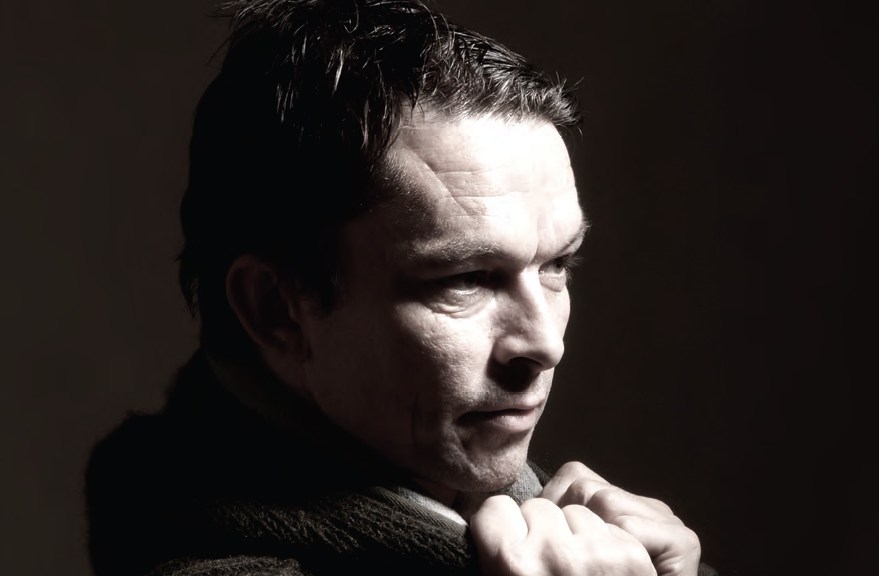

This makes Kinshasa a hell of a place to live at the best of times, but for Staff Benda Bilili singers Ricky Likabu, Theo Nsituvuidi, Coco Ngambali, Kabose Kaamba and Djunana Tanga there was also the complication of growing up with polio in a country with over 9,000 humans to every qualified doctor (the UK has 440). The core of the band bonded over their shared experience of disability, and many of their lyrics are directly informed by it. One song translates as “Parents, please go to the vaccination centre / Get your babies vaccinated against polio.”Of course, it is not this social consciousness that drew fans to the Brighton Dome the night I met them, so I began by asking if they fear their songs have less of an impact for crowds who not only don’t understand the lyrics, but are also living lives a world away from the situation the songs were born in. Michel Winter, their manager and acting translator, sums up their answer: “They’re here so that people can enjoy it. They realise that European audiences like their music, so what the lyrics mean isn’t so important. The music is good and so is their attitude on stage and the energy they give. They’re just happy to be here.”

I’m meeting them at the start of their first ever full tour, 35 dates dotted around Europe, and the band are clearly on a high following what they describe as the “great success” of their debut British show at London’s Barbican the previous night. They say they’ve always known they’d play in Europe; such is the utter confidence they have in the music they’re making. I ask if it was a dream, but Michel replies with a Gallic shrug, “It was obvious for them.” The rather staid, sedate venues they’re playing is perhaps a reflection of the narrow box ‘world music’ is routinely filed away in, and their remarkable if sobering back-story probably leads some to assume that a Staff Benda Bilili gig will be a solemn affair. The reality is anything but. Later that night the good people of Brighton are dragged as one from the comfort of their chairs to find themselves dancing down the aisles and pressing up against the stage. They are being led by an irresistible rhythm and the example of the band, pirouetting in their wheelchairs. Djunana hops out of his on powerful arms and forward-rolls across the stage, the legs that polio has withered to stumps tucked beneath him. He is grinning wildly, and so, I realise, am I. Regardless of anything else, Staff Benda Bilili are a great party band.

They were inspired by one of the greats. Back in 1974, Congolese dictator Mobutu helped bring the now legendary ‘Rumble in the Jungle’ fight between Muhammad Ali and George Foreman to Kinshasa. The fight was preceded by ‘Zaire 74’, a three day festival immortalised in the documentary Soul Power and headlined by James Brown. Two of the band saw Brown’s performance, and the Godfather of Soul’s fingerprints are imprinted on their music and on their tireless quest to entertain. On ‘Je t’aime’ you can hear them call out “Sex Machine” in tribute. As for other influences, they mention reggae, the Cuban rumba and the vague catchall of ‘international music’. They are sketchy about specific artists, and Michel reveals that it is only recent touring that has introduced them properly to many musicians. “Other than James Brown, they don’t know many Western artists. They are just starting to discover now. For example, they didn’t know about Jimi Hendrix before they started touring, but now they see some similarities.”

Claiming musical kinship with Hendrix strikes me as a bold claim, but the band have their own musical innovator in the shape of Roger Landu. As a child Roger lived on the streets of Kinshasa, but he was taken in by the band after they came across him busking with an instrument he had invented himself: the satongé. You can make one yourself if you happen to have a powdered milk tin, an electrical wire and a bit of broken basket lying around. Simply jam the curved basket wood into the side of the tin and string the wire between the top of the tin and its new handle. Sounds simple, looks simpler, but by pressing the tin tight to his chest and squeezing the wooden handle in and out, Roger wrings virtuoso solos out of that single wire that could raze Electric Ladyland. The only drawback to his improvisation seems to be several occasions during the night when he is forced to repair or even entirely rebuild his instrument.

Not that the audience seems to mind, and neither do the band. For them, it’s a tiny hurdle after a journey that seems to have been mainly constructed of much larger obstacles. Their music, and their performance, now drips with the confidence of a band who feel they can do anything. Before I leave, Michel smiles at the apparent chaos backstage and confides that when he first heard of the band he was told “They are fantastic musicians, but they are disabled. Is that a problem?” His reply has proved true, “If the music is good, there won’t be a problem.”

Originally published by Drowned In Sound.

Republished in an alternate form by the World Health Organisation.

This Mess We’re In

Tell a Colombian cocaine baron something he doesn’t want to hear and you probably won’t be heard from again. As Professor David Nutt found out, tell a British politician something they don’t want to hear about drugs and a similar fate awaits. His mistake was to think that prohibition has anything to do with something as trifling as scientific evidence. In The War on Drugs, the first of many casualties was the Truth. Tom Feiling has set out to resurrect it. His book ‘The Candy Machine – How Cocaine Took Over The World’ sees him chewing the cud with coca farmers in Colombia and contemplating crack with a former Mayor of Baltimore. Along the way he stares deep into the heart of the “culture war” that keeps drugs like cocaine illegal, and argues lucidly that the mess we’re in is as self-inflicted as a Sunday comedown.

I met Tom Feiling in his Brixton flat surrounded by maps and other exotic artifacts from remote parts. The ambience is distinctly South American, and as he rolls the first of many cigarettes he tells me it is a decade since he first visited the continent. He had set off for Venezuela, but after falling in with a gang of “gringo travelers” he found himself bewitched by Colombia. Returning years later, he shot a documentary feature ‘Resistencia: Hip-Hop in Colombia’ which told the social and political history of the country through the eyes and lyrics of young rappers. He describes it now as a risk, “People told me that if I wanted to find out about politics, I should talk to journalists and politicians, but I thought it was a gamble worth taking.” This blending of culture and politics is a gamble that still pays off. His book benefits from an understanding of the peculiar place that cocaine occupies within popular discourse, simultaneously aspirational party lubricant and, as crack, a demon stalking the poor and vulnerable. He suggests this paradox finds its way into music. “The whole story of crack dealing in the States can be traced by listening to hip-hop.”

This cultural context is essential given Feiling’s argument that drug prohibition is much more about a “culture war” than a true “public health problem”. “Prohibition was the government trying to assert itself,” he points out. “That’s the problem with trying to have a rational drugs policy. Drugs are emblematic of something else.” Feiling is not afraid to unpick the sociological history of cocaine vilification, but he also used his Colombian connections to shine a light on those growing the plant that becomes the drug. Coca production is heavily controlled, although fascinatingly some is still being legally imported into the States. The Coca-Cola Company ships 100 metric tons of coca to New Jersey every year, where the plants are ‘de-cocainized’, and the active ingredient sold on for use in pharmaceuticals. Most farmers, of course, find themselves working for even less savoury employers than Coca-Cola. Feiling blames the “long tradition of lawlessness” and lack of state apparatus for why, of the thirty-three countries which produced coca when it was legal, Colombia is now the world’s number one cocaine producer.

From Colombia, Feiling followed the white vein which runs to Tijuana, Kingston and Miami before arriving in Baltimore. Here he met Kurt Schmoke, who was in office for over a decade after becoming the city’s first elected black mayor in 1988. He also had a small part in ‘The Wire’ as an advisor to Mayor Clarence Royce, a reflection of the fact that Schmoke’s own liberal policies as mayor had inspired ‘Hamsterdam’, the area in the series where drugs are de facto legalised. “Schmoke made the point that the harm being done was not done by drugs, it was being done by drug money and the thirst for drug money,” Feiling tells me. “He also argued that as a society we don’t have to make things illegal to show that we disapprove of them. One in eight adults in Baltimore had a drug abuse problem during the time he was in office, so he saw the whole thing up close. When he suggested that decriminalization would take the sting out of the drugs trade he was pilloried and called a maniac. The impression that I got was that he was an up-and-coming Democratic politician who was being groomed for higher office, but after that his career in politics was over.”

This prohibition of debate is a critical barrier to new thinking about drugs. It is thus sadly appropriate that I met Feiling in the week that David Nutt was sacked as a government drugs advisor for suggesting that laws be based on scientific evidence rather than political ideology. “This isn’t something that can be debated,” Feiling points out, “This is the Government saying, ‘We don’t want to talk about this’. We’re not judging the success of the war, it’s the fact that there is a war that we’re judged on.” Feiling advocates legalisation, but stresses that this view comes more from evidence of the failure of the status quo than any ideology of his own, and he realises it won’t come soon. “It’s like saying I’m an advocate for the rivers running with milk and honey.” A debate desperately needs to take place, but this cannot happen while politicians would, as ‘The Wire’ had it, rather live in shit than let the world see them use a shovel. “If legalisation isn’t the way out, I’d like to know what the hell is? Unfortunately, most Western politicians are indifferent to what is happening in Colombia, in Mexico and in American and British inner cities. They’ve been indifferent to it for a long time, and I think that’s far more of a controversy than legalisation.” Like a hopeless addict returning for yet another hit, the longer we pursue failed prohibition policies the worse it gets. Nobody benefits but drug runners and gangsters. We do it to ourselves, and that’s what really hurts.

Originally published in Notion, December 2009.

The Handmade Tale: India’s silk weavers

HandmadeTaleLosing your job is rarely pleasant, but simultaneously losing your employment, your cultural traditions and a way of life that supports whole communities is a worse redundancy package than most. For hundreds of thousands of Indian silk weavers, this is a reality which has seen the jobless forced into such desperate measures as selling their blood or even their own children to make ends meet. Death from starvation is common, although many take their own lives first.
It is only just dawn in Varanasi, one of Hinduism’s holiest cities, but the street corners and marketplaces are already teeming with people. Among them is Bhaiya Maurya, but he has not come here to admire the ancient temples that rise from the banks of the Ganges. He has come here, like everyone else, to look for work – any work. Over the next hour, trucks will come and collect labourers. If Bhaiya is chosen he’ll make 75 rupees today, less than £1, and he will consider himself lucky. Two days out of three his luck is out and he’ll go home empty-handed. Across the globe, recession is making countries fear the spectre of mass unemployment. Here in Uttar Pradesh, India’s northern and most populous state, there are more than three times as many mouths to feed as in the UK. The numbers out of work are staggering and the threads that bind them together are made of silk.

Patents and Protectionism in a Globalised World: voices of traditional Indian ArtisansWaiting at home in the village of Damodarpur 15 km from Varanasi is Bhaiya’s father, Hari. He is a master weaver who in the past decade has seen falling demand, rising costs and increased foreign competition decimate the silk trade. At its peak, it employed a million people in this area. Now, it employs less than half that number. As Hari explains: “A few years ago, everyone in my village was engaged in hand-weaving. Now, most people are unemployed. If everyone had work, then the village would develop automatically. First we need jobs, and only then will come safe water, electricity and roads.”
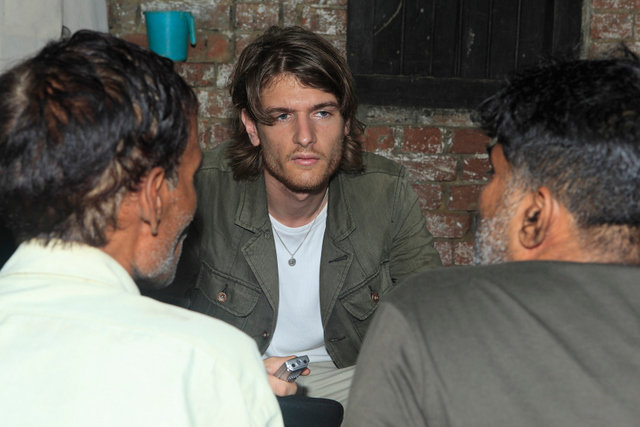


There is debate over whether the jobs they so urgently need can come from the labour-intensive hand-weaving sector, as they have in the past. The Indian prime minister, Manmohan Singh might have been thinking of the silk weavers of Varanasi when he told the G20 recently that he would resist the “inevitable pressures” for protectionism caused by “low growth and high unemployment”. The struggles of this industry are the familiar problems that increased mechanisation and globalisation can bring. Traditional hand-woven saris simply cannot compete on cost with machine-made garments from China.

Falling demand is also a symptom of cultural change. Fashions are changing across the subcontinent and Indian communities worldwide. Young girls are less likely than their mothers to wear saris. When they do, they want lighter, tighter designs, not the heavy, gold-and-silver-embroidered Banarasi sari of antiquity.

However, this weight of history and tradition may turn out to be the hand-weavers’ greatest asset. The Banarasi sari is famous throughout India and traditionally every Hindu bride will wear one on her wedding day. Weavers such as Hari are the only ones skilled to make it authentically, having passed the knowledge down from generation to generation. Ashok Kapoor, a trader who has worked to help preserve hand-weaving, sums up his concerns bluntly. “I don’t care about the starving weavers,” he tells me. “I care that the art is dying.”

Four and a half thousand miles away, in Whitechapel, London, there is evidence of what British politicians might call “green shoots of recovery”. The Banarasi sari remains a marketable brand. Imported saris sell for about £250, but even within India it can be difficult to be sure that what is sold as a Banarasi sari has actually originated in Varanasi. That is now changing. Realising that substandard imitations were damaging their reputation, and sales, the weavers have organised a co-operative, Banaras Bunkar Samiti (BBS). They now negotiate with traders as a group and, with support from the development agency Find Your Feet, they have managed to persuade the government to introduce a patent for Varanasi’s saris. This protects their product in the same way as champagne or Darjeeling tea. KP Verma, the assistant director of the state government’s handloom department assures me that this will have a transformative effect on the lives of the weavers, but Hari is wary. He is quick to point out that any success the patent has will rely on demand from relatively wealthy consumers who are prepared to follow the lead of Banarasi fans such as Bollywood’s Aishwarya Rai and pay a premium for luxury. Traders and exporters such as Maqbool Hasan concede that while there is still demand for genuine Banarasi silk from Indian elites, many buyers, including the large export markets of America and Europe, care only about price.

2009 VaranasiThe only thing that will revive the hand-weaving industry is co-operation. As well as lobbying the government, BBS have also formed microcredit groups to help the weavers back on their feet. A loan from the co-operative enabled Hari to reopen the loom he calls “the symbol of my pride”. It is now the only one in his village, where once there were 200, but it is a start. With help from Bhaiya’s younger brother, Krishna, Hari has diversified from saris into a wider range of garments and home furnishings targeted at India’s growing middle class. Meanwhile another son, Raju, was supported by a BBS loan to learn computerised embroidery. He is now one of the few villagers to earn a salary.

Having started out with little and lost much, the first task for these communities is creating new opportunities. Hari is a man of quiet dignity. He does not ask for charity. He wants only the opportunity to work himself and his family out of their situation.

As he says: “The most important thing in the definition of development is jobs. Work is essential for each and every hand.”

Originally published in The Guardian.

Read more about a former factory owner here: ‘Ghost in the factory’.

Read more about a local women’s microcredit group here: ‘Finance for the future’.

Trench warfare: Sanitation in the Democratic Republic of Congo

In the Ngiri-Ngiri district of Kinshasa, the capital of the Democratic Republic of Congo, there is a wide trench which runs down the side of the street. Beside it, a team of men are working with shovels and rakes. Most are gathered around the edges, but others are standing in the liquid sewage and waste that fills the trench and laps around their cracked black boots.

The rainy season is beginning and the trench should be draining water from the muddy track which serves as a road, but it has become too clogged with the debris of tightly packed lives. Unless the team can clear the trench the slums on either side of the street will be flooded when the rain comes. One of the men, Karem, in his mid-twenties, is breaking up the solidifying mass of waste and mud with a rake, and his neighbour is shovelling it onto the side. Karem looks dolefully up and down the road. “My country, the DRC,” he says, “it’s fucked”.

There are trenches like this beside streets like this all over Kinshasa, and all across the DRC. Just 8% of the urban population have access to decent sanitation, according to WSP estimates, which means that in Kinshasa alone there are over seven million people living without toilets. The UNDP’s 2005 Poverty Reduction Strategy Paper refers directly to the open trenches when it states that “more than 80 per cent of illnesses are linked to the bad state of the environment”.

As the team pause for a break from the heat they buy water in tiny plastic bags from street vendors. It is relatively expensive, but also the only reliably clean source of drinking water. As they dextrously split the bags without spilling a drop, children in school uniforms pass by, seemingly accustomed to the great stench as the sun hits the sewage. They eat food from open stalls just metres from the trench, and for many getting home means making use of makeshift bridges or jumping across where the compacted waste on either side has narrowed the channel. But it is the young who are most at risk from the diseases the sewers harbour. 88% of diarrhoea infections, the second most common cause of infant mortality, are due to a lack of safe water and basic sanitation. For every 1,000 children born in the DRC, 126 will die before their first birthday.

Sanitation also has a consequential impact on education, as a 2007 report by the ODI makes clear. Diarrhoeal diseases and parasites are often linked to a reduction in attendance and attention at school, either due to sickness of the child or a family member, with the burden of caring for relatives and going to collect clean water falling disproportionately on young females. Furthermore, girls will often deliberately avoid school if they cannot access female-only toilets.

The state, however, have neither the will nor the finances to provide this basic infrastructure. They justify the fact that sanitation attracts less than one percent of the already limited national budget by claiming that there is no public demand for it, but this is arguably due more to the cultural taboo that discussing toilet facilities still carries. The tangible desire for cleaner living conditions is evidenced by the fact that Karem and his workmates are all volunteers, working for free simply because the alternative is to watch their homes become swamped by their own waste. They are members of a NAPO (Noyau D’Action Pour Participation Populaire), a community group who work together to solve localised problems.

20-year-old Kaleb joined the NAPO because he was motivated by memories of flooding from previous years. “[During the flooding] there is no transportation and people can’t even walk on foot. You have to carry people on your back to get around as it comes right up to our waists. After the floods, people go to bed hungry as they are unable to get food. People are in a hurry to buy food now while it is not raining as they will be unable to get it when it rains. We are living in a very difficult situation.”

Kaleb does propose a solution. “We need to build a gutter and when it is built, the problem will be solved.” The gutter he describes is effectively a concrete version of the trench that already exists, and is common in the relatively wealthier areas of Kinshasa. However, even these less rudimentary gutters soon become clogged without accompanying sewers and solid waste collection. The ODI report found that Kinshasa’s public sanitation authority possesses just a single working rubbish lorry.

The NAPO in Ngiri-Ngiri has existed for three years, and each year its work is repeated. Without a state infrastructure to fall back on, their Sisyphean task is toiling simply to keep roads traversable and drains flowing, always knowing that the effects of the rainy season mean their labour is only a hard rain away from being undone. A permanent change will require a change in political priorities and with the DRC’s first ever local elections scheduled for later this year, the significance of the local NAPO leaders should not be downplayed.

While in the short-term NGOs have been forced into a situation where they are in a literal sense bailing out the worst affected communities, in the longer term these local leaders have the chance to redirect the political discourse towards cleaner toilets and sewage systems. Cities are built on their sewers, and if the DRC is to break Karem’s despairing assessment of its prospects, sanitation has to be seen not as an embarrassing problem, but as the foundation of good health and education. Jean-Michel Mvondo works for RECIC, a Civil Education network which supports NAPOs across the city. He says “Ngiri-Ngiri is one of the most unhealthy and dirty areas of Kinshasa and there is a serious problem with ditches of water, but we are convinced that good governance starts from the lowest level.”

Originally published in The Guardian, 23 July 2009.

Remembrance of Things Past: John Peel, Mark E Smith & Gordon Strachan

When I was 13, I used to listen to John Peel while I did my homework. The sound of his voice is one of the snatches of memory that I recall from those nights, a hazy decade ago, like the smell of the wooden desk or the burning light of the desk lamp when I glanced up. I would listen to Radio One incessantly at that age, even forcing myself through the boorish Chris Moyles in my desire to become acquainted with the music which populated the charts. I would stop and start my tape deck, trying to capture my favourite songs, or at least the ones I thought the pretty girls at school would be eagerly discussing the next day.

It goes without saying that by the time John Peel got on air, late in the evening, different rules applied. The girls at school would not be discussing anything that John Peel played, and nothing on his playlist would make it onto the charts at the end of the week. What he played was utterly foreign to my ears, accustomed to either the Beatles and Byrds of my parents or the Britpop of my peers. Some of it would confuse or bore me, some I would adore, but the most frustrating fact, for me, was that he seemed to play things once and once only. I was used to the rapid repetition of daytime Radio One to help me create my mix tapes. With Peel, by the time I felt the pangs of love I was already too late, the songs were gone. With the internet still in its infancy, tracking down music as wantonly obscure as Peel’s seemed like an impossibility to me. Somehow though, two different songs managed to sear themselves onto my memory, although I had no idea of their authors, or indeed even their exact titles. All I knew was that one was about, but certainly not by, a band called ‘The Fall’, and the other was about a footballer named Gordon Strachan.

I was reunited with the song about The Fall a few years ago. It’s by Jeffrey Lewis and it’s called, helpfully, ‘The Legend of ‘The Fall’. The irony, of course, of always remembering a song about Mark E. Smith and his coterie, but never being able to find it, was that in the meantime I spent a lot of time listening to their music, by way of a proxy. The song had been my first introduction to the eponymous band, and the lyrics had been bewitching. “He had a dream rock’n’roll could be given a new brain / Something raw and uncompromising and smart and strange.” Indeed, even Peel himself was name-checked; “John Peel said they were his favourite band because they’re always different but always the same.” The Fall proved to be everything the song promised, but it is Jeffrey Lewis himself who I now adore, after I reencountered him late at night on MTV2’s now sadly defunct ‘120 Minutes’, singing ‘Williamsburg Will Oldham Horror’. That was in 2005, some six years after I had first heard him on Peel, and it was in my subsequent acquisition of his back catalogue that I rediscovered ‘The Legend of ‘The Fall’ and could finally identify its creator.

The second of the two songs John Peel left me took much longer to find me again, but I stumbled across it earlier today and it was that which prompted this torrent of memories. It is a song called ‘Strachan’ by a band called ‘The Hitchers’. It would be a shame if you let the fact that it’s a song about a footballer put you off it, because it’s glorious. Punctuated by raging shoegaze guitars, it does admittedly spend much time describing the wee Scotsman’s role in a mid-nineties Leeds United side, but it is told through a framework of domestic minutiae which will be familiar to football fans and neglected partners alike. She asks “What’s that you’re watching?” He retorts, “A program about art.” Listening to it now it still sounds as exhilarating as it did then, and although The Hitchers seem to have disappeared without a trace, the sound they introduced me to still echoes through the bands listed on my computer’s hard drive.

Which brings me, finally, to Heraclitus and to wondering whether any of us are the same person we were ten years ago. I don’t consider myself to have much in common with that boy, sat over his homework at age 13. We have staggeringly different views of the world, and while we certainly share some memories I have no doubt lost almost as many as I have gained. Our tastes in art would certainly seem to be absurdly divergent. I mean, that kid was into Oasis. Yet for some reason I still get the same pleasure listening to ‘Strachan’ or Jeffrey Lewis now as I did ten years ago when I first heard them. Was I drawn to them then because of some germ of my future tastes, or do I listen to Lewis now because of a seed that song planted in my head, without me even knowing the singer’s name? Perhaps there is simply an illusion caused by my brain filtering out all those thousands of songs I’ve heard and forgotten to create a false sense of continuity, but I can’t shake the feeling that I am stepping into the same stream of consciousness twice.

It’s all John Peel’s fault.

Thanks, John.

Originally published at The Comment Tree.

Click here to read my review of John Peel compilation ‘Kats Karavan’ at Drowned In Sound.

The Greatest Silence

greatestLast week, I was invited to speak at the Centre for Development and Emergency Practice’s Human Rights Film Festival, at Oxford Brookes University, following a screening of ‘The Greatest Silence: Rape in the Congo’. It is a powerful and shocking documentary made two years ago by Lisa F Jackson, who draws on her own experience as a rape victim, and I would highly recommend it although it is far from comfortable viewing. At one point a Congolese doctor describes how he thinks that each patient he sees has the most harrowing story imaginable, until he encounters the next, and the film is similar – each story, told firsthand, brings a fresh horror to what has gone before.

It was difficult to find any glimmers of hope following such a distressing film, but I tried to highlight some of the remarkable work that Christian Aid’s partners are able to do, even in the war-torn East, to rebuild lives torn apart by sexual violence.

I told the story of Afua, who was abducted by Mai Mai militia in 2002 while out farming in the fields and was gang raped while being held at a military camp. She told Christian Aid’s partners that when the soldiers eventually left the area, she immediately sought out medical help. ” I was physically sick with worry that I had caught AIDS. I was in trouble with my husband. He didn’t want me anymore – he wanted me out of the house and away.”

Afua was helped by Madame Albertine, head of Christian Aid partner UMAMA. She arranged medical tests which proved Afua was free from disease and gave counseling, acting as a bridge between Afua and her estranged husband, who had accused Afua of seeking and enjoying sex with her attackers. As ‘The Greatest Silence’ explores, this view of rape victims is common. Afua was eventually reconciled with her husband and children, after Albertine had made it clear to him that his wife had been a victim, targeted because she was vulnerable in the fields where she worked to feed her family.

UMAMA also helped Afua with a loan of $100 for a bread oven, allowing her to earn a living without the obviously traumatic need to go back into the fields where she was attacked. She now earns $20 a week, the same amount her husband, a nurse, earns in a month, and is able to pay back $10 each month to pay off UMAMA’s loan. afua

Afua says now that “UMAMA is a good organization. It helped our family to survive and stay together.” While the scars of her attack remain, organisations like UMAMA are, in some way, able to rekindle hope. It brings to mind another partner organisation, Fondation Femme Plus, who are made up of women living with HIV-AIDS and its consequences. They specialise in psychological, social and medical support, as well as promoting income-generating activities for women with HIV-AIDS such as a restaurant, a tailor’s workshop and photography training. Their slogan is “Rendre l’espoir est notre vocation” – Returning hope is our job.

Originally published at Congolese Dawn.

Trapped In A Series of Tubes: The Government, The Internet And You

“Take away the right to say ‘fuck’”, said Lenny Bruce, “and you take away the right to say ‘fuck the government.’” Last December, the Secretary of State for Culture, Media and Sport, Andy Burnham, announced that when it comes to the internet, “There is content that should just not be available to be viewed. That is my view. Absolutely categorical.” He proposed to start deciding what internet users can and cannot view by introducing filters which would screen web-pages for obscene content. He was, quite literally, proposing to take away our right to say ‘fuck’.

Just days earlier, the Internet Watch Foundation, the self-regulatory, non-governmental body which regulates the internet in the UK, had blocked the Wikipedia page for Scorpions’ album ‘Virgin Killer’, which was released in 1976. The block had come about due to the fact that the album cover has an image of a young, naked girl on it, but this was not explained, nor was the rest of the page accessible – it simply returned a 404 error, which meant that users did not even know that they were being blocked.

Perhaps most worrying of all is the ongoing case against Darryn Walker over allegedly posting an explicit story describing the rape and murder of Girls Aloud. The worrying aspect of this case is not so much that he is being prosecuted – while grotesque fan fiction of this kind is not a new phenomenon, a case could certainly be made for him to be tried for harassing and intimidating the very real subjects of his story. No, the worrying aspect is that he is being tried under the Obscene Publications Act, the law which tried unsuccessfully to outlaw ‘Lady Chatterly’s Lover’ and the Oz ‘Schoolkids Issue’ in the 60s and 70s. If successful, the prosecution will set the remarkable precedent of making it a criminal act simply to type words that are thought to be ‘obscene’. The case has met with little protest, due in no small part to the fact that there is very little political capital to be won defending Girls Aloud rape stories. But the unsavory subject matter does not reduce its importance. As Martin Niemöller might have said, “they came first for the perverts…”

Burnham has defended his plans to censor the internet by pointing out that as a father; he does not feel safe leaving his young children alone to access the internet, saying “Leaving your child for two hours completely unregulated on the internet is not something you can do.” He has drawn a comparison with the success of the TV watershed in protecting children from obscene content. This is disingenuous for a number of reasons. Firstly, Burnham’s parental decision making should not determine national law – it is already possible for parents to select which websites their children are able to view, or indeed to install filters of the kind Burnham is proposing to make mandatory for the entire country. Secondly, potentially the most dangerous part of the internet for young children is chat rooms, which would not be covered by filters which restrict content. Thirdly, pornographic material is already marked by age limits, something Burnham is proposing should now cover all websites. What Burnham is seeking to extend censorship to is not images, but words. The comparison is not with the TV watershed, but with putting policemen in public libraries.

Burnham need only look to Australia if he is seeking a lesson in the complexities of suppressing web pages he does not approve of. Recent proposals there for a compulsory internet filter have been met with widespread protests. The proposals would make Australia one of the strictest democracies in terms of internet regulation, with at least 1,300 sites prohibited, based on a list drawn up by the state and not made public, leaving it free from legal scrutiny. The filter would have two tiers, one which would block the sites on the government’s blacklist, the other which would be optional and would block pornography by using keywords. When internet providers pointed out that much of the illegal material which is theoretically being targeted here, such as child pornography, is traded via peer-to-peer networks or chat programs, Communications Minister Stephen Conroy’s office said a peer-to-peer filter would be considered, despite the fact that the technology to do this simply does not exist.

It is at this point that we are reminded of what a brave new world the internet has led us into. No matter how much governments desire to regulate the internet, technology seems to be able to stay ahead of them. Technology like Tor and Freenet already make it possible to access the internet and transfer data anonymously, and Dr. Vint Cerf, who was one of the internet’s founding fathers when along with Robert Kahn he designed the TCP/IP Internet network protocol in the early 1970s, has said on numerous occasions that any attempt by governments to control the internet are doomed to failure due in part to private ownership. In 2007, he said “It’s tempting to think that you need a United Nations-like structure to deal with it, but I believe it will be very hard to accomplish that objective for one simple reason – 99 percent of the internet, the physical internet, is in private sector hands, operated by the private sector.”

Cerf has, however, backed multiple stakeholder models on control, which would include customers, governments and wider society. “The internet is used by a billion users around the world, it’s not strictly a purely governmental thing to control, and that’s why you need this multi-stakeholders structure to make sure all the prospects are respected.” Cerf is the chair of the Internet Corporation for Assigned Names and Numbers (ICANN), which is the body which controls domain names, and which Cerf describes as “the first big expert in a global multi-stakeholders structure.” However, even, ICANN reports to the U.S. Commerce Department, which has drawn criticism on a number of occasions, either for political interference in the Web’s governance, or for simply being out of touch. In 2006, Senator Ted Stevens, Chairman of the Senate Commerce Committee, expressed his fears that the internet would slow down due to heavy usage, saying, “The Internet is not something that you just dump something on. It’s not a big truck. It’s a series of tubes. And if you don’t understand, those tubes can be filled and if they are filled, when you put your message in, it gets in line and it’s going to be delayed by anyone that puts into that tube enormous amounts of material…just the other day an Internet was sent by my staff at 10 o’clock in the morning on Friday. I got it Tuesday. Why? Because it got tangled up with all these things going on the Internet commercially.”

Government will not stay this out of touch with the internet for long. Burnham has talked of working with Obama to regulate the English-language internet, and a recent think-tank report entitled ‘Securing Cyberspace for the 44th Presidency’ calls for “strong authentication of identity, based on robust in-person proofing and thorough verification of devices”. The British Government has been scrabbling around desperately for a justification for its much derided identity card scheme, and the internet may well provide one – a theoretically viable means of authenticating age, and individual agency, on the internet. Smuggled in under the paranoia which surrounds identity theft, swiping into your computer with your ID card is not a conspiracy theorists fantasy, it is a policy option being currently debated.

But while the nature of the internet would suggest that some people, somewhere, will always find a way of getting around the censors, and although even Thomas Jefferson knew that “taste cannot be controlled by law”, this has not stopped plenty of countries exercising fierce control over those who seek to take advantage of the freest of free presses. 13 countries were placed on Reporters Without Borders’ ‘Enemies of the Internet’ list, including China, where Obama’s inauguration speech was recently censored of any mention of communism, and Egypt, where Kareem Amer remains in prison for critically blogging about Islam and the Egyptian President.

Closer to home, LSE itself has a history when it comes to online censorship. Former lecturer Erik Ringmar wrote ‘A Blogger’s Manifesto’ about his experiences after he published blog posts which included details of his salary and others which were critical of the way the school is run. He was asked by his department convener to “destroy/cancel your blog entirely and shut the whole thing down until further notice”. The convener was in turn backed up by Howard Davies, although he argued that “The issue here is not a policy on blogging, it is whether a colleague can publicly abuse his employer and his colleagues without consequences.” That it is the message being censored, and not the medium, is beside the point. There was once a time when the press was free only to those who owned one, but the internet has democratised publishing, and this is the situation which is now under threat.

As Ringmar himself points out in his book, LSE also has a prouder tradition to draw on, which predates the internet. Karl Popper wrote ‘The Open Society and Its Enemies’ shortly before taking up a post at the school, and in it he set out his belief that society only moves forward if it has the power to ask questions and the space to listen to dissenting voices. “It is the longing of uncounted unknown men to free themselves and their minds from the tutelage of authority and prejudice. It is their attempt to build up an open society which rejects the absolute authority to preserve, to develop, and to establish traditions, old or new, that measure up to their standards of freedom, of humaneness, and of rational criticism.”

It is this tradition that we must protect now. The internet represents the greatest tool yet found for the free exchange of ideas, to challenge the tutelage of authority and prejudice whether it be in Egypt or England, at home or in the workplace. The internet revolutionised our access to knowledge, and power, so swiftly that it is easy to take for granted, and the cases which Burnham and the IWF have cited are difficult to defend – but they must be. We don’t have to agree with everything that is published on the internet to realise the value of the space it grants all of us. We all own our own presses, now, and as Albert Camus would have it, “A free press can be good or bad, but, most certainly, without freedom a press will never be anything but bad.”

Originally published by the LSE’s Clare Market Review.

A voice from Gaza: Majeda Al-Saqqa

9th January 2009 at 3.30pm

Majeda Al-Saqqa works for the Culture and Free Thought Association, a group that was established in 1992 to improve life for the people of Khan Yunis refugee camp in Gaza by running community activities for children, young people and women. She spoke to Ctrl.Alt.Shift about her experiences over the last few weeks, her belief in the power of the masses and her hopes for the future.

“At the moment I’m in my house in Khan Yunis, in the south of the Gaza Strip. It’s quiet, but there is no electricity and there are some airplanes in the sky. It’s a bit tense because we don’t know what will happen. It seems that there are some escalations, from what we heard on the news, so we don’t know what is going to happen.”

“Because we don’t have electricity we don’t have access to TV news, so we’re just listening to local FM radios all the time. They are reporting about what is happening in several places across the Gaza Strip. The Israelis are in the eastern villages of Khan Yunis, but so far they have not entered into the city. Of course, you can still hear the shelling and the air-strikes all the time.”

“In my opinion, I don’t think this war has anything to do with Hamas, even though Israel has announced it is because of what Hamas is doing. If we look at the history, if we look at 1948 or 1967, or the first Intifada, it’s not always Hamas. Unfortunately, it is the Israeli regime and the occupation that is doing this.”

“With what we are seeing in the world, I don’t think anything will change withIsraelas long as the American administration is acting this way, as long as the EU is acting this way, and as long asRussiais acting this way. Unfortunately, all the people who supportPalestineare the people, the masses who are not in power. They are the supporters for the Palestinian cause and the right to live free and to end the Israeli occupation. As long as the EU is rewarding Israel and upgrading their relationship, the Israelis have no reason to stop what they are doing. Unfortunately, it is an arrogant state, and we are hoping that the people, the masses in Europe andAmerica, in the Arab world and the Muslim world, will continue their revolution and change the situation inPalestineas well.”

“We hear about protests all over the world. Supporters from London or Europe or the Arab world will call random phone numbers in the Gaza Strip and they are supporting people and telling them that the masses are on the street and that they are protesting in the big cities and in small villages, even. This is our hope. Our hope is that our freedom will come from the people. I don’t think we have any hope in any of the governments of the world, not even Obama. He said that he will bring change, but his last statement equalised the victim and the oppressor. We were so disappointed, because he is saying he cares about the security in Sderot, but he does not care at all about the hundreds of people who are dying, the children who are dying in Palestine. I mean, because of 17 people in Sderot who suffered from the rocket, I don’t know how to describe it but it’s nothing compared to the F-16s that are hitting civilians, that are hitting children. And I don’t think you did not see it. Everybody saw it, everybody is a witness of this crime. Unfortunately, Obama is part of an administration, and I don’t think his administration will allow him to bring change. I don’t think the American administration is ready for any change in the Middle East, but we were hoping that the EU, or the UK after Blair, would do something but unfortunately they are still very shy in their statements, and it’s undermining the Palestinian cause and it’s dehumanising, sometimes. So we are waiting for the people, but because we are struggling for our rights, our freedom, for justice and for peace I think we are going to win.”

“There was no warning at all when the attacks started. Our kids were in kindergarten and at school. It was a Saturday so it was a day off for us but the schools were open. People were in the market, just like every day. This is why it was so bad, and it killed so many people. In a second they changed the whole geography of Gaza, but no Government is doing anything about it. It happened all of a sudden, there were bombings everywhere, huge sounds and huge lights. It was like an earthquake, the house was moving. My first thought was of my nephews in kindergarten. I ran down the steps and went towards the door to go and get them, but fortunately our neighbour was near the kindergarten, and he brought them with him. It happened in a few seconds, it lasted maybe five minutes, but they hit so many places at one time. Then we heard that it’s all over the Gaza Strip, so we tried to call my brother, my relatives, my friends, my colleagues. We just wanted to understand what was going on. Unfortunately the phone lines were not working, mobiles or landlines, and it took two or three hours before they worked again. It was horrific, I can’t describe it. It is the most awful thing that’s happened in our lives. I just can’t describe it, it’s heartbreaking, because people were just in the markets and in their work, the children were in kindergarten and schools, and here you have this war-machine that is taking over your sky and your whole life, they are hitting everywhere. Nobody is talking about this trauma, they are just talking about the Israelis in Sderot unfortunately.”

“Of course I think that one day we will see a peacefulPalestine. I think I will see it myself, and I think my nephews and so many other children will live in better situations and have better lives soon, because what is happening is madness. What the Israelis are doing is a crime, and criminals can’t escape all their lives. They will be caught one day, and they will be brought to justice. I think they went out of control, and I don’t think the world will allow them. If the world will allow them, then I don’t think anybody deserves to live in this earth.”

“My message to the people in Britain is please go on and continue your fight, because the Palestinian cause is not only a Palestinian cause, it is a Human Rights cause. We are all humans sharing this earth together, so it is your responsibility as much as it is our responsibility to stop the craziness of the Israelis. It is their duty to work to bring change with the British government. I think every nation, every people in their own country, should work to bring change within their own government.”

Tim Butcher: Journeying to Africa’s Broken Heart

Tim Butcher’s book, ‘Blood River: A Journey to Africa’s Broken Heart’, part-travelogue, part-history of the Congo, topped bestseller lists early this year. The premise of the book was that Butcher would follow in the footsteps of Stanley, the first man to map the length of the Congo River, and in doing so tell the story of the country. We had the chance to speak to Butcher recently about his experiences.

You seem to spend every moment of the book in fear for your life, did you actually enjoy the experience? 

Tim Butcher: “I think enjoy would be the wrong word. It was an ordeal, and it was challenging and rewarding, but I wouldn’t say I enjoyed it. I’ve been told that there aren’t many laughs in the book, and I’m afraid that that’s because you can’t really make light of the situation. Of course I enjoyed meeting the fantastic people who helped me, but that enjoyment was tempered by the fact that I had to leave them there. I’m still in contact with Benoit, who was one of the motorbike drivers who took me on a large part of the journey, and since the book he has lost his job with Care International simply because they were downsizing their operation. He is now forced to eke out a shitty, miserable living, while in a stable country he’d have a great job, maybe the head teacher of a school. Benoit is one of the most incredible men I’ve ever met, and I would trust him with my life – well, I did trust him with my life. Some people accused me of being too negative in the book, but I reject that claim. I think I wrote about the way that the human spirit had survived, but it’s not a situation to be made light of. I think I was realistic in the book.”

Why were the local Congolese people happy to go so far out of their way to help you on your journey?

“The milk of human kindness runs very deep there. People like Benoit and Georges Mbuyu, the pygmy leader, didn’t even ask for money. They really wanted to help me. The people of the Congo are incredibly generous. It’s one of those classic cases of a tiny fringe of radicals colouring the perception of an entire group of people.”

Your journey wasn’t just unusual in that it was done by a non-Congolese person, even the locals rarely travel through the dangerous eastern provinces. How unified can the country be if communities are so isolated?

“That’s a very good question, because why would the country be unified along such arbitrary geographic lines? – lines drawn up by the very worst kind of colonialism. Amazingly there is a national identity, though, because the country passes the football test. Everybody cheers for the Simba. It’s astonishing, but even in areas of the country where it’s impossible to get television coverage of the games, everybody knows that there’s a game on and are behind the team. Since the 60s with Katanga, none of the regions have really talked of secession. I mean, some rebels have talked about making various provinces independent, but it’s just pie in the sky. Considering that it’s basically a failed state there is a remarkable amount of national unity.”

‘Blood River’ mentions the lack of institutional memory, the fact that the reasons for fighting wars can quickly be forgotten. Is Patrice Lumumba remembered as a hero of independence?

“It’s difficult to have that memory because it’s a country of young people. Lumumba doesn’t really have a Mandela-like following. He was a man of his time, and his murder was shrouded in so much mystery. It’s only relatively recently that the truth has come out. The violence is so complicated and multi-layered that it is difficult for anyone to keep track of it and remember it.”

The book is full of examples of decaying infrastructure, as the jungle reclaims roads and train-tracks. Is there a part of you that enjoys the unspoilt nature of the rainforest?

“If I could guarantee that my children would be safe and that my wife wouldn’t be raped, then the Congo would be a beautiful place to visit. It’s an incredible environmental paradise.

There are strange benefits. It is an African irony that HIV started in the Congo, the first samples are from Leopoldville, and there’s evidence from the 30s, 40s and 50s. But the country hasn’t been that badly affected by HIV. There is HIV there, certainly, but it hasn’t spread as rapidly as it could have done, simply because the transport infrastructure isn’t there. HIV needs two things to spread quickly: poverty and good transport, and that’s why countries like Botswana and South Africa have been so badly affected.

So there is a positive side to the unspoilt nature. The oxygen we breath comes from the Congo rainforest, it’s one of the lungs of the world. And the unfortunate fact is that I can guarantee that the first roads that go into those areas will be logging roads.

Some of the remoter regions support fantastic ecosystems. An expedition recently found something like nine new species of mammal. So there is a pure, exciting, Garden of Eden, element to the country, but at the moment it’s not safe for the people.”

What does the Congo need, above all else?

“The rule of law, and transparency. People have to know that if someone takes something that belongs to them, they can do something other than take a gun and shoot them. There is money in the country. The cobalt mines are generating fantastic amounts of money, but where is it going? Into Swiss bank accounts. Of course it’s easy for me to say what the Congo needs. The million dollar question, the million dollar developmental question, is how you implement the rule of law and transparency.”

Originally published at Congolese Dawn.