
 Have you ever pictured The Rolling Stones as the heroes of their own picaresque novel – the rogueish heroes battling their way through a corrupt and venal society as sketched by Dickens, Thackeray or Henry Fielding? Probably not, to be honest, yet you have to admit the idea of Jagger and Richards cocking a snoot at authority and living on their wits does make a certain amount of sense. It made so much sense to Simon Goddard, author of Ziggyology and Mozipedia, that he’s reimagined the story of the band in Rollaresque, a new novel, complete with sketch illustrations by Mr Chadwick. I spoke to Goddard to find out why he wanted to retell the ‘rakish progress’ of The Rolling Stones…
Category Archives: NME

Lusts
 It was while trawling round Paris in search of the ghosts of Oscar Wilde and Ernest Hemingway that Andy Stone and his younger brother James were inspired to start a band. “We met some cool people and ended up going to loads of parties,” says Andy. “We realised it’s not just about visiting these old haunts, it’s about finding the equivalent scene now.”
They did seek inspiration from decadent French poet Rimbaud though, even if they couldn’t actually understand him. “James bought me Rimbaud’s Illuminations for my birthday, but he bought the French edition by mistake,” explains Andy. “We wrote a song based on what we envisioned the book might be about. One of the good things about being brothers is that it doesn’t matter so much when one of us does something fucking weird, it can still spark something off.”
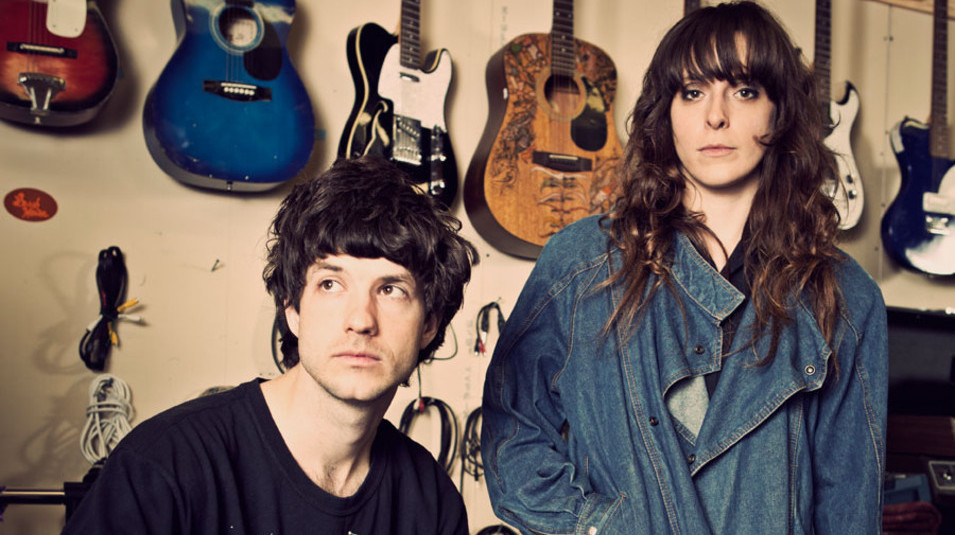
Beach House in the studio
Th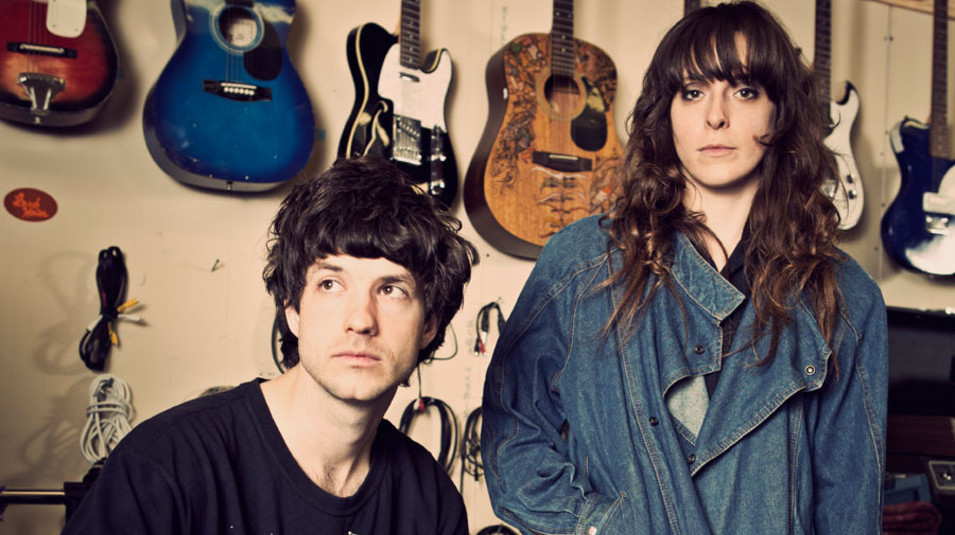 eir band may be called Beach House, but when Baltimore dream-pop duo Victoria Legrand and Alex Scally were ready to record their fifth album they headed to a little place in the country. “It’s called Studio in the Country,” explains Scally, “and it was built in the 70s to be a premier studio way out in the middle of nowhere in Louisiana. Stevie Wonder recorded there, and Kansas recorded ‘Dust In The Wind’ there. It was the spot for a little while. It’s such a cool studio, but in the worst possible place. Studios are the coolest places in the world, but nobody even goes to them anymore because no-one wants to spend the money.”
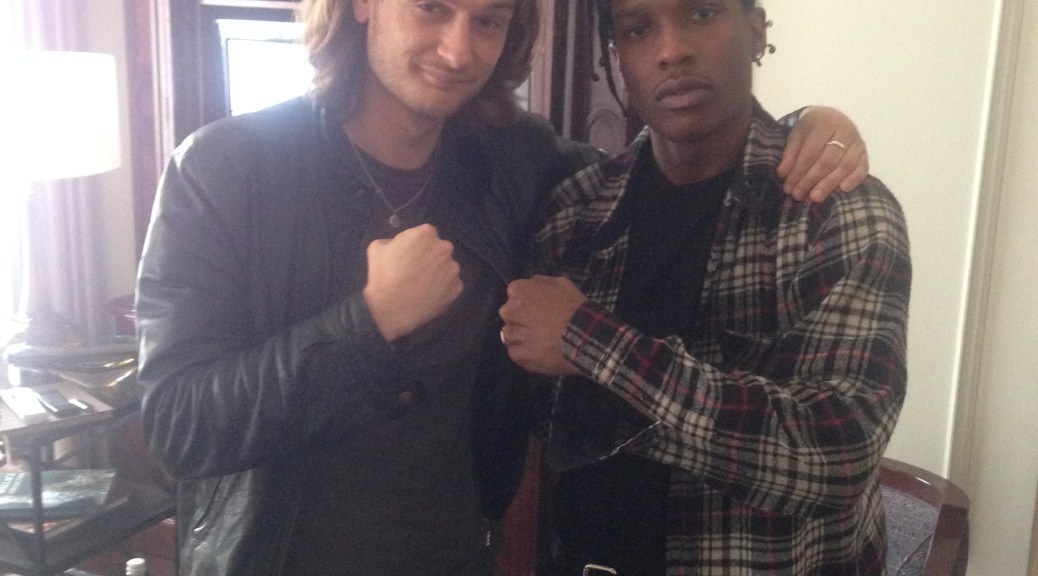
Rocky All Over The World

 The 1,000-square-foot Wedgewood Suite at London’s opulent Langham Hotel, all antique bookcases and porcelain horses, looks like the sort of place minor royalty would stay if Buck Palace was overbooked. The sofa alone probably costs more than a decent family car, but this is no time to get distracted by the upholstery.
“Do you mind if I roll up some bud?” asks 26-year-old hip-hop icon A$AP Rocky. He grins and heads off into another room to retrieve a bag of weed and a pack of Backwoods cigars, one of which he deftly unrolls so he can make a blunt.
Rocky is sharing the suite with Joe Fox, a young British singer and guitarist who featured on five tracks on Rocky’s most recent album, ‘At.Long.Last.A$AP’, which came out at the end of May. The story of how Rocky and Joe Fox met is so good that most people assume it’s made up, but both men swear this is how it happened: Rocky was leaving Soho’s Dean Street Studios at around 4am after a long night of recording. Joe approached him, not recognising him, hoping to sell him a CD. Rocky asked Joe to play a song. He did, Rocky loved it, they jumped in an Uber and the rest is history. Joe, who was homeless at the time, moved into Rocky’s hotel room and jumped straight from busking on the streets to appearing on an American Billboard Number One album.
“When I met him, he had this weird energy,” Rocky says of Joe, who’s currently out. “He was so full of hope and light. We totally disregarded the fact that he was homeless. What mattered was that he had a voice and I knew that the world needed to hear it.”
It’s also clear that Rocky sees Joe as a kindred spirit. “He has so many chicks, man,” Rocky says. “It’s weird, because he always had chicks but… Jesus, man. I’m impressed because I never seen someone get chicks like him – unless they were A$AP.”
Meeting Joe in London just one of the reasons Rocky has come to think of the capital as his adopted home. He recorded 15 of ‘At.Long.Last.A$AP’s 18 tracks in the city, either at Dean Street or Red Bull Studios. It had been his dream to come to the city since he was 14. “I really love it, man,” he says. “I don’t know what it is. The energy kinda reminds me of New York, but better.”
Rocky has built a circle of London-based friends and collaborators that takes in everyone from cloud rap crew Piff Gang to Sam Smith, who he ran into late last night at Soho House. “Coming here feels nostalgic to me,” he says. “There’s some sort of connection, like I belong here. I can’t really explain being from somewhere else and claiming another place! I never thought I would have to explain that in life, but apparently here we are.”
Rocky was actually born in Harlem, New York, named Rakim Mayers after hip-hop legend Rakim. He made his name with the woozy 2011 mixtape ‘Live.Love.A$AP’, which demonstrated his ability to assimilate numerous rap styles, while also introducing the rest of Harlem’s A$AP Mob (including rappers A$AP Ferg and A$AP Nast) to the world. 2013’s major label debut ‘Long.Live.A$AP’ was a more conventional affair, spawning international mega-hits ‘Fuckin’ Problems’ and Skrillex collaboration ‘Wild For The Night’ (62 million and 42 million YouTube views respectively). Yet Rocky’s experimental new record ‘At.Long.Last.A$AP’ feels like another left-turn. This is deliberate: he’s intent on rejecting the pop world he courted on his last album.
“Think about where mainstream is, and how far from mainstream my music is,” he says. “The biggest artists have to make pop music. I know how to make that music, I just hate it. Pop sounds like some Space Jam bubblegum fucking shit. If you listen to my first mixtape and you listen to the last album, they kind of connect. That middle project had a few mainstream joints on there. Whatever. I had a song with Florence + The Machine on there [‘I Come Apart’].” He gives the impression that the Florence collaboration was a label exec’s idea of what he should be doing to cross over, whereas the collaborators on his new album were strictly hand-picked – even Rod Stewart, who he calls a “jiggy motherfucker”.
Rocky draws languidly on the blunt. While smoking weed everyday isn’t rare in the rap world, his musical experimentation has been coloured by the embrace of more psychedelic drugs. “LSD freed me from a lot,” he explains. “Where I come from, recreational drugs are like marijuana or something like that. Shit like acid is foreign. Only white people do it, that’s the mentality in the hood.”
He begins to tell me the story of the first time he ever had a proper acid trip – here in London, with LSD – when he’s interrupted by a knock at the door.
“This is the infamous Joe Fox,” says Rocky, by way of introduction.
“Are you doing an interview?” Joe asks.
“Yeah, but sit down, chill,” says Rocky. “It’s good vibes, man.”
Fox spots the blunt. “Oh, it’s lit.”
“It’s always lit. You know it’s always lit,” chides Rocky. Joe sits down on the sofa, but barely has time to get comfortable before Rocky asks: “So you fuck both of them bitches last night?”
“Just one,” says Fox.
“Ahh, shit!” sighs Rocky. “It’s weird, motherfuckas don’t just want to be fucking one bitch no more. It’s two or better.”
“You have to remember that that’s not how society does it,” laughs Fox. “Sometimes you’re like: ‘Oh yeah, threesomes aren’t normal’.”
“You want to know something though?” asks Rocky. “I think threesomes are normal now.”
“They’re normal to you,” says Fox.
“I’ll tell you this much,” says Rocky, “before I was famous, they weren’t normal but I damn sure was trying every chance I got, and I got lucky sometimes. Now it’s common. It’s just sex, man. I love a woman with confidence who’s comfortable with her sexuality. I’m a weirdo: I don’t want a virgin. I don’t. That’s boring. You’re gonna cheat on that girl, man. What about a girl that’s open-minded? What about a girl who knows that you’re a man and sometimes you might slip? I need to be honest enough to be able to tell that girl: ‘I messed up last night, and I fucked another girl.’ I don’t expect it to be OK, I expect repercussions, but I expect the friendship to be able to stand it.”
Rocky’s talk of women and sex is not held back by the recent furore over his song, ‘Better Things’, which contained the following lyrics: “I swear that bitch Rita Ora got a big mouth / Next time I see her might curse the bitch out / Kicked the bitch out once cause she bitched out / Spit my kids out, jizzed up all in her mouth and made the bitch bounce.” He must have known how nastily misogynistic those lines are, so was he expecting the repercussions?
“I thought it was going to be like the ’90s,” he shrugs, “and people would let art be art.”
He laughs at his own faux-naivety, but continues: “You know, when you had Eminem saying all types of shit he didn’t have to explain that shit in interviews or on the radio or on camera or shit. People just said what they said and you had to listen to the next song to hear how they felt.”
Does he understand why people call him a sexist? “No, not at all. I think it’s a misunderstanding. When I talk about an experience I’ve had with a woman, I’m talking about an experience. That’s that. I don’t go around saying women are just hos. Do I think they’re less of a person compared to a man and the human race? No.”
Rocky argues that he doesn’t even talk about sex that often in his lyrics. “I don’t really talk about the orgies too much. I do love bad bitches, I do have a fuckin’ problem, but that’s really old. The only time I talked about orgies in the press was that one time doing LSD at SXSW. That was a big deal because I was high. Man, it was incredible.”
How often does he sleep with a new woman?
“I meet chicks. I don’t fuck a new chick every night… or do I?” Rocky seems genuinely unsure at this point. “I don’t… do I, Joe?”
“If you average it out, man,” replies Fox, sagely. “Sometimes I think you do that shit to be time effective. You’ll sleep with six girls in a night just so you can work for five days.”
That’s too big a claim even for Rocky’s ego. “Nah, he’s lying! I do not sleep with six girls a night. I might sleep with three girls at once but not every day. That’s lying on my own penis if I said that.”
When he reflects on his behaviour, Rocky suggests he’s motivated by a sense of mortality – particularly after the deaths of his father at the end of 2012, and his friend and collaborator A$AP Yams, who died in January this year. “I’m 26 and people try to pressure me to be like this role model,” he says. “I’m not no role model because I’m not perfect. I’m only human. When you ask a guy who’s 26, who’s been famous for barely three years, really, and who lost his father and his best friend and Robin Williams in that whole time period… I look at life like I need to be having motherfuckin’ orgies!”
As such, he’s reluctant to comment on politics. Referring to his recent talk at the Oxford Union, he says: “I was asked a question about whether I think it’s important for as an artist like me to talk about what’s going on in Ferguson and Baltimore, and the police brutality towards urban people in America. I was like: ‘I have an opinion on that, but as far as the subject matter I don’t really think that’s something I should be talking about unless I’m making a difference. I was in London recording the whole time this shit has been going down. For me, I’m in it because obviously I’m from America, my people are from America and I’m black but at the same time my reach isn’t only to them. If I have a responsibility, it wouldn’t only apply to black people. Right now, why are people trying to pressure me to be a fuckin’ spokesperson when in reality my art reaches out to all people of different backgrounds? The culture, the movement, is bigger than one race.”
So what does Rocky see as his artistic responsibilities? “It’s my responsibility as a black man and as an artist to inspire and to make a way and shed light on how to be successful or artistic and express yourself to the youth. That’s what my job is.”
Rocky feels at home doing that job in London. Here in Britain, he’s found plenty of like-minded souls willing to indulge his appetite for sex, drugs and making trippier music. While recording ‘At.Long.Last.A$AP’ he stopped worrying about trying to please the world. “If people like pop music, and the masses love it apparently, then I think the masses like shitty music. How many billion people were listening to ‘Gangnam Style’? This album I think is dope. I think it’s hard. Either you like it or you hate it, and that’s fine. I don’t expect everybody to like it.”
He drops the dying blunt into a fine china teacup. “A$AP Rocky is not for everybody, clearly.”
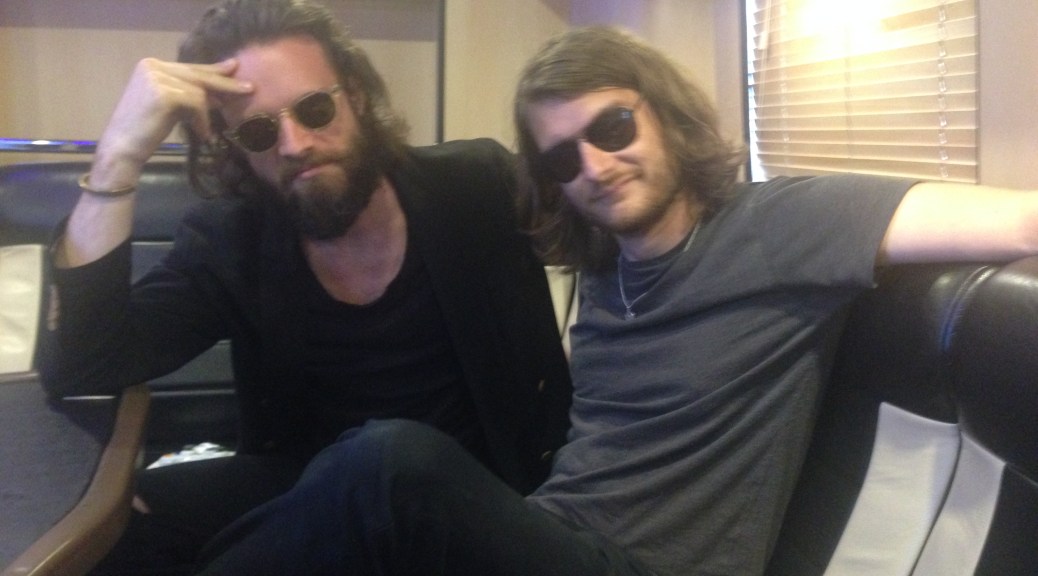
Open’er 2015: Father John Misty says he has “no interest in writing about love anymore”

Josh Tillman, who performs as Father John Misty, has written my favourite album of the year: ‘I Love You, Honeybear’. I spoke to him on his tourbus backstage at Poland’s Open’er Festival 2015:
What can you tell me about the writing of ‘Chateau Lobby #4 (in C for Two Virgins)’?
“To be honest, the details around that song are pretty salacious, and I’m not sure I want them circulating in the British imagination. It’s really just a tune about the first few months of being in love with someone. It’s definitely the most sentimental thing I’ve ever written, which gave me some problems when it came time to record it. In terms of the context of the album… I know the music media isn’t crazy about context… but within the context of the album I feel like it gives the other tunes… I feel like the song has a chance to breath. It’s sort of a welcome respite from the very thorough angst of the rest of the album. Isn’t that a great story, that I just told? A classic. Tell it again! Tell the story about ‘Chateau Lobby #4’!”
How did your wife react when you played it to her?
“She went ‘Ah!’” [Clutches bosom]
Was that the desired effect?
“Yeah, yeah. Actually, it was more like ‘Ah!’” [Smiles and clutches bosom]
Did you feel comfortable sharing so much detail about your life?
“I’d be in the wrong business… you know? I think that’s just the job. I’m grateful to have something to share, you know what I mean? I definitely was writing some real bullshit for a little while, between these two albums and before meeting Emma. [I’m inside, I’m gonna take these off. I’m inside.] I think the anxiety about sharing comes after the fact. During the mixing phase I remember having quite a bit of anxiety. It’s part of the deal.”
And your wife doesn’t mind?
“No, I mean she’s kinda the one… I mean, our lives are one and the same, at this point, and we both view it that way. I think that she was very much the person holding me accountable as an artist, because my instinct was to obscure how personal and how meaningful the songs, and the experiences therein, were to me. My instinct is to kind of, if I can, inject some element of ‘Just kidding!’ to the songs. I tried that and it just wasn’t… it was horrible. The songs just laid there like wet shit, when that attitude was applied to it. She was very much the person who was like: ‘You need to be a man. You wrote these songs, and now you must suffer the consequences.’ She’s very inspirational in that regard.”
I take it she has a highly-attuned bullshit sensor.
“Well yeah, we both do. That’s part of the reason we work. More often that not… I don’t believe in love as a ‘thing’. I don’t believe you can write about love as a ‘thing’. I think love is a context. It’s a perspective, you know? It’s a perspective that allows you to address things honestly, which is I think the irony in the fact that so many love songs are rooted in some kind of fantasy that I don’t recognise. If you have love at your disposal, if you have that perspective, I think you’re able to look at things for what they really are. I think that’s what’s exciting to me about having intimacy with another person who’s willing to kind of go that much further inside yourself, and inside the other person. Literally and figuratively. Anyway…” [Waggles eyebrows].
Is there a nod to Leonard Cohen’s ‘Chelsea Hotel No. 2’ in the title?
“Oh, the numeral? I don’t know why he has that… maybe… no, that wasn’t the intention. I recorded the song like four times, kinda for the reasons I was describing earlier, where it was just like I couldn’t get to what was vital about the song, because what was vital about the song was it’s sort of blind romanticism, and that was what I was having such a hard time acknowledging. It had that component, and it just needed to be acknowledged. It needed horns and whatever else it needed. It needed exuberance, which isn’t typically my forte.”
You usually mask it with gags?
“Yeah, I mean not the gags so much, but just the unchecked angst, or the unchecked scepticism about myself, and about the whole enterprise of love or intimacy.”
It seems to be counterbalanced by songs like ‘The Night Josh Tillman Came To Our Apt.’
“It’s a love song. It’s very devotional. Any time you write a song about someone, any time someone inspires you enough to write a song, whether it’s been distorted or not, distorted by ego or whatever, it’s still devotional. It’s passion. Everybody knows this shit, but love and hate… are not so different. Deep thoughts!”
Speaking of Leonard Cohen, your cover of ‘I’m Your Man’…
“I love that song.”
Seems to contain a lot of the DNA…
“Oh, absolutely.”
…of the Father John Misty character
“Yeah…? What character? It’s not a character. It’s just a name. It’s just a sequence of phonetic sounds. He doesn’t exist. There’s no cartoon character, do you know what I mean? But I feel like that song is good extra credit in terms of the album and the issues that I wanted to address. I think in that song he’s posing this age old question of ‘What is it that a woman wants from a man?’ It’s like: they want everything. It’s the same thing with men. What do men want out of a woman? What does anyone want out of a companion? They want everything. They want what they need when they need it. It’s incredible. That’s our attitude towards everything. It’s our attitude towards God, and life, and other people. We’re very reckless when it comes to what we need. I love acknowledging that. So often songs say: ‘I will be whatever you need’ or ‘I can be whatever you need’, which is bullshit. Coming out and saying: ‘I need everything. I need you to be everything’ is really cathartic. It’s great.”
Where do you go from here? Will you continue to write about love?
“I have no interest in writing about love anymore, or for a while. I’m kinda worn out on that. I’m proud of it. I feel like for me it was an accomplishment because, at the time that I undertook it, it felt so far out of my wheelhouse. Right now… I have the next album written.”
What’s it about?
“Well, I don’t want to confuse the issue. I feel like writing about intimacy afforded me a really unexpected level of clarity, so turning that perspective outwards is essentially what the next album is all about.”
So more along the lines of ‘Bored In The USA’?
“I would say ‘Bored In The USA’ and ‘Holy Shit’. Those two are a good indicator of where I’m going. The album after that is just pure vodka. Just The Vodka Album… I don’t know what that means.”
Does being in a happy and stable relationship change the sort of things you want to write about?
“I don’t know. Happiness and stability means different things to different people. Like I was just saying about clarity, I definitely think it broadens your perspective and broadens what you’re able to write about. At the time that I wrote ‘Fear Fun’ I was convinced that all I could really write about was getting fucked up and being bummed about it. I thought that anything outside of that I was out of my depth. I was really surprised at the outcome of going into such unchartered territory for myself with this one. I really don’t… certainly at some point I will absolutely run out of juice. It happens to everybody. I will put out some really… I’m sure there’s some horrible music from me on the horizon, but I’m not sure that that’s just yet.”
Interviewed for NME.
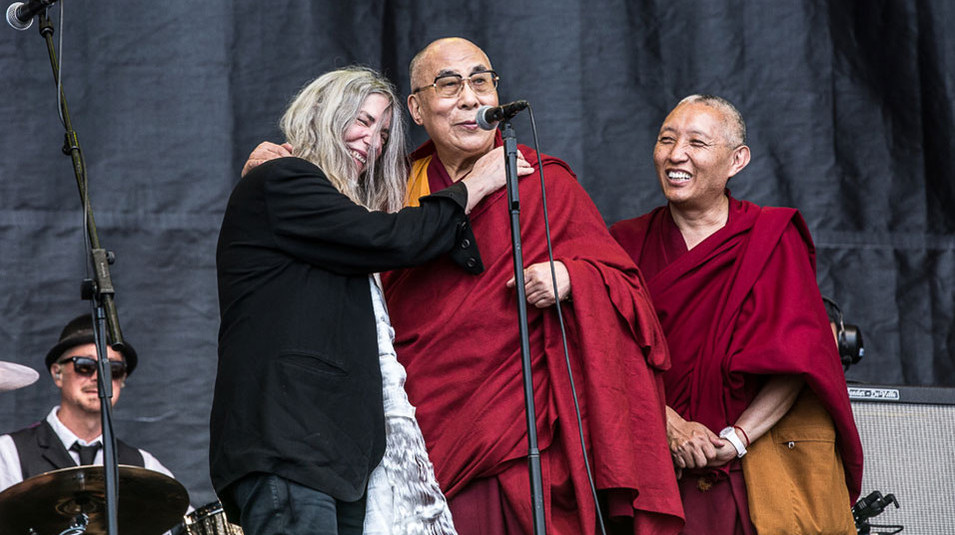
Glastonbury 2015: Patti Smith joined by the Dalai Lama
 There are some things that could only ever happen at Glastonbury, and Patti Smith welcoming the Dalai Lama onstage midway through her electric show on the Pyramid Stage to wish him a happy birthday is undoutbtedly one of them. His Holiness the Dalai Lama, who earlier spoke about the importance of global unity and oneness at the Stone Circle, will turn 80 on July 6. As an early birthday present Smith read a new poem that she had written for the occasion:
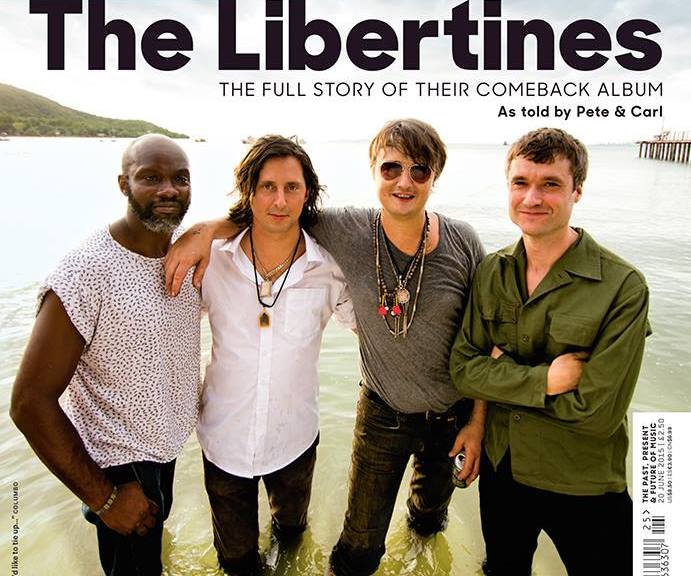
Thai For Heroes

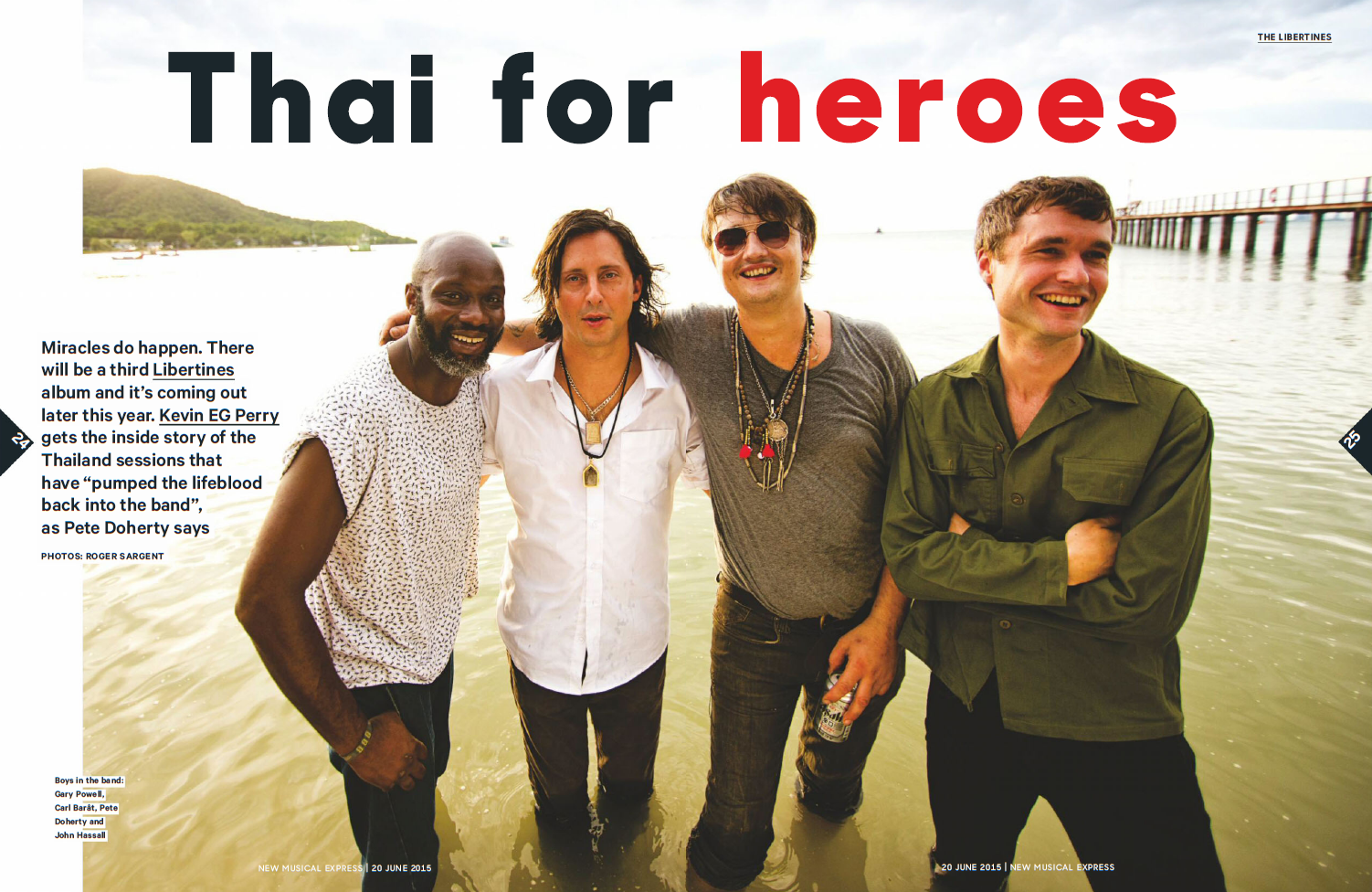 In Thailand, they have a saying about deeply improbable events. They say châat nâa dton-bàai, meaning it will happen ‘one afternoon, in your next reincarnation’. In England, we’d say ‘when hell freezes over’ or ‘when The Libertines record a new album’. Yet, somehow that most improbable of days has arrived. For the first time in over a decade, Pete Doherty and Carl Barât sat down nose to nose and wrote new songs together. Then they recorded them with bassist John Hassall and drummer Gary Powell over a five-week period at Thailand’s Karma Sound studios. From that studio built on an old snake pit, where recording sessions were punctuated by visits to the notorious vice den of Pattaya, their third album has finally emerged. It’s the moment anyone who ever dreamed of Albion has been waiting ten years for – the Libertines included. “People are going to love it,” says Pete, who’s still ensconced in his Thai bolthole, “There’s a miracle aspect to actually getting it done and all getting together to do it. We’re all really proud of it.” “It’s unbelievable,” says Carl, back in London and still sounding like he can scarcely believe what’s going on. “It’s staggering that we’ve got to the point where we’ve actually got an imminent release for the fucking Libertines. Are you kidding me? Honestly, I’m still kind of pinching myself. Is this really going to happen? It’s mental, but I guess it is.”
Cover story for NME, 20 June 2015. Continue reading.
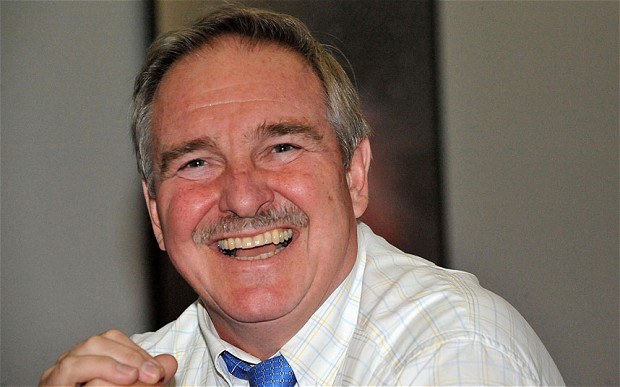
Professor David Nutt on legal high ban: “The government are miserable sods”
 Last week, the Government announced that it’s going to outlaw “any substance intended for human consumption that is capable of producing a psychoactive effect” – except from those it deigns to allow like caffeine, certain medicines and booze. It’s a move which in theory means the end of the road for nitrous balloons, poppers and that stash of legal highs being sold next to the bongs at festival stalls and in your local head shop. While some might celebrate the fact that you’ll no longer be kept awake in your tent by the insistent ‘woosh’ of balloons being filled, a lot of people will probably see it as a dark day for civil liberties and personal choice. Also, given the difficulty of policing this area, the law may not have much practical use at all. To get an expert’s opinion on what the new law will mean, I spoke to Professor David Nutt, the government’s former chief drug advisor. Since his sacking in 2009, Professor Nutt has been campaigning for drugs policy to be based on scientific evidence rather than political whim. He told me why he believes the new law is “pathetic” – an attack on fun by the government’s “miserable sods”:
Laughing gas balloons have become incredibly popular at festivals over the last few years. How dangerous is inhaling nitrous oxide?
“Well, if you take one of the canisters that they use for treating women in childbirth for four or five days then you will certainly end up damaging the vitamin B in your blood, but two balloons every hour for a couple of hours aren’t going to affect anyone. Outlawing nitrous oxide truly is pathetic. Some of the greatest minds in the history of Britain, the people that made British science, used nitrous oxide. Wordsworth and the Romantic poets used nitrous oxide. The guy who popularised the use of nitrous oxide, Humphry Davy, was friends with Wordsworth and Coleridge. Nitrous oxide has been around as a medicine and a way of people understanding a different way of feeling for 200 years. Banning it now is pathetic. They’ll be putting yellow stars on drug takers’ foreheads soon. It is a peculiar attack on being anything other than a member of the Bullingdon Club – but they did drugs, didn’t they? I think this is just about young people enjoying themselves, and they hate that because they’re miserable sods.”
Why do you think the government is bringing this law in?
“What’s going on is that they want to stop people using highs that are sold at head shops. I don’t know if you’ve noticed, but it’s been driven by an organisation called the Local Government Association, and these people hate the idea of head shops. They’re supported by Police Exchange, which is a very right wing group. They’re basically an outpost of right wing US Republican thinking on drugs. What they want to do is get rid of head shops because they don’t like the idea that head shops could be doing anything useful. They may also be funded by the drinks industry at arm’s length… I’ve got no proof of that, but it wouldn’t surprise me. They want to get rid of head shops because they don’t like the idea of people doing drugs other than alcohol, for reasons I don’t understand. They concocted this lie that 97 people died last year from legal highs, which is not true. Of those 97 deaths, almost all of those were related to illegal drugs. They’ve concocted and continue to perpetuate this lie. In fact, my view is that there are almost no deaths from legal highs at all. There are millions of people using them, but the most dangerous ones have disappeared. I don’t think there are any really dangerous legal highs out there at present – but this is about politics, it isn’t about saving people’s lives. What will happen is this will drive people onto the internet or underground. No-one will know what they’re getting and there will be no quality control. In head shops, people are largely getting what they wanted. Now it will all be underground or on the internet, and my own personal belief is that harms will rise significantly.”
Will they actually be able to police the sale of poppers and nitrous oxide?
“Well you can buy poppers to disinfect your house. You can buy poppers in the supermarket, and you can buy nitrous oxide to foam up your cream. Are they going to stop people doing that? They haven’t thought this through. It’s all just a silly gesture. They’ve said they won’t prosecute people for possession or for personal use but they will prosecute people trying to sell it. The Act isn’t clear at present, but we think that trying to purchase it on the internet might end up being an offence. I think people will get around that, but they could in theory be prosecuted for buying stuff knowing that it was going to change their brain.”
How will they choose which substances are exempt from the ban?
“The Home Secretary will make her mind up and a drug will be in or out depending on her whim. It doesn’t appear that they’re going to take any notice of what scientists say. She’s going to decide whether a drug is a psychoactive or not. They’re going to exempt tea, coffee, alcohol… and I don’t know what else. Probably antidepressants, antipsychotics and all that sort of stuff. They haven’t defined what a psychoactive substance is. Most medical treatments of the brain are psychoactive. It hasn’t been thought through at all. It may all flounder because it may be impossible to write a law that isn’t so full of holes it disintegrates. On the other hand, they could just write a law which is useless, like in Ireland which encorages deaths because of backstreet use. Deaths in Ireland have gone up since they banned head shops, not gone down.”
Because people don’t know what they’re getting?
“Absolutely, and also because when you’re going to illegal dealers you’re also going to be offered heroin and cocaine. Heroin has been illegal for 50 years and we still have 1,200 deaths from people seeking opiates. It’s not as if banning has ever been shown to work. In fact, we know it doesn’t work because most of the drugs involved in those 97 deaths are banned – but people are still using them. They’re not being sold in head shops, by the way. The deaths are not coming from head shops. The deaths are coming from people getting them illegally. Head shops don’t sell illegal drugs. They’re the good guys. They’re selling drugs which are known to be relatively safe. Attacking head shops is like attacking sex shops because you think they lower the tone of your town.”
Given the difficulty of policing this area, do you think this law will actually have a big impact or is it just political grandstanding?
“I think it will make things a lot worse. Head shops will struggle. They may go back to selling these substances to as ‘bath salts’ or ‘plant food’. Then there will be some test prosecutions. It’s difficult to know. One suspects the law actually may fail if it’s enacted and there are test prosecutions which fail. That will be some time away, and a lot of head shops may just give up because they decide it’s not worth the effort. Trying to offer a safer alternative to alcohol is not really appreciated in this country – which is kind of weird, really. You want to deny people a safer drug than alcohol? It’s a weird, weird world. Science is out the window here. This is all politics.”

The Great Escape 2015: Fraser A Gorman
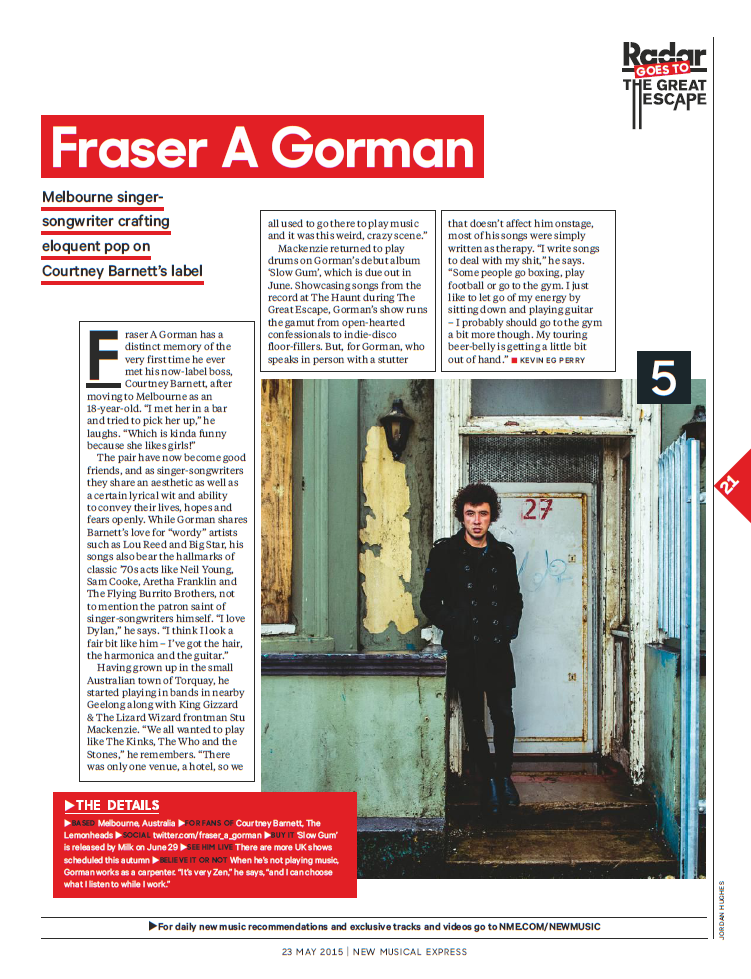 Fraser A Gorman has a distinct memory of the first time he ever met his now-label boss Courtney Barnett after moving to Melbourne as an 18-year-old. “I met her in a bar and tried to pick her up,” he laughs, “Which is kinda funny because she likes girls.”
The pair have now become good friends, and as singer-songwriters they share an aesthetic as well as a certain lyrical wit and ability to convey their lives, hopes and fears openly. While Gorman shares Barnett’s love for “wordy” artists like Lou Reed and Big Star, his songs also bear the hallmarks of classic 70s acts like Neil Young, Sam Cooke, Aretha Franklin and The Flying Burrito Brothers, not to mention the patron saint of singer-songwriters himself. “I love Dylan,” he says. “I think I look a fair bit like him, I’ve got the hair, the harmonica and the guitar.
Having grown up in the small Australian town of Torquay, he started playing in bands in Geelong along with King Gizzard and the Lizard Wizard frontman Stu Mackenzie. “We all wanted to play like the Kinks, the Who and the Stones,” he remembers. “There was only one venue, a hotel, so we all used to go there to play music and it was this weird, crazy scene.”
Mackenzie returned to play drums on Gorman’s debut album ‘Slow Gum’, which is due out in June. Showcasing songs from the record at The Haunt during The Great Escape, Gorman’s show ran the gamut from open-hearted confessionals to indie disco floor-fillers. But for Gorman, who speaks in person with a stutter that doesn’t affect him onstage, most of his songs were simply written as therapy. “I write songs to deal with my shit,” he says. “Some people go boxing, play football or go to the gym. I just like to let go of my energy by sitting down and playing guitar – I probably should go to the gym a bit more though. My touring beer-belly is getting a little bit out of hand.”
The Great Escape 2015: Ho99o9
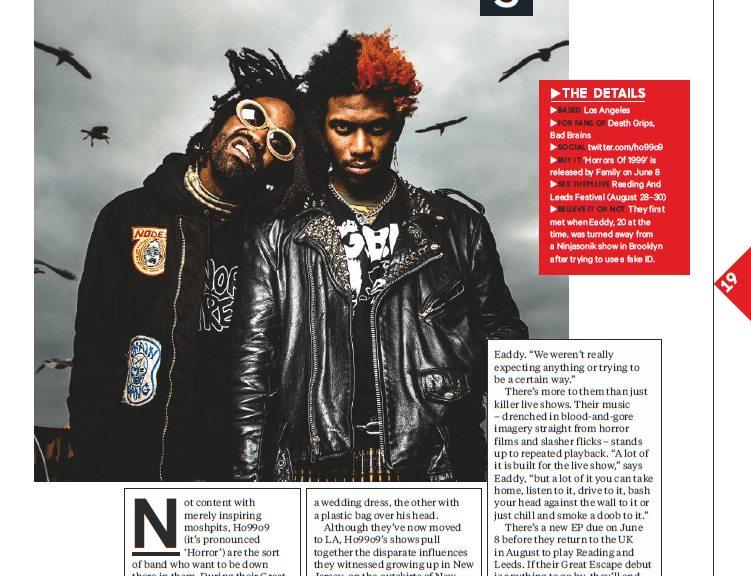
 Not content with merely inspiring mosh pits, Ho99o9 (it’s pronounced ‘Horror’) are the sort of band who want to be down there in them. During their Great Escape set at Patterns it doesn’t take long before co-vocalist Eaddy is off the stage and in the pit, shirtless and screamin into his mic. A few days earlier, at their first ever London show at Electrowerkz, Eaddy and bandmate The OGM had begun the show in the crowd: one wearing a wedding dress, the other with a plastic bag over his head.
Although they’ve now moved to LA, Ho99o9’s shows pull together the disparate influences they witnessed growing up in New Jersey, on the outskirts of New York, where The OGM says they bonded over “girls” and going to “punk shows, rap shows and art shows.” All those elements combine in a visceral mix the pair have been honing since they first played together in 2012. “We went into it headfirst with our eyes closed,” remembers Eaddy. “We weren’t really expecting anything or trying to be a certain way.”
There’s more to them than killer lives shows. Their music – drenched in blood- and-gore imagery straight from horror films and slasher flicks – stands up to repeated playback. “Our music is diverse,” says Eaddy. “A lot of it is built for the live show, but a lot of it you can take home, listen to it, vibe to it, drive to it, bash your head against the wall to it or just chill and smoke a doob to it.”
There’s a new EP due on June 8 before they return to the UK in August to play Reading and Leeds. If their Great Escape debut is anything to go by, they’ll no doubt end up as one of the most talked about bands of the summer. “We want to make a statement with our presence,” says Eaddy. “It’s a powerful force. It’s like Mike Tyson entering the ring. You’re thinking: ‘This motherfucker’s about to do some damage.’ It’s heavyweight title shit.”

Catfish & The Bottlemen: Van McCann on setting off “a little bomb in the music industry”

At first, he thinks it must have started raining. It’s August 2014, moments before Catfish And The Bottlemen are due onstage at Reading Festival, and Van McCann can see crowds of people running towards the tent, pushing their way forward to squeeze inside. Then he looks outside and sees there’s nothing but sunshine. “That’s when I knew it was real,” he says. “I thought they were just coming in because it was pissing it down, but it was still sunny. When we went on they knew all the songs. Our album wasn’t even out yet. It was mental.”
After tearing through their set, Van walked offstage and noticed the band’s management team were crying tears of joy. “I think everyone was kind of taken aback,” he says. “Playing T In The Park and then Reading and Leeds last year were real game-changers for us. Before that we’d been playing 50-100 capacity venues, and they’d been crazy – but then at the festivals it was just as crazy and there were 4,000 more people.”
A lot has happened since then. In the past six months, the band released debut album ‘The Balcony’, which duly hit the Top 10 and went gold. Meanwhile, their live reputation has grown to the point that they sold out two nights at London’s 5,000-capacity O2 Academy Brixton this November – within nine minutes of tickets going on sale. “That’s 10,000 tickets,” marvels Van. “Could we have sold 20,000 in 20 minutes? You’re on your way to stadiums then, aren’t you?”
Cover story for NME, 16 May 2015. Continue reading.

Everything Everything on new album ‘Get To Heaven’: “All these songs are absolutely killer”

Fat White Family’s Lias Saudi on gentrification and the disappearance of squat culture

“We’ve opened Pandora’s Box”
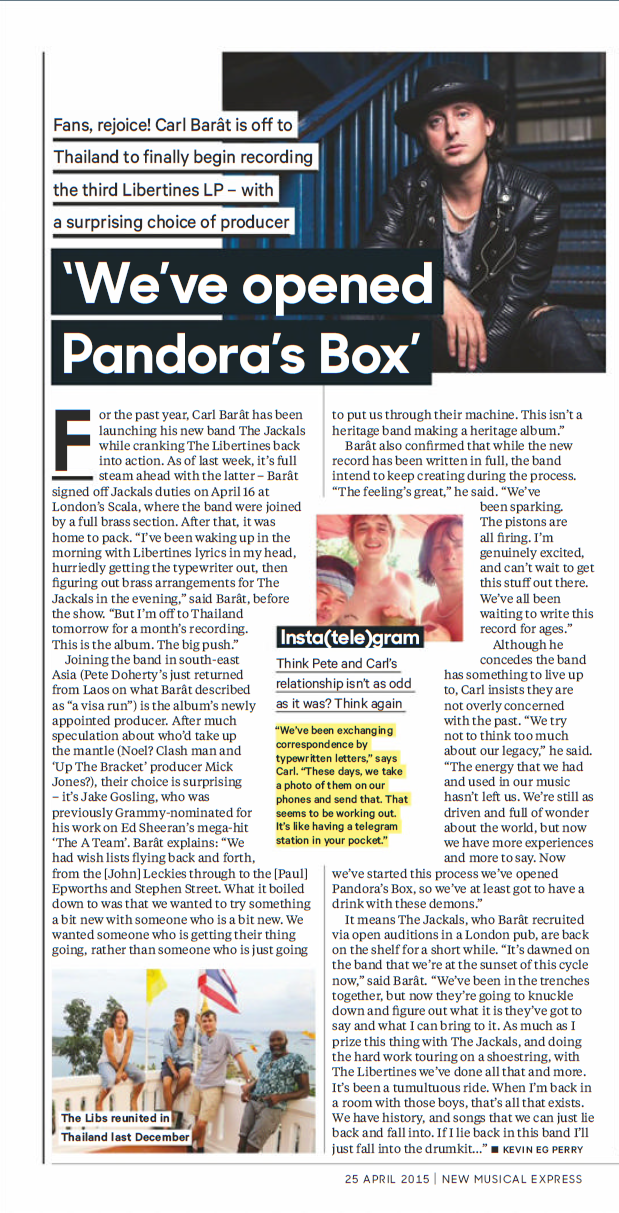 For the past year, Carl Barât has been launching his new band The Jackals while cranking The Libertines back into action. As of last week, it’s full steam ahead with the latter – Barât signed off Jackals duties on April 16 at London’s Scala, where the band were joined by a full brass section. After that it was back home to pack. “I’ve been waking up in the morning with Libertines lyrics in my head, hurriedly getting the typewriter out, then figuring out brass arrangements for the Jackals in the evening,” said Barât, before the show. “But I’m off to Thailand tomorrow for a month’s recording. This is the album. The big push.”
Joining the band in Southeast Asia (Pete Doherty’s just returned from Laos on what Barât described as “a visa run”) is the album’s newly appointed producer. After much speculation about who’d take up the mantle (Noel? Clash man and ‘Up The Bracket’ producer Mick Jones?) their choice is surprising – it’s Jake Gosling, who was previously Grammy-nominated for his work on Ed Sheeran’s mega-hit ‘The A Team’. Barât explains: “We had wish lists flying back and forth, from the [John] Leckies through to the [Paul] Epworths and Stephen Street. What it boiled down to was that we wanted to try something a bit new. We wanted someone who is just getting their thing going, rather than someone who is just going to put us through their machine. This isn’t a heritage band making a heritage album.”
Barât also confirmed that while the new record has been written in full, the band intend to keep writing creating during the process. “The feeling’s great,” he said. “We’ve been sparking. The pistons are all firing. I’m genuinely excited, and can’t wait to get this stuff out there. It’s nice to be back in that position. We’ve all been waiting to write this record for ages.”
Although he concedes the band have something to live up to, Barât insists they are not overly concerned with the past. “We try not to think too much about out legacy,” he said. “The energy that we had and used in our music hasn’t left us. We’re still as driven and full of wonder about the world, but now we have more experiences and more to say to each other, and to the world. It’s exciting. We need to get it done now. Now we’ve started this process we’ve opened Pandora’s Box, so we’ve at least got to have a drink with these demons.”
It means The Jackals, who Barât recruited via open auditions in a London pub, are back on the shelf for a short while. “It’s dawned on the band that we’re at the sunset of this cycle now,” said Barât. “We’ve been in the trenches together, but I think now they’re going to knuckle down and figure out what it is they’ve got to say and what I can bring to it. As much as I prize this thing with The Jackals, and doing the hard work touring on a shoestring, with The Libertines we’ve done all that and more. It’s been a tumultuous ride. When I’m back in a room with those boys, that’s all that exists. We have history, and songs that we can just lie back and fall into. If I lie back in this band I’ll just fall into the drumkit…”
Originally published in NME, 25 April 2015.

Between Rock And A Hard Place

 If ever a band was equally loved and loathed it is Mumford & Sons. Their first two albums have sold over three million copies each and they’ve cracked America in a way that no British band has managed since Coldplay. Their brand of earnest folk rock has taken them to The White House, where they played for Obama, and Glastonbury, where they headlined in 2013. Yet the same sincerity that’s won them legions of fans has brought them an equal number of detractors. They are gentlemen of the middle of the road: wildly successful, but deeply uncool.

Welcome Back To The Terrordome
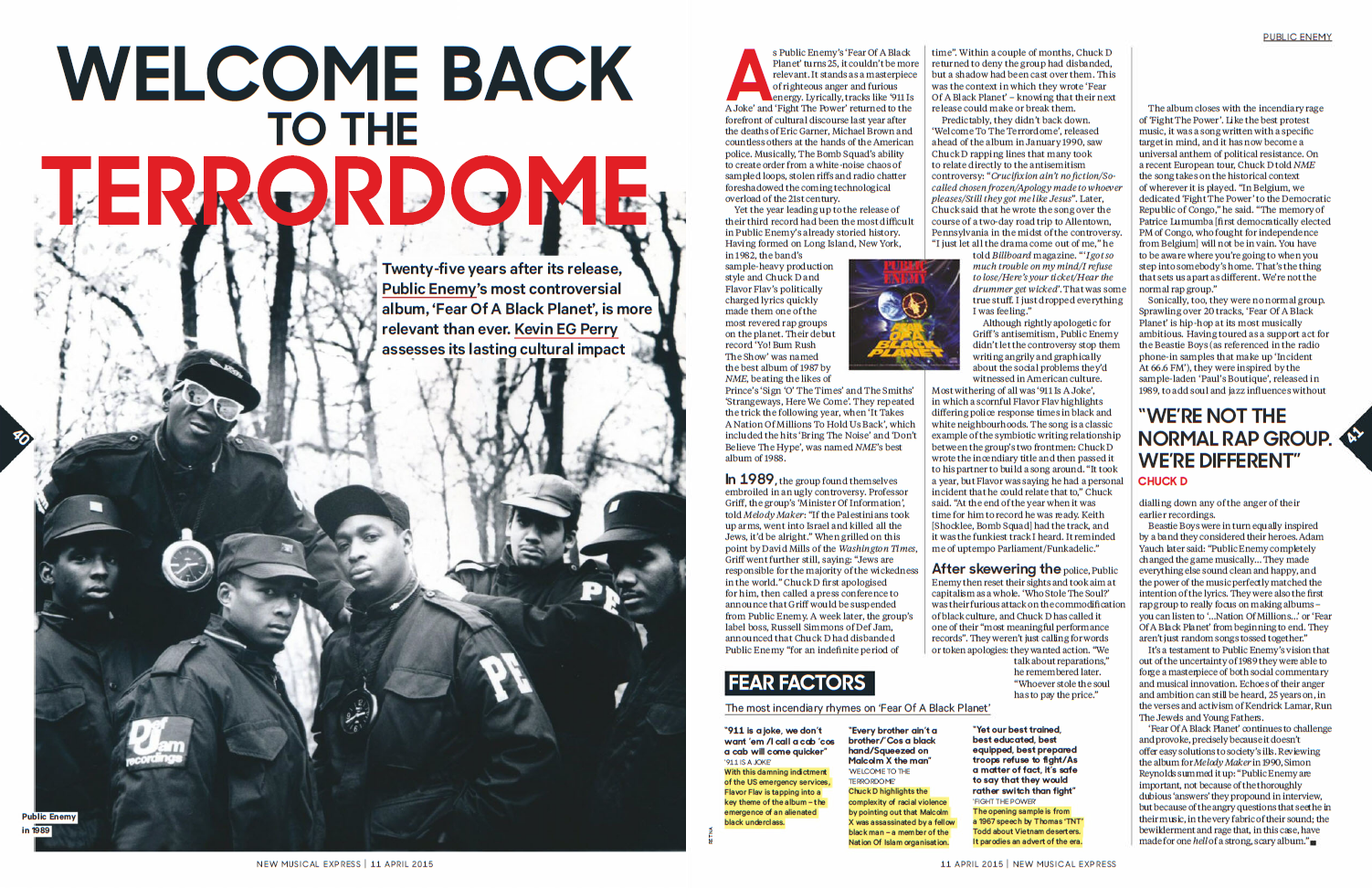
As Public Enemy’s ‘Fear Of A Black Planet’ turns 25 it couldn’t be more relevant. It stands as a masterpiece of righteous anger and furious energy. Lyrically, tragically, tracks like ‘911 Is A Joke’ and ‘Fight The Power’ returned to the forefront of the cultural discourse last year after the deaths of Eric Garner and Michael Brown at the hands of the American police. Musically, The Bomb Squad’s ability to create order from a white noise chaos of sampled loops, stolen riffs and radio chatter foreshadowed the coming technological overload of the 21st Century.
Yet the year leading up to the release of their third record had been the most difficult in Public Enemy’s already storied history. Having formed on Long Island, New York in 1982, the band’s sample-heavy production style and Chuck D and Flavor Flav’s politically-charged lyrics quickly made them one of the most revered rap groups on the planet. Their debut record ‘Yo! Bum Rush The Show’ was named the best album of 1987 by NME critics, beating the likes of Prince’s ‘Sign O’ The Times’ and The Smiths’ ‘Strangeways, Here We Come’. They repeated the trick the following year, when ‘It Takes A Nation Of Millions To Hold Us Back’, which included hits like ‘Bring The Noise’ and ‘Don’t Believe The Hype’, was named NME’s best album of 1988 ahead of records by REM, Morrissey and The Pogues.
Yet in 1989, the group found themselves embroiled in an ugly controversy. Professor Griff, the group’s ‘Minister of Information’, told Melody Maker that: “If the Palestinians took up arms, went into Israel and killed all the Jews, it’d be alright.” When grilled on this point by David Mills, of the Washington Times, Griff went further still, saying: “Jews are responsible for the majority of the wickedness in the world.” Chuck D first apologised for him, then called a press conference to announce that Griff would be suspended from Public Enemy. A week later, the group’s label boss, Russell Simmons of Def Jam, announced that Chuck D had disbanded Public Enemy “for an indefinite period of time”.
Within a couple of months, Chuck D returned to deny that the group had disbanded, but by now a shadow had been cast over the band. This was the context in which they wrote ‘Fear Of A Black Planet’ – knowing that their next release could make or break them.
Predictably, they didn’t back down. ‘Welcome To The Terrordome’, released ahead of the album in January 1990, saw Chuck D rapping lines that many took to relate directly to the anti-Semitism controversy: “Crucifixion ain’t no fiction/So-called chosen frozen/Apology made to whoever pleases/Still they got me like Jesus”. Later, Chuck said that he wrote the song over the course of a two day road trip to Allentown, Pennsylvania in the midst of the controversy. “I just let all the drama come out of me,” he told Billboard magazine. “‘I got so much trouble on my mind/I refuse to lose/Here’s your ticket/hear the drummer get wicked”. That was some true stuff. I just dropped everything I was feeling.”
Although rightly apologetic for Griff’s anti-Semitism, Public Enemy didn’t let the controversy stop them writing angrily and graphically about the social problems they’d witnessed in American culture. Most withering of all was ‘911 Is A Joke’, in which a scornful Flavor Flav highlights differing police response times in black and white neighbourhoods. The song is a classic example of the symbiotic writing relationship between the group’s two frontmen: Chuck D wrote the incendiary title and then passed it to his partner to build a song around. “It took a year, but Flavor was saying he had a personal incident that he could relate that to,” Chuck said. “At the end of the year when it was time for him to record he was ready. Keith [Shocklee, Bomb Squad] had the track, and it was the funkiest track I heard. It reminded me of uptempo Parliament/Funkadelic.”
After skewering the police, Public Enemy then reset their sights and took aim at capitalism as a whole. ‘Who Stole The Soul?’ was their furious attack on the commodification of black culture, and Chuck D has called it one of their “most meaningful performance records”. They weren’t just calling for words or token apologies: they wanted action. “We talk about reparations,” he remembered later. Whoever stole the soul has to pay the price.”
The album closes with the incendiary, insurrectionary rage of ‘Fight The Power’. Like the best protest music, it is a song written with a specific political target in mind, which has now become a universal anthem of political resistance. On a recent European tour, Chuck D told NME that the song grows stronger as it takes on the historical context of wherever it is played. “In Belgium, we dedicated ‘Fight The Power’ to the Democratic Republic of Congo,” he said. “The memory of Patrice Lumumba [first democratically elected prime minster of Congo, who fought for independence from Belgium] will not be in vain. You always have to be aware where you’re going to when you step into somebody’s home. That’s the thing that sets us apart as different. We’re not the normal rap group.”
Sonically, too, they were no normal group. Sprawling over 20 tracks, ‘Fear Of A Black Planet’ is hip-hop at it’s most musically ambitious. Having toured as a support act for the Beastie Boys (as referenced in the radio phone-in samples that make up ‘Incident At 66.6 FM’), they were inspired by the sample-laden ‘Paul’s Boutique’, released in 1989, to add soul and jazz influences without dialling down any of the anger of their earlier recordings.
Beastie Boys were in turn equally inspired by a band they considered their heroes. Adam Yauch later said: “Public Enemy completely changed the game, musically. No one was just putting straight-out noise and atonal synthesizers into hip-hop, mixing elements of James Brown and Miles Davis; no one in hip-hop had ever been this hard, and perhaps no one has since. They made everything else sound clean and happy, and the power of the music perfectly matched the intention of the lyrics. They were also the first rap group to really focus on making albums – you can listen to ‘…Nation of Millions…’ or ‘Fear Of A Black Planet’ from beginning to end. They aren’t just random songs tossed together.”
It’s a testament to Public Enemy’s vision as songwriters that out of the controversy of uncertainty of 1989 they were able to forge a masterpiece of both social commentary and musical innovation. Echoes of their anger and ambition can still be heard, 25 years on, in the verses and activism of Kendrick Lamar, Run The Jewels and Young Fathers.
‘Fear Of A Black Planet’ continues to challenge and provoke listeners, precisely because it doesn’t offer easy solutions to society’s ills. Reviewing the album for Melody Maker in 1990, Simon Reynolds summed it up: “Public Enemy are important, not because of the thoroughly dubious ‘answers’ they propound in interview, but because of the angry questions that seethe in their music, in the very fabric of their sound; the bewilderment and rage that, in this case, have made for one hell of strong, scary album.”

Wytches’ Brew
 Fresh from bringing their doom-laden riffs to the NME Awards Tour, Brighton-based three-piece The Wytches have been back in east London’s all-analogue Toe Rag Studios, where they made last year’s debut album ‘Annabel Dream Reader’, to record a new four-track EP.
Full piece in NME, 11 April 2015.

Hyena
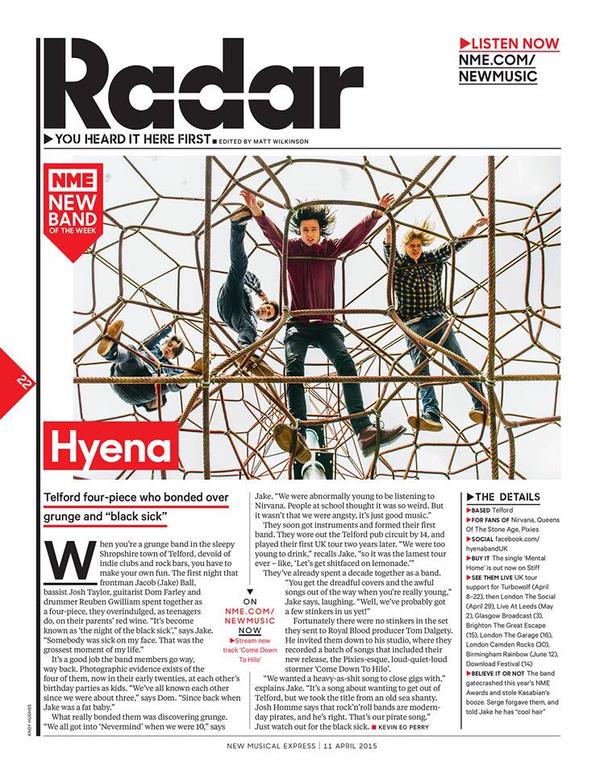 When you’re a grunge band in the sleepy Shropshire town of Telford, devoid of indie clubs and rock bars, you have to make your own fun. The first night frontman Jake Ball, bassist Josh Taylor, guitarist Dom Farley and drummer Reuben Gwilliam spent together as a four-piece, they overindulged, as teenagers do, on their parents’ red wine. “It’s become known as ‘the night of the black sick’,” says Jake. “Somebody was sick on my face. That was the grossest moment of my life.”
Full piece in NME, 11 April 2015.
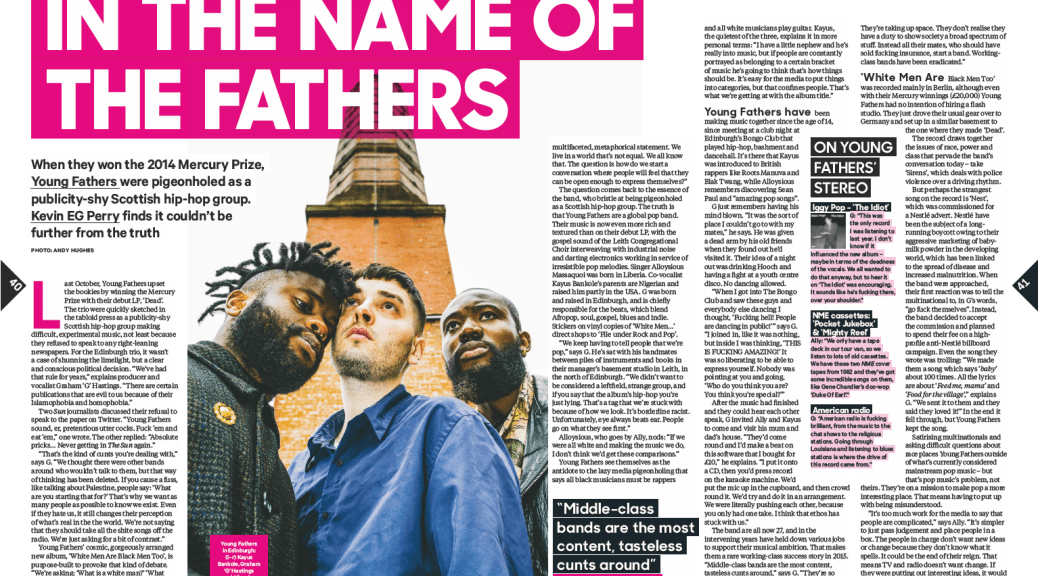
In The Name Of The Fathers
 Last October, Young Fathers upset the bookies by winning the Mercury Prize with their debut LP ‘Dead’. The trio were quickly sketched in the tabloid press as a publicity-shy Scottish hip-hop group making difficult, experimental music, not least because they refused to speak to any right-leaning newspapers – like The Sun, Daily Express, Daily Mail, Daily Star, The Times and The Telegraph. For the Edinburgh trio, it wasn’t a case of shunning the limelight, but a clear and conscious political decision. “We’ve had that rule for years,” explains producer and vocalist Graham ‘G’ Hastings. “There are certain publications that are cross-the-line evil to us because of their Islamophobia and homophobia.”
Two Sun journalists discussed their refusal to speak to the paper on Twitter. “Young Fathers sound, er, pretentious utter cocks. Fuck ’em and eat ’em,” one wrote. The other replied: “Absolute pricks… Never getting in The Sun again.”
“That’s the kind of cunts you’re dealing with,” says G. “We thought there were other bands around who wouldn’t talk to them, but that whole way of thinking has been deleted. If you cause a fuss about something, like talking about Palestine, people say: ‘Oh what are you starting that for?’ That’s why we want as many people as possible to know we exist. Even if they hate us, it still changes their perception of what’s real in the world. We’re not saying that they should take all the shite songs off the radio. We’re just asking for a bit of contrast.”
Young Fathers’ cosmic, gorgeously arranged new album, ‘White Men Are Black Men Too’, is purpose-built to provoke that kind of debate. “We’re asking: ‘What is a white man?’ ‘What is a black man?’ ‘What is a Muslim man?’ ‘Are women sexualised?’” says G. “The title is a multifaceted, metaphorical statement. We live in a world that’s not equal. We all know that. The question is how do we start a conversation where people will feel that they can be open enough to express themselves?”
The question comes back to the essence of the band, too, who bristle at being pigeonholed as a Scottish hip-hop group. The truth is that Young Fathers are a global pop band. To call them Scottish makes as little sense as calling your iPhone Chinese – the parts may have been assembled there, but the ideas, design and components come from all over the planet. Young Fathers’ bearded singer Alloysious Massaquoi was born in Liberia. Dreadlocked co-vocalist Kayus Bankole’s parents are Nigerian and raised him partly in the USA. G was born and raised in Edinburgh, and it’s G who’s chiefly responsible for the beats, which blend everything from Afropop to soul to gospel to blues to indie. There are stickers on vinyl copies of ‘White Men…’ which direct shops to ‘File under Rock and Pop’.
“We keep having to tell people that we’re pop,” says G. He’s sat with his bandmates between piles of instruments and books in their manager Tim Brinkhurst’s tiny basement studio in Leith, in the north of Edinburgh. “We didn’t want to be considered a leftfield, strange group, and if you say that the album’s hip-hop you’re just fucking lying. It’s just not fucking true. That’s just a tag that we’re stuck with because of how we look. It’s borderline racist. Unfortunately eye always beats ear. People go on what they see first.”
Alloysious, who goes by Ally, nods: “If we were all white and making the kind of music we do I don’t think we’d get these comparisons.”
Young Fathers see themselves as the antidote to the lazy media pigeonholing that says all black musicians must be rappers and all white musicians play guitar. Kayus, the quietest of the three, explains it in more personal terms. “I have a little nephew and he’s really into music,” he says, “but if people are constantly portrayed as belonging to a certain bracket of music then he’s going to think that’s how things should be. It’s easy for the media to put things into narrow categories, but that confines people. That’s what we’re getting at with the title of this album.”
Young Fathers have been making music together since the age of 14, since meeting at a club night at Edinburgh’s Bongo Club that played hip-hop, bashment and dancehall. It’s there that Kayus was introduced to British rappers like Roots Manuva and Blak Twang, while Alloysious remembers discovering Sean Paul and “amazing pop songs”.
G just remembers having his mind blown. “It was the sort of place I couldn’t go to with my mates who I grew up with,” he says. He was given a dead arm by his old friends when they found out he’d visited it. Their idea of a night out was drinking hooch and having a fight at a youth centre disco. No dancing allowed.
“When I got into The Bongo Club and saw these guys and everybody else dancing I thought: ‘Fucking hell! People are dancing in public!’” says G. “I joined in, like it was nothing, but inside I was thinking: ‘THIS IS FUCKING AMAZING!’ It was so liberating to be able to express yourself. Nobody was pointing at you and going: ‘Who do you think you are? You think you’re special?’ It was something that had been missing from my life.”
After the music had finished and they could hear each other speak, G invited Ally and Kayus to come and visit his mum and dad’s house. “They’d come round and I’d make a beat on this software that I bought for £10,” he explains. “I put it onto a CD, then you’d press record on the karaoke machine. We’d put the mic up in the cupboard, and then crowd round it. We’d try and do it in an arrangement. We were literally pushing each other, because you only had one take. I think that ethos has stuck with us.”
The band are all now 27, and in the intervening years have held down all manner of jobs to support their musical ambition. That makes them a rare working class success story in 2015. “Middle class bands are the most content, tasteless cunts around,” says G. “They’re so comfy that understanding anything with a bit of bite or grit about it seems like rocking the boat. They’re taking up space. They don’t realise they have a duty to show society a broad spectrum of stuff. Instead all their mates, who should have sold fucking insurance, start a band. Working class bands have been eradicated.”
‘Young Men Are Black Men Too’ was recorded mainly in Berlin, although even with their Mercury Prize winnings (£20,000) Young Fathers had no intention of hiring a flash studio. Instead they just drove their usual gear over to Germany and set up in a similar basement to the one where they made ‘Dead’.
The record draws together the issues of race, power and class that pervade the band’s conversation today. Take ‘Sirens’, which deals with police violence over a driving rhythm. “We say “the police are on cocaine” because when you see videos online of policemen shooting unarmed men, it’s like they’re on coke,” says G. “They can do whatever they want and get away with it.”
Perhaps the strangest song on the record is ‘Nest’, which was commissioned for a Nestlé advert. Nestlé have been the subject of a long-running boycott due to their aggressive marketing of baby milk powder in the developing world, which has been linked to the spread of disease and increased malnutrition. When the band were approached their first reaction was to tell the multinational to, in G’s words, “go fuck themselves.” Instead, the band decided to accept the commission and planned to spend their fee on a high-profile anti-Nestlé billboard campaign. Even the song they wrote was trolling: “We made them a song which says ‘baby’ about 100 times in it. All the lyrics are about ‘Feed me mama’ and ‘Food for the village’,” explains G. “We sent it to them and they said they fucking loved it!” In the end it fell through, but Young Fathers kept the song.
Undoubtedly, satirising multinationals and asking difficult questions about race places Young Fathers outside of what’s currently considered mainstream pop music – but that’s pop music’s problem, not theirs. They’re on a mission to make pop a more interesting place. That means having to put up with being misunderstood.
“It’s too much work for the media to say that people are complicated,” says Ally. “It’s simpler to just pass judgement and place people in a box. The people in charge don’t want new ideas or change because they don’t know what it spells. It could be the end of their reign. That means TV and radio doesn’t want change. If they were putting out interesting ideas, it would make people realise that change is possible. That’s what we’ve got to do.”

The Van who would be King

Cigarette paper between his fingers, Van McCann is sat in the smoking room at the back of Catfish & The Bottlemen’s tourbus. It’s parked outside Schubas Tavern in Chicago, a 200-capacity room where the band are due onstage in less than an hour.
“I don’t know what to do,” he croaks.
Sat across from him is Catfish’s sound guy, Mike Woodhouse. “Your voice is fucked,” says Mike, “so the way I see it, you have three options. Option one: sing as normal. From what you’re saying, that’s not an option. Option two: get the audience to help you. Get them to sing like you did that night in Leeds. Option three: pull the gig, but…”
Van cuts him off. “We’re not pulling the gig.” Catfish & The Bottlemen have never pulled a gig. “People have paid their hard-earned money and they’ve already been waiting outside for hours,” Van says, gesturing to the snow piled up outside. “It’s fucking freezing out there.”
On their current American tour Van has been up at 9am every day to do live sessions for radio and local TV before the band’s evening gigs. He says that’s why his 22-year old voice currently sounds like a waste disposal pipe. He’s tried all sorts to save it. He’s tried not drinking. He’s even tried not smoking, and Van smokes likes it’s a dying art. Nothing made any difference.
“Our label says we have to do sessions if we want to be the biggest band in the world,” he says, “but it frustrates me that the competition winners at the session this morning are going to get a better show than the fans tonight. I’m only in this band to write songs and sing. It frustrates me when I can’t do it.”
The rest of the band and management once again propose cancelling the gig, even at this late hour. Van won’t hear of it. If Catfish & The Bottlemen have made it this far – two sold-out nights at O2 Academy Brixton, a Top 10 UK debut album in ‘The Balcony’, appearing on Letterman – it’s because of Van’s work ethic, about which he’s endearingly earnest. Catfish have been gigging hard since 2009. This is their second US tour and it too is completely sold out, but Van refuses to let anyone treat it like some kind of victory lap. If they want to keep reaching new heights, they have to be responsible about it. No slacking or hard partying. Schubas Tavern is a rung on the ladder to playing big shows: Van wants Oasis at Knebworth, The Stone Roses at Spike Island.
“I remember going to see Oasis at Heaton Park,” he says. “It was like everyone was going to the core of the earth. It was like Jesus was back. A couple of lads from Burnage did that? That looks good to me.”
 The first thing Van McCann says when he gets onstage is: “I need you tonight, Chicago. My voice has gone completely so I need you as much as you can.” The band launch into opener ‘Rango’, which tilts at the stadium rock of recent Kings Of Leon songs, and Van starts thrashing around as he plays, as if hoping to make up for his lack of voice through sheer physical exertion.
“Thank you,” he rasps afterwards, then launches into an explanation that’s near enough word-for-word what he just said to Mike and the band in the bus: “I’m sorry my voice sounds so rough. I want you to know we don’t go out and get fucked up before shows. We’ve had to play sessions every morning. We love playing shows. We take this seriously. We’re professional. We’ve never pulled a show, because we’re prepared. I’m really sorry I’m not 100 per cent…”
They make it through the single ‘Pacifer’ unscathed, but Van isn’t done apologising. “I’m only here because I can sing,” he says. “I feel awful. If any of you want your money back afterwards you can have it. Or I’ll buy you a beer. I promise you I’ll buy the whole place a beer…”
A voice from the crowd cuts him off: “Shut up and sing!”
“You sound great!”
“We love you!”
They tear through ‘Fallout’ at full pace, and afterwards Van just grins. “Shit. Did I promise you all beers? I’ve just done the maths in my head. There’s a lot of you in here. Is this an 18-plus gig? So you’re all old enough to drink? Shit. I didn’t say anything about getting your money back, did I?”
The crowd laugh and shout for him to go on, but on ‘26’ his voice starts to drop out, and by the next track, the slower-paced ‘Business’, he sounds awful. The band’s tour manager runs onto the stage and puts his arms around Van’s shoulders and asks if he wants to pull the gig there and then, but Van won’t leave unless he’s dragged off.
He’s got to play the next song, because it’s ‘Kathleen’ and that’s the big radio hit. It’s the one the American fans all heard first. The one they played on the Late Show With David Letterman. The one that finds the sweet spot between The Strokes and The Cribs. Impossibly, something about ‘Kathleen’ seems to rejuvenate his voice. By the end of the song he’s full of confidence again, and signals for the other three members to leave the stage so he can play the introspective ‘Homesick’ on his own. Accompanied by just his guitar, his voice is now totally exposed and yet somehow healed. The band come back on and they roar through a couple more songs. Then, before the howling closer ‘Tyrants’, the tour manager reappears. He tells the room the band have put enough money behind the bar to buy everyone in the venue a pint.
The crowd look at each other. “Fuck,” someone says. “He wasn’t kidding!”
 After the show, the band are back in the tourbus for just 13 brief minutes. Van and his best mate and guitar tech Larry shut themselves in the back room for a smoke, their post-gig decompression ritual, then open the doors and jump out into the snow to meet the fans clustered outside.
“We were going to invite them in and make them a brew,” says Van, “but imagine what people would think if they saw some picture of a young girl posing with us on our tourbus.”
So instead they stand around outside for an hour, even as the temperature drops down below minus 10. They separate off, and three concentric circles of fans form: one around bassist Benji Blakeway and drummer Bob Hall, one around guitarist Johnny ‘Bondy’ Bond, and the biggest around Van. A girl hugs him and says, “You changed my life!”
A 21-year-old guy called Nicholas tries to force a fistful of dollars into Van’s hand. “I just played the House Of Blues a couple of weeks ago with my band and I had bronchitis,” he explains afterwards. “I know how hard it is to go onstage and sing your heart out. When he said he was going to buy everyone in the venue a drink I got goosebumps from my toes to my fucking head. They just put on the best show I’ve ever seen, because it was so real. It’s humble, and it’s honest. The lyrics mean something to everyone. It’s not the overproduced bullshit that you usually hear on the radio. When he sings about being drunk and horny… I’ve been there. We’ve all been there.”
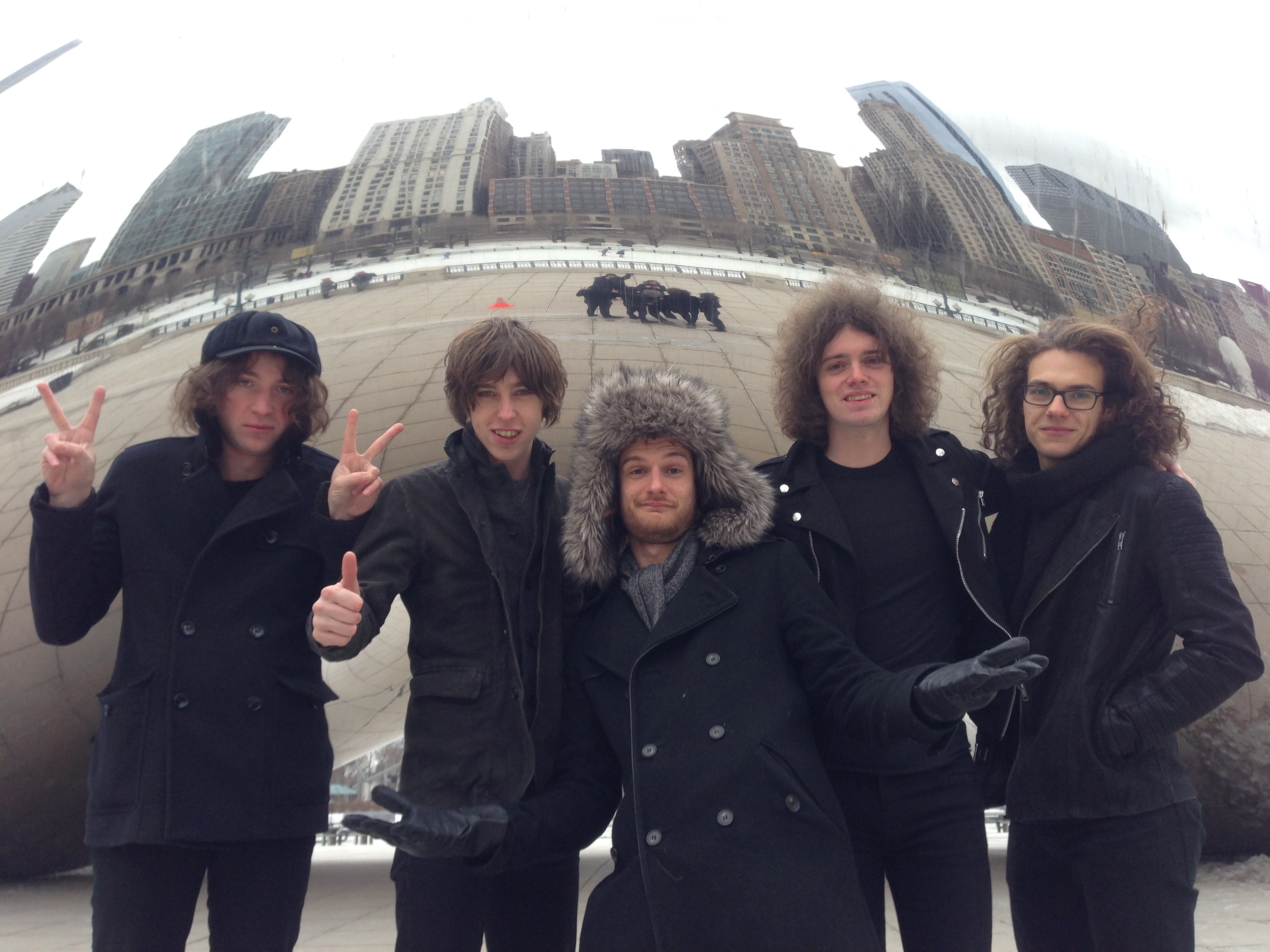 Only when absolutely everyone has got their selfies do Catfish climb back onto the bus. Van heads back to his smoking room, leaving the rest of the band to hang out at the front. At the end of last year Van told NME that the band aren’t really mates. After so long on the road, is that still true?
“I think we’re like brothers now. We get on,” says Bondy. He laughs, and continues: “Although saying that, I fight with my brother all the time.”
“There’s a family spirit,” says Benji, nodding.
Van re-emerges. After spending so much of the night worrying about his voice, he wants to think about something else. Talk turns to their next album, which he wrote months ago but first played to the band last night.
“It’s more widescreen,” says Van. “We needed to open our eyes a little bit. The album we’ve got is good, but it’s an 18-year-old boy trying to get out of a small town. When I listen to the first album now, it sounds angry. That was us trying to break out and get somewhere, and now we’re opening up and going, ‘Christ, we’re in America! This is class!’ We want to go to stadiums and play simple rock’n’roll songs. Put your girlfriend on your shoulders and your arm round your best mate. Dads can take their kids, like my dad used to take me. They’re still songs about normal life, but it’s less about John in Manchester and more about Manchester, y’know what I mean?”
The band head back into the venue to hit the bar. Van prefers to chill out on the bus. He hasn’t thought about anything other than Catfish & The Bottlemen for six years. “I’ve tried to slow it down because I realised I wasn’t enjoying it,” he says. “All the lads would be laughing and having a joke, but I’d be coming of stage thinking, ‘Fuck, I missed that note.’”
The idea is that it’ll all be worth it in the long run. Van has put every penny he’s ever earned from royalties into a separate bank account. “I’ve never touched it,” he says, “even if I wanted £40 to go to the pub. I’ve kept it all and when I have a kid I’m going to give it to them. That means every single song I’ve ever wrote will mean something to somebody. I want to be the best dad and the best husband, like my dad was to me.”
That’s why Van keeps writing songs. He wasn’t supposed to start writing that new album until April. Instead, he finished it while they were still recording the last one. Then he wrote 20 more songs. His friends in bands told him he should take advantage of his record label and get them to fly him to LA, so he hatched a plan to keep the new record a secret until April, then feign writer’s block and get a free holiday. He couldn’t do it. He shrugs. “I couldn’t hold it in.”
He loves being on tour in America, but he misses Britain. “I love pound coins,” he says, “and pasties.” Mostly he misses his “shitty cottage” in Chester, where he can write songs, play FIFA and smoke in the kitchen. That’s why, after he has eventually joined his bandmates for a few drinks, he tells them he won’t be going on to the next bar with them. Instead, he goes back to the bus with Larry, and they smoke and rewatch Austin Powers until Larry falls asleep. Then Van picks up his guitar, and he writes another song.

Brandon Flowers: In bloom
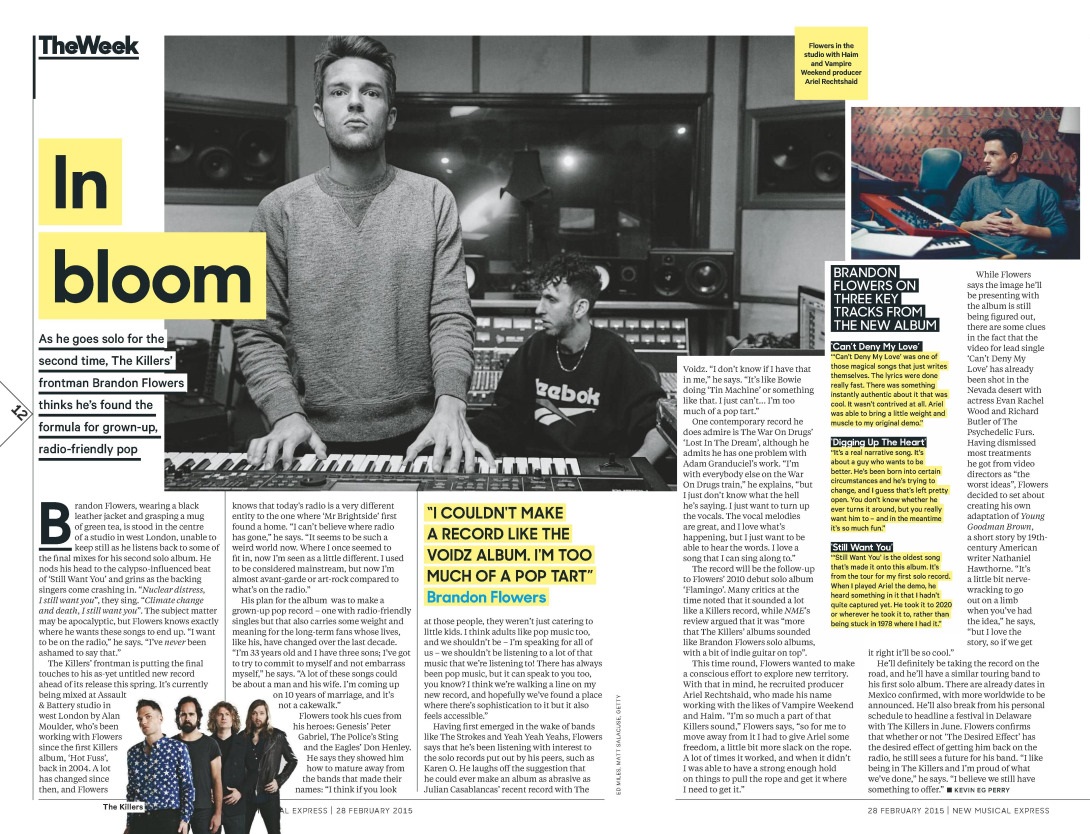
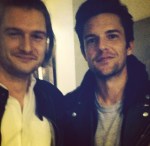
Brandon Flowers, wearing a black leather jacket and grasping a mug of green tea, is stood in the centre of a mixing studio in West London unable to keep still as he listens back to some of the final mixes for his second solo album,
He nods his head to the calypso-influenced beat of ‘Still Want You’ and grins as we hear his backing singers come crashing in. “Nuclear distress, I still want you,” they sing. “Climate change and death, I still want you.”
The subject matter may be apocalyptic, but Flowers knows exactly where he wants these songs to end up. “I want to be on the radio,” he says. “I’ve never been ashamed to say that.”
The Killers frontman is putting the final touches to his new record, which will be called ‘The Desired Effect’, ahead of its release this spring. It’s currently being mixed at Assault & Battery studio in West London by Alan Moulder, who’s been working with Flowers since the first Killers album ‘Hot Fuss’ back in 2003.
A lot has changed since then, and Flowers knows that the radio is a very different place to the one where ‘Mr Brightside’ found a home. “I can’t believe where radio has gone,” he says. “It seems to be such a weird world now. Where I once seemed to fit in, now I’m seen as a little different. I used to be considered mainstream but now I’m almost avant-garde or artrock compared to what’s on the radio.”
His plan for ‘The Desired Effect’ was to make a grown-up pop record with singles that can get played on Radio One while also carrying some weight and meaning for his long-term fans whose lives, like his, have changed over the last decade. “I’m 33 years old and I have three sons, I’ve got to try to commit to myself and not embarrass myself,” he says. “A lot of these songs could be about a man and his wife. I’m coming up on 10 years of marriage, and it’s not a cakewalk.”
Flowers took his cues from his heroes: Genesis’ Peter Gabriel, The Police’s Sting and The Eagles’ Don Henley. He says they showed him how to mature away from the bands that made their names: “I think if you look at those people, they weren’t just catering to little kids. I think adults like pop music too, and we shouldn’t be – I’m speaking for all of us – we shouldn’t be listening to a lot of that music that we’re listening to! There has always been pop music but it can speak to you too, you know? I think we’re walking a line on my new record, and hopefully we’ve found a place where there’s sophistication to it but it also feels accessible.”
Having first emerged in the wake of bands like The Strokes and Yeah Yeah Yeahs, Flowers says that he’s been listening with interest to the solo records put out by his peers, like Karen O. He laughs off the suggestion that he could ever make an album as abrasive as Julian Casablancas’ recent record with The Voidz. “I don’t know if I have that in me,” he says. “It’s like Bowie doing ‘Tin Machine’ or something like that. I just can’t… I’m too much of a pop tart.”
One contemporary record he does admire is The War On Drugs’ ‘Lost In The Dream’, although he has one problem with Adam Granduciel’s work. “I’m with everybody else on the War On Drugs train,” he says, “but I just don’t know what the hell he’s saying. I just want to turn up the vocals. The vocal melodies are great, and I love what’s happening, but I just want to be able to hear the words. I love a song that I can sing along to.”
‘The Desired Effect’ will be the follow-up to Flowers’ 2010 debut solo album ‘Flamingo’. Many critics at the time noted that it sounded a lot like a Killers record, while NME’s review argued that it was “more that The Killers’ albums sounded like Brandon Flowers solo albums, with a bit of indie guitar on top.”
This time round, Flowers wanted to make a conscious effort to explore new territory. To that end he recruited producer Ariel Rechtshaid, who made his name working with the likes of Vampire Weekend and Haim. “I’m so much a part of that Killers sound,” Flowers says, “so for me to move away from it I had to give Ariel some freedom, a little bit more slack on the rope. A lot of times it worked, and when it didn’t I was able to have a strong enough hold on things to pull the rope and get it where I need to get it.”
While Flowers says the image he’ll be presenting with the album is still being figured out, there’s some clues in the fact that the video for lead single ‘Can’t Deny My Love’ has already been shot in the Nevada desert with Evan Rachel Wood and Richard Butler of the Psychedelic Furs. Having dismissed most treatments he got from video directors as “the worst ideas”, Flowers decided to create his own adaptation of ‘Young Goodman Brown’, a short story by 19th Century American writer Nathanial Hawthorne. “It’s a little bit nerve-wracking to go out on a limb when you’ve had the idea,” he says, “but I love the story, so if we get it right it’ll be so cool.”
He’ll definitely be taking the record on the road, and he’ll have a similar touring band to his first solo album. There are already dates in Mexico confirmed, with more worldwide to be announced. He’ll also break from his personal schedule to headline a festival in Delaware with The Killers in June. Flowers confirms that whether or not ‘The Desired Effect’ has the desired effect of getting him back on the radio, he still sees a future for his band. “I like being in the Killers and I’m proud of what we’ve done,” he says. “I believe we still have something to offer.”
Originally published by NME, 28 February 2015.

Blur: It really, really, really is happening
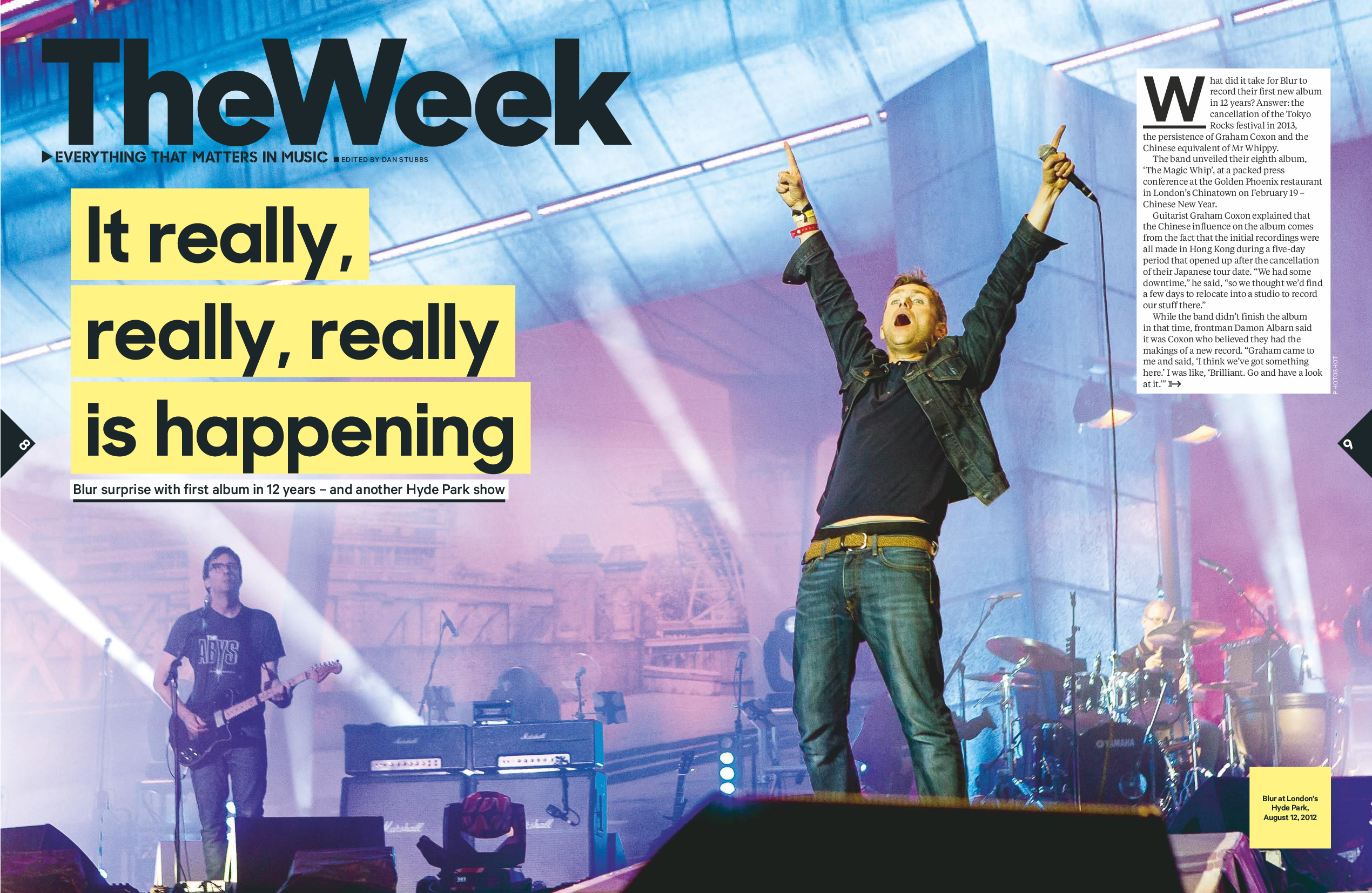
What did it take for Blur to record their first new album in 12 years? Answer: the cancellation of the Tokyo Rocks festival in 2013, the persistence of Graham Coxon and the Chinese equivalent of Mr Whippy.
The band unveiled their eighth album, ‘The Magic Whip’, at a packed press conference at the Golden Phoenix restaurant in London’s Chinatown on February 19 –Chinese New Year.
Guitarist Graham Coxon explained that the Chinese influence on the album comes from the fact that the initial recordings were all made in Hong Kong during a five-day period that opened up after the cancellation of their Japanese tour date. “We had some downtime,” he said, “so we thought we’d find a few days to relocate into a studio to record our stuff there.”
While the band didn’t finish the album in that time, frontman Damon Albarn said it was Coxon who believed they had the makings of a new record. “Graham came to me and said, ‘I think we’ve got something here.’ I was like, ‘Brilliant. Go and have a look at it.’”
 Albarn thought Blur had “run its course” and was busy with his solo projects, so admitted to “mixed emotions” when Coxon and producer Stephen Street played him back the new material. “I was like, ‘Oh no, this is really good.’”
With Coxon having quit the band by the release of 2003’s ‘Think Tank’, his influence will be far more apparent on this record – the first full-group effort since 1999’s ‘13’ – although, speaking to NME after the press conference, both of the band’s songwriters say their relationship on this album was more symbiotic than ever. “There were snatches of [lyrics from the original recordings] that you can grab hold of to get some sort of gist,” said Coxon. “It’s always been my job to glean what I can from what he’s saying and put it through a guitar.”
Albarn added: “And then once that happens I’ve got to go back and finish it. If he’s interpreted a word or a sound, it kind of helps finish the words. Basically it’s been a really great process this time round. I’ve never made a record in this way. On this occasion it’s worked really well for us. Whether we could repeat it again? Who knows? Probably not.”
Albarn completed writing the lyrics for the album by drawing on his visits to Hong Kong and China, and his wider travels, too. One song, ‘Pyongyang’, deals with his experiences visiting North Korea, and ‘There Are Too Many Of Us’ is not simply about urban overpopulation. “Probably the initial idea came from being in a very claustrophobic city,” he said, “but I actually finished the lyric after having come back from Australia. I was there the day they had the hostage situation in the chocolate shop, which was an extraordinary thing to witness. I was staying in a hotel where I could literally see what was going on outside and watch it on TV. I’ve never been in that position before, and as a songwriter that was a very interesting standpoint to have: to be seeing something on TV, and then out the window it’s happening. Seeing the reality of what was happening and how it was being distorted through the prism of [the camera] was kind of fascinating.”
The album’s title “can mean a lot of things, he added. It’s a folkloric conceit in traditional Chinese culture. It can be an ice cream. It’s a firework. It’s also a whip. The whip, for me, was very important because I always have a sense of the hidden control everywhere in China. I love its multifaceted madness, but you can’t help but get the sense of that element of control.”
The band also announced that they will headline the British Summer Time festival in Hyde Park on June 20, and Albarn revealed to NME that the band will play “gigs around the country prior to that… We’re going to play in Wales, in Scotland and in England.”
Having cited the new album as “the only reason” they’ve decided to play live again, Albarn said he’d like to play as much of the new material as possible at Hyde Park, although “we’ve got quite a few songs that we wouldn’t want to not play in a big field like that. There’ll be an element of editing the new material to work in context with the old material.”
Drummer Dave Rowntree believes the band now has the “challenge of taking the record and transplanting it into the four of us playing live”.
Bassist Alex James thinks it won’t pose much of a problem, though. “I don’t find the idea of that particularly challenging,” he said. “It’s a really exciting proposition to play live, because it’s just the four of us giving it the beans. 2012 was such a triumph, that Olympic show, so how do we take it up a notch from there? Well, here’s a bunch of new bangers. Let’s have a go.”
Originally published in NME, 28 February 2015.
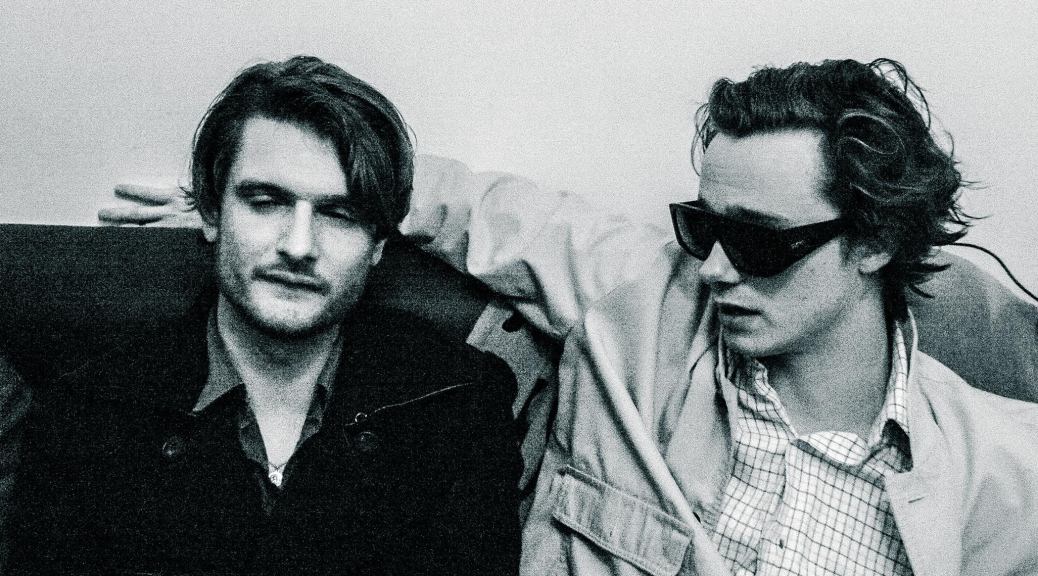
Karma Violets
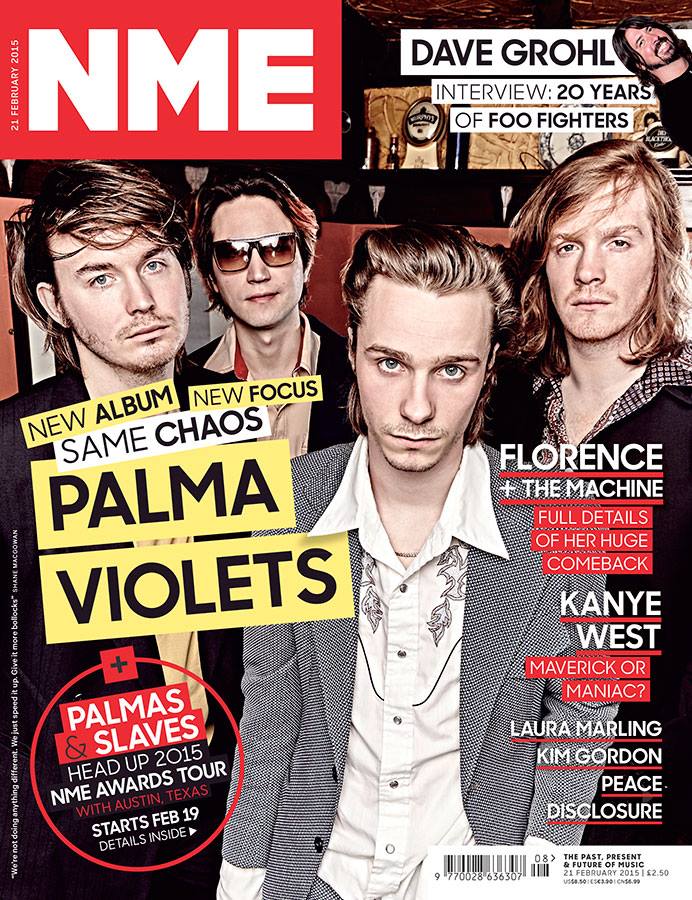
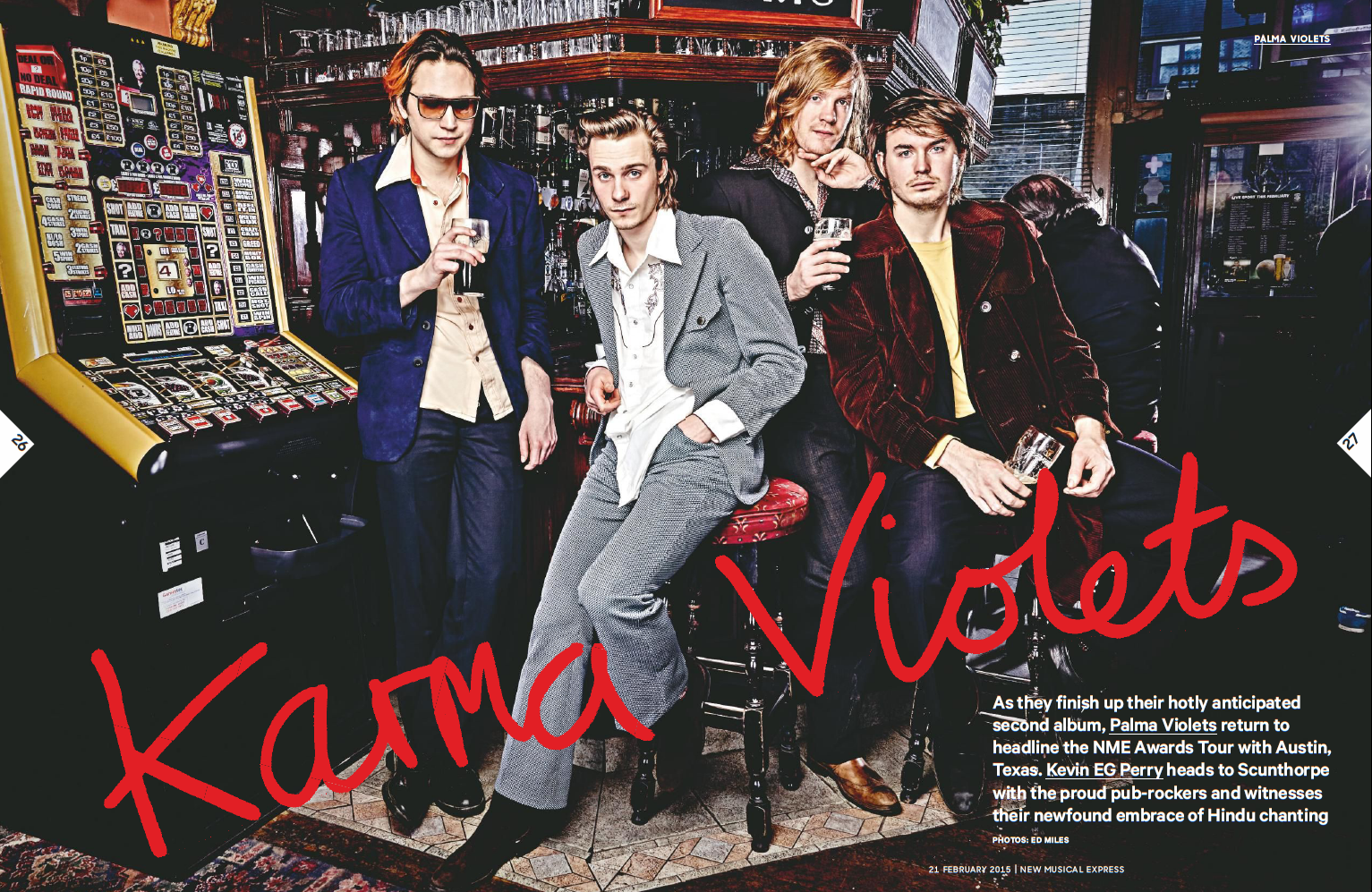 Minutes before they’re due on stage in the back room of a pub called the Lincoln Imp in Scunthorpe, Palma Violets frontmen Sam Fryer and Chilli Jesson invite me out to their tour van to join them for “a round of Hare Krishna”. I agree, assuming they’re referring to some exotic new drug extracted direct from the adrenal gland of Hindu beauty queens and available solely on the intra-band black market.
Hare Krishna, Hare Krishna
Krishna Krishna, Hare Hare
Hare Rama, Hare Rama
Rama Rama, Hare Hare
They’re not. These days they really do spend the last 10 minutes before each gig chanting the 15th century Maha Mantra, or ‘Great Mantra’, so beloved of orange-clad, shaven-haired monks. I’m sceptical, but I realise I’ll have to join in out of politeness. “Take a breath after every ‘Hare Hare’,” Sam reminds us. By the third cycle of the sixteen-word Vaishnava mantra I begin to understand. My head is clear, my heart is pure and my voice feels ready to belt out at least an hour’s worth of dirty punk rock songs.
“I think it’s saved the band,” says Sam as we head back inside. “I was reading a book about Hare Krishna and thought we should try it as a vocal warm-up. It really works. Neither of us are trained singers, so we needed to start doing something like this or we were going to destroy our throats.”
Tonight is the first of a handful of warm-up dates the band have lined up ahead of headlining the NME Awards Tour in February and March and the release of their second album, ‘Danger In The Club’, on May 4. The wild-eyed boys that first broke through with ‘Best Of Friends’ in 2012 may be taking better care of their voice boxes these days, but have they matured enough to write a genuinely classic new record? Will their fans still have something to pogo around the room to? And what the hell are they doing in Scunthorpe anyway?

That morning I’d met the bleary-eyed band outside Studio 180, the home base on the Lambeth Road they immortalised on debut record ‘180’. It’s 10am, unfashionably early for a rock’n’roll band to be up and about, but necessary if we’re to make the four hour drive up to Scunthorpe in time for sound check.
A town previously primarily famous in rock’n’roll circles for being the birthplace of Howard Devoto, of Buzzcocks and Magazine, and for being one of the few English place names with the word “cunt” in it, Scunthorpe doesn’t seem like an intuitive place to stage a comeback. After we pile into the back of the tour van and start heading north, Sam explains that the venue was chosen primarily to repay their mates Ming City Rockers for coming all the way down to Hitchin for last year’s Reading and Leeds warm-up gig. They’re what Chilli calls “the real deal”, and hail from nearby Immingham (an English place name with the word “ming” in it, it must be something in the water).
No sooner have we pulled onto the M1 than Chilli begins chanting a line about motorways that the band love from a live version of an old Brinsley Schwarz pub rock song called ‘Home In My Hand’.
Spend long enough with Palma Violets and you’ll overhear the phrase ‘pub rock’ more often than backstage at a Dr Feelgood gig on Canvey Island. “I love that era,” explains Chilli. “I’m a big fan of Ducks Deluxe and all those bands who started punk before punk. I would definitely consider us a pub rock band.”
The oft-overlooked genre, which gave starts to the likes of Joe Strummer, Ian Dury and Elvis Costello, is in tune with the band both in terms of their music and their love of playing small, sweaty venues like the Lincoln Imp. “You’d consider us a pub rock band, wouldn’t you Sam?” asks Chilli.
“Yeah!” nods Sam vigorously. “I think people just got confused at the beginning. Someone must have misheard us. It sounds a bit like ‘punk’, but it’s ‘pub’.”
The band have recently been working on a new song written by Graham Parker, whose group The Rumour were one of pub rock’s defining acts. After his daughter brought him to a Palma Violets show in America, Parker came to see them again at London’s Coronet and presented them with a song he’d been working on but didn’t quite fit on his new record. “He said he wanted us to give it a whirl,” says Chilli. “It’s called ‘Any Kind Of Weather’. He wrote it, without lyrics, or rather with what he called ‘nonsense lyrics’. We wrote some new ones, which was great because to us he’s a legend. We love his records, stuff like ‘Squeezing Out Sparks’. It’s not going to be on our record because we’re still working on it. It could be a great song, we just haven’t had the time to finish it.”
When we arrive at the Lincoln Imp mid-afternoon on Friday, the first thing landlady Lorraine Briggs tells us is that she’s been offered hundreds of pounds in cash for just one extra ticket. Demand for the gig has so outstripped available places in the room that the local newspaper, The Scunthorpe Telegraph, is reporting that “the Imp has been inundated with calls from female admirers offering to work the night for free as barstaff, glass collectors – and even bouncers!” Palma Violets don’t just have fans, they have fanatics. The same kind of dedicated lifers who would have moaned for Elvis or thrown jelly beans at The Beatles and fainted at airports.
These aren’t just screaming kids either. Before the show, one mum spots Chilli outside and runs over to him. “I promised my daughter that if I saw you I’d give you a kiss!” she tells him breathlessly before pecking him on the cheek. I ask her if her daughter’s at the gig as well. “No,” she replies. “I’ve put her on babysitting duty.” Another fan nervously shakes Chilli’s hand and tells him his Stones-mad grandfather had seen the Palmas on Jools Holland and told his whole family to check them out. “I watched it because I know he knows his stuff, and I was blown away. I thought: those are some crazy, drugged-up motherfuckers!”
“That’s us,” grins Chilli. Back inside, he shrugs off the fanaticism. “It’s just nice that we haven’t been forgotten about. You never know what’s going to happen when you go away to record an album.”
If tonight is supposed to be a lowkey way to make sure everyone can play the new songs in time, it’s doomed from the start. It’s carnage. About halfway through the set the two hired bouncers, who had been struggling manfully to keep the crowd off the stage, are suddenly joined by a wall of hardcase blokes who form a wall between audience and band. They barely distinguish between the two, at one point grabbing Chilli in a headlock. At least one person gets knocked out and there’s an ambulance waiting outside. Nobody has any idea where the hardnuts came from, until the landlady explains. “They’re the Ashby army,” she says. “Anybody causes any trouble round ‘ere, I call the boys in.” Considering the Imp is the sort of pub that has a spit and sawdust boxing ring in the basement, I don’t doubt her for a second.
By the end of the night fans are staggering around like they’ve just been involved in a mugging in a sauna. There’s a guy called Mitch whose shoes have fallen apart. He’s covered in sweat from head to toe, and most of it isn’t his. He’s got pupils the size of dinner plates and he’s so giddy and exhausted he can barely string a sentence together. Mitch doesn’t care. He’s found love. Mitch has just seen Palma Violets play in the back room of a pub to 150 people and they’ve blown his mind out through his ears.
“They were so good, man,” he mumbles. “Will even fixed my shoes.” He points down to where Palma’s drummer Will Doyle has wrapped gaffer tape around the guy’s shredded footwear in an act of rudimentary punk cobbling.
“It was chaos,” says Sam. “If you’re honest, you’ll write that we played shit tonight. It was a great gig, but we played shit. I had to keep moving the mic stand because I thought someone was going to smash into it and knock all my teeth down my throat.”
This is bullshit. They were on righteous form, despite the extenuating circumstances. “At some points I was playing every key on the keyboards at once,” adds Pete Mayhew. “Just because I was trying to hold them down and keep them upright.”
I don’t doubt that there’ll be further rehearsals ahead of the NME Awards Tour. Unlike ‘180’, which contained eleven and a half songs written together in sweaty basements and honed through relentless touring, their second album is a proper studio album. It was recorded at Rockfield Studios in Monmouth, Wales, where Queen recorded ‘Bohemian Rhapsody’ and Oasis made ‘(What’s the Story) Morning Glory?’ It was overseen by John Leckie, who produced ‘The Stone Roses’ in the same studio, and his influence as well as the band’s maturation as writers is presenting them with a whole new set of challenges as they return to life on the road.
“Some of the new songs are going to have to change a lot when we play them live,” says Chilli. “We’ve never had this problem before, because we recorded ‘180’ just as we’d been playing it. Working with John Leckie this time round means that we’ve been doing more with percussion and backing vocals, and Pete and Will have stepped up and started singing too.”
“Leckie wasn’t as encouraging as Steve Mackey had been on our first album,” says Pete. “He wouldn’t say, ‘That’s great, but why don’t you try this…’ he’d just say ‘I don’t like that.’ It was a shock at first, but I think it was what we needed. He hasn’t worked with an English rock band in a long time, so we really appreciated him almost coming out of retirement to work with us. He obviously thought it was worth it.”
“He turned the studio into his own little world,” says Will. “We’d write all day and then at the end of the day he’d play us records that he’d made, like Magazine’s first album ‘Real Life’ and a lot of The Fall, and the other stuff to push us like ‘The Four Horsemen’ by Aphrodite’s Child and the Bonzo Dog Doo-Dah Band.”
“He helped us add something to our sound, but as Chilli says it means that even though we’ve finished the album we’re still working out how to play it live,” adds Sam. “It’s the complete opposite way of working to what we did on the last album.”
In Scunthorpe they play three new songs. There’s ‘On The Beach’, or rather ‘Girl You Couldn’t Do Much Better (On The Beach)’, to give it it’s full title. It features a strutting guitar riff as well as Sam’s favourite lyric on the album, “We’ll probably burn out and fail, but at least it’s a marvellous failure”, which Chilli explains was inspired by the inscription on Sex Pistols impresario Malcolm McLaren’s grave: “Better a spectacular failure, than a benign success.” Words to live by.
They also play ‘Matador’, which Sam calls “probably the strangest song on the album.” He describes it as: “like two completely different songs together. It’s definitely the saddest song on the album. It’s got a D minor in it.”
The final new song they play in Scunthorpe is the new record’s title track ‘Danger In The Club’. Both Sam and Chilli agree it’s among their favourites of the new songs. “For me, it sums up this record,” explains Chilli. “Musically and lyrically, it rounds this whole album up. Whenever I listen to it I’m always amazed, because it’s complex and there’s so many different things going on. I never thought we’d be able to write a song like that, and I think that’s one of the things that John Leckie helped us to do.”
“A fight breaks out in the middle of the song,” adds Sam. “It’s very punchy, like pub and glam rock mixed together.”
The morning after the adrenalin rush of the gig at the Imp we wake up on a truly dismal morning at a Travel Lodge on a roundabout somewhere outside Scunthorpe. We pile back into the van and head towards London and another tiny show at Bethnal Green’s Sebright Arms. Like the night before at the Imp, you could trade yourself just about anything you want for a spare ticket. Over 7,000 people tried to get themselves a spot in the 150 capacity venue. Also like the night before, Sam and Chilli spend the last 10 minutes before the show in a van chanting ‘Hare Krishna’. The band’s manager Milo Ross shakes his head in confusion as he watches. “Times have changed,” he shrugs.
Hare Krishna, Hare Krishna
Krishna Krishna, Hare Hare
Hare Rama, Hare Rama
Rama Rama, Hare Hare
Anyone lucky enough to squeeze themselves into the Sebright Arms will have heard another new song. ‘English Tongue’ is the band’s newest anthem, and one which sums up the band’s spontaneous way of working. The whole album had already been mixed and mastered when the band went into the studio for a couple of weeks to rehearse. Sam and Chilli decided to jam some ideas they’d been working on individually, and instantly sparked something. “It was a freak occurrence,” explains Sam, “because we both came in with the same idea. Different lyrics but the exact same melody and chords.”
“We just wanted to record a couple of demos,” adds Chilli, “but then Geoff and Jeannette [Travis and Lee from Rough Trade] came down and loved it so much they wanted to put it on the album.”
That left them with just a day to get the song properly recorded, mixed and mastered before the deadline for their record. “I was on one side of London doing the artwork and they were on the other side of London doing the mastering,” says Sam. “It all had to be done by 6pm. We were on the phone shouting at each other going: ‘What the fuck are we doing?’ It was an exciting way to finish it. A twist in the tail.”
“You have to realise, we thought we had the record done…” sighs Chilli.
Maybe it’s all those Hare Krishnas, but the Palma Violets of 2015 seem somehow older and wiser then the fresh-faced band who took the NME Awards Tour by storm in 2013. Now that they’re returning to headline it, I ask Chilli if he agrees the band see things differently now. “I think my reason for doing what we’re doing has slightly changed,” he nods. “I think when you start in a band you do it for certain reasons – for the fame, maybe, or to impress a girl. Getting the chance to record an album is exciting and anywhere you can play is a gift.”
This time round, they’ve got their sights on immortality. “Now it’s about wanting to leave something behind,” he says. “A legacy. There are bands out there who say they don’t care if people listen to their albums in 10 years time. That’s not how I feel at all. I think it’s about making something timeless. I really hope people listen to our records in 10 years. Maybe I’m chatting shit. I don’t fucking know, to be honest, but I’m proud. That’s the thing. I can listen to our new record and think that it’s great, because we spent time on it. And now we get to come and play it to people, in pubs and on the NME Tour. I can’t think of anything better than that.”
That’s a mantra to live by.

In bed with Bez
 Bez and his girlfriend Firouzeh Razavi have begun their week-long ‘bed-in’ protest which intends to raise awareness of the UK anti-fracking movement.
The protest, inspired by John Lennon and Yoko Ono’s two anti-Vietnam war protests in 1969, has the support of Ono herself. In 2013 she penned the anti-fracking anthem ‘Don’t Frack My Mother’, which was performed by her son Sean Lennon.
Bez told NME: “We’re off to a great start because we’ve already attracted the attention of the world’s media. The fact is that 69 per cent of our land has been licenced for fracking and it’s been done without consultation with any of us. We haven’t been told about the dangers.”

Carl Barât: “I have two bands, two tours, two records and two babies. It’s full on, and that doesn’t give me any time to get depressed”
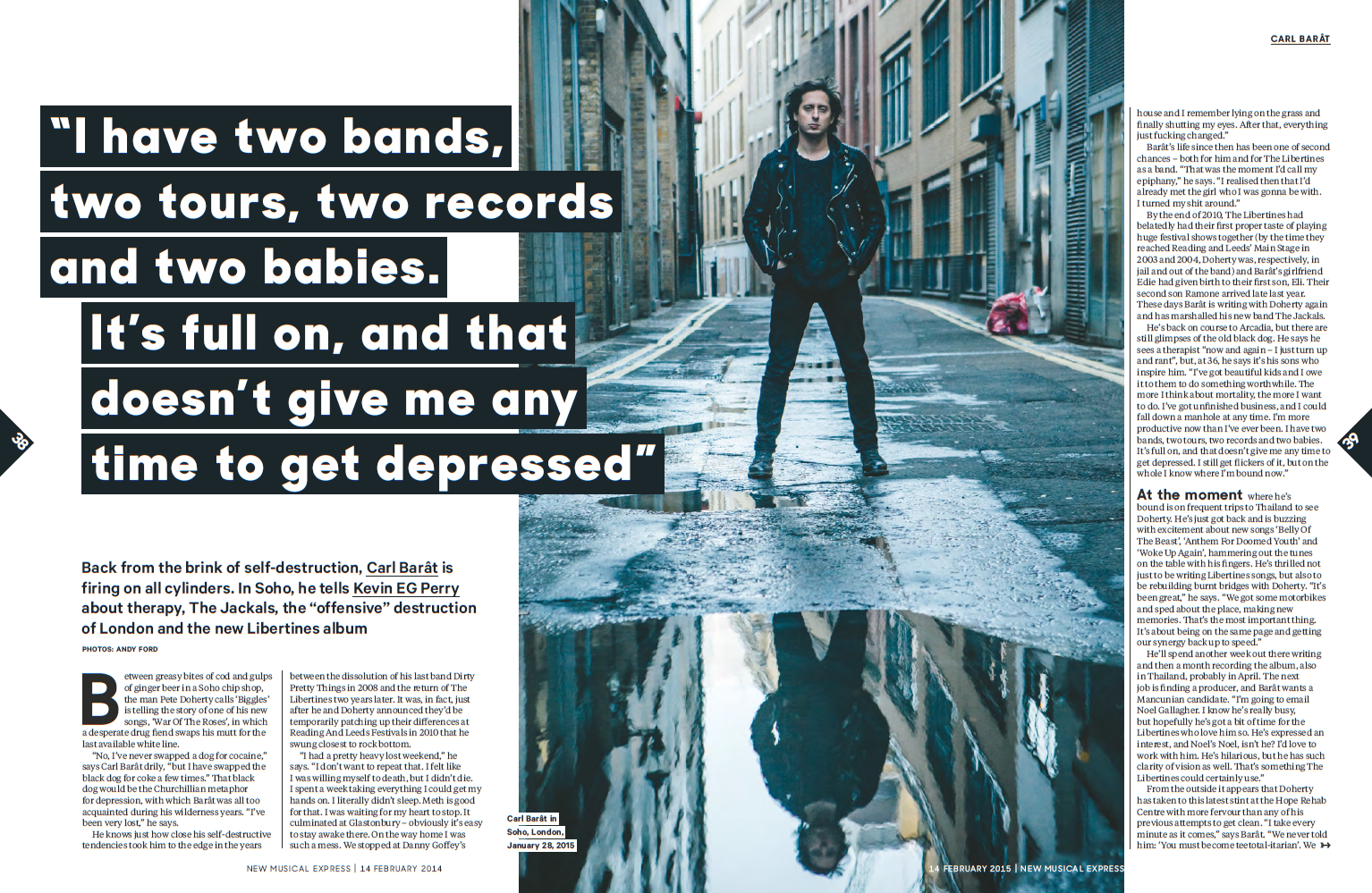
 Between greasy bites of cod and gulps of ginger beer in a Soho chip shop, the man Pete Doherty calls ‘Biggles’ is telling the story of one of his new songs, ‘War Of The Roses’, in which a desperate drug fiend swaps his mutt for the last available white line.
“No, I’ve never swapped a dog for cocaine,” says Carl Barât drily, “but I have swapped the black dog for coke a few times.” That black dog would be the Churchillian metaphor for depression, with which Barât was all too acquainted during his wilderness years. “I’ve been very lost,” he says.
He knows just how close his self-destructive tendencies took him to the edge in the years between the dissolution of his last band Dirty Pretty Things and the return of The Libertines. It was in fact just after he and Doherty announced they’d be temporarily patching up their differences at Reading and Leeds in 2010 that he swung closest to rock bottom. “I had a pretty heavy lost weekend,” he says. “I don’t want to repeat that. I felt like I was willing myself to death, but I didn’t die. I spent a week taking everything I could get my hands on. I literally didn’t sleep. Meth is good for that. I was waiting for my heart to stop. It culminated at Glastonbury – obviously it’s easy to stay awake there. On the way home I was such a mess. We stopped at Danny Goffey’s house and I remember lying on the grass and finally shutting my eyes. After that, everything just fucking changed.”
Barât’s life since then has been one of second chances – both for him and for The Libertines as a band. “That was the moment I’d call my epiphany,” he says. “I realised then that I’d already met the girl who I was gonna be with. I turned my shit around.”
By the end of 2010, The Libertines had belatedly had their first proper taste of playing huge festival shows together and Barât’s girlfriend Edie Langley had given birth to their first son, Eli. Their second son Ramone followed late last year. These days Barât is writing with Doherty again and has marshalled his own new band The Jackals. He’s back on course to Arcadia.
There are still glimpses of the old black dog. He tells me he sees a therapist “now and again. I just turn up and rant,” but, at 36, he says it’s his sons who inspire him. “I’ve got beautiful kids and I owe it to them to do something worthwhile,” he says. “The more I think about mortality, the more I want to do. I’ve got unfinished business, and I could fall down a manhole at any time. I’m more productive now than I’ve ever been. I have two bands, two tours, two records and two babies. It’s full on, and that doesn’t give me any time to get depressed. I still get flickers of it, but on the whole I know where I’m bound now.”
At the moment where he’s bound is frequent trips to Thailand to see Doherty. He just got back and he buzzes with excitement about new songs ‘Belly Of The Beast’, ‘Anthem For Doomed Youth’ and ‘Woke Up Again’, hammering out the tunes on the table with his fingers. He’s thrilled not just to be writing Libertines songs again but also to be rebuilding burnt bridges with Doherty. “It’s been great,” he says. “We got some motorbikes and sped about the place, making new memories. That’s the most important thing. It’s about being on the same page and getting our synergy back up to speed.”
He’ll spend another week out there writing and then a month recording the album, probably in April. The next job is finding a producer, and Barât wants a Mancunian candidate: “I’m going to email Noel Gallagher. I know he’s really busy, but hopefully he’s got a bit of time for The Libertines who love him so. He’s expressed an interest, and Noel’s Noel isn’t he? I’d love to work with him. He’s hilarious, but he has such clarity of vision as well. That’s something The Libertines could certainly use. We’d defer to his brilliance.”
From the outside it appears that Doherty has taken to this latest stint at the Hope Rehab Centre with more fervour than any of his previous attempts to get clean. “I just take every minute as it comes,” says Barât. “We never told him: ‘You must become teetotalitarian’. We said: ‘We’ll take you as you are’. He’s happy and wholesome, as good as ever before.”
The band have just announced their first major festival headline slot of the summer, at T In The Park in July. They should have plenty of new material to perform by then, but questions remain: will Doherty need a minder on tour to keep him out of trouble? Will they have to tour dry? “I don’t think so,” shrugs Barât. “We’ll work it out. I’ll do whatever he wants, whether that’s boozing or not boozing. Well… obviously not heroin.”
It comes back to that idea of second chances. For Barât that means the opportunity to deliver on the promise they once looked like frittering away. “We’ve both had plenty of lost time,” he says, by way of understatement. “Now we want to make beautiful things that we’re proud of and that stand the test of time. I hope we can do that. To us, we already have. Our old songs stand up as much as they did when we first put them down. If we’ve got that in us, why rob ourselves of it, let alone anyone else?”
Before his Libertine summer there’s the small matter of ‘Let It Reign’, his first record with new band The Jackals. It’s scrappier, heavier music than Barât aficionados will be used to – a chance for the old romantic to channel his anger and vitriol into song. He’s tells me he’s been inspired by the apathy he sees around him to kick against the pricks. Especially those responsible for transforming his beloved London into an oligarch’s playground.
“I’m disgusted,” he says. “To me, it’s like seeing a museum smashed up and turned into a McDonalds. It offends my deepest sensibilities. We’re losing Buffalo Bar and Madame JoJos. I’ll do my bit where possible. Hopefully we’ll get a gig down the 12 Bar.”
He calls the approaching General Election “pigs in a sty jostling for food”. He’s a supporter of Russell Brand’s critique of the status quo, and could “acquiesce” to vote Green for lack of a better option. There’s a dystopian mood to the record, which Barât says draws on Evelyn Waugh, Terry Gilliam’s ‘Brazil’ and Orwell’s ‘1984’. He points over my head to where a flashing blue police light outside is illuminating the chip shop tiles. “I think Big Brother is getting closer and closer. The march of the neo-puritans is upon us.”
The video for lead single ‘Glory Days’ is dedicated to the 306 soldiers who were shot at dawn during World War I for “cowardice” or “desertion”. Theirs is a plight that Barât is genuinely moved by: “If I pull you out of your house from your family, put you in a bull ring and tell you to fight a bull, and you don’t, so then I shoot you, that’s murder. That’s state-sanctioned fucking murder.”
Barât can trace these questions about glory and patriotism right back to his childhood. He was raised by separated parents: a father who worked in an armaments factory, and a mother who was a member of the Campaign for Nuclear Disarmament and lived in Teepee Valley, a tented hippy commune in south Wales.
“That’s my life all over: schizophrenic,” nods Barât when I mention his unusual upbringing. “It was like parallel lives. A council estate with Victorian strictness on one side, and hippy-dippy lostness on the other side.”
Despite the powerful sense of British identity that runs through the record, Barât actually recorded it in Los Angeles during a series of margarita-fuelled sessions with The Bronx guitarist Joby J. Ford. The bulk of the record was laid down there, featuring the likes of Killers’ violinist Ray Suen and Beastie Boys percussionist Fredo Ortiz. Then they came back to London, where he brought in his newly-auditioned Jackals bandmates to finish it.
After our fish supper we wheel away through a cold night in Soho to Wardour Street to find them. Barât maintains an office here, a war room of sorts. There are Union Jacks on the walls and a finely detailed map of France. “I apologise,” he says, “for the fact it looks like a National Front headquarters.”
Barât introduces me to guitarist Billy Tessio, drummer Jay Bone and bassist Adam Claxton, none of whom should be mistaken for mere yes men. “As much as I respect Carl as a fellow musician, and adore his past work, I don’t want to put him on a pedestal,” says Tessio. “There’s four of us in this band now, let’s see what we can do.”
They shrug off the idea that the Libertines reunion puts them in an awkward position. “I’m as excited about a new Libertines album as anybody else,” says Bone. “This band is an outlet for some of the things Carl wants to do that don’t fit The Libertines. We’re heavier, with grunge influences and louder guitars.”
“What’s good about Carl,” adds Claxton, “Is he treats this project with as much respect as he treats that project. He’s as hungry and thirsty for it as we are.”
That much is clear. Barât has that Libertine glint in his eye once more, and The Jackals have helped chase the black dog from the door. Earlier, he’d told me another Churchill line worth remembering in times of darkness: “If you’re going through hell, keep going.”
Originally published by NME, 14 February 2015.

Bad Breeding: “Vote for who you believe can make the biggest change in your life”

The Staves: “Bon Iver is our Gandalf”
Shura: “We’re all geeks really”

New Albums of 2015: Palma Violets
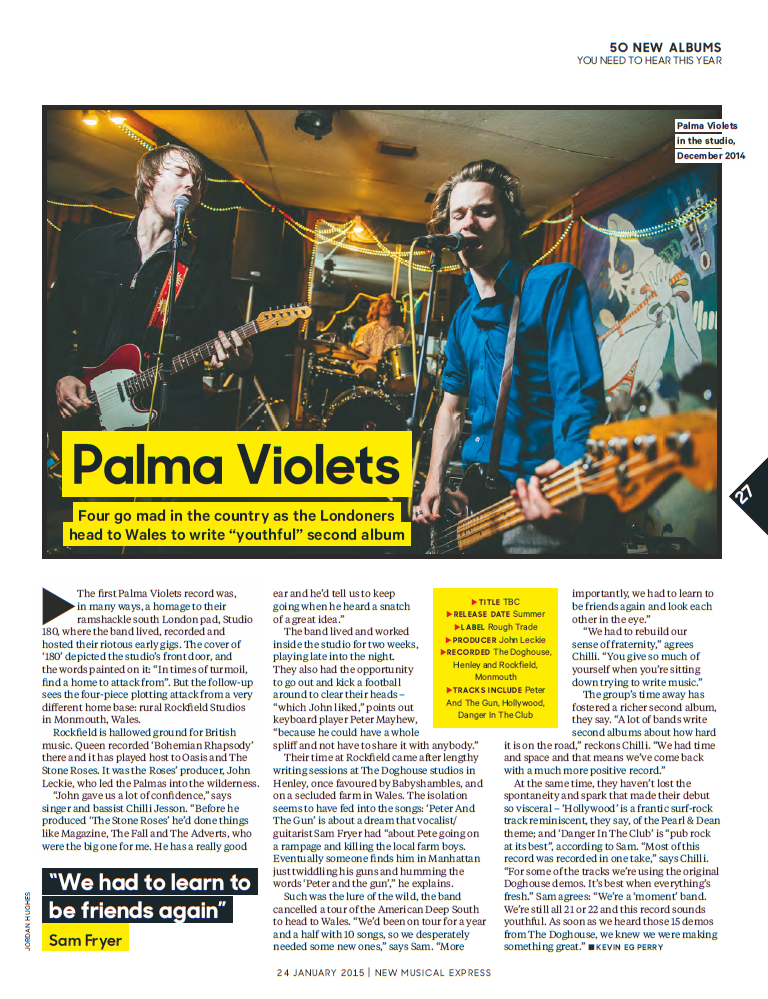 The first Palma Violets record was, in many ways, a homage to their ramshackle London pad, Studio 180, where the band lived, recorded and hosted their riotous early gigs. The cover of ‘180’ depicted the studio’s front door, and the words painted on it: “In times of turmoil, find a home to attack from”. But the follow-up sees the four-piece plotting attack from a very different home base: Rockfield Studios in Monmouth, Wales.
Full piece in NME, 24 January 2015.

James Bay: “I wanna take my music to more people in bigger rooms”

Eurosonic Noorderslag 2015
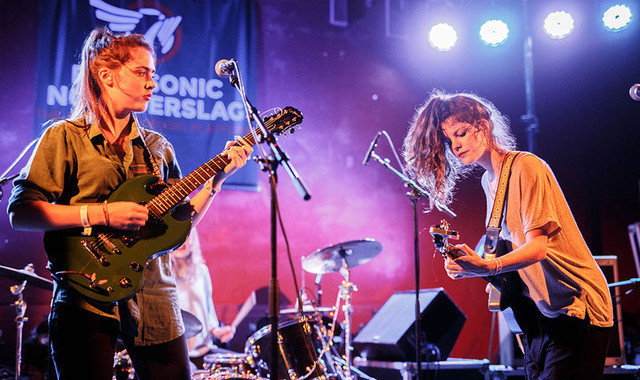 Hundreds of festival bookers descended on a sleepy, sodden Dutch town last week hoping to spot the bands with the potential to do great things in 2015.
Everyone’s looking for something different of course. The French techno bookers probably only pass the Hungarian metal-fest bosses in the queues at the hash coffeehouses, but if anyone was even vaguely interested in punk with something to say then they’ll have gone home raving about Bad Breeding. The Stevenage four-piece tore through a late-night set at De Spieghel on Friday sounding a little like The Stooges would if they’d grown up in suburban England and had met Damon Albarn instead of Iggy Pop. Frontman Christopher Dodd ends up off the stage and down in the mosh pit, yet even when the sweat is dripping off him his lyrics remain raw but eloquent – “living in a town where nothing really happens, except nothingness itself,” he yells in ‘Age Of Nothing’ – as if someone kidnapped Art Brut and made them listen to hardcore records and read Chomsky.

Hinds (FKA Deers) on planning their debut album
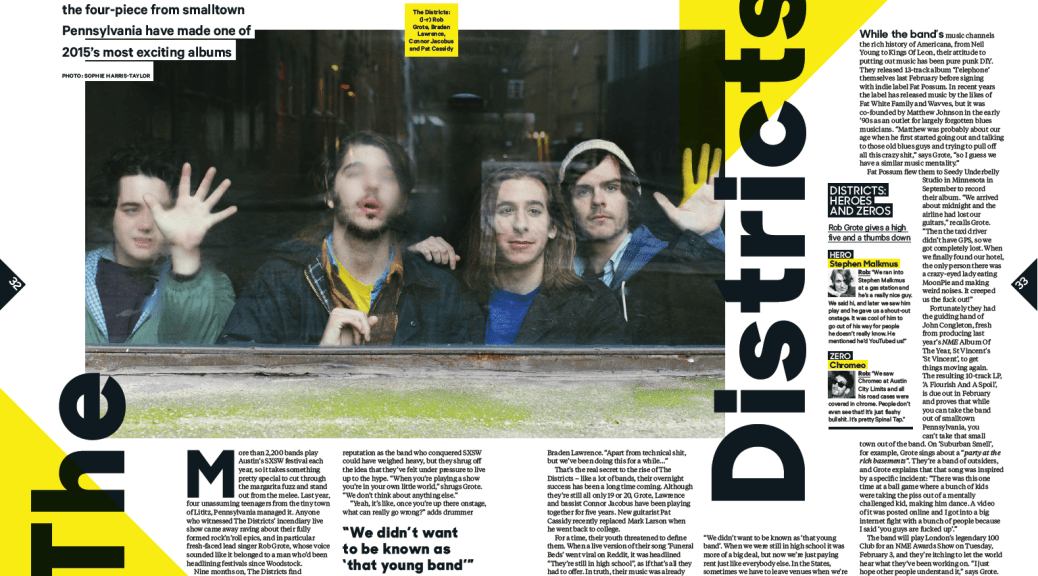
Artists of 2015: The Districts
 More than 2,200 bands play Austin’s SXSW festival each year, so it takes something pretty special to cut through the margarita fuzz and stand out from the melee. Last year, four unassuming teenagers from the tiny town of Lititz, Pennsylvania managed it. Anyone who witnessed The Districts’ incendiary live show came away raving about their fully-formed rock’n’roll epics, and in particular fresh-faced lead singer Rob Grote whose voice sounded like it belonged to a man who’d been headlining festivals since Woodstock.
Nine months on The Districts find themselves in London after a year spent spreading their gospel around the world. Their reputation as the band who conquered SXSW could have weighed heavy, but they shrug off the idea that they’ve felt under pressure to live up to the hype. “When you’re playing a show you’re in you own little world,” shrugs Grote. “We don’t think about anything else.”
Originally published in New Bands of 2015 issue, 10 January 2015. Continue reading at NME.

Artists of 2015: Shamir
 Shamir greets me with a hug. He’s just finished soundchecking at London’s intimate Courtyard Theatre, where later he’ll play his first ever UK show in front of an audience peppered with label heads, music journalists and radio DJs. Armed with the bouncy, Technicolor rap of his breakthrough hit ‘On The Regular’ and the soulful strut of ‘I Know It’s A Good Thing’, one of NME’s Top Tracks of 2014, there’s a gathering consensus that Shamir just might be The Next Big Thing.
Originally published in New Bands of 2015 issue, 10 January 2015. Continue reading at NME.
2014’s Been A Mixed-up Year For Anyone Trying To Make Sense Of The Music Business
 This year, over a million vinyl records were sold for the first time in the last two decades. Meanwhile, HMV posted a £17 million profit just a year after going into liquidation. In other news, up is down. Black is white. Cats and dogs are living together.

Bobby Keys embodied the rock’n’roll spirit
 When Bobby Keys died last week, aged 70, Keith Richards said he’d “lost the largest pal in the world.” Keef got that right: the sax player was larger than life itself.
Even if you’ve never heard his name you’ll have danced to his tunes. He’s on the best Stones records, blowing his heart out on ‘Rip This Joint’ and giving ‘Brown Sugar’ its signature solo. Originally that song had a guitar part until Keys jammed on it at his own birthday party with Keith, Eric Clapton, George Harrison, Ringo Starr and Keith Moon. Mick Jagger and producer Jimmy Miller were watching. They realised on the spot they needed Keys on the record.
Aside from his defining work with the Stones, Keys also played on a pile of great records by the likes of John Lennon, Harry Nilsson and Warren Zevon. That’s him you hear wailing on Lennon’s ‘Whatever Gets You Thru The Night’, recorded in one take.
Not bad considering he’d once feared rock’n’roll would end his career. When he first saw The Stones in 1964 he said he “saw the death of the saxophone unravelling before my eyes” because none of the new bands used one. It was Keys’ playing that helped it become part of rock’n’roll’s sound. He made sax cool.
It didn’t hurt that he and Keith got on famously. Shortly after they met they realised they’d been born on the same day: December 18, 1943. “Bobby, you know what that means?” Keith told him. “We’re half man and half horse, and we got a licence to shit in the streets.”
And shit in the streets they did. Together they basically invented the myth of the rock’n’roll star. Anyone who ever fills a bath with Dom Pérignon and dives in with a model will know that Keys got there first. It cost him all the money he made on that tour. “Kind of dumb,” he said later, “but, you know, man, I’d do it again.”
Or picture the most archetypal rock’n’roll image of all: throwing a TV set out of a hotel room window. It was Bobby and Keith who invented that, giving inspiration to decades of rock stars and extra work to generations of TV salesmen when documentary director Robert Frank asked them to provide a bit more chaos for his film Cocksucker Blues.
Keys’ drink and drug consumption was prodigious, and he was there along with Nilsson, Starr and Moon during John Lennon’s infamous ‘lost weekend’ which ran from 1973-75. Keys went to prison several times throughout his life, usually for crimes he didn’t remember committing. He was once caught with heroin and syringes while attempting to fly out of Hawaii and avoided a serious stretch behind bars when he was bailed out by a local pineapple magnate, who just happened to be the father of a girl he’d just slept with.
So while his death is sad, Bobby Keys will live on. Not just through his music or the tall tales told about him, but through the debauched spirit of rock’n’roll that he helped to mould. Every time a young band trashes a hotel room or empties a can of lager into a bidet, they’ll be carrying a small part of Keys’ monster spirit with them.
Originally published in NME, 13 December 2014.
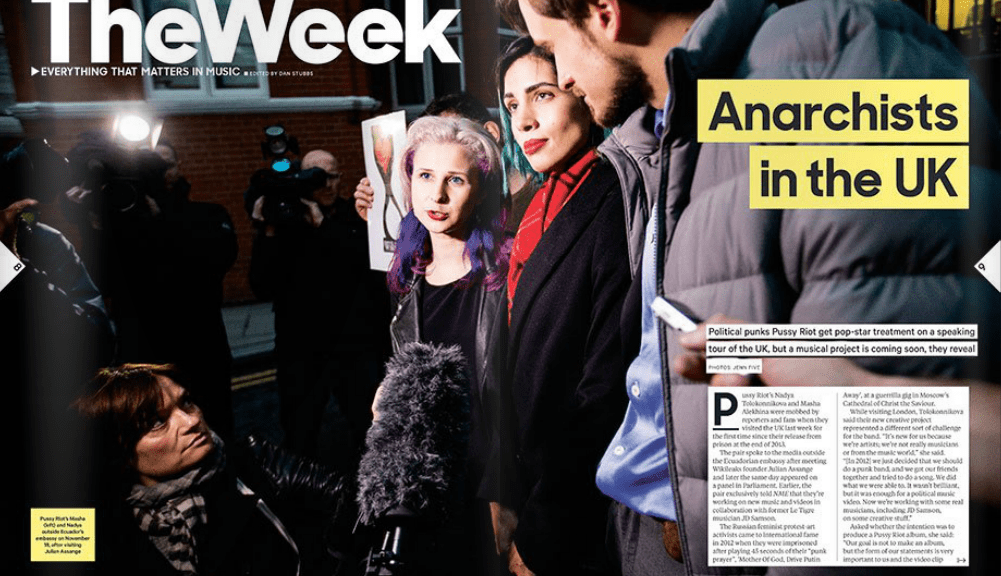
Pussy Riot: Anarchists in the UK

From NME, 29 November 2014:
Pussy Riot’s Nadya Tolokonnikova and Masha Alekhina were mobbed by reporters and fans when they visited the UK last week for the first time since their release from prison at the end of 2013.
The pair spoke to the media outside the Ecuadorian Embassy after meeting Wikileaks founder Julian Assange as well as speaking at Parliament. Earlier, the pair exclusively told NME that they’re working on new music and videos in collaboration with former Le Tigre musician JD Samson.
The Russian feminist protest art activists came to international fame in 2012 when they were imprisoned after playing 45 seconds of their “punk prayer”, ‘Mother of God, Drive Putin Away’, at a guerrilla gig in Moscow’s Cathedral of Christ the Saviour.
While visiting London, Tolokonnikova said their new creative project represented a different sort of challenge for the band. “It’s new for us because we’re artists, we’re not really musicians or from the music world,” she said. “[In 2012] we just decided that we should do a punk band, and we got our friends together and tried to do a song. We did what we were able to. It wasn’t brilliant, but it was enough for a political music video. Now we’re working with some real musicians, including JD Samson, on some creative stuff.”
Asked whether the intention was to produce a Pussy Riot album, she said: “Our goal is not to make an album, but the form of our statements is very important to us and the video clip form is one we like. Maybe at some point in the future we will do an album, but right now we want to make videos.”
After visiting Assange at the Ecuadorian Embassy, where he has claimed asylum, the pair told NME that they “had more in common with him than we expected.”
Asked to clarify what those things in common are, Alekhina said: “It’s basically universal things about freedom of expression, if we’re talking about us, and freedom of information, if we’re talking about him.”
Tolokonnikova added: “I believe that everything about a state should be transparent to its citizens, including the issue of surveillance. Its legality and justification should be explained to citizens. We are under constant surveillance by the FSB (the Russian internal security services) in Russia, and we’re trying to protest against this, question its legality and ask why they’re doing it. We naturally would not want Western states to follow the bad example of Russia, where we’re trying to fight exactly the same things that Assange is fighting against here.”
On whether they saw any problem with members of a feminist collective such as Pussy Riot openly supporting Assange, a man who is wanted in Sweden over sexual assault allegations, Tolokonnikova said: “We did not review this charge that has been directed at him. We do not think it is in relation to the things that he is doing right now.”
Alyokhina added: “We also try to see the direction of one’s intentions in the future, what he is trying to do and is doing right now.”
The visit to Assange came just hours before the two women appeared at Parliament to speak at an event organised by Russian opposition politicians to support the introduction of a ‘Magnitsky law’. Such a law, named after Sergey Magnitsky, a Russian whistleblower who died in police custody in Moscow, would punish the Russian officials responsible for his murder by freezing their assets in the UK and restricting their visa rights.
That event came at the end of a busy week of public appearances, which had also seen Tolokonnikova and Alekhina speak at an Amnesty International event in London attended by the likes of Django Django, Viv Albertine and Jamie Hince. Asked by former Slits guitarist Albertine whether they’d inspired a new generation of girls, Tolokonnikova said: At the end of the day, we inspired people to be less afraid. A lot of people started their political activity because of our involvement with the law. There’s different value to someone going to a political rally in England than in Russia, so even if we’ve only inspired a few 100 people that has tremendous value in modern Russia.”
While in the country they also spoke at the Cambridge Union and addressed a sold-out 450-capacity audience at the Greenwood Theatre at King’s College London.
From NME, 20/27 December 2014:
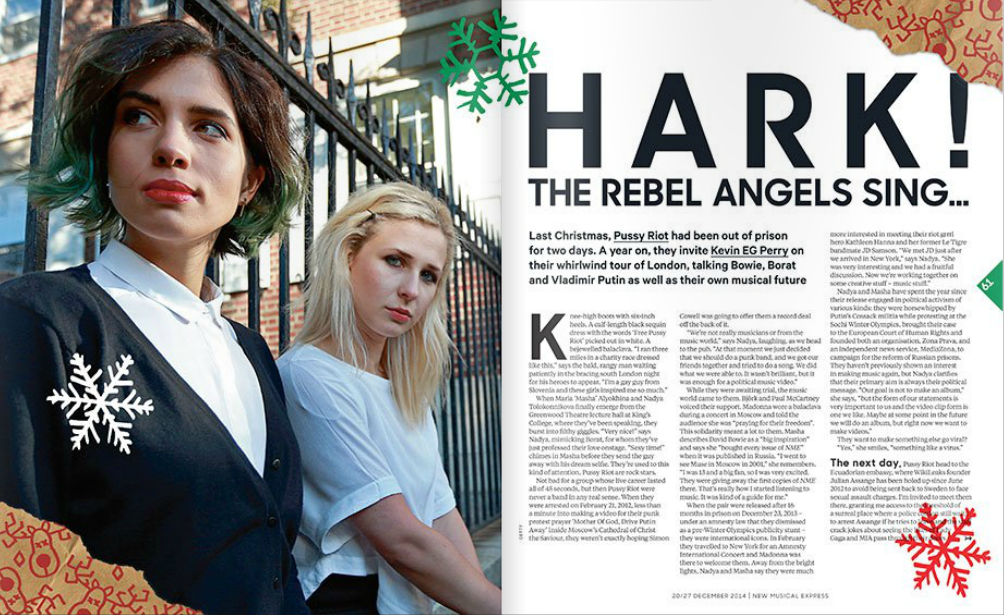
Knee high boots with six inch heels. A calf-length black sequin dress with the words ‘Free Pussy Riot’ picked out in white. A bejewelled balaclava. “I ran three miles in a charity race dressed like this,” says the bald, rangy man waiting patiently in the bracing south London night for his heroes to appear. “I’m a gay guy from Slovenia and these girls inspired me so much.” When Masha Alyokhina and Nadya Tolokonnikova finally emerge for a cigarette from the lecture hall where they’ve been speaking they burst into filthy giggles. “Very nice!” says Nadya, mimicking Borat. “Sexy time!” chimes in Masha before they send him away with the selfie of his dreams. They’ve gotten used to this kind of attention. Pussy Riot are rock stars.
Not bad for a group whose live career lasted all of 45 seconds, but then Pussy Riot were never a band in any real sense. When they were arrested on February 21, 2012 less than a minute into making a video for their punk protest prayer ‘Mother of God, Drive Putin Away’ inside Moscow’s Cathedral of Christ the Saviour they weren’t exactly hoping Simon Cowell was going to offer them a record deal off the back of it.
“We’re not really musicians or from the music world,” laughs Nadya, after we head to the pub. “At that moment we just decided that we should do a punk band, and we got our friends together and tried to do a song. We did what we were able to. It wasn’t brilliant, but it was enough for a political music video.”
While they were awaiting trial the music world came to them. Björk and Paul McCartney voiced their support. Madonna wore a balaclava during a concert in Moscow and told the audience she was “praying for their freedom.” This solidarity meant a lot to them. Masha is the sort of music fan who describes David Bowie as a “big inspiration” and says she “bought every issue of NME” when it was published in Russia. “I went to see Muse in Moscow in 2001,” she remembers. “I was 13 and a big fan, so I was very excited. They were giving away the first copies of NME there. That’s really how I started listening to music. It was kind of a guide for me. I didn’t have anything except NME.”
When the pair were released, just before Christmas last year, they were international icons. In February they travelled to New York for an Amnesty International Concert and Madonna was there to welcome them. Away from the bright lights, Nadya and Masha say they were much more interested in meeting their riot grrrl hero Kathleen Hanna and her former Le Tigre bandmate JD Samson. “We met JD just after we arrived in New York,” says Nadya. “She was very interesting and we had a really fruitful discussion. Now we’re working together on some creative stuff, music stuff.”
Nadya and Masha have spent the year since their release engaged in a host of political activism: they were horsewhipped by Cossack police while protesting at the Sochi Winter Olympics, brought their case to the European Court of Human Rights and founded both an organisation, Zona Prava, and an independent news service, MediaZona, which campaign for the reform of Russian prisons. They haven’t previously shown interest in making music again, but Nadya clarifies that their first thought is always their political message. “Our goal is not to make an album,” she says, “but the form of our statements is very important to us and the video clip form is one we like. Maybe at some point in the future we will do an album, but right now we want to make videos.”
They want to make something else go viral?
“Yes,” she smiles, “Something like a virus.”
The day after my interview I’m invited to meet Pussy Riot again at the Ecuadorian Embassy, where Wikileaks founder Julian Assange has been holed up since June 2012. A man hiding from sexual assault charges in Sweden may seem like a strange bedfellow for avowedly feminist activists, but outside the embassy Nadya tells reporters simply that they didn’t discuss the charges because they don’t think “it is in relation to the things that he is doing right now.”
Instead, Masha says they found common ground in their work to support prisoners and whistleblowers, particularly Wikileaks source Chelsea Manning, whose case they describe as “one of the most important in today’s world.”
Masha tells me that while their own time in prison was “difficult”, she saw reasons to be optimistic: “I had conversations with guards and other prisoners which really influenced me. When a normal, common Russian girl who is completely outside of politics and civil society life tells you that she understands what you’re doing, she appreciates it and wants to fight for her rights now – that’s a real shock and that’s what I’m focusing on now because it’s inspiring for me.”
That evening we head to Parliament where Nadya and Masha are speaking in support of a proposed ‘Magnitsky law’. Sergei Magnitsky was a Russian accountant and whistleblower who was beaten to death in Moscow prison. The proposed law, which has already been introduced in America, would prevent those responsible for his death from spending their ill-begotten wealth in Britain. Despite the gravity of the situation, Nadya can’t help cracking jokes. “We think it’s a brilliant idea to invite punks to Parliament,” she says by way of introduction. “It’s the nicest idea since you invited Ali G here.”
Despite everything that Vladimir Putin has thrown at them, Nadya and Masha have kept laughing in his face. That’s seen them venerated in the West, yet when I visited Russia last summer to cover Subbotnik Festival I met Moscow hipsters who dismissed Pussy Riot as troublemakers who don’t represent young Russians. I ask Nadya whether there’s any way of getting though to them. “What you’re talking about is a question of courage,” she says. “The reaction to us was really polarised between the West and Russia because in the West we were treated like heroes but in Russia we were witches who were against religion. The Russian media just wanted to paint us black and not provide realistic information.”
The way that Putin controls and manipulates Russian media leads to an uninformed populace – especially, Nadya argues, when it comes to feminist art movements. “I bet only a very small number of those Russian hipsters know what the riot grrrl movement is, or who the Guerrilla Girls were,” she says. “There’s a huge tradition of those sorts of groups here, but for some reason it seems that Putin doesn’t want people to be really well educated. Educated people tend to ask questions.”
She suggests that Putin’s eventual undoing will likely be as a result of his own hubris, and doesn’t entirely rule out the idea of running for office herself one day. “Actually in the next 10 years I’m not allowed to do it, because under Russian law convicted criminals can’t run for office for a decade. After 10 years? I have no idea. Maybe! I wish I had more education to run the country. I have some suggestions, of course, but in a few years my picture of reality will be more clear. I couldn’t continue my education in jail because I had to work so I lost two years. I’m a 25-year-old with the education of a 23 year old… but with the experiences of a 40 year old.”
Away from the maelstrom that’s accompanied their trip to London, taking in sold-out public lectures, meeting celebrity dissidents and speaking at Parliament, I ask Nadya to reflect on the past year. This time 12 months ago she was still in prison. Now she and Masha travel the world as celebrities and everybody they meet seems to expect them to have the solutions to oust Putin, bring peace to the Ukraine and end international totalitarianism while they’re at it.
“That’s the strangest thing,” she agrees. “We’re not gods. We don’t have answers to everyone’s questions. But, you know, it’s a miracle of solidarity that so many people want to support us. Immanuel Kant wrote about something that happens sometimes when political changes take place. It’s something like a miracle. When we have the power and the ability of all the people working together, we can get what we want.”
She thinks for a moment, then says: “When I was 16 I said to my schoolmates that I wanted to lead the craziest life that I can, and that if I can’t do that I may as well just live in garbage.” She nods towards a pile on bin bags on the side of the road and laughs.
Putin himself would have to agree she’s succeeded. Nadya and Masha have two of the craziest lives on the planet. They’re the prisoners who became punk icons. The rock stars of dissidence. Does that burden weigh heavy?
“The only pressure I’ve felt in the last year was when I came out of prison and realised that so many eyes were looking towards me,” says Nadya. “I realised that I have a really big responsibility. I used to talk a lot of bullshit, but now I don’t have that option anymore. So many people don’t have a voice, like those in prison in Russia and around the world. We have to speak for them.”
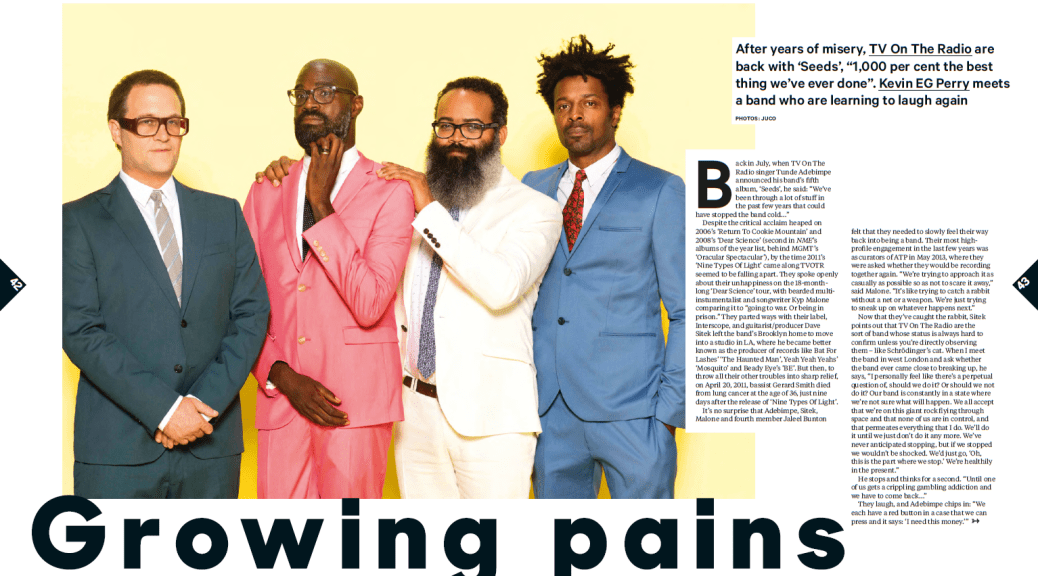
Growing pains
 Back in July, when TV On The Radio singer Tunde Adebimpe announced that his band’s fifth album ‘Seeds’, he said: “We’ve been through a lot of stuff in the past few years that could have stopped the band cold…”
Despite the critical acclaim heaped on 2006’s ‘Return To Cookie Mountain’ and 2008’s ‘Dear Science’ (second in NME’s album of the year list, behind MGMT’s ‘Oracular Spectacular’), by the time of the release of 2011’s ‘Nine Types Of Light’ the band seemed to be fracturing apart. The band spoke openly about their unhappiness on the 18-month long ‘Dear Science’ tour, with bearded multi-instumentalist and songwriter Kyp Malone comparing it to “going to war. Or being in prison”. They parted ways with their label, Interscope, and guitarist/producer Dave Sitek left the band’s Brooklyn homeland to move into a studio in LA where he became better known as producer for records like Bat for Lashes’ ‘The Haunted Man’, Yeah Yeah Yeahs’ ‘Mosquito’ and Beady Eye’s ‘BE’. But then, to throw all their other troubles into sharp relief, on April 20, 2011, bassist Gerard Smith died from lung cancer at the age of 36, just nine days after the release of ‘Nine Types Of Light’.
It’s no surprise then that the Adebimpe, Sitek, Malone and fourth member Jaleel Bunton felt that they needed to slowly feel their way back into being a band. Their most high-profile engagement in the last few years was as curators of ATP Camber Sands in May 2013, where they were asked whether they would be recording together again. “We’re trying to approach it as casually as possible so as not to scare it away,” said Malone. “It’s like trying to catch a rabbit without a net or a weapon. We’re just trying to sneak up on whatever happens next.”
Now that they’ve caught the rabbit and the album is being pressed into vinyl, Sitek points out that TV On The Radio are the sort of band whose status is always hard to confirm unless you’re directly observing them, like Schrodinger’s cat. When I meet the band in West London and ask whether the band ever came close to breaking up, he says: “I personally feel like there’s a perpetual question of ‘Should we do it? or ‘Should we not do it? Our band is constantly in a state where we’re not sure what will happen. We all accept that we’re on this giant rock flying through space and that none of us are in control, and that permeates everything that I do. We’ll do it until we just don’t do it anymore. We’ve never anticipated stopping, but if we stopped we wouldn’t be shocked. We’d just go, ‘Oh, this is the part where we stop.’ We’re healthily in the present.”
He stops and thinks for a second. “Until one of us gets a crippling gambling addiction and we have to come back…”
They laugh, and Adebimpe chips in: “We each have a red button in a case that we can press and it says: ‘I need this money.’”
Over their decade long career TV On The Radio have built a reputation for being among rock music’s most lucid and eloquent commentators on politics, and they’ve been particularly outspoken when it comes to discussing our culture’s disastrous impact on the planet’s ecology. ‘Seeds’, perhaps unsurprisingly given the circumstances of its creation, turns the band’s forensic gaze inward.
When I suggest that this is the band’s most introspective work to date, Sitek immediately agrees. “I think that’s accurate,” he says. “I think with ‘Return To Cookie Mountain’ there was a lot of reconciling of how to be human within this giant mix-up, and although nowadays there’s certainly as many or more mix-ups to try to reconcile, I think the broad stroke [on ‘Seeds’] was to deal with the personal with the same fervour. Let me unpeel the onion of my mind, even though it’s going to make me cry.”
That idea of knowing yourself and how your own brain ticks is central to the record, particularly when it comes to how we deal with trauma, bereavement and loss. Lead single ‘Happy Idiot’ discusses shutting out pain to enjoy the bliss of ignorance, while the refrain of standout track ‘Trouble’ runs: “Everything’s going to be okay / I keep telling myself / Don’t worry be happy / you keep telling yourself.”
Sitek says the song is about the self-delusions that are sometimes necessary for surviving modern life. “The ‘I keep telling myself…’ line means that it might not be true,” he says. “Everyone goes through that, on multiple levels. There’s a lot of doubt floating around. What has modern living and its greatest aspirations lead to? ‘Trouble’, at least for me, is about putting your helmet on. Light bulbs were invented to be perfect and last forever, and it was only when they realised that they couldn’t keep selling them that they made them only last for so long. For a species that makes the conscious decision to support that, and to forget that it used to be different, set us up for a new paradigm. There’s psychic consequences that we feel. We’re realising where all this convenience has led. Being in touch all the time has led to an underlying anxiety, because we’re not supposed to be in touch all the time.” He grins. “We’re not supposed to be connected to all of the filth at one time.”
Adebimpe adds that the idea of how we mentally adapt to modernity is one that’s fascinated him since he was a child: “I grew up around people who were experiencing a lot of mental health issues and anxiety because my father was a psychologist and a social worker. I’d go with him to work and I’d see people who’d had a psychic break and they just weren’t present in the way that we are. Their reality is not the same. I saw all of that stuff pre-internet, and I wonder how much the internet has affected that. I feel like if I’d have had this much connection to strangers as a teenager, I don’t think I would have made anything. I know people are still making things, but I think about how much alone time I had and how formative that was. There’s that quote about how all of man’s misfortune in life stems from not being able to sit in a room quietly by themselves. I can see that, but the other part of that is there’s so much room to destroy your mind. People are very sensitive, and if you already have that sensitivity then technology [like a smart phone] is like falling into a portal. You just need to flick your thumb. It’s the easiest thing in the world.”
“Who knew your thumb could drive you mad?” chips in Sitek. “Wi-fi can stop a plane, your thumb can stop your brain.”
Back in that first ‘Seeds’ announcement about how they almost ‘stopped cold’, Adebimpe added that the record is “1,000 percent, without a doubt, the best thing we’ve ever done.” The rest of the band are more circumspect, but Malone does say that the singer’s passion is catching: “I don’t have favourites, but the fact of Tunde’s excitement about it is very exciting to me. If any of us are standing on a chair and shouting that this is the best, then that kind of enthusiasm is very valuable, and very contagious.”
As for Adebimpe himself, he seems particularly proud that the band are continuing to forge their own path. Although musically they’ve softened their harder edges since last time out, creating a polished, synth-laden record that’s more upbeat and accessible than ‘Nine Types of Light’ ever was, it’s clear the changes they’ve made have been on their own terms. “Figuring out how to make work without compromising, and have that float me, and do it with my friends, and to do it for this long with my friends – it’s an intensely special and rare thing. Especially in our arena you’re always making concessions to go forward or ‘keep up with the times’ or whatever, and we haven’t really had to do that too much.”
He shrugs: “I mean, we were going to make an EDM record… but then it just fell through… we couldn’t find the drop…”
Beside him, Sitek mimes knocking over a glass. “Spillex… oh shit!”
Adebimpe can’t help but crack up: “Oh, there’s the drop.”
“We don’t drop beats,” grins Sitek, “we just drop drinks.”
For a band that a few years ago were showing stress fractures, TV On The Radio find themselves in a position to crack jokes as they launch an album that sets to music Antonio Gramsci’s definition of the challenge of modernity: “To live without illusions without becoming disillusioned.” Somehow they’ve ended up about as mentally well-adjusted as anyone could hope to be in this year of our Lord 2014. For Sitek, that’s all down to their fervent belief in throwing away their old templates and starting anew. “Commercial success has eluded this band from the start, but it was never really part of our goal,” he says. “There’s still varying degrees of shock when we’re playing in front of 30,000 people. Why do 30,000 people know this band? It’s beyond me, but the only reason we got here is because we’ve been reckless. So let’s stay reckless.”
Originally published in NME, 22 November 2014.

Bad Breeding
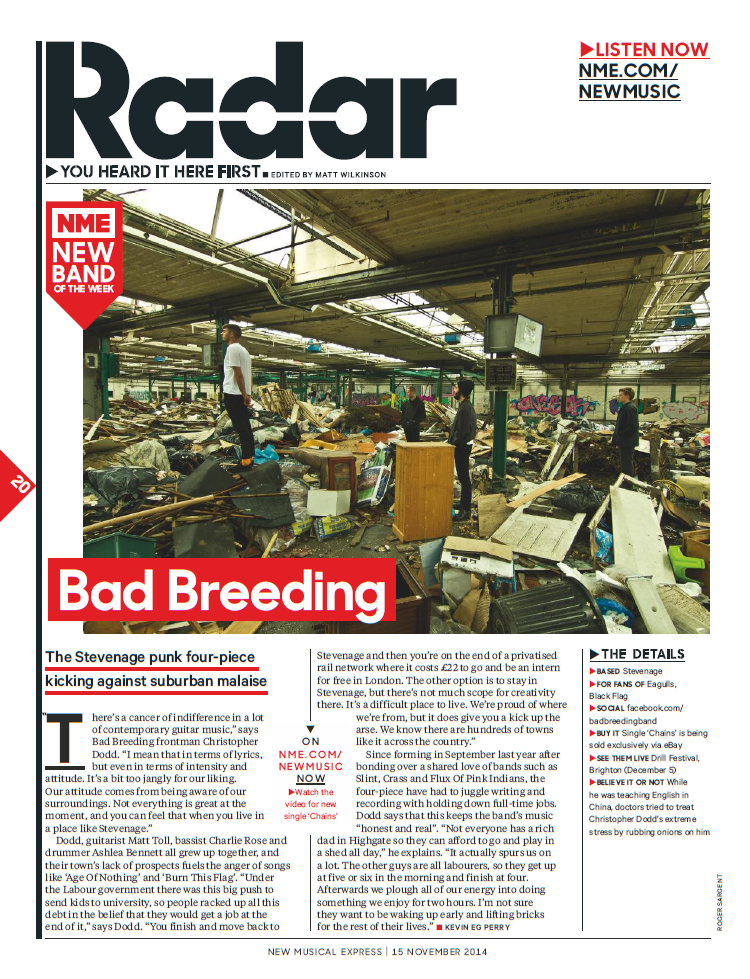 “There’s a cancer of indifference in a lot of contemporary guitar music,” says Bad Breeding frontman Christopher Dodd. “I mean that in terms of lyrics but even in terms of intensity and attitude. It’s a bit too jangly for our liking. Our attitude comes from being aware of our surroundings. Not everything is great at the moment, and you can feel that when you live in a place like Stevenage.”
Full piece in NME, 15 November 2014.
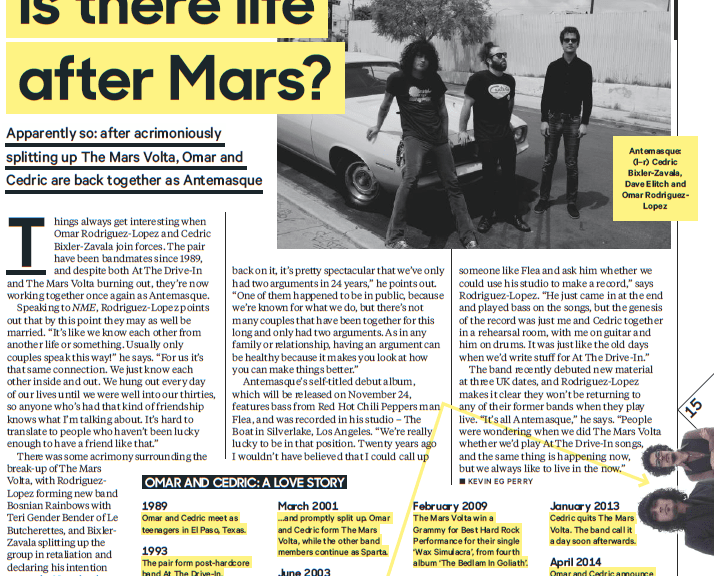
Is there life after Mars?
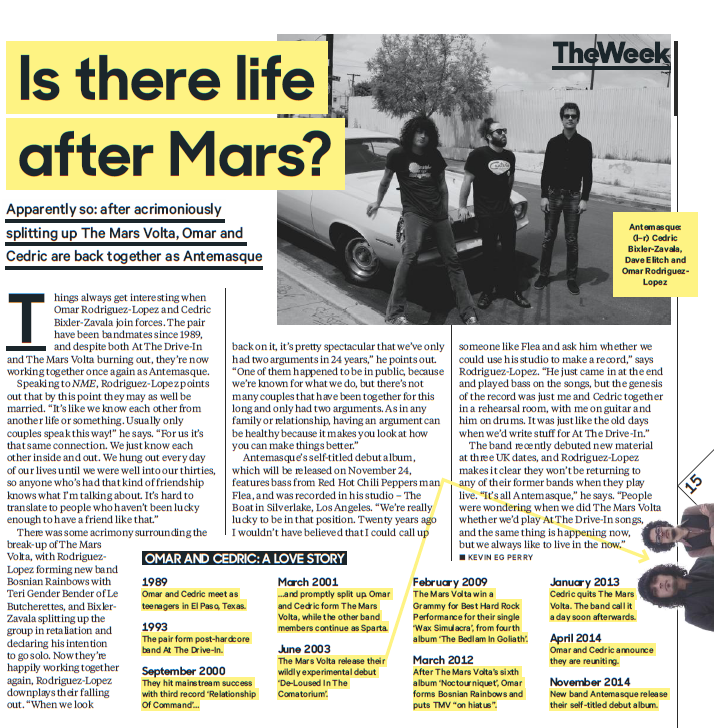 Things always get interesting whenever Omar Rodriguez-Lopez and Cedric Bixler-Zavala join forces. The pair have been bandmates since 1989, and despite both At The Drive In and The Mars Volta burning out, they’re now working together once again as Antemasque.
Full piece in NME, 15 November 2014.

CMJ 2014: Radar’s Brooklyn Takeover
 When J. Spaceman, Mick Jagger’s son and the Ramones’ old manager all turn up to your party, you’ve gotta be doing something right. Radar took over Williamsburg’s Glasslands venue to serve up the most anarchic show of this year’s CMJ festival: a night which featured sinister topless gyrations, a death-defying balcony leap off and someone inexplicably performing in a full penguin costume.
Before all that dangerous weirdness it was Girlpool who opened the night with a set of whip-smart songs that crackled with their own brand of subversive wit. On the stand-out ‘Jane’, LA duo Cleo Tucker and Harmony Tividad tell the tale of the eponymous hero punching a boy called Tommy in the mouth. They’re just an indie film soundtrack away from becoming cult heroes.
There’s a decidedly 90s feel to the next part of the night, as Peterborough’s The Wytches channel Nirvana and those early Radiohead recordings where it still sounded as if Thom Yorke and co. thought they were a grunge band.
London three-piece Happyness are that rare band who manage to mix a genuinely absurd sense of humour into their lyrics, while musically they rifle through the best of Pavement and Blur.
There’s something gleefully absurd about seeing a guy dressed as a penguin announce that his band are “here to play some rock’n’roll,” but it didn’t seem to ruffle Twin Peaks’ Cadien’s feathers. The Chicago band drew one of the best receptions of the night from the moshing crowd, with tracks like ‘Making Breakfast’ sounding like a band full of Mac DeMarcos playing at full pelt.
You can’t get more of a homecoming show than Public Access TV playing here at Glasslands. The New Yorkers used to live within the venue’s warehouse space, so they’re delighted to be back before it closes its doors at the end of the year. They’ve grown in stage presence since their first UK shows back at The Great Escape earlier this year, and their perfectly crafted indie rock ear-worms like ‘Monaco’ and newie ‘In The Mirror’ will be rattling around the audience’s skulls for days.
Surely wary of tonight’s headliners’ fearsome live reputation, Bo Ningen pull out all the stops. While guitars whirl around the stage behind him like chainsaws, frontman Taigen Kawabe plays his bass above his head, ‘stabs’ himself with its neck and then climbs up the speaker stack to a balcony which he leaps off into the crowd.
Even that crowd-baiting anarchy can’t quite match the Fat White Family for sheer evil stage presence. Frontman Lias looks like a man possessed during a ferocious opening salvo which includes ‘Is It Raining In Your Mouth?’ The band dedicate it to former Ramones manager Danny Fields, who had been spotted backstage taking photos of the band. If the Americans in the crowd were in any doubt that they were witnessing the birth of something ungodly on their shores, the grinding ‘I Am Mark E Smith’ will surely have ripped the scales from their eyes. Lias introduced it as a song about “nobility”, but theirs is a strange new British Invasion.
Originally published in NME, 1 November 2014.
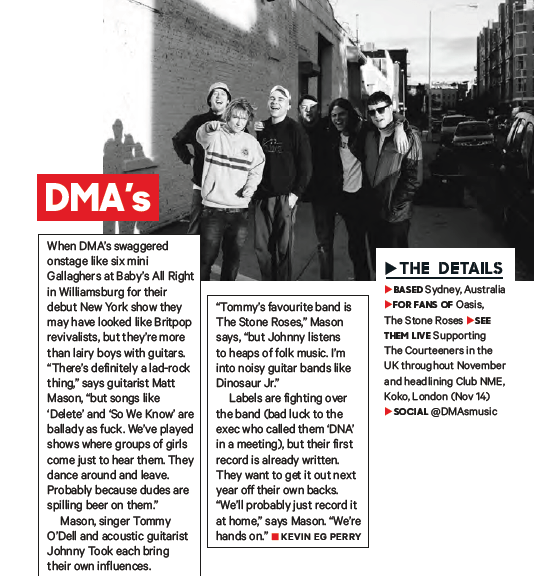
DMA’s
 When DMA’s swaggered onstage like six mini Gallaghers at Baby’s All Right in Williamsburg for their debut New York show they may have looked like Britpop revivalists, but they’re more than lairy boys with guitars. “There’s definitely a lad-rock thing,” says guitarist Matt Mason, “but songs like ‘Delete’ and ‘So We Know’ are ballady as fuck. We’ve played shows where groups of girls come just to hear them. They dance around and leave. Probably because dudes are spilling beer on them.”
Full piece in NME, 1 November 2014.

Hello, Goodbye
 For many bands, the offer of a record deal is so exciting that they don’t stop to read the small print – and the path to glory is littered with bands who’ve signed over more of their rights than they’d want to. Chvrches to the rescue: though they only have one album to their name themselves, the Glasgow trio set up their own label, Goodbye Records, at the beginning of the year to help new acts onto the first rung of the ladder.
Full piece in NME, 18 October 2014.
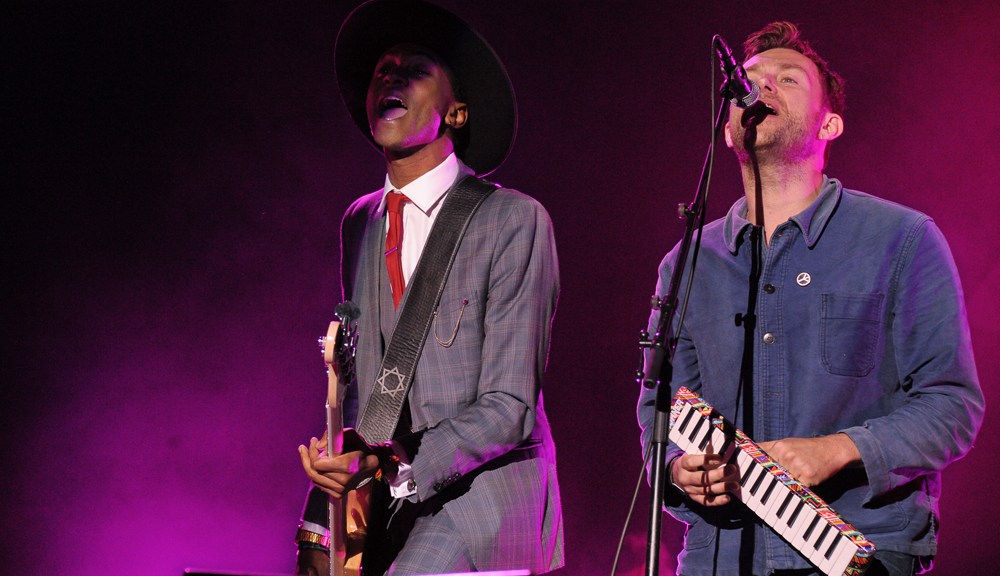
Corona Capital 2014: Music, mescal and mud
 Usually when you visit Mexico City’s Corona Capital, you’re more concerned about sun cream than wellies. 2014 was different. Fans this year had to overcome a thunder storm, deep mud and a seriously waterlogged site. Still, on the bright side, that does mean the festival is more like Glastonbury than ever.

Belle & Sebastian: ‘Nationalism is pretty stinky’

Scene Report: Austin, Texas
 For any serious live music junkie, there’s no hit quite like walking down Sixth Street in downtown Austin when its in full flow. The broad street is splattered with the town credo: ‘Keep Austin Weird’ and lined with bars. Every single one seems to have great bands playing both upstairs and downstairs. The result is a glorious cacophony which hints at why Austin has become America’s live music capital.
Full piece in NME, 11 October 2014.
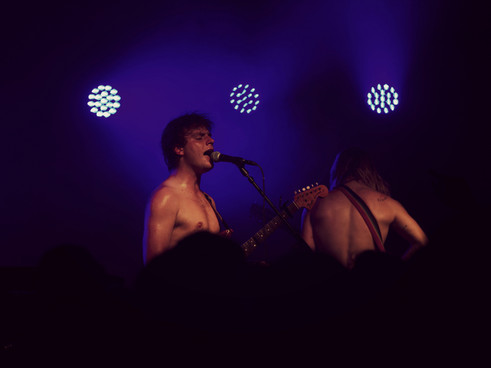
Mac DeMarco proves Austin’s a city with no limits
 75,000 music fans may have converged on Zilker Park last weekend for the first weekend instalment of the Austin City Limits festival, but the truth is some of the best shows were taking place in the same place they do all year round: the bars and venues of Austin itself.
Infamous haunts like Beerland, Stubb’s and Red 7 around the Sixth Street/Red River area are just the beginning of Austin’s thriving scene. East of the I-35 there’s another treasure trove of great venues, and The Scoot Inn on East 4th Street and Navasota is an archetypal example of a classic Austin venue.
It was here at SXSW earlier in the year that Tyler, the Creator played the show that later saw him arrested for allegedly inciting a riot, and this weekend it was Tyler’s pal Mac DeMarco’s turn to play an anarchic late night set that captured the spirit of what live music can be in a city that really embraces it.

You can do it, put your back Inuit
 “He’s a penny pincher.” Ask a Toronto taxi driver how their crack-smoking, stupor-drunk mayor Rob Ford ever gained so much support and he’ll give you a simple answer. He’s known as the man who cuts waste. You can’t escape austerity anywhere, yet Canada’s music scene is thriving. I came here to find out why.
The next morning, before the award of the annual Polaris Music Prize, I have breakfast downtown with founder Steve Jordan. In Award Show years, the Polaris is only a baby – Jordan started the award in 2006, inspired by way the Mercury Prize shortlist introduced him to a host of obscure and interesting new British music each year. “A lightbulb went off,” he says. “I was thousands of miles away, but I was discovering records through them.”
He wanted to do the same for Canadian music, so he rounded up 190 Canadian journalists to vote for their favourite home-grown albums of the year. Unlike the slightly murky, label-led Mercury submission process, the journalists were given free reign to nominate whichever records they wanted to. Then each year a new ‘Grand Jury’ of 11 is drawn up, with each record on the 10-strong shortlist having its champion. Like the Mercurys the winner is decided on the night of the award, so when we meet Jordan has no idea who will win. “The only thing I know for sure,” he says, “is that whoever wins, half our audience will be shocked and the other half will tell us we’ve been too predictable.”
 Kevin EG Perry: Collected Works