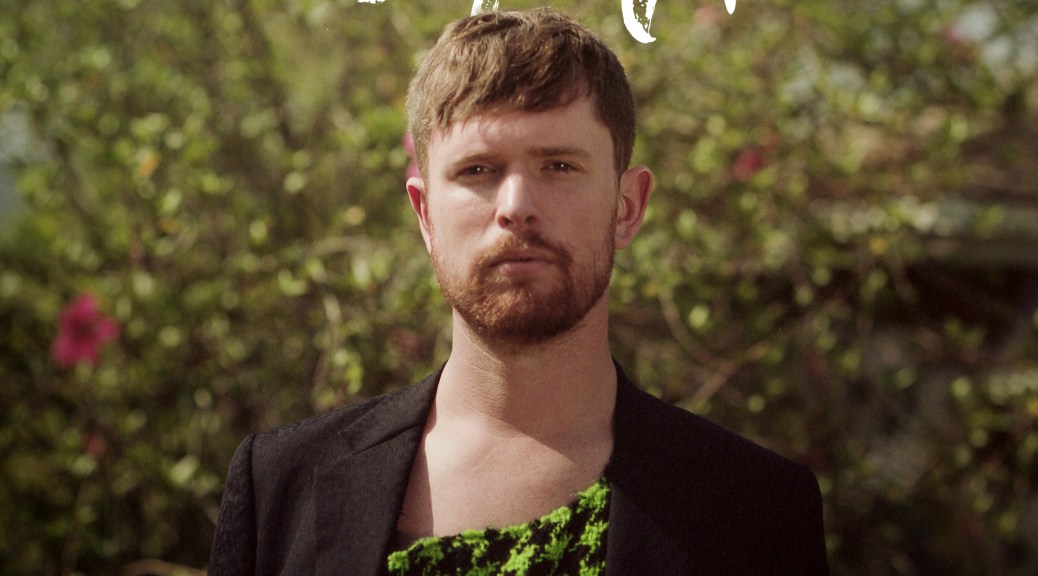
Given he’s spent much of the last decade writing songs about isolation, loneliness and the hunger for personal connection, James Blake figured he was well prepared to make music about the atomising effects of worldwide lockdown. “I felt like I’d been one of those preppers boiling chicken and putting it into jars for the last 20 years, ready for the apocalypse,” says the Enfield-born 32-year-old, speaking over Zoom from the light and airy home in the Hollywood Hills he shares with his partner, the actor Jameela Jamil. “I was super prepared to talk about it and to talk about mental health in general, but I also wasn’t really ready for how I’d react to lockdown myself.”
The couple spent the first month of the pandemic watching a new disaster movie every night, “Dante’s Peak, all the hits,” because it felt like the only way to externalise what was going on out in the world. Blake continued to write music at home, but it quickly became impossible to ignore just how much had really changed. “I had already been in a version of self-imposed lockdown, but there were things stopping me from slipping into depression, old habits and addictions,” he says. “When lockdown happened, those anchors to the real world suddenly weren’t there any more. I felt like I was plunged into a completely featureless landscape where I didn’t have anything to hold on to.”
Lynette Fromme was 18, depressed and living homeless on Venice Beach, Los Angeles, when she first met Charles Manson. She fell for him immediately, particularly when he talked charismatically about protecting the environment. Fifty-two years later she still feels the same way. “There’s just life in some people that attracts,” she says, “his being, his animation, his personality. You know, Al Gore is saying the right things, but he’s not as attractive as Charlie. People say [Manson] was evil, but I never saw evil in him. He said he was both – good and bad – and was free to do as he wanted because of it.”
Machine Gun Kelly’s house in LA is the sort of place that makes it a shame they don’t do MTV Cribs any more. A gothic-style mansion arranged around a huge central staircase, the place is decorated with ornate chandeliers and elaborate tapestries, but there are plenty of clues that this is a young man’s bachelor pad. One room, which looks out onto the swimming pool, is given over to a hoop-shooting basketball arcade game, a pool table and a Monster Energy-branded drinks fridge.
He has come a long way since he burst onto the scene in 2011 with a party-rap tune called “Wild Boy” – which has now racked up more than 135 million views on YouTube – and quickly set about living up to that sobriquet. Earlier in the week he celebrated his 29th birthday with a bacchanalian party in Hollywood attended by the likes of Tommy Lee, Pete Davidson and Marilyn Manson, who presented him with the gift of a dildo with Manson’s own face on it. Obviously.
Yet for all his hard-partying ways, Machine Gun Kelly is difficult to pigeonhole. Sure, on the one hand he’s a 6ft 4in bleach-haired rapper from Cleveland, Ohio, who has beefed with Eminem, but he has also enjoyed pop success, collaborating with Camila Cabello on “Bad Things” (409m Spotify plays). As an actor (he performs under his real name, Colson Baker), he had a break-out role this year playing to type as fellow wild boy – and new friend – Tommy Lee in Netflix’s Mötley Crüe biopic The Dirt, yet he’s also a doting father to his ten-year-old daughter, Casie, and concerned enough about his own health that shortly after we meet he syringes a shot of oregano oil into his mouth. “For every foul thing I put in my body I try to pump something good in there,” he explains. “Especially after the weekend I’ve just had.”
With a fourth album, Hotel Diablo, out now and more acting jobs on the way, including a role alongside Davidson in the comedy Big Time Adolescence, Machine Gun Kelly sits down, sparks up a joint and takes the GQ&A…
When Leonard Cohen did not go all the way to Glastonbury to fool us, 2008
There’s a popular misconception that Leonard Cohen’s music is a bit of a downer and it was this falsehood I found myself battling as I corralled a group of friends into joining me for his 2008 set on the Pyramid Stage. They thanked me later. Cohen’s performance was as uplifting and joyful as any I’ve ever witnessed, in the muddy fields of Pilton or anywhere else. The man himself, suavely suited and with a sly grin half-hidden under a fedora, seemed to be enjoying himself too. “I told the truth,” he sang during an unforgettable “Hallelujah”. “I did not come all the way to Glastonbury to fool you.”
It’s been 40 years since Joy Division released their debut record Unknown Pleasures, an album that has done more than any other to teach us what the radio waves from pulsar stars look like.
Its now-iconic cover art, found by guitarist Bernard Sumner in The Cambridge Encyclopaedia Of Astronomy before being modified by graphic designer Peter Saville, has gone on to appear on everything from bed sheets and baby grows to trainers and skateboards.
While the Unknown Pleasures artwork has been subsumed into popular culture, the music itself has steadfastly resisted commercialisation. When the record was first released on 15 June 1979 on Factory Records it sounded quite unlike anything that had come before it. That was a result of the unlikely cast who ushered it into existence. Sumner and bassist Peter Hook had formed a band called Warsaw in 1976, later changing their name to avoid confusion with the punk band Warsaw Pakt. In Ian Curtis they had stumbled across a singular lyricist and frontman. Drummer Stephen Morris completed the band, but the sound of Unknown Pleasures would also be heavily shaped by maverick producer Martin Hannett.
Acclaimed from the moment it was released, the album’s critical reputation has only grown in the last four decades. NME, Q and Pitchfork all named it one of the greatest albums of the Seventies, while Rolling Stone called it one of the best debut albums of all time. The diverse list of artists to have cited it as an inspiration includes U2, Moby and The Killers.
Here, Sumner, Morris and Saville recall the creation of a classic.
In November last year, not long before he was announced as the winner of the 2019 Brits Critics’ Choice Award, 24-year-old singer-songwriter Sam Fender appeared on BBC Radio 5 to play a live version of his single “Dead Boys”. He explained on air that the song was inspired by the suicide of a close friend and by other young men in Fender’s hometown of North Shields who had also taken their own lives. For at least one listener, the song arrived just in time.
“Somebody emailed the studio to say that he had been on the way to kill himself,” Fender tells GQ. “He was listening to the radio. He said he stopped the car and just cried for ages, then he drove back and got help.”
Lizzette Martinez was a 17-year-old high school student hanging out at the mall in Miami when she met R Kelly by chance in 1995. Despite the incongruous setting she recognised him immediately – the previous year he’d had his first No1 hit with “Bump N’ Grind” – and after the briefest of conversations, she says one of his bodyguards passed her Kelly’s phone number. Martinez was an aspiring R&B singer and hoped this could be her big break. She rang Kelly and agreed to join him for dinner.
“When I met him I felt like I was hanging out with someone who was in high school,” Martinez tells GQ. “He’s a jokester. He’s very likeable when you don’t know his dark side. He uses his power and who he is to lure little girls in.”
Despite Martinez telling the then 28-year-old Kelly that she was 17, below the age of consent in Florida, she claims he took her virginity soon afterwards. She describes how, over the next four years, she became trapped in an increasingly manipulative, controlling and abusive relationship with him, during which she says he dictated what she wore and when she ate, repeatedly physically assaulted her and forced her to perform sex acts in front of his friends. “It doesn’t start that he’s going to control you completely, but that’s what it goes into,” she says. “I was expected to just sit in a dark room and wait for him.”
In 2011, when Cardi B lost her job at Manhattan’s Amish Market it was her former boss who suggested her new career path. “You have such a nice body,” he told her. “Why don’t you go across the street and work at Private Eyes?” She took his advice, but stripping couldn’t contain her outsized personality for long. Videos of her sharing her South Bronx street wisdom went viral, landing her on reality show ‘Love & Hip Hop: New York’ in 2015. It was only then that Cardi – born Belcalis Almanzar – began taking music seriously, leading some to assume that her rapping was merely a gimmick to bolster her celebrity. They were wrong. Her hit ‘Bodak Yellow’ was the biggest song of last summer, while this April the 25 year-old broke a record previously held by Beyoncé to become the woman with the most songs in the US charts simultaneously. Debut album ‘Invasion of Privacy’ proved that inside that ‘nice body’ was a sharp and savagely funny lyricist. In a culture dominated by the famous-for-being-famous, Cardi B is that rare thing: the reality star who turned out to be more talented than the competition. The Amish Market’s loss is everyone else’s gain.
Johnny Ramone, Jayne Mansfield, Cecil B. DeMille: The stars were out last night at Hollywood Forever Cemetery in Los Angeles, the silent majority joining the lairy still-living to see Alex Turner unveil his latest sashay towards songwriting immortality.
The Arctic Monkeys release their sixth album this coming Friday. Titled Tranquility Base Hotel and Casino, it is in parts a sort of glam, retro-futuristic concept album about a lunar hang-out where Bowie’s “Starman” and Elton John’s “Rocket Man” might meet up for a martini. Counter-intuitively, it’s also Turner’s most introspective collection of songs to date.
If you ever find yourself in a hip hop themed pub quiz, try to make sure Chuck D is on your team. Not only is he one of the greatest and most influential MCs in the history of rap, he’s also blessed with the sort of encyclopedic knowledge and staggering recall that places him among the genre’s foremost historians and custodians. Chuck was there, and he got receipts.
Born Carlton Douglas Ridenhour in Queens, New York in 1960, Chuck formed Public Enemy in the late Eighties. Records like 1988’s “It Takes A Nation Of Millions To Hold Us Back” and 1990’s “Fear Of A Black Planet” became instant classics, transforming the genre and proving that hip hop could simultaneously be politically incisive and sonically explosive.
He’s currently looking back on those early years with the launch of a new compilation album, Hip-Hop The Golden Era 1979-1999, which brings together 72 choice cuts from the likes of NWA, Run-DMC, Sugarhill Gang, Eric B & Rakim, the Beastie Boys and, of course, Public Enemy themselves.
But Chuck is looking forwards too. He’ll be back on the road this summer with Prophets Of Rage, a supergroup which also features Tom Morello, Tim Commerford and Brad Wilk of Rage Against the Machine, B-Real of Cypress Hill, and his longtime Public Enemy collaborator DJ Lord.
Here, he shares his memories of hip hop’s “golden era” before weighing in on the future of the genre – and why Kanye might not have ended up as a Trump supporter if he was following more than one person on Twitter.
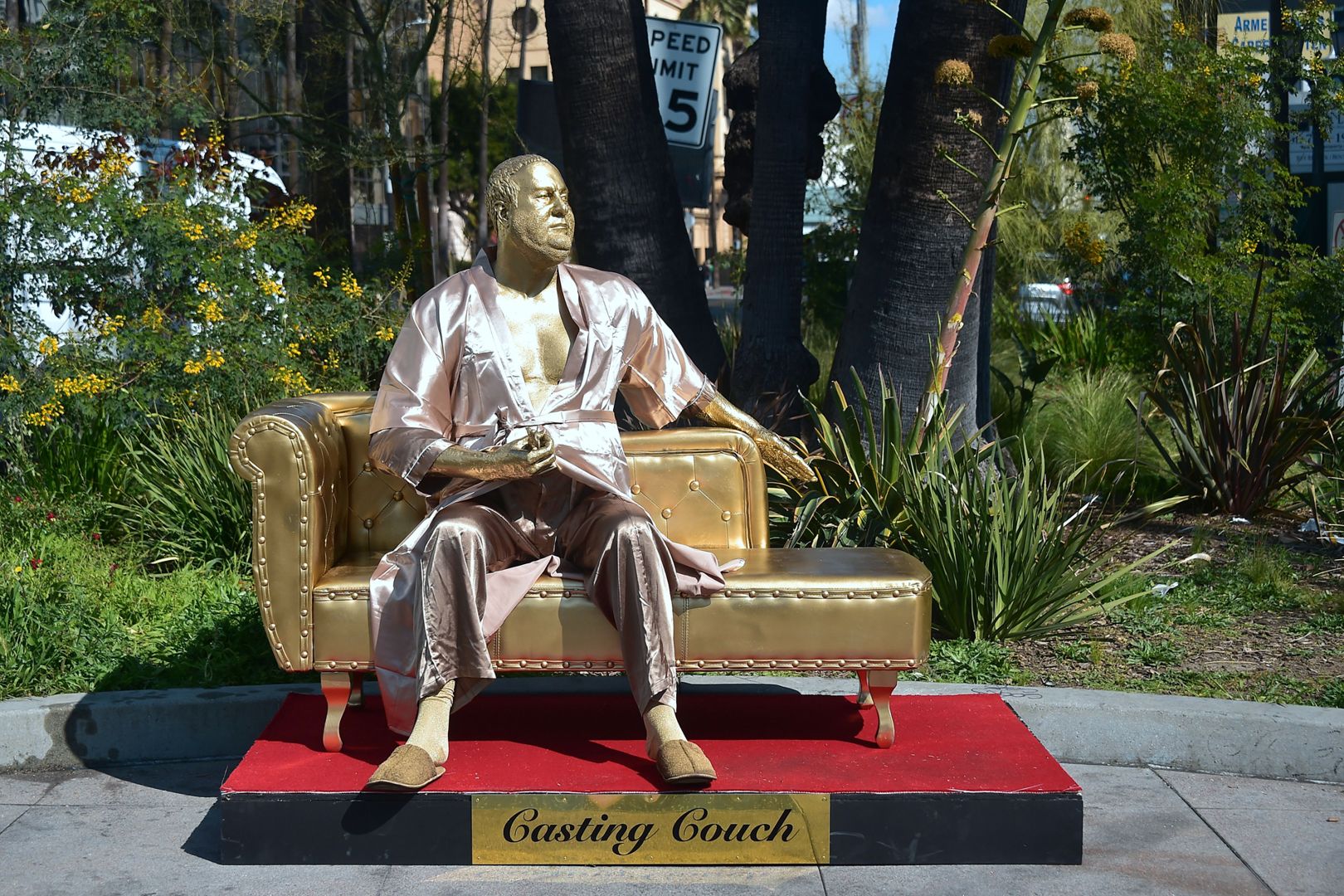
With just a couple of days to go before this year’s Oscars, a lifesize gold-coloured model of Harvey Weinstein perched on a ‘casting couch’ has appeared in Hollywood near the venue for the ceremony. In his right hand he holds an Oscar statue, suggestively clasped above his groin. The artwork is a collaboration between British-born street artist Plastic Jesus and Joshua ‘Ginger’ Monroe, the artist behind the naked Donald Trump statues. GQ caught up with Plastic Jesus this morning in LA:
GQ: What’s the message behind this piece of work?
Plastic Jesus: The idea behind this piece is that Harvey Weinstein was this iconic figure in the industry. In terms of profile, I don’t think there’s anybody to compare with him. I chose to come to LA, as so many other people do, pursuing a dream. There would have been so many people who came here hoping to be actors or actresses and the opportunity to get somewhere near Harvey for a meeting or a dinner would have been an absolute dream. For some, that dream clearly turned into a nightmare. The idea for this piece was that I wanted people to be able to come and sit down on the sofa next to Harvey. Knowing what we now know about Harvey, in terms of his abuse of power, sexual harassment and rape, what does it feel like sitting next to him? This icon who turned out to be a monster.
The Tower Bar, near the eastern end of the Sunset Strip, is one of Hollywood’s most elegant celebrity hangouts. Tucked away on the ground floor of the Sunset Tower Hotel, in what was once the mobster Bugsy Siegel’s apartment, it’s the sort of place where it’s no surprise to see Dita Von Teese waiting in a corner booth, perfectly poised in a floral Zac Posen dress.
Already the world’s most famous burlesque dancer, not to mention a model and fashion designer, Dita Von Teese is about to add another string to her bow by releasing her first album. On the self-titled record, the former Mrs Marilyn Manson eschews her ex-husband’s goth rock in favour of sensual Gainsbourg-esque seduction, on songs which were written for her by contemporary French sleaze-pop merchant Sébastien Tellier.
Over a martini, she tells us how her collaboration with Tellier came about, the highest compliment Hunter S Thompson ever gave her and discusses her reaction to the Harvey Weinstein scandal and #MeToo.
The barmaid at Gulliver’s, on Oldham Street in Manchester, spotted Mark E Smith walking in with me and had poured out a pair of double whiskeys before we reached the bar. That still left the question of what I was going to drink.
Mark E Smith, The Fall frontman who has died today aged 60, will be remembered as one of post-punk’s great frontmen, a poet with a genuinely unique and provocative style, and an occasionally combative interviewee. Along with his music, personally I’ll remember him most as one of the most entertaining men I was ever lucky enough to go for a drink with.
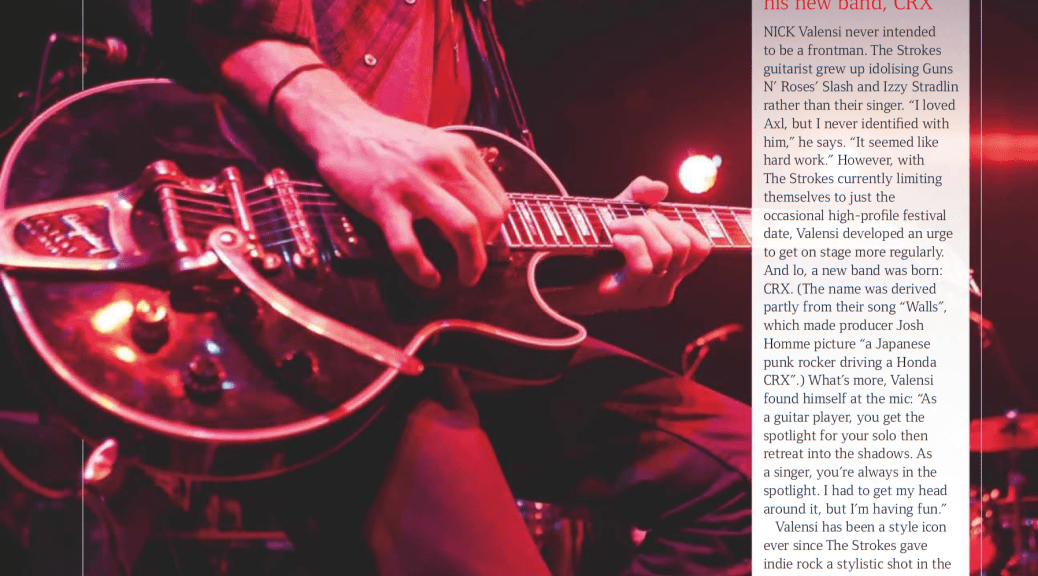
Just after 9pm on Sunday 11 August 1996, Noel Gallagher stepped on stage in front of 125,000 people for the second night running, jabbed his index finger at them and bellowed:
‘This is history. Right here. Right now. This is history!
“I thought this was Knebworth,” deadpanned brother Liam, standing front and centre. “What are you on about? ‘Ah, we’re all going to History for the weekend to watch Oasis.’ It’s not on the map, our kid…”
Both brothers were, for once, right. Oasis at Knebworth was history in the making. Those two nights in a muddy field near Stevenage were the high-water mark not just for their band but for a wave of British culture that transformed the country at the end of the last century. For better or for worse, the energy of a whole generation was coming to a head.
It was 1967 when Palm Island first got its name. Until then this speck of land in the southern tail of the Caribbean had been known by the less salubrious moniker ‘Prune Island’. In truth, it was little more than a swamp when John Caldwell first set foot on it. If you mention Caldwell’s name to any old sea salt they’ll tell you he was the mad American who set off to sail from Panama to Australia at the end of WWII in search of Mary, his wartime bride. He had little idea how to sail and not much on board beyond two cats and a book on navigation. Before long he was wrecked in a hurricane somewhere off Fiji and nursed back to health by the islanders. After he finally made it to Australia and was reunited with Mary he wrote a book, ‘Desperate Voyage’ which recounted various tall tales from his time at sea, like the time he was forced to survive by frying shoe leather in engine oil.
The experience did little to put him off sailing. In the Sixties he, Mary and their two sons chartered a boat around the Caribbean and he developed a habit of carrying sprouting coconuts which he’d plant when they made land. It was in this way that Prune Island became Palm Island, as the new trees reclaimed dry land from the marshes. In 1966 he leased the island from the government of St Vincent & The Grenadines for 99 years, at a rate of $1 per annum, with the aim of opening a resort there. He changed the name of the island, just as the islanders had changed his. By this point, everyone was calling him Johnny Coconut.
My first sighting of the island Johnny Coconut built was from the window of our little 19-seater DHC-6 Twin Otter before it turned to land on the nearby Union Island. We’d had to wave goodbye to the luxury of Virgin’s Upper Class in Barbados. Needless to say there is no landing strip on Palm Island so we made the final leg of our journey by boat. The island is just 135-acres of green, edged with a golden border and stretched almost flat in the turquoise sea. It’s the sort of desert island where, if you were to become stranded, you’d take your time about organising a rescue. It’s no surprise to learn that just a well-skimmed stone away is Petit Tabac, where Johnny Depp uttered the deathless line: “But why is the rum gone?”
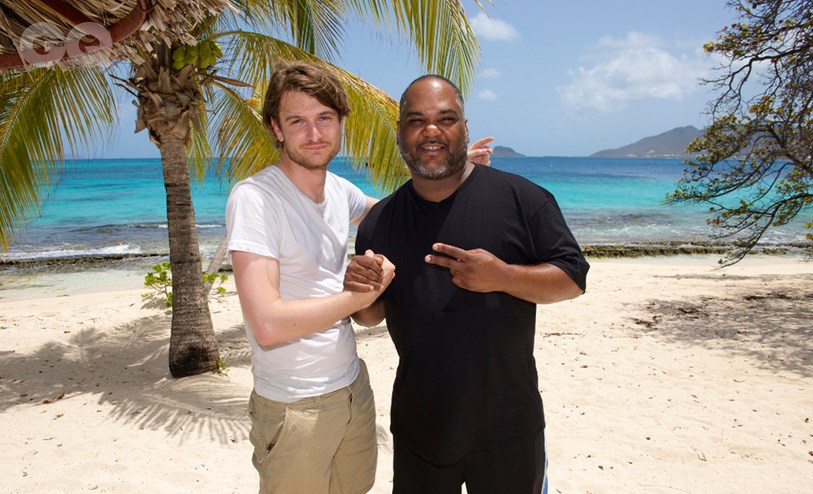
I wasn’t there to worry about pirates. GQ had asked me to go there to meet De La Soul’s DJ Maseo, who had been booked to play on the beach. It was an offer I couldn’t refuse.
The morning after we landed I went to visit Maseo at his villa. I’d been up late the night before drinking some sort of peanut-infused local rum. Maseo immediately saw that I was a man in need of help and quickly whipped up a batch of scrambled eggs. “This is the best hangover cure,” he assured me, with that distinctive laugh that Damon Albarn loved so much he sampled it for the opening of Gorillaz‘s ‘Feel Good Inc.’ With no false modesty he added: “I make the best damn scrambled eggs in the motherfucking world. I-Hop got nothing on me. Denny’s got nothing on me.” He was right too. The man makes damn fine scrambled eggs.
Later on we settled down to talk about how he’d ended up on Palm Island. “It’s been somewhat of a Bucket List thing to come to the Caribbean,” he explained. Gesturing behind him at the beach, he added: “It’s a piece of paradise. It’s very tranquil. If you have a technology habit, you might not want to be here. This is a total switch-off, where you can come to revive.”
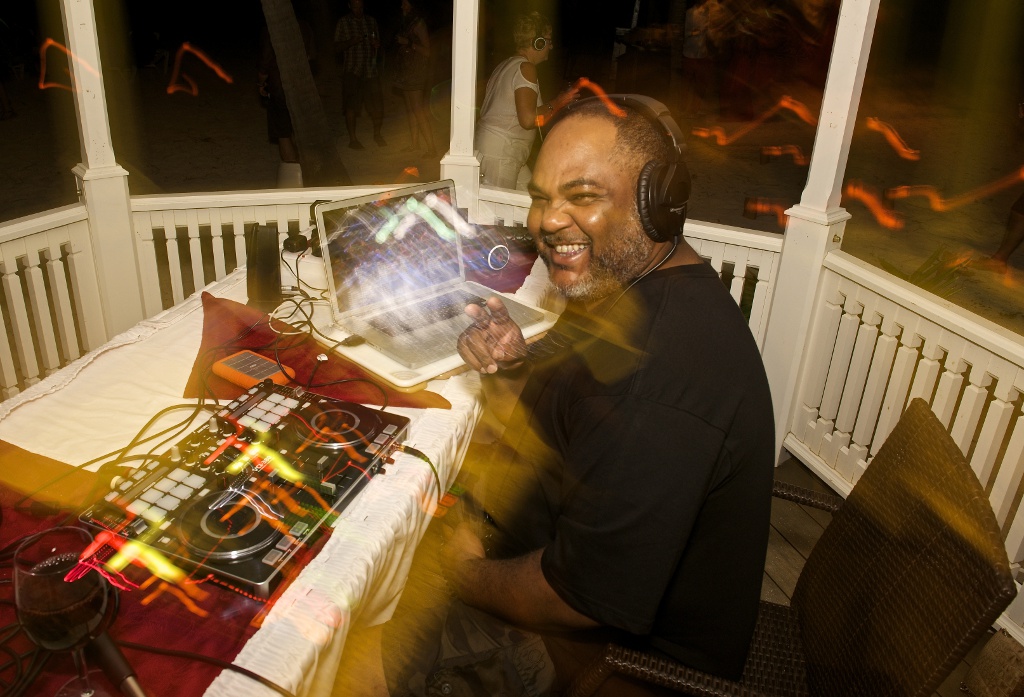
In keeping with the laidback vibe it was to be a silent disco – the first of its kind in the Caribbean and the first that Maseo had played. “The ambience of it will be really interesting,” he said. “It’s more relaxing. It’ll be cool to see people actually partying in headphones. There’s no speakers and there’s no club. It’s outdoors, but the heat won’t bother me and the wind won’t bother me in terms of what I want to achieve. It’ll be mellow.”
There was still a day to fill before the set so, leaving Maseo to his iPod and his eggs, I set off on the resort’s Catamaran Yannis to explore the nearby islands and inlets. Dotted around Palm Island are all sorts of spots where we could snorkel, chasing little fishes between the rocks and swimming side by side with sea turtles. There’s nothing that’ll remind you that you’re in someone else’s habitat faster than following a turtle while a stingray passes serenely by in the opposite direction. It’s hard to conceive that somewhere on the same planet the District Line still trundles on.
When the sun went down the party started back on Palm Island. We got out of our wet clothes and into a dry martini, or at least an excellent mojito. Maseo’s set opened with De La Soul’s greatest hits before sliding into a series of hip-hop and soul classics, and it was mellow just like he promised. You soon forgot the headphones because there are few dancefloors on the planet where waves lap gently at the edges and you can look straight up into a star-filled sky. There’s even a ‘cool breeze on the rocks’, as De La Soul once said. In that moment we were one island nation under a groove, and the great thing about being stranded in the place Johnny Coconut dreamed up is that the rum is never gone.
De La Soul are currently celebrating the 25th anniversary of 3 Feet High and Rising by playing huge shows around the world, but nobody’s enjoying 2014 more than their DJ Maseo. The man born Vincent Mason has scored the sweetest gig in music: two nights playing silent discos at a pair of Caribbean resorts. I met him at his villa on Palm Island in the Grenadines ahead of the first date at the beginning of June. He’ll play a second date at Galley Bay in Antigua in September, and both sets will be recorded for future performance exclusively on the islands. On the beach in paradise, I found the man with the most distinctive laugh in hip-hop in the mood to talk Dilla, anniversaries and red, red wine.
What’s new in the world of De La Soul?
We’re working on a new album called You’re Welcome, I’ve been working on a project called DJ Conductor and I’ve also been working with an artist called Bill Ray. For me, music these days is on a project-by-project base and is conceptual more than anything. You can never rush the art process. Touring never stops, and that’s always been a significant part of what we do. Thank God for the technology nowadays that puts you in a place where you can still create. A flight can turn into a studio session, until you have to record vocals… but then a hotel room can turn into a vocal booth.
You’re celebrating the 25th anniversary of 3 Feet High and Rising this year. What’s it like to be in that first generation of rappers celebrating seminal records?
Well, hip-hop is the youngest genre. We’ve finally hit another milestone where we have another level of rappers who’ve reached their 40s and 50s and have a certain level of success with making records. The era before us didn’t have that success with making records and them having a global appeal. There were so many of us but there’s only a select few of us that are able to tour, and that’s down to the work we put in 25 years ago and the lessons we learned from the school we were among at that time. It feels good to say that I’m part of the old school, if you want to call it that. There were a lot of lessons to be learned, from a creative standpoint, a performance standpoint and from a business standpoint. I feel good to have caught those lessons and still be doing viable business today, whether it’s DJing on my own or rocking with the group.
What do you know now that you didn’t know 25 years ago?
The music business. 25 years ago all I knew was the music I was making, but I didn’t know the business that went along with it. Now I know the business and I know my place within it. Back then the opportunities that presented themselves seemed very different because the day before I would have been mopping floors or working at a gas station.
What’s the best thing you can cook?
I do the best scrambled eggs. Don’t use oil. You gotta make them with butter. Not margarine, butter. Mix them in a bowl with a little salt and pepper. They don’t need much time on the heat, just enough to get them fluffy.
What’s your DJ ‘Get Out Of Jail Free’ card?
When all else fails, play Michael Jackson. Everybody loves Michael Jackson. There are certain people who are really fans of Prince. Prince is a great musician, one of my favourites, but he can be hit-or-miss at times in the party. I think people listen to Prince a little more intimately, you know what I’m saying?
Why did you decide to put out the Smell The D.A.I.S.Y mixtape using J. Dilla beats?
That was our way of honouring Dilla, celebrating his life as much as everybody else has and donating to the foundation. I think it came out pretty well. It’s pretty much revised lyrics from old material on new Dilla stuff, so that’s kind of cool.
What’s the on tour purchase you’ve regretted the most?
These turntable needles I brought in Japan. I forgot the names of them but they were supposed to be skip-less needles but they sucked! They didn’t hold up and the needle wore out really, really fast. They cost about $300, I was had!
What should no man have in his wardrobe?
A man should never wear a thong. Ever. Ever, ever, ever, ever. Briefs are cool, fam, but underwear up the crack? Nah.
What current hip-hop trend needs to end right now?
I can’t advocate nothing like that. That would attack the freedom. I mean, I could honestly say that based on the freedom that exists a lot of shit is whack, but I couldn’t advocate ending it because that would tamper with the freedom.
What’s your drink of choice?
Red wine. I like Merlot more than everything else. I’m still learning. I’m still a novice, but I like red wine over everything I’ve tasted.
What’s your hangover cure?
Some scrambled eggs, man! Scrambled eggs and water. Keep hydrating yourself. That’s the best way. Protein and water. That’s the best way to do it… or have another drink. [Laughs] It’s one or the other. It’s like the best way to cure seasickness: jump in the water!
What’s the most important item on your rider?
My sound specs. That’s more important than anything on the catering rider. Me, I prefer a buy-out anyway where I can go get my own food! The sound specs are the most important to me because I need to know we have the quality of equipment to make the show as it should be.
Who’s the most stylish man in hip-hop?
Puff Daddy’s very stylish. No homo. Puff always had good style and good taste. I’ve personally bought Sean John because I like it. I got some Sean John stuff free, but I’ve bought it as well because I truly like it. He’s got a good fashion sense because he knows what he wants and he knows what the people like as well.
Where’s the strangest place you’ve heard De La Soul?
Places like Lithuania, Bulgaria, Beirut… just to know that our music has been played there enough that they’ve asked us to go and play for them.
What was the best record in your mother’s record collection?
Byron Lee and the Dragons. They’re a calypso band. That group used to have the backyard parties rocking. I’ve been thinking recently about playing more Calypso in my DJ sets. Byron Lee and the Dragons and Mighty Sparrow were two Calypso records that my Mum used to love. She’s not from the Caribbean, but they were big in my household. She loved Fleetwood Mac too!
What’s the best advice you’ve ever received?
“Be yourself.” My music teacher taught me that. 25 years later I’m still the same person. You change the things that are necessary. You evolve as a person. You travel to a lot of different places and you learn new things, but I think I’m the same guy that I was 25 years ago. I’ve always been myself and been honest about my flaws. Through everything I’ve achieved, I’ve always been myself. I think that’s been the ticket to success, along with the talent and the camaraderie that I have with the two other guys. The way we came in is the way we’ll go out. Being ourselves is what truly got us this far. I don’t plan on changing. I’m in my mid-40s now. People don’t change much in their mid-40s!
Dubai’s towering skyline has erupted from the desert in just two decades, and if you’re one of the ten million tourists who visit each year you’ll know that it’s a town built on excess. It’s a city of glass summoned into reality in the middle of a desert. Pity the tireless window cleaners. Everything must be bigger and grander than everything else that’s gone before – and after a while, it all gets a bit much. When a man is tired of Dubai, where does he go?
Ras Al-Khaimah – an hour’s drive or a short hop on a seaplane – is positioning itself as the new alternative destination within the United Arab Emirates. If Dubai is where you go to shop, party and date, Ras Al-Khaimah is where you retreat to unwind in real luxury. At the Emirate’s flagship Waldorf Astoria, even the trained falcons that keep the pigeons from defacing the roof are fed only quail.
The 346-room beachfront hotel, which opened last August, is just as sprawling and as opulent as you’d expect in a part of the world where there’s plenty of land and apparently no shortage of marble. It looks and feels like a palace, so it’s no surprise when we spot Ras Al-Khaimah’s ruler Sheikh Saud Bin Saqr Al Qasimi over sushi at its Japanese restaurant UMI.
There’s a decent cocktail bar on the 17th floor, but with much less of a nightlife scene than Dubai what the Waldorf Astoria really lends itself to is a couples’ retreat. The charming personal concierge was more than happy to provide roses for the room – £41 for a dozen, although they turned their noses up at spreading them on the bed (plays havoc with the linen, apparently). They can also arrange a private dining area at Marjan, the Middle Eastern restaurant overseen by Lebanese celebrity chef Joe Barza, or organise a champagne-fuelled cruise on the Arabian gulf onboard Tony Fresco’s Freedom catamaran. There are several pools, the well-appointed spa offers a “VIP couples’ journey” and the bathroom provisions mean you never have any excuse for not smelling as Salvatore Ferragamo intended.
Less than a decade ago the main industry here was pearl diving, and companies like RAK Pearl can still let you prise your very own trophies from oyster shells. However, to really impress your date head inland into the Arabian desert where – with another quiet word to the concierge – you can arrange to explore the seemingly endless horizons by 4×4 until you see, as if by mirage, the hotel’s own staff waiting to serve high tea atop the dunes. Alternatively, maybe a champagne reception would be more appropriate – after all, it seems only right to take advantage of Ras Al-Khaimah’s offer of a certain style of decadence that Peter O’Toole, Lawrence of Arabia himself, would surely have approved.
“Hey, you’re on the telly right now!” shouts a guy sneaking a crafty cigarette in the shelter of his own doorway. Every candidate who’s ever worked a campaign trail must have wished they could be in two places at once and, thanks to the magic of television, John Bickley is. On a bitterly cold Sunday morning, UKIP’s candidate in the Wythenshawe and Sale by-election is simultaneously haranguing his Labour opponent Mike Kane for “betraying the working class” on the BBC’s Sunday Politics and out knocking on doors in the Brooklands area of the constituency. “I was just laughing at you giving it to that Labour guy,” the man with the cigarette grins. “You really let him have it!”
Wythenshawe, in the south of Manchester, is staunch Labour country and although the more affluent Sale has a Conservative-controlled council, the Wythenshawe and Sale constituency is considered a safe seat. In 2010, Paul Goggins was returned for a fourth consecutive time with a majority of over 7,000; his unfortunate death on 7 January triggered this by-election. After finishing second in Eastleigh, South Shields and Middlesbrough, UKIP believe they can repeat the trick here and in doing so strike fear into Labour in what should be their heartland.
Last week, Peter Hain vocalised this fear in an interview with The Independent. “UKIP is hoovering up the anti-politics vote,” he said. “It goes beyond Europe and even beyond immigration. Some of it is plain bigotry. A lot of it is deep, deep antagonism to the political class, of which all the major parties are part. Under New Labour – and it has still not been wiped away – there has been a big disillusionment with us as a party among white working class traditional Labour supporters.”
A morning spent canvassing with Bickley proves Hain right. Granted, at the first few doors Bickley gets the expected responses: “I’m voting, but not for you. Get out.” Or “We’re Labour here.” Then the yet more disheartening: “Oh, there’s an election? How do you vote?”
However, as Bickley works his way around the streets, more and more people start to promise him their support. A 73-year-old pensioner is keen to talk to Bickley. She says she feels disillusioned with Labour and even more so with the coalition government. “It’s disgusting what they’ve done to the pensioners. They’ve taken money off us.” She brings up immigration straight away: “What are they letting all these foreigners come in the country for? This is what I can’t understand. People want jobs and they can’t get them because of the Polish and what have you.”
A handful of people tell Bickley they’ve given up on politics as a whole, but just as many present him with the opportunity to win them over for the same reason. He’s “not like the others”. Bickley has a smart response whenever people bring up Labour, as they inevitably do: that his family were Labour voters, but that he feels let down by them. This strikes a chord with a woman in her mid-forties. “I’ve always been Labour but I’ll vote UKIP this time,” she says. “My parents were Labour, and my husband’s parents. Just the last twelve months we feel totally let down with everything that’s happened.” As Bickley leaves, she shouts: “Good luck to you!”
Before long, two or three houses in a row start telling Bickley he has their support, and he’s tallying up as many yeses as nos. While privately he admits that he still expects Labour to win – particularly due to the short timeframe the election has been run over and the prevalence of postal votes, which Labour have been encouraging people to return early – it’s difficult to come away without a sense that UKIP are proving attractive.
“I think you’re picking up a flavour there of people’s frustration,” Bickley says when we duck back into the car to warm our frozen fingers. “They perceive the political class as ignoring them and favouring non-British citizens.”
It’s striking how rarely Bickley, or indeed any of the other UKIP activists on the campaign trail directly bring up withdrawing from the European Union. While the party may have formed back in 1993 as a single-issue party, their ambitions are now much broader. They campaign primarily on jobs – which are then linked back to immigration – and foreign aid, which they believe should be suspended in order to divert that money to help people affected by flooding in the South West.
There’s a sense that UKIP are attempting to be all things to all people. While they can campaign on tax cuts or social conservatism in the south, here they want to present themselves as a working class party to fill the void left by Labour. Bickley says this is why they’re taking votes from both sides. “These voters will never vote Tory,” he says. “Maybe 30 years ago they briefly lent Thatcher their vote, but I don’t think that will happen again. They’re looking around, and they’re starting to listen to what UKIP has to say.”
In the hotel bar at the Britannia Airport Hotel, UKIP supporters who have come from across the country to attempt to sway the undecided gather for pints of Tetley’s. It’s fair to describe them as enthusiastic amateurs, rather than cadres of slickly professional politicians – and that’s a badge they’d wear with pride. One thing mentioned time and again is a disillusionment with being represented by career politicians with no life experience outside of Westminster. James Hadfield-Hyde, who nominated Bickley and is out supporting his campaign, once presented a Granada television programme as ‘Lord Lust’. That’s certainly a life outside politics.
Tony Hooke, a county councillor from Hampshire, describes joining UKIP as an act of “rebellion”: “People are sick and tired of the way the Conservatives, Labour and the Liberals are fighting over the same middle ground. You could interchange any of the party leaders and they’d be at home in their new parties.”
Melanie Hurst, the Chairperson of UKIP’s Tynedale branch, adds that their mere presence has already invigorated local politics. “Where I live locally we’ve seen real improvements since we set up our UKIP branch. We’ve seen our MP out knocking on doors in villages that he’s never set foot in before in his life.”
Nigel Farage wants more. The party seem hopeful that a strong showing in May’s European elections could set them up to take a scalp in next year’s general election. Judging by the palpable anger against the political class on the streets of Wythenshawe, you wouldn’t want to bet against them pulling it off.
It’s easy to poke holes in UKIP’s belief that withdraw from Europe would be a panacea for all of Britain’s ills. For a start, this week the Financial Times dampened their mass immigration argument by pointing out that the number of European migrants in the UK is almost exactly balanced by the number of British people living in the EU. (2.2m people have gone in either direction, with over 1m Brits now living in Spain alone.) Furthermore, their uncomfortableness with same-sex marriage seems out of step with the country at large and it’s not clear that their proposed flat rate of tax adds up. But it almost doesn’t matter if their policies are thin and their budgets uncosted, as long as they can tap into the wellspring of anger at how remote Westminster appears when viewed from the rest of the country.
At first glance, there might appear to be little in common between Nigel Farage and Russell Brand, but in fact what’s powering UKIP at the moment is the same sense of dissatisfaction that Brand tapped into in his much discussedNewsnight interview. Farage would almost certainly have nodded along with Brand’s description of the “weariness and exhaustion from the lies, treachery, deceit of the political class” and his description of a “disenfranchised, disillusioned, despondent underclass that are not being represented by that political system.” The difference is, Brand isn’t on the doorsteps of Wythenshawe preaching about social justice. UKIP are, here to offer up Europe as a scapegoat.
There’s an alternative narrative to be told – one that talks about the value of European integration and the worth of foreign aid – but for the people out in the cold in Wythenshawe who are disillusioned with the mainstream political class as a whole, right now UKIP are the only game in town.
People say that port gives you monstrous hangovers. People would be wise not to say that to Tim Stanley-Clarke. “Bullshit!” is the port expert’s robust assessment. “And I speak from years of first-hand research.”
Stanley-Clarke, who works for the Symington Family, owners of various famous port producers including Dow’s, Graham’s and Warre’s, is on a mission to see Port restored from its current position languishing as a night cap – the real reason he thinks it gets the blame for hangovers is that it tends to arrive at the tail end of a night of drinking – to a wine to be enjoyed over a long and sumptuous dinner.
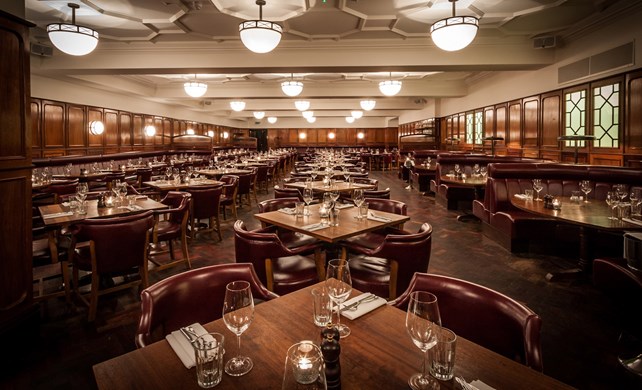
Fortunately, we met at Hawksmoor where they do that sort of thing rather well. While the Graham’s Fine White Port, served with scallops, is too sweet for our taste, the Graham’s 20 year Tawny Port makes Stanley-Clarke’s case. It’s rich with a long, smooth finish and not entirely unreasonable at £35 a bottle. It holds its own paired with Hawksmoor’s Tamworth Belly Ribs, which is so soft and tender you lament for every time you have to eat pork cooked any other way.
The real star of the night though is Graham’s Quinta dos Malvedos 2001 Vintage Port, which comes exclusively from the company’s famed flagship vineyard and is blessed with a rich blackberry taste, a long finish and a £24 pricetag. And the best part? No hangover.
“My personal opinion is that if someone writes honestly about war, it will inherently be anti-war,” says Kevin Powers, with the authority of experience. “I can’t think of any situation in which you could write a pro-war book that would be intellectually or emotionally honest. It doesn’t seem possible.”
Powers’ experience didn’t come cheap. He served as a machine gunner and in bomb disposal squads with the American Army in Iraq in 2004 and 2005. After leaving with an honorable discharge, he wrote his debut novel, The Yellow Birds, which deals with the bond between soldiers on the battlefield and takes its title from an old military marching song. Compared favourably to the work of Ernest Hemingway and Cormac McCarthy, the book won him an armload of prizes and fans including Damian Lewis, who described the book as “a poetic and devastating account of war’s effect on the individual”, and Tom Wolfe who called it “the All Quiet on the Western Front of America’s Arab wars.”
Over coffee in London’s Marylebone, a world away from conflict in the Middle East, Powers discusses the unlikely music that takes him back there, why he wrote in secret and the politics of the war in Iraq from a soldier’s vantage point.
GQ: When you joined the army did you already feel like a writer, or was it a case of coming back with a story to tell? Kevin Powers: Writing was always an aspiration, but I’d kept it a secret even from myself. As a teenager I started thinking about poetry and novels seriously. I started writing, but never thinking it would be anything other than a hobby. It wasn’t until after I came back that I felt that I didn’t have anything to lose. Failure was no longer the biggest fear that I had faced in my life.
How old were you when you enrolled in the army? I signed up when I was 17 and went overseas when I was 23. I’d been in the army for a little while before I saw any kind of action. There were a number of reasons for joining up. The male role models I had all seemed to have been in the military. My father served in the army. My uncle was in the Marine Corps. Both of my Grandfathers served in WWII. There weren’t any career soldiers in my family, but when I was young it seemed like a way of arriving at adulthood. I wasn’t a particularly good student but I wanted to go to college. It can be really expensive to go to college in the States, so the financial aspect made military service very attractive. Also the other obvious reasons: I was young and I wanted to see the world and experience some kind of adventure.
If The Yellow Birds had a soundtrack, what would be on it? About once every month we’d get to go to this little airfield where they had a PX, which is basically a little store. As you’d imagine, they have a very limited selection of music. I remember getting Weezer’s Blue Album, and I discovered this guy called Graham Lindsey who I don’t think is well-known at all. He’s this folk Americana guy who sounds like Justin Vernon would if he lived in a ditch. It’s really raw and beautiful. He has this album called Famous Anonymous Wildernes that I listened to all the time when I was over there.
What’s the best book about war? Probably the book that really consciously influenced me is a really amazing Vietnam novel called Meditations In Greenby Stephen Wright. That book is so strange and beautiful and unlike any other war narrative that I’ve ever read. It made me feel that I was free to follow my imagination and write the story that makes sense to me. I’ve read a lot of novels and poetry about Vietnam written by veterans. As important as those were to read as both a veteran and a human being in the world, just seeing the variety of different stories that are out there just gave me the sense that I was free to approach it whatever way I wanted to.
How did serving in Iraq change you? I think the long-term effect, unsurprisingly, is that it’s made me really appreciative of how lucky I am to have survived. I think I have a sense of gratitude for things I may not have appreciated otherwise. You naturally mature during those years anyway, and I like to think I would have arrived at those kinds of things on my own, but that experience concentrates everything. You see things with a sharper focus than you might otherwise. You also learn that what you thought were your limits are not your limits. You endure more than you thought you could.
Were you writing while you were in the army? I was writing – secretly. I didn’t really want to announce to my platoon mates that I was a wannabe poet. When I got overseas I would jot things down in a journal but not real attempts at poetry or stories. I didn’t have the mental energy for that.
What were you reading in Iraq? I read a lot more than I wrote. My mother would send me care packages. She sent me Graham Greene’s The Quiet American which was sort of strange – but that’s my mother! On a few occasions I’d have a book in my pocket while we were out on patrol. Not that I was reading then, but maybe it operated as a kind of talisman. It made me feel a little more comfortable: “This is insane, but at least I understand what’s happening here in my book.”
Did you learn much about Iraq itself or was it an insular barracks existence? There’s a very high degree of isolation, just for security reasons. There were some occasions where I thought I was getting a window into the experiences of the people for whom we were allegedly fighting, but oftentimes “going outside the wire” meant adopting a totally different mindset. You’re on a small base not really coming into contact with locals at all. The way that my unit operated, because of the job we had, was that we’d spend 48 hours outside the wire then come back for 24 hours. When you go off the base it’s like flicking a switch and all of sudden all you’re thinking about is making sure that you come back. You need to make sure that you’re looking out for your friends. There was one instance when we stopped on patrol and I looked over at this mound and thought: “Oh s***, those are the walls of ancient Nineveh.” It was a surreal experience to be in the land where civilisation was born and be engaged in the kind of violence that we were engaged in. There’s a dissonance which is unavoidable.
How close is the book to your own experience? The specifics of the story aren’t necessarily actual events that I experienced. Really what I was trying to get at was some sort of emotional core. In terms of survivor’s guilt, even though I never lost anybody as close to me as the character in the book, when I came home there was definitely a period, particularly with the war still going on and with people still dying, the question become unavoidable: Why did I survive? Why didn’t these other people? I’m clearly no more worthy of surviving as these people, perhaps in some cases less so. Who knows if one of those guys might have cured cancer? You absolutely start to wonder if it’s purely chance. How does it work? Having survived, what is your responsibility going forward? Those are all things that I tried to put into the process that he goes through of coming to terms with what he’s experienced.
When you were writing the book were you conscious of making a political statement? I’m aware that it’s unlikely anyone will read the book without thinking about the political ramifications of our time in Iraq and what it means. I tried to avoid having a political agenda. I wanted to tell one guy’s story, so that no matter what you think about the war itself perhaps by narrowly focusing on this guy’s story somebody could connect on an emotional level. Obviously this is a subject that I’ve thought some about. As much as I wonder what we accomplished, there were instances when I was able to see some good. I spent some time in a predominantly Kurdish area and those people perhaps were better off than they had been under Saddam, but when you think about what the military action entailed and the reasons that were given to justify it there is a disconnect that I haven’t been able to make much sense of.
As soldiers were you aware of the public debate and the protests about going into Iraq? It’s probably different for each person, but I don’t think it would have come as a great surprise to anybody. When I went to Iraq we as an army had been there for a little less than a year and no weapons of mass destruction were turning up, nor would they. That was no secret to the soldiers. They weren’t asking us to keep our gas masks on, if you know what I mean? At the same time, your primary focus is: “Alright, we’re here, this may be bullshit but the fact that it’s bulls*** isn’t getting us home, so we have to look out for each other.” That becomes the only thing that you really focus on. My process of sorting through my culpability, my participation in that, was something that I had to do the real hard work on after I got back. Only when I came back and was safe did I start trying to come to terms with what it meant to have fought in a war that we may not have needed to fight at all. I’m not sure what we’ve accomplished. To be perfectly honest I haven’t arrived at any sort of answer that gives me great comfort.
What advice would you give your younger self? I’ve thought about that a lot. I wonder if my younger self would listen. I feel like I had all the information available to me to make the right choices but when you’re 17 you hear what you hear. I would probably say the same things that were said to me by the people that cared about me. That this is a serious thing you’re doing. Joining the military is not to be taken lightly. You’re putting every part of yourself at risk, not just your body but your moral and spiritual centre. That can be injured grievously as well. Even if you think you’re physically invincible, as many 17-year-olds do, there are other ways to become wounded. That’s probably what I’d say, but who knows if I would have listened?
“’E started it! Not me. It was ‘im. This is the man I told you about. He got me into trouble…”
The first words Hunter Thompson ever wrote about Ralph Steadman were filled with foreboding: “All I knew about him was that this was his first visit to the United States. And the more I pondered the fact, the more it gave me fear. How would he bear up under the heinous culture shock of being lifted out of London and plunged into the drunken mob scene at the Kentucky Derby? There was no way of knowing.”
That was in 1970, when Scanlan’s Monthly decided to pair Thompson not with a photographer but with an illustrator already known for his vicious eye for satire. The piece they created together, “The Kentucky Derby Is Decadent And Depraved”, became the world’s first taste of “Gonzo journalism”. It was the start of a partnership that would go on to produce 35 years of brilliant and iconoclastic work, including Steadman’s intense and visceral illustrations for Fear And Loathing In Las Vegas and a whole series of lurid Rolling Stone covers.
When we meet on London’s Southbank, Steadman is on the hunt for Sauvignon Blanc. We’re here to talk about For No Good Reason, an honest and candid documentary about his life and work that he’s put together with the help of Johnny Depp and the filmmaker Charlie Paul. The conversation soon turns to powerful hallucinogenic drugs, why America’s “heinous culture shock” was the best thing that ever happened to him and the true meaning of Gonzo.
GQ: You say in For No Good Reason that you want to use your art to bring about social change. Where did that impulse come from? Ralph Steadman: Well, that was the bullshit I used! I actually did want to change the world. I decided that I wasn’t just going to be an advertiser. I had worked for an advertising agency, I had worked in Woolworths and I had worked for de Havilland Aircraft Company, where I was going to be an engineer. That all went out the window. I took a course when I was doing my national service. I saw an advert for Percy V Bradshaw’s Press Arts School Course. It read, “You too can learn to draw and earn £££s.” It was a bit of an old fashioned course, but it got me going. I started sending pictures to the Aberdeen Journal, the Leicester Mercury and the Manchester Evening Chronicle. The very first cartoon I had published was at the time of the Suez crisis. It was a lock-keeper sitting in his chair looking at a newspaper and saying, “Nasser, who’s he?” It seems rather a long time ago now. All those guys are gone and I’m still here.
Having lived through the events of The Kentucky Derby Is Decadent And Depraved, were you surprised when you first read the piece? I was quite flattered to read what he’d said. “Waiting for Steadman…” became one of our things! He invited me to meet some of his old friends. There was a girl there and I started drawing her. She says, “I’m purdy, aren’t I? You ain’t drawn me purdy! Why aren’t I purdy?” I said, “Well, you have a go. Draw me.” She went crazy with anger because she couldn’t get anything down without a scribble. That’s when Hunter said, “Stop doing those filthy scribblings, Ralph! You’ll get us thrown out.” He took me to the airport and threw me out. I think he says I was half-naked at the time. I wasn’t really, but Hunter embroidered the truth. It was truth and it wasn’t truth. Hunter told me I’d lost it, and I didn’t think he’d ever invite me back. I didn’t think Scanlon’s would either, but then they did.
After the Kentucky Derby you went to cover the America’s Cup yacht race together… That’s the one! That’s the only time I took drugs. Psilocybin. If I’d have completed what I thought I was going to do I’d never have left America. Hunter had got these spray cans. I said, “Why did you bring those along?” He said, “I don’t know. I thought maybe we could use them.” We had a few drinks in the bar in Rhode Island. Hunter had a Lille flare gun with him. He kept that on him, “You never know when you might need a thing like this.” We had drinks then went back on the rowing boat to the three-masted schooner we were staying on. Then we took off in the boat, me with the spray-cans and Hunter trying to row. The oars were coming out of the rollicks. I can seem him now, with his legs in the air. “Fuck this goddamn boat. Hurry up and do the job!” I was to write “Fuck the Pope” on the side of one of the boats. It was the Gretel and the Intrepid. They were beautiful things, worth £500,000 each. If I’d done it I don’t think they’d have let me leave America. Luckily we were caught. Someone had shouted down, “Excuse me, what are you doing down there?” Hunter said, “Oh, we’re just looking at the boats.” Unbeknown to them was what I was planning under the influence of that drug. Luckily I didn’t do it. It makes a better story than it felt in actuality at the time. It was terrible.
I remember getting a plane back to New York and for some reason I wouldn’t sit down for the whole journey. At the time you could smoke and walk around, there wasn’t security like there is now. I just refused to sit down. I got back to New York and I remembered I’d met a lady in Italy who’d said, “If you’re ever in New York…” I remember ringing her and saying: “I’ve just been on this terrible journey with Hunter.” I went to see her and she got me a doctor. He put me out for 24 hours. I’d got myself into a bit of a state. It’s weird that Jann Wenner says I’m crazier than Hunter. It’s not true.
George Plimpton met you and Hunter in Kinshasa when you were all there to cover Muhammad Ali’s “Rumble In The Jungle”. He wrote: “[Ralph] seems to pep things up, and inspire a corporate rather than an individual madness”. That’s rather a good quote, isn’t it! Dear old George Plimpton. I mean, everybody was there. There was a queue of all the greatest names you’ve ever heard of from the journalists of the time. They were all queuing to get out of Kinshasa. That was surreal. I don’t know if anyone got any film of that line of great journalists.
But Hunter didn’t finish the story. Rolling Stone editor Paul Scanlon told us you were very angry, because that meant they didn’t use your pictures. Did you worry Hunter had lost it at that point?
No, they didn’t use them and I’d done all these pictures! Hunter was still producing, in a way he was just about to begin. I think I was a bit upset because I considered it to be one’s duty to fulfil the assignment. That was important. I went out there always with a sense of responsibility. I’d get as crazy as I could but I’d do the job. I did what I was being paid to do, or not paid to do. Half the time I never got paid, but it was something to do.
Were you more reliable than Hunter?
He had to see the work before he could write anything. Then he said to me, “Don’t write, Ralph. You’ll bring shame on your family.” I did the drawings first. He used to say he’d “get off the back of them.” “You do something, Ralph, anything. I’ll write after that.”
In 1980 you worked together on The Curse Of Lono book, the only time you shared equal credit. How did that come about?
With him saying, “Ralph, we’ve got to go join the marathon.” I spent some time in Honolulu and thought there was a book there somewhere.Hunter wanted to call it The Hawaiian Diaries. I thought that was a boring title. I’d heard about Lono, this god figure rowing away into the distance across the sea. I suddenly thought: Hunter’s the god Lono. Hunter was always on about the curse of things, so I thought: “We’ll call it The Curse Of Lono.” I did the drawings first. Hunter wanted to hang them up, so he pinned them up all around in Owl Farm and wrote with them as a background. We split the credit on that one.
What did you think when you were first sent the manuscript for Fear and Loathing in Las Vegas?
I recognised the process. He was with his “Samoan lawyer”. In some ways I’d been dropped. I think he wanted to go with somebody who could represent him if he got into difficulties. The Samoan lawyer was more useful than the mad “English” artist. I couldn’t argue with that. He’d already done it, anyway. He’d taken off in this car, but I knew exactly what it was like to do it when I drew the illustrations like the hitchhiker. The art intrudes over the text. There’s someone leaning on the letter ‘E’, sort of a Kentuckian. That was a nice thing to think about and work on. I think Rolling Stone were quite trailblazing at the time. It was a hell of a good thing. The best thing I did was go to America in 1970. I found out about things that weren’t in your local paper.
Did going to America also give you an enemy to fight?
I hated Nixon so much. I felt it was my duty to destroy him somehow. Drawing became a weapon. If I had a long nib I could have stabbed him with it, but instead I had to do it on paper. In some ways, drawing has always been for me a very real alternative to violence. “The only thing of value is the thing you cannot say.” Wittgenstein said that. That’s true, but you can draw it. Drawing can, sometimes, in just a few lines say what you’d want to say in a long paragraph.
What’s your proudest achievement?
I think I Leonardo is the most comprehensive set of pictures I’ve ever done. It was very personal. It meant a lot to me, to do. I did a book about God as well, called The Big I Am. That was quite interesting.I was able to play God, just as I had “become” Leonardo. When I did a book about Sigmund Freud I was lying down on the floor in his actual consulting room, looking up at the ceiling and imagining what it was like to have him standing above you. That all became part of the book. I think process is really quite important when you’re doing anything.
That’s a very Gonzo idea, to place yourself inside the story.
You become the story. That’s what Hunter always liked the idea of best. Don’t stand back and do it like an official bank clerk filling in a form. You’re actually creating the story as you go. There is no story, until you start one. That’s how we did it. That’s why it always was fun. That’s why it was hopeless when he killed himself.
How did you learn he’d died?
It was from my friend Joe Petro III, a screenprinter from Louisville, Kentucky. He rang up in the middle of the night on February 20th, 2005. He said, “Take your phone off the hook, Ralph. Hunter’s just committed suicide.” It was… a downer. I think it’s remained so, although I’m still doing my own thing. I’ve been thinking what a dimension to my life Hunter has been. I couldn’t imagine living life without the kind of stimulus that came from him. People are still interested in Hunter the man, crazy man that he was. He was physically big. Enormous. He had a head like a lump of granite.
Do you have any regrets?
You can’t. It’s past! It’s gone. No regrets. The best thing I did was go to America and get work from Scanlan’s magazine in New York. Scanlan was a little-known Nottingham pig farmer – that’s how it got the name. Their whole quest was to impeach Nixon. I went along with that idea.
In the end, did you change the world? I think the world is worse now than when we started. That’s really what happened. It’s awful now.
Originally published by British GQ.
Kevin EG Perry is a writer for The Independent, The Guardian, GQ, NME, Empire, Wallpaper*, Vice, Lonely Planet Traveller and other reputable publications


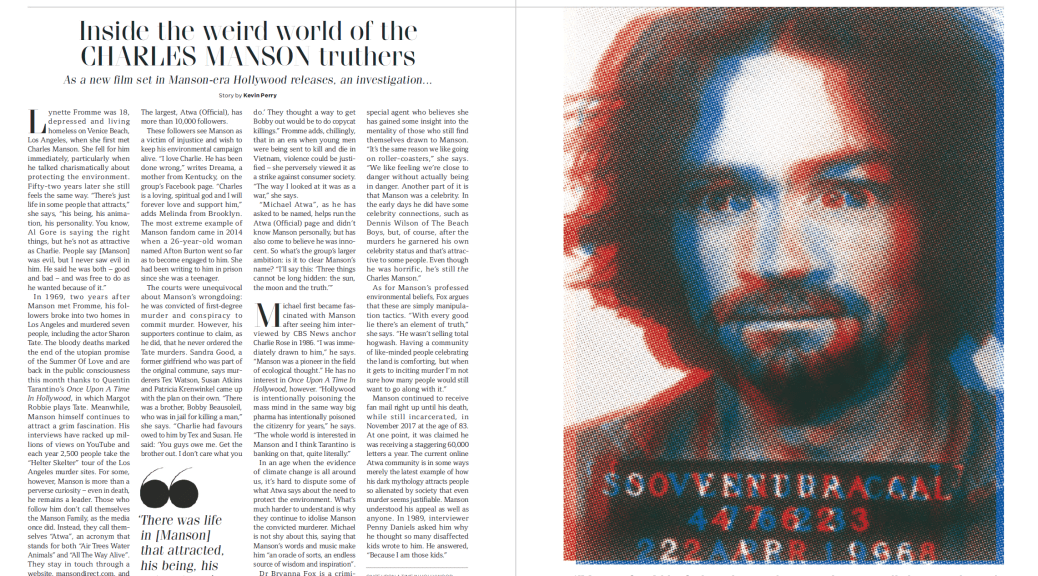
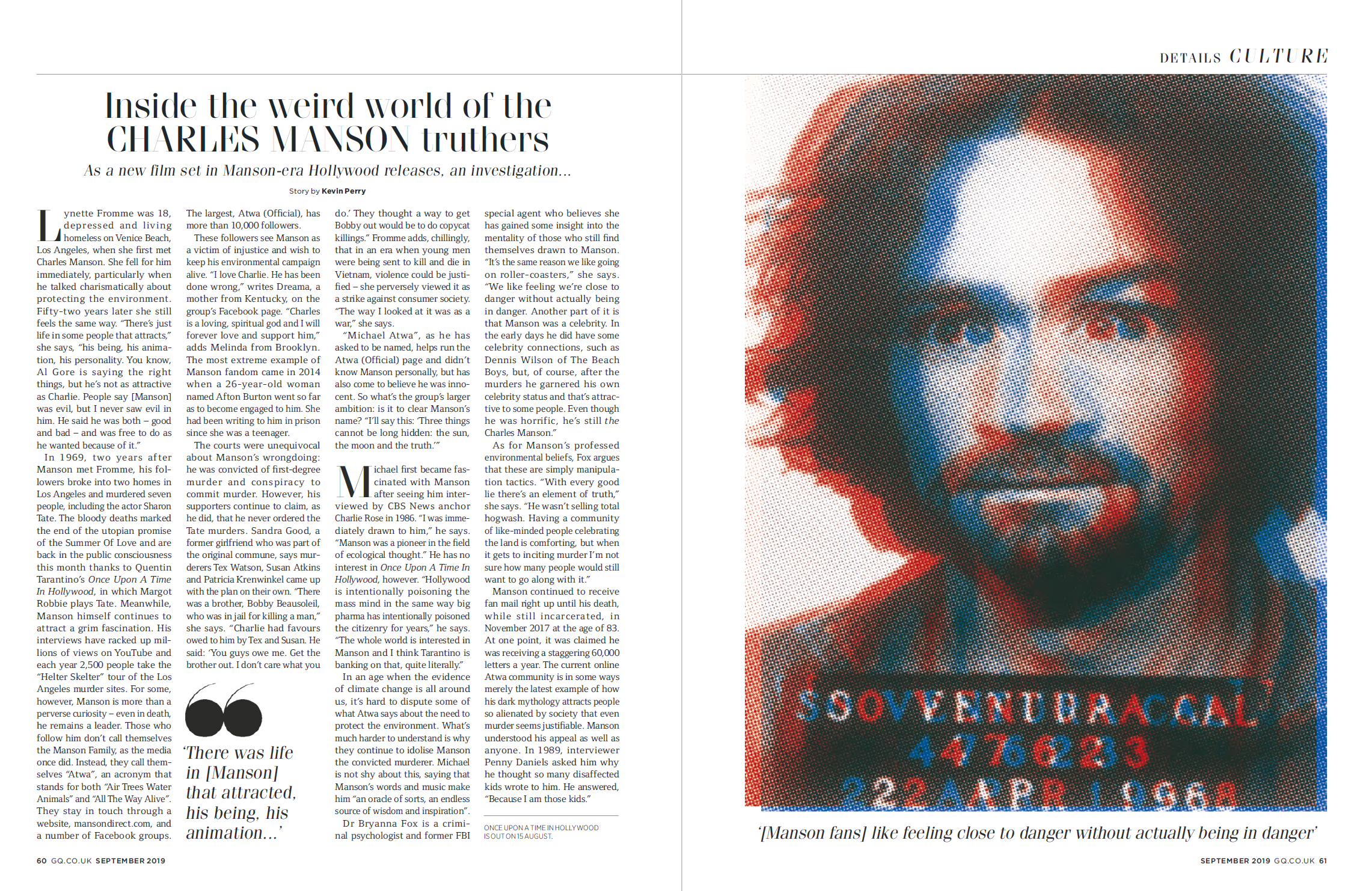 Lynette Fromme was 18, depressed and living homeless on Venice Beach, Los Angeles, when she first met Charles Manson. She fell for him immediately, particularly when he talked charismatically about protecting the environment. Fifty-two years later she still feels the same way. “There’s just life in some people that attracts,” she says, “his being, his animation, his personality. You know, Al Gore is saying the right things, but he’s not as attractive as Charlie. People say [Manson] was evil, but I never saw evil in him. He said he was both – good and bad – and was free to do as he wanted because of it.”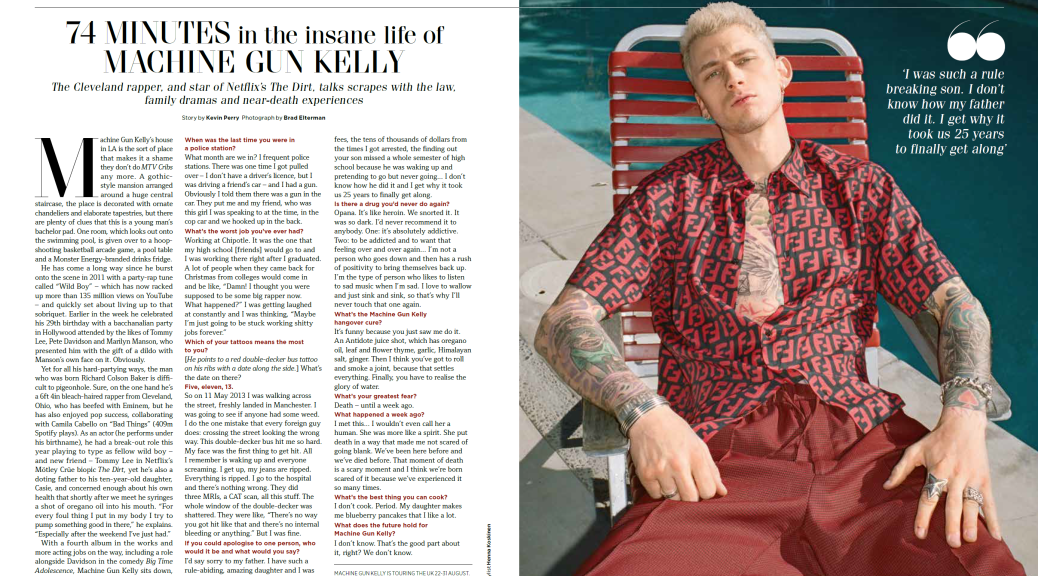
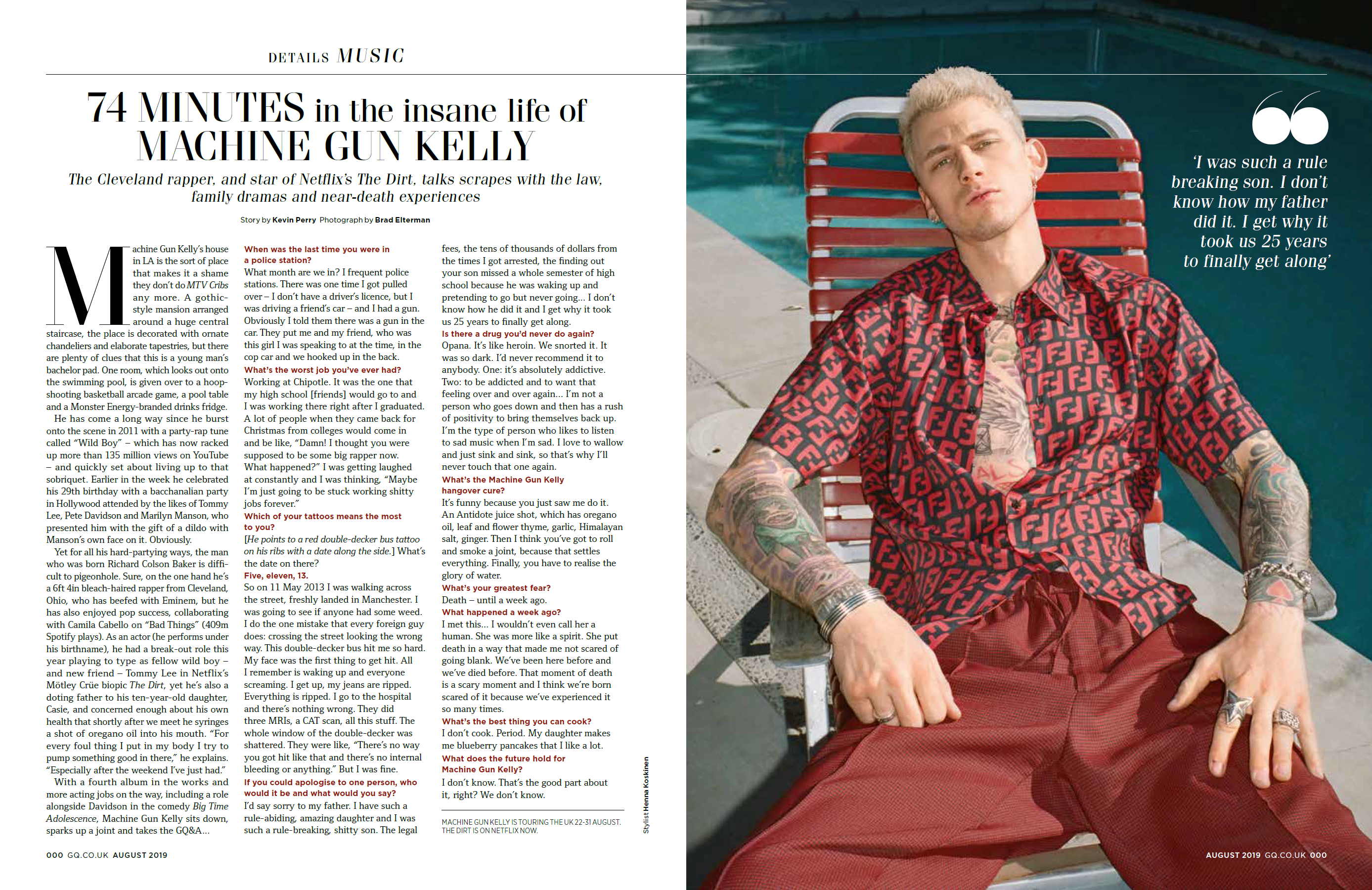
 Machine Gun Kelly’s house in LA is the sort of place that makes it a shame they don’t do MTV Cribs any more. A gothic-style mansion arranged around a huge central staircase, the place is decorated with ornate chandeliers and elaborate tapestries, but there are plenty of clues that this is a young man’s bachelor pad. One room, which looks out onto the swimming pool, is given over to a hoop-shooting basketball arcade game, a pool table and a Monster Energy-branded drinks fridge.
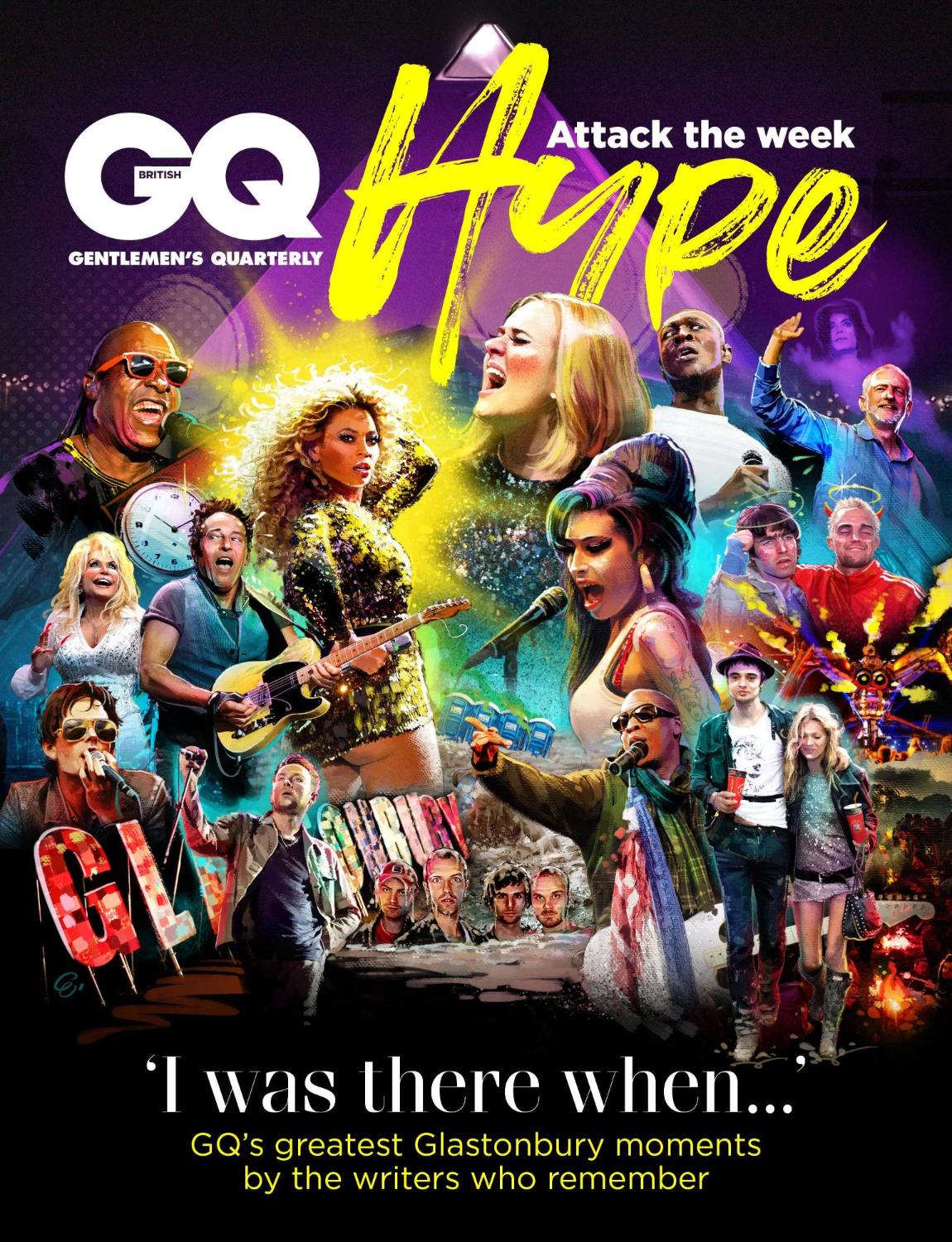 When Leonard Cohen did not go all the way to Glastonbury to fool us, 2008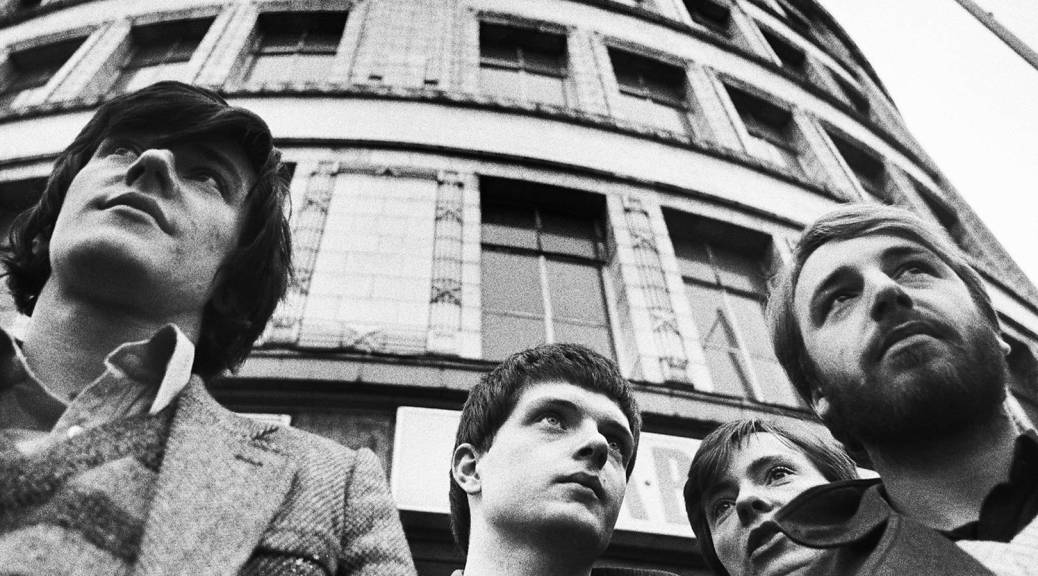
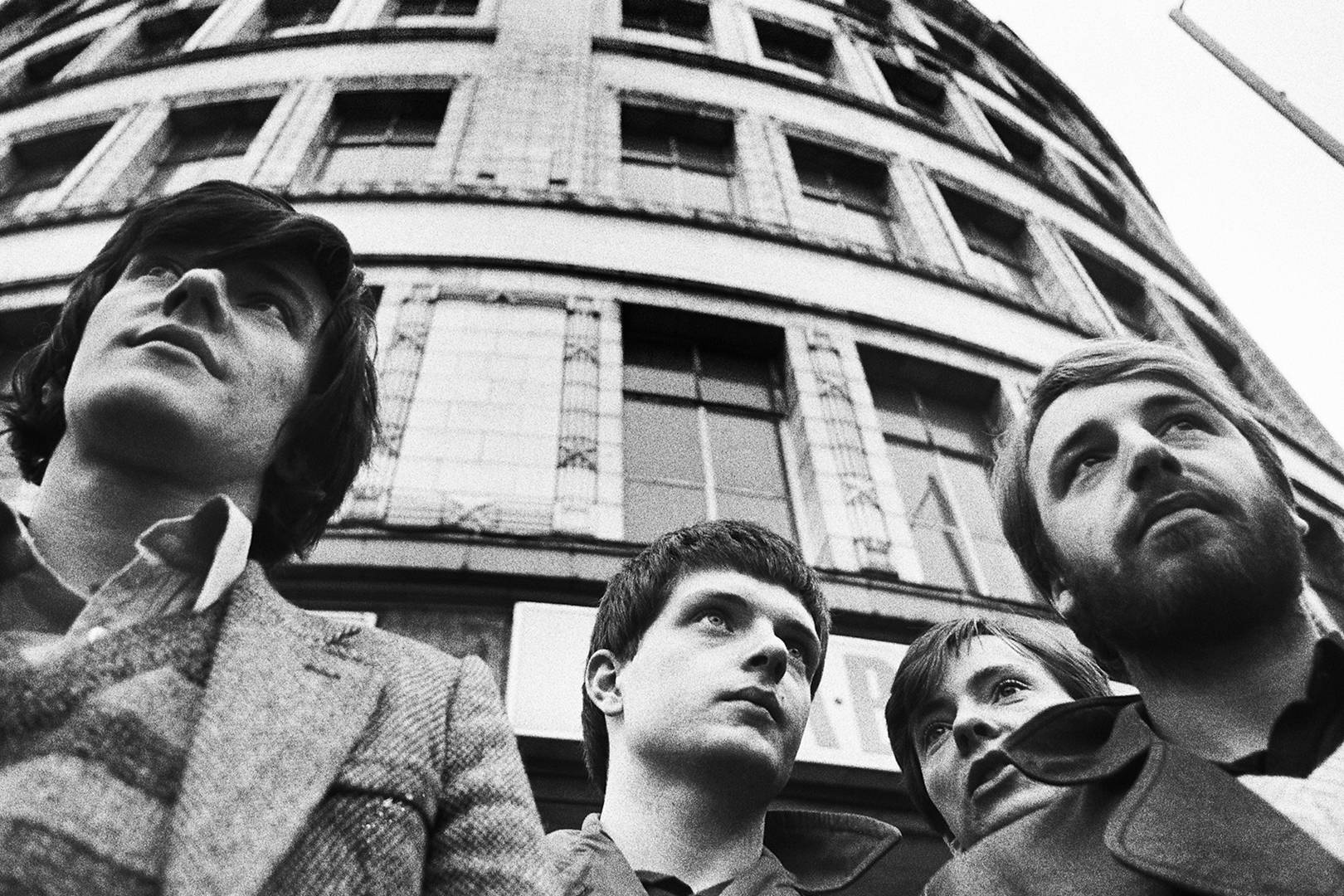 It’s been 40 years since Joy Division released their debut record Unknown Pleasures, an album that has done more than any other to teach us what the radio waves from pulsar stars look like.
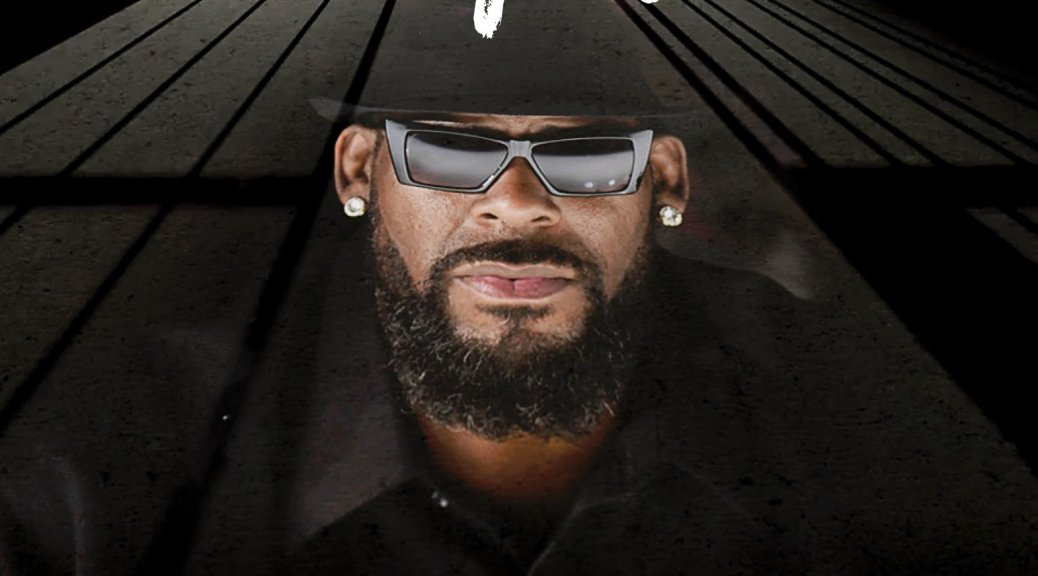
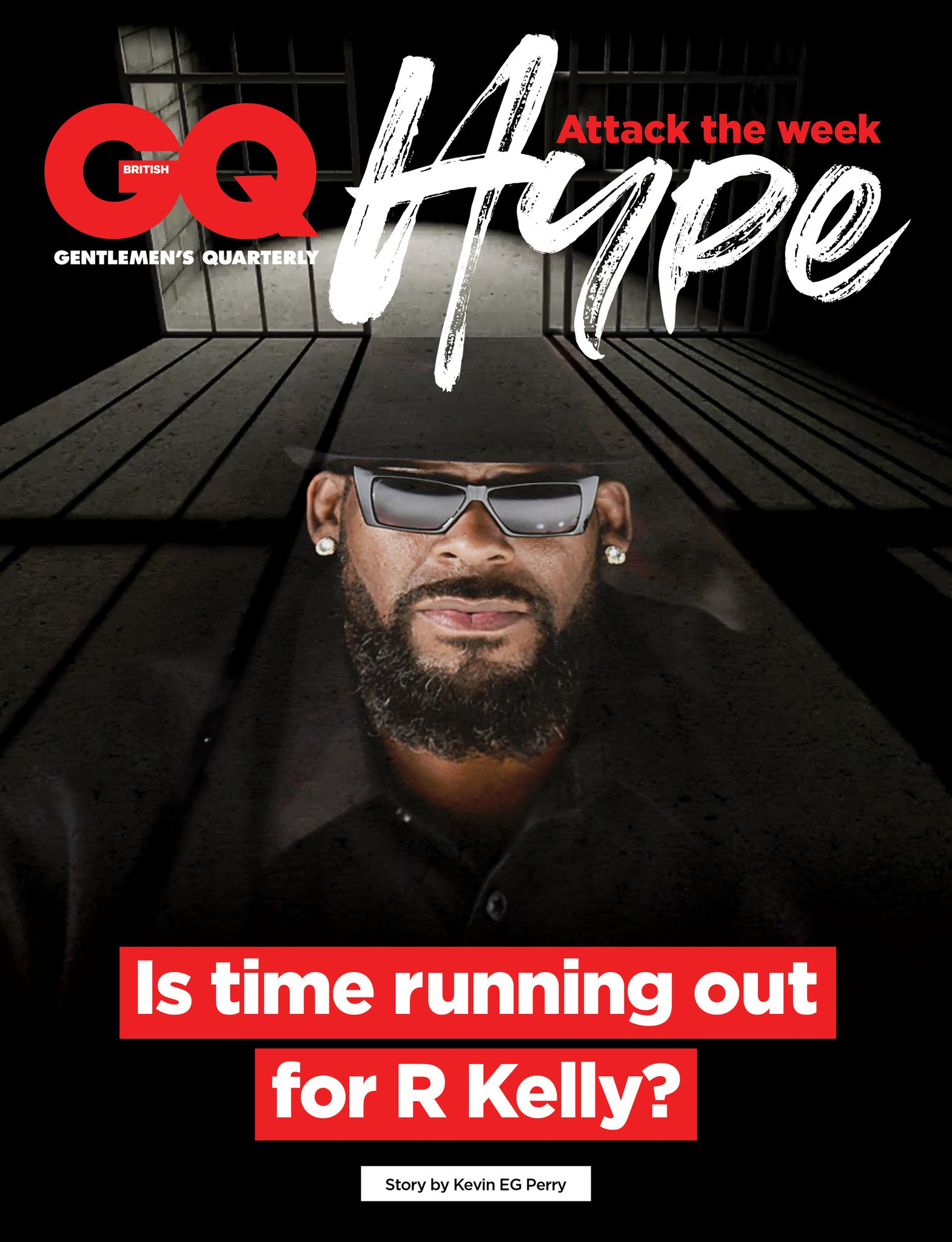 Lizzette Martinez was a 17-year-old high school student hanging out at the mall in Miami when she met R Kelly by chance in 1995. Despite the incongruous setting she recognised him immediately – the previous year he’d had his first No1 hit with “Bump N’ Grind” – and after the briefest of conversations, she says one of his bodyguards passed her Kelly’s phone number. Martinez was an aspiring R&B singer and hoped this could be her big break. She rang Kelly and agreed to join him for dinner.



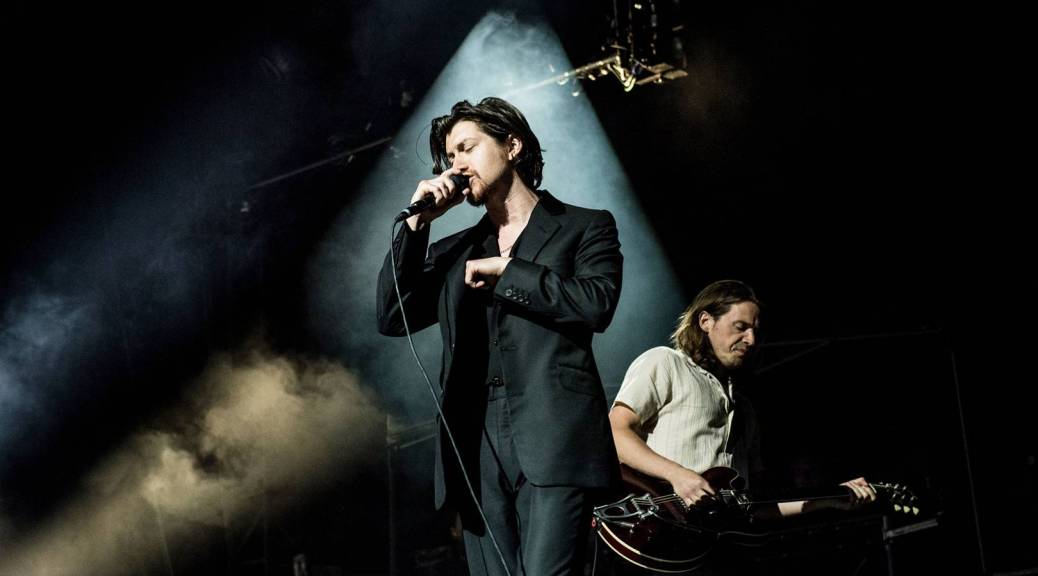
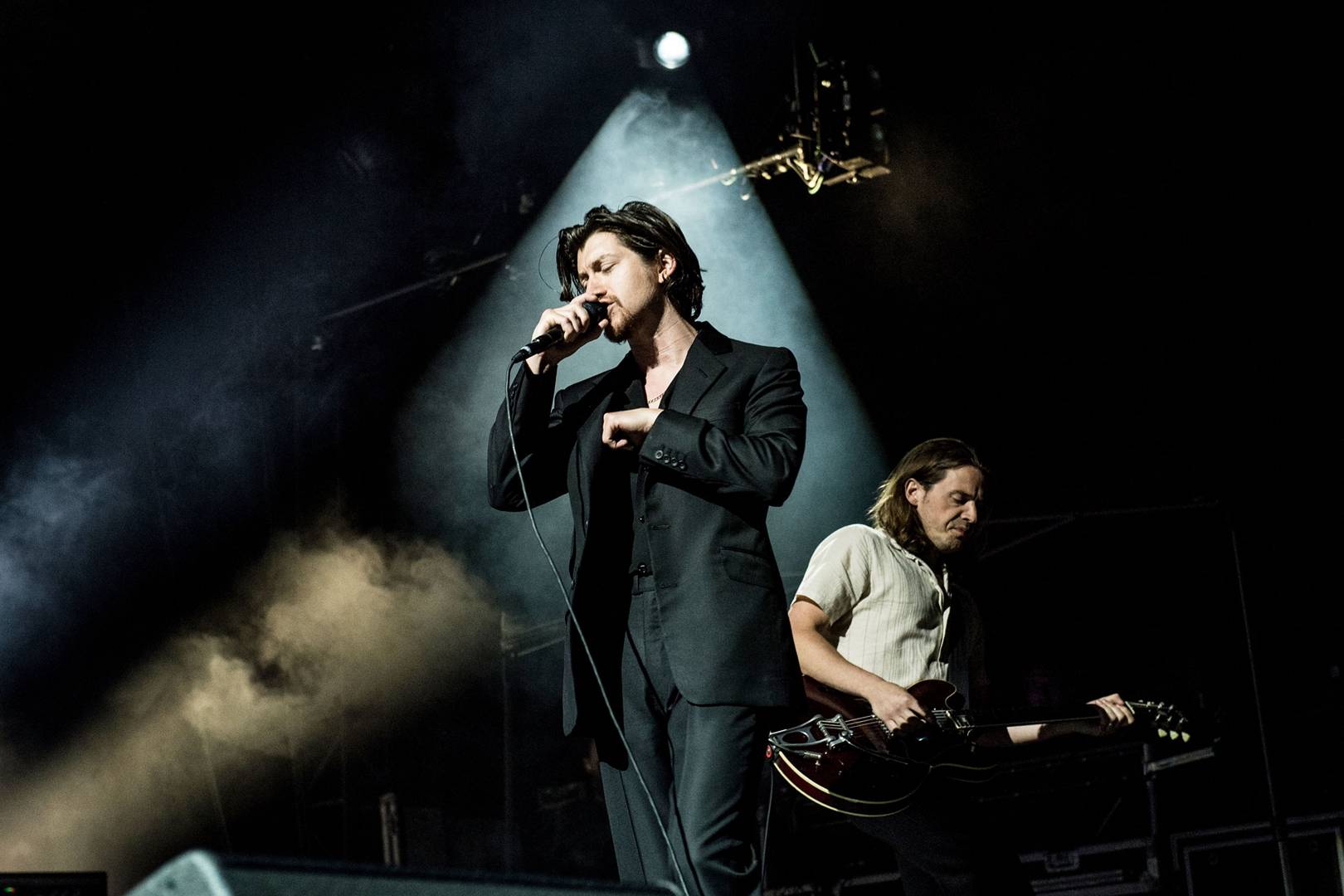 Johnny Ramone, Jayne Mansfield, Cecil B. DeMille: The stars were out last night at Hollywood Forever Cemetery in Los Angeles, the silent majority joining the lairy still-living to see Alex Turner unveil his latest sashay towards songwriting immortality.
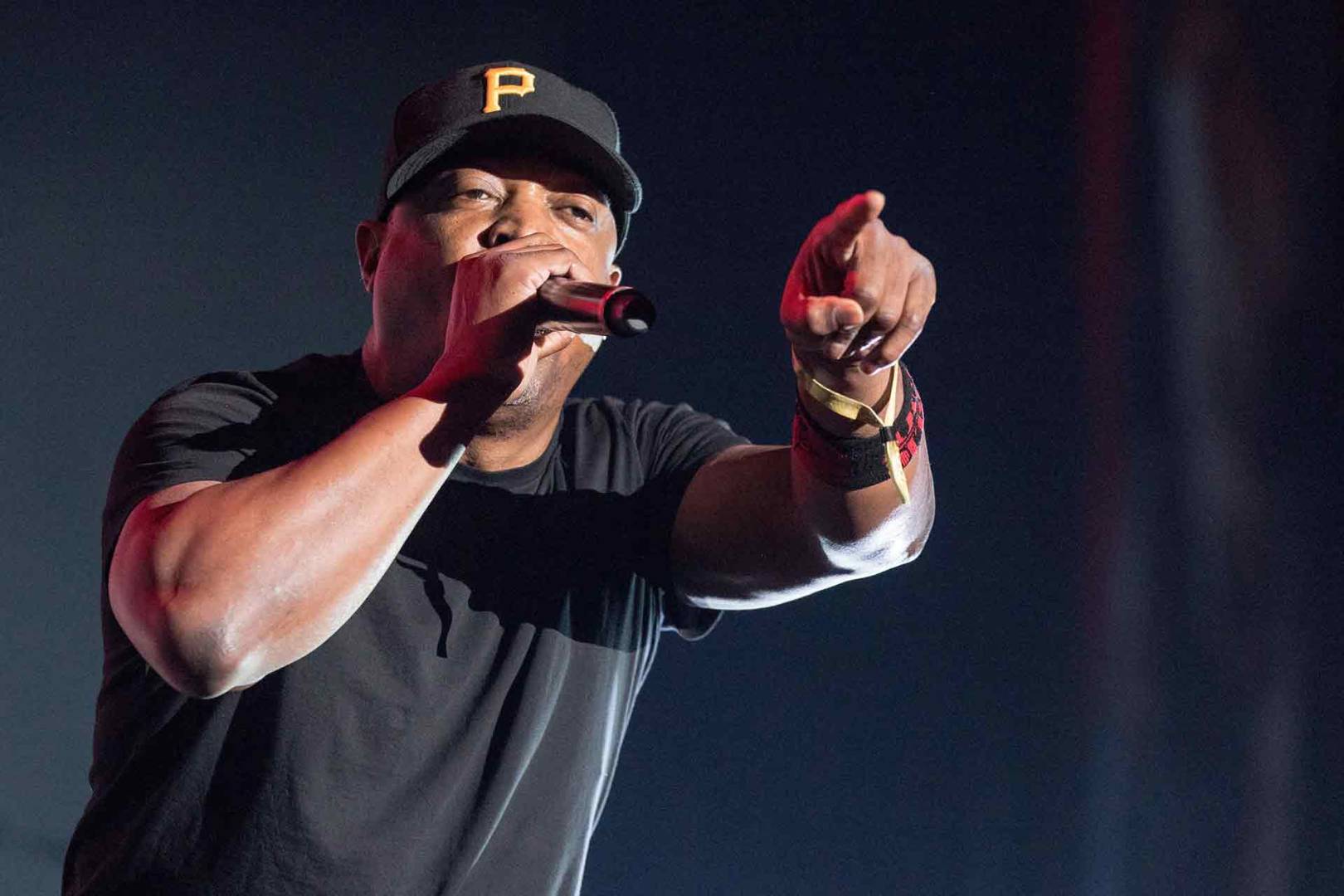 If you ever find yourself in a hip hop themed pub quiz, try to make sure Chuck D is on your team. Not only is he one of the greatest and most influential MCs in the history of rap, he’s also blessed with the sort of encyclopedic knowledge and staggering recall that places him among the genre’s foremost historians and custodians. Chuck was there, and he got receipts.

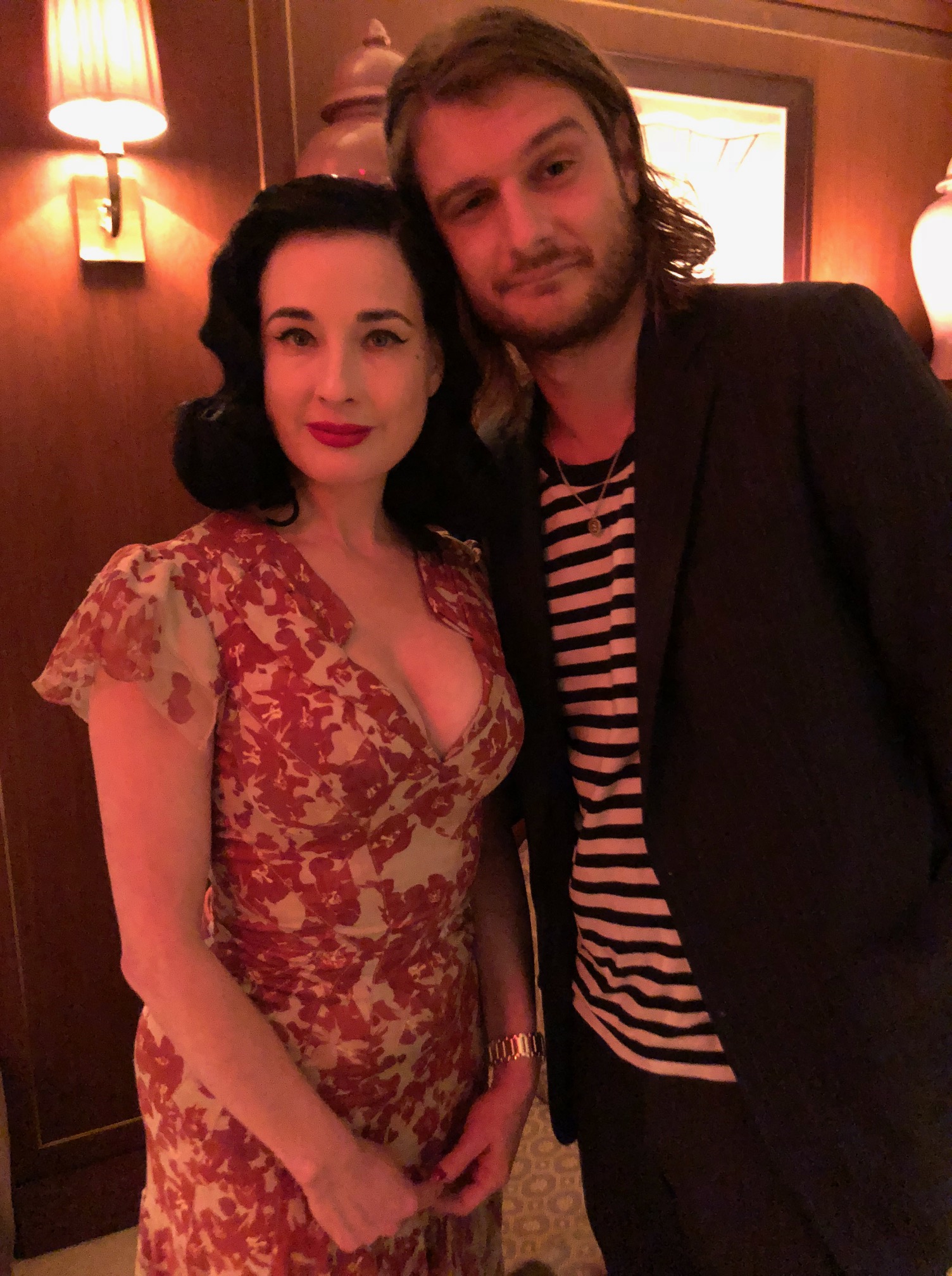 The Tower Bar, near the eastern end of the Sunset Strip, is one of Hollywood’s most elegant celebrity hangouts. Tucked away on the ground floor of the Sunset Tower Hotel, in what was once the mobster Bugsy Siegel’s apartment, it’s the sort of place where it’s no surprise to see Dita Von Teese waiting in a corner booth, perfectly poised in a floral Zac Posen dress.
 The barmaid at Gulliver’s, on Oldham Street in Manchester, spotted Mark E Smith walking in with me and had poured out a pair of double whiskeys before we reached the bar. That still left the question of what I was going to drink.


 Published in British GQ, May 2017.


 Published in British GQ, April 2017.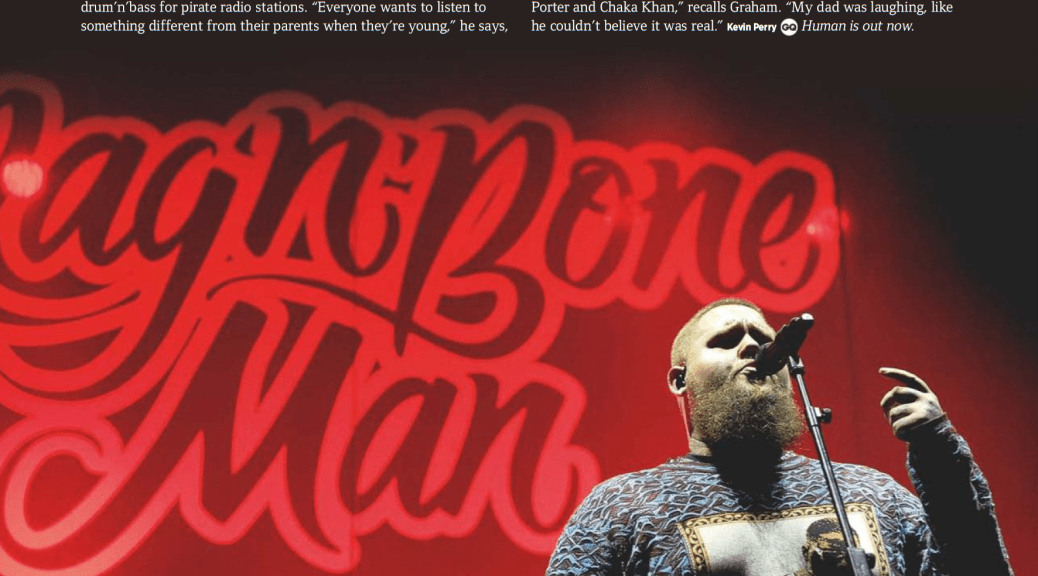
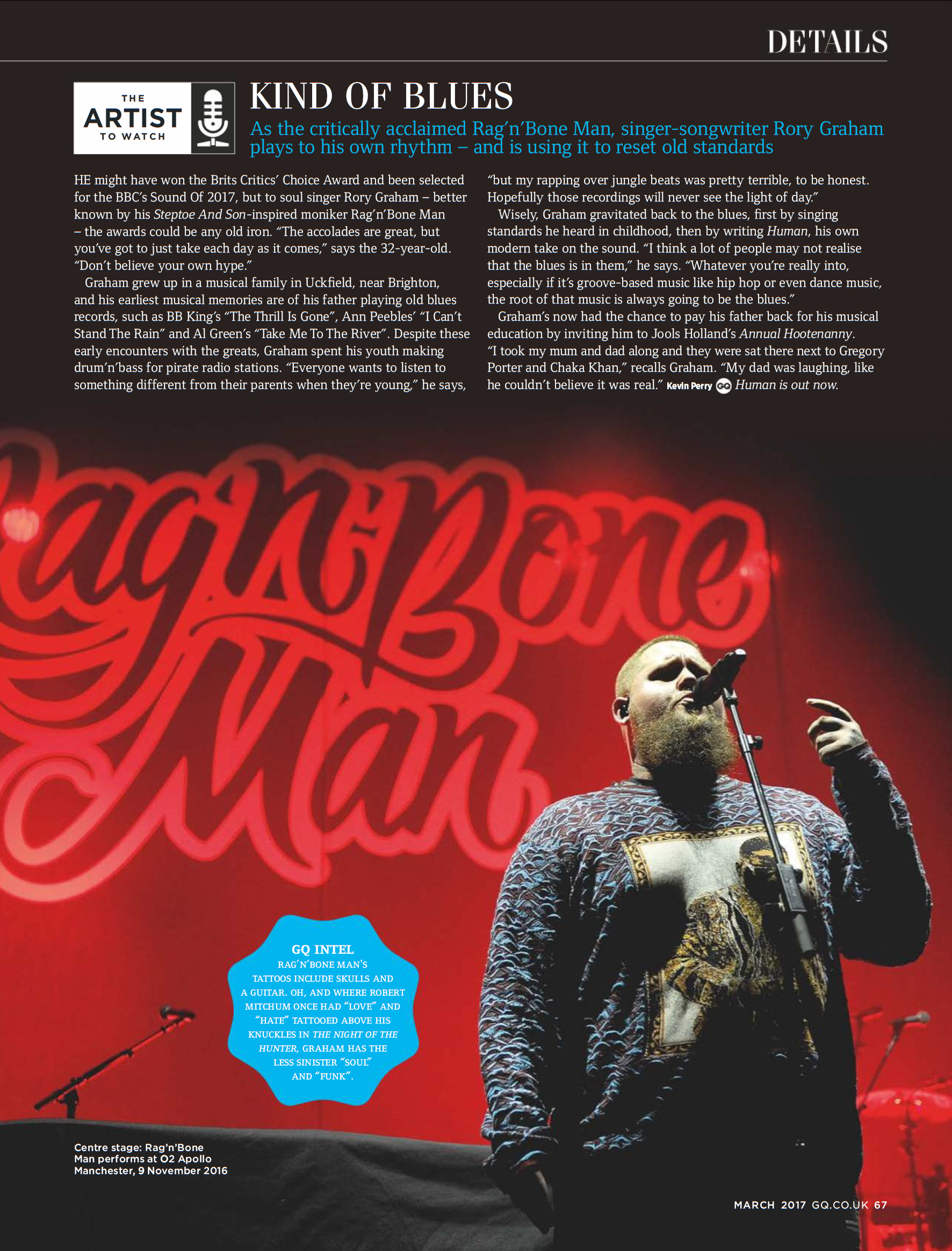
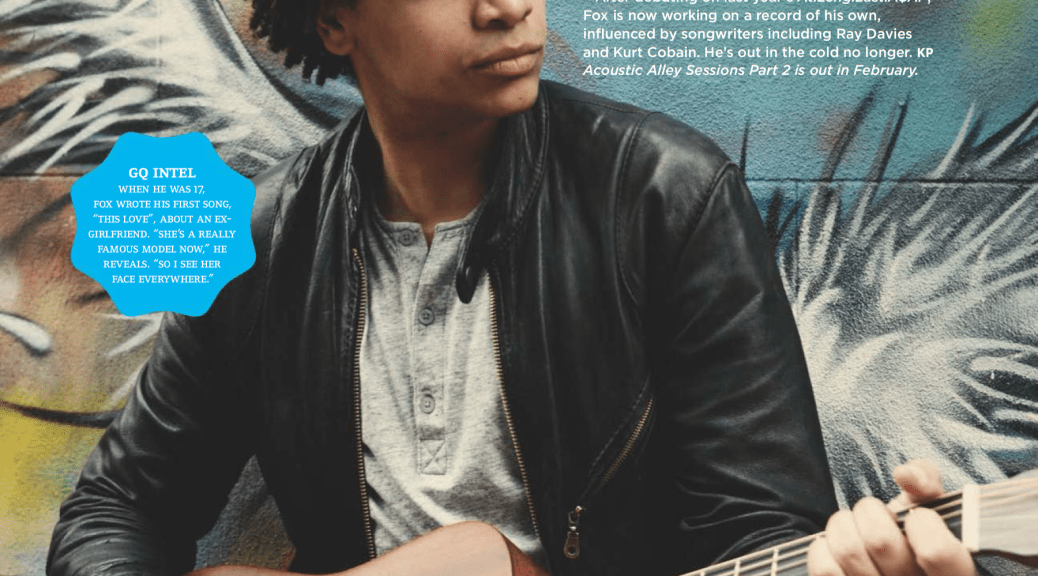
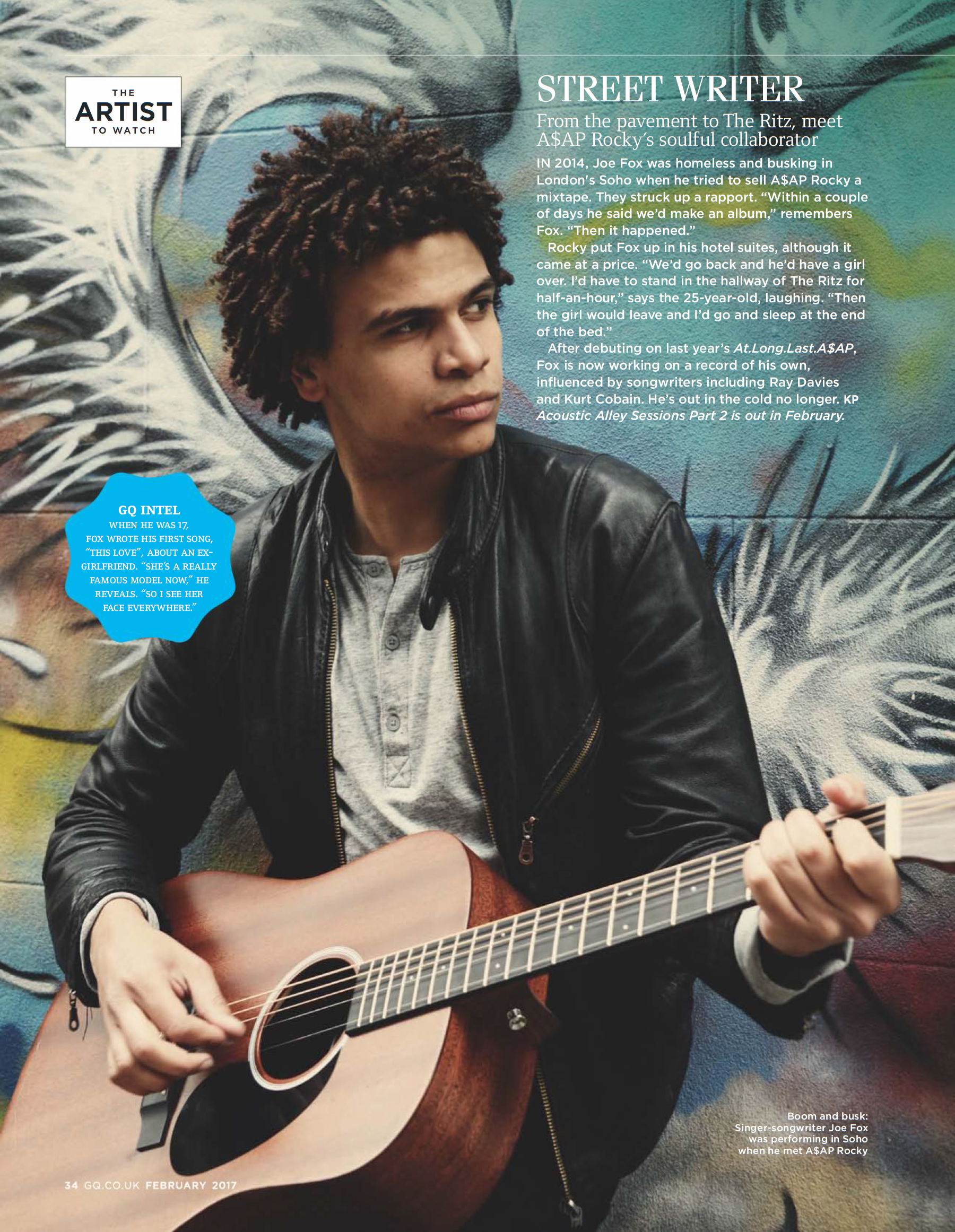 Published in British GQ, February 2017.
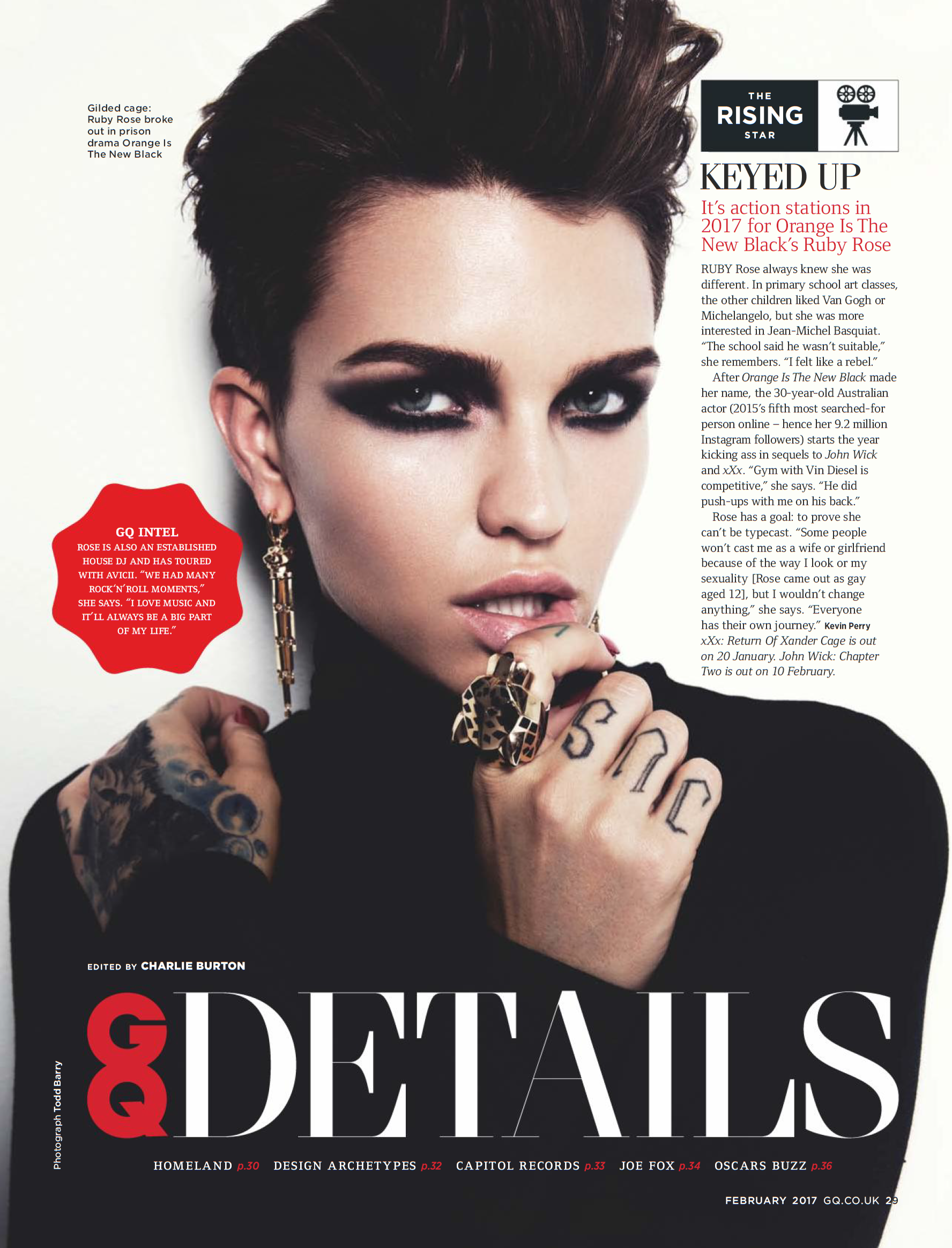 Published in British GQ, February 2017.
 Published in British GQ, January 2017.











 Dubai’s towering skyline has erupted from the desert in just two decades, and if you’re one of the ten million tourists who visit each year you’ll know that it’s a town built on excess. It’s a city of glass summoned into reality in the middle of a desert. Pity the tireless window cleaners. Everything must be bigger and grander than everything else that’s gone before – and after a while, it all gets a bit much. When a man is tired of Dubai, where does he go?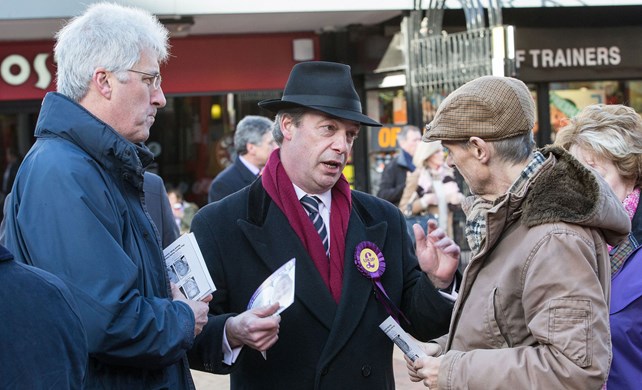


 Kevin EG Perry: Collected Works