

How British Indie’s Reaching War-Torn Libya
 If you found yourself scanning radio frequencies in Tripoli, capital of the still war-torn Libya, you might not expect to hit upon the latest slice of garage-psych from Temples or Savages’ ferocious manifesto ‘Shut Up’.
But if you were listening this week, you could well have done. The British Council’s weekly radio show, The Selector, broadcasts UK music to 39 countries scattered across the planet, with Libya just being the most recent addition to their roster.
Back in London, presenter Goldierocks lays out their philosophy: “We play everything from hip-hop through to thrash metal, jazz, blues, electronica… just whatever’s new and fresh and we feel represents the underground culture of the UK.”
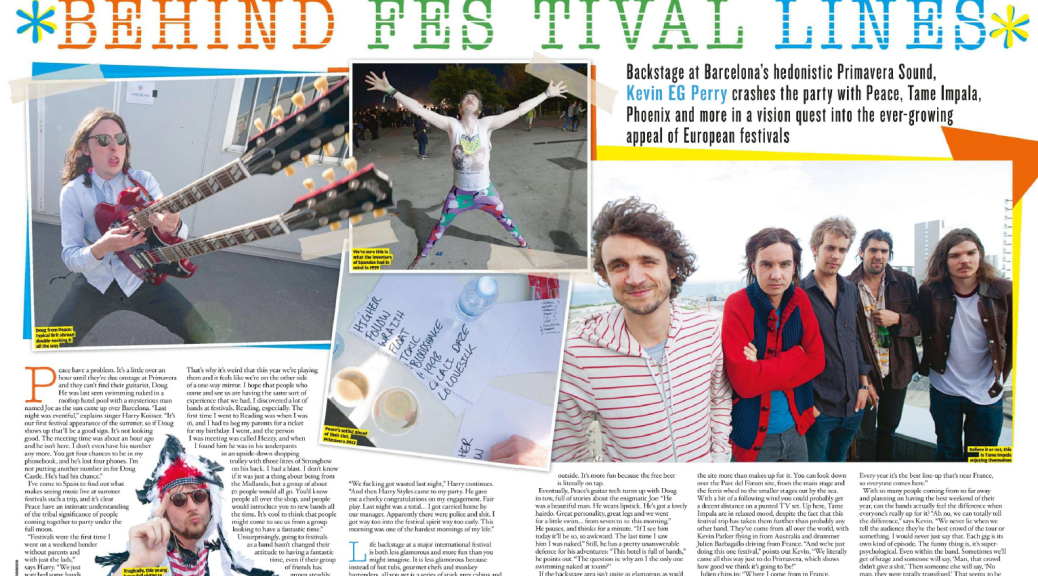
Behind Festival Lines
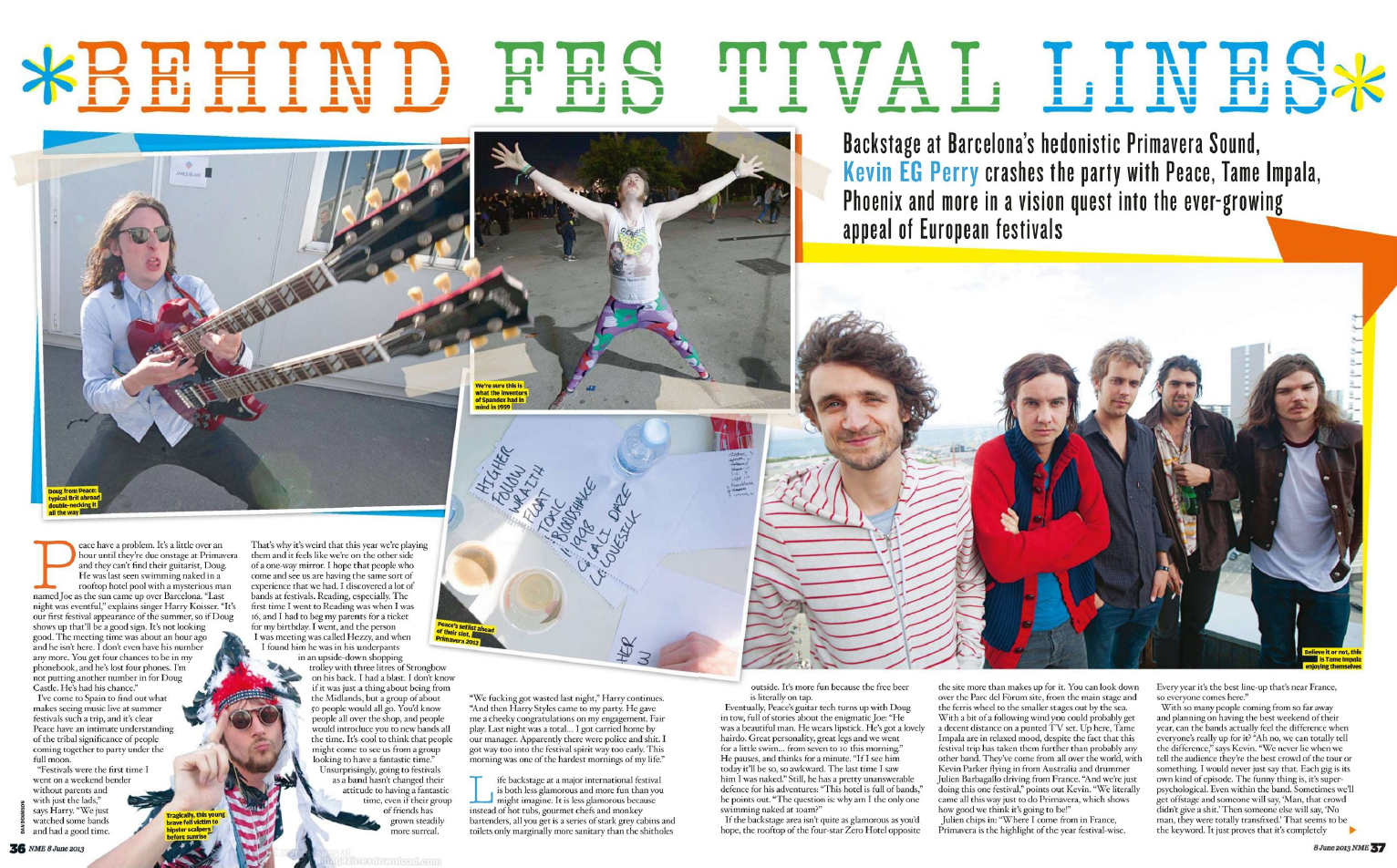
Peace have a problem. It’s a little over an hour until they’re due onstage at Primavera and they can’t find their guitarist, Doug. He was last seen swimming naked in a rooftop hotel pool with a mysterious man named Joe as the sun came up over Barcelona. “Last night was eventful,” explains singer Harry Koisser. “It’s our first festival appearance of the summer, so if Doug shows up that’ll be a good sign. It’s not looking good. The meeting time was about an hour ago and he isn’t here. I don’t even have his number anymore. You get four chances to be in my phonebook, and he’s lost four phones. I’m not putting another number in for Doug Castle. He’s had his chance.”
I’ve come to Spain to find out what makes seeing music live at summer festivals such a trip, and it’s clear Peace have an intimate understanding of the ancient, tribal significance of people coming together to party under the full moon.
“Festivals were the first time I went on a weekend bender without parents and with just the lads,” says Harry. “We just watched some bands and had a good time. That’s why it’s weird that this year we’re playing them and it feels like we’re on the other side of a one-way mirror. I hope that people who come and see us are having the same sort of experience that we had. I discovered a lot of bands at festivals. Reading, especially. The first time I went to Reading was when I was 16, and everyone I had to beg my parents for a ticket for my birthday. I went, and the person I was meeting was called Hezzy, and when I found him he was in his underpants in an upside-down shopping trolley with three litres of Strongbow on his back. I was like: “Fair. I can dig.” I had a blast. I don’t know if it was just a thing about being from the Midlands, but a group of about 50 people would all go. You’d know people all over the shop, and people would introduce you to new bands all the time. It’s cool to think that people might come to see us from a group of people looking to have a fantastic time.”
Unsurprisingly, going to festivals as a band hasn’t changed their attitude to having a fantastic time, even if their group of friends has grown steadily more surreal. “We fucking got wasted last night,” Harry continues. “And then Harry Styles came to my party. He gave me a cheeky congratulations on my engagement. Fair play. Last night was a total… I got carried home by our manager. Apparently there were police and shit. I got way too into the festival spirit way too early. Total knockout. This morning was one of the hardest mornings of my life.”
Life backstage at a major international festival is both less glamorous and more fun than you might imagine. It is less glamorous because instead of hot tubs, gourmet chefs and monkey bartenders all you get is a series of stark grey portacabins and toilets only marginally more sanitary than the shitholes outside. It’s more fun because the beer is literally on tap, and it’s free and they let you pour it yourself. Although the security do get restless if you try to squirt it straight into your mouth.
Eventually, Peace’s guitar tech turns up with Doug in tow, full of stories about the enigmatic Joe: “He was a beautiful man. He wears lipstick. He’s got a lovely hairdo. Great personality, great legs, and we went for a little swim… from seven to ten this morning.” He pauses, and thinks for a minute. “If I see him today it’ll be so, so awkward. The last time I saw him I was naked.” Still, he has a pretty unanswerable defence for his adventures: “This hotel is full of bands,” he points out. “The question is: why am I the only one swimming naked at 10am?”
If the backstage area isn’t quite as glamorous as you’d hope, the rooftop of the 4-star Zero hotel opposite the site more than makes up for it. From up here you can look down over the Parc del Fòrum site, from the main stage and the Ferris Wheel to the smaller stages out by the sea. With a bit of a following wind you could probably get a decent distance on a punted TV set. Tame Impala are in relaxed mood, though, despite the fact that this festival trip has taken them further than probably any other band. They’ve come from all over the world, with Kevin Parker flying in from Australia and drummer Julien Barbagallo driving from France. “And we’re just doing this one festival,” points out Kevin. “We literally came all this way just to do Primavera, which shows how good we think it’s going to be!”
Julien chips in: “Where I come from in France, Primavera is the highlight of the year festival-wise. Every year it’s the best lineup that’s near France, so everyone comes here.”
With so many people coming from so far away and planning on having the best weekend of their year, can the bands actually feel the difference when everyone’s really up for it? “Ah no, we can totally tell the difference,” says Kevin. “We never lie when we tell the audience they’re the best crowd of the tour or something. I would never just say that. Each gig is it’s own kind of episode. The funny thing is, it’s super psychological. Even within the band. Sometimes we’ll get offstage and someone will say: “Man, that crowd didn’t give a shit.” Then someone else will say: “No man, they were totally transfixed.” That seems to be the keyword. It just proves that it’s completely subjective. The crowd could have been dead, or it could have been transfixed, and transfixed is like the best possible thing because they’re so into it they can’t even move. How you interpret it depends on how you’re feeling.”
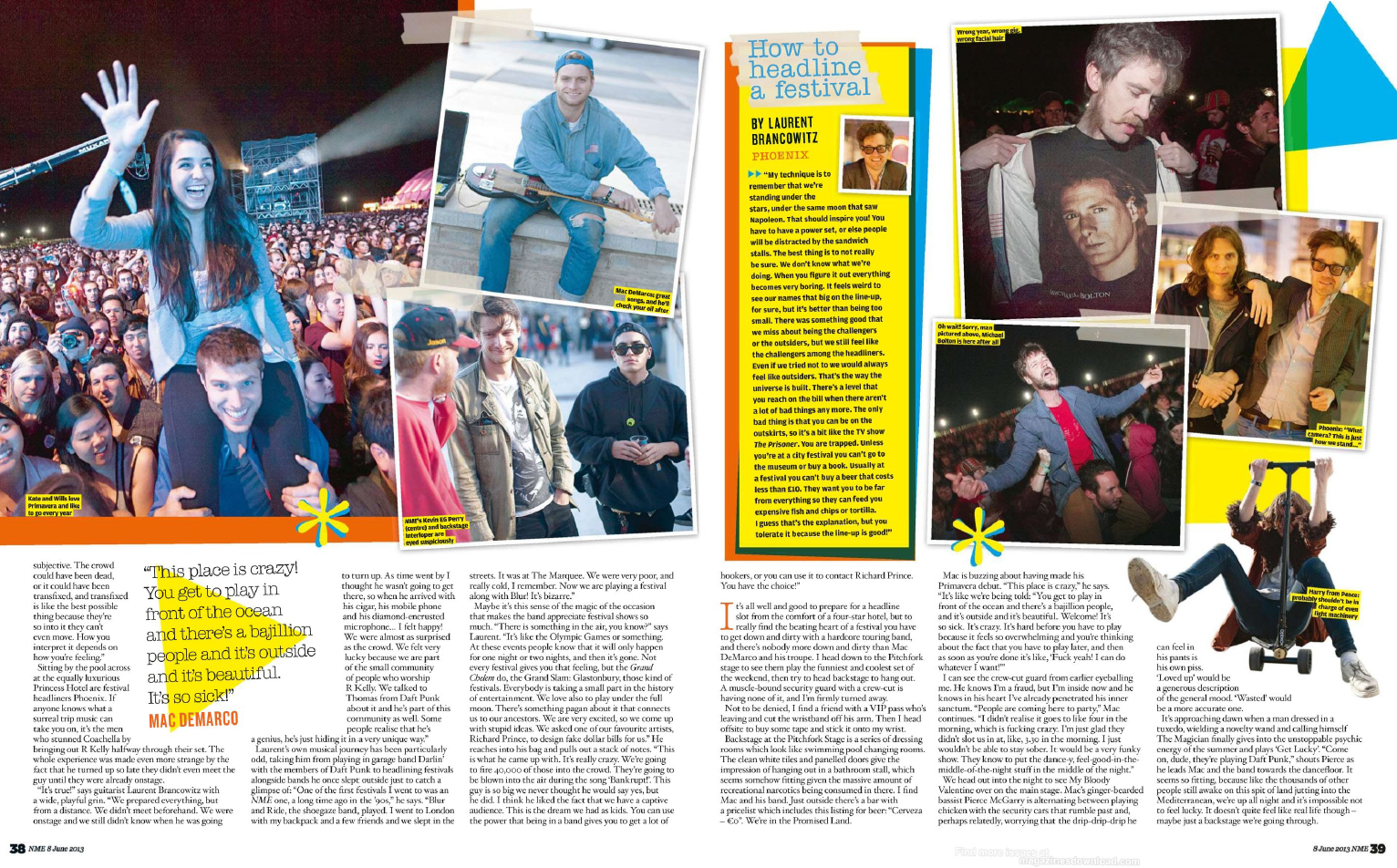
Sitting by the pool across at the equally luxurious Princess hotel are festival headliners Phoenix. If anyone knows what a surreal trip music can take you on, it’s the men who stunned Coachella by bringing out R Kelly halfway through their set. The whole experience was made even more strange by the fact that he turned up so late they didn’t even meet the guy until they were already onstage.
“It’s true!” says guitarist Laurent Brancowitz with a wide, playful grin. “We prepared everything, but from a distance. We didn’t meet beforehand. We were onstage and we still didn’t know when he was going to turn up. As time went by I thought he wasn’t going to get there, so when he arrived with his cigar, his mobile phone and his diamond-encrusted microphone… I felt happy! We were almost as surprised as the crowd. We felt very lucky because we are part of the small community of people who worship R Kelly. We talked to Thomas from Daft Punk about it and he’s part of this community as well. Some people realise that he’s a genius, he’s just hiding it in a very unique way.”
Laurent’s own musical journey has been particularly odd, taking him from playing in garage band Darlin’ with the members of Daft Punk to headlining festivals alongside bands he once slept outside just to catch a glimpse of: “One of the first festivals I went to was an NME one, a long time ago in the ‘90s,” he says “Blur and Ride, the shoegaze band, played. I went to London with my backpack and a few friends and we slept in the streets. It was at The Marquee. We were very poor, and really cold, I remember. Now we are playing a festival along with Blur! It’s bizarre.”
Maybe it’s this sense of the magic of the occasion that makes the band appreciate festival shows so much. “There is something in the air, you know?” says Laurent. “It’s like the Olympic Games or something. At these events people know that it will only happen for one night or two nights, and then it’s gone. Not every festival gives you that feeling, but the Grand Chelem do, the Grand Slam: Glastonbury, those kind of festivals. Everybody is taking a small part in the history of entertainment. We love also to play under the full moon. There’s something pagan about it that connects us to our ancestors. We are very excited, so we come up with stupid ideas. We asked one of our favourite artists, Richard Prince, to design fake dollars bills for us.” He reaches into his bag and pulls out a stack of notes. “This is what he came up with. It’s really crazy. We’re going to fire 40,000 of those into the crowd. They’re going to be blown into the air during the song ‘Bankrupt!’. This guy is so big we never thought he would say yes, but he did. I think he liked the fact that we have a captive audience. This is the dream we had as kids. You can use the power that being in a band gives you to get a lot of hookers, or you can use it to contact Richard Prince. You have the choice!”
It’s all well and good to prepare for a headline slot from the comfort of a 4-star hotel, but to really find the beating heart of a festival you have to get down and dirty with a hardcore touring band, and there’s nobody more down and dirty than Mac DeMarco and his band. I head down to the Pitchfork stage to see them play the funniest and coolest set of the weekend, then try to head backstage to hang out. A particularly muscle-bound security guard with a crew-cut is having none of it, and I’m firmly turned away.
Not to be denied, I find a friend with a VIP pass who’s leaving the site and cut the wristband off his arm. Then I head offsite to buy some sellotape and stick the band onto my wrist. The perfect crime.
Backstage at the Pitchfork Stage is a series of dressing rooms which look to be swimming pool changing rooms in normal life. The clean white tiles and panelled doors give the impression of hanging out in a bathroom stall, which seems somehow fitting given the massive amount of recreational narcotics being consumed in there. I find Mac and his band and start drinking heavily until some guy comes in and takes our bottle of vodka, which pisses everyone off until someone points out, quite reasonably, that we’re in the wrong dressing room and it was probably his bottle all along. Nevermind, just outside there’s a bar with a pricelist which includes this listing for beer: “Cerveza – €0”. The Promised Land.
Mac is buzzing about having made his Primavera debut. “This place is crazy,” he says. “It’s like we’re being told: “You get to play in front of the ocean, and there’s a bajillion people, and it’s outside and it’s beautiful. Welcome!” It’s so sick. It’s crazy. It’s a little bit overwhelming sometimes. It’s hard before you have to play because it feels so overwhelming and you’re thinking about the fact that you have to play later, and then as soon as you’re done it’s like: “Fuck yeah! I can do whatever I want!””
I can see the crew-cut guard from earlier eyeballing me. He knows I’m a fraud, but I’m inside now and he knows in his heart I’ve already penetrated his inner sanctum. I eyeball him back, and down a free beer that tastes like victory. “People are coming here to party,” Mac continues. “I didn’t realise it goes to like four in the morning, which is fucking crazy. I’m just glad they didn’t slot us in at like 3:30 in the morning. I just wouldn’t be able to stay sober. It would be a very funky show. I think they know to put the dance-y, feel-good-in-the-middle-of-the-night stuff in the middle of the night. It’s very groovy.”
We head out into the night to see My Bloody Valentine over on the mainstage. Mac’s ginger-bearded bassist Pierce McGarry is alternating between playing chicken with the security cars that rumble past and, perhaps relatedly, worrying that the drip-drip-drip he can feel in his pants is his own piss. ‘Loved up’ would be a generous description of the general mood. ‘Wasted’ would be a more accurate one.
It’s approaching dawn when a man dressed in a tuxedo, wielding a novelty oversized wand and calling himself The Magician finally gives into the unstoppable psychic energy of the summer and plays ‘Get Lucky’. “Come on dude, they’re playing Daft Punk,” shouts Pierce as he leads Mac and the rest of the band towards the dancefloor. It seems so fitting, in its way, because like the thousands of other people still awake on this spit of land jutting into the Mediterranean, we’re up all night and it’s impossible not to feel lucky. It doesn’t quite feel like real life though, maybe just a backstage we’re going through.
Originally published in NME, 8 June 2013.

Klaxons: “We want to blow peoples’ minds”
 When Klaxons made their return to the UK festival stage at The Great Escape last month, almost half of their 11-song set was made up of new material. The new songs – ‘Children Of The Sun’, which shares a name with the play by Maxim Gorky, ‘Invisible Forces’, ‘Love Frequency’, ‘Rhythm Of Life’ and ‘New Reality’ – are all expected to appear on the London band’s third album and retain their urgent, irresistibly danceable sound. The as-yet-untitled record could well be released this year, three years after 2010’s ‘Surfing The Void’. Having picked up 2007’s Mercury Prize for debut album and defining artefact of the new rave scene, ‘Myths of the Near Future’, the disappointing reaction to its follow-up record now puts Klaxons in the difficult position of being dismissed by some as a band who’ve already had their time in the sun. Early reports on the new album suggest they’re going all-out to right that wrong, with DJ Erol Alkan and Tom Rowlands of The Chemical Brothers on production duties, plus input from LCD Soundsystem’s James Murphy. We sat down with the band to find out more on their new ventures…
Franz Ferdinand: “Our new album’s a hole to a whole universe”
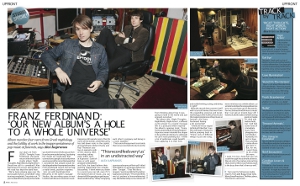 Four years on from 2009’s ‘Tonight:’, Franz Ferdinand return with their fourth studio album ‘Right Thoughts, Right Words, Right Action’. Should we call it a comeback? Alex Kapranos isn’t so sure. He says life on the road has kept the band lean.
“We’ve been playing gigs over the last couple of years, so we didn’t stop touring completely,” he points out. “If you’re a band that’s purely in the studio you lose the sense of who you are live. It can become quite boring. So playing live meant we could keep that connection to people. It was only when we announced the record last week that I considered that people would be deciding whether they wanted another Franz Ferdinand record, but we had a really lovely, positive response. ”
He’s sat with bandmate Nick McCarthy in the latter’s Sausage Studios, the recording space in East London with the wurst name in music. Kapranos still spends most of his life north of the border while McCarthy has lain down roots in the capital, and bandmates Robert Hardy and Paul Thomson also live at opposite ends of the country. With recording taking place either here, at Kaprano’s Scottish base or with guest producers in Stockholm and Oslo, the band believe their working relationship has actually blossomed. “I think when you listen to a record you can tell, even if it’s the darkest kind of music, you can always tell if the people are getting on,” observes McCarthy. “If they’re enjoying each other’s company and being in a room together.”
That sense of enjoyment is certainly there on a record which returns to the jaunty exuberance of their self-titled 2004 debut. It’s a change of direction after ‘Tonight:’ “That felt like a tangent,” points out McCarthy, before Kapranos continues: “This record feels very ‘us’, and very ‘us’ in an undistracted way. We deliberately cut ourselves off from thinking about how it was going to land in the world and just enjoyed ourselves.”
The album title, ‘Right Thoughts, Right Words, Right Action’, is offered as the answer to a cryptic message left in a postcard which inspired the album’s opening track: “Come home, practically all, is nearly forgiven”. Kapranos never intended the slogan as a political rallying cry, although he can’t resist pointing out: “I think a lot of politicians could benefit from applying it to their lives and really thinking, acting, and doing it right!”
What the record does concern itself with is lyrical themes that veer from the expanding universe and Greek mythology to the futility of work and the inappropriateness of pop music at funerals. Are Franz Ferdinand feeling existential?
“I think we’re too stupid to think of it like that,” says Alex with a grin. He pauses before jumping back in: “There’s lots of different things in just one song, never mind across a whole album, so sometimes it does the songs a disservice to try to sum them up in a few words. For me, the best kind of music is music that I can get an instant buzz off, I listen to it and it makes me feel fucking good, or maybe it’s dark and melancholic but I still feel some kind of immediate buzz from plugging into somebody’s humanity. It’s got to have that, and that can be all you get from it. But for me, I want there to be a little bit more. I want it to be a hole that you can crawl through into a whole universe. We put a lot of ourselves into putting that universe there, but if all you want is the little buzz then that’s there as well.”
Originally published in NME, 1 June 2013.
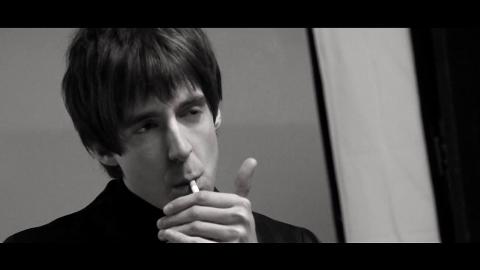
Miles Kane on ‘Don’t Forget Who You Are’
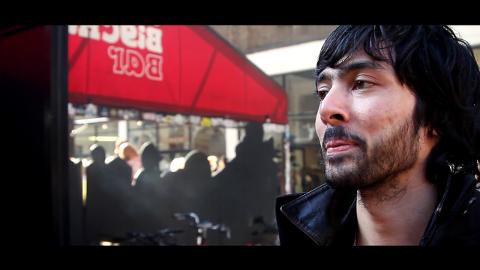
Justice on ‘D.A.N.C.E.’ and ‘Civilization’

The Vaccines on ‘If You Wanna’, ‘Post Break-Up Sex’ and ‘Bad Mood’

Nile Rodgers: “Daft Punk are like David Bowie. Abstract… but very clear”

 With ‘Random Access Memories’ finally out, Chic guitar legend and Daft Punk collaborator Nile Rodgers talks to me about 2013’s most hyped record.
How did you become involved with the record?
“We’ve known each other for a very, very long time and every time we’ve had the opportunity to get together it’s been completely chaotic. So finally the brilliant thing that Thomas and Guy-Man did is they just came to my apartment in New York! It was so smart because it was just the three of us sitting there face-to-face. Three artists who have mutual admiration for each other and have had it for such a long time. We actually sat around joking about the times that we’d missed each other… “Oh yeah, do you remember in St Tropez when we were supposed to meet up?” “Remember Paris when I ended up sat at the head of your record company’s house for three hours?” It was a wonderful moment when we could just laugh and laugh about the irony of the situation. The only way we could really have a chance to chill out and just be artist-to-artist was for them to come to my apartment. That meeting was the smartest thing and the most perfect way to do this. It was great because they didn’t have their gear and I didn’t have my gear. All I had was one acoustic jazz guitar. We just sat there and started talking and I picked up my axe and started jamming and playing some ideas. They said: “That’s how we want to make this record. We want to make this record exactly the way you made records back in the day. You just start playing, from the beginning to the end. You just play.” I said: “Oh, I know how to do that!” That’s what R&B and Dance records were, back in the day. We just went in there and we had charts or a template and then we’d just play this long, linear journey from beginning to middle to end.”
Did Daft Punk have a firm idea of what they wanted before they came to you?
“They may have had a solid idea. I think they’re too smart to have not had a solid idea, but they didn’t need to speak to me in those terms. Some of the brightest artists, and I always use Bowie as the great reference point: the smartest artists can speak to you in very abstract terms but you hear them clear as a bell. It’s almost as if we were spies breaking a code. They can speak to me in incredibly coded language and it’s 100% clear as a bell to me. When they started talking, and I started to realise that they were talking about making an old-school record, or using old-school techniques to make a record that’s timeless, a record that represents the past, the present and the future, it didn’t take a lot of explanation at all. I went: “Oh, I know what you mean” and I went and got an old fashioned guitar, an old jazz guitar from the 30s or 40s, and started playing new music on that thing. They went: “Yes! That’s exactly what we mean!” You can take something old that’s organic and beautiful and it’s made of wood and it resonates. Top-of-the-line craftsmanship went into that thing, and then you use it to play something modern, something that it wasn’t designed to do. When that guitar was made, it was made to play in a big band with Duke Ellington or something. It wasn’t made to play at 120 beats-per-minute with a vocoder next to you. All of a sudden, you mix these things together and they sound wonderful because they represent the past, the present, which is what you’re doing now, and hopefully if you do it right, it’ll sound fresh and wonderful and relevant to somebody 30 years from today. That’s what I think classic music is all about. I happen to be a jazz freak, so when I listen to Cab Calloway sing ‘Reefer Man’ I feel like it’s happening right now. I get into it. I want to dance jitterbug or lindy hop even though I can’t. It doesn’t feel like I’m listening to old fashioned music. It feels like I could walk outside and everybody would be wearing zoot suits.”
Giorgio Moroder told us they used a different microphone to record him depending on which era he was talking about.
“I get that! That’s a perfectly funny and sound example of how they think. They would use three mics to represent the past, present and future. That’s exactly correct. I love that. The things that’s really cool is that most listeners won’t hear that. They won’t hear it now. 10 years from now, when they get older, when they’re playing it for their kids or their friends, they’ll be saying: “Oh man, I remember when Daft Punk dropped this record.” They’ll listen to it and I have a feeling that they will have the same kind of feeling that I get now when I walk into a club and there are 16 and 17 year olds dancing to ‘Good Times’. They’re acting like it’s something brand new and cool, and I’m thinking to myself: “Wow, that’s so amazing.” You need to have that kind of passion, and the intellectual credibility and knowledge, to pull this off. You don’t have to make records like this, trust me. They didn’t have to do it this way. They chose to do it this way because they were either paying homage to something that they love and trying to recapture the feeling that made them want to make music, or inspired them to make the music that they made, but they also realised that in order to do that, you had to realise that the music that was being made at that particular time was inspired by people who were living before them. We are living in three different musical eras when it comes to making classic music. When it comes to making throwaway music, the sort of thing that everybody loves and then after five years it doesn’t really move you anymore. They say you ‘grow out of it’, and it’s true. We all do ‘grow out of’ a lot of stuff, but the stuff that’s classic, even though our styles may change, when we listen to that music it still gives off that feeling. It still conjures that primal or intellectual or spiritual or artistic thing in us. I know that’s the truth with me. I never grow up. The records that I heard when I was younger are still amazing to me.”
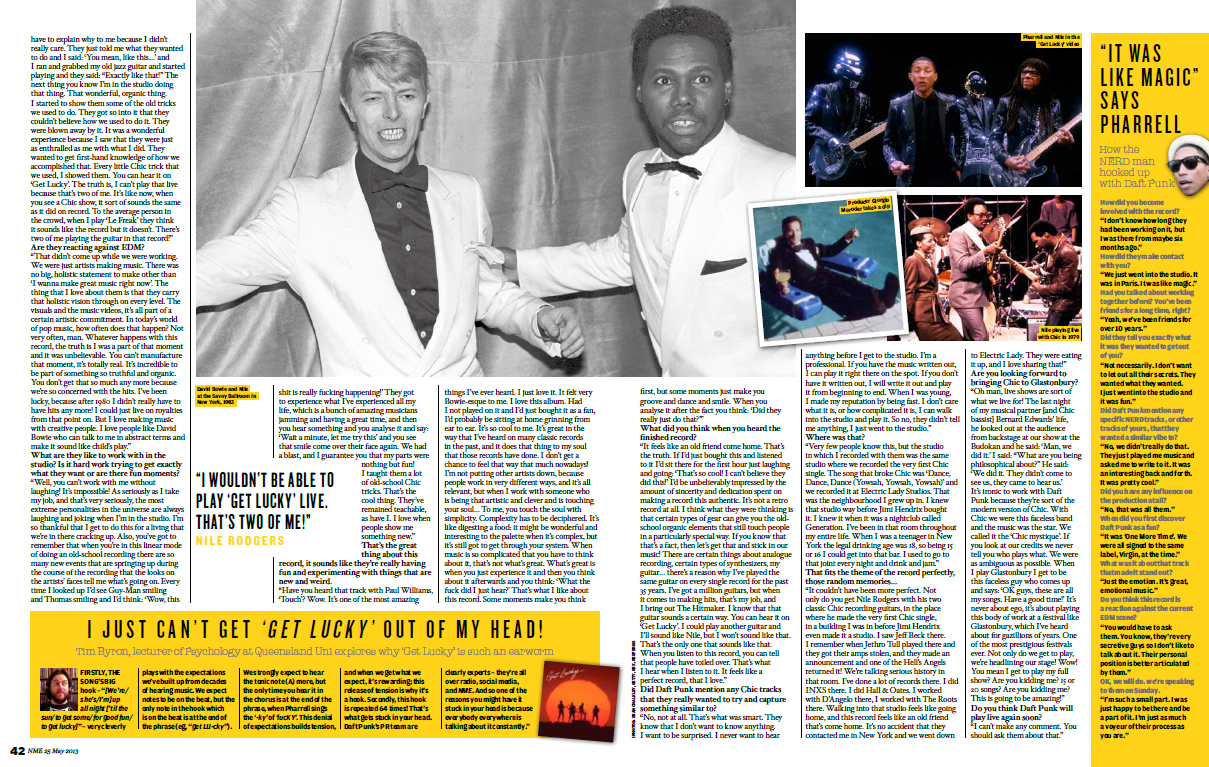
Why do you think Daft Punk wanted to record with a live band and musicians like yourself?
“I don’t know, but that’s OK! They didn’t have to explain why to me because I didn’t really care. They just told me what they wanted to do and I said: “You mean, like this…” and I ran and grabbed my old jazz guitar and started playing and they said: “Exactly like that!” The next thing you know I’m in the studio doing that thing. That wonderful, organic thing. When it came to my guitar playing, I started to show them some of the old tricks we used to do. They got so into it that they couldn’t believe how we used to do it. They were blown away by it. It was a wonderful experience for me because I saw that they were just as enthralled with what I did. They wanted to get first-hand knowledge of how we accomplished that. Every little Chic trick that we used, I showed them. It was like: “Wow, this is cool”. You can hear it on ‘Get Lucky’. The truth is, I can’t play that live because that’s two of me. I can play it something like that! It’s like now, when you see a Chic show, it sort of sounds the same as it did on record. To the average person in the crowd, when I play ‘Le Freak’ they think it sounds like the record but it really doesn’t. There’s two of me playing the guitar in that record!”
Are they reacting against EDM?
“That didn’t come up while we were working. W e were just artists making music. There was no big, holistic statement to make other than: “I wanna make great music right now.” The thing that I love about them is that they carry that holistic vision through on every level. The visuals and the music videos, it’s all part of a certain artistic commitment. There was one moment that moved me in a way I’ve only been moved a couple of times before. I can count those times on my hand. When we first played ‘Let’s Dance’ and ‘Good Times’ for a room full of strangers, and I saw their reaction. When I first heard Diana Ross outside of a recording studio, in a nightclub. People responded in a visceral, primal, spiritual way. Doing the music video for the next Daft Punk single, after days of shooting, when we finally did the first full playback from beginning to end it was the first time the extras heard it. They were weeping. They were hugging each other. They weren’t crying because of exhaustion. I’ve seen this before and it’s people going: ‘Something important just happened, and we’re a part of that thing.’ I was crying too! I kept thinking to myself: ‘Thank God I have my own trailer so they don’t see me like this. I’m supposed to be in control.’ I’d been up onstage jamming my butt off, and they were all into it, but then I went from Mr Riff Machine to welling up and saying: ‘I understand just how you feel, guys…’ It was funny and it was sweet and it was wonderful. In today’s world of pop music, how often does that happen? Not very often, man. Whatever happens with this record, the truth is I was a part of that moment and it was unbelievable. You can’t manufacture that moment, it’s totally real. It’s incredible to be part of something so truthful and organic. You don’t get that so much anymore because we’re so concerned with the hits. I’ve been lucky, because after 1980 I didn’t really have to have hits anymore! I could just live on royalties from that point on, but I love making music with creative people. I love people like David Bowie who can talk to me in abstract terms and make it sound like child’s play.”
What are they actually like to work with in the studio? Is it hard work trying to get exactly what they want or are there fun moments?
“Well, you can’t work with me without laughing! It’s impossible! As seriously as I take my job, and that’s very seriously, the most extreme personalities in the universe are always laughing and joking when I’m in the studio. I’m so thankful that I get to do this for a living that we’re in there cracking up. Also, you’ve got to remember that when you’re in this linear mode of doing an old school recording there are so many new events that are springing up during the course of the recording that the looks on the artists’ faces tell me what’s going on. Every time I looked up I’d see Guy-Man smiling and Thomas smiling and I’d think: ‘Wow, this shit is really fucking happening!’ They got to experience what I’ve experienced all my life, which is a bunch of really amazing musicians jamming and having a really great time, and then you hear something and you analyze it and say: “Wait a minute, let me try this” and you see that smile come over their face again. We had a blast, and I guarantee you that my parts were nothing but fun! I taught them a lot of old school Chic tricks. They love learning about old techniques and they love getting smarter. I think that’s the cool thing. They’ve remained teachable, as have I. I love when people show me something new.”
That’s the great thing about this record, it sounds like they’re really having fun and experimenting with things that are new and weird.
“Have you heard that track with Paul Williams, ‘Touch’? Wow. It’s one of the most amazing things I’ve ever heard. I just love it. I absolutely love it. Having made as many records as I have with Bowie, it felt very Bowie-esque to me. I love this album. Had I not played on it or wrote for it, and I’d just bought it as a fan, I’d probably be sitting at home grinning from ear to ear. It’s so cool to me. It’s great in the way that I’ve heard on many classic records in the past, and it does that thing to my soul that those records have done. I don’t get a chance to feel that way that much nowadays! I’m not putting other artists down, because people work in very different ways, and it’s all relevant, but when I work with someone who is being that artistic and clever and is touching your soul. To me, you touch the soul with simplicity. Complexity has to be deciphered. It’s like digesting a food, it might be wonderful and interesting to the palette when it’s complex, but it’s still got to get through your system. When music is so complicated that you have to think about it, that’s not what’s great. What’s great is when you just experience it and then you think about it afterwards and you think: “What the fuck did I just hear?” That’s what I like about this record. Some moments make you think first, but some moments just make you groove and dance and smile. When you analyse it after the fact you think: “Did they really just do that?””
What did you think when you heard the finished record?
“It feels like an old friend come home. That’s the truth. If I’d just bought this and listened to it I’d sit there for the first hour just laughing and going: “That’s so cool! I can’t believe they did this!” I’d be unbelievably impressed by the amount of sincerity and dedication spent on making a record this authentic. It’s not retro. It’s not a retro record at all. I think what they were thinking is that certain types of gear can give you the old school organic elements that still touch people in a particularly special way. If you know that that’s a fact, then let’s get that and stick in our music! There are certain things about analogue recording, certain types of synthesisers, my guitar… there’s a reason why I’ve played the same guitar on every single record for the past 35 years. I’ve got a million guitars, but when it comes to making hits, that’s my job, and I bring out The Hitmaker. I know that that guitar sounds a certain way. You can hear it on ‘Get Lucky’. I could play another guitar and I’ll sound like Nile, but I won’t sound like that. That’s the only one that sounds like that. When you listen to this record, you can tell that people have toiled over. That’s what I hear when I listen to it. It feels like a perfect record, that I love.”
Did Daft Punk mention any Chic tracks that they really wanted to try and capture something similar to?
“No, not at all. That’s what was smart. They know that I don’t want to know anything. I want to be surprised. I never want to hear anything before I get to the studio. I’m a professional. If you have the music written out, I can play it right there on the spot. If you don’t have it written out, I will write it out and play it from beginning to end. When I was young, I made my reputation by being fast. I don’t care what it is, or how complicated it is, I can walk into the studio and play it. So no, they didn’t tell me anything, I just went to the studio.”
Where was that?
“Very few people know this, but the studio I recorded with them at was the same studio where we recorded the very first Chic single. The song that broke Chic was ‘Dance, Dance, Dance (Yowsah, Yowsah, Yowsah)’ and we recorded it at Electric Lady. What was funny for me was that was the neighbourhood I grew up in. I knew that studio way before Jimi Hendrix bought it. I knew it when it was a nightclub called Generation. I’ve been in that room throughout my entire life. When I was a teenager in New York the legal drinking age was 18, so being 15 or 16 I could get into that bar. I used to go to that joint every night and drink and jam.”
That fits the theme of the record perfectly, those random memories…
“It couldn’t have been more perfect. Not only do you get Nile Rodgers with his two classic Chic recording guitars, in the place where he made the very first Chic single, in a building I was in before Jimi Hendrix even made it a studio. I saw Jeff Beck there. I remember when Jethro Tull played there and they got their amps stolen, and they made an announcement and one of the Hell’s Angels eventually returned it! We’re talking serious history in that room. I’m not superstitious or anything, but you can’t deny there’s something wonderful trapped inside those walls. I’ve done a lot of records there. I did INXS there. I did Hall & Oates. I worked with D’Angelo there, I worked with The Roots there. Walking into that studio feels like going home, and this record feels like an old friend that’s come home. It’s no accident that they contacted me in New York and we went down to Electric Lady. They were eating it up, and I love sharing that!”
Are you looking forward to bringing Chic to Glastonbury?
“Oh man, live shows are sort of what we live for! The last night of my musical partner [and Chic bassist] Bernard Edwards’ life, he looked out at the audience from backstage at our show at the Budokan and he said: “Man, we did it.” I said: “What are you being philosophical about?” He said: “We did it. They didn’t come to see us, they came to hear us.” It’s ironic to work with Daft Punk because they’re sort of the modern version of Chic. With Chic we were this faceless band and the music was the star. We called it the ‘Chic mystique’. If you look at our credits we never tell you who plays what. We were as ambiguous as possible. When I play Glastonbury I get to be this faceless guy who comes up and says: “Okay guys, these are all my songs. Have a good time!” It’s never about ego, it’s about playing this body of work at a festival like Glastonbury, which I’ve heard about for gazillions of years. One of the most prestigious festivals ever. Not only do we get to play, we’re headlining our stage! Wow! You mean I get to play my full show? Are you kidding me? 15 or 20 songs? Are you kidding me? This is going to be amazing!”
Do you think Daft Punk will play live again soon?
“I can’t make any comment. You should ask them about that.”
Originally published in NME, 25 May 2013.

The Great Escape 2013

Mac Demented

The Canadian poster-boy for slacker delinquents, Mac DeMarco has garnered a reputation for putting on some of the most raucous live shows around. One of the biggest hitters at this year’s South By Southwest, he’s set to take next week’s Great Escape festival by storm. From his bizarre DIY videos to his lascivious debut ‘Rock And Roll Night Club’ and it’s follow-up ‘2’, DeMarco is master of Jonathan Richman-like calypso-soaked riffage. But what terrible skeletons lurk in his closet? From transvestites shooting heroin to naked U2 covers, he tells us about some of the strange and terrible experiences have made Mac DeMarco the man he is today…
SMACK SHOOTIN’ TRANSVESTITES
“My first memories of going to bars are from when I was 16 and had a fake ID. I went to one with my friend Jeremy, who’s a bit older, and there was this famous Canadian transvestite there. Her legal name is Lexi Tronic Supersonic. She even has cheques with that name on. There was a photographer there, and she had this band on and was doing heroin in the club while he took pictures. Jeremy went up to her, trying to feel if she had a cock or a pussy. That was pretty fucked up to see that at that age.”
JERKIN’ OFF AT THE VET’S
“The first job I had was at a vet’s when I was 14. It sucked. I’d sweep the floors. I’d walk the dogs, but they were all fucking sick with diarrhoea. They’d be all feeble and bummed out. I didn’t have to put them down, but afterwards they’d just leave them out, chilling. It was sketchy. I jacked off a lot, in the kennel bathrooms. I got bladder infections. It was filthy in that kennel. Touching sick animals then jacking off has got to be bad. I was working in a medical setting, so it really should have crossed my mind.”
ANAL DRUMSTICKS AND NAKED U2 COVERS
“One night in Montreal before a show I got so fucking drunk I loaded my iPod with backing tracks I could sing over, including one specific U2 track. I wasn’t even supposed to be playing. I went onstage, and then… I don’t even know what happened. People were taking off my pants, someone was pouring beer on me, I was screaming and then I turned around and shoved two drumsticks up my ass, right at the crescendo of ‘Beautiful Day’, when the vocals were really soaring. This kid videoed it and it got on YouTube. My aunt sees the video, and my mom, and my grandma too for that matter, my whole family. It was right around the time of that zombie bath salts thing, so they thought I was smoking bath salts or meth or something. So that’s what the song ‘Freaking Out The Neighbourhood’ is about.”
CRAZED STRIPPER FANS
“I was playing a rock’n’roll show at a house party. This girl I knew who’d become a stripper was there. While I was playing she kept coming up to me and grabbing me and hitting her head against mine. She swung at me and I fell back on the bass drum. She sat on me while I was lying on the drum and I had my guitar on top of me, digging into me. I was going: ‘Argh!’ but she was like: ‘Yeaahh!’, grinding her ass on me. It was fucked up. Eventually I got up and everyone said: ‘Don’t punch him!’, so she turned around and punched my friend Chris in the face instead.”
SHITTY TOURING
“When we tour in America we do it by car. I don’t know why we did this, because there were definitely places to stop, but when we first did it for some reason we were infatuated with pissing in jugs. I took a shit in a Cheetos bag at one point. We’d make these little tents in the corners of the car and then jack off. Looking back it’s like: ‘Why the fuck did we do those things? It’s disgusting!’ But you know… we were 18-year-olds on tour, really living it up.”
TEACHIN’ COMPUTERS TO THE VIETNAMESE
“I signed up for community work in Vancouver. They normally put you downtown to teach homeless people how to use the internet. I really needed the money. Instead they put me in a high school where half the kids were my age. I was Mr DeMarco. Then they put me in a community centre. I taught these old Vietnamese couples how to plug their computers in. They were totally chill. All they wanted was to search for pictures of the Yangtze, because that’s where they all went on honeymoon. Then they’d be like: ‘I don’t need to look at this thing anymore.’”
SMOKIN’ LIKE STEVE MCQUEEN
“‘Ode To Viceroy’ is about a brand of cigarettes. I like them because they’re cheap. People wave them at me at shows now. The thing is, Viceroy is owned by British American Tobacco. It’s a giant company and I think they’re like: ‘Okay, this is the shittiest tobacco that we can’t put in any other cigarettes so we’re going to put it in Viceroy’. It used to be a big cigarette in the States. Steve McQueen used to endorse them. I think it was a nicer smoke in the Fifties and Sixties, but now it’s just the cheapest cigarette you can get.”
Originally published in NME, 18 May 2013.

Benga on ‘Forefather’

Breaking into journalism isn’t a heist – but a leg-up helps
 I’ve been in shock twice in my life. The first time was when my best friend broke his arm playing five-a-side football. It was a nasty break. The bone came through the skin and he lost a lot of blood. I helped him out of the school hall on a rush of adrenaline. It was only later, after the ambulance had gone, that I started to feel breathless and my hands shook uncontrollably.
The second time was in Kinshasa, in the Democratic Republic of Congo. I felt fine while I talked to volunteers from a sanitation project in a slum area, but the moment I left, I felt the same familiar symptoms. Their Sisyphean task felt as jarring as my friend’s spilled blood. They’d made me promise to tell their story to people in the UK, and writing it seemed like a way to put my shock to some use. That piece was shortlisted for the Guardian’s International Development Journalism competition in 2009, the first time my work had been published outside the student press.
I’ve been asked to tell you how I “broke into” journalism, which makes it sound like a heist. Maybe it was. Being shortlisted for the Guardian competition, and travelling to India to write a second piece, wasn’t a robbery, but it at least got me over the first fence.

The play’s the thing for villages in India tackling real-life dramas


Sibaguda is a remote tribal village in southern Odisha state, in the east of India. There are just 49 households, and cows are frequently herded through the main square. The electricity supply has been disrupted by a broken transformer and the only road has fallen into disrepair. What Sibaguda does have, in common with many tribal villages, is a central meeting place where theatre is performed. Now, thanks to one particular performance, a school is being built here for the first time.

Amaresh Satapathy works for the Integrated Agency for Education, Environment and Technology (IAEET) in the nearby town of Koraput. Although his organisation works on everything from land rights to public health, Satapathy describes himself as a theatre activist. He first visited Sibaguda in 2007 as the leader of a Unicef-backed group performing street theatre to raise awareness of the importance of hand-washing.

A decade after the invasion of Iraq, one solider’s story of conflict
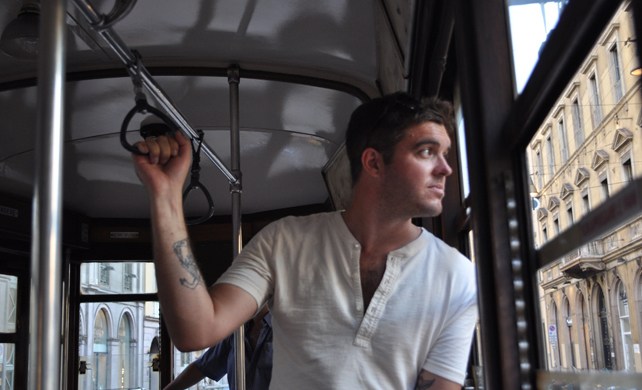 “My personal opinion is that if someone writes honestly about war, it will inherently be anti-war,” says Kevin Powers, with the authority of experience. “I can’t think of any situation in which you could write a pro-war book that would be intellectually or emotionally honest. It doesn’t seem possible.”
Powers’ experience didn’t come cheap. He served as a machine gunner and in bomb disposal squads with the American Army in Iraq in 2004 and 2005. After leaving with an honorable discharge, he wrote his debut novel, The Yellow Birds, which deals with the bond between soldiers on the battlefield and takes its title from an old military marching song. Compared favourably to the work of Ernest Hemingway and Cormac McCarthy, the book won him an armload of prizes and fans including Damian Lewis, who described the book as “a poetic and devastating account of war’s effect on the individual”, and Tom Wolfe who called it “the All Quiet on the Western Front of America’s Arab wars.”
Over coffee in London’s Marylebone, a world away from conflict in the Middle East, Powers discusses the unlikely music that takes him back there, why he wrote in secret and the politics of the war in Iraq from a soldier’s vantage point.
GQ: When you joined the army did you already feel like a writer, or was it a case of coming back with a story to tell?
Kevin Powers: Writing was always an aspiration, but I’d kept it a secret even from myself. As a teenager I started thinking about poetry and novels seriously. I started writing, but never thinking it would be anything other than a hobby. It wasn’t until after I came back that I felt that I didn’t have anything to lose. Failure was no longer the biggest fear that I had faced in my life.
How old were you when you enrolled in the army?
I signed up when I was 17 and went overseas when I was 23. I’d been in the army for a little while before I saw any kind of action. There were a number of reasons for joining up. The male role models I had all seemed to have been in the military. My father served in the army. My uncle was in the Marine Corps. Both of my Grandfathers served in WWII. There weren’t any career soldiers in my family, but when I was young it seemed like a way of arriving at adulthood. I wasn’t a particularly good student but I wanted to go to college. It can be really expensive to go to college in the States, so the financial aspect made military service very attractive. Also the other obvious reasons: I was young and I wanted to see the world and experience some kind of adventure.
If The Yellow Birds had a soundtrack, what would be on it?
About once every month we’d get to go to this little airfield where they had a PX, which is basically a little store. As you’d imagine, they have a very limited selection of music. I remember getting Weezer’s Blue Album, and I discovered this guy called Graham Lindsey who I don’t think is well-known at all. He’s this folk Americana guy who sounds like Justin Vernon would if he lived in a ditch. It’s really raw and beautiful. He has this album called Famous Anonymous Wildernes that I listened to all the time when I was over there.
What’s the best book about war?
Probably the book that really consciously influenced me is a really amazing Vietnam novel called Meditations In Greenby Stephen Wright. That book is so strange and beautiful and unlike any other war narrative that I’ve ever read. It made me feel that I was free to follow my imagination and write the story that makes sense to me. I’ve read a lot of novels and poetry about Vietnam written by veterans. As important as those were to read as both a veteran and a human being in the world, just seeing the variety of different stories that are out there just gave me the sense that I was free to approach it whatever way I wanted to.
How did serving in Iraq change you?
I think the long-term effect, unsurprisingly, is that it’s made me really appreciative of how lucky I am to have survived. I think I have a sense of gratitude for things I may not have appreciated otherwise. You naturally mature during those years anyway, and I like to think I would have arrived at those kinds of things on my own, but that experience concentrates everything. You see things with a sharper focus than you might otherwise. You also learn that what you thought were your limits are not your limits. You endure more than you thought you could.
Were you writing while you were in the army?
I was writing – secretly. I didn’t really want to announce to my platoon mates that I was a wannabe poet. When I got overseas I would jot things down in a journal but not real attempts at poetry or stories. I didn’t have the mental energy for that.
What were you reading in Iraq?
I read a lot more than I wrote. My mother would send me care packages. She sent me Graham Greene’s The Quiet American which was sort of strange – but that’s my mother! On a few occasions I’d have a book in my pocket while we were out on patrol. Not that I was reading then, but maybe it operated as a kind of talisman. It made me feel a little more comfortable: “This is insane, but at least I understand what’s happening here in my book.”
Did you learn much about Iraq itself or was it an insular barracks existence?
There’s a very high degree of isolation, just for security reasons. There were some occasions where I thought I was getting a window into the experiences of the people for whom we were allegedly fighting, but oftentimes “going outside the wire” meant adopting a totally different mindset. You’re on a small base not really coming into contact with locals at all. The way that my unit operated, because of the job we had, was that we’d spend 48 hours outside the wire then come back for 24 hours. When you go off the base it’s like flicking a switch and all of sudden all you’re thinking about is making sure that you come back. You need to make sure that you’re looking out for your friends. There was one instance when we stopped on patrol and I looked over at this mound and thought: “Oh s***, those are the walls of ancient Nineveh.” It was a surreal experience to be in the land where civilisation was born and be engaged in the kind of violence that we were engaged in. There’s a dissonance which is unavoidable.
How close is the book to your own experience?
The specifics of the story aren’t necessarily actual events that I experienced. Really what I was trying to get at was some sort of emotional core. In terms of survivor’s guilt, even though I never lost anybody as close to me as the character in the book, when I came home there was definitely a period, particularly with the war still going on and with people still dying, the question become unavoidable: Why did I survive? Why didn’t these other people? I’m clearly no more worthy of surviving as these people, perhaps in some cases less so. Who knows if one of those guys might have cured cancer? You absolutely start to wonder if it’s purely chance. How does it work? Having survived, what is your responsibility going forward? Those are all things that I tried to put into the process that he goes through of coming to terms with what he’s experienced.
When you were writing the book were you conscious of making a political statement?
I’m aware that it’s unlikely anyone will read the book without thinking about the political ramifications of our time in Iraq and what it means. I tried to avoid having a political agenda. I wanted to tell one guy’s story, so that no matter what you think about the war itself perhaps by narrowly focusing on this guy’s story somebody could connect on an emotional level. Obviously this is a subject that I’ve thought some about. As much as I wonder what we accomplished, there were instances when I was able to see some good. I spent some time in a predominantly Kurdish area and those people perhaps were better off than they had been under Saddam, but when you think about what the military action entailed and the reasons that were given to justify it there is a disconnect that I haven’t been able to make much sense of.
As soldiers were you aware of the public debate and the protests about going into Iraq?
It’s probably different for each person, but I don’t think it would have come as a great surprise to anybody. When I went to Iraq we as an army had been there for a little less than a year and no weapons of mass destruction were turning up, nor would they. That was no secret to the soldiers. They weren’t asking us to keep our gas masks on, if you know what I mean? At the same time, your primary focus is: “Alright, we’re here, this may be bullshit but the fact that it’s bulls*** isn’t getting us home, so we have to look out for each other.” That becomes the only thing that you really focus on. My process of sorting through my culpability, my participation in that, was something that I had to do the real hard work on after I got back. Only when I came back and was safe did I start trying to come to terms with what it meant to have fought in a war that we may not have needed to fight at all. I’m not sure what we’ve accomplished. To be perfectly honest I haven’t arrived at any sort of answer that gives me great comfort.
What advice would you give your younger self?
I’ve thought about that a lot. I wonder if my younger self would listen. I feel like I had all the information available to me to make the right choices but when you’re 17 you hear what you hear. I would probably say the same things that were said to me by the people that cared about me. That this is a serious thing you’re doing. Joining the military is not to be taken lightly. You’re putting every part of yourself at risk, not just your body but your moral and spiritual centre. That can be injured grievously as well. Even if you think you’re physically invincible, as many 17-year-olds do, there are other ways to become wounded. That’s probably what I’d say, but who knows if I would have listened?
Originally published by British GQ.

Bastille on ‘Laura Palmer’ and ‘Pompeii’

The Family Rain flood Berlin

Lots of studios have a history, but none quite like Hansa. It’s the ‘Hall By The Berlin Wall’ where Bowie and Iggy came to record ‘“Heroes”’ and ‘Lust For Life’ in the middle Seventies and where Nick Cave was strung out on heroin in the Eighties. Now it’s home to three brothers from Bath who are living in the flats on the top floor and spending fourteen hours a day recording incendiary, primal blues rock.
That’s not to say they’re too concerned about the weight of history. “We’re not looking towards the past,” says drummer Tim. “We’re a forward-thinking band. It’s great that all those guys recorded here, but we’re obsessed with modern records as much as we are old-school ones.”
“But we did find out,” chips in singer Will, “that a break we used in one of our songs from Iggy Pop’s ‘Nightclubbing’ was recorded in the same fucking studio. It comes full-circle. That’s fucking cool.”
One listen back to the album sessions and it’s clear Hansa’s reputation is in safe hands. The record is full of the sort of hook-filled, strutting rock songs that Jack White would sell his sister for, shot through with a trace of Bristol trip-hop.
“We used to have other people in the band and be quite strict about the type of music we’d make, but we had an epiphany when it became just the three of us,” Will explains. “I remember us being on holiday in the sun and listening to ‘Can’t You Hear Me Knocking’ by The Rolling Stones. We thought: ‘This is the point of music. From then on it’s just been about writing music that you can fucking get into and groove to.”
It’s the sort of music that just begs to be heard in a sweaty underground bar, so we pile into taxis and head across town to White Trash. It’s the sort of place where you can get a tattoo, eat a heart-punishing burger, down a shot of whisky, smoke a cigarette, meet a beautiful stranger and watch a life-changing rock’n’roll show all without leaving your barstool.
The band are instantly at home. Their set is fast, swaggering and deafeningly loud. “If we had it our way we would be playing shows 365 days of the year,” says guitarist Ollie backstage. “And if we weren’t doing that then we’d be in the studio. We find it so natural because we’ve been playing music together since we were 14. Being in Berlin and actually getting paid to do it is the dream.”
They’re not stopping here: they’ll spend April touring the UK with Willy Moon ahead of hitting this summer’s festival circuit. Their sights are trained on the top of the bills: “We’ve always dreamed big,” says Will. “We want to sell a million fucking records and headline every festival around the world. If you’re not thinking huge then what’s the fucking point?”
Before that they’ve got a city to take. “Berlin doesn’t look open, but once you explore you realise how cool it is,” says Ollie. “We’ve been to bars in DVD shops and an old dentist surgery. Maybe it’s pot luck but we haven’t found a bad one yet – and we’ve been to a lot of bars…”
Tonight we end up in Chalet, a tumble-down Kreuzberg mansion which dates from the 19th Century and must have been a stately home in its time. Now it’s overrun by hordes of gorgeous German party kids. And why not? As The Family Rain know: who needs history when you’ve got right now?
Originally published in NME, 23 March 2013.

Saint Dave reveals all


“God damn, it’s bright in here.” Dave Grohl winces and draws the curtains out of respect for his burgeoning hangover. It’s midday and he thinks he got to bed maybe four hours ago. He’s making the most of his time in London. Last night he swung by his favourite Soho rock hangout The Crobar before attempting to pay a visit to burlesque club The Box, which turned out to be closed. That didn’t stop the party, but one hanger-on nearly did. “There was this English singer with us who was completely wasted. We almost had to throw him out,” he explains. Which of this country’s hard-living rockers is he referring to? You’ll never guess: “Have you heard of this band… Blue?”
That’s right, the greatest drummer of his generation spent last night being tailed by conspiracy-spouting pop crackpot Lee Ryan. “The guy kept telling us how many million records he’s sold,” Grohl shrugs. “I was like, really? You?”
The mind recoils at the idea of the pair propping up a bar, but then Grohl does have a reputation for being “the nicest guy in rock” and he’s no stranger to surrounding himself with a weird and varied cast of characters. Last night he played a show with his Sound City Players, a band that included the Foo Fighters as well as Grohl’s former Nirvana bandmate Krist Novaselic, Cheap Trick guitarist Rick Nielson and 80s heartthrob Rick Springfield. They’re in town to for the premiere of his documentary, Sound City, which tells the story of the legendary LA recording studio where Neil Young, Fleetwood Mac, Rage Against The Machine, Arctic Monkeys and many more all laid down masterpieces. The place holds a special significance for Grohl, because it was there that Nirvana went in 1991 to record ‘Nevermind’.
As he sits down for a revitalising breakfast of sausage and eggs, Grohl opens up to us in-depth for the first time since he was named Godlike Genius at the 2011 NME Awards. There’s a lot to talk about, from his plans for the next Foo Fighters record to how his musical idol Paul McCartney came to front a reunited Nirvana lineup and why he still wants to throttle the charlatans who produce manufactured pop.
NME: Your film starts with Nirvana in a beat-up van going to Sound City to record ‘Nevermind’. When did you realise how big that record would get?
Dave: When I joined Nirvana they had demoed ‘In Bloom’ and ‘Lithium’ with the original drummer Chad so there was already this buzz about the band. We signed to the David Geffen Company and they gave us money to go down to Los Angeles to record ‘Nevermind’. I don’t know why we picked Sound City. I think it was because of the board, which was an old Neve, and because it was cheap. It was like $600 a day. Our budget wasn’t much because nobody thought anything was going to happen with the record. When we got there we were surprised that it was such a shithole, but we weren’t accustomed to the finer things in life anyway. It was such a quick session and nobody thought anything was going to come of it. We only took three pictures while we were making the record. That’s all there is to document the making of that record, other than the record. It was so far outside Hollywood that none of the fucking posh A&R people would ever come out. I asked our manager if I should worry, and he said: “No, consider yourself lucky! You don’t want those assholes there.” We recorded in April and the record came out in September and then we were just touring in the van as we’d usually do. Things started to change by Christmas. I knew things were going well because our per diem went like from $7 to $10 a day. It was a sweet gig! Audiences started getting bigger and bigger and by the end of the tour the album was gold. Something was happening with the other bands too: Pearl Jam, Soundgarden and Alice in Chains. In two months, everything changed.
What was it like to go back into that room at Sound City where it all started?
The first time I went back after we recorded ‘Nevermind’ I went in and right as you walk in the front door there’s a huge Nirvana plaque. It was an incredibly emotional experience for me because when I first walked in to Sound City I thought: ‘Oh my god, what a shithole.’ Then I looked at the wall and saw Fleetwood Mac, Tom Petty and Neil Young. I couldn’t believe that these legendary records had been made there, because it was such a dump. It was good to think that another kid would say the same thing when he walked in the front door: “I can’t believe ‘Nevermind’ was made here, it’s a shithole.”
What’s the wildest thing you got up to at Sound City?
Once I was producing a band called Verbena and it was the singer’s birthday so I bought him this mini motorcycle that went fucking 45mph. We spent an entire afternoon jumping the ramp that goes up to the parking lot like Evel Knievel. It was the stupidest, most dangerous thing I’ve ever done in my entire life. There were countless nights where we’d just abandon the session and start drinking. It’s not like you were going to mess anything up in there. Once you got into that back hallway where it was really dark and all the walls were carpeted, some really nasty shit went on there. It was fun.
When Sound City closed you bought the soundboard. Now you’ve got it in your studio are you desperate to record the next Foo Fighters record on it?
Yeah, but it’s funny because I’ve just made the biggest infomercial for my studio. We’re getting calls from really popular bands who want to come and record on the Sound City board. I’m fucked because it’s my studio and I don’t have anywhere to go! I think the reason they sold the board to me was because they knew I wasn’t going to chop it up and sell it for parts. I wanted to use it the way it’s supposed to be used. That thing hasn’t been turned off, other than like power outages and earthquakes, for forty years. You’re not supposed to turn boards off, and those tubes have been glowing for forty fucking years.
You’ve said you’ll start working on the next Foo Fighters record as soon as you get home. When can we expect to hear it?
Eventually! We have a lot of music, we just need to turn it in to a record. You know, I think we do best when we step away from things and regroup. One of the reasons we’ve been a band so long is that we eventually learned how to say no to things. I mean, we’re on hiatus now and we’re busier than we’ve ever been in our life. Pat Smear calls it ‘I hate us’! We can’t spend that much time away from each other because we’ve been friends for a really long time. Whenever we get back together just to do something as silly as the Sound City project it’s always fun. The next record is going to be good. I’m looking forward to it.
When will you next going be onstage as the Foo Fighters in the UK?
I don’t know. Not any time soon.
Five years?
I can’t wait that long! God damn, if I waited five years I’d almost be 50 years old! I’ve got to come back before then. You’d have to fucking wheel me onstage…
Well if it was Reading it wouldn’t be the first time someone was pushed onstage in a wheelchair…
[Laughs] Exactly! You don’t want to go through all that again.
Last year at Reading there were rumours you’d cover Nirvana. Is that something you’d ever consider?
Every once in a while we talk about it. For the Sound City gig here in London we were thinking about musicians that we could invite because Stevie Nicks and John Fogerty couldn’t make it. Someone came up with the idea of doing a Nirvana song with Polly, PJ Harvey. Kurt loved her, and we love her, and we thought: “Yeah, what would we do?” I said: “God, what if we were to do ‘Milk It’ from ‘In Utero’ with Polly singing?” We all looked at each other like: “Woah, that would be amazing…” and then she couldn’t do it! The thing is, it’s sacred ground. If we were ever to do something like that it would have to be right because you want to pay tribute. There’s a reason Foo Fighters don’t do Nirvana songs, and it’s a good reason.
At that Hurricane Sandy benefit show a lot of people thought you were reforming Nirvana with Paul McCartney…
When he came to our studio to record with us that day we didn’t know what to expect. Some musicians need to know what they’re going to do before they get in the studio, others are just willing to get weird and experiment and jam. Paul likes to just walk in and see what happens, which I have so much respect for because he’s fearless. He has a confidence that you don’t find in a lot of musicians because he’s really good! I knew that we weren’t going to do a Beatles song and I was pretty sure we weren’t going to do a Nirvana song, so when I talked to him he said: “Well, why don’t we just write something?” I said “Oh great, that takes the pressure off!” Then with the Hurricane Sandy benefit he called and said “Hey, um, I’m doing this benefit, would you like to play?” I said: “Of course.” He said: “Maybe you could play a bit of drums. Hey, why don’t we do the Sound City song?” I would never have suggested that! I wouldn’t have been like: “Hey Paul, let’s do one of my songs”, you know? So I asked Krist and Pat and it just happened. Of course, there was a lot of speculation. People didn’t know what our intentions were, but I was really happy that we were the one band that went out there and did a song that no-one had ever heard. A song that no-one knew existed at that point! We’d kept it a real secret.
What was your most surreal moment with him?
We were in the studio and he says: “Go in there and double my vocal”, and I said: “Ok, you mean put a harmony on it?” “No, no just sing what I sang. Me and Lennon used to do it all the time…” Like, what?! Who am I? What’s going on here? This is crazy! I had to pinch myself. Even had we not filmed it or recorded it, that still would have been the most special day of my entire life. It was so awesome to sit with my absolute hero, my musical hero, the person that influenced me more than anyone else and to record on the board that I think is responsible for me being here. It was incredible.
Your film emphasises the importance of bands playing together and sounding shitty while learning their craft rather than taking the X Factor route to the top. What is it that talent shows lack?
I think people should feel encouraged to be themselves. Music is meant to be a basic expression and it should be entirely human, like hearing someone speak or watching someone move. One person’s Beethoven can be another person’s fucking Throbbing Gristle. That’s what bums me out about those shows where people are judged so harshly by fucking musicians that hardly even play an instrument on their own fucking albums! It makes me really mad. I swear to God, if my daughter walked up on stage and sang her heart out and some fucking billionaire looked at her and said: “No, I’m sorry you’re not any good”, I’d fucking throttle that person, I swear to God. Who the fuck are you to say what’s good or bad? If you were to put Keith Moon up on stage and have him judged by prolific fusion drummers they would say: “Well, your time’s not great, you’re all over the place, you’re hitting rim-shots when you weren’t supposed to, your cymbal work is a little sloppy….” It’s ridiculous. It homogenises music so that everyone sounds like fucking Christina Aguilera. I mean, really? In my world I listen to fucking drummers that sound like they’re falling down the stairs as much as I love listening to a beautiful disco track where someone’s got perfect time like Tony Thompson. People need to understand that if you’re passionate about something and you’re driven to do it then don’t be fucking scared, do it. The next time someone says you’re not that good a singer, say: “Fuck you!” I interviewed Neil Young, and he said in his first band someone said to him: “The band’s really great but honestly you shouldn’t be the singer. Please, don’t sing.” If Neil Young had listened to that person, we wouldn’t have Neil Young!
The Foo Fighters are supposed to be on hiatus but you’re working harder than ever. Can you ever imagine retiring?
Retiring? You should see the house I have to make payments on! No, look, I’ve had jobs. I’ve had shitty jobs: manual labour, pizza restaurants, fucking record stores, whatever. This is not a job. I’ve already retired. I retired the fucking day that ‘Nevermind’ went gold. The thing is, I have more opportunities thrown at me now than ever before in my life and the hardest part is doing as little as possible. I get all these amazing opportunities and you’d be crazy not to take them.
You get called the ‘nicest guy in rock’, but don’t you need to have an edge to be successful in music?
Evidently not! I think that it’s important that you try to treat the people that work with you with respect and that you try to take as much time as you can with the people that come up to say hello. Sometimes it gets overwhelming when you just want to sit down and have a fucking drink and you can’t, but it could be worse. I have this motto in life: ‘It could be worse’. Some people have a ‘It could be better’ mentality, but not me. Even when it’s bad, it could get worse, believe me. I don’t have any complaints.
With that it’s time for Dave Grohl to head off into the sunset. He’s got to start whipping those Foo Fighters songs into shape, not to mention maintaining his reputation as the world’s most in-demand drumslinger-for-hire by playing with everyone from Queens Of The Stone Age to RDGLDGRN. Judging by his unstoppable workrate, don’t be surprised to see him back prowling a UK stage before too long. It means too much to him not to. “You know it’s funny, recording at Sound City and playing the Reading Festival happened within six months of each other,” he says. “It was such a crazy year in my life. I was 22, I was a child. I was so dumb, but all those huge experiences happened in a short period of time so I look back on that period in a very romantic light. To be young, and to have the world in the palm of your hand… I wouldn’t change a thing.”
Cover story for NME, 23 March 2013.

Wiley on ‘Heatwave’, ‘Can You Hear Me?’ and ‘Reload’
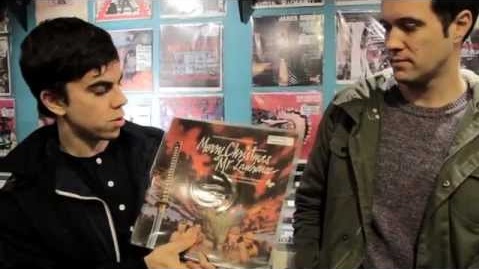
Record shopping with Electric Guest and the story of ‘The Bait’

Tribes on ‘How The Other Half Live’ and covering Alabama Shakes

“We’re the living embodiment of the belief that you can do whatever you want.”

If you only know The Flaming Lips as electric-hued purveyors of highly-polished psychedelic pop and hosts of the world’s most euphoric live shows, their new album might be a jolt. Aptly titled ‘The Terror’, it’s a dark and abrasive record that stares into the abyss and yet, somehow, still manages to find some beauty amid the fear and dread. Truth is, this band have always been more comfortable than most dealing with the big existential questions, from when they started out as a mind-bending punk band recording songs about ‘Jesus Shootin’ Heroin’ right through to smuggling a blunt and jarring reminder of humanity’s fragile mortality into their most universally adored anthem. Over glasses of single malt at a well-appointed hotel in London’s Clerkenwell, Wayne Coyne gets heavy on everything from the mysteries of free will, reinventing The Flaming Lips and the importance of getting fucked up now and again.
The Flaming Lips are a hard band to pin down. I first discovered you when ‘Yoshimi…’ came out, but then for Christmas my dad bought me your early box-set ‘Finally The Punk Rockers Are Taking Acid’.
Hahaha! Well, he’s ruined it for you then! You thought we were those people who made ‘Yoshimi…’, and then that record ruined it for you!
I was like: ‘What the fuck is this shit?’ It blew my mind.
‘Yoshimi…’ is so refined. We made it on purpose to use commercial music as an experiment. We were listening to fucking Nelly Furtado and shit like Madonna. I mean we loved it but we were using it as a palette. It’s so well made. It’s a trick because we sound like we really know what we’re doing and the truth is we don’t know what we’re doing.
The abrasiveness of ‘The Terror’ seems to hark back to The Flaming Lips’ earlier, more experimental material: songs like ‘Jesus Shooting Heroin’.
Bizarre songs like that, yeah. When we were young we had no guide. You kind of just make what you can. Sometimes you wish that you knew more about production, but it is what it is. We’ve made 16 records now and it does lead you into this world which helps you understand about sound and how you can use it to evoke certain things. The main thing you learn about music is that if something’s good, don’t fuck it up. The really good things that happen in music are collisions. In the beginning, we took punk rock in the same sense as John Lydon said it: anarchy. In music and art, do whatever the fuck you want, just fucking do it. It quickly turned into punk rock being a particular look and sound. That isn’t what we thought of it. We thought it was just: “You’re fucking free.” When we proclaimed ourselves The Flaming Lips we asked ourselves: “How long will this last?” We thought it would last six months and then we’d be back at our restaurant jobs. We thought that would be the end of the story but the fucking story never ended. You keep thinking that someone is gonna knock on the door: “Flaming Lips, we know it’s all bullshit, it’s over”. “Okay you caught me, I surrender” but nobody has yet. We’re the living, breathing, somewhat successful embodiment of this retarded belief that you can do whatever you want and we really do live by that.
How did writing ‘The Terror’ compare to previous albums?
Sometimes you feel compelled to follow a sound. When we were making ‘The Soft Bulletin’ we didn’t think about making it, we just followed a sound. That really means rejecting all these other sounds. You might not know what you like, but you know what you hate. I think ‘The Terror’, in a sense, is the same thing. I don’t think people will look at like ‘The Soft Bulletin’, with whatever that means to people, but I think for us it feels like we’ve self-destructed again, not in the same way but with the same intensity. The minute we said: ‘This is how we’re gonna be as a band forever’, absolutely the next second we were completely different and utterly changed. I think we’re onto probably the third phase, the third version, of The Flaming Lips.
What gives you ‘The Terror’?
When you’re young, you feel that it’s you that’s saying: “I want this”, “I don’t want that” or “I’m rejecting that”. It feels as though it’s something that we decide from the front of our minds. For me, when it comes to ‘The Terror’ the shocker line is: “We don’t control the controls.” The intense way that we love is not something that we have a say over. It’s a part of our subconscious life that probably comes from our parents or from whatever our bullshit DNA has made us. It’s like the reason you’re tall and have hair and the reason the other guy is short and doesn’t. We don’t decide, dude! Something in us gets to decide. When you’re young you can say: “My eyes were decided by my DNA but the music I listen to isn’t.” As you get older, it starts to seem like you don’t really know how much of anything you get to decide. That’s ‘The Terror’. ‘The Terror’ is that it appears everything is normal and alright but inside you is a fear that says: ‘I don’t know.’ That’s why this music is full of anxiety and feels stressful. It feels depressing but it’s kind of triumphant. You know something now, but the thing you know is disturbing.
‘The Terror’ also seems to speak about mortality and the existential terror that comes from our knowledge of it. That’s the ultimate thing you can’t control. It reminds me of ‘Aubade’ by Philip Larkin, do you know it?
Yeah, I’ve read it, it’s cool. As far as control goes, well, you can kill yourself. That would give you some control, although even that is probably something that is innate in you. It’s probably part of your personality, that’s the twist on all of it. You don’t know, of everything you reach for, how much is you wanting it and how much you’ve been pre-ordained to want it, but loving something helps us not feel so alone. That’s part of it too, we’re trapped in the isolation of our own minds. Fear can make part of you say that you’ll live in the middle. “I won’t lust for this and I won’t care about that.” That’s another form of ‘The Terror’. Who wants to fucking live like that? You can’t live in this fucking nothing grey zone where nothing is gained and nothing is lost. You have to surrender. All the great things require that you give in. You can’t even have an orgasm if you’re too fucking scared and hold back. It’s the same in the moment where you’re conscious that you’re falling asleep. It’s God. It’s everything. That’s the most beautiful thing that happens to you, but you have to surrender.
Even a song like ‘Do You Realize??’ contains seeds of terror within it.
It does. I mean, it’s a very optimistic world with some terrible seeds in the middle, whereas ‘The Terror’ is the just the seeds themselves. I don’t think the success of ‘Do You Realize??’ is because we’re clever or because we’re such good songwriters. There are almost a million songs that play that exact same thing. That chord change is used so often because it works. Whatever kind of mind it is listening to it, if you like The Beatles you like these chord changes. It plays on you in a way that is optimistic and it appears to be telling a story that you already know which is a good story. Then I start singing these words and then right at the time when you’re at your most comforted in the song, I tell you this horrible line, that “Everyone you know, someday, will die,” and it’s almost as if you go: “It’s okay,” and you take it in because that’s what the music and everything has done. That isn’t because we’re smart or anything, that’s just dumb fucking luck that that momentum or whatever allowed that to happen. I understand that’s how it is for most really great artists. It’s just a dumb luck combination and I see that now. At the time I didn’t see that. I remember asking Steven: “What do you think of this?” and when I went to that line he said: “Dude, that’s a Wayne classic right there, man. You got it!” But even then you don’t have any idea that people are gonna play it at funerals or that it’s gonna take on this other meaning.
When you look back at your life, what advice would you have given your younger self?
I was very serious back then about making myself be an artist. All my brothers and older sister, they’re great people but they’ve all been on some level or another a drug addict. I was very serious. I didn’t want to indulge in everything because I’d be as vulnerable as them and end up addicted to the same drugs. It’s very difficult to keep pursuing music and art when life become too much of a calamity. However, if I could I would probably tell myself: “Wayne, for two weeks you get to be as serious and work as hard as you fucking can, but on this night, get fucked up.” I think it would’ve served me well because I would’ve had some relief. I think that’s the reason I do drugs and stuff now. I understand that I’m broken in the way that I will take things very seriously and I will work too hard and be too intense, but then I’ll get fucked up and not care that much. When I come back to myself, some of the things I was so serious about won’t worry me. It allows you, if you’re lucky, some perspective.
Sometimes you need to take a holiday from your own head, don’t you?
Yeah, and back then I didn’t value that, I thought these lazy assholes, all they wanna do is get drunk. I wanna make music I wanna make art but, you know, I’d tell myself to have fun.

Kasabian on festival plans and their next move
“Drawing became a weapon”
The first words Hunter Thompson ever wrote about Ralph Steadman were filled with foreboding: “All I knew about him was that this was his first visit to the United States. And the more I pondered the fact, the more it gave me fear. How would he bear up under the heinous culture shock of being lifted out of London and plunged into the drunken mob scene at the Kentucky Derby? There was no way of knowing.”
That was in 1970, when Scanlan’s Monthly decided to pair Thompson not with a photographer but with an illustrator already known for his vicious eye for satire. The piece they created together, “The Kentucky Derby Is Decadent And Depraved”, became the world’s first taste of “Gonzo journalism”. It was the start of a partnership that would go on to produce 35 years of brilliant and iconoclastic work, including Steadman’s intense and visceral illustrations for Fear And Loathing In Las Vegas and a whole series of lurid Rolling Stone covers.
When we meet on London’s Southbank, Steadman is on the hunt for Sauvignon Blanc. We’re here to talk about For No Good Reason, an honest and candid documentary about his life and work that he’s put together with the help of Johnny Depp and the filmmaker Charlie Paul. The conversation soon turns to powerful hallucinogenic drugs, why America’s “heinous culture shock” was the best thing that ever happened to him and the true meaning of Gonzo.
GQ: You say in For No Good Reason that you want to use your art to bring about social change. Where did that impulse come from?
Ralph Steadman: Well, that was the bullshit I used! I actually did want to change the world. I decided that I wasn’t just going to be an advertiser. I had worked for an advertising agency, I had worked in Woolworths and I had worked for de Havilland Aircraft Company, where I was going to be an engineer. That all went out the window. I took a course when I was doing my national service. I saw an advert for Percy V Bradshaw’s Press Arts School Course. It read, “You too can learn to draw and earn £££s.” It was a bit of an old fashioned course, but it got me going. I started sending pictures to the Aberdeen Journal, the Leicester Mercury and the Manchester Evening Chronicle. The very first cartoon I had published was at the time of the Suez crisis. It was a lock-keeper sitting in his chair looking at a newspaper and saying, “Nasser, who’s he?” It seems rather a long time ago now. All those guys are gone and I’m still here.
Having lived through the events of The Kentucky Derby Is Decadent And Depraved, were you surprised when you first read the piece?
I was quite flattered to read what he’d said. “Waiting for Steadman…” became one of our things! He invited me to meet some of his old friends. There was a girl there and I started drawing her. She says, “I’m purdy, aren’t I? You ain’t drawn me purdy! Why aren’t I purdy?” I said, “Well, you have a go. Draw me.” She went crazy with anger because she couldn’t get anything down without a scribble. That’s when Hunter said, “Stop doing those filthy scribblings, Ralph! You’ll get us thrown out.” He took me to the airport and threw me out. I think he says I was half-naked at the time. I wasn’t really, but Hunter embroidered the truth. It was truth and it wasn’t truth. Hunter told me I’d lost it, and I didn’t think he’d ever invite me back. I didn’t think Scanlon’s would either, but then they did.
After the Kentucky Derby you went to cover the America’s Cup yacht race together…
That’s the one! That’s the only time I took drugs. Psilocybin. If I’d have completed what I thought I was going to do I’d never have left America. Hunter had got these spray cans. I said, “Why did you bring those along?” He said, “I don’t know. I thought maybe we could use them.” We had a few drinks in the bar in Rhode Island. Hunter had a Lille flare gun with him. He kept that on him, “You never know when you might need a thing like this.” We had drinks then went back on the rowing boat to the three-masted schooner we were staying on. Then we took off in the boat, me with the spray-cans and Hunter trying to row. The oars were coming out of the rollicks. I can seem him now, with his legs in the air. “Fuck this goddamn boat. Hurry up and do the job!” I was to write “Fuck the Pope” on the side of one of the boats. It was the Gretel and the Intrepid. They were beautiful things, worth £500,000 each. If I’d done it I don’t think they’d have let me leave America. Luckily we were caught. Someone had shouted down, “Excuse me, what are you doing down there?” Hunter said, “Oh, we’re just looking at the boats.” Unbeknown to them was what I was planning under the influence of that drug. Luckily I didn’t do it. It makes a better story than it felt in actuality at the time. It was terrible.
I remember getting a plane back to New York and for some reason I wouldn’t sit down for the whole journey. At the time you could smoke and walk around, there wasn’t security like there is now. I just refused to sit down. I got back to New York and I remembered I’d met a lady in Italy who’d said, “If you’re ever in New York…” I remember ringing her and saying: “I’ve just been on this terrible journey with Hunter.” I went to see her and she got me a doctor. He put me out for 24 hours. I’d got myself into a bit of a state. It’s weird that Jann Wenner says I’m crazier than Hunter. It’s not true.
George Plimpton met you and Hunter in Kinshasa when you were all there to cover Muhammad Ali’s “Rumble In The Jungle”. He wrote: “[Ralph] seems to pep things up, and inspire a corporate rather than an individual madness”.
That’s rather a good quote, isn’t it! Dear old George Plimpton. I mean, everybody was there. There was a queue of all the greatest names you’ve ever heard of from the journalists of the time. They were all queuing to get out of Kinshasa. That was surreal. I don’t know if anyone got any film of that line of great journalists.
But Hunter didn’t finish the story. Rolling Stone editor Paul Scanlon told us you were very angry, because that meant they didn’t use your pictures. Did you worry Hunter had lost it at that point?
No, they didn’t use them and I’d done all these pictures! Hunter was still producing, in a way he was just about to begin. I think I was a bit upset because I considered it to be one’s duty to fulfil the assignment. That was important. I went out there always with a sense of responsibility. I’d get as crazy as I could but I’d do the job. I did what I was being paid to do, or not paid to do. Half the time I never got paid, but it was something to do.
Were you more reliable than Hunter?
He had to see the work before he could write anything. Then he said to me, “Don’t write, Ralph. You’ll bring shame on your family.” I did the drawings first. He used to say he’d “get off the back of them.” “You do something, Ralph, anything. I’ll write after that.”
In 1980 you worked together on The Curse Of Lono book, the only time you shared equal credit. How did that come about?
With him saying, “Ralph, we’ve got to go join the marathon.” I spent some time in Honolulu and thought there was a book there somewhere.Hunter wanted to call it The Hawaiian Diaries. I thought that was a boring title. I’d heard about Lono, this god figure rowing away into the distance across the sea. I suddenly thought: Hunter’s the god Lono. Hunter was always on about the curse of things, so I thought: “We’ll call it The Curse Of Lono.” I did the drawings first. Hunter wanted to hang them up, so he pinned them up all around in Owl Farm and wrote with them as a background. We split the credit on that one.
What did you think when you were first sent the manuscript for Fear and Loathing in Las Vegas?
I recognised the process. He was with his “Samoan lawyer”. In some ways I’d been dropped. I think he wanted to go with somebody who could represent him if he got into difficulties. The Samoan lawyer was more useful than the mad “English” artist. I couldn’t argue with that. He’d already done it, anyway. He’d taken off in this car, but I knew exactly what it was like to do it when I drew the illustrations like the hitchhiker. The art intrudes over the text. There’s someone leaning on the letter ‘E’, sort of a Kentuckian. That was a nice thing to think about and work on. I think Rolling Stone were quite trailblazing at the time. It was a hell of a good thing. The best thing I did was go to America in 1970. I found out about things that weren’t in your local paper.
Did going to America also give you an enemy to fight?
I hated Nixon so much. I felt it was my duty to destroy him somehow. Drawing became a weapon. If I had a long nib I could have stabbed him with it, but instead I had to do it on paper. In some ways, drawing has always been for me a very real alternative to violence. “The only thing of value is the thing you cannot say.” Wittgenstein said that. That’s true, but you can draw it. Drawing can, sometimes, in just a few lines say what you’d want to say in a long paragraph.
What’s your proudest achievement?
I think I Leonardo is the most comprehensive set of pictures I’ve ever done. It was very personal. It meant a lot to me, to do. I did a book about God as well, called The Big I Am. That was quite interesting.I was able to play God, just as I had “become” Leonardo. When I did a book about Sigmund Freud I was lying down on the floor in his actual consulting room, looking up at the ceiling and imagining what it was like to have him standing above you. That all became part of the book. I think process is really quite important when you’re doing anything.
That’s a very Gonzo idea, to place yourself inside the story.
You become the story. That’s what Hunter always liked the idea of best. Don’t stand back and do it like an official bank clerk filling in a form. You’re actually creating the story as you go. There is no story, until you start one. That’s how we did it. That’s why it always was fun. That’s why it was hopeless when he killed himself.
How did you learn he’d died?
It was from my friend Joe Petro III, a screenprinter from Louisville, Kentucky. He rang up in the middle of the night on February 20th, 2005. He said, “Take your phone off the hook, Ralph. Hunter’s just committed suicide.” It was… a downer. I think it’s remained so, although I’m still doing my own thing. I’ve been thinking what a dimension to my life Hunter has been. I couldn’t imagine living life without the kind of stimulus that came from him. People are still interested in Hunter the man, crazy man that he was. He was physically big. Enormous. He had a head like a lump of granite.
Do you have any regrets?
You can’t. It’s past! It’s gone. No regrets. The best thing I did was go to America and get work from Scanlan’s magazine in New York. Scanlan was a little-known Nottingham pig farmer – that’s how it got the name. Their whole quest was to impeach Nixon. I went along with that idea.
In the end, did you change the world?
I think the world is worse now than when we started. That’s really what happened. It’s awful now.
Originally published by British GQ.

Johnny Marr on being named ‘Godlike Genius’ at the NME Awards 2013

Kavinsky: “I’m not making music for clubs!”
 If you’d just recorded an electro concept album about a teenager zombified by a collision with a mysterious red Ferrari Testarossa, how would you announce it to the world? If you’d throw a party at a sprawling Ferrari showroom in Paris with a free champagne bar and inviting Daft Punk, Justice and Sebastian Tellier, then congratulations – you’re ready to step into Kavinsky’s world.
It’s a world that the Parisian DJ, born Vincent Belorgey, has built for himself from the ground-up. Everything about debut LP ‘Outrun’ adheres to his idiosyncratic aesthetic, founded on a love of fast cars, Eighties fashion and the sort of cinematic electro purpose built for neon-lit streets. “The best place to listen to my music is in your car,” he says over espressos. “It’s not made for clubs… or if it is I want to know about that club! I chose the character because I didn’t want to be on the front cover in black and white, sat next to a fireplace, looking moody. I wanted a story.”
Nicolas Winding Refn liked the story so much he used the Lovefoxx-featuring ‘Nightcall’ on the soundtrack of his 2011 Ryan Gosling-flick Drive, propelling the track towards 30 million YouTube hits. Such is Kavinsky’s hedonistic lifestyle, the first time he saw the film he’d spent the day in Paris downing whisky with Skrillex.
When they rocked up to the exclusive screening he still wasn’t sure when his tune would turn up. “I was like: “Where the fuck is my music?”” he says. “I thought maybe it would be over the end titles. I couldn’t wait. Then there was the black screen and: POW! I was jizzing in my pants! I grabbed hold of Skrillex and went: “Fuck, it’s my music! Man, this is the shit!” Then I felt a tap on my shoulder and some guy told me to shut up because he couldn’t hear the film!”
Originally published in NME, 2 March 2013.

Record shopping with Kele from Bloc Party and the story of ‘Truth’

On The Road Special: Django Django/Miles Kane/Palma Violets/Peace
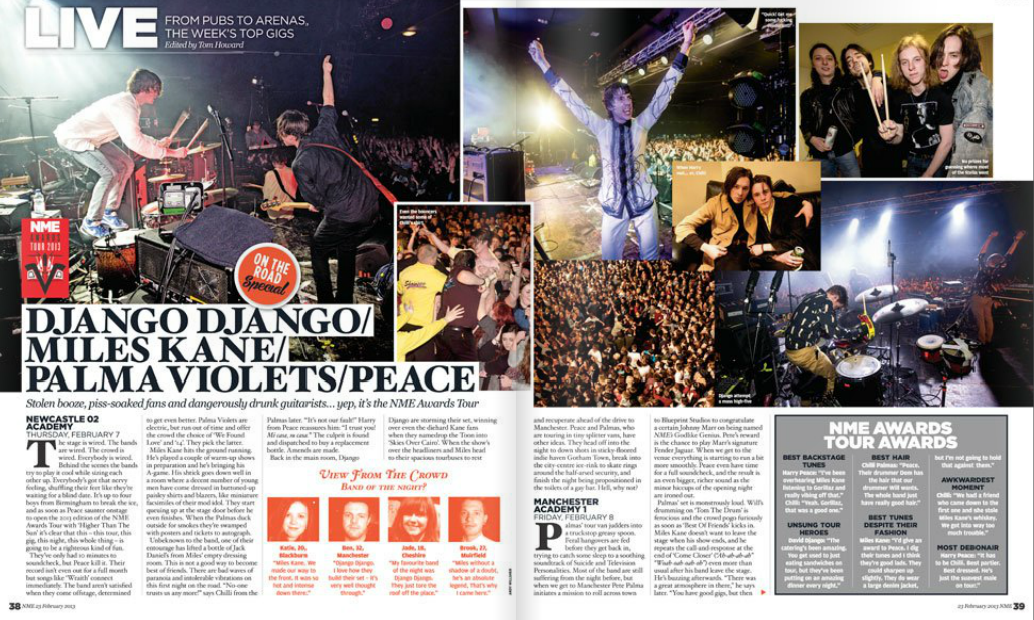
The stage is wired. The bands are wired. The crowd is wired. We’re all totally wired. Behind the scenes the bands try to play it cool while sizing each other up. Everybody’s got that nervy feeling, shuffling their feet like they’re waiting for a blind date. It’s up to four boys from B-Town to break the ice, and as soon as Peace saunter onstage to open the 2013 edition of the NME Awards Tour with ‘Higher Than The Sun’ it’s clear that this – this tour, this gig, this night, this whole thing – is going to be a righteous kind of Fun.
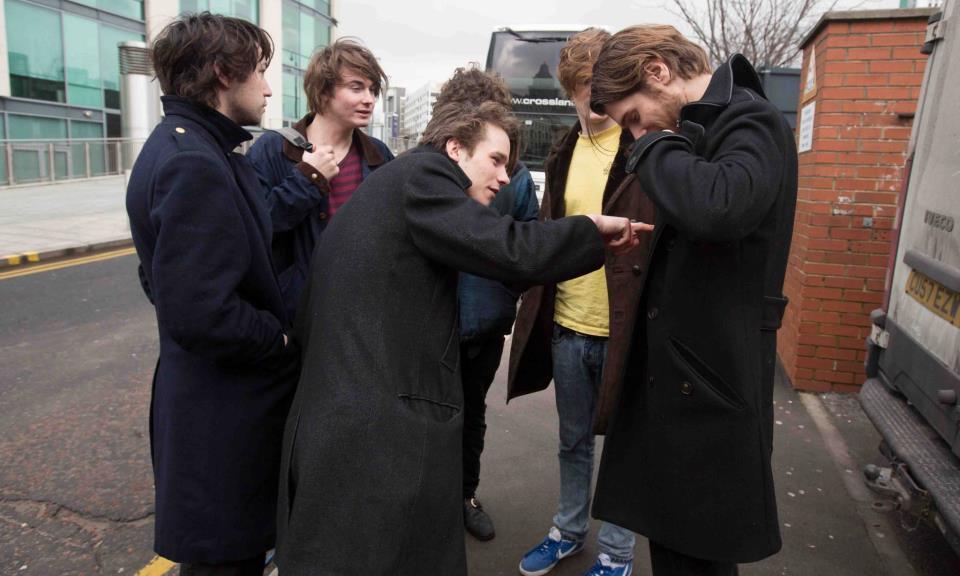
Backstage on the NME Awards Tour 2013
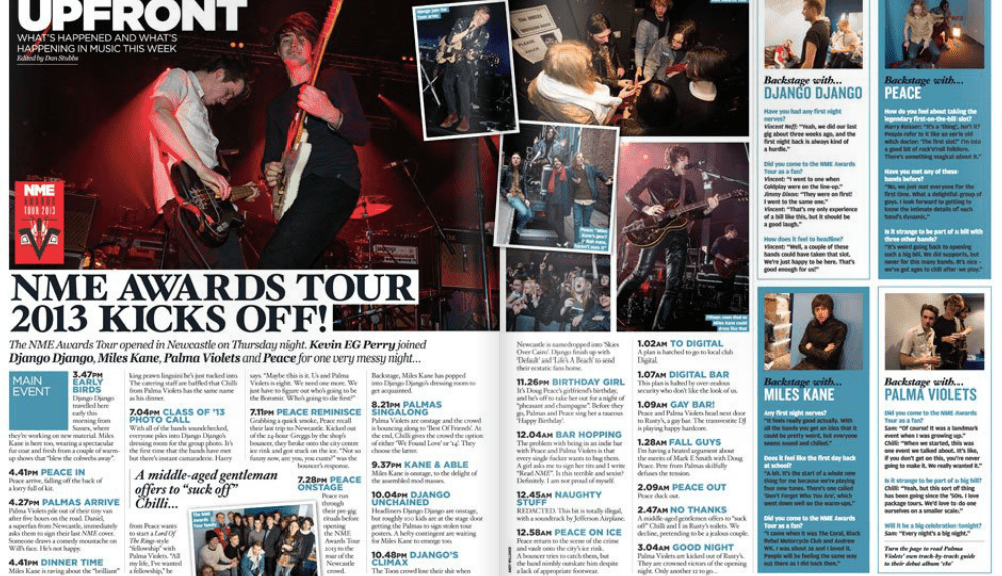
NME Awards Tour 2013 Kicks Off

We rocked up to Newcastle’s Academy last Thursday (February 7) to meet up with Django Django, Miles Kane, Palma Violets and Peace as the NME Awards Tour 2013 burst into life. Here’s what went down. It gets messy.
3:47pm Early Birds
Django Django have been here since early morning, catching up on some sleep in their bus after coming all the way up from Sussex where they’ve been working on new material. Miles Kane is here too, wearing a spectacular fur coat and fresh from a couple of warm-up shows which “blew the cobwebs away”. There is no sign of Peace or Palma Violets.
4:41pm Peace In
Peace arrive, falling off the back of a lorry full of kit.
4:27pm Palmas Arrive
Palmas arrive and pile off their tiny van, stretching their legs after five hours on their bus. Drummer Will is philosophical, pointing out that after touring the States even the length of the UK feels like a relatively civilised distance now. Daniel, a Palmas super fan from Newcastle, has brought along his NME New Bands Issue so that Palma Violets can sign their joint cover with Haim. Someone has drawn a comedy moustache on Will’s face. He’s not happy.
4:41pm Dinner Time
Miles Kane is telling everyone he meets about the “brilliant” king prawn linguini he’s just tucked into. There’s a moment of farce when the catering staff are baffled by the fact that Chilli from Palma Violets has the same name as his dinner order.
7:04pm Class Of ‘13 Photo Call
With all the bands now sound-checked, everyone piles into Django Django’s dressing room for the group photo. This is the first time that the bands have met each other, so spirits are high and there’s instant camaraderie.
7:11pm Peace Reminisce
Grabbing a quick smoke before they kick the tour off, Peace are reminiscing about the last time they were in Newcastle. They got kicked out of the 24 hour Gregg’s by the sausage roll shop’s bouncer, and then broke onto the city centre ice rink. Unfortunately the band then got stuck on the ice. “Not so funny now, are you, you cunts?” was the bouncer’s unhelpful response.
7:28pm Peace Onstage
Peace run through their pre-gig rituals before opening the NME Awards Tour 2013 to the roar of the Newcastle crowd. Backstage, Miles Kane has popped into Django Django’s dressing room to compare notes and get acquainted.
8:21pm Palmas Singalong
Palma Violets are onstage and the whole crowd is bouncing along to ‘Best Of Friends’. At the end of their set, Chilli gives the crowd the option of choosing between ‘We Found Love’ and ‘Fourteen’. They choose the latter night-bus anthem.
9:37pm Kane & Able
Miles Kane is onstage, to the delight of the assembled mod masses. Backstage, Chilli is having a fag and reiterating that ‘Fourteen’ is definitely about a bus, not an underage female.
10:04pm Django Unchained
Headliners Django Django have just taken to the stage, but out the back of the venue there’s roughly 100 kids at the stage door getting the Palmas to sign their stolen tour posters. There’s also a hefty contingent of fans waiting for Miles Kane to emerge.
10:48pm Django’s Climax
The Toon crowd lose their shit when Newcastle is name-dropped into ‘Skies Over Cairo’. Django finish up with ‘Default’ and ‘Life’s A Beach’ to send their fans home ecstatic.
11:26pm Birthday Girl
It’s Doug from Peace’s girlfriend’s birthday, and he’s take her out for a night of pheasant and champagne. Back at the venue, Palmas and Peace pile into one dressing room to sing her a raucous ‘Happy Birthday’.
12:04am Bar Hopping
The problem with being in an indie bar with Peace and Palma Violets is that every single fucker wants to hug them before we get to the bar. A girl asks me to sign her tits and I write “Read NME” across them. Is this terrible and sexist? Definitely. I am not proud of myself.
12:45am Naughty Stuff
REDACTED This bit is totally illegal, with a soundtrack by Jefferson Airplane.
12:58am Peace On Ice
Peace return to the scene of the crime and vault onto Newcastle’s city centre ice rink. A bouncer makes a half-hearted attempt to catch them, but Peace nimbly outskate him despite their lack of appropriate footwear.
1:02am To Digital
A plan is forged to go to local club Digital
1:07am Digital Bar
This plan is abruptly halted by over-zealous security who don’t like the look of us.
1:09am Gay Bar!
Peace and Palma Violets head next door to Roxy’s, a gay bar. The transvestite DJ is playing Happy Hardcore.
1:28am Fall Guys
I’m having a heated argument about the merits of Mark E Smith with Doug Peace. Pete from Palmas skilfully defuses the situation.
2:09am Peace Out
Peace duck out.
2:47am No Thanks
A middle-aged gentlemen offers to “suck off” Chilli and I in Roxy’s toilets. We decline, pretending to be a couple.
3:04am Good Night
Palma Violets kicked out of Roxy’s. They are crowned victors of the opening night. Only another 12 to go…
Originally published in NME, 16 February 2013.
Sex, Death And Growing Up

When I was 13 I used to have a coughing fit every time James sang about sex. It was the opening lines of their hit single ‘Laid’ that did it: “This bed is on fire with passion and love / The neighbours complain about the noises above / But she only comes when she’s on top.” This sounded unbelievably filthy to my young ears, so when my mum made a disapproving comment after overhearing it blaring out of my bedroom I was so mortified that I’d desperately try to drown out the offending lines with an impromptu hacking cough if I thought she was within earshot.
The trouble is I had to do this a lot. James were barely off my stereo when I was a teenager – the first band to get me excited about music and, fittingly, the first band I ever saw live, at the Great Hall at Exeter University on 26 October 2000. They were even better than I’d imagined they’d be, with singer Tim Booth flailing himself into a hypnotic trance. When I heard that James were releasing their first ever boxset, ‘The Gathering Sound’, I took the chance to finally talk to Booth about growing up, life-changing gigs and blowing Brian Eno’s mind.
James in Exeter in 2000 was my introduction to live music. Do you remember the show, or have those old tours just blurred into one long gig?
I think I was sick. I may have had the flu. It’s interesting: when you get sick before a concert it strips you down so you’ve got nowhere to hide. They can either be the worst gigs you do, or some of the best. I seem to remember that being a really beautiful one, because I was just so vulnerable. Certain gigs jump out and I have memories of, and then other gigs I haven’t got a clue. I remember fantastic gigs or very bad gigs.
Is it important to you to feel vulnerable as a musician?
I have an inherited liver disease which I’ve had it all my life. It’s probably saved my life, because I can’t indulge too much in alcohol or drugs – which go hand in hand with my profession! I think having periods of severe illness gives you a strange perspective. I’ve nearly died a couple of times. Being brought close to the end, to near death, is always a good place to write from. It’s a real leveler and it’s made me look for what people would term “spiritual answers”, which really just means coming to terms with the fact that you’re going to leave this world. All of us at some point go: “What the fuck happens next?” I think that’s true of most religions – it’s everyone going: “What the fuck happens next?”
I think the fact that you were tackling those big, existential questions is what drew me to James as a teenager.
Great, I’m so happy that’s what you found. That’s what we put down there. There were artists who similarly reached out to me, especially in my teens when you’re fucking confused and asking: ‘What the fuck is this about?’ You know it’s all a fucking mess and piece of shit – or you can do! Then there are certain things that you read and you go: ‘Thank God! I’m not alone!’ They seem to have a bead on this. For me, it was Patti Smith and the writers Doris Lessing and Albert Camus. ‘The Outsider’ is one of those books where you go: ‘Oh thank God! I’m not alone.’ I love that we were part of that daisy chain, that paper chase.
I had the same experience reading Camus. What was it about Patti Smith that you connected with?
Well, speaking of Camus: there’s that amazing scene in ‘The Outsider’ where he’s imprisoned and they want the priest to come to him and he’s telling them to fuck off even as he’s about to die. So when you hear Patti Smith’s opening line on ‘Horses’: “Jesus died for somebody’s sins, but not mine,” you realise it’s all about taking responsibility for your own life and your own sins. You also realise that within what is called ‘sin’ there’s a huge amount of power and energy. Part of what makes us individuals is sometimes doing taboo things we definitely would have been burned for hundreds of years ago by the authority. I particularly remember hearing Smith’s song ‘Birdland’ the night I was told my father was going to die. It was the first time I’d ever really listened to it and it’s about a boy losing his father. So I think that went in at a very deep level, and probably unconsciously made me become a singer and a lyricist. She was a poet, so words became hugely important to me.
What was the first gig you went to as a fan?
The very first one was when somebody dragged me to Hawkwind, with Motorhead opening for them. The second one, which was more of a conscious choice, was Steve Harley and Cockney Rebel. I think the third was the White Riot tour [The Clash, The Jam, The Buzzcocks, The Slits and Subway Sect]. That was the point from when I never looked back. That was the point from when it made sense. The fourth might have been Iggy Pop, and I was lost after that! There was no hope for me!
In 13 years I still haven’t seen many performers go into the sort of trancelike state that you do during a James show – when did you start dancing like that?
I don’t know. It was just something I could do. I used to take songs when no one else was around and I’d throw myself around the room, often ending up crying or shouting or screaming. It was my choice of release. You can see the power of dance from the fact that 100 years ago it was banned in many Christian countries, on pain of death, because it was seen as a very sinful thing. Look at Elvis! His dancing is Shamanic. Then early Iggy was the most beautiful thing I’d ever seen on stage. In my 30s I met a woman who taught dance as a way of going into trances, but she recognized that that’s what I already did. You get into an ecstatic state. It’s a great place to write songs from, and an amazing place to see the world from. There’s a tradition going back to the Sufis of dancers writing poetry. It’s a tradition of ecstatic worship.
‘Sometimes’ is a personal favourite, how did you write that?
Oh, thank you! We jammed it in our rehearsal room at Beehive Mill in Manchester. We knew it would be a big song, so we sent the demo to Brian Eno. Everyone wanted to work with Eno, and they still do! He rang me up at 9 o’clock in the morning and said he’d record with us. ‘Sometimes’ was the main song he talked about. I hadn’t got the lyrics for it at the time. I had the bit about the boy who wanted to be struck by lightning but no chorus. In the studio I had to keep telling him I wasn’t ready to record it yet, because I hadn’t finished the lyrics. We had this layout where we’re in a circle around him with the recording console is in the middle of the room. Eventually we say: “Okay Brian, we’re ready to record ‘Sometimes’.” I’d got the chorus ready and I hadn’t told them. He’s prowling around the floor while we were playing the start of the song, just waiting to see what I’d got. I sang the chorus and he kind of went white and sat down while we were playing. I thought: ‘Oh shit, he doesn’t like it’. When we finished he didn’t say anything. He had his head in his hands on the desk and we all crowded round him and eventually he looked up and he said: “I’ve just experienced one of the highlights of my musical life.” We went: “Woah!” We were completely blown away. That someone we held in such high esteem could have such a physical, tangible reaction to that song. His reaction was one of our highlights of our musical life!
Just to burst our balloon and bring us down to Earth, I was going through customs in Manchester airport once, and one of the customs guys is frisking me and he goes: “You’re in that band James?” I go: “Yeah.” He says: “That song ‘Sometimes’: does the chorus lyric bear any relationship to the verse?” I said: “Not really.” And he said: “Thought not. I’m a Morrissey man myself.”
Everyone’s a critic.
Everyone’s a critic, and there are just some lyrics that don’t make sense. The chorus in some ways doesn’t connect with the verse – I don’t know why I’m singing that chorus but I’m singing that fucking chorus because I know it’s the right chorus for that song. Some of my favourite songs lyrically don’t make sense – the Pixies: what the fuck are they singing about on most of their songs? Then there are other lyrics that I want to make sense all the way through. Lyrics are a mystery, in terms of what works and what doesn’t. Lyrics are important to me. Some of those Patti songs hit me in the subconscious even though they don’t necessarily make literal conscious sense.
Speaking of lyrics, the opening lines of ‘Laid’ used to make me so embarrassed I’d have to cough over the word “comes” if my mum was around.
Well, I just hope you don’t still cough whenever sex is discussed. A censored version was released with the line: “But she only hums when she’s on top”. Normally I refuse to censor our lyrics, but I found that quite witty.
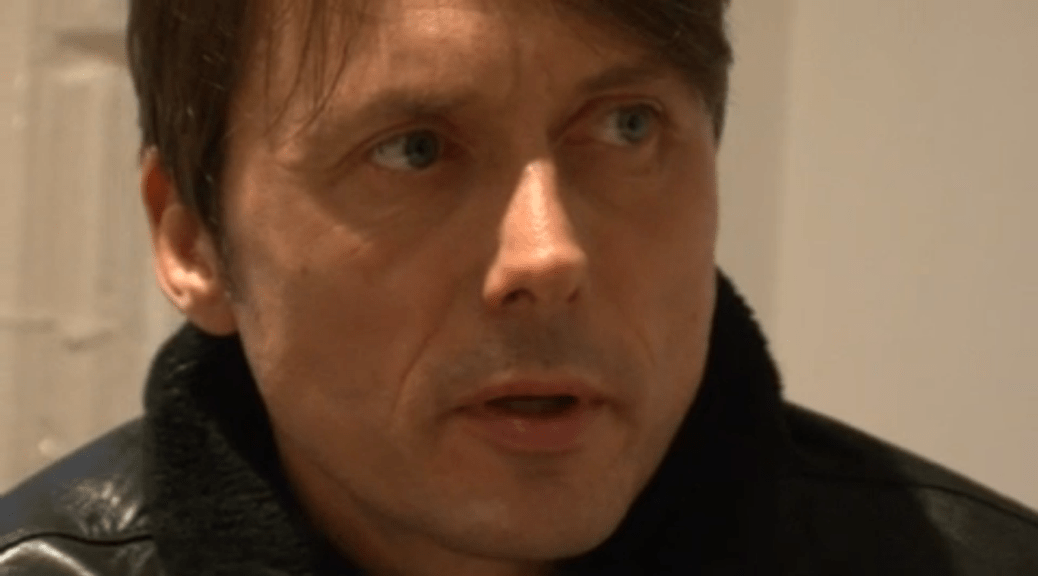
Suede on ‘Animal Nitrate’, new songs and the importance of the NME

TNGHT, Horns & ‘Weird Jazz’ – Gilles Peterson’s 2013 Tips
 Gilles Peterson’s Worldwide Awards show, hosted at Koko last weekend, is one of the best places on the planet to hear the cream of the world’s grooviest, jazziest and most eccentrically experimental tunes.
The show itself featured standout performances from Mala’s hypnotically groovy ‘In Cuba’ project, the staggeringly talented Natalie Duncan, funky Bossa Nova legend Marcos Valle and the impossibly cool Neneh Cherry. If you haven’t heard Cherry’s mind-blowing cover of Suicide’s ‘Dream Baby Dream’ yet, you can rectify that travesty immediately with the Spotify playlist below. We caught up with Mr Peterson backstage to get his take on 2012’s highlights and the coming trends for 2013.

(This Is) The Dream Of Jimmy and Ben: 10 years of The Postal Service

On February 19th 2003, a band called The Postal Service released an album called Give Up. It was the product of a curious union between vocalist Ben Gibbard of Death Cab for Cutie and the producer Jimmy Tamborello, known as Dntel. The pair had been exchanging CD-Rs through the post and working on their glitchy, introspective electro-pop independently in their bedrooms. Their record label, Sub Pop, were supportive but realistically expected it to shift maybe 20,000 copies.
By September 1st 2010, Give Up had sold 1,012,135 copies in the US alone, making it only the second Sub Pop release after Nirvana’s Bleach to go platinum. Something about this sweet, ethereal record struck a chord that surprised even those who made it. They thought they were putting together something niche, a labour of love, but Give Up was the album for its time and place. It brought electronic music in from the clubs and made it something quiet and personal: a romantic, digitised sound for a digitised world in need of romance.
I’ve found myself coming back to Give Up more often than almost any other record in the last decade. It’s been the soundtrack to countless flights, train-journeys, tube-rides and evenings spent lit by the glow of a computer. As the album nears its tenth anniversary, and with it likely that the duo will mark the occasion by reforming at least for a handful of festival dates, I wanted to track down some of the people involved in the record to see if they could help me to better understand this beautiful freak.
“I agree with you, there’s something mysterious about the record as a whole,” says Jen Wood, who dueted with Gibbard on ‘Nothing Better’. “I think that a lot of the songs have a dream-like theme and there is a dark, romantic cloud that looms around inside every song. I think the lyrics are so poetic that it leaves you in an imaginative state… it just allows you to be transported to a different place in your mind.”
That place is hard to pin down from the beguilingly rootless music, but in reality the story of Give Up starts in L.A. in 1993, a decade before its release, at a small college radio station called KXLU. Here, Jimmy Tamborello was working as the Music Director while playing bass in a band called Strictly Ballroom with Chris Gunst. Through KXLU they met Tony Kiewel and Jeff Antebi, who later managed Danger Mouse, and the pair of them teamed up to release Strictly Ballroom’s album. Looking back now, Kiewel says: “Strictly Ballroom didn’t really get out of California much but they were a fairly influential part of the local music scene while they were around. Suffice to say, there’s an odd crew of folks who were all really close and involved in this little scene who all went on to do relatively interesting stuff.”
The interesting stuff Tamborello was working on was an album of music that he would release under the name Dntel in 2001, Life is Full of Possibilities. “Jimmy had been quietly churning out tons of music from his bedroom for years,” says Kiewel, “but that album was a whole new venture for him.” It featured a host of guest vocals, including his old bandmate Gunst, but the track that Kiewel calls “a special bit of alchemy” was his first collaboration with Gibbard: ‘(This Is) The Dream of Evan and Chan’.
The track was a product of chance, one of those possibilities that life is indeed full of. Kiewel and Tamborello both shared a house with Pedro Benito, whose band The Jealous Sound landed a tour with Death Cab for Cutie. It was through Benito that Tamborello was introduced to Gibbard and given the opportunity to invite him to sing on his album.
Following Death Cab’s tour, Gibbard ended up back in Seattle where Kiewel was now working in A&R for Sub Pop. One evening, when Tamborello and Benito came to visit them, Gibbard and Tamborello fell into reminiscing about their collaboration. “Those guys started talking about how much fun making that one song was and how great it would be to bust out an EP,” says Kiewel. “I suggested that if they were going to make an EP they might as well make an album and said if they did I was pretty sure Sub Pop would be into putting it out.”
It was his job to sell the idea to the label: “When I pitched the project to the A&R group at Sub Pop I brought in ‘The Dream of Evan and Chan’ and played it and basically explained that they wanted to make a whole album like that. There wasn’t a single voice of dissention. Everyone was totally into the idea. Plus the guys said they didn’t need much of a recording budget. That record literally cost a couple thousand to make and most of that was spent on FedEx and hard drives. They made pretty much the whole thing in their bedrooms.”
Gibbard invited Death Cab’s Chris Walla to get involved and also asked singer-songwriter Jen Wood to add her vocals into the mix. “It all was a little out of the blue,” she remembers. “I had no idea that Ben was working on this project. I just got an email asking if I’d wanna sing on his new project. Ben then mailed me a CD of rough mixes. I remember playing it for the first time and being so stunned. It was nothing like Death Cab. It was a cool surprise! I cranked up the volume to the max and literally started jumping and dancing around in my room. Obviously, then, my answer was ‘Yes! I will sing on these songs!’ At the time, I didn’t know anyone who was making a record via mailing CDs back and forth. It was a new idea to me. I remember just thinking how rad it was that they were doing that, such a creative and yet kind of endearing way of making music together. There’s something special about receiving packages of music back and forth between two friends. It creates a sentimental kind of feeling.”
The critic Robert Christgau called ‘Nothing Better’ “the album’s centerpiece” and argued that Gibbard needs his female principle “too much to mince metaphors”. The song owes a debt to The Human League’s ‘Don’t You Want Me?’, but Wood says that, for her at least, it wasn’t a conscious homage. “Honestly, I don’t recall Ben ever telling me that about the song. Not at first at least. When I was recording my vocals, I had no idea that that was an influence. I basically was just thrilled to do something totally brand new. I was already getting bored with playing acoustic guitar and the Postal Service songs allowed me to embody something fresh and energizing.”
While Wood recorded her parts in Seattle, Jenny Lewis added her vocals in L.A. “They’re all very different people,” remembers Kiewel, “but they’re all incredibly grounded, ridiculously sweet and frustratingly talented.” In total, he says the whole recording process probably only took three months. “Every couple of weeks Jimmy would send up two CD-Rs to my office with two or three songs and Ben would pop over and pick them up. Then he’d track some vocals and guitars on top and bring the CD-R’s back in a few days to a week. It just went like clockwork.”
Squirreled away in his studio, Tamborello was busily absorbing sounds from across the globe. Looking back, the producer says: “There were a lot of Morr Music influences, the German label. People like Lali Puna. It was light-hearted, but I guess it was kind of indietronica. When we started making the record I figured it would be a little more experimental but we ended up just having more fun and making straight-forward pop songs.”
Kiewel had total confidence in the album as the release approached: “Around the time they finished we were experiencing a bit of a renaissance at Sub Pop. The Shins and David Cross were selling really well and the Hot Hot Heat debut was about to take off. I just remember thinking, ‘Wait ‘til people get a load of this Postal Service album!’ So, I was really confident about the project at pretty much every step. I also knew I was totally biased. I loved the people involved on a personal level and this music was tailor-made to hit all my pop sweet spots.”
It turned out he wasn’t the only one it seemed tailor-made for. “I always thought there was a better than average chance it would do a lot better than we’d predicted, but I knew for sure when they went on tour immediately following the release of the album and show after show started to sell out. Second shows were being added everywhere. The year that followed was really bizarre. The record continued to find fans all on its own. We were giving away ‘Such Great Heights’ on our website and we were seeing over a hundred thousand downloads a week, sometimes a lot more.”
For his part, Tamborello was completely caught off guard. “Yeah! It was pretty surprising,” he tells me. “It was slightly gradual, the way it got big, so there wasn’t a big moment of shock. When we made it it was really one of the most casual recording situations I’ve been in. We were just really having fun and doing exactly what we wanted to do, and when it was done I couldn’t really figure out who it was made for.”
In August 2003, the band received a cease and desist letter from the U.S. Postal Service citing their trademark of their name. The resulting publicity, which saw the dispute appear on the cover of the New York Times, didn’t hurt the record one bit. Indeed, in a novel settlement the band agreed to let their music be used in adverts for the Postal Service and played a show at their National Executive Conference. In return, the postmen started selling Give Up on their website. Meanwhile, ‘Such Great Heights’ was becoming a radio hit across California, although it wasn’t given such a warm welcome elsewhere: “At least one music director told me that it was ‘too gay’,” says Kiewel, “and I suspect that pretty much summed up the macho bullshit attitude we were up against from most places east and north of California.”
Regardless of the ‘macho bullshit’ the album took on a life of its own, almost despite the efforts of the band members who were keen to get back to their day-jobs. “The plan was for The Postal Service to record a new album after that next Death Cab album but between the busy Death Cab schedule and a short stretch of writers block on Jimmy’s part early on, that record has still never come to pass,” says Kiewel. No matter, the music was out there now. Napoleon Dynamitedirectors Jared and Jerusha Hess directed a video for ‘We Will Become Silhouettes’ and ‘Such Great Heights’ found an even wider audience after it appeared in the trailer for Garden State – apparently suggested by the video editor who happened to be another alumni of KXLU.
Nearly ten years after Gibbard and Tamborello first collaborated on ‘(This Is) The Dream of Evan and Chan’, Give Up continues to sell over 500 copies every week. Jen Wood still feels “super shocked and super thrilled” by the album’s success: “Ben and Jimmy were making these songs purely because they enjoyed it and it was fun for both of them. I think I didn’t realise that it was going so big-time until it was in full-force. I remember being on tour at the time with a Seattle band, Aveo, and every single venue we played at across the US was playing the Postal Service in the bar. It was insane! I remember feeling totally baffled yet so happy that everyone was listening to the Postal Service. Then, when it was being covered and used in movies and commercials, it really hit me that it was taking over! The icing on the cake was when I got a call from Tony Kiewel telling me had a gold record for me! In my mind I was thinking ‘Holy crap! This is crazy!’”
There’s now a platinum record to go with that gold one but in truth the unexpected commercial success and pop cultural appearances make no difference at all to the blissful forty-five minutes when Give Up holds you in its reverie. “I think it has to do with its effortlessness and the incredible talent of the people who made it,” says Kiewel. “That album was never meant to be anything other than a labour of love. They had no expectations and no ambitions as a band. They wanted to make something for the sheer joy of it that paid respect to some of their favorite 80s influences. That they transcended that one modest goal is a testament to their rare abilities.”
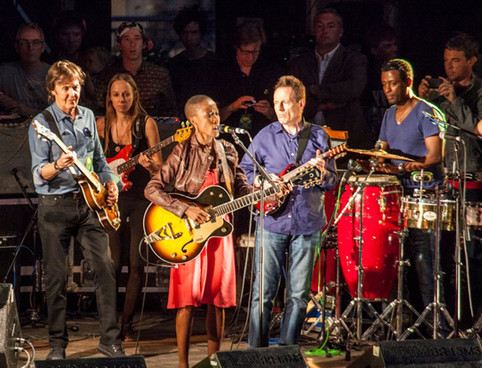
Malian musicians call for peace – and Glastonbury helps their music play loud
Can you imagine a place without music? In the north of Mali, in West Africa, Islamist extremists have taken control of vast swathes of the country and set about imposing a restrictive social code which includes the banning of all forms of music. It’s a cruel irony that this is happening in a place known all over the world for the richness and beauty of its musical culture. Among the areas that have now fallen silent are Timbuktu, near the site of the famous Tuareg ‘Festival Au Désert’, and Niafunke, the hometown of the legendary triple-Grammy-winning guitarist Ali Farka Toure.
Can you imagine a place without music? In the north of Mali, in West Africa, Islamist extremists have taken control of vast swathes of the country and set about imposing a restrictive social code which includes the banning of all forms of music. It’s a cruel irony that this is happening in a place known all over the world for the richness and beauty of its musical culture. Among the areas that have now fallen silent are Timbuktu, near the site of the famous Tuareg ‘Festival Au Désert’, and Niafunke, the hometown of the legendary triple-Grammy-winning guitarist Ali Farka Toure.
Glastonbury Festival last week declared their solidarity with Mali’s silenced musicians by announcing Rokia Traore as the first act on this year’s line-up. They also pledged that every day a singer from the country will open the Pyramid Stage. If you’re not already a fan of Traore then you should know she comes highly endorsed: at this summer’s Africa Express concert in London she was joined onstage for a gorgeous performance of ‘Dounia’ by both Paul McCartney and Led Zeppelin’s John-Paul Jones.
The banning of music is not without precedent, but recent history shows that somehow songs finds a way to survive. In Afghanistan until 2001, music, dancing and television were all banned under the Taliban’s rule. However, as Havana Marking’s 2010 documentary ‘Afghan Star’ showed, by the end of the decade the unlikely saviour of the ‘Pop Idol’ format was helping a culture find its voice. The remarkable documentary illustrates that even under the Taliban music continued to live on out of earshot of the authorities. The film opens with young boy, blind in both eyes, singing his heart out straight to camera. He can’t be more than six or seven, but when he finishes he says that without music, human beings would be unhappy. A reality his parents’ generation lived through. In another incredible scene, unearthed footage from the early ’80s shows an Afghan electro-pop band who look and sound as if they’ve just walked off the set of Top of the Pops. It’s evidence that pop music wasn’t as alien to Afghan culture as the Taliban tried to make it seem.
Hopefully the people of northern Mali will not have to live without music for as long as the Afghan people did, with international attention now being drawn to the country. Meanwhile, Fatoumata Diawara recently gathered over 40 of the country’s most renowned musicians to record a song called ‘Mali-ko’ (Peace / La Paix). The group, collectively called ‘Voices United for Mali’, includes local legends like Amadou and Mariam, Toumani Diabate and the late Ali Farka Toure’s son Vieux. With any luck, by the time Glastonbury arrives the song will be able to be heard not just in Pilton but on the streets of Timbuktu and Niafunke too.
Originally published by NME.

Fly Me To The Moon: What Buzz Aldrin can teach the planet
 After becoming the first humans to ever walk on another celestial body, Neil Armstrong and Buzz Aldrin returned to the Apollo 11 lunar module to discover that a vital circuit breaker had simply broken off from the launch system. They were sat on the moon, and their car wouldn’t start.
Their fate, in front of an unprecedented global television audience of millions, could have been a slow death 240,000 miles from home, with Michael Collins condemned to fly back to Earth horribly alone. Buzz Aldrin, staying cool, jammed a pen into the hole and started the ignition.
Aldrin still has the pen.
It’s easy to forget how rudimentary much of the technology was in 1969 that somehow managed to slingshot men onto the surface of the moon – and perhaps even more improbably brought them back again.
Easy too to forget the backgrounds of the ordinary heroes who soared into the realm of myth. When the Apollo astronauts flew to the Moon, they received the same standard per diem pay that they would have done as military personnel away from base anywhere else: $8 per day. That’s before deductions, like room and board. They had a bed on the spacecraft after all. Aldrin still has his payslip: a grand total of $33.31. As a joke, one astronaut is said to have tried to submit an expenses claim for travel expenses at the standard eight cents per mile, which would have come to around $80,000. NASA’s reply was to invoice him for the Saturn V rocket he’d be riding, at $185million.
As humans we love myths, and the moon has been at the centre of them since pre-history and the first of our ancestors to look up and see a light in the darkness. The people who first set foot on it, and the teams that put them there, were mould-breaking champions who beat their own fear and self-doubt like a gong.
Only 12 people, all men, have ever walked on the moon and they all did it between 1969 and 1972. After that, NASA’s funding was slashed and, as the writer Andrew Smith explores in his incredible book Moondust, each of the moonwalkers dealt with their experiences in wildly different ways. Interviewing the surviving returners he finds that some turned to art or deep science while others fell in with new age mystics. Aldrin, for his part, fell to earth hard. After his return he sank into depression. Who could blame him? When you’ve walked on the moon, it’s tough to find an encore.
It must be tough, too, to deal with that most profound of shifts in perspective. The photographs alone that NASA brought back from the moon flights changed the way we see ourselves on Earth. Space was no longer just the heavens above but now also a backdrop against which the Earth hung like a jewel. We saw ourselves for the first time framed as a flash of life in the otherwise haunting emptiness of the abyss. Neil Armstrong once said that while on the moon he realised he could blot out the whole of the Earth with his thumb. Asked if that made him feel really big, he replied: “No, it made me feel really, really small.”
Norman Mailer called the Apollo missions a “surreal adventure” and he was right. They are rendered especially surreal by the fact space exploration has become simultaneously futuristic and retro.
Since the Seventies we’ve slowly abandoned manned space travel because it’s expensive, difficult and the benefits are not easily seen. Many critics have questioned what the use of travelling to the Moon or to Mars are when we already know that they’re deserted, rockywastelands. When the Montgolfier brothers achieved the first manned flight in history in 1783, Benjamin Franklin is said to have been asked what he thought the use of flying about in the air could possibly be. He replied: “Sir, what’s the use of a newborn baby?”
Just as Aldrin struggled to find an encore for the moon landing, so did the rest of the planet. That’s why his continued dedication to the “imperative to explore” is something that can inspire of all. When he talks of colonising Mars, he’s echoing every villager before him who wanted to know what was over that mountain range or across that ocean. The journey that takes us away from home and into the unknown is as much an existential expedition as it is scientific.
The great and wise astrophysicist Carl Sagan once said that we seek to explore space because “some part of our being knows this is where we came from. We long to return, and we can, because the cosmos is also within us. We’re made of star stuff. We are a way for the cosmos to know itself.” As yet we’ve known life on just a pair of corresponding rocks. We’ve barely dipped a toe into the wider universe, but it was our instinct to explore and understand that brought us crawling out of the primordial slime in the first place. We can’t stop here.
—
 It takes a certain kind of mind to calmly strap yourself to the top of a Saturn V rocket pointed at the moon. Despite being sat 300ft in the air and riding 2,000 tons of rocket fuel, guided by significantly less computing power than’s found in the average iPhone, at the moment Apollo 11 launched Buzz Aldrin’s pulse was just 110 bpm, the lowest of any of the Apollo astronauts. Aldrin is as cool as they come.
As he’ll describe in startling detail, Aldrin’s stoicism was put to the test during Apollo 11’s nervy landing and return. However, from the moment he joined mission commander Neil Armstrong on the lunar surface on 20 July 1969 his place in history as one of humanity’s greatest pioneers was assured.
Now aged 82, Aldrin remains a fierce advocate for the manned exploration of space. He’s designed the innovative “Aldrin Cycler”, which he argues could help transport people and supplies to Mars, and he’s now working with Lynx on their campaign to send 22 competition winners into space.
When we meet at the Empire Hotel in New York, he’s dressed casually in a silver sports jacket bearing the Apollo 11 insignia and his own “Buzz Aldrin” patches. Around his right wrist he wears a Tibetan bracelet of clear skulls, while on his left he wears a distinctive watch with two faces on one band. Settling down in the corner of his suite, the legendary astronaut shares his thoughts on moonwalking, colonising other planets and the time he saved his life with a felt-tip pen.
GQ: What’s the secret to moonwalking?
Buzz Aldrin: Walking around on the moon was significantly easier than we’d thought it would be. There weren’t any balance problems so you weren’t tumbling over. I think in general, looking back on it, you could make sense of it: if you put one foot down and then another, the first foot down would have a little error that you could fix with the second one and then push off. Then you’d coast.
Do-doo. Do-doo. Do-doo. Sort of like a horse when it’s going around a circle. That seemed to be the natural rhythm, rather than bouncinglike a kangaroo. Bom. Bom. Bom.
Is it true that the first music heard on the lunar surface was when you played Frank Sinatra’s ‘Fly Me To The Moon’?
No, I don’t remember that. We could have received it. Sometimes Mission Control played some music as a wake-up call, but I don’t remember what it was! We only had one sleep and one wake-up while we were on the moon.
You were a fan of Sinatra’s though, did you ever meet him?
I did, but it was just like meeting any other celebrity entertainer. When I met him and other people, usually they were on the downside of their career. They’d already contributed, but they were still held in esteem. As most people are even as they deal with diminishing productivity. I was a fan of his and Karen Carpenter. I like her way of projecting her voice. It’s as identifiable as Frank Sinatra’s voice is.
At the end of your time on the surface of the moon, as you prepared to launch off in the lunarmodule, you realised that the ignition system was broken. This could have left you stranded, but you managed to fix it by jamming a pen into the circuit. What went through your mind in those moments?
We discovered it shortly after we came back in, as we prepared to make an effort to sleep. I said to Neil that my preference would be the floor. He sat on the cover of the engine and could lean back.
The telescope for making platform alignments was visible to him, and of course the view of the Earth kept him awake! Meanwhile, I observed this broken circuit breaker and reported it to Mission Control. We hoped they’d handle the problem. We found that it was a critical engine-arm circuit breaker. There was a point in our launch checklist when that had to be engaged to supply electricity to turn on the engine. There was an uncertainty as to whether any effort to push that in would be successful and then whether it would stay in or pop out again. Obviously there’s electrical contacts in there, which I didn’t know that much about! It seemed to me though that if we had a choice of objects to push it in, a metal instrument was probably not too good! Equally, a little finger might get burned.
Fortunately, there was a felt-tip pen. The public relations guyback in Houston had a list of things that were on board. The only pen that he had listed on board was a mechanical pen. He thought we’d used that pen, so some news releases carried the name of that particular Fisher zero-gravity pen – a pressurised one that pushes the ink out whether it was this way, that way, or underwater. The problem was, that was metal. I found my own plastic felt-tip was much more distinct for recording numbers. That was the one I used and that was what I pushed it in with. It stayed in, and I made sure to push it in hours before lift-off so we knew that it would actually stay in!
What advice do you have for the Lynx competition winners who will be travelling into space?
My advice to everyone would be to pay attention to the instructions and try to win the prize. As you go through the training, hopefully you’ll be selected as one of the 22 winners in this programme. Make sure you absorb what the information is that you’re give. When you’re in a spacecraft, you need to know what things you can touch and what things you shouldn’t touch! This is the opportunity of a lifetime, so also think about how you can remember what happens: what you can record and when you can take pictures.
You’re an advocate of sending a manned mission to Mars.What do you say to those people who arguethat it’s too expensive?
Let’s make it cheaper! Let’s do it more efficiently. Let’s not spend resources that we don’t need to be sending astronauts back to the moon. Let’s not spend expensive resources on bringing people who have reached Mars back again. Prepare them to become a growing colony. With teamwork, experience and sharing I think that the desire to go back to your family, for me, doesn’t prove to be that important. The service to humanity will be appreciated by history.
The decision to go to the moon is now appreciated and associated with President Kennedy’s speech, but somebody else had told him it was a good idea. It turned out to be a good commitment, but it was a uniquesituation. I didn’t realise how unique it was at the time.
For us it just unfolded and seemed like a good thing to do. Really, it was also to do with the Cold War situation, the motivation of technical achievement and the desire to assure the people of their security during the threatened periods of that war.
Were there funny moments on Apollo 11?
Well, I don’t think I was a source of levity. Mike Collins called Neil the “Tsar” of the group – not that there were dictatorial commands being given, but it was his way of acknowledging the chain of command.
Why do you wear two watch faces on one band?
So if one stops, I got the other one! No, there’s a practical reason. You see I’m very proud that in 1970 I suggested to a watch company that normally on a watch when you pull out the stem the second handstops and you have to move the minute hand around once to get the hour hand to move. I said to the watch company: “You don’t want to stop the second hand, and you don’t want to forget where the minute hand is. Otherwise you’ll lose the accuracy.” I said they should have two hour hands, one of which stays tied to the minute hand and the other which moves just one hour at a time.
If you screw that up, you can look down here at the second face. That’s why you have two hour hands – one of them is home time, and the other local time. I didn’t get paid anything for that invention! I showed it to them and they said “Oh, isn’t that something!” But this two on one strap is one-of-a-kind. They’re both Omega, one is the watch they use on the Space Station.
Did seeing the Earth from the surface of the Moon change your perspective on life?
No. Any observations from the Moon or a sense of realising this or that about the greater meaning of things wasn’t as influential for me as the experience of coming back and dealing with being a person who’s been to the Moon. That put me in a situation with other human beings where I had torespond to instructions about what I was “supposed” to do as an astronaut who’s been to the moon. It was difficult to deal with the opportunities, or avoid certain opportunities, that come along as the result of what happens when you change from the position of being an active astronaut. All three of us decided that after being on the first landing, even though Mike didn’t land, we decided that we didn’t want to stay in the rotation but would depart active crew positions. My choice was to return to the service that I came from. I was the first Navy, Marine or Air Force person who had been an astronaut to return back to the Air Force. I had certain expectations about what would be a reasonable and desirable position to be assigned to after my years of service. That didn’t turn out to be the case. It began a period in my life of things not going quite as right as they had up to that point.

Wrapped Up In Books
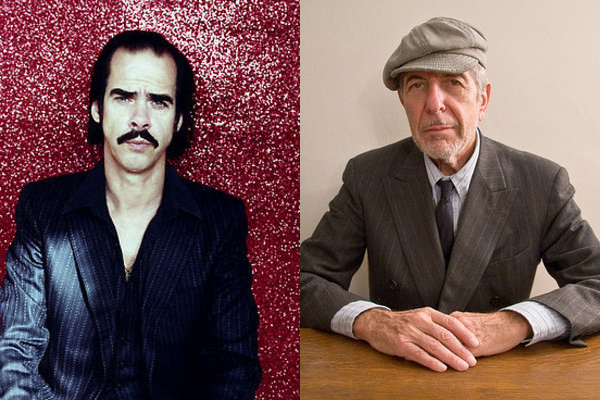 There have been truckloads of great rock memoirs: Keith Richards’ Life, Patti Smith’s Kids, Mark E Smith’s Renegade, R Kelly’s Soulacoaster, but how many lyricists have made the leap from songwriting to longform fiction? And have any of them been any good?

Do You Remember The Last Time?
Backstage during Pulp’s raucous return to Sheffield, two huge shaven-headed roadies are watching Jarvis Cocker cavort around the stage and throw himself off speakers, whipping the crowd into a frenzy with every thrust of his impossibly sharp hips. Eventually, during the long, strange intro to ‘Party Hard’, one turns to the other, a baffled look slapped across his face. He tilts his head towards Jarvis and mutters: “There’s something not quite right about him.”
34 years after Jarvis decided to form a band during a boring economics lesson, Pulp remain elegant outsiders. They’re still the band that every mis-shape, mistake and misfit and in the country see themselves in. When they stepped in to headline Glastonbury at the last minute back in 1995, Jarvis told us: “If a lanky get like me can do it, and us lot yeah, you can do it too.” Their underdog triumph made it cool to be different. They weren’t afraid to be smart or literate. Their songs were like Philip Larkin poems rebuilt for the indie disco.
But all things must pass. Rumours are flying around that this will be their final UK show, with only a pair of dates on the Coachella Cruise remaining of their reunion tour. Fittingly, they’re playing at the arena home of the Sheffield Steelers ice hockey team. The rink has been boarded over with chipboard floors but it’s still there, frozen under their fans’ feet. Pulp are being put on ice.
It was even colder outside, but that didn’t deter the Pulp ‘hardcore’, who’ve been arriving since 8am. Someone brought a marker pen to write the order they arrive in on their hands. That way they can huddle together for warmth but still keep their strict positions in the queue. A fan called Susanne is wrapped in silver foil, like a collapsed marathon runner.
The first to arrive was Melina, who had flown over from Georgia in the USA just to see the show. “It’s my first time in the UK,” she says. “I’m so sad that I’m leaving again tomorrow. I first saw Pulp on television when I was 16. I fell in love right there and then.” She’s one of many international fans who’ve made the pilgrimage, knowing this could be the last chance to see their idols in the flesh.
The fans are younger than you’d expect for a reformed Britpop group. Another early arrival is Alice, who at 17 has been alive exactly half the time that Pulp have been a band. “When I saw them at Reading Festival it changed my life,” she giggles. “I was just like: “Marry me, Jarvis!” I can’t wait for ‘This Is Hardcore’, when Jarvis does his thrusting.”
Another fan, from Australia, sums up why Pulp are the sort of band worth queuing all day for: “It’s because of the people that Pulp write about. You don’t hear about people like me unless you listen to a Pulp song.”
There are 12,000 people at the Sheffield Arena who feel the same way, so Pulp have to work hard to make the show feel intimate. Before the band go on, drummer Nick Banks says: “We’re going to play a lot of songs tonight. We’ll play all the ones they want to hear, so I don’t think they’ll be leaving disappointed, but hopefully they’ll also hear some stuff they might not have heard for a long time – or even ever.”
Against the odds, Pulp manage to transform this cavernous sports warehouse into a local club. They have a fake fireplace on stage, beside which Jarvis nonchalantly sips red wine. The best touch, though, is what Jarvis describes as toilet paper-powered “time travel”. In the band’s early days they would festoon venues with rolls of it, in lieu of the pricier pyrotechnics they can deploy today. After inviting the audience to cover the whole arena in long white paper streaks of the stuff, they then reach way-back into their collective history, fishing out 1983’s My Lighthouse’ – accompanied by Jarvis’ sister Saskia – 1985’s brilliant ‘Little Girl (With Blue Eyes)’ and 1991’s disco-drenched ‘Countdown’.
The whole show is a barnstorming triumph, from the opening shimmy of ‘Do You Remember The First Time?’ through to the collective ecstasy of ‘Common People’ and the anthemic ‘Mis-Shapes’.
Longtime collaborator Richard Hawley joins them onstage for a chunk of the set, most visibly when he plays the solo on ‘Born To Cry’ live for the first – and possibly last – time. He won’t be joining the band for their cruise-ship shows, so tonight is particularly poignant for him. He tells me later: “I’ll be seeing them off with a tearful hanky at the pier, I think, but it seems fitting to wave them off into the sunset.”
He adds his own thoughts on the significance of Pulp: “The only shame about them not doing anything new is that they could put a real spin on what’s happening in our country and the fuckwits that lead us, although in a way it’s already been said with songs like ‘Common People’. Jarvis’ lyrics aren’t just of a period of time, they still make sense. We’ve stills got cunts in charge. As long as there are dickheads like Cameron and his ilk, Pulp will always have relevance. Also emotionally they still resonate. Their songs go beyond political ranting to something far more subtle and important than that.”
Later in the night, at Pulp’s party for friends and family at The Blue Shed, you can see the baton being passed to a new generation as Pulp bassist and Palma Violets producer Steve Mackey hugs his protégés as Arctic Monkeys tunes blast across the dancefloor. Chilli from the Palmas is full of praise for their mentor: “Steve Mackey is a king! I saw Pulp at Hyde Park, but tonight the one! This was a whole different level, even if all the Sheffield references did make us feel a bit left out. I could tell how much they put into it emotionally.”
Emmy the Great describes the gig as definitely in the top three shows she’s ever seen, “possibly the top one.” She adds: “I saw a girl just behind me by the mixing desk, wearing a T-shirt with Pulp written on every square inch of her body. At the end she was just weeping, but I understood because that’s how this band makes people feel. Their first show may have been in 1980 but they’re still so good and so relevant.”
At the end of the night, Jarvis hosts a small party in his dressing room. It’s a chance to ask him exactly what it meant to him to come back and play in Sheffield. “The thing is,” he says, “even though I haven’t lived here for a very long time I always get in a right fluster when we come to Sheffield. Tonight was no exception. It had highs, and lows, and it was funny. There were lots of friends and family here, and that’s what piles the pressure on even more. Your mother’s there, your sister’s there – even onstage singing with yer. I think it went okay. I think we made a connection. The toilet rolls were good. It’s hard to play a big place like this. It’s an arena, so it doesn’t have any atmosphere of its own. You have to try and make an atmosphere happen. We were trying to take this shed, where anybody will play, and make it feel like a Sheffield thing and an intimate thing.”
So the only remaining question is: is this really it, Jarvis? The last ever Pulp show on terra firma? “Ooh, I can’t…” He cracks a smile and trails off. “Certainly for a while, yeah. I don’t believe in saying that it’s the last one forever. There was enough pressure on tonight without saying: ‘This is it: the final show.’ It’s not really your call, do you know what I mean? Ten years ago when we played at the Magna, it felt like: “Ooh, right, this is the end.” You can try to tie everything up neatly, but you just have to see what life throws at yer. I think that’s the way life works. You can’t impose a structure on it. So… we’ll see. But it’s it for now.”
Originally published in NME, 5 January 2013.
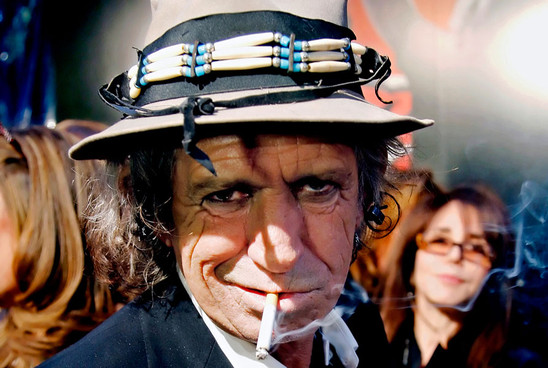
Keith Richards’ Most Kick Ass Riffs
If rock’n’roll could be turned into flesh and made to walk the earth, it would look and sound a lot like Keith Richards. It’s not the skull ring, the elegantly wasted appearance or the chemically-enchanced bloodstream that does it – although that all helps – but the fact that he has an unerring knack of hoovering up pretty much all of the greatest guitar riffs ever written.

Mac DeMarco live at Birthdays

A couple of hours before their first ever London show, Mac DeMarco and his band are curled up on the stage at Birthdays, stealing a few moments of shuteye. “We’re all hella jet-lagged,” Mac tells the capacity audience that squeezes in later. It doesn’t show.

Christian Louboutin: The secret of my success
 Twenty years after founding the business that bears his name, the 49-year-old Frenchman now sells more than half a million pairs of shoes a year. Following the launch of his first UK men’s boutique, on London’s Dover Street, he retraces key steps from his route to the top:
Don’t sweat the practicalities. When I start a drawing, I don’t worry about manufacturing technique: everything technical can be resolved afterwards. I always let creativity drive all of the elements of my work.
Try out bizarre ideas. One day, years ago, I was looking at some shoe prototypes and comparing them to my drawings, and they just looked too black. So, I grabbed the model’s nail polish and said, “Can I try something?” I painted the sole red and it made the colours really pop. From then on, I decided to paint all my soles red.
Whatever the customer wants, do it. I have always done special orders for certain customers. On one occasion, a gentleman came to me and simply said “I want you to design a shoe that is really extraordinary. I have a lot of gems, and they should be involved.” My red soles are a part of my identity because people relate them to me, to my shoes and to my work. So I designed him a shoe with a sole paved with rubies. I said, “You understand that she won’t be able to walk in them?” He replied, “Don’t worry, she won’t be in that position when she’s wearing them.”
Keep the egos out of the workplace. I started 20 years ago with a staff of two: one plus me. Twenty years later we have, well, a little bit more than that, but I really couldn’t work if it was a hostile environment. In a creative business, if you’re happy it will come out in your work. I don’t see how you can be happy if you don’t like the people you’re working with and if they aren’t a joy to have fun with.
Always bill. I don’t give away my shoes to celebrities for free. I’m only happy when people like what I do and make the effort to buy them. I would not be happy to see people in my shoes if I knew that they had to be paid to do it, that they had to be pushed. I want to make other people happy with what I do. I wouldn’t get any satisfaction if it was forced.
Never relent. Nobody in my family was in this business, but I pursued it because it’s my passion. I’m obsessed by freedom and the belief that you can build something for yourself out of your dreams.
Word of mouth is more valuable than any billboards. I saw it as a good sign that in the middle of August, when there is no one around, I could open my first men’s store in Paris without advertising it – and from the first day it started to take off.
Trust me, it’s different for girls. I opened the Paris men’s shop because when you mix men’s and women’s products in a store, the environment changes: the size of the men’s shoes are so different that they always look like, there is a French expression, “an elephant in a china shop”.
Forget five-year plans. The secret of my longevity is in not having any direction. As I never had a plan, all of my success has been a nice surprise and I have been able to do things at the correct moment. Every day of my work I’m reminded first of all to enjoy it and to let things grow organically. I never really thought I would start a company. I really just wanted to design things.
Originally published in British GQ, December 2012.

Tarun Tejpal on surviving his assassins
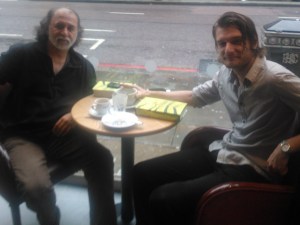 India’s most renowned investigative journalist and novelist Tarun Tejpal meets us at a coffee shop in Knightsbridge flanked only by his literary publicist, rather than the 24 armed policemen he’s grown used to following his every move over the last decade. After his investigate news organisation Tehelka published an investigation into government corruption in 2001, a foiled assassination attempt on Tejpal’s life led to a security detail following his every move. While battling to keep Tehelka alive in the face of political interference, Tejpal somehow also found the time and space to write his first novel, The Alchemy Of Desire in 2006.For his second book, The Story Of My Assassins, he used the assassination attempt as the fictional starting point for a novel which explores the many faces and stories of contemporary India. Dressed in black with long hair slicked back, he cuts a swashbuckling and eloquent figure. Here, GQ India’s 2011 Writer Of The Year sets forth about empathising with his would-be killers, the challenges facing journalism and what the future holds for his endlessly complicated country.
GQ: How did you learn that a contract had been taken out to assassinate you?
Tarun Tejpal: In May 2001 I received a call to tell me that five killers had been arrested by the Delhi police. The police told me, and I have no reason to doubt it despite the fact that it sounds so outlandish, that they had picked up five boys who had been given a contract in Nepal by the ISI of Pakistan. The perverse reckoning was that if there was a hit on me, the Indian government of the day, which was then assaulting me, would have to take the rap. The ISI of Pakistan was trying to hit me so that the Indian government would fall. In other words, even as it was assaulting me the Indian government had a great interest in protecting me. I came under heavy security cover which lasted nine years. For about six years there were 24 armed policemen guarding me around the clock. Anywhere I travelled in India I would be met at the airport by armedcops. I would be escorted day and night. My house was sandbagged. My office was sandbagged. It was a bit hysterical. That became the conceit for the novel.
Why had the Indian government been assaulting you?
I started Tehelka in 2000 as India’s first serious online journalistic platform. We broke some really big stories, including match-fixing in cricket. Then in 2001 we broke this huge story which is known as the “Watergate of Indian journalism”. We called it “Operation West End” and it was an exposé into corruption in arms procurements. It almost led to the downfall of the Indian government of the time. It led to the resignation of the defence minister of India and the president of the ruling party. It also led to a huge extra-constitutional assault on all our lives. Tehelka was shut down for close to four years. We were fighting a completely out of control state.
Why did you choose to write a novel rather than writing a memoir about your experiences?
What interested me was using this conceit to open up the lives of the killers. I was fascinated by the thought that five guys who didn’t know me at all had taken a contract to kill me. How does one arrive at such a place? One scene which is true to life is the scene in the courtroom. That was a very difficult scene for me to write because I wanted to capture the peculiar mix of Kafka and Chaplin in that tableau. I really was summoned to a lower court where these five guys were paraded out in chains and I was asked to identify them if I knew them. Of course I didn’t know them! It was just five guys. I remember one of them looked tough and unconcerned, so he became themodel for [one particular character] the hammer killer. The rest were nondescript guys. I saw them once and then I forgot about them and imagined the stories of five likely killers. When I finished the book I realised that the five killers subliminally represented five of the biggest fault lines of India: caste, religion, class, language and feudalism. I didn’t set out to do that, but I found I could pull in all the things I wanted to say about an unbelievably complex country.
How close is the narrator’s voice to your own?
The trouble with trying to wrestle down the material was trying to find the tone. Until I found the tone of the highly dislikeable narrator, who is acidic, acerbic and dyspeptic, I couldn’t enter the material. This is not material you can enter with an earnest, sincere voice. You would just heap up the banalities. When I found the voice and wrote the first line I was on a roll. Most of the book is obviously imagined, but there are some seed incidents which are true to life.
What did you learn about your assassins from writing the novel?
That business of telling the story of every assassin from the start of his life helped to establish the fact that in the beginning there is a kind of innocence to all things. Then the world happens to us and we become other things. I wanted to make a far more complex moral judgement of the assassins than we would normally make. I almost wanted to say that fundamentally the killers and the man they wanted to kill may have very little to choose between them morally. Neither is morally superior or inferior.
The narrator’s mistress sides more with the assassins than with him.
I loved Sara! She came out of nowhere. I’m constantly being asked by my wife who this woman is! She was the perfect foil to open up thestories. You do meet people like her: the well-meaning, misguided do-gooders. She was gorgeous. She was driven to do the right thing but didn’t know what the f*** she was doing.
What motivates you to write?
For me, what’s exciting about literature and good writing is that fundamentally it should have the stomach to look evil in the eye. I understand the vocation of both literary writing and journalism as being fundamentally subversive. To subvert the status quo and received notions. Somebody once told me that after reading The Story Of My Assassins they couldn’t sleep all night. I said: “I love it!” That’s wonderful. I don’t want my readers to sleep after reading my books. My job is to provide you with discomfiture. I’m not here to provide you comfort. That’s the job of television, cinema and mass media. There’s way too much of it. We live in an age of amusement. I don’t think the job of a serious writer is to amuse you.
What’s your favourite James Bond moment?
I actually really like Daniel Craig. I’m from the Sean Connery generation, but I really think the way Craig redefined Bond from the beginning of Casino Royale is fantastic. I like the way he plays him with that peculiar, hard-nosed intensity rather than the fey, playboy charm.
Who’s your best-dressed British man?
Most Indians would probably say David Beckham, but I feel like I should say VS Naipaul. I like the way he dresses.
Do you worry that news agencies are losing the ability to fund in-depth investigative journalism?
It’s a huge challenge, and the problem is that India needs so much of it. There is so much bigotry, injustice, inequality and corruption to fight. You need the sort of hard journalism that we do at Tehelka, but nobody wants to pay for it. Sustaining it costs a lot of money. You have to be very smart and use a lot of sleight of hand. You have to be very seductive. You have to convince men of means that you’re a worthy cause and that they should back you. A lot of my work goes into that: ensuring that rich men fund the journalism which will finally hurt them! [Laughs] What we need to fear in free societies is monolithic media, like Murdoch. The more media you have the more insulated you are against control.
What keeps you awake at night?
Actually I sleep really well. It’s one of the things I do well. I think if there’s something I worry about all the time it’s India, which is crazy given that it’s gone on quite alright for 6000 years. There is a kind of racial commitment to the country I was born into and its complicated miseries. If there’s something that really bothers me and gets me exercised it’s the struggle for India. The incredible poverty and deprivations, the really unequal society, the state of justice, these are things that really bother me.
Are you optimistic for the future of India?
I think India is going through an historical curve right now. It was the dominant civilisation 1500 years ago. It’s been on a great decline but now it’s coming back. I think history is on our side but our challenges are huge. I’m a great believer in politics and its enabling potential. I’m not among those who knock it, I really believe in it but I think we need some great visionary politics to see us through our next 20 years. The idea of India was created out of absolutely visionary politics. Men like Gandhi and Nehru were extraordinary but to protect their idea we need a second generation of great leaders. I don’t see it right now, but I hope for it.
What’s the best advice you’ve ever been given?
My father told me: “Don’t be afraid”. I’ve found that invaluable. Most people are crippled by fear. The potentiality of their lives and what they can be and do is all linked to fear. Fear of failure, fear ofcriticism, fear of society, fear of tradition, fear of the church, fear of the temple, fear of priest, fear of the teacher, fear of the parent: it’s crippling. My father was fantastic. He’s probably the wisest man I’ve known in my life. One of the earliest things he taught me was not to be afraid. When all hellbroke loose, there was a murder attempt on my life and the whole government was on our ass, everybody was running for cover around us. The television channels in India were full of it. Everyone was calling me and telling me to be careful, including my mother. The only person who called me and said, “It’s going to be alright, stop worrying,” was my father. No matter what happened, he was completely sanguine. I find that a source of great strength.
Originally published by British GQ.

Into The Grape Beyond
 From Winston Churchill to Snoop Dogg, whether you’re rolling around Long Beach or defeating Hitler, it pays to know your XOs from your VSOPs. The world of cognac can be an intimidating one, filled as it is with esoteric nomenclature, so we’ll start with the basics. All cognac comes from a small and highly protected area of southwest France, so while it’s true to say that it is a type of brandy, not all brandies are cognacs. Among serious drinkers, calling a bottle of Hennessy XO a brandy will get you the same sort of looks that you’d get if you called Bollinger a “sparkling wine”.
There are four main cognac houses who dominate the world market:
Hennessy, Remy Martin, Martell and Courvoisier. For the connoisseur, there’s also a wide range of small family-owned distilleries producing cognac to suit individual taste. Cognac is made by distilling wine for a second time to make a clear 70 per cent alcohol known as the “eau de vie” (French for “spirit”). This is then aged in oak barrels. As a general rule, the longer the spirit stays in the barrel the smokier and woodier the drink tastes. Cognac only ages while it’s in the barrel, so buying a 20-year-old bottle and putting it away at the back of a cupboard to “mature” is senseless. If you’ve got a bottle gathering dust somewhere, you’re better off just drinking it.
Of the most common cognac designations, VS (“Very Special”) is the youngest blend and will have been aged for at least two years in the barrel. VSOP (“Very Superior Old Pale”) has to have been aged for at least four years, but commonly it will be much longer.
XO (now commonly referred to as “Extra Old” but the symbols originally stood for “Age Unknown”) must have been aged for at least six years, but in reality tends to have been aged for around 20 years for the finest blends.
A cognac connoisseur will balk if you start diluting the older stuff, so if you’re looking to make cocktails we’d recommend going for a younger blend like the Courvoisier Exclusif, which has been specifically designed to capitalise on the brand’s surge popularity in clubs over the last decade. As you’d imagine, Busta Rhymes is a popular man in the south of France.
If you want a more traditional cognac, the sort of drink you can reach for to accompany a soul-bearing after-dinner conversation, then a good place to start is with a Hennessy XO. This is a strong, smoky drink with the classic cognac taste. If you’re looking for something more niche, then Delamain produce a true wine drinkers’ cognac. Aged only in barrels which have already been used to produce cognac many times in the past, the drink retains a fruity wine taste even as it ages to become an XO. Our personal favourite of the smaller distillers is the peerless Pierre Ferrand. If you want to really impress a cognac drinker, produce a bottle of Cognac Pierre Ferrand Selection des Anges.
Once you’ve chosen your cognac, the only remaining question is how to drink it. Traditionally cognac should be savoured slowly, allowing time to enjoy the aroma, but as with somuch in life if you’re looking for something more adventurous then follow Ernest Hemingway’s advice.
They called this technique “Carburetion”, based on the science of an engine’s carburettor, and you’d imagine it must have raised just as many eyebrows in 1930s Havana as it did when we tried it in the sedate town of Cognac. However you drink it, if it’s good enough for Hemingway, Churchill and Snoop Dogg, then it’s got to be worth reaching for a cognac the next time you finish a moveable feast.

A Liquid Lunch: In Bed With Shane MacGowan
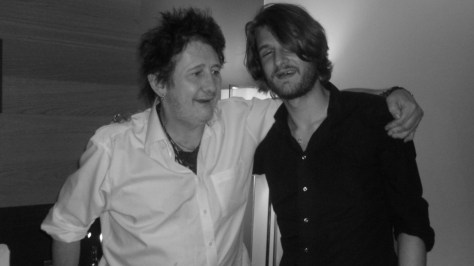 Shane MacGowan is unwell. In a hotel room in London Bridge, the Pogues frontman is sat up in bed fully dressed, eating soup with his fingers. He runs them around the nearly empty bowl on the tray beside him, licks them delicately and then wipes his hand on the bed sheets. The television is on, chattering about the news, but nobody’s watching. There’s a pack of Gauloises on the bedstand and another pack of Bensons lying on the bed. Shane’s partner Victoria Mary Clarke welcomes me in. “Do you want a glass of this?” she says, proffering a bottle of red wine. “It’s very good. It costs £50.”
She pours me a glass and tops up herself and Shane. He apologises for the drag of having to conduct the interview from his bed. He’s had gastroenteritis. “I’ve been ill. Nothing to do with the food. I just overdid it. The food was great. The whole thing was great. Too great. Now I’m paying the price.”
So now he’s laid up in his sick bed like Cúchulainn, the mythical Irish warrior who, when his enemies finally came for him, was said to have tied himself to a standing stone so as to be able to die on his feet. When Shane wrote his song ‘The Sick Bed Of Cúchulainn’, he transposed one of the stories of the indefatigable hero onto a tale about a fighter with Frank Ryan’s anti-fascist Irish nationalists. The opening track of The Pogues’ flawless 1985 album Rum, Sodomy & The Lash, it’s archetypal MacGowan songwriting: an exuberant celebration of boozing delivered with a punk snarl yet somehow timeless, as if the song had been passed down through the ages.
But it hadn’t. Shane had to write it. In his memoir of his life in The Pogues, Here Comes Everybody, accordion player James Fearnley says of another track from that album, ‘Sally MacLennane’: “the melodies were so seamlessly Irish I was surprised to find out that the song wasn’t traditional.”
Shane shrugs when I tell him this. “Well, there are similar Irish and Scottish folk songs. There’s only eight notes, or sixteen if you want to count it the proper way. I like story songs. Most really good songs, I’m not necessarily saying mine, but if you think of rock & roll, or blues, go as far back as you want, they all have a story. They’re all about a revolution, or a battle, or a love affair, or whatever. I came from a really musical family. Everybody played music and told stories and made up songs. All the neighbours did as well.”
Shane MacGowan was born to an Irish family living in Kent on Christmas Day 1957. Lord knows what people listened to at Christmas before he wrote ‘Fairytale Of New York’, but presumably there was music of some description. When he was a young child his family moved back to Tipperary, but they were in England again by the time he went to school. He won a literature scholarship to go to Westminster School, but was expelled after being caught in possession of dope, acid and pills.
As a young man in London he was in a succession of “Irish ballad groups and rock bands”, and felt the first trembles of punk: “Things were building up to punk for years. There were people like the Stooges, the MC5 and the Dolls. The Pistols have to take the credit, but one of the regular support gigs they got when they were starting out was with the 101ers. Joe Strummer really liked them. At that point Mick Jones and Tony James were in a band called London SS. There’s a joke behind that, because Mick had got a university degree while living up on the 90th floor of a godforsaken tower block in Harrow Road. With that degree he’d got the job of opening letter bombs for the Department of Health and Social Security: the DSS.”
Shane lets out a wheezing snicker, which sounds something like how Muttley would laugh if he’d given Dick Dastardly the slip and gone out for a night on the tiles with Tom Waits instead.
“They were also into the leather and coy Fascist bling and coy Communist bling, all at the same time. I saw a guy wearing this homemade shirt one night and then the next day they had a copy of it in Sex for fucking £50. It had Marx and some Nazi or Ivan The Terrible on it, and it was covered in hammers and sickles and swastikas. It was great. The main thing was making your own stuff, which the hippies did to a certain extent with tie-dye and all that shit. You could make your own fashion, you know what I mean? Then, so that people wouldn’t feel left out if they couldn’t make their own clothes, or destroy their own clothes and then put them back together with safety pins, you could buy one for £50 from the Sex shop – or you could nick one! I used to let people nick my shirts, as advertising.”
It must have been an exhilarating time to be a part of the music scene in London?
“The scene that formed round the Pistols was something that record labels just couldn’t understand at all. They were all people like Dave Dee of Dave Dee, Dozy, Beaky, Mick and Tich. Do you know them?”
I have to confess to not being au fait with the oeuvre of Dave Dee, Dozy, Beaky, Mick and Tich.
“They were a completely over-the-top, grotesque, outrageous Sixties band. In the Sixties everyone knew ‘The Legend Of Xanadu’ by Dave Dee, Dozy, Beaky, Mick and Tich. He used to crack a whip. The fact that people in those days in the state they were in could actually say their name… Dave Dee was the guy who later got sacked from one of the record labels for not signing up The Sex Pistols. Yes, they were crass and outrageous. Yes, The Sex Pistols pissed older people off, but so did Dave Dee, Dozy, Beaky, Mick and Tich!”
Shane snickers again and streaks another soupy hand down the bed sheets. Victoria, who has been watching him do this since I arrived, finally snaps: “Shane, there is a napkin!”
He glances around guiltily and wipes his hand on a napkin from the tray, then deposits it into his soup bowl.
The Pogues released their first record ‘Red Roses For Me’ in 1984, a mix of Shane’s gutter hymns and traditional Irish songs with one, ‘The Auld Triangle’, written by Dominic and Brendan Behan. Behan also features on one of the album’s most famous tracks, ‘Streams Of Whiskey’, appearing to Shane in a dream. How important was the great poet’s influence on him as a young writer?
“It’s interesting. Behan recorded loads of talk-books in which he bursts into song. I think they’re great. I also think he was a great writer of stories. He used to experience things when he was pissed but he couldn’t discipline himself to write it down or type it out. Even if he had his things in the pub with him, he’d only have a pint of stout because he’d drink slowly while he was doing it. He couldn’t get wrecked and then go home and write a bloody story. It’s not the same with me. It’s strange… Later on, he could write stories when he was pissed because people recorded him. He’d go off in all directions. It’s fascinating, really fascinating.”
The streams of whiskey helped the streams of consciousness along?
“Yeah, and bursting into song. All that. That’s the thing about Irish writing. It developed from story-telling. Story-telling is a huge thing in Ireland, or used to be. All the playwrights, all the novelists, all the poets… well they’re all poets. It’s all poetry, really, the same way that Shakespeare is poetry in play-form.”
There’s a strong tradition of public performance.
“Yes, exactly yes. Music and poetry are meant to be performed. I mean you can get a really good poem, but if somebody reads it out without really thinking about what it means then it’s a total waste of everybody’s time.”
Does he still enjoy getting up in front of an audience?
“I’m phasing it down,” he says, then nods at Victoria: “She’s seen thousands of Pogues, Popes, whatever you want to call it, gigs with me in them. She reckons the first of the nights in Paris that we were filming for the DVD was really great and the second night was even better.”
“I was really surprised,” she says. “You never know what to expect. It might have been terrible. Ha!”
“When the Parisians go nuts they really go nuts. The audience gives you so much.” He grins at Victoria: “But I’m always great, anyway.”
Victoria smiles back: “You’re not always great. Sometimes you’re shit.”
“Not any more!” He snickers. “Occasionally… no, I’m never shit! Sometimes I’m as boring as the rest of them, but in Paris they were great as well. The audience was great. We were great.”
The Pogues’ Christmas tours have become a semi-regular fixture, and I don’t doubt that the royalty cheques for ‘Fairytale Of New York’ are a pleasant gift each year, but I ask whether Shane ever fears that song overshadows the rest of the band’s work?
He shrugs. He doesn’t seem to mind if it does or not. “Well, yes, it was a Christmas hit and Kirsty is on it and it was a special moment. It took two years for that thing to go from the original bet with Elvis Costello, who was no longer producing it when we eventually did it with Kirsty. Originally it was going to be Cait O’Riordan doing it. Cait did it well, but I think Kirsty was a really important element. She had the right attitude, and she produced herself. She separately double-tracked her own voice.”
How was working with Elvis Costello on Rum, Sodomy & The Lash? Shane pauses and there’s an audible intake of breath from Victoria before he answers: “I preferred working with Kirsty!” His laugh sounds like a death rattle. “A lot! And I preferred working with Cait but he [Costello] went off and fucking married her and made her leave the bloody band. I was furious.”
Shane’s own departure from the band, precipitated by his failure to even turn up for the opening dates of their 1988 American tour, finally came when he found himself sacked at a Japanese festival in 1991.
He would go on to marshall a new band, The Popes, for a few years, but before that he recorded and released a duet with Nick Cave, ‘What A Wonderful World’, in 1992. He’s recorded with Cave on several occasions since. How did that friendship come about?
“I was always into Nick Cave, and I always hoped he was into me. It turned out he was. There’s a lot of similarities, I think, between our songs. We’re very different people. We have a lot of similarities, but he’s more studious I suppose.”
Victoria picks up on Shane’s understatement: “It’s strange because Nick is very intolerant of people. He really doesn’t like people. Shane is the only person I’ve ever seen him tolerate. The thing about Shane is he’s late for everything. He’s messy, he spills drinks. He’s quite the opposite of Nick, but Nick doesn’t mind. It’s strange, because he’d criticise anyone else for that. He just forgives Shane anything. Nick’s very disciplined. He gets up at 6am and sits in his little shed and writes. He loves to work more than anything.”
Shane laughs: “And I love to work less than anything.”
This seems to be one of the central facts of Shane’s mythology: that unlike Cave’s meticulous and painstaking craft, there was a time when Shane would simply load up on drink and drugs and the poetry would flow out of him. Was that really how he experienced it? Was the writing automatic?
“Yeah, a lot of the time, yeah. Lots of people do that. You chug away at the same old riff until it’s hypnotic. Maybe you get it wrong, and then you have a new riff, or at least a different riff. You get a title. A title is a really good start. Then musically a riff. I don’t feel like it’s me writing it.”
I don’t know if he’s being disingenuous. His songwriting is rich with classical and literary allusions and layers of meaning. Was there really no graft involved in constructing them?
Shane pulls a face at this: “Well that’s not graft, do you know what I mean? Literature is just stories. One of the greatest works of literature is Finnegans Wake by James Joyce. The inspiration for that came from ‘Finnegan’s Wake’ which is a great story-song. Nobody knows who wrote it, it’s so old. Well, it’s not that old. It’s 200 years old maybe. People just used to pass it down, as often happened at wakes. That’s what wakes are for. People would start off being very nice about the person, then there’d be more and more slanging and then they’d have a huge row and all the rest of it. If that didn’t wake them up then they must be dead, yeah? It was all because there were so many premature burials in those days.”
He goes to take another swig of wine, then pauses with his glass poised at his lips as he remembers something more about Joyce: “In his later years Joyce was nearly blind and he was using a typewriter that he was constantly having to hock and get out again. There were two or three bum letters on it so he didn’t know exactly what was going to come out. He had bad eyesight, a bad back, all the rest of it. In those days a doctor would write you a prescription for everything, and he was a boozer from an early age.”
Were Behan and Joyce your biggest influences?
“The whole folk tradition, it doesn’t have to be Irish. I might be in a cab with a Greek guy, it might be in Greece, it might be in London, and if he’s singing this great song, great tune, beautiful song and I’m asking him: ‘Can you give me a rough idea of what it’s about?’ He’ll say: ‘It’s about a guy murdering his girlfriend.’ In Irish and English songs there’s often no reason given why the guy kills his girlfriend, then the girlfriend’s ghost warns him that he’s going to get caught. They’re going to find her body and he’s going to get hung. She’s not angry with him, because she loves him and just wants to warn him.”
I guess that’s a recurring theme in folk songs.
“It’s a recurring theme in life, really.” He lets out a long laugh: “Sex, birds, life, death, sex, birds, life, death.”
There’s plenty of death in Shane’s writing. When he first played the band ‘A Pair Of Brown Eyes’, guitarist Spider Stacy’s initial response was: “You sick fuck! Labelled parts one to three? What sort of a twisted, fucked-up sort of mind comes up with lyrics like that?”
“Mine,” said Shane.
“That song’s about a guy who’s pissed off because he’s broken up with his girlfriend,” Shane explains now. “There’s also this older guy whinging away in the corner. There’s people singing songs and it gives you the titles of them. There’s a bit where Johnny Cash sings ‘A Thing Called Love’ on the jukebox, and ‘My Elusive Dreams’ is by Ray Lynam and Philomena Begley. That particular song is kind of autobiographical. It’s set in The Scottish Stores which is an Irish bar near Camden, do you know it?”
It’s now The Flying Scotsman, the rundown strip pub with blacked-out windows by King’s Cross Station.
“There’ll always be someone, you’d be sitting there feeling miserable and some old geezer says: ‘Why do you look so bloody miserable? Listen to what happened to me!’ and he tells him about whatever war it was. Of course, there was a war going on at the time in Ireland, as usual.”
Having had his premature death predicated for years, Shane has now reached the 30th anniversary of The Pogues. What is he proudest of?
“Getting this far without fucking being… well, I have been in the nuthouse. I’ve been locked up a few times, but without any serious… I have been beaten up several times. Then I’ve beaten other people up. I’ve had some ludicrous accidents, but…”
He looks at Victoria. “You’re alive,” she says.
Shane seizes on this: “Yes! That’s my greatest achievement: still being alive!”
“You’ve come very, very close to death,” she replies. “I found you not breathing once.”
“A couple of times you’ve started my heart.”
Victoria turns to me: “He jumped out of a moving car onto a motorway.”
Shane reacts with practised exasperation. He’s fought this corner before: “The woman was only driving at twenty miles an hour and she couldn’t see! She wasn’t wearing her glasses!”
Victoria ignores his protestations: “And he got hit by a taxi that was going quite fast.”
Shane nods: “Twice. Once I got hit by a taxi that was going pretty fast, but it glanced off me. If it had been a few inches in the other direction he’d have hit me head on and I’d be dead. I was knocked 18 feet across the road. On another occasion it happened when I was working at the Hudson Bay Warehouse. I wasn’t even drunk, just hungover from the night before. I was doing overtime on a Sunday. At lunch hour most people used to go across the road to the pub. I was just wandering across, and this Renault hit me much faster than the taxi. Again he glanced me but it knocked me across the road. I was really lucky. I didn’t even realise I had a lacerated arm. With the taxi I had a smashed up leg on one side.”
Shane ruminates on this for a moment. “You know, some people are lucky, and some people aren’t. I’m a lucky guy, as a general rule.”
Do you have any regrets?
“There are things that I wish had gone the other way, but there are no regrets. I savagely get rid of them. I won’t dwell on regrets. If it means going out and having a skin full then I’ll go out and have a skin full.”
He pauses and grins: “Then I’ll have something else to regret.”
Everyone laughs, and Shane turns the conversation back to writing. He asks about my work, then tells me proudly about Victoria’s books, which she believes are channeled from angels. I ask him if he’s religious?
“If you mean by ‘religious’, do I believe that things have happened to me which aren’t supposed to be possible? Then yes. I’m not going to say that I didn’t see what I’ve seen. I’ve seen ghosts. I’ve seen loads of ghosts. Whether it was Ireland or England I was always brought up in fairly haunted areas, particularly in Ireland. Well, the whole of Ireland is haunted.”
“I don’t see things,” Victoria points out.
“But you hear them.”
“I don’t hear them,” she says, “but the words come automatically.”
“I actually see people dictating to me behind me through… they call it the third eye, but the Japs reckon you’ve got at least eight, apart from the two here. I’ve seen ghosts behind me in period costume dictating songs on a couple of occasions. ‘A Rainy Night In Soho’ was automatic writing. I had no idea what it was about. I had a vague idea by the time I got to the fourth verse but until then I hadn’t got a clue what was going on.”
I’m not sure that I believe in angels or ghosts in period costumes, but I do believe that anything that helps a person write a song as fierce and pure and righteous as ‘A Rainy Night In Soho’ is a good thing. I tell Shane that the line that always floors me is when he starts the final verse with: “Now the song is nearly over…”
“That just came out, you know what I mean? I know it sounds very clever-clever, but it wasn’t me being clever-clever.”
It seems self-aware, but it really captures that feeling of melancholy.
“Yes, yes. It’s meant to be melancholy. It is melancholy.”
It’s hard to imagine writing something that beautiful while being completely out of it, I say, but maybe that’s your gift.
Shane takes another swig of wine. His eyes twinkle with a wild kind of joy: “I do have a gift for getting out of it.”
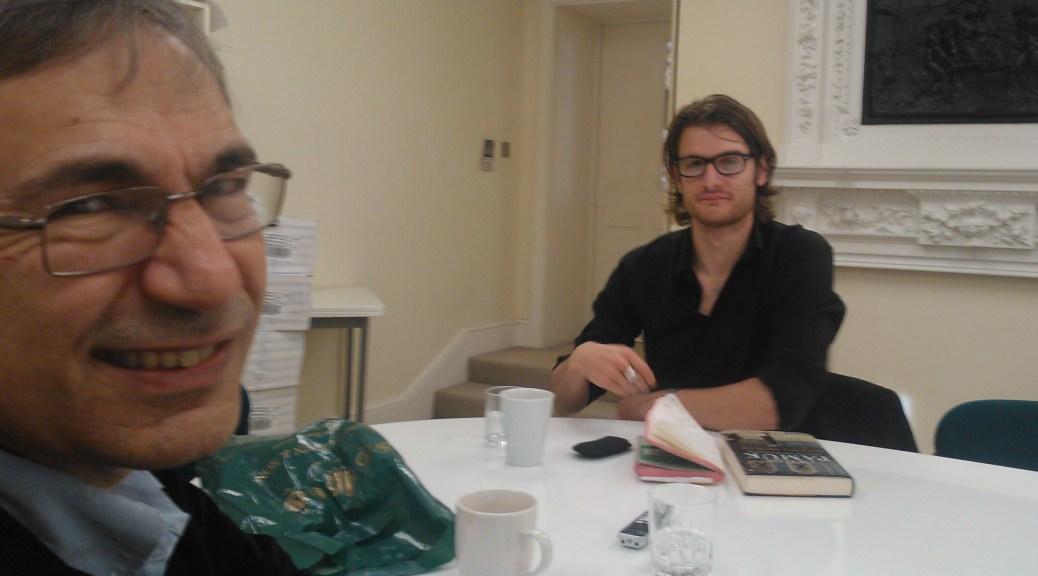
‘A Blank Page Gives Me Freedom’

Orhan Pamuk arrives in Bloomsbury carrying Japanese paintbrushes. It’s a crisp autumn afternoon and the 2006 Nobel Literature Laureate has spent the morning shopping for art supplies. “The painter in me has been resurrected,” he says with a playful smile as we settle down to drink strong black tea at his publisher’s office.
Pamuk was born in Istanbul on 7 June 1952. Growing up on the fault line between Europe and the East, the child who would become the most widely-read Turkish writer in history dreamed not of prose, but of painting. His family supported his art and architecture studies and were surprised when, at the age of 23, something changed. “Suddenly a screw was loose in my head and I began to write novels,” he says. “I could never explain why that happened, but it’s an essential fact of my life. My mind is still busy with it. I wrote My Name Is Red to try and understand the joys of painting and Istanbul to try and understand why I did what I did. The Museum Of Innocence also addresses the dead painter in me. The dead painter in me helps the writer in me. They are getting closer. Perhaps I will try to combine pictures with text more often in my books in the future.”
What happened to Pamuk to make his life skip a groove? In The Silent House, the novel which he wrote in 1983 but is now being published for the first time in English, there is a character who “read so many books that he went crazy.” This is an autobiographical nod. He is the boy who read so many books that he went crazy. “Not one particular book, but Tolstoy, Dostoevsky, Thomas Mann, Borges, Calvino… these writers and their novels made me. Reading novels changed my life. I’ve said that I mysteriously moved from painting to novels but at that time I was reading so much that it’s really no mystery. Discovering these writers, as Borges once said about reading Dostoevsky for the first time, is like the experience of seeing the sea for the first time in your life. Discovering these writers, all of them, was like seeing the sea for the first time. You’re stuck there. You want to be something like that. You want to belong to that.”
So he put down his paintbrushes and began to write. Actually, the truth is he had already started experimenting with language. At 19 he had some of his poems published in one of Turkey’s leading literary magazines, but he quickly realised he wasn’t born to write poetry. “My little poetic success helped me to move from painting to literature, and gave me some self confidence, but frankly I didn’t believe that I was a poet. Turkey and the Ottoman Empire have a long tradition of poetry. The poet can pose as someone who is possessed by God. He is not a calculating spirit but is frank and honest under the command of a higher being. The poet has a certain status in the culture, while writing novels is a lesser thing. You are a long-distance runner. This distinction still exists. A poet is a saint, a novelist is a clerk.”
Pamuk explores this idea in his novel Snow, which features a poet who hears voices. “This is related to Coleridge’s experiences of writing Kubla Khan,” he explains, “where poetry comes under the influence of God, and also opium perhaps, and then disappears. Poetry is something that you are not doing, but you are possessed by some outer force. It is moving your hand while you watch with amazement.”
Unexpectedly, I’m reminded of Shane MacGowan. I tell Pamuk that The Pogues frontman recently told me in an interview for this website that he believes some of his songs came from a ghost standing behind him and writing for him.
“That is sweet,” Pamuk replies, “It’s a rhetorical thing that makes you relax. To a point I agree with it. All novels have those kind of poetical pages, which later you have to edit and manage, but there are also pages where this kind of poetry doesn’t help. I like surrealistic writing, or what they call automatic writing, but not always. It has to be balanced with a calculating, managing, orchestrating sensibility. I argued in My Name Is Red that Western Civilisation puts artistic creativity on a pedestal. That’s a nice thing. We respect artists. But most of art, I tell you as a novelist, is really craft. I turn around sentences again and again. Yes, there is some artistic element, but lots of craft. Now the poor craftsmen of medieval time are discredited, but all the Picassos and Turners and Coleridges of history were also craftsmen.”
Pamuk spent seven years in the mid-Seventies learning and honing his craft, reading and writing during the days before wrapping up “in two sweaters and an overcoat” to go to the film screenings at the European consulates. There he discovered yet more great storytellers: Orson Welles, Roman Polanski and Wim Wenders. Under all of these influences he published his first novel, Cevdet Bey And His Sons, in 1982 at the age of 30.
The Silent House was his second novel to be published, but the third he had written. He was forced to abandon an “outspoken political novel” he had been working on when there was a military coup in Turkey in 1980. He didn’t think the next book he wrote was political at all, but 29 years on The Silent House seems remarkably prescient about the tensions between the West and the Muslim world which have surfaced over the last three decades.
“It does foresee the future in a sense,” Pamuk agrees. “The character Hasan is an angry and resentful 18-year-old high school student who flunks his classes and goes around with right-wing militants. He collects money from shop owners, terrorizing them. His language of anti-Western resentment is something that everybody knew about in Turkey but nobody cared. That resentment grew and grew. Now it is on the agenda. You can call it ‘political Islam’ or ‘Islamic fundamentalism’, but it’s not necessarily Islam. It could be Hindi or Japanese anti-Western sentiment. The voice of Hasan is based on the confessions of Turkish right-wingers who were arrested after the military coup of 1980. The army not only rounded-up left-wing militants but also some of the right-wingers who had killed people. They were forthcoming in their confessions about what they did but also about their daily lives and political fantasies.”
Has the political landscape changed significantly in the last 29 years?
“Istanbul had changed. My city grew from one million to 14 million. Swallowed by this development was all the Mediterranean flora of fig trees and olive trees, little shantytowns and factories, Ottomans ruins, railroads and hills. The whole landscape has changed, swallowed by high-rises, bigger factories and working-class districts. On the other hand, the problems of modernising Turkey and the ambitions of modernisation, the contradicting resistance and anger, the anti-Western resentment: they’re the same. One more thing changed: the country grew richer, Istanbul is not as frustrated anymore. In the novel, even the upper classes are frustrated. They feel all sorts of inferiority, troubled by their self-image: those angry and resentful voices on the street are fading away because the country is getting richer.”
You’ve said recently that you think the European Union is turning away from Turkey. How concerned are you by that?
“I was eager for Turkey to join the EU, but I understand that the EU has bigger problems now. Enlargement has slowed down as everyone is busy with the Euro problem, which is more than a European problem, it’s a global problem. I’m a bit disappointed about Turkey’s entry, but I’m not crying about it.”
Are you concerned though that Europe’s resistance to admitting Turkey was a product of religious divisions?
“Yes. Europe has every right to ask if Turkey is getting religious or parochial, but also we outsiders who believe in Europe have the right to say that if Europe defines itself not by liberté, égalité, fraternité, but by Christianity or ethnicity then it is going to end up just like Turkey too. If your definition of Europe is based on religion then yes, Turkey has no part in it, but if it’s something else, like liberté, égalité, fraternité, then once Turkey satisfies these criteria it should have a place.”
As he’s mentioned, parts of The Silent House are drawn from his memories of being a young man in Istanbul, and I ask him if there was a certain nostalgic melancholy that came from revisiting the work during the process of translation: “No. I’m happy that the whole nation got rid of this frustrating sense that nothing was happening, and stopped killing each other. Don’t forget that the book describes an Istanbul of the late 1970s and early 1980s where left wing militants and right wing militants were seriously shooting each other. If you read the wrong newspaper in the wrong neighbourhood you could get shot. So I’m not nostalgic about that period, but I may be nostalgic about the old streets of Istanbul. This is not about that. This is about the intensity of living in a country where the expectation of unhappiness is so intense.”
If you could speak to yourself in 1983, would you give yourself any advice?
“I would say to myself: don’t make the ending that tragic. I would definitely say that. I may be wrong, but I would make the picture broader and the book longer, adding more characters, but the rest I’m happy with. I’m happy that I did not give too much prominence to inner monologue or stream-of-consciousness, as other people did at that time. It’s balanced. I’d argue that there’s no such thing as inner monologue. It’s really inner dialogue. We don’t talk just to ourselves, we talk to some real or imaginary person or maybe something that somebody said 20 years ago, but there is another text to think against and other beings. It’s a literary concept, but actually inner monologue, I argue, is inner dialogue. You always answer someone in your mind.”
This statement strikes me as startlingly lucid, the sort of keen observation which makes Pamuk such an enthralling and humane writer. There are many reasons to love his books. He is wise and kind and treats his characters with empathy, but perhaps more than anything what brings me back to his novels is the elegiac ocean of melancholy which dwells within them. In his 2003 memoir Istanbul: Memories Of A City, he dedicates a chapter to Turkish melancholy: hüzün.
“I asked myself what feeling does Istanbul evoke in me? The obvious answer, not just in me but in everyone in Turkish poetry and music, is hüzün. Istanbul was my autobiography until the age of 23. It ends in 1974. The young generation of Turkish readers said: ‘No, our Istanbul is not black and white and melancholy. It’s a happy, colourful place.’ They were right, and today they would be even more right. The economic boom made the city, at least its historical and touristy parts, a very colourful and happy place. However, that historical and touristy Istanbul is not the only Istanbul. There remain 13 million people who are living in the peripheries in the working class districts. Go to those places in winter and again you will find the melancholy I mention in Istanbul.”
Are you still trying to capture that in your work?
“My Istanbul book, The Museum Of Innocence and The Innocence Of Objects have the same sentiment. That this city was provincial, that it generated sadness and inwardness not in individuals but in the whole community, but as I say it is changing now.”
But can economic changes really do anything about the underlying melancholy?
“Hüzün also has communal ethical and moral dimensions that can be compared to what an American scholar said about Japanese culture: ‘the nobility of failure’. Hüzün advises you: don’t venture too much, you’re not going to succeed. Be modest. Don’t be individualistic or capitalistic but belong to the community. I respect some of these sentiments, but it is also sometimes important to have the creativity of the solitary artist. Hüzün advises too much to respect the elders or establishment. That melancholy has a negative medieval side to it. A terror of being yourself. It tells you to belong to the community, just don’t be distinct. Be like others. Some of these ideas may work in pre-modernity,” he laughs, “but I don’t like them.”
Is hüzün related to the existential terror of death?
“No, belonging to a community doesn’t avoid the idea of death, really,” he laughs again. “Fear of death, all the anxieties about that… maybe that fear is not around in me. Maybe it will come to me, but I don’t think of it too much. In my youth, say, reading Albert Camus: “The greatest philosophical question is whether to commit suicide or not.” I loved these questions as a teenager, but not as someone worrying about the other world or what will happen to me. Maybe that will come. Now in my mind I’m not as busy with teenage metaphysics. Maybe my paintings are a bit, but I’ve changed. Now I think of death as a very natural ending. I hope it happens naturally, but my mind is not busy with death. I am busy with the novels that I will write. Yes, of course I should have characters whose minds are busy with it, but I have acknowledged death. Maybe because of the likes of Camus or Dostoevsky and that sort of existential thinking in my early twenties. It is not news for me. I’m not worried about it, but perhaps I will begin worrying as it gets closer.”
In 2006 Pamuk had just started teaching at Columbia University in New York and was working on his next novel, The Museum Of Innocence. One morning, at seven am, he received a phone call to tell him he had won the Nobel Prize. “My automatic reaction was to say: “This will not change my life!” The words came out of me in a hurry, in a panic. That is the cliché about the prize. As a writer, it didn’t change me. I continued the novel I was in the middle of. I was lucky, because I didn’t have to say: ‘Oh, what am I going to do now? What is my next project?’ I was deeply buried in a project that I could continue. However, it did change my life in many ways. It made me more of a diplomat of Turkey, with more political responsibilities and pressures. Everyone is watching, so you cannot be playful or silly or irresponsible. I am doing my best to keep the irresponsible, playful child in me alive. This is the one who helps me write my books and find new ideas. That is what I have to protect above the formality or snobbishness the prize may give you.”
Do you think of yourself as the voice of a generation?
“I’d prefer that to be ‘voice of a nation’. Inevitably, you represent both your nation and generation. From the visitors to the Museum of Innocence, I know that they tell me they had the same things in Spain, and Italy, and Iran. That immediately places you in your generation, but of course we all write to address something beyond our generation. The problem about being a famous Nobel Prize winner, particularly as there are not many other high-profile Turkish intellectuals, is that the burden of both explaining the country to the world and addressing political issues is sometimes too much.”
That next novel, The Museum of Innocence, became one of Pamuk’s greatest projects and helped to resurrect the painter within him. “The Museum of Innocence is a novel about love that doesn’t put love on a pedestal. It treats it as a more human thing, something like a car accident that happens to all of us. We all behave the same. All the negotiations with the lover: anger, resentment, impatience and so on. In the story, the upper class spoiled man collects the things that his beloved touches, and after the sad ending he wants to exhibit these objects and even tells us how to make the museum. Four years after I published the book in Turkey I created the museum, and opened it this April in Istanbul. Both the novel and the museum were conceived together. It’s not that I had a successful selling novel and then wanted to illustrate it. They are telling the same story. When I opened it the welcome from the Turkish media was very sweet, which was surprising but I was very happy. We have a good number of visitors. In 2011 I did not write as much in the last six months as I had been for the last 38 years. I quit writing fiction and gave all of my energy to the eleven or twelve artists, carpenters, friends and assistants who were working together. That was a really great time. The painter in me was so happy, but so was the writer in me. Now that period is over I’ve returned to my old self. Empty page. Discipline. Working all the time. Which I like.”
Have do you feel when you face the blank page?
“No problem. I never have what Americans call ‘writer’s block’. Perhaps it’s because I plan ahead, and if I do feel blocked I can move to another chapter. Perhaps it’s because I’m optimistic. If I know what I’m going to write, and I always prepare that the night before, then a blank page gives me not anxiety but freedom. The freedom of creativity and being alive.”
Thomas Mann said that writers are people for whom writing is more difficult than other people. Do you agree?
“Writing is always difficult, but you have your rewards too. You are writing something that nobody else has done. Even a little detail, if no-one else has done it then you’re happy. It’s your invention. There is that kind of happiness. Writing is difficult, but it’s also rewarding. If you’re happy with what you do then you smile all night. Sometimes you can’t. Then I’m sulking and my daughter says to me: “You didn’t write well today, is that it?””
Do you enjoy holding court in public?
“I didn’t. I’m not a good party person, especially when I was a teenager. I was not good at parties. That is represented in The Silent House, there is lots of nervousness and inner dialogue going on. I learned to do it because of the success of my books, learning to introduce and read from them. Contrary to my youthful days I now enjoy listening to other people talk. In my youth, just like the characters Hasan and Metin, I tried to prove myself. That has changed, and I’m not complaining!”
I asked that because I was wondering if you consider yourself a natural storyteller?
“No, I don’t. I’m a modern novelist and a modern novelist should perhaps occasionally, like Albert Camus in L’Etranger, be a natural storyteller, but most of it is planning, making decisions even before you start to write. I’m also a photographer. You don’t mind, right?”
While he was speaking Pamuk has taken his digital camera out of his jacket pocket, and has crooked his arm over his shoulder so that he can photograph himself with me in the back of the shot. The phrase ‘MySpace pose’ flashes across my mind. I tell him I don’t mind as long as he takes one for me as well. He does.
From the look on Pamuk’s face I get the impression that the “irresponsible, playful child” within him is at work, so I ask him to tell me a joke. He thinks for a moment, then says: “This comes from life, and it’s about a subject that I deal with in my books: sibling rivalry. I used to exchange letters with my brother full of this rivalry. Eventually I wrote to him: ‘Look, the two of us have wasted a lot of energy on resentment. Now that we’re going to university, we should forget this competition between us. He wrote back: ‘Yes, you’re right… but I observed it first.’”
He smiles at the memory. “I like these oxymoronic jokes and self-contradictory observations. It is like the guys, and I come across a lot of them in Turkey, who say that they are ‘probably the most modest person in the world.’ They are proud of their modesty, and say: ‘I’m very, very modest. Perhaps you didn’t notice it. There’s nobody more modest than I am.’”
What are you proudest of?
“I’m happy that I did not waste much time in life. I’m happy that I did not spend too much time hanging out with the boys, that I locked myself up. I was partly like Metin, my character who wants upper-class mobility or some success and wants to try and prove his intellect. Perhaps I did that, but only through writing books, not through other venues like business. I’m proud of the fact that although this or that happened I never left writing. I continued to write and from the age of 23 I’ve never stopped. Through hard times, political and personal problems, I wrote my novels. The experience of writing a novel is the experience of looking at the world through other’s windows, from other points of view. This teaches you a sort of humility if you do it for almost 40 years. I’m proud of that humility, if I have it. I hope I have it.”
I can’t resist telling him that being proud of his humility sounds like one of his oxymoronic jokes.
He laughs. “Yes, another joke! Another contradiction!”
Have your writing habits changed since you started at 23?
“No, I still handwrite with a fountain pen into squared notebooks.”
Why squared?
He shrugs. “I don’t know. I’m used to it. It’s just easier. The comfort of it. Probably I am working more now. I’m more careful not to waste time. I plan out more, because if you don’t plan then you’ll waste a lot of time, but the rest is the same thing. Sitting at the table in the morning, and if you know what you’re going to do that day then you’re the happiest person alive.”
His playful smile is back. “I’m still like that.”
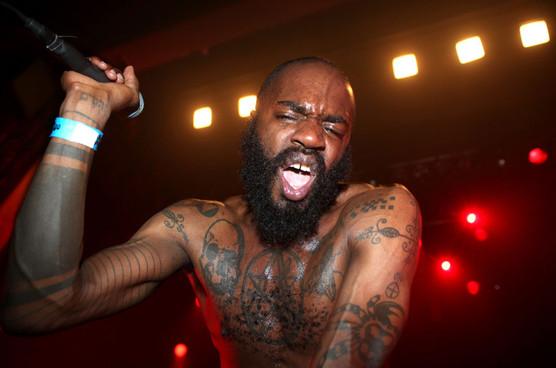
Poutine Age Riot
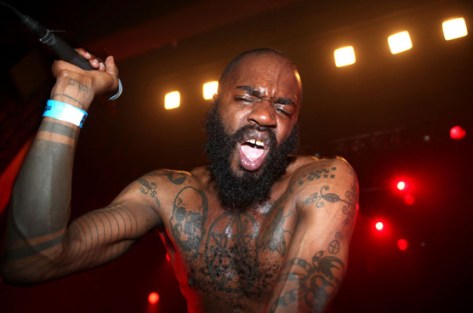 Any city whose staple food is chips, gravy and cheese curd is alright by me. Montreal’s proud, surprisingly not overweight, citizens call it ‘poutine’ and even if you don’t rock up at notorious 24hr joint La Banquise until four in the morning they’ll still be queuing around the ice cold block for it. I was in town last week for the annual M For Montreal festival, Canada’s new band festival and worthy rival of the likes of SXSW and The Great Escape. In a handful of crammed city centre venues the festival cheerfully slathered some of the year’s best international acts over a generous helping of Canada’s finest homegrown bands. I put on my warmest, furriest hat and headed out into the frozen night to see what I could find. These are the bands worth writing home about:
Death Grips
M For Montreal pulled off something of a festival coup by bagging Death Grips, and the Californians were easily the pick of the international bands. Yeah, so it’s a bit of a shame that touring without production guru Andy ‘Flatlander’ means they’re playing to a pre-recorded backing track, but even that doesn’t take too much away from Zach Hill’s monstrous drumming, which seems him breaking drum sticks and hammering the skins with his fists, or from the visceral power of MC Ride in full flow. A ferocious live proposition.
Blue Hawaii
Initially sold to us on the Grimes connection (they’re signed to Arbutus Records and have opened for Montreal’s current indie queen on various occasions) it took about 4 seconds of their set in Casa Del Popolo on Wednesday night for it to become clear that they’re in no need of riding anybody’s coat-tails. Singer Raph is blessed with an immediately captivating voice while her boyfriend Agor works all kinds of magic on synths and drums. The first band of the week to get everyone dancing, I next saw them in an underground illegal warehouse manfully battling to keep playing on while the party was shut down around them. Well played.
Suuns
Dark, experimental rockers Suuns were much feted at the beginning of 2011 when they released debut album ‘Zeroes QC’, but on the evidence of their set following Blue Hawaii at Casa Del Popolo their second record ‘Images Du Futur’, due next March, will be one of the highlights of 2013. You can hear lead single ‘Edie’s Dream’ now – but here’s a tip for when you’re raving about them later: it’s pronounced ‘Soons’, not ‘Suns’.
No Joy
There was a whole lot of shoegazing going on at M For Montreal, so for any band to stand out they had to be doing something special. Thank the Lord then for No Joy, who actually have the songs to back up the de rigueur hazy guitar sounds. Their ‘Negaverse’ EP, released this year, has been blowing Montreal’s collective minds, but personally I’m just a sucker for anyone who dedicates a great rock tune to Philip Larkin.
Duchess Says
Regardless of the sprawling lineup, the one band all the organizers were raving about in private were Duchess Says. Something of a Montreal institution having formed a little under a decade ago, they brought their driving Stooges-with-synths to the skull-covered environs of the Katacombes. I didn’t see a better live performer all week than Annie-Claude Deschênes, who wails like Karen O and spent most of the show walking upright over the crowd, held aloft by a sea of hands. The devout down the front would swear she could do the same on water.
Mac DeMarco
There could be only one victor of this year’s festival, however, and that was Mac DeMarco. Montreal will be dominating end-of-year album lists across the world and across genres thanks to year-defining records by such disparate musicians as Grimes and Leonard Cohen, but Mac’s the next big thing. His record ‘2’ is full of deceptively simple riffs and laidback jamming with snatches of everyone from The Modern Lovers to Pavement. He was welcomed back to Sala Rossa as a returning hero, and had already won the audience over before the final charming moment of crowd-surfing with his girlfriend in his arms while ‘Together’ played out. If that wasn’t enough, the next night he turned up at a warehouse party playing drums and then bass with the brilliant Walter TV (who you can hear here). There’s nothing else to say but light up a Viceroy and dance.
Originally published by NME.

Tom Morello on 20 years of Rage Against The Machine
 Rage Against The Machine matter in a way few bands ever do. Righteously angry and fiercely intelligent, they also proved that political rock didn’t have to suck. They made rap manifestos that rocked and heavy riffs you could dance to.
Their debut album went off like a bomb twenty years ago this month. Over the next two decades the shockwaves changed countless lives, including mine. To mark the anniversary the band are re-releasing the record in a box set that also contains footage from the band’s first ever public performance at Cal State Northridge in 1991 as well as their Finsbury Park victory concert in 2010. They’ve also thrown in the original demo tape of 12 songs that they recorded before they’d even played a show.
I don’t need a calendar-based excuse to listen again to Tom Morello’s incendiary guitar riffs, but it doesn’t hurt. Morello’s a genuine Harvard-educated political heavyweight as well as a technical pioneer who famously used his guitar’s toggle switch to simulate a DJ’s scratching. I caught up with the rebel with a cause to find out what he remembers about making the album, politicising a generation of fans and the moment it all kicked off at Reading.
It’s been two decades since you released ‘Rage Against The Machine’. How does it feel?
In some ways time has just flown by, but in other ways I never thought I’d live this long! Looking back at 20 years of “Fuck you, I won’t do what you tell me” has been really energising and I’m so glad that we’re able to put out this box set for the people who I’ve always considered the fifth member of Rage Against The Machine: the fans.
If you could somehow speak to yourself in 1992, would you give yourself any advice?
Oh yeah. The success of the band outpaced the emotional maturity of all four of us. We were swept up in it. We were offered a record deal after our second show. It took a while for the band for the break the US, but ‘Killing In The Name’ exploded in the UK shortly after it was released. We didn’t really pay the normal dues together, where bands build a brotherhood of solidarity. We were thrust straight onto the cover of the NME! The one thing I would say to myself would have been to press pause and really check in with each other as friends and as brothers to see where everybody was at and how everyone was doing as opposed to just pressing forward with the next gig.
What do you remember about recording those first demos together?
Let’s make it clear that we had no ambition beyond writing songs that we liked. We thought that the disparate genres of music that we were combining would be wholly unacceptable to the general consciousness. We didn’t even dream of an indie record feel. That was just off the board. We didn’t even think we would be able to book club shows. At a rock club nobody wanted to hear anybody rap and at rap clubs they certainly didn’t want to hear Zach. Then the band’s politics as well: there was nothing like that ever on the radio. Then there was the ethnic make-up of the band: there were no bands with a half-black guy and then a Chicano and a half-Jewish guy. So we wrote those songs for this first record with complete surety, without any aspirations to even book a club show let alone get a record deal. I reckon that’s one of the reasons we connected, because we were so unafraid, and we didn’t have any commercial aspirations. We made that whole first demo, recording 12 songs, before we even played a show.
Was there a moment when you realised things had exploded?
It was Reading ‘93. We had been to the UK a couple of times to play club shows, and we were still opening up for House Of Pain back in the United States and opening up clubs, and we were somewhere middle of the bill at Reading. When we came out it was like the whole country was pogoing. It was unbelievable. Clearly every one of the 65,000 people knew every lyric and were just going ape shit. We were like ‘Wow, what’s happened?’ It was really then that it occurred to us that there more might have been going on than we expected.
Are you proud of what the band achieved in terms of engaging fans politically, or do you sometimes wish you could have changed society more?
First of all there has never been a more popular band with politics as radical as Rage Against The Machine. We planted a flag on the political rock Mount Everest. There are bands that are political who have sold more records but they’re not as radical. There are bands who are more radical – well, maybe – than Rage Against The Machine but they haven’t come near to the same global popularity. That’s something we can be very proud of. You can look at it on a global scale and a personal scale. Bands like The Clash and Public Enemy changed me and encouraged me to pursue a life of activism and charity work. I meet people every day who tell me that Rage Against The Machine has done that to them. A number of the founders of the Occupy movement on a global scale have cited this particular record as the thing that politicised them. So any work that they do is in part because of those ten tracks! So that’s on a personal level. Certainly on a global level there have been specific issues that the band have been involved in, such as different union struggles in the US, where there have been great successes. There have been other goals, such as the Zapatistas’ goal in Mexico, which may have not been fulfilled to the fullest, but Rage has been a link in the chain of a long history of musical artists who stand with and for the oppressed and continue to put wind in the sails of future generations of rebels. That’s something to be proud of.
Why do you think there aren’t more bands today engaged with politics?
In the wake of Rage Against The Machine’s success in 1992/93, there were a lot of bands who were kind of emasculated versions of Rage. They played commercially successful rock/rap music without the politics. I can’t name two bands who even attempted to do what Rage did. That makes me feel very fortunate to have made the acquaintance of Zach, Tim and Brad and have that perfect storm come together.
What’s been your proudest moment with Rage Against The Machine?
Wow. I would say just lasting 20 years. It’s the fans who are the reason why we connect so viscerally with our global audience because the raw emotion that you feel in the music in the performances and in Zach’s lyrics is real. The entire band’s history is a tightrope walk. At any moment that raw emotion could tear the band apart. The other side is that if it could be harnessed it could be the biggest band of all time and maybe start a global revolution! [Laughs] The band somehow picked a path, directed by fate and luck and chance and the vectors of day to day living, where we were able to get some good work done but left some work undone. I’m proud of the fact that 20 years later we’re all alive and able to celebrate the 20 year anniversary. Sometimes I feel like our fans have been underserved by us. Maybe we haven’t toured as much as our fans would have liked, or brought out as many records as they’d have like, but this moment in time is for them. Here’s all of it. Here are shows from 1993 in a Philadelphia bar that you weren’t at, but now you get to enjoy forever. This band lit a lot of fires.
How important has the UK been to the band?
The UK is where Rage first broke, so thank you. The UK is where Rage had our first ever number one ‘pop single’, so thank you. It’s been a love affair with the UK since day one, so sincerely thank you for the support y’all have shown us over the last 20 years.

Plan B Predicts A Riot
 Sleepy London town might seem like no place for a street fighting man this autumn, but in an interview with Radio One this week Plan B predicted that we could see a repeat of last August’s riots. He thinks the government is “out of touch”, and hasn’t done enough to solve the problems which initially provoked the unrest.
He’s not the only one.
Nobody wants to see a return of the destruction and violence that ended with 3,000 arrests, but plenty have said it could happen. This includes many of the police officers who were interviewed for an LSE study into the riots. One superintendent from Manchester said: “I don’t think anything has changed between now and last August, and the only thing that’s different is people have thought: riots are fun.”
Similarly, a Centre for Social Justice report argued that the crackdown that followed the riots has itself led to more gang violence, as younger members battle to replace their arrested leaders.
The strangest fact for anybody who remembers how earth-shaking the riots felt at the time is how little has changed. The government has ploughed on with funding cuts for all manner of youth services, while since last August youth unemployment has increased. Today in the UK there are over a million unemployed 16- to 24-year-olds, 12% more than when the riots kicked off a year ago. It’s particularly difficult to find work with any sort of criminal record, as those 3,000 arrested for their part in the riots will be finding out. Anger and resentment about how young people are policed still runs through many areas of Britain’s cities like kindling.
This is why it’s so inspiring to see Plan B taking a stand. In an age when it’s routine for musicians to worry more about the state of the record industry than the wider world, and to avoid getting political for fear of being seen as divisive, he’s switched-on and saying things like: “Through music and through film we can change people’s perception of the problem and show them the reality of it.”
He’s also putting his money where his mouth is. He recently said that’ll be donating £1 from every ticket sale from his 2013 arena tour to his new charity, Each One Teach One, which will give money to people doing good work in communities who aren’t receiving financial support.
David Cameron could pick up a lot from watching Plan B. He doesn’t have to learn how to rap, act or direct films but he does have to learn how to listen.
Originally published by NME.
 Kevin EG Perry: Collected Works