
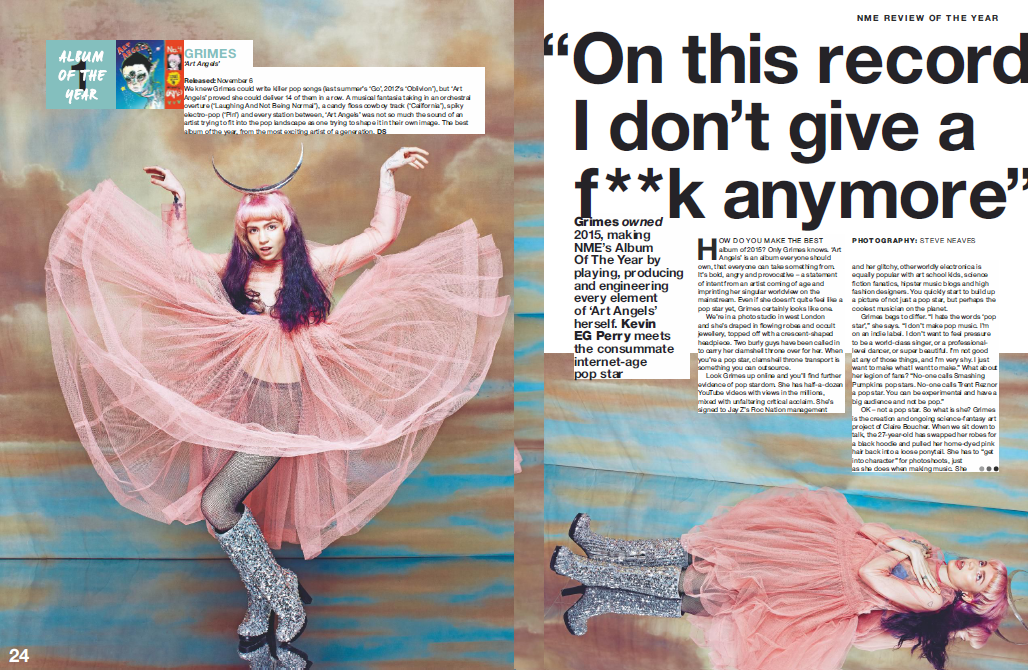
 How do you make the best album of 2015? Only Grimes knows. ‘Art Angels’ is an album everyone should own, that everyone can take something from. It’s bold, angry and provocative – a statement of intent from an artist coming of age and imprinting her singular worldview on the mainstream. Even if she doesn’t quite feel like a pop star yet, Grimes certainly looks like one.
We’re in a photo studio in west London and she’s draped in flowing robes and occult jewellery, topped off with a crescent-shaped headpiece. Two burly guys have been called in to carry her clamshell throne over for her. When you’re a pop star, clamshell throne transport is something you can outsource.
Look Grimes up online and you’ll find further evidence of pop stardom. She has half-a-dozen YouTube videos with views in the millions, mixed with unfaltering critical acclaim. She’s signed to Jay Z’s Roc Nation management and her glitchy, otherworldly electronica is equally popular with art school kids, science fiction fanatics, hipster music blogs and high fashion designers. You quickly start to build up a picture of not just a pop star, but perhaps the coolest musician on the planet.
Grimes begs to differ. “I hate the words ‘pop star’,” she says. “I don’t make pop music. I’m on an indie label. I don’t want to feel pressure to be a world-class singer, or a professional-level dancer, or super beautiful. I’m not good at any of those things, and I’m very shy. I just want to make what I want to make.” What about her legion of fans? “No-one calls Smashing Pumpkins pop stars. No-one calls Trent Reznor a pop star. You can be experimental and have a big audience and not be pop.”
 OK – not a pop star. So what is she? Grimes is the creation and ongoing science-fantasy art project of Claire Boucher. When we sit down to talk, the 27-year-old has swapped her robes for a black hoodie and pulled her home-dyed pink hair back into a loose ponytail. She has to “get into character” for photoshoots, just as she does when making music. She denies being cool almost as vehemently as she denies being a pop star. “There’s a perception that I am, but I’m extremely uncool,” she insists. “I don’t go out much.”
What does she think cool is? “Umm,” she thinks. “People with social skills?”
Born and raised in Vancouver, Boucher moved to Montreal to study at McGill University with thoughts of becoming an neuroscientist. That fell by the wayside when she discovered the city’s DIY party scene. In 2010 she released two strangely beautiful electronica records: ‘Geidi Primes’, a concept album about Frank Herbert’s fantasy novel Dune, and ‘Halfaxa’. “When I first started everyone was like, ‘Ha, ha, a Dune concept album,’” she says. “But now because of Game Of Thrones and stuff it’s more chill.”
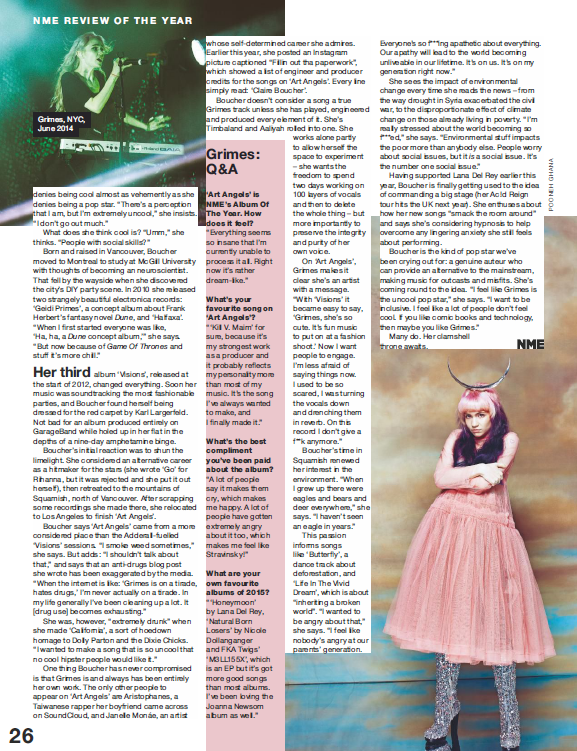 Her third album ‘Visions’, released at the start of 2012, changed everything. Soon her music was soundtracking the most fashionable parties, and Boucher found herself being dressed for the red carpet by Karl Largerfeld. Not bad for an album produced entirely on GarageBand while holed up in her flat in the depths of a nine-day amphetamine binge.
Boucher’s initial reaction was to shun the limelight. She considered an alternative career as a hitmaker for the stars (she wrote ‘Go’ for Rihanna, but it was rejected and she put it out herself), then retreated to the mountains of Squamish, north of Vancouver. After scrapping some recordings she made there, she relocated to Los Angeles to finish ‘Art Angels’.
Boucher says ‘Art Angels’ came from a more considered place than the Adderall-fuelled ‘Visions’ sessions. “I smoke weed sometimes,” she says. But adds: “I shouldn’t talk about that,” and says that an anti-drugs blog post she wrote has been exaggerated by the media. “When the internet is like: ‘Grimes is on a tirade, hates drugs,’ I’m never actually on a tirade. In my life generally I’ve been cleaning up a lot. It [drug use] becomes exhausting.”
She was, however, “extremely drunk” when she made ‘California’, a sort of hoedown homage to Dolly Parton and the Dixie Chicks. “I wanted to make a song that is so uncool that no cool hipster people would like it.”
One thing Boucher has never compromised is that Grimes is and always has been entirely her own work. The only other people to appear on ‘Art Angels’ are Aristophanes, a Taiwanese rapper her boyfriend came across on SoundCloud, and Janelle Monáe, an artist whose self-determined career she admires. Earlier this year, she posted an Instagram picture captioned “Fillin out tha paperwork”, which showed a list of engineer and producer credits for the songs on ‘Art Angels’. Every line simply read: ‘Claire Boucher’.
Boucher doesn’t consider a song a true Grimes track unless she has played, engineered and produced every element of it. She’s Timbaland and Aaliyah rolled into one. She works alone partly to allow herself the space to experiment – she wants the freedom to spend two days working on 100 layers of vocals and then to delete the whole thing – but more importantly to preserve the integrity and purity of her own voice.
On ‘Art Angels’, Grimes makes it clear she’s an artist with a message. “With ‘Visions’ it became easy to say, ‘Grimes, she’s so cute. It’s fun music to put on at a fashion shoot.’ Now I want people to engage. I’m less afraid of saying things now. I used to be so scared, I was turning the vocals down and drenching them in reverb. On this record I don’t give a f**k anymore.”
Boucher’s time in Squamish renewed her interest in the environment. “When I grew up there were eagles and bears and deer everywhere,” she says. “I haven’t seen an eagle in years.”
This passion informs songs like ‘Butterfly’, a dance track about deforestation, and ‘Life In The Vivid Dream’, which is about “inheriting a broken world”. “I wanted to be angry about that,” she says. “I feel like nobody’s angry at our parents’ generation. Everyone’s so f***ing apathetic about everything. Our apathy will lead to the world becoming unliveable in our lifetime. It’s on us. It’s on my generation right now.”
She sees the impact of environmental change every time she reads the news – from the way drought in Syria exacerbated the civil war, to the disproportionate effect of climate change on those already living in poverty. “I’m really stressed about the world becoming so f***ed,” she says. “Environmental stuff impacts the poor more than anybody else. People worry about social issues, but it is a social issue. It’s the number one social issue.”
Having supported Lana Del Rey earlier this year, Boucher is finally getting used to the idea of commanding a big stage (her Ac!d Reign tour hits the UK next year). She enthuses about how her new songs “smack the room around” and says she’s considering hypnosis to help overcome any lingering anxiety she still feels about performing.
Boucher is the kind of pop star we’ve been crying out for: a genuine auteur who can provide an alternative to the mainstream, making music for outcasts and misfits. She’s coming round to the idea. “I feel like Grimes is the uncool pop star,” she says. “I want to be inclusive. I feel like a lot of people don’t feel cool. If you like comic books and technology, then maybe you like Grimes.”
Many do. Her clamshell throne awaits.




 For the next three weeks at the Camden People’s Theatre in north London, you’ll find a show with a little story to tell about three bad brothers you know so well.
 Having created both Gorillaz and Tank Girl during almost 30 years as a graphic artist, Jamie Hewlett has finally been tempted into a gallery for his debut art show. He was inspired, like so many before him, by Googling “tramp sex”.
 “Why is it that all the writers one admires are always arseholed?”
 In 1984, a Duran Duran tour was as big as it got: like Adele backed by One Direction, with a dash of debauchery thrown in for good measure. Here, bassist John Taylor and photographer Denis O’Regan talk us through pictures from their photobook about the tour, ‘Careless Memories’, and reminisce about life on the road.


 Men often think of themselves as lone wolves. Lone wolf being ambitious in the office. Lone wolf on Tinder. Lone wolf playing Fallout 4 alone in a flat, eating lasagne out of the microwave carton. As we get older and life inevitably starts flinging shit at us, we might start to wonder whether there’s a reason most wolves hunt in packs.














 While the island’s unique geography is part of its draw, the country also has a busy cultural calendar. Here, its small size is a definite advantage. Halla Helgadóttir, who runs Iceland’s design week in March, says that designers from a variety of disciplines come here to share ideas; while Stella Soffía Jóhannesdóttir, of the Reykjavik International Literary Festival, tells an anecdote that illustrates just how intimate their events are. “When David Sedaris spoke here, he said he was used to audiences of 3,000. Here, he spoke to 100 people,” she says. “That makes our festival an opportunity to meet your favourite authors in very unusual circumstances.”


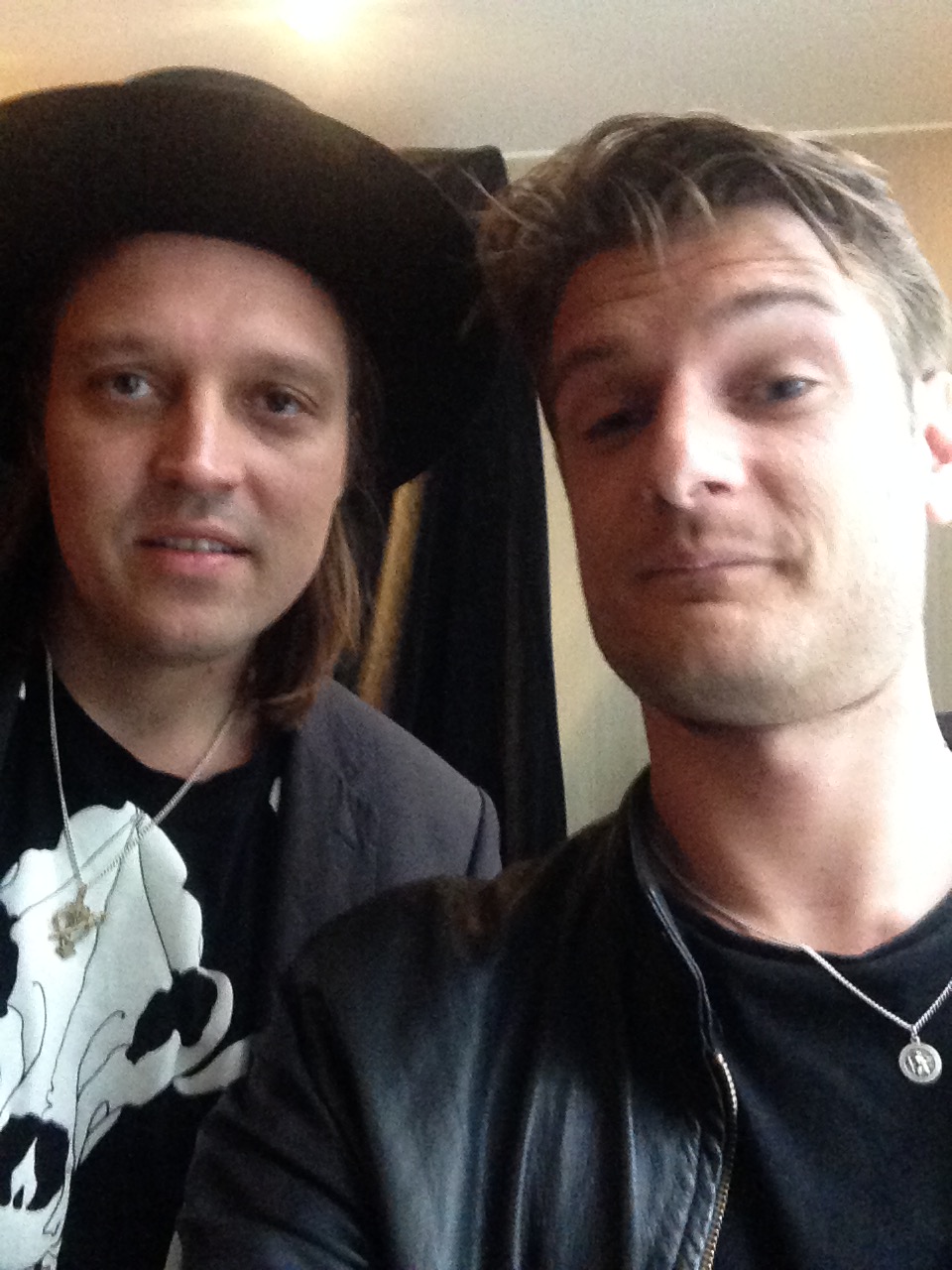





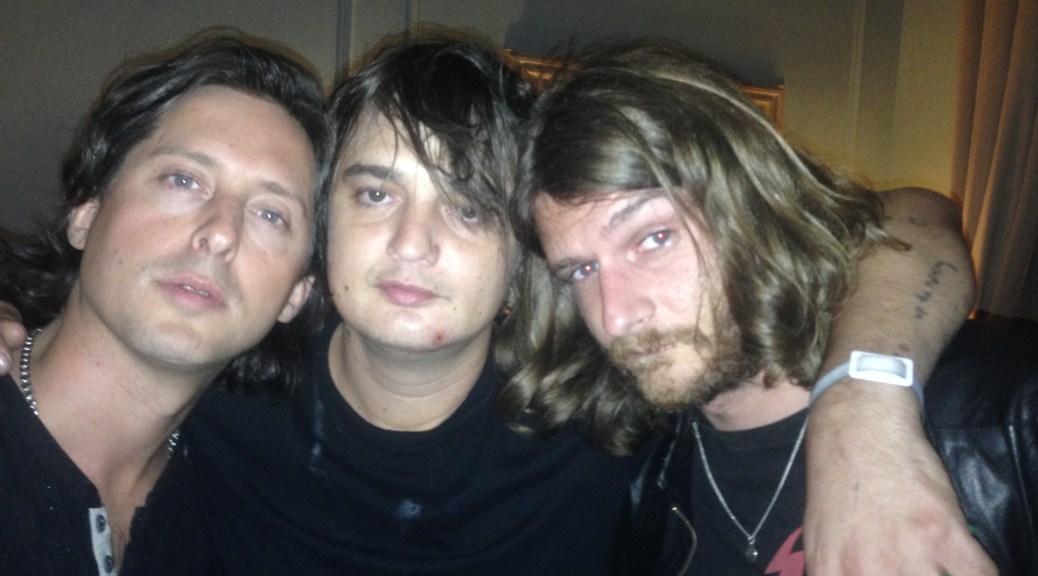


















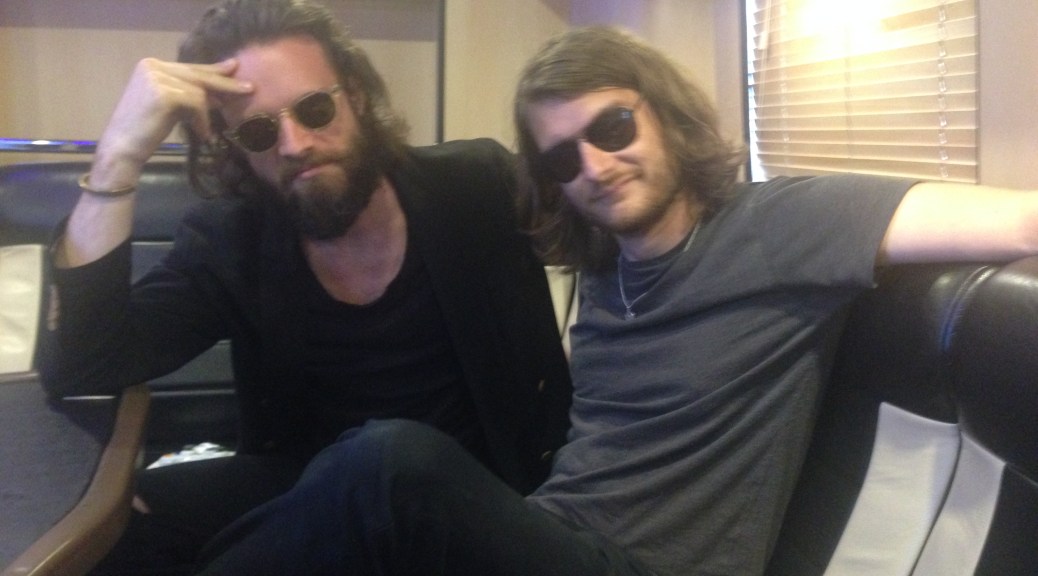

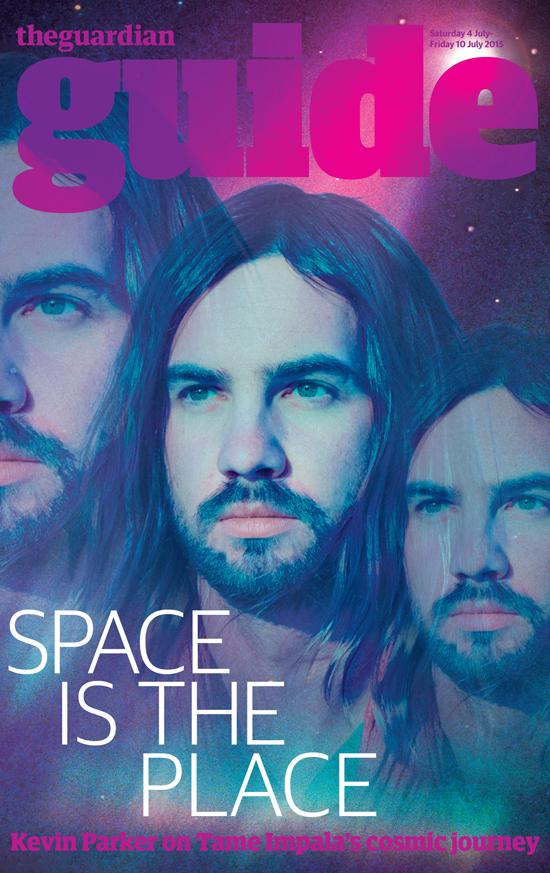
 It’s a few days before Glastonbury, and Kevin Parker – the 29-year-old Australian musical polymath behind Tame Impala – is in west London rehearsing for his appearance at the festival with Mark Ronson. Somewhat extravagantly, Ronson has hired out the entirety of the Hammersmith Apollo for the week as a practice room. Presumably he can afford it, though. “Have you ever heard of a little song called Uptown Funk?” jokes Parker.




 Back in the annals of time when we all lived in tiny hamlets, young men would have to set off on arduous quests towards the bright lights of the big cities just so they could find a wife who wasn’t either their sister or their cousin. These days you just have to reach into your pocket to be presented with a local selection of some of Tinder’s 50 million active users, 1.2 million of them in London alone.
 In the last five years, Greece has become as synonymous with their interminable financial crisis as it has always been with democracy, philosophy and yogurt. Just last week, the left wing government lead by Syriza put two fingers up to the International Monetary Fund and told them that they’re not going to pay them back the €300m they were supposed to until at least the end of June, when they absolutely promise they’ll come up with the full, erm, €1.5billion they now owe them.


 Last week, the Government announced that it’s going to outlaw “any substance intended for human consumption that is capable of producing a psychoactive effect” – except from those it deigns to allow like caffeine, certain medicines and booze. It’s a move which in theory means the end of the road for nitrous balloons, poppers and that stash of legal highs being sold next to the bongs at festival stalls and in your local head shop. While some might celebrate the fact that you’ll no longer be kept awake in your tent by the insistent ‘woosh’ of balloons being filled, a lot of people will probably see it as a dark day for civil liberties and personal choice. Also, given the difficulty of policing this area, the law may not have much practical use at all. To get an expert’s opinion on what the new law will mean, I spoke to Professor David Nutt, the government’s former chief drug advisor. Since his sacking in 2009, Professor Nutt has been campaigning for drugs policy to be based on scientific evidence rather than political whim. He told me why he believes the new law is “pathetic” – an attack on fun by the government’s “miserable sods”:










 Kevin EG Perry: Collected Works