Category Archives: NME

Nirvana’s 2020 reunion: A heavy, heart-bursting treat for fans

GettyImages-1197628819_NIRVANA_2000It’s not Nirvana, but it’s Near-vana. Krist Novoselic and Pat Smear are making eye contact from opposite sides of the stage. Dave Grohl is beating the living shit out of some poor, unsuspecting drums. Between them, St Vincent and Beck are trying their best to work a sort of secular voodoo and summon up a little of the spirit of Kurt Cobain.

They opened with St Vincent taking care of lead vocals on a thunderous version of ‘Lithium’. Then it’s over to Beck, who stumbles a little through the lyrics of ‘In Bloom’ but saves himself with a series of blistering guitar solos. Afterwards, he waxes nostalgic. “That was a pretty good mosh pit,” he said. “I was in the most intense mosh pit of my life in this room. I remember being carried off my feet, and when I got out my hands were bleeding and I didn’t know why. The band was Nirvana.”

That would have been in 1990, when Nirvana played the Palladium a year after the release of ‘Bleach’. That was 30 years ago, so how can it be that when Beck leads the band into ‘Been A Son’ – which they played that night, along with ‘In Bloom’ – it still sounds so fresh, urgent and dangerous?

Continue reading at NME.

My Chemical Romance in Los Angeles: A triumphant, cathartic return

zeWVSgRA-MY-CHEM-2000‘Twas five nights before Christmas, at a place called the Shrine, and a creature was stirring, in the LA sunshine. It had been 2,771 nights since this particular animal was last spotted in the wild (seven years, seven months and one day, to put it another way, but who’s counting?). The Halloween announcement that Gerard Way, Ray Toro, Frank Iero and Mikey Way were finally reuniting for a My Chemical Romance comeback show was met with mass hysteria. Tickets sold out in less than the time it takes to say ‘MCR’, to 6,299 unbelievably lucky fans.

6,299 lucky fans, and me. Sorry. It’s not that I didn’t like them, they just kind of passed me by at the time. I was a fraction too old when they first came out, and – as will forever be the case with music enjoyed by the age bracket just after yours, they always seemed terminally uncool. Still, it’s Christmas – a time when NME’s British staff can’t be parted from the warm bosom of their families/warm bottles of Jameson’s (delete as applicable), and I’m already in LA. So here I am.

Continue reading at NME.

NME’s Greatest Albums of The Decade: The 2010s

Best-of-Decade-Web-Header

  1. Arctic Monkeys – ‘AM’

It all started with those drums. We don’t just mean the languid stomp of opener ‘Do I Wanna Know?’ or the showy solo at the start of ‘R U Mine?’. No – we mean the way that as soon as you heard ‘AM’ erupt out of your speakers for the first time it was clear that from now on the Arctic Monkeys were moving to a different beat.

They were thieves, of course, but they were good at it. The band cheerfully admitted to nicking a few ideas from the likes of Dr Dre, Outkast and Aaliyah, but what was really remarkable was the sheer range and scope of their rampant looting. They stole from hip hop, glam, Motown, rock’n’roll, R&B and even doo-wop with equal ease and evident delight. They picked Phil Spector’s pockets and mugged John Lennon. They lifted that “Mad sounds/In your ears” bit from a song by their early producer Alan Smyth. For the finale, they just straight-out plagiarised a John Cooper Clarke poem. Somebody should have called the police.

This disparate collection of pilfered genres and stolen sounds came together seamlessly with Turner’s too-clever-by-half lyrics about love, lust and the grey area in-between. It’s still hard to get over the elegantly sketched scene in the car in ‘Arabella’, which ends with the phenomenal line: “The horizon tries but it’s just not as kind on the eyes.” The man can chirpse. He had us at: “I’m sorry to interrupt/It’s just I’m constantly on the cusp/Of trying to kiss you.” But ‘AM’ was about so much more than just chat-up lines. What about the lovely, melancholy double meaning of: “Leave me listening to the Stones/2000 Light Years From Home”? The writing is sharply-observed, sometimes self-lacerating and often laugh-out-loud funny. There were a lot of great albums released in the 2010s but only one of them features prominent lyrical references to both Mean Streets and Thunderbirds. 

What it all amounted to was as good a portrait of what it was like to be staying out too late and getting into trouble in the 2010s as anyone wrote in any medium, with the added bonus that it was also really fun to dance to. That meant it connected with people. It sold more copies than One Direction’s ‘Up All Night’. It became the soundtrack for countless nights out, hook-ups and comedowns in every town and city of this country. It was the album of the decade.

Read the full list at NME.

Noah Baumbach: Modern Lover

Noah-Baumbach-Website-1430-x-804-696x391There are certain telltale signs which let you know you’re in a Noah Baumbach movie: everyone around you is some sort of creative artist, probably a writer, actor, director or dancer. They are all obsessed with living in New York. Distant fathers greet their offspring with the words: “There’s my son.” Nobody can ever find a parking spot. Everybody has just been or is about to be featured in either The New York Times or The New Yorker, the only publications which exist within the Baumbach Cinematic Universe (BCU).

Yet even though he has a tendency to set his films within a particular milieu, Baumbach is at his best when he manages to hone in on that which we can all relate to. Over the course of his almost quarter century career (Noah’s arc, you might say), spread across the 10 narrative features he’s written and directed (plus one, 1997’s Highball, which he disowned) he has done this time and again.

In his 2005 breakout hit The Squid and the Whale, he transformed the pain of his own parents’ divorce into a story that was at once touching, heartfelt and hilarious, and was rewarded with an Oscar nomination for Best Original Screenplay (losing out to unsettling crime drama Crash, which also won Best Picture).

In his collaborations with partner Greta Gerwig, including 2012’s widely-acclaimed Frances Ha and their criminally-underrated 2015 follow-up Mistress America, he captured the melancholy rush of youth flying by in a way that connected even if you weren’t a part of their specific social group. It’s not as if the BCU isn’t rooted in reality. Shortly after Baumbach and Gerwig first made their relationship public, they were featured together in a joint profile in (where else?) The New Yorker.

Continue reading at NME.

Vampire Weekend’s Chris Baio and Fort Romeau on reinventing krautrock with new band CYM

PRESS-PHOTO-C.Y.M.-credit-Joey-Greene-1-1220x775Hidden away in Eagle Rock, a trendy neighbourhood in east Los Angeles, there’s a studio that once belonged to legendary Beastie Boys producer Mario C. These days, its home to Vampire Weekend bassist Chris Baio, and he’s already putting it to good use. Not content with merely being part of one of the albums of the year (VW’s ‘Father of the Bride’) or pursuing his solo career as Baio, he’s now teamed up with house music producer Mike Greene – who you may know as Fort Romeau – to form yet another band, CYM. Their experimental three-track debut EP is a wildly imaginative take on krautrock, and they say they’re just getting started. We visited the studio to get the lowdown:

Continue reading at NME.

Black Sabbath made Birmingham the Home of Metal. Shouldn’t the city repay the favour?

Earlier this summer, guitarist Tony Iommi and bassist and lyricist Geezer Butler returned to Birmingham for the opening of an exhaustive exhibition about Black Sabbath, the band they formed in the city 50 years ago. Birmingham Museum & Art Gallery is currently home to a vast collection of both the band’s own memorabilia and a staggering array of fan tributes. Asked if there was anything not present in the collection that they expected to see, Butler couldn’t resist a quip: “Ozzy?”

Continue reading at NME.

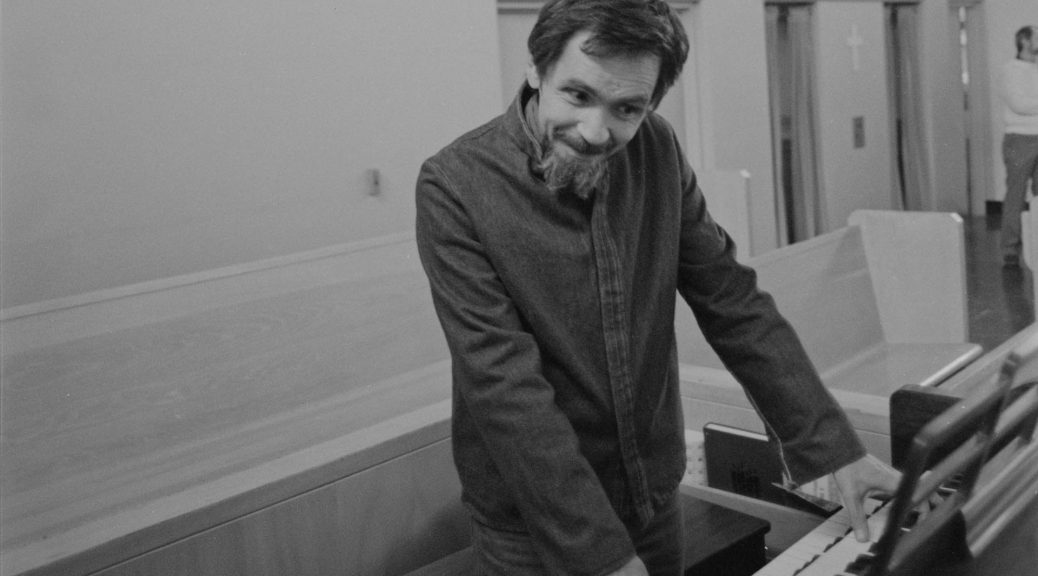
Charles Manson: how the notorious cult leader tried – and failed – to launch a music career

Charles Manson hovers like a spectre in the background of Quentin Tarantino’s excellent new retro-romp Once Upon A Time In Hollywood, just as he’s haunted American popular culture ever since he orchestrated a series of gruesome murders in Los Angeles in August 1969.

The way his crimes came to represent the poisoning of the hippy ideal has given him an outsized reputation, making him appear far more powerful and terrifying than he really was. The truth is that Manson was a cruel and manipulative piece of shit, and like many pieces of shit before and since, what he really wanted in life was to be a rock ’n’ roll star.

Continue reading at NME.

Oliver Stone on dropping acid during ‘Nam, his failed Bob Marley biopic and the psychedelic allure of Jim Morrison

There’s been a spate of big, campy music biopics in the last few years, including films about Queen (Bohemian Rhapsody), Elton John (Rocketman), Mötley Crüe (The Dirt) and even one about that band of freakish Doctor Moreau rejects whose screams haunt my nightmares (Cats).

Back in 1991, however, music biopics could be altogether darker and druggier affairs. Oliver Stone’s The Doors portrayed frontman Jim Morrison as a death-obsessed shaman who wandered the Sunset Strip spouting lines like: “What’s a band for? Let’s plan a murder or start a religion” or “I don’t remember being born, it must have happened during one of my blackouts”. It also featured a memorable desert acid trip sequence that would be lovingly satirised in Wayne’s World 2 (“I have to ask, didn’t you think it was a trifle unnecessary to see the crack in the Indian’s bottom?”).

Now that music films are back in vogue, the film has been given a shiny new 4K polish and is being re-released today. To mark the occasion, we headed to Oliver Stone’s Hollywood office to see if he’d let us touch one of his three (three!) Oscars (Best Adapted Screenplay for 1979’s Midnight Express, Best Director for both 1987’s Platoon and 1990’s Born on the Fourth of July). When that failed, we settled for talking to him about how Val Kilmer managed to rack up a $20,000 massage bill on the set of The Doors, the best place to score acid in Sydney in 1968, and why Madonna’s lack of acting chops led him to walk away from Evita.

Continue reading at NME.

Can Above & Beyond’s yoga class and meditation album cure my post-Glastonbury malaise?

The week after Glastonbury is always tough. After a year as glorious as this one, even the drive home was more than I could bear. I got The Fear as soon as we got to a service station. Did we really have to come back to concrete civilisation? Couldn’t we just live in the fields? Where had all my serotonin gone? Why are there so many different types of crisps? Nothing made sense anymore.

I was lying flat across the backseat of the car in a cocoon of blankets and self-loathing when the email came through. I could hear my editors discussing it up front. Humongous, Grammy-bothering dance act Above & Beyond are apparently about to release a new album designed specifically for yoga and meditation, and they’re running a post-Glastonbury yoga session in a yard in Victoria. One of my editors jerked his thumb towards the back seat. “Kev’ll do it,” he said. I didn’t hate the idea. Maybe it’ll be just what I need to return my broken body to some state of normalcy. What they don’t tell me is that it starts at 8am. Bastards.

I’m late, obviously. The organisers have saved me a spot right in front of the DJ decks, but it’s hard to be inconspicuous when you’re wearing space cat leggings. I try to sneak straight into a surreptitious downward dog but before I know it a serene figure in white has appeared next to me. “That was quite the entrance,” she breathes. I’m far too fragile for all this.

Still, my Columbo-like powers of deduction are functioning enough that I gather this ethereal presence must be Elena Brower. One of the world’s leading yogi (not the bear), the story goes that she met the guys from Above & Beyond at Burning Man (where else?) in 2014. She led a yoga session in front of the Robot Heart soundsystem in the deep playa while Above & Beyond DJed (The set has now been streamed over two million times on Soundcloud). It was, by all accounts, such a profound and powerful experience for everyone involved that they ran it again five or six times at various other festivals and parties and eventually  decided to collaborate on a new album, ‘Flow State’.

The record itself is a continuous ambient instrumental mix, but there’s also a second version featuring a lengthy spoken word piece by Elena. The threat of a ‘spoken word yoga album’ is usually the sort of thing that makes me delete an email faster than you can think of a rhyme for Jeremy Hunt, but right now listening to Elena I realise I’d sell the stronger of my two kidneys for a recording of her. It’s not just that she’s gracefully guiding us through the yoga, making even pretzeling myself into an excruciating pigeon position seem elegant, it’s that she’s keeping up such a steady stream of wisdom about gratitude and safety and self-reliance that I catch myself smiling up at the clear blue sky. The music swells euphorically, not in a I’ve-just-dropped-a-pinger-in-Block-9 way, more like a striding-off-into-a-new-dawn way. It feels vast and cinematic. I’m Renton with the bag full of cash at the end of ‘Trainspotting’. I think it’s all going to be OK. I think it’s going to be fine.

Once Elena is done restoring me to the status of functioning human, I sit down with her and Above & Beyond’s Paavo Siljamäki and Tony McGuinness to find out how they ended up creating this instant dose of Serenity Now.

“We’re obviously DJs who spend most of our time playing dark nightclubs,” explains Paavo. “I think where this fits in is that I feel like if I look after my own mental fitness better, and look after my body better, if I’m in better shape mentally and physically, then I can get more out of the parties. It enables a lot more fun in life.”

We’re living in a hyper-accelerated age, where the danger of pushing yourself too hard and too fast is all too real. That fear is the tragic backstory to this project, which was born in the wake of the recent suicides of Avicii and Bill Hamel, a member of Fatum, who released music through Above & Beyond’s label Anjunabeats.

“I’ve been burning out,” says Paavo. “I’ve been struggling with depression. For me, this has been a therapeutic thing. I’ve needed to stop stuff, and I’ve needed space to really work through things. Music is such an awesome thing because I can make music if I’m feeling happy or sad or tired or energetic. That’s very much where a lot of this album has come from, from a very painful and dark place, but doing it has been a release and now that’s it’s out there maybe it’s going to resonate with people who are struggling. All the shocking things that have happened in the last few years have made me realise that we need to get people talking about this. There’s no shame in it.”

To reinforce the message he wanted to convey with this music, Paavo approached Elena to record her voice-over. “Her message is so on point with what we’re trying to do,” he explains.

So what exactly is Elena’s message? “The very first line [of the spoken word recording] is I think the most important,” she says. “‘There is a place within you that is always at rest and always at peace.’ Then we walk through the process of forgetting and remembering several times over the course of the talk, so that by the end there’s no question: You are here listening to this so that you can remember that space inside of you, provide yourself with a sense of safety and presence and hold your own hand. By doing so, you’re going to be able to do that for other people. That is a service that we can all give to the communities in which we live.”

Speaking of communities, I’ve got about 200,000 mates who I think would be into this. “We’ve got to bring this to Glastonbury, for sure,” says Paavo. “I think Glastonbury would be the place,” adds Tony. “Even more than Burning Man.”

Elena, are you in? “I’d love that!” Let’s make it happen. Glastonbury. 2020. Elena Brower and Above & Beyond, I wanna be your downward dog.

Originally published by NME.

Glastonbury 2019: Running away to join the circus

KEVIN-EG-PERRY-ANDY-HUGHES-NME-GLASTO19-6667

Glastonbury has a way of getting under your skin. By the time Sunday rolls around, you start dreaming of ways you could keep living the festival life forever. If you’re anything like me, there comes a point where you start to think: ‘Could I… could I run away and join the circus?’

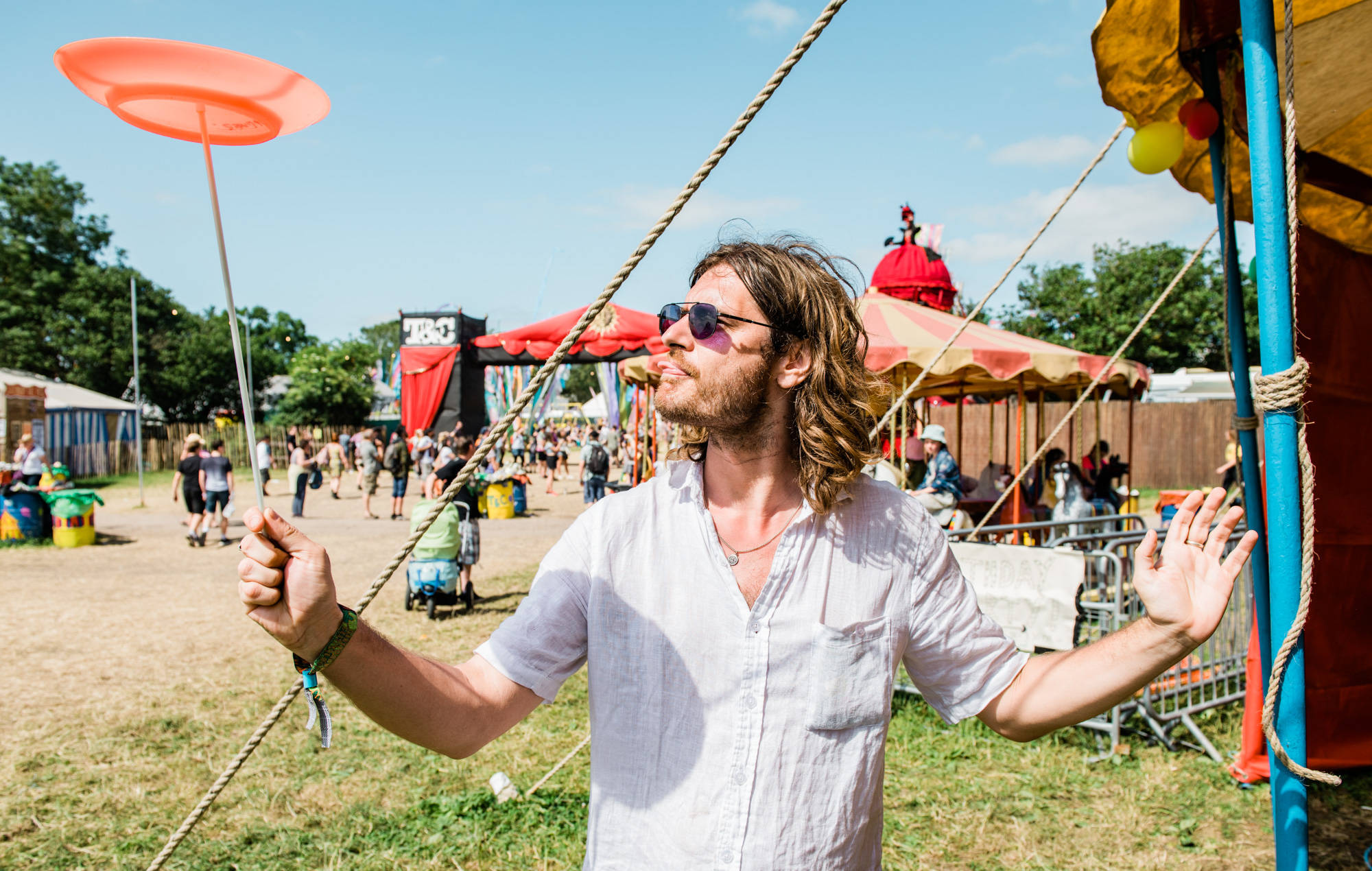
Luckily, Glastonbury is exactly the sort of place which encourages these sort of insane dreams. With Monday’s threat of a return to reality hurtling towards me at breakneck speed, I decided to pull on my trusty space cat leggings and head down to the the festival’s circus field. There’s a whole tent there dedicated to teaching a range of useful everyday life skills like hula-hooping, poi, juggling, contact balls, devil sticks and plate-spinning. That’s where I meet Ben the Juggler. Not the most inventive name, but you get the idea. “I wanted to be called Willy Drop’em,” Ben tells me sadly, “But somebody had already taken the name.”

He points out the circus tent proper on the other side of the field, which boasts a line-up of some of the planet’s most in-demand acts. You can see everything in there from high-wire acts and acrobats to card tricks and contortionists. “There’s some world class acts in the circus tent,” says Ben. “And we’re the beginning of the next world class acts.” I can only assume he’s talking about me. I’m pretty good at juggling deadlines. How much harder can balls or clubs be?

KEVIN-EG-PERRY-ANDY-HUGHES-NME-GLASTO19-6574

Pretty hard, as it turns out, although Ben makes it look as straight-forward as necking a pear cider. He’s been a professional juggler for 30 years, teaching in the south-west of England, and has come to Glastonbury in 15 of the last 20 years. “I always do the festival this way,” he tells me. “We get a lot of people coming here who can already juggle a little bit, so instead of just doing 1-2-3 we can open people’s minds to things that they never thought were possible to do themselves. That’s the cool thing about all this stuff, you do it for yourself. It gives you a little spring in your step knowing that you have a superhuman power with a hula-hoop. When people first learn to do something like spin a plate they get a look of joy on their face. It’s a leap of faith. You do it for yourself when you never knew you could. People feel good about themselves, that’s the thing.”

I like the sound of that, but when Ben starts showing me his moves with the juggling clubs I quickly lose confidence. “With clubs, it’s about knowing where the spin is,” he explains as they start flying around his body. “When I throw the clubs from one hand to another it spins around my shoulder height, and that way I know it will come down easily in my other hand.” He makes it sound so simple, but it looks close to magic. Soon he’s throwing them under his leg and balancing one of the clubs on his trilby mid-juggle. Showing off, in other words.

“Juggling, out of all these things, does take a bit longer to learn,” Ben concedes. “Hula-hooping you’re only concentrating on one thing, plate spinning you’re only concentrating on one thing, whereas with juggling you’ve got to get both sides going. People say it’s good for the grey matter, although there’s not much evidence for that for me.”

KEVIN-EG-PERRY-ANDY-HUGHES-NME-GLASTO19-6556

Ben’s being self-deprecating there. He’s inspired me to further pursue my circus dreams, but sadly I’m a truly terrible juggler. I’m not much better at hula-hooping either, and I can’t seem to spin a plate without sticking my tongue out. There’s no way I’m giving up that easily though. My eyes have been drawn to the grand centre-piece of the circus field: the flying trapeze. It’s time for me to go big or go home, and I don’t want to go home.

Every afternoon of the festival, Above and Beyond runs two-and-a-half hours worth of free aerial trapeze workshops. The company is run by 71 year-old Glastonbury veteran Mike Wright, who’s produced performances for the Brit Awards, Euro 96 and Simply Red. Hard to resist calling that a high-flying career.

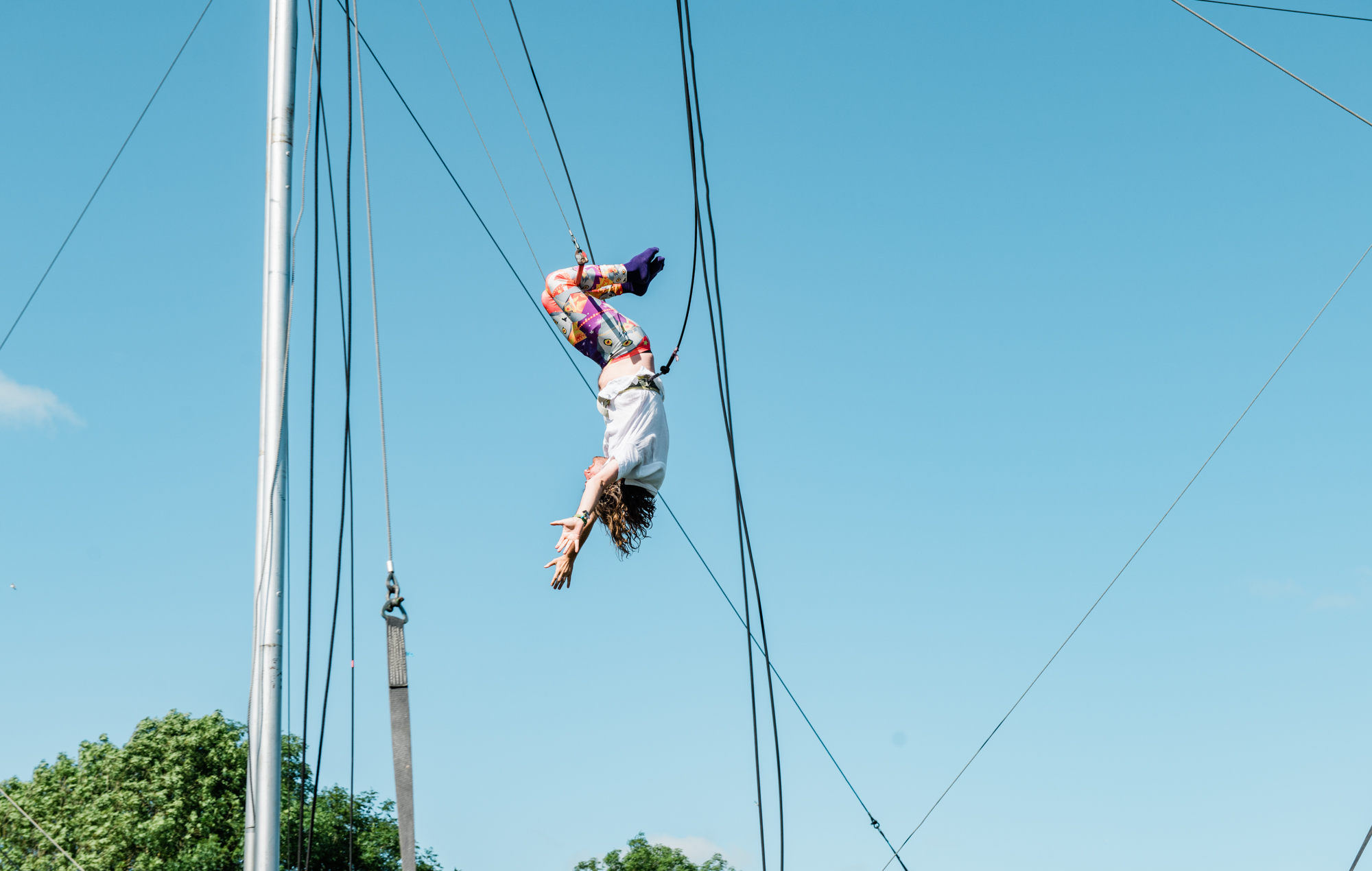
Just as my training is about to begin, I get a text from a friend that Nick Cave has just come out with Kylie over on the Pyramid Stage. Annoying. Still, that’s the problem with Glastonbury. You can’t be everywhere at once, and I can’t quit on my new dream already. The instruction is, frankly, minimal. It basically consists of being told not to let go of the fly bar, which I probably could have figured out for myself. Just as I’m thinking that, one of the people ahead of me slips straight off the bar as soon as they leave the platform and crashes clumsily into the safety net. I don’t want to be that guy. If I can hang on long enough, the plan is that I’m going to perform a move called a knee hang, generally considered to be the most basic and accessible of flying trapeze tricks. Still, I’ve got to start my circus career somewhere, and upside down 25ft in the air seems as good a place as any.

KEVIN-EG-PERRY-ANDY-HUGHES-NME-GLASTO19-1392

As I climb the long, unsteady ladder to the platform, I can hear faint strains of ‘Can’t Get You Out Of My Head’ drifting across the fields. The view from the top is magnificent. On one side, I can just about make out Kylie on the big screens beside the Pyramid Stage. To the other, I can see down towards the madness of Block 9 and Shangri-La in the south-east corner, where in the early hours of this morning I was still rhythmically twitching to some sort of aggressive dance music. The foggy memories come roaring back into horrible clarity. Was that really only a few hours ago? Is it wise to launch myself off this platform in this sort of state? It’s nice up here. Will this be the end of me?

KEVIN-EG-PERRY-ANDY-HUGHES-NME-GLASTO19-6672

I grasp the fly bar in both hands. I hear the instructor’s voice say: “Ready?” and then: “Hup!” I jump up and the bar carries me forward, out into the clear blue sky. At the height of the first swing I somehow, impossibly, manage to curl myself up and hook my legs over the bar. As it swings back I let go and hang in the air upside down. I’m flying, Jack!

KEVIN-EG-PERRY-ANDY-HUGHES-NME-GLASTO19-6656

After a couple more swings I pull myself back the right way around and drop into the net. Okay, I know what you’re thinking, I might need to learn how to do more than just one knee hang before I can run away to join the circus. Yet as I dismount from the net I can feel that look of joy Ben the Juggler told me about spreading across my face. I saw a lot of great bands at Glastonbury this year, hugged a lot of friends, and did a lot of dancing, but what’s really special about this festival are the opportunities to do something totally new. Like learning to fly.

Originally published by NME.

Glastonbury 2019: Jeff Goldblum brings out Sharon Van Etten and announces new album

GettyImages-1159217185

Jeff Goldblum won over the crowd at his debut Glastonbury performance with a mix of easy charm and jazz classics. He also took the opportunity to announce the release of his second album with the Mildred Snitzer Orchestra, which will be released before the end of the year. It will feature a version of Irving Berlin’s ‘Let’s Face The Music And Dance’ featuring guest vocals from Sharon Van Etten, who joined him onstage today to perform their slow and sultry take on the classic tune from 1936. “Sharon Van Etten, can you please come and join us on stage,” Goldblum asked before she appeared. “The great Sharon Van Etten. We’re going to do a tune that – can I say? – we recorded for a new record on Decca Records.”

Continue reading at NME.

Glastonbury 2019: Liam Gallagher rolls back the years

LIAM-ANDYHUGHES-2

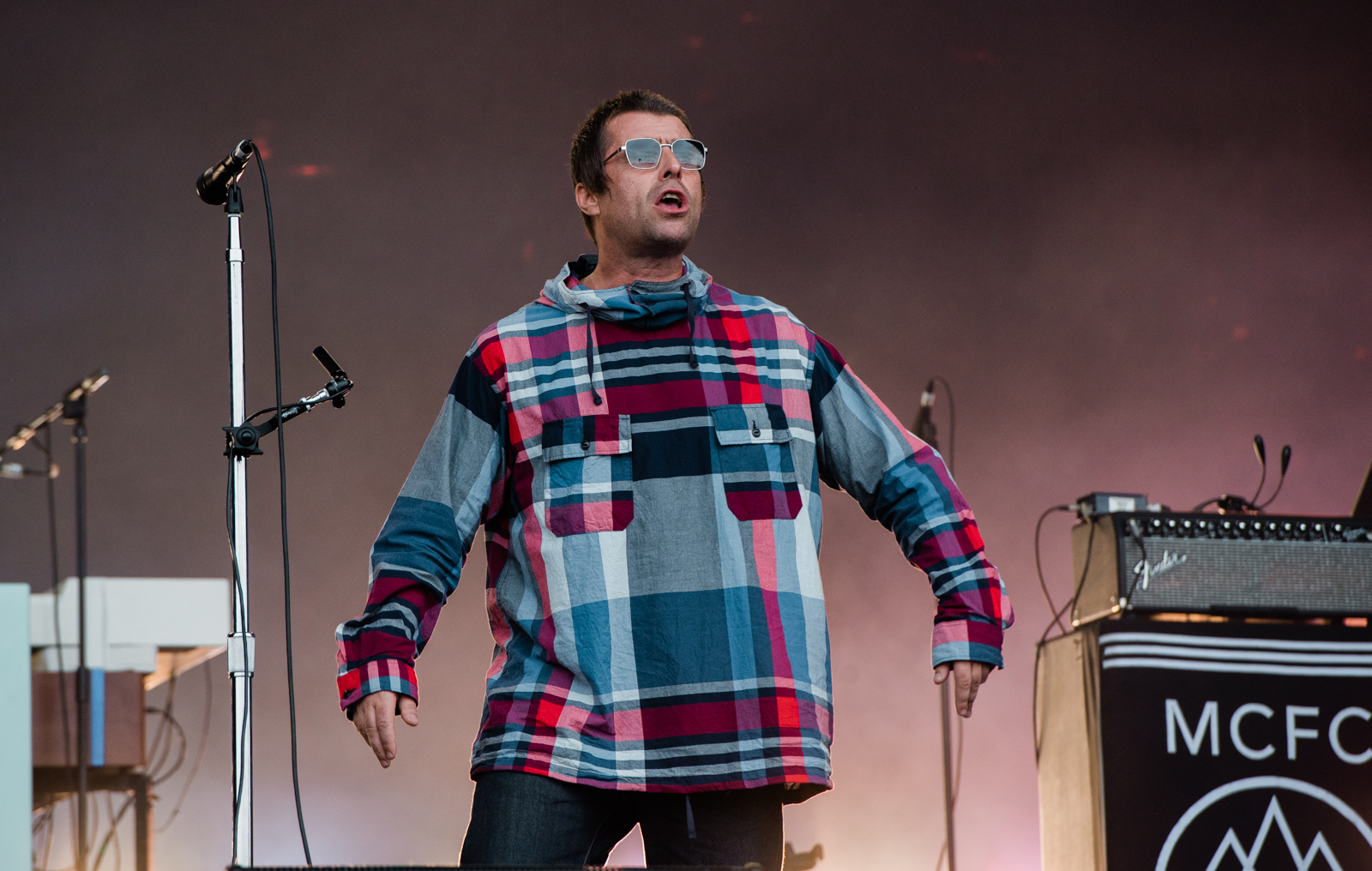
Liam Gallagher was put on this earth for moments like this. His set on the Pyramid Stage on Saturday night after a glorious day of sunshiiiine was so full of ‘Glastonbury moments’ that it’ll be hard for any act this weekend to better him.

He came out of the blocks like Usain Bolt running for a bus. He started the show with a pre-recorded chant of “Championes, championes”, presumably a reference to his beloved Manchester City as well as to his own rejuvenated fortunes in recent years. His stage set featured a banner reading: ‘MCFC Spezial’ as well as his usual ‘Rock ‘N’ Roll’ sign. As the chant faded out, Oasis’ classic opening music blared out over the field as Liam strutted on stage. And nobody struts quite like Liam.

Continue reading at NME.

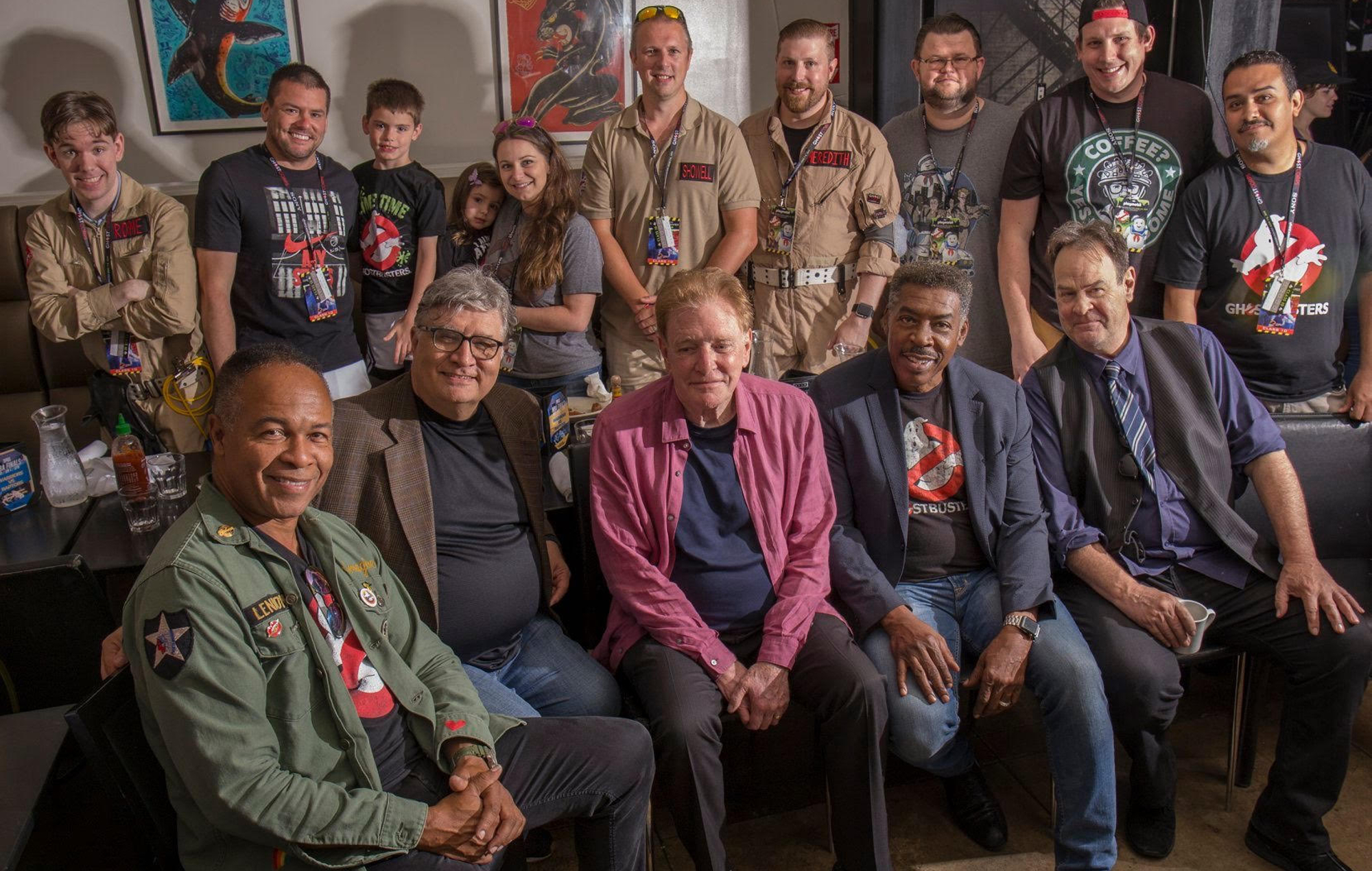
Mass Hysteria: Ghostbusters reunite to celebrate 35th anniversary and set out 2020 vision

ghostbusters-fan-fest
Last Saturday marked the 35th anniversary of the release of Ghostbusters, the most popular and commercially successful movie ever to feature a scene in which one of the lead characters receives a blowjob from a ghost. (Contrary to scurrilous rumour there is absolutely no evidence that Dan Aykroyd getting head from the dead was the origin of the popular theme lyric: “Bustin’ makes me feel good.” The only connection is the one you’re making now, in your own mind, and neither I nor the filmmakers can be held responsible for what goes on in there.)

I’m sure you all celebrated the occasion in your own way, perhaps by eating some Stay Puft marshmallows or a big Twinkie, but I decided to strap on my proton pack and head over to the Sony Pictures lot in Los Angeles to join original Ghostbusters Dan Aykroyd and Ernie Hudson at the Ghostbusters Fan Fest. I have to confess, there was a part of me that felt a little cynical about the whole endeavour. The idea of hosting a sort of ComicCon in miniature based solely on Ghostbusters could have been little more than an exercise in flogging merch and fleecing the very fans who hold the series so dear. I couldn’t help but think of Bill Murray’s line as Peter Venkman in the original 1984 film: “The franchise rights alone will make us rich beyond our wildest dreams!”

Yet as soon as I arrive I realised how wrong I’d been. Most of the costumes – and there were a lot of costumes – on display were homemade, whether it be jumpsuits or the impressively intricate proton packs everyone seemed to have designed for themselves. As if by magic, I felt myself being transported back to my brother’s birthday when we were kids, the one when we used foam-firing proton guns and a ghost trap made out of a shoebox to hunt and eventually capture Casper the Friendly Ghost, in what many critics claim to be “the most ambitious crossover event in history.”

The idea of children wielding proton guns turns out to be central to the plot of the eagerly awaited Ghostbusters 3. Jason Reitman, the director of Juno and Up In The Air, took part in one of the day’s most eagerly awaited panel discussions and revealed all sorts about what we can expect from next year’s film. He told the crowd: “We wanted to make a love letter to the original movie. I did not expect to be making a new Ghostbusters movie. I thought I was going to be this indie dude who made Sundance movies. And then this character came to me. She was a 12 year old girl. I didn’t know who she was or why she popped into my head, but I saw her with a proton pack in her hand. And I wrote this story. This story began to form over many years actually. It started with a girl and all of a sudden it was a family. And eventually I knew this was a movie that I needed to make.”

He confirmed that the 12-year-old girl in question will be played by Mckenna Grace, who recently played the young Carol Danvers in Captain Marvel. Her family will be fleshed out by Stranger Things star (and Calpurnia frontman) Finn Wolfhard, who of course already has some experience in a Ghostbusters uniform, and Gone Girl’s Carrie Coon as their mother. Reitman also promised that the film would blend horror in with the comedy, joking: “I want to scare children.” He’d earlier mentioned that Steven Spielberg had recently told him that he considered the library ghost from the original film as being one of the “Top 10 scares of all time.”

The big question hanging over the film, however, has been the extent to which the cast of the original two films will return. Reitman made a show of attempting to keep his lips sealed, but he did lay a pretty strong hint at their involvement by confirming that Bill Murray, Dan Aykroyd, Ernie Hudson and Sigourney Weaver have all read the script for the film.

The sweetest moment of the day though was when Reitman turned to his father Ivan – director of the original two Ghostbusters films – to sincerely express his “gratitude for telling this story that’s brought people together from all over the world.” Just like that, all my cynicism exploded like a 100-foot tall Marshmallow mascot in the streets of New York. Roll on 2020, I’m excited beyond the capacity for rational thought.

Originally published by NME.

Dr. John, 1941-2019 – A guide for the confusementalised

GettyImages-182302024.jpgGod damn, I wish I’d been in New Orleans last night. That must have been a hell of a good party. Missing someone though.

Not me, obviously. Well, not just me. It was missing Dr. John, who died from a heart attack on Thursday just as the sun was coming up. On Friday night, the streets outside Kermit’s in the Treme were thronged with what looked like thousands of people, gathered to play and sing his music loud and raw as part of the great New Orleans tradition of the Second Line parade. Disappointingly for me I’m gleaning this only from YouTube clips. Although, watching those Second Line videos did make me wonder whether Dr. John will be given the full jazz funeral treatment in due course? He must do, right? I need to see coverage of that exactly like Princess Diana’s, ideally with the same presenters. I want to see professional Royal observers forced to try and interpret not just the pomp and ceremony but also Dr John’s intoxicating blend of voodoo ritual and pure rock’n’roll. Live on two different channels so I can pick the best commentators.

Continue reading at NME.

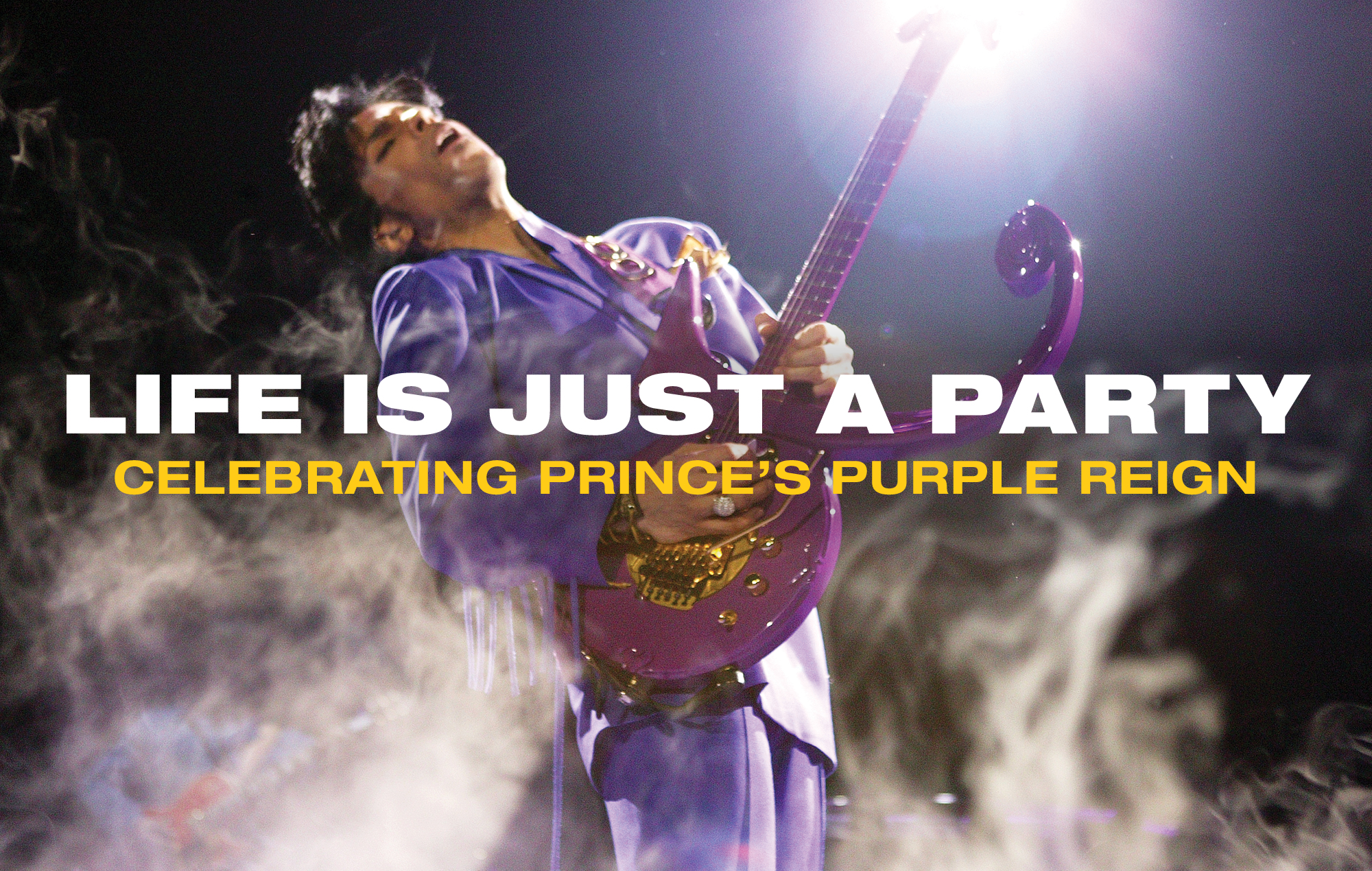
Life Is Just A Party: Celebrating Prince’s purple reign

Prince-purple-reign

In 1979, Earth, Wind and Fire’s manager Bob Cavallo travelled to Anaheim, California to see a young artist who’d approached him about the possibility of working together. Cavallo had with him his wife and 12 year-old daughter, so he was somewhat taken aback when the performer came onstage wearing a trenchcoat and pantyhose. Every time he span around the coat would lift and open, revealing the G-string he was wearing underneath. After the show, Cavallo made his way backstage. “Well, young man,” he began. “I thought your show was great and your band is great, but I don’t think it’s right for you to go onstage in your underwear.” Prince looked back at him. “Okay,” he said. “Next time, I’ll take it off.”

Cavallo, naturally, signed Prince on the spot and would go on to manage him for the next decade. As well as shepherding the wildly ambitious 1984 film Purple Rain into existence, in 1987 Cavallo also helped Prince build his 65,000 square-foot, $10 million home base Paisley Park in Chanhassen, just outside Minneapolis. Prince had gotten the idea when shooting pick-ups for Purple Rain at Earth, Wind and Fire’s own studio, The Complex. “Whenever he wanted something, he just pretty much told me I was doing it,” remembers Cavallo, sat inside Paisley Park’s own soundstage as part of Celebration 2019, a gathering of thousands of the world’s purplest Prince fans at their own, personal Mecca to mark the third anniversary of their hero’s death.

Continue reading at NME.

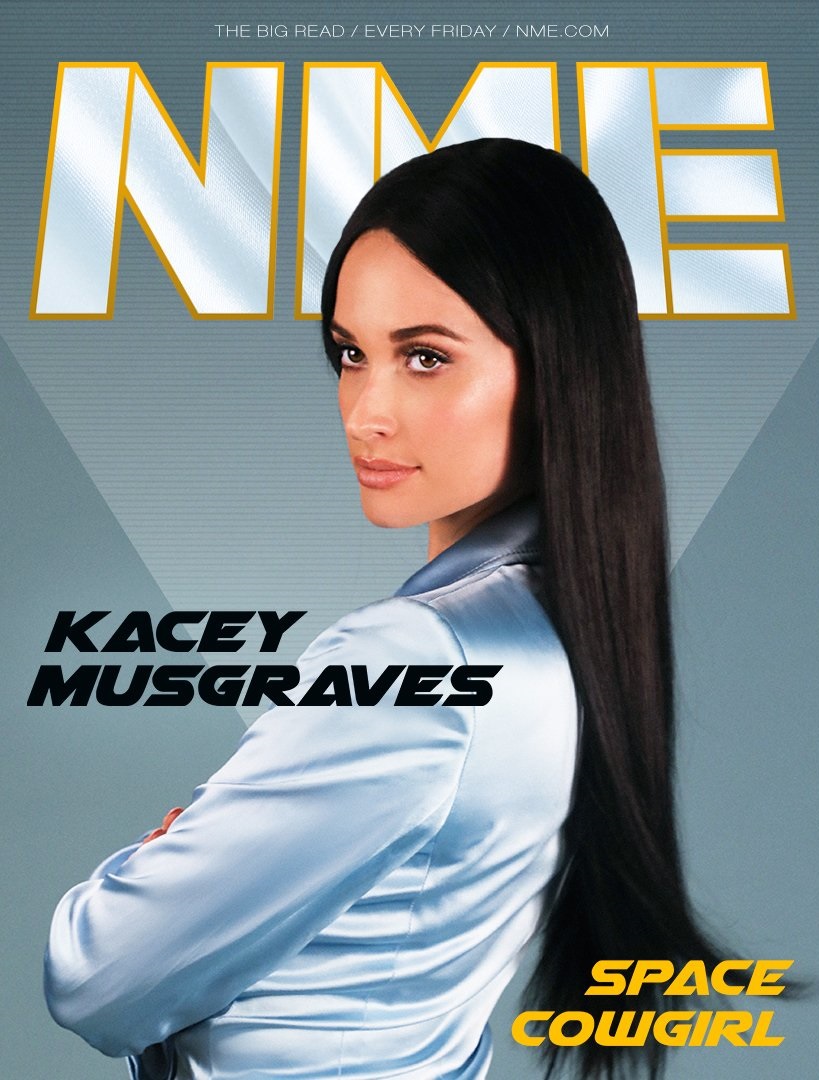
Kacey Musgraves: Space Cowgirl

kacey-musgraves-nme

The sun is going down on the first Friday of Coachella 2019 and Kacey Musgraves is onstage in front of an outlandishly oversized disco ball attempting to introduce the spirit of country music to California’s hipsters. She is doing this via the medium of call-and-response. “Let’s see if Cali can bring the yee-haw,” she says, approaching the front of the stage. “When I say ‘yee’ you say ‘haw’… ‘Yee!’” The crowd responds with the appropriate: “Haw!” She goes again: “When I say ‘yee’ you say ‘haw’,” except this time she points the mic towards the crowd in silence. “Haw!” shout the crowd, falling right into Musgraves’ trap. She grins as she pulls the mic back to her mouth: “I didn’t say fucking yee!”

It’s a moment that captures Musgraves’ playful sense of humour, as well as her ability to teasingly win over any crowd she finds herself playing to. A few hours earlier, sitting in a hotel in Palm Springs while a stylist takes a blowdryer to her wet hair, she points out that her spot on Coachella’s main stage couldn’t be more serendipitous. “We have a slot during the literal golden hour,” she says, brimming with delight.

Continue reading at NME.

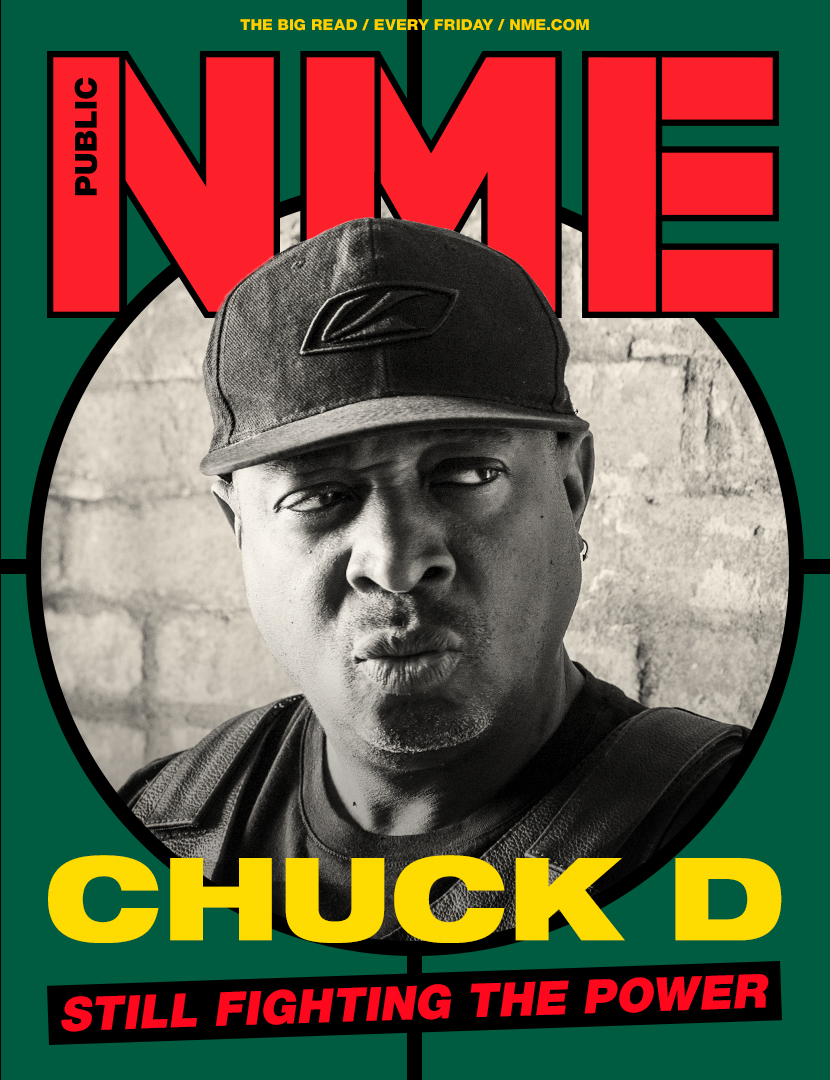
Chuck D: Still Fighting The Power

chuckd

From the outside, the house looks perfectly ordinary. A three-bedroom suburban family home built in the mid-60s, it sits up on a hillside overlooking the city of Ventura. On a clear day, like today, you can glimpse the Californian coastline and the ocean beyond. Look again at the house and you might notice that above the garage a string of fairy lights have been pinned up in the shape of the CND logo, the internationally recognised symbol of peace and political activism. That’s the only clue that this is the house where Chuck D lives.

The Public Enemy leader appears before I even get to the front door. He’s dressed all in black except for a dark green military cap with a pair of wraparound shades balanced above the brim. He lives here in Ventura because his wife, Professor Gaye Theresa Johnson, teaches at the Department of Black Studies at the nearby University of California, Santa Barbara. I also get the impression he enjoys the relative seclusion. A veteran of a staggering 112 tours of duty, he’s currently preparing to embark on his 113th: the aptly-named ‘Gods of Rap’ tour, where he’ll join Wu-Tang Clan and De La Soul for shows in London, Manchester and Glasgow.

Continue reading at NME.

Mac DeMarco: Even Cowboys Get The Blues

mac-coverSo there’s this tree in the yard behind Mac DeMarco’s house in Los Angeles. It feels good sitting in the shade beneath it, whiling away an afternoon listening to records, looking up at the light coming through the pale green leaves and smelling the faint scent of citrus. It’s a pomelo tree, Mac says. I’m not exactly sure what a pomelo is, but judging by the lumpy yellow fruit hanging from the branches I’d guess that a pomelo is a sort of shitty grapefruit.

Across from the shitty grapefruit tree is a swimming pool, impossibly blue in the bright sun on this cloudless Californian afternoon. Moving gently across the surface in the breeze is an inflatable killer whale, floating belly up.

Next to the pool is Mac’s studio, a separate building behind his house. Inside is piled high with all manner of instruments and vintage recording gear. Next to the door there’s a pennant with a picture of a moose on it and the words ‘EDMONTON ALTA’, a memento from the Canadian city where Mac grew up and first started making music. A lot has changed since then. A lot hasn’t. Even though he now has this space, the studio still feels like a bedroom.

There’s a dark green flag with a white peace sign on it hung behind the desk, and there are various bits of Simpsons merchandise scattered around as decoration. In a rack near the door sits the copy of Playboy with Marge on the cover. On the desk there are two empty bottles of champagne, two empty beer cans, three empty water cans and three empty packs of Marlboro Reds. There are more empty cans and cigarette packs on a low table in front of a sofa on the other side of the room, detritus from last night’s impromptu recording session with a few friends. When he first cracks the door open, Mac apologises that the place “smells like a body”. He is not wrong.

Back outside underneath the tree is a glass table covered in blossom and an ashtray filled with a miniature Everest of cigarette butts. Mac is sat there now, his back to the tree, drinking coffee and talking about the life he and his girlfriend Kiera have made for themselves since moving here from New York. He says they rarely leave the property. Kiera makes bread and is learning to teach pilates. Mac makes his music. Together they look after the cat, Pickles, who has been here longer than they have.

“I think he was born under the house and has lived in this backyard his entire life,” says Mac. “We started putting food out for him about a year ago. He would come up, eat, see us and fuck off. Then later we could sit with him while he ate. Then maybe we could give him a little touch. Then we moved the food bowl in and he would eat inside. Now, that puss is sleeping in the fucking bed with us every night.” He smiles his gap-toothed smile. “Good kitty.”

Mac seems content to take things slow these days, coaxing a measure of happiness into his life like that feral cat. His new album, ‘Here Comes The Cowboy’, came the same way: slowly at first. Mac himself calls it “kind of a weird one.” There are simple little songs with just one or two repeated lyrics, there are Sly Stone-sounding funk jams and there are straight-up declarations of love for Kiera. There aren’t too many radio-friendly feel good hits of the summer. “It’s like: festival record? No no no,” shrugs Mac. “It’s slower and softer.”

In part this is a reflection of his life, which now seems a far cry from the wild and crazy stories that swirled around McBriare Samuel Lanyon DeMarco when the world first started paying attention to his antics. There was one tale from the early days, about sticking a pair of drumsticks up his ass midway through a drunken show while U2’s ‘Beautiful Day’ hit a crescendo, that followed him around for years, proving the old adage true: write as many songs and play as many shows as you want, but stick just one pair of drumsticks up your ass and they’ll never let you forget it. Still, times change.

“I’m living a pretty domesticated existence,” says Mac, gesturing around. “We have a house, I’ve been with my girlfriend for a long time… it’s not like we have a routine or anything but things are comfortable. It feels like settling down. I have way too much gear now to be able to move to another city at the drop of a pin. I think my head is just in a different space than it’s ever been in, because I’ve travelled all over the world, met all kinds of different people and had different experiences and now I’m navigating that and figuring out: ‘Where do I belong?’ ‘What is this shit?’”

Those are the sort of questions that define the human experience. We’re all trying to figure that shit out every day, making things up as we go along and desperately laying tracks in front of the train even though we’re shovelling coal into the engine at the same time. What’s different about Mac is that he’s had to do a lot of that figuring out in public.

When he first arrived in London to play his first ever UK show at Birthdays in Stoke Newington in December 2012 he was 22-years-old and had just finished touring the USA by car, doing all the driving himself. Hardly anyone had come to see him. “Chicago was fine and LA was fine,” he remembers now, “But for the most part we were playing to no-one in the middle of nowhere.”

Though he didn’t know it then, everything was about to change. The Birthdays show was sold out, and then so was the whole tour. “We were like: ‘What happened?’” he remembers. “I think it was that ‘2’ came out and people gave it good reviews, but I found it really bizarre to see the power of that. It was like: here’s the record, here’s the hype, then here’s the people. I couldn’t believe it was so immediate.”

Foreshadowing the years of hard-partying touring that was to come, when I first met Mac in Montreal just before that first London show he told me that he’d heard good things about playing in Europe: “People have been telling me that a lot of times they’ll give you a whole bunch of beer in the green room and you can take it afterwards,” he said, sounding as if he was describing a vision of paradise he’d seen in a fever dream. “That sounds good to me!”

Mac lets out a long, knowing laugh when I remind him of this. “You know, it’s funny. First tours in the United States, maybe you get one free drink at the bar,” he explains. “The promoter is like: ‘Get the fuck out when you’re done.’ In Europe they really treat you nice. They give you beer and then they’re like: ‘We made you a lasagna.’ Oh my God! You’re kidding me? That first European tour it was like a homemade lasagna every night.”

Mac blew up fast. In just under two years he went from playing that first show at Birthdays to 250 people to Kentish Town Forum to 2,300 people. He quickly built a reputation for having the best live show in town, with a wild edge and an unpredictable comic streak. I remember he closed that Forum show by playing the theme from Top Gun over and over again for something like 20 minutes. It was one of those perfect jokes that starts off funny, then isn’t funny at all, then gets increasingly hilarious the longer it goes on.

By that point, Mac was more than just a cult artist – but he did have a cult following. The Cult of Mac. “That was a trip,” he remembers. “I used to have a lot of kids wearing the exact same kit as me for a little while. Maybe there still are, but I’m not out there so much anymore. That was wild, but people go through phases. I think I’m already in the phase where it’s like: ‘Oh, he’s so played out. He’s not cool anymore’. That’s inherent, but it’s funny to watch. It’s fine with me.”

As the years have gone by and the venues he plays have continued to increase in size, Mac has responded not by becoming more outrageous but by mellowing out. It’s as if, to paraphrase Homer Simpson, he’s learned to enjoy not just the glorious highs and the terrifying lows but also the creamy middles. “It’s not like I’m pushing back on purpose,” says Mac, “but even when the shows get bigger, or maybe it’s as I get older, I feel like: ‘There’s a giant stage? A giant crowd? Then let’s play really slow and really quiet. For me musically right now that’s something different. We never did that, so it’s something new for me.”

Which brings us back to that “slower and softer” new album ‘Here Comes The Cowboy’, which – for the record – is not about cowboys at all. “I just use ‘cowboy’ as slang with friends,” Mac sort-of clarifies. “Like when you say: ‘Hey cowboy!’, but where I grew up cowboys were a thing. There was the [Calgary] Stampede, and people did cowboy activities, and there were themed-bars. For the most part, those zones were geared towards people that I didn’t really want to interface with. Jocks who wanted to call me a profanity and kick my ass. So for a long time it had a very negative connotation for me.”

Mac enjoys toying with and then confounding expectations, so it should be no surprise that the titular cowboy really signifies nothing. “For me, it’s funny and interesting to call something a cowboy record because immediately people jump to connotations,” he says. “There are a lot of things that come with that word, but the record is not a country record. It’s not really a cowboy record at all. I don’t know where that song ‘Here Comes The Cowboy’ comes from but I like it because I don’t know how it makes me feel. Is it funny? Is it strange and jarring? Maybe it’s both, somewhere in the middle. Who is this cowboy? Where the fuck is he coming from? What is he doing? I love that!”

That same instinct to confound lies behind the strange lizard-faced version of Mac who appears in the video for first single ‘Nobody’. If you’re not sure how that unsettling prosthetic mask he wears makes you feel then that’s exactly the point. “You ask yourself: ‘What is this?’, and that’s the kind of thing that interests me,” he says. “I’m just trying to create…” he puts on a mocking voice “…the content that I’d like to engage with.”

One through line in Mac’s musical life has been his insistence on recording everything himself while playing almost all the instruments, like a chain-smoking slacker one-man-band, but without the accordion he plays with his foot. He’s always done things that way. “It was a good trick for a while,” he says. “People are like: ‘You played all the instruments?’ And you’re like: ‘Well, none of them are played that well, but yes.’”

Now it’s more than just a trick or an aesthetic choice. He’s come too far to change. For this record he had touring keyboardist Alec Meen lay down some music, but something was never quite the same. “It only felt right if I played it with no metronome, just the way that it works for my hands to play it,” says Mac. “He played it perfectly and straight a million times, and I’d be like: ‘But that’s not how the song sounds’. I have a problem with needing things to be perfectly shitty.”

One of the best tracks on the new record is called ‘Finally Alone’. As the title suggests, it’s a song about seeking solitude even when you’re not sure that’s what you want. “It’s kind of a cute-sounding song, so when Alec looked at the project title he was like: ‘This song is called ‘Finally Alone’? What the fuck?’ I’ve always loved that juxtaposition of cute-sounding music and then lyrics about isolation. It’s inner turmoil. I think the theme of this record goes through that a lot. It’s about not knowing what you want and vibing on it.”

Mac’s own love of isolating himself here in his house and studio – he says he sends “almost zero” percent of his life online – got him into internet faux-outrage trouble the day the record was announced. A brief Twitter cloudburst spat drizzle at the suggestion his album ‘Here Comes The Cowboy’, with lead single ‘Nobody’, was a slight against Mitski’s similarly-titled album ‘Be The Cowboy’, with lead single ‘Nobody’. This came as a “huge surprise” to Mac, because he’d never heard of it. “Truthfully told, I’m very, very bad at keeping up with contemporary music,” he says. “I listen to music from Final Fantasy video games and The Beatles. That’s about it.”

Mac’s self-imposed period of solitude will soon be coming to an end when he returns to his first passion, playing live shows. “I still love to do it,” he says. “I think the last couple of tours of this year I was pretty burnt. Things inherently get stale after a while, but we find ways to spice it up or do something incredibly stupid onstage for an hour. It’ll be exciting to have new music.”

One of those shows will be headlining his very own mini-festival in June at Dreamland in Margate, which has a capacity of 15,000. A real long way from Birthdays. He’ll be joined by a hand-picked line-up that also includes Aldous Harding, Yellow Days, Tirzah, Thurston Moore, Amyl and The Sniffers, Girl Ray, Kirin J Callinan, and Blueprint Blue. “It should be cool!,” he says. “We have a lot of homies who are going to play.” He puts on a voice that sounds like Springsteen when he’s covering Suicide: “Dreamland, baby. It’ll be chill. It’ll be tight. Let’s rock’n’roll.”

Our time under the shady tree is interrupted because it’s time for Mac to go and have his photo taken. Mac’s first NME cover. He drives us to the location, a dreamy rural cabin that somehow exists within Los Angeles. The owner issues him with a stainless steel bucket to use as an ashtray, and Mac faithfully carries it from location to location. When he’s done we go downtown because there’s this great ramen place he’s just remembered about, and then we buy some beers and head back to the yard.

When we arrive, Andy White, who plays guitar in Mac’s band, is already there. He’s from Florida but is staying with Mac while they rehearse for the next tour. A brief aside about Andy White: He’s one of the most beautiful men I’ve ever met, with long blonde hair in pigtails and the sort of moustache that hasn’t been fashionable since 1979. Every time I’ve met him he’s been incredibly nice, he’s currently preparing to run the LA Marathon, and when I ask him where he’s been all day he tells me he’s been at the library reading about economic history. I don’t understand Andy White even a little bit but I think I’d like to be him when I grow up.

When the sun goes down we go to see Mac’s friend Eyedress play a show at a once-hip Silver Lake club called Tenants of the Trees. Eyedress is amazing – weird and wild and punk – but the crowd is kinda douchey so when the show is over Mac invites us all back to the yard. Somebody builds a fire. Mac orders an ungodly amount of pizza. The studio is opened and the fruit of last night’s recording session is played loud. If this is Mac figuring shit out, it seems like he’s doing pretty well. He’s happy. It’s late now, so that’s where we leave him. The camera pulls back endlessly into the sky and we see the final shot: Mac, fire burning, surrounded by good friends (did I mention Andy White?) and far too much pizza, finding contentment under the branches of his shitty grapefruit tree.

Originally published by NME, 3 May 2019.

Robyn kicks off tour with heavenly dance party in Hollywood

AP-1YHB26HR51W11_newsThere’s a moment in the Robyn show. You know, one of those you giddily recount and discuss and dissect later in the night, looking at each other with smiling eyes; the sort you just have to post to Instagram even though your own voice is obnoxiously loud on the audio. The sort that reminds you why we bother with all this in the first place.

It comes, perhaps predictably, during ‘Dancing On My Own’, a song which could make as good a case as any for being the greatest pop single released in any of our lifetimes. Specifically, it comes a minute in, just after Robyn sings: “But I just gotta see it for myself…” and then the music cuts out and she stops singing, but none of us has realised yet so we’re all still singing the chorus at the top of our lungs, a chorus about being alone, and it’s just us singing now, the crowd, but somehow it sounds skin-tingling because we’re a choir, although we didn’t mean to be, and we’re not sure how long we should keep going for, because part of us thinks the music will cut back in after a line or two, but it doesn’t, so we sing the whole chorus, and Robyn swoons onstage, and we’re not alone, we’re all together, all of us, joined in one voice in that perfect song in this perfect moment.

Continue reading at NME.

Oscars 2019: Why shouldn’t A Star Is Born win Best Picture? Because it’s basically The Ryan Adams Story

a-star-is-born-ryan-adams-1220x775An established male rock star stumbles across a talented younger female singer. He recognises that she’s a great songwriter and tells her so, inviting her to collaborate and then tour with him. Their relationship swiftly becomes sexual. When her talent becomes apparent to others, he reacts by becoming jealous and controlling. Under the influence of drugs and alcohol, his behaviour becomes increasingly erratic and disturbing.

Pop quiz: Is this (A) a brief summary of just some of the allegations against Ryan Adams, reported earlier this month by the New York Times? (B) The plot of ‘A Star Is Born’, nominated for Best Picture at this Sunday’s Oscars? (C) Both. It’s both, isn’t it? This is a rhetorical device, not a real quiz.

Continue reading at NME.

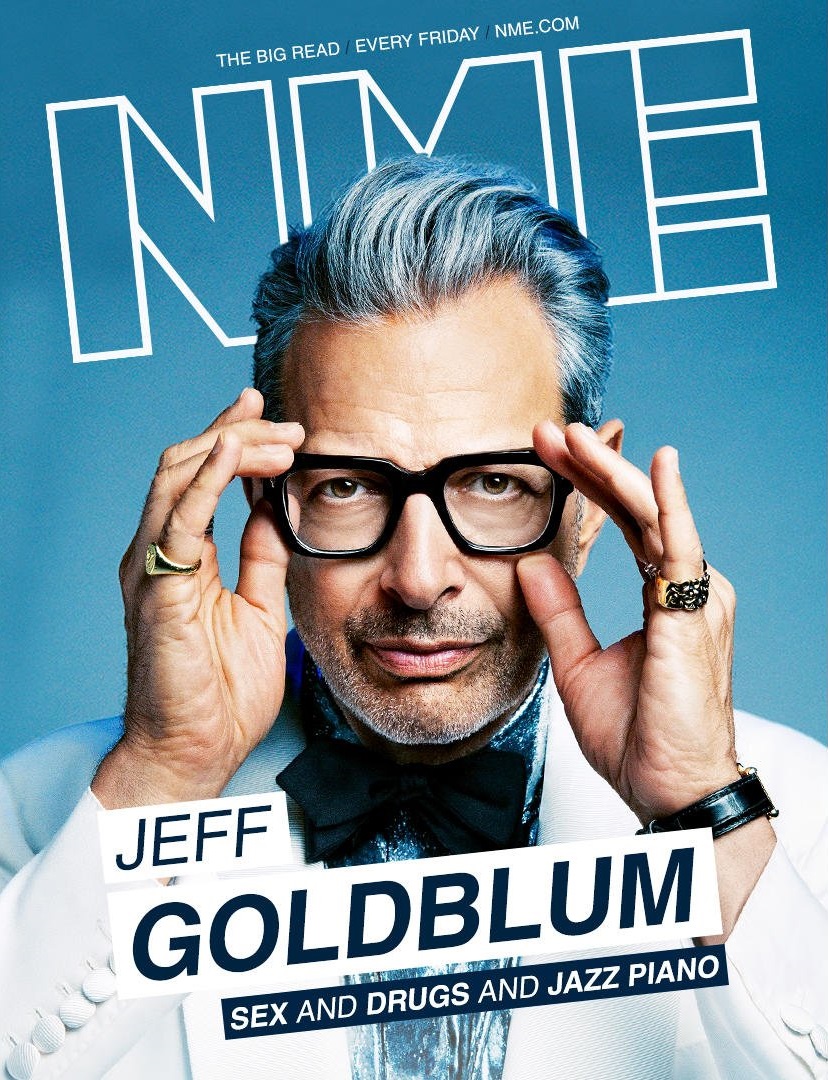
Jeff Goldblum: Sex and Drugs and Jazz Piano

jeff-goldblum-nme-cover

sdrJeff Goldblum lost his virginity the same night he made his professional stage debut. It was Tuesday July 27, 1971, and he was a gangly 18-year-old from Pittsburgh who had moved to New York the previous summer to follow his dream of becoming an actor. He was studying at the Neighborhood Playhouse under the great acting coach Sanford Meisner, and had managed to get a part in the chorus of a new musical adaptation of Two Gentlemen of Verona. Opening night at the Delacorte Theater in Central Park was a success, and afterwards some of the cast and crew ended up at dinner together.

“There was this woman who seemed exotically older to me,” recalls Goldblum, his eyes sparkling as we wait for our breakfast outside in the patio section of the Chateau Marmont. “I think she was in her late 20s. Nine or 10 years older than me. She worked in the costume department. She’d been married and was now separated, living in a loft in some place like Tribeca or SoHo. This was all exotic to me. We’d flirted a little bit. After the meal she said: ‘Let’s share a cab home.’ In the cab there was some, uh, um… kissing. She said: ‘Come to my house.’ We went there, and, well, I won’t go into all the details but that’s where I lost my virginity.”

A momentous evening, by anybody’s standards. I ask him if he felt like a different person the next day.

“Another mosaic piece was laid into the final thing, certainly,” he says. “I told her, just before we did it. I said: ‘I’ve gotta tell you, I’ve never done this before.’ She seemed to like that. She said: ‘Really? Really?’”

Continue reading at NME.

She’ll Take You There

Mavis-Staples-by-Chris-StrongWhy is NME writing about Mavis Staples in 2018? That’s a reasonable question, and it deserves an honest answer. We’ll get into that in a moment, but first I should say: Don’t worry, she’s not dead. Mavis Staples is alive, and despite being only a year shy of her 80th birthday she’s in such rude health that when she played the Ford Amphitheatre in Los Angeles this weekend her performance was alternately spellbinding and ass-kicking. Her voice sounded strong and pure and righteous, and she moved exuberantly around the stage and cracked jokes between songs. There is no sound on earth more joyful than Mavis Staples singing, except maybe Mavis Staples laughing.
Continue reading at NME.

In search of Sub Pop’s soul

nirvana

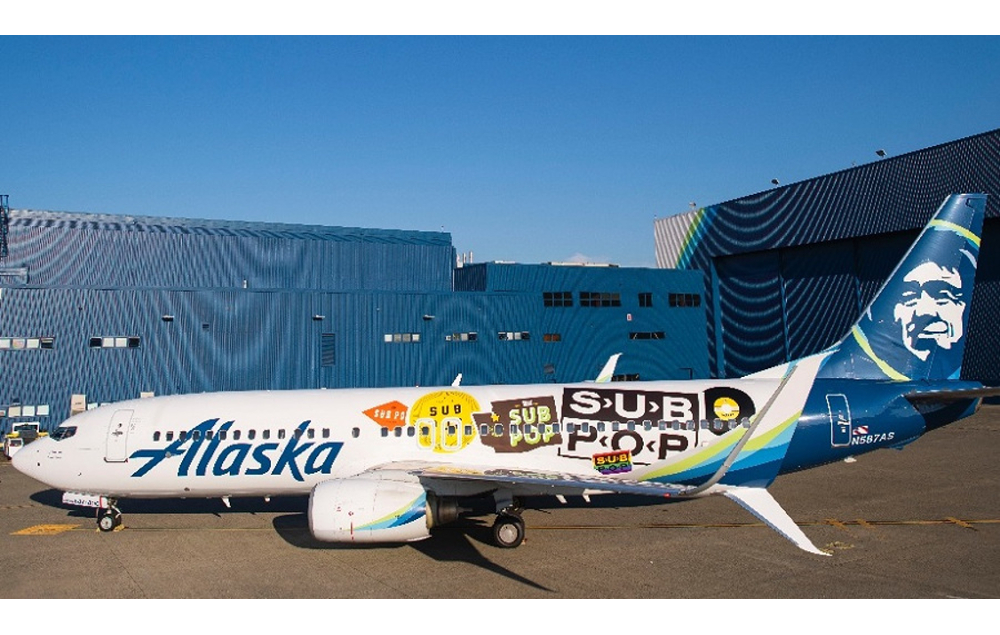
In 1988, underground radio DJ Jonathan Poneman and fanzine editor Bruce Pavitt quit their day jobs to dedicate themselves full-time to running their independent record label. 30 years later, I’m stood in a departure terminal at LAX looking across the tarmac at the Alaska Airlines Boeing 737-800 which will take me to Seattle. It’s covered in what looks like huge road case stickers that all read: ‘SUB POP’.

I have questions. How do you go from making a few scribbled notes in Seattle’s Uptown Espresso coffee shop to becoming one of the world’s most famous record labels, with your name painted down a plane’s fuselage? What was it about the remote Pacific North West that allowed it to incubate grunge, the sound that would change the world? And most pressingly: Does this mean they’ll let me play ‘God’s Balls’ by Tad over the tannoy?

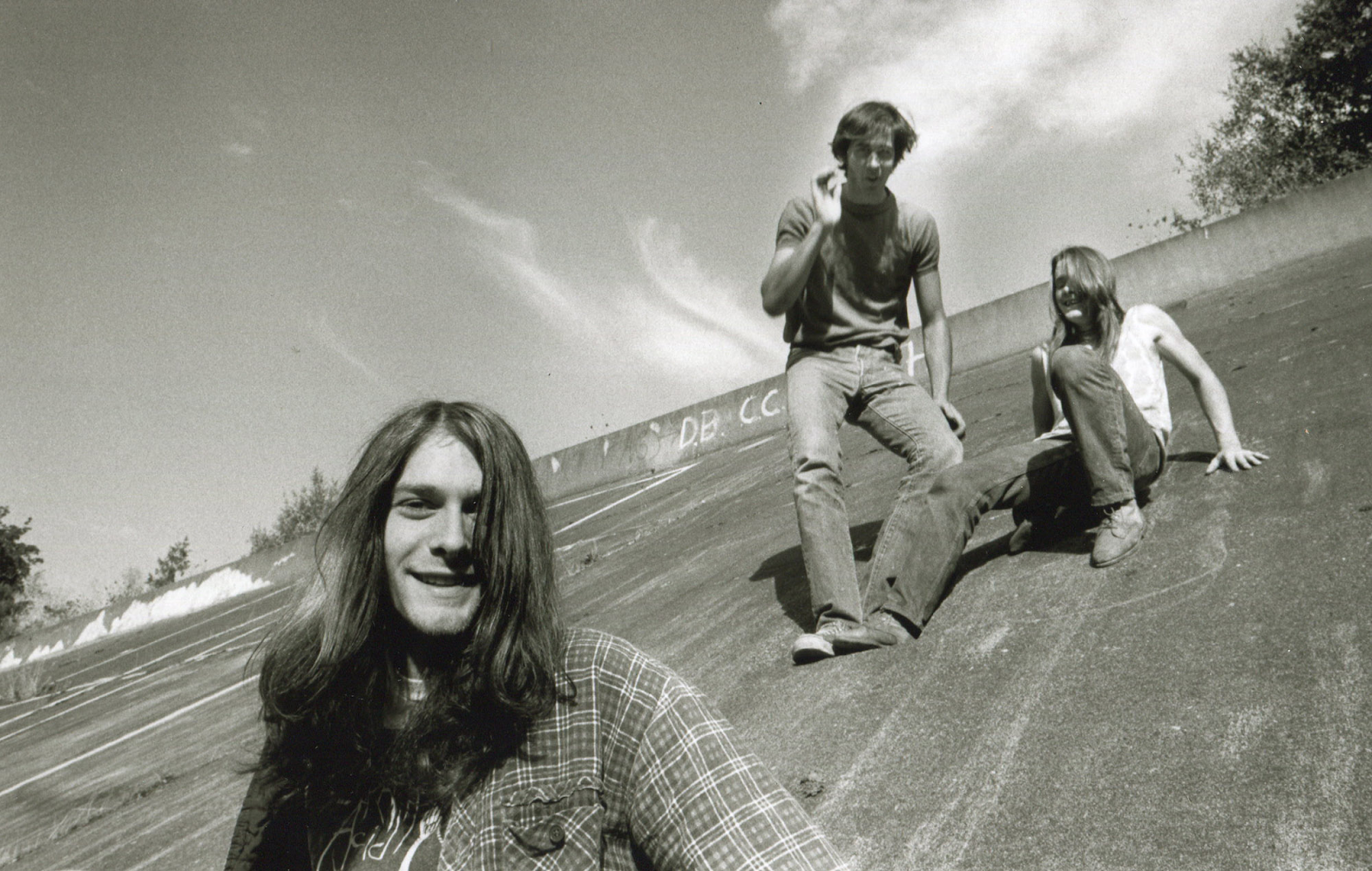
The answer to one of those questions is: ‘No’. The rest will take some explaining.sub-pop-planeLet’s get right to the heart of this thing. Let’s ask somebody who was there. About 24 hours ago I was sitting in the baking LA heat listening to Mark Lanegan tell me – in that voice that sounds like gravel in a gale – about the first time he ever heard Sub Pop’s most famous signing. It was the tail end of the 80s and he was still living in Ellensburg, a small town smack in the middle of Washington state, and singing with Screaming Trees, when he got a phone call from his friend Dylan Carlson.
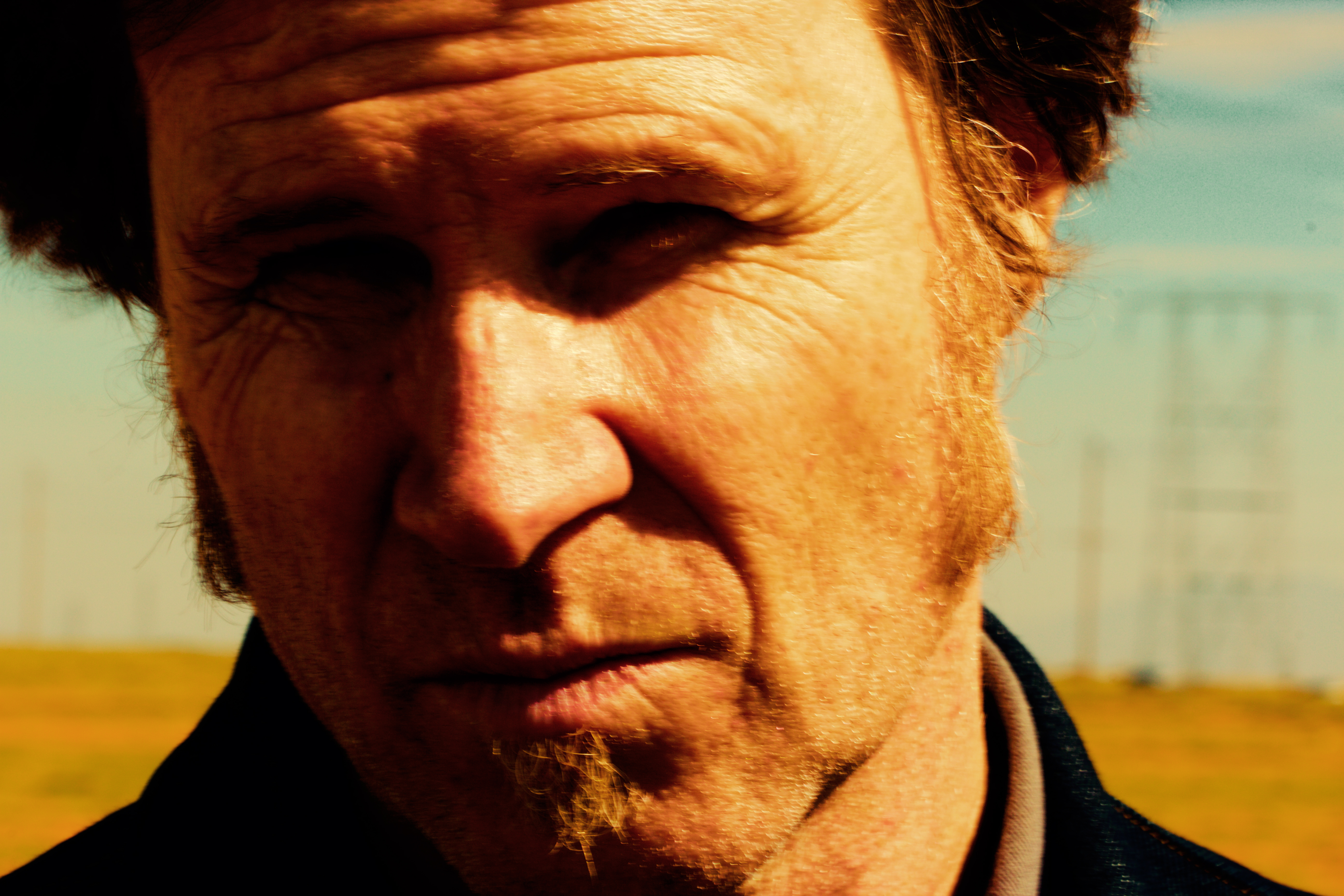

“He said: ‘Hey, my friend is playing a show at the Ellensburg Library and he’s a big fan of your music.’” remembers Lanegan. “‘Would you go down and watch him? Because there’s probably not going to be anybody there and it would be a thrill for him if you went.’ I went down there. When they started playing, I realised that I was hearing one of the best bands I had ever heard… and in the fuckin’ Ellensburg Library no less. It was Nirvana that were playing, and it was Kurt that he wanted me to meet.”

From that day on, Lanegan and Cobain became close friends. They shared a love of old blues records, not to mention heavy duty narcotics. Soon they were cooking up a half-baked plan to record an EP of Leadbelly covers together. Naturally, Sub Pop – the newborn label who had snapped up Nirvana for an initial outlay of just 600 bucks – were keen to put it out, but when it failed to materialise it was co-founder Poneman who rang Lanegan and asked if he wanted to make a solo record instead.

“I distinctly remember that the offer was for $13,000 for the first record,” says Lanegan. “Up until that point, my contribution to Screaming Trees songwriting basically amounted to changing some of the more egregious lyrics written by the guitar player to make them less embarrassing. I had never picked up a guitar or anything, but I knew that the records we’d made were for a strict $1,000 budget. I thought I could make a record for a thousand dollars and pocket the other twelve.”

IMG_6179.jpg

So Lanegan taught himself to write, and then wrote ‘The Winding Sheet’. He included the sole song salvaged from the ill-fated Leadbelly sessions: a version of ‘Where Did You Sleep Last Night?’, featuring both Cobain and Krist Novoselic. The album was a departure for both Lanegan and Sub Pop, but it turned into a success that would heavily influence the sound of Nirvana’s own famous MTV Unplugged performance. This story illustrates two important facts about Sub Pop: They were willing to gamble, but they knew their shit.

“I thought it was kind of weird because everything else on the label was hard rock, but they were into the idea and it obviously panned out for me. I owe him one!” says Lanegan, acknowledging the confidence Poneman showed in him. While he says his own relationship with them was “tempestuous” (they dropped him midway through the recording of follow-up, ‘Whiskey For The Holy Ghost’, only to later resign him and give him the money to finish it), Lanegan reserves high praise for the label.

“What really changed shit was Nirvana and Sub Pop,” he says. “Sub Pop had a genius for marketing and the way they promoted the label, with Nirvana of course being the shining star in their universe. In terms of Seattle at that time, I don’t think it had ever really happened before where a small city had so many bands going to the top of the Billboard charts. Soundgarden. Alice In Chains. Pearl Jam still play stadiums like they’re the Grateful Dead. It was an unprecedented phenomenon.”

I tell him I’m about to head north to visit the city for myself. ”Shit, man. I haven’t looked at the weather report but you might want to take an umbrella,” he drawls. I tell him I’ll be used to it, coming from Britain. “It’s uber-British,” he says. “People say Manchester is like Seattle. Bullshit. Seattle is like Manchester x100 weather-wise. It’s got the shittiest weather of any city in the world, hands down.”

SUBPOP-PICTURE

“A lot is said about the weather,” says Jonathan Poneman, sat in his office at Sub Pop HQ in downtown Seattle. Outside in the corridors are various bits of memorabilia, like a framed copy of a restraining order that K Records’ Calvin Johnson took out against Courtney Love, and a bit of wall ripped from that previous office that Kurt Cobain scrawled his address on. Poneman doesn’t know if it was the climate that made Seattle creative, although he does posit an alternative explanation: “I’ve heard it said that there are more books read per capita in Seattle than in any other major American metropolitan city,” he says. (This is true, at least according to Amazon, who happen to now be one of the city’s main employers.) “Although…” Poneman continues. “That may not be saying all that much at this point.”

While it’s easy to look back with hindsight and see the Seattle scene as fully formed from the get go – Sub Pop would put out debut releases by Mudhoney, Soundgarden and Nirvana all within a couple of years – Poneman says the reality was very different. “The thing that was most remarkable about Seattle was how spontaneous everything was,” he says. “There was no premeditation or calculation. We were just thinking about life-changing shows and mind-blowing bands.”

Suddenly, though, the outside world was starting to take notice. By 1992, the New York Times had decided they needed to find out what this grunge thing that was happening was all about. This lead to one of Sub Pop’s most infamous gags – Poneman passed a phone call from a reporter on to Megan Jasper, a mohawked receptionist who’d recently left the label and was by then working at Caroline Records. She promptly supplied the Times with a list of entirely made-up ‘grunge’ lingo which the newspaper of record faithfully printed. A loser was henceforth to be known as a “cob nobbler”. Hanging out was apparently referred to as “swingin’ on the flippity-flop”. Whatever happened to Jasper? She’s now Sub Pop’s CEO, obviously.

“They were doing a huge piece on Seattle. It was the front page of the Style section,” Jasper recalls. “I had had a shitload of coffee, and was just rattling a bunch of bullshit off. I honestly thought at some point we’d just laugh and say: ‘This is ridiculous’. That never happened.”

It’s a funny story, but it also illustrates just how strange, exotic and remote Seattle seemed to outsiders at that time. “You have to imagine that the writers for the New York Times are pretty intelligent people, we would hope,” says Jasper. “But there was this weird, dark corner of the country that so many people knew so little about.”

The years that followed the grunge boom weren’t always plain sailing for Sub Pop. Bruce Pavitt left the company acrimoniously in 1996, saying that he saw too much waste, and money being squandered. At least they managed to keep a sense of humour about it. Ten years ago, at their 20th anniversary, they announced they were celebrating ‘15 years of great music.’ “Every record label has its dark times, and we’re no exception,” says Poneman now. “I’ll leave it up to the discerning listener to decide which five years we were talking about. They weren’t always sequential.”

But Sub Pop weren’t finished yet. In 2001, The Shins’ debut record ‘Oh, Inverted World’ helped usher in a new era of indie. The Postal Service’s one-off 2003 album ‘Give Up’ gave the label an unexpectedly massive hit, their first platinum record since Nirvana’s ‘Bleach’. Fleet Foxes followed before the end of the decade, who in turn begat Father John Misty – now one of the label’s biggest success stories, and part of a genuinely eclectic roster that also includes Beach House, Pissed Jeans, Shabazz Palaces and – at least as far as their musical endeavors go – Rick and Morty.

nirvana_gallery

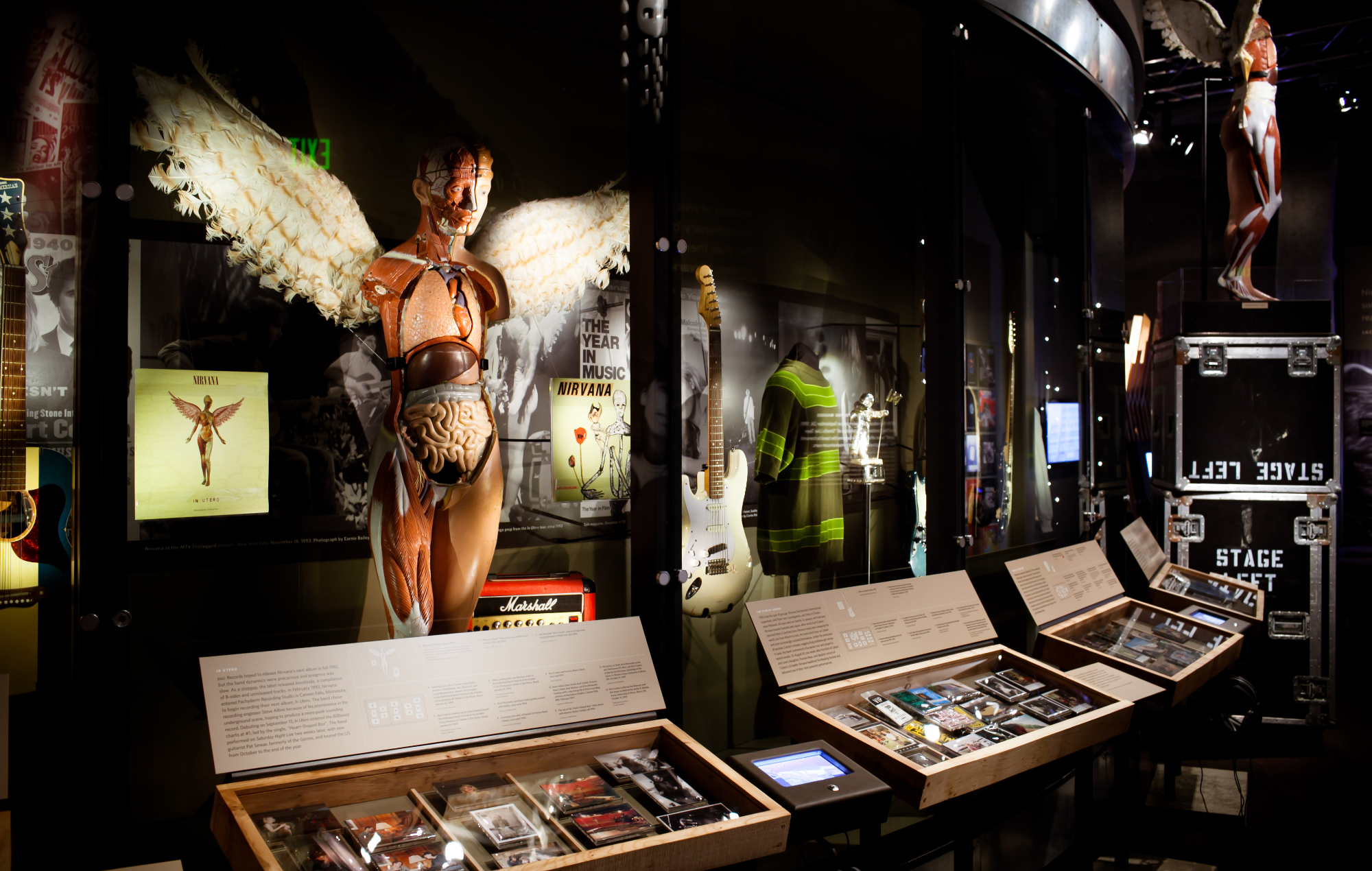
Leaving Sub Pop’s offices on my way to see Afghan Whigs play the label’s showcase beneath Seattle’s iconic Space Needle, I decide to stop off at the nearby Museum of Popular Culture. Inside, there’s a whole exhibition dedicated to Nirvana. Among the collection they have the first demo tape that Nirvana sent to Sub Pop, and the first contract they signed with the label, along with later curios like the original print off of the photo of the baby in the pool from the ‘Nevermind’ cover. It’s inscribed with the memorable line, from Geffen’s art director Robert Fisher: “If anyone has a problem with his dick we can remove it.”

It’s a great exhibition, although for anyone who grew up on Nirvana’s music there’s something odd about seeing that youthful energy literally trapped under perspex. It shouldn’t be strange to see them as an historical band – the 30 years that have gone by since their debut single ‘Love Buzz’ is exactly the same amount of time that separates ‘Love Buzz’ from The Everly Brothers crooning ‘All I Have To Do Is Dream’ – yet somehow it is. Go and put on ‘Bleach’ and tell me it doesn’t still sound vital.

The next morning it’s raining, just as Lanegan prophesied. I catch a ferry from downtown Seattle over to Alki Beach, where Sub Pop’s free birthday festival is taking place, and overhear a couple of young fans onboard.

“I wish Nirvana were still around to play today,” one of them muses.

There’s a widespread general murmur of approval at this thought. Everyone wishes they could have seen Nirvana.

“Then again,” the same fan eventually concludes. “If they were… you know they’d be charging for it.”

Moaning_NifferCalderwood_spf30_CC0A6347

Even with the label’s newest signings, the influence of Kurt Cobain still hangs in the ether. LA three-piece Moaning are one of the festival’s early highlights. Frontman Sean Solomon tells the crowd that at the first show he ever played, a Battle of the Bands, his band played ‘Molly’s Lips’ by The Vaselines in the style of Nirvana’s cover. “Our mics didn’t turn on so it was just the same two chords over and over again,” he recalls. “It was really embarrassing.”

Earlier, he’d told me how Sub Pop had always been the label he’d dreamed of signing with. “Everyone in the band has been friends since we were teenagers, and we’d always joke about getting signed to Sub Pop. It was the label we fantasised about. They were always, in my mind, the label I was supposed to be on.”

While the label have long outgrown the ‘grunge’ tag that they always bristled against anyway, Solomon says there’s still a certain vibe that unites the bands that Sub Pop sign. “I think we all have a sense of independence, and you can tell that the music is untouched,” he says. “A lot of labels get more involved than Sub Pop do. They really allow artists to do their thing, and they don’t interfere. In a lot of different productions it’s difficult to be an auteur, but I feel like the artists on Sub Pop have very clear visions, and I think that’s why so many of their records are my favourites. There’s a sense of authenticity, and I think that makes sense that the ‘grunge’ label continues to put out really authentic-sounding records.”

20180811-mudhoney_jim.bennett_spf30-022

Despite the grey, Manchester x100 drizzle, the rest of the birthday party goes off without a hitch. It’s estimated that 50,000 people show up. Father John Misty, Shabazz Palaces and Beach House all play on the beach. Loma frontwoman Emily Cross not only jumps into the crowd but manages to run out into the sea while the band plays on. Yet somehow the best band of the day end up being Mudhoney, playing some songs that are as old as the label itself. The past isn’t over, as Faulkner said. It isn’t even past.

The next day I take the inevitable pilgrimage to the house where Kurt died. There’s a steady stream of visitors to his memorial bench, seemingly unaware that his old record label had just celebrated an anniversary. Outside the gates of the house, I meet a young guy with long hair and a Nirvana T-shirt on. His name is Justin Huynh, and he’s come from Fort Worth, Texas. He’s 25 – five years younger than Sub Pop. “This was the must-do thing of my life,” he tells me.

There’s a solid wooden gate in front of the house, but he’s determined to get picture so he crouches down and pushes his phone underneath.

“Hi Kurt,” I hear him say. “I love you.”

Originally published by NME.


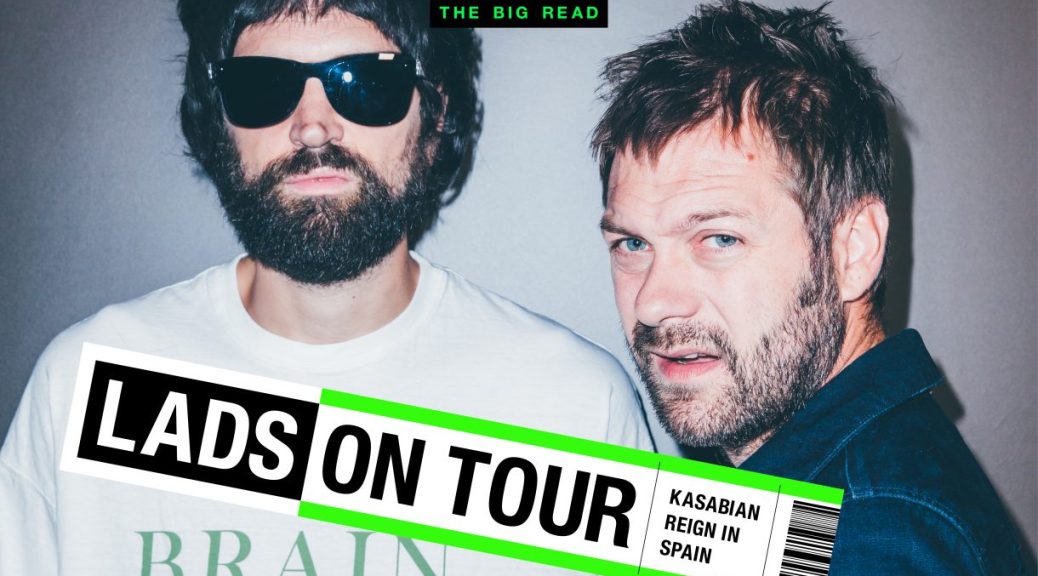
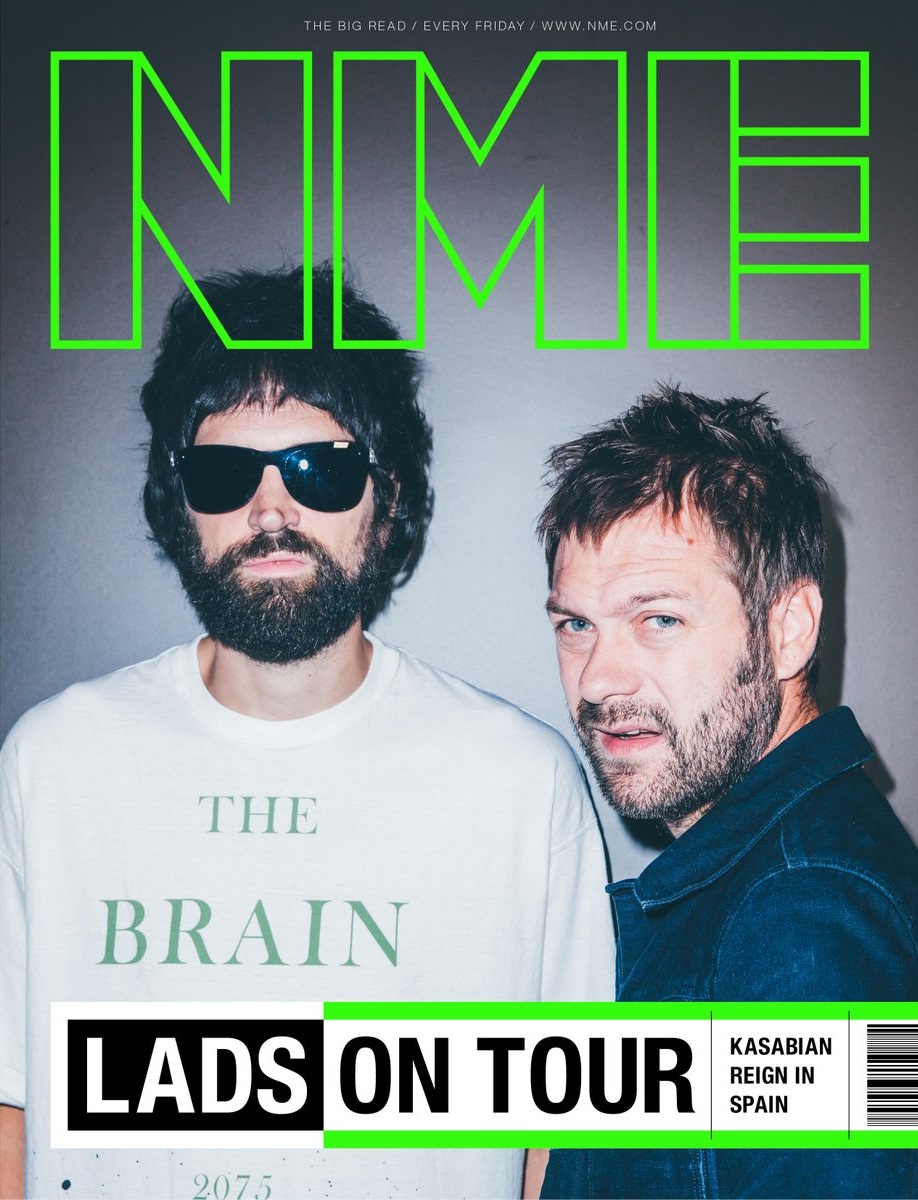
Lads On Tour: Kasabian Reign In Spain

kasabian.cover

It’s the day after England’s emotional, last-gasp defeat to Croatia in the World Cup semi-final and noted football fanatics Kasabian are bouncing back the best way they know how: by playing a huge festival headline slot at Madrid’s mammoth Mad Cool festival.

Backstage, frontman Tom Meighan is sipping a cup of pre-show Yogi Tea that may be helping his voice but is doing nothing to calm his hyperactive personality. He shrugs off last night’s result. “It is what it is, we were never going to win it,” he shrugs. Right now he’s more interested in a bright orange graffiti marker somebody’s left lying around. “I haven’t seen one of these in years!” he cries with glee, grabbing it and setting about tagging every sheet of paper he can find.

Bandmate Serge Pizzorno cuts a more laidback figure. He’s laughing to himself at the length of the seemingly endless guitar solo we can hear emanating from Pearl Jam, who are currently onstage. “He’s shredding out there, isn’t he?” he grins. “The rest of the band must be like…” and he mimes impatiently tapping his watch.

Continue reading at NME.

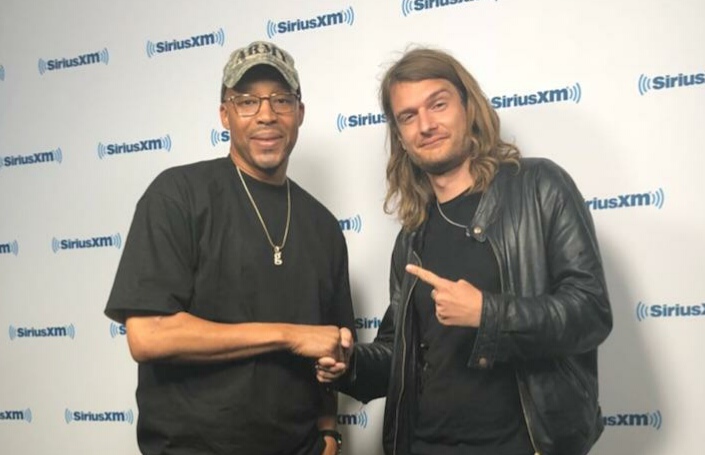
Warren G on G-Funk, making Annie Lennox starstruck and the immortal ‘Regulate’

Warren-G-KEGP

Picture the scene. You’re deep in the sesh with a load of people you don’t really know and somebody asks you to pick the next tune. What do you choose? You need something everybody loves. You need a song any person between the ages of 18 and 39 knows all the words to. You need Warren G. You need Nate Dogg. You need ‘Regulate’.

I’ve been to a lot of parties in my life (yeah, I know. Legend.) and I’d estimate that I’ve heard ‘Regulate’ played loud and late more often than anything else. It’s rivaled only by Biggie’s ‘Juicy’ for its sheer ubiquity, and only by the Fresh Prince theme for the likelihood of someone being able to recite all the lyrics off the top of their head while mashed. Altogether now: ‘It was a clear black night, a clear white moon…’

What I’m saying is, ‘Regulate’ is a seriously big tune. It’s so big that it’s easy to let it overshadow what an integral figure Warren G has been for West Coast hip-hop. A new documentary, ‘G-Funk’, streaming from today on YouTube Premium, goes some way to redress that balance. It follows Warren from his early days in Long Beach growing up with Snoop and Nate Dogg, forming 213, his sometimes tense relationship with his step-brother Dr Dre, his influence on ‘The Chronic’ and how his signing for Def Jam – and not Death Row – changed the course of rap history.

To mark the release of the documentary, I hit the east side of the LBC on a mission trying to find Mr Warren G. We talked family, fame and G-funk. But first, a question that’s been bugging me for years:

What does ‘The rhythm is the bass and the bass is the treble’ mean?

“I don’t know! ‘Rhythm is life, and life is rhythm.’ I learned that from Jimmy Spicer. He always used to say that, so I said it, and then Nate took that part with his singing: ‘The rhythm is the bass and the bass is the treble.’ Chords. Strings. We brings. Melody. [Laughs]”

That’s made my day, just hearing you recite that. How does it feel to have created a song as universally loved as ‘Regulate’? I honestly don’t think there’s any song that gets played as reliably at parties in London to this day.

“It’s all good, man! It feels so good. I got the chance to go over to London and just really get a chance to feel it. I’mma tell you, I was thinking different because there were a lot of Jamaicans there! I was like: ‘This is crazy!’ but it was cool. You guys’ accents and everything, it was incredible to me, and the love I was getting was just incredible. I performed at Wembley when Snoop was doing it. He asked me to come out in his show, and when he pulled me out they lost it. Wembley went crazy! I was like: ‘Oh, shit!’ I was so nervous, but then I was like: ‘Damn, they really love me!’”

We do, it’s true. We really love you. In the documentary it’s clear that when you and Nate were making it that you were just trying to tell a story.

“That record was things that I went through, and friends of ours went through. We’d witnessed that and we’d been a part of it. We just told the story, and then on the hook we just let everybody’s imagination flow. After hearing that you’re going: ‘Wow, he went through this’ and then: [sings] ‘I laid all them busters down, I let my gat explode’ and you roll right back into it. It’s on again!”

You had no idea when you were making it how big it would become?

“No we didn’t know, man. I got to meet Annie Lennox, and so many different people that I didn’t think I would ever get to meet.”

Are you a big Annie Lennox fan?

“Annie Lennox couldn’t even hardly speak English! I’m serious, I was like: ‘Wait a minute! You’ve got ‘Sweet Dreams!’ She could speak English, but not fluent. I was like: ‘This is crazy!’ I told her: ‘You just don’t know how much I love you! You carried me through so much shit with ‘Sweet Dreams’.’ That was one of my theme songs when I was travelling from the United States to Europe. That was my theme song, my song to get myself right and think: I’m really out here. I’m really international.”

The title and the opening sample comes from the 80s cowboy movie Young Guns, doesn’t it?

“Yeah. I was a fan of Young Guns, that was one of my favourite movies at the time. I used to watch it all the time on VHS. I would watch it two or three times a day. We used to always say ‘Regulate’. Like: ‘Man, we’re gonna have to regulate this shit in here!’, ‘Fool, regulate the spot!’ or ‘Get on out of here, we’re gonna have to regulate this situation.’ We used to always say that, so when I heard him say: “We work for Mr. Tunstall as regulators. We regulate any stealing off his property – we’re damn good too!” it made me think of our crew, and who we was. The Death Row crew. I was over there, and I was part of it. I took the RCA jacks right out of the VHS and plugged it into a quarter-inch into my MPC60 – which I’ve still got! I’ve still got the Moog that ‘The Chronic’ was done on, and all the record crates. Don’t tell Dre! [Laughs]”

Dre is your older step-brother, but it comes across in the documentary that even though you worked on ‘The Chronic’ and introduced him to Snoop, he maybe didn’t always appreciate your contribution. There’s a moment where you turn up at the airport to join Dre and Snoop’s first tour, and everybody’s got a ticket but you. Were you upset with Dre for that?

“I wasn’t upset with him. I was upset at the way I was treated when I was ride or die. It wasn’t Dre! Suge [Knight] was the head of the company. I got treated different, and it just wasn’t cool. I wasn’t getting ready to sign or anything. Dre was like: ‘You should go and be your own man. Create you own life so you don’t have to deal with this shit.’”

Do you think if you’d signed with Dre and Suge Knight at Death Row at that point, maybe you’d never have made ‘Regulate’?

“Exactly. He was kind of like a saviour. He purposely did that to push me into doing my own thing. He knew I was dope already, and he would help me with whatever I needed. If I’d signed to Death Row I probably wouldn’t have made my own record. I’d probably be in jail. That’s how a lot of motherfuckers ended up, in jail, and I probably would have been right there with them.”

This documentary is a real reminder of how influential you were on G-Funk, and how influential G-Funk has been on hip-hop. Are you making new music?

“Yeah, I’m planning on dropping seven new songs around this documentary. Me and Snoop have been in the studio together. I’m constantly working. It would drive me crazy if I didn’t do no more music. I have other passions that I love doing too, like barbecuing. This is me. I always say: ‘Music and barbecue and love’ and then I say: ‘G-Funk’. That’s the good shit.”

Originally published by NME.

Your story to tell: How Pamela Des Barres paved the way for #MeToo

cof“She’s a good girl, loves her mama. Loves Jesus and America too. She’s a good girl, crazy ’bout Elvis. Loves horses and her boyfriend too. It’s a long day, livin’ in Reseda…”

I meet Pamela Des Barres for lunch at a Mexican restaurant in Reseda, the San Fernando Valley neighborhood where she grew up and now lives. She can’t say for certain whether Tom Petty was thinking of her when he wrote those lines, but it seems likely. ‘Free Fallin’’ was released two years after Pamela published her explosive memoir ‘I’m With The Band’ in 1987, and those lyrics echo the early chapters. “I always thought he must have written that song after reading it,” she says as we take our seats. “The girl growing up in Reseda, loving Jesus and horses. That’s all in the book, although I don’t know for sure.”

‘I’m With The Band’ became an instant bestseller, making Pamela the most famous groupie on the planet. “Groupie is just another word for love,” she tells me today, “And love of music and musicians.” Her memoir provides a window into something everyone wanted to know about: what it was like to be right there on the Sunset Strip, at the heart of the 60’s musical, cultural and sexual revolution. To be fought over by Jimmy Page and Mick Jagger, huff solvents with Jim Morrison and find yourself living out debauched fantasies with Keith Moon. These days, however, Pamela says people are more interested in hearing horror stories.

“People are always trying to make me say that musicians abused me and used me, and it just didn’t happen,” she says, defiantly. “I’ve said that all along. It was equal. There was an equal exchange of love and energy and fun between us and the musicians.”

She did have her own experiences of harassment, but they came later – particularly when she was trying to establish herself as an actor, in situations where the power dynamics were very different. In the book, she recounts the story of auditioning for a director who then offers her a massage and comes at her with a vibrator. “There was tonnes of that in my whole life,” she tells me. “There were so many assholes! I related so much to the women who came forward finally, having been through so much of that shit myself. I have plenty of ‘Me Too’ moments, plenty, but none with musicians.”

Pamela is rightfully entirely unabashed about her youthful escapades, but she was above the age of consent by the time she entered the swinging world of groupiedom. By contrast, in 2018 it’s shocking to read her stories of Jimmy Page going off with the then 13-year-old Lori Maddox, or her actor boyfriend Don Johnson leaving her for 14-year-old Melanie Griffith. Pamela tells me it’s impossible to judge that era by today’s standards, adding: “I was repulsed by it. I was totally turned off by it in many ways, but it was what was happening. You deal with what’s put in front of you. At that time, no-one thought: ‘Oh, we better call the police.’ It just didn’t happen that way. Lori’s mom knew what she was going on. Lori is a very good friend of mine, and has been for decades now. She’s proud of her history, she’s happy with it, she has no qualms about it, no regrets whatsoever. That’s what happened in those days.”

She doesn’t think there will ever be equivalents to the Operation Yewtree convictions for the rock stars of that era. “People ask me: ‘Do you think so-and-so is going to go down?’ No, they’re not going down,” she says. “The girls aren’t complaining. No women have come forward and said: ‘David Bowie abused me.’ It’s not going to happen. So that’s why. These women [in the #MeToo movement] came forward and felt abused and taken advantage of. In music, it was an equal exchange, and a very different dynamic.”

Pamela’s own introduction into the world of rock’n’roll came when a school friend, Victor Hayden, introduced her to his cousin Don Van Vliet – better known as Captain Beefheart – who in turn introduced her to Frank Zappa. “Zappa and Beefheart were my mentors!” says Pamela, letting out a laugh at her own good fortune. “Just that alone! They fed off each others’ genius, you know? I came across them so young that I was really sparked by their brilliance.”

It was Zappa who encouraged Pamela to form her own group, The GTOs (Girls Together Outrageously… or Orally… or Occasionally… or Often… these were such free times that even acronyms resisted consistent definition). Their sole record, ‘Permanent Damage’, was released in 1969 and remains a trippy, fascinating document of the Sunset Strip scene at that time. “Zappa always wanted to capture moments in time,” remembers Pamela. “He found this nutty group of dancers and he wanted to encapsulate our world. He thought we had something fun and interesting and useful to say. That encouraged us so much, that someone of his calibre would find us intriguing. He was a master at pulling stories out of people. He helped our creativity by believing in us and then encouraging.”

The emergence of The GTOs helps explain how Pamela went from fantasising about Mick Jagger at home in Reseda to making him her lover. “By the time I met him, he wanted to meet me,” she says. “I was in that situation with The GTOs. There was no internet, no Instagram, none of that, but people were talking about The GTOs. We were the first all-girl group in that rock’n’roll, far-out Zappa way. All the bands were very curious about us, especially the British bands.”

Pamela, of course, has plenty more rock’n’roll war stories, both exuberant and somber: watching Led Zeppelin from atop Page’s guitar amp, seducing Waylon Jennings, taking acid at the Joshua Tree Inn after the death of Gram Parsons or the moments after Altamont when a shaken and distraught Mick Jagger seriously considered leaving the music industry for good. For those, you’ll have to get your hands on ‘I’m With The Band’, which has just been republished in a revised edition. She has also written four more books, and continues to teach a writing workshop for women which has produced award-winners like the author Emma Cline.

It’s her writing that is her most important legacy. She might be best known for the people she partied and slept with in the 60s – immortalised by caricatures like Penny Lane in ‘Almost Famous’ – but really the line between Pamela and the current era of Me Too is a direct one. At a time, and on a subject, when women were expected to stay silent she decided to tell her own story loudly and proudly. She defined her own experiences, on her own terms. “I’m perceived as a loose, freaky woman, and I was a wild child I admit that,” she says, with a playful smile, “But I’m really proud that I was able to express myself in the book. It was the first time you could do that as a woman, in our timeframe.”

Originally published by NME.

Ramble On: Meet Greta Van Fleet, the post-millennial Led Zeppelin

GVF.jpgThere’s this moment three minutes and twenty-five seconds into ‘Black Smoke Rising’, the last song on Greta Van Fleet’s double EP ‘From The Fires’, where the music has built with such unstoppable momentum that when singer Josh Kiszka roars: “YEEEAAAHHHHH” it feels as inevitable and powerful as an avalanche, or a tornado. It is rock’n’roll as elemental force. It is the sort of sound which makes this writer leap into the air to attempt an ill-advised scissor kick while his cat eyes him warily. It is very good.
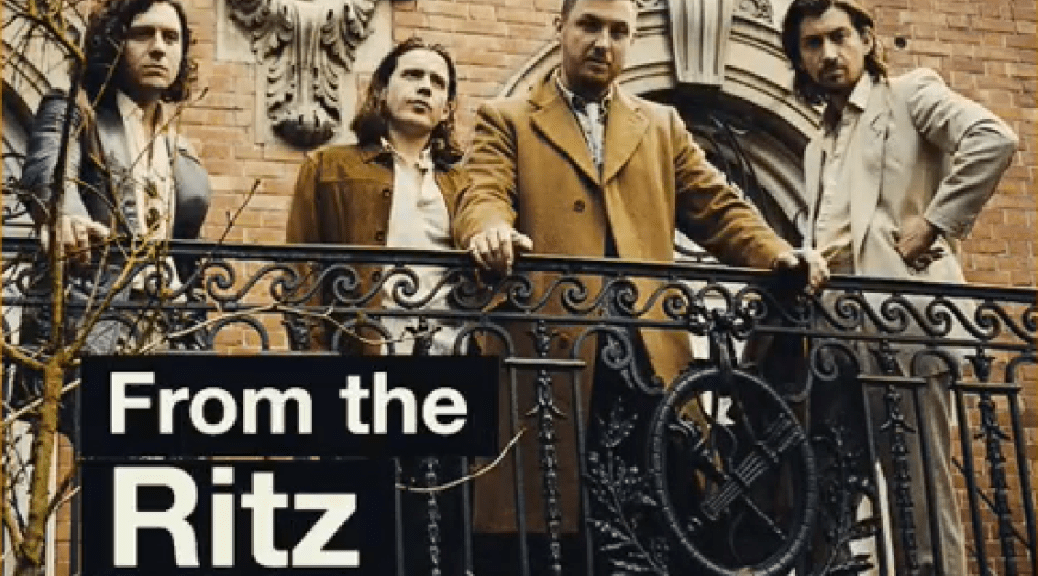
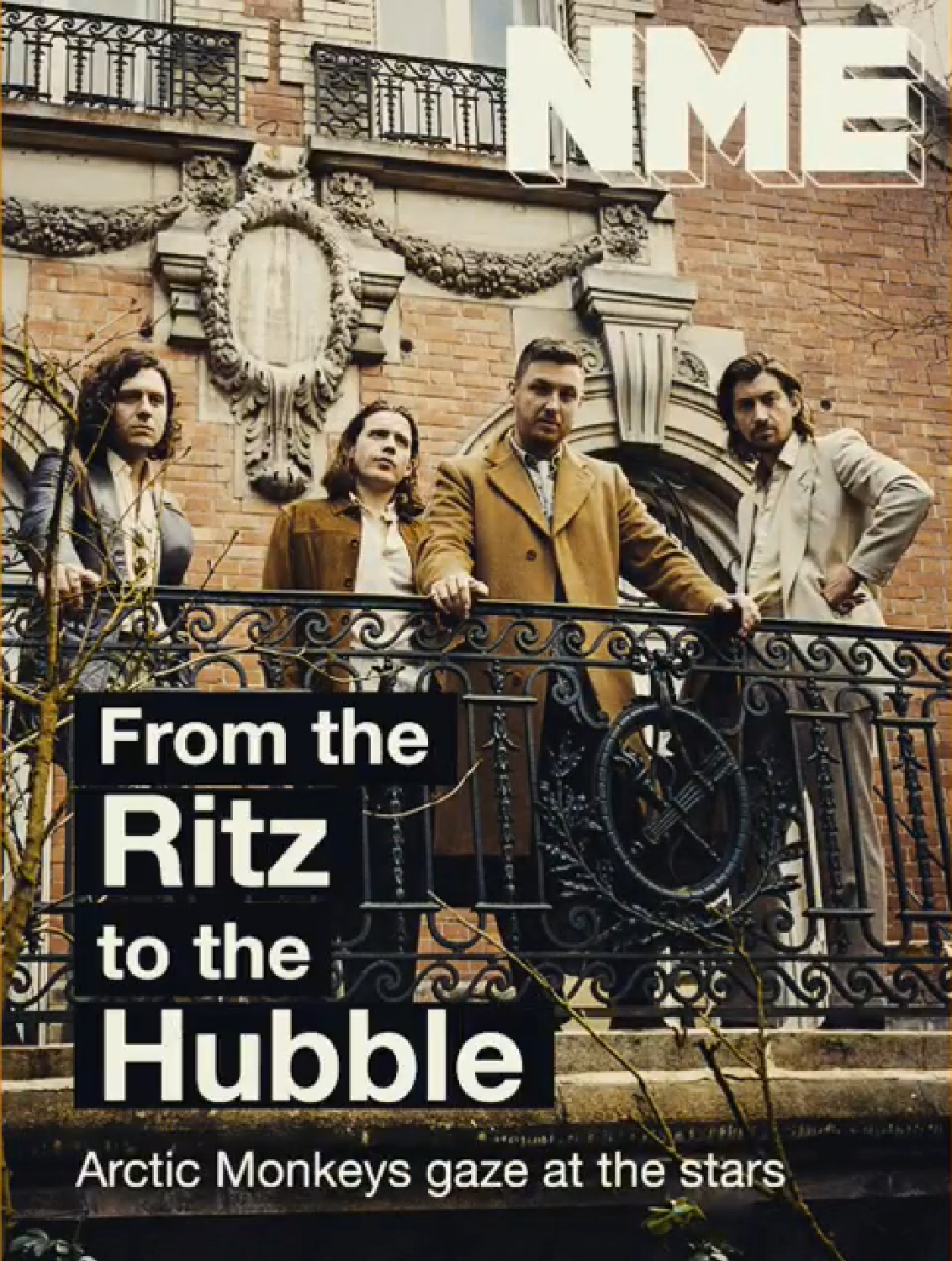
I tell this to Greta Van Fleet when I meet them backstage at Marathon Music Works in Nashville and Josh, a curly-haired, handsome cherub of a man, reassures me by saying he was feeling pretty much the same way when he first let out the aforementioned “YEEEAAAHHHHH”. He was responding instinctively to the music. “The song will, in a fashion, speak to you,” he says. “And you kind of just go with it.”

Continue reading at NME.

Alex Turner: Star Man

arctic-monkeys-nme-coverWhat do you mean, you’ve never seen ‘Blade Runner’?
Alex Turner lives for moments like this. The strangled incredulity in the voices of those who simply refuse to believe that in this age of instant on-demand entertainment he’s never sat down to watch Harrison Ford hunt replicants. He loves it so much he wrote the line into ‘Star Treatment’, the opening track of the Arctic Monkeys’ sixth album ‘Tranquility Base Hotel and Casino’.

“When it’s at it’s absolute best, that scenario,” he says, with pure glee in his eyes, “And I’ve only seen this happen a couple of times, but it goes beyond: ‘What do you mean you’ve never seen ‘Blade Runner’?’ and gets to: ‘Oh my God, I envy you!’”

The memory of this makes him throw back his head and laugh, the sound echoing around the Masonic Lodge in Los Angeles’ Hollywood Forever Cemetery where in a few hours the band will play out on the lawn. He’s wearing a tan safari suit, a pair of yellow-tinted shades and a white shirt open so low you wonder why they even bothered putting buttons on it in the first place.

“I fucking love that shit,” he says, composing himself. “When it goes there, that’s like a fuckin’ slam dunk. ‘Oh I envy you!’ People are so involved in that stuff, aren’t they?”

It’s rare to see Turner this unguarded. Usually the 32-year-old talks like he writes: slowly, marshaling his thoughts in long pauses and choosing every syllable precisely. Yet back at the start of 2016, he found himself at a complete loss for words. He had no idea how to follow the multi-platinum international success of 2013’s ‘AM’. He was rattling around his home in Los Angeles, with his model girlfriend Taylor Bagley and their dog Scooter, not watching ‘Blade Runner’. Instead he was watching Fellini’s 1963 meta masterpiece ‘8½’.

If you want to understand how Turner arrived at ‘Tranquility Base Hotel and Casino’, ‘8½’ is the key to unlock it. It’s a film about a director with writer’s block, struggling to make a science-fiction movie – a towering spaceship set is under construction – but all the while being haunted by flashbacks of his youth.

“I’m not sure if ‘haunted’ is exactly the right word,” suggests Turner. There he goes again, always interrogating language. “It seems inherently negative and I don’t think it has to be, but yeah, things from his past are coming in and out, and it’s writing about writing.”

‘8½’ showed Turner a way forward. It combined a lot of the things he was struggling to talk about: his own writer’s block, the memories of his youth, and the science-fiction vocabulary which would allow him to explore it all without leaving himself too exposed.

So he went down to the old spare room, which he would later start referring to as the ‘lunar surface’, and which now contained a Steinway Vertegrand piano that the band’s manager Ian McAndrew had given him for his 30th birthday. Sitting down at the piano, he experienced his own Fellini-esque flashback. He tumbled back through time to before the house in LA, before headlining Glastonbury twice and the millions in the bank, back before even the electric excitement of that first album, to little 8-year-old Alex learning to play the piano with his dad, David.

“There’s something about the stuff I wrote on piano that definitely reminds me of the types of thing he would play, and still does even now,” he says. “There’s this bit in ‘One Point Perspective’, the sort of jazzy bit of that, that every time it comes around, when I sit there, it feels like something he would play. That’s the thing I’ve been playing whenever I’ve sat on a piano stool since I was a kid, but I never thought it would find its way into my compositions as much as it has on this record.”

As he sat there, playing his dad’s old chords, he experienced another flashback, to a now-teenage Alex in his parents’ garage writing ‘Whatever People Say I Am, That’s What I’m Not’. There is only one time in our conversation when Turner doesn’t pause or hesitate to answer, and it’s when I ask whether he thinks this record is lyrically the closest thing he’s ever written to their first.

“Absolutely I do, absolutely,” he cuts in, before the words are even out of my mouth. “I can’t put me finger on exactly why I think that, but I have been saying it a lot recently. It’s set in a completely different place, obviously, but there’s something in the lyrics that reminds me of something in that writing. I’m tempted to say that it’s something to do with how blunt it is. I think that was something I was trying to get away from, and perhaps I’ve returned to it now.”

So it makes sense that the album opens with one of the bluntest lines he’s ever written: “I just wanted to be one of the Strokes, now look at the mess you made me make.” He has found himself in a beautiful house, with a beautiful girlfriend, and he asks himself – how did I get here? “The first thing that line does is make me think about then and how much time seems to have suddenly passed,” he says. “I expected to change it, but by the time I got back around to it it seemed like it was exactly where it needed to be, and I was obviously attracted to how blunt it was.”

The album is littered with lyrics just as frank and direct as that one. On ‘Science Fiction’, he sings about his own creative process: “I want to make a simple point about peace and love but in a sexy way where it’s not obvious… So I tried to write a song to make you blush, but I’ve a feeling that the whole thing may well just end up too clever for its own good, the way some science fiction does.” If it wasn’t for the trappings of the fictional lunar hotel that he set about constructing around himself, this could have been a purely confessional, autobiographical record.

“And you could say because of those trappings, it’s allowed to be,” he suggests. Then he laughs to himself at what he’s just given away. “I just walked right into that one didn’t I? I think the way in to that was that I became interested in the idea that these worlds are created in science fiction stories that allow you to explore things that are rooted in this world.”

Things he would have found hard to explore without that device?

“Almost impossible,” he agrees.

One of those subjects is his own personal failings, a topic he keeps prodding like a wound that won’t heal. He sings about: “Things that I just cannot explain to you and those that I hope I don’t ever have to”, and the album closes with the line: “I’ve done some things that I shouldn’t have done. But I haven’t stopped loving you once.” Rather than writing more songs about love and lust, did he find himself drawn to writing songs of regret?

“Oh, you devil!” he laughs at this line of questioning. Understandably, he’s not going to be drawn on the specifics, but he did think it was time to stop singing about love. “I think ‘Sweet Dreams, TN’ from the Puppets album seemed like the place to leave that, for the time being,” he says. “All that is is a love letter, I don’t know how much more detail you could go into. Also, it was suggested to me by a friend: ‘What about not doing that for a moment’. I think I was arriving at that place meself anyway.”

As well as allowing him to be more introspective, the science fiction setting also gave Turner space to write about modern life. One of the album’s best tracks, ‘Four Out Of Five’, concerns a taqueria on the roof of the titular lunar hotel complex with the unlikely name: ‘The Information-Action Ratio’. It’s a phrase Turner lifted from Neil Postman’s 1985 book ‘Amusing Ourselves to Death’, which also heavily influenced Father John Misty’s ‘Total Entertainment Forever’ on last year’s ‘Pure Comedy’. Turner says the phrase ended up as the name of the taqueria by happy accident. It just so happened that the words came in on the backing vocals he recorded with drummer Matt Helders just as the lyrics mentioned the taqueria.

“The implication of course is that that’s the name of the thing,” he explains. “But what a wonderful name for a taqueria on the roof of a lunar hotel complex! But you’re more interested, I think, in why that phrase leapt out at me. I think one of the things I liked about that phrase is that you sort of know exactly what it is right away.”

The Information-Action Ratio is Postman’s prescient analysis of the way that a tidal wave of information and entertainment renders all of us on the receiving end utterly helpless as to how to decipher which of it is useful or useless. In other words, you’re not alone if you feel overwhelmed by 24-hour rolling news coverage, Twitter feeds and the constant, pinging updates on your phone.

“Exactly,” he says. “And phonetically it’s quite alluring, I think.”

Once Turner had corralled all these disparate ideas into ‘Tranquility Base Hotel and Casino’, he assembled the band – Helders, guitarist Jamie Cook, bassist Nick O’Malley and producer James Ford – and they decamped first to Vox Studios in Los Angeles and then to La Frette, the 19th century mansion-cum-recording studio in northern France where Nick Cave & The Bad Seeds recorded ‘Skeleton Tree’. There, the five were joined by a host of other musicians including their touring keyboard player, Tom Rowley, Tame Impala’s Cameron Avery, Klaxons’ James Righton, Mini Mansions’ Zach Dawes and Tyler Parkford, and drummer Loren Humphrey. They all played together in the same room, inspired by the lush recording sessions for the Beach Boys’ ‘Pet Sounds’ and the idea of Phil Spector’s ‘Wall of Sound’, as heard on Dion’s ‘Born to Be With You’ and Leonard Cohen’s ‘Death of a Ladies’ Man’, some of Turner’s favourite records. “You see those images from those recording sessions and it just looks so exciting,” says Turner. “Primarily I think I love those albums and I wanted my album to be a bit like them.”

Yet when it came to the vocals, they found that it was the lines Turner recorded on his vintage 8-track Tascam 388 in splendid isolation at home that needed to be retained for the record, impossible to better wherever else they tried them.

In a way, that’s fitting. ‘Tranquility Base Hotel and Casino’ is full of songs which sound like they’re being narrated by a reclusive rock star. On ‘One Point Perspective’, he’s dancing at home alone in his underwear, only distracted by the suggestively named “Mr Winter Wonderland” who keeps making him lose his train of thought. Like David Bowie’s ‘Space Oddity’ and Elton John’s ‘Rocket Man’, these are songs that are ostensibly about space travel but use that as a metaphor to talk about the isolating nature of fame.

Where ‘Tranquility Base Hotel and Casino’ joins the dots is by extending that idea to all of us. These days we’re all isolated, living in our own bubbles overwhelmed and rendered apathetic by the alienating stream of information pouring in on our screens. We seek refuge in frivolity. “Everyone’s on a barge floating down the stream of great TV,” as Turner sings on ‘Star Treatment’. We can have everything we want delivered to us on-demand. “You push the button and we’ll do the rest”, the slogan from a very early 1888 Kodak advert, repurposed for ‘The World’s First Ever Monster Truck Front Flip’, that could also describe every app on whatever device you’re reading these words on. Is Turner telling us that in 2018 we’re all becoming more like reclusive rock stars, sat in our pods with every form of entertainment ever devised available to us at the push of a button, slowly realising that having our desires met instantly may not actually make us happy?

“I find it hard to disagree with anything you’re saying,” he says finally, after another of those lingering pensive pauses. “I can’t resist. I’m trying to think of something that I can say that relates that I didn’t say on the record. Of course, I suppose. Of course.”

Originally published by NME, 11 May 2018.

Pa’l Norte 2018: Franz All Over The World

FRANZFERDINAND_5156_JF

Alex Kapranos is wearing a jacket with Day of the Dead-style skulls embroidered on the chest, and that’s not the only way that Mexico is close to the Franz Ferdinand frontman’s heart.

“I think there’s a certain energy that we have to our music which really clicks with people in Latin America,” he says, leaning forward on a sofa in the band’s dressing room backstage at Monterrey’s Pa’l Norte festival. “There’s a real kind of openness and warmth to people here. It’s our natural environment, I think.”

They might be 5,000 miles from Glasgow, but they’re made to feel right at home by the 105,000 people squeezed into Parque Fundidora for the festival. Rock’n’roll that you can shake your hips to is very much the order of the weekend at Pa’l Norte, with Queens of the Stone Age and Muse also turning in sets that are seductive, rather than headbanging.

After the festival, Franz will be continuing their Mexican love affair with their own headline show in Mexico City – a place they’re returning to for the first time since one of their crowds trashed a venue. “It was a big arena, and the crowds in Mexico are really intense,” says Kapranos. “The first four or five rows of seats in the arena got completely destroyed. Hopefully we’re not playing a seated arena this time!”

The band’s love for this part of the world extends beyond the joy of playing to vast crowds. Drummer Paul Thomson has spent time in Puerto Vallarta, famous for being the town where Richard Burton and Elizabeth Taylor holed up while Burton was shooting ‘The Night of the Iguana’, while Kapranos recently explored the Yucatán Peninsula. “It’s incredible,” he says. “I hired a car and drove all around there. They have these cenotes, these underwater caves where you can swim completely underwater, and they have these strange albino fish that never see sunlight. The food down there is astonishing, things like Sopa de Lima. For me, in Mexico, but also in any city or country around the world, the best thing to do is get yourself lost. To turn the GPS off on your phone and see where you end up. Watch people, talk to people. Those are some of the best surprises you can get. The London perspective is often not to talk to strangers, but when you find yourself in other parts of the world that’s sometimes the best thing you can do.”

Now back at work, they’ve been introducing fans to tracks from new album ‘Always Ascending’, which was released in February. It’s an experimental, playful record – but Kapranos says it’s still been generating the requisite energy when played live. “It’s experimental in the sense that it’s lots of stuff that you haven’t maybe heard on our previous records, but it still sounds like Franz Ferdinand, and there’s still bangers on it,” he says. “It might sound different to our other records but people still want to get up and dance to it.”

The band will spend much of the rest of the year on the road – with key dates including a Glasgow homecoming at TRNSMT Festival at the end of June, a headline show at the Roundhouse in September and their first ever trip to Ukraine. “Nowadays, in the age of social media, you’re very aware of where your fans are,” says Kapranos. “We’ve had a lot of feedback from people from Ukraine for a long time. ‘When are you going to come?’ So finally this year we’re going to get to see it.”

For Franz fans who want to catch the band in an exotic locale without leaving Britain, they headline Festival No. 6 this September in Portmeirion, the curious Welsh tourist village that was designed by architect Clough Williams-Ellis in the style of an Italian village and featured in cult TV show The Prisoner. “I’m really excited about,” says Kapranos. “I’m a huge fan of The Prisoner, and I’ve never been to Portmeirion before.”

Thomson, though, has been before. “I went when I was 16 with a bunch of guys, because of The Prisoner,” he reminisces. “I’m not sure you’d call it a lads’ weekend. Maybe a virgin’s weekend? I’ll be returning a man this summer.”

Originally published by NME.

Baaba Maal on being the sound of Black Panther’s Wakanda

WOMAD Festival
To soundtrack the moment in Black Panther when we’re first transported to Wakanda, director Ryan Coogler and score composer Ludwig Göransson knew they needed something special. They found it in Baaba Maal, the legendary Senegalese singer whose unique vocals echo out as we soar over the country’s hilltops. Maal is singing in his native Fula language about the death of an elephant, a metaphor for a fallen monarch.

For the filmmakers, working with Baaba Maal was an opportunity to incorporate African music alongside Kendrick Lamar’s more high-profile soundtrack. For Maal himself, it was a chance to lend his voice to a new kind of storytelling about his home continent: “I like the story a lot, and the challenge of telling the story,” he tells NME. “I confess, I didn’t know the film would have the impact that it has had now! It’s unbelievable. I really, really like the film but I didn’t expect all of that!”

Maal, whose most recent album ‘The Traveller’ was produced by The Very Best’s Johan Hugo in 2016, knows all about combining traditional and modern forms of music and storytelling. “I’m very traditionalist, but also very modern in the way that I love electronic sounds and the way technology changes culture,” says Maal. “The way it comes across in the film is that the culture is ancient, but also it talks to the future as well.”

The collaboration came about after Göransson travelled to northern Senegal to meet Maal at his home in the town of Podor, and then spent several weeks learning about the music of the region. “I’m always touring in very remote places in Senegal, so when he arrived I told him I was going on tour and invited him to go with me,” says Maal. “We left from my hometown, Podor, and then we visited every part of north Senegal. I thought he’d enjoy the tour and also find some inspiration. Then when we came back we jumped in the studio and he recorded me as well as all the other musicians he wanted to record for Black Panther.”

When creating the sound of Wakanda, Maal says that Göransson was not just inspired by the shows he saw on tour but also by the music being made by the public. In Senegal, locals often pay tribute to important figures like Maal by playing drums for them outside their home or when welcoming them into a new town or village.

“When you follow a band like my band around Senegal, it’s not just the band themselves who are going to inspire you, it’s also the population,” says Maal. “Everywhere we go people welcome us and play music. There are a lot of ceremonies in the daytimes. If you’re there and you listen and watch it will give you a lot of inspiration. I think that sort of music is also connected to the story of Black Panther. He heard a lot of songs about kings, and about kingdoms, that have been passed down since ancient times, so I think that was good for him.”

Throughout the score, certain instruments are associated with certain characters. Michael B. Jordan’s Killmonger is often accompanied by the sound of a Fula flute. For Chadwick Boseman’s T’Challa, the score uses the talking drum, a popular West African instrument which can mimic the tone of human speech. “The talking drum is an instrument which comes from far away in the past but leads to the future,” explains Maal. “When you play it, it sounds as if it could fill up the universe.”

Originally published by NME.

Sister Nancy is the first lady of dancehall

SISTER-NANCY-AND-LEGAL-SHOT-SOUND-SYSTEMIt was 1982 in Kingston, Jamaica, and Sister Nancy – the first ever female dancehall DJ – realised that she needed one final song to complete her debut album. Recording at Channel One Studios with a band that included the legendary Sly and Robbie rhythm section, she went to the mic and freestyled ‘Bam Bam’ over Ansell Collins’ ‘Stalag 17’. It’s fair to say she nailed it.
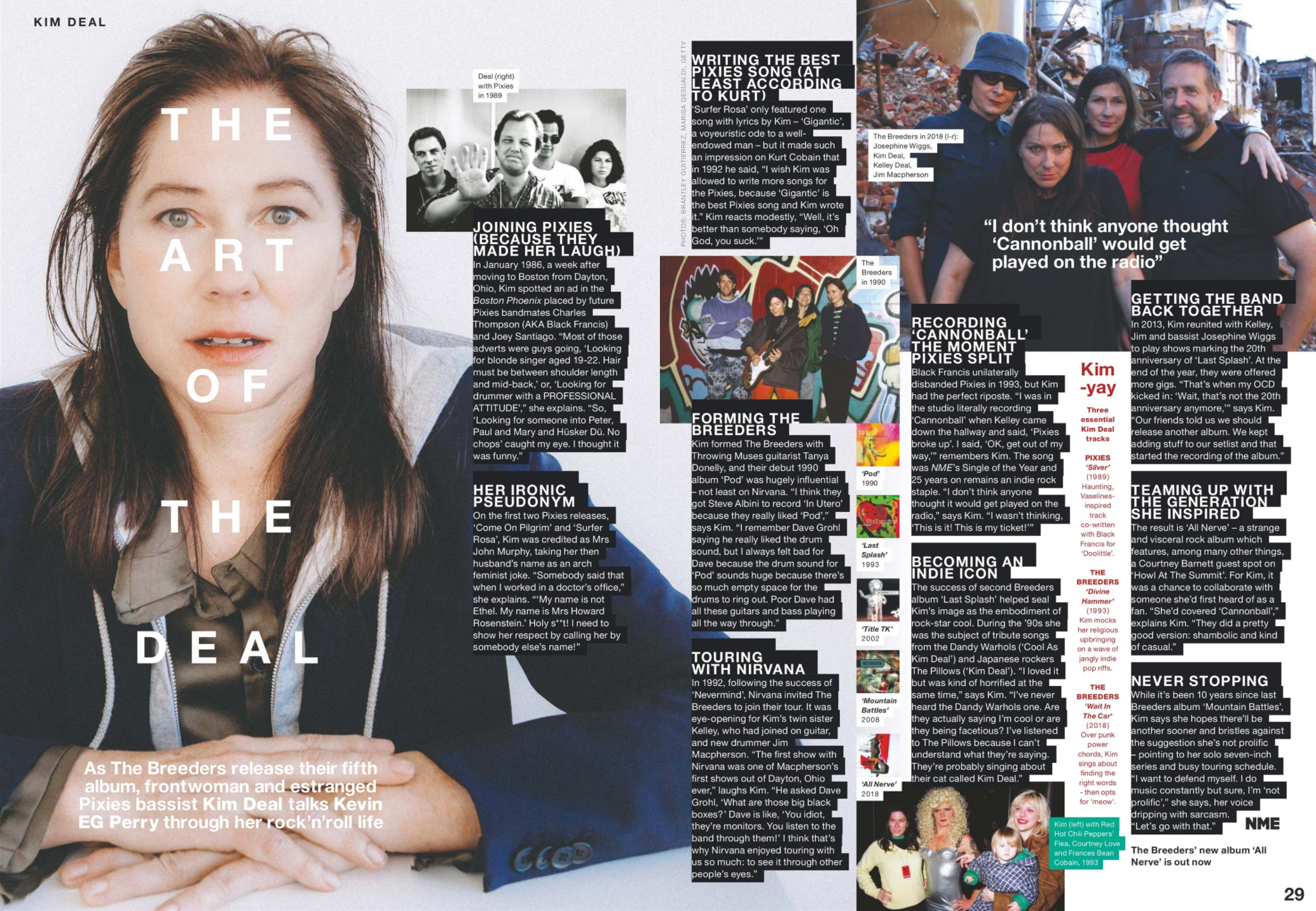
‘Bam Bam’ went on to become one of the most influential reggae songs of all time, sampled at least 80 times on tracks including Kanye’s ‘Famous’ and Jay-Z’s ‘Bam’. More importantly, ‘Bam Bam’ itself has stood the test of time. Almost four decades on there is still almost nothing that sounds better played loud in the sun.

Yet Sister Nancy saw little reward from the song’s success. Contractually cut out from receiving any royalties, she left music behind and moved to New Jersey where she took a job in a bank. It was only in the last four years, after the song enjoyed another resurgence, that she was finally able to get her hands on some of her backdated royalties and return to playing live. Ahead of her European tour this summer, Sister Nancy shares her remarkable story:

How did you first get involved in making music when you were growing up in Jamaica?

“It was always a part of me. Music is a part of us, but it was my bigger brother Brigadier Jerry who motivated me to do something with it. I went to see him DJ, and I thought if he could do it then I could do it as well. I didn’t think about it, I just did it. It was always a part of my family. It’s not that my brother was encouraging me with words, I just followed what he was doing because I liked it.”

You became the first ever female dancehall DJ – were there other women working in music in Jamaica at the time?

“There weren’t many of us. There was one, Muma Liza, who was a harmonizer with Kojak, but I was the one who came and took it to the dancehall. I started off with three tracks: ‘Papa Dean’, ‘Money Can’t Buy Me Love’ and ‘Proud A We’. Then I did a couple more singles: ‘One Two’ and ‘Transport Connection’. After I did those, ‘One Two’ started to take off and was doing well so that’s when I was asked to do an album. So that’s how my album ‘One, Two’ came about.”

Is it true that ‘Bam Bam’ was a late addition?

“Yes that’s right, ‘Bam Bam’ was the last track I put on the album. I had nine songs done and I needed to do one more but it was very hard for me, you know? There was an older song called ‘Bam Bam’, so I decided to do a ‘Bam Bam’ too. So that’s how I did the last track and finished the album. I freestyled it, I only wrote it down after. It’s timeless. It’s been 36 years, and ‘Bam Bam’ is still there. It’s not going anywhere.”

Despite the huge success of ‘Bam Bam’, you initially didn’t see much money from it. Are you getting properly paid these days?

“Yes, I’m getting the royalties now. I wasn’t getting anything for 34 years, but in 2014 after they used it in a Reebok commercial I decided to sue them. Now I own 50% of the ‘One, Two’ album. At least I’m getting something now, I never used to get anything.”

So when Kanye sampled ‘Bam Bam’ for ‘Famous’ in 2016 did he have to ask your permission?

“No, he didn’t have to ask me because I don’t own the song. The song is owned by Westbury Music, who are based in England. Kanye would have had to go through them, and then they gave him authorisation to use it. Then they make sure I get my royalties from the sample too.”

That’s good. What did you make of ‘Famous’?

“It’s not the first time I’ve heard someone sample ‘Bam Bam’. When I heard him do it I just thought: ‘Well, that’s good for me.’ Whatever way he takes it, it’s very good for me because it keeps me moving. Do you know what I’m saying? It keeps me working. Then Jay-Z did the same thing. It’s a blessing.”

You went back to Jamaica with Jay-Z, didn’t you?

“Yeah that’s right. He wanted me to appear in the video for ‘Bam’ that he was making with [Damian] Marley. I spent three days down there with him. It was nice, but a man is just a man. Jay-Z is just a man, same as you. He’s no different.”

You’re playing the Positive Vibration festival in Liverpool this summer. At your shows do you still see a lot of young people getting into your music?

“It’s always been like that! Sometimes I wonder how they know about me after so long. I’ve been doing this for 41 years. I don’t know how they hear about me, but it’s mostly young people at my shows when I’m performing all over the world. There’s a few older folks like me, but mostly it’s younger people. They’ll have the ‘One, Two’ album or a couple of singles and they bring them to me to sign.”

What is it about your music that keeps connecting with new generations?

“I don’t know what causes it, but I’m going to say that they’re in love with the songs and they’re in love with me… or my voice! I think it’s my voice, and ‘Bam Bam’. You can’t not love ‘Bam Bam’. I don’t know what to say about it. ‘Bam Bam’ is just ‘Bam Bam’! Whatever it is, I’m grateful.”

Originally published by NME.

The Art Of The Deal

the-art-of-kim-deal-nme

“You guys are such dorks!” says Kim Deal, which is a fair assessment because I’ve just told her about the time teenage me and a friend went to see her band The Breeders in homemade T-shirts that said: ‘Cool as Kim Deal’.

Sure, I’m a dork, but I’m in good company. The former Pixies bassist inspires devotion, whether it’s Kurt Cobain naming Breeders’ ‘Pod’ as an album that changed his life or Thom Yorke saying he was uncomfortable playing after Pixies because it’s “like the Beatles opening for us.”

As The Breeders prepare to release fifth album ‘All Nerve’, Kim talks us through her rock’n’roll life:

  1. JOINING PIXIES (BECAUSE THEY MADE HER LAUGH)

In January 1986, a week after moving to Boston from her hometown of Dayton, Ohio, Kim spotted an ad in the Boston Phoenix placed by future Pixies bandmates Charles Thompson (Black Francis) and Joey Santiago. “Most of those adverts were guys going: ‘Looking for blonde singer aged 19-22. Hair must be between shoulder length and mid-back.’ or: ‘Looking for drummer with a PROFESSIONAL ATTITUDE’,” she explains. “So: ‘Looking for someone into Peter, Paul and Mary and Hüsker Dü. No chops.’ caught my eye. I thought it was funny.”

  1. HER IRONIC PSEUDONYM

On the first two Pixies releases, ‘Come On Pilgrim’ and ‘Surfer Rosa’, Kim was credited as Mrs John Murphy, taking her then husband’s name as an arch feminist joke. “Somebody said that when I worked in a doctor’s office,” she explains. “‘My name is not Ethel. My name is Mrs Howard Rosenstein.’ Holy shit! I need to show her respect by calling her by somebody else’s name!”

  1. WRITING THE BEST PIXIES SONG (AT LEAST ACCORDING TO KURT)

‘Surfer Rosa’ only featured one song with lyrics by Kim – ‘Gigantic’, a voyeuristic ode to a well-endowed man – but it made such an impression on Kurt Cobain that in 1992 he said: “I wish Kim was allowed to write more songs for The Pixies, because ‘Gigantic’ is the best Pixies song and Kim wrote it.” Kim reacts modestly: “Well, it’s better than somebody saying: ‘Oh God, you suck.’”

  1. FORMING THE BREEDERS

Kim formed The Breeders with Throwing Muses guitarist Tanya Donelly, and their debut 1990 album ‘Pod’ was hugely influential – not least on Nirvana. “I think they got Steve Albini to record ‘In Utero’ because they really liked ‘Pod’,” says Kim. “I remember Dave Grohl saying he really liked the drum sound, but I always felt bad for Dave because the drum sound for ‘Pod’ sounds huge because there’s so much empty space for the drums to ring out. Poor Dave had all these guitars and bass playing all the way through.”

  1. TOURING WITH NIRVANA

Nirvana were such fans that in 1992, a year after ‘Nevermind’ made them mind-bogglingly successful, they invited The Breeders to join their tour. It was an eye-opening experience for Kelley, who had joined on guitar, and new drummer Jim Macpherson. “The first show with Nirvana was one of Macpherson’s first shows out of Dayton, Ohio ever,” laughs Kim. “He asked Dave Grohl: ‘What are those big black boxes?’ Dave is like: ‘You idiot, they’re monitors. You listen to the band through them!’ I think that’s why Nirvana enjoyed touring with us so much: to see it through other people’s eyes.”

  1. MAKING ‘CANNONBALL’ WHILE PIXIES SPLIT

Black Francis unilaterally disbanded Pixies in 1993, but Kim had the perfect riposte. “I was in the studio literally recording ‘Cannonball’ when Kelley came down the hallway and said: ‘Pixies broke up’. I said: ‘Okay, get out of my way,’” remembers Kim. The song was named NME’s Song of the Year and 25 years on remains a timeless indie rock staple. “I don’t think anyone thought it would get played on the radio,” says Kim. “I wasn’t thinking: ‘This is it! This is my ticket!’”

  1. BECOMING AN INDIE ICON

The success of ‘Cannonball’ and second Breeders album ‘Last Splash’ helped seal Kim’s image as the embodiment of rock star cool. During the ‘90s she was the subject of tribute songs from the Dandy Warhols (‘Cool As Kim Deal’) and Japanese rockers The Pillows (‘Kim Deal’). “I loved it but was kind of horrified at the same time,” says Kim. “I’ve never heard the Dandy Warhols one. Are they actually saying I’m cool or are they being facetious? I’ve listened to The Pillows because I can’t understand what they’re saying. They’re probably singing about their cat called Kim Deal.”

  1. GETTING THE BAND BACK TOGETHER

In 2013, Kim reunited with Kelley, Jim and bassist Josephine Wiggs to play shows marking the 20th anniversary of ‘Last Splash’. When the year was over, they were offered more gigs. “That’s when my OCD kicked in: ‘Wait, that’s not the 20th anniversary anymore,’” says Kim. “Our friends told us we should release another album. We kept adding stuff to our setlist and that started the recording of the album.”

  1. TEAMING UP WITH THE GENERATION SHE INSPIRED

The result is ‘All Nerve’, a strange and visceral rock album which features, among many other things, a Courtney Barnett guest appearance on ‘Howl At The Summit’. For Kim, it was a chance to collaborate with someone she’d first heard of as a fan. “She’d covered ‘Cannonball’,” explains Kim. “They did a pretty good version: shambolic and kind of casual.”

  1. NEVER STOPPING

While it’s been 10 years since last Breeders album ‘Mountain Battles’, Kim says she hopes there’ll be another sooner and bristles against the suggestion she’s not prolific – pointing to her solo 7 inch series and busy touring schedule. “I want to defend myself. I do music constantly but sure, I’m ‘not prolific’,” she says, her voice dripping with sarcasm. “Let’s go with that.”

Originally published in NME, 9 March 2018.