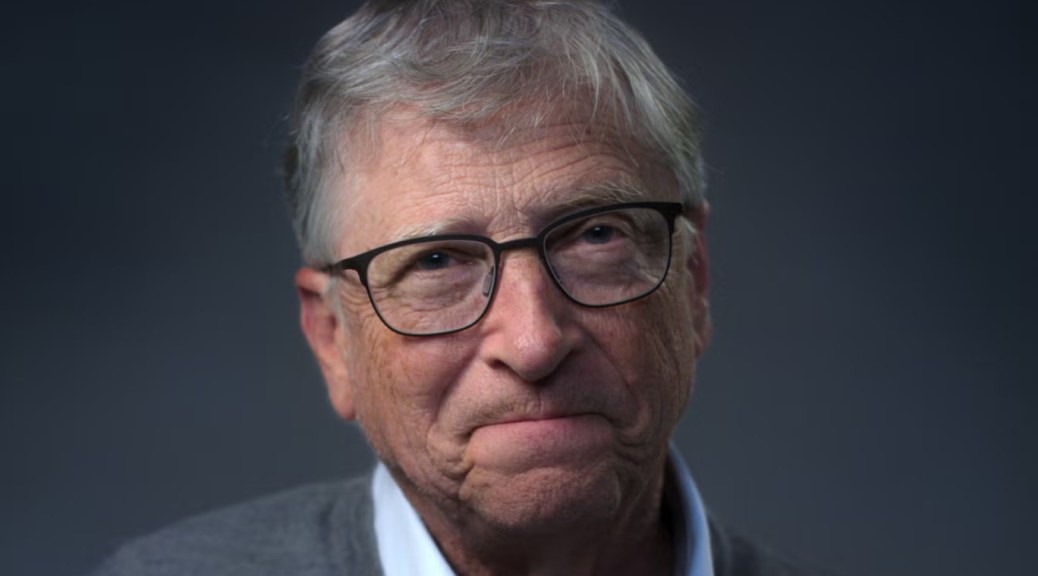
Bill Gates didn’t see the conspiracy theories coming. The Microsoft co-founder built one of the most immense fortunes the world has ever seen with his foresight about the personal computer revolution, but he never predicted so many people would end up using those machines to cast him as a baby-guzzling, shape-shifting lizard who puts microchips in vaccines and plans pandemics for profit. “I thought the internet, with the magic of software, would make us all a lot more factual,” he laments, a wry smile playing beneath his black-framed spectacles. “The idea that we kind of wallow in misinformation… I’m surprised about that.”
Not that he’s complaining. “I don’t care how I’m perceived,” the 68-year-old assures me over a video call (Microsoft Teams, naturally) from his office in Kirkland, on the banks of Lake Washington, opposite Seattle. So even when “a woman came up and yelled at me that I implanted stuff in her, that I was tracking her” he took it in his stride. “My life is fantastic,” he says. “I’m the luckiest person alive, in terms of the work I get to do.”
Online misinformation troubles Gates not because of his personal reputation, but because it’s the rare problem he doesn’t have an answer for. In his new five-part Netflix documentary series, What’s Next? The Future with Bill Gates, the multibillionaire shares his optimistic vision of a world where scientific innovation rolls back climate change and eradicates deadly diseases while advances in artificial intelligence leave us all free to enjoy perpetual leisure time. It’s just the conspiracy theories that have him stumped. “I feel a bit like we’ve handed that to the younger generation,” he says. “Both to face up to and to figure out: ‘Okay, what’s this boundary between free speech and incitement to violence, or harassment, or just craziness that gets people not to take health advice?’”
Gates is well aware that one reason grotesque and outlandish rumours about him capture the public imagination is because, as he puts it in the show, “extreme wealth brings with it questions about your motives”. He stepped down as CEO of Microsoft in 2000 to establish the Bill & Melinda Gates Foundation with his then-wife, aiming to give away “lots of money to save lots of lives”, yet he remains one of the world’s richest people (seventh on the real-time Forbes list, with an estimated net worth of $138bn).
I ask him directly whether he can reassure me that billionaires do have the best interests of the rest of us at heart. His answer doesn’t exactly set my mind at ease. “I’m a huge believer in the estate tax [the American equivalent of the UK’s inheritance tax] and more progressive taxation,” he replies. “I don’t think we should generally generationally let families whose great grandfather, through luck and skill, accumulated a lot of wealth, have the economic or political power that comes with that.”
Not a ringing endorsement of the billionaire class, then. Would he agree that he is too rich? “If I designed the tax system, I would be tens of billion dollars poorer than I am,” he nods. “The tax system could be more progressive without damaging significantly the incentive to do fantastic things.”
Continue reading at The Independent






















 Kevin EG Perry: Collected Works