Category Archives: The Quietus

Scene Report: Carlos Capslock In São Paulo

Capslock 1 - Credit Felipe GabrielSão Paulo is the largest city in the western hemisphere, a vast and sprawling concrete jungle whose metropolitan area is home to some 21 million souls and more high-rises than anywhere else on earth. Yet as you walk the crowded streets it’s easy to spot buildings that have been left empty or abandoned, often half-hidden behind sheets that flap in the breeze, the architectural equivalent of Miss Havisham’s wedding dress. The best estimate is that there are more than 200,000 vacant buildings in the city.

For the DJ and cultural activist Paulo Tessuto, these spaces represent opportunities to party. Formerly a member of the diverse VoodooHop art collective which formed in 2009 to transform abandoned spaces for music and art projects, Tessuto went on to start his own spin-off DIY night, Carlos Capslock, dedicated purely to electronic music. “We started as a monthly night at Trackers, the first squat location we had in São Paulo,” remembers Tessuto. “After we had our third birthday party there, I started to search for new locations. We would just walk the streets, looking out for abandoned buildings that could become venues for parties.”

Continue reading at The Quietus.

Where The Magic Happens: Baaba Maal Interviewed

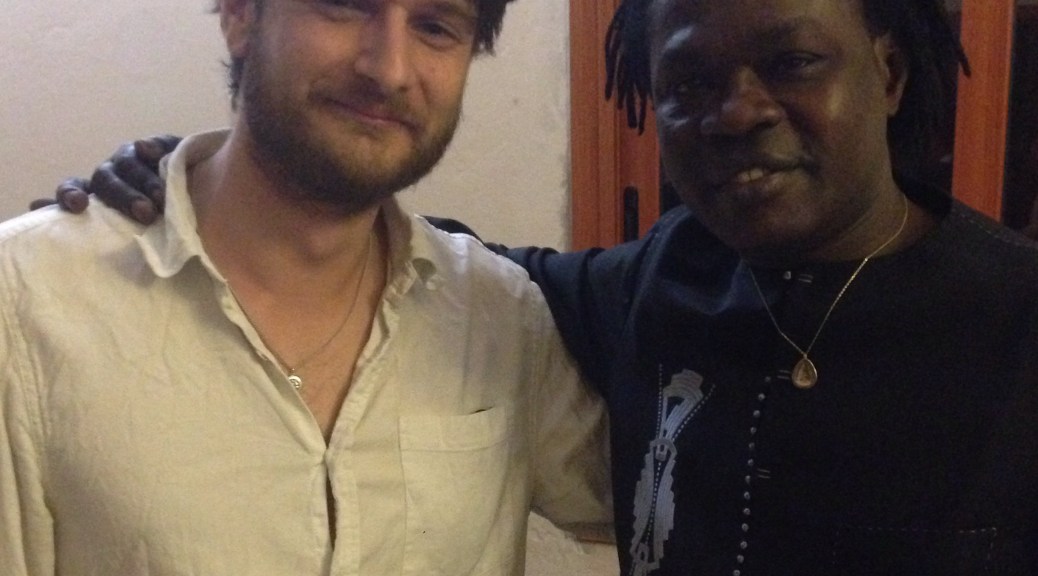
kegp-baaba-maalBaaba Maal has a bed big enough to sleep six people in either direction. We’re at his house in Podor, his hometown at the northernmost point of Senegal, and he’s giving me the tour. If they made MTV Cribs in West Africa this is the part where he’d sweep in and say something faintly embarassing like: ‘This is where the magic happens’, but instead he just laughs and tells me it’s actually only a guest room, and the oversized bed is “just to be a little bit exotic.”

We’re here for Blues Du Fleuve, Baaba’s annual celebration of music drawn from the four countries connected by the Senegal river: Guinea, Mali, Mauritania and Senegal itself. The festival opens with Baaba arriving on a multicoloured fishing boat regatta, oar symbolically aloft, and sees performances from the likes of Orchestra Baobab, Petit Yero and the spellbinding Mauritanian singer Noura Mint Seymali. Baaba makes a cameo appearance during Noura’s set, treating us to a coming together of two of Africa’s finest voices.

This time two years ago, Baaba’s guests here included Johan Hugo Karlberg, of The Very Best, and Mumford & Sons guitarist Winston Marshall. After the festival, they stayed behind to work on songs for what would become Baaba’s new record The Traveller, his eleventh album and first since 2009. It turns out this guest room with the big bed, converted into an impromptu recording studio, really was where the magic happened.

Continue reading at The Quietus.

Senegal on song – travel feature for The Guardian.

Chuck Palahniuk: All Of Creation Just Winks Out

chuckThere’s this guy who paints houses for a living. He has a pick-up truck and a pug dog, who he loves very much. The guy has to change his health insurance so he goes for a check-up, and afterwards they ask him to come in to talk about his results with a counsellor, which is never good news. So he goes in and he’s sat across the desk from this well-dressed, middle-aged woman with a folder of results. She says: “I’m sorry to tell you this, but you’ve tested positive for HIV.”

She says: “Do you know how serious this is?”

She starts to weep with the stress of having to tell him this news, but he’s lost in thought. He’s thinking how every night before he goes to sleep he jerks off into a Kleenex and drops it off the side of the bed, and every morning his dog has shredded and eaten most of it. He’s thinking that he’s killed the one thing in the world that he loves, and that loves him.

She’s going on and on about how they need to do viral load tests and what treatment might be best, and eventually he has to stop her and he says: “Can you just shut up? I’ve just got one question that I need answering.”

“I need you to tell me if I could have transmitted the AIDS virus to my pug dog?”

The woman’s face freezes into a lip-trembling mask of horror. This woman who has dedicated her life to social work and helping others. He can’t see her move but he can hear her wooden chair creaking. She’s leaning as far back as she can trying to get away from him, until it finally dawns on him and he says:

“Oh! You think I fucked my dog!”

So he tells the story about the tissues, and she is so relieved to know that she hasn’t devoted her life to counselling the sort of person who fuck pug dogs that she bursts out laughing. They’re able to laugh and to move past the impossible moment. She explains that the ‘H’ in HIV stands for ‘Human’, and they’re able to talk about what they need to talk about.

Telling that story is the reason Chuck Palahniuk isn’t allowed to speak at Barnes & Noble anymore. When he came to London, at the tail end of last year, it was one of many stories that he told onstage at Madame JoJo’s. I’d been asked to compère the night, which meant that as well as having to finally nail the pronunciation of his surname (it’s Paula-nick) I also got to sit beside Chuck and witness the effect his stories have on an audience. The way the atmosphere seemed to decompress as the audience inhaled as one and the room lost cabin pressure. Then the nervous snorts that punctuated the story and finally the lurch of redemptive laughter as we, like the man and his counsellor, moved past the impossible moment.

A few days later I met Chuck again at a genteel little guest house just off Soho Square. It was the sort of place that has oil paintings on the walls and marble busts in all the alcoves. We found a quiet place to talk in a small library with book-lined walls and a real fire burning in the hearth. In person, he speaks softly and thoughtfully. It was not the sort of atmosphere in which you would expect to be haunted by a story about fearing you’ve given your pug AIDS, yet here we were.

Chuck told me that he was sent the story, which is apparently true, by the house painter himself after he had read Palahniuk’s short story ‘Guts’. Although it was his debut 1996 novel Fight Club that made his name, ‘Guts’ burnished his reputation when ambulance-loads of people started passing out whenever he read it in public. The fact that the house painter felt comfortable sending his story to Chuck illustrates something important about his art. “It’s partly about creating the opportunity and the freedom for other people to make that same admission,” he says. “When I go up and read ‘Guts’ I humiliate and debase myself in a public way. It gives the audience this superiority that gives them the freedom to risk that kind of debasement in order to admit something about themselves.”

You can read ‘Guts’ in full here, and I urge you to do so if you haven’t. Hurry back, I’ll hold my breath. The first time I ever read that story, I was talking to a good-looking girl at a party about how much Fight Club had blown apart my young world and she told me I had to read this short story by the same writer. In fact, she said, I should read it aloud to the whole party. This is a good example of why you shouldn’t try to impress good-looking girls at parties. Chuck gets a hoot out of this when I tell him. “You had no idea where it was going?” he asks. “What a laugh that was.”

For those who need reminding, it’s a series of three escalating stories about the things that young men will do to make stroking their own penises feel more intense, each with more horrendous consequences than the last. To make matters even worse, Chuck says that like the pug dog tale each of these stories are essentially true.

“I’d been carrying around two parts of ‘Guts’ since my college days,” he says. He knitted them together, tinkering with details – like standardising all their ages to 13 – but the stories themselves were obtained with good old-fashioned journalistic initiative. “The carrot story took a lot of drinking. I had to get my friend so drunk. The candle story came from another friend who had been in the military and had been discharged and now was going to college. He phoned me and asked me to pick up all of his homework for several classes. It took a lot of over-the-phone manipulation. I eventually said: ‘I will not pick up your homework until you tell me what happened’. I had to threaten him to get that story.”

So Chuck carried those two stories around with him, looking for a third to complete the set. “I knew I needed a third act, and I needed a bridge verse as well. I thought of it like a song, with three verses and a bridge. For the bridge verse, I used that passage about how most of the last peak of teen suicide was really kids choking to death. I love to read forensic science textbooks. I started to notice that medical examiner procedural textbooks started to include a new chapter in the 1990s about how to identify auto-erotic asphyxiations where the crime scene has been manipulated by loving friends and family. I wanted to include that information as a sort of big voice observation, before we land in the ultimate anecdote. That’s how the story went together: like a song, with three verses and a bridge.”

He found his third verse when he was hanging out at a sexual compulsive support group, doing research for his 2001 novel Choke. “I asked this very thin man how he stayed in such good shape, and he explained that he couldn’t eat meat. I asked why, if it was an allergy, and he said no, he just had a reduced large intestine. It took a lot of talking before he eventually told me that he’d had a radical bowel resectioning, and why. I kind of embroidered it a little. There’s no way you could survive losing that much intestine. He did not bite through it, but he did have a prolapsed bowel from doing that and he did have to somehow wrench it out of the machinery to save his life. He told me the whole thing face-to-face, but it was a very gentle unpacking.”

At Madame JoJo’s, Chuck read a new short story, ‘Zombie’, which you can read in full here. Again, speaking as someone with your best interests at heart I advise you to go and do so immediately. Chuck thinks it’s a new standard bearer for his work: “It’s nice, every few years, to bring out something that’s really strong, that becomes the signature scandalous thing. For so long it was Fight Club. Then it became something else. Then ‘Guts’ carried the weight for a long time. I think this year’s story, ‘Zombie’, will be another perennial story.”

What floored me when I heard Chuck read ‘Zombie’ was the fact that while it starts out with typically Palahniukian helpings of dark humour, cynicism and nihilism, ultimately the story rejects those ideas in favour of an essential optimism: the existential meaning that can be provided by our sense of community.

“For me, it’s a big breakthrough,” he agrees. “I see my generation as snarky because it was our default identity in the face of the earnestness of the hippies at Woodstock. All of that was a sincere attempt to save the world. Our reaction to that was punk and new wave and with them cynicism, irony and sarcasm. We needed to be to be the reverse of the preceding generation. I want another option. I’m not going to live forever, so why not risk the ultimate transgression for my generation: to be sentimental and to be vulnerable. I think the breakthrough in the story is where the character says: “I don’t even know what a happy ending is.” I think my generation doesn’t believe in happy endings. The first step to resolving that is to admit that we have no idea what a happy ending would be anymore. By making the admission, we’re opening the vulnerability to maybe make it happen.”

Admitting we don’t know what a happy ending looks like, now that our old belief systems are gone, is the first step to finding one. ‘Zombie’ seems to echo that old Gramsci line: “The challenge of modernity is to live without illusions without becoming disillusioned.”

Likewise, Fight Club was about finding a device, almost a game, by which to deal with existential angst. It’s about bravery in the face of the void, as Philip Larkin wrote in ‘Aubade’: “Courage is no good, it means not scaring others. Being brave lets no one off the grave.”

“Beyond just being stoic about it, I liked the idea of being playful about it,” says Chuck. “I think so many discoveries come through the joy of play. Fight Club was about finding a game that would allow the impossible thing to be explored. I was so confronted by violence that I thought if there was a consensual, structured way that I could explore violence, experience violence, inflict violence, then I could develop a greater understanding and mastery and I wouldn’t have that fear. Fear of death is why I started going to those terminal illness support groups and volunteering in hospices, so that I would see at least what the physical process was and how other people dealt with it. As a young adult in my mid-twenties I would at least be taking some action, and have some experience of the thing, so that it wouldn’t be preying on me all the time. It looks like such an impossible thing to die. I think I wrote that into the character of Madison when I wrote Doomed. When she looks at her Grandmother’s hand she sees age spots and wrinkles and thinks: ‘How am I ever going to accomplish that?’ I look at my own hands now and see liver spots that my grandmother had. I remember being a child and thinking ‘Wow! How did those happen?’ It seems so miraculous to find them on my own hand now.”

We’ve reached a terminal point, so let’s go back to the beginning.

Chuck Palahniuk was born on 21 February 1962 in a city called Pasco in Washington State. His family history is bloodier than fiction. His grandfather killed his grandmother, and then himself. Chuck’s father, who was three years old, was at home at the time. “His earliest memories were of being in the house and hiding while his father was trying to find him and kill him.”

Chuck’s father worked on the railroad, an itinerant lifestyle which he and his brother swore they’d never repeat. Now his brother works in Angola, with a family in South Africa, while Chuck spends a third of his time on the road. “We’ve both ended up with my father’s life,” he says with a wry smile.

He says he didn’t learn how to read or write until he was eight or nine, in the third grade. “I think I was the last child in my class. I was filled with terror that I was going to be left behind. When I finally was able to read and write I was filled with such joy that I think that’s why I attached so much to it.”

Chuck talks passionately about how raising a child helps you to understand your own upbringing and to question all your assumptions about the world. “A child is a constantly quizzing thing,” he says. However, he’s talking about the experiences of his friends. Chuck is gay, a subject he doesn’t usually talk about in interviews, but in the context of raising a child I ask whether he’s considered surrogacy or adoption.

“No!” he says immediately. “I devour biographies and writers make really terrible parents. Kurt Vonnegut, Norman Mailer, William Burroughs – oh my God! They were all self-involved and self-obsessed and all of their children suffered.”

Does he recognise that in himself?

“Yeah, I’m completely selfish. I’m just glad that my partner is really good at letting me be obsessed with what I’m obsessed about. I’m really blessed. We’ve been together for twenty years, since before I started to write, so he’s kind of seen me through one persona into a completely different persona. When we met I was working at Freightliner, he was working stocking aircraft for an airline. We both had these very blue-collar lives, and now our lives are completely different.”

Chuck was in his thirties before he started attending creative writing workshops. He learned to write standing on a bar. His teacher, Tom Spanbauer, would arrange public readings in sports bars. “People were involved in sports on televisions or playing pool or pinball or videogames,” says Chuck. “I remember seeing friends of mine trying to read heartfelt memoir that was so subtle and emotionally sensitive that they would be weeping and no-one would give a shit. When it came my turn to stand on the bar and read I made sure that the thing that I read drew the attention of the entire bar, and it worked.”

In Spanbauer’s workshops he studied short-story writers like Mark Richard and his “extraordinary” collection The Ice At The Bottom Of The World, Thom Jones’ “amazing” The Pugilist At Rest and Denis Johnson’s collection Jesus’ Son. Chuck also adored Kurt Vonnegut, and learned from his work the beauty of the repeated chorus, as in Slaughterhouse Five‘s ‘So it goes’. Palahniuk loves them because of “that wonderful way that they keep the past always present, and they provide a standard transition that allows you to move past the impossible moment. I love those cultural ways which we have of getting past that moment where nothing can be said.”

His writing routine is still informed by his early experiences of reading stories aloud in a noisy bar, and he’s wary of the internet, a place where stories grow stale. “I almost never go to the internet for anything, except for maybe to check the spelling of a name, because if it’s on the internet then it’s not fresh. It’s not something original. It really takes talking to people to draw out these fantastic, unrealised new things. I write longhand. I tend to do what they used to call brain-mapping, where you have an idea and you gather everything you can in relation to that idea. I’ll compile notebooks full of handwritten notes exploring every facet of the thing I want to ultimately write about. Then at some point it will start to crystallise and I’ll sit down at a keyboard. When I talk about writing Fight Club in six weeks, or next year’s novel Beautiful You which I wrote in six weeks, I’m really talking about the keyboarding part. The writing took a year or more, but the keyboarding took six weeks.”

Chuck’s way of dealing with the writer’s terror of the blank page is to physically put himself in the places where stories happen. “I want to be in the world,” he says. “I want to be interacting with people and I want to produce something that can compete with the real world. I want to write in largely the same circumstances in which my work will be consumed, in places like bars or airports or hospitals, where people are surrounded by stress and distraction. If I can produce the work in those circumstances I think it’s more likely that people can consume the work there.”

He says the best piece of advice he’s received about writing was from Joy Williams’ essay ‘Uncanny Singing That Comes from Certain Husks’, where she writes: “A writer isn’t supposed to make friends.” Chuck grins as he recites those words. “I just so love that. The idea that you don’t write something in order to be liked. It transcends that. That has nothing to do with genuine writing. It moves me to think about that. “You don’t write to make friends.””

Just as you don’t write to make friends, he argues that when he’s first pitching a story to an editor, it’s less important that they like it and more important that they simply can’t forget it. “Eventually they will recognise some value in it,” he explains. “I think my short stories especially have a depth to them that very few people get. Very few people recognise the fantastic sadness at the end of ‘Guts’. I’m glad that they don’t. It’s nice that they come out of it with a lot of laughs, but occasionally I get a letter from someone saying that when the father has reduced his son to the idiot family dog, that’s heartbreaking, that’s the saddest thing I’ve ever read, and the fact that somebody recognises that makes it all worthwhile. Even if just one person gets it. It’s so gratifying.”

Iris Murdoch said that “every book is the wreck of a perfect idea,” and I want to know whether Chuck still struggles with sealing an unforgettable idea or an ear-catching bar tale in the wax of prose. He says: “That’s the way it used to be. I used to be in love with the idea but now I realise that what I’m in love with is just the tiniest seed of the idea. The idea is going to grow and evolve and bring me to something I could never comprehend in the first place. I can’t be the person who came up with the idea and be the person who has the answer at the end. I’m going to have to grow and evolve through the whole process as well. So I accept that struggle, and that there are going to be unpleasant parts in that struggle where I’m just stymied, but that eventually we all work through those. It’s like my Eiffel Tower story… do you mind if I tell that?”

Not at all.

“Years ago I was in Paris and my publisher threw me this dinner party. Everyone at this party was smoking. I had arrived the day before, so I was jetlagged, and my schedule was just dense with obligations. I was so tired and I knew the day after and the day after and the day after were going to be an ordeal. The last thing I wanted to do was stay up late at this dinner party listening to people speak French, which I don’t speak, and breathing their cigarette smoke. I was so angry because they were just ignoring me. They were talking about whatever they were talking about and it was getting later and later, so I finally begged a couple, who were very drunk, to take me back to my hotel. They were so drunk that they would get lost. They would sit through green lights and run red lights. I was terrified that I would be killed in a car accident. We seemed to be aimlessly driving through Paris, in one direction and then back in the same direction. Just criss-crossing Paris aimlessly. Finally, they pulled up on a kerb near the Eiffel Tower. They parked on the kerb, they left the engine running, they threw the doors open, they jumped out and then screamed: “Chuck, run!” They abandoned the car and started running across the plaza towards the Eiffel Tower. These policemen started to approach us, and I didn’t know what to do so I chased after them. I was just running. They were screaming back at me: “Run, run, we’ve got to run!” I thought maybe they had drugs, and we were about to be arrested for possession. The police were chasing us. As we got underneath the Eiffel Tower they stopped and started screaming: “Look up! Look up!” The Eiffel Tower was all lit up. It was blazing with lights. When you’re under the centre – I didn’t know this – and you look up, it’s this tapering, blazingly bright tunnel that flares in on all sides. We were standing under the very centre looking up at this tunnel that seems to stretch into infinity. As I’m looking up into this tunnel, out of breath and drenched in sweat, my heart is pounding… everything vanishes. All of creation just winks out. There is nothing. Not a sound. Not a light. All I can hear is this collective gasp of breath. The few people who were there at that moment all inhaled at the same moment. I became disorientated in this total darkness and my knees buckled. I had to grasp the pavement because I had such vertigo in that moment of complete nothingness.”

“It turned out that for the whole dinner party what they had been debating was what experience I had to have while I was in Paris? What was the most striking thing that they had to show me? They all decided that I needed to be underneath the Eiffel Tower at midnight when they shut off the lights. They flip all the lights off with a single switch and the whole thing goes to darkness. The entire evening, including the meander through Paris, had been a delaying tactic, so that I would arrive out-of-breath underneath the centre of the Eiffel Tower at exactly the right moment. The whole thing had been a conspiracy to bring me to an ecstasy that I couldn’t conceive of. I had been so filled with rage, and so sure that they hated me and I hated them, and this was such a reversal that it really was an ecstasy. It was a weeping euphoria. Since then it has changed how I feel about writing. That it may be gruesome and torturous in this moment, but the next moment might be an ecstasy greater than anything I could have imagined. The book might not be exactly that seed that you fell in love with, but what it ends up as might be something so beyond who you were when you came up with that idea that it might be this deliverance to something extraordinary. It’s changed how I feel about life too. Maybe life itself, with all of its moments of irritation and suffering might be a conspiracy to bring us to an ecstasy that now we can’t even conceive of.”

Originally published by The Quietus.

A Liquid Lunch: In Bed With Shane MacGowan

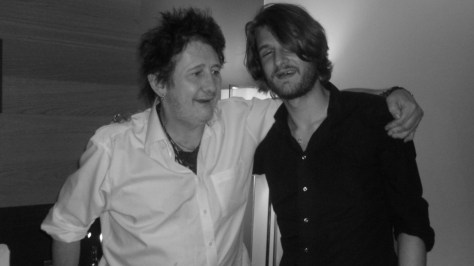
Shane & IShane MacGowan is unwell. In a hotel room in London Bridge, the Pogues frontman is sat up in bed fully dressed, eating soup with his fingers. He runs them around the nearly empty bowl on the tray beside him, licks them delicately and then wipes his hand on the bed sheets. The television is on, chattering about the news, but nobody’s watching. There’s a pack of Gauloises on the bedstand and another pack of Bensons lying on the bed. Shane’s partner Victoria Mary Clarke welcomes me in. “Do you want a glass of this?” she says, proffering a bottle of red wine. “It’s very good. It costs £50.”

She pours me a glass and tops up herself and Shane. He apologises for the drag of having to conduct the interview from his bed. He’s had gastroenteritis. “I’ve been ill. Nothing to do with the food. I just overdid it. The food was great. The whole thing was great. Too great. Now I’m paying the price.”

So now he’s laid up in his sick bed like Cúchulainn, the mythical Irish warrior who, when his enemies finally came for him, was said to have tied himself to a standing stone so as to be able to die on his feet. When Shane wrote his song ‘The Sick Bed Of Cúchulainn’, he transposed one of the stories of the indefatigable hero onto a tale about a fighter with Frank Ryan’s anti-fascist Irish nationalists. The opening track of The Pogues’ flawless 1985 album Rum, Sodomy & The Lash, it’s archetypal MacGowan songwriting: an exuberant celebration of boozing delivered with a punk snarl yet somehow timeless, as if the song had been passed down through the ages.

But it hadn’t. Shane had to write it. In his memoir of his life in The Pogues, Here Comes Everybody, accordion player James Fearnley says of another track from that album, ‘Sally MacLennane’: “the melodies were so seamlessly Irish I was surprised to find out that the song wasn’t traditional.”

Shane shrugs when I tell him this. “Well, there are similar Irish and Scottish folk songs. There’s only eight notes, or sixteen if you want to count it the proper way. I like story songs. Most really good songs, I’m not necessarily saying mine, but if you think of rock & roll, or blues, go as far back as you want, they all have a story. They’re all about a revolution, or a battle, or a love affair, or whatever. I came from a really musical family. Everybody played music and told stories and made up songs. All the neighbours did as well.”

Shane MacGowan was born to an Irish family living in Kent on Christmas Day 1957. Lord knows what people listened to at Christmas before he wrote ‘Fairytale Of New York’, but presumably there was music of some description. When he was a young child his family moved back to Tipperary, but they were in England again by the time he went to school. He won a literature scholarship to go to Westminster School, but was expelled after being caught in possession of dope, acid and pills.

As a young man in London he was in a succession of “Irish ballad groups and rock bands”, and felt the first trembles of punk: “Things were building up to punk for years. There were people like the Stooges, the MC5 and the Dolls. The Pistols have to take the credit, but one of the regular support gigs they got when they were starting out was with the 101ers. Joe Strummer really liked them. At that point Mick Jones and Tony James were in a band called London SS. There’s a joke behind that, because Mick had got a university degree while living up on the 90th floor of a godforsaken tower block in Harrow Road. With that degree he’d got the job of opening letter bombs for the Department of Health and Social Security: the DSS.”

Shane lets out a wheezing snicker, which sounds something like how Muttley would laugh if he’d given Dick Dastardly the slip and gone out for a night on the tiles with Tom Waits instead.

“They were also into the leather and coy Fascist bling and coy Communist bling, all at the same time. I saw a guy wearing this homemade shirt one night and then the next day they had a copy of it in Sex for fucking £50. It had Marx and some Nazi or Ivan The Terrible on it, and it was covered in hammers and sickles and swastikas. It was great. The main thing was making your own stuff, which the hippies did to a certain extent with tie-dye and all that shit. You could make your own fashion, you know what I mean? Then, so that people wouldn’t feel left out if they couldn’t make their own clothes, or destroy their own clothes and then put them back together with safety pins, you could buy one for £50 from the Sex shop – or you could nick one! I used to let people nick my shirts, as advertising.”

It must have been an exhilarating time to be a part of the music scene in London?

“The scene that formed round the Pistols was something that record labels just couldn’t understand at all. They were all people like Dave Dee of Dave Dee, Dozy, Beaky, Mick and Tich. Do you know them?”

I have to confess to not being au fait with the oeuvre of Dave Dee, Dozy, Beaky, Mick and Tich.

“They were a completely over-the-top, grotesque, outrageous Sixties band. In the Sixties everyone knew ‘The Legend Of Xanadu’ by Dave Dee, Dozy, Beaky, Mick and Tich. He used to crack a whip. The fact that people in those days in the state they were in could actually say their name… Dave Dee was the guy who later got sacked from one of the record labels for not signing up The Sex Pistols. Yes, they were crass and outrageous. Yes, The Sex Pistols pissed older people off, but so did Dave Dee, Dozy, Beaky, Mick and Tich!”

Shane snickers again and streaks another soupy hand down the bed sheets. Victoria, who has been watching him do this since I arrived, finally snaps: “Shane, there is a napkin!”

He glances around guiltily and wipes his hand on a napkin from the tray, then deposits it into his soup bowl.

The Pogues released their first record ‘Red Roses For Me’ in 1984, a mix of Shane’s gutter hymns and traditional Irish songs with one, ‘The Auld Triangle’, written by Dominic and Brendan Behan. Behan also features on one of the album’s most famous tracks, ‘Streams Of Whiskey’, appearing to Shane in a dream. How important was the great poet’s influence on him as a young writer?

“It’s interesting. Behan recorded loads of talk-books in which he bursts into song. I think they’re great. I also think he was a great writer of stories. He used to experience things when he was pissed but he couldn’t discipline himself to write it down or type it out. Even if he had his things in the pub with him, he’d only have a pint of stout because he’d drink slowly while he was doing it. He couldn’t get wrecked and then go home and write a bloody story. It’s not the same with me. It’s strange… Later on, he could write stories when he was pissed because people recorded him. He’d go off in all directions. It’s fascinating, really fascinating.”

The streams of whiskey helped the streams of consciousness along?

“Yeah, and bursting into song. All that. That’s the thing about Irish writing. It developed from story-telling. Story-telling is a huge thing in Ireland, or used to be. All the playwrights, all the novelists, all the poets… well they’re all poets. It’s all poetry, really, the same way that Shakespeare is poetry in play-form.”

There’s a strong tradition of public performance.

“Yes, exactly yes. Music and poetry are meant to be performed. I mean you can get a really good poem, but if somebody reads it out without really thinking about what it means then it’s a total waste of everybody’s time.”

Does he still enjoy getting up in front of an audience?

“I’m phasing it down,” he says, then nods at Victoria: “She’s seen thousands of Pogues, Popes, whatever you want to call it, gigs with me in them. She reckons the first of the nights in Paris that we were filming for the DVD was really great and the second night was even better.”

“I was really surprised,” she says. “You never know what to expect. It might have been terrible. Ha!”

“When the Parisians go nuts they really go nuts. The audience gives you so much.” He grins at Victoria: “But I’m always great, anyway.”

Victoria smiles back: “You’re not always great. Sometimes you’re shit.”

“Not any more!” He snickers. “Occasionally… no, I’m never shit! Sometimes I’m as boring as the rest of them, but in Paris they were great as well. The audience was great. We were great.”

The Pogues’ Christmas tours have become a semi-regular fixture, and I don’t doubt that the royalty cheques for ‘Fairytale Of New York’ are a pleasant gift each year, but I ask whether Shane ever fears that song overshadows the rest of the band’s work?

He shrugs. He doesn’t seem to mind if it does or not. “Well, yes, it was a Christmas hit and Kirsty is on it and it was a special moment. It took two years for that thing to go from the original bet with Elvis Costello, who was no longer producing it when we eventually did it with Kirsty. Originally it was going to be Cait O’Riordan doing it. Cait did it well, but I think Kirsty was a really important element. She had the right attitude, and she produced herself. She separately double-tracked her own voice.”

How was working with Elvis Costello on Rum, Sodomy & The Lash? Shane pauses and there’s an audible intake of breath from Victoria before he answers: “I preferred working with Kirsty!” His laugh sounds like a death rattle. “A lot! And I preferred working with Cait but he [Costello] went off and fucking married her and made her leave the bloody band. I was furious.”

Shane’s own departure from the band, precipitated by his failure to even turn up for the opening dates of their 1988 American tour, finally came when he found himself sacked at a Japanese festival in 1991.

He would go on to marshall a new band, The Popes, for a few years, but before that he recorded and released a duet with Nick Cave, ‘What A Wonderful World’, in 1992. He’s recorded with Cave on several occasions since. How did that friendship come about?

“I was always into Nick Cave, and I always hoped he was into me. It turned out he was. There’s a lot of similarities, I think, between our songs. We’re very different people. We have a lot of similarities, but he’s more studious I suppose.”

Victoria picks up on Shane’s understatement: “It’s strange because Nick is very intolerant of people. He really doesn’t like people. Shane is the only person I’ve ever seen him tolerate. The thing about Shane is he’s late for everything. He’s messy, he spills drinks. He’s quite the opposite of Nick, but Nick doesn’t mind. It’s strange, because he’d criticise anyone else for that. He just forgives Shane anything. Nick’s very disciplined. He gets up at 6am and sits in his little shed and writes. He loves to work more than anything.”

Shane laughs: “And I love to work less than anything.”

This seems to be one of the central facts of Shane’s mythology: that unlike Cave’s meticulous and painstaking craft, there was a time when Shane would simply load up on drink and drugs and the poetry would flow out of him. Was that really how he experienced it? Was the writing automatic?

“Yeah, a lot of the time, yeah. Lots of people do that. You chug away at the same old riff until it’s hypnotic. Maybe you get it wrong, and then you have a new riff, or at least a different riff. You get a title. A title is a really good start. Then musically a riff. I don’t feel like it’s me writing it.”

I don’t know if he’s being disingenuous. His songwriting is rich with classical and literary allusions and layers of meaning. Was there really no graft involved in constructing them?

Shane pulls a face at this: “Well that’s not graft, do you know what I mean? Literature is just stories. One of the greatest works of literature is Finnegans Wake by James Joyce. The inspiration for that came from ‘Finnegan’s Wake’ which is a great story-song. Nobody knows who wrote it, it’s so old. Well, it’s not that old. It’s 200 years old maybe. People just used to pass it down, as often happened at wakes. That’s what wakes are for. People would start off being very nice about the person, then there’d be more and more slanging and then they’d have a huge row and all the rest of it. If that didn’t wake them up then they must be dead, yeah? It was all because there were so many premature burials in those days.”

He goes to take another swig of wine, then pauses with his glass poised at his lips as he remembers something more about Joyce: “In his later years Joyce was nearly blind and he was using a typewriter that he was constantly having to hock and get out again. There were two or three bum letters on it so he didn’t know exactly what was going to come out. He had bad eyesight, a bad back, all the rest of it. In those days a doctor would write you a prescription for everything, and he was a boozer from an early age.”

Were Behan and Joyce your biggest influences?

“The whole folk tradition, it doesn’t have to be Irish. I might be in a cab with a Greek guy, it might be in Greece, it might be in London, and if he’s singing this great song, great tune, beautiful song and I’m asking him: ‘Can you give me a rough idea of what it’s about?’ He’ll say: ‘It’s about a guy murdering his girlfriend.’ In Irish and English songs there’s often no reason given why the guy kills his girlfriend, then the girlfriend’s ghost warns him that he’s going to get caught. They’re going to find her body and he’s going to get hung. She’s not angry with him, because she loves him and just wants to warn him.”

I guess that’s a recurring theme in folk songs.

“It’s a recurring theme in life, really.” He lets out a long laugh: “Sex, birds, life, death, sex, birds, life, death.”

There’s plenty of death in Shane’s writing. When he first played the band ‘A Pair Of Brown Eyes’, guitarist Spider Stacy’s initial response was: “You sick fuck! Labelled parts one to three? What sort of a twisted, fucked-up sort of mind comes up with lyrics like that?”

“Mine,” said Shane.

“That song’s about a guy who’s pissed off because he’s broken up with his girlfriend,” Shane explains now. “There’s also this older guy whinging away in the corner. There’s people singing songs and it gives you the titles of them. There’s a bit where Johnny Cash sings ‘A Thing Called Love’ on the jukebox, and ‘My Elusive Dreams’ is by Ray Lynam and Philomena Begley. That particular song is kind of autobiographical. It’s set in The Scottish Stores which is an Irish bar near Camden, do you know it?”

It’s now The Flying Scotsman, the rundown strip pub with blacked-out windows by King’s Cross Station.

“There’ll always be someone, you’d be sitting there feeling miserable and some old geezer says: ‘Why do you look so bloody miserable? Listen to what happened to me!’ and he tells him about whatever war it was. Of course, there was a war going on at the time in Ireland, as usual.”

Having had his premature death predicated for years, Shane has now reached the 30th anniversary of The Pogues. What is he proudest of?

“Getting this far without fucking being… well, I have been in the nuthouse. I’ve been locked up a few times, but without any serious… I have been beaten up several times. Then I’ve beaten other people up. I’ve had some ludicrous accidents, but…”

He looks at Victoria. “You’re alive,” she says.

Shane seizes on this: “Yes! That’s my greatest achievement: still being alive!”

“You’ve come very, very close to death,” she replies. “I found you not breathing once.”

“A couple of times you’ve started my heart.”

Victoria turns to me: “He jumped out of a moving car onto a motorway.”

Shane reacts with practised exasperation. He’s fought this corner before: “The woman was only driving at twenty miles an hour and she couldn’t see! She wasn’t wearing her glasses!”

Victoria ignores his protestations: “And he got hit by a taxi that was going quite fast.”

Shane nods: “Twice. Once I got hit by a taxi that was going pretty fast, but it glanced off me. If it had been a few inches in the other direction he’d have hit me head on and I’d be dead. I was knocked 18 feet across the road. On another occasion it happened when I was working at the Hudson Bay Warehouse. I wasn’t even drunk, just hungover from the night before. I was doing overtime on a Sunday. At lunch hour most people used to go across the road to the pub. I was just wandering across, and this Renault hit me much faster than the taxi. Again he glanced me but it knocked me across the road. I was really lucky. I didn’t even realise I had a lacerated arm. With the taxi I had a smashed up leg on one side.”

Shane ruminates on this for a moment. “You know, some people are lucky, and some people aren’t. I’m a lucky guy, as a general rule.”

Do you have any regrets?

“There are things that I wish had gone the other way, but there are no regrets. I savagely get rid of them. I won’t dwell on regrets. If it means going out and having a skin full then I’ll go out and have a skin full.”

He pauses and grins: “Then I’ll have something else to regret.”

Everyone laughs, and Shane turns the conversation back to writing. He asks about my work, then tells me proudly about Victoria’s books, which she believes are channeled from angels. I ask him if he’s religious?

“If you mean by ‘religious’, do I believe that things have happened to me which aren’t supposed to be possible? Then yes. I’m not going to say that I didn’t see what I’ve seen. I’ve seen ghosts. I’ve seen loads of ghosts. Whether it was Ireland or England I was always brought up in fairly haunted areas, particularly in Ireland. Well, the whole of Ireland is haunted.”

“I don’t see things,” Victoria points out.

“But you hear them.”

“I don’t hear them,” she says, “but the words come automatically.”

“I actually see people dictating to me behind me through… they call it the third eye, but the Japs reckon you’ve got at least eight, apart from the two here. I’ve seen ghosts behind me in period costume dictating songs on a couple of occasions. ‘A Rainy Night In Soho’ was automatic writing. I had no idea what it was about. I had a vague idea by the time I got to the fourth verse but until then I hadn’t got a clue what was going on.”

I’m not sure that I believe in angels or ghosts in period costumes, but I do believe that anything that helps a person write a song as fierce and pure and righteous as ‘A Rainy Night In Soho’ is a good thing. I tell Shane that the line that always floors me is when he starts the final verse with: “Now the song is nearly over…”

“That just came out, you know what I mean? I know it sounds very clever-clever, but it wasn’t me being clever-clever.”

It seems self-aware, but it really captures that feeling of melancholy.

“Yes, yes. It’s meant to be melancholy. It is melancholy.”

It’s hard to imagine writing something that beautiful while being completely out of it, I say, but maybe that’s your gift.

Shane takes another swig of wine. His eyes twinkle with a wild kind of joy: “I do have a gift for getting out of it.”

Originally published by The Quietus.

‘A Blank Page Gives Me Freedom’

Orhan Pamuk

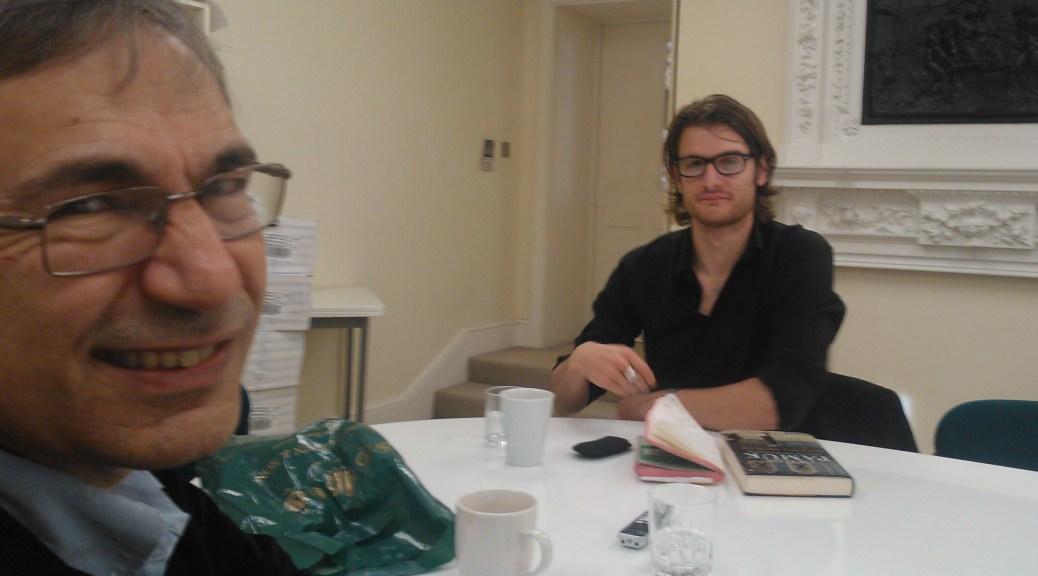
Orhan Pamuk arrives in Bloomsbury carrying Japanese paintbrushes. It’s a crisp autumn afternoon and the 2006 Nobel Literature Laureate has spent the morning shopping for art supplies. “The painter in me has been resurrected,” he says with a playful smile as we settle down to drink strong black tea at his publisher’s office.

Pamuk was born in Istanbul on 7 June 1952. Growing up on the fault line between Europe and the East, the child who would become the most widely-read Turkish writer in history dreamed not of prose, but of painting. His family supported his art and architecture studies and were surprised when, at the age of 23, something changed. “Suddenly a screw was loose in my head and I began to write novels,” he says. “I could never explain why that happened, but it’s an essential fact of my life. My mind is still busy with it. I wrote My Name Is Red to try and understand the joys of painting and Istanbul to try and understand why I did what I did. The Museum Of Innocence also addresses the dead painter in me. The dead painter in me helps the writer in me. They are getting closer. Perhaps I will try to combine pictures with text more often in my books in the future.”

What happened to Pamuk to make his life skip a groove? In The Silent House, the novel which he wrote in 1983 but is now being published for the first time in English, there is a character who “read so many books that he went crazy.” This is an autobiographical nod. He is the boy who read so many books that he went crazy. “Not one particular book, but Tolstoy, Dostoevsky, Thomas Mann, Borges, Calvino… these writers and their novels made me. Reading novels changed my life. I’ve said that I mysteriously moved from painting to novels but at that time I was reading so much that it’s really no mystery. Discovering these writers, as Borges once said about reading Dostoevsky for the first time, is like the experience of seeing the sea for the first time in your life. Discovering these writers, all of them, was like seeing the sea for the first time. You’re stuck there. You want to be something like that. You want to belong to that.”

So he put down his paintbrushes and began to write. Actually, the truth is he had already started experimenting with language. At 19 he had some of his poems published in one of Turkey’s leading literary magazines, but he quickly realised he wasn’t born to write poetry. “My little poetic success helped me to move from painting to literature, and gave me some self confidence, but frankly I didn’t believe that I was a poet. Turkey and the Ottoman Empire have a long tradition of poetry. The poet can pose as someone who is possessed by God. He is not a calculating spirit but is frank and honest under the command of a higher being. The poet has a certain status in the culture, while writing novels is a lesser thing. You are a long-distance runner. This distinction still exists. A poet is a saint, a novelist is a clerk.”

Pamuk explores this idea in his novel Snow, which features a poet who hears voices. “This is related to Coleridge’s experiences of writing Kubla Khan,” he explains, “where poetry comes under the influence of God, and also opium perhaps, and then disappears. Poetry is something that you are not doing, but you are possessed by some outer force. It is moving your hand while you watch with amazement.”

Unexpectedly, I’m reminded of Shane MacGowan. I tell Pamuk that The Pogues frontman recently told me in an interview for this website that he believes some of his songs came from a ghost standing behind him and writing for him.

“That is sweet,” Pamuk replies, “It’s a rhetorical thing that makes you relax. To a point I agree with it. All novels have those kind of poetical pages, which later you have to edit and manage, but there are also pages where this kind of poetry doesn’t help. I like surrealistic writing, or what they call automatic writing, but not always. It has to be balanced with a calculating, managing, orchestrating sensibility. I argued in My Name Is Red that Western Civilisation puts artistic creativity on a pedestal. That’s a nice thing. We respect artists. But most of art, I tell you as a novelist, is really craft. I turn around sentences again and again. Yes, there is some artistic element, but lots of craft. Now the poor craftsmen of medieval time are discredited, but all the Picassos and Turners and Coleridges of history were also craftsmen.”

Pamuk spent seven years in the mid-Seventies learning and honing his craft, reading and writing during the days before wrapping up “in two sweaters and an overcoat” to go to the film screenings at the European consulates. There he discovered yet more great storytellers: Orson Welles, Roman Polanski and Wim Wenders. Under all of these influences he published his first novel, Cevdet Bey And His Sons, in 1982 at the age of 30.

The Silent House was his second novel to be published, but the third he had written. He was forced to abandon an “outspoken political novel” he had been working on when there was a military coup in Turkey in 1980. He didn’t think the next book he wrote was political at all, but 29 years on The Silent House seems remarkably prescient about the tensions between the West and the Muslim world which have surfaced over the last three decades.

“It does foresee the future in a sense,” Pamuk agrees. “The character Hasan is an angry and resentful 18-year-old high school student who flunks his classes and goes around with right-wing militants. He collects money from shop owners, terrorizing them. His language of anti-Western resentment is something that everybody knew about in Turkey but nobody cared. That resentment grew and grew. Now it is on the agenda. You can call it ‘political Islam’ or ‘Islamic fundamentalism’, but it’s not necessarily Islam. It could be Hindi or Japanese anti-Western sentiment. The voice of Hasan is based on the confessions of Turkish right-wingers who were arrested after the military coup of 1980. The army not only rounded-up left-wing militants but also some of the right-wingers who had killed people. They were forthcoming in their confessions about what they did but also about their daily lives and political fantasies.”

Has the political landscape changed significantly in the last 29 years?

“Istanbul had changed. My city grew from one million to 14 million. Swallowed by this development was all the Mediterranean flora of fig trees and olive trees, little shantytowns and factories, Ottomans ruins, railroads and hills. The whole landscape has changed, swallowed by high-rises, bigger factories and working-class districts. On the other hand, the problems of modernising Turkey and the ambitions of modernisation, the contradicting resistance and anger, the anti-Western resentment: they’re the same. One more thing changed: the country grew richer, Istanbul is not as frustrated anymore. In the novel, even the upper classes are frustrated. They feel all sorts of inferiority, troubled by their self-image: those angry and resentful voices on the street are fading away because the country is getting richer.”

You’ve said recently that you think the European Union is turning away from Turkey. How concerned are you by that?

“I was eager for Turkey to join the EU, but I understand that the EU has bigger problems now. Enlargement has slowed down as everyone is busy with the Euro problem, which is more than a European problem, it’s a global problem. I’m a bit disappointed about Turkey’s entry, but I’m not crying about it.”

Are you concerned though that Europe’s resistance to admitting Turkey was a product of religious divisions?

“Yes. Europe has every right to ask if Turkey is getting religious or parochial, but also we outsiders who believe in Europe have the right to say that if Europe defines itself not by liberté, égalité, fraternité, but by Christianity or ethnicity then it is going to end up just like Turkey too. If your definition of Europe is based on religion then yes, Turkey has no part in it, but if it’s something else, like liberté, égalité, fraternité, then once Turkey satisfies these criteria it should have a place.”

As he’s mentioned, parts of The Silent House are drawn from his memories of being a young man in Istanbul, and I ask him if there was a certain nostalgic melancholy that came from revisiting the work during the process of translation: “No. I’m happy that the whole nation got rid of this frustrating sense that nothing was happening, and stopped killing each other. Don’t forget that the book describes an Istanbul of the late 1970s and early 1980s where left wing militants and right wing militants were seriously shooting each other. If you read the wrong newspaper in the wrong neighbourhood you could get shot. So I’m not nostalgic about that period, but I may be nostalgic about the old streets of Istanbul. This is not about that. This is about the intensity of living in a country where the expectation of unhappiness is so intense.”

If you could speak to yourself in 1983, would you give yourself any advice?

“I would say to myself: don’t make the ending that tragic. I would definitely say that. I may be wrong, but I would make the picture broader and the book longer, adding more characters, but the rest I’m happy with. I’m happy that I did not give too much prominence to inner monologue or stream-of-consciousness, as other people did at that time. It’s balanced. I’d argue that there’s no such thing as inner monologue. It’s really inner dialogue. We don’t talk just to ourselves, we talk to some real or imaginary person or maybe something that somebody said 20 years ago, but there is another text to think against and other beings. It’s a literary concept, but actually inner monologue, I argue, is inner dialogue. You always answer someone in your mind.”

This statement strikes me as startlingly lucid, the sort of keen observation which makes Pamuk such an enthralling and humane writer. There are many reasons to love his books. He is wise and kind and treats his characters with empathy, but perhaps more than anything what brings me back to his novels is the elegiac ocean of melancholy which dwells within them. In his 2003 memoir Istanbul: Memories Of A City, he dedicates a chapter to Turkish melancholy: hüzün.

“I asked myself what feeling does Istanbul evoke in me? The obvious answer, not just in me but in everyone in Turkish poetry and music, is hüzün. Istanbul was my autobiography until the age of 23. It ends in 1974. The young generation of Turkish readers said: ‘No, our Istanbul is not black and white and melancholy. It’s a happy, colourful place.’ They were right, and today they would be even more right. The economic boom made the city, at least its historical and touristy parts, a very colourful and happy place. However, that historical and touristy Istanbul is not the only Istanbul. There remain 13 million people who are living in the peripheries in the working class districts. Go to those places in winter and again you will find the melancholy I mention in Istanbul.”

Are you still trying to capture that in your work?

“My Istanbul book, The Museum Of Innocence and The Innocence Of Objects have the same sentiment. That this city was provincial, that it generated sadness and inwardness not in individuals but in the whole community, but as I say it is changing now.”

But can economic changes really do anything about the underlying melancholy?

“Hüzün also has communal ethical and moral dimensions that can be compared to what an American scholar said about Japanese culture: ‘the nobility of failure’. Hüzün advises you: don’t venture too much, you’re not going to succeed. Be modest. Don’t be individualistic or capitalistic but belong to the community. I respect some of these sentiments, but it is also sometimes important to have the creativity of the solitary artist. Hüzün advises too much to respect the elders or establishment. That melancholy has a negative medieval side to it. A terror of being yourself. It tells you to belong to the community, just don’t be distinct. Be like others. Some of these ideas may work in pre-modernity,” he laughs, “but I don’t like them.”

Is hüzün related to the existential terror of death?

“No, belonging to a community doesn’t avoid the idea of death, really,” he laughs again. “Fear of death, all the anxieties about that… maybe that fear is not around in me. Maybe it will come to me, but I don’t think of it too much. In my youth, say, reading Albert Camus: “The greatest philosophical question is whether to commit suicide or not.” I loved these questions as a teenager, but not as someone worrying about the other world or what will happen to me. Maybe that will come. Now in my mind I’m not as busy with teenage metaphysics. Maybe my paintings are a bit, but I’ve changed. Now I think of death as a very natural ending. I hope it happens naturally, but my mind is not busy with death. I am busy with the novels that I will write. Yes, of course I should have characters whose minds are busy with it, but I have acknowledged death. Maybe because of the likes of Camus or Dostoevsky and that sort of existential thinking in my early twenties. It is not news for me. I’m not worried about it, but perhaps I will begin worrying as it gets closer.”

In 2006 Pamuk had just started teaching at Columbia University in New York and was working on his next novel, The Museum Of Innocence. One morning, at seven am, he received a phone call to tell him he had won the Nobel Prize. “My automatic reaction was to say: “This will not change my life!” The words came out of me in a hurry, in a panic. That is the cliché about the prize. As a writer, it didn’t change me. I continued the novel I was in the middle of. I was lucky, because I didn’t have to say: ‘Oh, what am I going to do now? What is my next project?’ I was deeply buried in a project that I could continue. However, it did change my life in many ways. It made me more of a diplomat of Turkey, with more political responsibilities and pressures. Everyone is watching, so you cannot be playful or silly or irresponsible. I am doing my best to keep the irresponsible, playful child in me alive. This is the one who helps me write my books and find new ideas. That is what I have to protect above the formality or snobbishness the prize may give you.”

Do you think of yourself as the voice of a generation?

“I’d prefer that to be ‘voice of a nation’. Inevitably, you represent both your nation and generation. From the visitors to the Museum of Innocence, I know that they tell me they had the same things in Spain, and Italy, and Iran. That immediately places you in your generation, but of course we all write to address something beyond our generation. The problem about being a famous Nobel Prize winner, particularly as there are not many other high-profile Turkish intellectuals, is that the burden of both explaining the country to the world and addressing political issues is sometimes too much.”

That next novel, The Museum of Innocence, became one of Pamuk’s greatest projects and helped to resurrect the painter within him. “The Museum of Innocence is a novel about love that doesn’t put love on a pedestal. It treats it as a more human thing, something like a car accident that happens to all of us. We all behave the same. All the negotiations with the lover: anger, resentment, impatience and so on. In the story, the upper class spoiled man collects the things that his beloved touches, and after the sad ending he wants to exhibit these objects and even tells us how to make the museum. Four years after I published the book in Turkey I created the museum, and opened it this April in Istanbul. Both the novel and the museum were conceived together. It’s not that I had a successful selling novel and then wanted to illustrate it. They are telling the same story. When I opened it the welcome from the Turkish media was very sweet, which was surprising but I was very happy. We have a good number of visitors. In 2011 I did not write as much in the last six months as I had been for the last 38 years. I quit writing fiction and gave all of my energy to the eleven or twelve artists, carpenters, friends and assistants who were working together. That was a really great time. The painter in me was so happy, but so was the writer in me. Now that period is over I’ve returned to my old self. Empty page. Discipline. Working all the time. Which I like.”

Have do you feel when you face the blank page?

“No problem. I never have what Americans call ‘writer’s block’. Perhaps it’s because I plan ahead, and if I do feel blocked I can move to another chapter. Perhaps it’s because I’m optimistic. If I know what I’m going to write, and I always prepare that the night before, then a blank page gives me not anxiety but freedom. The freedom of creativity and being alive.”

Thomas Mann said that writers are people for whom writing is more difficult than other people. Do you agree?

“Writing is always difficult, but you have your rewards too. You are writing something that nobody else has done. Even a little detail, if no-one else has done it then you’re happy. It’s your invention. There is that kind of happiness. Writing is difficult, but it’s also rewarding. If you’re happy with what you do then you smile all night. Sometimes you can’t. Then I’m sulking and my daughter says to me: “You didn’t write well today, is that it?””

Do you enjoy holding court in public?

“I didn’t. I’m not a good party person, especially when I was a teenager. I was not good at parties. That is represented in The Silent House, there is lots of nervousness and inner dialogue going on. I learned to do it because of the success of my books, learning to introduce and read from them. Contrary to my youthful days I now enjoy listening to other people talk. In my youth, just like the characters Hasan and Metin, I tried to prove myself. That has changed, and I’m not complaining!”

I asked that because I was wondering if you consider yourself a natural storyteller?

“No, I don’t. I’m a modern novelist and a modern novelist should perhaps occasionally, like Albert Camus in L’Etranger, be a natural storyteller, but most of it is planning, making decisions even before you start to write. I’m also a photographer. You don’t mind, right?”

While he was speaking Pamuk has taken his digital camera out of his jacket pocket, and has crooked his arm over his shoulder so that he can photograph himself with me in the back of the shot. The phrase ‘MySpace pose’ flashes across my mind. I tell him I don’t mind as long as he takes one for me as well. He does.

From the look on Pamuk’s face I get the impression that the “irresponsible, playful child” within him is at work, so I ask him to tell me a joke. He thinks for a moment, then says: “This comes from life, and it’s about a subject that I deal with in my books: sibling rivalry. I used to exchange letters with my brother full of this rivalry. Eventually I wrote to him: ‘Look, the two of us have wasted a lot of energy on resentment. Now that we’re going to university, we should forget this competition between us. He wrote back: ‘Yes, you’re right… but I observed it first.’”

He smiles at the memory. “I like these oxymoronic jokes and self-contradictory observations. It is like the guys, and I come across a lot of them in Turkey, who say that they are ‘probably the most modest person in the world.’ They are proud of their modesty, and say: ‘I’m very, very modest. Perhaps you didn’t notice it. There’s nobody more modest than I am.’”

What are you proudest of?

“I’m happy that I did not waste much time in life. I’m happy that I did not spend too much time hanging out with the boys, that I locked myself up. I was partly like Metin, my character who wants upper-class mobility or some success and wants to try and prove his intellect. Perhaps I did that, but only through writing books, not through other venues like business. I’m proud of the fact that although this or that happened I never left writing. I continued to write and from the age of 23 I’ve never stopped. Through hard times, political and personal problems, I wrote my novels. The experience of writing a novel is the experience of looking at the world through other’s windows, from other points of view. This teaches you a sort of humility if you do it for almost 40 years. I’m proud of that humility, if I have it. I hope I have it.”

I can’t resist telling him that being proud of his humility sounds like one of his oxymoronic jokes.

He laughs. “Yes, another joke! Another contradiction!”

Have your writing habits changed since you started at 23?

“No, I still handwrite with a fountain pen into squared notebooks.”

Why squared?

He shrugs. “I don’t know. I’m used to it. It’s just easier. The comfort of it. Probably I am working more now. I’m more careful not to waste time. I plan out more, because if you don’t plan then you’ll waste a lot of time, but the rest is the same thing. Sitting at the table in the morning, and if you know what you’re going to do that day then you’re the happiest person alive.”

His playful smile is back. “I’m still like that.”

Originally published by The Quietus.

Richard Milward: The Interpretation of Dreams

Author-Richard-Milward-003_1349704636_crop_550x366There is no such thing as an aspiring writer: you’re either writing or you’re not. Richard Milward sat down at home in Middlesbrough with a pencil and paper aged 12, immediately after devouringTrainspotting in the Britpop-soundtracked summer of 1996, and hasn’t had a month off since. He’d already produced half-a-dozen novels before one of them, a tale of acid-gobbling teenage mums titled Apples, was published in 2007. His second, Ten Storey Love Song, followed in 2009. Written as a single pill-fuelled paragraph, the unbroken text mimics the novel’s tower-block setting, where lives intertwine and interrupt each other at will.

His new book, Kimberly’s Capital Punishment, is a sprawling epic which pushes the formal inventiveness still further: there are multiple endings, the dialogue of inseparable mates Shaun and Sean is rendered as parallel columns and the words from a memorised menu form the shape of a stag’s head on the page. That’s just the start of it, but Milward’s experimentation is always in service of his narrative. Here, he discusses death, drugs and the strange rituals of writing.

Continue reading at The Quietus.

Clash Of The Titans

There’s a monkey who watches the news in the Guggenheim in Bilbao. An artist named Francesc Torres put him there. He’s sat on a rotating high chair, and as it turns his simian gaze takes in first the television playing CNN, then glacially slow footage of the Russian Revolution, Hitler’s rise to power, Roosevelt, Churchill and Stalin at the Yalta Conference, the creation of the state of Israel, decolonization as represented by Algeria’s war of independence and Gorbachev taking control of the Soviet Union. Finally he sees an etching by Goya, in which fortune punishes those who have risen to greatness with downfall. History stutters past as the baffled chimp watches on. I think I know how he must feel, and I don’t even own a rotating high chair. That monkey doesn’t know how lucky he is.

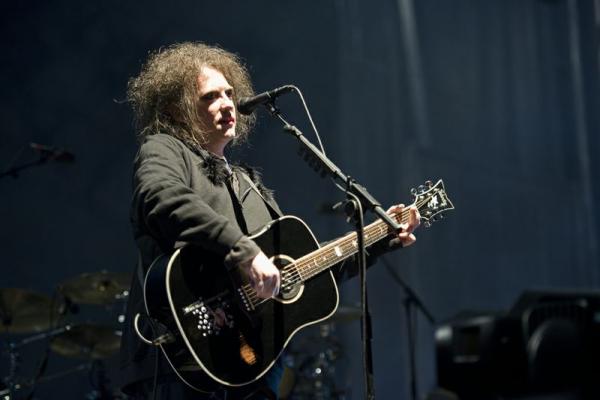
I’ve come to Bilbao to weigh up whether either Radiohead or The Cure can lay claim to being the foremost proponents of live “alternative rock” in 2012 or whether fortune is grasping their ankles and precipitating their downfall.

Continue reading at The Quietus.

I Dreamed Of Being An Olympic Dancer

I am not a dancer. Not even for fun. I’ve been seen to twitch in darkened rooms to pounding basslines but that was just a trick of the strobe light. Mine is a largely sedentary life, aside from the odd unavoidable flight of stairs.

I’ve hiked to the top deck of the bus on occasion. I climb in and out of bed several times each day. I can only imagine that any more strenuous exercise would feel roughly like a hangover, and knowing how much they take it out of me I’ve done all I can to avoid it.

Continue reading at The Quietus.

A Culture In-Between

baloji“The energy in Kinshasa is something else,” says Baloji before pausing, searching for the right way to describe the industrious and frenetic Congolese capital. The sound of the city throbs out of every bar of his second solo album, Kinshasa Succursale, which blends the expressive rap style that made his name in Belgium with the unmistakeable Congolese rhythm of collaborators like Konono No. 1. “Maybe it sounds strange, but I want to say that it is unique. It’s a city that was made for 500,000 people, and now there are 12 million living there. Nothing is really built for that. Everybody has to work hard and to address themselves to their situation, but they do it with elegance. It’s clichéd to say that African people always laugh, or African people are always friendly, but it’s true. There is a spirit there of people saying: ‘Let’s be creative, let’s find a way to make things work.'”

Continue reading at The Quietus.

Mark E Smith: We Only Have This Excerpt

MES

“It’s a shopper’s paradise, isn’t it?” says Mark E Smith as he surveys ‘Smoak’, the inexplicably Texan-themed bar in Manchester’s Malmaison hotel. It’s a Saturday afternoon a month or so before Christmas, and both the hotel bar and the adjacent lobby are crawling with families laden with expensive-looking carrier bags. We collect our beers, chosen at random from a long list of imports, and Smith spots a quiet corner on the other side of the lobby: “We’ll go over there.”

He moves in a shuffling gait, and already seems older than his 54 years, but his wit and his work rate never seem to slow. In the 35 years since he and a handful of mates formed The Fall in an apartment in Prestwich he has released 29 albums under that name. Although his bandmates have long since become the subject of regular rotation, over the years Smith has crafted for himself a complex, literate authorial voice which is as unmistakable as his own Salford anti-vocals. The new record, ‘Ersatz G.B.’, is out in time for the Christmas shoppers, at his own insistence.

Is he happy with it? “Yeah!” he grins as we get settled on a sofa, “but I wouldn’t mind a copy! Have you got one?” He lets out a cackle. Smith laughs long, and hard and often. It’s an expressive laugh, and depending on the subject it ranges from a chesty death rattle to whooping back in his seat. His tongue emerges regularly. It looks like a gila monster, and in his long career it seems to have gotten him in and out of trouble in roughly equal measure.

Where did the title ‘Ersatz G.B.’come from?

“Well, it’s one of them word things. I came up with the title before I started writing half the songs. That’s what they like, the record companies. They like the title first, because I was insisting on it being out by Christmas.”

What’s the thinking behind it?

“Well… what do you think the thinking is behind it?”

I tell him it sounds like a state of the nation address. That Great Britain isn’t what it seems to be, or perhaps what it used to be. Smith, however, has never been one for nostalgia.

“There’s always that rose-coloured glasses shit, but people forget how crap it was in the Seventies. All you’ve got to do is to look to your right to know what the title means. Ha ha ha ha” To our right, a woman with a toddler in a pushchair has taken a seat. The handles of the pushchair are heavy with shopping bags. “What surprised me was that a lot of people didn’t know what ‘ersatz’ was.”

That British people now read less and have smaller vocabularies would seem to validate the point.

“I think that’s probably right, yeah. I don’t think they appreciate what they’ve got, but you’ve got to be careful because you end up sounding like a grumpy old man. It was like this when I was fucking 12. I used to read all the fucking time, but I was the only one at the fucking school who did. I went to a grammar school but I was the only one who actually read anything. It’s not because of computers or anything. People have always been pig ignorant! Ha! There’s nowt you can do about it! Ha Ha Ha! Cheers!”

It’s Smith’s turn to ask the questions, so we talk for a while about The Quietus and about how much I’m getting paid to do this interview, and then about our shared love of Hunter S Thompson and conversely about the lad’s mag journalism he unsurprisingly abhors:

“I’ve never been into cars or looking at birds. I don’t understand that. It’s funny because when my book came out, I went to this writing convention in Wales. It’s like where all these writers congregate. Very famous.”

The Hay festival?

“Yeah. So that fella was there. The Top Gear fella. Jeremy whodyamob. Jeremy whatisface from Top Gear.”

Oh, Clarkson.

“I dunno, I know nothing about cars at all. Even my dad was like that. My dad had a Lada. Ha ha ha. What happened was, I was doing this thing about my book, and there was about 500 people there. But for this geezer there was thousands. You couldn’t get out of the place. There was about a million cars on this camping site. It’s almost like you’re drowning in people who look like him!” Smith points at a balding, middle-aged man reading a newspaper on the other side of the lobby. “Fucking thousands of them! I had this fucking co-writer with me, the ghost-writer. The fucking idiot is shaking hands with the fuckers because he thinks they’ve all come to see me, or ‘im. So I fucking bottled him! Ha ha ha ha. I bottled him in the car park! He was shaking hands with fucking every fucker you’d see! I just wanted to get out, it was that frustrating. It was horrible.”

It’s a pretty damning indictment of people’s reading habits that Jeremy Clarkson is the most popular man at the Hay Festival.

“I know, yeah, but there weren’t like young girls there. It was people like him.” He points again. “It was quite frightening! Thousands and thousands of thousands of them, and they must be parents so you can’t really blame the kids who aren’t reading. A lot of fellas my age, they won’t fucking grow up.”

Who were your literary influences?

“When I was about your age I used to like Burroughs and stuff like that.”

You can hear echoes of Burroughs’ fragmented narratives in some of Smith’s most glorious lyrics, like this, from 1982’s ‘The Classical’: “You won’t find anything more ridiculous than this new profile razor unit, made with the highest British attention to the wrong detail, become obsolete units surrounded by hail”. Like Burroughs, Smith gets his hands dirty operating down in the bowels of language.

“Yeah, I think his influence is apparent. I used to read a lot of Nietzsche. Still do!” A sly laugh, before he deadpans: “He’s not very popular.”

Are you attracted to the idea of the übermensch?

“No, I think that’s all bullshit. Arthur Machen, you know, the horror writer. HP Lovecraft, who I still read, sadly. I could go on forever really. All the Pan Horror classics.”

What about Ballard? I’ve thought I heard his influence a few times?

He turns the question around: “Do you like him?”

Yeah, I do. How about you?

“Well, I don’t know. I like that one where the world’s underwater. He did ‘Crash’, though, I didn’t like that one. I prefer Clarke. Arthur C Clarke, people don’t like him but I do. He’s very underrated, I think.”

What about playwrights? There seems to be an obvious parallel between the use of repetition in Samuel Beckett’s work and in the music of The Fall.

“It’s funny you should mention that, because we’re playing the Royal Exchange tomorrow and I saw ‘Waiting for Godot’ there. We’re the first rock group to play there. Personally I don’t know how much he had an influence. Do you like Beckett?”

I do, yeah.

“All me mates do. They really love him. I can’t see it myself. Although, I did see a version of it where it was set in the Weimar Republic and it was really good. The big bully boy was a Nazi. I like Shakespeare a lot, though. Macbeth, in particular. I think Shakespeare’s very, very underrated. Henry V. Every American film you can see they’ve just nicked bits from it. Do you like film?”

I do. Have you seen ‘Naked’ by Mike Leigh?

“Yeah! I’ve got it. It’s good, isn’t it?”

Johnny driving down from Manchester to London and being stuck outside all night.

“I can relate to that, ha ha ha! Seriously, I can relate to that!”

I mention it because in your book you talked about travelling being overrated because: “Where you’re living is in your head.” Johnny says something similar in the film, about never really being outside “because you’re always inside your head.”

We talk a bit more about travel, and touring, and he says:

“I’m in two minds about travelling. The good thing about it is it keeps the group on their fucking toes. They have to be tired for two or three days. A lot of groups nowadays they just think they’re in their little shuttle-bus. The wife’s not very pleased and the group aren’t very pleased, but I just think it’s just good to keep them on the fucking go all the time, even if it’s for useless things. I’ve always been like that. What you get then is ‘Why did we travel for two days just to be onstage for fifty minutes?’ and I say: ‘Because you fucking do.’ If you don’t like it you can fuck off. You’re very lucky to have a job.”

By this point our glasses are empty, so Smith hands me £20 and sends me over to brave the bar. “Do you want to get another one? Could you please? I’ve got something on my feet,” he says. He’s been rubbing them underneath his shoes and it’s clear they’re causing him some pain.

When I get back he says:

“What the fuck is that buffalo doing there?”

He’s been inspecting the bar’s mock saloon decor and faux animal skulls. I tell him it’s not what I expected when I heard I’d be meeting him in a Manchester bar.

“It’s not like people come here expecting a buffalo is it? Ha ha ha. Sorry!”

I ask him about what the music scene was like in Salford in the middle Seventies, and he talks about rebelling against the hippies but taking a lot of acid. “It was proper acid. In my experience, hippies didn’t take acid, they just smoked dope. The bikers sort of controlled it in North Manchester, for a while. If you want a confession, I took acid before I smoked. Before I smoked cigarettes or had a drink. You can’t say that now. I particularly object to ecstasy. It’s a horrible drug, sub par to acid.”

But ecstasy became such a big part of the Manchester scene.

“That’s why I moved to Scotland. It’s true. I’d rather drink whisky, thank you very much. I don’t relate to other groups. I never have. I don’t relate to a lot of musicians to be quite frank. I don’t relate to anything from Manchester and I never saw us as anything like that.”

I take it you won’t be off to see The Stone Roses reform at Heaton Park then?

“Oh no, it was bad enough when Oasis played. I’ve got this really mad mate from Liverpool, and he lives just the other side of Heaton Park. He knocked on me fucking door when Oasis played: ‘What you gonna fucking do? You’ve got some influence in the fucking music industry! Can you fucking tell them to fucking shut up? Every fucking day!’ I said, ‘I can’t do anything about it! I can’t tell ‘em to stop sound checking!’ He said: ‘You fucking know ‘em! Otherwise I’m gonna get my fucking crossbow out!’ I said: ‘DO NOT do that.’ He only likes metal groups. But it’s reformation, innit? ‘Reformation!’ That’s what the song’s about. But you must know this, Kevin: the reason they reform is that the tax bill’s coming. I don’t relate to ‘em at all, really. I don’t see myself as in any way having anything in common with them. I mean, Mike Joyce rang up the other day and I mean, I can get on with some guys, the Gorillaz and all, but I can’t really relate to musicians. How about you, do you play an instrument?”

I don’t, no. I’m a writer.

He laughs and pats me on the shoulder. “Good lad! Correct! So am I. That’s what it’s got on me passport.”

We talk a bit more about writing, and agree that although Tom Wolfe and Hunter Thompson were grouped together as New Journalism, Thompson was out on his own in terms of talent.

“Oh, definitely. Though I had a French friend who used to be a good pal of Thompson’s, and I used to say: ‘Could he do it without the drugs?’ I don’t think Thompson could.”

Was taking drugs a big part of your writing process?

Smith laughs long and hard at this question. “Was the Pope Catholic? Are you mad? Why, have you got any?”

I wish I did.

“I wish you did and all.”

But was it something you felt you had to do to write, like you’re saying about Thompson?

“In life, there’s sex, drugs and rock’n’roll. I’ve never been into either three of them, to be honest. I’d rather read a good book. I’d rather get pissed and have a cigarette.”

I take the hint, and we go outside for a cigarette.

Back inside and with fresh drinks, I ask whether they had to turn around the album quickly to meet his self-imposed Christmas deadline?

“No, it was quite a long process, for me, really. Started about April, so about three or four months. The main thing was to get it out before Christmas. Which is sacrilege in the music business because you can’t bring out things then because there’s a Christmas rush. ‘Best Hits of Robbie Williams’ or whatever, so the factories are all clogged up with crap.”

But you wanted to make sure you were in people’s Christmas stockings?

“Yeah. Definitely. I don’t wanna wait behind ‘The Best of Barry Manilow’, you know what I mean? That’s what The Fall used to be about.”

Getting a record out every year?
“Yeah. As I’m sure you’ve found out most groups are very content to sit on their fucking arses. With Cherry Red we want to bring out a single or two and a fucking LP before Christmas. As opposed to the last record companies we’ve had. It’s more economical for record companies nowadays to bring out ‘The Best of the fucking Three Welsh Dwarves’ or whoever. So I’m pleased that it’s out. I’ve got back to my bloody roots really: ‘Our cassette will be in your shops next week’. People just look at you: ‘We need six months to do it. We need six weeks to develop the marketing.’ All this shit. ‘We need six weeks to do the marketing, six weeks to do the interneting.’ Can’t you just get the fucking thing out?”

You’d think the internet would speed all this up, but the big record companies still seem just as slow.

“If not more.”

Do you use the internet yourself?

“No, not a lot.”

But you own a computer?

“Yes.”

So the possibility’s there.

“My wife is really good at it, so she does it, but sometimes I’m just like: ‘Turn that fucking thing off!’ We’ve got the lot: iPad and that. We’ve got a lot of young friends, so we’ve got the fucking lot. I mean we buy it off ‘em but they give it us, so it’s all there, but it’s what I’ve always said: it’s the tongue of Satan.”

Why’s it the tongue of Satan?

“I don’t know! Somebody said that to me!”

It’s a good phrase anyway.

“I do realise you work for an internet magazine which I think is good. I’ve read the stuff and I think it’s fucking excellent, but what I’m saying is I can’t go over and…” He does a comic mime of a man trying to type. “I can just about turn Channel fucking 26 on, you know what I mean? I’m allergic to machinery and machinery is allergic to me. Nothing’s changed. I’ve got four mobile phones and they all just break. Watches explode. Think I’m kidding, don’t ya?”

Not at all. Do you reads the papers regularly?

“I do, yeah.”

Which paper?

“Well they’re very few and far between where I live. It’s not like London. It’s North Manchester, innit. People don’t bother.”

That’s interesting.

“It fucking is interesting, isn’t it? They’re all trying to work out that…” He mimes typing again, “which is maybe what Blair’s plot was. If people spend so much time on their computers, they’re not reading Marx, are they? They’re not reading anything else either… This beer’s great, isn’t it?”

It’s not bad. Speaking of Blair, do you vote?

“Sometimes, yeah.”

Who did you vote for at the last election?

“Council. The anti-Zionist Jewish something for the restoration of payments in North Manchester. Oh, you mean in the main election? I did the one but last one. The last one I just defaced the card. What a bunch of tossers the Lib Dems turned out to be, eh? You wouldn’t have thought that would you?”

I asked about newspapers because I wanted to know whether you use them in your writing: re-appropriation of texts, Burroughsian cut-up and that sort of thing.

“I like crap, me. The local advertiser and all that. The rubbish that’s written in there is quite fascinating. Free newspapers, the Metro and all that shit. What kind of person writes that? You look at it and think ‘whoever told this cunt he could write?’ It’s gotta be said, hasn’t it? I have wrote letters to the paper, under pseudonyms: ‘As an Australian living in Manchester I am appalled at the standard of writing by your main editor.’ Manchester Evening News. It’s gotta be said, hasn’t it? They have me on page three about how I kill squirrels in me backyard. It’s the Manchester Evening News, you cunts. It used to be a respected newspaper, didn’t it?”

We move on to whiskies, and when I return from the bar he’s spotted “the fucking referee from the bleeding game, Burnley vs. Leeds” checking in. I tell him I saw the comedian Jimmy Carr here just before he arrived. It’s obviously a celebrity hangout.

“Nah! No, ‘cause they’ve all moved up to Salford with the BBC, haven’t they? I know who you mean, that fucking dick. The unfunniest man in the world. None of them are funny, are they? None of them are as funny as Thompson.”

Absolutely not. Has Manchester changed a lot?

“It changes every fucking ten minutes.”

I start to ask about class, but Smith is momentarily distracted: “That fella keeps making gestures to me. I’m gonna hit ‘im in a minute. Is he security or something? Probably a United fan, bet you any money.”

I ask again about changes in class terms.

“I don’t know really, the working class doesn’t exist. I mean, look at this lot.” He indicates the shoppers milling around. “What are you gonna do? ‘Don’t get upset about it,’ that’s what my working class friends say. Leave ‘em to it. Can you see a fucking recession going on here? I fucking can’t. They don’t know what a fucking recession is. No fucking idea. There’s a recession in Greece. People can’t afford to eat. They fucking can round here.”

What do you make of the Occupy movement?

“What made me laugh about the Wall Street one is that it started off a thousand and then 800 of them went home. I said to the wife, they’ve gone home to their mam and dad’s haven’t they? It’s like the hippies. It’s got a bit cold. New York police have stopped treating you with the respect you used to get off them. I fucking hate New York coppers. I was arrested, I was in jail there. Only for a day or two. In New York, in America, it’s like, how much have you got? They don’t go: ‘In the van, mate.’ They go, ‘Who’s your fucking dad?’ You get my drift? They don’t go: ‘Get in the back of the fucking van you’re fucking busted’, if you go: ‘Oh, I’m John Von Dyke the fucking third’, it’s: ‘Oh, sorry sir!’ Ha ha ha. ‘I’m Al Capone’s fucking nephew.’ ‘Release him now.’ ‘My dad’s in the mafia’ Ha ha ha. If you’ve just taken a bad trip, or you’re black, fucking smack in the back of a van. The black fella’s going: ‘You’ll get used to it!’”

What were you arrested for?

“Fucking nothing! Smoking in a hotel room. The police were saying to me: ‘Do you know Freddie Mercury or David Bowie?’ and I said, ‘No, and I don’t fucking want to!’ ‘Do you know New Order?’ ‘Unfortunately, but I don’t fucking like them.”

He flicks a wrist at my whisky glass. “Do you wanna finish that off then, kid? Do you wanna go somewhere else?”

We get in a taxi and drive to Gulliver’s, on Oldham Street. It’s much more like the sort of pub where I would have expected to find Smith, and it couldn’t be more different from the Malmaison. He tells me: “It’s a hard case bar, so you don’t start laughing too much or anything.” From the Hotel Amnesia, to the Hotel Aggro.

He asks me about where I grew up, and then we talk about relationships, about how ‘Perverted by Language’, the book of short stories inspired by his music was “just crap… using my title and writing a load of gibberish”, and about how he prefers Bernard Manning to Stewart Lee. It’s starting to get late, and Smith is growing increasingly truculent and irascible. We’re both a bit drunk by now, and he says a few cruel and ugly things which are maybe intended as a bit of idle provocation. I don’t want to leave on that note, so I try to steer the conversation back towards writing. Did he ever want to write a novel himself?

“No way,” he snaps.

“Fair enough,” I say, “Your songs tell your stories. That’s what makes your music great. That’s what people like me love about The Fall.”

He winds down and looks away from me, at the empty bottle in front of him. “Cheers, Kev,” he says softly. He rubs the sides of his feet and we’re both quiet for a while until, still speaking softly, but in the unmistakeable voice of Mark E Smith, he says: “I think I’m becoming very, very tired, Kevin.”

Originally published by The Quietus.

Now available in Point Close All Quotes: A Quietus Anthology.

Protest And Occupation: Billy Bragg on the future of the Left

Billy_Bragg_Boxing_1319550145_crop_550x660On Saturday (Oct 15) I was one of thousands of people packed into a tight knot outside St Paul’s Cathedral. The heavy-looking wall of policemen made it abundantly clear we’d get no closer to the London Stock Exchange, but that didn’t seem to matter all that much. We’d settle for occupying the home of the old God rather than the new. It was difficult to ignore the sense that anger shared across generations at how corrupt, how selfish and how venal the banks have been is now coming to a head in a long fine flash. A sense of relief, too, that there is international momentum. The occupation which has remained on the steps of the Cathedral since then is just one of hundreds which have sprung up across the world like franchises of the protest on Wall Street. And why not start franchises? After all we are all children raised by multinationals, and this is a protest for a globalised age.

Billy Bragg was there too, but as a supporter, not a leader. “That’s not my role,” he’d told me over coffee a few days earlier. “What I can’t do, despite having been asked by some people, is go down there with my guitar and become Che Guevara. My role is to try and reflect what’s going on. Write about it. Old geezers like me, with our perspective, hopefully we can help to inform. Connect it with what happened in the Thirties, with Woody Guthrie, stuff like that, but they don’t need me there. They’re doing fine. They need me to help spread the word, through the internet and through writing songs. That’s my role, and it’s important that songwriters remember that. Some of the young bands say to me, when I ask them why they don’t talk about this sort of thing in interviews: ‘Oh, I don’t know enough about politics.’ How the fucking hell do you think I learned about it? I left school when I was 16! I didn’t know shit about socialism until the miners’ strike, but you know enough to write the songs.”

Continue reading at The Quietus.

Sex & Trainers In Berlin

“Berlin. I’m a foreigner here, and yet it’s all so familiar,” thought Marion, the trapeze artist, as she lay across her bed under the angel’s watchful gaze in Wings of Desire. I knew how she felt.

Perhaps it’s the Wim Wenders films or the industrial influence this city has exerted on anglophone pop ever since it was the divided, decadent home of Bowie, Iggy Pop and Brian Eno in the 70s, but when I arrived in Berlin the city felt immediately familiar.

Continue reading at The Quietus.

Out Of The Darkness

In 2009, Tasmanian musician Julien Poulson walked into a karaoke bar in Phnom Penh and heard a lone female voice singing Peggy Lee’s ‘Johnny Guitar’. This struck him as odd. Ordinarily the bars in Cambodia’s capital only allow singers to perform in groups of around a dozen, and youth and vacant stares seem to be favoured over musical talent. “They kinda look like the zombies in Michael Jackson’s ‘Thriller’,” he says. As he listened to her he realised why she sang alone. A voice as naturally gifted as this is a rare find.

Continue reading at The Quietus.

This Festival Kills Fascists

HutzSzigetThe men sat in the front row of EasyJet flight 5443 from Gatwick to Budapest were wearing sunglasses and sheepish expressions. A fellow passenger caught their eye. “Are you guys in a band?” she smiled. “Yeah,” sighed Maxim Reality as he glanced across at Liam Howlett and Keith Flint, a man who doesn’t find it easy to look inconspicuous. “We’re The Prodigy.”

A look of recognition flickered across her face and the band shrugged, just a little self-consciously. Like the fine men and women of the British Music Press Corps scattered about the plane behind them, they were on their way to Sziget, a weeklong Hungarian festival which bursts into life every August on an island in the Danube nestled between the once distinct cities of Buda and Pest.

Continue reading at The Quietus.

Congotronics vs Rockers: A New Language In Music

congotronics_vs_rockersIt is early May 2011, and twenty musicians find themselves together for the first time in a recording studio somewhere in Brussels. Producer, bass-player and musical ringleader Vincent Kenis is marshalling his troops: half of them represent ‘Congotronics’ – drawn from the ranks of Konono N°1 and Kasai Allstars – the other half are ‘Rockers’, flown in from the States, Sweden, Argentina and Japan. The atmosphere, according to Matt Mehlan of Skeletons, is “intense”.

Continue reading at The Quietus.

Congo Powers: Konono No.1’s Familial Rhythms

konono-no_1Anyone who has spent time in Kinshasa, the capital of the Democratic Republic of Congo, will know that it’s a city that bustles with an industrious and infectious energy. Maybe it was living there that inspired Mawangu Mingiedi to take that energy and apply it like jump leads to the Bazombo trance music he had grown up with near the Angolan border. In doing so, he created a band called Konono No.1 and revolutionised a musical tradition that stretched back hundreds of years.

The impact Konono No.1 have had on Bazombo music has been literally electrifying. When Mingiedi found himself unable to find the sound he was looking for using traditional instruments he took it upon himself to build the first ever electric likembe. The likembe is a kind of handheld piano played with the thumbs, but amplification using magnets salvaged from old cars transformed it. When the band plays the likembe on stage it looks like they’re operating oversized remote controls. It sounds like nothing you’ve ever heard before.

Continue reading at The Quietus.