Category Archives: The Fall

Dominant

maggie-siff

In the Showtime drama Billions, about a US Attorney going after a corrupt hedge fund manager, the very first shot of the pilot episode shows Paul Giamatti bound and gagged on the floor. A dominatrix appears, putting out a cigarette on his chest and then helpfully alleviating the burn by pissing on him. By the end of the episode, we’ve learned that this woman is his wife.

It’s a hell of a way to make a first impression. For Maggie Siff, who plays the psychiatrist-turned-dominatrix, it presented both a challenge and an opportunity. “The sex stuff I was nervous about,” she says. “I’m not really an exhibitionist, yet I thought it was a really interesting component of their marriage. It felt smart. It made me want to know about that marriage, who those people were to each other and how they arrived there.”

It also makes her – in a show full of macho characters – quite literally the boss?

“And in a very literal sense it makes her the boss, yes,” she laughs. “She’s comfortable in that role.”

Siff and I are having breakfast in a hotel in Lower Manhattan, and over fruit and coffee she’s lamenting how rare it is to be offered such a powerful and complex female role. As an actress she’s become accustomed to being presented with barely-sketched stereotypes. “There’s the bitchy wife, the bitchy ex-wife, the sardonic best friend… there’s a lot of those tropes,” she says. “There’s just a disproportionate number of male writers, and directors, and producers, so the stories that are getting told are slanted that way. You get so used to that as a woman.”

It’s a particularly challenging situation for young actresses who are so keen to find work when they’re starting out that they find themselves playing roles they may inwardly cringe at. Siff, who grew up in the Bronx before studying English at Bryn Mawr, a women’s liberal arts college in Pennsylvania, and theatre at NYU’s Tisch School of the arts, remembers this time of her life well. “When you start out as a scrappy theatre artist just trying to pay back your student loans, you go through several years where you’re panning for gold,” she says. “I wasn’t picky at all. Your standard for what is acceptable goes down because you have to do things just to survive.”

After years working in regional theatre her television break came in her early 30s when she was cast to play department store heiress Rachel Menken in Mad Men. It was a role close to her heart. “Somehow I just knew that part was mine, no matter how many times I went back to audition for it,” she says “I just had this feeling like I knew who that person was. She reminded me of my grandmother, who grew up in the Lower East Side as a Jewish woman. I just thought: ‘Nobody else knows this character as much as I do.’ That’s a very unusual feeling, but it does happen rarely.”

Just as Mad Men was taking off, Siff won her next major part in biker drama Sons of Anarchy. It turned into a six-year job, filming for six months a year in California. She spent her summers there and her winters back in New York with her first love, theatre.

“I never think about quitting acting, but sometimes I do think: ‘When can I just go back to theatre?’” she says, pointing out that on the stage there’s less of a struggle to find great female roles. “It’s nice to go back to jobs where it’s purely an artistic exercise and not a commercial enterprise. I feel like that’s really where you get into the trouble spots. I’d also like to do more teaching, or things where the love that I have for the craft doesn’t have to be constantly slimed by the sexism that is really hard to avoid.”

Finding good roles is a perennial problem for actresses, and one that exacerbates off-screen problems of gender inequality too. When there are fewer great female roles to go around – and fewer female roles in general – it places actresses in a difficult bargaining position which in turn leads to the pay gap that’s recently been such a heated topic of debate in Hollywood. So – I ask Siff – what’s the solution?

“I don’t know, I’m trying to figure it out!” she laughs. “I go round and round because as a working actor you have to figure out how much power you actually have and how to use it. I’m not Scarlett Johansson, I’m not a box office draw in mainstream movies, so I feel like all I can do is be very selective about the kind of jobs that I choose to take. It’s about the kind of stories that I’m choosing to tell.”

The challenge for actresses continues even after they’ve won roles. Often, Siff says, they find themselves having to battle for how their character’s stories will develop. “You have to cross your fingers, especially when you sign on to do television, that the creators and directors are going to stay true to the course of what is promised from the outset,” she says. “Within creative projects you have to fight for the character continuing to have an interesting voice, and also fight for things like how many women are in the writers’ room. I do all that. I try to talk to people about that and make people conscious of it.”

One of the things which drew her to Billions was the chance to play a woman who’s on an equal footing with a cast of powerful men which includes Paul Giamatti as a US Attorney and Damian Lewis’ charismatic hedge fund manager. Siff’s character, Wendy Rhoades, is caught between the two as the wife of Giamatti’s character and a colleague of Lewis’.

“In the pilot the thing that was apparent to me was that she was this strong, unusually smart woman,” says Siff. “She’s really her own woman, and that’s really what attracted me. In terms of the story, yes she is married to somebody, she is somebody’s wife – as a woman you get used to being somebody’s wife, or somebody’s girlfriend, or somebody’s paramour or whatever – but she’s also in the workplace. What she does is of interest to people. She holds power in a similar way to which men do, and that’s interesting.”

Alongside her television work, Siff has also turned to independent films with the hope of telling more nuanced stories about women. This includes 2016’s A Woman, a Part, written and directed by the avant-garde filmmaker Elisabeth Subrin. “She approached me about it and told me what the story was and I thought: ‘Oh, that sounds interesting,’” says Siff, “and familiar.”

The film follows a successful television actress who has a nervous breakdown and returns to New York from Los Angeles to try and reclaim her old friendships and her theatre roots. For Siff, her only concern was that the film might be a little too close to the bone. “It was terrifying because it felt too close,” she says. “I thought: ‘Are people going to think this is me?’ It’s not me, but it’s a story that I’m really interested in telling and when else am I going to get the opportunity to tell this story? Elisabeth calls herself a feminist filmmaker and 50% of the crew were women, so the whole ethos behind the making of the film really had that at its heart.”

One positive change that Siff has observed has been the move of so much talent and money from film to television, where she argues there are more opportunities for actresses, particularly older women. “Films is a shrinking industry, and I think the energy of that has gone over to television,” she says. “The gift of that is there’s this ever-expanding opportunity for women, and for people of colour. You don’t need to get an audience of 16 million people for it to be a hit, so it’s more artisanal. Look at Orange Is The New Black, which has Blair Brown, an amazing theatre actress who’s 70 years old. She has this great arc on that show right now. I look at people like her and think that things are changing.”

In the decade Siff has spent working in television since she was first cast opposite Jon Hamm in Mad Men, she’s seen first-hand how women’s roles have slowly grown more powerful. Where once she had to contend with Don Draper storming out of a board room because he wouldn’t be spoken back to by a woman, now she’s crunching a stiletto’d heel onto Paul Giamatti’s chest. Even so, she points out there’s still some way to go before we see more strong female-led stories on our screens.

“The thing I find myself grappling with is how many macho shows I’ve been on,” she says. “You get to be a certain age, and as a 40 year-old woman you look back on your career and think: ‘How much of it has been spent shining a light on a man?’, you know?”

Originally published by The Fall.

The Artist

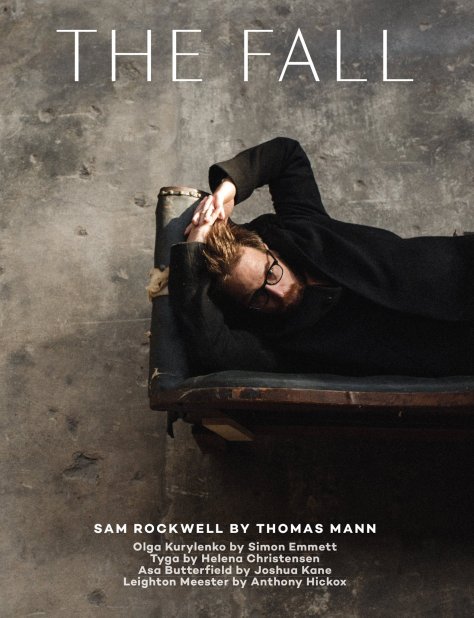
the-fall-sam-rockwellkegp-sam-rockwell

Sam Rockwell wants to dance. He’s having his photograph taken in a 120-year-old warehouse in Brooklyn but it’s a warm day and he’s starting to feel lethargy creep through his bones. “What music have we got?” he asks. “We need to wake up. Have you got any James Brown?”

Somebody fiddles with an iPhone and soon the godfather of soul is echoing off the exposed brickwork. This is Rockwell’s jam. He starts rolling his shoulders and then his feet follow, moonwalking him across the dusty floor. If you’ve seen a Sam Rockwell film in the past 20 years you’ve probably noticed the way he moves. He danced his way from his indie breakthrough in 1997’s Lawn Dogs to blockbusters such as Iron Man 2. He danced to wind-up Nicholas Cage in Matchstick Men and to impress George Clooney in Confessions of a Dangerous Mind. Even when his character was sick and depressed in Moon he still managed to throw some shapes to Walking on Sunshine.

Like a lot of teenage boys, he started dancing to impress a girl. Her name was Michaela, and he met her at a school dance. Until then he’d been a shy kid who smoked a lot of weed, but that changed when his friends Leroy and Charles started taking him to parties. “I tried to get over my shyness by dancing, and that’s what happened,” he says. He runs a hand through his beard and smiles at the memory. “I’ve been dancing ever since.”

Acting was the family business. When Sam Rockwell was born on 5 November 1968 in Daly City, just south of San Francisco, both his parents Pete and Penny were actors. “It was in the blood,” he says.

After his parents separated, when he was five, their lives took different paths on opposite coasts. His father, raising his only son in San Francisco, took a series of blue collar jobs to support them. He was a postman, a taxi driver, a union organiser and finally a printer. Years later, when he started acting again, it was in small roles in his son’s films like Frost/Nixon and Better Living Through Chemistry. His mother lived in New York and entrenched herself in the city’s bohemian theatre scene. Her son would visit during the summers and his first appearance on the stage, aged 10, was playing Humphrey Bogart opposite his mother in a skit that riffed on Casablanca at a small theatre in the East Village.

Back west, Rockwell attended the San Francisco School of the Arts where he joined an improv group called Batwing Lubricant along with Margaret Cho, who would become a stand-up, and Aisha Tyler, who Rockwell dated for a while and who now voices Lana Kane in Archer. There’s video online of them all making their first tentative steps into performance and even a moment where they must sit and tell the camera what they want from life. A voice echoes over the tannoy: “Sam, what do you want to be?” Rockwell – 18 years old, a long earring dangling from his left ear – shrugs. “I want to go out and, I don’t know, seek adventure,” he replies.

Thirty years later, he winces at his wide-eyed younger self. “Oh my God, so terrible,” he mutters, but he concedes he got what he wished for. “Oh absolutely, there’s been a lot of adventures.”

The adventures began with a move to New York to enrol at the William Esper Studio in Manhattan, met he Terry Knickerbocker, the acting coach he still works with to this day. It was there that Rockwell really began to approach acting as an art and to think seriously about his craft. “That was when I got it,” says. “When I studied Meisner that’s when it kicked in.”

The Meisner technique is an approach which focuses on getting actors out of their own heads so they can react instinctively to the scene. It’s something Rockwell still applies to his roles, and so that I can understand his process he guides me through a simple Meisner exercise.

“You’re wearing a grey shirt,” he says.

“I’m wearing a grey shirt,” I reply.

“You’re wearing a grey shirt?”

I’m wearing a grey shirt.”

Through this repetition we’re quickly responding simply to tone of voice, inflections and emphasis. “It’s a very naked exercise,” he explains. “You have to just be. Everything percolates to the surface. It’s peculiar. It’s about listening to your subtext and staying in tune with what your vibe is. It’s great training for life.”

Armed with a newfound confidence in his ability to act and live in the moment, Rockwell began to win small parts in films like Last Exit To Brooklyn and Teenage Mutant Ninja Turtles. He illegally sublet a room on Thompson Street in Manhattan from some other actors, paying them $484 a month, and supported himself working as a waiter, or delivering burritos by bicycle, and briefly as an assistant to a private investigator. In 1992 he became one of the founder members of the Labyrinth Theater Company. He was part of a scene of up-and-coming actors that included Mark Ruffalo, Liev Schreiber, Ethan Hawke and, most influentially, Phillip Seymour Hoffman.

“Phil directed me in a play and I learned a lot from him,” says Rockwell. “In the theatre, it has to cost you something. You have to get up there and lose a little piece of yourself every night. He demanded a lot of us, but you knew that he could walk the walk.”

Although they were the same age, Rockwell considered Hoffman a mentor. He took the actor’s death in February 2014 hard. “We all miss Phil,” he says. “Phil was the guy. It was really a big hit for me.”

I apologise for making him talk about something that’s clearly still so raw, but he waves his hand. “That’s alright. That’s real,” he says. “What are you going to do? You’ve got to keep living, and doing it the way Phil used to do it. He didn’t phone it in, that’s for sure.”

Rockwell got his break with stand-out roles in 1996’s Box of Moonlight and 1997’s Lawn Dogs which led to a part in his first major production, The Green Mile, in 1999. “It took me 10 years before I started to make a living,” he says. “It can be tough. Even when you’re successful it’s always precarious. Everybody has goals. Hopefully they’re more artistic goals rather than being famous or being big on Twitter or whatever the hell else.”

Immediately after The Green Mile Rockwell was cast in Galaxy Quest, but he was initially hesitant to take a role in a comedy. “I was reluctant because I really wanted to do what Sean Penn or Daniel Day Lewis were doing,” he says. “Then I realised: Sean Penn did Fast Times at Ridgemont High. It was an amazing movie, and it meant I met Alan Rickman and Sigourney Weaver.”

Those contacts paid off when he was cast as the villain in the 2000 remake of Charlie’s Angels. With the script going through constant rewrites, Rickman was one of the actors Rockwell asked help him punch up the role. Another was Kevin Spacey: “I had this cheesy line, and he said: ‘Why don’t you put the gun to your head when you say it?’ That really helped. Liev Schreiber came up with a funny line, and Mitch Glazer, Bill Murray’s writer, helped too.”

This is a theme Rockwell returns to when talking about building his characters. He’ll soak up as many influences as he can. He’s not afraid to ask for help. As he puts it: “Sometimes it takes a village, you know?”

Rockwell will also totally immerse himself in his subject, as he did before playing former The Gong Show host Chuck Barris in 2002’s Confessions of a Dangerous Mind. “I hung out with Chuck all the time,” he says. “I had him tape my lines and I learned a Baltimore accent.”

It was a perfect lead role for Rockwell, a chance for his irreverent energy to shine where another actor might have turned in a mechanical impersonation. However, it nearly didn’t happen. Rockwell was director George Clooney’s first choice but studio boss Harvey Weinstein wanted somebody else.

“I was at the Chateau Marmont and bumped into Ben Stiller,” recalls Rockwell. “He was a little shy around me. He said: ‘You’re going in tomorrow, right?’ I said: ‘For what?’ ‘For the movie, for George, for Confessions.’ I said: ‘Yeah, how’d you know?’ He went: ‘I went in today.’ So I found out the night before my screen-test that Ben Stiller was up for it too. I freaked out. I couldn’t sleep.”

Rockwell dealt with his nerves the same way he’s done since that school dance all those years earlier. “George had a boom box and we put some James Brown on,” he remembers. “I started dancing to try and shake out the nerves. George filmed it, we started improvising and he kept it in the screen test. I’ve always danced to relax.”

Rockwell won the part, although only after Clooney embedded his golf club in an office wall arguing with Weinstein. Clooney’s passion was well-founded: Rockwell shone, and his dancing stayed in the picture.

Rockwell could now take his pick of roles. Having grown up on a diet of movies like Taxi Driver, Badlands and Midnight Cowboy, his taste led him towards darker independent films like Choke and Moon. The latter, featuring his bravura performance as a pair of lunar-mining clones, came about after director Duncan Jones offered him the role of a child molester in a film he was trying to get made called Mute. Rockwell turned the part down but the two fell into conversation about their favourite science-fiction films.

“We talked about the working-class aspect of Alien and Outland,” Rockwell remembers. “In Alien, Harry Dean Stanton rolling cigarettes in a Hawaiian shirt grounds you, so when the monster shows up you sort of believe it. Duncan took that conversation and had Nathan Parker write this script about these clones. Then we infused a little humour into it, because it’s such a dark story.”

To build his cloned characters, Rockwell decided the film needed a touch of De Niro. He often incorporates his favourite films into his own performances. Taxi Driver is very prevalent in Moon,” he says. “And also very much in Seven Psychopaths, where there’s a conscious nod to Travis Bickle.”

When we see Sam Rockwell on screen, his performances look as effortless as his dancing. What we can’t see is the work that has gone in to crafting every moment. For Rockwell, work starts with his coach Terry Knickerbocker and then he’ll look for great performances to incorporate. Moon, for example, blends not just Taxi Driver but also Dustin Hoffman in Midnight Cowboy and Jeremy Irons’ dual role in Dead Ringers. Then he’ll immerse himself in the knowledge and skills his character needs, whether riding with police for his upcoming role as a cop in Three Billboards Outside Ebbing, Missouri or learning to speak the Sioux language Lakota for this year’s Sitting Bull drama Woman Walks Ahead. What ends up on screen is his unique take on everything he’s absorbed, brought to life with his own sense of adventure.

In 2014 Rockwell played a cowboy stuntman on stage in Sam Shepard’s Fool For Love and had to lasso a chair every night. He thinks of this when I ask him to place his finger on what it is that makes him so good at what he does.

“I would hope it’s a little bit of talent, but mostly hard work,” he says. “I think it’s true that if you do something over and over again then practise makes perfect. There were some days with the lasso where I’d be lassoing like shit. I’d take a break, come back to it, clear my mind. If you put in that time, an hour a day, it does pay off. It’s got to pay off.”

Cover feature for The Fall, January 2017.