Category Archives: Easyjet Traveller

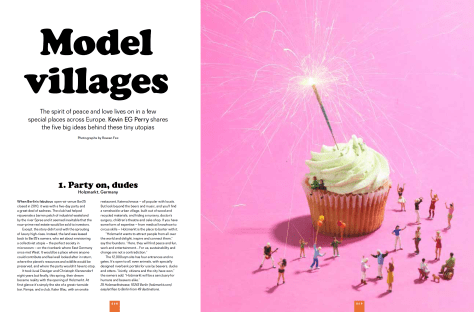
Model villages

model-villages

1. Party on, dudes
Holzmarkt, Germany

When Berlin’s fabulous open-air venue Bar25 closed in 2010, it was with a five-day party and a great deal of sadness. The club had helped rejuvenate a barren patch of industrial wasteland by the river Spree and it seemed inevitable that the now-prime real estate would be sold to investors.

Except, the story didn’t end with the sprouting of luxury high-rises. Instead, the land was leased back to Bar25’s owners, who set about envisioning a collectivist utopia – the perfect society in microcosm – on the riverbank where East Germany once met West. It would be a place where anyone could contribute and feel well looked after in return, where the planet’s resources and wildlife would be preserved, and where the party wouldn’t have to stop.

It took Juval Dieziger and Christoph Klenzendorf eight years but finally, this spring, their dream became reality with the opening of Holzmarkt. At first glance it’s simply the site of a great riverside bar, Pampa, and a club, Kater Blau, with an onsite restaurant, Katerschmaus – all popular with locals. But look beyond the beers and music, and you’ll find a ramshackle urban village, built out of wood and recycled materials, and hiding a nursery, doctor’s surgery, children’s theatre and cake shop. If you have some form of expertise – from medical knowhow to circus skills – Holzmarkt is the place to barter with it.

“Holzmarkt wants to attract people from all over the world and delight, inspire and connect them,” say the founders. “Here, they will find peace and fun, work and entertainment… For us, sustainability and change are not a contradiction.” The 12,000sqm site has four entrances and no gates. It’s open to all, even animals, with specially designed riverbank portals for use by beavers, ducks and otters. “Jointly, citizens and the city have won,” the owners add. “Holzmarkt will be a sanctuary for humans and beavers alike.”

2. Embrace woolly ideas
Lammas, Wales

“It’s totally possible to live a first-world lifestyle without it costing the Earth,” says Tao Wimbush, one of the founders of the Lammas Ecovillage in Pembrokeshire. His statement’s true in both senses – since 2009, Wimbush’s comfortable existence has been as cheap as it is sustainable.

Lammas is ‘off-grid’, meaning members of this pioneering community create their own power and rely on their skills to solve problems. Not that there are many within this lush enclave on the UK’s western edge. Happy cows chew the cud, the soil bursts with fresh produce and beautiful houses spring up without the help of any big development companies.

“In the village, we’ve all got computers, internet, washing machines, stereos…” Wimbush points out. The difference is that residents know exactly how much of the community’s solar and hydroelectrically generated power each appliance needs. “I’ve got two teenagers and they know that when they turn on their hairdryer it’s going to take 900 watts of power, so they check it’s available before they turn the hairdryer on. If it’s not, they can reroute power by turning off other appliances.”

Eating organic isn’t an optional luxury, it’s a necessity and houses are literally packed with natural materials. “We insulate our homes with sheep’s wool. It came straight off the sheep’s back and into a cavity in our timber-framed house,” says Wimbush. “We’ve proved that it’s totally possible to build affordable, healthy, high-performance houses with local, naturally available materials. The house I’m living in cost £14,000 [€16,000] and is more effectively insulated than the average suburban home.” It goes to show: it’s better to keep a sheep than be one.

3. Put your art into it
Christiania, Copenhagen

Pothole repairs are an issue that all towns face, but a workaday chore? Not in the ‘free town’ of Christiania. The autonomous neighbourhood in Copenhagen is famous Europe-wide, not least for its relaxed approach to cannabis, but also for its louche and lovely aesthetics. Here, potholes are as likely to be filled with marble mosaics or glazed tiles as asphalt.

“Beauty is just as important as function,” says Britta Lillesøe, an actress and the chairwoman of the Christiania Cultural Association. “Christiania is a town for people expressing themselves artistically in everyday life.”

Ever since it was founded as a squat in 1971, Christiania has attracted those who don’t feel they fit in anywhere else. “We accept and tolerate deviant ideas and behaviour, because we know that by judging others we judge ourselves,” says Lillesøe. “Being different is a way to be yourself.” However, those differences have a way of binding people together – forming what she calls an ‘urban tribe’. “Individualism and collectivism come together in the tribal spirit, which is beyond the political,” she says. “It honours tradition and yet despises worn-out ways. We are a bridge between the prehistoric and the future, between the shamanistic vision and the age of Aquarius.” Couldn’t have put it better myself.

4. Don’t stop till you get enough

Marinaleda, Spain

In 1979, 2,500 labourers in Andalusia found they had no land, no prospects and nothing left to lose. All around them they saw fields that weren’t being farmed and they decided to act.

It took 12 years of relentless protests, including whole-village hunger strikes, occupations of the farmland they were demanding and a march to the Andalusian capital, Seville, but by the turn of the 90s, the battle had been won and the land around the village of Marinaleda was handed over.

“Eventually, the local government decided it was more trouble than it was worth, bought the land from a duke and gave it to the people,” says journalist Dan Hancox, whose book The Village Against the World details the labourers’ struggles. During the almost three decades since, the people of Marinaleda have created their own narrative. “They have their own TV channel and radio station, which might sound ridiculous for a village of 2,500 people, but that’s what makes it fascinating,” says Hancox. “They party together at their own feria [festival] in July, which always has a revolutionary theme – one year it was Che Guevara. The village even has its own colour scheme: green for their rural utopian ideal, red for the workers’ struggle and white for peace.”

Che would surely approve.

5. Make love not war
Metelkova, Slovenia

The army barracks in the centre of Slovenia’s capital, Ljubljana, have not historically been the sort of place you’d want to spend a night on the tiles. Built by the Austro-Hungarian Empire in the late 19th century, they have at various times been home to soldiers from Fascist Italy, Nazi Germany and the authoritarian Socialist Federal Republic of Yugoslavia, none of whom were renowned for being much fun at the disco – which explains the glorious irony that since 1993 the barracks have been transformed into Metelkova, a home for artists and one of the most successful urban squats in the world. Moreover, the alternative city-state was home to Ljubljana’s first gay and lesbian clubs – Klub Tiffany and Klub Monokel respectively – and has since been used as a base for a whole variety of campaigns against racism and other forms of abuse. Even the mayor of Ljubljana, Zoran Janković, has been won over by the squat.

“Metelkova is a centre of urban culture,” he said in 2015. “It’s a place for critical reflection, civic engagement – and with its activities, it is establishing Ljubljana as an area where ideas of all generations can freely flow.”

If former Nazi army bases can become beacons of hope and togetherness, surely anywhere can.
Originally published in Easyjet Traveller, July 2017.

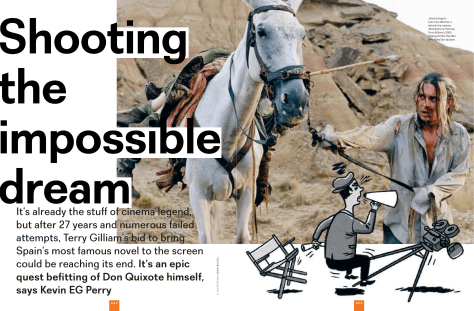
Shooting the impossible dream

don-quixote1

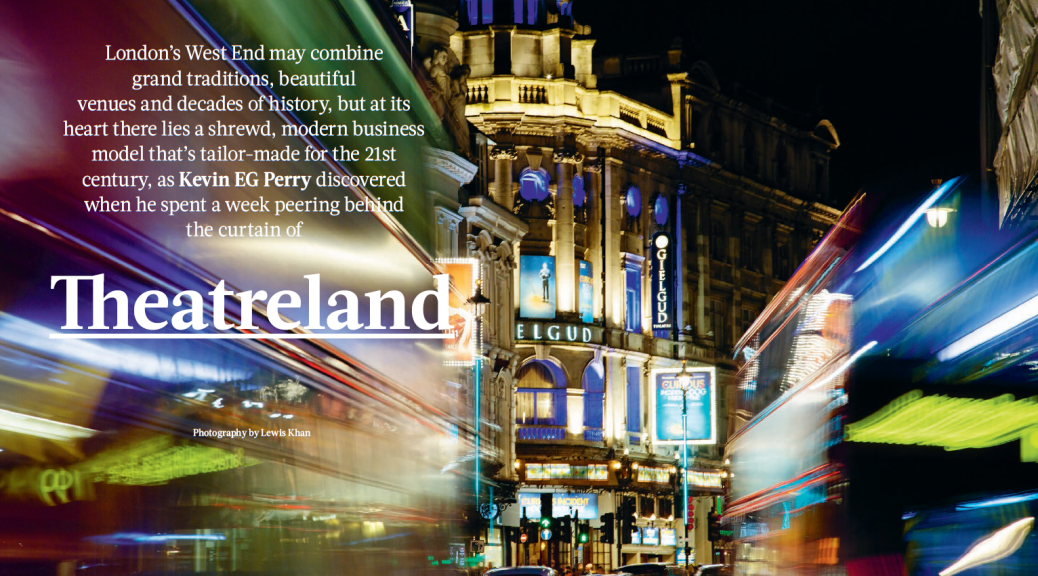
don-quixote2There are dark storm clouds gathering… F-16 fighter jets boom overhead, the thunderous sound of their engines interspersed with all-too-real thunderclaps. Johnny Depp is locked in a chain gang, scuttling sideways across the stark desert of the Bardenas Reales, in north-eastern Spain, but the microphones can’t pick up what he’s saying over the noise. The group approach the veteran French actor Jean Rochefort, poised atop a horse that refuses to move even when a member of the film crew gives a weighty push to its buttocks. Rochefort shifts uncomfortably in the saddle, feeling pain shoot through him from a herniated disc in his back. Finally, the storm breaks. It’s the only thing on this film set working on cue. As the rain lashes down, transforming the desert into a pit of quicksand, the director tilts his head back and roars into the heavens. “Which is it?” Terry Gilliam demands of the storm, “King Lear or The Wizard of Oz?”

That was just the second day of shooting during Gilliam’s attempt to film his epic The Man Who Killed Don Quixote in September 2000. Although millions of dollars had already been spent on the film-maker’s adaptation of Miguel de Cervantes’s classic Spanish novel, the hobbling production didn’t last much longer.

Two men who saw the whole sorry mess unfold were Keith Fulton and Lou Pepe. They thought they’d be working on a behind-the-scenes ‘making-of’ feature about Gilliam’s film and instead ended up making Lost in La Mancha, an excruciating documentary about a film falling apart at the seams.

“We were slow on the uptake, because it was hard to believe a production of that scale was going to come to its knees,” says Fulton now and Pepe agrees: “We were somewhat blinded to it, because Terry was a bit of a hero to us. As a young film-maker, you’re not taught about all the movies that don’t get made.”

Since that time, Lost in La Mancha has itself become a cult classic, while Gilliam’s pet project has become a byword for blighted film productions. But, 16 years on, he may finally turn his Quixotic dream into a reality. In May, at the Cannes Film Festival, the director announced he was going at it again with an all-new cast featuring Star Wars villain Adam Driver as his lead and his old Monty Python compadre Michael Palin as Don Quixote. He vowed to return to the festival next year with the finished film.

If he does, it will be a Herculean achievement. Indeed, Gilliam’s attempts to bring Quixote to the screen has been a story almost as epic as that of Cervantes’s protagonist. In total, he has now been working on The Man Who Killed Don Quixote for 27 years, over twice as long as the 12 years it took Richard Linklater to make Boyhood – and that featured a boy growing up in real time. In that period, Gilliam has found and lost a galaxy of stars – Depp and Rochefort, Ewan McGregor and Robert Duvall, Jack O’Connell and John Hurt – and seen seven iterations of the story ground into the dust. If he finally pulls it off this year, he may at least avoid the unwanted record of overtaking the 28 years it took Canadian animator Richard Williams to make his passion project, The Thief and the Cobbler.

He’s not even the first director to struggle to bring Don Quixote to the screen. Orson Welles began filming test footage for his own film version back in 1955, yet was met with so many setbacks along the way that the film remained unfinished at the time of his death in 1985, although a version of it was cobbled together by the Spanish director Jesús Franco and released in 1992.

Gilliam’s own journey began when he was still a wide-eyed 48-year-old in 1989, fresh from steeringThe Adventures of Baron Munchausen through its own wildly overbudget production. He’d called producer Jake Eberts, of Goldcrest Films, and said: “I’ve got two names for you and I want $20 million. One of the names is Don Quixote and the other is Terry Gilliam.” Eberts replied, “You’ve got your money.”

It seemed like a natural fit. Miguel De Cervantes’s sprawling 1605 novel, The Ingenious Gentleman Don Quixote of La Mancha, is concerned with the same questions of madness vs sanity, and fantasy vs reality, that have defined Gilliam’s films. The book tells the tale of an old man so obsessed with reading romantic stories about brave and noble knights that he sets out to live as one, gathering together a suit of armour from the things he finds around his house. His helmet is a shaving basin. His horse, Rocinante, is an old nag. His squire, Sancho Panza, is a fat peasant. Undaunted, Quixote sets off in pursuit of adventure and believes he finds it, regardless of what’s really going on. Where others see windmills, he sees giants to battle. Instead of whirling sails, he sees flailing arms.

“I think he’s heroic because he refuses to accept the limitations of reality,” explained Gilliam in Cannes. “He’s determined to see the world in a heroic, magical, spectacular way.”

Faced with the challenge of adapting the whole of Cervantes’s 900-page work for the screen, Gilliam decided instead to write a new story which would bring Quixote into the contemporary world – or at least send a representative back into his. Inspired by Mark Twain’s A Connecticut Yankee in King Arthur’s Court, he wrote a screenplay with his collaborator, Tony Grisoni, in which an advertising executive also named Toby Grisoni was sent back to the 17th century and mistaken by Quixote for Sancho Panza – and thus The Man Who Killed Don Quixote was born.

don-quixote3The first disaster struck quickly, when Eberts’s promised $20 million fell though. It would be 11 years before filming began, a period in which Gilliam made The Fisher King (1991), Twelve Monkeys(1995) and Fear and Loathing In Las Vegas (1998). It was on the latter that Gilliam believed he’d found his leading man. After his Gonzo odyssey as Raoul Duke, Johnny Depp was lined up to play Grisoni. His then partner, Vanessa Paradis, was cast as his love interest and Rochefort was Gilliam’s Quixote. With Depp as the lead, the film secured a budget of $32.1m and began shooting in Spain.

Everything that could go wrong went wrong. Preproduction was dogged by financial and scheduling problems and then, on the day that filming was due to start, Rochefort, who has been learning English for seven months in order to take this role, failed to board his flight to the set. He had severe prostate pain, with it only later emerging that he had an infection that would prevent him riding a horse – crucial for playing Quixote. They weren’t helped by their choice of location. The desert of the Bardenas Reales was chosen by Gilliam to double for La Mancha, but the storm that halted filming also transformed the sun-bleached location he’d picked into a quagmire. As the delays piled up and the money disappeared, first assistant director Phil Patterson told Gilliam, “We can’t make the film – not the film you want to make.”

After the collapse of that production, the film’s screenplay ended up in the hands of the insurance company. Some directors would have written off the project then and there – and for a time, Gilliam did, working on The Brothers Grimm and Tideland, both released in 2005. Yet behind the scenes, he refused to give up on Quixote and by 2008, he had won back legal ownership of his story. With Depp still attached and Robert Duvall replacing Rochefort, it seemed the project was back on. The film went back into preproduction and in an interview with The Independent, Gilliam said, “We’re going to completely reshoot it. The intervening years have taught me that I can actually write a much better film. I’m so excited it’s going to get done at last.”

It wasn’t to be. The money evaporated once more, leaving Gilliam clutching at air. As the years slid by, Depp was himself replaced by McGregor, but once again funding fell through. In 2013, Gilliam was still struggling along with his quest. He told Deadline, “Certain things just possess you and this has been like a demonic possession I have suffered through all these years. The very nature of Quixote is that he’s going against reality, trying to say things aren’t what they are, but how he interprets them. In a sense, there is an autobiographical aspect to the whole piece.” In November of the following year, Gilliam announced he was trying to drum up support once again with a whole new cast attached: Jack O’Connell as Grisoni, and John Hurt as Quixote. By now, the sound of the sky falling in must have been as familiar as birdsong.

You could be forgiven, then, for taking this May’s announcement that production is back on with a spadeful of salt. Yet Gilliam is more positive about the film than at any point since 2000. This seems to be down to Portuguese producer Paulo Branco, a frequent Wim Wenders collaborator who is known in the European film industry for being the man who can make the impossible real.

“I first met Terry in February and very fast we decided to do the film together,” Branco tells me from his base in Lisbon. “It’s a real pleasure to take on this mythic project. Terry, like all artists, is a dreamer. That’s why he’s completely fascinated by Don Quixote. I think the dreamers of this world sometimes want their dreams to come true. That’s why he’s so keen to make this film a reality.”

don-quixote4Working together, the pair have raised a budget of €17m and secured what Gilliam calls “the perfect cast”. He says lead Adam Driver is “the first actor involved in this project who’s actually reading the book”, while adding, “Thank God for Star Wars”, for transforming the former Girls actor into a bankable leading man. He adds that Palin will be ideal for Quixote because, while the character is “old, ridiculous, foolish [and] a pain in the ass… You’ve got to love him…”.

Wisely, filming – scheduled to begin this month – will move from the blighted location in La Bardenas Reales to new ones in Portugal, Spain and the Canary Islands. “In Spain, we’ll shoot near Madrid, in La Mancha and near Toledo,” says Branco. “In Portugal, in Tomar, near the Convento de Cristo. It’s a beautiful place and when the film opens, I hope people will want to come and see the places we shot.”

Will the curse of Don Quixote finally be lifted in 2016, exactly 400 years since the death of Cervantes? Gilliam is now 75, nearly 30 years older than he was when he began his quest, but his refusal to abandon his dream has not surprised those who’ve worked with him. “I hope he can pull it off,” says Lou Pepe, “but at the same time, pulling it off isn’t the point. The striving is the point. In the larger human context, the fact that there are people out there like Terry, who don’t give up on big visions, is important for inspiring the rest of us.”

Tellingly, Gilliam has now written his own struggles into the story. The latest synopsis reveals that his protagonist Toby Grisoni once shot his own film version of Don Quixote in a pretty Spanish village as a young and idealistic film student, and it is only when he returns as a jaded publicist that his strange journey begins.

“People used to say I was Don Quixote, because I was a fantasist and a dreamer and I’d go up against reality, fail, and then get up again,” reflected Gilliam in Cannes. “I don’t think I’m Don Quixote. I’m actually Sancho Panza. Don Quixote is the film and I’m following it. It’s like one of those dream-nightmares that never leaves you until you kill the thing.”

Originally published in Easyjet Traveller, August 2016.

Theatreland

Theatreland.png

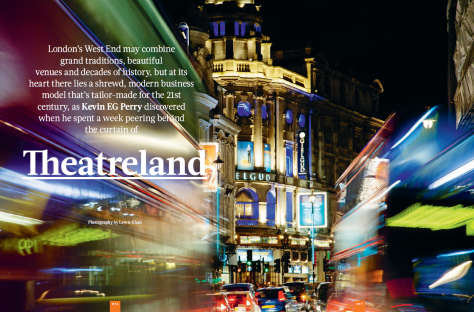
It’s a cold, miserable Tuesday in London’s West End, but the crowd clustered around the red carpet outside the Shaftesbury Theatre doesn’t seem to notice. Tonight is the opening of Motown: The Musical and a flashbulb chorus greets stars including Mary Wilson, Smokey Robinson and Motown founder, Berry Gordy.

“I’ve had, and Motown has had, a love affair with the UK for many years,” says Gordy, as explanation for why he brought his musical over from Broadway, where the Tony-nominated show enjoyed a run of nearly 800 performances, but that’s not the only reason he’s here.

The West End is as synonymous with London as the drizzle in the air and it’s also seriously big business. Last year, almost 15 million people bought a ticket for a West End performance. The 47 venues that are members of the Society of London Theatre (SOLT) grossed over £630m (€790m) in 2015 and SOLT estimates that 41,000 jobs depend on the industry, which contributes over £2bn to the economy.

West End theatres may combine grand traditions, beautiful venues and decades of history but at work is a shrewd, modern business model that has moved with the times – and it’s one that everybody wants a piece of.

Paul Ibell, author of Theatreland, a history of the past five centuries of London theatre, argues that West End shows have remained popular – even during both world wars – because they offer us entertainment, education and escape. “Noël Coward’s play Blithe Spirit, which opened in 1941, was a hit partly because the theme – a comedy about ghosts – enabled audiences to laugh at death at a time when they were experiencing it all the time in their own lives,” he says. “Much the same applied to the Depression between the wars, so it’s perhaps not surprising that at a time of economic and political upset, people flock to see shows like The Lion King, Mamma Mia! or The Phantom of the Opera. As a result, the West End has sailed through the recession, despite predictions of disaster.”

However, despite the thriving scene, launching a new show remains a risky business. Last year, 278 new productions opened in the West End, but some only remained open for a few weeks. While Agatha Christie’s The Mousetrap has famously run continuously since opening at St Martin’s Theatre in March 1974, others are not so lucky. Harry Hill’s X Factor parody, I Can’t Sing, closed in 2014 after just six weeks, losing its backers much of their £6m (€7.5m) investment.

What makes predicting the success of a new venture so difficult is also one of the West End’s greatest strengths: its variety. On any given night, you’ll find a mix of high-camp musicals, serious psychological dramas and, in the case of Stomp, lots of people clattering about with bins.

Beautiful is one recent success and this biography in musical form of the singer-songwriter Carole King, recently celebrated a year at the Aldwych Theatre. “It’s weird. Either a show runs for decades or it seems to close within three months,” says Cassidy Janson, who plays King. “There are big, big shows which close, so it’s a relief when you make it to a year.”

Alan Morrissey, who stars opposite Janson in Beautiful, agrees: “Particularly with new musicals, it’s really hard to survive in the West End. The majority don’t last a year, but these days six months is a great run.”

For Morrissey, as for many of those who perform in the West End, acting here is the realisation of a childhood dream. “Doing this job, London is totally the best place to be,” he says. “You’ve got New York, obviously, but Broadway has its own challenges. I love being a British actor and I love the quality of work we get over here.”

He says his most important motivation is remembering how inspired he was the first time he travelled down from Stockport as a child. “My first West End show blew me away and it’s someone’s first one tonight. That’s a beautiful pressure that we give ourselves as a show.”

Those looking for an illustration of the breadth of West End audience’s palates should look no further than The Curious Incident of the Dog in the Night-Time. Having started life at the National Theatre, adapted by acclaimed playwright Simon Stephens from Mark Haddon’s book, it’s told from the perspective of a teenage boy with Asperger’s syndrome. It’s a remarkable play that has become a West End hit at the Gielgud Theatre.

Bunny Christie, who designed Curious Incident’s wildly inventive, set, argues that West End shows don’t have to fall into pre-existing moulds. “I think it’s a mistake to think, ‘Oh, that’s not very commercial’ or ‘That’s not very West End’,” she says.

Christie is passionate about theatre’s ability to ask more of its audience than a television or iPad screen can. “If you imagine a film of Curious Incident, chances are it would be quite a straightforward narrative with lots of locations,” she says. “Of course, we can’t do that in theatre. What’s fantastic is that we ask people to use their imaginations and fill in the bits that we miss. It feels more sophisticated, in a weird way, because it’s about using our creativity. It’s a lovely thing that we all do as children really naturally and then  kind of forget about later in life.”

There’s certainly something childlike about the awe and wonder of seeing a great performance, but following the premiere of Motown: The Musical, the producers, cast and crew make the short journey to a very grown-up opening-night party at 100 Wardour Street in Soho. It’s attended by the likes of former Friends star Matthew Perry, who’s in town with his playwriting debut, The End of Longing, at the Playhouse Theatre. While the live band couldn’t go wrong with a string of Motown hits, including Superstition, You Can’t Hurry Love and My Girl, the cast are avoiding the stream of free cocktails.

“If you’re a lead in a West End show, you get membership to the Ivy Club and the Groucho, but it’s one of those things where, when you finally get it, you can’t really enjoy it,” laughs Janson. “You don’t go out and get hammered at the weekend.”

Performing eight high-intensity shows a week doesn’t exactly lend itself to the sort of bacchanalian debauchery the likes of Peter O’Toole and Oliver Reed once enjoyed. Working from 5.30pm until 10pm six nights a week would wreak havoc on anyone’s social life.

Away from the private-members bars, where performers might enjoy a mocktail, there’s at least one pub that can count on a regular theatre crowd: the Nell of Old Drury, on Catherine Street. It’s named after Nell Gwynn, the actress and mistress of King Charles II, who was recently the subject of an eponymous play at the Apollo Theatre. The pub, once known as the Lamb, has attracted thespians since 1663, when the Theatre Royal was built opposite and is connected to it by an underground tunnel, by which Charles is said to have visited his lover. “If you say you’re going to the Nell,” says Janson, “everyone knows where it is.”

“We cross paths with actors from other shows all the time,” adds Morrissey. “You meet at the same places, but there’s no rivalry. Everyone’s in it together.” That goes for all involved – playwrights, actors, crew, wardrobe, make-up.

“You’re working with the best of the best. It feels lucky to be here.”

No wonder, then, that shows and fans in their millions continue to be drawn to the West End, regardless of modern distractions, wider economic gloom or grey London skies.

“The West End feels more successful than ever,” says Christie. “There’s just something about sitting together in a theatre with people around you laughing or gasping that works. I think we really miss that, because many of our lives are quite solitary or insular. Going to the theatre is a communal experience and, as human beings, we like that.”

Originally published in Easyjet Traveller, May 2016.

The Battle To Be Top Christmas Toy

easyjet-traveller-battle-christmas-toy

easyjet-traveller-battle-christmas-toy-1A long time ago, in a galaxy not far away, a battle began between toy makers to win big on Christmas day. Today, using high-tech methods and Jedi marketing mind tricks, the industry is as far removed from an elf whittling away in Santa’s workshop as can be… But whose year will it be?

Picture the scene. It’s Christmas morning 2014 and parents across the world are being woken, bleary-eyed in the far-too-early hours, by their excited, expectant children, all with but one thing on their minds. What’s wrapped up underneath the tree – and soon to be ripped open – will have a greater bearing on the outcome of the day than whether Mum has decided to follow the year’s hot-chef advice of pre-brining her turkey or which box set Dad will fall asleep in front of. For a fairly large proportion of little girls in the UK, that item is a doll called My Friend Cayla.

Earmarked as the year’s hottest toy by retailers such as Hamleys, Cayla talks. Of course, talking dolls are nothing new – Edison first invented one back in 1890 – but Cayla’s wi-fi internet connection means that she can check Wikipedia in the blink of a plastic eye and answer pretty much anything you throw at her. Think of her as Siri with brushable hair. Cayla proved so successful that this year her maker, Surrey-based Vivid Imaginations, is expanding the range to include My Friend Freddy Teddy for younger children and a robot called i-Que that’s aimed at boys, both of which employ the same sort of cutting-edge technology.

It’s fair to say that the days when children would be satisfied with a puzzle or a painted wooden figure are long gone – and the stakes for toy makers are immeasurably higher, as a result. In fact, you could say that, as we go about obliviously eating, drinking and indulging, a turf war is being played out every year for supremacy beneath our Christmas trees. And every toy company on Earth wants to come out on top.

According to trade group Toy Industries of Europe, Europeans spend over €16.5bn on toys each year and over half of those sales are in November and December in the run-up to Christmas.

Now, companies pour their resources into spotting trends years in advance and into harnessing new technology. Yet, predicting and producing the year’s must-have toy remains a Jedi mind trick made even tougher by the fact that new products have to win over not one, but two of the most fickle, critical and discerning audiences on the planet: children and their parents.

Probably the safest bet is to ride in the wake of a wildly popular film franchise. Scan a list of the predicted top sellers for 2015 and you’ll see Minions, Disney’s Frozen and, inevitably, Star Wars featuring highly.

But what if you’ve an entirely new idea? Then you need to start thinking smart. To this end, companies like Vivid employ in-house research and development teams; they also look for help from external sources. Eric Rossi, Vivid’s European Managing Director, says Cayla was actually created by someone outside the company. “We have to be humble,” he says. “The idea for Cayla came from an inventor. We work closely with the inventor community and when we like an idea, we’ll enter into an agreement. Then we help with development and apply our marketing expertise. You can have a good product, but if it doesn’t connect with an audience then your job isn’t done.”

If there’s one toy that’s never had trouble connecting with an audience, it’s Thunderbirds’ Tracy Island. It’s been one of the toys most associated with Christmas in the British popular imagination ever since 1991, when short supply led to the BBC reporting on fights breaking out between parents in shops and a flourishing black market in secondhand sales. After more toy sets were produced to meet demand the following Christmas, it went on to be that year’s top seller. By then, Blue Peter presenter Anthea Turner had staked her claim for immortality by showing those who’d missed out how to build their own out of shoeboxes and sticky-backed plastic.

In 2000, a revamped Tracy Island play set again became the Christmas bestseller, so perhaps it’s no surprise that with new CGI series Thunderbirds Are Go on TV at the moment, a new iteration of the toy is enjoying yet another lease of life. Now also manufactured by Vivid, this year’s much-expanded version, complete with more sounds, bells and whistles, was named at the top of Hamleys list of predicted top sellers this Christmas.

Jamie Anderson, son of Thunderbirds creator Gerry Anderson and Managing Director of Anderson Entertainment, believes that Tracy Island has a timeless appeal. “The show itself was put together by people who were fascinated by stuff like space, aeronautical engineering, gadgets and where the future might take us,” he says. “With Tracy Island, we all know that making secret bases, even if it’s just a fort between a couple of chairs under a duvet, is the kind of thing kids love.”

It’s a testament to the invention and ingenuity of Gerry Anderson and special-effects designer Derek Meddings that their creations still inspire children 50 years after Thunderbirds first aired – and also to the legacy of Keith Shackleton, who was the man who masterminded the toy side of the company.

“I don’t think it’s unfair to suggest that Dad’s production company, Century 21, basically invented merchandising to the degree that we know it now,” says Anderson. “In the 1960s, Century 21 was putting together a magazine that had a circulation of a million copies a week – which now seems bizarre for a kid’s comic or any magazine. They also had a toy division, a publishing division and even a music division featuring Penelope and Parker singing stupid songs. By the end of the 1960s, it was established that you could make a huge amount of money on the merchandising side. Some of the same people went on to work on the Star Wars toys in the 1970s. They kind of changed the world in that way.”

Which brings us right back to this Christmas. The fact that Tracy Island is competing for shelf space with toys from the new Star Wars film is, in fact, a battle between teacher and student – a plot fit for a space opera.

“It will be very interesting to see how well Thunderbirds does after the Star Wars release [on 18 December],” says toy designer Stefan Knox. “It’ll be the same boys playing with those toys. In the past few months, they’ve all been playing Thunderbirds in the playground. I bet by January, when Star Wars is out and it has a slick machine like Disney behind it, they’ll all be playing Star Wars. What do retailers do then? Do they fill their shelves with all Star Wars toys – or 50% Star Wars and 50% Thunderbirds and other boys’ toys? If you don’t have the deep pockets of Hasbro to afford the Star Wars licence, then that really makes it difficult for other toy companies.”

Knox worked with both Hasbro and Vivid before leaving to form his own design company, Bang Creations, in 2000. On his desk in his design studio in Haslemere, Surrey, he carefully unwraps a few mementos of his time working on the last range of Star Wars toys. Along with Luke Skywalker and Darth Vader, his prized possession is a Boba Fett figurine, which was doomed long before it made it to mass production. “It’s too expensive,” he says, pointing to the grappling hook hanging from the prototype’s backpack. “The amount of detail you need just costs too much.”

This is one of the key challenges facing toy designers in 2015: they have to create products interesting enough to distract a child’s attention away from their phones or iPads, but simple enough to produce cheaply on a mass scale. “The word ‘toy’ implants in people’s minds that it’s just a bit of fun and that it’s easy,” says Knox. “Actually, it’s a really difficult product to design. You’ve got to capture two markets: kids and parents. Then you’ve got the fact that it’s the most safety-cushioned industry in the world and it’s the most litigious. Then you have to plan ahead to realise that your product, which costs $5 [€4.50]to make, will end up selling for £25 [€34.65] at retail. How do you make something for $5 that is so magical it looks like it’s worth £25?”

For maverick inventors and independent designers, figuring out how to fit their toys into existing worlds can make or break whether one of the bigger companies will help them take it to market. This year, Disney are marketing a Millennium Falcon drone – a good example of taking a new piece of technology and fitting it into a world of toys that children (and their parents) are already interested in.

“If you’re a toy inventor, the wise thing to do would be to look at a company’s portfolio,” says Knox. “For example, Hasbro has the Star Wars licence. If you’ve got an idea that could be moulded into the Star Wars property, spend your money on that and try and get it in. Starting a new brand needs a lot of marketing and you’re then competing against the films and the licences in this world. It’s a very hard sell.”

Star Wars is such a powerful force in the toy market that it even had a little-heralded impact on the survival of one of the world’s most successful toy companies. Back in the late 1990s, LEGO was floundering and dicing with bankruptcy. While it was struggling to modernise, it did have one big-selling product line keeping it afloat: Star Wars, its first outside licence. As the company rebuilt in the 2000s, they went on to licence a whole host of other franchises, including Harry Potter and Pirates of the Caribbean, but it’s Star Wars that has remained the biggest seller, even as the brand diversified into computer games. The LEGO Movie has also helped the Danish company to a stunning recovery and annual global sales approaching 28.6DKK (€3.83) billion.

Warren Elsmore, a professional LEGO builder and the man behind London’s Brick 2015 exhibition, believes that its recent success is down to finding a way to integrate modern interactivity with its physical toys. “They’ve kept their finger on the pulse of what people want,” he says. “The video games are huge sellers, but I think what’s really nice, especially with their new game, LEGO Dimensions, is that they’re melding the two together. There’s something visceral about playing with something with your hands.”

While LEGO has been successful in bringing together physical toys and computer games, one new technology that still isn’t quite up to scratch is 3D printing. Elsmore says that printers aren’t yet accurate enough to print bricks with the precision that LEGO requires. “LEGO bricks are made to the tolerance of one-fiftieth of a millimetre, 10 times finer than a human hair,” he says. “That’s way beyond what most 3D printers can cope with at the moment. It’s something that can be used in design, but it won’t take over from moulding LEGO bricks any time soon.”

Meanwhile, as battles rage between companies competing to create the newest tech and bid for the biggest film franchises, other toy companies still exist in a rather more sedate world, where they know their tried-and-tested formula works. Germany’s Playmobil, for instance, is targeted at younger children and pulls in an annual revenue of over €552m, without plastering any famous faces or brands on their boxes.

“Most of our toys are classics that we’ve been making since the beginning, like knights, firefighters and police. There’s no need to license things,” says Uwe Reuter, head of Playmobil’s product-development department. He says they get their inspiration for new toys from a more traditional source: “We receive 150 letters per month from children commenting on our products. They send us sketches and ideas. That’s what tells us which direction we should take.”

Come 25 December, when children across Europe dive underneath their Christmas trees to find out what Father Christmas has brought them, they’ll be holding in their hands the end result of a design, development and marketing process years in the making. Whether it’s brand-new technology or a timeless classic, it’s their parents who’ll be crossing their fingers behind their backs and asking: “Are these the toys you were looking for?”

Cover story for Easyjet Traveller, December 2015.

How Iceland Went From Bust To Boom

Iceland-Easyjet-TravellerIceland-Easyjet-Traveller-1It was only a matter of time before Iceland went bust. For decades, the people on this volcanic island in the middle of the Atlantic had made their money from fishing and aluminium smelting. Then, in the 2000s, they started making money from international finance. Lots of money. By 2007, Iceland’s three biggest banks were worth $140bn, 10 times the size of the country’s economy. The banks pulled this off by promising unrealistically high rates of return to foreign clients and buying up companies, real estate and even football clubs around the world. There was no way they could keep paying their bills and so, on 6 October 2008, the whole house of cards came crashing down overnight. Billions were wiped out in the flicker of a computer screen as the global financial crisis took hold.

Not that you’d notice walking around Reykjavik today, where an army of cranes pluck the city into new shapes. On Laugavegur, the main drag, tourists pose with Vikings and trolls, while restaurants lure in hipsters with gourmet hot dogs slathered in pulled pork. At night, the bars throng with Icelanders taking great pleasure in introducing their visitors to Brennivín, the powerful local schnapps. Clinking glasses punctuate spirited chatter.

And the reason for the cheery scenes? Instead of licking their wounds, this country of 329,000 people took it upon themselves to find a fix, creating a blueprint for how to plot a 21st-century economic recovery in the process.

Iceland-Easyjet-Traveller-2Magnús Sveinn Helgason is a great example. As a financial journalist and member of Iceland’s Althing Special Investigative Commission on the Collapse of the Financial System, Helgason has had a front-row seat for the whole ride. Nowadays, he gives ‘Walk The Crash’ tours of Reykjavík, where he helps visitors understand how the banks went down and how the country got back up again.

“I started the tour because every other tourist I meet is interested in hearing about either the collapse or the recovery,” he says. “They want to hear about the fall of our corporate Vikings, the marauding financiers who went around the world, not robbing monasteries, but buying up department stores.”

Tourism has played a huge part in this success story. In fact, last year, it became Iceland’s biggest industry – overtaking fishing – and you can see the results in the place we’re staying. Slap-bang in the business district, the Fosshotel Reykjavik is the city’s biggest hotel, with 320 rooms. Since opening in the summer, its been operating at near full capacity.

So, what caused the boom? Helgason attributes it – perhaps counterintuitively – to the impact of the crash and to the island’s volcanic eruptions in April 2010. “You had the currency collapsing, making it cheaper to visit, then you had the Eyjafjallajökull eruptions,” he says. “For the country, this was massive, free, international advertising.”

While Helgason’s tour is the most direct example of Icelanders turning their economic disaster into a tourism opportunity, the country abounds with specialists who’ve used their knowledge to offer visitors something they won’t find anywhere else. Take Hreinn Elías, who cofounded Arctic Surfers in 2010 and was thus perfectly positioned to benefit from the tourism swell. “Iceland is a unique location for surfers,” he says. “We have world-class waves and scenic locations, but it’s not enough to just know the spots. Here, you have to be on the move to find the best surf. That’s what people come to us for.”

Established destinations, like the Blue Lagoon, have also benefitted from this upswing in attention. Founder and CEO, Grimur Saemundsen, who’s currently building a luxury hotel at the lagoon, to open in 2017, says: “The last five years have been an adventure for us. It’s undisputed that the growth in tourism since 2010 has played a major role in reestablishing the economy of Iceland. We’re now the biggest sector in the economy and the biggest employer. The banking crash created a vacuum that the tourism industry stepped into.”

Iceland-Easyjet-Traveller-3While the island’s unique geography is part of its draw, the country also has a busy cultural calendar. Here, its small size is a definite advantage. Halla Helgadóttir, who runs Iceland’s design week in March, says that designers from a variety of disciplines come here to share ideas; while Stella Soffía Jóhannesdóttir, of the Reykjavik International Literary Festival, tells an anecdote that illustrates just how intimate their events are. “When David Sedaris spoke here, he said he was used to audiences of 3,000. Here, he spoke to 100 people,” she says. “That makes our festival an opportunity to meet your favourite authors in very unusual circumstances.”
Mingling among the tourists heading to Iceland since the crash have been some of Hollywood’s top directors. Prior to 2006, only three foreign films had been shot in the country. Since then, it’s provided locations for almost 20, including Christopher Nolan’s Batman Begins and Interstellar, Ridley Scott’s Prometheus and several seasons of Game of Thrones.

“More than 14% of visitors come here because they saw Iceland in a foreign film or TV show,” says Iceland’s film commissioner, Einar Tómasson. “With things like Game of Thrones filming here every year, I think people see the great landscapes and think, ‘Let’s go there. It’s so different’. One of our strengths is that our locations are so diverse. Within two hours, you have glaciers, lagoons, waterfalls, rivers, lakes, green valleys, black deserts and lava sculptures. It’s all packed together.”

As well as the locations, film studios also come in search of technical expertise. Daði Einarsson opened a division of visual-effects studio Framestore in Iceland shortly before the crash in 2008 and was able to buy the company out to form independent studio RVX in 2012. They’ve since provided effects for films including 2 Guns and this year’s mountaineering epic, Everest.

Einarsson says that, in the years following the crash, Icelandic companies benefited from a surge of talented workers returning to the labour market. “There had been a huge brain drain into the banking sector from basically everything else,” he says. “Nobody could compete with it in terms of wages or the sexiness of the industry at that time. Obviously, the crash was a catastrophe in many ways, but on the other side, it’s caused an influx of talent back into the workforce to do new things. After a year or so, there were a bunch of new entrepreneurs and start-ups. In some ways, we tried to create our way out of trouble.”

Iceland-Easyjet-Traveller-4One of those new start-ups was Plain Vanilla, an app company that created QuizUp, the fastest-growing iPhone game ever. Thor Fridriksson founded the company in 2010 and agrees with Einarsson that the crash created the incentive for people like him to follow their dreams. “If the crash hadn’t happened, and I was coming back from Oxford with student debt on my back, and had the option to go into a well-paid job at a bank, I probably would’ve done that,” he says. “It wasn’t on offer, so I did something else. The worst thing for entrepreneurism is if there’s too much luxury. It’s almost always born out of some sort of need.”

It’s not just in entertainment and arts that Iceland’s entrepreneurs have flourished. The country already generates all of its electricity from renewable sources, like hydropower and geothermal power, so it’s no surprise it’s also leading the way in carbon-capture innovation.

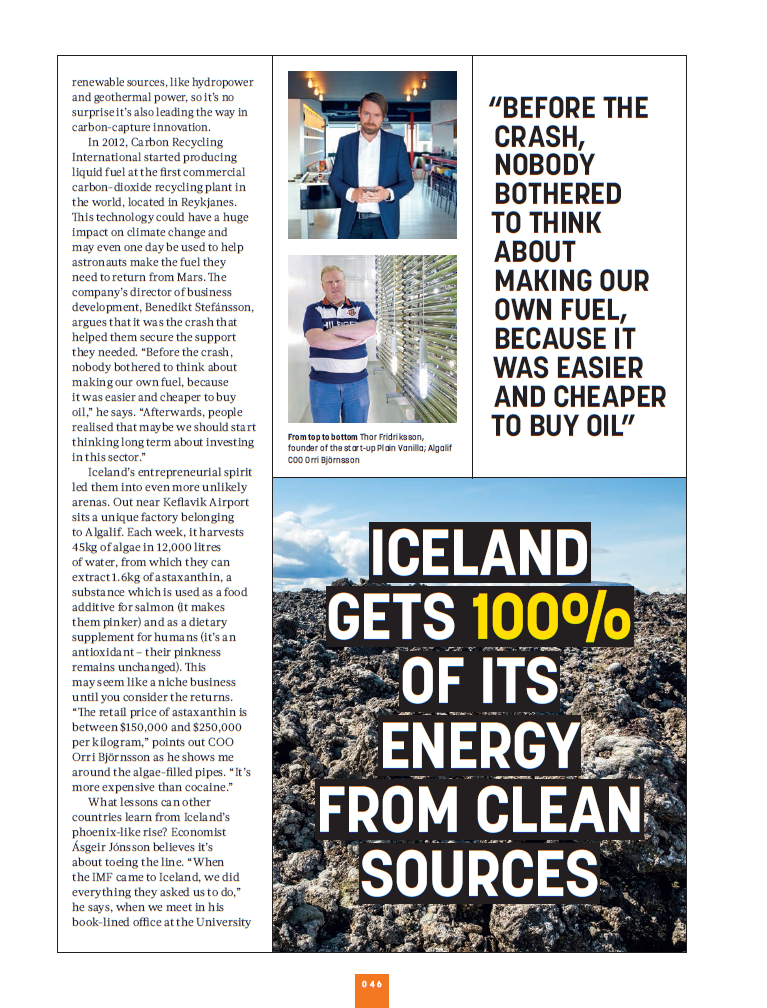
In 2012, Carbon Recycling International started producing liquid fuel at the first commercial carbon-dioxide recycling plant in the world, located in Reykjanes. This technology could have a huge impact on climate change and may even one day be used to help astronauts make the fuel they need to return from Mars. The company’s director of business development, Benedikt Stefánsson, argues that it was the crash that helped them secure the support they needed. “Before the crash, nobody bothered to think about making our own fuel, because it was easier and cheaper to buy oil,” he says. “Afterwards, people realised that maybe we should start thinking long term about investing in this sector.”

Iceland’s entrepreneurial spirit led them into even more unlikely arenas. Out near Keflavik Airport sits a unique factory belonging to Algalif. Each week, it harvests 45kg of algae in 12,000 litres of water, from which they can extract 1.6kg of astaxanthin, a substance which is used as a food additive for salmon (it makes them pinker) and as a dietary supplement for humans (it’s an antioxidant – their pinkness remains unchanged). This may seem like a niche business until you consider the returns. “The retail price of astaxanthin is between $150,000 and $250,000 per kilogram,” points out COO Orri Björnsson as he shows me around the algae-filled pipes. “It’s more expensive than cocaine.”

Iceland-Easyjet-Traveller-5What lessons can other countries learn from Iceland’s phoenix-like rise? Economist Ásgeir Jónsson believes it’s about toeing the line. “When the IMF came to Iceland, we did everything they asked us to do,” he says, when we meet in his book-lined office at the University of Iceland, where he’s an associate professor of economics. Iceland didn’t owe money either: “The Icelandic government had almost no debt when it got into the crisis. We kept the debts private. That’s what the IMF said: ‘No socialisation of losses’. Sovereign debt is not the same as private debt.”

For struggling economies, Nobel prize-winning economist Paul Krugman strongly recommends ‘doing an Iceland’. For Krugman, that entails allowing your banks to collapse, devaluing your currency (if you have your own), introducing capital controls on money leaving the economy and trying to avoid paying back foreign debts. Though, of course, not all nations have the same circumstances.

However, back on the ‘Walk The Crash’ tour, through the quiet streets of Reykjavik, Magnus Sveinn Helgason is arguing that Krugman has missed the most critical element in Iceland’s recovery. It’s the thing that binds together everyone from Arctic surfers and location directors to app designers and algae farmers. “The basis of Iceland’s prosperity has always been our human, social and cultural capital. That was not destroyed in the crash,” says Helgason. “You could have destroyed that if you had ripped apart the social contract and imposed brutal austerity measures. Icelanders got through because we really did feel that we were all in it together. That’s what other countries should learn from this recovery: the importance of society. If you’re in it together, you can get through it together.”

Cover feature for Easyjet Traveller, October 2015.