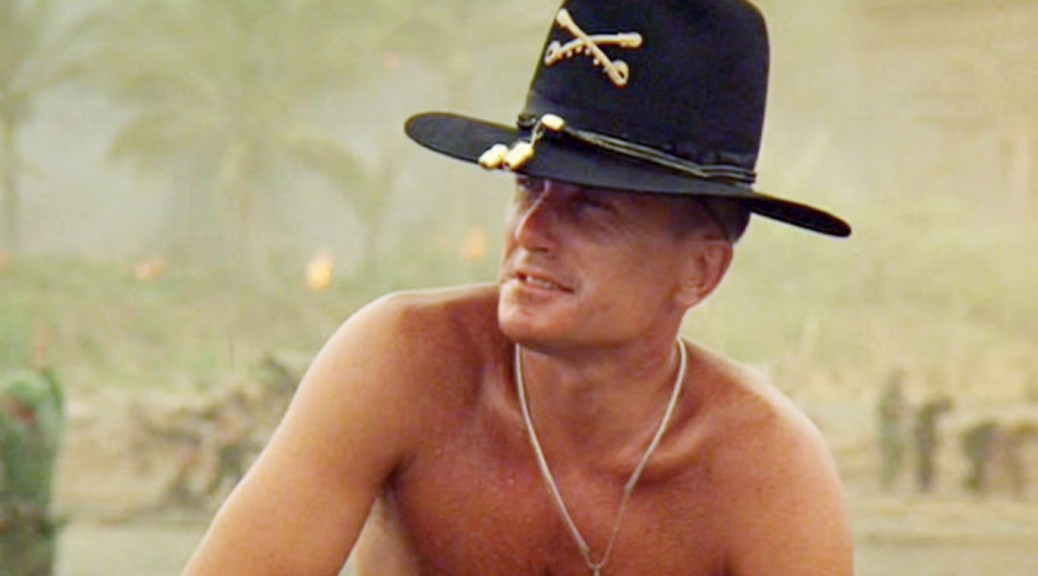
Robert Duvall is only onscreen for a little over ten minutes in Apocalypse Now, but that’s more than enough time for him to steal Francis Ford Coppola’s twisted war epic. Crouching shirtless on a Vietnamese beach moments after ordering the firebombing of the shoreline, his Lieutenant Colonel Bill Kilgore delivers the film’s most quoted line: “I love the smell of napalm in the morning.”
That line, as memorable and shocking as it is, is only the set-up. As Coppola’s camera slowly moves in on Kilgore’s face, the soldier’s eyes partly obscured by his oversized U.S. Cavalry hat, he reminisces fondly about the nightmarish death and destruction wrought by a previous napalm attack he had instigated. “The smell, you know that gasoline smell? The whole hill. Smelled like… victory,” he says, with terrible pride. Then, with something like grief: “Someday this war’s gonna end.”
It is one of the great moments in cinematic history, a glimpse at a man who has given himself totally to the war machine. It is hard to imagine anyone but Robert Duvall, who has died at the age of 95, at the dark heart of it. He was one of the most gifted American actors ever to grace the screen, blessed with a rare ability to bring stoic, tightly-wound man to vivid life. An undercurrent of raw vulnerability offset his own virile machismo. He won an Oscar for playing a country music star in 1983’s Tender Mercies, and was nominated six more times, including for his brief appearance in Apocalypse Now and for arguably his best known performance, as the trusted consigliere Tom Hagen in The Godfather.
 Kevin EG Perry: Collected Works