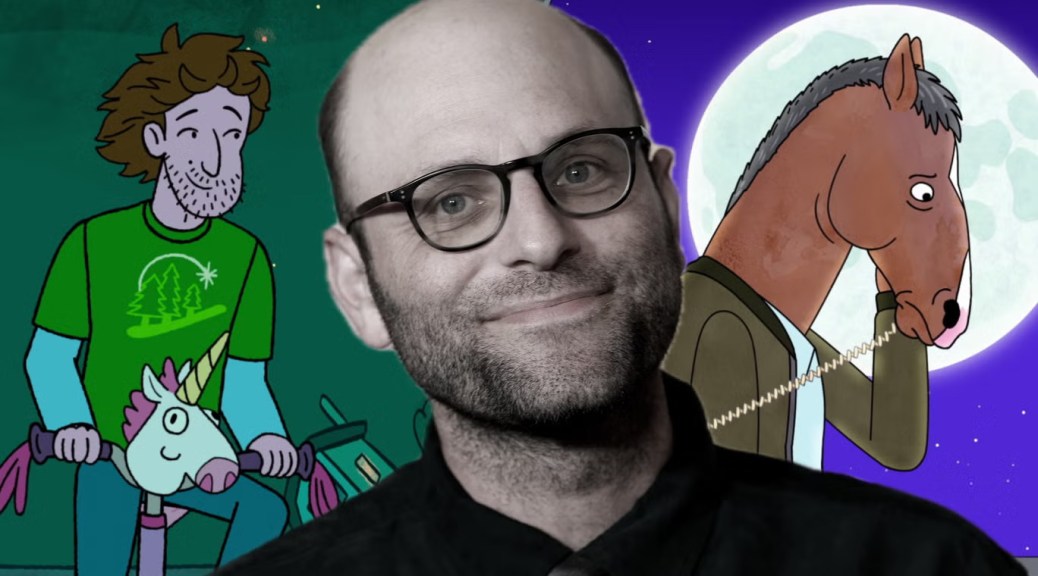
Raphael Bob-Waksberg knows how to tell a joke. This comes as no surprise: the 40-year-old American writer was the creator of BoJack Horseman, one of the funniest TV shows in recent memory. The Emmy-nominated Netflix animation ran for six seasons between 2014 and 2020, and was crammed with jokes – visual gags, Hollywood satire, ornate wordplay – and cut with raw, human pathos. His favourite joke, however, Bob-Waksberg inherited from his father.
A Nazi,he begins, is driving down the street. “And when I say Nazi, I mean an actual, classic, German Nazi. The whole shtick. The sort of guy who would murder me for saying the word ‘shtick’.” Bob-Waksberg, dressed casually in a checked shirt and baseball cap, is getting into the setup, gesticulating. “Anyway, this Nazi is driving down the street and he sees a Jew with a long beard and the hat. He rolls down his window and says: ‘You, Jew! Who is the enemy of the German people?’ And the Jew knows the answer, so he goes: ‘The Jews and the bicycle riders.’” He pulls a puzzled expression. “The Nazi says: ‘Why the bicycle riders?’ And the Jew says: ‘WHY THE JEWS?’”
I laugh. Bob-Waksberg smiles shrewdly. This particular joke, he says, explains something fundamental about his comic sensibility. BoJack was, on one level, a daffy comedy about a washed-up TV star who happens to be an anthropomorphic horse. But it was also deeply sincere – a Sopranos-influenced character study of its depressed, substance-abusing antihero. Bob-Waksberg’s new animated series Long Story Short, is a very different sort of show, but one that’s similarly concerned with finding light in the dark (or vice versa). “What I love about that joke is, first of all, I think it’s funny,” he says, speaking today from Los Angeles. “I think it plays with expectations, but I also think there’s real pain there. A lot of what I think the best comedy is, and a lot of the comedy that I write, comes from pain. It is an intermingling of humour and sadness and real cathartic laughter, and I hope this show can be that for some people.”
 Kevin EG Perry: Collected Works